 Reading Time: 14 minutes
My Husband Hit Me for Asking Where He Had Been All Night. The Next Morning, I Made His Favorite Southern Breakfast and Served It With a Smile—Then the Kitchen Door OpenedEverything changed because of one simple question.
“Where did you spend last night?”That was all I said.My husband, Ethan Blackwood, answered with the back of his hand.The blow pushed my lip into my teeth, and I tasted blood instantly.
For several seconds, the kitchen became completely still except for rain tapping against the windows and grease softly crackling in the cast-iron skillet. Ethan stood above me without the slightest sign of regret.
His white dress shirt remained flawless.
His silver cuff links caught the kitchen light.
His wedding ring shone on the hand that had just struck me.
“Do not question me in my own home,” he said coldly.
I touched my mouth and looked at the blood on my fingers.
Then I raised my eyes to him.
A slow smile returned to his face when he realized I would not scream, fight, or run.
That had always been the part he enjoyed most.
The quiet.
He confused it with fear.
With obedience.
With weakness.
In Ethan’s mind, I was merely a well-mannered Southern wife who had forgotten her place for one dangerous moment.
What he forgot was that I had been raised in the home of a respected judge.
What he had never valued was that I spent years investigating financial misconduct before becoming Mrs. Blackwood.
And what he did not know was that every suspicious conversation, missing dollar, forged invoice, and lie he had told during the previous six months had been recorded.
Saved.
Copied.
Protected.
Ethan straightened his cuff links as though nothing had happened.
“My mother is coming for breakfast,” he said. “Make something proper. And try not to shame me.”
I pressed a cloth against my bleeding lip.
“Of course.”
That response pleased him.
He believed the matter was finished.
He had no idea it had only begun.
I met Ethan Blackwood nine years earlier at a charity banquet in Charleston.
He was thirty-five then, handsome in a controlled and deliberate way. He knew exactly when to smile, when to lower his voice, and when to touch someone’s shoulder to make them feel important.
The Blackwood family name was attached to hotels, office towers, scholarships, and hospital wings throughout South Carolina.
Ethan’s grandfather had built the original fortune through shipping.
His father expanded it through commercial real estate.
By the time Ethan inherited Blackwood Holdings, the family was treated like Southern royalty.
I was different.
My father, Robert Hale, had served as a circuit judge for almost thirty years. My mother died when I was sixteen, and Dad raised me to believe facts mattered more than charm.
“Powerful people rarely fear accusations,” he once told me. “They fear records.”
After college, I became a forensic accountant.
I worked with attorneys, insurers, and government investigators to trace money hidden behind false companies and fabricated contracts.
Ethan claimed to admire that.
“You see what everyone else misses,” he told me during our third date.
At the time, I believed it was a compliment.
Years later, I understood it had also been a warning.
During our engagement, he encouraged my work.
After the wedding, his attitude changed.
He complained about my long hours.
He disliked the confidential calls.
He questioned why a wife needed a demanding career when her husband could provide everything.
When Ethan’s father died and left him control of Blackwood Holdings, he asked me to resign.
“We can finally build something together,” he promised. “You won’t have to spend your life cleaning up other people’s crimes.”
I believed him.
I left the career I had spent years creating.
At first, married life appeared beautiful.
We lived in a restored Georgian house outside Charleston.
Ethan bought fresh flowers every Friday.
We hosted elegant dinners.
I managed charitable events while he ran the company.
In photographs, we looked perfect.
But control rarely enters a home announcing itself.
It arrives disguised as concern.
Ethan began selecting which friends were “healthy influences.”
He reviewed household spending, even though most of the house had been purchased with money from my mother’s estate.
He criticized my clothes before events.
If I disagreed with him in public, he punished me later with silence.
His mother, Margaret Blackwood, encouraged him.
Margaret wore pearls to breakfast and judgment like perfume.
She believed wives existed to preserve their husbands’ comfort.
“A woman can be intelligent without being difficult,” she once told me.
What she meant was that intelligence was acceptable only when it remained quiet.
For years, I kept making excuses.
Ethan was under pressure.
He was grieving.
He had inherited enormous responsibilities.
Every excuse required me to become smaller.
Then the company’s numbers stopped making sense.
Blackwood Holdings reported growing revenue, but longtime employees were dismissed without explanation.
Suppliers complained about unpaid invoices.
Properties were sold below market value and transferred again weeks later.
Several consulting firms received enormous payments despite having no public offices, employees, or business history.
One evening, I asked Ethan about a company called Ashford Development Partners.
He looked at me for too long.
“Why are you asking?”
“I saw the name on a statement.”
“Which statement?”
The question was sharper than necessary.
I shrugged.
“One left in the study.”
Ethan smiled, but his eyes remained cold.
“Business is complicated, Claire. You don’t need to involve yourself.”
It was an insulting answer.
I understood complicated business better than most of the executives around his boardroom table.
That night, I searched public records.
Ashford Development Partners had been created eighteen months earlier.
Its registered address belonged to an empty warehouse.
The company’s organizer was an attorney connected to Margaret.
That was the first thread.
I began pulling.
Three additional shell companies led back to properties controlled by the Blackwood family.
Millions moved through consulting agreements and land purchases.
Some money went into an account associated with Margaret.
Other funds disappeared through offshore entities.
I needed more than suspicion.
So I called Daniel Mercer, a former colleague who now worked with a federal financial-crimes task force.
I did not accuse Ethan directly.
I asked what evidence investigators would require if someone suspected a corporate executive of diverting funds.
Daniel was quiet for several seconds.
“Records,” he said. “Communications. Proof the transactions were intentional. And Claire?”
“Yes?”
“Protect yourself.”
He knew me well enough to understand what I was not saying.
After that call, I began documenting everything.
I copied statements Ethan left in his office.
Photographed invoices.
Saved emails from shared household devices.
Recorded conversations in rooms where I was legally permitted to do so.
I discovered that Blackwood Holdings had diverted nearly fourteen million dollars through fraudulent consulting agreements.
Money from employee retirement accounts temporarily covered shortages.
Ethan planned to blame a recently dismissed accountant if regulators noticed.
Then I discovered Vanessa Cole.
Vanessa was Blackwood Holdings’ vice president of acquisitions.
She was thirty-eight, ambitious, polished, and present at almost every family event.
She had sat at my table.
Drunk my wine.
Complimented my cooking.
Ethan’s affair with her had lasted nearly a year.
Hotel bills were disguised as client expenses.
Jewelry appeared on marketing invoices.
Private trips were labeled property inspections.
The affair hurt.
But by then, the financial evidence frightened me more.
Ethan was not merely cheating.
He was dismantling hundreds of people’s futures while building an escape for himself.
Three months before he hit me, I found evidence of a life-insurance policy.
Five million dollars.
The insured person was me.
The beneficiary was Ethan.
I had never signed the application.
My signature appeared at the bottom anyway.
When I confronted the insurance broker indirectly, pretending I had misplaced the policy, he became nervous and ended the call.
I told Daniel.
His team began working quietly.
The policy alone was suspicious, but investigators needed proof of why it existed.
Then I remembered the night I nearly died.
Two weeks after the policy was issued, Ethan made tea for me.
That was unusual.
He barely knew where we kept the tea.
The drink had a faint metallic bitterness.
Within twenty minutes, my throat tightened.
My face began swelling.
I struggled to breathe.
Ethan watched from across the room and insisted I was having a panic attack.
He waited almost fifteen minutes before calling for help.
At the hospital, doctors diagnosed a severe allergic reaction but could not identify the trigger.
Afterward, Ethan told friends I was becoming emotionally unstable.
At the time, I believed he was embarrassed.
Now I understood he might have been creating a story.
An anxious wife.
An unpredictable medical condition.
A tragic future accident.
The night he struck me, he returned home shortly before dawn.
His jacket smelled like Vanessa’s perfume.
There was mud on his shoes and a faint scratch near his collar.
I stood in the kitchen while rain struck the windows.
“Where did you spend last night?”
His eyes changed.
Not because he felt guilty.
Because he feared I knew something.
Then came the blow.
After Ethan went upstairs, I locked myself in the downstairs bathroom.
My hands shook so violently that I almost dropped my phone.
I photographed my lip, cheek, and bloodstained blouse.
Then I called my father.
He answered on the second ring.
“Claire?”
For a moment, I could not speak.
My father had presided over cases involving violence, intimidation, and financial abuse.
Yet I had hidden my own marriage from him because I felt ashamed.
Not ashamed of Ethan.
Ashamed that I had stayed.
“Dad,” I whispered, “I need your help.”
His voice changed instantly.
“Tell me where you are.”
“At home.”
“Is Ethan there?”
“Upstairs.”
“Can you leave safely?”
“Yes.”
“Then leave.”
But I did not leave immediately.
I told him about the accounts, the recordings, the affair, the insurance policy, and the suspected poisoning.
Dad listened without interrupting.
When I finished, he said, “You will do exactly what Daniel and I tell you. Gather nothing that places you in greater danger.”
I explained that Margaret was coming for breakfast.
There was a long silence.
“Can you act as though nothing has changed?” he asked.
For years, I had acted as though nothing was wrong.
“One more morning,” I said. “Yes.”
Daniel’s team obtained the final emergency authorizations before sunrise.
My father drove through the night.
I transferred all my evidence to a secure account.
Then I searched Ethan’s office for his second phone.
I had seen him hide the drawer key inside a wooden cigar box weeks earlier.
The phone contained messages with Vanessa, account passwords, forged documents, and discussions with Margaret.
One message made my blood run cold.
Claire is becoming suspicious, Ethan had written.
Margaret replied, Then remind her what happens to wives who forget their place.
Another thread involved the life-insurance policy.
The timing must look natural, Margaret wrote.
Ethan answered, After the board vote. Then everything belongs to us.
I copied the device and placed it beneath the silver cover of Ethan’s favorite serving dish.
Then I went to work.
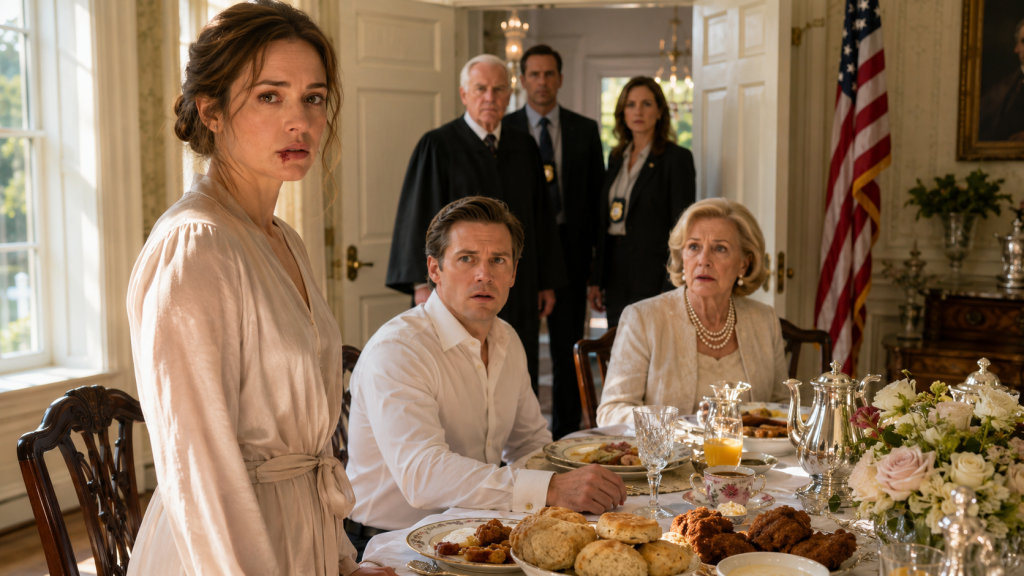
By morning, the house smelled like comfort and tradition.
Warm biscuits.
Peppered gravy.
Fried chicken.
Candied yams.
Buttered vegetables.
Sweet preserves.
Fresh coffee.
I polished the family silver.
Placed crystal glasses beside each plate.
Set white flowers in the center of the dining table.
Everything appeared perfect.
Exactly how Ethan preferred it.
He entered wearing a navy suit.
His gaze paused on my swollen lip.
“You should use more makeup.”
“I tried.”
“That is all I ask.”
Margaret arrived fifteen minutes later.
Graceful pearls.
Expensive perfume.
A permanent expression of judgment.
She noticed my injury immediately.
Instead of concern, she smiled.
“A wife ought to know when to stop speaking.”
Ethan laughed.
I poured their coffee.
They sat like honored guests, admiring the food and praising the arrangement, completely certain they remained in control.
Margaret spread preserves over a biscuit.
“This is better,” she said. “Harmony is possible when everyone remembers their role.”
Ethan nodded.
“Claire became confused last night.”
“I asked a question.”
His eyes lifted toward mine.
Margaret placed down her knife.
“A husband should not be interrogated in his own home.”
“My father always said innocent people rarely fear honest questions.”
The air changed.
Ethan stared at me.
I smiled gently.
“More coffee?”
His shoulders relaxed.
“Yes.”
He believed I had surrendered.
He believed the bruise had taught me something.
“What a proper wife,” he said proudly from the head of the table.
I carried in the final covered dish.
The silver lid reflected the chandelier above us.
I placed it directly in front of Ethan.
Then I stepped backward.
At that exact moment, the kitchen door opened.
The entire room went silent.
Ethan turned.
The certainty vanished from his face.
His coffee cup shifted slightly in his hand.
My father entered first.
At seventy-one, Robert Hale no longer wore judicial robes, but he still carried the presence that had silenced courtrooms for decades.
Beside him stood Daniel Mercer and two federal investigators holding sealed folders.
A uniformed officer remained near the doorway.
Ethan stood.
“What is this?”
Dad’s gaze moved to my injured lip.
Pain crossed his face for one second before hardening into controlled anger.
“This is the morning you answer for what you have done.”
Margaret pushed back her chair.
“You cannot enter this house without permission.”
Daniel raised a document.
“We have federal search and seizure warrants.”
Every trace of color disappeared from her face.
Ethan looked at me.
“You called them?”
I lifted the silver cover.
His hidden phone lay on the platter.
The screen glowed with a message from Vanessa.
Did she ask where you were last night?
Ethan stared at it.
Then at me.
“Claire, what have you done?”
“I protected myself.”
He stepped toward me.
Dad moved between us.
“You will never touch her again.”
The officer ordered Ethan to sit.
For once, he obeyed.
Daniel opened the first folder and placed documents across the breakfast table.
Forged invoices.
Hidden transfers.
Shell-company records.
Retirement-account withdrawals.
Messages linking Ethan and Margaret to fraudulent transactions.
Margaret’s voice shook.
“This is outrageous.”
One investigator turned toward her.
“Your name appears on three accounts and two shell companies.”
“I signed papers my son gave me.”
Ethan looked at her sharply.
Daniel placed printed messages beside her plate.
“These conversations indicate you understood the purpose of the transfers.”
She stared down.
A year of arrogance began collapsing between the biscuits and coffee.
Ethan recovered enough to speak.
“Anything taken from that phone is private and illegally obtained.”
Daniel remained calm.
“You may discuss admissibility with your attorney. We also have bank records, corporate emails, employee statements, and information provided by cooperating witnesses.”
“Which witnesses?”
No one answered.
That frightened him more than the accusations.
Then Daniel opened the second folder.
“There is another matter.”
He placed the life-insurance policy on the table.
“A five-million-dollar policy was taken out on Mrs. Blackwood three months ago using a forged signature.”
Ethan’s face collapsed.
Margaret stopped breathing.
I looked at my husband.
“Why did you insure my life without telling me?”
He did not answer.
Daniel produced additional documents.
The hidden phone contained searches for substances that could trigger severe allergic reactions.
It also contained photographs of my medical records and messages discussing my emergency-room visit.
Margaret whispered, “Ethan, you said she was already sick.”
He turned toward his mother.
“Stop talking.”
That single command revealed more than any confession could have.
The front door opened again.
Vanessa entered with another investigator behind her.
Her hair was pulled into a severe knot.
She looked exhausted.
Ethan rose halfway.
“Vanessa, say nothing.”
She stared at my bruised face.
“What did you do to her?”
“This is a setup.”
Vanessa laughed bitterly.
“You told me she was unstable.”
“You knew the plan.”
“I knew about the money. Not this.”
Margaret pointed at her.
“Liar.”
Vanessa stepped toward the table.
“You told him the policy would solve everything.”
The room became silent.
Daniel looked between them.
“Mrs. Blackwood, would you like to repeat that statement after consulting counsel?”
Vanessa covered her mouth.
Ethan closed his eyes.
For months, he had survived by keeping everyone separated.
He told me I imagined the financial irregularities.
He told Vanessa that I was unstable and our marriage was finished.
He told Margaret every transaction was protected.
He told employees the dismissed accountant had stolen the money.
But now we were all standing in the same room.
His lies could no longer remain apart.
Investigators arrested Ethan that morning on charges connected to wire fraud, embezzlement, falsified records, identity theft, and conspiracy.
The local officer separately documented the assault.
Margaret was taken into custody for questioning and later charged for her role in the financial scheme and insurance conspiracy.
Vanessa agreed to cooperate.
When the handcuffs closed around Ethan’s wrists, he looked at me.
“This is what you wanted?”
“No,” I said. “I wanted a husband who respected me.”
“You’ll regret humiliating me.”
Dad stepped closer.
“The only person who humiliated you is yourself.”
After they left, the house became strangely quiet.
Breakfast remained on the table.
Coffee cooled inside the cups.
The flowers looked too beautiful for the room.
I packed one suitcase.
My father waited near the staircase while investigators searched Ethan’s office.
Above us hung our wedding portrait.
In the photograph, Ethan looked directly at the camera.
I looked at him.
For years, I had built my life around watching a man who was interested only in being admired.
I removed the portrait from the wall and placed it facedown.
Then I left.
The investigation lasted eleven months.
Blackwood Holdings was placed under court supervision.
Auditors discovered almost fourteen million dollars diverted through false contracts and property deals.
Employee retirement contributions had been used to hide cash shortages.
Several executives resigned.
Others cooperated.
The accountant Ethan intended to blame was cleared.
Vanessa accepted a plea agreement in exchange for testimony.
She admitted approving false acquisitions and hiding the affair.
She also admitted Ethan planned to leave the country after the next board meeting.
Margaret denied everything until prosecutors played recordings of her discussing the insurance policy.
In one message, she told Ethan that my death would make the financial investigation easier to contain because grieving husbands were rarely questioned immediately.
Hearing those words in court felt different from reading them.
This woman had eaten at my table.
Accepted birthday gifts from me.
Watched me care for her son.
She did not merely dislike me.
She had calculated my value after death.
Ethan refused every reasonable plea agreement.
He believed he could charm a jury as he had charmed investors, employees, and friends.
His attorneys portrayed me as a bitter wife seeking revenge because of an affair.
Then the prosecutor presented the financial records.
The jury heard Ethan instruct Vanessa to approve false payments.
They saw messages between him and Margaret.
Doctors testified that the substance found inside our pantry could have triggered my allergic reaction.
A digital expert connected the purchase to Ethan’s hidden account.
Then the courtroom heard the recording from the night he struck me.
My voice asked one question.
“Where did you spend last night?”
The sound of the blow followed.
Several jurors looked away.
Ethan stared straight ahead.
For the first time, the entire world heard what happened inside our kitchen.
Not a rumor.
Not an accusation.
The truth.
The jury found him guilty on every major financial count.
He was also convicted of assault, identity theft, insurance fraud, and conspiracy connected to the attempt on my life.
Margaret was convicted of conspiracy and financial misconduct.
Vanessa received a reduced sentence because she cooperated.
At sentencing, Ethan was allowed to address the court.
He did not apologize.
He blamed pressure.
His mother.
Vanessa.
The company.
Then he blamed me.
“My wife betrayed me,” he said.
The judge looked at him for a long moment.
“Your wife did not betray you, Mr. Blackwood. She survived you.”
He received decades in federal prison.
Margaret received a shorter sentence, restitution obligations, and the permanent loss of control over family assets.
Blackwood properties were sold to repay employees and investors.
The company was reorganized under independent management.
I filed for divorce.
Ethan contested everything from prison.
He demanded the house, claimed I had damaged his reputation, and accused me of cooperating with investigators for personal gain.
The court was not sympathetic.
The house had been purchased largely with money from my mother’s estate.
I kept it temporarily.
Then I sold it.
I did not want another morning beneath that roof.
With part of the settlement, I created the Hale Foundation for Financial and Domestic Safety.
We helped people recognize economic abuse, preserve records, and escape controlling relationships.
Many victims did not realize that financial restriction was a form of abuse.
Their partners hid assets, ruined credit, withheld access to accounts, or convinced them they would be helpless alone.
I understood that fear.
Ethan had repeatedly told me I would have nothing without him.
He never understood that my greatest strength existed beneath the silence he mistook for surrender.
Two years after the breakfast that ended my marriage, I stood inside the foundation’s renovated office in downtown Charleston.
My father attended the opening ceremony.
Daniel came with several former Blackwood employees whose retirement savings had been restored.
On the wall inside my office, I hung one framed sentence from the sentencing hearing.
Your wife did not betray you. She survived you.
That afternoon, a young woman arrived without an appointment.
She wore sunglasses despite the rain.
Her hands shook as she removed bank statements from her handbag.
“My husband says I’m imagining things,” she whispered. “Money keeps disappearing, and he becomes angry whenever I ask questions.”
I invited her to sit.
“You are not imagining it,” I said. “And you are not alone.”
As one of our counselors joined us, I looked through the office window toward the harbor.
For years, I imagined survival would feel dramatic.
Like revenge.
Like victory.
Instead, it felt quiet.
It felt like breathing without listening for footsteps.
Drinking coffee without wondering which version of my husband would enter the room.
Helping another woman understand that her questions were never the problem.
The person terrified of answering them was.
On the third anniversary of Ethan’s arrest, Dad invited me to breakfast.
He prepared biscuits, gravy, fried chicken, sweet preserves, and coffee.
The same foods I had served on the final morning of my marriage.
For a moment, I stood in his kitchen doorway.
Dad noticed my hesitation.
“We can eat something else.”
I sat down.
“No. I think I need to reclaim this.”
He poured my coffee.
There was no fear in the room.
No judgment.
No blood hidden behind makeup.
Only morning light, warm food, and the presence of someone who loved me without conditions.
Dad raised his cup.
“To honest questions.”
I raised mine.
“To finally hearing the answers.”
Ethan believed striking me would teach me silence.
Instead, it reminded me of who I had been before he convinced me to disappear.
He called me a proper wife because I made his favorite breakfast and served it with a smile.
He never understood that breakfast was not an apology.
It was the final arrangement of evidence.
The perfect table.
The polished silver.
The hidden phone beneath the serving lid.
And the open kitchen door through which consequences finally entered.
The frightened look on Ethan’s face told me everything.
He had never truly feared losing his wife.
He feared his wife would remember her power.
Thanks for reading❤️ Follow Page For More Real Life Stories.