 Reading Time: 13 minutes
I Took Care of My 85-Year-Old Neighbor for Her Inheritance, but She Left Me Nothing—Then Her Lawyer Knocked and Said, “Actually, She Left You One Thing” I spent my entire childhood inside the foster-care system.
My mother supposedly abandoned me hours after I was born. My father was serving a long prison sentence for armed robbery. At least, that was the story written across every file that followed me from one temporary home to another. I had no grandparents listed. No aunts. No uncles. No emergency contact.
Only names of social workers who changed every year and foster parents who smiled during inspections but rarely looked at me once the front door closed. By sixteen, I had stopped unpacking completely.
Everything I owned fit inside a black garbage bag. Two shirts. One pair of jeans.
A secondhand winter coat.
A photograph of myself taken at school because every student was required to sit for one.
When the system finally released me at eighteen, a caseworker handed me a folder, a bus pass, and directions to a shelter.
“Good luck, James,” she said.
Those words sounded kind.
They also sounded like goodbye.
For the next two years, I worked whatever jobs I could find.
Dishwasher.
Warehouse loader.
Gas-station clerk.
Hotel cleaner.
I rented a narrow basement apartment in a small town where the pipes knocked at night and the windows sat level with people’s shoes.
The apartment beside mine belonged to Mrs. Eleanor Rhode.
She was eighty-five, sharp-eyed, stubborn, and always dressed as though she expected an important visitor.
Her white hair was pinned neatly behind her ears.
Her cardigans matched her shoes.
She walked with a wooden cane she claimed she did not need, even though I watched her grip railings whenever she climbed the front steps.
Our first real conversation happened after she saw me carrying two grocery bags through the rain.
One of the bags tore.
Cans rolled across the sidewalk.
Mrs. Rhode stood beneath her umbrella and watched me chase a tin of soup into the gutter.
“You buy terrible groceries,” she said.
I looked up.
“Excuse me?”
“No vegetables. No proper bread. And whatever is inside those cups isn’t real food.”
“They’re noodles.”
“They’re chemicals wearing noodles as a disguise.”
I almost laughed.
Instead, I gathered the cans.
She studied me for a moment.
“Are you working tomorrow?”
“Not until four.”
“Come upstairs at ten.”
“Why?”
“Because I need help, and you need better food.”
I did not go.
At ten fifteen, she knocked on my basement door.
“You are late,” she announced.
“I never agreed.”
“You didn’t refuse either.”
That was how Mrs. Rhode entered my life.
She invited me into her apartment and placed a cup of tea in front of me.
The room smelled of cinnamon, old books, and furniture polish.
Framed photographs covered the walls, but most showed places rather than people.
Mountains.
Train stations.
A lighthouse.
A small farmhouse surrounded by snow.
Mrs. Rhode sat across from me and folded her hands.
“I am dying.”
The statement was so direct that I almost spilled my tea.
“What?”
“Heart failure. The doctors believe I have months, perhaps a year if I behave, which I have no intention of doing.”
“I’m sorry.”
“I don’t need sorrow. I need someone to carry groceries, change light bulbs, sort medicine, and make certain I don’t fall in the bathtub.”
She leaned forward.
“You need money.”
I became defensive immediately.
“You don’t know what I need.”
“I know you wear the same coat every day, and your shoes let in water.”
I glanced toward the door.
Mrs. Rhode sighed.
“I am not insulting you. I’m offering employment.”
She named an hourly amount larger than anything I had earned.
Then she added, “I have no close family. No one who visits for the right reasons. If you care for me properly until the end, I will leave you everything.”
I stared at her.
Her apartment was modest, but it was clearly worth something.
She had savings.
Jewelry.
A collection of antique furniture.
For a young man who had spent his entire life being sent away, the offer sounded like security.
A home.
A future.
Something that could not fit into a garbage bag.
“Put it in writing,” I said.
Her eyebrows lifted.
“Smart.”
“People make promises.”
“And people break them.”
She held out her hand.
“Deal?”
I shook it.
“Deal.”
At first, our arrangement was exactly what she promised.
I bought groceries.
Changed light bulbs.
Carried laundry.
Sorted her pills into a plastic box marked Monday through Sunday.
I drove her to medical appointments in my rusted car and waited in parking lots while she argued with doctors.
She paid me every Friday in cash.
I wrote down the hours because I did not want her accusing me of taking advantage.
She inspected my notebook once.
“You counted the pharmacy trip as thirty minutes.”
“That’s how long it took.”
“You also waited for my prescription.”
“I was reading.”
“You were working.”
She added another hour to my pay.
Within a few weeks, I knew exactly how she liked her tea.
Two sugars.
A little milk.
Never cream.
She hated television news but watched old game shows every afternoon.
She loved crossword puzzles and cheated shamelessly by looking up answers in the dictionary.
She refused to eat peas.
She pretended not to like animals but left food behind the building for a stray orange cat.
Then she knitted me a pair of ugly green socks.
She pushed them into my hands one evening as I prepared to leave.
“What are these?”
“Socks.”
“I can see that.”
“So your feet don’t freeze.”
The wool was thick and uneven.
One sock was slightly longer than the other.
“I have socks.”
“You have holes tied together by fabric.”
I turned them over.
No one had ever made something for me.
Not because it was required.
Not because a caseworker arranged it.
Because someone had noticed my feet were cold.
“They’re ugly,” I said.
“Then wear them in the dark.”
I wore them the next morning.
Mrs. Rhode noticed immediately but said nothing.
She only smiled into her tea.
Our conversations became longer.
Almost every evening, I stayed after my paid hours ended.
She told me about growing up during hard winters, working in a textile mill, and marrying a railway engineer named Samuel.
They had wanted children but never had any.
Samuel died nearly thirty years earlier.
Mrs. Rhode still spoke of him as though he might return from the store.
I told her about foster homes.
The couple who locked snacks inside their bedroom.
The family that called me ungrateful because I refused to call them Mom and Dad after three weeks.
The group home where older boys stole my shoes.
The day a social worker told me my mother had signed papers abandoning me.
Mrs. Rhode listened without offering easy comfort.
She never said everything happened for a reason.
She never told me suffering made me stronger.
She only said, “You deserved better.”
That sentence stayed with me.
For the first time in twenty years, someone cared whether I returned home.
If I arrived late, she called.
If I skipped dinner, she left a plate outside my door.
If I worked overnight, she kept her porch light on until I came back.
Our agreement changed without either of us saying it aloud.
I was no longer counting hours.
She was no longer only paying for help.
She became the closest thing to family I had ever known.
Still, somewhere inside me, the inheritance remained.
I am not proud of that.
Sometimes, when she spoke about death, I imagined the apartment becoming mine.
I pictured sleeping without fearing rent increases.
I wondered what her furniture might sell for.
Then guilt followed immediately.
I loved her.
I also wanted the security she had promised.
Both things were true.
Her health declined during the winter.
She became short of breath after crossing the room.
Her ankles swelled.
She started forgetting small things.
One afternoon, I found her placing a television remote inside the refrigerator.
She laughed when I pointed it out.
“Perhaps I wanted colder programs.”
But I saw the fear behind the joke.
I began sleeping on her sofa during difficult nights.
She complained that I snored.
I told her she talked in her sleep.
Neither accusation was true.
We simply needed excuses for why I stayed.
One morning in early March, I entered her apartment carrying bread and milk.
The television played an old game show.
Mrs. Rhode sat in her favorite armchair facing the window.
At first, I thought she was asleep.
“Mrs. Rhode?”
She did not answer.
The grocery bag slipped from my hand.
The milk carton struck the floor.
I touched her shoulder.
Her skin was cool.
She had died peacefully during the night.
I called emergency services.
Then I sat beside her chair until they arrived, holding one of her hands between mine.
The room filled with strangers.
Paramedics.
A police officer.
The medical examiner.
They asked questions.
I answered automatically.
Was she ill?
Yes.
Did she have relatives?
Not really.
Who was I?
I did not know how to answer.
Neighbor sounded too small.
Employee sounded wrong.
Family was not legally true.
“I took care of her,” I said.
After they removed her body, the apartment became unbearably quiet.
Her teacup sat beside the chair.
The crossword puzzle on the table had one empty square.
I completed it.
Then I went downstairs and cried until I could not breathe.
Her funeral took place five days later.
The church arranged most of it because Mrs. Rhode had planned everything.
Only twelve people attended.
A few neighbors.
Two women from her church.
Her niece, Caroline, arrived late in an expensive coat and left before the final hymn.
She did not recognize me.
The lawyer, Mr. Leonard Wells, attended too.
He was a thin man in his sixties who carried a worn leather briefcase.
After the service, he handed me a card.
“The will reading is Thursday.”
I nodded.
I expected sadness.
I also expected the promise Mrs. Rhode had made over tea.
Everything.
The house.
The savings.
A future.
Thursday morning, I wore the green socks.
I told myself it was because they were warm.
The lawyer’s office smelled of paper and coffee.
Caroline sat across from me, checking her telephone.
A church representative sat beside her.
Two people from a housing charity occupied chairs near the wall.
Mr. Wells opened the will.
The apartment building, including Mrs. Rhode’s unit, went to a charity supporting elderly people at risk of homelessness.
Her savings went to the church.
Her jewelry and personal collection went to Caroline.
The remaining furniture was to be sold, with the proceeds divided between two community programs.
I waited for my name.
It never came.
Mr. Wells reached the final page.
“That concludes the distribution.”
My face burned.
I looked around the room.
Caroline smiled slightly.
The church representative avoided my eyes.
I raised my hand like a child in school.
“What about James Carter?”
Mr. Wells looked at me.
“There is no monetary bequest under that name.”
The words seemed impossible.
“She promised me everything.”
Caroline gave a short laugh.
“My aunt said many things.”
I turned toward her.
“You visited once in the year I cared for her.”
“She was still my aunt.”
Mr. Wells closed the file.
“I am sorry, Mr. Carter.”
Sorry.
The same word social workers used whenever they placed me somewhere new.
Outside, rain fell against the pavement.
I walked home without opening my umbrella.
Anger replaced grief.
I had bathed her when she could no longer stand.
Cleaned her apartment.
Missed work shifts.
Spent nights listening to her struggle for breath.
I had believed she loved me.
Had it all been a trick to secure free care?
I kicked off the green socks and threw them across my apartment.
Then I hated myself for caring about the money.
Mrs. Rhode was dead, and all I could think about was what she had not given me.
I slept through most of the next day.
When someone began knocking, I covered my head with a pillow.
The knocking continued.
“James Carter?”
I recognized Mr. Wells’s voice.
I opened the door wearing yesterday’s shirt.
He stood on the porch holding a dented metal lunchbox.
It was blue, with rust along one side.
“I thought the will said I got nothing.”
“It did.”
“Then why are you here?”
“Because the will was not Mrs. Rhode’s only instruction.”
He held out the lunchbox.
“Actually, she left you one thing.”
I stared at it.
“That?”
“She required me to deliver it the morning after the will reading.”
“Why not yesterday?”
“Because she believed anger would keep you from understanding it.”
That sounded exactly like her.
I took the lunchbox.
It was heavier than expected.
Inside lay a small brass key and an envelope with my name written in her shaky handwriting.
James.
My knees weakened.
I sat on the floor beside the open door.
The first line read:
James, you are probably angry that I left you nothing. Believe me—what I prepared for you will change your life.
I swallowed hard and continued.
She explained that traditional inheritances could be challenged.
Caroline had already threatened legal action if Mrs. Rhode left property to “some strange young man.”
The apartment building was complicated by old debts and repair obligations.
The church donation fulfilled promises made years earlier.
Mrs. Rhode did not want me trapped in court while relatives accused me of manipulating a dying woman.
The key opened safe-deposit box 214 at First County Bank.
At the bottom of the letter, she wrote:
Go alone. Wear the green socks. You will need them more than you think.
An hour later, I stood inside a private bank room.
I had retrieved the socks from beneath my kitchen chair and pulled them on.
One was still longer than the other.
A bank employee carried in a narrow metal box.
When the key turned, my hands began shaking.
Inside were photographs.
Birth records.
Adoption documents.
Newspaper clippings.
And a savings book showing deposits made every month for nineteen years.
The balance was $186,400.
Beneath it lay another letter.
James, I did not leave you my house because a house can be taken. I did not leave you jewelry because objects disappear. I built you a future no one could contest.
The account had been created through an irrevocable trust naming me as beneficiary.
It was not part of her estate.
Caroline could not touch it.
Neither could the church or charity.
Mrs. Rhode had paid taxes and legal fees in advance.
The money was mine.
I pressed my fist against my mouth.
But the savings were only the beginning.
Mrs. Rhode wrote that she had known my mother.
Her name was Anna Carter.
Anna had worked briefly at the textile mill where Mrs. Rhode supervised payroll.
She was seventeen, frightened, and pregnant.
Mrs. Rhode remembered her because Anna used to hide crackers inside her apron when morning sickness made it difficult to work.
After I told Mrs. Rhode the story of my abandonment, she began investigating.
She contacted retired social workers.
Requested public records.
Paid a private researcher.
The truth was different from what I had been told.
My mother had not abandoned me willingly.
Anna died from complications shortly after giving birth.
She never signed abandonment papers.
The signature belonged to my father’s older sister, Ruth.
My father had been involved in crime before my birth.
His family feared authorities would investigate them if anyone claimed me.
Ruth told hospital workers my mother wanted no contact and that no relatives were willing to care for me.
Then she disappeared.
Mrs. Rhode found proof.
Medical records.
A statement from a retired nurse.
A handwriting analysis comparing Anna’s signature with the abandonment form.
She also found my mother’s family.
My grandmother, Margaret, was still alive.
My uncle David lived with her on a farmhouse two states away.
And I had a younger half sister named Lily.
They had spent years searching for me.
Anna’s family had been told the baby died with her.
When they eventually discovered I had survived, records had already sealed my identity behind foster-care confidentiality.
The box contained letters from them.
Dozens.
Some addressed to Baby James.
Others to the grown man they hoped I had become.
There was a recent photograph of three people standing outside a white farmhouse.
An elderly woman with my eyes.
A broad-shouldered man holding a dog.
A young woman with dark hair and a nervous smile.
On the back, Mrs. Rhode had written:
Your grandmother, your uncle, and your sister. They have been waiting.
I could barely breathe.
The bank employee entered carrying one final envelope.
“A ticket was left with instructions that it be given to you after you opened the box.”
Inside was a train ticket dated that evening.
I almost did not go.
Hope frightened me more than disappointment.
I had survived by expecting no one.
What if these people looked at me and saw a stranger?
What if they had searched only because guilt required it?
What if Mrs. Rhode had created a reunion that could never match the family I imagined?
Then I looked at the green socks.
She had known I might run.
So she gave me warm feet and a train ticket.
That evening, I boarded.
The journey lasted six hours.
I did not sleep.
At every stop, I considered getting off and returning home.
But I stayed.
When the train arrived shortly after midnight, three people waited beneath the station lights.
I recognized them immediately.
The woman from the photograph stepped forward first.
My grandmother.
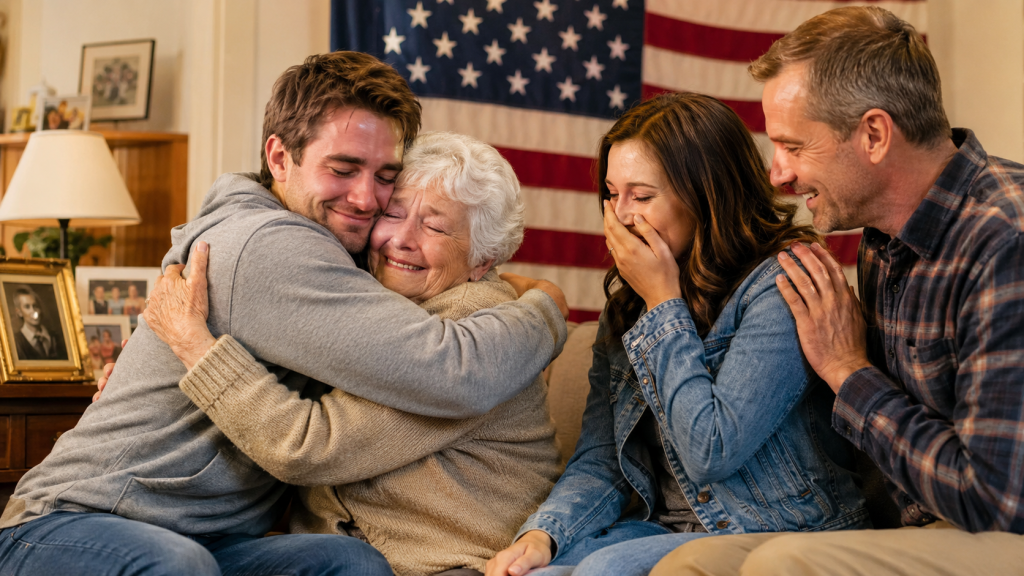
She looked at my face, covered her mouth, and began crying.
“Anna’s eyes,” she whispered.
I stood frozen.
Then she wrapped both arms around me.
For one terrifying second, I did not know what to do.
No one had held me like that since I was small enough not to remember.
Slowly, I hugged her back.
My uncle David placed one hand on my shoulder.
My sister Lily cried openly.
“You’re real,” she said.
“So are you.”
We drove to the farmhouse.
Photographs of my mother covered the dining table.
Anna as a child.
Anna on a bicycle.
Anna holding a school certificate.
Anna standing beside Mrs. Rhode outside the textile mill.
That photograph broke me.
They had known each other.
Mrs. Rhode had not found me by accident.
Perhaps she recognized my name when I moved next door.
Perhaps she noticed my face.
In her final letter, she admitted the truth.
She had suspected who I was from the beginning.
She remembered Anna’s eyes and the small scar near her eyebrow.
I had the same scar.
She did not tell me immediately because she wanted proof.
Then she became ill.
So she made a bargain.
Not because she needed to trick me into caring for her.
Because she knew I would refuse charity.
She offered payment and inheritance so I would keep returning long enough for her to earn my trust.
The money had never been the real inheritance.
It was time.
Evidence.
And the path back to people who had been searching for me.
I remained at the farmhouse for two weeks.
My grandmother showed me the room she had prepared years earlier in case I was found.
My uncle told me about his attempts to access sealed records.
Lily asked a hundred questions about my childhood and apologized whenever one made me uncomfortable.
There were awkward silences.
Painful truths.
Years we could not recover.
But no one asked me to pretend the past had not happened.
When I returned home, Mrs. Rhode’s apartment was being prepared for the charity.
Caroline stood outside while workers carried furniture.
She saw the green socks beneath my jeans.
“She really left you nothing?” she asked.
I looked toward Mrs. Rhode’s window.
“She left me what I needed.”
Using part of the trust, I enrolled in community college.
I studied social work.
Not because I believed I could repair the system alone.
Because I remembered what it felt like to leave with a bus pass and no one waiting.
I purchased a small house near my grandmother’s farm.
Nothing grand.
Two bedrooms.
A porch.
A door I could lock.
I kept Mrs. Rhode’s dented lunchbox on the mantel.
Inside were copies of the letters and the brass key.
The original documents stayed secure.
The ugly green socks remained in my top drawer.
I wore them every year on the anniversary of her death.
Mrs. Rhode promised that if I cared for her, she would leave me everything.
At first, I believed everything meant property and money.
A building.
Savings.
Jewelry.
I was angry when the will said I had received nothing.
But she understood inheritance better than I did.
She left me the truth about my mother.
A grandmother who never stopped searching.
An uncle who refused to forget.
A sister who had kept an empty place for me in family photographs.
She left enough money to build a future without making money the center of it.
Most importantly, she left proof that I had never been abandoned by everyone.
One person had noticed me.
One person had cared whether I came home.
One person had spent her final months returning a lost boy to his family.
The system had taught me that people always left.
Mrs. Rhode taught me that sometimes love works quietly after death, arranging keys, letters, train tickets, and ugly green socks so the person left behind can finally find his way home.
Thanks for reading❤️ Follow Page For More Real Life Stories.