 Reading Time: 13 minutes
I Bought My Parents First-Class Tickets to Visit Me, but They Never Came Once—Instead, They Used My Credit Card at My Sister’s Bridal Shop and Expected Me to Stay Silent Forever At 6:12 on Friday morning, my phone flashed with a fraud notification.
Not from an unknown person. From my own mother. Did you authorize a $3,800 purchase at Hartwell Bridal in Portland? I jerked upright so quickly that my coffee spilled across the kitchen counter. Hartwell Bridal was only thirty minutes away, in the same neighborhood where my younger sister, Madison, lived.
My parents were supposed to fly home that afternoon after spending ten days in Oregon. Ten days I had financed.
Ten days I had organized. Ten days during which I had waited for them to visit me at least once. Four years had passed since I last sat in the same room with my parents. Four years of video calls during which my mother, Helen, cried because she missed me.
Four years of my father, Robert, promising, “One day, Grace, we’ll all sit around the same table again.”
I believed them.
That was my mistake.
When they finally accepted my invitation, I bought their plane tickets myself.
First class, because Dad complained that his back could not tolerate an ordinary seat.
Extra luggage, because Mom said she wanted to bring gifts.
A rental car, because they insisted they did not want to inconvenience me by asking for rides.
I even added them as authorized users on a temporary travel credit card.
“It’s only for emergencies,” I told Mom. “Gas, meals on the road, or anything you need while visiting.”
She hugged me through the phone screen.
“You’re such a good daughter.”
Every evening that week, I came home from work and prepared dinner.
Pot roast on Monday.
Chicken parmesan on Tuesday.
Dad’s favorite chili on Wednesday.
Salmon with lemon butter on Thursday because Mom kept telling me she was trying to eat healthier.
Each night, I placed four settings around the dining table.
One for me.
One for Mom.
One for Dad.
And one for the hopeful version of myself who still believed they would walk through the door.
I switched on the porch light.
Straightened the pillows.
Checked the clock.
Then another excuse arrived.
Madison needs us tonight.
Your sister is emotional.
Her fiancé’s family invited us to dinner.
Maybe tomorrow, sweetie.
They were thirty minutes away.
They never came once.
On Thursday night, my mother sent the final message.
Maybe next time, sweetie!
The exclamation mark hurt more than the words.
Next time.
As though years had not passed.
As though I had not spent thousands of dollars bringing them across the country.
As though the dinners I threw away each night were nothing more than a scheduling misunderstanding.
Now the bank notification glowed in my hand.
$3,800.
Hartwell Bridal.
I called the fraud department immediately.
“Yes,” I said. “That transaction is unauthorized.”
The representative paused.
“Ma’am, the card was physically presented at the store.”
“That’s impossible. The card belongs to me.”
“Is there another cardholder on the account?”
“My parents have temporary authorized cards for travel emergencies.”
The representative typed something.
“The purchase was completed using one of those cards. The correct billing zip code was entered.”
My stomach tightened.
“Can you tell me who signed the receipt?”
“I’m not able to disclose the signature by telephone. However, I should inform you that there have been several purchases this week.”
My coffee went cold beside me.
“What purchases?”
“A spa charge for eight hundred twenty dollars. A steakhouse transaction for six hundred forty dollars. A luxury baby boutique purchase for one thousand one hundred dollars. And the Hartwell Bridal transaction.”
“A baby boutique?”
“Yes, ma’am.”
Madison was not pregnant.
At least, not as far as I knew.
“Freeze every card,” I said.
“Would you like to dispute all the transactions?”
“Yes.”
“Because these cards were issued to authorized users, the dispute may require additional review.”
“I never authorized them to buy dresses, spa treatments, or baby items.”
The representative began explaining the process, but I barely heard her.
I opened my message thread with Mom.
My calls went straight to voicemail.
Dad’s phone did the same.
Then an Instagram notification appeared.
Madison had posted a new story.
I tapped it.
There they were.
My parents stood beneath a wall of white roses inside Hartwell Bridal.
Madison occupied the center of the photograph wearing a white silk robe and holding a champagne flute.
Mom’s arm was wrapped around her waist.
Dad was brushing tears from his eyes.
All three looked happier than I had seen them in years.
The caption read:
Couldn’t imagine choosing my wedding dress without my real support system.
My real support system.
I looked at the untouched place settings in my dining room.
Then I grabbed my keys.
The drive to Portland passed in flashes of rain, traffic lights, and memories I had spent years pretending did not matter.
Madison had always been the family’s center.
When she wanted piano lessons, my parents found the money.
When I wanted to attend a summer science program, they said sacrifices had to be made.
When she crashed Dad’s car at seventeen, they called it a mistake.
When I forgot to call on Mom’s birthday during graduate school, they described it as proof that I cared more about work than family.
I became independent because no one expected me to need help.
Then my independence became the excuse for giving me less.
Grace can handle herself.
Grace has a good job.
Grace doesn’t need us the way Madison does.
I had spent my whole life being punished for surviving without them.
By the time I reached Hartwell Bridal, my fingers were numb around the steering wheel.
The boutique occupied a restored brick building with gold lettering across the front windows.
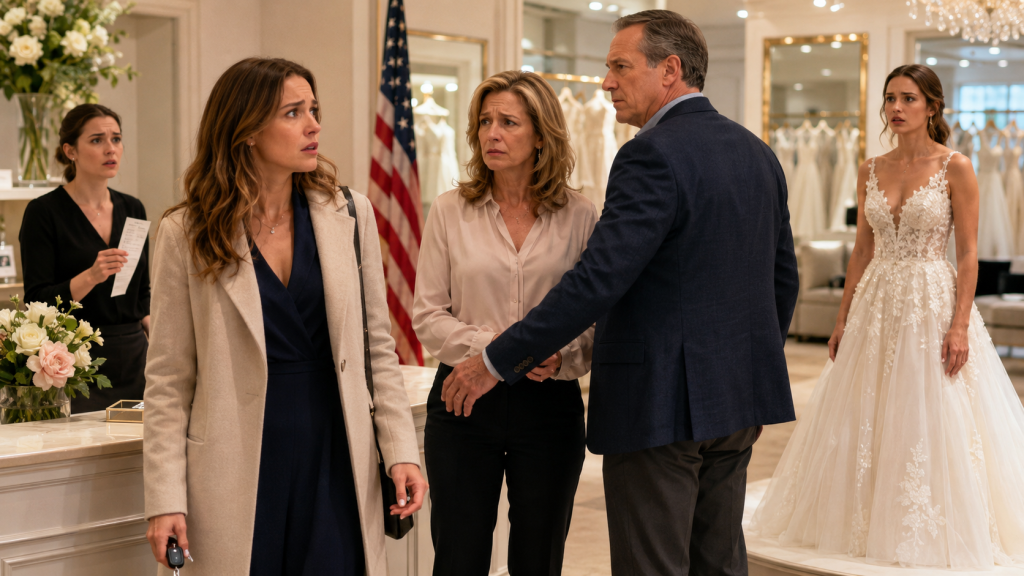
Inside, crystal lights reflected off mirrors and racks of ivory gowns.
Through the glass, I saw my mother laughing.
Dad sat on a velvet sofa holding a champagne glass.
Madison stood on a pedestal in front of three mirrors while a consultant adjusted a lace train around her feet.
A receipt rested on the front counter.
I pushed open the door.
A bell chimed overhead.
My mother turned first.
The color disappeared from her face.
“Grace.”
Madison froze.
Dad stood so quickly that champagne spilled onto his hand.
He stepped between me and my sister as though I were the danger.
“Grace,” he said softly, “don’t make a scene.”
That sentence told me everything.
Not What are you doing here?
Not We can explain.
Don’t make a scene.
They knew I had a reason to be angry.
The sales associate behind the counter looked from my parents to me.
“Can I help you?”
I pointed toward the receipt.
“That purchase was made using my credit card.”
The woman’s expression changed.
“Your card?”
“My account. My name.”
Mom moved closer.
“Sweetheart, lower your voice.”
“No.”
People in the fitting area turned toward us.
Madison stepped down from the pedestal, gathering the expensive gown around her.
“You’re embarrassing me.”
“You used my credit card to buy your wedding dress.”
“You gave Mom the card.”
“For travel emergencies.”
Dad placed his glass down.
“We intended to repay you.”
“When?”
“After the wedding.”
The associate lifted the receipt.
“Ma’am,” she said carefully, meeting my eyes, “we were informed that you approved everything.”
My mother stared at the floor.
“Who told you that?” I asked.
The associate glanced toward her.
“Mrs. Bennett said you were paying as a wedding gift.”
I looked at Mom.
She clasped her hands.
“You would have agreed if we’d had time to explain.”
“You had ten days.”
“Madison found the perfect dress unexpectedly.”
“After a spa visit, a steakhouse dinner, and a baby boutique?”
The boutique became completely silent.
Madison’s hand moved to her stomach.
It was a small gesture.
Protective.
Automatic.
I saw it.
“You’re pregnant.”
Her eyes filled.
Mom began crying before anyone answered.
“Twelve weeks,” Madison whispered.
For one second, the anger loosened.
My sister was pregnant.
I had always imagined that news arriving through a telephone call filled with nervous laughter.
I would send flowers.
Buy a tiny blanket.
Tell her I loved her even though our relationship had become complicated.
Instead, I learned through a fraud alert.
“You were all going to leave without telling me?”
“We were waiting for the right moment,” Mom said.
“You had four years and ten days.”
“This week was supposed to be about Madison.”
“It was supposed to include visiting me.”
Dad sighed.
“You knew the wedding planning was important.”
“I bought your tickets to see me.”
“You live nearby,” he said, as if that solved everything.
“Thirty minutes away, and you never came.”
Madison’s face hardened.
“You always make everything about what you didn’t get.”
I stared at her.
“I am standing inside a store where you charged thirty-eight hundred dollars to my account.”
“You can afford it.”
There it was.
The family’s oldest argument.
I had money, so taking it was not theft.
I had strength, so hurting me did not count.
I had survived alone, so abandonment was not abandonment.
The associate placed the receipt on the counter.
“There is another issue,” she said.
She pointed to an itemized line near the bottom.
Maternity fitting package.
Special alteration schedule.
Rush service.
I read every charge.
The gown.
The veil.
The shoes.
Champagne service.
Alterations.
A maternity-fitting deposit.
My name appeared at the top as the purchaser.
At the bottom was a signature that resembled mine.
Not perfectly.
But deliberately.
I looked at Mom.
“Did you sign my name?”
Her tears increased.
“We didn’t think the boutique would accept the card otherwise.”
“That is forgery.”
“Don’t use words like that,” Dad snapped.
“What word would you prefer?”
“Family assistance.”
The absurdity almost made me laugh.
Then Madison murmured, “You weren’t supposed to find out until after the wedding.”
“Find out about the charges?”
She looked toward our parents.
Mom shook her head, warning her to stop.
That movement told me the dress was not the deepest secret.
“Find out what?” I asked.
Dad’s voice lowered.
“Grace, this is not the place.”
“I’m not leaving until someone answers.”
Several shoppers had moved closer to the front of the boutique.
Madison looked humiliated.
For once, humiliation did not make me retreat.
She closed her eyes.
“My fiancé is connected to Daniel.”
My chest tightened.
Daniel was my ex-husband.
The man who emptied our joint savings, borrowed against our house, and disappeared three weeks before our divorce hearing.
“What does connected mean?”
Madison looked at me.
“Evan is Daniel’s younger brother.”
For a moment, the mirrors, lights, and white dresses seemed to move farther away.
I had never met Evan.
Daniel rarely spoke about his estranged younger brother during our marriage.
But I knew the name.
I also knew Daniel’s family had helped him hide money when our marriage collapsed.
His mother lied about where he was staying.
His father transferred a vehicle into another relative’s name.
Someone closed a shared business account before my attorney could freeze it.
My parents knew all of this.
They sat beside me during mediation while I cried over the savings I would never recover.
Now Madison was marrying into that family.
“How long have you known?” I asked Mom.
She wiped her eyes.
“Almost a year.”
“A year?”
“We didn’t know how you’d react.”
“You mean you knew exactly how I would react.”
Dad folded his arms.
“Evan is not Daniel.”
“His family helped Daniel steal from me.”
“People make mistakes.”
“Which people? The ones who hid him or the ones who lied under oath?”
Madison stepped forward.
“Evan had nothing to do with your divorce.”
“Then why keep him secret?”
She glanced at Dad.
My father finally answered.
“Because his family offered an arrangement.”
The cold feeling in my stomach spread into my chest.
“What arrangement?”
“Daniel’s parents agreed to return part of the money you lost.”
I stared at him.
“They have my money?”
“They know where some of it went.”
“And you’ve been negotiating with them?”
“We were trying to help.”
“Without telling me?”
“They wanted to avoid another legal fight,” Mom said. “If you accepted that the past was over and didn’t interfere with the wedding, they would repay a portion.”
“How much?”
Dad hesitated.
“Seventy-five thousand dollars.”
Daniel had taken more than three hundred thousand.
“You sold my silence for a fraction of what they stole.”
“No one sold anything,” Dad said.
“What did they ask you to do?”
Madison answered this time.
“Keep you away from the wedding until the agreement was signed.”
I looked at the gown she wore.
The dress purchased with my card.
The wedding I was apparently helping finance while being deliberately excluded.
“You used my money while agreeing to keep me silent.”
“We planned to tell you afterward,” Mom whispered.
“When I couldn’t object.”
“We thought once you saw how happy Madison was, you would forgive everyone.”
I laughed once.
There was no humor in it.
“You built your daughter’s wedding on money stolen from your other daughter.”
The boutique owner emerged from a back office.
She introduced herself as Caroline Hartwell.
The sales associate had quietly informed her about the dispute.
Caroline held a tablet.
“Ms. Bennett, I need to clarify whether you authorized this transaction.”
“I did not.”
She turned toward my mother.
“Mrs. Bennett, you represented that you were authorized to use your daughter’s account and sign on her behalf.”
Mom looked at Dad.
He said nothing.
Caroline continued.
“We have security footage of the purchase and signature.”
Madison began crying.
“This is supposed to be my dress appointment.”
I looked at her.
“It stopped being only your appointment when you put my name on the receipt.”
I called my bank.
In front of them, I froze every card and disputed every purchase.
The spa.
The steakhouse.
The baby boutique.
The bridal gown.
Mom grabbed my arm.
“Grace, please. You’ll ruin everything.”
I pulled away.
“You already did.”
The bank representative informed Caroline that the bridal charge was under dispute.
Until payment was resolved, the gown could not leave the store.
Madison stared at the lace around her.
“You can’t take my dress.”
Caroline remained professional.
“The purchase agreement is invalid if the payment was unauthorized.”
Dad turned on me.
“Pay for it now, and we’ll settle this privately.”
“No.”
“It’s your sister’s wedding.”
“No.”
“You have more than enough money.”
“That does not make it yours.”
Caroline then asked my mother to remain while the matter was documented.
Mom’s expression changed.
“Why?”
“Because signing another person’s name may constitute payment fraud. We have contacted store security, and the police are on their way.”
Dad’s anger vanished.
Madison covered her mouth.
Mom sank onto a velvet chair.
“This is family,” she whispered.
Caroline replied, “It became a business matter when the fraudulent signature was placed on our contract.”
The police did not arrest my mother that afternoon.
They took statements, reviewed the video, and collected copies of the receipt.
I had a choice about whether to pursue charges immediately.
Dad pulled me aside.
“Do not do this to your mother.”
I looked at him.
“She did it to herself.”
“She was trying to help your sister.”
“That has always been the excuse.”
His face hardened.
“What does that mean?”
“It means every time Madison takes from me, you call it helping her. Every time I object, you call me selfish.”
“She needs us.”
“I needed you too.”
For once, he had no answer.
The investigation uncovered more than the bridal charge.
My parents had used the temporary card throughout the entire trip.
They paid for Madison’s prenatal spa package, dinner with Evan’s parents, baby furniture, and gifts for the future in-laws.
My first-class tickets brought them to Oregon so they could celebrate the family that had helped destroy my marriage.
They slept in a luxury hotel I paid for because they claimed my guest room would hurt Dad’s back.
The rental car I financed carried them everywhere except my home.
The betrayal was not one impulsive purchase.
It was a schedule.
A plan.
A ten-day performance in which I was useful only as the funding source.
My attorney contacted Daniel’s family regarding the alleged repayment agreement.
That was when the next layer collapsed.
There was no formal agreement.
Only vague emails between Dad and Evan’s father.
The seventy-five thousand dollars was not a guaranteed repayment.
It was described as a “family reconciliation gift” dependent on my signing a release that would permanently waive any remaining claims related to Daniel’s hidden assets.
My parents planned to present the release after Madison’s wedding.
They believed grief, pressure, and family photographs would persuade me to sign.
Had I agreed, Daniel’s family could have kept far more than they offered to return.
I filed a renewed civil action based on evidence that they still possessed information about the missing money.
This time, I did not tell my parents the details.
They had shown me where their loyalty stood.
The lawsuit revealed that Daniel’s father had helped transfer funds into a property company controlled by a cousin.
My attorneys recovered nearly two hundred thousand dollars.
Daniel was also ordered to disclose additional accounts.
Evan insisted he knew nothing about the concealment.
That may have been true.
But his parents knew.
Madison’s wedding was postponed.
Not because I demanded it.
Because the alliance between the two families collapsed when attorneys became involved.
Evan’s parents blamed Madison for bringing my attention to the money.
My parents blamed me for refusing the quiet arrangement.
Madison blamed everyone.
She sent me a message saying I had destroyed the happiest time of her life.
I stared at it for a long time.
Then I replied:
You used my identity, my money, and my silence to build that happiness. It was never stable.
My mother eventually accepted responsibility for signing my name.
Because I agreed to restitution and she had no criminal history, the matter ended with probation, repayment, and required financial-ethics classes rather than jail.
Some relatives accused me of being cruel.
They said I should have handled it privately.
I asked why privacy always seemed to mean protecting the person who caused harm.
No one answered.
Dad sent a check covering part of the card charges.
He wrote FAMILY SHOULD FORGIVE across the memo line.
I returned it.
Not because I rejected repayment.
Because repayment required honesty, not a message blaming me for the consequences.
Months passed.
I stopped calling.
For the first time in my life, I allowed silence to belong to them.
My house became quieter but more peaceful.
I removed the extra place settings from the dining room.
The porch light remained off unless I expected someone who had actually said they were coming.
Madison gave birth to a daughter the following spring.
I learned through a photograph sent by an aunt.
The baby was beautiful.
I mailed a soft blanket with no note.
I did not attend the small wedding Madison and Evan held six months later.
They invited me only after the lawyers finished negotiating with Evan’s parents.
The invitation felt less like reconciliation than evidence they wanted to appear united.
I declined.
Two years after the bridal-shop confrontation, Mom came to my house alone.
This time, she bought her own economy ticket.
She rented no car.
She took a rideshare from the airport and stood on my porch holding one small suitcase.
I opened the door but did not immediately invite her inside.
“I should have called first,” she said.
“Yes.”
“I thought you might say no.”
“I might have.”
She nodded.
For the first time, she did not cry to make me comfort her.
“I came to apologize without asking you to fix anything.”
I waited.
She looked toward the darkened porch light.
“We taught you that being strong meant you needed less love. Then we punished you for believing us.”
The words reached a place inside me that anger had protected for years.
She continued.
“Madison needed attention, so we gave her yours too. When you succeeded, we treated your success like family property. When you hurt, we told ourselves you could manage.”
I did not forgive her that evening.
But I let her inside.
We sat at the table where four place settings once waited.
There were only two cups of tea.
That was enough.
Dad’s apology took longer.
He wrote several letters filled with explanations before finally sending one that contained none.
I protected the daughter who asked loudly and abandoned the daughter who stopped asking. I am ashamed.
I kept that letter.
Madison and I remained distant.
Sometimes she sent photographs of her daughter.
Sometimes I responded.
We did not pretend the past disappeared because a child was born.
Real healing did not arrive as one emotional family reunion.
It arrived through boundaries.
Separate accounts.
Shorter conversations.
Visits confirmed in advance.
No access to my credit cards.
No pressure to attend events simply to preserve appearances.
My parents never again referred to my money as something the family could use.
The first-class tickets taught me something that should have been obvious.
You cannot purchase someone’s presence.
You can pay for the flight.
Reserve the room.
Prepare the food.
Switch on the porch light.
But love still has to choose the address.
My parents traveled across the country using my money and never drove the final thirty minutes to my home.
That distance was not geographic.
It was the space between the daughter they loved and the daughter they found useful.
The fraud notification did more than expose a bridal-shop purchase.
It revealed the role my family had assigned me.
Provider.
Problem solver.
Silent witness.
I resigned from all three.
Madison eventually bought a different wedding dress.
My mother paid for it using money she earned herself.
Daniel’s family returned most of what they had helped conceal.
And the dinner table in my home no longer waited for people who had already chosen somewhere else.
The deepest betrayal was never the $3,800 charge.
It was discovering that my parents had accepted my generosity while negotiating my silence with the family that had helped rob me.
But silence was the one thing they no longer received.
I disputed the charges.
Opened the records.
Filed the case.
And spoke the truth even when everyone begged me to protect their celebration.
They believed I would remain quiet forever because I had always been the reasonable daughter.
They forgot that reasonable does not mean powerless.
And family does not mean permission.
Thanks for reading❤️ Follow Page For More Real Life Stories.