 Reading Time: 12 minutes
After Eight Months Away on Military Duty, I Came Home to Find My Newborn Son Dangerously Sick and My Wife Trapped Inside Our Own House The first sound I heard when I unlocked the front door was my newborn son crying.
It was not the strong, demanding cry of a hungry baby. It was weak. Tired. Broken. The kind of cry that sounded as though it had been going on for far too long. The second sound was my mother’s voice.
“Leave him alone,” she said coldly from somewhere upstairs. “He’ll figure it out.” My duffel bag slipped from my shoulder and struck the hardwood floor. Eight months overseas had changed the way I entered a room.
I had learned to stop before moving. To listen. To notice what did not belong.
And everything inside that house felt wrong.
The air was too warm.
The curtains were closed despite the afternoon sunlight.
The hallway smelled faintly sour, like spoiled milk, unwashed clothes, and medicine left open too long.
My son’s cries came from the nursery in short, exhausted bursts.
Between them were long pauses that tightened something deep in my chest.
“Leo?”
My voice echoed through the house.
No one answered.
I moved toward the staircase.
My boots sounded too loud against the wood.
Halfway up, I noticed one of Sophia’s slippers lying near the railing.
The other sat several feet away.
There was a dark stain on the carpet beside it.
I did not touch anything.
I kept moving.
The nursery door stood partly open.
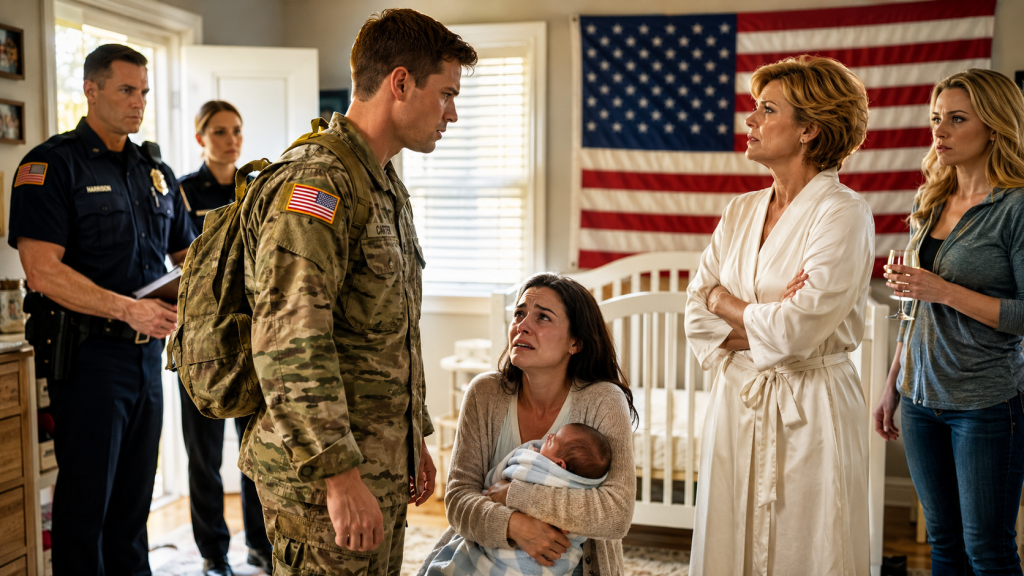
When I pushed it wider, I saw my wife sitting on the floor beside the crib.
Sophia’s back rested against the wall.
Her knees were pulled toward her chest.
Her hair, normally smooth and carefully braided, hung in tangled strands around her face.
She was trembling even though the room felt unbearably hot.
Her skin was pale.
Her eyes were frightened.
And there were signs on her arms showing that she had not been safe while I was gone.
“Sophia.”
She lifted her head slowly.
For one second, fear crossed her face.
Then she recognized me.
“Lucas…”
My name broke in her throat.
I dropped to my knees beside her.
Before I could ask what had happened, my mother stepped into the nursery doorway.
Eleanor Carter wore Sophia’s pale silk robe.
She had tied it around herself as though it belonged to her.
My younger sister, Audrey, appeared behind her holding a glass of wine.
Audrey looked irritated, as though my return had interrupted a comfortable afternoon.
Mother folded her arms.
“She needed to learn her place.”
Audrey gave a careless shrug.
“And the baby is her responsibility. We’re not here to serve her.”
I ignored them.
I went directly to the crib.
Leo lay beneath a thin blanket, his small body restless.
His cheeks were flushed.
His lips looked dry.
The moment I placed my hand against his forehead, my chest tightened.
He was burning with fever.
“How long has he been like this?”
Sophia tried to answer.
“He—”
“Since yesterday,” Mother interrupted. “She’s being dramatic.”
Sophia shook her head.
“Longer. His breathing changed yesterday morning. I tried to call the pediatrician, but they took my phone.”
I turned toward my mother.
“You took her phone?”
Eleanor’s expression remained calm.
“She was calling people and spreading lies about this family.”
Sophia reached for the crib rail.
“I tried to leave. They hid my keys. They said if I stepped outside, they would tell everyone I was unstable and have Leo taken from me.”
Audrey laughed quietly.
“You always did choose fragile women.”
I looked at my wife again.
Her lower lip trembled.
One wrist was swollen.
There was a faint mark near her temple.
I wanted to shout.
I wanted to cross the room and demand every answer at once.
But anger makes guilty people defensive.
Silence makes them careless.
“Why is my wife on the floor?” I asked.
Mother smiled as if she had already won.
“Because this is my house, Lucas. And she forgot that.”
That was the moment she made her greatest mistake.
The house had never belonged to her.
Three years earlier, after my grandfather died, the estate went into probate.
My mother told everyone she had inherited it.
She did not.
Grandfather had left debts larger than the remaining cash.
The bank prepared to sell the property.
I purchased it through the Carter Military Family Trust, using savings, a housing investment, and money inherited from my father.
Eleanor had been allowed to remain temporarily because she claimed she needed time to adjust.
Audrey moved in six months later after losing her apartment.
Neither woman had a lease.
Neither paid rent.
Neither had ownership rights.
Sophia and I permitted them to stay because we believed family meant protecting one another.
During my deployment, they apparently decided permission was the same as possession.
I lifted Leo carefully from the crib and wrapped him in a clean blanket from the bottom drawer.
He felt too light.
His cries weakened against my chest.
Audrey moved in front of me.
“Where do you think you’re taking him?”
“To get my son medical help.”
Mother’s eyes narrowed.
“You need to calm down and hear our side.”
I looked past her toward the front windows.
Headlights swept across the nursery ceiling.
Outside, several vehicle doors opened almost simultaneously.
“I already know enough.”
For the first time, Eleanor’s confidence slipped.
Audrey turned toward the driveway.
“What did you do?”
I did not answer.
They believed I had walked into the house unprepared.
They thought I was only a tired soldier coming home from deployment.
They had no idea that I had spent the previous six weeks collecting evidence.
Sophia’s messages had changed halfway through my assignment.
At first, she sent long updates.
Photographs of her pregnancy.
Videos of Leo moving before he was born.
Lists of names she liked.
Then her messages became short.
I’m tired.
Everything is fine.
Your mother is helping.
After Leo’s birth, the video calls almost stopped.
Whenever I asked to speak privately with Sophia, Mother appeared nearby.
“She needs rest,” Eleanor would say.
When I asked to see Leo, Audrey held the camera for less than a minute.
The house internet supposedly became unreliable.
Sophia’s phone was frequently “charging” or “lost.”
I knew my wife.
She did not disappear without explanation.
So I contacted her father, Michael Bennett.
He had also noticed the change.
Sophia had managed to send him three emails from an old tablet before access was cut off.
The first said Eleanor controlled the household money.
The second said Audrey monitored her calls.
The third contained only six words.
Please help me before Lucas returns.
Michael contacted local authorities.
Because I was deployed and the allegations involved my military residence and dependents, my commanding officer helped coordinate a welfare review.
The investigation had to remain quiet.
A premature confrontation might have made the danger worse.
Then a cloud backup restored footage from the nursery camera.
Mother and Audrey believed they had disconnected it.
They had unplugged the visible monitor.
They did not know the camera stored encrypted recordings remotely.
The footage showed Eleanor taking Sophia’s phone.
Audrey blocking the nursery door.
Both women shouting at her while Leo cried.
One recording captured Mother saying, “Once Lucas sees how incapable you are, he’ll leave you and this house will remain where it belongs.”
Another showed Audrey hiding medicine in the upstairs bathroom.
That was when my command approved my early return.
I was supposed to arrive the following morning with investigators.
Instead, after seeing a new camera alert showing Leo’s worsening condition, we moved immediately.
I arrived ten minutes before the response team.
The front door opened downstairs.
Heavy footsteps entered the hallway.
“Military police,” a voice called. “Remain where you are.”
Mother’s face turned white.
Audrey’s wineglass trembled.
Three military police officers came upstairs with a child-protective-services investigator, two paramedics, my attorney, and Sophia’s father.
Michael saw his daughter on the nursery floor.
His entire expression changed.
“Sophia.”
She began crying.
Not loudly.
Her body simply folded with relief.
I handed Leo to the lead paramedic.
“My son has a high fever and may be dehydrated.”
The medical team placed him on a portable examination pad.
One paramedic checked his breathing while the other prepared oxygen and monitored his temperature.
“We need to transport him now,” she said.
I helped Sophia stand.
She swayed immediately.
Michael caught her before she fell.
The CPS investigator noticed the marks on her arms.
“Mrs. Carter, are you safe speaking in front of everyone?”
Sophia looked at Eleanor.
“No.”
The officers separated my mother and sister.
Audrey set down her wineglass too quickly, spilling it across a dresser.
“This is insane,” she said. “Sophia is exaggerating because she hates us.”
Mother lifted her chin.
“My son invited us to live here. We were caring for his wife while he served his country.”
My attorney, David Holloway, placed a thick folder on the changing table.
“The nursery footage tells a different story.”
Eleanor stared at him.
“What footage?”
David opened the folder.
“The camera recorded you confiscating Mrs. Carter’s phone, blocking her access to transportation, withholding the child’s medication, and discussing how to remove her before Sergeant Carter returned.”
Mother recovered quickly.
“Recording private conversations is illegal.”
“The surveillance system belongs to the property owner,” David replied. “The camera was installed with Sophia’s knowledge for infant safety. You had no authority to disable it or control the room.”
Audrey pointed toward me.
“He planned this.”
“No,” I said. “I responded to what you did.”
One officer collected their phones under the authority of the emergency order.
Audrey pulled hers against her chest.
“You can’t take my property.”
The officer showed her the warrant.
“Yes, ma’am, we can.”
CPS searched the nursery and kitchen while the paramedics prepared Leo for transport.
Inside the medicine cabinet, they found unopened fever medication behind cleaning supplies.
Leo’s prescribed antibiotics were hidden in a cosmetic bag belonging to Audrey.
Sophia saw them and covered her mouth.
“I looked everywhere.”
Audrey shook her head.
“I moved them so she wouldn’t overdose him.”
“You told me he didn’t need them,” Sophia said.
“He didn’t.”
The paramedic turned toward her.
“Who gave you authority to override the child’s doctor?”
Audrey had no answer.
Mother pointed at Sophia.
“She was trying to turn Lucas against us. She complained constantly. She wanted us homeless.”
I looked at Eleanor.
“You endangered my wife and child because you wanted this property.”
Her face hardened.
“This estate belonged to my father.”
“His estate lost it.”
“You used family money to steal it.”
“I purchased it through a legal trust.”
“You would never have had the opportunity without our name.”
Even with police in the room and her grandson struggling to breathe, she remained focused on ownership.
David handed both women emergency removal orders.
“These prohibit you from entering or controlling the property while the investigation proceeds.”
Audrey read the first page.
Her voice rose.
“You’re throwing us out tonight?”
“You are being removed tonight,” David said.
“We have nowhere to go.”
I lifted Sophia carefully and supported her toward the hallway.
“You should have thought of that before trapping a sick mother and baby inside someone else’s home.”
By the time we reached the ambulance, rain had started falling.
Michael climbed inside with Sophia.
I sat beside Leo while a paramedic secured his carrier.
Through the open doors, I saw military police escorting Eleanor and Audrey toward separate vehicles.
My mother looked at me as if I had betrayed her.
“Lucas!” she shouted. “I am still your mother!”
I held my son’s small hand.
“And Sophia is my wife. Leo is my child.”
The doors closed.
At the hospital, doctors moved quickly.
Leo was severely dehydrated and suffering from an infection that had worsened without proper medication.
He needed intravenous fluids, antibiotics, and constant monitoring.
The physician told us another day without treatment could have become catastrophic.
Sophia was examined separately.
She had bruising, exhaustion, and signs of prolonged stress.
Nothing required surgery, but the emotional damage was obvious.
When the nurse asked whether she felt safe returning home, Sophia looked at me.
“I don’t know what home is anymore.”
That sentence hurt more than anything my mother had said.
I sat beside her bed.
“I should have returned sooner.”
She shook her head.
“They made every message sound normal. They stood behind the camera. When I tried to tell you, they threatened Leo.”
“I should have known.”
“You did know. That’s why you came.”
I took her hand.
“I will never ask you to live with them again.”
She began crying.
“I thought you would believe your mother.”
The truth was difficult to admit.
A year earlier, I might have.
Eleanor had controlled the family story my entire life.
She described herself as the widow who sacrificed everything.
Audrey was the misunderstood daughter.
I was the successful son who owed them stability.
Every boundary became disrespect.
Every refusal became abandonment.
Sophia had seen the pattern before I did.
She asked for separate housing arrangements before my deployment.
I told her it would be temporary.
I asked her to be patient.
My patience had become her prison.
“I failed to take your fear seriously,” I said.
She looked at me.
“Then take it seriously now.”
“I will.”
Leo’s fever began dropping before dawn.
His breathing strengthened.
When he finally drank from a bottle, Sophia and I cried together.
The sun rose over the hospital parking lot while our son slept between us beneath a pale blue blanket.
At that same hour, Eleanor and Audrey were formally taken into custody.
The charges included unlawful restraint, child endangerment, interference with medical care, theft, and assault-related offenses.
The investigation also uncovered financial crimes.
During my deployment, Mother had accessed a household emergency account intended for Sophia and Leo.
She used my old authorization information to transfer nearly forty thousand dollars.
Some paid Audrey’s credit cards.
Some financed renovations to the master bedroom.
They had moved Sophia’s belongings into a guest room and turned our bedroom into Eleanor’s private suite.
Audrey purchased designer clothing and told friends she was preparing to manage the estate.
Their messages showed a detailed plan.
They wanted Sophia declared mentally unfit.
They intended to claim she had neglected Leo.
Once I returned, they would pressure me to seek custody and remove her from the trust’s list of protected occupants.
Mother believed grief, exhaustion, and military duty would make me easy to manipulate.
Someone outside the estate had been helping them.
The final camera file revealed who.
My cousin Nathan worked at a local law office.
He had drafted false statements claiming Sophia abandoned the home voluntarily.
He also prepared a petition alleging she was unstable.
In exchange, Eleanor promised him a future share of the property after I transferred ownership to her.
Nathan had no idea the entire estate was protected by a trust he could not alter.
He also underestimated digital records.
Emails.
Payment transfers.
Cloud files.
He was arrested several days later and lost his position at the law firm.
Mother’s legal strategy collapsed almost immediately.
Audrey turned on her during the first week.
She claimed Eleanor planned everything.
Eleanor insisted Audrey had taken the phones and hidden the medicine.
Nathan blamed both women.
The united family that had controlled Sophia through intimidation fell apart as soon as accountability arrived.
We did not return to the estate immediately.
Sophia refused.
I did not question her decision.
We stayed with Michael for several weeks after Leo left the hospital.
His home was smaller, quieter, and filled with ordinary safety.
No one monitored Sophia’s calls.
No one entered the nursery without knocking.
No one told her when to feed her own child.
I began counseling through a military family program.
At first, I thought the sessions would focus on deployment stress.
Instead, I spent most of them learning how family loyalty had distorted my judgment.
I had mistaken providing shelter for creating peace.
I had believed I could keep everyone together through discipline and patience.
But a home is not safe merely because the mortgage is paid.
It is safe when the people inside it respect one another’s humanity.
The criminal cases lasted almost a year.
The nursery footage became central evidence.
It showed patterns, not one isolated argument.
Mother withholding Sophia’s keys.
Audrey mocking her while Leo cried.
Both women discussing financial plans.
The footage also captured Sophia repeatedly asking for medical help.
Eleanor called her dramatic.
Audrey said a fever would “teach her not to panic.”
When the recording played in court, my mother stared forward without expression.
Sophia left the room.
I followed her.
“You don’t have to watch,” I said.
“I lived it,” she answered. “I don’t need to watch it again.”
Eleanor eventually accepted a plea agreement involving imprisonment, restitution, and a long-term protective order.
Audrey received a shorter sentence after cooperating, though she remained prohibited from contacting Sophia or Leo.
Nathan pleaded guilty to fraud-related charges and professional misconduct.
The court permanently removed my mother and sister from the estate.
Their personal belongings were collected by a third party.
I did not attend.
The first time I returned to the house, I went alone.
The nursery was exactly as we had left it.
A blanket on the floor.
An overturned wineglass stain near the dresser.
The crib pushed slightly away from the wall.
I stood in the doorway and understood why Sophia could not return.
The building belonged to us legally.
Emotionally, it belonged to what had happened there.
I removed the nursery camera.
Packed Leo’s clothes.
Collected Sophia’s photographs and journals.
Then I walked through every room, deciding what the estate would become.
Selling it would have been easy.
But the trust allowed another option.
Six months later, we converted the property into a temporary residence for military spouses and children experiencing family crisis.
The large bedrooms became private living suites.
The formal dining room became a shared kitchen and support area.
My grandfather’s office became a legal-aid room.
The nursery became a bright childcare space with wide windows and trained staff.
Sophia chose not to participate in the renovation at first.
Later, she selected the colors for the children’s rooms.
Soft yellow.
Blue.
Green.
Nothing from the old nursery remained.
We moved into a smaller home near the base.
It had three bedrooms, a fenced yard, and no family history.
Sophia chose every piece of furniture.
I installed no cameras except one facing the front entrance, and she controlled the password.
Leo recovered fully.
As he grew, his cry became loud enough to wake the entire house.
Every time it did, I felt grateful.
On the first anniversary of my return, Sophia and I stood outside the converted estate during its opening ceremony.
Several military families gathered on the lawn.
An American flag moved gently near the entrance.
A small plaque beside the door read:
THE LEO CARTER FAMILY SAFE HOME
No one should be trapped where they are supposed to be protected.
Sophia held Leo against her shoulder.
He reached for the sunlight.
Michael stood beside us.
My commanding officer attended quietly near the back.
Reporters asked why we had transformed such a valuable estate instead of selling it.
I looked at the house.
“Because ownership should mean responsibility.”
Sophia took my hand.
For months after the case, people described me as the soldier who returned home and saved his family.
The truth was less flattering.
Sophia had been surviving long before I entered the house.
She hid evidence.
Sent messages.
Protected Leo.
Endured threats.
My return did not make me the hero.
It gave me the opportunity to finally believe her and act.
Real loyalty was not defending my mother because she raised me.
It was defending the innocent people she harmed.
Real strength was not shouting louder.
It was preparing carefully enough that the truth could not be dismissed.
Eleanor believed the estate belonged to her because she had lived there for years.
Audrey believed Leo was only Sophia’s responsibility because cruelty had made selfishness feel normal.
They expected me to return exhausted, confused, and obedient to the family story.
Instead, I arrived with records.
Witnesses.
Protective orders.
And people whose authority did not depend on Eleanor’s approval.
By sunrise, my mother and sister were gone.
But removing them from the house was only the beginning.
The harder work was rebuilding my wife’s sense of safety.
Learning to listen without explaining.
Apologizing without asking for immediate forgiveness.
Understanding that a locked door can protect someone—or imprison them—depending on who controls the key.
Eight months away taught me how to prepare for danger in unfamiliar places.
Coming home taught me that danger can wear your family’s face.
And sometimes the most important mission begins after you cross your own front door.
Thanks for reading❤️ Follow Page For More Real Life Stories.