 Reading Time: 26 minutes
The Lake House They Thought Was Already Theirs I stared at the photograph my granddaughter had sent until the words began to blur.
“GRANDMA’S RELOCATION STRATEGY.” Beneath that heading, Megan had written five numbered steps in her familiar, perfectly slanted handwriting.
The first made my stomach tighten.
Step One: Convince Patrick that Evelyn cannot safely maintain the lake house alone.
The second was worse.
Step Two: Begin documenting examples of forgetfulness, confusion, and emotional instability.
Then came the third.
Step Three: Arrange a family meeting to discuss senior living options.
The fourth read:
Step Four: Have Patrick assume responsibility for the property during the transition.
And the fifth, circled twice in red ink, said:
Step Five: Begin renovations before Christmas.
For several seconds, I couldn’t move.
The house where George and I had raised our son, celebrated birthdays, hosted Christmas dinners, and watched our grandchildren learn to swim had been reduced to five steps in my daughter-in-law’s planner.
And apparently, the first four involved getting rid of me.
My phone vibrated again.
It was Sophie.
“Grandma? Are you mad at me?”
I swallowed hard.
My granddaughter was twelve years old. She shouldn’t have been caught in the middle of something like this.
I typed carefully.
“Sweetheart, I could never be mad at you. Why did you send me this?”
Her response arrived almost immediately.
“Because Mom told Dad you were starting to forget things. She said you might not know what was best for you anymore.”
I closed my eyes.
I had misplaced my glasses once at Thanksgiving.
I’d forgotten to buy cranberry sauce at Christmas.
And last spring, I’d called Sophie by her mother’s name while distracted.
Three ordinary mistakes.
Apparently, Megan had been saving them as evidence.
Another message appeared.
“Grandma, you’re not sick, are you?”
That one nearly broke me.
I sat down on the edge of George’s old bed and looked around the room.
His fishing hat rested on the dresser. His favorite blue blanket was folded at the foot of the mattress. The wooden ruler marked with our grandchildren’s heights leaned beside the closet.
For years, I’d worried about losing those things.
Now I was more frightened by the possibility of losing the person my grandchildren believed me to be.
I called Sophie.
She answered on the second ring.
“Grandma?”
“I’m here, sweetheart.”
“Are you okay?”
I could hear waves in the background and the distant sound of music.
“I am. Are you having fun?”
There was a long silence.
“Not really.”
“Why not?”
“Dad and Mom keep fighting.”
My heart sank.
“About what?”
“About you.”
I tried to keep my voice steady.
“Sophie, whatever is happening between the grown-ups is not your responsibility. You understand that, don’t you?”
“But Mom said you were punishing us.”
“I’m not punishing you.”
“Then why are you selling the lake?”
I looked through the bedroom window.
The afternoon sunlight lay across the water like a path made of gold.
“Because sometimes,” I said softly, “even grown-ups have to learn when something they love is no longer a good place for them.”
She sniffled.
“Does that mean we can’t come see you anymore?”
“Oh, honey.”
My voice cracked.
“You can always come see me. I’m your grandmother. That doesn’t change because I live somewhere else.”
“Promise?”
“I promise.”
Then she whispered something that made me sit up straight.
“Grandma, I heard Mom tell Grandpa Richard that everything was already arranged.”
Richard was Megan’s father.
He and his wife, Linda, were on the cruise with them.
“What was arranged?”
“I don’t know. But Dad got really upset when Grandpa Richard asked if they should cancel the moving company.”
My blood went cold.
“What moving company, sweetheart?”
“I don’t know. I only heard them talking.”
Before I could ask another question, a woman’s voice called Sophie’s name.
“Mom’s coming,” she whispered.
“Go enjoy your vacation, sweetheart. And please don’t look through any more papers for me. This is for the adults to handle.”
“I love you, Grandma.”
“I love you more.”
The call ended.
I sat motionless, holding my phone.
A moving company.
A relocation plan.
And renovations scheduled for a house that didn’t belong to them.
I had believed my son was merely selfish.
Now I wondered how much farther that selfishness had gone.
The next morning, I drove to my attorney’s office carrying Megan’s folder.
Her name was Caroline Bennett, and she’d handled George’s estate after his death.
She’d known our family for nearly twenty years.
When I placed the renovation drawings and photographs of Megan’s planner on her desk, she read them without speaking.
Then she removed her glasses.
“Evelyn, how long has this been going on?”
“I wish I knew.”
“Has anyone asked you to sign documents recently?”
I frowned.
“Patrick brought me some papers last month.”
Caroline’s expression changed.
“What kind of papers?”
“He said they were emergency contact forms. Something about making sure he could help if I became ill.”
“Did you sign them?”
“No.”
“Why not?”
“Because George taught me never to sign anything I haven’t read.”
For the first time that morning, Caroline smiled.
“George was a very smart man.”
I told her about the conversation.
Patrick had arrived one Sunday afternoon carrying a leather folder.
He’d been unusually affectionate.
He made coffee.
He asked about my arthritis.
Then he mentioned that elderly people sometimes needed help managing their affairs.
At the time, I thought he was worried about me.
When I asked to keep the papers overnight, he became irritated.
“Mom, it’s just a precaution.”
I’d told him I’d review them with Caroline.
He’d taken the folder home and never mentioned it again.
Now Caroline leaned forward.
“Evelyn, I want you to understand something clearly. Your son cannot simply take control of your property because he thinks you’re getting older. There are legal requirements, and he does not have authority over your home.”
I nodded.
“That’s what I thought.”
“But we need to document everything. And I want to make sure nobody has made any unauthorized filings or attempted to represent themselves as your legal agent.”
She began taking notes.
Then her assistant knocked.
“Caroline, I’m sorry to interrupt. There’s someone on the phone asking about Mrs. Whitmore.”
That was my married name.
Caroline frowned.
“Who?”
“A gentleman named Richard Ellis.”
Megan’s father.
We exchanged a look.
“What does he want?” Caroline asked.
“He says he’s calling on behalf of the family about a property transaction.”
Caroline’s expression hardened.
“Tell him we represent Mrs. Whitmore, and we cannot discuss her affairs with him.”
The assistant nodded and left.
I felt a strange chill.
“Why would Richard call you?”
Caroline looked at Megan’s folder again.
“That’s something I’d like to know.”
My phone buzzed.
Patrick.
Then again.
Then Megan.
I turned the screen over.
Caroline folded her hands.
“Evelyn, do you still want to sell?”
I looked at her.
For one heartbeat, doubt returned.
Maybe I was moving too quickly.
Maybe I was allowing pain to dictate a decision I’d regret.
But then I remembered that planner.
The renovation drawings.
The blank space reserved for the homeowner’s approval.
And my granddaughter asking whether I was sick.
“Yes,” I said.
My voice was steady.
“I want to sell.”
By that afternoon, the situation had become even stranger.
My real estate agent, Denise, called while I was packing dishes.
“Evelyn, I need to tell you something.”
I placed the plate I was holding on the counter.
“What happened?”
“A contractor contacted my office this morning.”
My stomach dropped.
“Which contractor?”
“Someone named Alan Pierce. He said he’d been hired to begin remodeling the property next month.”
I gripped the edge of the counter.
“By whom?”
“He mentioned your daughter-in-law.”
I closed my eyes.
Of course.
“He was surprised to learn the property is under contract,” Denise continued. “Apparently, he’d already been asked to prepare a tentative schedule.”
“Did he say anything else?”
“He asked whether the new owners wanted to continue with the renovation plans.”
For a moment, I almost laughed.
It was such an absurd question.
The new owners hadn’t even moved in, and Megan’s plans were already reaching them.
“What did you tell him?”
“That he needed to discuss any future work directly with the buyers, after closing, and that your daughter-in-law had no authority to authorize construction.”
“Thank you.”
Denise hesitated.
“Evelyn, are you all right?”
I looked around the kitchen.
For thirty-two years, this house had been the center of my life.
And now the walls seemed crowded with the expectations of people who had forgotten I was still alive.
“Yes,” I answered.
“I’m going to be.”
After we hung up, I walked onto the back porch.
George had built it himself.
It wasn’t perfect.
One railing leaned slightly to the left, and the third floorboard creaked when you stepped on it.
He’d promised for years that he’d fix those things.
But I had always loved the imperfections.
They made the porch ours.
I sat in his old wooden chair.
“George,” I whispered, “I wish you were here.”
A breeze moved across the water.
For an instant, I could almost hear his voice.
Then stop letting that boy make all your decisions, Evie.
I laughed through my tears.
Because that was exactly what George would have said.
And for the first time since the cruise began, I felt something stronger than grief.
I felt free.
The seventh day of the cruise brought the phone call I’d been expecting.
Patrick.
This time, I answered.
“Mom, we need to talk.”
There was no greeting.
No concern about how I was feeling.
Just that familiar tone he used when something wasn’t going his way.
“I’m listening.”
“Tell me you haven’t actually sold the house.”
“I’ve signed a purchase agreement.”
“You can’t do that!”
I looked toward the lake.
“Actually, Patrick, I can.”
“That’s our family home!”
“It has been my home for thirty-two years.”
“Dad would never have wanted this.”
The words hit harder than I expected.
I took a breath.
“Don’t use your father to win an argument.”
“I’m not!”
“Yes, you are.”
He fell silent.
Then he tried a different approach.
“Mom, the kids are devastated.”
“Sophie called me.”
That stopped him.
“What did she say?”
“She asked whether I was selling because you left me behind.”
Patrick sighed dramatically.
“See? This is affecting them.”
“It is. And I wish you’d thought about that before teaching them their grandmother could be excluded whenever she became inconvenient.”
“That’s not fair.”
“Neither was sending me a text the night before a vacation I helped pay for.”
“You know Megan wanted time with her family.”
I let the silence stretch.
Then I asked one question.
“Patrick, what am I?”
“What?”
“You said Megan wanted the cruise to be family only. What am I?”
He didn’t answer.
I felt my eyes fill.
“Am I your family when the mortgage payment is due?”
“Mom—”
“Am I your family when the children’s school fees need paying?”
“That’s different.”
“Am I your family when Megan needs storage space, or you need help with your car, or somebody needs a babysitter?”
“Please stop.”
“No, Patrick. I think I’ve been quiet long enough.”
I heard him breathing heavily.
Then he said something that changed the conversation.
“You promised Dad the house would stay in the family.”
I frowned.
“I promised your father I’d take care of myself.”
“He told me the house would be mine someday.”
“Someday,” I repeated.
A long silence followed.
Then I said quietly, “Patrick, did your father ever tell you that you could have it while I was still living in it?”
Nothing.
“Did he ever say you could push me out?”
Still nothing.
I heard Megan speaking in the background.
“Ask her about the contract!”
Patrick covered the phone, but I could hear enough.
Then his voice returned.
“Look, Mom, we made commitments.”
My stomach tightened.
“What commitments?”
He hesitated.
“Financial commitments.”
I straightened in the chair.
“What kind?”
“Megan and I were planning to turn the property into something that would benefit everyone.”
“Everyone?”
“Yes.”
“Explain.”
He exhaled.
“We were going to renovate it. Possibly use part of it as a vacation rental. There’s good money in that area.”
I stared across the water.
“A vacation rental?”
“Just during the summer. We would’ve kept certain weeks for family.”
“And where was I supposed to live?”
Silence.
“Patrick?”
“We found a place.”
My fingers went numb.
“A place?”
“A senior living community about forty minutes away. It’s very nice, Mom. They have activities, meals, housekeeping—”
I stood so quickly the chair scraped across the porch.
“You found me a retirement home?”
“It’s not like that.”
“Did you visit it?”
“Yes.”
“When?”
He hesitated.
“Last month.”
I felt something inside me go very still.
Last month.
Before the cruise.
Before the cancellation.
Before I stopped paying their bills.
They had already begun arranging my future without me.
“Did you make a reservation?”
“It was just an inquiry.”
“Answer me.”
“No, Mom. Nothing was finalized.”
I closed my eyes.
He sounded almost offended that I would question him.
As though my entire life were a scheduling problem he was trying to solve.
“Patrick,” I said softly, “you didn’t want me on that cruise because you thought I wasn’t family enough.”
“That’s not what happened.”
“But you thought you could decide where I lived, what happened to my home, and when I should leave it.”
“We were trying to help you.”
“No,” I whispered. “You were trying to help yourselves.”
Then I ended the call.
For several minutes, I stood on the porch with tears running down my cheeks.
Not because I was losing the house.
Because I had finally understood how close I’d come to losing my freedom.
That evening, Caroline called with news that made me grateful I had contacted her before the closing.
“I’ve reviewed everything you sent me,” she said. “And Evelyn, there’s something else you should see.”
“What?”
“The contractor forwarded an email exchange to Denise. He wanted clarification because he believed Patrick had permission to coordinate improvements.”
I felt my chest tighten.
“What did Patrick say?”
Caroline paused.
“He represented himself as the future owner.”
I closed my eyes.
“Of course he did.”
“But that’s not the troubling part.”
I waited.
“He also wrote that your personal belongings would be removed before renovation work started.”
For a moment, I couldn’t speak.
“My belongings?”
“Yes.”
“Where were they supposed to go?”
“He didn’t specify. But there’s a reference to a storage facility and a moving company.”
I thought about the framed photographs in the hallway.
George’s tools.
My mother’s china.
The quilt my grandmother had made for our wedding.
A lifetime of memories, apparently scheduled for removal like unwanted furniture.
Then Caroline said, “There’s one more thing.”
I held my breath.
“The email is dated three weeks before the cruise.”
That was when the last bit of uncertainty disappeared.
This wasn’t a rushed decision made after a family argument.
They had been planning it for weeks.
I remembered how Patrick had visited me three Sundays earlier.
He’d hugged me longer than usual.
He’d brought flowers.
He’d asked whether I’d ever considered living somewhere with fewer stairs.
I’d been touched by his concern.
Now I understood.
He hadn’t been asking how I wanted to spend the rest of my life.
He’d been checking how difficult it would be to move me.
“Evelyn?” Caroline asked.
“I’m here.”
“Do you want me to contact Patrick?”
“No.”
“Are you certain?”
“Yes.”
I looked at the boxes stacked around my living room.
“I think the time for explaining myself has passed.”
The following morning, I woke before sunrise.
It was closing day.
For the last time, I made coffee in the kitchen George had painted pale yellow because he knew it was my favorite color.
I carried the mug onto the porch.
Mist hovered above the water.
A pair of ducks moved quietly near the dock.
Somewhere across the lake, a dog barked.
It was such an ordinary morning.
And somehow, that made leaving harder.
I remembered the first day George brought me here.
The house had been smaller then, with peeling paint and a roof that leaked whenever the rain came from the west.
We didn’t have much money.
George had worked overtime for almost two years to save the down payment.
When he finally handed me the keys, I cried.
“It’s not much,” he’d said.
I remembered taking his face between my hands.
“It’s everything.”
He’d kissed my forehead.
“Then we’ll make it ours.”
And we had.
Every room held pieces of our life.
There was the dining room where Patrick had blown out his fifth birthday candles.
The staircase where he once slid down in a laundry basket and broke his wrist.
The back yard where George taught him to ride a bicycle.
Later came Sophie’s first steps.
Noah’s first fishing trip.
Christmas mornings.
Summer barbecues.
And that terrible winter when George came home from the hospital knowing he wasn’t going to get better.
I remembered sitting beside him on this very porch.
He was thinner then.
His hands trembled when he lifted his coffee.
“Evie,” he’d said, “promise me something.”
“Anything.”
“Don’t spend the rest of your life waiting for people to visit you.”
I had laughed sadly.
“Who am I supposed to visit?”
“Whoever makes you happy.”
Then he’d squeezed my hand.
“And if this place ever becomes too much, sell it.”
I’d shaken my head.
“George, I couldn’t.”
“Yes, you could.”
He looked out at the lake.
“It’s a house, sweetheart. It’s not our marriage. You don’t have to stay here to keep loving me.”
At the time, I’d thought he was only trying to make things easier for me.
Now those words returned with a meaning I hadn’t understood.
George had never wanted me imprisoned by our memories.
He’d wanted me to have a life.
I finished my coffee.
Then I went inside and closed the porch door.
At ten that morning, I met the Hendersons at the closing office.
Thomas and Elaine Henderson were a retired couple in their early sixties.
They’d spent years searching for a peaceful home near the water.
Elaine approached me as soon as I entered.
“Mrs. Whitmore?”
“Please, call me Evelyn.”
She smiled.
“I know selling a family home can’t be easy. I hope you understand how grateful we are.”
There was something so genuine in her voice that my eyes stung.
“We’ve already fallen in love with the porch,” she continued. “My husband says he’ll probably spend every morning out there.”
I laughed softly.
“That’s exactly what my George used to do.”
Thomas smiled.
“We won’t change much. The place has too much character.”
For some reason, that simple promise comforted me more than anything else.
The house wasn’t being taken from me.
I was choosing to pass it to people who would appreciate it.
We signed the papers.
Caroline reviewed the final documents.
The funds were arranged.
And just before noon, the ownership transfer was complete.
The house was no longer mine.
I thought I would feel empty.
Instead, I felt something I hadn’t experienced in years.
Relief.
As we stood to leave, Elaine touched my arm.
“Evelyn, would you mind telling us something?”
“Of course.”
“There’s a little wooden bench beside the dock. It has two initials carved into it.”
I smiled through sudden tears.
“G and E.”
“Yes.”
“George and Evelyn.”
Elaine nodded.
“We’d like to keep it, if that’s all right.”
My throat tightened.
“Please do.”
She squeezed my hand.
“We’ll take good care of it.”
And just like that, I knew I’d made the right decision.
Patrick’s cruise ship returned the following morning.
I knew because he sent me a text at 7:18.
“Docking now. We need to discuss the house.”
I didn’t answer.
At 8:42, another message arrived.
“Mom, we’re heading there after breakfast.”
Then at 10:06, my phone began ringing.
I was sitting in the kitchen of the small cottage I’d rented near the town center.
It had two bedrooms, a sunny living room, and a little garden filled with roses.
There was no private dock.
No enormous deck.
No expensive view.
But there was peace.
And for the first time in years, everything inside the house belonged to me without someone else planning what to do with it.
I answered the phone.
“Hello, Patrick.”
“Mom!”
His voice was strained.
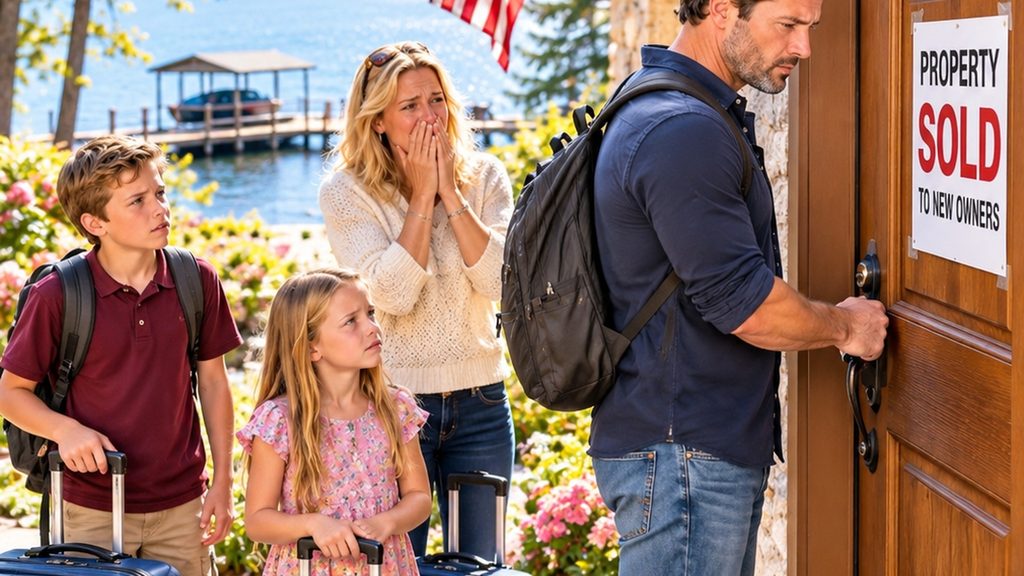
“There’s a strange car in the driveway!”
I said nothing.
“And someone changed the locks!”
“Yes.”
“What do you mean, yes?”
“The Hendersons own the house now.”
Silence.
Then he shouted.
“You actually did it?”
“Yes, Patrick.”
“You sold it while I was on vacation?”
I looked at the flowers sitting on my kitchen table.
“I sold my property while you were on vacation.”
“Where are we supposed to go?”
The question almost made me laugh.
“Home, I assume.”
“You know what I mean!”
“No,” I replied. “I don’t.”
“Megan’s parents were planning to spend Christmas here. We had contractors lined up. We made arrangements!”
“Then you’ll need to cancel them.”
His breathing became heavy.
“Mom, you’ve ruined everything.”
I closed my eyes.
Those words should have hurt.
Maybe once they would have.
But not anymore.
“I didn’t ruin your plans, Patrick. I simply stopped allowing you to make plans with things that don’t belong to you.”
I heard a car door slam.
Then Megan’s voice.
“Put me on the phone!”
A moment later, she was shouting.
“Evelyn, this is completely unacceptable!”
“Good morning, Megan.”
“Do you have any idea how much money we’ve already invested in that property?”
I sat straighter.
“How much?”
She stopped.
“What?”
“How much money did you invest in my property without asking me?”
There was a pause.
Then she snapped, “That’s not the point.”
“I think it’s exactly the point.”
“We had architects preparing designs!”
“Then you should have asked the homeowner.”
“Patrick is your son!”
“Yes.”
“And the house was supposed to be his!”
I felt my heart beat slowly.
“Was I supposed to die first, Megan? Or were you hoping I’d just move out quietly?”
The line went silent.
I waited.
Then she spoke again, her voice lower.
“You’re being deliberately cruel.”
“No. I’m being very clear.”
“You’re destroying your son’s future!”
I looked around my little cottage.
The sunlight coming through the windows.
The flowers in the garden.
The framed photograph of George on the mantel.
“My son has a job, a wife, two children, and a home of his own. If his entire future depended on taking mine, then he had a problem long before I sold it.”
Megan made an angry sound.
“You’ll regret this.”
I took a breath.
“I’ve regretted many things, Megan. But I don’t think this will be one of them.”
Then I ended the call.
An hour later, Patrick called again.
This time, his voice was quieter.
“Mom, can we meet?”
I hesitated.
“I don’t want another argument.”
“Neither do I.”
“Then what do you want?”
“I want to understand why you hate us so much.”
For a moment, I couldn’t speak.
Then I answered.
“Patrick, that’s exactly what you don’t understand.”
“What?”
“I don’t hate you. I love you. But loving you doesn’t mean you own me.”
There was a long silence.
Finally, he whispered, “Please, Mom.”
I looked at George’s photograph.
Then I made my decision.
“Meet me at Caroline’s office at three.”
“Your lawyer?”
“Yes.”
“Do we really need her there?”
“Yes, Patrick. We do.”
At three o’clock, Patrick and Megan arrived.
Patrick looked exhausted.
His face was pale, and there were dark circles beneath his eyes.
Megan looked furious.
She wore designer sunglasses pushed onto her head, and her expensive handbag swung from one arm.
Neither had brought the children.
Caroline offered them seats.
Megan refused.
“I don’t see why we need a lawyer to discuss a family disagreement.”
I looked at her.
“Because this stopped being a simple family disagreement when you started arranging my relocation without my permission.”
Patrick stared at the floor.
Megan stiffened.
“I don’t know what you’re talking about.”
I opened the folder.
Then I placed the photograph of her planner on the table.
Her face changed.
For the first time since I’d known her, Megan seemed genuinely surprised.
“Where did you get that?”
“Does it matter?”
“That’s private!”
I studied her.
“You planned to move me out of my home without consulting me, and you’re worried about your privacy?”
Patrick reached for the paper.
He read it slowly.
Then he looked at Megan.
“What is this?”
She crossed her arms.
“A planning document.”
“For what?”
“For your mother’s future.”
I shook my head.
“No, Megan. You made a plan for your future, and you needed me out of the way.”
She opened her mouth.
But Caroline spoke first.
“Mrs. Ellis, my client has asked me to clarify that no one has authority to make housing or property decisions on her behalf without the appropriate legal authorization. She’s made no such arrangement with either of you.”
Megan looked toward Patrick.
“Are you just going to sit there?”
Patrick didn’t answer.
I turned to him.
“Did you know about the moving company?”
His eyes lifted.
“What?”
“The company you and Megan contacted to remove my belongings.”
He looked at his wife.
“Megan, you said we were only getting estimates.”
She stared at him.
“We were.”
Caroline slid a printed email across the table.
“Then perhaps you can explain this.”
Patrick read it.
His expression changed.
“Scheduled collection of personal effects,” he whispered.
Then he looked at Megan.
“You booked them?”
“I reserved a date.”
“You told me nothing was final!”
Megan threw up her hands.
“Because you never make decisions! Someone had to do something!”
I watched them.
And suddenly, something became clear.
Patrick wasn’t innocent.
He knew about the retirement community.
He knew about the renovation plans.
He’d called himself the future owner.
But even he hadn’t understood how quickly Megan intended to push everything forward.
Then Megan said something that stunned us all.
“Richard and Linda already put money into this!”
Patrick turned.
“What money?”
“My parents invested in the rental business.”
His face went white.
“What rental business?”
Megan stopped.
Too late.
I leaned forward.
“Tell us.”
She looked between us.
Then she finally admitted it.
She and her father had planned to convert the lake house into a luxury vacation rental.
They had created a business proposal.
Prepared marketing materials.
Spoken with property managers.
And Richard had committed money toward the expected renovations.
All before I had ever agreed to leave.
Patrick stared at her.
“You told your parents we owned the property?”
“Not exactly.”
“What did you tell them?”
“That we would.”
He leaned back in his chair.
For a long moment, nobody spoke.
Then I asked the question that had been burning inside me.
“Patrick, did you know all of this?”
His eyes filled with tears.
“Not all of it.”
I waited.
“I knew Megan wanted to renovate the house. I knew she thought you should move somewhere smaller. I thought…”
He stopped.
“You thought what?”
He covered his face.
“I thought you’d eventually agree.”
My heart ached.
“Why?”
He lowered his hands.
“Because you always do, Mom.”
The words landed between us like something heavy falling onto a wooden floor.
I stared at him.
And he stared back.
For the first time in years, neither of us pretended.
He continued quietly.
“When we needed help with the mortgage, you paid it. When the kids needed school fees, you paid them. When Megan wanted the SUV, you helped. Every time something went wrong, you fixed it.”
His voice cracked.
“And I guess I started believing you always would.”
I nodded slowly.
“At least you’re telling the truth now.”
Then Megan spoke.
“This is ridiculous. She’s acting like we stole something.”
I turned toward her.
“You tried to make decisions about my home and my future without my consent.”
“We were looking after your interests!”
“Then why did you write that you shouldn’t mention the renovation plans to me?”
She went silent.
I looked at Patrick.
“Do you remember when you were eight years old and broke the kitchen window playing baseball?”
He blinked.
“What?”
“You were terrified of telling your father. You tried to hide the broken glass behind the trash cans.”
He stared at me.
“I remember.”
“Your father found it, of course. And do you remember what he said?”
Patrick swallowed.
“He said hiding a mistake doesn’t make it disappear.”
I nodded.
“Your father was right.”
Tears rolled down my cheeks.
“And I wish you had remembered that before you tried to hide an entire future from me.”
Megan stood abruptly.
“I’ve heard enough.”
She grabbed her handbag.
“Patrick, we’re leaving.”
But Patrick didn’t move.
“Patrick?”
He kept looking at me.
Then, in a voice so quiet I almost couldn’t hear it, he said, “Mom, I’m sorry.”
Megan laughed bitterly.
“Oh, here we go.”
Patrick turned toward her.
“Stop.”
She froze.
“What?”
“Just stop, Megan.”
He rubbed his forehead.
“We went too far.”
Her expression hardened.
“You’re taking her side?”
“I’m saying we went too far.”
Megan stared at him.
Then she looked at me.
“You know what? Fine. Enjoy your money. Enjoy your little house. But don’t expect us to come running when you’re lonely.”
I met her eyes.
“I haven’t expected anyone to come running for a very long time.”
She left without another word.
The door slammed.
Patrick remained seated.
For the first time in his adult life, my son looked exactly like the frightened little boy who had once broken our kitchen window.
He looked at me.
“Is there any way to get the house back?”
My heart sank.
Even now.
Even after everything.
Part of him was still thinking about the property.
“No, Patrick.”
“What if we offered the buyers more money?”
“No.”
“What if—”
“Patrick.”
He stopped.
I leaned forward.
“The house is gone. It’s legally theirs. I’m not asking those people to give up their new home because you don’t like my decision.”
He lowered his head.
Then I said the words I’d been carrying for days.
“You haven’t just lost the house you expected to inherit. You’ve damaged the relationship with the mother who was supposed to leave it to you.”
He began crying.
Not loudly.
Not dramatically.
Just silent tears falling onto his hands.
“I’m sorry, Mom.”
I wanted to reach across the table.
Every instinct in my body told me to comfort my child.
But something stopped me.
For years, whenever Patrick faced the consequences of his choices, I had rushed to make them disappear.
This time, I couldn’t.
I could love him.
I could forgive him someday.
But I couldn’t rescue him from the truth.
So I said quietly, “I hope you mean that.”
The next few weeks were difficult.
Megan didn’t apologize.
Instead, she posted a long message online about how some people used money to control their families.
She never mentioned my name.
She didn’t need to.
Several relatives called me.
Some were sympathetic.
Others thought selling the house had been unnecessarily harsh.
My sister, Helen, asked whether I could have waited until after Christmas.
I listened.
Then I asked her something.
“Helen, if somebody planned to move you out of your own home without asking, would you wait until after the holidays to decide what to do?”
She was silent.
Then she sighed.
“No.”
“Neither did I.”
After that, she never questioned my decision again.
As for Patrick, the financial consequences arrived quickly.
Without my monthly contribution, the SUV payment became difficult to manage.
He eventually sold it and bought a less expensive car.
The children stayed in their school, but some extra activities had to be reduced.
Their household budget changed.
Megan blamed me for much of it.
Patrick, however, began doing something he hadn’t done in years.
He started figuring things out himself.
He worked additional hours.
He made a budget.
He stopped calling me whenever a bill arrived.
And slowly, painfully, I began to see the difference between helping my son and keeping him dependent.
Six weeks after the house sale, Sophie came to visit.
Patrick brought both children to my cottage.
When they stepped through the front door, Sophie threw her arms around me.
“Grandma!”
I held her tightly.
Noah, who was nine, hugged my waist.
“Is this your new house?”
“It certainly is.”
He looked around.
“It’s smaller.”
I laughed.
“Much smaller.”
He frowned.
“Where’s the lake?”
I knelt beside him.
“Would you like to see something?”
Both children nodded.
I took their hands and led them through the garden gate.
At the end of the street was a little public park.
Beyond it lay the same lake.
Not my private shoreline anymore.
Not my dock.
But the same beautiful water.
The same gentle waves.
The same ducks.
Sophie stopped walking.
“Grandma!”
I smiled.
“Surprise.”
She stared at the lake.
“But Dad said you sold it.”
I knelt in front of her.
“Oh, sweetheart. I sold the house. Nobody owns the whole lake.”
She looked at me for a long moment.
Then she smiled.
“So we can still come here?”
“Of course.”
“And we can still fish?”
“Absolutely.”
Noah grinned.
“Can we bring Grandpa George’s fishing pole?”
My throat tightened.
“I brought it with me.”
His face lit up.
“Really?”
“Really.”
Then Sophie reached into her backpack.
“I made something for you.”
She handed me a folded piece of paper.
Inside was a drawing.
A little yellow cottage.
A garden full of flowers.
Three people standing beside a lake.
And above them, written in careful purple letters, were five words.
“Grandma’s House Is Wherever Grandma Is.”
I covered my mouth.
Sophie looked worried.
“Do you like it?”
I pulled her into my arms.
“Oh, sweetheart.”
I couldn’t say anything else.
I simply held her and cried.
But they weren’t the same tears I’d cried on the porch of my old home.
Those had been tears of loss.
These were tears of relief.
My grandchildren still loved me.
And I finally understood that I didn’t need to own a particular house to remain their grandmother.
That afternoon, Patrick stayed for coffee.
The children were in the garden, watching birds at the feeder.
He sat across from me at the kitchen table.
For a long time, neither of us spoke.
Finally, he said, “They love it here.”
I smiled faintly.
“So do I.”
He looked around.
“It’s peaceful.”
“Yes.”
Then he cleared his throat.
“Megan and I are having problems.”
I lowered my coffee cup.
“I’m sorry to hear that.”
“She thinks you turned everyone against her.”
I sighed.
“Patrick, I haven’t asked anyone to take sides.”
“I know.”
He looked toward the window.
“I’ve been thinking about Dad a lot.”
I waited.
“He used to tell me that a man should never make promises using somebody else’s money.”
I laughed softly.
“That sounds like George.”
Patrick smiled sadly.
“I didn’t understand what he meant.”
“And now?”
He looked at me.
“I think I do.”
Then he reached into his jacket.
He pulled out an envelope.
“I wrote you something.”
I took it.
Inside was a letter.
It wasn’t long.
But the first line made my eyes fill.
Mom, I owe you an apology that has nothing to do with the lake house.
I read slowly.
Patrick apologized for the cruise.
For letting Megan exclude me.
For assuming I would keep paying his bills.
For talking about my inheritance as though I were already gone.
And for allowing discussions about my future to happen without me.
At the bottom, he’d written:
I don’t expect you to trust me right away. I know I’ve made that difficult. But I want to become the kind of son Dad would have been proud of, even if I never receive another dollar from you.
I folded the letter.
When I looked up, Patrick was crying.
“I miss Dad,” he whispered.
“So do I.”
He wiped his face.
“I wish he was here.”
I reached across the table and took his hand.
“So do I, sweetheart.”
He squeezed my fingers.
“Can we start over?”
I thought carefully before answering.
“Not exactly.”
He looked confused.
I smiled gently.
“We can’t erase what happened. But we can build something different.”
He nodded.
“I’d like that.”
“So would I.”
Then I added, “But I need you to understand something.”
“Anything.”
“My financial support is over. You’re responsible for your household now.”
“I know.”
“And nobody gets to make decisions about my home, my money, or my future except me.”
He nodded again.
“I understand.”
“Good.”
Then I squeezed his hand.
“Because I’d like to spend the years I have left being your mother. Not your emergency bank account.”
Patrick lowered his head.
And for the first time, I believed he truly heard me.
Three months later, something unexpected happened.
I received a letter from Richard and Linda.
Megan’s parents.
At first, I considered throwing it away.
But curiosity won.
Inside was a short handwritten note.
Richard admitted he had invested money toward the proposed rental business because Megan had assured him the property would soon be transferred to Patrick.
He had never spoken to me about the arrangement.
He acknowledged that he should have verified ownership and obtained my approval before making any plans.
Then came a sentence I hadn’t expected.
We allowed ourselves to believe that because the house would eventually belong to Patrick, we had the right to begin treating it as his. We were wrong.
I read it twice.
There was no demand for reimbursement.
No threat.
No attempt to reopen the sale.
Only an apology.
I placed the letter in a drawer.
I didn’t feel obligated to respond.
But I was glad they had finally understood.
That spring, I bought a modest house permanently.
Not far from my rental cottage.
It had a little sunroom, a vegetable garden, and enough space for Sophie and Noah to sleep over.
I paid for it using part of the lake house proceeds.
The rest I invested conservatively with professional advice, keeping enough accessible for my future needs.
For the first time in years, I wasn’t planning around Patrick’s next emergency.
I was planning my own life.
I enrolled in a watercolor class.
I joined a local walking group.
I started having lunch with women I’d known for years but rarely made time to see.
And one Saturday, I did something I’d never done before.
I booked a cruise.
Just for myself.
Seven nights.
The Caribbean.
A balcony cabin.
I chose the itinerary, the dates, and every excursion.
When the travel agent asked whether anyone would be joining me, I smiled.
“No,” I said. “Not this time.”
I paid for the trip with my own card.
And when the confirmation arrived, I sat at the kitchen table grinning like a teenager.
I couldn’t remember the last time I’d spent money on something simply because I wanted it.
Two days before departure, Patrick visited.
He brought flowers and a small envelope.
“What’s this?” I asked.
“A little something for your trip.”
Inside was a gift card for the cruise line.
I looked at him.
“Patrick—”
“Before you say anything, it’s not much.”
He smiled nervously.
“But I wanted to pay for one nice dinner. You know, the kind Dad always used to take you to on your anniversary.”
My eyes filled.
For years, money had flowed in only one direction between us.
From me to him.
Not because I wanted something in return, but because I’d taught him that giving never required a limit.
Now, for the first time in a long while, he was offering something without expecting anything.
“Thank you,” I whispered.
He hugged me.
“You deserve a good vacation, Mom.”
Then he stepped back and smiled.
“And this time, nobody gets to uninvite you.”
I laughed so hard I cried.
On the first evening of my cruise, I stood alone on the balcony of my cabin.
The sea stretched endlessly toward the horizon.
The setting sun painted the water orange and pink.
I held a glass of sparkling water and felt the warm breeze lift my hair.
A year earlier, I would have been terrified of traveling alone.
I would have worried about Patrick.
About the grandchildren.
About whether someone needed me.
But standing there, watching the waves, I realized something.
I’d spent so many years being useful that I’d forgotten how to be happy.
There was a difference.
Being needed had made me feel important.
Being loved had made me feel safe.
And for too long, I’d mistaken the first for the second.
My phone vibrated.
It was a message from Sophie.
A photograph.
She and Noah were standing beside Patrick in my new garden.
They were holding a hand-painted sign.
It read:
“HAVE FUN, GRANDMA! WE LOVE YOU!”
Underneath, Patrick had written:
Enjoy every minute, Mom. Everything here is taken care of.
I smiled.
Then I looked out at the ocean.
For the first time in years, I believed him.
When I returned home a week later, I found a package waiting on my doorstep.
It was from the Hendersons.
The people who had purchased my old lake house.
Inside was a small framed photograph.
The picture showed the wooden bench beside the dock.
George’s initials.
Mine.
Still carved into the wood.
Beneath the photograph was a note from Elaine.
Dear Evelyn,
We wanted you to know that your bench is still exactly where you left it. We sit there every evening and watch the sunset. Your home has brought us so much happiness already, and we can feel how much love went into making it special.
Thank you for trusting us with its next chapter.
I sat down at my kitchen table.
For a long time, I looked at that picture.
And then I understood something that finally allowed me to let go completely.
The lake house had never stopped being a place of love.
It had simply stopped being a place where I could live without feeling taken for granted.
Now another family was filling it with new memories.
And I was filling my own life with new ones.
That was how things were supposed to be.
A few evenings later, Patrick came over for dinner.
Sophie and Noah were playing in the garden.
He helped me carry the plates to the sink.
Then he glanced toward the photograph of the old bench, now hanging beside George’s portrait.
“Do you ever wish you hadn’t sold it?” he asked.
I considered the question.
I remembered George laughing on the porch.
Patrick learning to swim.
Sophie chasing fireflies.
Noah falling asleep in his grandfather’s chair.
The beautiful parts of our life.
Then I remembered the planner.
The moving company.
The cruise.
And the message that had started everything.
You’re not coming anymore.
I turned to my son.
“Sometimes I miss the house.”
He nodded.
“I understand.”
“But I don’t regret selling it.”
He looked down.
“Because of what we did?”
I reached for his hand.
“Because I finally realized I was allowed to make a decision that was right for me.”
His eyes grew wet.
“I wish it hadn’t taken all that.”
“So do I.”
Then he said quietly, “Dad would have been proud of you.”
I looked toward George’s photograph.
And I smiled.
“I hope so.”
Patrick squeezed my hand.
After a moment, he asked, “Mom, do you think we’ll ever feel like a normal family again?”
I could hear Sophie laughing outside.
Noah was calling for his father to come see something he’d found beneath the rosebush.
I looked back at my son.
“Patrick, normal isn’t what I’m hoping for anymore.”
“What are you hoping for?”
I smiled.
“An honest family.”
He nodded slowly.
“I think we can do that.”
“We can try.”
And this time, trying would have to be enough.
That night, after everyone had gone home, I sat in my sunroom with a cup of tea.
The house was quiet.
A soft rain tapped against the windows.
George’s fishing hat hung on a hook beside the back door.
The wooden ruler marked with our grandchildren’s heights stood in the corner, ready for new measurements.
Nothing important had been lost.
Not my memories.
Not my love for my family.
Not even my hope that things could improve.
What I’d lost was the belief that keeping everyone happy was more important than protecting my own peace.
I thought about the woman I’d been when Patrick first sent that text.
A woman who had paid for a vacation she wasn’t allowed to enjoy.
A woman who had spent years financing a life that other people expected her to maintain.
A woman whose family had quietly begun planning what would happen to her belongings while she was still using them.
Then I thought about the woman sitting in that sunroom.
I had my own home.
My own plans.
My own money.
My grandchildren’s love.
And something I hadn’t felt in a very long time.
The freedom to say no without explaining myself a dozen times.
I picked up the photograph of George and touched his smiling face.
“You were right,” I whispered.
“The house wasn’t our marriage.”
I looked around the room.
At the fishing hat.
The wooden ruler.
The photographs.
The books we’d collected over the years.
Everything meaningful had come with me.
Then I added softly, “And I think I’m going to be just fine.”
Outside, the rain continued falling.
Inside, I felt perfectly at peace.
Because my son had spent years believing that one day he would inherit my lake house.
What he never understood was that an inheritance is something a person chooses to leave behind, not something their family is entitled to take while they’re still alive.
And when he told me I wasn’t welcome on the cruise I’d helped pay for, he thought he was simply excluding me from a vacation.
He never imagined he was giving me the courage to take back my entire life.
I didn’t sell the house to punish him.
I sold it because it was mine.
And for the first time in years, I remembered that my life belonged to me, too.
THE END! THANK YOU FOR READING!❤️