 Reading Time: 34 minutes
The first thing Bridget Colton placed on the black granite table was not a photograph, a bank statement, or a legal document. It was a birth certificate. Then another. And another. And another.
Four birth certificates lay side by side beneath the warm lights of the executive suite. Willa Brennan. Tessa Brennan. Josie Brennan. Penny Brennan.
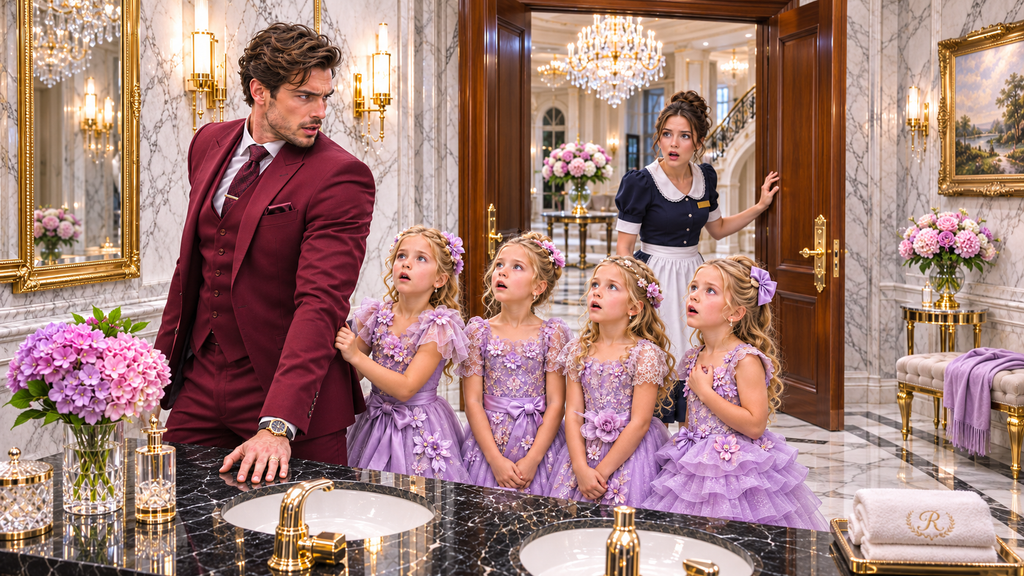
Born eleven minutes apart in a hospital outside New York City, six years and four months earlier.
The space marked Father’s Name had been left blank on every single one.
I stared at those empty spaces until the letters began to blur.
Across from me, Isla sat perfectly still.
She wasn’t looking at the certificates.
She was watching my face.
Bridget leaned forward.
“Graham, before we discuss the financial records, there’s something you need to understand. What happened to Isla seven years ago wasn’t simply a misunderstanding between two people who loved each other.”
She opened the first red binder.
“It was a coordinated operation.”
I looked at her.
“What kind of operation?”
“The kind that involved forged documents, intercepted correspondence, falsified financial records, and at least three people with direct access to your family’s private offices.”
My fingers tightened around the edge of the table.
“Who?”
Bridget hesitated.
Then she turned the binder toward me.
At the top of the first document was a familiar name.
ELEANOR WHITMORE.
My mother.
Below it appeared the name of my family’s longtime attorney, Frederick Vale.
And beneath his signature was a third name I recognized immediately.
CHARLES ASHFORD.
Margot’s father.
For several seconds, I couldn’t breathe.
Charles Ashford was the man whose daughter I had been expected to propose to less than six hours earlier.
He was also the man who had spent the previous eighteen months negotiating a multibillion-dollar partnership with Whitmore Holdings.
I raised my eyes.
“What does Margot’s father have to do with Isla?”
Bridget didn’t answer immediately.
Instead, she slid a document across the table.
It was dated seven years earlier.
I recognized the date.
October seventeenth.
The day Isla supposedly left me.
My mother had arrived at my apartment that morning carrying an envelope.
She told me Isla had taken money and gone overseas.
I had refused to believe it.
Then she showed me a letter bearing Isla’s signature.
Graham, what we had was beautiful, but I can’t build my future around a man whose family will never accept me. I’ve taken the opportunity offered to me. Please don’t look for me.
I remembered reading those words until the paper nearly tore between my fingers.
For seven years, I’d carried that letter like a wound.
Now Bridget placed a copy in front of me.
“Do you recognize this?”
I nodded.
“Isla’s goodbye letter.”
“Except Isla never wrote it.”
My head turned toward her.
Isla’s eyes filled with tears.
“I told you I didn’t leave.”
Bridget pointed to the signature.
“A document examiner identified characteristics consistent with a signature copied from an earlier employment agreement. We also found the original digital file in an archived folder belonging to Frederick Vale.”
I looked back at the page.
My mother’s favorite attorney had written the words that destroyed my life.
But that wasn’t the worst part.
Bridget turned another page.
“Two days before this letter was delivered to you, Isla went to your corporate office.”
I looked at Isla.
She lowered her eyes.
“I was trying to tell you I was pregnant.”
The room seemed to tilt.
“You came to see me?”
“Three times.”
I shook my head.
“I was never told.”
“I know that now.”
She swallowed.
“The first time, your receptionist told me you were in London. The second time, security escorted me outside. The third time…”
Her voice broke.
I moved closer.
“Isla?”
She wiped a tear from her cheek.
“The third time, your mother had me arrested.”
For a moment, nobody spoke.
Even the steady hum of the hotel’s heating system seemed to disappear.
“Arrested?” I whispered.
Isla nodded.
“She accused me of stealing confidential client documents from Whitmore Holdings. She told the police I had threatened to sell them unless your family paid me.”
I stared at her.
“That’s insane.”
“Yes,” Bridget said quietly. “And the complaint was eventually withdrawn. But Isla spent eighteen hours in police custody while pregnant. Her employer suspended her pending the investigation, and she lost the job before she could clear her name.”
I turned back to Isla.
“Why didn’t you call me?”
A bitter little smile touched her lips.
“I did.”
My heart dropped.
“Every number I had for you stopped working. Emails bounced back. Your apartment building wouldn’t let me upstairs.”
She looked down at her hands.
“And then Frederick Vale delivered a letter supposedly signed by you.”
Bridget opened the second binder.
Inside was another document.
This one carried my name.
My signature.
My family’s letterhead.
It stated that I denied responsibility for Isla’s pregnancy and wanted no further communication with her.
A warning at the bottom threatened legal action if she attempted to contact me again.
I read it twice.
Then a third time.
“I didn’t write this.”
“I know,” Isla whispered.
“I didn’t know about the babies.”
“I know.”
I turned toward her, unable to keep my voice steady.
“Isla, I would have come.”
Her face crumpled.
For the first time since I’d seen her at the restaurant, she stopped trying to hide how much she’d suffered.
“I waited for you, Graham.”
Her words barely rose above a whisper.
“I waited outside your office until my feet were swollen. I stood in the rain by your apartment. I called every night.”
A tear rolled down her cheek.
“When I found out there were four babies, I sat in the doctor’s office alone, terrified. I wanted you there so badly.”
I reached for her hand.
She didn’t pull away.
“I thought you knew,” she continued. “I thought you had decided we weren’t worth the trouble.”
I bent forward, pressing my forehead against our joined hands.
Seven years.
Seven years of birthdays.
Seven years of holidays.
Four first breaths.
Four first smiles.
Four little voices learning to say words.
And I had missed every single moment.
Because somebody had decided that my mother’s ambitions mattered more than five human lives.
When I finally lifted my head, Bridget was watching me carefully.
“Graham, there’s more.”
I almost laughed.
“How could there possibly be more?”
She opened the third binder.
And that’s when I discovered that stealing my family hadn’t been the only reason my mother had erased Isla.
It had also made her very, very rich.
THE TRUST NOBODY TOLD ME ABOUT
My grandfather, Gideon Whitmore, had built the family company from a struggling transportation business into an international investment group.
He was demanding, stubborn, and occasionally impossible.
But he believed something my mother had never understood.
Money was supposed to protect a family.
Not control one.
When he died, he left a substantial portion of his estate in an irrevocable trust for his descendants.
I’d always known about the trust.
What I hadn’t known was that the terms included provisions for my future children.
Bridget displayed a series of financial reports on the television screen.
“The Whitmore Descendant Trust holds voting shares and investments designated for your grandfather’s eligible descendants,” she explained. “Any newly identified beneficiaries must be reported to the independent trustee. Their interests can’t simply be reassigned because another family member finds them inconvenient.”
I frowned.
“What does that have to do with my daughters?”
Isla’s hand tightened around mine.
Bridget glanced at her.
“Your mother learned about Isla’s pregnancy before you did. And she eventually learned there were four children.”
“How?”
“A private medical invoice from Isla’s pregnancy was forwarded through a health benefits administrator with connections to the family’s office. Someone improperly shared information that should never have reached your mother.”
I felt sick.
Bridget continued.
“Your mother knew that acknowledging the children would trigger additional trustee reporting and scrutiny of the trust’s management. She was already using accounts tied to that trust to conceal unauthorized transfers.”
One of the forensic accountants, a silver-haired woman named Evelyn Marsh, turned her laptop toward me.
Rows of transactions filled the screen.
Dozens of payments had passed through companies I’d never heard of.
All with names designed to sound like legitimate investment subsidiaries.
Crescent Advisory.
Northbridge Strategic Partners.
Harborline Management.
“These companies received approximately six million dollars over several years,” Evelyn said. “Some transfers were described as administrative expenses. Others were recorded as consulting fees. We haven’t yet established the entire amount improperly taken, but the documentation supporting many payments appears fictitious.”
I looked at Bridget.
“You’re telling me my mother stole from the family trust?”
“I’m telling you we have substantial evidence suggesting serious financial misconduct. We need an independent trustee, law enforcement, and a court to determine the full extent.”
Then she placed a photograph on the table.
It showed my mother sitting beside Charles Ashford at a charity gala.
The photograph was three years old.
Bridget pointed to a document clipped behind it.
“Charles Ashford’s investment group received payments through two of those companies.”
I felt anger rising in my chest.
“What does he get out of this?”
“A great deal, potentially.”
She explained that the planned Whitmore-Ashford partnership included a restructuring of voting rights and an extensive review of the family’s ownership interests.
Under the proposed agreement, I would have been required to sign declarations about known descendants and outstanding beneficiary claims.
“My mother told me those declarations were routine.”
“For most people, they would be. But if you had signed a statement falsely claiming you had no children, even unknowingly, your mother and Ashford could have used it to delay disclosure and complicate challenges to the restructuring.”
I stared at her.
“And my engagement?”
Bridget’s expression hardened.
“Would have brought the families together publicly at the exact moment the transaction was nearing completion.”
My stomach twisted.
Margot wasn’t simply a woman my mother thought I should marry.
She was part of a larger arrangement.
An arrangement that required my daughters to remain invisible.
I looked toward the adjoining bedroom.
Four little girls were sleeping behind those doors.
Four children who had spent the evening shivering on a sidewalk while the grandmother who knew about their existence prepared a lavish engagement party.
I could barely process it.
Then Evelyn spoke again.
“There’s something particularly disturbing about the timing.”
She pointed to a line of transactions.
“Three weeks ago, a company linked to Charles Ashford acquired the building where Isla and her daughters were living.”
Isla sat upright.
“What?”
Evelyn continued.
“Four days later, the management company notified tenants that emergency renovations were required. Yesterday, Isla was locked out following a disputed notice.”
I turned toward Isla.
“The apartment?”
She nodded slowly.
“They said the building wasn’t safe. I told them I had nowhere to take the girls.”
My hands curled into fists.
“That wasn’t an accident.”
Bridget shook her head.
“We don’t believe so.”
Isla covered her mouth.
I could see the realization moving across her face.
The sudden eviction.
The restaurant manager telling her she couldn’t shelter her children in the storage room.
The freezing night.
The timing, only hours before my engagement announcement.
My mother hadn’t merely hoped Isla would stay away.
Someone had been actively pushing her out of the city.
“And the restaurant?” I demanded.
Bridget checked another page.
“The restaurant’s holding company is owned by an Ashford subsidiary.”
I stared at her.
“What are you saying?”
“I’m saying we’re investigating whether someone used Isla’s employment and housing situation to force her to leave New York before tonight.”
The thought of Penny trembling in that February wind nearly broke me.
I stood so abruptly that my chair struck the wall.
“Where’s my mother?”
Warren Rourke, standing near the door, answered.
“At the Whitmore residence. My team confirmed it twenty minutes ago.”
I grabbed my coat.
“Then I’m going there.”
“Graham.”
Isla’s voice stopped me.
I turned.
She was standing now.
Her expression was exhausted, but there was something stronger than exhaustion in her eyes.
“Your mother has controlled every part of this story for seven years.”
I swallowed.
“Not anymore.”
“Then don’t walk into her house angry and alone. That’s exactly what she’ll expect.”
I looked at Bridget.
“What do we do?”
Bridget closed the third binder.
“We preserve everything, protect the children, notify the trustee, and let your mother believe she still controls the situation.”
Then she looked directly into my eyes.
“Because tomorrow morning, Graham, we’re going to make sure the right people hear what happened.”
THE LITTLE GIRL WHO DIDN’T TRUST PROMISES
At almost three in the morning, I walked quietly into the adjoining bedroom.
The lights were dim.
Four teddy bears lay scattered across the enormous bed.
Willa slept with one arm around Josie.
Tessa had somehow tangled herself in the blanket.
Penny lay near the edge, clutching a small, worn rabbit that looked nothing like the expensive toys Warren had purchased.
I sat in the chair beside her.
For several minutes, I simply watched them breathe.
I had spent years attending board meetings, signing contracts, and acquiring things people told me were important.
I’d believed success meant having a name that opened doors.
Yet here were four little girls who shared my blood, and I didn’t even know their favorite breakfasts.
Penny suddenly opened her eyes.
She stared at me.
“You’re still here.”
I smiled weakly.
“Yes.”
She rubbed her face.
“Mommy said we’re staying somewhere warm tonight.”
“That’s right.”
“Are we in trouble?”
My heart cracked.
“No, sweetheart.”
She studied me with those enormous green eyes.
“Sometimes grown-ups say things are fine when they’re not.”
I didn’t know how a six-year-old could sound so tired.
I moved a little closer.
“You’re right. Sometimes they do.”
She considered that.
“Mommy cries when she thinks we’re sleeping.”
I looked away for a second.
“Does she?”
Penny nodded.
“But she always makes us pancakes in the morning, even when she’s sad.”
A painful lump formed in my throat.
“She sounds like a wonderful mother.”
“She’s the best.”
Penny hugged her rabbit tightly.
Then she asked the question I had been afraid to hear.
“Are you going to make her cry again?”
I felt the words like a blow.
I wanted to promise her that I would never hurt Isla.
That nothing bad would ever happen to them again.
But I had just learned what seven years of broken promises had done to this family.
So I told her the truth.
“I’m going to do everything I can to make sure she doesn’t have to cry because of me.”
Penny tilted her head.
“That’s not the same as no.”
“No,” I admitted. “It isn’t. Sometimes people make mistakes. But I won’t lie to you.”
She was quiet for a moment.
Then she reached one tiny hand toward me.
I took it.
“What’s your name again?” she asked.
“Graham.”
She tested the word.
“Gram.”
I smiled through tears.
“Close enough.”
“Can I call you that?”
“Of course.”
She shut her eyes again.
But before falling asleep, she whispered something I’ll remember for the rest of my life.
“Please don’t disappear like the other grown-ups.”
I stayed beside her until morning.
And when the sky began to brighten beyond the curtains, I realized that for the first time in seven years, I knew exactly what I was fighting for.
Not money.
Not revenge.
Not my family’s company.
Them.
All five of them.
THE WOMAN I WAS SUPPOSED TO MARRY
At 7:18 a.m., Margot Ashford arrived at the hotel.
She wasn’t wearing the designer gown she’d selected for our engagement party.
She wore jeans, a gray wool coat, and sunglasses that couldn’t quite conceal the fact she’d been crying.
Warren met her at the private elevator.
I stepped into the hallway before she reached the suite.
“Graham.”
Her voice trembled.
“We need to talk.”
I nodded.
“I’m sorry about last night.”
She gave a humorless laugh.
“You’re sorry? I spent three hours sitting in a conservatory while my father told everyone you were having a nervous breakdown.”
I winced.
“I didn’t know he said that.”
“Your mother told the guests you’d suffered a personal crisis.”
She took off her sunglasses.
“Then somebody showed my father a photograph of you outside a restaurant with a woman and four children.”
My stomach tightened.
“Who showed him?”
“I don’t know.”
She looked at me carefully.
“Are they yours?”
I didn’t answer immediately.
“We’re arranging a paternity test.”
Margot closed her eyes.
When she opened them again, something had changed.
“Her name is Isla, isn’t it?”
I stared at her.
“How do you know that?”
Margot looked down.
“Because six months ago, I heard my father arguing with your mother.”
My pulse quickened.
“About Isla?”
“Your mother kept saying the Brennan problem had to be resolved before the merger documents were signed.”
I took a step closer.
“What exactly did you hear?”
Margot’s eyes filled again.
“Your mother said, ‘Four children are four complications we cannot afford.'”
The hallway went silent.
“And you didn’t tell me?”
Her face crumpled.
“I didn’t understand.”
“Margot—”
“I thought they were talking about some lawsuit involving a former employee. My father told me it was confidential corporate business.”
She swallowed.
“Then last night, when you canceled the engagement, I started putting things together.”
I wanted to be angry with her.
Part of me was.
But the woman standing before me looked less like a conspirator and more like someone discovering she’d been used.
“Why are you here?” I asked.
Margot opened her handbag.
Inside was a slim black flash drive.
“Because after everyone left the party, I went into my father’s study.”
She held it out.
“I copied files from his private merger folder.”
I stared at the drive.
“Margot, those files could contain confidential material.”
“I know. I want your attorneys to handle it properly. I’m not asking you to publish anything.”
She took a shaky breath.
“But I saw enough to know that my father has been lying to me, too.”
I didn’t reach for the drive immediately.
“Why help me?”
Margot gave me the saddest smile I’d ever seen.
“Because I was prepared to marry a man who didn’t love me. But I wasn’t prepared to help destroy a woman and four children who never hurt anyone.”
I stepped aside.
“Come in.”
Bridget was waiting at the table.
Margot handed the drive to her.
“There’s one file you need to see.”
Bridget asked which one.
Margot answered quietly.
“It’s labeled Contingency Four.”
Something about those words made Isla look up sharply.
“Four?”
Margot nodded.
“The folder contains photographs of four little girls.”
I felt the blood drain from my face.
Margot continued.
“And a draft petition asking the court to appoint someone other than their mother to manage any trust interests they might be entitled to.”
Isla stood so quickly that her teacup fell to the carpet.
“No.”
I caught her before she stumbled.
“No one is taking your children.”
But she was shaking.
“You don’t understand, Graham.”
Her voice rose.
“Your mother tried this before.”
I turned toward her.
“What?”
Isla covered her mouth.
For several seconds, she couldn’t speak.
Then she whispered:
“When the girls were born, Eleanor came to the hospital.”
I stared at her.
“She came to see them?”
Isla nodded.
“And she brought four sets of adoption papers.”
FOUR BABIES, FOUR ENVELOPES
Isla sat down slowly.
She looked toward the bedroom, as though she needed to reassure herself that her daughters were still there.
Then she began to tell us what happened.
“The girls came early,” she whispered. “Thirty-two weeks. The doctors warned me the pregnancy was extremely high-risk, but I kept believing everything would be okay.”
She rubbed her hands together.
“Willa was born first. Tessa followed. Then Josie. Penny was the smallest.”
I felt my throat tighten.
“How small?”
“Three pounds, two ounces.”
I stared at her.
She gave a trembling smile.
“You should have seen her, Graham. She was so tiny. I could practically cover her entire back with my hand.”
A tear slipped down her cheek.
“All four needed extra care. I spent weeks going back and forth between the hospital and the little room I was renting.”
She stopped.
Then continued.
“One afternoon, your mother arrived with Frederick Vale.”
I gripped the chair.
“She said she’d heard about the babies and wanted to help. I was exhausted. I hadn’t slept properly in days. I had hospital bills, no steady job, and four premature daughters.”
Isla looked at me.
“For one stupid second, I thought she’d finally developed a conscience.”
She swallowed hard.
“Then Frederick opened his briefcase.”
Inside were four separate packets of documents.
Each packet proposed that Isla voluntarily place one of the babies with a private adoptive family.
The arrangements were described as confidential.
The prospective parents were supposedly wealthy.
The girls would receive excellent healthcare and private education.
And Isla would receive enough money to rebuild her life.
I stared at her, horrified.
“My mother wanted you to give away our daughters?”
“She called it an opportunity.”
Isla’s voice shook.
“She told me raising quadruplets alone would destroy me. She said it wasn’t fair to make four children suffer because I was too proud to accept reality.”
Margot pressed a hand over her mouth.
Isla looked down.
“I told her they were my babies. I told her I wasn’t giving up any of them.”
“What did she say?”
Isla took a long breath.
“She said that if I refused, she could make sure somebody reported me as an unfit mother.”
My entire body went cold.
“She threatened you?”
“She said I was unemployed, financially unstable, and living in one room. She told me authorities would be interested in how I planned to care for four medically fragile babies.”
A tear slid down her face.
“Then she said, ‘Think carefully, Isla. You couldn’t keep my son. What makes you think you can keep his children?'”
I stood.
For the first time in my life, I felt genuine hatred toward the woman who had raised me.
But Isla wasn’t finished.
“There was a nurse that day,” she whispered. “Her name was Barbara Salcedo.”
She looked at Bridget.
“Barbara heard part of the conversation. After Eleanor left, she told me I didn’t have to sign anything. She helped me contact a hospital social worker.”
“Did she keep records?” Bridget asked.
Isla nodded.
“I have copies of the documents and the complaint I filed with the hospital.”
Bridget exchanged a look with Evelyn.
“Those may be important.”
Isla looked directly at me.
“Your mother didn’t just take you away from us, Graham. She tried to take the girls away from me.”
I knelt beside her.
There was nothing I could say that would erase that memory.
Nothing I could buy to replace what she’d endured.
So I simply held her while she cried.
And when she finally whispered, “I was so scared,” I answered with the only truth that mattered.
“You kept them safe.”
She shook her head.
“Sometimes barely.”
“But you did.”
I looked toward the bedroom.
“And I will spend the rest of my life being grateful that you did.”
THE FILE CALLED CONTINGENCY FOUR
At 9:40 a.m., Bridget emerged from the study area with a grim expression.
She had reviewed enough of Margot’s files to identify something significant.
“Graham, the name Contingency Four wasn’t chosen randomly.”
I turned.
“What does it mean?”
She opened a document on her laptop.
It was an internal planning memorandum from Charles Ashford’s legal team.
It described several options in the event the four Brennan children were publicly identified as my biological daughters.
One option was to contest their parentage.
Another was to delay their recognition under the family trust.
The last proposed seeking court supervision over their financial interests while alleging that Isla was incapable of properly managing their assets.
None of the documents proved that a court would approve any of those actions.
But the intent behind them was unmistakable.
“They were planning how to fight the girls’ claims before the girls even knew they had claims,” Bridget said.
Margot leaned against the wall.
“My father knew about them.”
Her voice sounded distant.
“He knew all this time.”
I looked at her.
“I’m sorry.”
She shook her head.
“Don’t apologize to me. I’m not the one who spent six years raising four children with nothing.”
Then Bridget clicked on another file.
A spreadsheet appeared.
It contained payments associated with the building where Isla had lived.
There were communications about pressuring tenants to vacate.
And one email referred specifically to Isla.
The message came from an executive employed by Charles Ashford.
Target tenant remains in possession. Accelerate lawful removal options ahead of Whitmore announcement.
Beneath it was a reply from Frederick Vale.
Mrs. Whitmore requires resolution before Friday evening. No further delays.
I stared at the screen.
Friday evening.
The evening of my canceled engagement.
My mother knew that Isla was still in New York.
She knew about the girls.
She knew we might cross paths.
And she had been desperate to prevent it.
Suddenly, my phone rang.
My mother’s name appeared.
Again.
I’d ignored fourteen calls since the previous evening.
This time, Bridget nodded.
“Answer it. Don’t confront her about the documents yet.”
I put the phone on speaker.
“Mother.”
“Graham.”
Her voice was sharp.
“Finally. Do you have any understanding of the humiliation you caused this family last night?”
I looked toward Isla.
She sat perfectly still.
“Good morning to you, too.”
“Don’t be sarcastic. Charles is furious. Margot is devastated. Our guests have been calling since midnight.”
“Is that what concerns you?”
“What else should concern me?”
I felt Isla’s hand settle gently on my arm.
I forced myself to remain calm.
“Four little girls were sleeping outside in February last night.”
Silence.
Then my mother sighed.
“Isla Brennan has always been talented at manufacturing sympathy.”
The words struck me with startling force.
“You knew.”
“Graham, this is exactly why I wanted you nowhere near her.”
I stared at the phone.
“You knew she had children.”
“Of course I knew she had children.”
My breath stopped.
“Four children,” my mother continued coldly. “And I know she’s trying to make them your responsibility.”
I leaned forward.
“Are they mine?”
A pause.
“That’s irrelevant until there’s proof.”
“Then why did you tell me seven years ago that she had abandoned me?”
“Because you needed to move on.”
I felt something inside me go completely still.
“Did you send her a letter using my signature?”
She didn’t answer.
“Mother.”
“Graham, I protected you from a terrible mistake.”
Behind me, Isla made a small sound.
Not anger.
Something closer to grief.
My mother continued.
“You were twenty-six years old. You were about to take your place in the company. That girl would have dragged you into a life you weren’t prepared for.”
I closed my eyes.
That girl.
The woman who had brought four tiny babies into the world without me.
The woman who had worked double shifts and skipped meals.
The woman who still made pancakes while she was crying.
“Her name is Isla,” I said.
“Don’t take that tone with me.”
“And those children are not a mistake.”
“They will destroy everything your grandfather built if you let her manipulate you.”
I stood.
“No. What’s going to destroy this family is what you’ve done.”
My mother went quiet.
Then her voice changed.
It became soft.
Dangerously soft.
“Graham, come home. Alone. We can straighten this out.”
I looked at Bridget.
She shook her head.
I spoke slowly.
“I’m not coming home.”
“Then what are you planning?”
“For the first time in seven years, I’m planning to listen to the woman I should have believed.”
I ended the call.
My hands were shaking.
Bridget regarded me carefully.
“You understand she may accelerate whatever she’s been preparing?”
“Yes.”
“Then we need to move quickly.”
I nodded.
But before she could continue, Warren’s phone vibrated.
He answered.
Listened.
Then his entire expression changed.
“Graham, we have a problem.”
“What problem?”
“Two people just arrived in the hotel lobby claiming to be acting under an emergency child-protection order.”
Isla stood up.
Her face turned white.
Warren continued.
“They’re asking hotel management to bring the girls downstairs.”
NOBODY WAS TAKING MY DAUGHTERS
“Absolutely not,” I said.
Warren raised one hand.
“Nobody’s going anywhere. My team has already instructed hotel management not to release information or provide access to the suite without proper verification.”
Isla hurried toward the bedroom.
I followed her.
The girls were awake now.
Tessa sat cross-legged on the bed, reading a hotel breakfast menu.
Josie was drawing with a pencil she’d found in the desk.
Willa was helping Penny untangle the ribbon on her rabbit.
They looked up when Isla entered.
“Mommy?” Willa asked.
Isla knelt beside the bed.
“Everything’s okay, sweetheart.”
I could hear the fear beneath her words.
Willa could, too.
She looked directly at me.
“Is somebody trying to make us leave again?”
I knelt beside her.
“Nobody is taking you away from your mom.”
“Promise?”
I hesitated.
Not because I intended to break the promise.
Because I’d learned that promises were serious things.
“I promise I’ll do everything I can to keep you safe.”
Willa studied my face.
Then nodded.
“Okay.”
Outside the bedroom, Bridget was already speaking with an attorney who specialized in child welfare law.
The supposed visitors had presented paperwork, but several details appeared inconsistent.
The attorney contacted the appropriate agency through independently verified channels.
Within forty minutes, we had confirmation that the document presented at the hotel wasn’t a valid emergency removal order.
The two visitors left when hotel security requested that they wait for law enforcement.
Warren’s team preserved surveillance footage and incident records.
I stood in the lounge, staring at the report.
Someone had just tried to frighten Isla into surrendering her daughters.
Again.
Bridget approached me.
“This is now a separate matter for the authorities.”
“Was it my mother?”
“We can’t say that yet.”
I looked at her.
“But we can find out.”
“We can investigate who arranged it. And we’re not going to compromise the evidence by guessing.”
Her restraint was infuriating.
But she was right.
For seven years, my mother had relied on people reacting emotionally while she controlled the paperwork.
This time, she wouldn’t get that advantage.
At eleven that morning, I called an emergency meeting of Whitmore Holdings’ independent directors.
I also contacted the independent trustee of my grandfather’s trust.
For the first time, I told both groups that I had reason to believe undisclosed descendants existed and that financial records required immediate preservation.
I didn’t ask anyone to take my word for it.
I asked them to examine the evidence.
Then I made one final call.
To Frederick Vale.
He answered on the first ring.
“Graham. I’ve been expecting you.”
“Good.”
“We need to discuss what happened last night.”
“Yes,” I said. “We do.”
“Your mother is very concerned.”
I looked at the forged letters spread across Bridget’s table.
“She should be.”
I paused.
“Frederick, I have one question.”
“Of course.”
“Did you ever imagine I’d find Isla again?”
He was silent.
Just long enough.
Then he said, “I don’t understand what you’re suggesting.”
I smiled without humor.
“You will.”
And I hung up.
THE DAY MY MOTHER LOST CONTROL
At 2:00 p.m., I walked into the executive conference room at Whitmore Holdings.
The room had hosted some of the largest transactions in the company’s history.
I’d signed acquisitions there.
Celebrated record profits there.
Once, when I was twenty-eight, I’d stood at the window while my mother explained that sentiment had no place in business.
Now she sat at the far end of the table.
Eleanor Whitmore.
Perfectly dressed.
Perfectly composed.
Her pearl earrings gleamed beneath the recessed lights.
Frederick Vale sat beside her.
Charles Ashford occupied the chair to her left.
When I entered with Bridget and independent counsel, my mother’s mouth tightened.
“Graham. This is highly irregular.”
I took my seat.
“So was falsifying my signature.”
Frederick shifted.
Charles leaned back.
“Graham, perhaps you should be careful with accusations.”
I turned toward him.
“Perhaps you should be careful with financial records.”
His expression changed.
The independent board chair, Miriam Bell, cleared her throat.
“Graham has requested this meeting to discuss serious concerns involving trust administration, potentially undisclosed related-party transactions, and allegations of misconduct.”
My mother folded her hands.
“He’s distressed. An old girlfriend has reappeared with children and a very convincing story.”
I stared at her.
“Don’t.”
She raised an eyebrow.
“Don’t what?”
“Don’t talk about Isla as though she’s a problem you need to eliminate.”
Miriam looked between us.
“Graham, please continue.”
Bridget distributed copies of the relevant documents.
The forged letters.
The police complaint.
The financial transfers.
The trust reporting discrepancies.
The recently discovered housing communications.
Frederick’s face gradually lost its color.
Charles stopped leaning back.
And my mother?
She barely moved.
She read the first page.
Then the second.
Finally, she looked up.
“These documents are being presented without context.”
Bridget nodded.
“Then you’ll have an opportunity to provide that context through independent counsel and the appropriate investigators.”
My mother looked at me.
“You’ve brought outsiders into our private affairs.”
“No,” I said. “You brought criminal allegations and financial misconduct into our private affairs.”
Her eyes flashed.
“You have no idea what it takes to keep a family like ours intact.”
I leaned forward.
“Apparently, it takes keeping four children hungry and homeless.”
For the first time, her expression cracked.
“That’s an outrageous exaggeration.”
“Is it?”
I slid a photograph across the table.
It had been taken outside the restaurant the previous evening.
Isla was kneeling on the sidewalk.
Her arms were wrapped around Penny and Josie.
Willa stood beside the battered duffel bags, trying to zip Tessa’s thin coat.
My mother’s gaze flickered toward the picture.
“That was never the intention.”
The room went silent.
I stared at her.
“What did you just say?”
She straightened.
“I said I never intended for those children to be harmed.”
My voice dropped.
“But you intended for them to disappear.”
She looked away.
I felt a terrible certainty settle over me.
“You knew who they were.”
“Graham—”
“You knew they were mine.”
She closed her eyes.
And after seven years of lies, my mother finally said the words she’d been avoiding.
“Yes.”
Nobody moved.
I heard the faint click of a pen from the other side of the table.
I stared at her.
“How long?”
She looked at me.
“Since before they were born.”
I felt my breath catch.
She knew.
She’d known through their births.
Their first birthdays.
Their first days of school.
Every Christmas.
Every single year.
My voice sounded strange to my own ears.
“Did you ever look at their photographs?”
My mother didn’t answer.
“Did you know their names?”
She stared at the table.
I stood.
“Did you know that Penny calls her mother the best mommy in the world?”
“Graham, please.”
“Did you know Willa tries to protect her sisters? That Tessa likes numbers? That Josie draws when she’s nervous?”
My voice broke.
“Did you know they were cold last night?”
My mother looked up sharply.
“I didn’t arrange for them to be on the street.”
“Then who did?”
Her gaze moved briefly toward Charles.
It was enough to make every person in the room look at him.
Charles sat forward.
“I won’t participate in this circus.”
He pushed back his chair.
Miriam spoke firmly.
“Mr. Ashford, you may leave, but counsel has been instructed to preserve all relevant records and notify the appropriate authorities. The company will cooperate fully.”
Charles paused.
Then walked out without another word.
Frederick followed shortly afterward, saying he needed independent legal advice.
My mother remained seated.
For the first time in my life, she looked old.
Not weak.
Not innocent.
Just suddenly stripped of the authority she’d always worn like armor.
“Graham,” she whispered, “I did what I thought was necessary.”
I looked at her.
“No. You did what you thought you could get away with.”
Her eyes filled.
“I am your mother.”
I nodded slowly.
“Yes.”
Then I said the hardest words of my life.
“And Isla is the mother of my children. You didn’t protect your son. You stole his chance to become a father.”
The board did not decide anyone’s criminal guilt that afternoon.
That wasn’t its role.
But the independent directors voted to suspend my mother’s executive authority pending investigation and placed relevant financial approvals under independent oversight.
The merger negotiations with Ashford were halted.
The trustee initiated its own inquiry.
And I left that conference room knowing that the woman who had controlled my life for thirty-three years no longer had the power to decide what I loved.
THE TEST RESULTS
Three days later, four sealed reports arrived from an accredited genetic testing laboratory.
Isla and I sat side by side in Bridget’s office.
Neither of us had spoken much during the drive.
The girls were with a trusted caregiver, decorating cookies in the hotel kitchen under Isla’s supervision arrangements.
I kept imagining the possibility that everything would change again.
Bridget placed the envelopes on the table.
“The samples were collected with proper consent and identification. The results are consistent across all four tests.”
My mouth went dry.
“Just tell us.”
She opened the first envelope.
Then looked at me.
“Graham, the laboratory’s results establish an extremely high probability that you’re Willa’s biological father.”
My hands began to shake.
She opened the second.
“Tessa.”
Then the third.
“Josie.”
And finally the fourth.
“Penny.”
I covered my face.
For seven years, my daughters had existed somewhere in the world without me knowing.
Now their names were printed beside mine on official laboratory reports.
Four daughters.
My daughters.
Isla began to cry.
I reached for her, and she fell into my arms.
“I’m sorry,” I whispered.
She shook her head.
“You didn’t know.”
“I should have found you.”
“We both tried.”
I held her tighter.
“I missed everything.”
She gently pulled back.
“No, Graham.”
Her green eyes searched mine.
“You missed their beginning.”
She placed one hand against my cheek.
“But they’re still little. There are so many things you haven’t missed yet.”
I pressed my forehead against hers.
And for the first time, the grief I’d been carrying began to make room for something else.
Hope.
A FATHER IS MORE THAN A NAME
When we told the girls the results, Willa was the first to speak.
“So Gram is really our dad?”
Isla nodded.
“Yes, sweetheart.”
Tessa frowned thoughtfully.
“Does that mean he was our dad yesterday, too?”
I almost laughed through my tears.
“Yes.”
“And last week?”
“Yes.”
“And when we were babies?”
My voice cracked.
“Yes.”
Tessa considered this.
“Then how come you didn’t know?”
I sat on the carpet so I could look all four girls in the eyes.
“Because some grown-ups told your mom and me things that weren’t true. Your mom thought I didn’t want to be with her. I thought she didn’t want to be with me.”
Josie clutched her teddy bear.
“That’s sad.”
“It is.”
Willa folded her arms.
“Who lied?”
I glanced at Isla.
We had agreed not to burden the children with adult details before they were ready.
“Some people made very wrong choices,” I answered. “But we’re working on making things better.”
Penny climbed into my lap.
“Are you gonna live with us?”
The question hit harder than anything else.
I looked at Isla.
She smiled gently.
“That’s something we’re going to figure out together.”
Penny looked disappointed.
Then she studied me.
“Do you know how to make pancakes?”
I laughed.
“Not really.”
She sighed dramatically.
“Then Mommy has to teach you.”
Willa nodded.
“And you have to learn how to braid hair.”
Tessa added, “And you need to know our birthdays.”
Josie raised her hand.
“And I like purple. But not dark purple. The other purple.”
I looked at all four of them.
“I think I’ve got a lot to learn.”
Willa gave me a solemn nod.
“A lot.”
Then Penny wrapped her little arms around my neck.
And for the first time, she called me Daddy.
I cried so hard that Isla had to bring me tissues.
The girls thought it was hilarious.
They laughed until their stomachs hurt.
And I realized that no amount of money I’d ever earned could compare to that sound.
THE PRICE OF SEVEN YEARS
The months that followed weren’t simple.
Investigations rarely are.
The evidence led to subpoenas, interviews, forensic reviews, and legal proceedings that continued long after the headlines faded.
The independent trustee filed claims seeking recovery of funds improperly taken from the Whitmore Descendant Trust.
Several previously concealed accounts were identified.
Financial investigators discovered that millions had flowed through entities connected to Frederick Vale and Charles Ashford.
Margot cooperated with investigators through her own attorney.
She also publicly withdrew from the proposed marriage arrangement and severed her professional involvement with her father’s investment group.
When reporters asked whether she’d been abandoned at the altar, she gave a simple answer.
“There was no wedding to abandon. Two people were being pushed into a marriage neither of them wanted.”
I respected her for that.
Eventually, Charles Ashford faced fraud-related charges.
Frederick Vale was charged in connection with falsified documents and financial transactions.
My mother faced her own legal reckoning.
The financial claims and criminal proceedings took time to resolve.
She retained counsel.
She contested several allegations.
But the documents, witnesses, and money trails told a story that her influence could no longer erase.
The hospital records showed she’d visited Isla after the quadruplets were born.
The police records established that Isla had been detained following a complaint later withdrawn.
Archived correspondence showed my signature had been used on documents I had never authorized.
And the records from Isla’s former apartment building showed coordinated pressure that should never have been directed at a single mother and her children.
Not every allegation produced a criminal conviction.
But enough was proven to end my mother’s position at Whitmore Holdings permanently.
Substantial restitution and civil settlements followed.
Years earlier, she had told Isla that powerful families could make people disappear.
Now she discovered that wealth couldn’t make every piece of evidence disappear.
I didn’t celebrate when I learned she’d been sentenced following the criminal proceedings.
I sat alone for a long time.
She was still my mother.
There were memories of her bandaging my childhood knees.
Reading to me when I had the flu.
Holding my hand at my grandfather’s funeral.
Those memories hadn’t vanished.
But neither had the truth.
When I eventually visited her, she wore a plain sweater instead of her tailored designer suits.
She looked at me through the visiting room glass.
“Are the girls well?” she asked.
I nodded.
“They’re doing wonderfully.”
Her eyes filled.
“Do they know about me?”
“They know you exist.”
She swallowed.
“Will I ever meet them?”
I looked at her for a long time.
“That’s not a decision you get to make. Or one I’m going to rush. Their safety and Isla’s wishes come first.”
She looked down.
Then she whispered, “I thought I was protecting our name.”
I shook my head.
“A family name isn’t protected by erasing the family.”
For once, she had no answer.
I left without making promises.
Because I’d learned that forgiveness and reconciliation weren’t the same thing.
And the children didn’t owe anyone access to their lives.
THE HOUSE WITH FIVE BEDROOMS
Six months after the night at the restaurant, I stood in the kitchen of a house in Brooklyn, wearing an apron covered in flour.
Four little girls sat around the island.
Pancake batter covered almost everything.
Including my hair.
“You’re doing it wrong!” Tessa announced.
I stared at the misshapen pancake in the skillet.
“What’s wrong with it?”
“It’s supposed to be round.”
“That is round.”
Willa leaned over.
“It looks like New Jersey.”
Josie giggled.
Penny simply took another chocolate chip and dropped it into the bowl.
“I like New Jersey,” she said.
Isla entered the kitchen carrying a basket of laundry.
She stopped in the doorway.
Looked at the disaster.
Then looked at me.
“Graham.”
I held up the spatula.
“In my defense, they’re extremely demanding customers.”
The girls erupted into laughter.
Isla crossed her arms.
“How did you get flour on the ceiling?”
I glanced upward.
There was, indeed, flour on the ceiling.
“Advanced cooking technique.”
She laughed.
A real laugh.
The kind that reached her eyes.
I hadn’t heard it enough yet.
And every time I did, I felt a quiet gratitude I couldn’t fully describe.
The Brooklyn house wasn’t the largest property I owned.
It wasn’t the most expensive.
But it had five bedrooms, a garden, a wide kitchen, and a staircase the girls liked to race down every morning.
More importantly, it was a place Isla had chosen.
I had offered to buy a mansion.
She’d refused.
I had offered to hire a full-time household staff.
She’d refused that, too.
“Graham,” she’d told me, “I don’t want the girls growing up believing happiness is something you purchase.”
So we found a house that felt like a home.
She maintained control of her own finances and career.
The girls’ trust interests were properly established under independent oversight.
And I began learning what fatherhood actually required.
School pickups.
Dentist appointments.
Reading the same bedtime story four times because everyone wanted a different voice for the dragon.
Learning which stuffed animal belonged to whom.
Remembering that Josie hated carrots unless they were cut into stars.
That Willa was brave about almost everything except thunderstorms.
That Tessa asked questions nobody could answer.
And that Penny still occasionally woke in the night afraid everybody would leave.
Those nights were the hardest.
I would sit beside her bed until she slept.
Sometimes she held my hand.
Sometimes she asked me to promise I’d be there when she woke.
I always told her the same thing.
“I’ll be here in the morning.”
Then I made sure I was.
Over time, she stopped asking quite so often.
And that felt like the greatest accomplishment of my life.
THE ONE QUESTION ISLA COULDN’T ASK
By the following spring, the girls had begun calling me Daddy without hesitation.
Isla and I, however, were still learning how to find our way back to each other.
We were affectionate.
We laughed.
We spent evenings talking after the children were asleep.
But neither of us had forgotten what happened.
There were moments when she’d go quiet if my phone rang unexpectedly.
Moments when I could see her bracing herself for a disappointment that never came.
One evening, after the girls went to bed, I found her sitting on the back porch.
A light rain was falling over the garden.
I brought two mugs of tea.
She accepted one.
For a while, we listened to the rain.
Then she said, “Graham, can I ask you something?”
“Anything.”
She stared into her mug.
“Would you still be here if the girls weren’t yours?”
The question caught me off guard.
“Isla—”
“Please.”
She looked at me.
“I need to know.”
I sat beside her.
She continued quietly.
“Sometimes I wonder whether you’re here because you love us… or because you feel guilty about everything you missed.”
I felt my heart ache.
“Why would you think that?”
“Because you were about to marry someone else.”
I looked away.
She was right.
I had been.
Not because I loved Margot.
But because I’d surrendered to the life my family designed.
Isla took a shaky breath.
“I spent seven years teaching myself not to need you. And now you’re here, and the girls adore you, and I…”
Her voice broke.
“I’m terrified that one morning you’ll realize this isn’t the life you wanted.”
I set down my tea.
Then I took her hand.
“Isla, look at me.”
She did.
“I was miserable before I found you.”
She blinked.
“I had everything people told me to want. Money. Influence. A beautiful apartment. A company with my name on the building.”
I smiled sadly.
“And I came home every night to silence.”
Her eyes filled.
“I thought I’d lost you because you didn’t love me enough to stay. So I convinced myself love was something foolish people believed in.”
I moved closer.
“Then I walked into that restaurant.”
My voice trembled.
“And I saw four little girls with your eyes.”
A tear slipped down her cheek.
“I didn’t fall in love with you because I discovered they were mine.”
I pressed her hand against my heart.
“I never stopped loving you.”
She closed her eyes.
I continued.
“The girls brought me back to you. But even if the test had said something different, I still would have wanted to know why we lost seven years. I still would have wanted you safe. And I still would have loved the woman I remembered.”
Isla began crying.
I gently brushed the tears from her cheek.
“I can’t give us those years back. And I don’t expect you to forget what happened.”
I took a breath.
“But if you’ll let me, I’d like to spend the years ahead showing you that I’m not going anywhere.”
She looked at me for a long time.
Then she whispered, “You still love me?”
I smiled through tears.
“Every day.”
She leaned forward and kissed me.
Not the hesitant kiss of two strangers trying to remember the past.
But the kiss of two people finally allowing themselves to believe in a future.
When we pulled apart, she rested her forehead against mine.
“You know,” she whispered, “the girls are going to be unbearable if they find out.”
I laughed.
“Why?”
“Because Willa has been asking me for three weeks whether you’re my boyfriend.”
I grinned.
“What did you tell her?”
“That I hadn’t decided.”
I raised an eyebrow.
“And now?”
Isla smiled.
“Now I think you can ask me on a proper date.”
THE ENGAGEMENT THAT FINALLY MATTERED
One year after our reunion, I took Isla and the girls to a small lakeside garden upstate.
It wasn’t a luxury event.
There were no investors.
No reporters.
No board members.
Just a picnic blanket, sandwiches, flowers, and four little girls who were behaving suspiciously well.
Willa kept checking her watch.
Tessa had counted the minutes since lunch.
Josie carried a little box decorated with purple butterflies.
And Penny had been whispering with Isla all morning.
Isla looked at me.
“Why is everyone acting strange?”
I shrugged.
“Maybe they’re just happy.”
She narrowed her eyes.
“Graham Whitmore.”
I smiled.
“Isla Brennan.”
Then I got down on one knee.
Her hands flew to her mouth.
The girls gasped, despite knowing exactly what was happening.
I reached into my pocket.
But before I opened the ring box, I took out something else.
A small folded letter.
The original letter Isla had written to me seven years earlier.
The one she’d tried to deliver before my mother intercepted her correspondence.
Bridget had recovered it during the investigation.
I’d read it dozens of times since.
Now I unfolded the worn page.
“Isla,” I began, my voice already breaking, “seven years ago, you wrote that you were scared, but you believed we could figure everything out if we faced it together.”
Tears filled her eyes.
“You told me you loved me.”
I looked at her.
“And you asked me not to give up on us.”
She covered her face.
I continued.
“I never received that letter when you wrote it. And I’ve regretted every day we lost.”
I took a breath.
“But I’m holding it now. And I finally know the answer I should have given you.”
I opened the ring box.
Inside was a simple diamond ring.
Not the enormous stone my mother had selected for Margot.
Not a symbol of wealth or status.
Just something beautiful that I’d chosen because it reminded me of Isla.
“Yes,” I whispered.
“Yes, I want to face everything with you.”
The girls started crying.
Which made me cry harder.
“Isla Brennan, you have given me more than I could ever deserve. You gave four extraordinary girls a home full of love when the world made it unbelievably difficult.”
I looked toward our daughters.
“And you gave me a chance to become the father I should have been from the beginning.”
Then I looked back at her.
“I don’t want a perfect life. I want our life. The messy kitchen. The bedtime stories. The hard days. The ordinary mornings.”
I smiled.
“And whatever comes next, I want to face it with you.”
My voice shook.
“Will you marry me?”
Isla was crying so hard she could barely speak.
Finally, she nodded.
“Yes.”
Willa screamed.
Tessa jumped into the air.
Josie threw purple flower petals everywhere.
Penny climbed onto my back while I was still kneeling.
“Daddy! SHE SAID YES!”
I laughed and almost fell over.
Isla bent down, wrapped her arms around both of us, and kissed me.
The four girls crowded around.
For several wonderful seconds, we were a tangled mess of laughter, tears, flowers, and little arms.
And I thought about the engagement party I’d canceled.
The chandeliers.
The expensive champagne.
The guests waiting to congratulate two people who weren’t in love.
I’d been hours away from making the biggest mistake of my life.
Instead, four little girls had walked into a restaurant restroom.
And everything changed.
THE LAST ENVELOPE
Our wedding took place the following autumn.
Small.
Warm.
Filled with people who loved us for who we were, not what our last names could provide.
Margot attended.
She arrived with flowers and hugged Isla before the ceremony.
“I’m glad you found each other,” she whispered.
Isla smiled.
“So am I.”
Warren stood beside me as my best man.
Bridget sat in the second row, wiping her eyes before the music even started.
And our four daughters wore matching ivory dresses with little purple ribbons.
Willa proudly carried the rings.
Tessa had memorized the entire order of the ceremony.
Josie scattered flower petals.
Penny insisted on walking beside Isla because she didn’t want her mother to be nervous.
Just before the ceremony, Bridget approached me carrying a cream-colored envelope.
“This arrived from the independent trustee yesterday,” she said.
I looked at it.
“What’s this?”
“Something your grandfather left in the trust archives.”
Inside was a handwritten letter.
My grandfather’s handwriting.
I recognized it immediately.
The letter had been written years before Isla and I met.
It wasn’t addressed to me specifically.
It was intended for any future generation of the Whitmore family.
I read it quietly.
To those who come after me:
I have built businesses and accumulated wealth, but neither will matter if my descendants forget why families exist.
A family is not a company. Children are not liabilities. Love is not a transaction.
If wealth ever demands that you abandon someone who needs you, then wealth has become your master instead of your servant.
Choose the people who would sit beside you when you had nothing.
Those are the people who make you rich.
I read the letter twice.
Then folded it carefully.
For a moment, I could almost hear my grandfather’s voice.
He’d been dead for years.
Yet somehow, those words were exactly what I needed to hear.
I tucked the letter inside my jacket.
Beside his old cuff links.
The same ones I’d been wearing on the night I was supposed to propose to Margot.
Only this time, I was exactly where I belonged.
When the music began, I turned toward the garden entrance.
There stood Isla.
Beautiful.
Smiling through tears.
With Penny holding one hand and Josie the other.
Behind them, Willa and Tessa were trying very hard to remember their instructions.
I laughed.
Isla laughed, too.
And for a moment, the seven lost years seemed to fall away.
Not because they hadn’t mattered.
They mattered terribly.
They had shaped us.
Hurt us.
Changed us.
But they hadn’t destroyed us.
Isla reached the altar.
I took her hands.
And when the officiant asked whether I promised to love, honor, and stand beside her through every season of life, I answered before he could finish.
“I do.”
The girls giggled.
Isla whispered, “You’re supposed to wait.”
I smiled.
“I’ve waited long enough.”
EPILOGUE: WHAT SEVEN YEARS COULDN’T STEAL
Three years after the night that changed everything, I woke early on a Saturday morning.
Sunlight streamed through the bedroom curtains.
Somewhere downstairs, I could hear arguing.
“That’s my cereal!”
“No, yours is the blue bowl!”
“Mom said we could make waffles!”
“Daddy promised pancakes!”
I smiled into my pillow.
Beside me, Isla stirred.
“Your daughters are awake,” she murmured.
I laughed.
“My daughters?”
“When they’re being loud, they’re yours.”
I leaned over and kissed her forehead.
“Fair enough.”
She opened one eye.
“You know what today is?”
I thought for a moment.
Saturday.
No meetings.
No appointments.
No corporate emergencies.
Then I remembered.
The anniversary of the day we’d found each other again.
I smiled.
“Three years.”
Isla nodded.
“Three years since you canceled your engagement.”
“Best decision I ever made.”
She laughed.
“Second best.”
I raised an eyebrow.
“What’s the first?”
She lifted her left hand, letting the wedding ring catch the morning light.
I grinned.
“That one, too.”
Downstairs, a crash echoed through the house.
Followed by four voices shouting:
“DADDY!”
I sighed dramatically.
“Duty calls.”
Isla caught my hand before I could stand.
“Graham?”
I turned.
She looked at me with the same green eyes I’d fallen in love with more than a decade earlier.
“Are you happy?”
For a moment, I simply stared at her.
I thought about the apartment where I’d once lived alone.
The office I’d used to avoid going home.
The expensive suits.
The empty parties.
The life I’d mistaken for success.
Then I thought about the four little girls downstairs.
The mismatched socks.
The school projects.
The glitter that somehow appeared in every room.
The way Penny still crawled into our bed during thunderstorms.
The way Willa had started calling herself “the oldest” even though she was only eleven minutes older than her youngest sister.
The way Tessa could turn any ordinary question into an investigation.
The way Josie left drawings on my pillow whenever she thought I’d had a difficult day.
And Isla.
The woman who’d endured everything my family had thrown at her and still somehow built a world full of love.
I bent down and kissed her.
“More than I ever knew was possible.”
She smiled.
“Then go make your daughters breakfast.”
I headed downstairs.
Four little girls came racing toward me.
“Daddy!”
They collided with me in a laughing pile.
I caught as many as I could.
Willa demanded pancakes.
Tessa wanted waffles.
Josie requested French toast.
Penny announced that she wanted all three.
I looked toward the staircase, where Isla stood watching us.
And I started laughing.
Because once, I’d thought my greatest achievement would be becoming the most powerful Whitmore in the company’s history.
Instead, my greatest achievement was learning how to be the father of four little girls and the husband of the woman I’d never stopped loving.
My mother had stolen seven years.
She had stolen first words.
First steps.
First birthdays.
She had taken memories I would never get back.
But she’d failed to steal the one thing that mattered most.
Our future.
And every morning, when four little voices called me Daddy, I was reminded that the most precious things in life were never found inside bank accounts, boardrooms, or expensive engagement rings.
They were waiting at the breakfast table.
With syrup on their faces.
And love in their eyes.
THE END! THANK YOU FOR READING!❤️