 Reading Time: 13 minutes
My daughter returned from camp with wet hair, a blanket that wasn’t ours, and a paralyzing fear of entering the bathroom. But I didn’t call the camp director. I called 911. I set aside her uniform.
And that decision uncovered the fact that another girl hadn’t come back at all. Renata was ten years old. The bus arrived at 8:40 p.m. The other children hopped off screaming, clutching bracelets, backpacks, and laughter.
They smelled like sunscreen, campfire smoke, bug spray, and summer grass. Parents rushed forward with open arms.
Children threw themselves into hugs. Backpacks hit the pavement. Stories spilled everywhere.
But my daughter was the last one out.
Renata walked down the bus steps slowly.
Her knees were pressed together.
Her hair was damp.
And she had a gray blanket draped over her shoulders, even though it was a hot summer night.
For a second, my mind refused to understand what I was seeing.
This was not the girl I had sent to Saint Emily’s Academy retreat house four days earlier.
That girl had bounced on her toes at the pickup point, wearing her navy camp uniform and white sneakers, begging me not to cry because “it’s only a few nights, Mom.”
That girl had hugged me fast, then run toward her friends with a pink backpack bouncing behind her.
This girl looked hollow.
Her face was pale.
Her eyes stayed on the ground.
Her hands clutched the blanket as if letting go would make her fall apart.
The coordinator, Ms. Paula, stepped off the bus behind her and smiled a little too quickly.
“She got carsick on the ride home,” she said. “She just needs some rest.”
I looked at Renata.
She would not lift her head.
“Where is her backpack?”
Paula’s hand tightened around her clipboard.
“It got mixed up with the rest of the luggage. We’ll send it over tomorrow.”
“And her uniform?”
Renata gripped the blanket tighter.
“It got wet.”
“How?”
The coordinator answered for her.
“An accident. Nothing serious.”
I turned my eyes from Paula to my daughter.
“I asked Renata.”
Paula’s smile vanished.
For one brief second, I saw annoyance beneath the sweetness.
Then Renata grabbed my hand.
Her palm was ice cold.
“Mom, let’s go.”
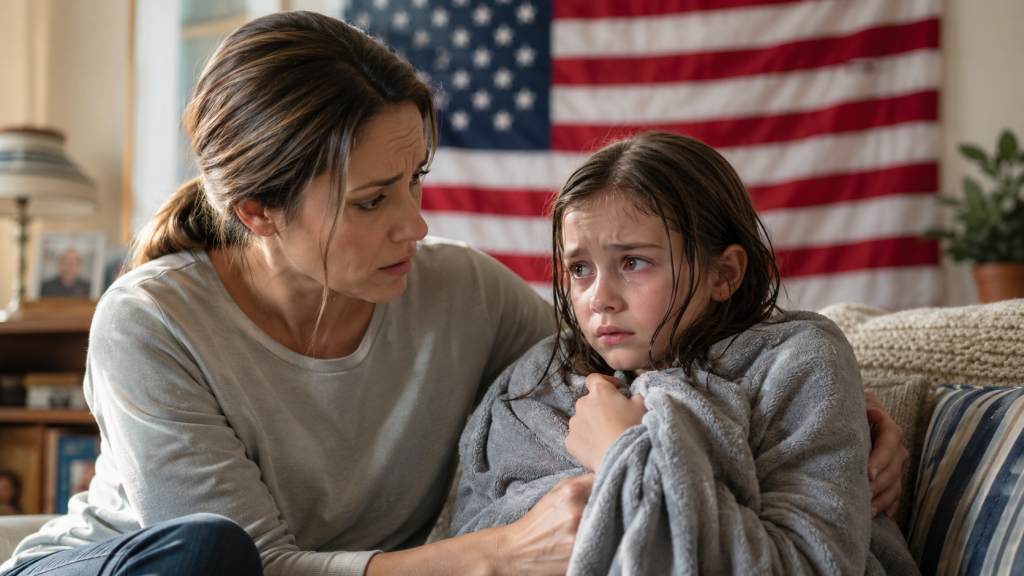
I did not ask another question there.
Not in front of the bus.
Not in front of the other parents.
Not in front of the woman watching my daughter too carefully.
I wrapped one arm around Renata’s shoulders and led her to the car.
She climbed in without speaking.
The gray blanket stayed around her like armor.
On the drive home, she stared out the window.
She smelled of heavy soap.
Not shampoo.
Not lake water.
The sharp kind used in school bathrooms when someone is trying to scrub away a problem.
“Baby,” I said softly, “are you hurt?”
She closed her eyes.
“I just want to go home.”
That was not an answer.
It was a plea.
When we reached the house, our dog Max came running to the door, tail thumping, barking with joy.
Renata usually dropped everything to hug him.
That night, she did not even bend down.
She stood by the door, shaking.
“I’m going to draw you a bath,” I said gently.
The color drained from her face.
“No.”
“Just to get you changed.”
“I don’t want to go in there.”
“Into the bathroom?”
Her breathing changed.
Fast.
Uneven.
Panicked.
“Don’t close the door.”
That was when the punch to my chest came.
Not fear.
Certainty.
Something had happened.
I crouched down in front of her without touching her.
I had learned years ago that scared children should be asked before being held.
“Renata, I’m going to call a doctor.”
“No.”
“I need to know you’re okay.”
Her lips trembled.
“The teacher said I wasn’t supposed to say anything.”
My blood went cold.
“Which teacher?”
“I can’t.”
“You don’t have to tell me now.”
“She said if we spoke up, the camp would be shut down. And everyone would hate me.”
I reached for my phone.
Not the camp director.
Not the coordinator.
Not another parent.
My voice sounded strange when the dispatcher answered.
Calm.
Too calm.
“My ten-year-old daughter just returned from a summer camp. She is in pain, she can’t sit down, she is terrified of the bathroom, and an adult told her not to talk. I need an ambulance and a police unit.”
The dispatcher’s voice changed immediately.
She asked for my address.
Then Renata’s age.
Then whether my daughter was safe from the people involved.
“Yes,” I said. “She is home with me.”
The dispatcher gave clear instructions.
Do not bathe her.
Do not change her clothes.
Do not wash anything.
Do not throw away the blanket.
Do not ask detailed questions.
Keep her calm.
Wait for help.
I looked at the blanket.
The damp hair.
The way my daughter stood as if her body hurt.
Then I looked at the small navy uniform shirt visible beneath the gray fabric.
For one second, motherly instinct screamed to take everything off her.
To clean her.
To make her comfortable.
To remove any trace of whatever had frightened her.
But the dispatcher’s voice held firm in my ear.
Preserve everything.
So I did.
I led Renata to the couch and sat nearby.
Not too close.
Not too far.
She cried without making a sound.
Tears slid down her cheeks, but her mouth stayed closed.
That broke me more than sobbing would have.
“Mom,” she whispered, “they’re going to say I made it all up.”
“I won’t.”
“The director says I’m a troublemaker.”
“Did the director speak to you?”
Renata closed her eyes.
“Everyone spoke to me.”
The doorbell rang fifteen minutes later.
Paramedics first.
Then two police officers.
I opened the door and felt the world split into before and after.
The female paramedic, Tanya, knelt a few feet away from Renata.
She did not rush.
She did not touch.
She spoke softly.
“Hi, Renata. My name is Tanya. Your mom called because she loves you and wants to make sure your body is okay. Is it okay if I sit here?”
Renata nodded slightly.
The male paramedic stayed near the door.
The officers spoke to me in the kitchen.
I told them only what I knew.
The bus.
The blanket.
The missing backpack.
The wet hair.
The bathroom fear.
The warning not to talk.
One officer asked, “Which camp is she coming from?”
“Saint Emily’s Academy. A retreat house in the Catskills.”
The officer stopped writing.
He looked at his partner.
“What?” I asked.
They exchanged a glance.
“We’ll talk at the hospital.”
Renata overheard from the living room.
Her head lifted.
“Another girl?”
The paramedic looked at her gently.
“You don’t have to talk right now.”
My daughter trembled.
“I thought they only punished Daniela.”
The officer turned back slowly.
“Who is Daniela?”
Renata lowered her head.
“The girl who didn’t get back on the bus.”
The house went completely silent.
Even Max stopped moving.
The officers did not pressure her.
They did not demand details.
They simply looked at one another, and something in their faces told me this was no longer only about my daughter.
At the hospital, they kept the blanket.
Sealed.
Dated.
Timed.
A nurse placed Renata’s clothing into separate evidence bags with a gentleness that made me cry.
They gave her a hospital gown.
They let me stay close.
They explained every step before doing anything.
Renata barely spoke, but she answered when asked simple questions.
Did anyone tell you not to talk?
Yes.
Did anyone wash your hair?
Yes.
Did anyone take your backpack?
Yes.
Did you see Daniela after the bus loaded?
No.
The doctor’s face stayed professional, but her eyes were devastated.
Within minutes, messages from the camp director started pouring into my phone.
Director Beatrice: Renata is confused.
Director Beatrice: It was all just an accident.
Director Beatrice: We need to recover the camp blanket.
Director Beatrice: Please do not involve outsiders before we clarify.
The officer took photos of the messages.
“Do not respond,” he said.
Twenty-five minutes later, Director Beatrice appeared at the hospital.
Impeccable.
Beige coat.
Expensive purse.
Parent-teacher-meeting smile.
She came with the coordinator, Paula, in tow.
“Gabriela,” Beatrice said, walking toward me quickly, “you’re blowing this way out of proportion.”
The police officer blocked her entry.
“You can’t go in there.”
“I am the director of the minor.”
“Exactly.”
Beatrice’s face tightened.
“I beg your pardon?”
The officer did not move.
“This is now a medical and police matter.”
Paula stood behind Beatrice, pale and trembling.
Her eyes kept flicking toward the hallway where Renata had been taken.
Beatrice claimed Renata had fallen.
First in the showers.
Then, according to Paula, near the pool.
The two women looked at each other.
Too late.
The contradiction hung in the air like smoke.
Then Paula’s phone vibrated.
She tried to hide it, but the screen stayed facing me.
I read the messages before she turned it away.
We already cleared the cameras.
We still need to find the red backpack.
The police officer saw my face and turned.
“Ma’am, hand over the phone.”
Paula went white.
Beatrice lost her voice.
The doctor came out of the room then, removing her gloves.
She looked at Beatrice with controlled fury.
“The absurdity is that a child showing these signs was bathed, changed, and sent home without a medical evaluation.”
No one answered.
Then Renata came out in a hospital gown.
When she saw the director, she stiffened so hard I thought she might collapse.
Beatrice softened her voice.
“Renata, honey. Just tell them it was a fall.”
My daughter stepped back.
“Mom…”
I moved toward her slowly.
“Can I hug you?”
She nodded.
I wrapped my arms around her carefully, protectively, feeling how small she was beneath the hospital gown.
Then Beatrice said, “Remember what we agreed on.”
The officer turned sharply.
“What did you agree on?”
Renata buried her face in my chest and whispered, “That Daniela was never there.”
The entire hallway went breathless.
Paula collapsed into a chair.
Beatrice tried to leave, but the police cut her off.
Renata looked up, shivering.
“Mom…”
“What is it, baby?”
“Daniela is still at the house.”
“At what house?” the officer asked.
My daughter looked straight at the director.
“In the room without windows.”
Everything moved after that.
Not fast like in movies.
Fast like adults suddenly realizing a child had been left somewhere dangerous.
The officer stepped away and called for state police.
Another officer stayed with us.
Hospital security placed Beatrice and Paula in separate rooms.
A detective arrived within twenty minutes.
She wore plain clothes, spoke softly, and introduced herself to Renata as Detective Elena Morales.
She did not ask my daughter to tell the whole story.
She only asked enough to understand where Daniela might be.
“Renata,” she said gently, “you said a room without windows. Can you tell me anything near that room?”
Renata held my hand so hard her nails pressed into my skin.
“Laundry machines.”
“Okay.”
“That buzzing light.”
“Good.”
“Stairs that go down.”
“Was Daniela moving when you last saw her?”
Renata’s eyes filled.
“She was crying.”
Detective Morales nodded.
“That helps us. You helped her.”
My daughter shook her head.
“I left her.”
“No,” Detective Morales said. “You came back. That is different.”
At 12:06 a.m., state police units reached Saint Emily’s Academy retreat house.
At 12:19, officers entered the building with a warrant.
At 12:31, Detective Morales received a call.
She stepped into the hallway.
I watched her listen.
Her mouth tightened.
Then she returned to us.
“They found the basement,” she said.
My heart stopped.
“And Daniela?”
“They are still searching.”
Renata made a sound so broken I pulled her closer and whispered, “Breathe with me. Just breathe with me.”
The next forty-six minutes were the longest of my life.
Renata lay against me in the hospital bed, exhausted but unable to sleep.
Every time footsteps approached, her body flinched.
At 1:17 a.m., the detective’s phone rang again.
She answered.
She listened.
Then her eyes filled with tears.
She covered the microphone for one second and looked at me.
“They found her.”
“Alive?”
Detective Morales nodded.
“Alive.”
Renata began crying for the first time.
Loud.
Broken.
Uncontrolled.
The kind of crying that finally believes someone might be safe enough to hear it.
I held her while she shook.
Across the hallway, Paula started sobbing when she heard the news.
Beatrice sat silent in the security room, staring straight ahead.
Later, we learned Daniela had been found in a locked storage room beneath the retreat house.
No windows.
A narrow mattress.
Laundry pipes along one wall.
A buzzing fluorescent light overhead.
Her red backpack was missing.
Her camp uniform was gone.
But she was alive.
That was the only word that mattered at first.
Alive.
The investigation uncovered the truth piece by piece.
Children threatened into silence.
Staff trained to protect the camp’s reputation before the children.
Incident reports rewritten.
Parents dismissed as anxious.
Cameras erased.
Uniforms washed.
Phones confiscated.
Backpacks hidden.
And a punishment system no brochure had ever mentioned.
Children who complained were labeled difficult.
Children who cried were isolated.
Children who told the truth were warned they would ruin camp for everyone.
Daniela had refused to repeat the approved story.
So she did not get back on the bus.
Renata had been washed, wrapped in a camp blanket, and sent home with a lie.
The only reason they failed was because my daughter spoke one sentence too many.
The girl who didn’t get back on the bus.
Beatrice kept insisting she had protected the institution.
The detective answered her during questioning with a sentence that later stayed with me.
“You protected adults and punished children.”
Three days later, police were at the homes of every adult involved.
The camp’s director.
Two senior counselors.
The coordinator.
The maintenance manager who controlled the basement keys.
A nurse who had never documented Renata’s condition.
And a board member who had received previous complaints and buried them quietly.
Renata’s blanket, uniform, and the messages became evidence.
Daniela’s red backpack was found behind a false panel in the laundry room wall.
Inside were drawings, a friendship bracelet, and a small notebook where she had written names.
Not just hers.
Other girls.
Other summers.
Other warnings adults had ignored.
When Beatrice saw the backpack in court, her perfect face collapsed.
Not because she felt sorry.
Because she knew the bag had become louder than she was.
Parents came forward one by one.
Some angry.
Some ashamed.
Some shaking.
A father admitted his son had begged not to return the previous year, and he had thought it was homesickness.
A mother said her daughter refused to shower alone for months, and the camp told her it was “attention-seeking.”
Another family had withdrawn quietly after their child came home with unexplained panic, but they had never reported it because the school threatened defamation.
Shame had protected Saint Emily’s longer than loyalty ever could.
I understood that shame too well.
For the first week after Renata came home from the hospital, I blamed myself for everything.
For choosing the camp.
For trusting the brochure.
For not noticing fear in the drop-off photos.
For telling Renata she would have fun.
For not driving to the Catskills the moment I felt uneasy.
Detective Morales stopped me one afternoon.
We were sitting in the family advocacy office while Renata met with a child specialist.
“You called 911 within minutes,” she said.
“I still sent her there.”
“You sent her to a licensed camp with background checks, references, and a school affiliation. Predators rely on good parents trusting official doors.”
I looked away.
“My daughter came home broken.”
“She came home,” the detective said gently. “And because you listened, another child did too.”
Healing was not clean.
Renata hated closed bathroom doors.
She hated gray blankets.
She hated heavy soap.
She slept with all the lights on.
For weeks, she would not let her hair get wet.
At first, I washed it with a damp cloth in the kitchen while she sat wrapped in my robe and watched cartoons.
Then, little by little, with therapy and patience, she moved closer to water.
A bowl.
A sink.
The bathroom door open.
Me sitting on the floor outside.
The first time she took a shower again, she cried afterward from exhaustion.
Then she asked for pancakes.
I made them immediately.
Some victories deserve syrup.
Daniela came over one afternoon with her mother, Sofia.
She was eleven.
Small for her age.
Quiet.
She wore a yellow sweater and kept her hands folded in her lap.
Renata saw her from the hallway and froze.
For a second, neither girl moved.
Then Daniela lifted one hand.
Renata ran to her.
They hugged for a long time.
No dramatic words.
No explanations.
They did not need to speak much.
They had survived the same secret.
The girls sat together on our porch while Sofia and I stayed inside near the window.
Renata showed Daniela Max’s tricks.
Daniela smiled once.
It was small.
But it was real.
Sofia watched with tears running silently down her face.
“She told me she missed the bus,” she whispered. “That was what the camp said. They said she ran away because she was embarrassed.”
I felt sick.
“They told me Renata was carsick.”
Sofia closed her eyes.
“They count on us being confused.”
“No,” I said. “They count on us calling them first.”
That was the truth.
If I had called Beatrice before 911, evidence would have vanished.
Stories would have been aligned.
Blankets collected.
Uniforms washed.
Backpacks hidden more carefully.
My daughter would have been pressured again before anyone protected her.
Calling emergency services had saved time.
Time had saved evidence.
Evidence had saved Daniela.
Months later, the camp was shut down permanently.
The board tried to rebrand.
Parents protested.
Survivors testified.
Licenses were revoked.
Civil lawsuits followed.
Criminal trials took longer.
Longer than they should have.
Longer than any child deserves.
But the adults who thought reputation was stronger than truth learned something.
Children remember.
Bodies remember.
Evidence remembers.
And mothers who listen can become dangerous.
Renata testified through a child advocacy process, not in the open courtroom.
She wore her favorite purple sweater and held a smooth stone in her hand.
Detective Morales stayed nearby.
So did I.
When the interviewer asked what she wanted adults to know, Renata thought for a long time.
Then she said, “If a kid says they don’t want to go somewhere, don’t call them dramatic first.”
I wrote that sentence down later.
I keep it in my wallet.
A year after the bus came home, Renata and Daniela planted flowers in our backyard.
Yellow marigolds.
Purple petunias.
White daisies.
Renata said the daisies were for girls who still needed someone to listen.
Daniela said marigolds were brave because they looked like little suns.
They dug holes in the soil with serious faces while Max tried to steal the gardening gloves.
I watched from the porch with Sofia.
The girls laughed when Max sneezed into the dirt.
That laugh felt impossible.
And because it felt impossible, it also felt holy.
Renata still had hard days.
So did I.
Sometimes a smell could pull her back.
Sometimes a closed door.
Sometimes a wet towel left on the floor.
But fear no longer ruled every room.
We learned new rules.
No adult gets automatic trust.
Secrets that make children scared are not safe secrets.
A child does not have to be polite to someone who makes their body feel unsafe.
Questions are allowed.
No is allowed.
Calling for help is allowed.
One night, Renata asked if I was angry that she did not tell me sooner.
I nearly dropped the laundry basket.
“No, baby.”
“You promise?”
I sat beside her bed.
“I am proud that you told me anything at all.”
Her eyes filled.
“I thought everyone would hate me.”
I touched her blanket, careful not to touch her without asking.
“Anyone who hates a child for telling the truth has something to hide.”
She thought about that.
Then she whispered, “Daniela said I saved her.”
“You did.”
“But I was scared.”
“You can be scared and still save someone.”
She nodded slowly.
Then she asked me to leave the hallway light on.
I did.
My daughter returned from camp with wet hair, a blanket that wasn’t ours, and a fear of entering the bathroom so deep it changed the air in our home.
The coordinator told me she was carsick.
The director told me it was an accident.
The camp told children silence was kindness.
But my daughter’s body told another story.
So I listened.
I did not bathe her.
I did not change her.
I did not call the camp to ask whether I was overreacting.
I called 911.
That decision led to sealed evidence.
Sealed evidence led to the messages.
The messages led to Daniela’s name.
Daniela’s name led police to the house in the Catskills.
And behind a locked door in a room without windows, another child was found alive.
People later called me brave.
I do not think I was brave.
I think I was a mother who finally understood that panic can wait, but action cannot.
A child’s terror is not drama.
It is information.
A missing backpack is information.
Wet hair is information.
A stranger’s blanket is information.
A fear of bathrooms is information.
And when adults rush to explain those things away, that is information too.
Renata is eleven now.
She swims again.
Only in places she chooses.
She still checks bathroom locks twice.
She still likes the door open when she washes her hair.
But she laughs louder than before.
She draws brighter colors.
She has a friendship bracelet from Daniela tied around her lamp.
Sometimes, when she thinks I am not looking, she touches it like proof.
Proof that she came home.
Proof that Daniela came home too.
Proof that the truth can survive even when powerful adults try to wash it away.
The camp director once told my daughter to remember what they agreed on.
That Daniela was never there.
But Daniela was there.
Renata was there.
The evidence was there.
And I was there when my daughter finally whispered the truth into my shirt.
I will be grateful for that whisper for the rest of my life.
Because that whisper became a siren.
And that siren became the sound of locked doors opening.
THE END! THANKS FOR READING!