 Reading Time: 58 minutes
“Robert,” my son repeated, trying to sound confident. “Dad’s middle name was Robert. What does that have to do with anything?” I looked at the thirty-five-year-old man standing in front of me.
The man I had carried inside my body. The little boy whose fever I had watched through sleepless nights. The teenager whose college tuition I had paid by working sixteen-hour days.
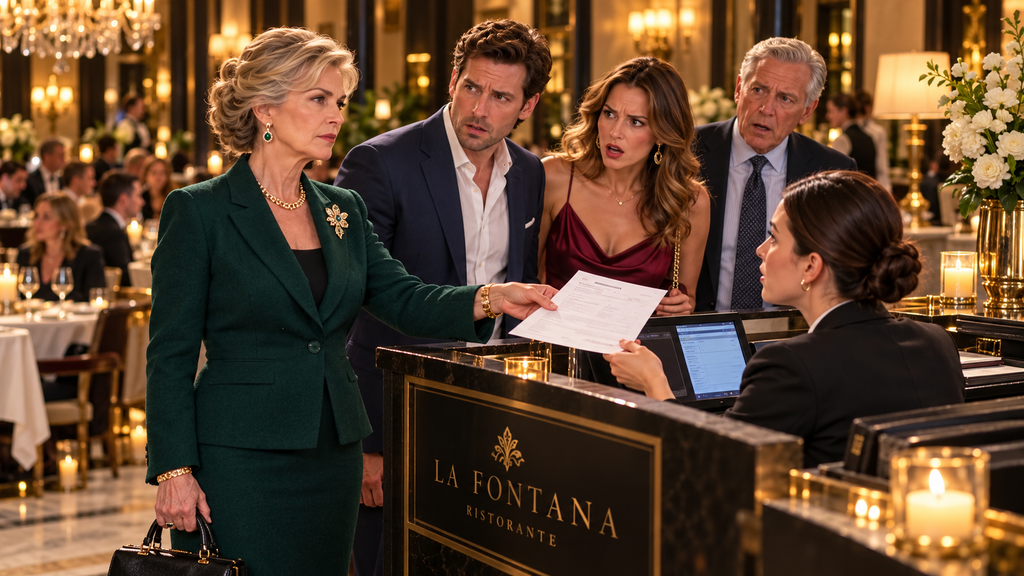
And now, the stranger who was trying to steal thirty-eight thousand dollars from me while pretending I had lost my mind.
I felt something inside my chest quietly break.
“Adam,” I whispered, “your father’s middle name was Vincent.”
His expression changed.
“Thomas Vincent Whitmore.”
I touched the pearl brooch pinned to my navy jacket.
“And your middle name is Vincent, too. We named you after him.”
Nobody spoke.
Not Vanessa.
Not her parents.
Not the six relatives standing behind them.
For a few terrible seconds, all I could hear was the soft Italian music coming from the restaurant speakers.
Then Adam looked down at the folded document in his hand.
And I understood.
He hadn’t simply forgotten his father’s name.
He had memorized the wrong name from the forged paperwork.
“Let me guess,” I said quietly. “That document identifies my late husband as Thomas Robert Whitmore.”
Adam’s fingers tightened around the paper.
That was all the confirmation I needed.
Vanessa stepped forward.
“Margaret, this is ridiculous. You’re making everyone uncomfortable.”
I turned toward her.
“Good.”
Her perfectly painted smile disappeared.
“Excuse me?”
“Everyone should be uncomfortable when someone attempts to steal thirty-eight thousand dollars from an elderly woman.”
Graham Price gave a dismissive laugh.
“Steal? That’s a rather serious accusation.”
“Yes,” I replied. “It is.”
Then I looked at Sofia, the restaurant manager.
“Would you please ask the guests to step away from the reception desk? And call Elena.”
Sofia’s expression sharpened.
“Of course, Mrs. Whitmore.”
Adam frowned.
“Who’s Elena?”
I didn’t answer.
Because the next few minutes were going to teach my son something he should have learned a very long time ago.
The difference between a mother who loves you…
And a mother you can rob.
The Document That Exposed Everything
Sofia picked up the telephone behind the reception desk.
“Could you ask Elena Ruiz to come downstairs, please? Mrs. Whitmore is here.”
Graham looked annoyed.
“Who exactly is Elena Ruiz?”
Sofia maintained her professional smile.
“Our regional operations director, sir.”
Vanessa rolled her eyes.
“Wonderful. Now we’re involving management because Margaret wants attention.”
I studied my daughter-in-law.
She was thirty-three, elegantly dressed in a cream-colored designer outfit, with diamond earrings that probably cost more than most people earned in three months.
For seven years, I had tried to love her as my own daughter.
I had bought her flowers when she opened her interior design business.
I had helped Adam make the down payment on their first home.
When Vanessa’s mother needed surgery, I had sent meals to their house for two weeks.
And whenever Vanessa forgot my birthday, I made excuses for her.
She’s busy.
She’s young.
She’s adjusting to marriage.
But standing there on Mother’s Day, listening to her ridicule me in front of her family, I finally understood something.
You cannot buy someone’s affection with kindness.
And the more you excuse their cruelty, the more comfortable they become showing it.
“Margaret,” Celeste Price said sharply, “you’re embarrassing your son.”
I looked directly at her.
“Interesting. I thought forging your mother’s signature would be the embarrassing part.”
Her face reddened.
“Watch your tone.”
“Celeste, I’m sixty-eight years old. You don’t get to tell me how to speak.”
A few customers near the entrance glanced toward us.
I lowered my voice.
“I would prefer to handle this privately. Whether that happens depends entirely on your family.”
Adam stepped closer.
“Mom, please. You’re misunderstanding everything.”
“Then explain it.”
He swallowed.
“It’s a family event.”
“Whose family?”
He glanced at Vanessa.
“Our family.”
“Am I invited?”
Silence.
I nodded.
“That’s what I thought.”
He rubbed his forehead.
“Mom, can we not do this right now?”
“You were perfectly comfortable using my money right now.”
“It’s not like that.”
“Then give Sofia the document.”
Adam hesitated.
Vanessa immediately reached toward him.
“Don’t. She’ll twist everything.”
That was the moment I saw something move behind Adam’s eyes.
Fear.
Not concern for my feelings.
Not embarrassment about Mother’s Day.
Fear of what might happen if someone actually examined the paperwork.
And that frightened me more than the thirty-eight thousand dollars.
Because people who are innocent generally want misunderstandings cleared up.
People who are guilty want conversations to end.
“Adam,” I said, holding out my hand, “give me the document.”
He took one step backward.
“No.”
I lowered my hand.
“Very well.”
Then I turned to Sofia.
“Please preserve the security footage from this entrance and reception desk. And make sure the pending charge stays unprocessed.”
Sofia nodded.
“It’s already on hold.”
Vanessa scoffed.
“Oh, so now you think you run this restaurant?”
I looked at her.
For the first time that evening, I smiled.
“Yes, Vanessa.”
I paused.
“Actually, I do.”
The Secret My Son Never Bothered to Learn
Nobody laughed.
Perhaps something in my voice told them I wasn’t joking.
Graham looked between Sofia and me.
“That’s absurd.”
I didn’t respond.
There was no reason to argue with a man who had already decided I was incapable of understanding my own finances.
Instead, I waited.
Less than three minutes later, a woman in a charcoal-gray pantsuit approached from the hallway behind the dining room.
Elena Ruiz.
Forty-six years old.
Former hotel executive.
Brilliant at her job.
And one of the people who had helped me turn a struggling hospitality investment into a thriving business.
She stopped beside me.
“Margaret. Sofia said there was an issue.”
I nodded toward Adam.
“My son is attempting to authorize a thirty-eight-thousand-dollar charge against my Founder’s Reserve account.”
Elena’s expression hardened.
“Without your permission?”
“Without my permission.”
She turned to Sofia.
“Has anything been processed?”
“No. I requested identification and written authorization. Mr. Whitmore provided a document that appears to contain Mrs. Whitmore’s signature.”
“Appears to?” Elena repeated.
I held her gaze.
“Because I didn’t sign it.”
The atmosphere changed.
This was no longer a wealthy family having an uncomfortable disagreement in a restaurant lobby.
This was a possible financial crime.
Elena looked at Adam.
“Sir, I’m going to ask you to provide that document for review.”
Adam forced a laugh.
“This is getting ridiculous. My mother’s simply confused.”
Elena didn’t smile.
“Mr. Whitmore, I have worked with your mother for six years. I don’t believe she’s confused.”
Vanessa folded her arms.
“And who exactly are you?”
“Elena Ruiz. Regional operations director for Whitmore Hospitality.”
Graham went still.
“Whitmore Hospitality?”
“Yes.”
He glanced at me.
Then at Elena.
“What does that company have to do with Bellavita?”
Elena hesitated.
I gave her a small nod.
She straightened.
“Whitmore Hospitality holds the controlling ownership interest in Bellavita. Mrs. Margaret Whitmore is its majority owner and chairwoman.”
For a moment, nobody moved.
Vanessa opened her mouth.
Closed it.
Then laughed nervously.
“That’s impossible.”
“It’s public corporate information,” Elena replied.
Graham stared at me.
“You own Bellavita?”
“I control the company that owns it.”
“Since when?”
“Six years.”
His face drained of color.
I could almost see the numbers turning inside his head.
Six years.
Six years of invitations he had declined.
Six years of conversations in which he had called me a lonely old widow living on my husband’s savings.
Six years of telling my son that his mother had no business sense.
What Graham didn’t know was that my late husband and I had built our wealth together.
Thomas had been an electrical engineer.
I had started out managing the accounts for a small catering company.
By thirty-eight, I was running my own food distribution business.
By fifty, I had warehouses, commercial properties, and investments in restaurants across Massachusetts.
I had sold the distribution company before Thomas became ill.
After he passed away, I began investing more heavily in hospitality.
Bellavita was one of those investments.
The restaurant had been struggling when I acquired my controlling interest.
Its food was excellent, but its management was poor.
The previous owners had cut staff benefits, ignored maintenance, and made decisions that drove loyal customers away.
I had spent years rebuilding it with Elena and our executive chef.
Now it was one of Boston’s most respected Italian restaurants.
My son knew I had investments.
He knew I occasionally attended business meetings.
He knew I had enough money to live comfortably.
But he had never once asked me what I actually did.
To Adam, I was simply Mom.
The woman who brought homemade soup when he was sick.
The woman who remembered every anniversary.
The woman he could ignore until he needed something.
And apparently, the woman whose signature he believed he could forge.
Vanessa looked at her husband.
“Adam, did you know about this?”
His voice cracked.
“No.”
I believed him.
And somehow, that made everything sadder.
He had spent years looking down on me without ever becoming curious about the person I was.
Graham cleared his throat.
“Well, Margaret, now that we understand the situation, surely we can settle this privately.”
I turned toward him.
“Oh, we’re going to handle it properly, Graham.”
He exhaled.
“Excellent.”
I continued.
“But first, I’m going to find out what else you’ve been doing with my name.”
That was when Vanessa suddenly grabbed Adam’s arm.
Hard.
“Adam,” she whispered, “we need to leave.”
I noticed.
So did Elena.
And for the first time that evening, I wondered whether the forged restaurant authorization was only the beginning.
The Envelope That Was Never Meant for Me
“Leaving already?” I asked.
Vanessa froze.
“We have another engagement.”
I glanced at the family members standing behind her.
“Your thirty-eight-thousand-dollar reception hasn’t even been approved.”
Celeste lifted her chin.
“We don’t need to be subjected to this interrogation.”
“No,” I agreed. “You don’t. You’re free to leave.”
Graham looked relieved.
“Finally, some common sense.”
“But before you do, there’s something you should understand.”
I stepped closer to the reception desk.
“No charge will be authorized against my account. And I will be asking my attorney to examine the document Adam presented.”
Graham’s relief vanished.
“Attorney?”
“Yes.”
“For a family disagreement?”
“For a forged financial authorization.”
Vanessa interrupted.
“You keep saying forged like it’s a fact!”
I looked at her.
“Then let the document prove me wrong.”
Adam stood motionless.
His hands had begun trembling.
I remembered those hands as tiny fists wrapped around my fingers.
I remembered teaching him to hold a pencil.
Helping him write his name.
Watching him sign his first employment contract.
Now those same hands held a document bearing a signature he knew didn’t belong there.
“Adam,” I said softly, “if you want Sofia to review that paperwork, you’ll have to give it to her.”
Graham touched his shoulder.
“Go ahead, son. We have nothing to hide.”
Vanessa turned sharply toward her father.
“Dad—”
“Vanessa,” Graham snapped, “be quiet.”
That caught my attention.
It was the first time I had ever heard Graham speak to his precious daughter that way.
Adam placed the folded papers on the counter.
Sofia carefully opened them.
The first page was a restaurant charge authorization.
The second was a document labeled Durable Power of Attorney.
And the third was a letter.
A medical letter.
My mouth went dry.
At the top was my full name.
Margaret Elaine Whitmore.
Below it was a paragraph stating that I had displayed signs of progressive cognitive impairment and could no longer reliably manage complicated financial decisions.
It was dated April twenty-third.
Sixteen days before Mother’s Day.
I stared at the paper.
For a moment, the sounds around me became distant.
They hadn’t simply planned to steal money.
They had prepared a story explaining why I wouldn’t be allowed to object.
“Who wrote this?” I asked.
Adam said nothing.
I lifted the third page.
“Who wrote this letter?”
Vanessa crossed her arms.
“It’s a medical assessment.”
“From which doctor?”
She pointed toward the bottom.
“The name is right there.”
I read it aloud.
“Dr. Daniel Pierce.”
I looked at her.
“I’ve never met Dr. Daniel Pierce.”
Graham stepped in smoothly.
“Your son arranged a confidential consultation.”
“Without me?”
“For your benefit.”
I laughed.
Not because anything was funny.
Because sometimes the truth is so ugly that your body doesn’t know how else to react.
“You arranged a medical consultation to determine whether I was mentally competent,” I said, “without the patient?”
Celeste’s lips tightened.
“Margaret, elderly people often don’t recognize when they’re declining.”
I looked straight at her.
“Neither do dishonest people.”
Her mouth fell open.
Elena leaned toward the papers.
“Margaret, I think you should let your attorney examine these.”
“Yes,” I replied. “I think I should.”
Adam finally found his voice.
“Mom, I can explain.”
I turned toward him.
“Then explain why there is a medical letter claiming I am incompetent.”
He looked at his wife.
I waited.
“Adam?”
He swallowed.
“Vanessa said it was just a precaution.”
Vanessa spun toward him.
“Don’t you dare put this on me!”
“I’m not—”
“You agreed!”
And there it was.
Two words.
You agreed.
The first crack in the story they had prepared.
Graham placed a firm hand on Vanessa’s shoulder.
“Enough.”
She fell silent.
But I had heard what I needed to hear.
My son hadn’t accidentally brought the wrong document.
He hadn’t misunderstood a family membership.
He had agreed to participate in something designed to take control of my financial life.
And the realization hurt far more than any amount of stolen money ever could.
I looked at Sofia.
“Please make copies for our records. Keep the original paperwork in view while you do.”
Sofia nodded.
“Of course.”
Adam didn’t object.
He seemed almost relieved that someone else was taking control of the situation.
I took my phone from my purse.
There was one person I needed to call.
A woman named Naomi Fletcher.
My attorney.
My friend.
And the person who had spent twelve years helping me protect everything Thomas and I had built.
She answered on the second ring.
“Margaret? Happy Mother’s Day.”
“Thank you, Naomi.”
There was a pause.
“You don’t sound happy.”
“I’m at Bellavita. Adam has presented what appears to be a forged power of attorney, along with a letter claiming I’m mentally incompetent.”
Silence.
Then her voice changed.
“Margaret, listen carefully. Don’t sign anything. Don’t agree to any transfer. Preserve the documents and tell me exactly who is present.”
I looked at the family gathered in front of me.
“My son. My daughter-in-law. Her parents. And several witnesses who were invited to watch me pay for their celebration.”
Naomi inhaled slowly.
“I’m going to contact our financial security counsel. Can Elena secure the records?”
“Yes.”
“Good. We also need to review any recent changes to your accounts and trusts.”
I looked at Adam.
He had gone pale.
Naomi continued.
“And Margaret?”
“Yes?”
“Has anyone recently asked you to sign anything unusual?”
I thought back.
And suddenly, I remembered an envelope.
An envelope Adam had brought to my house three weeks earlier.
He had arrived on a Wednesday evening carrying flowers.
That should have been my first warning.
My son hadn’t brought me flowers without an occasion in years.
He had sat at my kitchen table, eaten the lemon cake I’d baked, and casually mentioned that he needed my signature on some documents.
“Just estate-planning updates, Mom,” he had said.
I remembered laughing.
“Since when are you interested in my estate plan?”
He had kissed my cheek.
“Since I realized you’re not getting any younger.”
I hadn’t signed.
I had told him to send everything to Naomi.
He’d looked disappointed.
Then he’d collected the papers and left.
At the time, I’d thought nothing of it.
Now I understood.
That had been their first attempt.
And when I refused to sign voluntarily…
They had apparently decided to invent my consent.
“Naomi,” I said slowly, “we may have a bigger problem.”
The Son Who Tried to Replace My Signature
Elena offered us the smaller private dining room off the main corridor.
It was called the Florence Room.
Six years earlier, when Bellavita had been struggling financially, I had approved the renovation of that very room.
I had chosen the wallpaper myself.
Soft cream.
Olive-green accents.
A painting of the Tuscan countryside above the fireplace.
I never imagined I would sit there one day confronting my son about financial fraud.
But life has a cruel way of turning familiar places into memories you wish you could erase.
Adam entered first.
Vanessa followed.
Graham and Celeste came behind them.
The six other relatives had quietly left after Elena explained that the restaurant would not be proceeding with the reservation or charge authorization.
They had arrived expecting champagne.
They departed without making eye contact.
I almost envied them.
They could leave this nightmare.
I couldn’t.
Adam was my child.
There was no doorway through which I could walk and make that fact disappear.
Sofia brought water.
I thanked her.
She gave my shoulder a gentle squeeze before returning to the reception desk.
Elena remained with us.
“Mrs. Whitmore,” she said, “we’ve secured copies of the submitted documents and preserved the relevant transaction records.”
“Thank you.”
Graham leaned forward.
“This is getting completely out of proportion.”
I stared at him.
“You attempted to charge thirty-eight thousand dollars to an account you didn’t own.”
He spread his hands.
“Your son is your authorized representative.”
“No, he isn’t.”
“He had paperwork.”
“Forged paperwork.”
Graham’s jaw tightened.
“You can’t simply make accusations whenever something doesn’t go your way.”
I leaned back.
“Graham, do you know what makes an accusation different from a conclusion?”
He said nothing.
“Evidence.”
I pointed toward the papers.
“Right now, I’m collecting it.”
Celeste exhaled dramatically.
“This is appalling. We came here to celebrate Mother’s Day.”
I turned toward her.
“Then perhaps you should have invited the mother whose money you intended to use.”
She looked away.
For several minutes, nobody spoke.
Then Adam lowered himself into the chair opposite mine.
“Mom.”
I looked at him.
“Can we please talk alone?”
Vanessa immediately protested.
“Absolutely not.”
I watched Adam’s face.
His eyes were red.
The confidence he’d displayed at the reception desk had disappeared.
For a moment, I saw the frightened little boy who used to run to me when thunderstorms shook the windows.
But I forced myself to remember what he’d done.
“Adam,” I said, “you can speak freely. Or you can choose not to. But I’m not going to conceal what happened simply because we’re related.”
He rubbed his hands together.
“I didn’t think it would come to this.”
I felt my throat tighten.
“Come to what?”
He stared at the table.
“All of this.”
“Did you think I would never find out?”
He didn’t answer.
“Did you think I wouldn’t notice thirty-eight thousand dollars missing?”
He shook his head.
“No. It’s not—”
“Then tell me what you thought.”
His voice became almost inaudible.
“Vanessa said there was enough in your accounts that you wouldn’t miss it.”
I closed my eyes.
For one brief second.
When I opened them, I looked directly at my daughter-in-law.
“Enough that I wouldn’t miss it?”
Vanessa lifted her chin.
“Don’t act like you’ve never helped family before.”
“Helping family is when someone asks for help.”
I paused.
“Stealing is when someone takes it without permission.”
She scoffed.
“Everything is so dramatic with you.”
“No, Vanessa. Everything is very simple. Did I authorize this transaction?”
Silence.
“Did I sign that power of attorney?”
Silence.
“Did I give you or your husband permission to describe me as mentally incompetent?”
She looked toward Graham.
And in that instant, I understood who had taught her to turn every question into someone else’s problem.
Graham leaned forward.
“Margaret, perhaps I should explain the business arrangement.”
I met his eyes.
“Please do.”
He straightened his cuff.
“Adam and Vanessa are establishing a new investment venture. It has tremendous growth potential. We were arranging an event to introduce prospective partners.”
“Using my money.”
“Using available family resources.”
“Without asking me.”
“Your son assured me you wouldn’t object.”
I turned to Adam.
“Did I ever tell you that?”
He shook his head.
Graham’s face tightened.
“Adam, be careful what you say.”
I looked back at him.
“Why?”
“Because families should resolve these matters privately.”
I smiled without warmth.
“You’ve been treating me like an outsider all evening. Now that the money has become a problem, suddenly we’re family.”
He flushed.
Vanessa slammed her palm against the table.
“Fine! You want the truth?”
I looked at her.
“Yes.”
“We were planning to pay it back!”
There was silence.
I folded my hands.
“With what money?”
She hesitated.
Graham looked sharply at her.
“With what money, Vanessa?” I repeated.
She glanced at her father.
Then at Adam.
Finally, she muttered, “After the financing closed.”
Something cold moved through me.
“What financing?”
Nobody answered.
I turned toward Graham.
“What financing?”
He stared at me.
And for the first time, I saw something beneath his expensive watch, tailored suit, and practiced arrogance.
Desperation.
“Margaret,” he said carefully, “there are larger business considerations involved.”
I leaned forward.
“Then I suggest you start telling me about them.”
The Thirty-Eight-Thousand-Dollar Dinner Was Only the Beginning
My phone vibrated.
A message from Naomi.
She had reviewed the photographs Elena had securely sent through our attorney’s intake system.
Her message was short.
The power of attorney raises serious authenticity concerns. Do not rely on it. We are contacting your financial institutions to flag possible fraud. Call me when you can speak privately.
I stood.
“Excuse me.”
Adam immediately looked up.
“Where are you going?”
“To speak with my lawyer.”
Vanessa laughed bitterly.
“Of course you are.”
I stopped beside her chair.
“Vanessa, you keep treating legal advice as though it’s an insult.”
She looked at me.
“Maybe because you’re using it to threaten us.”
“No. I’m using it because someone has falsified documents in my name.”
Elena followed me into the hallway.
Once the door closed, she lowered her voice.
“Margaret, there’s something else.”
My stomach tightened.
“What?”
“This isn’t the first time Adam has attempted to use your membership.”
I stared at her.
“Explain.”
She took out a tablet.
“Last month, our Boston office received a request to add Adam as an authorized account administrator. It was rejected because the signature didn’t match our records.”
I felt the blood drain from my face.
“When?”
“April eighteenth.”
Five days before Adam brought those estate-planning papers to my house.
“Who submitted it?”
“An email account registered to Vanessa Price Whitmore.”
For a moment, I couldn’t speak.
Elena continued.
“A second request arrived on April twenty-fifth. This one included what appeared to be a power-of-attorney form. Our finance department referred it to compliance.”
“Why wasn’t I contacted?”
“The team sent a verification request to the mailing address listed on the submission. When they didn’t receive confirmation, they held the request. I only learned about the situation during today’s escalation.”
I exhaled.
“What address?”
Elena hesitated.
Then she showed me the screen.
A street address in Brookline.
I recognized it immediately.
It was the address of Adam and Vanessa’s house.
Not mine.
They had attempted to redirect verification notices to themselves.
I stared at the screen.
Two requests.
Two attempts.
Both before Mother’s Day.
This wasn’t an impulsive mistake made by a frightened couple.
It was a plan.
A plan that had been developing for weeks.
“Preserve everything,” I said.
“Already requested.”
“And Elena?”
“Yes?”
“Thank Sofia for refusing that charge.”
Elena’s expression softened.
“She did exactly what she was trained to do.”
“She may have saved me from something much worse.”
I called Naomi.
She answered immediately.
“I’ve seen the documents,” she said. “Margaret, this is serious.”
“Tell me.”
“The purported power of attorney appears to grant Adam authority over almost all of your personal and financial affairs.”
I leaned against the wall.
“How much authority?”
“Property transactions. Banking. Investments. Certain contractual decisions. Almost everything an agent could be authorized to manage.”
I closed my eyes.
“And the medical letter?”
“It’s being used to support the claim that you can no longer manage your affairs. But a letter alone doesn’t declare someone legally incompetent, and it certainly doesn’t establish that this power of attorney is valid.”
“Thank God.”
“Don’t relax yet.”
My eyes opened.
“Why?”
“Because I checked the inquiry log from your estate-planning office. Someone contacted the office three weeks ago asking what would happen to your revocable trust if you became incapacitated.”
I stopped breathing for a moment.
“Who?”
“The caller identified himself as your son.”
I stared through the narrow window into the private dining room.
Adam sat with his head lowered.
Vanessa was whispering urgently to Graham.
Celeste sat perfectly still.
I had never felt so far away from my own family.
“What did your office tell him?” I asked.
“Only general information. Nothing confidential.”
“Good.”
“Margaret, there’s something else I need to ask.”
“Yes?”
“Have you recently noticed anyone searching through your study, handling old documents, or taking photographs of your papers?”
My heart sank.
Because I remembered another visit.
Two months earlier.
Adam and Vanessa had come for Sunday lunch.
Vanessa claimed she had a migraine.
She asked to lie down in the guest room upstairs.
Later, when I went to check on her, I found her in the hallway outside my study.
She was holding her phone.
She laughed and said she’d gotten lost looking for the bathroom.
I hadn’t thought twice about it.
Now I could see the scene with terrible clarity.
The open study door.
The file cabinet.
Her nervous smile.
“Naomi,” I whispered, “I think someone may have accessed my personal documents.”
She became very quiet.
Then she said something that made my hands go cold.
“Margaret, I want you to look at the signature on the forged authorization again.”
“Why?”
“Because I recognize it.”
I stared at the floor.
“What do you mean?”
“It’s extremely similar to the signature on the property agreement you executed in 2019.”
I remembered the agreement.
A commercial building outside Boston.
The last major investment Thomas had encouraged me to make before his health began to deteriorate.
I had signed the documents at home because he was too sick for us to travel together.
Adam had been there.
So had Vanessa.
The original closing copies were still in my study.
Naomi continued.
“There’s a particular stroke in the final letter of your surname. The same irregular curve appears on both copies.”
“You think they copied it?”
“I think we need a forensic document examiner to determine exactly what happened.”
I swallowed.
“Naomi, why would my son do this?”
My attorney was silent for several seconds.
Then she replied gently.
“That’s a question only Adam can answer.”
I looked through the window again.
My son raised his head.
For one moment, our eyes met.
And the expression on his face told me something I had spent thirty-five years refusing to believe.
He knew exactly how much he was hurting me.
He had simply convinced himself that his needs mattered more.
A Mother’s Last Attempt to Understand
When I returned to the Florence Room, Graham was standing.
“We’re leaving,” he announced.
I nodded.
“You’re free to do that.”
He seemed surprised.
“You’re not going to stop us?”
“No.”
“Good.”
“But the charge authorization remains rejected, and my attorneys will be following up.”
His smile vanished.
“Margaret, do you have any idea how damaging these accusations could be to my business?”
I looked at him.
“Do you have any idea how damaging false claims of dementia could be to my life?”
He stared at me.
I continued.
“What if a bank believed them? What if someone used them to attempt to take control of my property? What if I were hospitalized, and your family presented that paperwork to make decisions I had never authorized?”
Nobody answered.
I felt my voice tremble.
“You didn’t just try to take my money.”
I looked at Adam.
“You tried to take away my right to speak for myself.”
His face crumpled.
“Mom, please.”
There it was again.
Please.
A word he’d used so many times as a little boy.
Please, Mom, one more story.
Please, Mom, don’t go to work yet.
Please, Mom, can I have that toy?
And later…
Please, Mom, help with tuition.
Please, Mom, we need money for the house.
Please, Mom, don’t tell Vanessa I asked.
I had spent thirty-five years responding to that word.
Not because I was weak.
Because I loved him.
But love cannot mean agreeing to be destroyed.
I pulled out the chair opposite him.
“Sit down, Adam.”
Graham looked at his watch.
“We really must go.”
I ignored him.
“Adam, I’d like five minutes with you. Elena can stay nearby, and anyone who wants to leave may leave.”
He glanced at Vanessa.
She shook her head.
“No.”
I looked at her.
“This isn’t your decision.”
“I’m his wife.”
“And I’m the person whose name appears on those documents.”
Adam closed his eyes.
Then he turned to Vanessa.
“Just give me five minutes.”
She stared at him in disbelief.
“Adam—”
“Five minutes.”
Something about his voice made her stop.
Graham took Vanessa by the elbow.
“Come on.”
They left the room, followed by Celeste.
Elena waited outside the open doorway.
For the first time that evening, my son and I sat alone together.
I studied his face.
He looked older than thirty-five.
There were dark circles beneath his eyes.
A line between his eyebrows that hadn’t been there a year earlier.
His hair, once thick and dark, was beginning to gray at the temples.
When had that happened?
When had my little boy become a man I barely recognized?
“Adam,” I said softly, “look at me.”
He did.
His eyes filled with tears.
I wanted to reach across the table.
I wanted to brush his hair back the way I had when he was small.
But I kept my hands folded.
“Did you know the signature was forged?”
His lips trembled.
He looked away.
“Adam.”
“Yes,” he whispered.
The word entered my chest like a knife.
I nodded slowly.
“Did you know about the medical letter?”
Another pause.
“Yes.”
I stared at him.
“And did you believe I had dementia?”
He shook his head.
“No.”
I could hardly breathe.
“Then why?”
He covered his face.
“Because everything was falling apart.”
I waited.
When he lowered his hands, tears were running down his cheeks.
“Vanessa’s father convinced me to invest in one of his developments. A senior living complex. He said it was a guaranteed opportunity.”
“How much?”
“Two hundred and eighty thousand.”
My stomach dropped.
“Adam, where did you get two hundred and eighty thousand dollars?”
He swallowed.
“We refinanced the house.”
The house.
The house I had helped them buy.
The house for which I had contributed a substantial down payment.
He continued.
“The development ran out of money. Graham said there were temporary delays. Then the contractors stopped working. The bank started calling.”
“And you came to me?”
He shook his head.
“No.”
“Why not?”
His expression twisted.
“Because I knew what you’d say.”
“What would I say?”
He looked at me miserably.
“You’d tell me I should have checked the numbers. You’d say I should have asked questions.”
I stared at him.
“Adam, I would have helped you understand the problem.”
He gave a broken laugh.
“Vanessa said you’d make me feel like a failure.”
I felt tears gathering in my own eyes.
“Since when have I ever treated you like a failure?”
He looked down.
I waited.
He couldn’t answer.
Because he knew.
When he failed his first driving test, I’d taken him out for ice cream.
When he lost his first job, I’d helped him rewrite his résumé.
When his business partnership collapsed at twenty-eight, I’d listened to him for hours without criticizing him.
I had never demanded perfection from my son.
Only honesty.
“Did you really think I would rather see you lose your home than help you?”
He began crying harder.
“No.”
“Then why didn’t you ask?”
He wiped his face.
“Because Graham said you had plenty of money. He said if I got access to the trust, we could cover the shortfall and replace it before you noticed.”
I stared at him.
“He wanted access to my trust?”
Adam nodded.
“And I told him you would never agree.”
“So you decided to pretend I wasn’t capable of saying no.”
His shoulders collapsed.
“Mom…”
I looked away.
There are moments when anger is easy.
When someone hurts you, you can shout.
You can slam doors.
You can tell yourself you never loved them.
But when the person hurting you is your child, the pain is different.
You remember every version of them.
The baby.
The toddler.
The boy in the school play.
The young man standing in a graduation gown.
You see all those faces at once.
And you wonder how you arrived here.
I wiped a tear from my cheek.
“Adam, do you know what hurts most?”
He shook his head.
“Not the money.”
I took a shaky breath.
“Not the forged signature.”
His eyes met mine.
“You sat in my kitchen three weeks ago. You ate the cake I made for you. You hugged me. You called me Mom.”
He began shaking his head.
“Please don’t—”
“And all that time, you were trying to find a way to take control of my life.”
He lowered his face.
I continued quietly.
“You didn’t invite me to Mother’s Day because you thought I was an embarrassment.”
“No, Mom—”
“You let your wife tell me I wasn’t part of the family.”
He was crying openly now.
“You stood beside her while she laughed at me for eating alone.”
“I’m sorry.”
“And after all that, you tried to use my membership to pay for a party I wasn’t allowed to attend.”
His hands trembled.
I leaned forward.
“Tell me something, Adam.”
He looked at me.
“Was there ever a moment when you thought about how I would feel?”
He tried to answer.
But no words came out.
Finally, he whispered, “I thought you’d forgive me.”
I closed my eyes.
There it was.
The truth.
Not that he believed I wouldn’t find out.
Not that he believed I wouldn’t be hurt.
He believed my love would protect him from the consequences.
I opened my eyes.
“Adam, forgiveness is not the same as permission.”
He stared at me.
“And loving you does not mean I have to let you destroy me.”
For the first time in his life, my son had no answer.
The Phone Call That Changed the Entire Investigation
My phone rang again.
Naomi.
I stepped into the hallway to answer.
“Margaret,” she said immediately, “are you somewhere private?”
“Yes.”
“Good. I need you to listen carefully.”
I pressed the phone tighter to my ear.
“We’ve been reviewing the preliminary records with your trust administrator. There’s an unusual inquiry connected to your family trust.”
“What kind?”
“Someone requested information about the procedure for replacing you as acting trustee in the event of incapacity.”
I felt my heart pounding.
“Adam?”
“The inquiry was made by a law office representing Graham Price’s development company.”
I stared at the wall.
“Graham’s lawyer?”
“Yes. We don’t yet know whether they were given accurate information about your consent, but they were asking very specific questions.”
My hands began trembling.
Naomi continued.
“There’s more. A prospective lender contacted the trust office last Friday asking for confirmation that certain trust assets could support a proposed commercial loan.”
I barely recognized my own voice.
“How much?”
A pause.
Then Naomi said, “One million eight hundred thousand dollars.”
The hallway seemed to tilt beneath my feet.
One million eight hundred thousand dollars.
Not thirty-eight thousand.
Not even the two hundred and eighty thousand Adam had admitted losing.
Nearly two million dollars.
“Naomi,” I whispered, “what kind of loan?”
“The lender described it as bridge financing for a distressed real estate development.”
Graham’s senior living complex.
I closed my eyes.
“He was trying to put my property behind his debt.”
“That is what we’re investigating. The trust office did not provide the confirmation he wanted.”
“Thank God.”
“Yes. The trust’s existing authorization procedures required direct verification with you, and no such verification had been completed.”
I leaned against the wall.
“So nothing was transferred?”
“Nothing we’ve identified so far. We are requesting full records and notifying the appropriate institutions. I don’t want to assure you of something until the review is complete.”
I appreciated that.
Naomi had never told me what I wanted to hear.
She told me what I needed to know.
“Do you think Graham arranged all of this?” I asked.
“I think someone has been attempting to create the appearance that Adam has authority he doesn’t possess.”
I looked toward the closed dining-room door.
“What should I do?”
“Preserve everything. Do not confront anyone with details we haven’t verified. And Margaret?”
“Yes?”
“I strongly recommend we make a formal report to law enforcement.”
I swallowed.
“My son…”
“I know.”
I covered my mouth.
Naomi’s voice softened.
“Margaret, you do not have to decide what forgiveness looks like tonight. But protecting your finances and reporting suspected forgery are not acts of cruelty.”
My eyes filled with tears.
“I’m frightened.”
“I know you are.”
“I’ve handled million-dollar negotiations without losing sleep. I’ve stood beside my husband through chemotherapy. I’ve buried people I loved.”
My voice broke.
“But I never imagined I’d be afraid of my own child.”
For a moment, Naomi didn’t speak.
Then she said gently, “You don’t have to face this alone.”
I pressed my fingers against my eyes.
Somewhere in the restaurant, people were laughing.
A woman was celebrating Mother’s Day with her grandchildren.
A waiter was carrying a birthday cake.
Life continued around me.
And mine had changed forever.
When I returned to the Florence Room, Adam looked up.
“Mom?”
I sat down slowly.
“Adam, I need to ask you something else.”
He nodded.
“Did Graham tell you he intended to use my trust as security for a loan?”
His face went completely white.
That was answer enough.
But I waited.
Finally, he whispered, “He said it was temporary.”
I felt a strange calm settle over me.
The sort of calm that arrives after fear has reached its limit.
“How much was he planning to borrow?”
Adam swallowed.
“About two million.”
I nodded.
“And you believed you had the right to offer my assets?”
He shook his head.
“I thought—”
“No. I want a real answer.”
His voice cracked.
“I thought if the business recovered, you’d never know.”
I sat back.
“And if it didn’t?”
He didn’t respond.
“Adam, if that business failed, what would happen to the property securing the loan?”
He looked down.
I answered for him.
“I could lose it.”
His shoulders began shaking.
“Mom, I’m sorry.”
I watched him.
Then I asked the question that had been forming in my mind since the moment I saw the forged signature.
“Did you know Graham was preparing a loan before you brought those papers to my house?”
He nodded.
I felt the final piece click into place.
My son hadn’t merely been persuaded to help his father-in-law.
He had been preparing to put my financial security at risk.
And he had done it while telling me he loved me.
I stood.
Adam reached toward me.
“Mom, please don’t go.”
I looked down at his hand.
The hand that once fit inside mine.
“I need to speak with Graham.”
His face changed.
“Mom, wait.”
I stopped.
He looked terrified.
“There’s something else.”
My heart sank.
“What?”
He swallowed.
“Graham told Vanessa that if the loan didn’t close, someone was going to come after him.”
I stared at him.
“Who?”
Adam shook his head.
“I don’t know.”
“What did he mean?”
“I don’t know. He just said the money was already spoken for.”
I felt a cold chill move down my spine.
Because suddenly I understood.
Graham wasn’t planning a celebration.
He was planning a rescue.
And my money was supposed to pay for it.
The Man Behind the Perfect Smile
I found Graham near the restaurant’s front entrance.
He stood beside Vanessa and Celeste, speaking urgently into his phone.
When he saw me, he ended the call.
“Margaret.”
I stopped a few feet away.
“Graham.”
He adjusted his jacket.
“Have you finished upsetting your son?”
I looked at him for a long moment.
“You’re a remarkable man.”
He smiled slightly.
“Thank you.”
“That wasn’t a compliment.”
His smile disappeared.
I continued.
“You’ve managed to convince my son that betraying his own mother is a reasonable way to solve your financial problems.”
Vanessa stepped forward.
“Adam made his own decisions.”
I nodded.
“Yes. He did.”
That surprised her.
I wasn’t going to pretend Adam had no responsibility.
He was thirty-five years old.
He had made choices.
Terrible ones.
And those choices had consequences.
But I also wanted to understand what Graham had promised him.
“How much money does your development owe?” I asked.
Graham looked irritated.
“That’s confidential.”
“You tried to put my trust behind a loan approaching two million dollars. I think I’m entitled to ask.”
“Nothing has been transferred.”
“Because you weren’t allowed to transfer it.”
He stared at me.
I continued.
“What happens if you don’t find the money?”
Vanessa crossed her arms.
“Dad doesn’t have to answer your questions.”
“No,” I agreed. “He doesn’t.”
I looked at Graham.
“But he should understand that any attempt to use my identity, my assets, or my companies without authorization will be addressed through my legal representatives.”
Graham stepped closer.
His voice dropped.
“Margaret, you’re making a mistake.”
I held my ground.
“What kind of mistake?”
“You’re turning a private family matter into a public disaster.”
“I haven’t made anything public.”
“You’re involving lawyers.”
“Yes.”
“Investigators.”
“Possibly.”
“Think about what that will do to Adam.”
My stomach twisted.
He had found the one weapon he believed would work.
My son.
“Adam is responsible for his own actions,” I said.
Graham’s eyes narrowed.
“And you’re prepared to let him suffer?”
I took a shaky breath.
“I’m prepared to stop him from hurting anyone else.”
He studied me.
Then he smiled.
It was a different smile from the one he’d worn when he arrived.
Cold.
Calculating.
“You always struck me as a sentimental woman.”
“Did I?”
“Someone who’d do anything for her child.”
“I would do many things for my child.”
I paused.
“But I won’t commit fraud for him. And I won’t let him commit it against me.”
Graham’s expression hardened.
“You know, Margaret, for all your success, you don’t seem to understand how business works.”
I almost laughed.
“Please enlighten me.”
“Sometimes you have to move money temporarily. Sometimes paperwork comes afterward. Sometimes you protect the family first and sort out the details later.”
I looked him straight in the eyes.
“That’s not how my businesses work.”
He leaned closer.
“Your son could lose everything.”
“Then perhaps you should stop using him to protect yourself.”
For the first time, Graham looked genuinely angry.
“Be careful.”
I felt my pulse quicken.
But my voice remained calm.
“Are you threatening me?”
Celeste stepped between us.
“Everyone needs to stop.”
Graham moved away.
“I’m telling you that actions have consequences.”
I nodded.
“On that, Graham, we finally agree.”
Behind me, Elena approached.
“Margaret, I’m sorry to interrupt.”
“What is it?”
“There’s something in the event booking notes you should see.”
Graham’s eyes darted toward her.
“Elena,” he said quickly, “that’s confidential client information.”
She looked at him.
“Mr. Price, the requested event was being arranged through an account belonging to Mrs. Whitmore, and the booking record contains representations about her participation.”
I turned toward her.
“What representations?”
Elena hesitated.
Then handed me her tablet.
At the top of the screen was a draft event announcement.
I recognized the date.
May twenty-eighth.
A private investor reception at Bellavita.
Beneath it was an elegant gold heading.
THE WHITMORE LEGACY INVESTMENT RECEPTION
My breath caught.
Below the heading were the names of the event organizers.
Graham Price.
Celeste Price.
Adam and Vanessa Whitmore.
And then…
My own name.
Margaret E. Whitmore — Honorary Chair and Principal Family Benefactor
I stared at the words.
I had never agreed to chair the event.
I had never approved its purpose.
I had never even heard of it.
Then I saw a quote attributed to me.
A glowing statement about supporting the development and believing in its financial future.
Words I had never spoken.
I scrolled farther.
The proposed invitation described the Whitmore family as one of the project’s principal financial supporters.
And it included a photograph of me.
A photograph taken at my husband’s memorial fundraiser three years earlier.
They had taken a picture of me standing beside a portrait of Thomas…
And used it to promote their failing business.
I felt sick.
“Graham,” I said slowly, “did you approve this?”
He stared at the tablet.
“That’s only a draft.”
“Did you approve it?”
“It hasn’t been finalized.”
“Did you tell potential investors I was supporting your development?”
He looked away.
Vanessa spoke quickly.
“Everyone knows you have money, Margaret. Your name gives people confidence.”
I turned toward her.
There are sentences that reveal more about a person than years of conversation.
That was one of them.
“My name,” I repeated.
She rolled her eyes.
“Yes. Your reputation. Your connections. Why is that such a terrible thing?”
“Because they’re mine.”
She stared at me.
I continued.
“I spent forty years building that reputation. I earned it by keeping promises, paying employees, and refusing deals that could hurt people.”
My voice trembled.
“And you thought you could simply borrow it without asking.”
Vanessa looked toward her father.
“Dad said it would help everyone.”
I nodded slowly.
“Of course he did.”
I returned the tablet to Elena.
“Please preserve the entire event record, including when each description was entered and who submitted it.”
Elena nodded.
Graham’s expression changed.
“Margaret, I strongly advise you to reconsider how you’re handling this.”
I looked at him.
“Then you should strongly advise yourself to contact an attorney.”
His face went pale.
And for the first time that evening, Graham Price had absolutely nothing to say.
The Woman Who Helped Me See the Truth
I needed air.
The restaurant had become too warm.
Too crowded.
Too full of people whose faces I knew but whose intentions I no longer understood.
I stepped into the small garden courtyard behind Bellavita.
It was one of my favorite parts of the restaurant.
There were white roses climbing a brick wall.
A little fountain.
A stone bench beneath an old maple tree.
Thomas had helped me choose that bench.
He’d been sick then.
Not yet bedridden, but tired easily.
We had visited the restaurant shortly after I began considering the investment.
He had looked around the courtyard and smiled.
“You should put a bench here, Maggie.”
“Why?”
“So people who come alone have somewhere peaceful to sit.”
I remembered teasing him.
“Planning to escape me already?”
He’d laughed.
“Never. But everybody needs somewhere to collect their thoughts.”
Now I sat on that bench.
Alone.
On Mother’s Day.
And finally allowed myself to cry.
Not the quiet, dignified tears I had shed in front of Adam.
Real tears.
The kind that make your chest ache.
The kind you can’t stop.
I cried for the boy who used to bring me wildflowers.
For the son who once promised he’d never let anyone hurt me.
For the marriage I’d lost when Thomas died.
For the family I had imagined we would remain.
And for the foolish little part of me that still wanted to walk back inside, hug Adam, and pretend none of this had happened.
I don’t know how long I sat there.
Perhaps ten minutes.
Perhaps twenty.
Eventually, the courtyard door opened.
“Mrs. Whitmore?”
I looked up.
Sofia stood in the doorway holding a small tray.
“May I?”
I wiped my cheeks.
“Of course, sweetheart.”
She approached the bench.
On the tray sat a cup of hot tea and a small plate of lemon biscotti.
“It’s on the house,” she said with a gentle smile.
Despite everything, I laughed.
“Sofia, I think that might be my decision.”
Her cheeks turned pink.
“Then consider it my personal Mother’s Day gift.”
I accepted the tea.
“Thank you.”
She sat at the far end of the bench.
For a few moments, neither of us spoke.
Then she said quietly, “My mother raised four children by herself.”
I looked at her.
“Did she?”
Sofia nodded.
“She cleaned offices at night. During the day, she worked in a bakery. I used to complain because she was never home.”
I listened.
“She’d come home exhausted, and I’d get angry because she forgot something small. A school form. A special lunch. My friend’s birthday party.”
Her eyes glistened.
“When I got older, I realized she was doing the work of three people just to keep us fed.”
I looked down at my tea.
“She sounds like an extraordinary woman.”
“She was.”
I turned toward her.
“Was?”
Sofia nodded.
“She died when I was twenty-seven.”
“I’m sorry.”
She smiled sadly.
“Every Mother’s Day, I still reach for my phone to call her.”
I felt something tighten in my chest.
Sofia glanced toward the restaurant.
“When Mr. Whitmore told me you were confused, I almost believed him for a second.”
I looked at her.
“Why?”
“Because he sounded so confident.”
She hesitated.
“Then I remembered something my mother used to say.”
“What?”
“She said, ‘When someone speaks for another person, make sure that person has agreed to be spoken for.’”
I swallowed.
“That was wise advice.”
Sofia nodded.
“So I asked for authorization.”
I reached across the bench and squeezed her hand.
“You did the right thing.”
She squeezed back.
“Mrs. Whitmore, may I say something?”
“Please.”
“What happened tonight wasn’t because you were alone.”
I looked at her.
She continued.
“And it wasn’t because you were too trusting.”
My eyes filled again.
“It happened because people you loved made terrible choices.”
I studied her face.
She was young enough to be my daughter.
And yet, in that moment, she sounded wiser than many people twice her age.
“Thank you, Sofia.”
She smiled.
“Also, for what it’s worth, I think having dinner alone can be wonderful.”
I laughed through my tears.
“Do you?”
“Absolutely. You get to order exactly what you want. Nobody steals your dessert.”
For the first time that evening, I laughed without forcing it.
Sofia stood.
“I should get back.”
“Of course.”
She hesitated.
“Mrs. Whitmore?”
“Yes?”
“Happy Mother’s Day.”
I looked at her.
Then at the white roses climbing the wall.
“Thank you, sweetheart.”
After she left, I sat quietly for another few minutes.
And something inside me began to settle.
I had arrived at Bellavita thinking that being alone was proof I had failed as a mother.
Now I was beginning to understand that loneliness and failure were not the same thing.
I had raised a son.
I had loved him.
I had made mistakes, as every parent does.
But his decisions belonged to him.
I could grieve those decisions without accepting them.
And I could protect myself without becoming cruel.
When I stood from the bench, I wasn’t suddenly fearless.
I was still hurt.
Still frightened.
Still a mother who loved her son.
But I knew what I had to do next.
The Last Conversation Before Everything Fell Apart
Adam was waiting near the hallway when I returned.
Vanessa and her parents were gone.
For a moment, I felt relieved.
Then I saw my son’s face.
He looked devastated.
“Mom.”
I stopped.
“Adam.”
He swallowed.
“Vanessa left.”
“I know.”
“She said if I keep talking to you, she’ll never forgive me.”
I looked at him.
“What do you want to do?”
He stared at me.
“I don’t know.”
There was a time when I would have answered that question for him.
I would have explained.
Reasoned.
Comforted.
Solved.
I had spent years trying to prevent him from making decisions that might cause pain.
But perhaps that had become part of the problem.
He needed to learn how to stand in the consequences of his own choices.
So I simply waited.
Finally, he said, “I don’t want to lose you.”
My throat tightened.
“Adam, you don’t get to keep someone by taking away their choices.”
He nodded slowly.
“I know.”
“Do you?”
He looked at me.
“I think I’m starting to.”
I glanced toward the dining room.
“Naomi has advised me to report the forged documents. I’m going to follow that advice.”
He closed his eyes.
When he opened them, they were filled with terror.
“Am I going to jail?”
I felt as though someone had struck me.
My son.
Asking me whether he would go to jail.
I wanted desperately to say no.
To promise that everything would be fine.
To take away his fear.
But I couldn’t.
“I don’t know, Adam.”
He began crying again.
“Please, Mom.”
I stepped closer.
“Listen to me.”
He looked up.
“I won’t lie about what happened.”
He nodded through his tears.
“I know.”
“And I won’t give anyone permission to use my assets.”
“I understand.”
“But I also won’t make up things to punish you. I will tell the truth.”
He looked at me desperately.
“Will you still love me?”
The question nearly broke me.
I reached out and touched his cheek.
“Adam, I’ve loved you every day of your life.”
His face crumpled.
“But love isn’t a guarantee that someone will rescue you from every consequence.”
He lowered his head.
I took a shaky breath.
“Your father used to tell you something when you were little. Do you remember?”
He shook his head.
“When you broke something, he’d say, ‘Tell the truth before you try to fix it.’”
Adam stared at me.
I continued.
“Because hiding what happened usually causes more damage than the mistake itself.”
He wiped his tears.
“I remember.”
I looked at him.
“Your father was a good man.”
Adam nodded.
“He was.”
“He wasn’t perfect. Neither am I. Neither are you.”
I paused.
“But he never confused loving someone with having the right to take from them.”
Adam began crying silently.
I reached into my purse.
For one terrible moment, he looked hopeful.
As though I might pull out my checkbook.
Instead, I removed a small photograph.
It was a picture of Thomas holding Adam at the beach.
Adam was about six years old.
His hair was wet.
He was laughing.
Thomas had lifted him onto his shoulders, and both of them were smiling into the camera.
I had carried that photograph for years.
“Do you remember this day?” I asked.
Adam stared.
“Cape Cod.”
I nodded.
“You were afraid of the ocean.”
He gave a broken little laugh.
“Dad carried me.”
“He did.”
I looked at the picture.
“You kept asking whether he’d drop you.”
Adam nodded slowly.
“And do you remember what he said?”
My son whispered the words before I could.
“Not while I’m holding you.”
I felt tears spill down my cheeks.
“That’s right.”
I handed him the photograph.
He held it carefully.
“Adam, your father spent his life trying to teach you how to become someone other people could trust.”
He stared at the picture.
“I know.”
“Then honor him by telling the truth now.”
He closed his eyes.
For a long time, he didn’t move.
Then he looked at me.
“I copied your signature.”
The words seemed to hang in the air.
I held myself very still.
He continued.
“Vanessa photographed one of your old documents when she was at your house. She sent it to me. I used it to create the authorization.”
My heart broke all over again.
“And the power of attorney?”
He looked down.
“I helped prepare it.”
“Who arranged the medical letter?”
“Graham said he knew someone who could get it.”
I stared at my son.
“Adam, that letter claims a doctor evaluated me.”
“I know.”
“But no doctor did.”
He shook his head.
“No.”
I inhaled slowly.
“Did you sign the witness declaration saying you saw me execute that paperwork?”
“Yes.”
I closed my eyes.
There was no misunderstanding left.
No excuse.
No comforting interpretation.
My son had knowingly participated.
When I opened my eyes, he was staring at me with an expression I would remember for the rest of my life.
“Mom, what do I do?”
I answered quietly.
“You tell your own attorney everything. And then, when it’s appropriate, you tell the investigators the truth.”
He nodded.
“Will you help me?”
I thought carefully before answering.
“I’ll help you find an independent lawyer. I won’t pay anyone to hide what happened.”
He lowered his head.
“Okay.”
It was the smallest word he’d spoken all evening.
And perhaps the first honest one.
As he turned toward the entrance, I called his name.
“Adam.”
He stopped.
I tried to speak.
For a moment, my voice failed.
Then I said, “One more thing.”
He turned.
“If you ever come back into my life, it cannot be because you need access to my money.”
His eyes filled.
“It has to be because you want your mother.”
He nodded.
Then he walked away.
I watched him pass through the glass doors.
The spring evening had turned dark.
His reflection disappeared into the streetlights.
And I realized that thirty-five years of motherhood had brought me to a place I never imagined.
I had to let my son walk away.
Not because I didn’t love him.
But because I finally understood that loving him did not require following him into his lies.
The Morning After Mother’s Day
I barely slept.
At 2:14 a.m., I was sitting at my kitchen table with a cup of tea that had gone cold.
The house was silent.
Thomas’s photograph stood on the mantel.
For years after he died, I’d spoken to it whenever I felt overwhelmed.
That night was no different.
“Oh, Tommy,” I whispered, “what have we done?”
The house offered no answer.
I remembered Adam’s childhood bedroom.
The model airplanes hanging from the ceiling.
The school certificates framed on the wall.
The wooden desk Thomas had built for his thirteenth birthday.
I’d kept most of it unchanged for years after Adam moved out.
Not because I expected him to return.
Because every mother needs somewhere to store the years that pass too quickly.
Eventually, I went upstairs.
I opened the door.
The room smelled faintly of old books and cedar wood.
On a shelf sat a small blue ceramic bowl Adam had made in elementary school.
It was lopsided.
The paint had run down one side.
Inside, scratched into the clay, were the words:
FOR THE BEST MOM EVER.
I picked it up.
And cried so hard I had to sit on the edge of the bed.
I wasn’t mourning the money.
I was mourning the boy who had given me that bowl.
The boy who believed his mother was the safest person in the world.
How had he grown into a man who saw me as an obstacle?
I sat there until dawn.
Then, shortly after eight, Naomi called.
“Good morning, Margaret.”
“Good morning.”
“How are you holding up?”
I looked at the little blue bowl in my lap.
“Not very well.”
Her voice softened.
“I’m sorry.”
I swallowed.
“Tell me what needs to happen.”
And she did.
She explained that we needed a careful review of the trust records, banking permissions, electronic communications, and any documents bearing my signature.
She recommended securing my home office and changing access credentials.
She also advised notifying my banks and investment custodians of the suspected forgery through their fraud departments.
None of it sounded dramatic.
There were no immediate arrests.
No judge appearing at my door.
No miraculous document that solved everything in an instant.
There were phone calls.
Verification procedures.
Written statements.
Lawyers.
Investigators.
And a great deal of waiting.
Naomi had warned me that the truth could take time.
She was right.
But even that first morning, we began finding things.
A financial institution had received a request to change the contact information associated with one of my investment accounts.
The request hadn’t been approved.
Another had received an inquiry about whether an agent acting under a power of attorney could access a certificate of deposit held in my name.
That inquiry had also been flagged for verification.
Each discovery felt like another betrayal.
I had believed Adam wanted my money.
Now I understood the plan had been much broader.
Someone had attempted to create a network of permissions that would allow my son to speak for me in places where I wasn’t present.
Banking.
Investments.
Property.
Estate administration.
My life, reduced to signatures on pieces of paper.
By late morning, Naomi had arranged a meeting with a financial forensic specialist.
His name was Marcus Hale.
He was a former fraud investigator who now worked with victims of financial exploitation.
When he arrived at my attorney’s office, he shook my hand gently.
“Mrs. Whitmore, I’m sorry we’re meeting under these circumstances.”
I nodded.
“Thank you.”
He sat across from me.
“Naomi has explained the situation. My job is to establish what documents were created, where they were submitted, and whether any funds or property rights changed hands.”
I appreciated his calmness.
“Do you think my son has already taken money?”
“I don’t want to speculate,” he replied. “We’ll follow the records.”
Naomi placed a folder on the table.
“We also have reason to believe the medical letter may be fraudulent.”
Marcus nodded.
“We’ll examine its origin, but any determination about authenticity will need proper verification.”
I looked at the paperwork.
Then at the two people across from me.
“May I ask you something?”
“Of course,” Marcus said.
“Do you see cases like mine often?”
He hesitated.
Then answered.
“Financial exploitation by relatives is unfortunately something we encounter. The details vary, but one feature can be especially painful.”
“What?”
“The person being harmed often knows the person doing the harming.”
I looked down.
He continued gently.
“That relationship can make victims reluctant to report what happened.”
My throat tightened.
“I keep thinking about Adam.”
“I understand.”
“I don’t want to destroy his life.”
Marcus leaned forward.
“Then let me ask you this. If someone you didn’t know had forged these documents, would you want the activity investigated?”
I nodded immediately.
“Yes.”
“Then your relationship with your son shouldn’t make the conduct invisible.”
I sat quietly.
He continued.
“You can care about your son and still insist that the truth be established.”
Those words stayed with me.
Because all my life, I had believed a mother was supposed to protect her child.
Now I was learning that sometimes protecting your child from accountability only allows them to cause greater harm.
Before we finished, Naomi placed a legal pad in front of me.
“Margaret, I want you to write down everything you remember about the visits to your home.”
I picked up the pen.
My hand shook.
I began with the Sunday when Vanessa had wandered into my study.
Then the Wednesday when Adam arrived carrying flowers.
Then Mother’s Day.
The insults.
The membership number.
The forged signature.
The lie about dementia.
And finally…
My son’s admission.
When I finished, there were eleven pages.
Eleven pages describing how the people closest to me had attempted to take control of my life.
I stared at the final sentence.
Adam admitted he copied my signature without permission.
My tears fell onto the paper.
Naomi quietly placed a tissue beside my hand.
I wiped my face.
Then signed the statement.
Not because I had stopped loving Adam.
But because I had finally begun protecting Margaret.
The Truth Hidden in the Documents
Three weeks passed.
Three weeks of unanswered questions.
Three weeks of paperwork.
Three weeks of waking in the middle of the night wondering whether my son was eating properly, sleeping, or sitting somewhere frightened about what would happen next.
Adam called eleven times.
I answered twice.
Both conversations were brief.
Both ended with him crying.
At Naomi’s recommendation, we kept discussions about the investigation between our attorneys.
I hated that.
I hated needing boundaries with the child who had once run barefoot through my kitchen.
But every time I felt tempted to make everything easier for him, I remembered the forged medical letter.
The claim that I could no longer manage my affairs.
The attempt to borrow against assets I had spent a lifetime building.
And I reminded myself that discomfort was not the same as cruelty.
Then, on a Thursday morning in early June, Marcus called.
“Mrs. Whitmore, we’ve made significant progress.”
I was standing in my garden trimming roses.
I set down my gardening shears.
“What have you found?”
“The electronic documents submitted to Bellavita included metadata that helped identify how the files were prepared.”
My heart began beating faster.
“Go on.”
“The authorization was created using software registered to Vanessa’s design business.”
I closed my eyes.
So it was true.
Vanessa hadn’t simply encouraged Adam.
Her business tools had been used to create the papers.
Marcus continued.
“The investigation also identified an earlier version of the same document among materials voluntarily provided by a third party involved in the proposed financing.”
“What was different about it?”
“The earlier version included the name of another proposed financial backer.”
I gripped the phone.
“Another person?”
“Yes.”
“Who?”
Marcus hesitated.
“A woman named Eleanor Bennett.”
I frowned.
“I don’t know anyone by that name.”
“We don’t believe you do.”
My stomach tightened.
“What happened to her?”
“Her name appears in records connected to an earlier proposed investment. Authorities are reviewing the documents and whether she consented to any use of her identity or assets.”
I felt sick.
“So they may have tried something similar with someone else?”
“We can’t conclude that yet. But the similarities are concerning.”
I looked out over my garden.
For weeks, I had thought of myself as the intended victim of a uniquely personal betrayal.
Now I was beginning to understand that Graham’s desperation might have placed other people at risk as well.
Marcus continued.
“There’s another finding. The medical letter appears to have been produced using the letterhead of a practice that closed several years ago.”
I stared at the roses.
“And Dr. Pierce?”
“Our investigators have made contact with the physician whose name appears on the document. He has stated that he never evaluated you and did not write or sign the letter.”
I closed my eyes.
There it was.
The confirmation I had dreaded.
Someone had deliberately created false medical evidence about me.
Not a misunderstanding.
Not a precaution.
A lie.
Designed to make my objections seem unreliable.
Marcus’s voice softened.
“Mrs. Whitmore?”
“I’m here.”
“Are you all right?”
I laughed sadly.
“I don’t know.”
He paused.
“There’s something else.”
I tightened my grip on the phone.
“Tell me.”
“Your son has retained independent counsel. His attorney has indicated that Adam wants to provide information about how the documents were prepared.”
My knees felt weak.
“Is that good?”
“It may help establish what happened. But we need to let the process continue.”
I thanked him and ended the call.
Then I sat down on the garden bench.
For several minutes, I simply listened to the birds.
A robin landed near the rosebush.
Somewhere down the street, a child was laughing.
Ordinary sounds.
Sounds from a world that seemed to have continued without noticing my family had fallen apart.
I thought about Eleanor Bennett.
A woman I had never met.
Was she a mother?
A widow?
Someone who trusted the wrong person?
Did she have a son who visited only when he wanted something?
I didn’t know.
But for the first time, I saw the situation beyond my own pain.
If I had ignored what happened at Bellavita, the people involved might have continued using false documents.
Perhaps against me.
Perhaps against someone else.
My silence would not have protected Adam.
It might only have protected the behavior that was destroying him.
That afternoon, I called Naomi.
“I want the investigation to continue,” I said.
She was quiet for a moment.
“Of course.”
“And I want to make sure the authorities receive the records they need.”
“We’ll cooperate through the proper channels.”
I took a deep breath.
“Naomi?”
“Yes?”
“I’ve spent my whole life worrying about whether people would think I was a good mother.”
She waited.
“And now I realize I’ve been asking the wrong question.”
“What question should you have been asking?”
I looked toward the garden.
“Whether I was also being good to myself.”
Naomi said nothing for a moment.
Then she replied, “I think Thomas would be proud of you.”
My eyes filled.
I looked toward the window where his photograph stood on the mantel.
“I hope so.”
The First Letter From My Son
The first real letter arrived in July.
Not a text message.
Not an email.
An actual envelope.
My name was written across the front in handwriting I knew as well as my own.
Adam Vincent Whitmore.
My little boy.
The same handwriting that had once filled birthday cards with crooked hearts.
I sat at the kitchen table for nearly ten minutes before opening it.
Inside were four pages.
The first line made me cry.
Mom, I don’t deserve you to read this, but I hope you will.
I took a breath.
And continued.
Adam wrote about the pressure he had felt to impress Vanessa’s family.
How Graham had repeatedly compared him to other men.
How Celeste had criticized his salary, his car, his clothing, even the neighborhood where he and Vanessa lived.
How he had begun lying about small things because he was ashamed of not being as wealthy as they appeared to be.
He had believed that if he could make one successful investment, Graham would finally respect him.
Instead, the investment collapsed.
And when Adam began asking questions, Graham told him that successful people understood how to handle temporary setbacks.
The answer, according to Graham, was more financing.
More risk.
More money.
When Adam couldn’t find it, Graham suggested using a family connection.
Me.
My son wrote that he initially refused.
Then Vanessa told him he was weak.
She said real men protected their wives.
She accused him of choosing his mother over his marriage.
So he agreed to ask me for help.
When I refused to sign the estate-planning documents without legal review, he panicked.
Vanessa told him I was being controlling.
Graham said my caution was proof I couldn’t understand modern business.
Eventually, Adam wrote, the three of them convinced themselves that using my assets temporarily was not really stealing.
Because I had plenty.
Because they intended to repay me.
Because I was his mother.
The reasoning was ugly.
But familiar.
I had heard pieces of it for years.
The assumption that my resources existed for other people to claim.
The belief that refusing a request meant I wasn’t loving enough.
The expectation that I should be grateful whenever someone included me.
And then I reached the third page.
There was a sentence underlined twice.
Mom, I need you to know something. Nobody made me copy your signature. Vanessa suggested it, and Graham encouraged it, but I was the one who did it. I chose to hurt you because I was afraid of admitting I had failed.
I covered my mouth.
Tears ran down my face.
The letter continued.
I could blame my wife. I could blame her father. I could say I was manipulated. Some of that may explain how I ended up there, but none of it excuses what I did.
I read that paragraph three times.
Because it was the first time since Mother’s Day that Adam had accepted responsibility without immediately asking me to remove the consequences.
On the final page, he wrote:
I remember Dad’s middle name.
Of course I remember.
I remember the way he used to sign birthday cards.
Thomas Vincent Whitmore.
I remember because my middle name is Vincent.
When you asked me at Bellavita, I panicked. The forged paperwork had his name wrong, and I repeated what I’d been staring at for days.
I looked at you, and instead of telling the truth, I told another lie.
I pressed the letter against my chest.
The words blurred.
Then came the final paragraph.
I’m not asking you for money.
I’m not asking you to make the investigation disappear.
I’m not even asking you to forgive me.
I just wanted to tell you that when I saw you standing alone at Bellavita, I knew we had hurt you. I saw your face. I saw the way Vanessa laughed. And I did nothing.
That is the part I am most ashamed of.
I hope one day I can become the kind of man Dad wanted me to be.
Love, Adam.
I sat there for a long time.
Then I folded the letter carefully.
I put it in the blue ceramic bowl he’d made as a child.
And I cried.
Not because everything was fixed.
It wasn’t.
But because, for the first time, my son had stopped asking me to carry the weight of his mistakes.
He had finally begun carrying them himself.
When Graham Price’s Empire Began to Collapse
By late August, the investigation had become broader than anyone initially expected.
Graham’s development company had been struggling for much longer than he’d admitted.
The senior living project was not simply delayed.
It had significant unpaid obligations.
Contractors had filed claims.
Lenders were demanding information.
And several prospective investors had been given promotional materials that overstated the financial backing available to the development.
My name appeared in some of those materials.
Without my permission.
At least two other individuals had also disputed representations made about their involvement.
Naomi kept me informed.
Carefully.
She never treated rumors as facts.
She separated what had been documented from what investigators were still trying to establish.
I appreciated that more than she knew.
My family had nearly destroyed me with claims they couldn’t prove.
I didn’t want to become like them.
In September, the authorities filed criminal charges connected to the forged documents and the attempted misuse of my financial identity.
Adam was included.
So were Vanessa and Graham.
The allegations against Graham extended beyond the restaurant authorization and included other financial representations connected to his business.
The cases did not all move together.
There were different attorneys.
Different hearings.
Different sets of evidence.
And, as Naomi reminded me, charges were not convictions.
Celeste wasn’t charged in connection with the forged documents at that stage, although investigators had interviewed her about what she knew.
For weeks, I avoided reading the newspaper.
I didn’t need strangers explaining my family to me.
I already knew enough.
But one morning, I saw Graham’s photograph on the front page of a business publication.
The headline described allegations of financial misconduct and the collapse of his development company.
I stared at the picture.
He looked older.
The confident smile was gone.
I remembered the Rolex.
The expensive suit.
The way he’d looked at my navy jacket as though it were beneath him.
And I wondered how much of his life had been built on making other people believe he was more successful than he really was.
That afternoon, Vanessa called.
I hadn’t heard her voice since Mother’s Day.
I almost didn’t answer.
But I did.
“Margaret.”
Her tone was sharp.
“Vanessa.”
“Are you happy now?”
I closed my eyes.
“No.”
“My father is being investigated. Adam’s reputation is ruined. Our marriage is falling apart.”
I remained silent.
She continued.
“Do you have any idea what you’ve done to this family?”
I looked at Thomas’s photograph on the mantel.
“Vanessa, your family submitted documents containing my forged signature.”
“You could have handled it privately!”
“I tried to resolve the restaurant charge without an argument. You insisted I was mentally confused.”
She gave a bitter laugh.
“Oh, please.”
I took a breath.
“Did you create the authorization using your company’s software?”
Silence.
“Did you photograph documents in my study?”
More silence.
“Did you help prepare the false medical letter?”
Her voice cracked.
“Dad said nobody would get hurt.”
For the first time, she sounded frightened.
Not angry.
Frightened.
I sat down slowly.
“Vanessa, somebody did get hurt.”
She began crying.
“You don’t understand. Everything was going wrong.”
“I understand that you were afraid.”
She went quiet.
“But fear doesn’t give you the right to steal from someone.”
She sniffed.
“Adam is leaving me.”
My chest tightened.
“I didn’t know.”
“He says he can’t trust me.”
I closed my eyes.
How cruelly life could turn.
My son had once allowed Vanessa to convince him that his mother was untrustworthy.
Now he was discovering what it felt like to question someone he loved.
“I’m sorry your marriage is in trouble,” I said.
Vanessa laughed bitterly.
“You don’t sound sorry.”
“I am. But I can’t fix it for you.”
She was silent.
Then she whispered, “I thought you’d give us the money if we could just get everything arranged.”
I looked at the telephone.
There it was.
The same belief that had driven the entire scheme.
If the paperwork existed…
If the event was scheduled…
If the financing was nearly complete…
I would feel pressured to agree.
Perhaps I would even be embarrassed to refuse.
“You never gave me the chance to decide,” I said.
Vanessa began crying harder.
“We were desperate.”
“So was I.”
She stopped.
I continued quietly.
“I was desperate for my son to call me on Mother’s Day.”
The line went silent.
“I was desperate to feel included in his life.”
Vanessa didn’t speak.
“And while I sat alone at dinner, your family was preparing to spend my money and use my name without permission.”
I swallowed.
“That’s what you did.”
For a long moment, neither of us said anything.
Then Vanessa whispered, “I didn’t think you’d fight us.”
I closed my eyes.
“I know.”
She began sobbing.
I waited.
Then I said, “You need to speak with your lawyer, Vanessa. And you need to tell the truth.”
She didn’t answer.
I ended the call.
And for the first time, I didn’t feel guilty about not comforting her.
The Day My Son Stood Before a Judge
Adam’s case reached a resolution later that autumn.
His attorney negotiated a plea agreement after discussions with prosecutors.
Adam admitted his participation in preparing and submitting the false authorization.
He also agreed to cooperate with the continuing investigation into the broader financing scheme.
The court imposed a probationary sentence, required him to comply with financial-crime prevention conditions, and ordered restitution for the losses the court found recoverable.
He would carry the consequences on his record.
His professional future would be affected.
His marriage was already collapsing.
Nothing about it was simple.
And nothing about it made me happy.
I attended the hearing.
I sat in the second row wearing a dark-blue dress.
The same pearl brooch I’d worn on Mother’s Day was pinned above my heart.
Adam looked smaller than I remembered.
He wore an ordinary gray suit.
No expensive watch.
No confident smile.
When he entered the courtroom, our eyes met.
For a moment, I saw the boy who had once walked into his first day of kindergarten, terrified to let go of my hand.
Then he turned toward his lawyer.
The judge reviewed the agreement and questioned Adam about his understanding of the consequences.
He answered clearly.
“Yes, Your Honor.”
His voice shook only once.
When the judge asked whether he understood that he had submitted documents containing his mother’s unauthorized signature, Adam looked directly at me.
“Yes,” he said.
A tear rolled down his cheek.
“I did.”
There was no dramatic speech.
No sudden reversal.
No courtroom full of people gasping.
Just a man admitting what he had done.
And a mother listening.
When the judge asked whether I wished to make a statement, I stood.
My knees trembled.
I walked toward the front of the courtroom and unfolded the paper Naomi had helped me prepare.
I looked at the judge.
Then at my son.
“Your Honor, I understand that this hearing concerns the law. But I want the court to know what this experience has meant to me.”
I took a breath.
“I am sixty-eight years old. I have spent much of my life building businesses, raising my son, and trying to help the people I love.”
My voice trembled.
“I never imagined that one day I would need legal protection from my own child.”
Adam lowered his head.
I continued.
“When these documents were presented, I wasn’t simply frightened of losing money. I was frightened that someone might believe I could no longer make decisions for myself.”
I looked at the judge.
“I was afraid that if I objected, my objection would be used as evidence that I was confused.”
The courtroom was completely quiet.
I swallowed.
“My son knew I was mentally capable. He knew I had not signed those papers. Yet he helped create a false story about me.”
Tears gathered in my eyes.
I paused.
Then continued.
“I’m not asking the court to be cruel to him.”
Adam began crying.
“I’m asking that what happened not be treated as harmless simply because we are family.”
I looked directly at my son.
“Adam, I loved you before you were born.”
His face crumpled.
“I loved you when you were difficult. I loved you when you made mistakes. And I still love you today.”
My voice broke.
“But love cannot mean allowing someone to take away another person’s dignity.”
I wiped my cheek.
“I hope my son builds a better life after this. I hope he becomes honest, responsible, and kind. I hope he learns that love is not measured by how much another person will tolerate.”
I took a final breath.
“And I hope no other mother ever has to stand in a courtroom and explain why she deserves the right to control her own life.”
I folded the paper.
Then returned to my seat.
Adam was crying silently.
I was crying too.
But for the first time since Mother’s Day, I felt I had said everything I needed to say.
The Man Who Came to My Door Without Asking for Money
Two months after the hearing, I heard a knock at my front door.
It was a cold Saturday morning.
Snow had begun falling over Boston.
I was in the kitchen preparing bread dough when the doorbell rang.
I wiped my hands on a towel.
Then opened the door.
Adam stood on the porch.
He wore an old winter coat.
His cheeks were red from the cold.
In his hands was a small paper bag.
For a moment, we simply stared at each other.
“Mom.”
My throat tightened.
“Adam.”
He swallowed.
“I know I should have called.”
I looked at him.
“Yes. You should have.”
He nodded.
“I’m sorry.”
The snow fell quietly around him.
He glanced toward the street.
“I won’t stay if you don’t want me here.”
I took a breath.
“Why did you come?”
He looked down at the bag.
“I brought something.”
My chest tightened.
Money?
Documents?
Another problem?
He seemed to read the expression on my face.
“It’s not about money.”
I remained silent.
He opened the bag.
Inside was a small wrapped box.
He handed it to me.
I hesitated.
Then unwrapped it.
Inside was a blue ceramic bowl.
Not the original.
A new one.
Lopsided.
Unevenly painted.
The glaze had pooled along one edge.
And scratched into the bottom were the words:
I’M LEARNING TO BE BETTER.
I stared at it.
Adam gave a nervous laugh.
“I started taking pottery classes.”
I looked up.
He shrugged.
“My counselor suggested I find something to do that wasn’t about money or work.”
His eyes filled.
“I remembered the bowl I made you when I was a kid.”
I held the new one carefully.
“It’s beautiful.”
He laughed through tears.
“It’s terrible.”
“It is,” I said gently. “But it’s beautiful.”
For the first time in months, we both smiled.
Then the smile disappeared from his face.
“Mom, I need to tell you something.”
I waited.
“Vanessa and I have separated.”
My chest tightened.
“I’m sorry.”
He nodded.
“We’re working through the legal part.”
I didn’t ask for details.
He continued.
“I sold my car. And we sold the house.”
I looked at him.
The house I had helped them buy.
The home where I imagined grandchildren might one day play.
Gone.
“Where are you living?”
“A small apartment near my job.”
“Are you working?”
He nodded.
“I found a position with a logistics company. It’s not glamorous.”
I almost smiled.
“There’s nothing wrong with honest work.”
He looked at me.
“I know.”
A pause.
Then he said, “I didn’t know it before.”
I studied his face.
He wasn’t asking for sympathy.
He wasn’t blaming Vanessa.
He wasn’t telling me how unfair life had become.
He was simply telling me what had happened.
“I’ve been seeing a counselor,” he continued.
“Good.”
“And I’m attending financial responsibility classes as part of my probation.”
I nodded.
He looked down at his hands.
“I’ve learned something about myself.”
“What?”
“I kept thinking I had to impress people who didn’t care about me.”
I waited.
“And I treated the person who did care about me like she was the problem.”
My eyes filled.
“Adam…”
He shook his head.
“Please. Let me finish.”
I nodded.
He took a breath.
“Dad used to tell me that a person’s character is what they do when nobody’s watching.”
I smiled sadly.
“He did.”
“I thought being successful meant driving a certain car, wearing expensive clothes, and having important people invite me to dinner.”
He looked at me.
“But I had a mother who would have sat with me over a bowl of soup if I’d just asked.”
My throat tightened.
“And I treated that like it wasn’t enough.”
Tears rolled down his cheeks.
“I don’t expect you to trust me again just because I’m sorry.”
I waited.
“I know I have to earn it.”
The snow was falling harder now.
I looked at the little blue bowl in my hands.
Then at my son.
“Adam, would you like some coffee?”
His face changed.
Not dramatically.
Not like someone who had won a fortune.
More like a lost child who had finally recognized the way home.
“Yes,” he whispered.
“I’d like that.”
I stepped aside.
He entered.
And for the first time since Mother’s Day, my son came into my house without asking for anything but time.
It was a beginning.
Not forgiveness wrapped in a ribbon.
Not trust magically restored.
A beginning.
And sometimes, a beginning is all two people can honestly offer each other.
The Truth That Finally Caught Up With the Price Family
By the following spring, the legal proceedings had revealed just how far Graham Price’s financial problems had spread.
His development business had not failed overnight.
The difficulties had accumulated over several years.
Loans had been extended.
Payments had been delayed.
Investors had received increasingly optimistic projections that did not match the company’s financial position.
And when Graham could no longer maintain the appearance of success, he began searching for new sources of money.
Adam had been one of those sources.
I had been intended as another.
But the investigation revealed something more disturbing.
Eleanor Bennett, the woman whose name had appeared in an earlier version of the financing documents, was seventy-four years old.
A retired schoolteacher.
A widow.
And the owner of a modest commercial property inherited from her husband.
She had once attended an investment presentation hosted by Graham’s company.
Later, she discovered that documents circulating among potential lenders described her as a committed financial supporter.
She had never agreed to that.
Her name had been used to make Graham’s development appear more financially secure.
When Eleanor objected, representatives of the company claimed there had been a misunderstanding.
Her objections were initially dismissed as confusion about complicated investment terminology.
I felt physically ill when Naomi told me.
Because I recognized the pattern.
Make a claim.
Use an older person’s name.
And if she objects, suggest she doesn’t understand.
Eleanor’s experience was not identical to mine.
But we shared something awful.
Someone had treated our age as a weakness they could exploit.
Her records became part of the broader investigation.
Several months later, Graham resolved the criminal charges against him through a plea agreement that included a custodial sentence and substantial financial consequences.
His companies faced separate claims from creditors and investors.
The expensive lifestyle he had used to impress everyone around him began to disappear.
Vanessa also had to answer for her involvement in preparing the forged documents.
Her case resulted in court supervision, restitution obligations, and serious damage to her professional reputation.
None of it brought me pleasure.
I didn’t celebrate when I heard about Graham’s sentence.
I didn’t send Vanessa a message telling her she deserved what had happened.
I didn’t post photographs of their misfortune.
Their choices had already cost enough.
But I was relieved that the truth had finally been established.
And I was especially relieved when Naomi confirmed that our review had found no completed unauthorized transfer of my trust assets.
The attempted restaurant charge had never been processed.
The proposed loan had never been secured against my property.
The forged authority documents had not succeeded in placing Adam in control of my finances.
That did not erase what happened.
But it meant the safeguards had worked.
Sofia had asked a question.
Our trust administrator had required verification.
My attorney had acted quickly.
And the people who attempted to bypass those protections had been stopped.
A few weeks later, I received a letter from Eleanor Bennett.
We had never met.
She wrote in careful, sloping handwriting.
Dear Mrs. Whitmore,
I heard that your refusal to accept false paperwork helped investigators examine what happened to other people as well.
For a long time, I felt embarrassed that I had almost trusted the wrong people.
But I have learned that shame belongs to the person who chooses to deceive, not the person who expects honesty.
Thank you for speaking up.
With gratitude, Eleanor.
I read the letter twice.
Then placed it beside Adam’s letter in my desk.
One reminded me that betrayal could come from someone I loved.
The other reminded me that telling the truth could help people I had never met.
Both mattered.
The Mother’s Day I Finally Chose for Myself
One year after that terrible dinner, Mother’s Day arrived again.
I woke to sunlight streaming through my bedroom curtains.
For a moment, I simply lay there listening to the birds.
The house was quiet.
But this time, the silence didn’t feel like rejection.
It felt peaceful.
I went downstairs and made coffee.
On the kitchen counter sat a small vase of yellow roses.
They had arrived the previous afternoon.
From Adam.
The card read:
Happy Mother’s Day, Mom.
Thank you for allowing me to become part of your life again.
I know trust takes time.
I love you.
Adam.
I touched the card.
Then smiled.
Over the previous months, our relationship had changed.
We spoke once or twice a week.
Sometimes about serious things.
Sometimes about nothing important at all.
The weather.
His job.
A book he’d read.
A terrible television program he thought I might enjoy.
He had continued making payments toward his financial obligations without asking me to make them for him.
He had kept his counseling appointments.
He had begun learning to manage his money.
And when he didn’t know something, he asked.
Not for a bailout.
For advice.
Those changes mattered more than flowers.
More than apologies.
More than promises.
Because trust is not rebuilt by saying the right words once.
It is rebuilt by doing the right things repeatedly, especially when nobody is watching.
That afternoon, I put on my favorite navy suit.
The same one I’d worn the year before.
I pinned Thomas’s pearl brooch to my lapel.
Then I drove to Bellavita.
When I entered, Sofia greeted me near the hostess stand.
She was no longer the assistant manager.
She had been promoted to general manager several months earlier.
Not simply because of what happened with Adam.
Because she was exceptional at her job.
She had helped strengthen our verification procedures, trained staff to recognize suspicious authorization requests, and built a service culture in which employees felt supported when they asked difficult questions.
“Happy Mother’s Day, Margaret,” she said.
I smiled.
“Happy Mother’s Day, sweetheart.”
She hugged me.
Then stepped back.
“Your table is ready.”
I looked toward the dining room.
Families were celebrating.
Children carried flowers.
Waiters balanced trays of pasta.
Sunlight sparkled against wineglasses.
It looked remarkably similar to the previous year.
But I felt completely different.
Sofia led me to a table near the window.
A single place setting waited beneath a small vase of white roses.
I sat down.
And smiled.
Because this time, I wasn’t eating alone because someone had excluded me.
I was eating alone because I had chosen to enjoy a peaceful lunch.
There is a tremendous difference.
I ordered the same pasta.
The same sparkling water.
And the same dessert.
Lemon panna cotta.
Thomas’s favorite.
Halfway through my meal, Sofia approached.
“Margaret, there’s someone asking to see you.”
I looked up.
“Who?”
She smiled gently.
“Your son.”
My heart gave a small, unexpected leap.
Adam stood a few feet behind her.
He wore a simple blue shirt.
Dark trousers.
An inexpensive watch.
And an expression I hadn’t seen in years.
Nervous hope.
He stepped toward the table.
“Hi, Mom.”
I smiled.
“Hello, sweetheart.”
He glanced at the empty chair opposite mine.
Then looked at me.
“Would it be all right if I sat with you for a little while?”
I studied his face.
A year earlier, my son had tried to take control of my restaurant membership without asking permission.
Now he was asking permission to sit at my table.
Such a small difference.
And yet, it meant everything.
“Of course,” I said.
His face softened.
“Thank you.”
He sat down.
For a few minutes, we simply talked.
He asked about the restaurant.
I asked about his work.
He told me he was saving for a better apartment.
I told him the flowers he’d sent were beautiful.
Then he reached into his pocket.
“I brought something else.”
I raised an eyebrow.
“Oh?”
He placed a small envelope on the table.
My stomach tightened for one brief moment.
Old fears don’t disappear just because people change.
But Adam noticed.
And he smiled sadly.
“It’s not paperwork, Mom.”
I laughed softly.
“I’m glad to hear it.”
He pushed the envelope toward me.
“Open it.”
Inside was a Mother’s Day card.
On the front was a little boy holding his mother’s hand.
I opened it.
Adam had written:
Mom,
Last year, I nearly lost you because I forgot the difference between what I wanted and what I had a right to take.
You gave me love.
You gave me opportunities.
You gave me a home.
And I mistook your generosity for something I was entitled to.
I don’t expect one year of better choices to erase the damage I caused.
But I want you to know that I am trying to become someone you can feel safe with again.
I don’t need your accounts.
I don’t need your property.
I don’t need your connections.
I just need the chance to know you as the person you are.
Not only as my mother.
As Margaret.
Happy Mother’s Day.
Love, Adam Vincent Whitmore.
I stared at the final line.
Adam Vincent Whitmore.
For a moment, I couldn’t speak.
Then I looked up.
“Your father would have liked this.”
Adam’s eyes filled.
“I hope so.”
I reached across the table.
He took my hand.
We sat there quietly.
No grand speeches.
No promises that everything would always be perfect.
Just a mother and son holding hands across an ordinary restaurant table.
And for the first time in a very long time, ordinary felt wonderful.
The Last Thing My Son Said That Day
After lunch, Adam offered to walk me to my car.
Outside, the spring air was warm.
The streets were busy with families enjoying the holiday.
At the corner, a little boy carried an enormous bouquet almost as tall as he was.
His mother laughed as he struggled to keep the flowers upright.
I smiled.
Adam noticed.
“Remember when I used to pick dandelions for you?”
I laughed.
“You used to bring me entire handfuls, roots and all.”
He smiled.
“You always put them in a vase.”
“Of course I did.”
“They were weeds.”
I looked at him.
“They were flowers from my son.”
His smile trembled.
We reached my car.
For a moment, neither of us moved.
Then Adam turned toward me.
“Mom?”
“Yes?”
“Can I ask you something?”
“Of course.”
He hesitated.
“Do you think we’ll ever be the way we were before?”
I looked at him.
I could have said yes.
It would have been easy.
Comforting.
The kind of answer a mother gives when she wants to make her child feel safe.
But I had learned something that year.
Sometimes honesty is the greatest kindness.
“No, Adam,” I said gently.
His expression fell.
I reached for his hand.
“I don’t think we’ll ever be exactly the way we were before.”
He looked down.
I continued.
“But that doesn’t mean we can’t build something good.”
He raised his eyes.
“Something different?”
I nodded.
“Something more honest.”
A tear rolled down his cheek.
I smiled sadly.
“Before, I was always afraid that saying no would make you stop loving me.”
He shook his head.
“Mom…”
“And you were afraid that telling me the truth would make me stop loving you.”
He swallowed.
I squeezed his hand.
“We were both wrong.”
He stared at me.
“Love has to be strong enough for the truth.”
His lips trembled.
“And boundaries?”
I smiled.
“Especially boundaries.”
He laughed through his tears.
Then he stepped forward and hugged me.
I wrapped my arms around him.
He was taller than his father had been.
Broader through the shoulders.
A grown man.
But for one brief moment, I remembered the little boy who used to fall asleep against my chest.
I closed my eyes.
And held him.
Not because the past had been erased.
Not because forgiveness meant forgetting.
But because healing sometimes begins when two people finally stop pretending.
When he stepped back, he wiped his cheeks.
“I love you, Mom.”
I touched his face.
“I love you too, Adam.”
Then he said something I will remember for the rest of my life.
“I’m glad you didn’t let us take your money.”
I stared at him.
He continued.
“Because if you’d given in, I don’t think I would ever have understood what I was becoming.”
My eyes filled with tears.
“Maybe not.”
He nodded.
Then smiled.
“Happy Mother’s Day, Mom.”
“Happy Mother’s Day, sweetheart.”
He walked down the sidewalk.
This time, watching him leave didn’t feel like losing him.
It felt like allowing him to become his own person.
And allowing myself to remain mine.
Epilogue: The Most Important Number Was Never 000147
People sometimes ask whether I regret what happened at Bellavita.
Whether I wish I’d kept quiet.
Whether I think a mother should have protected her son from the consequences of his mistakes.
My answer is complicated.
Of course I wish it had never happened.
Of course I wish Adam had never forged my signature.
Of course I wish Vanessa and her family had treated me with kindness.
I wish I could go back to that Mother’s Day and find my son waiting at a table with flowers.
I wish Thomas had been there.
I wish our family had never reached a point where I needed an attorney to protect me from people I loved.
But I do not regret saying no.
I do not regret preserving the evidence.
I do not regret insisting that my age didn’t make me incapable, my wealth didn’t make me available for exploitation, and my motherhood didn’t make me responsible for solving everyone else’s problems.
That year taught me something I wish I’d understood much earlier.
You can love your children with your whole heart and still refuse to let them take pieces of your life that don’t belong to them.
You can help family without financing dishonesty.
You can forgive someone without immediately trusting them.
And you can sit alone in a beautiful restaurant without being lonely, ashamed, or incomplete.
My Founder’s Reserve membership number is still 000147.
Bellavita is still one of my favorite places in Boston.
Sofia still manages the restaurant with the same integrity that saved me that evening.
And Adam?
He’s still learning.
So am I.
We have good days.
And difficult conversations.
Sometimes a memory catches me off guard, and I have to remind myself that rebuilding trust takes time.
But he no longer asks me to prove my love with money.
He asks how I’m feeling.
He remembers my birthday.
He comes by with groceries when the weather is bad.
And sometimes, on a quiet Sunday, he sits at my kitchen table while I make coffee.
We talk about Thomas.
About work.
About the future.
About little things that don’t cost a cent.
Those are the moments I treasure most.
Because the most valuable thing my son could give me was never an expensive present.
It was respect.
And the most important thing I could give myself was the courage to stop accepting less.
I still keep two blue ceramic bowls on my kitchen windowsill.
One says:
FOR THE BEST MOM EVER.
The other says:
I’M LEARNING TO BE BETTER.
They’re both crooked.
Both imperfect.
And both precious to me.
The first reminds me of the child I raised.
The second reminds me of the man he’s trying to become.
Between them sits a photograph of Thomas.
Sometimes, when the afternoon sunlight falls across all three, I imagine what he would say if he could see us now.
I think he’d smile.
I think he’d put his arm around me.
And I think he’d whisper the same thing he told Adam when he was small.
“Tell the truth before you try to fix it.”
Because in the end, the thirty-eight thousand dollars wasn’t what changed my life.
Neither was the restaurant.
Nor the forged signature.
Nor the courtroom.
It was the moment I finally understood that being a good mother did not require me to stop being a person.
And the moment my son understood that love was not something he could charge to an account.
That Mother’s Day, I arrived at Bellavita alone.
I left with my dignity intact.
And one year later, when my son asked whether he could sit beside me, I gave him something he had forgotten was mine to give.
A choice.
I chose to let him sit.
Not because I owed him my forgiveness.
But because he had finally learned to ask.
THE END! THANK YOU FOR READING!❤️