 Reading Time: 69 minutes
“Your mother knows what happened in that garage, Valeria. But the question is whether she’s protecting your father… or protecting herself.”
Detective Ethan Cole said those words so quietly that, for a moment, I thought I had imagined them. I stared at him from my hospital bed.
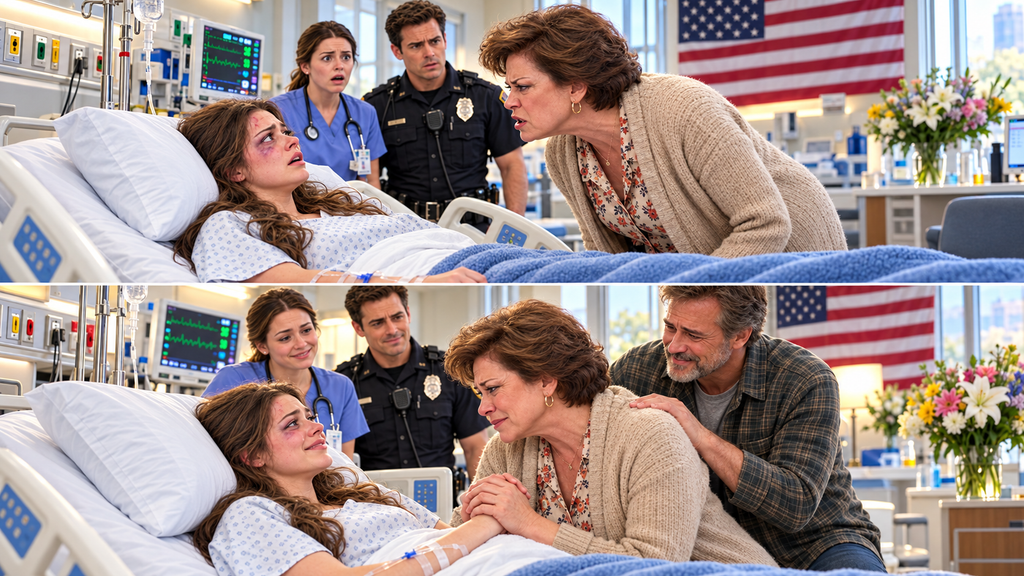
Outside my window, the afternoon sky had turned the color of dirty cotton. Rain tapped against the glass, and somewhere down the hallway, a child was crying for his mother.
I had spent fourteen days unconscious.
I had awakened with broken bones, a shattered memory, and the knowledge that my own father had nearly beaten me to death.
And now a detective was telling me that my mother might know more than she had admitted.
“What do you mean?” I whispered.
Cole didn’t answer immediately.
Instead, he placed the photograph from the motel on the blanket between us.
My father stood beside an unfamiliar woman.
His hand rested against the small of her back.
She was smiling at him.
It wasn’t the smile of someone conducting business.
It was the intimate, comfortable smile of a woman who had been loved by the same man for a very long time.
I looked at the picture again.
Then something inside my head shifted.
The woman’s face blurred.
Another image took its place.
A summer barbecue.
Yellow balloons.
My mother laughing beside a swimming pool.
A woman in a navy blue scarf standing behind her.
And my father, watching that woman with an expression I had been too young to understand.
I suddenly grabbed Cole’s wrist.
“Oh my God.”
“Valeria?”
“I know her.”
He leaned closer.
“Who is she?”
My lips trembled.
I had not seen that woman in more than twelve years.
But I remembered her voice.
I remembered her perfume.
And I remembered the way my mother used to introduce her.
“That’s Celia.”
Cole’s expression changed.
“Celia who?”
“Celia Ward.”
I swallowed.
“She was my mother’s best friend.”
The room seemed to tilt.
And then I remembered something even worse.
My mother had not lost her best friend twelve years ago.
She had been sharing her husband with her.
1. The Woman in the Photograph
I was eleven years old the last time Celia Ward came to our house.
Back then, she was Aunt Celia.
Not because we were related, but because she had been part of our family for as long as I could remember.
She brought me books on my birthday.
She made cinnamon pancakes.
She was the person who stayed overnight when my mother had surgery and my father had to work.
When I was little, I used to tell people I had two mothers.
Teresa would laugh.
Celia would kiss my forehead.
And my father would smile.
That smile.
I remembered it now.
The same smile he wore in the motel photograph.
“What happened twelve years ago?” Cole asked.
I squeezed my eyes shut.
“My mother said they had a terrible argument.”
“About what?”
“She never told me.”
I remembered standing halfway down the stairs one rainy afternoon, listening to two women shouting behind the kitchen door.
My mother had screamed, “You promised me!”
Celia had replied, “It wasn’t supposed to go this far.”
Then something shattered.
After that day, Celia stopped coming around.
Whenever I asked about her, my mother changed the subject.
Eventually, I stopped asking.
Children learn quickly which questions make adults angry.
Cole picked up the old photograph from the cardboard box.
It showed three people standing outside our family home.
My father.
My mother.
And Celia.
They were much younger.
My father had his arm around Teresa.
But his fingers were intertwined with Celia’s behind my mother’s back.
I had looked at the photograph earlier without noticing.
Now I couldn’t look anywhere else.
“Where did this box come from?” I asked.
Cole examined the shipping label.
“It wasn’t mailed. Someone left it at the hospital reception desk. The security camera caught a woman wearing a hood, but she kept her face turned away.”
“Celia?”
“We’re trying to establish that.”
I touched the navy scarf again.
A memory struck so suddenly that I gasped.
A motel room.
A bedside lamp.
Celia sitting on the edge of a bed, crying.
And my own voice saying:
“You don’t get to call yourself my aunt anymore.”
The image disappeared.
I clutched my forehead.
Cole stood.
“That’s enough for now.”
“No.”
“Valeria, you’ve suffered a serious brain injury. We need to be careful.”
“You don’t understand.”
My voice cracked.
“I remember confronting her.”
He became still.
“When?”
“I don’t know.”
“Where?”
“The motel.”
“Did your father see you?”
I stared at the photograph.
Then another memory surfaced.
My father’s voice, low and furious.
“You should have minded your own business.”
My heartbeat accelerated.
“I think he did.”
Cole reached for his notebook.
“Tell me everything you remember.”
But before I could answer, someone knocked.
A young officer opened the door.
“Detective? You need to see this.”
Cole stepped into the hallway.
Through the opening, I heard the officer whisper:
“The garage footage was deleted.”
A pause.
“Not only deleted,” the officer continued.
“Someone replaced it.”
Cole turned toward me.
For the first time since I had met him, he looked genuinely frightened.
2. The Recording That Shouldn’t Have Existed
When Cole returned twenty minutes later, he pulled a chair beside my bed.
“Valeria, I need to ask you about your parents’ security system.”
I laughed bitterly.
“Of course they have security cameras. My father installs them for half the businesses in Maple Ridge.”
“What kind of system?”
“Four cameras outside. One in the garage. Two covering the driveway.”
“Who has administrator access?”
“My father.”
“Anyone else?”
“My mother. Sometimes me, but I haven’t logged in for months.”
Cole folded his hands.
“Someone erased the footage from the evening you were attacked.”
My stomach tightened.
“And replaced it with what?”
He hesitated.
“A recording of an empty garage.”
I stared at him.
“An empty garage?”
“The timestamp displays the evening of the assault. But the shadows outside the garage windows don’t match the reported weather. The footage appears to have been taken on another day.”
I thought about that.
My father knew exactly how those systems worked.
He had built his contracting business installing security equipment.
He had once lectured me for leaving my laptop unlocked.
“People don’t need to be smarter than you,” he used to say. “They just need access.”
Now he had used that knowledge to make his own daughter disappear from a recording.
“Does that mean you have no evidence?” I asked.
“No.”
Cole leaned forward.
“It means somebody was desperate enough to destroy evidence.”
“But that doesn’t prove who did it.”
“No.”
He looked at me carefully.
“That’s why I need you to understand something. Your father is claiming that you came to the house in a violent state, threatened both your parents, and injured yourself during an altercation.”
For several seconds, I couldn’t make a sound.
Then I whispered:
“He said I did this to myself?”
Cole nodded.
“He claims you fell against a workbench and then struck your head on the concrete.”
I looked at my wrist.
The cast was covered with signatures from nurses I barely knew.
Three broken ribs.
A fractured cheekbone.
A serious concussion.
Fourteen days of darkness.
And my father had told the police I had fallen.
“What does my mother say?”
Cole didn’t answer.
“Detective.”
He sighed.
“She supports his account.”
I turned toward the window.
Rain ran down the glass in crooked lines.
I remembered my mother kneeling beside me when I was six, cleaning gravel out of my scraped knee.
I remembered her saying, “Tell Mommy what happened, sweetheart.”
I remembered believing that if I told her the truth, everything would be all right.
Now I was twenty-eight.
And my mother had chosen to believe the man who nearly killed me.
Not because she had no reason to doubt him.
But because believing me would destroy the life she wanted to keep.
“Can I ask you something?” I said.
“Of course.”
“Why did she come to my hospital room?”
Cole looked confused.
“Your mother?”
“Yes.”
“She asked to see you when she heard you’d regained consciousness.”
I swallowed.
“She didn’t come to check whether I was alive.”
“Valeria—”
“She came to see whether I remembered.”
Cole didn’t contradict me.
And that frightened me more than anything else.
3. The Book With the Missing Pages
That evening, after Cole left, I asked Nurse Maggie to bring me the cardboard box.
Maggie was in her late fifties, with kind brown eyes and the practical patience of someone who had seen every variety of human suffering.
She had been on duty when I woke up.
She had also been the person who pulled my mother away before security arrived.
“You should rest,” she said.
“I’ve rested for fourteen days.”
“You’ve been unconscious for fourteen days. That’s different.”
Despite everything, I almost smiled.
She placed the box on my lap.
“Call me if you need anything.”
I waited until the door closed.
Then I began examining its contents.
The scarf.
The photograph.
The lighthouse keychain.
And the paperback.
The book was an old copy of Jane Eyre.
Its cover was faded, its corners bent, and its pages smelled faintly of dust.
I opened it.
On the inside cover, someone had written:
For Valeria. Never mistake someone’s kindness for their character.
Underneath was a date.
June 14, 2010.
I recognized the handwriting.
Celia Ward.
She had given me this book for my twelfth birthday.
I hadn’t seen it in years.
Why would she have it now?
I flipped through the pages.
Several were folded.
Others had faint pencil marks in the margins.
Then I reached a place where three pages had been torn out.
A small square of paper had been tucked between the remaining sheets.
My fingers shook as I unfolded it.
There were only six words.
Ask Nora what happened on Thursday.
I read them again.
Nora.
Nora Finch.
The woman who owned the highway diner.
The same woman who had given Detective Cole the receipt with my handwriting on it.
I pressed the nurse-call button.
Maggie appeared a moment later.
“What’s wrong?”
“I need to call someone.”
“Who?”
“The detective.”
Her eyebrows rose.
“Now?”
I showed her the note.
“Yes. Now.”
Cole answered on the third ring.
“Valeria?”
“I found something.”
“What?”
“A note inside the book.”
I read it aloud.
He was quiet for several seconds.
Then he said, “Don’t touch anything else in that box.”
“Why?”
“Because Nora Finch called me ten minutes ago.”
My heart stopped.
“What did she say?”
Cole took a breath.
“She said she’s ready to tell us what happened.”
I gripped the telephone.
“What happened to me?”
“No,” he replied.
“What happened to the woman who tried to stop it.”
4. Nora’s Confession
The next morning, Nora Finch entered my hospital room with Detective Cole.
She was a small woman with silver hair, thick glasses, and hands that looked as though they had spent decades lifting heavy coffee pots.
Her face crumpled when she saw me.
“Oh, sweetheart.”
I had no memory of knowing her.
But the way she spoke made something ache deep inside my chest.
She approached slowly.
“I’m so sorry.”
“For what?”
Her eyes filled with tears.
“For not coming forward sooner.”
Cole offered her a chair.
She sat beside my bed, twisting a folded tissue between her fingers.
“I own the Bluebird Diner,” she began. “Been there thirty-one years. I know everyone who comes through those doors. Truckers, tourists, couples having affairs.”
She glanced at Cole.
“I probably know more secrets than the entire police department.”
He gave her a small, encouraging nod.
Nora turned back to me.
“You first came in about three weeks before the assault. You were nervous. Kept watching the motel across the road.”
“Did I tell you why?”
“Not at first.”
She looked down at her hands.
“Then one Thursday, you came in crying.”
Something tightened in my stomach.
“What did I say?”
“You said you’d discovered your father was cheating on your mother.”
I closed my eyes.
“I told you that?”
“Yes.”
“What else?”
Nora hesitated.
“You said the affair wasn’t the worst thing you’d found.”
I opened my eyes.
Cole leaned forward.
“Nora, tell her the rest.”
The elderly woman swallowed.
“You brought me an envelope.”
“What was in it?”
“I didn’t open it. You told me not to.”
“Where is it?”
Nora looked toward Cole.
“The detective has it.”
My pulse raced.
“Why didn’t you give it to him earlier?”
“Because you specifically told me to wait until someone could prove they were investigating what happened to you.”
She pulled another tissue from her pocket.
“Valeria, you were frightened. More frightened than I have ever seen a grown woman.”
I stared at her.
“What did I say?”
Her lips trembled.
“You told me your father had been lying to your mother for years, but the woman at the motel wasn’t just his mistress.”
I waited.
Nora lowered her voice.
“You said she was helping him steal something that belonged to you.”
A cold sensation crawled across my skin.
“Steal what?”
Nora looked straight into my eyes.
“Your grandmother’s house.”
For a moment, I forgot how to breathe.
My grandmother’s house.
The old white farmhouse on Orchard Lane.
The place with the crooked porch and lilac bushes beneath the kitchen windows.
The house where I had spent every summer as a child.
The one property my grandmother had left directly to me.
I hadn’t thought about that house in weeks.
My father managed it because I lived in an apartment closer to work.
He handled the taxes.
The repairs.
The rental arrangements.
He had always told me that it was safe.
That I didn’t need to worry.
And I had believed him.
I began trembling.
“My father wouldn’t…”
But the sentence died before I finished it.
Because he would.
A man who could crush his daughter’s cheekbone against a garage floor could certainly forge her signature.
Cole opened a folder.
“Valeria, do you recognize this document?”
He showed me a copy of a loan agreement.
My name appeared near the bottom.
Valeria Santos.
Beside it was a signature.
It looked like mine.
Almost.
Except I knew I had never signed it.
“What is this?”
“A property-secured business loan. The farmhouse was used as collateral.”
My throat tightened.
“How much?”
Cole hesitated.
Then he turned the page toward me.
$780,000.
I stared at the number until the figures lost all meaning.
Nearly eight hundred thousand dollars.
Borrowed against the only thing my grandmother had wanted me to own.
My hands began to shake so violently that Nora reached for them.
“I didn’t sign that,” I whispered.
Cole nodded.
“We’re looking into the signatures and the notarization.”
“My father told me the house was fully paid off.”
“The property records show otherwise.”
I felt something break inside me.
Not because of the money.
Because I remembered my grandmother lying in her hospice bed, holding my hand.
“Your father is a good businessman,” she’d told me. “But this house is yours, sweetheart. Promise me you’ll always know the difference between asking for help and giving up control.”
I had promised.
And then I had trusted him anyway.
I looked at Detective Cole.
“Did he use the money for Celia?”
“We haven’t established where all the proceeds went.”
“But some?”
He met my eyes.
“A substantial amount was transferred to a company linked to her.”
Nora began to cry.
“I should have made you go to the police that first day.”
I reached for her hand.
“You didn’t know what would happen.”
She shook her head.
“No. But you did.”
I felt the air leave my lungs.
“What do you mean?”
Nora looked at Cole.
Then she looked back at me.
“Because before you left the diner that last Thursday, you told me something I’ve heard in my dreams every night since.”
“What?”
Her voice broke.
“You said, ‘If I don’t come back, don’t let my mother bury the truth with me.’”
5. The Visitor Who Called Himself My Father
My father came to the hospital two days later.
I was sitting in bed trying to eat a bowl of soup when I heard his voice outside the door.
“I don’t need permission to see my own daughter.”
A nurse replied, “Sir, she’s requested no visitors without approval.”
“I’m her father.”
The words made my stomach turn.
I pressed the call button.
Maggie appeared almost immediately.
“Please don’t let him in.”
She saw my face and understood.
“I won’t.”
But before she could reach the door, Arthur Santos stepped inside.
He looked exactly as I remembered.
Gray hair combed neatly back.
Brown leather jacket.
Expensive watch.
Wedding ring shining beneath the fluorescent lights.
He carried a bouquet of white lilies.
My favorite flowers.
For twenty-eight years, that man had been the person I called when my car broke down.
The person who taught me to ride a bicycle.
The person who told me never to tolerate a man who raised his hand to me.
Now I was looking at the same hands that had broken my bones.
“Sweetheart,” he said.
I shrank against the pillows.
He stopped.
The expression on his face changed.
For one fleeting second, I thought I saw guilt.
Then it was gone.
“I brought you flowers.”
I stared at the bouquet.
“Get out.”
His jaw tightened.
“Valeria.”
“Get out.”
Maggie stepped between us.
“Mr. Santos, you need to leave.”
Arthur smiled politely at her.
“Would you mind giving us a moment? This is a family matter.”
“No,” Maggie replied. “It is a patient-safety matter.”
His smile faded.
“I’m not here to hurt anyone.”
I looked at the lilies.
Then at his hands.
“That’s what you told me in the garage, isn’t it?”
He froze.
The silence that followed felt enormous.
I hadn’t planned to say it.
The words had simply escaped.
But Arthur’s reaction told me they had struck something real.
“What did you say?” he asked.
I raised my chin.
“I remember you being there.”
He looked toward Maggie.
Then back at me.
“Your head injury has confused you.”
I felt my heart pounding.
“No.”
“Sweetheart, you were upset. You slipped. It was a terrible accident.”
“Three broken ribs?”
He swallowed.
“You fell against the workbench.”
“A fractured wrist?”
“You were trying to catch yourself.”
“Fourteen days in a coma?”
His face hardened.
“Accidents happen.”
I stared at him.
He stared back.
And suddenly I understood something.
He had rehearsed this.
Every answer.
Every excuse.
Every detail.
He had spent two weeks preparing a version of events in which he was an innocent father and I was an unstable daughter.
He had no idea that I had spent three weeks preparing for the truth.
I glanced toward Maggie.
“Please call security.”
Arthur exhaled sharply.
“Valeria, don’t make another scene.”
“Another?”
His eyes narrowed.
“You’ve already dragged our family through enough.”
I felt tears burning behind my eyes.
Not because I believed him.
Because some small, foolish part of me had hoped he would walk into the room, fall to his knees, and beg me to forgive him.
Instead, he wanted me to apologize.
“For what?” I whispered.
He stepped closer.
“For going after things that never concerned you.”
I looked directly at him.
“You mean your mistress?”
His face went pale.
Then something frightening happened.
He smiled.
“Be careful, sweetheart.”
Maggie reached for the phone.
Arthur lowered his voice.
“Memory is a delicate thing after a brain injury. People might believe you’re confused.”
I stared at him.
He glanced at the flowers.
“Your mother is very worried about you.”
I nearly laughed.
“She spat in my face.”
His expression didn’t change.
“She was emotional.”
“She said she’d rather bury me.”
For the first time, his eyes flickered.
But he didn’t apologize.
Instead, he leaned toward me.
“Your mother knows what happens to families when people refuse to let things go.”
My blood ran cold.
There it was.
Not regret.
Not love.
A warning.
I forced myself to remain still.
“Then tell her something for me.”
His smile returned.
“What?”
I looked him directly in the eyes.
“Tell her I remember enough.”
The smile disappeared.
Security arrived moments later and escorted him from the room.
But before he left, Arthur turned around.
For the first time in my life, I saw something in my father’s face that I had never expected.
Fear.
And the sight of it made me realize something important.
He wasn’t frightened of what I remembered.
He was frightened of what I might still have.
6. The Envelope Nora Kept
Detective Cole returned that evening with another investigator.
Her name was Marissa Chen.
She was a financial-crimes detective from the county prosecutor’s office, and she carried a folder thick enough to make my stomach sink.
“I know you’re exhausted,” she said gently. “But I think we can explain why your father was so desperate to take your phone.”
Cole placed a sealed evidence sleeve on the table.
Inside was a cream-colored envelope.
The one I had left at Nora’s diner.
On the front, in my own handwriting, were four words:
For whoever believes me.
My vision blurred.
I had written that.
Before the garage.
Before the coma.
Before my mother spat in my face.
I had already been afraid no one would believe me.
Chen carefully removed several photocopied documents.
“Your father borrowed money against your grandmother’s property using documents that appear to bear a forged signature.”
I nodded.
“We’ve been over that.”
“There’s more.”
She spread the papers across the table.
The farmhouse wasn’t the only thing.
There were insurance documents.
Business transfers.
Applications for credit.
A draft purchase agreement.
And a list of payments to a company called Ward Consulting Group.
Celia’s company.
Chen pointed to three transactions.
“Altogether, these transfers total slightly over four hundred thousand dollars.”
I looked at the figures.
“What was she consulting on?”
“We found no clear documentation of services provided.”
My chest tightened.
“So he was giving her my money.”
“That’s one possibility we’re investigating.”
Cole leaned forward.
“Valeria, this envelope also contained a letter.”
He unfolded a page.
I recognized my handwriting immediately.
He began reading.
“My name is Valeria Santos. If you’re reading this, please understand that I am not trying to destroy my family. I am trying to stop my father from destroying what my grandmother left me.”
My eyes filled with tears.
Cole continued.
“I believe Arthur Santos and Celia Ward have been having an affair for years. I also believe they have used my name without my permission to obtain loans and transfer money. I have recordings of conversations in which they discuss the property. I intend to take the evidence to an attorney.”
I pressed my palm against my mouth.
The room was silent.
Then Cole read the final paragraph.
“If something happens to me, please ask why my father wants the original recording more than he wants to tell the truth.”
He folded the letter.
My tears fell onto the hospital blanket.
For fourteen days, I had been a woman without a story.
Everyone else had been free to invent one for me.
My father had called me unstable.
My mother had called me a liar.
People I had known my entire life had whispered that I was angry, dramatic, confused.
But the woman I had been before the assault had known exactly what was happening.
She had been frightened.
She had been alone.
And still, she had tried to protect herself.
I looked at Cole.
“Where’s the recording?”
His expression grew serious.
“We’re still trying to recover the full file from your phone.”
“Is it gone?”
“Not necessarily.”
Chen looked through the documents.
“There’s something else you should see.”
She took out a copy of a bank statement.
One transaction had been circled in red.
The date was seven days before my assault.
The amount was $95,000.
The recipient wasn’t Celia.
It wasn’t my father.
It was my mother.
Teresa Santos.
I stared at the paper.
“No.”
Chen said nothing.
“My mother has her own account. My father gives her money all the time.”
“This payment came from the loan proceeds.”
I felt my throat closing.
“Maybe she didn’t know.”
“That’s possible.”
I looked at Cole.
“Please tell me she didn’t know.”
He remained quiet.
And I understood that detectives couldn’t give me the comfort I wanted.
They could only give me facts.
The worst part was that I already knew what the facts were beginning to say.
My mother hadn’t simply chosen my father over me.
She had accepted money connected to what he had stolen.
And somewhere between the motel and that garage, she had decided that keeping her life intact mattered more than keeping her daughter safe.
That night, I dreamed of my grandmother’s farmhouse.
I was standing on the porch.
The windows were dark.
The front door was locked.
Inside, I could hear my mother calling my name.
But every time I reached for the handle, my father’s voice whispered:
“You don’t live here anymore.”
I woke up screaming.
Maggie ran into the room.
She sat beside me until my breathing slowed.
Then she said something I would remember for the rest of my life.
“Blood makes people relatives, sweetheart. It doesn’t automatically make them safe.”
I looked at her through my tears.
“How do you stop loving someone who could do this to you?”
Maggie brushed the damp hair away from my forehead.
“You may not stop loving them all at once.”
She squeezed my hand.
“But you can stop letting that love give them permission to hurt you.”
For the first time since waking up, I cried without trying to be quiet.
And Maggie stayed.
Not because she shared my blood.
Not because she owed me anything.
But because I was hurting.
And she cared.
7. The Three Weeks I Had Forgotten
On the fifth morning after I woke up, my best friend walked into my hospital room.
Her name was Jasmine Rivera.
We had met in the third grade when she defended me from a boy who stole my lunch.
She had been defending me ever since.
But the woman standing in my doorway looked as though she hadn’t slept in a month.
Her dark hair was pulled into a messy bun, her eyes were swollen, and she was holding a paper bag from the bakery near my apartment.
For a moment, she didn’t move.
Then she said, “You look terrible.”
I burst into tears.
She dropped the bag onto the visitor’s chair and hurried toward me.
“Hey. Hey, don’t do that. I was trying to be funny.”
I tried to laugh.
It hurt my ribs.
She wrapped her arms around me as carefully as she could.
And for the first time since waking up, I remembered what it felt like to be hugged by someone who loved me.
Not examined.
Not questioned.
Not threatened.
Just held.
“I thought you were gone,” she whispered.
I buried my face against her shoulder.
“I don’t remember anything.”
“I know.”
“Three weeks before the garage. It’s all missing.”
Jasmine pulled back.
“Three weeks?”
I nodded.
“The last thing I remember clearly is buying strawberries.”
She stared at me.
“Valeria.”
“What?”
“You bought those strawberries almost three weeks before the attack.”
My stomach dropped.
“What?”
She sat beside me.
“You were making dessert for your mom’s birthday dinner. You sent me a picture from the grocery store complaining that organic strawberries cost more than steak.”
I remembered that.
The grocery store.
The two containers.
The ridiculous price.
I had been smiling.
My life had been normal.
Or I had believed it was.
“That was nineteen days before the garage,” Jasmine said.
I stared at her.
Nineteen days.
And then another fourteen unconscious.
More than a month of my life had become a black hole.
“What happened after that?” I asked.
Jasmine hesitated.
“You started acting different.”
“How?”
“You were distracted. You stopped answering messages. You canceled our Friday dinners.”
“Did I tell you why?”
“Not at first.”
She looked toward the door.
“Then you came to my apartment one night, crying so hard you could barely speak.”
My pulse accelerated.
“What did I say?”
Jasmine took my hand.
“You told me you had found out your dad was cheating.”
I closed my eyes.
“And I told you something else?”
She nodded.
“You said he was stealing from you.”
I gripped her hand.
“Did I have proof?”
Jasmine looked at me for a long moment.
Then she reached into her handbag.
And took out a small yellow envelope.
My heart began pounding.
“What is that?”
“You gave it to me the night before you were attacked.”
I stared.
“Why didn’t you give it to the police?”
“I did.”
“What?”
“I gave them a copy. But you told me to keep the original envelope unopened, just in case someone tried to claim you’d invented everything.”
My breath caught.
“What’s inside?”
Jasmine opened it carefully.
There were three photographs.
A copy of a business record.
And a handwritten note.
She handed me the note first.
I recognized my handwriting.
Jas, if I ever say I made this up, don’t believe me until you know why. I’m terrified of what Dad will do when he finds out what I have.
A sob escaped me.
Jasmine’s eyes filled.
“You were so scared, Val.”
“Why didn’t you make me stay with you?”
“I tried.”
Her voice broke.
“I begged you not to go to your parents’ house.”
I looked at her.
“And what did I say?”
She wiped her cheek.
“You said your mother had called. You said Teresa was crying and asking you to come over so she could hear your side.”
The room seemed to contract.
My mother.
She had asked me to come.
Not my father.
My mother.
I looked at Jasmine.
“Did I tell you why she wanted me there?”
Jasmine nodded slowly.
“You said she promised you that your father wouldn’t be home.”
My hands went cold.
I could almost hear my mother’s voice.
Come over, sweetheart. Just you and me. We need to talk.
Then Jasmine said something that made every hair on my arms rise.
“Val, I remember one more thing.”
“What?”
“You made me promise something.”
I held my breath.
“You said that if your mother truly wanted the truth, she’d come to you.”
A tear slid down Jasmine’s cheek.
“Instead, she kept insisting you come to that garage.”
The image hit me with such force that I cried out.
A phone vibrating.
My mother’s name on the screen.
Her voice.
“Your father is out. Come through the garage. The front lock is sticking.”
Then another memory.
Me standing in the driveway.
The garage door open.
My father waiting beside the workbench.
And my mother standing behind him.
I gasped.
Jasmine grabbed my shoulders.
“Valeria!”
I couldn’t speak.
The hospital room disappeared.
For one horrifying second, I was back in the garage.
I could smell engine oil.
Fresh sawdust.
My father’s cologne.
I could hear my mother’s voice.
Arthur, she has the phone.
And then—
Darkness.
When I opened my eyes, Maggie was checking my pulse.
Jasmine was crying beside the bed.
“Tell Detective Cole,” I whispered.
Maggie leaned closer.
“Tell him what?”
I looked at Jasmine.
My voice was barely audible.
“My mother didn’t invite me there to hear the truth.”
I swallowed against the pain.
“She invited me there so my father could take it away.”
8. The Daughter They Invented
By that afternoon, I learned that my parents had spent the entire time I was unconscious rewriting my life.
Jasmine showed me screenshots.
At first, she tried to shield the phone.
I made her hand it over.
The first post was on my mother’s Facebook page.
It had been published four days after the assault.
Above a photograph of me smiling at a family picnic, Teresa had written:
Our daughter is fighting for her life following a tragic family incident. We ask for prayers and privacy. Mental health struggles are complicated, and we hope everyone will remember that we love Valeria deeply.
I stared at the words.
Mental health struggles.
A tragic family incident.
We love Valeria deeply.
There were hundreds of comments.
Praying for your beautiful family.
Arthur and Teresa, stay strong.
So sorry you’re going through this.
One woman wrote:
It’s heartbreaking when children turn against the parents who sacrificed everything for them.
My hands began shaking.
I scrolled further.
My father had shared the post.
Underneath, he’d written:
No matter what happens, a father’s love never stops.
I stared at his picture.
He was standing beside my mother in front of our church.
Both of them smiling sadly.
People had called them courageous.
Faithful.
Devoted parents.
My mother had posted that while I lay unconscious with blood on my brain.
She had let strangers pray for the man who put me there.
“There’s more,” Jasmine said quietly.
I looked at her.
“More?”
She nodded.
“Your dad called your boss.”
I felt sick.
“What?”
“He said you’d suffered a breakdown. He told them you’d been behaving erratically and making false accusations.”
I closed my eyes.
I worked as a senior project coordinator at an architectural firm in Columbus.
I had spent six years building my career.
I had never received a disciplinary warning.
But I knew how rumors worked.
Especially when they came from parents who appeared respectable and concerned.
“What did my boss say?”
Jasmine squeezed my hand.
“Your boss didn’t believe him.”
I looked up.
“What?”
“She told Arthur that any information about your employment was confidential. Then she called me because you had listed me as your emergency contact.”
I felt my throat tighten.
“Did she visit?”
“Twice. While you were unconscious.”
I stared at Jasmine.
“She came?”
“Yes.”
“Why don’t I remember?”
Jasmine smiled sadly.
“Because you were in a coma, genius.”
A laugh escaped me.
Then tears.
Jasmine took the phone back.
“Val, I need you to understand something.”
“What?”
“People know your parents. But people know you, too.”
She opened another message.
It was from my boss.
Tell Valeria her job is waiting for her. We don’t know all the facts, but she will be supported while the investigation proceeds.
I read it three times.
Then another message.
My downstairs neighbor offering to water my plants.
A former college professor asking where to send flowers.
My coworker Daniel saying he had organized a meal schedule for when I went home.
There were dozens.
People who had nothing to gain from believing me.
People who hadn’t demanded an explanation.
People who simply wanted me to survive.
I pressed the phone against my chest.
For the first time, the world outside my hospital room didn’t feel entirely hostile.
But Jasmine wasn’t finished.
“Your parents have also been asking about your apartment.”
I frowned.
“Why?”
“Your mom called the landlord. She said she needed to collect some of your belongings.”
“What belongings?”
“Your laptop. Your external hard drive. Some documents.”
My heart began hammering.
“Did he let her in?”
Jasmine shook her head.
“No. Your lease doesn’t authorize her. He called me.”
Relief washed through me so suddenly I almost felt dizzy.
“Thank God.”
Jasmine’s expression darkened.
“Val, your mother was furious. She told him that as your parent, she had the right to protect you from yourself.”
I looked down at my bandaged hands.
Protect me from myself.
Those were the words she used.
To explain why she wanted access to my computer.
To explain why she was defending my father.
To explain why she had spat in the face of her injured daughter.
Suddenly, I knew something with terrible certainty.
My mother wasn’t waiting for me to get better.
She was waiting to find out whether I could still destroy the story she’d helped build.
9. The Woman Who Had Loved My Father
Celia Ward came to the hospital six days after I regained consciousness.
Detective Cole had arranged the meeting after she contacted his office through an attorney.
She agreed to speak with investigators, but she wanted to see me first.
I said no.
Then I changed my mind.
Not because I wanted to forgive her.
Because I wanted to understand how someone who had once kissed my forehead could stand beside the man who nearly killed me.
When she entered the room, I barely recognized her.
The woman in the motel photograph had looked polished and confident.
This woman looked exhausted.
Her hair was tied back.
Her face had lost weight.
There were dark circles beneath her eyes.
She wore a plain gray cardigan.
No jewelry.
No makeup.
And her hands trembled.
She stopped just inside the doorway.
“Valeria.”
Hearing her voice made my stomach turn.
I remembered that voice reading bedtime stories.
Teaching me to bake.
Singing along with the radio during summer drives.
“Don’t call me that like you know me,” I said.
She flinched.
“You’re right.”
Cole stood near the door.
Celia looked at the injuries on my face.
Then she began crying.
I felt no sympathy.
“You don’t get to cry first.”
She covered her mouth.
“I know.”
“You don’t get to walk in here and make this about how terrible you feel.”
She nodded.
“I know.”
I watched her for a moment.
Then I asked the question I’d been carrying since the photograph.
“How long?”
Her eyes dropped.
“Valeria…”
“How long have you been sleeping with my father?”
She swallowed.
“Seventeen years.”
The room went silent.
I had expected seven.
Maybe ten.
Seventeen years.
Almost two-thirds of my life.
I shook my head.
“No.”
She stared at her hands.
“The relationship began before your mother’s fight with me.”
“Seventeen years?”
“Yes.”
“So when you came to my birthday parties—”
“Valeria—”
“When you helped my mother decorate our Christmas tree—”
Her face crumpled.
“When you sat beside her at church?”
“Please.”
I leaned forward, ignoring the pain in my ribs.
“Were you sleeping with him then?”
She began sobbing.
“Yes.”
I stared at her.
I couldn’t understand it.
Not the affair itself.
People betrayed one another every day.
But the ease of it.
The birthdays.
The dinners.
The vacations.
The photographs.
The years of watching my mother smile across a table while the two people closest to her shared a secret.
“Did my mother know?”
Celia went still.
I watched her.
“Answer me.”
She nodded.
My stomach dropped.
“How long?”
Celia looked at Detective Cole.
He said nothing.
Then she whispered:
“She found out twelve years ago.”
I closed my eyes.
The kitchen argument.
The shattered glass.
My mother’s voice.
You promised me.
She had known.
All these years, she had known.
“She made him choose,” Celia said. “He told her he chose his family.”
“And he didn’t.”
“No.”
I opened my eyes.
“But she stayed.”
Celia looked ashamed.
“Yes.”
“Did you keep seeing him?”
She nodded.
“At first, we stopped. Then he contacted me again.”
I laughed bitterly.
“Of course he did.”
She wiped her tears.
“I’m not asking you to understand.”
“Good.”
I looked at her.
“Because I don’t.”
For a while, neither of us spoke.
Then I asked:
“Why did you come?”
Celia inhaled shakily.
“Because I saw what happened to you.”
My heart stopped.
“In the garage?”
She nodded.
Detective Cole moved closer.
“Celia, remember what your attorney advised. We’re recording this conversation with your consent, and you can stop.”
She looked at him.
Then back at me.
“I don’t want to stop.”
Her voice trembled.
“I’ve spent too many years being a coward.”
I stared at her.
“Then tell me.”
She wiped her face.
“Your father called me that Thursday evening. He said you had discovered the loan documents. He said your mother had finally agreed to help him convince you to hand over your phone.”
“What did you do?”
“I told him to leave you alone.”
I felt anger surge through me.
“You helped him steal my house.”
She lowered her eyes.
“Yes.”
“You helped him lie to my mother.”
“Yes.”
“And now you want me to believe you were suddenly worried about me?”
Celia took the accusation without defending herself.
Then she whispered:
“You’re right. I don’t deserve to be believed without proof.”
I stared at her.
“What happened in the garage?”
Her hands began trembling harder.
“Arthur told Teresa he only wanted to scare you.”
My blood ran cold.
“He said he’d take your phone, delete the video, and make you promise to stop investigating the business.”
“And my mother agreed?”
Celia cried silently.
“Yes.”
I felt something inside my chest collapse.
I had known.
Somewhere, before she spoke, I had known.
But hearing it made the truth real.
“Why were you there?”
“Because I didn’t trust him.”
She looked up.
“He’d been drinking that afternoon. He was angry. He kept saying you were going to ruin everything.”
My throat tightened.
“Tell me what he did.”
Celia looked toward Cole.
Then she spoke so quietly I almost couldn’t hear her.
“He hit you.”
I closed my eyes.
“With what?”
“His fist. At first.”
My fingers tightened around the blanket.
“You fell into the workbench.”
Her voice cracked.
“Then you got back up.”
A memory flashed.
The workbench.
The smell of oil.
My father shouting.
I whispered:
“I told him to stop.”
Celia looked startled.
“You remember?”
“Not all of it.”
She nodded.
“You told him you weren’t afraid of him anymore.”
I began crying.
Because I could hear myself saying those words.
Because I could remember how badly I had wanted them to be true.
Celia continued.
“You tried to get past him. He grabbed your arm. You fell again.”
Her voice broke.
“He struck you several more times. I ran toward you, but he shoved me against the cabinet.”
I felt my chest tightening.
“And my mother?”
Celia closed her eyes.
“Teresa was there.”
I waited.
“She was standing by the door.”
“Did she try to stop him?”
Celia covered her mouth.
I leaned forward.
“Did she?”
Finally, she shook her head.
“No.”
For several seconds, the only sound was the quiet beeping of the hospital monitor.
My mother.
The woman who held my hand across busy streets.
The woman who checked my temperature when I was sick.
The woman who once cried because I needed stitches after falling from a bicycle.
She had stood in her garage and watched her husband beat me.
I couldn’t make myself understand it.
I couldn’t even hate her properly.
All I felt was a terrible, bottomless emptiness.
“Did she say anything?” I whispered.
Celia nodded.
I stared at her.
“What?”
Celia began crying harder.
Then she answered.
“She said, ‘Arthur, stop. You’re going to kill her before she tells us where the other copy is.’”
I felt the room fall away.
The other copy.
Even then.
Even while I was bleeding.
They had been thinking about the recording.
Not whether I would live.
Not whether I could breathe.
The recording.
I looked at Celia.
“Then why am I alive?”
She reached into her purse with Cole’s permission.
She removed a folded copy of a telephone record.
“Because I called 911.”
Her voice shook.
“I ran outside when he wouldn’t stop. I called from the road. I told them someone was being attacked.”
I stared at the paper.
The emergency call had been placed at 8:43 p.m.
The caller had refused to give her name.
Celia wiped her eyes.
“I came back and tried to help you. You were barely breathing.”
She began sobbing again.
“Arthur kept saying you’d wake up. Teresa was screaming at him to get rid of the phone.”
I looked away.
My jaw hurt.
My ribs hurt.
My heart hurt in a place the doctors couldn’t reach.
“And you left?” I whispered.
Celia nodded.
“I was afraid they’d blame me for everything. I had signed financial documents I knew were wrong. I thought if I stayed, Arthur would turn on me.”
“You let them tell the police I attacked them?”
“Yes.”
“You let me lie in a coma while they called me crazy?”
She cried harder.
“Yes.”
I turned toward the window.
“Then you don’t get to call yourself the person who saved me.”
Celia didn’t argue.
I heard her stand.
“I understand.”
She walked toward the door.
Then she stopped.
“There is one thing you should know.”
I didn’t look at her.
“What?”
“That video you took at the motel…”
My heartbeat changed.
I turned.
“What about it?”
She looked directly at me.
“Arthur thinks he destroyed the only copy.”
I gripped the blanket.
“Didn’t he?”
Celia shook her head.
“No.”
My breath caught.
She whispered:
“You made another recording. And you hid it somewhere he would never think to look.”
10. The Lighthouse
After Celia left, Detective Cole asked if I wanted a break.
I said no.
I couldn’t bear another night of questions.
Another night of trying to remember.
Another night of wondering what my parents had done while I lay unconscious.
“Where is it?” I asked.
Cole pulled up his chair.
“Celia says you contacted her several days before the assault.”
I stared.
“Why would I contact her?”
“According to her, you had already discovered the affair. You confronted her at the motel and told her you had copies of financial documents.”
A faint memory returned.
Rain against a motel window.
Celia sitting on a bed.
Me standing with my phone in my hand.
“You used to tell me I could trust you,” I heard myself saying.
Celia crying.
“I know.”
“Then prove it.”
I pressed a hand against my forehead.
“What else?”
Cole opened his notebook.
“She says you asked about the original loan agreements. You suspected some documents had been altered after they were signed.”
“And?”
“Celia says she showed you records your father had kept at the motel. You photographed them.”
I swallowed.
“She told us that afterward, you became worried your father might get hold of your phone.”
I looked toward the cardboard box.
The scarf.
The photograph.
The book.
The keychain.
Suddenly, something clicked.
The lighthouse.
It was a silver keychain I had given my father for Father’s Day when I was sixteen.
I bought it at a gift shop during a trip to Lake Erie.
It had cost $12.
I remembered saving my allowance to buy it.
I remembered my father smiling when he opened the little box.
“What’s this for, pumpkin?”
“So you always find your way home.”
He had laughed.
Then clipped it onto his keys.
For twelve years, I had seen it swinging from his hand.
But now the keychain was in my hospital room.
Inside the cardboard box.
Why?
I picked it up.
The silver lighthouse was slightly heavier than I remembered.
There was a tiny seam beneath the roof.
I turned it between my fingers.
A sudden memory flashed.
My father laughing one Christmas.
“Look at this thing. You can unscrew the top.”
He had removed the little silver roof.
Inside was a tiny hollow compartment.
Back then, he’d put a folded dollar bill inside and told me it was his emergency fund.
My heart began pounding.
“Detective.”
Cole looked up.
“The keychain.”
“What about it?”
“The top opens.”
He stood.
“Don’t force it.”
I handed it to him.
He put on gloves and examined it.
Then he twisted the roof.
It moved.
One turn.
Two.
The little silver cap came free.
Inside the hollow lighthouse was a tightly folded strip of paper wrapped around something dark.
Cole carefully eased it out.
My pulse thundered.
The dark object was a tiny memory card.
For several seconds, neither of us spoke.
Then Cole looked at me.
“Did you put this here?”
I stared at the object.
And suddenly, I remembered.
Not everything.
But enough.
A gas station restroom.
My hands shaking.
Me taking a small memory card out of a portable recording device.
The lighthouse keychain sitting beside the sink.
I remembered whispering to myself:
“He never opens it anymore.”
Then slipping the card inside.
I covered my mouth.
“Oh my God.”
Cole sealed the memory card in an evidence sleeve.
“Valeria, do you remember what’s on it?”
I nodded slowly.
“I think so.”
“What?”
I stared at him.
“The motel.”
He waited.
“And the garage?”
My eyes filled with tears.
“I don’t know.”
Cole stood.
“We’ll have the lab examine it.”
He headed toward the door.
Then stopped.
“Valeria.”
I looked up.
“Whatever’s on this card, I want you to understand that your father’s actions are not your responsibility.”
I began crying.
“I know.”
But I didn’t know.
Not entirely.
Because a part of me still believed that if I hadn’t followed him, none of this would have happened.
If I hadn’t filmed the motel.
If I hadn’t investigated the loans.
If I had stayed quiet.
I might still have a family.
But another part of me was beginning to understand the truth.
Silence hadn’t protected my family.
It had protected the people hurting it.
And they had nearly killed me to keep it.
11. The Video
The following afternoon, Detective Cole returned with Marissa Chen.
Neither of them smiled.
I knew before they spoke.
They had found something.
Cole placed a laptop on the rolling hospital table.
“Valeria, the memory card contains several recordings. We want to show you one section, but only if you’re comfortable.”
I looked at the screen.
A frozen image showed the parking lot outside the motel.
My father’s truck was visible near the entrance.
I swallowed.
“Play it.”
Cole hesitated.
“Are you sure?”
“Yes.”
He pressed a key.
The video began.
At first, all I saw was an ordinary motel room.
A brown bedspread.
A cheap wooden desk.
A lamp with a crooked shade.
Then my father appeared.
He was wearing a blue button-down shirt.
His sleeves were rolled to the elbows.
Celia stood beside him.
She looked younger than she had in my hospital room.
Happier.
They were laughing.
Then Arthur reached for her.
He kissed her.
Not a quick kiss.
Not a moment of weakness.
He held her face between his hands and kissed her like a man returning to someone he loved.
I felt physically sick.
“Stop,” I whispered.
Cole paused.
I stared at the screen.
It wasn’t the affection that broke me.
It was how ordinary they looked.
How practiced.
How comfortable.
My father had spent years making a second life look like a casual Thursday afternoon.
I wiped my face.
“Keep going.”
Cole pressed play.
The angle shifted.
Another recording.
This one had been captured from inside the motel room.
My voice was audible.
Calm.
Much calmer than I felt now.
“Tell me about the loan.”
Arthur’s face appeared.
His expression changed instantly.
“Valeria?”
I watched myself emerge from beside the door.
I was wearing jeans, a cream-colored sweater, and a navy jacket.
My hair was pulled into a ponytail.
I held a small recording device in one hand and my phone in the other.
Arthur stared at me.
“What the hell are you doing here?”
“Recording the truth.”
Celia stepped backward.
“Valeria, please.”
I ignored her.
“Dad, did you use my grandmother’s house to borrow money without my permission?”
Arthur laughed.
“Don’t be ridiculous.”
“Then why is my signature on a loan I never signed?”
His smile faded.
“Where did you get that?”
“Answer the question.”
He stepped closer.
“Give me your phone.”
“No.”
“Valeria.”
I heard my own voice rise.
“Did you forge my signature?”
The room went silent.
Then Celia whispered:
“Arthur, just tell her.”
He turned on her.
“Shut up.”
Celia flinched.
I watched my father’s face transform.
The warm, familiar expression disappeared.
Underneath it was a man I didn’t recognize.
“Do you have any idea what you’ve done?” he demanded.
I heard myself answer:
“I know exactly what you’ve done.”
Arthur pointed at the camera.
“Turn that off.”
“No.”
“I’m your father.”
“And I’m the person whose name you used.”
Celia began crying.
“Arthur, give her the documents.”
He rounded on her.
“Are you trying to get us arrested?”
My stomach tightened.
Us.
The word landed like a stone.
Celia hadn’t merely received money.
She had helped.
Then the recording captured something even worse.
Arthur turned back toward me.
“Your grandmother left that property to you because she didn’t understand how business works. I kept it maintained. I paid for everything. That house should have belonged to me.”
I stared at the screen.
My father.
The man who always praised my grandmother’s generosity.
The man who stood beside her casket and thanked her for everything she’d done for our family.
He had believed the house was his.
I heard myself say:
“Grandma left it to me because she wanted me to have something nobody could take away.”
Arthur laughed.
“Everything you have came from me.”
“No. Not this.”
His expression hardened.
“You have no idea how much money I’ve spent keeping that house in good condition.”
“Then send me the invoices.”
He went silent.
I stepped closer.
“Send me every receipt. Every contract. Every bank statement. And explain why Celia’s company received hundreds of thousands of dollars.”
Celia covered her face.
Arthur stared at me.
Then he said:
“You think you’re so smart.”
I didn’t answer.
“You think one little video makes you powerful.”
I heard myself reply:
“No. I think the truth matters.”
Arthur stepped toward the camera.
The image shook.
“Give me the phone.”
“Don’t touch me.”
“Give it to me!”
The video jerked.
There was a crash.
Then a loud scraping sound.
The next image showed the ceiling.
Arthur’s voice thundered:
“You have no idea what you’re starting.”
And my own voice answered:
“I know exactly what I’m ending.”
The recording cut off.
I sat motionless.
My hands were trembling.
My father had admitted enough to explain the financial investigation.
And he had threatened me on camera.
But the video didn’t show the garage.
It didn’t show the assault.
It didn’t show my mother.
I looked at Cole.
“Is that all?”
He shook his head.
“There’s another clip.”
My throat tightened.
“From where?”
He glanced toward Chen.
Then back at me.
“Your parents’ house.”
I went cold.
“The security footage?”
“No.”
He took a breath.
“This was filmed from your phone while it was still recording inside your jacket.”
I stared at him.
“The phone he smashed?”
“Yes.”
“We recovered a damaged recording fragment from the device itself. It doesn’t show much. But it has audio.”
I looked at the laptop.
“Play it.”
Cole hesitated.
“Valeria, I need to warn you—”
“Please.”
My voice broke.
“I’ve spent every night imagining what happened. Whatever’s on that recording, it can’t be worse than not knowing.”
He looked at me for a long moment.
Then pressed play.
The screen was mostly black.
I heard footsteps.
A garage door rattling.
Then my mother’s voice.
“Valeria, thank God. You’re here.”
My own voice answered:
“Where’s Dad?”
A pause.
Then Teresa said:
“He’s inside.”
I heard myself stop.
“You told me he wouldn’t be home.”
Silence.
Then my father’s voice.
“Come in, sweetheart.”
I felt my heart begin racing.
On the recording, I said:
“No.”
Arthur laughed.
“Don’t be dramatic.”
“I know why you want me here.”
My mother spoke.
“Valeria, please. Just give us the phone.”
“Mom, did you know about the loans?”
No answer.
“Did you know he used my name?”
Teresa began crying.
“Your father made a mistake.”
I heard myself gasp.
“A mistake?”
“Families forgive mistakes.”
“He stole almost eight hundred thousand dollars using my property!”
“Lower your voice!”
That was my mother.
Not my father.
My mother.
I heard myself say:
“Why are you defending him?”
Then Teresa said the words that would haunt me for years.
“Because if this gets out, we’ll lose everything.”
A silence followed.
Then my own voice.
“What about me?”
My mother didn’t answer.
I heard a movement.
Then Arthur said:
“Enough. Give me the phone.”
“No.”
“Valeria.”
“Get away from me.”
A loud sound.
My own scream.
The recording shook.
Someone shouted.
Then another crash.
Cole reached for the pause button.
“Stop,” I whispered.
He froze the recording.
I was crying so hard I could barely breathe.
I knew what came next.
I didn’t need the rest.
But then I heard something from the paused speakers that made my blood run cold.
A faint sound.
Almost hidden beneath the movement.
A second voice.
Not Arthur.
Not Teresa.
A man’s voice.
I grabbed Cole’s wrist.
“Wait.”
He looked startled.
“What’s wrong?”
“Play the last few seconds again.”
He rewound the recording.
My father shouted.
I screamed.
There was a crash.
And then, faintly:
“Boss, the truck’s still running.”
I stared at the screen.
“Who is that?”
Cole said nothing.
I looked at him.
“Detective?”
His expression tightened.
“We’re trying to identify him.”
Suddenly, I remembered the receipt.
The words I’d written on the back.
Keep an eye on truck 214.
I looked at Cole.
“Truck 214.”
He froze.
“What?”
I grabbed his sleeve.
“The truck. Nora’s receipt. The one I told her to watch.”
Cole stood so quickly his chair scraped against the floor.
He looked at Chen.
She was already reaching for her phone.
“What is it?” I demanded.
Cole turned back.
“Your father’s company has several fleet vehicles.”
I nodded.
“Truck 214 is one of them.”
“What’s special about it?”
He hesitated.
Then said:
“The company recently installed commercial dashboard cameras in its service trucks.”
My heartbeat thundered.
“Are they connected to the security system?”
“No.”
“Then where do the recordings go?”
He looked me directly in the eyes.
“To a third-party fleet monitoring service.”
I stopped breathing.
The home cameras had been erased.
My phone had been smashed.
The motel footage had been hidden inside a keychain.
But there might be another camera.
One my father hadn’t thought to destroy.
One that had been recording while the garage door was open.
I looked at Cole.
“Please tell me you can get it.”
He was already moving toward the door.
“We’re going to find out.”
12. The Truck That Remembered
For the next forty-eight hours, Detective Cole refused to tell me much.
Not because he was hiding something malicious.
Because the investigation had reached a point where one careless conversation could alert the wrong person.
My father had stopped trying to visit.
My mother had stopped calling.
Celia had hired an attorney and agreed to further questioning.
And somewhere in Maple Ridge, a truck with the number 214 on its door had become the most important vehicle in my life.
Jasmine spent both evenings beside my bed.
She brought crossword puzzles.
Ginger ale.
Soup from the little restaurant near my apartment.
She talked about ordinary things.
A coworker who kept stealing lunch from the office refrigerator.
Her neighbor’s dog that barked at every passing bicycle.
A terrible movie we’d once watched together.
I was grateful.
Not because I was interested in stolen lunches or barking dogs.
But because she reminded me that my world had once contained more than betrayal.
On the second evening, Jasmine was helping me brush my hair when Cole called.
“I need you to prepare for something,” he said.
My stomach tightened.
“What happened?”
“We obtained footage from the fleet company.”
I gripped the phone.
“And?”
“Truck 214 was parked outside your parents’ garage on the evening of the assault.”
I stopped breathing.
“Was it recording?”
“Yes.”
I closed my eyes.
“Did you see it?”
Cole hesitated.
“Yes.”
My voice trembled.
“Did it show what my father did?”
Another pause.
Then he said:
“Yes.”
The word settled over me like a heavy blanket.
For days, I had been desperate for proof.
Now that it existed, I was terrified of it.
“Was my mother there?” I whispered.
Cole’s voice softened.
“Yes.”
I stared at the wall.
“Did she try to help?”
He was quiet.
And the silence was answer enough.
I began crying.
Jasmine wrapped one arm around my shoulders.
“Val, you don’t have to watch it.”
I shook my head.
“I need to.”
Cole spoke gently.
“You don’t have to watch the assault to help us prosecute it. There are other ways we can document what happened.”
“I understand.”
I swallowed.
“But I need to know what happened after.”
“After?”
“After he stopped hitting me.”
Cole didn’t answer immediately.
Then he said:
“Come to the station with your attorney when you’re medically cleared. There are things we need to discuss with you in person.”
I gripped the phone.
“Detective, please.”
“What is it?”
“Did my mother call an ambulance?”
A long silence.
Then Cole said:
“No.”
My eyes closed.
I had thought I was prepared.
I wasn’t.
I could almost forgive someone for freezing in terror.
For standing still while something unimaginable happened.
I might even have understood a mother who panicked and didn’t know what to do.
But after?
When her daughter lay bleeding?
When her husband had finally stopped?
What had my mother done?
Cole’s next words answered that question.
“Valeria, the footage shows your mother helping your father search your belongings.”
I covered my mouth.
He continued.
“She opened your handbag. She searched your jacket. Then she carried several items into the house.”
My breathing became shallow.
“She didn’t come back out until the emergency vehicles arrived.”
I looked at Jasmine.
Her face had gone pale.
I whispered:
“So she left me there.”
Cole’s voice was quiet.
“Yes.”
I stared at the ceiling.
The fluorescent lights blurred behind my tears.
My mother had stood over me.
She had seen the blood.
She had watched my father beat me.
And afterward, instead of calling for help, she had searched my pockets.
For a video.
A file.
A piece of evidence.
I remembered the last thing my grandmother told me before she died.
“Never measure love by what people say when life is easy. Watch what they do when something becomes inconvenient.”
I hadn’t understood her then.
I understood now.
My parents had loved me as long as loving me cost them nothing.
The moment telling the truth threatened their money and reputation, they had decided I was expendable.
But what they didn’t know was that the truck had captured something else.
Something Detective Cole wouldn’t tell me until the following morning.
Something that transformed the case from a family assault into a conspiracy involving a third person.
And by sunrise, one of my father’s oldest employees would be missing.
13. The Man Who Disappeared
His name was Graham Pike.
He was forty-six years old, married, and the father of two teenage girls.
For fourteen years, he had worked as the operations supervisor at Santos Security and Restoration, my father’s company.
I remembered Graham from childhood.
He used to give me peppermint candies when I visited my father’s office.
He had taught me how to change a tire.
When I turned eighteen, he had secretly slipped a fifty-dollar bill into my birthday card because, as he put it, “Your old man doesn’t pay me enough to buy you a real present.”
I hadn’t seen him in almost a year.
Now Detective Cole was telling me Graham had been present when my father attacked me.
And nobody knew where he was.
“The police went to his house?” I asked.
Cole nodded.
“His wife says he left after receiving a call from your father.”
“When?”
“Yesterday afternoon.”
My stomach tightened.
“What did Dad say?”
“We’re working on that.”
“Could he have hurt him?”
Cole chose his words carefully.
“We don’t have evidence of that.”
But I had seen enough fear in my father’s eyes to understand something.
Arthur Santos was no longer in control.
His wife had lied for him.
His mistress had confessed.
His daughter had survived.
And a truck camera had recorded the crime he thought he’d erased.
Graham was another person who knew the truth.
That made him dangerous.
I looked at Cole.
“Please find him.”
“We’re doing everything we can.”
He stood.
Then he added:
“There’s something else. The recording confirms that Graham tried to intervene.”
I stared at him.
“What?”
“After you fell, Graham approached the garage. Your father ordered him to leave. Graham refused.”
My eyes filled with tears.
“What did he do?”
Cole looked down at his notes.
“He told your father that if he didn’t call an ambulance, Graham would.”
I swallowed.
“And?”
“Your father threatened to fire him. Graham went outside and called emergency services anyway.”
I covered my mouth.
Two calls.
Celia had called from the road.
And Graham had called from the truck.
Two people who had helped my father maintain his lies for years had finally been frightened enough to do the right thing.
Not soon enough to prevent the assault.
But soon enough to save my life.
“What happened after that?” I whispered.
Cole looked at me carefully.
“According to the video, your father told Graham he would ruin him if he ever spoke about that night.”
My chest tightened.
“He has children.”
“Yes.”
“He’s scared.”
“We believe so.”
I looked at the photograph on my bedside table.
My mother.
My father.
Me.
Taken at Christmas three years earlier.
We were all smiling.
For so long, I had believed that a smile in a photograph could prove happiness.
Now I knew better.
“Detective?”
“Yes?”
“My father has an old hunting cabin near Mill Creek.”
Cole stopped.
“Where?”
“About forty minutes outside town. Graham helped him renovate it. The road is private, and my father keeps a spare key behind the woodshed.”
Cole was already reaching for his phone.
“Can you give me the exact address?”
I did.
He thanked me and left.
For the next three hours, I watched the clock.
At 2:17 p.m., my phone rang.
It was Cole.
“We found Graham.”
My eyes closed.
“Is he alive?”
“Yes.”
I let out a sob of relief.
“Where?”
“At the cabin.”
“Was my father there?”
“No.”
I gripped the blanket.
“Then why did he disappear?”
Cole paused.
“He received threatening messages and went into hiding. He says he didn’t know who to trust.”
I felt tears roll down my cheeks.
“Will he testify?”
A pause.
Then Cole said:
“He already agreed.”
I stared at the wall.
After fourteen days unconscious, after weeks of lies, someone had finally decided that telling the truth mattered more than protecting my father.
But Graham had one final piece of information.
Before the assault, my father had given him a specific instruction.
He had asked Graham to park truck 214 facing the garage.
To leave it running.
And to keep the driveway clear.
My father said they were expecting to load equipment.
Graham didn’t know about the planned confrontation.
He didn’t know what my parents intended to do to me.
But the truck had been positioned there at my father’s request.
And its dashboard camera had recorded the very crime Arthur hoped to conceal.
The man who spent his life installing cameras had arranged the perfect camera angle for his own downfall.
14. The Morning They Came for My Father
Arthur Santos was arrested on a Monday morning.
I learned about it from Jasmine.
She arrived at the hospital carrying two coffees and wearing the expression of someone who had been holding in news for far too long.
“Val.”
I looked up.
“What?”
She closed the door.
“It’s happening.”
My heart started pounding.
“What is?”
She placed her phone on the table.
A local news notification filled the screen.
LOCAL BUSINESS OWNER ARRESTED FOLLOWING INVESTIGATION INTO DAUGHTER’S ASSAULT AND PROPERTY FRAUD
Beneath the headline was a photograph.
My father.
Arthur Santos.
Walking out of his office between two police officers.
His hands were restrained in front of him.
His face was red.
His eyes were fixed on the ground.
For a long moment, I couldn’t move.
I had imagined this moment dozens of times.
I thought I would feel victorious.
I thought I would smile.
Maybe laugh.
Maybe shout.
Instead, my first thought was:
Did he have breakfast?
The thought horrified me.
This was the man who had nearly killed me.
The man who had stolen my inheritance.
The man who had watched me lie unconscious while he created a story to protect himself.
And some part of me still worried whether he had eaten.
I began crying.
Jasmine sat beside me.
“Val?”
“Why do I still care?”
She took my hand.
“Because he was your dad before you knew what he’d done.”
I looked at her.
“I hate that.”
“I know.”
I stared at the photograph again.
My father had once looked invincible.
He was tall.
Confident.
The sort of man who entered a room and expected everyone to listen.
Now he looked small.
Not weak.
Just ordinary.
A frightened man facing the consequences of what he had done.
“What are they charging him with?” I asked.
Jasmine checked the report.
“Felonious assault, evidence tampering, and several financial offenses. They say the investigation is continuing.”
I swallowed.
“And my mother?”
Jasmine’s expression changed.
“What?”
She hesitated.
“Teresa was taken in for questioning.”
My chest tightened.
“Arrested?”
“Not yet.”
I stared at the ceiling.
I didn’t know what I wanted.
Justice?
Yes.
Accountability?
Absolutely.
But did I want to watch my mother walk into a jail cell?
I didn’t know.
I had spent my entire life looking at her as someone who would protect me.
Now I had to learn how to see her as someone who needed to be held accountable.
That afternoon, Detective Cole visited.
He confirmed the arrest.
My father had been taken into custody after investigators obtained evidence from the fleet footage, my phone, financial records, and witness statements.
His business office was being searched under a warrant.
Celia had formally agreed to cooperate.
Graham had provided a detailed account.
And the prosecutor was examining my mother’s role in the assault and cover-up.
I listened quietly.
Then I asked:
“What did my father say when you arrested him?”
Cole looked at me.
“Do you really want to know?”
“Yes.”
He hesitated.
“He asked whether you’d given us another recording.”
I closed my eyes.
Of course.
Not how I was recovering.
Not whether I had permanent injuries.
Not whether his daughter could ever forgive him.
The recording.
Even then.
I laughed through my tears.
“He still doesn’t understand.”
Cole sat beside me.
“Understand what?”
“That the video didn’t destroy his life.”
I looked at the detective.
“He did.”
15. My Mother’s Version of Love
Teresa called me three days after my father was arrested.
I nearly declined the call.
My attorney had warned me not to discuss the investigation with anyone who might be charged.
I let it go to voicemail.
Then another call came.
And another.
Finally, a message appeared.
Valeria, please. I am still your mother.
I stared at those words.
I am still your mother.
As though motherhood were a title that could never be taken away.
As though giving birth had guaranteed her the right to my loyalty, regardless of what she did afterward.
I gave the message to my attorney.
She contacted Teresa’s lawyer and made it clear that I would not discuss the case privately.
A week later, my attorney told me Teresa had written a letter and asked whether I wanted to receive it.
I thought about it all night.
Then I said yes.
Not because I wanted her explanation.
Because I wanted to see whether she was finally capable of telling the truth.
The letter arrived in a plain white envelope.
My name was written across the front.
My sweet Valeria.
The first line nearly made me throw it away.
I know you’re angry, but I hope one day you will understand that I was trying to keep our family together.
I stared at the sentence.
Not I’m sorry I left you bleeding.
Not I’m sorry I lied.
Not I’m sorry I spat in your face when you woke up.
She wanted understanding.
For herself.
I kept reading.
Your father and I have been married for thirty-one years. We’ve built a life together. We’ve sacrificed everything for you. When you came to us with those accusations, I was terrified.
Terrified.
That was the word she used.
I knew about Celia. I had known for years. I stayed because I believed marriage meant fighting through difficult things.
I pressed the paper against the blanket.
A marriage.
That was what she had been protecting.
Not a daughter.
Not the truth.
A marriage she had already known was built on lies.
The letter continued.
I didn’t think Arthur would hurt you so badly. I believed he only wanted your phone. I never imagined things would go that far.
My hands started shaking.
She had admitted it.
In writing.
She knew Arthur planned to frighten me and take my phone.
She knew I had been deceived into coming to the garage.
She knew the confrontation wasn’t a misunderstanding.
And still, she described it as something that had simply gone too far.
I kept reading.
When you collapsed, I panicked. Arthur said you would wake up. Celia was screaming. Graham was shouting. I didn’t know what to do.
My eyes filled with tears.
Then came the sentence that made my stomach turn.
I only searched your bag because I was afraid the recording would ruin us.
I put the letter down.
There it was.
The truth.
The same truth she’d screamed while I was bleeding.
The recording would ruin us.
Not him.
Us.
She considered herself part of his deception.
And my decision to expose it had made me the enemy.
The final paragraph read:
If you withdraw what you said about Arthur, perhaps our family can heal. He didn’t mean for you to end up in the hospital. Please don’t let one terrible evening destroy thirty-one years of marriage.
I sat motionless.
One terrible evening.
She had reduced my broken bones, my coma, and the theft of my inheritance to an inconvenience in her marriage.
Then I noticed something strange.
At the bottom of the letter, she had written:
You know I’ve always done everything for you.
I read it again.
And suddenly remembered the day my grandmother died.
I had been twenty-one.
We were standing in her kitchen.
My mother was putting dishes away.
My grandmother had already signed the papers leaving me the farmhouse.
Teresa had looked at me and said:
“You’re very lucky, Valeria. Your father and I spent years taking care of that place.”
I had thanked her.
She hadn’t smiled.
Then she’d added:
“Some children forget what they owe their parents.”
At the time, I thought she was grieving.
Now I understood.
She had never thought the house truly belonged to me.
She believed that because she raised me, anything I owned was ultimately part of the family wealth.
Anything I earned.
Anything I inherited.
Anything I built.
And when I tried to defend what was mine, she called it betrayal.
I folded her letter.
Then I did something I had never done before.
I stopped trying to explain myself.
I gave the letter to my attorney and asked her to provide it to the investigators.
I didn’t write back.
I didn’t call.
I didn’t tell Teresa I loved her.
I didn’t tell her I hated her.
I simply chose not to let her rewrite what had happened.
For once, her feelings were not my responsibility.
16. The Ninety-Five Thousand Dollars
The final twist came from Marissa Chen.
By then, I had been discharged from the hospital.
I was living temporarily with Jasmine, sleeping in her spare bedroom and learning how to do ordinary things again.
Standing in the shower without getting dizzy.
Walking down the stairs without gripping the railing.
Sleeping through the night without waking from nightmares.
My wrist was healing slowly.
My ribs hurt whenever I laughed.
The concussion left me exhausted after reading for more than twenty minutes.
Some days, I forgot words.
Some days, I walked into a room and couldn’t remember why.
And on the worst days, I woke up believing I was still in the garage.
My physical therapist called the process recovery.
I called it learning how to inhabit a body that no longer felt entirely mine.
One Thursday, Chen arrived at Jasmine’s house with my attorney.
They sat across from me at the kitchen table.
Jasmine made tea.
I noticed immediately that neither investigator looked comfortable.
“What happened?” I asked.
Chen opened her folder.
“We traced the ninety-five-thousand-dollar payment to your mother.”
I swallowed.
“Okay.”
“It didn’t remain in her account.”
I frowned.
“Where did it go?”
Chen slid a document toward me.
A property purchase agreement.
The address was in a lakeside town almost two hours away.
The property was a modern condominium with floor-to-ceiling windows and a private boat slip.
The purchaser was listed as Teresa M. Santos.
My mother.
I stared at it.
“What is this?”
Chen spoke gently.
“Your mother used the money as part of a down payment.”
I felt my heartbeat change.
“When?”
“Three days after your assault.”
The kitchen went silent.
I looked at Chen.
“Three days?”
“Yes.”
I stared at the document again.
Three days after my father left me unconscious on a garage floor.
Three days after doctors warned my family that my brain injury could leave me permanently disabled.
Three days after my mother began posting messages asking everyone to pray for me.
She had been arranging to buy a condominium.
I couldn’t understand it.
“Was she planning to leave him?”
Chen hesitated.
“We’ve found communications suggesting she’d considered separating from your father. The property purchase was not disclosed to him.”
I stared at her.
My mother had defended Arthur publicly.
She had lied to protect him.
She had searched my belongings for evidence.
She had called me mentally unstable.
But privately, she was preparing a future without him.
Using money connected to the loan he had fraudulently obtained against my house.
I began laughing.
I couldn’t stop.
Jasmine reached for my hand.
“Val?”
I shook my head.
“Do you see?”
Nobody answered.
“My mother said she did everything to save her marriage.”
My laughter turned into tears.
“She said I was destroying the family. She said Dad was a good man. She said she couldn’t survive if the truth came out.”
I looked at the document.
“But she was already planning to leave him.”
Chen nodded.
“We can’t know all her motives without hearing her explain them. But yes, the records suggest she had been preparing a separate residence.”
I pressed my hands against my face.
All those years, I had believed my mother was weak.
Frightened.
Trapped in a marriage she couldn’t bear to lose.
But she had enough independence to arrange a condominium.
Enough money to hire an attorney.
Enough determination to protect herself.
What she hadn’t been willing to do was protect me.
Because protecting me would have meant giving up the money.
Giving up her public image.
Giving up the comfortable story in which she was a faithful wife suffering through her husband’s mistakes.
I looked at Chen.
“Does Dad know?”
She shook her head.
“I’m not discussing what he’s been told.”
I nodded.
Then I whispered:
“For thirty-one years, they built a marriage where lying was easier than leaving.”
I looked at Jasmine.
“And when I told the truth, they treated me like I was the problem.”
Jasmine squeezed my hand.
“You weren’t.”
I stared out the kitchen window.
It had started to rain.
For a moment, I remembered my mother standing beside the porch at our family home, holding an umbrella above my head.
I remembered her laughing as I jumped through puddles.
I remembered believing she would always keep me dry.
Then I looked down at the purchase agreement.
And finally understood something that had taken twenty-eight years to learn.
My mother wasn’t incapable of protecting someone.
She had simply chosen to protect herself.
17. The Courtroom Where My Father Finally Looked at Me
Nine months after the assault, I walked into the county courthouse.
I wasn’t wearing a hospital gown.
I wasn’t connected to a heart monitor.
There were no nurses adjusting my pillows or detectives asking me to remember something my brain had tried desperately to forget.
I was wearing a dark blue dress.
My grandmother’s pearl earrings.
And a thin silver bracelet Jasmine had given me on the day I left the hospital.
Inside the bracelet, she had engraved four words.
You are still here.
I touched those words as we entered the courtroom.
My attorney walked beside me.
Jasmine was on my other side.
Behind us came Nora Finch, Maggie, and several friends from work.
I hadn’t asked them all to attend.
They had simply come.
Because when the most important day of my life arrived, they wanted to make sure I didn’t face it alone.
Then I saw my parents.
My father sat at the defense table.
He looked older.
His gray hair had thinned.
He had lost weight.
His expensive suits were gone, replaced by plain courtroom clothes.
But the expression on his face hadn’t changed.
He still looked like a man who believed that if he spoke confidently enough, everyone would eventually agree with him.
My mother sat several rows behind him.
She had been charged separately with offenses connected to the cover-up and financial scheme.
Her attorney sat beside her.
She wore a black cardigan and held a tissue in one hand.
When she saw me, her eyes filled.
She raised her hand slightly.
I didn’t raise mine.
Instead, I sat down beside Jasmine.
My heart was racing.
“Breathe,” Jasmine whispered.
“I am.”
“Barely.”
I gave her a small smile.
Then the proceedings began.
My father had rejected an earlier opportunity to resolve the case through a plea agreement.
He insisted that he was innocent of intentionally assaulting me.
He claimed the financial documents were legitimate.
He claimed Celia had misled him.
He claimed Graham misunderstood what happened.
And he claimed I had become confused after discovering his affair.
The prosecutor began laying out the evidence.
The motel recording.
The forged property documents.
The financial transfers.
The damaged phone.
My mother’s letter.
Graham’s account.
Celia’s testimony.
And finally, truck 214.
I had been warned that hearing the evidence could be difficult.
I had decided not to watch the full assault footage.
My attorney had helped me prepare for that choice.
I knew what the cameras showed.
I didn’t need to make myself relive every second to prove I was brave.
But I stayed when the prosecutor described it.
She explained how the truck had been parked with a clear view through the open garage.
How the dashboard camera had continued recording.
How my father had struck me repeatedly.
How my mother had watched.
How the two of them had searched my belongings afterward.
And how Graham had called emergency services after Arthur refused.
My father stared at the table.
He never looked up.
Then the prosecutor played the emergency recording.
Celia’s voice filled the courtroom.
“Please send somebody. There’s a woman who’s been hurt. She’s not waking up.”
The dispatcher asked for the address.
Celia gave it.
Then the dispatcher asked:
“Is the person who hurt her still there?”
A pause.
Celia began crying.
“Yes.”
“Do you know him?”
Another pause.
Then:
“It’s her father.”
I pressed my hand against my mouth.
I had never heard that call before.
Hearing someone tell a stranger that my father had hurt me made the truth feel heavier than ever.
Then Graham testified.
He described arriving at the property to collect equipment, unaware that my parents had planned a confrontation.
He described hearing shouting.
Seeing my father push me.
Seeing me fall.
Then seeing Arthur strike me again as I tried to get up.
Graham stopped speaking for a moment.
The prosecutor offered him water.
When he continued, his voice shook.
“I told Arthur he needed to stop.”
“What did he say?”
Graham stared at the floor.
“He said it was a family matter.”
The prosecutor waited.
“What did you do?”
“I told him it stopped being a private family matter when someone was lying on the floor unable to stand.”
I began crying.
Jasmine took my hand.
Graham looked toward me.
Our eyes met.
He swallowed.
“I should have stepped in sooner.”
I shook my head slightly.
Not because what happened was acceptable.
Not because he had been perfect.
But because he had finally done something my parents hadn’t.
He had chosen my life over my father’s approval.
When Graham finished, Celia testified.
She admitted the affair.
She admitted helping my father conceal financial transfers.
She admitted participating in transactions that she knew were improper.
And she admitted remaining silent after the assault because she feared prosecution.
Her attorney had arranged a cooperation agreement that required her to tell the truth and make restitution.
She didn’t try to portray herself as innocent.
That was perhaps the only dignity she had left.
Then the prosecutor asked her:
“Why did you eventually come forward?”
Celia looked toward me.
Her eyes filled with tears.
“Because I helped steal from that girl.”
Her voice broke.
“I helped her father lie. I helped him take money that belonged to her. And when she discovered everything, she was nearly killed.”
The prosecutor waited.
Celia continued.
“For years, I told myself I was a good person who had made bad choices.”
She looked at the jury.
“But eventually, if you keep choosing the wrong thing, you have to stop pretending it’s an accident.”
I lowered my eyes.
For the first time, someone involved in the betrayal had said something that sounded like real accountability.
It didn’t erase what Celia had done.
It didn’t earn forgiveness.
But it mattered.
Then came my mother’s testimony in the separate proceedings connected to the cover-up.
By that point, she had changed her earlier account after investigators confronted her with the recordings and financial documents.
I sat in the courtroom as she described what happened.
Her hands shook.
She cried.
She said she had been afraid of losing her marriage.
Afraid of scandal.
Afraid of financial ruin.
Then she said something I would never forget.
“I thought Valeria would eventually forgive us.”
The prosecutor looked at her.
“Forgive you for what?”
Teresa swallowed.
“For frightening her.”
The prosecutor paused.
“Mrs. Santos, your daughter suffered multiple fractures and a brain injury that left her unconscious for fourteen days.”
My mother began crying harder.
“I know.”
“Did you know that when you searched her belongings?”
Teresa lowered her head.
“I knew she was badly hurt.”
“Did you call an ambulance?”
“No.”
“Did you attempt first aid?”
“No.”
“Did you tell police that your husband had attacked her?”
“No.”
The prosecutor allowed the silence to settle.
Then asked:
“What did you do?”
My mother’s voice was barely audible.
“I looked for the recording.”
I stared at her.
There it was.
Without excuses.
Without the language of marriage.
Without the comforting disguise of family loyalty.
She had chosen a video over her daughter.
The prosecutor asked one final question.
“After your daughter regained consciousness, did you tell her the truth?”
My mother began sobbing.
“No.”
“What did you do?”
Teresa covered her mouth.
Then whispered:
“I accused her of lying.”
“And?”
She squeezed her eyes shut.
“I spat at her.”
A hush spread through the courtroom.
I felt something strange.
I wasn’t satisfied.
I wasn’t happy.
But for the first time, the memory belonged entirely to the truth.
My mother couldn’t call it confusion anymore.
She couldn’t call it a misunderstanding.
She couldn’t pretend the hospital staff had exaggerated.
She had admitted it.
In a room full of people.
Under oath.
And the shame was finally where it belonged.
With her.
Not me.
18. The Last Time My Father Tried to Control My Story
When it was my turn to give my victim-impact statement at sentencing, I thought I would be terrified.
Instead, I felt strangely calm.
My father had been convicted of the assault and evidence-related offenses, along with charges arising from the financial fraud.
The investigation had uncovered additional forged records.
The court had heard how the home security footage was altered.
How money had been moved.
How my family had tried to convince everyone that I was unstable.
I had spent months preparing for this moment.
My attorney had helped me write a statement.
I brought it in a pale blue folder.
When I approached the lectern, my legs were trembling.
The courtroom was quiet.
I opened the folder.
Then I saw the first sentence.
My father used to tell me that family was everything.
My vision blurred.
I looked toward Arthur.
He finally met my eyes.
For a second, I saw the man who taught me to ride my bicycle.
The man who lifted me onto his shoulders at the county fair.
The man who held my hand at my grandmother’s funeral.
Then I remembered the garage.
And I began.
“My father used to tell me that family was everything.”
I paused.
“He said it at birthday dinners. At Christmas. At church. Whenever someone needed help, he reminded us that family should come first.”
I looked at him.
“For twenty-eight years, I believed that.”
My voice trembled.
“Then I learned that in my father’s mind, family only came first when family agreed with him.”
Arthur looked down.
I continued.
“When I discovered his affair, I didn’t attack him. I didn’t threaten him. I asked him to tell the truth.”
I swallowed.
“When I found evidence that my property had been used without my permission, I asked him to explain it.”
My hands shook.
“When I went to my parents’ house, I believed my mother had invited me there because she wanted to listen.”
I paused.
“I was wrong about all three things.”
A tear rolled down my cheek.
“My father didn’t see a daughter asking questions. He saw a threat to his money and reputation.”
I looked at the judge.
“He beat me so badly that I lost fourteen days of my life. I lost weeks of memory. I lost the ability to sleep without fear.”
My voice began to break.
“I had to learn how to walk without getting dizzy. I had to learn how to trust my own thoughts. For months, every time a car door slammed, I thought I was back in that garage.”
The courtroom remained silent.
I looked toward my mother.
“And when I woke up, I believed that at least one person would be happy I survived.”
My throat tightened.
“I thought my mother would hug me.”
Teresa began crying.
“I thought she would ask whether I was in pain.”
I wiped my cheek.
“Instead, she spat in my face and told me she’d rather bury me than believe me.”
Someone behind me quietly sobbed.
I didn’t turn around.
I looked at Arthur.
“For a long time, I thought the worst thing my father did was hurt me.”
I paused.
“But it wasn’t.”
His expression changed.
“The worst thing he did was convince me that telling the truth made me disloyal.”
I took a breath.
“He made me believe that if I defended myself, I was destroying my family.”
My voice grew stronger.
“I know now that I didn’t destroy anything.”
I looked directly at him.
“You made choices. You lied. You stole. You hurt me. And when you had the chance to help me, you chose to protect yourself.”
Arthur shifted in his chair.
I continued.
“I loved you, Dad.”
My voice broke completely.
“I loved you so much that even after you were arrested, I wondered whether anyone had brought you breakfast.”
Tears slipped down my face.
“I hate that a part of me still worries about you.”
I looked down at the pages.
Then I closed the folder.
I didn’t need it anymore.
“Do you know what I wanted most when I woke up?”
Arthur didn’t answer.
“I wanted you to walk into that hospital room and say you were sorry.”
My father stared at me.
“Not explain. Not threaten. Not blame my concussion.”
I swallowed.
“Just say you were sorry.”
The silence felt endless.
“But you never did.”
I looked toward the judge.
“I am not asking the court to punish him because he had an affair. People make terrible choices in relationships. That is not why we’re here.”
I took another breath.
“We’re here because my father believed he had the right to use violence when his daughter refused to stay silent.”
I looked at Arthur one last time.
“And I want him to know something.”
His jaw tightened.
“I am not the girl lying on the garage floor anymore.”
I touched Jasmine’s bracelet.
“I survived.”
My voice steadied.
“I will recover. I will rebuild my life. And I will never again apologize for telling the truth.”
Then I returned to my seat.
Jasmine held my hand.
Maggie quietly placed a tissue in front of me.
Nora squeezed my shoulder.
I cried.
But I wasn’t crying because I was frightened.
I was crying because, for the first time in almost a year, I had told the entire story without anyone interrupting me.
Without anyone calling me a liar.
Without anyone demanding that I protect my father.
And nobody had been able to stop me.
19. The Sentence
The judge sentenced Arthur Santos to sixteen years in state prison for the convictions arising from the assault and financial crimes.
There would be restitution.
There would be ongoing civil proceedings over the property.
There would be appeals and paperwork and many things my attorney warned me not to expect to resolve overnight.
But the most important part was simple.
My father was going to prison.
He could no longer walk into my hospital room.
He could no longer demand my phone.
He could no longer tell the police that I was confused and expect everyone to accept his word.
He could no longer control the story merely because he had always been the loudest person in the room.
When the sentence was announced, he turned toward me.
For one moment, his face twisted with anger.
Then he said something under his breath.
I couldn’t hear it.
And for the first time in my life, I didn’t care.
I didn’t need to know.
My mother later pleaded guilty to offenses related to evidence tampering and the financial cover-up. She received a custodial sentence and was ordered to cooperate with the continuing restitution proceedings.
Celia also faced criminal consequences for her involvement in the fraudulent transactions.
Her cooperation did not erase her responsibility.
Graham returned to work elsewhere after leaving my father’s company.
Nora kept running her diner.
And Detective Cole eventually called me one afternoon to say the criminal case had reached its final major milestone.
I was sitting on Jasmine’s porch when he called.
The sun was setting.
A breeze moved through the trees.
For a moment, neither of us spoke.
Then Cole said:
“How are you feeling, Valeria?”
I looked out at the street.
“Better.”
“Good.”
I smiled faintly.
“Not every day.”
“That’s all right.”
I hesitated.
“Detective?”
“Yes?”
“Can I ask you something?”
“Of course.”
“Did you ever think I was lying?”
He was silent for a moment.
Then he said:
“When I saw you in that hospital bed, I knew something terrible had happened. My job was to find out what the evidence showed, no matter whose story it supported.”
I nodded.
“I know.”
He continued.
“But there was one thing I never forgot.”
“What?”
“The message on your broken phone.”
My throat tightened.
If something happens to me, look at this.
“You were frightened,” Cole said. “You knew someone might try to silence you. And you still tried to make sure the truth survived.”
Tears filled my eyes.
“You did something brave, Valeria.”
I stared at the sunset.
“For a long time, I didn’t feel brave.”
“You don’t have to feel brave while you’re doing it.”
I laughed softly.
“Thank you.”
“No. Thank you for trusting us enough to keep going.”
When we hung up, I sat outside for a long time.
The sun disappeared behind the trees.
A neighbor’s dog barked.
A car drove slowly down the street.
Ordinary sounds.
Ordinary life.
For months, I had measured time by hospital visits, police interviews, court dates, and medication schedules.
Now, for the first time, I could imagine a future that wasn’t organized around what my parents had done.
And the thought felt almost unreal.
20. The House My Grandmother Left Me
The farmhouse became mine again in every sense that mattered.
It took time.
A great deal of it.
The fraudulent loan documents had to be challenged.
The lender had to review the evidence.
Attorneys filed petitions.
There were financial disputes and settlement negotiations.
But eventually, the disputed lien was released, and the property records were corrected.
One autumn morning, my attorney called.
“Valeria?”
I was sitting at Jasmine’s kitchen table.
“Yes?”
“I have good news.”
My stomach tightened.
“What?”
“The final documents have been recorded.”
I closed my eyes.
“The house?”
“Yes.”
I gripped the phone.
“It’s safe?”
“The disputed lien has been released. The title is clear of that claim.”
For several seconds, I couldn’t speak.
Then I began crying.
My attorney gave me a moment.
“Valeria?”
“I’m here.”
“Are you okay?”
I laughed through my tears.
“Yes.”
I pressed a hand against my chest.
“Yes, I think I am.”
That weekend, Jasmine drove me to Orchard Lane.
The farmhouse stood at the end of a long gravel driveway, surrounded by old maple trees.
The white paint had faded.
Several shutters needed repair.
The porch steps were crooked.
But the lilac bushes still grew beneath the kitchen windows.
I stood beside the car, staring.
For a long time, I couldn’t move.
Jasmine touched my shoulder.
“You okay?”
I nodded.
Then shook my head.
Then laughed.
“I don’t know.”
She smiled.
“Fair.”
I walked slowly toward the porch.
My grandmother used to sit there in the evenings, drinking sweet tea and telling stories about people I had never met.
She kept a tin of peppermint candies beside her rocking chair.
She loved crossword puzzles.
She hated wasting food.
And every summer, she made strawberry jam from fruit we bought at the farmers market.
I remembered helping her wash the jars.
I remembered her pretending not to notice when I stole strawberries from the bowl.
I remembered her laughing.
You can’t make jam if you eat them all, little bird.
I stepped onto the porch.
The boards creaked beneath my feet.
For one terrifying instant, I remembered another wooden floor.
Another garage.
Another place where I had fallen.
My breathing changed.
Jasmine noticed.
“Val?”
I gripped the railing.
“Just a second.”
She stood quietly beside me.
I closed my eyes.
Took one breath.
Then another.
I reminded myself where I was.
Orchard Lane.
My grandmother’s house.
Jasmine beside me.
Sunlight on my face.
No one waiting behind a garage door.
No one demanding my phone.
No one telling me that I owed them my silence.
I opened my eyes.
Then unlocked the front door.
The house smelled of old wood and dust.
Sunlight streamed through the living room windows.
There was a stack of furniture covers beside the fireplace.
An old clock hung on the wall.
And above the mantel was a photograph of my grandmother.
She was standing in her garden, laughing.
I walked toward it.
For a moment, I could almost hear her voice.
Promise me you’ll always know the difference between asking for help and giving up control.
My eyes filled.
“I know now, Grandma.”
Jasmine stood behind me.
I reached for the photograph.
Then whispered:
“I wish I’d listened sooner.”
I felt a hand on my shoulder.
Jasmine.
“She left this place to you because she believed in you.”
I swallowed.
“I nearly lost it.”
“But you didn’t.”
I looked around the room.
The house needed repairs.
The garden was overgrown.
The kitchen cabinets were worn.
The porch roof would probably need replacing before winter.
It wasn’t a mansion.
It wasn’t worth millions.
It wasn’t perfect.
But it was mine.
And for the first time in my life, that word didn’t feel selfish.
Mine.
Not my father’s.
Not my mother’s.
Not something I owed anyone for raising me.
Something my grandmother had chosen to give me.
Something I had fought to protect.
And something I would never again surrender merely to keep another person comfortable.
21. The Letter I Never Sent
My mother wrote to me again after the sentencing.
This time, the letter was shorter.
There were no excuses about marriage.
No demands that I withdraw anything.
No references to how much she had sacrificed.
It began:
Valeria, I finally understand that I failed you.
I sat at the farmhouse kitchen table holding the letter.
Outside, rain tapped against the windows.
The room smelled of fresh paint.
Jasmine had helped me choose a pale green color for the walls.
I read slowly.
I don’t expect you to forgive me. I don’t deserve to ask. I was more afraid of losing my life as I knew it than I was willing to face what Arthur had done.
My hands trembled.
I should have protected you. I should have called for help. I should have told the truth when the police arrived. And when you woke up, I should have been on my knees thanking God you were alive.
I closed my eyes.
For a moment, I could picture her.
My mother.
Sitting somewhere with a pen in her hand.
Trying to find words that might reach me.
I kept reading.
I can’t undo what I did. I know that. But I am sorry, Valeria. I am sorry for the garage. I am sorry for the lies. And I am especially sorry for what I did in your hospital room.
My throat tightened.
When you opened your eyes, you deserved a mother who was relieved you had survived.
A tear dropped onto the paper.
Instead, I gave you another reason to wish you hadn’t.
I pressed my hand against my mouth.
The letter ended:
I love you. I know those words may mean very little now. I hope someday I can become someone who deserves to say them.
I read it twice.
Then a third time.
And I cried.
Not because I was ready to forgive her.
Not because a letter could erase what happened.
I cried because those were the words I had waited almost a year to hear.
But the person who needed them most was the frightened woman waking from a coma.
The woman with broken ribs.
The woman staring at her mother and expecting love.
That woman had needed an apology.
She had needed protection.
She had needed someone to say:
I believe you.
Now I had survived without any of those things.
And an apology, however sincere, couldn’t return the life I’d had before.
That evening, I sat down at the kitchen table with a blank sheet of paper.
I wrote:
Mom,
Then I stopped.
For a long time, I stared at the page.
Finally, I continued.
I believe that you’re sorry.
I also believe that when I needed you most, you made a choice that nearly cost me my life.
I cannot pretend your apology repairs what happened.
I am working very hard to build a life where I feel safe. Right now, that life cannot include you.
I hope you use this time to understand why.
But I am no longer responsible for helping you feel better about the consequences of your decisions.
Valeria.
I folded the letter.
Placed it inside an envelope.
Then set it in the kitchen drawer.
I never mailed it.
Not because I wanted to punish her.
Because I realized I didn’t owe her an immediate response.
For twenty-eight years, I’d been taught that whenever my parents were upset, I needed to fix it.
Their anger.
Their disappointments.
Their arguments.
Their expectations.
I had carried those things as though they belonged to me.
Now I was learning something different.
Someone could regret hurting me.
And I could still choose distance.
Someone could love me.
And I could still refuse to let them back into my life.
Forgiveness, if it ever came, would be mine to decide.
Not theirs to demand.
I placed my mother’s letter in another drawer.
Closed it.
And went outside to plant roses.
22. The Dinner I Didn’t Know I Needed
One year after the assault, I hosted Thanksgiving at the farmhouse.
It wasn’t a large gathering.
There were only six of us.
Jasmine.
Nora.
Maggie.
Graham and his wife, Elena.
And me.
We ate at my grandmother’s old dining table.
I had polished the wood the weekend before.
Jasmine brought mashed potatoes.
Nora arrived with two pies.
Maggie made enough green bean casserole to feed an entire neighborhood.
Graham brought a bottle of sparkling cider and insisted on checking the porch lights before dinner.
“You know,” he said, standing on a ladder, “your father installed these things backward.”
I looked up.
“Seriously?”
He laughed.
“Seriously.”
I crossed my arms.
“Well, that’s comforting.”
He grinned.
“Good news is, I can fix them.”
“Are you going to send me an invoice?”
“Absolutely.”
I raised an eyebrow.
He climbed down.
“Payable in leftover pie.”
I laughed.
And for the first time, laughing didn’t hurt my ribs.
That surprised me.
For months, every laugh had come with a reminder of the garage.
Now it was just laughter.
At dinner, we sat around the table while the windows darkened and the lights glowed warmly above us.
For a moment, I became overwhelmed.
I remembered Thanksgiving dinners at my parents’ house.
My father carving the turkey.
My mother arranging flowers.
The familiar sound of their voices filling the kitchen.
I had assumed that losing them meant losing every holiday forever.
But here I was.
Surrounded by people who had shown up when I needed them.
People who hadn’t demanded that I earn their support.
People who had cared enough to listen.
Nora noticed my silence.
“You all right, sweetheart?”
I nodded.
“Yeah.”
“You sure?”
I looked around the table.
Then smiled.
“I just never thought I’d have this again.”
Maggie reached for my hand.
“Have what?”
I swallowed.
“A family dinner.”
The room went quiet.
Then Jasmine raised her glass.
“Well, you’re stuck with us now.”
Graham nodded.
“Unfortunately.”
Elena elbowed him.
Everyone laughed.
And I cried.
Not the helpless, frightened tears I had cried in the hospital.
Not the angry tears from the courtroom.
These were different.
They came from a place inside me that had finally begun to believe happiness was possible again.
After dinner, Nora helped me wash dishes.
The old farmhouse kitchen was warm.
The windows had fogged slightly.
She handed me a plate.
“You know,” she said, “I’ve been thinking about something.”
“What?”
“The first time you came into my diner.”
I smiled sadly.
“I still don’t remember all of it.”
“You looked so serious.”
I laughed softly.
“Sounds like me.”
She dried a glass.
“You ordered coffee and strawberry pie.”
I stopped.
“Strawberry pie?”
She nodded.
“Extra whipped cream.”
I stared at her.
“That’s funny.”
“What is?”
“The last thing I remembered before the coma was buying strawberries.”
Nora’s expression softened.
“Maybe your brain was holding on to something good.”
I looked at her.
She smiled.
“Sometimes that’s how we survive terrible things. We remember the little moments that remind us life was worth loving.”
I turned toward the window.
Outside, the porch lights Graham had repaired glowed softly through the darkness.
I thought about the grocery store.
The two containers of strawberries.
The completely ordinary decision I’d been making.
For so long, that memory had felt cruel.
A final glimpse of innocence before everything was stolen.
Now I saw it differently.
It was proof that my life had existed before the betrayal.
And that it could exist after it.
I dried my hands.
Then hugged Nora.
She seemed surprised.
After a moment, she hugged me back.
“Thank you,” I whispered.
“For what?”
“For believing me before I knew how to believe myself again.”
Nora held me tighter.
“Oh, sweetheart.”
Her voice broke.
“You were always worth believing.”
23. The Day I Stopped Being Afraid of the Door
There was one thing I hadn’t done since the assault.
I hadn’t returned to my parents’ house.
Not once.
Not during the investigation.
Not during the court proceedings.
Not even after my father’s conviction.
Whenever I drove through that part of Maple Ridge, I took a different street.
Sometimes I drove miles out of my way.
I couldn’t bear to pass the driveway.
The garage.
The house where I had grown up.
But one December afternoon, I found myself stopped at the intersection near my old neighborhood.
I was driving home after a physical therapy appointment.
Snow was falling lightly.
The traffic light turned red.
And suddenly, instead of turning left, I drove straight.
I didn’t plan it.
I didn’t call Jasmine.
I didn’t prepare a speech.
I simply drove.
Past the elementary school.
Past the bakery where my mother used to buy birthday cakes.
Past the little park where my father had taught me to ride a bicycle.
Then I turned onto our old street.
The houses looked smaller than I remembered.
The sidewalks were cracked.
A few Christmas decorations hung from porches.
And there, at the end of the block, stood my parents’ house.
It was quiet.
The lawn needed care.
The curtains were closed.
The driveway was empty.
I parked across the street.
For several minutes, I simply stared.
I remembered riding my bicycle down that driveway with my father running behind me.
“Keep pedaling, pumpkin!”
I remembered falling.
Scraping my knee.
Crying.
He had picked me up.
Carried me inside.
Cleaned the wound.
Then told me:
“Nothing bad is going to happen while Daddy’s here.”
I began crying.
Because that little girl had believed him.
Because she had needed to believe him.
And because I wished I could reach backward through time and tell her what I knew now.
That she deserved safety.
That loving someone didn’t make their actions harmless.
That a parent could be wrong.
And that telling the truth wasn’t betrayal.
I wiped my cheeks.
Then looked at the garage.
The door was closed.
There was no truck.
No workbench visible.
No one waiting.
I touched the bracelet on my wrist.
You are still here.
For a long time, I sat quietly.
Then I whispered:
“You don’t get to keep this part of me.”
I started the car.
And drove away.
I didn’t feel magically healed.
The nightmares didn’t vanish that night.
I still had appointments.
I still struggled with certain memories.
But something important had changed.
For the first time, I had passed the place where my life nearly ended.
And I had been the person who decided when to leave.
24. The Last Piece of the Recording
There was one final thing I needed to do.
The original memory card from the lighthouse had remained in evidence during the proceedings.
Its contents had been copied and preserved as part of the case.
After the trial, my attorney helped arrange for me to receive a copy of the personal files that did not need to remain restricted.
Among them was a short recording I had made on the afternoon before the assault.
I hadn’t watched it.
Not during the investigation.
Not during the trial.
I knew it existed because Detective Cole had mentioned it.
But I had been afraid.
Afraid that the woman speaking in the video would seem like a stranger.
Afraid she would be terrified.
Afraid she would say something I couldn’t bear to hear.
One evening, almost fifteen months after the assault, I sat at my farmhouse kitchen table and opened the file.
The screen flickered.
Then I saw myself.
My hair was tied back.
I wore a gray sweater.
There were shadows beneath my eyes.
But I looked healthy.
Uninjured.
Alive.
I stared at my own face.
The woman on the screen took a deep breath.
Then she began speaking.
“Okay. My name is Valeria Santos.”
My throat tightened.
“If you’re watching this, I either finally did something brave, or something went very wrong.”
She laughed nervously.
I covered my mouth.
I had forgotten the sound of that laugh.
The woman in the recording looked down at a sheet of paper.
“I’ve been collecting evidence for three weeks. I found out Dad is having an affair with Celia Ward. I found out he used my grandmother’s property to obtain loans without my permission. And I found out my mother has known more than she’s willing to admit.”
She paused.
Then looked directly into the camera.
“I’m scared.”
My eyes filled with tears.
“I’m really scared.”
She swallowed.
“Dad has always been the person everyone listens to. When he says something, people believe him. Mom backs him up. And I’m just…”
She laughed bitterly.
“I’m just their daughter.”
I began crying.
The woman on the screen continued.
“I keep wondering whether I should stop. Whether I should delete everything, forget the affair, and pretend I never saw those documents.”
She looked away.
Then slowly shook her head.
“But Grandma worked her whole life for that house.”
Her voice trembled.
“She wanted me to have something of my own. And I can’t let him take it just because he’s my father.”
I pressed my hand against my heart.
“I don’t want to hurt my mother.”
The woman on the screen began crying.
“I love her. I know she thinks I’m making things worse. But I can’t spend the rest of my life pretending that something is right just because telling the truth makes everyone uncomfortable.”
She wiped her face.
Then looked directly at the camera.
And said something that shattered me.
“If I forget why I started this, I hope somebody reminds me that I was trying to protect myself.”
I began sobbing.
Not quietly.
Not carefully.
I cried until I had to pause the video.
Because I finally understood.
The woman I had been before the assault wasn’t reckless.
She wasn’t spiteful.
She wasn’t trying to destroy her family.
She was frightened.
She was alone.
And she was trying to do the right thing.
I pressed play again.
On the screen, my younger self took another breath.
“I don’t know what’s going to happen tomorrow.”
She smiled faintly.
“But if everything goes okay, I think I’m going to take a few days off work. Maybe drive up to the lake.”
She laughed.
“Maybe buy some strawberries and make Grandma’s jam.”
My heart broke.
She didn’t know what was coming.
She didn’t know she would spend fourteen days in a coma.
She didn’t know her mother would spit in her face.
She didn’t know her father would go to prison.
She didn’t know her life would become something she had to rebuild piece by piece.
But she had hope.
Even then.
She looked into the camera one final time.
“If anybody is watching this because something happened to me…”
Her voice softened.
“Please don’t let them make me into somebody I’m not.”
Then she smiled.
A small, frightened smile.
And whispered:
“I’m a good person. I know I am.”
The recording ended.
I sat in the quiet kitchen.
The clock above the stove ticked.
Rain tapped against the window.
And for a long time, I held the laptop against my chest.
I wanted to reach into the screen.
To hold that younger version of myself.
To tell her not to go to the garage.
To tell her that her parents were capable of things she couldn’t imagine.
But I couldn’t change what happened.
I could only answer her.
So I looked at the dark screen.
And whispered:
“I know.”
My voice broke.
“I know you were a good person.”
I touched the bracelet on my wrist.
“And you still are.”
25. The Life They Could Not Take
The following spring, I planted strawberries behind the farmhouse.
Nora helped me choose the plants.
Jasmine carried bags of soil.
Maggie brought lemonade.
Graham repaired the garden fence.
It was a Saturday afternoon.
The sky was bright.
The air smelled of fresh earth and lilacs.
I knelt beside the raised bed, carefully pressing soil around the roots.
For a moment, I thought about my father.
I wondered what he was doing.
Whether he ever thought about the garage.
Whether he regretted what he had done.
Whether he had finally understood that his daughter had nearly died because he couldn’t bear to be exposed as a liar.
Then I thought about my mother.
I wondered whether she read my name in old birthday cards.
Whether she remembered holding me when I was small.
Whether she understood that the worst thing she had done wasn’t simply choosing her husband.
It was abandoning me while I was still alive.
I had no answers.
For a long time, not having answers had tormented me.
But that afternoon, kneeling in the sunshine, I realized something.
I no longer needed answers from them to live my life.
Their reasons belonged to them.
Their guilt belonged to them.
Their consequences belonged to them.
The future belonged to me.
Jasmine came outside carrying a tray of cold lemonade.
“How’s the strawberry empire coming along?”
I smiled.
“Very slowly.”
“Good. I expect a lifetime supply of jam.”
“You haven’t even helped plant anything.”
She looked offended.
“I provided emotional support.”
Nora laughed from the porch.
“That girl charges by the hour.”
We all laughed.
I stood, brushed the dirt from my knees, and looked at the farmhouse.
The porch had been repaired.
The windows were freshly painted.
There were roses growing beside the steps.
A new wooden sign hung by the front door.
Jasmine had made it for me.
It said:
HOME IS WHERE YOU ARE SAFE.
I stared at those words.
Then I thought about the hospital.
About waking up with no memory.
About the broken phone in the evidence bag.
About my mother leaning over me.
About the words that had destroyed whatever innocence I had left.
I’d rather bury you than believe a liar like you.
For so long, that sentence had lived inside my head.
It had followed me into nightmares.
Into courtrooms.
Into doctor’s appointments.
Into quiet moments when I wondered whether I could ever feel whole again.
But standing there in the sunlight, I realized that my mother’s words no longer defined me.
She had wanted to bury the truth.
My father had tried to destroy it.
They had erased cameras.
Smashed phones.
Forged documents.
Invented stories.
And nearly ended my life.
But they had failed.
I was standing in my grandmother’s garden.
Surrounded by people who loved me.
My body bore the scars.
My memory still had gaps.
There were days when I struggled.
Days when healing felt unfairly slow.
But I was here.
I was alive.
And I was finally learning that surviving wasn’t the same as living.
Survival was what happened when my body fought to wake up.
Living was what I chose to do afterward.
I looked down at the last strawberry plant.
Gently, I pressed the soil around its roots.
Then I stood.
Jasmine handed me a glass of lemonade.
“To your first harvest,” she said.
I smiled.
“To new beginnings.”
Nora lifted her glass.
“To telling the truth.”
Maggie raised hers.
“To being alive.”
We touched glasses.
And for the first time in a very long time, I didn’t feel as though I was waiting for something terrible to happen.
I felt grateful for the ordinary afternoon.
For the smell of fresh soil.
For the sound of my friends laughing.
For a house filled with light.
For strawberries that would someday grow.
Later that evening, after everyone had gone home, I sat on the front porch holding my grandmother’s old photograph.
The sunset stretched across the fields.
I traced her smiling face with my thumb.
“Grandma,” I whispered, “I kept the house.”
A breeze moved through the trees.
I smiled through my tears.
“And I kept myself.”
I placed the photograph beside me.
Then I looked toward the horizon.
My father had taken fourteen days of consciousness from me.
He had taken pieces of my memory.
He had taken my trust.
He had tried to take my inheritance.
And my mother had taken away the certainty that I would always be safe in her arms.
But neither of them had taken away my future.
That was still mine.
I looked down at the silver bracelet on my wrist.
You are still here.
And suddenly, I knew exactly how I wanted to remember the story.
Not as the daughter whose father put her in a coma.
Not as the daughter whose mother spat in her face.
Not as the woman who lost her family because she discovered an affair.
But as the woman who woke up.
The woman who told the truth.
The woman who refused to be erased.
I had once believed that the most important thing in life was being loved by my parents.
Now I understood something far more important.
Love that demands your silence isn’t protection.
Love that requires you to accept cruelty isn’t loyalty.
And love that disappears the moment you tell the truth was never the kind of love that could keep you safe.
My mother had said she’d rather bury me than believe me.
My father had tried to make sure I could never tell anyone what happened.
But they had underestimated one thing.
The daughter they raised had learned to stand up for herself.
Even when she was terrified.
Even when she was alone.
Even when the people she loved most became the people she needed protection from.
I closed my eyes.
Breathed in the evening air.
And whispered the words I wished I could have told the frightened woman in that hospital bed:
“You made it, Valeria.”
A tear slipped down my cheek.
“You finally made it home.”
THE END! THANK YOU FOR READING!❤️