 Reading Time: 18 minutes
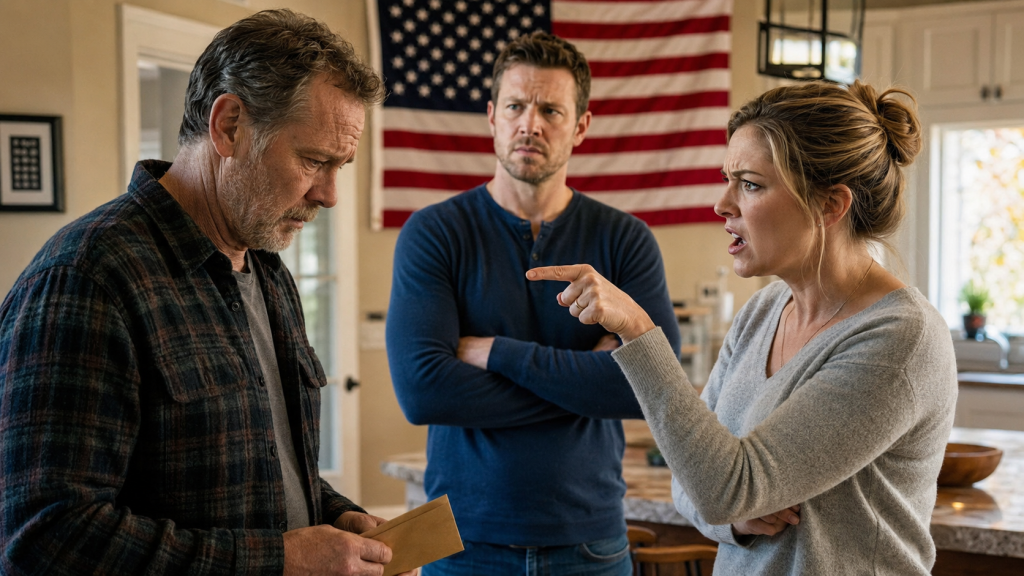
My father stood in my kitchen asking to borrow $1,000, his hands trembling with shame. Before he could explain why, my wife looked at him and said, “Tell him to get another job. We aren’t a bank.”
I gave him the money anyway. Three days later, a hospital called to say he was in emergency surgery—and that before going under, he had left me a sealed envelope with one warning:
“Do not let your wife see this.” At the time, I thought my father was trying to protect me from another argument.

I was wrong. He was trying to protect me from something that had been hidden for nearly four decades. And when I finally learned why he needed that $1,000, I understood that the most important thing my father had ever given me wasn’t money, property, or an inheritance.
It was the truth.
THE FIRST TIME MY FATHER ASKED ME FOR MONEY
My father, Raymond Mercer, had never asked me for money before.
That was why I knew something was wrong the moment he appeared at my house on a Tuesday afternoon.
Raymond was sixty-eight years old.
He had the hands of a man who had spent more than three decades building things for other people. He had hauled lumber, poured concrete, repaired roofs, framed houses, replaced windows, and worked beneath the brutal Colorado summer sun until the skin on the back of his neck looked permanently weathered.
He had never been wealthy.
But he had always been proud.
After my mother died when I was nine, Dad raised me alone.
He wasn’t particularly good at cooking. For almost a year, I thought spaghetti was supposed to be slightly burned on the bottom.
He didn’t understand fashion.
He once sent me to school wearing two different shades of blue because, according to him, “Blue is blue.”
But he showed up.
Every time.
He worked ten-hour shifts and still attended my school concerts.
He sat at the kitchen table helping me with algebra even though I eventually realized he was learning it from the textbook five minutes before explaining it to me.
He packed my lunches.
He washed my football uniform.
He sat beside my bed when I had pneumonia.
He taught me how to shave.
He taught me how to change a tire.
And when I left for college, he stood beside his old pickup truck pretending the Colorado wind was responsible for the tears in his eyes.
Years later, I discovered that many of the things I remembered disappearing from our lives hadn’t disappeared accidentally.
Dad sold them.
His motorcycle vanished when I started college.
I later learned he sold it to cover part of my tuition.
The only expensive suit he owned disappeared when I was nine.
He sold it because I needed winter clothes and new shoes.
There were probably dozens of sacrifices I never discovered.
That was Raymond.
He gave quietly.
He suffered privately.
And he almost never asked for anything.
So when he stood in my kitchen and said, “Grant, I need to borrow a thousand dollars,” I immediately put down my coffee.
My wife, Natalie, did not.
She was standing at the kitchen counter looking at something on her phone.
“A thousand?” she repeated.
Dad nodded.
“I’ll repay it.”
“What do you need it for?”
Dad’s shoulders tightened.
“I need some certified records. And I need to speak with an attorney.”
Natalie finally looked up.
“An attorney?”
“Yes.”
“What did you do?”
The question bothered me.
Dad heard the accusation in it too.
“I didn’t do anything.”
“Then why do you need a lawyer?”
“I also need to pay for a test.”
“What test?”
Dad hesitated.
That hesitation was enough for Natalie.
She gave a humorless laugh.
“Tell him to get another job, Grant. We aren’t a bank.”
Silence filled the kitchen.
I looked at her.
“Natalie.”
“What?”
“That’s enough.”
She crossed her arms.
“I don’t understand why I’m the bad person for asking basic questions.”
Dad looked at the floor.
His hands were clasped so tightly that the knuckles had gone pale.
“I shouldn’t have come.”
Something inside me snapped.
Not because Natalie disagreed with lending him money.
A married couple had every right to discuss finances.
It was the way she had spoken to him.
Like he was a stranger asking for a handout.
Like he hadn’t given us anything.
“Dad, come outside.”
We walked into the backyard.
He didn’t speak until the door closed behind us.
“I didn’t mean to create trouble.”
“You didn’t.”
“She doesn’t want me around.”
“That’s not true.”
He looked at me.
It was the kind of look fathers give their sons when both men know a lie has just been told out of kindness.
I sighed.
“What is the money really for?”
He looked toward the mountains.
“Records.”
“What records?”
“Old adoption records.”
I stared at him.
“Whose adoption?”
He didn’t answer immediately.
Instead, his eyes shifted toward the kitchen window.
Natalie was still standing inside.
Watching us.
Dad lowered his voice.
“I need proof before I tell you.”
“Proof of what?”
“Something I should have told you years ago.”
A strange pressure formed in my chest.
“Does this involve me?”
He nodded.
“And Natalie?”
Another pause.
Then another nod.
“Dad, tell me.”
“I can’t yet.”
“Why?”
“Because if I’m wrong, I could damage your marriage for nothing.”
“And if you’re right?”
He looked me directly in the eyes.
“Then your marriage may not be what you think it is.”
THE $1,000
I wanted to demand answers.
But then I looked at my father.
He looked tired.
Not physically tired in the ordinary sense.
Older.
Almost frightened.
That scared me more than anything he had said.
Raymond Mercer wasn’t easily frightened.
I remembered being twelve when a storm tore half the shingles from our roof. Dad climbed up in the rain with a tarp while lightning flashed over the neighborhood.
I remembered him confronting a drunk man who had followed a teenage cashier into a parking lot.
I remembered him working two jobs after Mom died because he refused to let me know how close we were to losing the house.
But standing in my backyard that afternoon, my father looked afraid.
“I’ll get the money,” I said.
Relief softened his face.
“I’ll repay you.”
“You won’t.”
“Grant—”
“You paid for college.”
“That was different.”
“You sold your motorcycle.”
His eyebrows lifted.
“You knew about that?”
“I found the paperwork years ago.”
He looked almost embarrassed.
I smiled.
“Consider us even.”
“We’ll never be even.”
“You’re right. I still owe you.”
For the first time that afternoon, he smiled.
I went inside and walked to my office.
I kept emergency cash in a small safe beneath my desk.
As I removed ten hundred-dollar bills, Natalie appeared in the doorway.
“You’re actually giving it to him?”
“Yes.”
“We agreed to discuss large expenses.”
“We are discussing it.”
“No, you’re ignoring me.”
“He has never asked me for money.”
“That doesn’t mean he won’t start.”
I turned toward her.
“He’s sixty-eight.”
“So?”
“He isn’t suddenly planning to make a career out of borrowing from us.”
“You always defend him.”
“He’s my father.”
“And this is our house.”
That sentence stayed with me.
Our house.
Legally, the house belonged to me.
I had bought it six months before Natalie and I married.
And the only reason I’d been able to afford the down payment was because Dad had sold the final parcel of land his mother had left him.
He had handed me a cashier’s check for $70,000.
“Build your life,” he’d said.
Natalie knew that.
I walked past her.
Dad was waiting by the front door.
I handed him the envelope.
His fingers trembled when he accepted it.
“I’m sorry, son.”
“You have nothing to apologize for.”
He looked over my shoulder toward Natalie.
Then he tucked the envelope into his jacket.
Normally, Dad hugged me before leaving.
That day, he didn’t.
He simply said, “I’ll call you soon.”
Then he walked away.
The door had barely closed before Natalie spoke.
“You embarrassed me.”
I turned around.
“I embarrassed you?”
“You undermined me in front of him.”
“You humiliated my father in my kitchen.”
“Our kitchen.”
I stared at her.
“He came here asking for money without explaining why.”
“He said he needed legal records.”
“And that doesn’t sound suspicious to you?”
“Not enough to treat him like garbage.”
Her expression hardened.
“You always choose him.”
I was quiet for several seconds.
Then I said the words I had been thinking since childhood.
“He chose me every day of his life.”
We barely spoke that night.
THE HOSPITAL CALL
Three days later, I was sitting in my office when an unfamiliar number appeared on my phone.
I nearly ignored it.
Something made me answer.
“Is this Grant Mercer?”
“Yes.”
“My name is Rebecca. I’m calling from Valley Regional Hospital. Raymond Mercer listed you as his emergency contact.”
My chair rolled backward when I stood.
“What happened?”
“He collapsed earlier this morning.”
I grabbed my keys.
“What happened?”
“The doctors discovered an aortic aneurysm. He was taken into emergency surgery.”
My stomach dropped.
“Is he alive?”
“He was stable when he entered the operating room.”
I pressed my free hand against the desk.
“When?”
“Approximately twenty minutes ago.”
“I’m coming.”
“Mr. Mercer, there’s something else.”
I stopped.
“Before your father was sedated, he asked us to give you a sealed envelope.”
I thought about our conversation.
The records.
The test.
The attorney.
“There is also an attorney waiting here,” Rebecca continued. “Her name is Priya Desai.”
“An attorney?”
“Yes.”
Then her voice became more cautious.
“Your father left one specific instruction.”
“What instruction?”
“He asked that you not discuss the envelope with your wife until you’ve spoken with Ms. Desai.”
Every muscle in my body tightened.
“What does Natalie have to do with this?”
“I honestly don’t know.”
I drove to the hospital without remembering most of the journey.
THE ENVELOPE
A woman in a navy suit was waiting outside the surgical unit.
She looked to be in her early fifties, with silver beginning to show in her dark hair.
“Grant Mercer?”
“Yes.”
She extended her hand.
“Priya Desai.”
“Where’s my father?”
“Still in surgery.”
“You’re his attorney?”
“For the past four days.”
Four days.
Dad had contacted her the day before asking me for money.
Priya held a thick envelope.
“He asked me to make sure this reached you if anything happened.”
She led me into a private consultation room.
I sat across from her.
“What’s happening?”
She didn’t immediately answer.
Instead, she removed several documents from a folder.
The first was a birth certificate.
Mine.
The second was a court document.
I read the heading twice.
PETITION FOR ADOPTION.
My name appeared beneath it.
I looked up.
“What is this?”
“Your adoption record.”
I actually laughed.
Not because it was funny.
Because my brain rejected the information.
“I’m not adopted.”
Priya remained silent.
“My mother gave birth to me.”
“The woman you knew as your mother, Margaret Mercer, legally adopted you when you were eleven months old.”
I stared at her.
“And Raymond?”
“He adopted you too.”
The room suddenly felt too small.
“Then who are my biological parents?”
Priya took a breath.
“Your biological mother was Raymond’s younger sister.”
I couldn’t speak.
“Elaine Mercer.”
A face appeared in my memory.
A photograph Dad kept in a drawer.
A young woman with long brown hair standing beside him at a county fair.
“Aunt Elaine?”
“Yes.”
“She died.”
“When you were eleven months old.”
I felt sick.
“Who was my father?”
“A man named Daniel Whitmore.”
The name meant nothing to me.
“Why didn’t Dad tell me?”
“Because Elaine was seventeen when you were born. Daniel was older. The circumstances were complicated, and Raymond believed protecting your identity was the safest choice.”
I stared at my birth certificate.
“Then Raymond is my uncle.”
“Biologically.”
Something in me immediately rejected that sentence.
“No.”
Priya looked at me.
“He’s my father.”
Her expression softened.
“I believe he would say exactly the same thing.”
THE NAME THAT CONNECTED EVERYTHING
I wiped my eyes.
Then I remembered why I was there.
“Natalie.”
Priya’s expression changed.
“Yes.”
“What does my wife have to do with my adoption?”
She slid another document toward me.
It was a genealogy report.
“Your father became interested in genealogy several months ago after finding a box belonging to Elaine.”
“What did he find?”
“Letters.”
She handed me photocopies.
Most were written by Daniel Whitmore.
One included a name I recognized.
Eleanor Whitmore.
Natalie’s maternal grandmother.
I stared at it.
“What am I looking at?”
“Daniel Whitmore and Eleanor Whitmore were siblings.”
My heart started pounding.
“So Natalie and I are related?”
“Distantly through marriage and extended family connections, but not in a way that presents the issue you’re imagining. That isn’t what concerned Raymond.”
“Then what did?”
Priya opened another folder.
“Daniel’s mother, Abigail Whitmore, died seventeen years ago.”
She placed a trust document in front of me.
“Before she died, she established a trust for Elaine Mercer’s biological child.”
I read the figure.
$1,800,000.
I looked again.
“That can’t be right.”
“The original trust was smaller. Investments increased its value.”
“Why didn’t anyone find me?”
“Because after Elaine died, your adoption was sealed. Your surname became Mercer, and Raymond moved you to another county.”
I looked at her.
“Does Natalie know?”
“That is what your father was trying to determine.”
MY WIFE’S MESSAGE
My phone vibrated.
Natalie.
I ignored it.
She called again.
Then again.
Finally, a text appeared.
WHERE ARE YOU?
Thirty seconds later:
IS RAYMOND OKAY?
Then another.
DID HE GIVE YOU ANY DOCUMENTS?
I stopped breathing.
Priya noticed.
“What?”
I showed her.
She read the messages.
Her expression became serious.
“How would she know there were documents?”
Exactly.
I hadn’t told Natalie about the envelope.
I hadn’t told her about Priya.
I hadn’t told her anything.
Another message arrived.
GRANT, PLEASE CALL ME BEFORE YOU READ ANYTHING.
I looked at Priya.
“She knows.”
“We need to be careful about assumptions.”
“Look at the message.”
“I agree it’s concerning. But concern isn’t evidence.”
“What evidence did Dad find?”
Priya hesitated.
“Enough to become suspicious.”
She explained that Raymond had discovered Natalie had ordered a genealogy report three years earlier.
That alone meant nothing.
Millions of people did the same thing.
But Raymond had also found evidence that someone had contacted the administrator of the Whitmore trust eighteen months earlier asking whether the beneficiary had ever been located.
The inquiry came from an email address linked to Natalie.
My hands went cold.
“She knew about the money.”
“Possibly.”
“Why wouldn’t she tell me?”
“That is something only Natalie can answer.”
Then another text arrived.
PLEASE DON’T SIGN ANYTHING.
I stared at those words.
Suddenly, dozens of conversations from the previous two years returned to me.
Natalie encouraging me to put her name on the house.
Natalie suggesting we combine every financial account.
Natalie asking whether Dad kept “old family paperwork.”
Natalie once asking if I had ever considered taking a DNA test.
At the time, none of those questions seemed important.
Now they felt completely different.
MY FATHER SURVIVED
The surgical doors opened almost four hours after I arrived.
A doctor walked toward us.
“Grant Mercer?”
I stood so quickly my knees nearly buckled.
“Your father’s surgery is finished.”
“Is he alive?”
“Yes.”
I closed my eyes.
“He’s in critical condition, but the procedure went well.”
I sat down.
For several seconds, I couldn’t speak.
I didn’t care about the trust.
I didn’t care about Natalie.
I didn’t care about adoption records.
My father was alive.
That was enough.
Several hours later, a nurse allowed me to see him.
Raymond looked impossibly small beneath the hospital blankets.
Machines surrounded him.
His eyes slowly opened.
“Grant?”
I took his hand.
“I’m here.”
His lips moved.
“The envelope?”
“I opened it.”
Fear entered his eyes.
“I’m sorry.”
“For what?”
“For not telling you.”
I leaned closer.
“You’re my father.”
His eyes filled.
“You understand?”
“I understand that a piece of paper says Elaine gave birth to me.”
He swallowed.
“And?”
“And you raised me.”
A tear moved down his cheek.
I squeezed his hand.
“You taught me to ride a bicycle.”
He closed his eyes.
“You stayed awake with me after Mom died because I was afraid I’d lose you too.”
His fingers tightened weakly around mine.
“You sold your motorcycle for my tuition.”
A faint smile appeared.
“You weren’t supposed to know that.”
“I know.”
I laughed through my tears.
“You’re my father. Nothing in that envelope changes that.”
For several seconds, neither of us spoke.
Then his expression became serious.
“Natalie.”
“I haven’t told her anything.”
“Be careful.”
“Did she know about the trust?”
His eyes closed.
“I think so.”
“How?”
“I found something.”
“What?”
He struggled to speak.
“Storage box.”
“Dad, don’t push yourself.”
“Elaine’s letters.”
“I saw them.”
“No.”
He shook his head.
“Another letter.”
I leaned closer.
“Where?”
“Workshop.”
Before he could explain further, the nurse stepped in.
“He needs rest.”
I kissed Dad’s forehead.
“I’ll handle it.”
As I walked toward the door, he whispered my name.
“Grant.”
I turned.
“Don’t hate her until you know everything.”
Even after everything, that was my father.
Still trying to keep me from making a decision out of anger.
THE LETTER IN THE WORKSHOP
The next morning, Priya and I went to Dad’s house.
His workshop stood behind the garage.
I had spent half my childhood there.
Dad had taught me woodworking at that bench.
Priya and I searched for almost an hour.
Then I noticed an old red toolbox beneath a shelf.
Inside was an envelope.
My name was written across the front.
Grant.
The letter inside wasn’t from Elaine.
It was from Natalie.
It was dated fourteen months earlier.
Raymond,
I know Grant is Elaine’s son.
I also know about the Whitmore trust.
Please do not tell him yet.
I need time to explain how I discovered it.
Natalie.
I read it twice.
Then a third time.
She had known for fourteen months.
Maybe longer.
Priya found additional correspondence.
Raymond had written back asking Natalie to tell me.
Apparently she had promised she would.
She never did.
Then Dad discovered she had contacted the trust administrator.
That’s when he began investigating independently.
The $1,000 had paid for certified adoption records, legal consultations, and a DNA test confirming my identity.
My father hadn’t borrowed money because he was desperate.
He had borrowed it to give me my own name back.
I WENT HOME
Natalie was waiting in the living room when I returned.
She looked exhausted.
“Is Raymond alive?”
“Yes.”
Relief crossed her face.
At least that appeared genuine.
“Thank God.”
I didn’t sit down.
“How long have you known?”
Her face went pale.
“Known what?”
“Don’t.”
One word.
That was enough.
Her shoulders dropped.
“Grant…”
“How long?”
She sat slowly.
“Almost two years.”
My stomach twisted.
“Two years?”
“I discovered the family connection when I did a genealogy test.”
“And the trust?”
“Later.”
“How much later?”
“About six months.”
“So for more than a year, you knew my biological identity and knew someone had left me nearly two million dollars.”
She began crying.
“I was going to tell you.”
“When?”
“I don’t know.”
“After I put your name on the house?”
Her head snapped upward.
“That isn’t fair.”
“After we combined every account?”
“Grant—”
“After my father died?”
“No!”
Her answer came so quickly that I believed that part.
But believing one sentence didn’t repair everything else.
“Why didn’t you tell me?”
She wiped her face.
“Because I was afraid.”
“Of what?”
“That you’d change.”
I almost laughed.
“You hid $1.8 million from me because you were afraid money would change me?”
“No. Because I was afraid Raymond would use it to push me out.”
I stared at her.
“What are you talking about?”
“He never liked me.”
“He gave us seventy thousand dollars for this house.”
“He gave you seventy thousand dollars.”
There it was again.
You.
Me.
His.
Hers.
Everything was a ledger to Natalie.
Everything had ownership attached.
“My father treated you like family.”
“He tolerated me.”
“And you humiliated him when he asked for a thousand dollars to prove something you already knew was true.”
Her face collapsed.
“I didn’t know what he was doing.”
“You knew enough to be afraid.”
She didn’t answer.
THE PART THAT HURT MOST
I wish I could say I immediately threw Natalie out.
Real life isn’t always that simple.
We had been married seven years.
There had been good years.
Vacations.
Christmas mornings.
Inside jokes.
Sunday breakfasts.
Birthdays.
Ordinary evenings watching television together.
People can betray you and still have shared beautiful moments with you.
That’s what makes betrayal painful.
If every memory were terrible, leaving would be easy.
Natalie begged me to attend counseling.
I agreed to one condition.
Complete financial transparency.
She agreed.
That decision uncovered the final truth.
Our accountant found that Natalie had spent nearly $24,000 over eighteen months consulting financial planners and an attorney.
Not our attorney.
Her attorney.
The documents showed she had asked questions about marital rights to inherited assets, trusts, and separately owned property.
She had specifically asked what would happen if a spouse received a previously undisclosed inheritance during marriage.
When I confronted her, she stopped denying it.
“I wanted security.”
“You had security.”
“I wanted to know where I stood.”
“So you hired a lawyer before telling me I had an inheritance?”
“I didn’t take anything.”
“That isn’t the point.”
“I never stole from you.”
“No.”
I looked at her.
“You just prepared yourself before I knew there was anything to protect.”
She cried.
I didn’t.
By then, something inside me had gone quiet.
RAYMOND CAME HOME
Dad spent twelve days in the hospital.
When I brought him home, he moved slowly with a walker.
I stayed with him for several weeks.
One evening, we sat on his porch watching the sun disappear behind the mountains.
“I heard you and Natalie separated,” he said.
I looked at him.
“Who told you?”
“I’m old, not dead.”
I laughed.
Then he became serious.
“I didn’t want this.”
“You didn’t cause it.”
“Maybe if I’d kept quiet—”
“No.”
I stopped him.
“You spent my entire life protecting me from difficult truths.”
He looked down.
“Maybe too much.”
“Maybe.”
I smiled.
“But this one needed to be told.”
He nodded.
After a while, I asked him the question that had been sitting inside me since the hospital.
“Why didn’t you tell me about Elaine?”
Dad looked toward the mountains.
“She was my little sister.”
His voice changed.
“She was seventeen. Scared to death. Your biological father wanted nothing to do with responsibility. Elaine loved you, but she wasn’t ready to raise a baby.”
He swallowed.
“Then she got sick.”
“What happened?”
“An infection. It moved fast.”
I had heard a different version growing up.
Dad continued.
“Before she died, she made me promise you would never grow up feeling unwanted.”
My eyes burned.
“So I became your father.”
“You already were.”
He smiled.
“I suppose I was.”
“What about Mom?”
“Margaret never hesitated. She said, ‘Bring that baby home.’”
I looked away because I was crying.
Dad put his hand on my shoulder.
“She loved you completely.”
For the first time, learning the truth about my birth didn’t feel like losing something.
It felt like discovering how many people had chosen me.
THE TRUST
Priya handled the legal process.
DNA confirmation and the original adoption documents established that I was Elaine’s biological child.
Six months later, the Whitmore trust was transferred to me.
After taxes, fees, and adjustments, the amount was still life-changing.
I did not buy a sports car.
I did not buy a mansion.
I did not quit my job.
The first thing I did was repay my father.
Not $1,000.
I paid off the remaining mortgage on his small house.
When he discovered what I’d done, he called me furious.
“You had no right!”
“You gave me seventy thousand dollars.”
“That was different.”
“You always say that.”
“I don’t need charity.”
“Neither did I when you sold your motorcycle.”
Silence.
Then he muttered, “You really know how to annoy an old man.”
“I learned from you.”
He laughed.
So did I.
WHAT HAPPENED TO NATALIE
Natalie and I separated for nearly eight months.
We attended counseling.
For a while, I genuinely considered reconciliation.
But trust is strange.
You can forgive someone and still realize you can no longer build a life with them.
Natalie eventually admitted something that finally gave me clarity.
She said, “When I discovered the trust, I started thinking of it as our future before you even knew it existed.”
That sentence explained everything.
She hadn’t married me because of the money.
I believe that.
She hadn’t known about it when we met.
But once she discovered it, she had allowed fear and greed to reshape our marriage.
She began planning around money that wasn’t hers.
She began seeing my father as an obstacle.
She began treating information as leverage.
And eventually, she had looked at a sixty-eight-year-old man standing humiliated in our kitchen and told him to get another job because she was afraid he was about to uncover the truth.
Our divorce was finalized quietly.
There was no dramatic courtroom battle.
The house remained mine because it had been purchased before our marriage and because Dad’s contribution was documented as a gift specifically to me.
The trust also remained separate property.
Natalie received what she was legally entitled to from our shared marital assets.
Nothing more.
Nothing less.
I didn’t try to punish her.
I didn’t want revenge.
Consequences were enough.
ONE YEAR LATER
A year after Dad’s surgery, we stood together in his backyard.
He was stronger.
Slower than before, but stronger.
On the table between us sat an old photograph.
Raymond.
Margaret.
Elaine.
All three were young.
Dad was holding a baby.
Me.
I picked up the photograph.
“You kept this?”
“Of course.”
“You could have told me.”
“I know.”
“Why didn’t you?”
He thought for a moment.
“Because every year that passed made it harder.”
I understood that.
“Do you regret adopting me?”
He looked offended.
“That’s the stupidest question you’ve ever asked.”
I laughed.
“I’m serious.”
“So am I.”
He took the photograph from my hand.
“Grant, biology made Elaine your mother.”
He pointed toward himself.
“Life made me your father.”
Then he handed the photograph back.
“And I’d choose that life again.”
I hugged him.
This time, neither of us pretended there weren’t tears.
WHAT I DID WITH THE MONEY
I kept most of the trust invested.
But I used part of it to create something in Elaine and Margaret’s names.
The Elaine and Margaret Family Scholarship.
Every year, it helps young parents and students from struggling families attend community college or trade school.
Dad hated having his name left out.
“Why aren’t you putting Mercer on it?”
“Because you already got your legacy.”
“What legacy?”
I smiled.
“Me.”
He rolled his eyes.
But I saw him wiping his face when he thought I wasn’t looking.
The scholarship’s first recipient was a nineteen-year-old single mother studying nursing.
At the ceremony, Dad sat in the front row wearing a new suit.
Afterward, I asked him about it.
“You finally bought another good suit?”
He straightened his jacket.
“Figured I could afford one now.”
I laughed.
Then he pointed at me.
“And don’t you dare sell it to buy somebody shoes.”
That nearly broke me.
Because suddenly I was nine years old again.
And I understood exactly how much one man had quietly given away so his son would never feel poor.
THE $1,000 ENVELOPE
There is one part of the story I haven’t mentioned.
Months after Dad recovered, he handed me an envelope.
Inside were ten hundred-dollar bills.
The same amount I had given him.
“I told you I was paying you back,” he said.
I tried to return it.
He refused.
So I did something else.
I framed one of the hundred-dollar bills.
Underneath it, I placed a small brass plaque.
It reads:
THE BEST $1,000 I EVER SPENT.
Dad laughed when he saw it.
But that’s exactly what it was.
That money bought certified records.
It paid for legal advice.
It paid for a DNA test.
But more importantly, it gave my father the tools he needed to tell me a truth he had carried for almost forty years.
I learned where I came from.
I learned who my biological mother was.
I learned that an inheritance had been waiting for me.
I learned what my wife had hidden.
But none of those discoveries mattered as much as something else.
I learned the difference between someone who wants to share your life and someone who has spent their life building yours.
Raymond Mercer didn’t give birth to me.
He didn’t share exactly the same biological relationship I had always believed we shared.
But he woke up every morning and chose to be my father.
When I was hungry, he fed me.
When I was scared, he stayed.
When I needed shoes, he sold his suit.
When I needed college tuition, he sold his motorcycle.
When I needed a home, he sold inherited land.
And when I needed the truth, he swallowed his pride, stood in my kitchen, and asked his son for $1,000.
The last time I visited him, we sat on his porch watching the Colorado sunset.
He looked at me and said, “You know, I still feel bad about asking you for that money.”
I laughed.
“Dad, you’re never going to let that go, are you?”
“A man should pay his debts.”
“You did.”
“When?”
I looked at him.
“About forty years ago.”
He frowned.
“What are you talking about?”
“You spent your entire life paying me in advance.”
For once, Raymond Mercer had nothing to say.
He simply looked toward the mountains.
Then he put his arm around my shoulder.
And we sat there together.
Father and son.
Not because a birth certificate said so.
Not because DNA said so.
Not because a court had approved an adoption decades earlier.
But because love had already decided it.
Sometimes the people who give us the most never ask for anything.
Sometimes the person we think is interfering with our life is actually trying to save us from something we cannot yet see.
And sometimes a trembling hand asking for $1,000 isn’t asking for charity at all.
Sometimes it’s a father making one final sacrifice to protect his child.
If I could return to that Tuesday afternoon and change one thing, I wouldn’t stop Natalie from saying what she said.
As painful as it was, that moment showed me something I needed to see.
I would simply walk across the kitchen sooner.
I would put my arm around my father’s shoulders.
And before he ever had the chance to lower his eyes in shame, I would tell him:
“You don’t have to explain anything, Dad. Whatever you need, I’m here.”
Because after everything Raymond Mercer had done for me, $1,000 was never really a loan.
It was simply my first opportunity to give something back to the man who had given me an entire life.
And no inheritance—not even $1.8 million—could ever be worth more than that.
THE END! THANKS FOR READING!