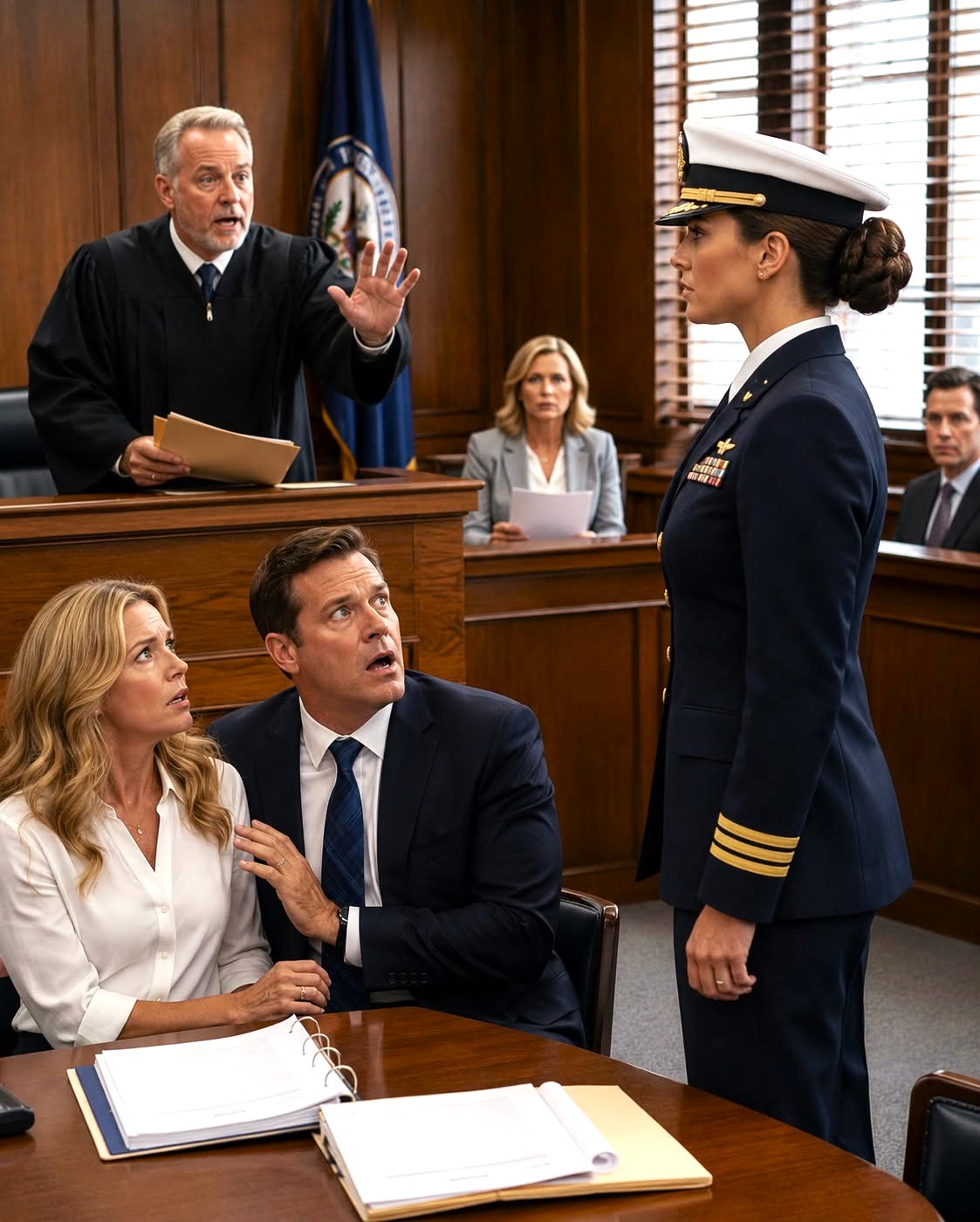
He had expected me to arrive ashamed, confused, and unprepared.
He had expected the daughter he remembered.
The woman standing across from him had survived far worse than his disappointment.
Judge Simmons looked at my mother.
“Mrs. Carter, did you know the deed named your daughter alone when you signed this petition?”
Mom took a breath.
Her fingers tightened around the clasp of her handbag.
“Yes,” she said at last.
Dad turned toward her.
The word was quiet, but it changed the room.
Judge Simmons asked why she had signed a petition describing the farmhouse as family property.
Mom looked at me then.
For the first time that morning, she did not look at the uniform.
She looked at my face.
“We thought she would never come back,” she said.
“I came back from every deployment,” I replied.
“You know what I mean.”
“I do,” I said. “You mean I did not come back and apologize for becoming someone you did not choose.”
Dad pushed back from the table.
“This is ridiculous.”
Judge Simmons told him to remain seated.
The authority in his voice stopped my father more effectively than anger would have.
My mother’s eyes filled, but I did not mistake tears for accountability.
There had been years available for a phone call.
Years for an apology.
Years to ask whether I was alive after the explosion.
They had used none of them.
Judge Simmons reviewed the documents once more.
Then he ruled that the petition had not established any legal basis for transferring the property.
The certified deed remained controlling.
The tax records contradicted the claim that my parents had carried the property expenses.
The request was denied.
There was no applause.
Real courtrooms do not resolve family pain with applause.
There was only the sound of the clerk gathering papers and my father breathing through his nose as if he had been personally insulted by the truth.
Judge Simmons addressed me before closing the file.
“Commander Carter, the court recognizes your documentation and your appearance today.”
“Thank you, Your Honor.”
His gaze dropped briefly to the ribbons on my chest.
Then he nodded.
It was a small gesture.
It meant more than my parents understood.
Outside the courtroom, Dad caught up with me in the hallway.
“You made us look like liars,” he said.
I shifted the folder under my arm.
“I brought the receipts.”
“You wore that uniform to humiliate us.”
“I wore it because you spent twelve years pretending it was a costume.”
Mom stood several feet behind him.
Her pearls were slightly crooked now.
“Evelyn,” she said, “we are still your parents.”
I looked at both of them.
“That was never the question.”
Dad opened his mouth, but I raised one hand.
Not in anger.
Not as a threat.
Just enough to end the familiar pattern before it began.
“You do not get to call my service abandonment when it suits you, then call me family when you want my house.”
Neither answered.
I walked away with the deed, the receipts, and the same limp I had carried into the building.
The uniform did not make me stronger.
It reminded me that I already was.
A week later, I drove to the farmhouse with a toolbox in the back of my SUV and Knox in the passenger seat.
The porch still sagged.
The paint still peeled.
The oak tree was still half dead.
Winning in court had not repaired any of it.
So I started with the front step.
I removed the warped board, measured the opening twice, and cut a replacement.
Knox lay in the shade while I worked.
By late afternoon, the new board sat level beneath my boots.
I found one of my grandfather’s old pencils in a kitchen drawer, worn flat on one side and too short to sharpen properly.
For a long moment, I held it in my palm.
My parents had tried to turn the farmhouse into proof that I had abandoned them.
Instead, it became proof of what I had carried all along.
Ownership was not the paper alone.
It was the taxes paid from far away, the repairs arranged between deployments, the promises kept when nobody was watching, and the decision to return without asking permission.
Before leaving, I placed my commanding officer’s letter in a plain frame on the mantel.
I did not hang my medals there.
I did not need the house to become a shrine.
I only wanted one sentence visible.
Honor is sometimes simply having the courage to show up.
The next morning, my mother called.
I watched her name appear on my phone while Knox slept near the back door.
For twelve years, I had imagined what I might say if either of my parents finally reached out.
In those imagined conversations, I was sharper.
Colder.
Sometimes I did not answer at all.
But real choices rarely arrive with the clean satisfaction we rehearse for them.
I let the phone ring twice.
Then I answered.
“Hello, Mom.”
She was quiet for several seconds.
“I saw the house,” she said.
I looked through the kitchen window at the azaleas I had trimmed the day the summons arrived.
“And?”
“The step looks good.”
It was not an apology.
Not yet.
But it was the first honest thing she had said to me in years.
“Granddad taught me to measure twice,” I said.
“I remember.”
Another silence followed.
This one felt different.
Not healed.
Not forgiven.
Open.
I did not promise her the farmhouse.
I did not erase the petition, the lies, or the years they had refused to know me.
I simply stayed on the line long enough to see whether she could speak without asking me to become smaller.
That was the boundary I carried forward.
The judge had protected my title to the house.
I had to protect the title to my own life.
Commander.
Daughter.
Survivor.
None of those words canceled the others.
For years, my parents had believed family loyalty meant returning as the person they remembered.
They were wrong.
Sometimes the most loyal thing you can do is come back as yourself and refuse to surrender what it cost you to become that person.
When the call ended, Knox lifted his head.
I rested my hand against his neck and looked at the framed letter on the mantel.
Then I picked up my coffee and went outside.
The azaleas still needed trimming.
This time, there was no summons waiting in the mailbox.
THE END! THANKS FOR READING!