“They’re going to see who I became,” I said.
The words sounded stronger than I felt.
The next morning, I called the courthouse.
The clerk confirmed that my parents wanted the property transferred to them on the grounds of abandonment.
“Am I required to appear in person?” I asked.
“Yes, ma’am.”
That word stayed with me after the call ended.
Abandonment.
My father had used it the day I enlisted.
“You’re abandoning your family,” he had said.
“No, Dad. I’m serving something bigger.”
He never forgave me for saying it.
That afternoon, I drove past the farmhouse.
The oak tree in front was half dead.
Paint peeled from the siding in long curls.
The porch sagged lower than I remembered, and weeds had pushed through the gravel near the side gate.
My grandfather had built that house with his own hands.
I remembered following him through the rooms as a child while he carried a pencil behind one ear and measured boards twice before cutting them.
He believed care was a verb.
You fixed the hinge.
You paid the bill.
You showed up when the roof leaked.
My parents had allowed the place to decline while telling a court they had been carrying it.
I sat in my car across the road and felt anger arrive slowly.
Not hot.
Not reckless.
Precise.
That evening, I found an old letter from my commanding officer.
“Commander Carter served with quiet distinction. Honor is not always found in victory. Sometimes, it is simply having the courage to show up.”
I read the lines three times.
Then I brushed the uniform, polished what needed polishing, and pinned every medal back into place.
The following morning, the jacket felt tighter than I remembered.
The reconstructed knee ached when I straightened.
For a moment, I considered changing into civilian clothes.
I could have worn a navy suit, carried my receipts, answered the questions, and gone home.
That would have been easier.
It also would have allowed my parents to continue treating my service as an embarrassing detour rather than the life I had built.
I straightened the collar.
“Let’s finish this quietly,” I told Knox.
Portsmouth greeted me with heavy air and a washed-out morning sky.
On the drive, I passed the diner where my family used to eat when I was a child.
I remembered Ryan’s trophies lined across the living-room wall when we were children.
There had never been anything displayed for me.
Not a certificate.
Not a photograph.
Not even the graduation notice I had mailed home.
At the courthouse entrance, a janitor noticed my ribbons and stopped pushing his cart.
“Ma’am,” he said.
I gave him a small nod.
In the hallway, conversations softened as I passed.
Families sat on hard benches holding folders, coffee cups, and the strained expressions of people waiting for strangers to decide something personal.
When the clerk called Case 4238B, I stood.
My knee ached with the first step.
It ached with the second.
Every step remained steady.
Seeing my parents hurt more than I expected.
Dad’s hair had thinned, but the hard set of his mouth had not changed.
Mom wore pearls and sat with her hands folded over a structured handbag.
Neither rose.
Neither smiled.
They looked at the uniform as if it were proof of bad manners.
I had not brought a lawyer.
The facts were simple enough to carry myself.
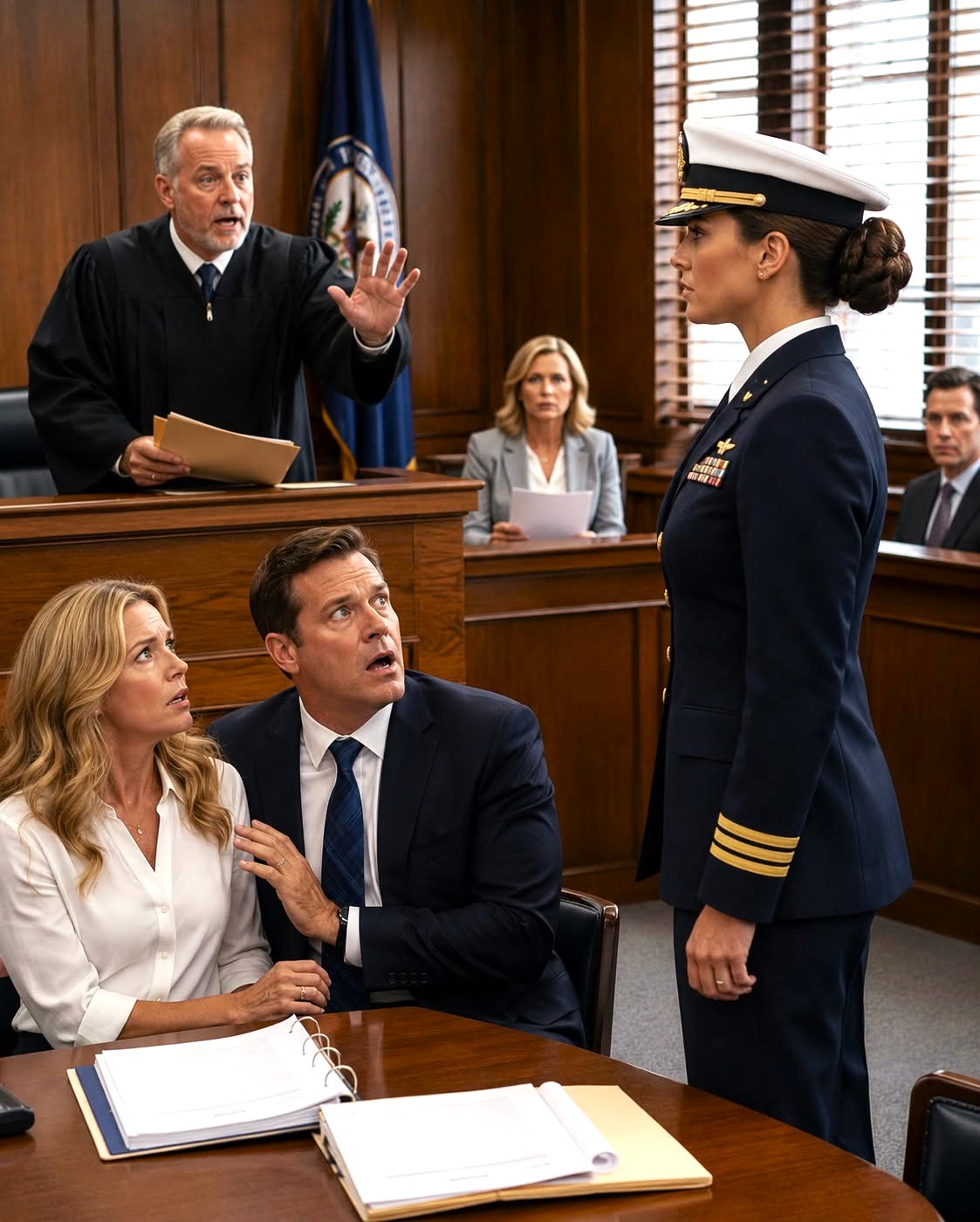
Judge Simmons entered and took his seat.
When he looked up and recognized me, the entire room shifted.
“Commander Carter,” he said after a moment, “would you like to make a statement?”
My father blinked.
“Commander?” he repeated.
The word landed between us like an object dropped on a quiet floor.
I moved to the table and placed the tax receipts beside the summons.
“Yes, Your Honor.”
Judge Simmons opened the court file.
Before I began, he looked at me once more.
“I remember your name,” he said. “And I remember why.”
Dad shifted sharply.
“Your Honor, this is supposed to be about the farmhouse.”
“It is,” the judge said. “Which is why facts matter.”
I explained that my grandfather had transferred the farmhouse to me and that the certified deed named me as the owner.
I explained that I had paid the property taxes every year since 2013.
I placed the receipts in chronological order.
I included the roof repair invoice, the well-pump bill, and the insurance notices.
I did not give a speech about sacrifice.
I did not describe the convoy.
I did not tell the room how many nights I had spent awake after coming home.
I gave dates.
Dates were enough.
Dad leaned toward the table.
“Those receipts don’t prove she lived there.”
“I never claimed I lived there,” I said. “I claimed I owned it, maintained it, and paid what was due.”
Mom turned toward me.
“You left us.”
“I deployed.”
Her mouth tightened.
“You chose strangers over your own family.”
“No,” I said. “I chose my service. You chose to make that a punishment.”
The courtroom remained quiet, but it was no longer the stunned silence that had followed my entrance.
Now people were listening.
Judge Simmons examined the deed and compared it with the language in the petition.
The deed named me alone.
The petition repeatedly described the farmhouse as shared family property that had fallen to my parents because I had disappeared.
I had not disappeared.
My address appeared on tax records, insurance notices, and repair invoices.
My payments appeared year after year.
Judge Simmons asked my father to identify a single property-tax payment he had made.
Dad opened his folder.
He moved one page, then another.
His attorney whispered something to him.
Dad’s jaw hardened.
“We handled the property,” he said.
“That was not my question,” Judge Simmons replied.
Dad looked at me.
The old accusation was in his face before he spoke.
“She walked away from us.”
The judge rested both hands on the bench.
“Mr. Carter, military deployment is not evidence that a property owner surrendered title.”
Dad’s face reddened.
Mom stared down at her handbag.
Judge Simmons then asked whether either of them had a signed agreement from me transferring ownership, granting them permanent control, or authorizing them to claim my expenses as their own.
They had none.
He asked whether they disputed the certified deed.
They did not.
He asked whether they disputed the tax receipts.
Dad said he needed time to review them.
The judge reminded him that he had filed the petition.
That was the first moment I saw uncertainty enter my father’s expression.