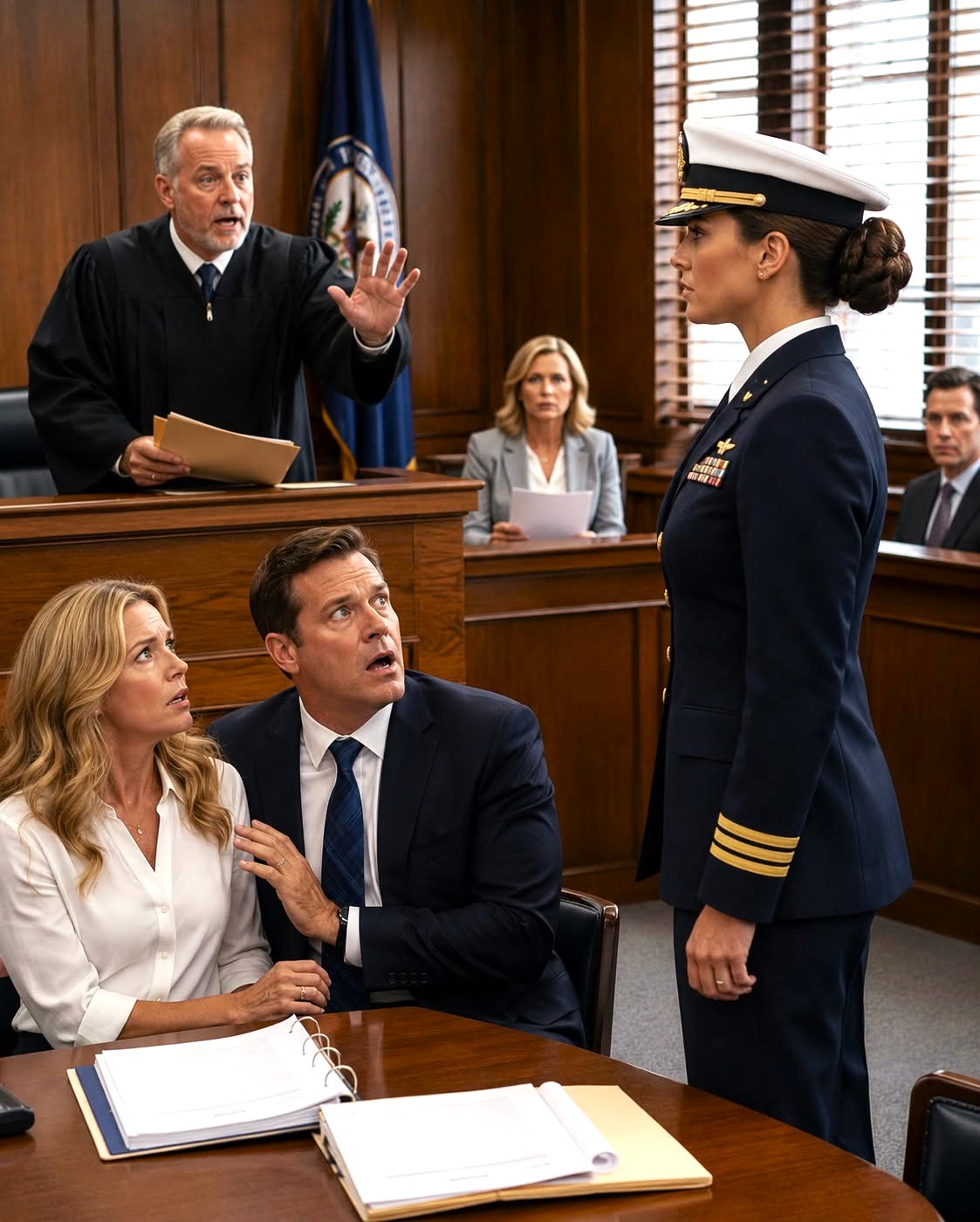
The courtroom did not go silent because I raised my voice. It went silent because I walked through the doors wearing the uniform my parents had spent twelve years pretending meant nothing.
My father noticed me first. Robert Carter leaned toward my mother and laughed under his breath, the same dismissive little sound he used whenever he believed I had made a spectacle of myself.
Margaret Carter turned in her seat, saw the dark uniform and rows of ribbons, and slowly shook her head.
Her pearls shifted against the collar of her cream blouse.
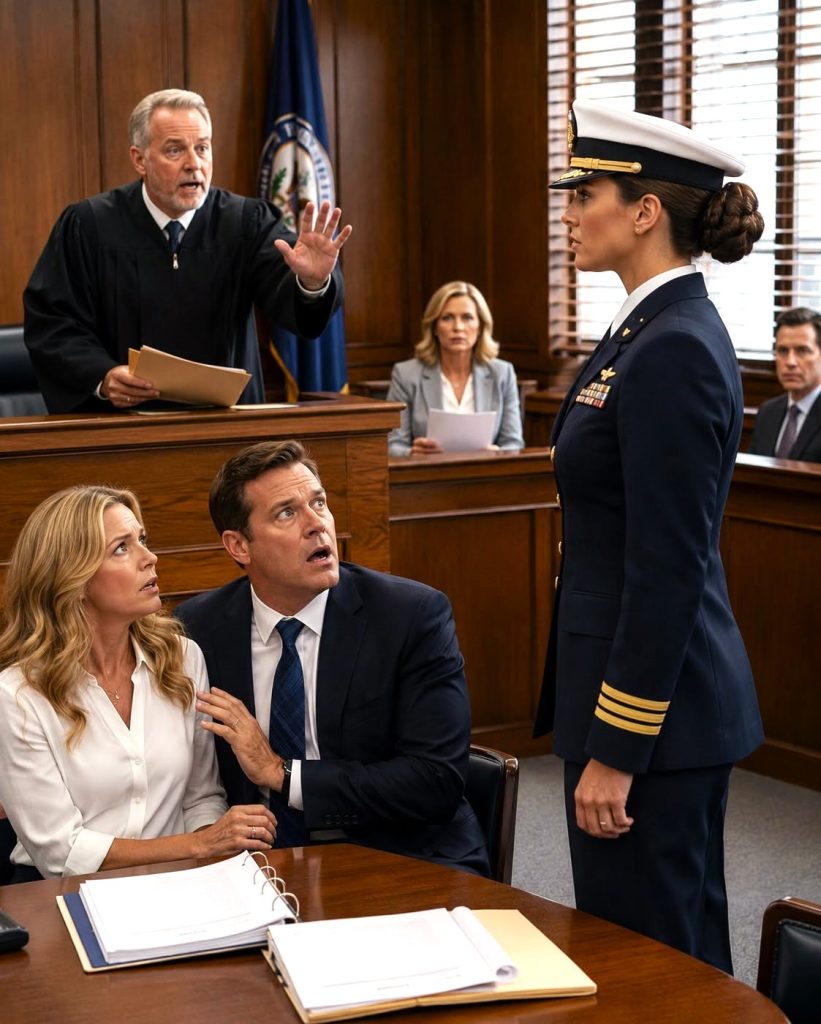
“Uniform,” she whispered, with the weary disappointment of a woman who had already decided that whatever I did must be wrong.
Then Judge Simmons looked up.
His eyes moved from my face to the ribbons on my chest, then back to my face again.
The hand beside his case folder trembled.
“My God,” he said. “Is that really her?”
Every conversation in the courtroom stopped.
A clerk froze with a folder halfway across the table.
A man in the second row lowered his paper coffee cup without taking a drink.
My father’s smile stayed on his mouth for one second longer than it belonged there, then vanished.
Two days earlier, I had been outside my small house near Norfolk trimming the azaleas when Knox began barking at the mail carrier.
The afternoon was humid enough to make my T-shirt cling between my shoulders, and the electric trimmer had left the sharp green smell of cut leaves hanging over the yard.
The envelope was cream-colored and heavier than ordinary mail.
Portsmouth Family Court, Virginia.
I wiped my hands on my jeans before opening it.
The first page carried a case number.
4238B.
Carter versus Carter.
Petition for property division.
Plaintiffs: Robert and Margaret Carter.
Defendant: Evelyn Carter.
For several seconds, I stood beside the mailbox reading the names as if repetition might turn them into strangers.
It did not.
My own parents were taking me to court.
The property listed in the petition was the old farmhouse my grandfather had built.
He had left it to me.
My parents wanted it transferred back to them on the grounds that I had abandoned it.
A dry laugh slipped out of me before I could stop it.
It was not amusement.
It was what happened when life offered one more absurdity after you had already used up your tears on worse things.
I carried the summons inside and set it on the kitchen table.
Knox followed, nails clicking across the floor, then rested his head against my knee.
“Guess they finally found another way to talk to me,” I told him.
It had been twelve years since I had gone home.
The last time my parents saw me, I was wearing fatigues after finishing BUD/S.
Dad did not come.
Mom sent a text.
“We raised a daughter, not a soldier.”
I read that message in a parking lot with my gear beside me and a knot in my throat I refused to name.
For years, I kept expecting one of them to call and ask whether I was safe.
They never did.
Instead, they sent occasional messages through relatives about birthdays I had missed, holidays I had ruined, and the shame of having a daughter who preferred the Navy to her family.
They called it abandonment.
I called it service.
That difference became the wall between us.
My work was rarely dramatic in the way civilians imagined military service.
There were missions, yes, but there were also lists, maps, fuel calculations, equipment checks, and long hours spent making sure other people came home.
Men trusted me with their lives because I did not confuse noise with leadership.
I learned to see what was missing.
I learned to notice when a number did not match, when a route felt wrong, or when a story had been polished too carefully.
That instinct saved us more than once.
It did not save us outside Al-Huda.
The IED tore through the convoy with a pressure wave that seemed to split the air itself.
I remembered metal, dust, somebody shouting my name, and the impossible weight of my own leg.
I came home with a reconstructed knee, a permanent limp, and a pension.
I also came home without Lewis.
His folded flag rested in the old Navy chest at the foot of my bed, beside my uniform and medals.
I bought a modest house near Norfolk and repaired what I could with my own hands.
The first year, I replaced a leaking section of roof.
The second, I rebuilt the back steps.
When my knee would not cooperate, I sat on the ground and worked from there.
The farmhouse remained in my name.
I paid its property taxes every year beginning in 2013.
During deployments, I arranged the payments before I left or handled them through the account I used for recurring bills.
When storms damaged the roof, I paid for repairs.
When the well pump failed, I paid to replace it.
I did not live there, but I never abandoned it.
My grandfather had given me the house because he understood something my parents never had.
He knew leaving was not the same as forgetting.
That evening, I made a pot of coffee and spread the summons across the table.
The petition claimed my parents had covered every expense related to the farmhouse.
I opened the metal file box from the hall closet.
Inside were tax receipts, insurance notices, repair invoices, and copies of the deed.
The papers were not dramatic.
They were better than dramatic.
They were dated.
The 2013 receipt showed my payment.
So did 2014, 2015, and every year after that.
A roof invoice carried my name and the farmhouse address.
A well repair bill had been charged to my account.
The petition did not merely exaggerate.
It contradicted a paper trail that had existed for years.
Some people lie because they think nobody will challenge them.
My parents had gone further.
They had mistaken my silence for the absence of evidence.
After midnight, I opened the old Navy chest.
The smell of salt, canvas, and gun oil rose from it.
My uniform lay folded beneath a cloth cover.
The medals were kept in a small box, each one wrapped carefully enough to prevent scratching.
Lewis’s flag rested below them.
My hands shook when I lifted the jacket.
Knox sat beside the bed, watching me with the solemn concentration dogs reserve for grief they cannot understand but refuse to leave alone.