After My Son Hit Me for Refusing to Pay His Gambling Debts, I Roasted His Favorite Dinner—Then Three Estate Lawyers Turned Around From the Head of the Table My son hit me because I refused to pay the men who wanted to break his hands.
I did not cry when my shoulder struck the marble floor. I did not cry when pain flashed through my ribs or when the back of my head narrowly missed the bottom stair. I did not cry when Caleb stepped over me, adjusted the designer watch I had bought him, and said, “You should have stayed useful, Mom.”
For thirty-one years, I had mistaken blood for loyalty. Caleb Whitmore had once been the little boy who slept with a red toy fire truck beneath his pillow.
He had followed his father through the warehouses of Whitmore Logistics, wearing a plastic construction helmet and asking questions about every truck that entered the loading yard.
When he was six, he announced that he would run the company one day.
My husband, Henry, smiled and placed a hand on his small shoulder.
“First, you learn how to carry responsibility,” he said.
Caleb remembered the promise of the company.
He forgot the responsibility.
Now he stood at the top of the staircase in Henry’s house, smelling of whiskey, expensive cologne, and desperation.
His white shirt was wrinkled.
His eyes were red from sleeplessness.
Two men had visited me that morning.
They did not give their real names.
They did not need to.
One placed photographs on my kitchen counter showing Caleb seated beside a known bookmaker at a private poker room.
Another photograph showed him signing loan documents.
The final page listed my name and the Whitmore estate as collateral.
I had never signed anything.
The men remained polite.
That made them more frightening.
“Your son owes four hundred eighty thousand dollars,” the taller one said. “We were told you would make it right.”
“I did not borrow the money.”
“He said you would understand.”
“I understand that he lied.”
The man smiled without warmth.
“We would prefer not to damage such a respectable family.”
He slid one final photograph toward me.
Caleb was leaving a casino at three in the morning.
Someone had drawn a circle around his hands in red ink.
“Tell him he has forty-eight hours.”
Then they left.
I called Caleb immediately.
He arrived an hour later, not ashamed or frightened, but angry that the men had approached me directly.
“You owe them,” he said.
“No. You owe them.”
His face twisted.
“Dad would have helped me.”
That almost made me laugh.
His father had helped him many times.
Henry paid for two unfinished college degrees.
He covered the damage after Caleb crashed a company vehicle while intoxicated.
He funded a freight-management business that failed within fourteen months because Caleb stopped appearing at the office.
He paid off a credit card Caleb used to finance a week in Monaco.
But Henry never handed him control of Whitmore Logistics.
That refusal became the final conflict between them.
Whitmore Logistics began with two secondhand trucks and a warehouse with a leaking roof.
Henry drove overnight routes while I handled invoices from our kitchen table.
When the company could not afford office staff, I answered phones while caring for Caleb.
I learned payroll, insurance, contracts, and fleet scheduling.
Henry built the roads beneath the company.
I held together everything that traveled over them.
By the time we were sixty, Whitmore Logistics operated across nine states.
People often called it Henry’s empire.
He corrected them.
“It belongs to Margaret and me,” he always said.
Caleb heard only the word empire.
He assumed being our son made him its prince.
Henry loved him deeply.
But love did not make him blind.
Before he died from pancreatic cancer, he placed the estate, company shares, family properties, and investment accounts under my control.
Caleb would receive a generous trust allowance and could inherit voting shares after my death, provided he met specific conditions.
He had to remain free of felony convictions.
He could not commit financial fraud against the estate.
He could not threaten, exploit, or assault me.
Most importantly, the trust contained a protective clause allowing me to remove him permanently if his conduct endangered the family or company.
Caleb did not know the exact language.
Henry insisted we keep it private.
“If he knows where the line is,” Henry told me, “he’ll learn to stand one inch away from it.”
Then he handed me a sealed letter.
Inside was one sentence I never forgot.
Protect what we built, even from our own son.
After Henry died, grief weakened every boundary I had.
Caleb called constantly.
He said losing his father had destroyed him.
He needed help stabilizing his life.
The first request was for eighty thousand dollars to repair a bad investment.
The second was for a replacement sports car after he crashed the one Henry had given him.
The third was a casino debt concealed behind the word business.
Each time, I paid.
Each time, Caleb cried, apologized, and promised it would never happen again.
Each rescue taught him the wrong lesson.
He did not learn that gambling was dangerous.
He learned that his mother would absorb the consequences.
This time, he had used my name as collateral.
This time, strangers had come to my home with photographs.
This time, I finally said no.
Caleb stared at me from the staircase.
“You have the money.”
“That does not make the debt mine.”
“They’re dangerous.”
“You knew that when you borrowed from them.”
His voice rose.
“I’m your son!”
“And I am your mother, not your private bank.”
He descended one step at a time.
“You would let them hurt me?”
“I will pay for treatment. I will pay for a legitimate attorney. I will help you enter a gambling-recovery program.”
“I don’t need treatment.”
“You owe nearly half a million dollars to criminals.”
“I need a check.”
“You are not getting one.”
His smile vanished.
Then his hand hit my shoulder.
The fall was fast, bright, and nearly silent.
I struck the marble and lost my breath.
Caleb came down slowly.
He crouched beside me, close enough that I could see the small scar above his eyebrow from when he fell off his bicycle at seven.
I had held a towel against that wound while he cried into my chest.
Now his face contained no trace of that child.
“Tomorrow, you’ll call the bank,” he whispered. “Or next time, I won’t miss.”
Then he took my phone from the side table, deleted the message containing the photographs, and walked out.
He made one mistake.
He forgot the camera.
Five years earlier, after my hip surgery, Henry installed a discreet security camera inside the staircase alcove.
It monitored the stairs in case I fell while alone.
The camera automatically uploaded footage to a protected server controlled by the estate security company.
Caleb believed the system had been disconnected after Henry’s death.
It had not.
I remained on the floor for almost ten minutes.
When I finally stood, my ribs ached and my left arm felt heavy.
At midnight, I sat in Henry’s study with an ice pack pressed against my side.
His desk still carried faint scratches from the years he used it.
His reading glasses remained inside the top drawer because I could never bring myself to move them.
I called Dr. Samuel Levin, our family physician.
He came to the house, examined my shoulder and ribs, documented the bruising, and insisted I go for imaging the following morning.
Then I called Jonathan Graves, Henry’s estate attorney.
“Mrs. Whitmore?” he answered, his voice thick with sleep.
“Jonathan, I need you to come tomorrow.”
Something in my tone woke him completely.
“Are you safe?”
I looked toward the empty staircase.
“Safe enough.”
“What happened?”
“Caleb crossed the line.”
There was a pause.
“Which line?”
“All of them.”
I explained the gambling debt, the forged collateral, the blow, and the threat.
Jonathan’s voice became sharp.
“Call the police.”
“I will.”
“Tonight.”
“The security company has the recording. Dr. Levin documented the injuries. I need tomorrow handled carefully.”
“What do you need from me?”
“Bring witnesses. Bring a notary. Bring the documents Henry and I discussed five years ago.”
Another silence.
Then he asked, “It’s time?”
I closed my eyes.
“Yes.”
The next morning, I went to the hospital for X-rays.
Nothing was broken, but my shoulder was badly bruised and two ribs were strained.
A police detective named Karen Doyle met me in a private room.
I gave a full statement.
The security company provided the staircase footage.
Detective Doyle watched it once, then asked whether Caleb had access to weapons.
I said he owned a licensed handgun, though I did not know where he kept it.
She advised me not to confront him alone.
“I won’t be alone,” I said.
Jonathan arrived at noon with two other attorneys.
Martin Bell specialized in corporate governance.
Elijah Ross represented the family trust.
A licensed notary came with them.
They spread documents across Henry’s dining table.
The protective clause was stronger than I remembered.
If Caleb committed violence against me, misused the family name as collateral, threatened estate assets, or exposed Whitmore Logistics to criminal liability, I could remove him as a beneficiary immediately.
His trust income could be terminated.
His future shares could be redistributed.
His access to company property, vehicles, accounts, and residences could be revoked.
The only requirement was documented evidence and notarized confirmation from me.
We had both.
Jonathan looked at the bruise beneath my sleeve.
“You do not have to serve him dinner.”
“I know.”
“Then why are you doing this?”
“Because he expects me to surrender.”
“That sounds dangerous.”
“Detective Doyle will have officers nearby.”
Jonathan studied me.
“This isn’t revenge?”
“No.”
“What is it?”
I looked at Henry’s chair at the head of the table.
“The last consequence his father tried to prepare him for.”
By three that afternoon, the documents were signed.
Caleb was removed as beneficiary, voting heir, and successor to Whitmore Logistics.
His monthly trust payment was suspended.
The company canceled his executive consultant title, which had always been mostly ceremonial.
His corporate cards were frozen.
His access credentials were revoked.
The security team recovered the company-owned Range Rover from his apartment garage.
The estate issued a no-entry order covering the family home, warehouses, offices, and vacation properties.
Jonathan notified the banks that any collateral documents bearing my name were fraudulent.
Detective Doyle began arranging for Caleb’s arrest on assault, threats, attempted fraud, and identity-related charges.
Then I went into the kitchen.
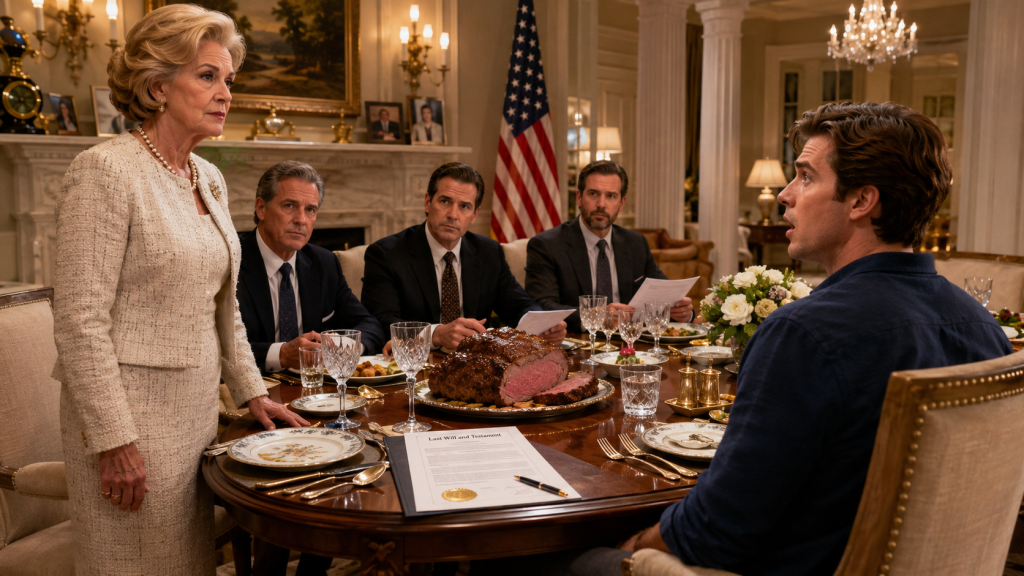
I roasted a prime rib.
Henry used to cook it every Christmas.
Caleb loved the crisp edges and always stole the first slice before anyone sat down.
I prepared garlic potatoes, roasted carrots, and creamed spinach.
I polished Henry’s crystal glasses until they shone beneath the chandelier.
I placed the silverware in perfect lines.
At the head of the table, Jonathan, Martin, and Elijah reviewed the final notarized copies.
Detective Doyle waited in the library with two uniformed officers.
At six thirty, I texted Caleb.
Come for dinner. We’ll discuss the check.
His reply arrived instantly.
Knew you’d calm down.
He entered the house forty minutes late, wearing the same watch and a navy blazer over an open-collared shirt.
He smelled of whiskey and confidence.
He did not notice the unfamiliar sedan parked near the service entrance.
He did not ask about my bruised shoulder.
His eyes went directly to the roast.
“Good,” he said. “You finally remembered what matters.”
The three attorneys sat with their backs to the doorway.
Caleb assumed they were business associates or family friends.
He walked to the table without washing his hands, tore a piece of meat from the platter, and put it into his mouth.
“Perfect,” he said while chewing.
Then he laughed.
“Good girl. Now go get my checkbook.”
The three men turned around.
Caleb stopped moving.
Jonathan Graves had known him since birth.
He had handled Henry’s will, Caleb’s first trust distribution, and every legal rescue that followed.
“Jonathan?” Caleb asked.
Jonathan placed a notarized document beside the empty plate.
“Sit down.”
“What is this?”
“Official notice that your mother has exercised the estate’s protective clause.”
Caleb looked at me.
“What did you do?”
Martin opened a second folder.
“Effective at three fourteen this afternoon, you were removed as a beneficiary of the Henry and Margaret Whitmore Family Trust.”
Elijah continued.
“You have also been removed as future voting heir and successor to Whitmore Logistics.”
Caleb stared at them.
Then he laughed.
It was too loud.
“She can’t do that.”
Jonathan opened Henry’s private letter.
“Your father gave her explicit authority if you defrauded, threatened, exploited, or assaulted her.”
“I didn’t assault anyone.”
I picked up the remote from the sideboard.
The dining-room screen came alive.
The staircase footage began playing.
Caleb watched himself descend toward me.
He watched his hand strike my shoulder.
Watched my body hit the floor.
Watched himself crouch beside me and threaten to do worse.
The room became silent except for his recorded voice.
Tomorrow, you’ll call the bank. Or next time, I won’t miss.
I paused the video.
Caleb’s face had turned gray.
“That camera was illegal.”
“It was installed by the property owner,” Jonathan said. “Your father.”
“You set me up.”
I almost could not believe the words.
“You came into my home and hit me.”
“You knew I was under pressure.”
“You created the pressure.”
His eyes moved rapidly between the attorneys.
“What about my trust payments?”
“Terminated,” Elijah said.
“My apartment?”
“The estate does not own your apartment.”
“The Range Rover?”
“Recovered this afternoon.”
“My company position?”
“Revoked.”
Caleb pushed back his chair.
“You can’t remove me from my father’s company.”
Martin looked at him calmly.
“Your father’s company is controlled by your mother.”
“He built it for me.”
“No,” I said. “He built it with me.”
Caleb pointed toward the screen.
“One mistake doesn’t erase thirty-one years.”
“No. Thirty-one years of rescues allowed this mistake to happen.”
His voice cracked.
“I’m your son.”
I looked at Henry’s empty chair.
“You were my son when I held you through fevers. You were my son when I paid your school fees, repaired your mistakes, and gave you chance after chance.”
“I still am.”
“Then you should have remembered I was your mother before you treated me like collateral.”
His expression changed from panic to rage.
He lunged toward the table.
Jonathan moved back.
Before Caleb could reach the documents, the library door opened.
Detective Doyle entered with two officers.
“Caleb Whitmore, step away from the table.”
He froze.
“You called police?”
“You struck me and threatened my life.”
“I was upset.”
Detective Doyle held up a warrant.
“You are under arrest for assault, criminal threats, attempted financial fraud, and identity-related offenses.”
Caleb looked at me as the officers approached.
“Mom, stop this.”
I said nothing.
“Tell them it was a misunderstanding.”
I remembered every time he had cried after a bailout.
Every apology that lasted until the next emergency.
“No.”
The handcuffs closed around his wrists.
“Those men will kill me!” he shouted.
Detective Doyle guided him toward the door.
“The police are already investigating the illegal lending operation. Cooperating may help you.”
He twisted toward me.
“You would rather see me in jail?”
“I would rather see you alive and accountable than free and destroying everyone around you.”
His voice broke as officers took him away.
“Dad would hate you for this!”
I looked at Henry’s chair again.
“No. Your father prepared me for it.”
After the door closed, I returned to the table.
The prime rib cooled beneath the chandelier.
One crystal glass stood at each place.
For the first time since Henry died, I allowed myself to cry.
Not because Caleb had lost the inheritance.
Because the child I remembered had disappeared long before I admitted it.
Jonathan remained silent until I could breathe again.
Then he placed Henry’s letter beside my hand.
“You protected what you built.”
The criminal investigation uncovered more than gambling debt.
Caleb had forged my signature on three loan agreements.
He used Whitmore Logistics letterhead to persuade lenders that the company guaranteed his obligations.
He created false investment statements showing he controlled future shares.
He had also withdrawn money from an emergency family account using credentials stolen from my desk.
The bookmaker’s associates were arrested as part of a larger illegal gambling and lending operation.
Their records confirmed Caleb’s debt.
They also showed he had lost far more over the previous four years than he ever admitted.
Nearly two million dollars had passed through casinos, private games, online betting sites, and fake business ventures.
Some of that money came from me.
Some came from Henry.
Some came from people Caleb deceived.
Caleb spent six weeks in custody before entering a secured treatment program as part of a supervised release arrangement.
His attorneys urged him to accept responsibility.
At first, he refused.
He blamed grief.
Addiction.
His father’s expectations.
My control of the estate.
Every explanation contained a fragment of truth.
None erased what he had done.
The company faced scrutiny because Caleb had used its name.
I addressed the board personally.
I showed them the fraudulent documents and explained the protective action.
Several directors had tolerated Caleb’s ceremonial role because he was Henry’s son.
I ended that tradition.
“No family member will hold authority here without qualifications, accountability, and independent oversight,” I said.
The board approved the new governance rules unanimously.
Some employees worried the scandal would damage Whitmore Logistics.
Instead, transparency strengthened it.
We reported the fraud.
Cooperated with investigators.
Protected employee pensions and company assets.
Within a year, the business was more stable than it had been before.
Caleb eventually pleaded guilty to assault, forgery, attempted fraud, and criminal threats.
His sentence included incarceration followed by intensive gambling treatment, restitution, and a long-term protective order.
During sentencing, he looked smaller than I remembered.
The designer watch was gone.
The suit belonged to his attorney’s office.
When the judge allowed him to speak, Caleb turned toward me.
“I thought she would always fix everything.”
His voice shook.
“I hated her when she said no because no had never lasted before.”
That was the most honest thing he had said in years.
“I told myself taking her money was harmless because I would inherit it eventually. When she refused, I felt like she was stealing from me.”
The judge asked, “Do you understand now that it was never yours?”
Caleb looked at me.
“Yes.”
I did not forgive him that day.
Forgiveness delivered on demand becomes another bailout.
I needed time.
So did he.
The estate documents redistributed Caleb’s former inheritance.
A portion went to employee profit-sharing.
Another funded scholarships for children of Whitmore Logistics drivers and warehouse employees.
I created the Henry Whitmore Recovery Fund to support families dealing with gambling addiction and financial coercion.
The fund paid for treatment, legal counseling, and emergency financial protection.
It did not pay gambling debts.
That distinction became its central rule.
Three years passed before Caleb and I sat in the same room without attorneys or guards.
The meeting took place at his treatment center.
A counselor remained nearby.
Caleb looked older.
Not because of age.
Because entitlement had left his face, and reality had taken its place.
“I’m sorry,” he said.
I waited.
“For hitting you. For threatening you. For using your name. For acting like Dad’s work belonged to me because I was born into it.”
I did not make the apology easier for him.
He continued.
“I thought disinheriting me meant you stopped loving me.”
“What do you think now?”
“I think you stopped funding the part of me that was killing everything else.”
My eyes filled.
He looked down.
“I don’t expect the money back.”
“You won’t receive it.”
“I know.”
“I will not restore company access.”
“I know.”
“And if you threaten me again, contact ends.”
“I understand.”
That was the beginning.
Not of returning to what we had.
What we had was unhealthy.
It was the beginning of something more honest.
Caleb found work with a small equipment-repair company unaffiliated with Whitmore Logistics.
He started at the bottom.
He earned hourly wages.
Paid rent.
Submitted to financial monitoring.
Attended recovery meetings.
For the first time, he lived without the certainty that his mother would erase every consequence.
He did not enjoy it.
But he grew.
One Christmas, five years after the dinner, Caleb asked permission to visit.
He arrived carrying the red toy fire truck he had kept since childhood.
The paint was chipped.
One wheel was missing.
“I found this in storage,” he said.
“I remember.”
He placed it beneath Henry’s photograph.
“I used to think Dad wanted me to inherit everything.”
“He wanted you to become capable of carrying it.”
“I wasn’t.”
“No.”
He accepted the answer.
Then he helped me roast the prime rib.
He did not tear meat from the platter.
He waited until everyone sat down.
The crystal glasses reflected the dining-room lights.
Henry’s chair remained empty, but his absence no longer controlled every breath inside the room.
Caleb lifted his water glass.
“To Dad.”
I raised mine.
“To responsibility.”
The trust remained unchanged.
Caleb never regained the inheritance.
That surprised people.
Some relatives believed recovery should restore every privilege.
But healing is not a transaction in which an apology purchases the past.
Caleb needed to build a life not dependent on money he had once believed was guaranteed.
I needed to know that love could exist without financial surrender.
Over time, we found a relationship inside those limits.
He called weekly.
Visited with permission.
Paid for his own travel.
When he needed advice, he asked rather than demanded.
When I said no, he did not punish me.
Those ordinary moments meant more than any inheritance.
People later called the dinner cruel.
They said preparing his favorite meal before disinheriting him was theatrical.
Perhaps it was.
But Caleb entered my home expecting obedience.
He believed the polished glasses and roasted meat proved I had surrendered.
The three attorneys at the table represented something he had avoided his entire life.
Written consequences.
Witnesses.
Boundaries he could not manipulate through tears or anger.
I did not serve that dinner to humiliate him.
I served it because I needed to end the pattern in the same house where it had been created.
Henry and I had built Whitmore Logistics from nothing.
But with Caleb, we made a terrible mistake.
We confused rescue with love.
Every debt we paid became permission for the next one.
Every consequence we removed told him consequences were for other people.
By the time he struck me, he did not believe he was attacking his mother.
He believed he was forcing a malfunctioning machine to work again.
The bank account had said no.
So he hit it.
That realization hurt more than the bruises.
My son told me I should have stayed useful.
Instead, I became honest.
I was his mother.
I was not his collateral.
I was not his shield from criminals.
I was not the future inheritance he could spend before my death.
When the officers led him away, I did not stop loving him.
I stopped allowing love to protect his addiction from reality.
Henry’s final instruction had seemed harsh when I first read it.
Protect what we built, even from our own son.
For years, I thought he meant the company.
The estate.
The house.
Eventually, I understood that he also meant Caleb.
Because the greatest threat to my son was not disinheritance.
It was the belief that someone would always pay before he had to change.
The night Caleb struck me, I finally let that belief die.
Everything worthwhile began afterward.
Thanks for reading❤️ Follow Page For More Real Life Stories.