 Reading Time: 15 minutes
I Inherited $35 Million From My Father—Then His Attorney Told Me I Had Secretly Been Divorced for Two Months The rain had not stopped since dawn. Downtown Chicago looked like a watercolor painting left beneath running water—headlights blurred across wet pavement, pedestrians hurried beneath black umbrellas, and gray clouds pressed low against the glass towers.
I walked into Sterling and Price Attorneys carrying the weight of my father’s funeral on my shoulders. My black dress still smelled faintly of lilies from the church. Drops of rain clung to my sunglasses.
Inside my handbag was a handwritten list of unfinished tasks waiting for me at NexaData, the technology company my husband and I had built together.
I expected nothing more than a formal reading of Arthur Vance’s will.
Then I planned to return home, curl against Julian’s chest, and finally allow myself to grieve.
Instead, the first thing Victoria Sterling said made no sense at all.
“Mrs. Vance, before we proceed, there appears to be a serious discrepancy.”
Victoria had represented my father for almost thirty years.
She was a precise woman in her early sixties, with silver hair, dark-framed glasses, and a voice that rarely revealed emotion.
That morning, however, concern tightened the corners of her mouth.
“What kind of discrepancy?” I asked.
She looked at her computer screen.
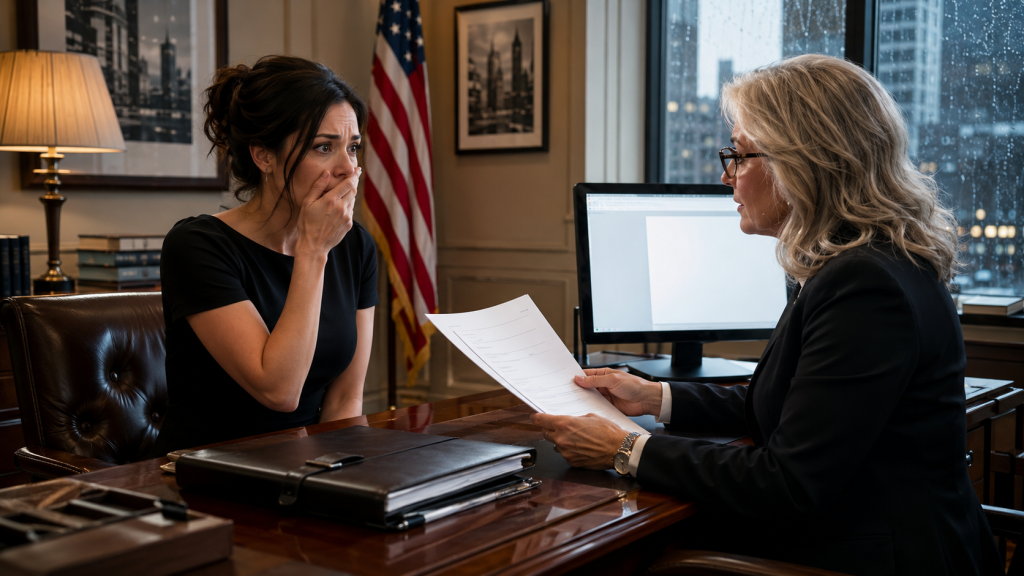
“According to the court records, you have been legally divorced for two months.”
For several seconds, I simply stared at her.
“Divorced?”
“Yes.” “I live with my husband.”
Victoria turned the monitor toward me.
An official court database filled the screen.
VALERIA VANCE HART
JULIAN HART
DISSOLUTION OF MARRIAGE
FINAL DECREE ENTERED
The date was exactly sixty-three days earlier.
My hands went cold.
“There must be another Valeria Hart.”
“The identifying information matches yours.”
“No.”
My voice sounded distant.
“Julian and I had breakfast together this morning. He texted me twenty minutes ago.”
I removed my phone.
His message remained on the screen.
Take your umbrella. Storm’s getting worse. Love you.
The same man who worried about whether I would get wet had apparently removed me from his life on paper without ever telling me.
Victoria printed the court file.
The machine hummed while I sat motionless.
Page after page emerged.
Petition for dissolution.
Mutual-consent agreement.
Waiver of appearance.
Property settlement.
Final decree.
Every document appeared legitimate.
The case had been processed through a private mediation service and submitted electronically.
All correspondence went to NexaData’s corporate legal address rather than our home.
Then I reached the signature page.
My name appeared at the bottom.
Valeria Vance Hart.
The signature was not forged.
It was mine.
A memory struck me with such force that I gripped the edge of the desk.
Two months earlier, I had been sitting outside the intensive-care unit while my father fought for his life.
I had gone nearly three days without proper sleep.
Julian arrived carrying coffee and a thick leather folder.
He sat beside me, kissed my forehead, and placed the papers in my lap.
“These are urgent documents for the Series A funding round,” he said. “If we don’t submit everything to the underwriters today, the deal could collapse.”
At the time, NexaData was negotiating a major financing package.
My father’s condition had deteriorated that morning.
Machines beeped behind the ICU doors.
A nurse had just warned me that he might not survive the night.
I glanced at the stack.
“Do I need to read all of this?”
Julian smiled gently.
“Most of it is standard authorization language.”
“I can review it later.”
“We don’t have later. The investors are waiting.”
He placed a pen between my fingers.
Then he leaned close and asked the question that now echoed through my head.
“Do you really think I would ever hurt you?”
I signed every marked page.
I trusted my husband more than I trusted my own exhaustion.
While my father lay dying only a few doors away, I unknowingly signed the documents that legally ended my marriage.
“I didn’t know what they were,” I whispered.
Victoria removed her glasses.
“That may create grounds to challenge certain provisions, especially if fraud or coercion can be established.”
“Why would Julian divorce me secretly and continue living with me?”
“I don’t know.”
She closed the divorce file and placed another folder on the desk.
“But the timing may relate to your father’s estate.”
The room became colder.
“What did Dad leave?”
Victoria took a breath.
“Arthur’s estate is worth approximately thirty-five million dollars.”
I blinked.
My father had always lived comfortably, but quietly.
He owned several commercial buildings and early shares in technology companies, yet he drove an old Lincoln and wore the same wool coat for fifteen winters.
I knew he had assets.
I did not know the amount was that large.
Victoria continued.
“The estate includes liquid investments, commercial properties, stock options, and a controlling interest in a private lending fund.”
She opened the will.
“Everything passes to you.”
My grief shifted beneath the shock.
“All of it?”
“Yes. But your father included very specific protective language. The inheritance transfers exclusively to you as separate property. It cannot enter a marital estate, be pledged as marital collateral, or be managed by a spouse without your independent written authorization.”
She paused.
“Because you were legally divorced before Arthur died, Julian cannot claim even an indirect marital interest.”
I looked at the divorce decree again.
Julian believed he had ended our marriage before my father’s estate arrived.
Perhaps he expected to protect himself from my family’s liabilities.
Perhaps he believed Dad would leave debts.
Whatever his reason, the secret divorce had locked him outside thirty-five million dollars.
My father had protected me one final time without knowing how desperately I would need it.
Victoria studied my face.
“Do not tell Julian the value of the estate.”
I nodded slowly.
“Do not confront him until we understand what else he has done.”
“What else?”
“A man willing to obtain a secret divorce while continuing to live as your husband probably did not stop with the marriage certificate.”
That sentence stripped away the last part of me still hoping for an innocent explanation.
I left the office without crying.
Rain soaked through my dress as I crossed the parking garage.
I barely noticed.
Inside my car, I replayed every moment of the previous two months.
Julian cooking dinner.
Julian kissing me goodnight.
Julian standing beside me at my father’s funeral.
He had accepted condolences as my husband while knowing the law no longer recognized him as one.
I called Marcus Thorne.
Marcus had worked as a cybercrime investigator before opening a private investigative firm.
My father trusted him.
So did I.
He answered immediately.
“Valeria?”
“I need you to follow Julian.”
There was a pause.
“Your husband?”
“My ex-husband, apparently.”
I explained only the essentials.
Marcus did not waste time expressing disbelief.
“I’ll start today.”
“Discreetly.”
“Always.”
I returned to our Gold Coast townhouse shortly before seven.
Julian stood in the kitchen pouring wine.
He looked exactly as he had that morning.
Tall.
Immaculate.
Familiar.
“Rough meeting?” he asked.
I set down my handbag.
“Yes.”
He crossed the room and kissed my cheek.
The gesture almost made me recoil.
I forced myself to remain still.
“What did Arthur leave?” he asked casually.
There it was.
Not how are you?
Not was the reading difficult?
What did he leave?
I removed my damp coat.
“A few personal things. Some investments. Victoria says the estate will take time to settle.”
Relief flickered across his face.
It vanished quickly, but I saw it.
“Any surprises?”
“One.”
His hand paused around the wine bottle.
I smiled faintly.
“Dad kept every birthday card I ever gave him.”
Julian relaxed.
“That sounds like Arthur.”
He poured me a glass.
I accepted it but did not drink.
That night, he slept beside me with one arm resting across my waist.
I stared into the darkness and wondered how long a person could imitate love before the imitation became effortless.
The following afternoon, Marcus sent one photograph.
Julian was entering a luxury condominium on East Pearson Street.
His hand rested possessively against the back of the woman beside him.
Serena Vale.
NexaData’s chief financial officer.
My closest professional confidante.
The woman who had held my hand at Dad’s funeral.
The message beneath the photograph read:
They have been using the condo for approximately six weeks. Building staff recognize both of them.
I closed my office door and enlarged the image.
Serena wore the camel coat I had complimented three days earlier.
Julian carried an overnight bag he claimed he kept at the gym.
The betrayal should have felt like fire.
Instead, I felt cold.
Marcus sent another message.
The lease began two months ago. Same week as the divorce decree.
That evening, Serena entered my office carrying quarterly reports.
“Are you all right?” she asked.
Her voice sounded concerned.
She had always been good at that.
“I’m tired.”
“You should take time away.”
“I might.”
She sat opposite me.
“Julian and I can manage the company while you handle the estate.”
Julian and I.
I wondered whether she realized how naturally the words came.
“What do you know about my father’s estate?”
Her eyes shifted.
“Nothing specific.”
“Julian asked me about it.”
“He’s probably worried about you.”
“Probably.”
She smiled.
“If you need anything, I’m here.”
“I know.”
After she left, I locked my office and accessed NexaData’s governance portal.
My credentials still worked, but several permissions had changed.
I could view routine operations.
I could not approve major transfers.
My voting rights appeared under review because of “marital restructuring.”
The phrase made my pulse quicken.
I contacted Victoria.
She brought in a corporate litigator named Naomi Chen and a forensic technology specialist.
By midnight, we had uncovered the outline of the scheme.
The secret divorce settlement assigned Julian “his separate business interests” and assigned me “personal and household assets.”
Buried in an attached schedule was language claiming that I voluntarily relinquished disputed voting rights in NexaData in exchange for our townhouse and a retirement account.
The schedule contained my initials.
I had signed beside them believing they related to financing disclosures.
Julian had divorced me, stripped my company rights, and continued living in my home while preparing to complete the takeover.
“He cannot simply remove a founder through a divorce agreement,” Naomi said. “NexaData’s shareholder documents contain independent transfer restrictions.”
“Can he sell the company without me?”
“Not legally.”
The word legally did little to comfort me.
People planning fraud rarely stop because a rule exists.
Marcus discovered that Julian and Serena had held private meetings with Meridian Arc, a multinational software conglomerate.
The proposed acquisition price was nearly four hundred million dollars.
Julian planned to sell NexaData.
My company.
The platform I had designed after watching hospitals struggle to coordinate pediatric therapy data.
He intended to complete the sale, distribute proceeds according to his altered ownership records, and announce our divorce afterward.
By then, he expected me to have little money and even less leverage.
The thirty-five-million-dollar inheritance had not been part of his calculations.
He believed Dad would leave me sentimental objects and a few declining properties.
My father’s wealth was private enough that even Julian had underestimated it.
That became our advantage.
For the next five days, I behaved like a grieving daughter who knew nothing.
I ate breakfast with Julian.
Attended meetings beside Serena.
Answered questions about funeral arrangements.
Meanwhile, Naomi challenged the corporate ownership changes under seal.
Victoria moved Dad’s estate into a protected trust under my sole control.
Marcus traced communications between Julian, Serena, the private mediator, and a corporate attorney named Peter Graves.
The evidence revealed deliberate deception.
Peter prepared documents disguised as financing authorizations.
The mediator submitted the divorce petition without verifying whether I understood it.
Serena coordinated the transfer of my voting shares through internal records.
They even discussed how to portray me after the acquisition.
Serena wrote:
Valeria will claim grief and confusion. We emphasize that she voluntarily stepped away because of emotional strain.
Julian responded:
She signs whatever I put in front of her when she’s overwhelmed.
I read that sentence three times.
It did not describe one betrayal.
It described how he had always seen me.
Useful.
Trusting.
Manageable.
The night before the scheduled board vote, I searched Julian’s home office while he showered.
He had become careless because he believed the important work was complete.
His laptop password was the name of the restaurant where we had our first date.
Inside a hidden folder, I found the acquisition draft.
Projected payouts.
Julian: $118 million.
Serena: $26 million.
Peter Graves: advisory fee of $4.5 million.
My name appeared beside a payment of $2.2 million for “settlement compliance.”
Two million dollars from a company I had helped build into one worth hundreds of millions.
There was also a post-closing plan.
Julian would marry Serena after a six-month “respectful transition.”
They would purchase a lakefront estate.
The townhouse would be sold despite being awarded to me in the divorce.
They planned to pressure me into signing because Julian assumed I could not afford maintenance alone.
I copied everything.
Then I found an email discussing my father.
Serena asked whether his death might create complications.
Julian replied:
Arthur never trusted me, but he kept most assets tied up in old properties. Valeria is sentimental. She’ll probably let me handle whatever remains once she realizes she needs support.
Even after secretly divorcing me, he planned to control my inheritance by pretending to remain my husband.
I closed the laptop before he returned.
The following morning, Julian adjusted his tie in our bedroom mirror.
“Big board meeting today,” he said.
“So I’ve heard.”
He turned.
“Serena mentioned you might join remotely.”
“I think I should be there.”
Concern crossed his face.
“You’ve been through a lot.”
“NexaData matters to me.”
“Of course.”
He approached and placed his hands on my shoulders.
“But today’s discussion will involve complex restructuring. You don’t need that stress.”
I looked at his reflection.
“I helped create the structure.”
He smiled.
“And no one can take that away from you.”
The audacity almost impressed me.
We arrived separately.
The boardroom occupied the top floor of NexaData’s headquarters, overlooking the Chicago River.
Julian sat at the head of the table.
Serena occupied the seat to his right.
Peter Graves arranged documents near the presentation screen.
Several board members greeted me cautiously.
They had been told I was emotionally fragile and gradually stepping away.
Julian began with a polished speech about the company’s future.
He described the Meridian Arc acquisition as a transformational opportunity.
Serena presented financial projections.
Peter explained that all ownership approvals had been secured.
Then Julian turned toward me.
“Valeria, I know this has been an emotional period. We appreciate you being here to support the next chapter.”
Support.
Not vote.
Not lead.
Support.
I folded my hands.
“Before the board votes, I have a question.”
Peter frowned.
“This transaction has been thoroughly reviewed.”
“Then the answer should be simple.”
I looked at Julian.
“When were you planning to tell everyone we were divorced?”
Silence struck the room.
One board member shifted sharply.
Serena’s face froze.
Julian recovered first.
“Valeria, this is not the appropriate setting.”
“You used our divorce to alter company ownership. I think the setting is appropriate.”
Peter stood.
“I advise we pause this discussion.”
The boardroom doors opened.
Victoria entered first.
Naomi followed.
Marcus came behind them carrying a secured evidence case.
Two investigators from the Illinois Attorney General’s financial-crimes division entered last.
Julian stared at me.
“What have you done?”
I placed the divorce decree on the table.
“Congratulations. You divorced me before my inheritance arrived.”
Serena’s eyes moved toward me.
“What inheritance?”
I opened Dad’s trust documents.
“Thirty-five million dollars in protected separate assets.”
The room erupted in whispers.
Julian’s face became unreadable.
“You told me Arthur left personal items.”
“I told you what I wanted you to know.”
He leaned back.
For the first time, he understood what it felt like to trust a false story.
Naomi distributed copies of the emergency court order.
“The ownership transfers attributed to Ms. Vance have been suspended pending investigation into fraud, deceptive execution, and breach of fiduciary duty.”
Peter grabbed the first page.
“This is based on unproven allegations.”
Marcus placed the copied emails beside him.
“These may help.”
Serena stood.
“This is a misunderstanding.”
I opened the acquisition file.
“Is the twenty-six-million-dollar payment to you also a misunderstanding?”
Her lips parted.
Julian’s voice hardened.
“Valeria, we can discuss this privately.”
“You ended our marriage privately. You altered my shares privately. You slept with my CFO privately. I think we’ve had enough privacy.”
Several board members looked at Serena with open disgust.
One of the investigators spoke.
“All disputed company accounts and ownership records are now frozen. Electronic devices relevant to the transaction must be preserved.”
Peter reached toward his phone.
“Do not delete anything,” the second investigator warned.
Then Victoria revealed the final move.
My father’s estate held a private lending portfolio.
One of its funds had quietly purchased NexaData’s outstanding bridge debt from an anxious creditor the previous day.
The debt agreement contained conversion rights triggered by fraudulent governance activity.
With the court’s authorization, the estate could convert part of the debt into temporary voting control while the ownership dispute was resolved.
Dad’s money had not merely protected my inheritance.
It had given me the leverage to stop the sale.
Naomi placed the conversion notice in front of Julian.
“Effective this morning, Valeria controls fifty-three percent of eligible voting authority pending judicial review.”
Julian stared at the document.
“That’s impossible.”
“No,” I said. “It’s inconvenient.”
Serena’s composure broke first.
She pointed at Julian.
“He said the divorce was legitimate.”
Julian turned toward her.
“Stop talking.”
“He said Valeria wanted out of the company.”
“You knew she didn’t,” Marcus said.
Serena looked around the room.
“I relied on counsel.”
Peter snapped, “Do not involve me in your personal arrangement.”
Within minutes, the alliance began collapsing.
Serena blamed Julian.
Peter blamed Serena’s financial team.
Julian blamed grief, timing, and misunderstood documents.
Nobody blamed themselves.
The board voted unanimously to suspend Julian and Serena from all company duties.
Peter’s legal access was terminated.
Investigators collected devices.
I remained in the boardroom after everyone left.
Rain moved against the windows.
The city below looked like it had on the morning Victoria told me I was divorced.
Julian remained near the door, accompanied by counsel.
“Valeria,” he said quietly.
I looked at him.
“We built this together.”
“You tried to sell it without me.”
“I made mistakes.”
“You created a divorce file while my father was dying.”
His face tightened.
“The marriage was already failing.”
“That would have been useful information for your wife.”
“I was trying to protect the company.”
“You were protecting yourself.”
He stepped closer, stopping when Marcus moved between us.
“The thirty-five million changes nothing between us.”
I almost laughed.
“It changed nothing for me either. The divorce did.”
“We can reverse it.”
“You cannot reverse what it revealed.”
He lowered his voice.
“Serena meant nothing.”
“She meant twenty-six million dollars according to your spreadsheet.”
“That was business.”
“And sleeping with her?”
He looked away.
I took the ring from my finger.
For two months, I had worn it while legally unmarried.
I placed it on the boardroom table.
“You already ended our marriage. I’m simply acknowledging your decision.”
The investigation lasted eighteen months.
Forensic analysts confirmed that Julian, Serena, and Peter had designed the documents to deceive me.
The divorce decree itself remained legally effective because I had signed it, but the property and company provisions were set aside for fraud.
The secret mediation service lost its license.
Peter was disbarred and charged with conspiracy and document fraud.
Serena cooperated after prosecutors showed her the full email archive.
She admitted altering internal ownership records and coordinating the unauthorized sale.
Her agreement reduced her sentence but ended her career.
Julian fought everything.
He claimed I understood the divorce.
He said our continued cohabitation was an informal transition.
He argued that my involvement in NexaData had become ceremonial.
Then prosecutors displayed messages in which he instructed staff to hide legal correspondence from me.
They presented surveillance footage from the ICU showing him handing me the disguised folder.
A handwriting expert confirmed that headings had been concealed beneath removable instruction sheets marking where I should sign.
The scheme was deliberate.
Julian was convicted of fraud, conspiracy, identity-related offenses, and financial misconduct.
He received a prison sentence and substantial restitution orders.
The acquisition collapsed.
Meridian Arc sued for deceptive negotiations.
NexaData survived, but barely.
Employees feared layoffs.
Clients questioned our stability.
For the first six months, I worked fourteen-hour days rebuilding the company’s credibility.
I did not use Dad’s inheritance to cover every problem.
He had taught me that money could solve a shortage but not repair rotten judgment.
We replaced the board.
Strengthened founder protections.
Created independent approval procedures.
No executive could again alter voting rights through hidden personal documents.
I promoted people who had challenged Julian’s decisions, including a compliance manager he had tried to dismiss.
NexaData returned to profitability the following year.
We rejected another acquisition offer and expanded our pediatric rehabilitation platform into rural hospitals.
That mattered more to me than the company’s valuation.
The business had begun with a purpose.
Julian almost converted it into a payout.
I brought it back.
Dad’s estate took longer to understand emotionally.
Thirty-five million dollars looked like freedom from the outside.
To me, it initially felt like another reminder that he was gone.
I visited the commercial buildings he had owned.
Met tenants who knew him by name.
Read letters from entrepreneurs whose businesses he had quietly financed.
My father had hidden his wealth not from shame but from discipline.
He believed money should work without becoming someone’s identity.
Victoria gave me a final letter he had written six months before his death.
Valeria,
You trust deeply. That is one of your finest qualities, but never allow anyone to persuade you that trust requires blindness.
Read what you sign.
Ask the uncomfortable question.
Keep something in your life that belongs only to you—not because marriage must fail, but because love should never require helplessness.
If someone resents your independence, they do not want partnership. They want access.
Dad
I sat in his old office and cried until sunset.
He had seen the danger before I did.
Perhaps not the secret divorce.
But Julian’s hunger.
The way he treated every relationship as a structure to control.
Dad tried to warn me without demanding that I choose between them.
In the end, he protected me through careful language.
I used part of the inheritance to create the Arthur Vance Digital Ethics Fellowship, supporting women returning to technology careers after financial or domestic control.
Many had signed documents they did not understand because someone they loved rushed them.
Others had been removed from companies they helped build.
We provided legal reviews, emergency funding, and independent financial education.
At the first fellowship dinner, a woman approached me holding a folder.
Her business partner and fiancé wanted her to sign a “routine restructuring agreement.”
She had postponed the signing after reading my story.
An attorney discovered the document would have transferred nearly all her voting rights.
“You saved my company,” she said.
“No,” I told her. “You paused long enough to save it yourself.”
Three years after the will reading, I returned to Victoria’s office.
The rain had stopped.
Sunlight moved across the same desk where my marriage first fell apart.
Victoria handed me the final estate report.
“All assets are settled.”
I signed slowly.
Read every page.
Checked every attachment.
Victoria smiled faintly.
“Arthur would approve.”
“I hope so.”
Before leaving, I looked at the chair where I had sat in shock.
I once believed that room was where my life collapsed.
It was actually where the illusion collapsed.
The marriage had ended before I entered.
The betrayal had already occurred.
Victoria simply gave the truth a name.
Julian’s greatest mistake was not divorcing me before I inherited thirty-five million dollars.
It was believing trust made me weak.
He thought I would continue signing whatever he placed before me.
He thought grief had made me easy to control.
He thought removing me from the marriage and company on paper would remove me from the life I had built.
Instead, his secret divorce protected my inheritance from him.
His hidden affair exposed his CFO.
His fraudulent takeover gave me grounds to reclaim control.
And the father he underestimated left behind exactly the legal and financial structure I needed to stop him.
The last message Julian sent through his attorney asked whether I ever missed our life together.
I did not respond.
Sometimes I missed the woman I had been before discovering the truth.
The woman who believed his reminder to carry an umbrella was love.
The woman who signed papers beside an ICU because her husband’s word felt safer than her own judgment.
But I did not miss the marriage.
A marriage that exists only because one person hides the divorce is not love.
It is occupation.
Julian ended ours secretly, expecting to keep every benefit until he was ready to discard me publicly.
He failed because paper cuts both ways.
The decree that removed me from his marital control also placed my father’s estate beyond his reach.
He thought he had written the ending.
In reality, he signed himself out of everything.
The inheritance.
The company.
The home.
And the woman who had once trusted him enough to sign without reading.
When Julian asked in the boardroom whether we could fix things, I finally gave him the only honest answer.
“You already fixed it. You made sure I owed you nothing.”
Thanks for reading❤️ Follow Page For More Real Life Stories.