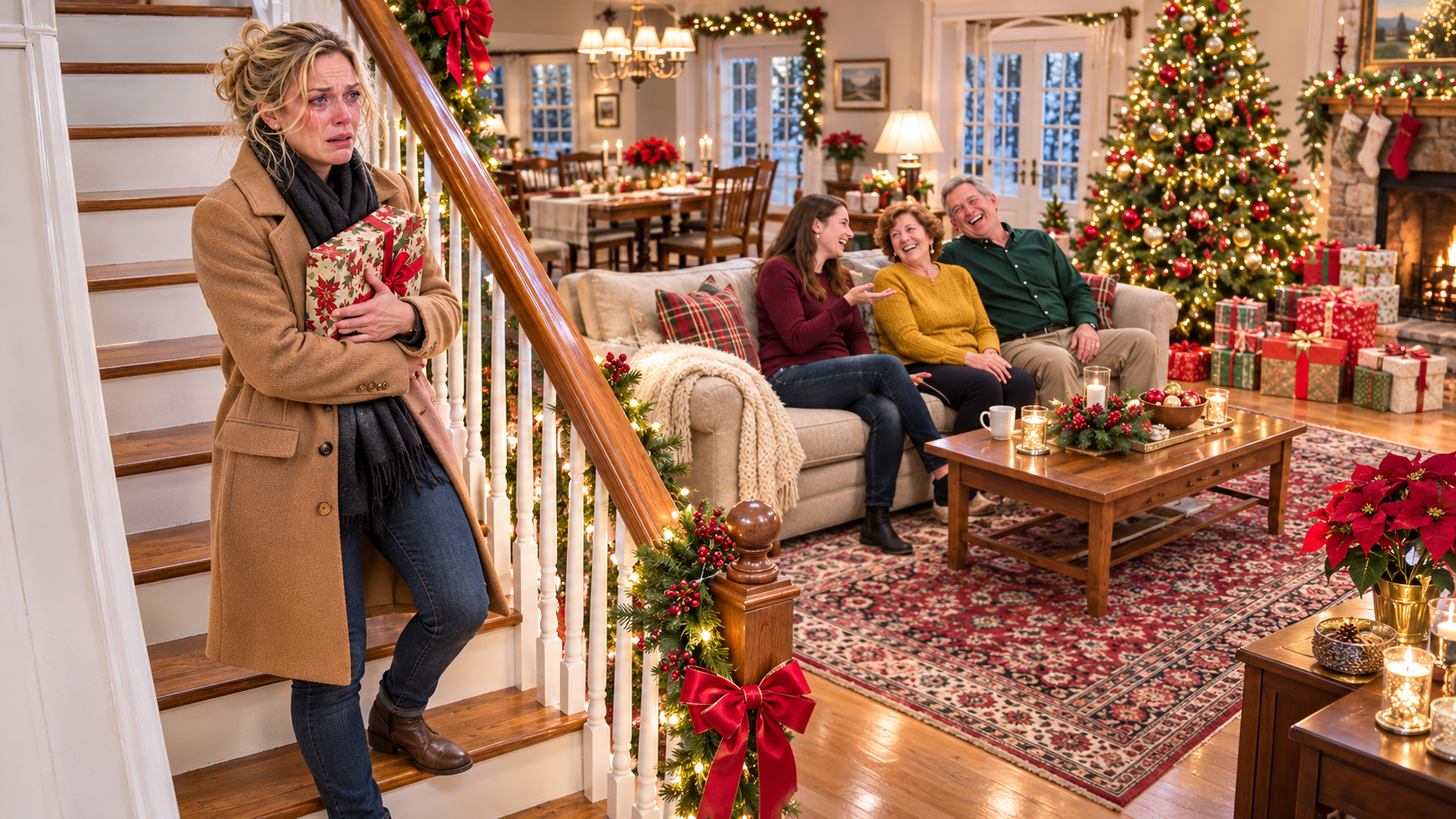
I opened the next message. And suddenly, I understood why my entire family had been desperately trying to reach me. It was from my mother.\
“Mira, the lender has put everything on hold. They’re questioning your signature. Please, sweetheart, just tell them you agreed to the loan. We can explain everything afterward. If you refuse, your father could lose the house, and Fallon could get into serious trouble.”
I read it once.
Then twice.
Then a third time, because my brain refused to accept what my eyes were seeing.
My signature?
What loan?
What did my father potentially losing his house have to do with me?
And why would Fallon be in trouble?
Before I could process those questions, another message appeared.
This one was from my sister.
“Stop ignoring us! You have no idea what you’ve done. We need $198,000 approved, and you’re the only person who can fix this. Call me NOW!”
One hundred and ninety-eight thousand dollars.
I sat upright in the hotel bed.
Outside my window, snow covered the parking lot. A maintenance worker was spreading salt along the sidewalk, and somewhere down the hallway, a child was laughing excitedly about Christmas presents.
It should have been an ordinary Christmas morning.
Instead, I was staring at messages suggesting that my family had somehow involved me in a loan worth almost two hundred thousand dollars.
Without my knowledge.
Without my permission.
And possibly without my signature.
My hands began to tremble.
I opened the messages from Dad.
There were twenty-three of them.
The first few simply said to call home.
Then the tone changed.
“Mira, your mother is upset. Please answer.”
“Mira, we need to settle something before the lender reopens after Christmas.”
“Mira, don’t do anything rash. Family should handle these matters privately.”
And finally:
“Whatever you heard last night, don’t make a decision while you’re angry.”
I stopped breathing for a moment.
Whatever I heard last night?
They knew.
Somehow, they knew I’d been there.
That I’d stood in their hallway.
That I’d heard my sister wishing for my death.
I scrolled farther.
A message from my aunt Denise appeared at 2:17 in the morning.
“Your mother found something by the front door. We know you came. Please don’t let a silly joke destroy the family.”
A silly joke.
I stared at those words until my vision blurred.
Six hours of driving through a snowstorm.
A car full of expensive gifts.
Thirty-five years of trying to be a daughter they could be proud of.
And they’d reduced everything I’d overheard to a silly joke.
But the loan was worse.
Much worse.
Because suddenly I wasn’t just wondering whether my family loved me.
I was wondering what they’d done with my identity.
I got out of bed and walked into the bathroom.
The woman in the mirror looked exhausted.
My hair was tangled from sleeping badly. Dark shadows sat beneath my eyes, and my face was still pale from the previous night’s shock.
I turned on the cold water and splashed some over my cheeks.
“Think, Mira,” I whispered.
“Don’t panic. Think.”
I’m a software engineer.
My job has taught me that when something goes wrong, the worst thing you can do is start pressing buttons without understanding the problem.
You stop.
You look at the evidence.
You find out what actually happened.
And only then do you decide what to do.
I returned to the bed, opened my laptop, and searched my email.
At first, everything appeared normal.
Work notifications.
A holiday greeting from my department manager.
An advertisement from a clothing store.
Then I checked my spam folder.
My stomach dropped.
There was an email from a financial institution called North Valley Community Lending.
The subject read:
ACTION REQUIRED: Identity Verification — Joint Loan Application.
It had arrived at 11:46 the previous night.
I opened it.
The message stated that an application listing me as a co-borrower had been placed on hold pending direct verification of my identity and consent.
The amount requested was $198,000.
The primary applicants were my parents.
The purpose was debt consolidation and refinancing secured against their home.
And listed beneath their names was mine.
Mira Bennett.
My full legal name.
My current address.
My employer.
My approximate annual salary.
Even my date of birth.
I felt physically sick.
Someone had used my personal information to apply for a loan.
A loan I had never discussed.
A loan I had certainly never agreed to guarantee.
I opened the attached verification summary.
There was an image of a signature on a preliminary authorization form.
It looked almost like mine.
Almost.
But the final stroke of the letter M was slightly wrong.
My stomach twisted.
I’d seen that exact mistake before.
Years earlier, Fallon had signed my name on a permission slip so she could borrow my car when I was visiting home.
She’d laughed when I confronted her.
“Oh, relax, Mira. Your signature is practically impossible to copy. I did my best.”
I remembered telling her never to do it again.
Apparently, she’d simply practiced.
My phone began ringing.
FALLON.
I watched it vibrate across the nightstand.
Once.
Twice.
Three times.
I let it go to voicemail.
Then I took screenshots of every message.
I saved copies of the email and the attached documents.
And I began writing down everything I could remember about the previous night.
The exact words.
The laughter.
Who had spoken.
Who had remained silent.
I didn’t know yet how far this situation would go.
But one thing was already certain.
I would never again allow my family to rewrite what had happened while I was standing right there.
At 9:12 that morning, I made my first phone call.
Not to Mom.
Not to Dad.
And certainly not to Fallon.
I called my bank’s fraud department.
The representative was calm and professional.
I explained that someone appeared to have used my identity in a loan application without my consent.
She helped me review my accounts for suspicious activity and explained how to protect them.
Fortunately, no money had been withdrawn.
No unauthorized transfer had been completed.
But that didn’t mean I was safe.
I changed my passwords.
I reviewed account access.
I began the process of freezing my credit with the major credit bureaus and documenting the suspected identity theft.
The representative also reminded me that any questionable application needed to be disputed directly with the lender.
“Do you believe someone close to you may have submitted the information?” she asked.
I swallowed.
“Yes.”
“Do you know who?”
I stared at the Christmas lights blinking in the hotel parking lot.
“My sister,” I whispered.
There was a brief silence.
“I’m sorry you’re dealing with that, ma’am.”
Her voice was kind.
Too kind.
I nearly started crying.
Because a stranger had expressed more concern for me in five minutes than my own family had shown all night.
After ending the call, I sat on the edge of the bed.
Then I called my friend Natalie.
Natalie and I had been roommates during our first year after college.
She was an attorney now, although financial fraud wasn’t her specialty.
We’d been friends for fourteen years.
She answered on the second ring.
“Merry Christmas, you mysterious woman. Aren’t you supposed to be with your family?”
I tried to speak.
Nothing came out.
“Mira?”
I pressed my lips together.
“Mira, what’s wrong?”
“They wished I would die.”
Silence.
“What?”
“My family. Last night. I drove all the way home, and I heard them joking that if I crashed in the storm, they’d inherit my money.”
“Oh, my God.”
“And now I think they’ve forged my signature on a loan.”
Natalie didn’t say anything for several seconds.
Then her voice changed.
Not angry.
Focused.
“Tell me everything.”
So I did.
I told her about the drive.
The gifts.
The laughter.
The hotel.
The eighty missed calls.
The loan application.
And my mother’s request that I lie to the lender.
When I finished, Natalie said something I’ll never forget.
“Mira, there are two separate things happening here.”
I wiped my cheeks.
“What do you mean?”
“Your family has hurt you emotionally. That’s one thing. But someone may also have committed financial fraud using your identity. That’s another.”
I nodded even though she couldn’t see me.
“Don’t let them make you feel that protecting yourself financially is some kind of betrayal.”
I closed my eyes.
“I’m scared, Nat.”
“I know.”
“What if they lose their house?”
“Then they will have to deal with whatever financial decisions brought them here. You didn’t apply for that loan.”
“But they’re my parents.”
“And you’re their daughter. Not their emergency bank account.”
I started crying.
Natalie let me.
Then she said, “Keep the messages. Don’t sign anything. Don’t confirm a loan you didn’t authorize. Contact the lender through its verified channels and consider speaking with an attorney who handles identity theft. You may also need to make a formal report.”
I took a deep breath.
“Okay.”
“And Mira?”
“Yes?”
“Where are you?”
“At a hotel about fifteen minutes from their house.”
“Are you safe?”
Those three words broke something inside me.
Are you safe?
Not, Did you bring the presents?
Not, How much money do you have?
Not, Can you fix this?
Just—
Are you safe?
I bent forward and cried so hard that Natalie stopped talking.
She simply stayed on the phone.
And for the first time since I’d walked into my parents’ hallway, I felt like somebody remembered I was a human being.
Around eleven, there was a knock on my hotel room door.
My whole body went rigid.
For one terrible second, I imagined Fallon standing outside.
I approached cautiously and looked through the peephole.
It was a hotel employee carrying a small paper bag.
I opened the door.
“Good morning, ma’am. We have complimentary breakfast sandwiches for guests staying through Christmas.”
I blinked.
“Oh. Thank you.”
She smiled.
“We know a lot of people are stranded because of the weather.”
I accepted the bag.
There was a warm egg sandwich inside, a little container of fruit, and a handwritten card that said:
Wishing you a peaceful Christmas, wherever home may be.
I closed the door.
Then I sat down and cried again.
I know that sounds ridiculous.
A sandwich.
A little card.
But kindness hurts in a strange way when you’ve just discovered how little of it you’ve been receiving.
For years, I had measured my usefulness to my family through what I could provide.
Paying Dad’s unexpected repair bills.
Sending Mom grocery money.
Helping Fallon when her rent was late.
Covering family emergencies that somehow always appeared a few days before payday.
I had never kept a proper total.
I didn’t want to.
Love wasn’t supposed to be a spreadsheet.
But that morning, with a warm sandwich in my hands and snow outside my window, I realized my family had apparently been keeping a very different kind of account.
They knew what I earned.
They knew what my apartment was worth.
They knew I had no husband.
No children.
And they had discussed my death as though they were waiting for an investment to mature.
My phone buzzed again.
This time, the message came from an unfamiliar number.
“Mira, this is your cousin Leah. Please don’t ignore this. I’m not asking you for money. I need to tell you something about last night.”
I stared at it.
Leah was twenty-four.
A quiet girl who worked as a teacher’s assistant.
She was the daughter of my mother’s younger brother.
We weren’t close, but we’d always gotten along.
I remembered seeing her car outside my parents’ house.
I typed:
“Were you there when Fallon said she hoped I would die?”
The reply came almost immediately.
“Yes.”
My hands went cold.
“Did you laugh too?”
Three little dots appeared.
Disappeared.
Then appeared again.
Finally, she wrote:
“No. I walked into the kitchen. But I didn’t say anything to stop them, and I’m ashamed of that.”
I stared at the message.
Then another arrived.
“There’s something worse, Mira. They were talking about your money before you even got there.”
I called her.
She answered in a whisper.
“Thank God.”
“Leah, tell me what happened.”
“Are you somewhere safe?”
“Yes.”
“Good.”
I heard a door close on her end.
Then she said, “Yesterday afternoon, Fallon was showing everyone some paperwork.”
“What paperwork?”
“A loan application. Your parents’ house. Something about refinancing.”
My heart pounded.
“She told everybody you’d agreed to help.”
“I didn’t.”
“I know that now.”
“What exactly did she say?”
Leah hesitated.
“She said you had plenty of money and that the loan wouldn’t affect you because you weren’t actually going to be paying it.”
I shut my eyes.
“And everyone believed her?”
“Your mom kept saying you always looked after the family.”
“And Dad?”
“He said the lender needed somebody with stronger income to qualify.”
I rubbed my forehead.
“Did anyone ask whether I’d agreed?”
Leah’s silence answered before her words did.
“No.”
I looked toward the hotel window.
“Then what happened?”
“She brought out a folder. It had information about your job and your apartment. She was showing Uncle Raymond how much your place might be worth.”
Uncle Raymond was my mother’s older brother.
A real estate agent.
A man who rarely spoke to me unless he wanted to know whether I was planning to buy another property.
My stomach turned.
“Why was he looking at my apartment?”
“I don’t know,” Leah whispered.
Then she said something that made my blood run cold.
“Mira, Fallon said that if anything ever happened to you, your parents would inherit everything anyway. She said it was stupid that they had to ask permission to use money that would eventually belong to the family.”
I couldn’t speak.
Leah continued.
“Then somebody mentioned the snowstorm. Fallon made that joke.”
I heard her take a shaky breath.
“And people laughed.”
“Mom and Dad?”
“Yes.”
I pressed my hand over my mouth.
Leah’s voice cracked.
“I’m sorry.”
I looked at the ceiling.
“Why didn’t anybody stop her?”
“I don’t know.”
“Did nobody think it was wrong?”
“I did.”
“But you didn’t say anything.”
“No.”
For several seconds, neither of us spoke.
Then Leah whispered, “I wish I had.”
That was the first honest thing I’d heard from anyone who’d been inside that room.
Not an excuse.
Not a demand.
Not a request for money.
Just regret.
I wiped my eyes.
“Why are they calling me so much?”
“Because the verification request came through last night. Fallon couldn’t complete it.”
I sat straighter.
“What verification?”
“She needed you to confirm that you’d signed and agreed to be included. Apparently, the lender sent something directly to your email. When you didn’t respond, the application went on hold.”
I glanced at my laptop.
The email.
The signature.
The amount.
Everything fit.
Leah continued.
“Fallon told everyone you were just being difficult because you were angry about the joke.”
A bitter laugh escaped me.
“She knows I never agreed.”
“I think she does.”
“Leah.”
“Yes?”
“Did she admit forging my signature?”
There was a long pause.
Then Leah said, “I heard her tell your mom, ‘I copied it from the old paperwork. How was I supposed to know they’d ask her to verify it herself?’”
My fingers tightened around the phone.
There it was.
Not a misunderstanding.
Not an administrative mistake.
Not an innocent family favor.
My sister had copied my signature.
And she hadn’t expected anybody to ask me.
I wanted to leave town immediately.
I wanted to throw my suitcase into the car, drive six hours back to my apartment, lock the door, and pretend none of this had happened.
But the roads were still dangerous.
And more importantly, I realized that leaving without understanding the full situation wouldn’t make it disappear.
My name was attached to financial documents I hadn’t signed.
My family had access to personal information they should never have used.
And somewhere in that house, there might be other papers I knew nothing about.
At noon, I received another text from Mom.
“Sweetheart, please come home. Everyone is terribly upset. We can have Christmas dinner together and discuss this calmly.”
Then another.
“I made your favorite roast chicken.”
I stared at the screen.
Roast chicken.
As if a plate of food could fix an attempted financial deception.
As if she could rewind the night and put me back at the Christmas table.
A third message appeared.
“We’ve always loved you, Mira. Don’t punish us over one unfortunate comment.”
I typed a response.
Deleted it.
Typed another.
Deleted that too.
Finally, I wrote:
“I am safe. I know about the loan application. I did not authorize it, and I will not lie to the lender. Do not use my name, financial information, or signature again. We will discuss the rest when I’m ready.”
I sent it to Mom, Dad, and Fallon.
For several seconds, nothing happened.
Then my phone rang.
Mom.
I declined.
Dad.
I declined.
Fallon.
I declined.
Then Fallon sent a message that made me sit completely still.
“You have no idea what you’re doing. If this loan falls through, the house could be taken. And if the house goes, everyone will know who caused it.”
I stared at the words.
Everyone will know who caused it.
There it was again.
The same familiar threat.
If I didn’t give them what they wanted, I would become the villain.
The ungrateful daughter.
The selfish older sister.
The wealthy woman who turned her back on struggling relatives.
I had played that role before.
When Fallon lost her first apartment and I refused to pay six months of back rent, Mom told our relatives that I’d abandoned my sister.
When Dad needed a new furnace and I offered to pay the contractor directly, he complained that I didn’t trust him with money.
When I skipped a family reunion because of a work deadline, my aunt Denise told everyone I thought I was too important for them.
Nothing I gave was ever quite enough.
And every boundary became evidence that I didn’t care.
But this time, something was different.
I wasn’t refusing to buy somebody a handbag.
I was refusing to participate in something that might destroy my financial future.
I placed my phone facedown.
Then I opened the spreadsheet where I tracked my household expenses.
For the first time, I created a new category.
Family assistance.
I started looking through my bank records.
I wasn’t doing it to punish anyone.
I wanted to understand what I’d actually been giving.
There was $800 to Dad for a plumbing emergency.
$1,400 for Fallon’s car repair.
$2,600 toward Mom’s dental work.
$900 because Fallon had been between jobs.
$3,200 for an emergency roof repair.
$1,100 toward a medical bill.
And on and on.
Then I reached the recurring transfers.
Every month for almost five years, I’d sent my parents $650.
They’d told me it helped with the mortgage.
I’d set up the transfer automatically.
I barely thought about it anymore.
Sixty months.
Six hundred and fifty dollars a month.
Nearly thirty-nine thousand dollars.
And yet Fallon was telling me they might lose the house.
I stared at those figures.
Then I opened an old message from Dad.
It was from the previous summer.
“Thanks for the mortgage help, sweetheart. You’re keeping this roof over our heads.”
I read it twice.
Something wasn’t right.
If I’d been helping with the mortgage for years, why were they suddenly desperate for a six-figure loan?
Where had all that money gone?
I called Leah back.
She answered immediately.
“Is everything okay?”
“I need to ask you something.”
“Sure.”
“Have you heard anything about my parents being behind on the mortgage?”
There was silence.
Then Leah said, “Mira, I thought you knew.”
My chest tightened.
“Knew what?”
“Your parents took out another loan against the house a few years ago.”
I gripped the phone.
“What?”
“Uncle Raymond told my dad they were refinancing because Fallon needed money for her business.”
I closed my eyes.
Fallon’s business.
Of course.
Three years earlier, Fallon had decided to open a boutique home-decor shop.
She’d talked endlessly about selling handcrafted candles, imported ceramics, and luxury seasonal decorations.
I had offered to help her build a website.
She refused.
“I need investors, Mira. Not computer advice.”
Six months later, the store closed.
Fallon told everyone she’d lost a little money but learned a valuable lesson.
Apparently, there was much more to that story.
“How much did they borrow?” I asked.
“I don’t know exactly. I heard it was around eighty thousand dollars.”
My stomach sank.
Eighty thousand.
“And my parents used their house?”
“I think so.”
I stared at the figures on my screen.
My mother had asked for a $270 skincare collection.
My sister wanted a $350 designer purse.
My father wanted expensive tools.
And somewhere beneath all those Christmas wish lists was a house drowning in debt.
Not because my parents had simply fallen on hard times.
But because they’d continued funding Fallon’s mistakes while expecting me to fund theirs.
I thought about the laughter I’d heard the previous night.
At least all that money would finally be put to good use by this family.
The words sounded even uglier now.
Because apparently, in my sister’s mind, keeping her comfortable was a better use of my money than allowing me to live my own life.
That afternoon, I made a decision.
I wouldn’t go to my parents’ house for Christmas dinner.
I wouldn’t participate in an emotional argument where five people shouted over me until I agreed to something.
But I did want answers.
So I sent one final message to Dad.
“After the holiday, I want copies of the mortgage statements, the refinancing documents, and a complete explanation of how my name ended up on this loan application. Until then, do not contact me about money.”
He responded almost immediately.
“Mira, please. We’re your parents.”
I looked at the message.
Then I typed:
“And I’m your daughter. Not your collateral.”
I pressed send.
For the first time all morning, my hands were steady.
I had no idea how badly that single sentence would change my family.
I certainly didn’t know what my father would tell me three days later.
Or what I would discover inside the folder Fallon had been waving around on Christmas Eve.
But one thing had become clear.
The inheritance joke had not been the beginning of the betrayal.
It was only the moment I finally heard them say out loud what they’d been quietly believing for years.
That everything I’d worked for already belonged to them.
And I was about to prove how wrong they were.
Three days later, my father asked to meet me at a diner near the highway.
Not at the house.
Not in front of Mom or Fallon.
Just the two of us.
I almost refused.
By then, I’d spent another two nights at the hotel, spoken with the lender’s fraud team after its holiday closure, and arranged to meet with a local attorney who handled financial disputes.
The lender had confirmed that the application was on hold.
No loan had been finalized.
No money had been released.
My disputed authorization was being investigated.
That information allowed me to breathe a little easier.
But the emotional damage was another matter.
I hadn’t slept properly since Christmas Eve.
Every time I closed my eyes, I heard Fallon laughing.
I heard my mother’s laughter joining hers.
And then I heard Dad.
The man who’d taught me to ride a bicycle.
The man who used to carry me on his shoulders at county fairs.
The man whose hands I’d held when I was frightened of thunderstorms.
Laughing at the thought of my death.
That was the sound I couldn’t escape.
Still, I agreed to meet him.
Because I needed the truth.
Not another excuse.
The truth.
Dad was already sitting in a booth when I arrived.
He looked smaller than I remembered.
His gray hair needed cutting. His old brown coat hung loosely around his shoulders, and his coffee sat untouched in front of him.
There was a thick folder beside his plate.
He stood when he saw me.
“Mira.”
“Dad.”
He opened his arms.
I didn’t move.
For a moment, he stood there awkwardly.
Then he lowered them.
“I understand,” he whispered.
I sat opposite him.
The waitress came over.
I ordered tea.
Dad waited until she walked away before speaking.
“Your mother doesn’t know I’m here.”
I looked at him.
“Why?”
“Because she thinks we should all sit down together and sort things out.”
“And you don’t?”
He rubbed his forehead.
“I think there are things you deserve to hear without Fallon interrupting.”
I glanced at the folder.
“Is that the mortgage information?”
He nodded.
I held out my hand.
He hesitated.
Then he slid it across the table.
Inside were bank statements, loan agreements, and notices with red letters printed across the top.
I recognized the property address immediately.
My childhood home.
The house with the creaky staircase.
The backyard where I’d learned to plant tomatoes with Grandma.
The kitchen where Mom used to bake Christmas cookies while Fallon and I fought over who got to lick the spoon.
I turned the first page.
The mortgage balance was much higher than I’d expected.
Then I saw the second loan.
And the third.
“Dad.”
He didn’t look up.
“How much do you actually owe?”
He swallowed.
“Enough that the bank has been sending notices.”
“That’s not a number.”
He rubbed his hands together.
I waited.
Finally, he whispered, “About a hundred and forty thousand altogether, counting the mortgage, home-equity debt, and other loans. Some of it is past due.”
I stared at him.
I knew my parents had never been wealthy.
But their house had been nearly paid off when I graduated from college.
They’d talked about being mortgage-free before retirement.
Now they were facing the possibility of losing it.
“How?” I asked.
Dad stared at the table.
“Fallon’s business.”
I closed my eyes.
Of course.
He continued.
“When she opened that little shop, she needed more money than we’d realized. Rent, inventory, insurance, renovations. She kept saying the next season would be better.”
“And you borrowed against the house?”
“Your mother wanted to help her get started.”
“Did you?”
He paused.
“I wanted your sister to succeed.”
I looked at him.
“And when the business failed?”
He didn’t answer.
“Dad.”
“We kept paying what we could. But there were credit cards. Another loan. And then your mother had some medical expenses.”
I leaned forward.
“Why didn’t you tell me?”
He gave a tired laugh.
“Because you’d already helped us so much.”
I stared at him.
“Then why did you put my name on a two-hundred-thousand-dollar application?”
His expression collapsed.
For the first time, he looked directly into my eyes.
“Because we were afraid.”
“Of losing the house?”
“Yes.”
“Or of telling me how much you’d lied?”
He looked away.
There was my answer.
I opened the folder again.
Then I asked the question I’d been holding inside for three days.
“Where did the money I sent every month go?”
Dad froze.
“The six hundred and fifty dollars,” I continued. “Every month for almost five years. You told me it was helping with the mortgage.”
“It was helping us.”
“That’s not what I asked.”
His eyes filled.
I watched him struggle.
Then he whispered, “Some of it went toward Fallon’s business debts.”
I felt something inside me go very still.
“How much?”
He shook his head.
“I don’t know the exact amount.”
“Dad.”
“Most of it, Mira.”
I stared at him.
“Most of it?”
He nodded.
I leaned back against the booth.
Thirty-nine thousand dollars.
Five years of automatic transfers.
Five years of believing I was helping my aging parents keep their home.
And a large portion had apparently gone toward cleaning up Fallon’s financial mistakes.
Without anyone telling me.
My father reached for my hand.
I pulled it away.
“Mira, please understand. Your sister was in trouble.”
I laughed once.
It wasn’t a happy sound.
“Dad, Fallon has been in trouble since she was nineteen. Every time something goes wrong, you rescue her.”
“She needed help.”
“And I didn’t?”
He frowned.
“What do you mean?”
I looked at him.
“Did you know I had surgery three years ago?”
His face changed.
“Of course. You had that procedure.”
“I was in the hospital for four days.”
“Yes.”
“Neither of you came.”
He lowered his eyes.
“You said it wasn’t serious.”
“I said that because Mom told me you couldn’t afford the trip.”
He rubbed his forehead.
“Your mother was worried about the expenses.”
“And while I was recovering alone, you were sending my money to Fallon.”
He didn’t answer.
I continued.
“Do you remember when my company went through layoffs?”
He nodded.
“I was terrified of losing my job. I worked twelve-hour days for months. I canceled a vacation I’d saved for because I didn’t know what would happen.”