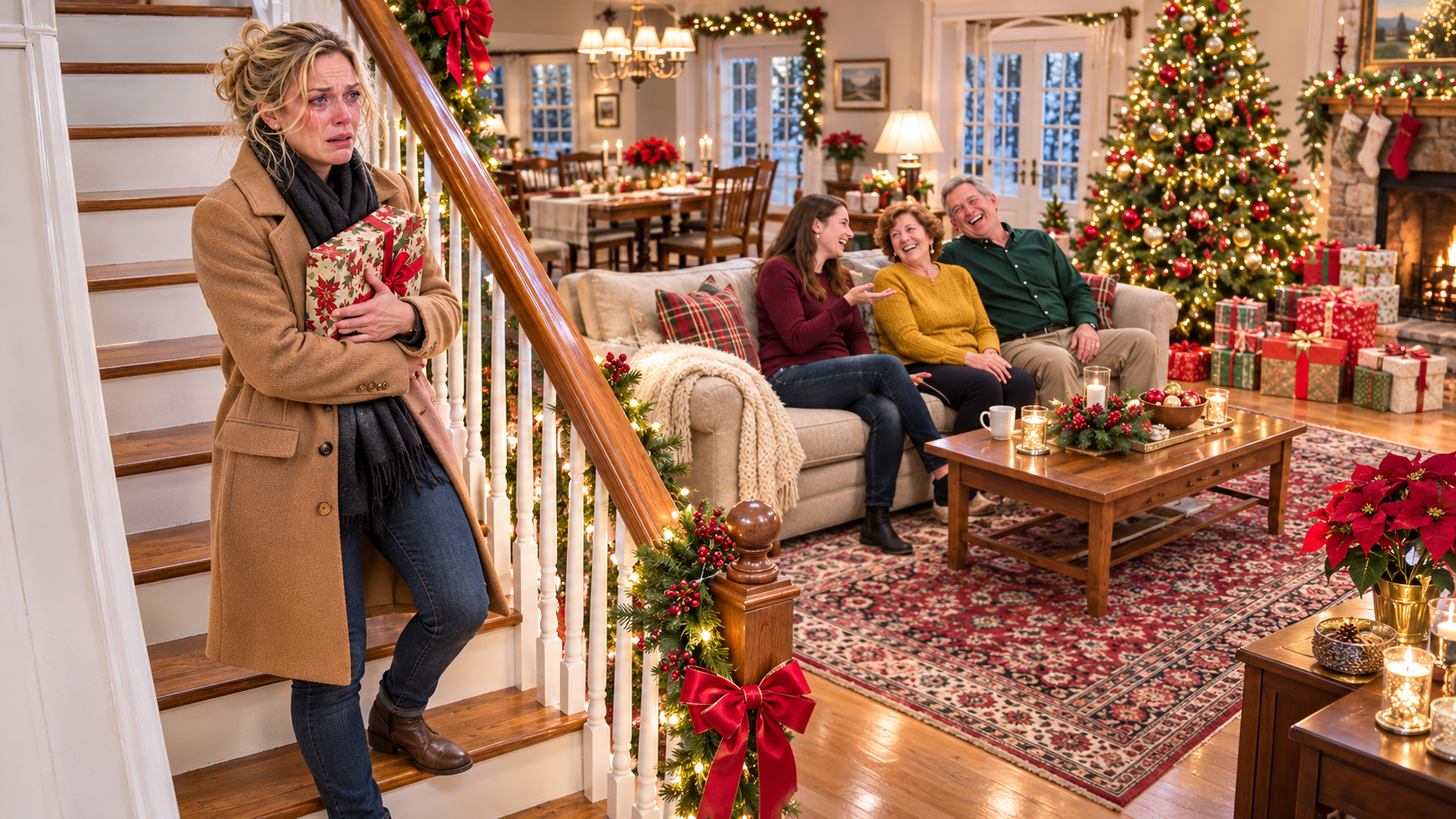
She looked as though she wanted to say a hundred things.
Instead, she asked one question.
“Did you make it through the storm all right?”
I closed my eyes.
There it was.
The question I’d needed four days earlier.
The question a mother should have asked before worrying about a loan.
I turned toward her.
“Yes, Mom.”
My voice broke.
“I made it.”
She nodded, crying.
“I’m glad.”
I wanted to believe that.
Maybe she even meant it.
But I also knew that words spoken after consequences arrive are not quite the same as words spoken when nothing is at stake.
I opened the door.
Cold air rushed into the hallway.
For a moment, I looked back.
Mom stood beside the Christmas tree.
Dad stood near the fireplace.
My childhood home looked warm and beautiful behind them.
But I understood something now.
A house can hold a thousand happy memories and still become a place where you no longer feel welcome.
I stepped outside.
And this time, I didn’t turn around.
I drove home the following morning.
The roads had been cleared.
The snowstorm was finally over.
For the first hour, I barely spoke.
I had the radio turned low, but I couldn’t concentrate on the music.
I kept thinking about my parents.
About Fallon.
About the house.
About the little red envelope I’d left behind.
And about the version of myself who had driven through the storm believing Christmas would bring us closer together.
That woman felt very far away.
At a rest stop, I bought a cup of coffee and called Natalie.
“Heading home?” she asked.
“Yes.”
“How are you feeling?”
I considered lying.
Saying I was fine.
Saying I was relieved.
Saying everything had worked out.
Instead, I told her the truth.
“Sad.”
She was quiet for a moment.
Then she said, “That makes sense.”
“I thought I’d feel stronger.”
“You can feel strong and sad at the same time.”
I looked out at the highway.
“Do you think I’m being cruel?”
“No.”
“Even if they lose the house?”
“Mira, you didn’t make them borrow money. You didn’t make Fallon forge your signature. And you didn’t make your parents hide their finances from you.”
I swallowed.
“I know.”
“Then don’t turn their consequences into your guilt.”
I watched a little boy climb out of a car in the parking lot.
His mother zipped his coat all the way to his chin.
He complained.
She laughed and kissed his forehead.
Something about that ordinary moment made my eyes fill.
“I still love them, Nat.”
“I know.”
“I don’t know how to stop.”
“Then don’t.”
I frowned.
“What?”
“You don’t have to stop loving them. You just have to stop letting that love be used against you.”
I sat quietly.
Then I whispered, “I think that’s what I’m learning.”
When I finally reached my apartment, it was dark.
The city streets were wet, and a thin layer of old snow clung to the edges of the sidewalks.
I parked in the garage.
Then I opened the trunk.
The Christmas presents were still there.
Beautifully wrapped.
Untouched.
Mom’s expensive skincare.
Dad’s tools.
Fallon’s handbag.
The chocolates.
The wine.
The scarf.
I stood staring at everything.
For a moment, I felt foolish.
I’d spent so much time choosing those gifts.
I’d imagined the smiles.
The hugs.
The laughter.
I’d even pictured Fallon trying on the scarf and telling me it was exactly her color.
None of it had happened.
I carried the bags upstairs.
Then I placed them beside my Christmas tree.
I’d decorated it before leaving.
It was small, with warm white lights and little wooden ornaments I’d collected over the years.
There were no presents underneath it.
I’d bought everything for other people.
I stood there for a while.
Then I picked up the scarf.
It was a beautiful deep green.
Soft.
Warm.
Exactly the sort of thing I liked wearing.
I’d only bought it for Fallon because I knew she’d want something expensive.
I removed the tissue paper.
Wrapped the scarf around my own neck.
And looked in the mirror.
For the first time in a long while, I smiled.
“Looks better on you anyway,” I whispered.
Then I laughed.
A real laugh.
Small.
Unexpected.
But mine.
The next few weeks were difficult.
I won’t pretend otherwise.
There were nights when I wanted to call Mom.
There were mornings when I wondered whether Dad had eaten breakfast.
There were moments when I caught myself opening my banking app, ready to send money out of habit.
Five years of automatic generosity don’t disappear overnight.
Neither does thirty-five years of wanting your parents to be proud of you.
But I kept the boundaries I’d set.
I ended the recurring financial transfers.
I followed through with the identity-theft reports and continued communicating with the lender.
After reviewing the disputed application, the lender confirmed in writing that I had not been added to any completed loan.
My attorney helped me make sure the relevant records were corrected.
The matter involving the unauthorized signature remained for the lender and appropriate authorities to address.
I didn’t lie for Fallon.
I didn’t exaggerate against her either.
I simply told the truth.
And that was enough.
As for the presents, I returned most of them.
The refunds went into my savings.
I kept the scarf.
I gave the chocolates to my neighbors.
And I donated several unopened gifts through a local holiday assistance program.
I thought giving them away might make me feel bitter.
Instead, I felt strangely peaceful.
Because I was finally choosing where my generosity went.
It wasn’t an obligation.
It wasn’t a way to buy affection.
It was a choice.
In February, Dad called.
I almost didn’t answer.
But something made me pick up.
“Hello?”
“Mira?”
His voice sounded tired.
“Hi, Dad.”
There was a pause.
“Are you busy?”
“Not right now.”
He cleared his throat.
“I wanted to tell you something.”
I sat down.
“What is it?”
“Your mother and I have spoken with a housing counselor. We’ve reviewed our debts.”
I waited.
“We’re putting the house on the market.”
I closed my eyes.
Even though I’d known it might happen, hearing the words hurt.
The house.
My childhood home.
The place where I’d learned to ride a bicycle in the driveway.
Where we’d celebrated birthdays.
Where I’d cried over my first heartbreak.
“I’m sorry,” I whispered.
Dad took a breath.
“Don’t be.”
I was surprised.
“What?”
“We should have dealt with this years ago. We kept borrowing and telling ourselves things would improve.”
He paused.
“And every time you helped, we used that money to avoid making the decisions we needed to make.”
I stared at the window.
He continued.
“Your mother and I are looking for a smaller place. Something we can actually afford.”
I nodded slowly.
“That sounds sensible.”
“And Fallon is going to have to figure out her own finances.”
I almost laughed.
“Really?”
“Really.”
He sounded different.
Not defeated.
Tired, certainly.
But honest.
“She was angry at first. Still is, some days.”
I waited.
“But we told her we can’t keep taking out loans to rescue her.”
I felt my eyes fill.
I had wanted my parents to say those words for years.
I just wished it hadn’t taken so much pain to get there.
Then Dad said, “Mira, there’s something else.”
“Yes?”
“I was looking through some old photographs.”
I smiled faintly.
“Oh?”
“I found one of you when you were about eight.”
I closed my eyes.
“You were standing in the driveway with your first bicycle. Pink helmet. Scraped knees. Big smile.”
I laughed softly.
“I remember that bicycle.”
“So do I.”
His voice broke.
“You fell three times before you finally made it to the end of the street.”
I smiled.
“You told me to keep trying.”
“I did.”
He became quiet.
Then he whispered, “I spent your childhood teaching you to stand on your own two feet.”
Tears slipped down my cheeks.
“And somewhere along the way, I started punishing you for doing exactly that.”
I pressed my fingers against my eyes.
“Dad.”
“I’m sorry, sweetheart.”
He was crying now.
“I’m sorry for the loan. I’m sorry for the lies. And I’m sorry I laughed that night.”
I couldn’t speak.
He continued.
“I don’t expect you to forgive me today. I just wanted you to know I finally understand.”
I sat quietly.
Then I whispered, “Thank you for saying that.”
He took a shaky breath.
“Can I call you again sometime?”
I closed my eyes.
The question was so simple.
For years, he’d called whenever he needed money.
Now he was asking whether he could call just to talk.
“Yes, Dad.”
My voice trembled.
“You can call.”
Fallon didn’t apologize in February.
Or March.
Or April.
She sent a few angry messages at first.
Then she stopped.
Through Leah, I heard that she’d taken a job at a local office supply company.
It wasn’t glamorous.
It wasn’t the life she’d imagined.
But it was steady work.
I also heard that she was dealing with the consequences of the unauthorized loan documents.
I didn’t ask for details.
That wasn’t because I’d stopped caring.
I was learning something difficult.
Caring about someone does not mean you have to manage every consequence of their choices.
In May, my parents sold the house.
They moved into a modest two-bedroom rental apartment on the other side of town.
Dad sent me a photograph.
There were boxes everywhere.
Mom stood in the kitchen holding a coffee mug.
Behind her was a little window overlooking a garden.
His message read:
“New place. Smaller kitchen. Better view. We’re going to be okay.”
I stared at it for a long time.
Then I replied:
“I’m glad, Dad. I hope this is a fresh start.”
He sent back a heart.
Nothing about money.
Nothing about what I could do for them.
Just a heart.
It was a small thing.
But after everything, small things mattered.
In July, I received a letter.
A real letter.
Not a text.
Not an email.
A handwritten envelope with my address carefully printed on the front.
The return address was my parents’ new apartment.
But the handwriting wasn’t Mom’s.
It was Fallon’s.
I stood in the kitchen holding it.
For several minutes, I couldn’t bring myself to open it.
Then I sat down.
Slid my finger beneath the flap.
And unfolded three pages.
The first line made my chest tighten.
Dear Mira,
I don’t know if you’ll read this. I wouldn’t blame you if you threw it away.
I kept reading.
I’ve spent months being angry at you.
I told myself you embarrassed me.
I told myself you ruined Christmas.
I told myself you didn’t understand what it was like to struggle.
But I’ve had a lot of time to think, and I’ve realized something I didn’t want to admit.
I wasn’t angry because you were wrong.
I was angry because you finally stopped letting me get away with things.
Tears blurred the page.
I wiped them away.
I used your signature because I believed you’d eventually forgive me.
I knew you’d never agreed.
I knew it was wrong.
But I kept telling myself we were family, and family helps family.
I used that excuse because it was easier than admitting I was taking advantage of you.
I stopped reading.
My hands were shaking.
For the first time, Fallon wasn’t blaming me.
She wasn’t blaming Mom or Dad.
She wasn’t blaming her failed business.
She was taking responsibility.
I continued.
I also need to apologize for what I said on Christmas Eve.
There isn’t an explanation that makes it okay.
I knew you were driving in dangerous weather.
I knew you were coming because you wanted to see us.
And I made a joke about your death because I was jealous of everything you had.
The truth is, I’ve been jealous of you for years.
I closed my eyes.
A tear slipped onto the paper.
When you bought your apartment, I told everyone it was too small because I was ashamed that I couldn’t afford one.
When you got promoted, I said you were lucky because it was easier than admitting how hard you worked.
When you sent money to Mom and Dad, I convinced myself you had so much that it didn’t matter.
And when you finally said no, I felt like you were taking something away from me.
But it was never mine.
I pressed a hand against my mouth.
The next paragraph was shorter.
I used to think being your little sister meant you’d always rescue me.
I never asked whether you needed rescuing too.
My eyes filled.
Then I reached the final page.
I’m working now.
I’m trying to deal with my debts and the problems I caused.
I know I can’t fix what happened with an apology.
I know you may never trust me again.
But I want you to know something.
That night, when Mom found your gift tag and we realized you’d been there, I was frightened.
At first, I was frightened because I knew you’d heard us.
Then I was frightened because I realized you might actually have driven back into the storm.
For a few minutes, I thought something terrible might have happened to you.
And the thought made me sick.
I didn’t know how to admit that without admitting what I’d said.
So I got angry instead.
I called you selfish.
I demanded you fix the loan.
I made everything worse.
I’m sorry, Mira.
I’m sorry for the signature.
I’m sorry for the money.
And more than anything, I’m sorry for making you feel like your life mattered less than what you owned.
You were always a good sister to me.
I wish I’d been one to you.
Love, Fallon.
I read the letter twice.
Then I placed it on the table.
And cried.
Not because everything was suddenly fixed.
It wasn’t.
Not because a letter erased years of hurt.
It couldn’t.
But because for the first time, my sister had spoken to me as though I was a person.
Not a resource.
Not an obligation.
Not someone who existed to make her life easier.
A person.
I didn’t call her that day.
Or the next.
I needed time.
But I kept the letter.
And two weeks later, I wrote back.
It took me three attempts to find the right words.
Finally, I sent:
Fallon,
I read every word.
Thank you for apologizing and for being honest.
I love you. That hasn’t changed.
But trust has changed, and rebuilding it will take time.
I’m not ready to return to the relationship we had before.
In fact, I don’t want that relationship back.
I want something healthier.
Something where we can love each other without money being involved.
Something where neither of us has to pretend.
I’m willing to begin there, slowly.
Love, Mira.
She replied with one sentence.
“I’d like that too.”
And for once, she didn’t ask for anything else.
By the following December, my life looked very different.
My apartment was still mine.
My job was going well.
My savings were intact.
But those were no longer the things I felt proudest of.
I was proud that I’d learned to say no without apologizing.
I was proud that I’d stopped hiding my happiness to make someone else comfortable.
I was proud that I no longer measured love by how much I could give.
And I was proud that I’d built a life with people who wanted me around even when I had nothing to offer them.
Natalie and I began spending more time together.
We took a weekend trip to the mountains.
We laughed.
We ate ridiculous amounts of dessert.
We talked about everything and nothing.
For the first time in years, I went on vacation without feeling guilty that the money could have gone to somebody else’s emergency.
I also started volunteering with a local organization that helped young adults learn basic computer skills.
One afternoon, a nineteen-year-old student asked me why I spent my Saturdays teaching people for free.
I thought about the question.
Then I smiled.
“Because I want to.”
He grinned.
“That’s it?”
“That’s it.”
And that simple answer felt wonderful.
Because helping someone was finally a choice again.
Not a debt I owed the world.
When Christmas Eve arrived the following year, snow began falling outside my apartment.
Not a dangerous storm.
Just soft, beautiful flakes floating past the windows.
I stood in my kitchen preparing dinner.
This year, I wasn’t driving six hours.
I wasn’t carrying a trunk full of expensive presents.
I wasn’t trying to surprise people who saw my arrival as an inconvenience.
Instead, I’d invited a small group of friends.
Natalie was coming.
Two coworkers.
A neighbor who had recently moved to the city.
And Leah, who had traveled to spend a few days with me.
Leah arrived first.
She carried a homemade pie.
“Merry Christmas!” she announced.
I laughed.
“Come in before you freeze.”
She stepped inside and looked around.
My apartment smelled of cinnamon and roasted vegetables.
Warm lights glowed around the windows.
Soft music played in the background.
Leah smiled.
“This is beautiful.”
“Thank you.”
She placed the pie on the kitchen counter.
Then she looked at me.
“Mira?”
“Yes?”
“Can I tell you something?”
I nodded.
“Of course.”
Her expression grew serious.
“I still think about last Christmas.”
My smile softened.
“So do I.”
She swallowed.
“I wish I’d said something when Fallon started joking.”
I looked at her.
“You did say something eventually.”
“Not when it mattered.”
I considered that.
Then I reached for her hand.
“Leah, you were the first person in that house who told me the truth without asking for anything.”
Her eyes filled.
“That meant more than you know.”
She hugged me.
And for a moment, we simply stood there.
Then she pulled away and laughed.
“Okay. Enough crying. I’m supposed to be helping you cook.”
I grinned.
“Good. Because I need someone to peel potatoes.”
She groaned.
“I knew there was a catch.”
We both laughed.
At six o’clock, everyone had arrived.
The table was full.
There were candles, food, mismatched glasses, and laughter that made my cheeks hurt.
Nobody asked how much my apartment was worth.
Nobody made jokes about my being unmarried.
Nobody demanded expensive gifts.
Nobody suggested that my financial success somehow belonged to them.
We exchanged small presents.
A book.
A scarf.
A homemade candle.
A framed photograph.
Nothing extravagant.
Everything thoughtful.
When Natalie opened the little silver bracelet I’d bought her, she smiled.
“Mira, it’s beautiful.”
I grinned.
“I’m glad you like it.”
Then she handed me her gift.
It was a small wooden sign.
I unwrapped it carefully.
The words made me laugh through sudden tears.
HOME IS WHERE YOU ARE LOVED, NOT WHERE YOU ARE USED.
I stared at it.
Natalie squeezed my hand.
“Thought it belonged in your apartment.”
I nodded.
“It does.”
I placed it on the mantel.
Right beside my Christmas tree.
Then my phone buzzed.
A message from Mom.
“Merry Christmas, sweetheart. Dad and I are thinking of you. We hope you’re having a wonderful evening.”
A second message followed.
A photograph.
Mom and Dad standing beside a tiny Christmas tree in their apartment.
There were two mugs of hot chocolate on the table.
They looked older.
A little tired.
But peaceful.
Dad had one arm around Mom.
Both were smiling.
I felt a familiar ache in my chest.
Not the sharp, terrible pain of the previous year.
Something softer.
A sadness that had learned to live beside hope.
I typed:
“Merry Christmas, Mom and Dad. Your tree looks beautiful. I love you.”
Then I sent them a photograph of my own dinner table.
Mom responded:
“Looks wonderful. We’re happy you’re surrounded by people who love you.”
I stared at those words.
A year earlier, I’d have wondered whether she meant them.
This time, I believed she was trying.
Maybe that was all we could ask of one another.
To try.
To learn.
To do better than before.
At nine thirty, while everyone was finishing dessert, my phone rang.
Fallon.
I excused myself and stepped into the bedroom.
For a moment, I watched her name on the screen.
We’d spoken several times since the summer.
Short conversations.
Sometimes awkward.
Sometimes surprisingly pleasant.
She’d told me about her job.
I’d told her about my volunteer work.
We’d even laughed together once about a childhood memory.
But we hadn’t discussed money.
Not once.
I answered.
“Hello?”
“Mira?”
“Hi, Fallon.”
“Merry Christmas.”
I smiled.
“Merry Christmas.”
There was a pause.
Then she said, “I hope I’m not interrupting.”
“I’m having dinner with friends.”
“Oh. Sorry.”
“It’s okay. We’re just finishing dessert.”
She laughed softly.
“Sounds nice.”
“It is.”
Another pause.
Then she asked, “Are you happy?”
The question surprised me.
“What?”
“Are you happy tonight?”
I looked through the bedroom doorway.
I could hear Natalie laughing at something Leah had said.
There was music.
Warm light.
The quiet comfort of people who enjoyed one another’s company.
I smiled.
“Yes.”
My voice softened.
“I really am.”
Fallon was quiet for a moment.
Then she whispered, “I’m glad.”
I swallowed.
“Thank you.”
She took a breath.
“Mira, I know last Christmas was terrible.”
My smile faded.
“Yes.”
“I’ve been thinking about something.”
I waited.
“You drove all that way because you wanted to see us.”
I closed my eyes.
“Yes.”
“And we made you feel like you shouldn’t have come.”
Tears burned behind my eyelids.
“Yes.”
She paused.
Then she said, “I wish I could go back and change that night.”
I leaned against the wall.
“I know.”
“I wish I’d run to the door when you arrived.”
My throat tightened.
“I wish I’d hugged you.”
A tear slipped down my cheek.
“I wish I’d told everyone to stop laughing.”
I couldn’t speak.
Her voice broke.
“And I wish I’d told you I was glad you made it safely through the storm.”
I pressed a hand against my mouth.
For a moment, all I could hear was her breathing.
Then she whispered, “Because I am, Mira.”
I closed my eyes.
“I know that now.”
She began crying.
“I’m so sorry.”
I wiped my cheeks.
“Thank you, Fallon.”
We were quiet for a while.
Then she asked, “Do you think maybe next year we could have coffee somewhere? Just us?”
I considered the question.
A year earlier, I might have promised an entire Christmas together.
I might have offered a vacation.
A family gathering.
Something expensive and elaborate to prove everything was forgiven.
But I knew better now.
Small steps.
Honest steps.
Steps taken because we wanted to know one another again.
Not because we needed something.
“I’d like that,” I said.
She laughed through her tears.
“Really?”
“Really.”
“Okay.”
I smiled.
“Okay.”
Then, just before hanging up, Fallon said something that made my heart ache.
“Mira?”
“Yes?”
“Thank you for answering.”
I closed my eyes.
“Goodnight, Fallon.”
“Goodnight, big sister.”
And for the first time in a very long while, those words felt like something other than a responsibility.
After the call, I returned to the living room.
Natalie looked up.
“Everything okay?”
I smiled.
“Yes.”
She studied my face.
“Really?”
I nodded.
“Really.”
She handed me a cup of hot chocolate.
“Good. Because Leah is trying to convince everyone that her pie deserves an award.”
From the kitchen, Leah shouted, “It absolutely does!”
We burst out laughing.
I sat down beside the Christmas tree.
For a moment, I watched the people around me.
People who had chosen to be there.
People who weren’t calculating the value of my possessions.
People who would be disappointed if I disappeared from their lives—not because of what they might lose financially, but because they would miss me.
And suddenly, I remembered something.
The previous Christmas morning.
The hotel room.
The snow.
Eighty missed calls.
The terrible feeling of being wanted only for what I owned.
I thought about how frightened I’d been.
How lonely.
How close I’d come to believing that maybe I really was only valuable when I was useful.
Then I looked around my apartment.
At the laughter.
The warmth.
The people who loved me.
And I understood something that had taken me thirty-five years to learn.
Being needed is not the same as being loved.
People can need your money.
Your time.
Your labor.
Your connections.
Your ability to solve problems.
They can become dependent on your generosity.
They can even convince themselves that your success creates an obligation to support them.
But none of those things proves they love you.
Love is what remains when you stop giving.
Love asks whether you arrived safely.
Love notices when you’re tired.
Love celebrates your happiness without comparing it to someone else’s.
Love doesn’t wait for you to disappear so it can divide what you leave behind.
I had spent years believing that if I gave enough, my family would finally appreciate me.
I thought one more gift might make Fallon happy.
One more transfer might make Dad proud.
One more sacrifice might make Mom understand how much I cared.
But the problem had never been that I wasn’t giving enough.
The problem was that I’d forgotten I deserved something in return.
Not money.
Not presents.
Not favors.
Just kindness.
Respect.
And the simple comfort of knowing that my life mattered more than my bank account.
A year ago, I drove six hours through a snowstorm to surprise my family for Christmas.
I walked through their front door carrying presents and hope.
I overheard my sister say she wished I’d never make it home.
And I stood there listening while the people I loved laughed about inheriting everything I’d worked for.
I left without a word.
The next morning, I woke up to eighty missed calls.
At first, I thought those calls meant my family had finally realized how much they’d hurt me.
Instead, I discovered a forged signature, a secret loan application, and years of financial deception.
It was the worst Christmas of my life.
But it also became the Christmas that changed everything.
My parents eventually learned to live within their means.
My sister began facing responsibilities I’d spent years helping her avoid.
Our relationships didn’t magically heal.
There were difficult conversations.
There were apologies that came too late.
There were consequences nobody could simply wish away.
And there were days when I still missed the family I thought I’d had.
But I no longer confused keeping the peace with being loved.
I no longer used money to silence my own disappointment.
And I no longer believed that saying no made me a bad daughter or sister.
I still love my family.
I probably always will.
But now I love myself enough to know when to step away.
Sometimes I think about that snow-covered road.
About the woman who kept driving because she believed the people waiting at the end would be happy to see her.
I wish I could go back to that moment.
Not to stop her from making the journey.
Not to warn her about the cruelty waiting in the living room.
But to tell her one thing.
You are going to make it home, Mira.
Not the house you grew up in.
Not the place where they are waiting for your gifts.
Your real home.
The place where you can finally be yourself without apologizing.
The place where your worth isn’t measured in dollars.
The place where people will be grateful that you walked through the door.
That Christmas Eve, I had turned around in silence because I was too heartbroken to speak.
One year later, as I sat beneath the warm lights of my own Christmas tree, surrounded by people who loved me, I realized I no longer needed to explain myself.
I was thirty-six years old.
Unmarried.
Childless.
Financially independent.
And happier than I’d ever been.
My life wasn’t incomplete.
It was mine.
My phone buzzed one final time that night.
It was a message from Dad.
Just four words.
“Glad you’re home, sweetheart.”
I read it twice.
Then I smiled through my tears.
Because those were the words I should have heard the previous Christmas.
And although they couldn’t change what had happened, they reminded me that sometimes people really can begin to learn.
I typed back:
“Me too, Dad. Me too.”
Then I turned off my phone, joined my friends at the table, and let the evening continue.
Outside, snow fell softly against the windows.
Inside, the room was filled with laughter.
And for the first time in years, Christmas wasn’t about how much I could give away.
It was about how wonderful it felt to be alive.
To be safe.
To be loved.
And to finally understand that I didn’t have to earn my place at the table.
I had always deserved one.
THE END.
THE END! THANK YOU FOR READING!❤️