“Mira—”
“And I kept sending you six hundred and fifty dollars every month.”
My voice cracked.
“Because you told me you needed it.”
Dad wiped his eyes.
“I know.”
“No,” I whispered. “I don’t think you do.”
I looked down at the table.
“You see my salary. My apartment. My savings. And you think that means everything is easy for me.”
He said nothing.
“You don’t see the weekends I spent studying while everyone else went out. You don’t see the years I lived with roommates to save money. You don’t see the times I ate cheap noodles because I was putting every extra dollar toward my mortgage.”
I swallowed.
“You see the result. And you decide I can afford to give it away.”
His face crumpled.
“I never meant to make you feel that way.”
I looked at him.
“But you did.”
We sat in silence until the waitress returned with my tea.
Dad thanked her.
I watched the steam rise from the cup.
Then I asked, “Whose idea was it to use my name?”
He took a long breath.
“Fallon suggested it.”
“And you agreed?”
“Your mother thought—”
“Dad.”
He looked at me.
“Did you agree?”
His shoulders slumped.
“Yes.”
The word was barely audible.
But I heard it.
“Yes,” he repeated. “I agreed.”
I nodded slowly.
“Did you know she’d copied my signature?”
He closed his eyes.
“I knew she was using documents you hadn’t signed for this application.”
“That’s not an answer.”
He opened his eyes.
“No,” he said softly. “I didn’t think she’d actually copy it until she told us she’d already submitted the paperwork.”
“And after you found out?”
He swallowed.
“We didn’t stop it.”
I stared at him.
He looked ashamed.
For the first time in my life, I wanted my father to feel ashamed.
Not because I enjoyed hurting him.
But because I needed him to understand the seriousness of what he’d done.
“Why didn’t you call me?” I asked.
“Fallon said once the loan went through, we’d explain everything.”
I stared at him in disbelief.
“After it went through?”
He looked away.
“You were going to tell me after my name was already legally connected to your debt?”
He didn’t answer.
“Dad, do you understand that this could have damaged my credit? My ability to buy another home? My financial security?”
“I know now.”
“You knew enough to hide it.”
He flinched.
I hated that I had to say it.
But I wasn’t going to soften the truth just because it made him uncomfortable.
Then I noticed another sheet inside the folder.
It wasn’t a bank statement.
It was a printed property estimate.
My apartment.
My building.
My street.
My approximate property value.
I picked it up.
“Why is this here?”
Dad went pale.
I turned the sheet toward him.
“Dad?”
He looked at the window.
Then he whispered, “Your uncle Raymond printed that.”
“Why?”
“Fallon wanted to show him how much equity you had.”
A chill spread through my body.
“Why did she need to show him that?”
Dad rubbed his forehead.
“She was trying to understand whether your apartment could help support the loan if the bank wanted more security.”
I stared at him.
For several seconds, I couldn’t form words.
My apartment.
The place I’d worked so hard to own.
The place where I felt safe.
The place where I’d imagined growing old someday, whether I married or not.
They’d been discussing it like an asset on a family balance sheet.
Without me.
“Did you tell her she could use my apartment?”
Dad looked horrified.
“No, Mira. We knew that would require your permission.”
“But you were discussing it.”
“Yes.”
“And nobody thought to ask me?”
He covered his face.
I pushed the paper back toward him.
“Do you know what scares me most?”
He lowered his hands.
“What?”
“That if the verification process hadn’t stopped this, you might have kept making decisions about my life without ever telling me.”
He couldn’t deny it.
Because we both knew it was true.
I thought that was the worst revelation.
I was wrong.
As we were finishing, Dad reached into his coat pocket.
He pulled out a small, folded card.
It had a red ribbon attached.
I recognized it immediately.
My handwriting.
My little silver snowflake sticker.
It was the gift tag I’d tied to Mom’s Christmas present.
Somehow, it must have fallen off when I turned to leave the house.
Dad placed it on the table.
“Your mother found this by the front door.”
I picked it up.
On the front I’d written:
To Mom. Merry Christmas. I missed you more than you know.
My throat tightened.
Dad watched me.
“We didn’t realize you’d actually come inside until she found it.”
I nodded.
“So you knew.”
“Yes.”
“And you knew I’d heard what Fallon said?”
He swallowed.
“We suspected.”
I looked at him.
“Then why didn’t anybody come looking for me?”
His face twisted.
“We called.”
“About the loan.”
He shook his head.
“We were worried about you too.”
I stared at him.
“Then why didn’t you say that?”
He opened his mouth.
Nothing came out.
“Dad, I drove through the worst storm we’ve had in years. I disappeared without telling anyone where I was. You didn’t know whether I’d reached a hotel, gone back onto the highway, or ended up in a ditch.”
His eyes filled.
“And the message Mom sent wasn’t ‘Are you alive?’ It was ‘Please tell the lender you signed.’”
He began crying.
Quietly.
The way men of his generation sometimes do when they’ve spent their whole lives believing tears should be hidden.
I watched him.
And even then, some part of me wanted to reach across the table and comfort him.
That’s the terrible thing about loving people who hurt you.
Your heart doesn’t immediately stop recognizing them.
I still knew the sound of my father’s cough.
I still remembered how he made pancakes in the shape of animals when we were children.
I still loved him.
But love couldn’t erase what he’d done.
“Dad,” I whispered, “when Fallon said she hoped I would die on those roads…”
He lowered his eyes.
“Did you laugh?”
His face crumpled.
I waited.
Finally, he nodded.
“Yes.”
The word felt like a knife.
“Why?”
“I don’t know.”
“That’s not good enough.”
He pressed his fingers against his eyes.
“Because everybody else was laughing. Because I didn’t want another argument with your sister. Because I was a coward.”
I stared at him.
He looked up.
“But I didn’t want you to die, Mira.”
A tear rolled down my cheek.
“Then why didn’t you say so?”
He began crying harder.
“I should have.”
I nodded.
“Yes. You should have.”
He reached across the table.
This time, he didn’t try to touch my hand.
He just placed his palm between us.
“I failed you,” he whispered.
I looked at him.
“Yes, Dad.”
My voice broke.
“You did.”
Before we left the diner, my father told me one more thing.
Something that explained why Mom had sounded so uncomfortable when I first announced I was coming for Christmas.
They had planned to announce the loan during dinner.
Not ask.
Announce.
Fallon had told the relatives that I was helping the family refinance the house.
Mom had even prepared a little speech thanking me for my generosity.
Dad said there was an envelope sitting under the Christmas tree.
Inside were documents they expected me to sign, including paperwork confirming my participation in the loan.
They had assumed that once everyone knew, I would be too embarrassed to refuse.
I stared at him.
“You were going to put me on the spot in front of the whole family?”
He nodded.
“And when I told Mom I was coming, she knew?”
“Yes.”
Suddenly, I understood her hesitation.
“Oh, Mira, that’s really not necessary.”
She hadn’t been worried about the house being crowded.
She’d been worried about whether I’d cooperate.
They had wanted my money.
My good credit.
My income.
My apartment’s value.
But they hadn’t wanted the woman those things belonged to.
They had wanted a signature.
Not a daughter.
And the cruelest part was that I’d spent weeks trying to make my arrival a beautiful surprise.
Meanwhile, they had been preparing a surprise of their own.
The following morning, I met with an attorney named Rebecca Ortega.
She had been recommended by the lawyer handling the dispute with the lender.
Her office was in a modest brick building beside the courthouse.
She was a woman in her fifties, with silver-framed glasses and a calm manner that immediately put me at ease.
I brought everything.
The emails.
The screenshots.
My father’s documents.
The text messages.
The application summary.
Even the little Christmas gift tag.
Rebecca listened without interrupting.
When I’d finished, she sat quietly for a moment.
Then she said, “Your immediate priority is making sure your identity and finances are protected.”
I nodded.
“I’ve already contacted my bank and started freezing my credit.”
“Good.”
She reviewed the application.
“We’ll make sure your dispute is documented properly with the lender. If someone signed your name without permission, you should not represent that signature as yours.”
“I won’t.”
She looked at me.
“And because this involves relatives, I want you to understand something.”
I waited.
“You may face significant pressure to withdraw your complaint or say this was a misunderstanding.”
I gave a small, bitter laugh.
“That pressure has already started.”
She nodded.
“Then keep your communications in writing whenever possible. Don’t agree to any financial arrangement until you’ve had independent advice.”
I looked down.
“Could my sister get in trouble?”
Rebecca chose her words carefully.
“Using another person’s identity and signing without authorization can have serious consequences. The lender and any investigating authorities will determine what happens next.”
I swallowed.
“I don’t want to destroy her life.”
Rebecca’s expression softened.
“Mira, you didn’t submit those documents.”
I nodded slowly.
She continued.
“You can care about what happens to your family without taking responsibility for choices you did not make.”
Those words stayed with me.
Because that was exactly what I’d been doing for years.
Taking responsibility for everyone.
Their emergencies.
Their disappointments.
Their mistakes.
Their debts.
And somehow believing that if I didn’t fix everything, I’d be the one who had failed.
I left Rebecca’s office with a plan.
I would cooperate honestly with the lender’s investigation.
I would document the identity theft and follow the appropriate reporting process.
I would keep my accounts and credit protected.
And I would no longer provide financial support to my parents or Fallon.
Not to punish them.
To protect myself.
But there was one final thing I needed to do before going home.
I needed to look them in the eyes.
I sent a message to Mom.
“I’ll come to the house tomorrow at two. I am not coming to sign anything or discuss giving money. I am coming to tell you where we stand.”
She responded almost immediately.
“Thank God. We’ll be waiting.”
Fallon sent another message.
“Finally. Maybe now you’ll listen to reason.”
I didn’t answer.
The next afternoon, I drove through the neighborhood where I’d grown up.
The snow had begun to melt.
Dirty slush lined the sidewalks, and icicles hung from the gutters.
My parents’ house stood at the end of the street, decorated with the same white Christmas lights Dad had hung every year.
For a moment, I sat in the car and stared at it.
I remembered Christmas mornings when Fallon and I raced downstairs in matching pajamas.
Dad would pretend Santa had left muddy footprints by the fireplace.
Mom would make cinnamon rolls.
There had been happiness in that house.
Real happiness.
I didn’t want to pretend otherwise.
But memories aren’t permission slips.
Just because someone once loved you well doesn’t mean you must accept being treated badly forever.
I took a deep breath.
Then I walked to the front door.
Mom opened it before I knocked.
“Mira!”
She reached for me.
I stepped back.
Her smile disappeared.
“Oh, sweetheart.”
“Hello, Mom.”
She looked tired.
Her hair was pulled back loosely, and her eyes were swollen.
“You look exhausted.”
I almost laughed.
“I’ve had a difficult Christmas.”
She lowered her head.
“Please come inside.”
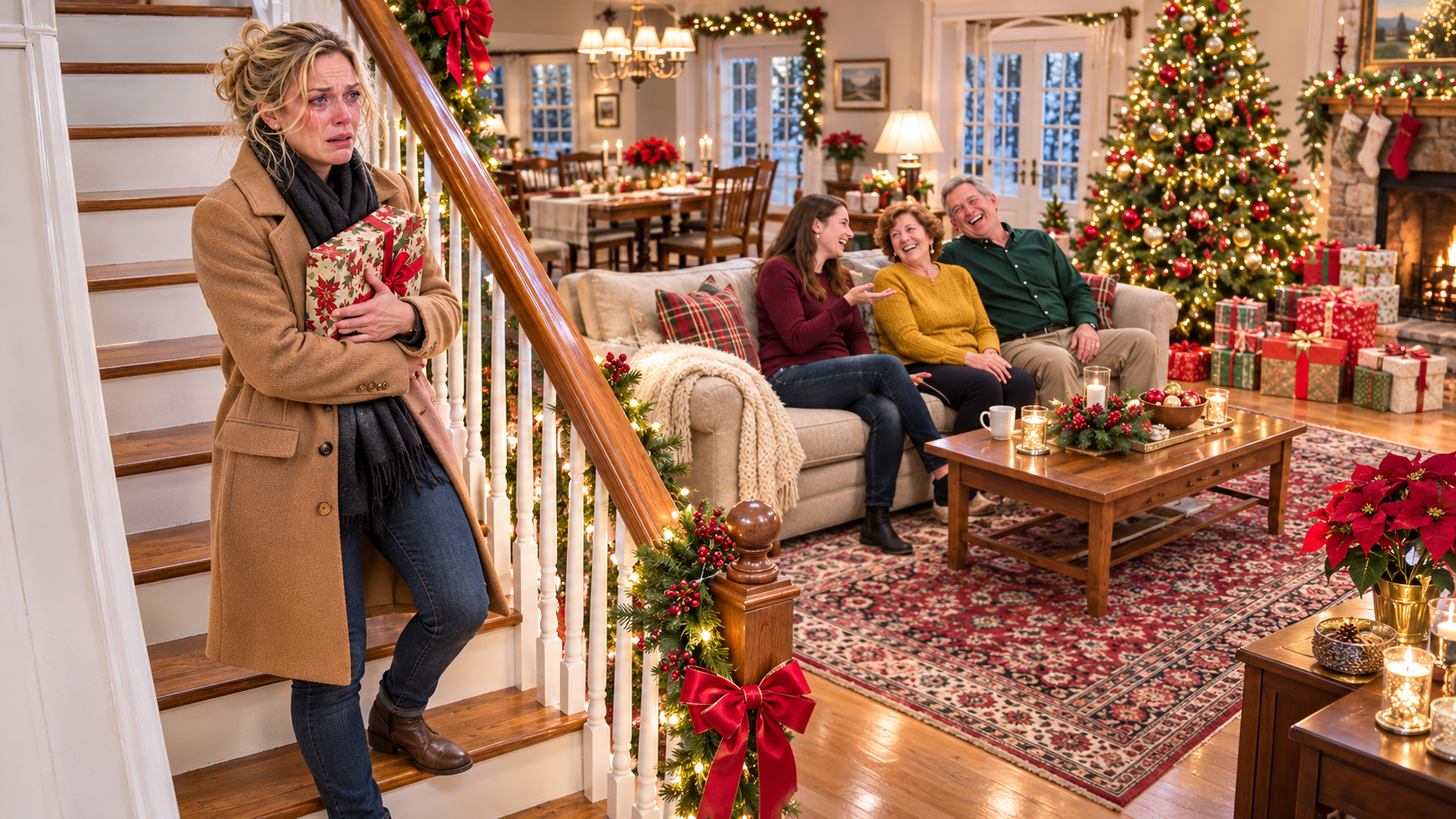
I followed her into the hallway.
The Christmas tree was still lit.
There were wrapped gifts beneath it.
A plate of cookies sat on the coffee table.
Everything looked almost exactly as it had the night I’d arrived.
Except this time, the front door was closed behind me.
And I knew what everyone was capable of saying when they thought I wasn’t listening.
Fallon was sitting on the sofa.
Dad stood beside the fireplace.
Aunt Denise and Uncle Raymond were there too.
I stopped in the doorway.
“Why are they here?”
Mom clasped her hands.
“We thought it would be good for everyone to talk.”
I looked at her.
“I said I was coming to speak to you, Dad, and Fallon.”
Aunt Denise stood.
“Now, Mira, there’s no need to be difficult.”
I turned toward her.
“Then please leave.”
She blinked.
“Excuse me?”
“This doesn’t involve you.”
Uncle Raymond cleared his throat.
“Well, technically, I helped your father understand the refinancing options.”
I looked at him.
“Then you should be especially careful about getting involved in a conversation about my identity being used without permission.”
His face changed.
For a moment, nobody spoke.
Then Dad said quietly, “Denise, Raymond, I think Mira’s right.”
Aunt Denise stared at him.
“Oh, for heaven’s sake.”
Dad didn’t move.
“Please.”
She grabbed her purse.
“This is ridiculous. We’re all family.”
I looked at her.
“Yes.”
Then I added, “That’s what made it so disappointing.”
She left without saying goodbye.
Raymond followed.
I waited until the door closed.
Then I looked at Mom.
“No more surprises.”
She nodded.
“No more surprises.”
But Fallon was already standing.
“Can we just get this over with?”
I turned toward her.
“Gladly.”
For several seconds, we simply stared at each other.
My little sister.
The girl who used to climb into my bed during thunderstorms.
The girl I’d helped with homework, school projects, college applications, and job interviews.
The girl who called me whenever she needed money.
She looked furious.
Her arms were folded.
Her jaw was tight.
And there wasn’t a trace of shame on her face.
“You’ve made everything so much worse,” she said.
I didn’t answer.
She continued.
“Do you have any idea how humiliating this has been?”
I stared at her.
“Humiliating?”
“Yes! The lender is asking questions, Mom and Dad are stressed, and now people think I’m some kind of criminal.”
I looked at her for a long moment.
“Did you sign my name?”
She hesitated.
Mom shifted uncomfortably.
“Sweetheart, let’s not—”
“Mom. Please.”
I kept my eyes on Fallon.
“Did you sign my name?”
She rolled her eyes.
“I copied your signature on a preliminary form. It’s not like I withdrew money from your bank account.”
I felt my chest tighten.
“You’re admitting it.”
“I’m not denying it!”
“Did I give you permission?”
“No, but—”
“Did I agree to become responsible for your parents’ loan?”
“No, but—”
“Did I even know about it?”
Her face reddened.
“No!”
I nodded.
“Then what exactly did you think you were doing?”
She threw up her hands.
“Helping this family!”
I stared at her.
“By putting almost two hundred thousand dollars of debt under my name without telling me?”
“We weren’t going to make you pay it!”
“Then why did you need me on the application?”
She stopped.
I waited.
Her eyes narrowed.
“Because your credit is good!”
I nodded.
“And why is my credit good, Fallon?”
She looked away.
“Because I worked for it.”
“Oh, please.”
“Because I paid my bills. Because I saved. Because I made decisions about what I could afford instead of assuming somebody else would rescue me.”
Her face twisted.
“You’ve always thought you were better than me.”
The accusation hit an old, familiar wound.
I remembered being sixteen and getting an academic scholarship.
Fallon cried because Mom had praised me at dinner.
I remembered buying my first car.
Fallon complained that hers wasn’t as nice.
I remembered accepting my first engineering job.
Fallon told relatives I’d gotten lucky.
For years, I’d made myself smaller to avoid making her feel inferior.
I stopped celebrating promotions in front of her.
I avoided mentioning vacations.
I hid expensive purchases.
I even stopped talking about work because she’d accuse me of bragging.
And none of it had helped.
“No, Fallon,” I said quietly. “I’ve spent most of my life trying to make sure you never felt that way.”
Her face hardened.
“Then why are you doing this to me?”
I looked at her.
“Because you did something wrong.”
She opened her mouth.
I continued.
“And because you don’t get to decide that my success belongs to you.”
Mom began crying.
“Mira, please. We’re all upset. Let’s calm down.”
I turned toward her.
“Mom, I need you to answer something.”
She wiped her cheeks.
“What?”
“When Fallon said she hoped I’d die in the snowstorm, why did you laugh?”
The room went silent.
Dad stared at the floor.
Fallon scoffed.
“Oh, my God. We’re still talking about that?”
I didn’t look at her.
I kept my eyes on Mom.
“Why?”
Her lips trembled.
“It was a terrible joke.”
“I know.”
“Nobody meant it.”
“Then why was it funny?”
She stared at me.
“I don’t know.”
I stepped closer.
“Mom, did you know I was driving through dangerous weather to see you?”
“Yes.”
“Did you know I was excited?”
She began crying harder.
“Yes.”
“Then why didn’t you tell Fallon to stop?”
Mom pressed a tissue against her mouth.
For a long moment, she couldn’t speak.
Then she whispered, “Because she was only joking, and everyone was laughing.”
I nodded.
“Everyone.”
Tears rolled down my face.
“Do you know what I was holding when I heard you?”
She shook her head.
“Your Christmas presents.”
Her eyes widened.
“The skincare you wanted. The tools Dad asked for. Fallon’s handbag. Chocolates. Wine. A scarf I’d picked because I thought she’d love the color.”
Fallon looked away.
I swallowed.
“I drove six hours to make you happy.”
Mom covered her mouth.
“And I stood in that hallway listening to you celebrate the possibility of my death.”
“No,” she whispered. “Mira, we weren’t celebrating—”
“You were laughing.”
She began sobbing.
I let the silence settle.
Then I asked, “Did any of you wonder whether I made it safely to the hotel?”
Dad spoke quietly.
“I did.”
I turned toward him.
“Then why did you wait until our conversation at the diner to tell me?”
He closed his eyes.
“I don’t have a good answer.”
I nodded.
“That’s the first thing you’ve said today that I believe completely.”
Fallon suddenly stepped forward.
“So what do you want?”
I looked at her.
“What?”
“An apology? Money? Do you want us to get down on our knees and beg?”
I shook my head.
“I want you to understand that I’m not your backup plan.”
She laughed bitterly.
“Easy for you to say. You have everything.”
Something about those words finally exhausted me.
Not anger.
Not sadness.
Exhaustion.
I looked at my sister.
“Fallon, what exactly do you think I have?”
She stared at me.
“A great job. A paid-off apartment. Money. Freedom.”
I nodded.
“Yes.”
“And you act like you’ve suffered.”
I took a long breath.
“Do you remember when I graduated from college?”
She rolled her eyes.
“Here we go.”
“I had forty-six thousand dollars in student debt. I lived with three roommates in a tiny apartment. I worked full-time and took extra programming contracts at night.”
“So?”
“So I paid it off.”
“Congratulations.”
“I saved for nine years to buy my apartment. I worked holidays. I missed birthdays. I turned down trips I wanted to take.”
She crossed her arms.
“And?”
“And when I finally bought the place, I invited you to see it.”
She said nothing.
“You told me it was too small.”
Her expression flickered.
I continued.
“When I got promoted, you said engineers were overpaid.”
“Mira—”
“When I started earning more, Mom began sending me lists of things the family needed. I said yes because I thought that’s what a good daughter should do.”
Tears burned my eyes.
“And somewhere along the way, none of you seemed to notice that I was doing all of it alone.”
Mom stared at me.
I looked at her.
“I wanted to get married once.”
Her expression changed.
“What?”
I laughed sadly.
“Seven years ago. His name was Daniel.”
Dad looked up.
“We remember Daniel.”
I nodded.
“We were together for three years. We were planning a future.”
I swallowed.
“When he got a job overseas, we tried to make long-distance work. It didn’t. I was devastated.”
Mom whispered, “You never told us how badly it affected you.”
I looked at her.
“I tried.”
Her eyes filled.
“I called you the night we broke up.”
She closed her eyes.
“I remember.”
“You told me not to dwell on it because Fallon had just lost her job and needed support.”
Fallon looked down.
I nodded slowly.
“So I stopped talking about it.”
Nobody spoke.
“I learned that my sadness could wait. My exhaustion could wait. My dreams could wait.”
My voice broke.
“But Fallon’s emergencies couldn’t.”
For the first time, my sister didn’t have an answer.
I wiped my cheeks.
“And then on Christmas Eve, I finally heard how little my life mattered compared with what you thought I owned.”
Dad sat down heavily in his armchair.
Mom was crying.
Fallon stood near the Christmas tree, staring at the floor.
I hadn’t planned to say so much.
I’d imagined walking into the house, delivering a few firm sentences, and leaving.
But there were years of things I’d never said.
Years of swallowing disappointment because I didn’t want to cause trouble.
Years of trying to be the easy daughter.
The reliable one.
The one who never needed anything.
And now the words were coming out whether I wanted them to or not.
I reached into my handbag.
Mom watched nervously.
I took out a folded sheet of paper.
“This is what I need you to understand.”
I placed it on the coffee table.
It wasn’t a demand for repayment.
It wasn’t a list of grievances.
It was a written summary of my boundaries.
“I am ending the monthly transfers,” I said.
Dad closed his eyes.
“I will no longer pay personal bills or support Fallon’s business decisions.”
Mom nodded through her tears.
“I will not sign the loan application or give permission for my financial information to be used.”
Fallon looked away.
“And I will cooperate truthfully with the investigation into my signature.”
Her head snapped up.
“You’re really going through with that?”
“Yes.”
She stared at me in disbelief.
“You’d let your own sister get investigated?”
I looked at her.
“I won’t lie to protect you from what you chose to do.”
She began crying angrily.
“You’re ruining my life!”
“No, Fallon.”
My voice was quiet.
“You made a decision about my life without asking me. I’m making sure it doesn’t happen again.”
Mom reached for my hand.
“Mira, what about the house?”
I looked at her.
“You need to speak to your mortgage lender, a housing counselor, and someone qualified to help you review your debts. You may have to sell it.”
She made a small, frightened sound.
“That’s our home.”
“I know.”
“We’ve lived here for thirty-two years.”
“I know, Mom.”
Her voice cracked.
“It’s where we raised you.”
I looked around the room.
At the framed family photographs.
At the staircase covered in old carpet.
At the little wooden angel I’d made in kindergarten, still hanging on the tree.
“I know exactly what this house means.”
Tears spilled down my cheeks.
“But I can’t sacrifice my future to save decisions you made without me.”
Dad nodded slowly.
“She shouldn’t have to,” he said.
Mom turned toward him.
“Richard—”
He shook his head.
“No. She’s right.”
Fallon stared at him.
“Dad!”
He looked at his younger daughter.
“Fallon, enough.”
His voice wasn’t loud.
But I’d never heard it sound quite like that.
“Your sister has helped us for years. We should never have put her in this position.”
Fallon began sobbing.
“But we’re family!”
Dad looked exhausted.
“Yes,” he whispered.
“And that’s why we should have treated her better.”
Fallon stared at Dad as though he’d slapped her.
For a moment, I thought she might finally understand.
Then she looked at me.
“So that’s it? You’re just walking away?”
I nodded.
“I’m walking away from paying for everyone’s mistakes.”
“And what about the Christmas presents?”
The room went completely silent.
I genuinely thought I’d misheard her.
“What?”
“The gifts,” she repeated. “You said you brought them. Did you take them back?”
I stared at my sister.
After everything.
After the loan.
The forged signature.
The laughter.
The tears.
She was still thinking about a handbag.
Mom turned toward her.
“Fallon.”
“What?” she snapped.
Mom’s voice shook.
“Please stop.”
Fallon rolled her eyes.
“I’m just asking.”
“No,” Mom said.
This time, there was something different in her voice.
“You are not asking your sister about presents. Not after what we’ve done.”
Fallon looked stunned.
For twenty-nine years, Mom had defended her.
Excused her.
Protected her.
And now, for the first time I could remember, Mom wasn’t rushing to make Fallon feel better.
My sister grabbed her coat.
“Fine. Everyone can blame me.”
She marched toward the hallway.
Then she turned back.
“You know what, Mira? I hope you’re happy sitting alone in your perfect apartment with all your perfect money.”
I looked at her.
My heart hurt.
But I didn’t move.
“I’d rather be alone than surrounded by people who only value what I can give them.”
Her face twisted.
For a moment, I thought she might say something truly unforgivable.
Instead, she opened the door and left.
It slammed behind her.
The same door I’d quietly slipped through on Christmas Eve.
Only this time, I didn’t feel invisible.
Mom sank onto the sofa.
Dad stared into the fireplace.
I looked around the room one last time.
Then I reached into my pocket.
I’d brought something with me.
A small red envelope.
Inside was the Christmas card I’d intended to give my parents before everything happened.
I placed it on the coffee table.
Mom looked at it.
“What’s that?”
“Your Christmas card.”
Her eyes widened.
I swallowed.
“I wrote it before I left home.”
She picked it up with trembling fingers.
On the front was a picture of a little house surrounded by snow.
Inside, I’d written:
Dear Mom and Dad,
I know we don’t see each other as often as we should.
This year, I wanted to change that.
I’ve missed our old Christmas mornings. I’ve missed sitting in the kitchen while Mom cooks and listening to Dad tell the same stories I’ve heard a hundred times.
I hope this Christmas can be the beginning of spending more time together.
I love you both.
Always, Mira.
Mom read it silently.
Then she covered her face and began to sob.
Dad took the card from her.
His hands shook as he read.
When he finished, he didn’t speak.
He simply sat there staring at my handwriting.
For a long time, the only sound was the ticking clock.
Finally, Mom whispered, “We thought you were coming to show us how successful you’d become.”
I stared at her.
“What?”
She wiped her face.
“Fallon kept saying you were coming to make everyone feel bad. That you’d show up with expensive presents and remind us how much money you had.”
My chest tightened.
“Mom, I never wanted that.”
“I know.”
“No, I don’t think you did.”
She nodded through her tears.
“Maybe I didn’t.”
I looked at the Christmas tree.
“I came because I missed my family.”
Dad bowed his head.
Mom began crying harder.
“I know that now.”
I took a long breath.
“Then please remember it.”
I picked up my handbag.
Dad stood.
“Mira?”
I turned.
He looked at me with tears in his eyes.
“Will you ever come home again?”
I considered the question.
A week earlier, I would have said yes immediately.
I would have promised to visit more often.
I would have comforted him.
I would have offered to help solve the mortgage problem.
But I couldn’t be that person anymore.
“I don’t know,” I said.
His face fell.
I continued.
“I love you. Both of you. But I don’t feel safe trusting you right now.”
Mom sobbed.
“And I can’t pretend everything is fine just because it’s Christmas.”
Dad nodded.
“I understand.”
I looked at him.
“Understanding is a beginning, Dad. What you do next matters more.”
He wiped his eyes.
Then he whispered, “You’re right.”
I walked to the door.
Mom followed me.
As I reached for the handle, she spoke.
“Mira?”
I stopped.
“Yes?”