 Reading Time: 21 minutes
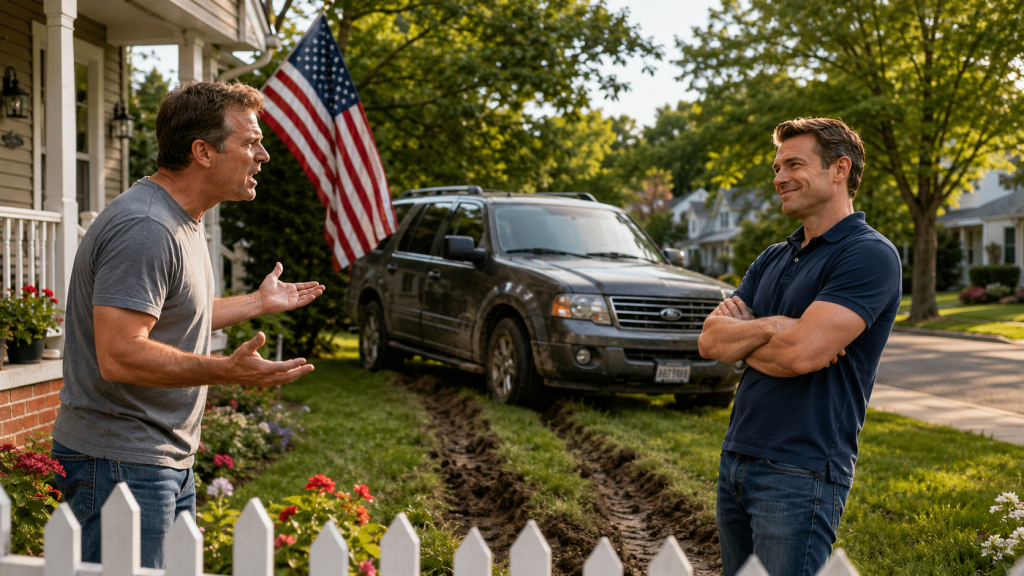
I woke up that Saturday expecting nothing more exciting than coffee, scrambled eggs, and maybe an hour on the porch before the August heat became unbearable. Instead, I looked through my front window and nearly dropped my mug.
My neighbor’s SUV was sitting in the middle of my front lawn. Not partly on it. Not with one tire accidentally touching the edge of the grass. The entire vehicle was parked on my property as casually as if my lawn were an overflow parking lot.
For several seconds, I simply stared.
Four enormous tires had sunk into the soft ground and left deep tracks across grass I had spent most of the spring repairing. One tire was dangerously close to the small maple tree my late father had helped me plant years earlier.
There was plenty of room on the street.
That was the part that bothered me most.
This was not an accident.
My neighbor, Brad Keller, had parked there because he wanted to.
And I knew exactly why.
Brad had moved into the house next door eighteen months earlier.
He was forty-three, worked in sales, drove an expensive black SUV, and possessed the remarkable ability to make almost every conversation sound like a competition.
When he first arrived, I actually liked him.

I am sixty-one years old, divorced, and my two children are grown. My daughter lives in North Carolina with her husband and two boys, while my son works in Chicago. Most of the time, my little house in Ohio is quiet.
I like quiet.
I bought the place twenty-six years ago with my former wife. After our divorce, I refinanced it and stayed.
The house itself is nothing extraordinary.
Three bedrooms.
Two bathrooms.
A small garage.
A maple tree out front.
A wooden porch that needs repainting every few years.
But it is mine.
And I take care of it.
Brad’s house had belonged to an elderly couple named Frank and Betty Simmons. When Betty died and Frank moved closer to his daughter, Brad bought it, renovated the kitchen, replaced the siding, and immediately began telling everyone how much more valuable the neighborhood would become because he had arrived.
That should have been my first warning.
Our first disagreement happened over garbage cans.
Brad started leaving his cans beside my driveway because, according to him, the garbage truck had “better access” there.
I asked him politely to stop.
He laughed.
“Come on, Tom. They’re garbage cans. Who cares?”
“I care because they’re on my property.”
He stared at me for a moment, then gave me that familiar little grin.
“Sure, buddy.”
He moved them.
For about two weeks.
Then they appeared again.
The next disagreement involved his dog.
Brad had a beautiful German shepherd named Duke. The dog wasn’t the problem. Duke was friendly and well trained.
Brad was the problem.
He would walk Duke across my front yard and occasionally let him do his business near my flower beds without cleaning it up.
The first time, I assumed he had forgotten a bag.
The second time, I mentioned it.
The third time, I left a roll of dog-waste bags on Brad’s porch with a friendly note.
He returned the roll by placing it in my mailbox.
No note.
Just the bags.
Then came the basketball hoop.
Brad bought a portable hoop for his teenage son, Tyler, which was perfectly reasonable.
Except he positioned it so the boys played from the street toward his driveway, meaning missed balls constantly bounced through my flower beds.
Again, I tried being reasonable.
Again, Brad treated reasonable behavior as weakness.
“Kids play basketball, Tom.”
“I know.”
“They’re not hurting anybody.”
“They’ve broken three flowers.”
“They’re flowers.”
That was Brad’s favorite strategy.
Reduce everything until your complaint sounded ridiculous.
Grass was “just grass.”
Flowers were “just flowers.”
Property lines were “a couple feet.”
Noise at midnight was “just music.”
If something mattered to you but not to Brad, then according to Brad, it shouldn’t matter at all.
Still, I avoided a feud.
Neighborhood wars are exhausting.
I’ve seen grown adults spend thousands of dollars fighting over fences six inches out of place.
I wanted no part of that.
So I remained polite.
Until the Friday before that Saturday morning.
Brad was hosting a backyard party.
Around twenty people showed up.
I didn’t care.
It was summer.
People should enjoy themselves.
At about seven that evening, I was watering my lawn when Brad walked over holding a beer.
“Hey, Tom.”
“What’s up?”
“I’ve got some people coming.”
“I noticed.”
He laughed.
“Street might get crowded.”
I looked toward the curb.
There were already five cars parked around his property.
“Okay.”
“Mind if somebody parks along your curb?”
“Not at all. It’s a public street.”
“Appreciate it.”
That should have been the end of the conversation.
But Brad looked toward my lawn.
“You’ve got plenty of space here too.”
I shut off the hose.
“For what?”
“Parking.”
I thought he was joking.
Then I realized he wasn’t.
“Nobody is parking on my lawn.”
Brad chuckled.
“Relax. I was just asking.”
“And I’m answering.”
He raised both hands.
“All right, Captain Property Line.”
I ignored the comment.
At around ten, the music became louder.
At eleven, it became considerably louder.
By midnight, I could hear Brad laughing from inside my bedroom.
I considered calling him but decided against it.
It was Friday.
Let the man have his party.
Eventually I fell asleep.
The next morning, I discovered his SUV on my lawn.
Apparently, sometime after our conversation, one of Brad’s guests needed his driveway cleared.
Instead of moving his SUV onto the perfectly legal street, Brad had driven it directly onto my property.
I put down my coffee.
I walked outside.
The morning sun was already bright, and seeing the damage up close made my stomach tighten.
The tires had pressed deep into the damp soil.
I walked next door and rang Brad’s doorbell.
It took almost a minute before he answered.
He was wearing sweatpants and a T-shirt.
And he was smiling.
That smile told me everything.
“Morning, Tom.”
“Your SUV is on my lawn.”
He glanced toward it theatrically.
“Oh. Yeah.”
“Move it.”
He rubbed his chin.
“We had a parking situation last night.”
“There is an empty street.”
“People had cars everywhere.”
“Brad, move your SUV.”
He leaned against the doorframe.
“It’s eight in the morning.”
“I don’t care.”
“Can’t you give me an hour?”
“No.”
He laughed.
Actually laughed.
“Man, you’re making a huge deal out of a little grass.”
I felt my jaw tighten.
“It’s my property.”
“And I said I’ll move it.”
“Now.”
For a second, neither of us spoke.
Then his grin widened.
“Relax, Tom. I promise I won’t do it again.”
The sarcasm was unmistakable.
He wasn’t apologizing.
He was enjoying this.
Brad wanted me angry.
Maybe he wanted me to shout.
Maybe he wanted me to threaten him so he could tell everyone about his “crazy neighbor.”
So I did the one thing he wasn’t expecting.
I smiled.
“Okay.”
His expression changed slightly.
“Okay?”
“Have a nice morning, Brad.”
I turned around.
“Tom?”
I kept walking.
By the time I reached my porch, I could practically feel him watching me.
His SUV remained there another forty-five minutes before he finally moved it.
I took photographs of everything.
The tire marks.
The license plate.
The position of the vehicle.
The damaged grass.
Then I made breakfast.
And while I ate, I started thinking.
The younger version of me probably would have done something stupid.
Maybe blocked his driveway.
Maybe dumped dirt on his lawn.
Maybe parked my truck behind his SUV.
But sixty-one years of life had taught me something important.
The best revenge isn’t revenge.
It’s making someone face the natural consequences of their own behavior while you remain completely calm.
And I had an idea.
First, however, I needed information.
I called my friend Dennis.
Dennis had retired from the city public works department three years earlier and knew practically everything about municipal regulations.
I explained what happened.
He laughed.
“He parked the whole thing on your lawn?”
“Right in the middle.”
“You have pictures?”
“Plenty.”
“Don’t touch his vehicle.”
“I wasn’t planning to.”
“Good.”
Then Dennis said something that changed my little idea into a much better one.
“Remember when the city surveyed that drainage project on your street?”
I did.
Two months earlier, crews had marked underground utilities and drainage easements throughout the neighborhood.
Dennis continued.
“Check your property paperwork. I think you’ve got a utility access strip running close to that side.”
After hanging up, I went into my office.
I keep important paperwork in a gray filing cabinet.
Thirty minutes later, I found the property survey.
Dennis was right.
But the utility easement wasn’t the most interesting thing on the document.
The most interesting thing was the exact property line.
For months, Brad had insisted that the narrow strip between our driveways was “basically shared.”
It wasn’t.
Almost five feet of what Brad treated as his side actually belonged to me.
That included a section where his visitors frequently cut across my grass.
Suddenly, my plan became obvious.
I wasn’t going to damage Brad’s property.
I wasn’t going to block him in.
I wasn’t going to trespass.
I was simply going to make my property impossible to mistake for his.
That afternoon, I drove to a home improvement store.
I bought twelve bright landscaping stakes, reflective markers, several bags of decorative stone, heavy-duty garden edging, two small signs, and solar pathway lights.
Then I called my nephew, Kevin.
Kevin is thirty-two and owns a landscaping business.
“Busy tonight?” I asked.
“That depends.”
“I need some landscaping done.”
“How much?”
“About five feet wide and sixty feet long.”
He paused.
“Why do you sound like you’re plotting something?”
“I’m improving my property.”
“That didn’t answer my question.”
I laughed.
“Can you come around eight?”
He arrived at 7:45 with his pickup truck.
When I explained everything, he laughed so hard he had to sit on my porch.
“You’re serious?”
“Completely.”
“Uncle Tom, this is the most passive-aggressive landscaping project I’ve ever been hired for.”
“It’s not passive-aggressive.”
“What is it?”
“Boundary clarification.”
He laughed again.
We waited until Brad left around nine that evening.
Then we started working.
There was nothing secret about what we were doing.
We weren’t sneaking onto his property.
Everything happened entirely on mine.
First, Kevin measured the property line according to the survey.
Then we installed neat black garden edging about eight inches inside my side of the boundary.
Inside the edging, we created a long decorative bed with pale river stone.
We planted three small ornamental grasses near the front.
Then came my favorite part.
At regular intervals, we installed solar lights.
Not cheap plastic ones.
Nice ones.
By ten-thirty, what had previously looked like an ambiguous strip of grass had become an obvious landscaped boundary.
But I wasn’t finished.
Near the front, Kevin installed a small wooden sign.
It read:
PLEASE KEEP VEHICLES OFF GRASS
Simple.
Polite.
Impossible to misunderstand.
Then, directly beside the spot where Brad had parked his SUV that morning, I placed the second sign.
PRIVATE LAWN — THANK YOU FOR BEING A GOOD NEIGHBOR
Kevin read it.
“You’re evil.”
“It’s polite.”
“That’s what makes it worse.”
We finished shortly before midnight.
Under the glow of the solar lights, the boundary looked fantastic.
Actually, I should have done it years earlier.
But there was one more surprise.
At seven the next morning, Kevin returned.
This time, he brought his small work trailer.
Inside were six large decorative boulders.
Not enormous.
Not dangerous.
Just heavy enough that nobody would casually drive over them.
We positioned them completely within my property line, along the front edge of the lawn, leaving plenty of room for my mower and pedestrian access.
They looked natural.
At eight-fifteen, Brad came outside.
I was sitting on my porch drinking coffee.
He stopped.
I watched his eyes move from the river stone to the lights, then to the signs, and finally to the boulders.
His face was priceless.
“What the hell is this?”
“Morning, Brad.”
He walked toward me.
“What did you do?”
“Landscaping.”
“You put rocks everywhere.”
“Decorative boulders.”
“Why?”
I took a sip of coffee.
“I’ve been meaning to improve the front yard.”
Brad stared at the boulders.
Then he saw the sign.
PRIVATE LAWN — THANK YOU FOR BEING A GOOD NEIGHBOR.
His face turned red.
“You did this because of yesterday.”
“Yesterday?”
“You know exactly what I’m talking about.”
“Oh, your SUV.”
“Yes, my SUV.”
I nodded.
“I thought you promised you wouldn’t park there again.”
“I won’t.”
“Then the landscaping shouldn’t bother you.”
He opened his mouth.
Nothing came out.
That alone was worth every dollar.
But the truly priceless surprise hadn’t happened yet.
Brad pointed toward the decorative stone separating our properties.
“This is over my line.”
“No, it isn’t.”
“Yes, it is.”
“I had it measured.”
“By who?”
“A professional landscaper using my recorded survey.”
Brad scoffed.
“Your survey is wrong.”
“Could be. You’re welcome to hire a licensed surveyor.”
He stared down the length of the new landscaping.
I could see him calculating.
Then he noticed something else.
His sprinkler head.
One of Brad’s sprinkler heads was sitting inside my newly defined property line.
He stared at it.
Then at me.
“That’s mine.”
“Yes.”
“You landscaped around my sprinkler.”
“Yes.”
“Why didn’t you move it?”
“Because it isn’t mine.”
He looked furious.
“You’re saying my sprinkler is on your property?”
“According to the survey.”
“That system was installed before I bought the house.”
“I believe you.”
“So what are you going to do?”
“Nothing.”
That answer confused him.
“Nothing?”
“It’s not bothering me. You can leave it there for now.”
Brad seemed almost disappointed that I wasn’t demanding its removal.
Then Kevin stepped out from behind the trailer.
“Morning.”
Brad turned.
“Who are you?”
“My nephew.”
“The landscaper?”
Kevin nodded.
Brad pointed toward the stones.
“You sure that’s the property line?”
Kevin smiled professionally.
“We placed everything inside the boundary shown on Mr. Miller’s recorded survey. We actually gave you several extra inches to avoid any dispute.”
That sentence nearly caused smoke to come out of Brad’s ears.
He went back inside.
I thought the matter was finished.
I was wrong.
Around noon, a white pickup pulled into Brad’s driveway.
A man wearing a bright safety vest got out carrying surveying equipment.
I almost laughed.
Brad had hired a surveyor immediately.
For the next hour, the man measured.
Brad followed him around like a detective waiting for evidence.
Eventually, I saw them talking near the side yard.
Brad’s shoulders dropped.
Then he looked directly toward my porch.
I raised my coffee mug.
He didn’t wave.
Later that afternoon, the surveyor knocked on my door.
“Mr. Miller?”
“Yes?”
He introduced himself as Carl.
“Your neighbor asked me to verify the boundary.”
“And?”
“Your existing survey is accurate.”
I nodded.
“That’s what I expected.”
Carl hesitated.
“There is one thing you may want to know.”
“What?”
“The boundary actually places part of his driveway extension on your property.”
Now that surprised me.
“How much?”
“Not much. At the widest point, about fourteen inches.”
I looked toward Brad’s driveway.
Several months earlier, he had widened it with a strip of concrete so Tyler could park beside the garage.
Apparently, part of that strip crossed the property line.
“Are you sure?”
Carl nodded.
“I showed him.”
Suddenly, Brad’s expression made sense.
“I’m not interested in making him tear up concrete.”
Carl smiled.
“Probably wise. But you should document it. Boundary issues can become complicated later.”
I thanked him.
That evening, Brad avoided me.
Monday morning, however, things changed again.
I was getting into my truck when Brad walked over.
No grin this time.
“Tom.”
“Morning.”
“Can we talk?”
“Sure.”
He shoved his hands into his pockets.
“The surveyor says part of my driveway crosses onto your property.”
“So he told me.”
“I didn’t know.”
“I figured.”
“The previous owner must’ve done something weird with the line.”
“The extension was poured six months ago, Brad.”
He looked uncomfortable.
“My contractor handled it.”
“Okay.”
“I didn’t personally measure anything.”
“I believe you.”
He seemed surprised.
“You do?”
“Yes.”
I wasn’t trying to trap him.
People make mistakes.
Even irritating people.
Brad looked toward my house.
“So what happens?”
“What do you mean?”
“Are you going to make me remove it?”
“No.”
He blinked.
“No?”
“As long as we put something in writing acknowledging where the actual boundary is, I don’t care about fourteen inches of concrete.”
Brad stared at me.
That was probably the moment the whole situation could have ended.
All he needed to say was thank you.
Instead, pride took over.
“Well, that’s good, because making me remove it would be ridiculous.”
I sighed.
There was Brad again.
Unable to accept generosity without converting it into entitlement.
“I didn’t say you had a right to it.”
“It’s fourteen inches.”
“And Saturday it was ‘a little grass.’”
His face tightened.
“That again?”
“Yes, Brad. That again.”
“You’re really holding a grudge.”
“No. I’m establishing a pattern.”
“What pattern?”
“The pattern where anything belonging to someone else becomes insignificant the moment it inconveniences you.”
He stared at me.
I continued.
“My grass doesn’t matter. My flowers don’t matter. My property line doesn’t matter. But the second fourteen inches of your driveway are involved, suddenly boundaries matter.”
He didn’t answer.
“You want me to leave the concrete?”
“Yes.”
“Then here’s what I want.”
“What?”
“Respect my property.”
He crossed his arms.
“I do.”
“No, you don’t.”
“Come on.”
“No cars on my lawn. No garbage cans beside my driveway. Clean up after Duke. Tell Tyler and his friends to stop cutting through my flower beds.”
“That’s a lot of rules.”
“They’re not rules, Brad. They’re ordinary neighbor behavior.”
He looked away.
Finally, he said, “Fine.”
“Fine?”
“Fine.”
Then he walked home.
For almost three weeks, everything improved.
The garbage cans stayed on his side.
Nobody parked on my grass.
Duke’s mess disappeared.
Tyler even apologized one afternoon when a basketball rolled into my flowers.
I began thinking perhaps the landscaping had solved everything.
Then Labor Day weekend arrived.
Brad held another party.
This one was bigger.
By seven, cars lined both sides of the street.
I didn’t mind.
At eight, somebody knocked on my door.
It was a woman I didn’t recognize.
“Hi,” she said. “Are you Tom?”
“Yes.”
“Brad said I could ask you about parking.”
My stomach sank.
“What about it?”
“He said you might let us use your driveway.”
I almost laughed.
“Brad said that?”
“He said you’re usually cool with it.”
I looked past her.
My driveway was empty because my truck was in the garage.
“No, I’m sorry. I need access to my garage.”
“Oh. No problem.”
She walked away.
Ten minutes later, Brad appeared.
“Tom.”
“Did you tell your guests they could park in my driveway?”
“I said they could ask.”
“Why?”
“Street’s packed.”
“Then they need to find legal parking.”
He sighed dramatically.
“Here we go.”
“No, Brad. We’re not doing this again.”
“I just thought you might help.”
“You didn’t ask me. You sent someone else to ask after telling her I was probably okay with it.”
“What’s the difference?”
“The difference is you volunteered my property.”
He shook his head.
“You are unbelievably territorial.”
I looked toward the landscaped border.
“Yes.”
Brad laughed sarcastically.
“Fine.”
He walked away.
I thought that was it.
At eleven-thirty, I went to bed.
At twelve-fifteen, headlights flashed through my bedroom window.
I got up.
A pickup truck was reversing into my driveway.
I went downstairs and stepped outside.
A young man climbed out.
“Can I help you?”
He looked startled.
“Oh. Brad said overflow parking was okay here.”
Of course he did.
“No, it isn’t.”
“Sorry, sir.”
To his credit, he immediately moved.
I didn’t blame him.
But something had become clear.
Brad hadn’t learned anything.
He had simply behaved temporarily because he disliked the boulders and survey.
The next morning, I decided I needed a different approach.
Not revenge.
Documentation.
I installed two security cameras covering my driveway and front lawn.
I also sent Brad a short certified letter.
It wasn’t threatening.
It simply stated that neither Brad nor his guests had permission to park vehicles on my lawn or driveway.
I included the date.
I kept a copy.
Then life returned to normal.
Autumn arrived.
Leaves covered the street.
Football replaced backyard parties.
For nearly two months, Brad behaved perfectly.
We barely spoke.
Then, one rainy Thursday in November, I came home from dinner with my sister and found a silver sedan parked in my driveway.
Not Brad’s vehicle.
One of his guests.
My garage was blocked.
I parked on the street.
I took a photograph.
Then I walked next door.
Brad opened the door.
“Somebody from your house is parked in my driveway.”
He looked behind him.
“Oh, that’s Tyler’s friend.”
“Please have him move it.”
“He’s leaving soon.”
“Now, Brad.”
He rolled his eyes.
“Seriously?”
“Yes.”
“There’s nowhere else to park.”
“That’s not my problem.”
He lowered his voice.
“You’ve got an empty driveway.”
“I also have a truck in my garage that I need to get out.”
“Tonight?”
I stared at him.
That question summarized the entire problem.
Brad believed my property was available whenever he decided I wasn’t using it enough.
“Move the car.”
Something in my voice finally convinced him.
The teenager moved it.
The next day, I made a phone call.
Not to the police.
Not to a lawyer.
To a local towing company.
I explained the situation and asked what I legally needed to do before an unauthorized vehicle could be removed from private residential property.
They explained the local requirements.
I followed every one.
I purchased the proper private-property parking notice and installed it where anyone entering the driveway could clearly see it.
AUTHORIZED VEHICLES ONLY.
Simple.
No insults.
No threats.
Brad saw it that evening.
He stood in his yard reading it.
Then he looked at me.
“You’re kidding.”
“No.”
“You’d actually tow somebody?”
“I hope I never have to.”
He shook his head.
“This neighborhood used to be friendly.”
I almost laughed.
“It still is.”
“Not anymore.”
“Brad, friendship doesn’t mean unlimited access to somebody else’s property.”
He walked away muttering.
Winter came.
And strangely, Brad became quiet.
Maybe the cold weather helped.
Maybe the sign helped.
Maybe he finally understood.
By Christmas, we were exchanging polite nods again.
On December 23, something unexpected happened.
A snowstorm hit overnight.
Nearly nine inches fell.
At six-thirty the next morning, I heard an engine outside.
I looked through the window.
Brad was using his snowblower.
But he wasn’t only clearing his driveway.
He cleared my sidewalk too.
Then my driveway.
All of it.
When he finished, I stepped outside.
“Brad.”
He shut off the machine.
“Merry Christmas.”
I looked at the cleared driveway.
“You didn’t have to do this.”
“I know.”
That answer caught me off guard.
“Thank you.”
He nodded.
Then he started walking home.
“Brad?”
He turned.
“Want coffee?”
He hesitated.
Then he smiled.
Not the sarcastic grin I had come to hate.
A normal smile.
“Sure.”
We sat in my kitchen for almost an hour.
And for the first time since he moved next door, we actually talked.
Not argued.
Talked.
Brad told me he’d grown up in a family where nobody respected boundaries because nobody had any.
Five children in a tiny house.
Everything shared.
Bedrooms.
Clothes.
Cars.
Food.
Privacy barely existed.
“If something wasn’t being used,” he said, “somebody else used it.”
“That explains a lot.”
He laughed.
“I guess it does.”
He stared into his coffee.
“I’m kind of an ass sometimes.”
I raised an eyebrow.
“Sometimes?”
He laughed harder.
“Okay. Frequently.”
I smiled.
He became serious again.
“The SUV thing was stupid.”
“Yes.”
“I knew it would irritate you.”
“I know.”
“I’d been drinking. You told me nobody could park there, and for some reason I wanted to prove you couldn’t tell me what to do.”
“Also something I knew.”
Brad nodded.
“Then you put those giant rocks out there.”
“Decorative boulders.”
“Right.”
He laughed.
“I came outside and thought you’d lost your mind.”
“They look good.”
“They actually do.”
We both laughed.
Then Brad said something I didn’t expect.
“When the surveyor told me my driveway was over the line, I thought you were going to make me tear it out.”
“I considered it for about three seconds.”
“I deserved it.”
“Probably.”
“And when you said I could leave it, I should’ve thanked you.”
“Yes.”
“I’ve been meaning to.”
I waited.
“Thank you.”
“You’re welcome.”
That could have been the ending.
In most stories about bad neighbors, people expect dramatic revenge.
Tow trucks.
Courtrooms.
Police.
Fences.
Maybe somebody dumping manure in a driveway.
But real life is sometimes more satisfying when people change.
Brad didn’t become perfect.
Neither did I.
We still disagreed occasionally.
But things improved.
The following spring, he asked before trimming branches near our property line.
When Tyler’s basketball broke one of my tulips, Tyler replaced it.
When Brad hosted a graduation party, he came over three days beforehand.
“I’m expecting about thirty people.”
“Okay.”
“Parking might get crowded.”
I looked at him.
He smiled.
“I’m not asking for your lawn.”
“Good.”
“Or driveway.”
“Even better.”
“I rented parking spaces at the church down the street.”
I laughed.
“Look at you.”
“Personal growth.”
The party went perfectly.
But the funniest moment came nearly a year after the original SUV incident.
A new family moved into the house across the street.
Their name was Reynolds.
Nice couple.
Two children.
On their first weekend, they hosted relatives who were helping them unpack.
One of those relatives arrived in a large pickup.
Apparently unfamiliar with the neighborhood, he drove partly onto Brad’s lawn.
I happened to be outside watering my flowers.
Brad walked out.
He stared at the truck.
Then at the tire sitting on his grass.
I tried not to smile.
He approached the driver.
“Hey, excuse me.”
The man apologized immediately.
“Sorry. I thought this was okay.”
Brad glanced toward me.
Our eyes met.
I raised one eyebrow.
He started laughing.
Actually laughing.
Then he looked at the driver.
“No problem. Could you just move it onto the street?”
“Absolutely.”
The truck moved.
Brad walked toward me.
“Don’t say it.”
“I wasn’t going to.”
“Yes, you were.”
“I wasn’t.”
“You’ve been waiting a year for this moment.”
“Maybe.”
He looked at the tire mark.
“You know what?”
“What?”
“It is annoying.”
I burst out laughing.
Brad laughed too.
Then he pointed toward my landscaping.
“I might need some decorative boulders.”
“I know a guy.”
That evening, I sat on my porch with a cup of coffee and looked across the front lawn.
The grass had completely recovered from the SUV tracks.
The maple tree was taller.
The ornamental grasses Kevin had planted were thick and healthy.
The river-stone border still looked surprisingly good.
And those six boulders remained exactly where we’d placed them.
People sometimes ask why I didn’t simply call the police that first morning.
I could have.
Maybe I would have been justified.
Others ask why I didn’t have Brad’s SUV towed immediately.
Perhaps I could have pursued that too, depending on local rules.
But I am glad I didn’t.
Because the lesson wasn’t really about a vehicle.
It wasn’t even about grass.
It was about boundaries.
Some people keep pushing because nobody ever makes the boundary visible.
They take another inch.
Then another.
Not necessarily because they’re terrible people.
Sometimes it’s because they’ve learned that confidence gets mistaken for permission.
Brad interpreted politeness as surrender.
Every time I avoided conflict, he assumed the boundary had moved.
It hadn’t.
I simply hadn’t marked it clearly enough.
So eventually, I did.
Literally.
With river stones, solar lights, signs, and six extremely heavy decorative boulders.
And the surprise waiting for Brad the morning after he parked on my lawn really was priceless.
Not because it humiliated him.
Not because it damaged his SUV.
Not because it cost him money.
It was priceless because he walked outside expecting to find the same lawn he had treated like his personal parking space and discovered that overnight, every inch of my property had become unmistakably mine.
There was no shouting.
No vandalism.
No revenge that could get anyone arrested.
Just landscaping.
Very, very strategic landscaping.
These days, Brad and I occasionally sit on my porch together.
Whenever someone new moves into the neighborhood, he tells them the story.
Naturally, his version makes him sound slightly less obnoxious.
According to Brad, there was a “minor misunderstanding about parking.”
According to me, a forty-three-year-old man deliberately parked a two-ton SUV in the middle of my carefully maintained lawn after being specifically told not to.
We have agreed to disagree about the wording.
But he always ends the story the same way.
He points at those boulders and says:
“See those rocks? Those are because of me.”
And I always correct him.
“Decorative boulders.”
He rolls his eyes.
But he never parks on my lawn.
Nobody does.
A few months ago, Kevin came over to help me replace some mulch.
Brad saw his truck and wandered across the yard.
“Hey, landscape genius.”
Kevin looked up.
“Still respecting the property line?”
Brad laughed.
“Very funny.”
Then Brad helped us unload the mulch.
That afternoon, the three of us sat on my porch drinking lemonade.
At one point Kevin looked toward the boulders.
“You know, Uncle Tom, I still think that was the funniest job you’ve ever hired me for.”
Brad nodded.
“I hated you both that morning.”
“I know,” Kevin said.
“I seriously considered moving those rocks.”
“With what?”
“My SUV.”
Kevin almost spit out his lemonade.
I stared at Brad.
“You were going to drive onto my lawn again to remove the things preventing you from driving onto my lawn?”
“When you say it like that, it sounds stupid.”
“There isn’t another way to say it.”
We laughed until my sides hurt.
Then Brad grew quiet.
“You know something, Tom?”
“What?”
“You handled it better than I would have.”
I looked at him.
“Maybe.”
“No. Definitely.”
He nodded toward his own house.
“If somebody had parked in my yard after I told them not to, I’d probably have lost my temper.”
“I almost did.”
“But you didn’t.”
“Age.”
“What?”
“When you’re young, you think winning means making the other person feel worse than you do. When you’re older, you realize winning means solving the problem without creating three new ones.”
Brad considered that.
“That’s annoyingly wise.”
“I’m sixty-one. I’m allowed one wise sentence per week.”
“Was that this week’s?”
“Absolutely.”
He laughed.
The truth was, I had learned that lesson the hard way.
My father used to say that a fence doesn’t insult a good neighbor.
A good neighbor sees a fence and understands where his yard ends.
Only someone who intended to cross the boundary becomes angry that the boundary exists.
I never really understood that when I was younger.
Now I do.
Boundaries aren’t punishments.
They’re instructions.
They tell people how to remain welcome in your life.
The same applies to family.
Friends.
Coworkers.
Neighbors.
You can be generous without allowing yourself to be used.
You can be patient without becoming a doormat.
You can forgive somebody while still changing the conditions that allowed them to disrespect you.
And sometimes the strongest response isn’t screaming louder.
It’s quietly making sure the same thing cannot happen twice.
One Sunday last spring, my daughter Emily visited with my grandsons.
The boys immediately climbed onto the boulders.
Emily looked at them.
“Were these always here?”
“No.”
“When did you get them?”
Before I could answer, Brad shouted from his driveway.
“Your father put those there because I’m an idiot!”
Emily stared at me.
I shrugged.
“That’s the short version.”
She laughed.
Later, after dinner, I told her the whole story.
When I finished, she shook her head.
“You really landscaped the entire boundary overnight?”
“Most of it.”
“Dad.”
“What?”
“That is the most you thing I’ve ever heard.”
“Meaning?”
“You didn’t yell. You didn’t fight. You just spent money making it physically impossible for him to annoy you the same way again.”
“Efficient.”
She smiled.
“Mom would have laughed.”
That stopped me.
My former wife, Susan, and I had been divorced for years, but we remained friendly until she died unexpectedly three years after our separation.
Emily was right.
Susan would have found the whole thing hilarious.
Especially the sign.
PRIVATE LAWN — THANK YOU FOR BEING A GOOD NEIGHBOR.
She always said I could deliver an insult so politely that it took people five minutes to realize what had happened.
Maybe she was right.
I looked out the window toward Brad’s house.
He was helping Tyler wash a car.
A moment later, Brad noticed me watching.
He waved.
I waved back.
Funny how things change.
A year earlier, seeing his SUV on my lawn had filled me with anger.
Now the man occasionally picked up my mail when I traveled.
I watered his plants when his family went on vacation.
He helped me move a new refrigerator.
When I had the flu, his wife brought over chicken soup.
Good neighbors?
Eventually, yes.
But becoming good neighbors required something our relationship had lacked from the beginning.
Respect.
Not agreement.
Not friendship.
Respect.
And sometimes respect doesn’t appear until somebody realizes you are willing to protect your boundaries.
Last fall, Brad finally had the fourteen-inch section of driveway corrected.
I hadn’t asked him to.
A contractor was resurfacing part of the driveway anyway, so Brad had them remove the narrow strip crossing my line.
When the work was finished, he called me outside.
“Look.”
I inspected it.
Perfectly aligned.
“You didn’t need to do that.”
“I know.”
“Then why?”
Brad shrugged.
“It’s your fourteen inches.”
That may have been the most mature sentence I’d ever heard him say.
I smiled.
“Thank you.”
“Don’t get emotional.”
“Wouldn’t dream of it.”
Then he pointed toward the sprinkler head that was still technically on my property.
“What about that?”
I looked down.
“You can leave it.”
“You sure?”
“Yeah.”
He smiled.
“Thanks.”
That one little word meant more than the fourteen inches.
Because eighteen months earlier, Brad would have told me it was “just a sprinkler.”
Now he asked.
That was the difference.
People don’t always need punishment.
Sometimes they need a consequence strong enough to interrupt a bad habit.
Sometimes they need to see themselves from the other side.
And occasionally they need six decorative boulders.
I still wake up early on Saturdays.
I still make coffee.
I still sit on my porch.
The neighborhood remains mostly quiet.
Children ride bicycles down the sidewalk.
Dogs bark.
Lawns get mowed.
Cars come and go.
Ordinary suburban life.
And every Saturday morning, those boulders catch the sunlight.
They’ve become part of the yard now.
The ornamental grass grows around them.
My grandsons sit on them.
Birds occasionally land on them.
Brad jokes that when I eventually sell the house, I have to tell the next owner why they’re there.
I told him I might have a little plaque made.
He didn’t think that was funny.
I did.
If there is one thing I learned from the entire ridiculous episode, it’s this:
You don’t need to become cruel just because somebody treats your kindness like weakness.
You don’t need to destroy their property because they disrespected yours.
You don’t need to scream because they laughed.
You don’t even need to “get even.”
You simply need to stop making disrespect convenient.
The morning Brad parked his SUV on my lawn, he believed he had won because I walked away.
He thought my smile meant surrender.
He thought my silence meant there would be no consequences.
But sometimes silence simply means someone is thinking.
And by the next morning, when Brad stepped outside and saw a freshly landscaped property line, reflective markers, solar lights, polite signs, and six beautiful boulders standing between his SUV and my grass, he finally understood something I’d been trying to tell him for months.
My property was not his to use whenever he pleased.
The best part?
I never had to say it again.
The yard said it for me.
And nearly two years later, the little wooden sign is still standing beside the maple tree:
PRIVATE LAWN — THANK YOU FOR BEING A GOOD NEIGHBOR.
Brad has asked me twice whether I’m ever going to remove it.
My answer is always the same.
“Why? You’re a good neighbor now.”
He never has a comeback for that.
And every single time, I smile.
THE END
Thank you for reading.