 Reading Time: 16 minutes
I was standing inside a small lakeside rental cabin almost three hours away, unpacking two sweaters and placing Diane’s old leather-bound journal on the nightstand.
Snow had started falling outside. The lake beyond the window looked like a sheet of gray glass, bordered by dark pine trees dusted with white. It was the kind of quiet Diane had loved.
My phone vibrated again. VANESSA. I let it ring.
Then Colin called.
I answered.
“Dad, what’s going on?”
No hello.
No Merry Christmas.
No asking whether I had arrived safely.
Just that.
“What do you mean?”
“Vanessa’s card was declined.”
“I know.”
There was a pause.
“You know?”
“Yes.”
“Then fix it.”
I looked through the window.
A cardinal landed on the railing outside.
Diane used to say cardinals were nature’s way of putting a drop of red paint into winter.
“I can’t fix Vanessa’s credit card, Colin.”
“It’s your account.”
“Exactly.”
Silence.
Then his voice changed.
“Dad, we’re standing in a grocery store with two carts full of food.”
“Then I suggest you decide what you can afford.”
“Dad.”
“What?”
“We have thirty people coming.”
“That was Vanessa’s decision.”
“You agreed!”
“No. Vanessa informed me that thirty people were coming to my house. Then she handed me a five-thousand-dollar shopping list and told me I was paying for it.”
“You said you understood.”
“I did understand.”
He exhaled sharply.
“What is that supposed to mean?”
“It means I understood exactly what was happening.”
Another pause.
I could hear Vanessa speaking angrily in the background.
Then Colin said, “Where are you?”
“On vacation.”
“You actually left?”
“I told you I would.”
“I thought you were joking.”
“I wasn’t.”
“Dad, Christmas is in four days.”
“I’m aware.”
“What are we supposed to do?”
That question nearly made me laugh.
For three years, I had been asking myself the same thing.
What was I supposed to do when the electric bill doubled?
Pay it.
What was I supposed to do when Vanessa wanted the kitchen remodeled?
Pay for it.
What was I supposed to do when Colin needed new tires?
Pay for them.
What was I supposed to do when they wanted a streaming subscription, better internet, lawn service, snow removal, new patio furniture, and a second refrigerator for the garage?
Pay.
Every inconvenience in their lives eventually became my responsibility.
Now, for the first time, the inconvenience belonged to them.
“You’re adults,” I said. “Figure it out.”
Colin lowered his voice.
“This is really petty.”
“No. Petty would have been hiding Vanessa’s car keys. This is simply me not buying groceries for thirty people I didn’t invite.”
I ended the call.
For several minutes, I stood completely still.
My hands were shaking.
People imagine that setting boundaries feels powerful.
Sometimes it does.
Sometimes it feels terrible.
Especially when the person on the other side is your child.
I loved Colin.
That was precisely how we had reached this point.
After Diane died, I had confused helping him with loving him.
Every time he stumbled, I put my hand beneath him before he hit the ground.
Eventually, he forgot how to stand without it.
And somewhere along the way, he began believing my hand belonged there.
That evening, I made tomato soup and grilled cheese.
Nothing fancy.
Diane and I had eaten the same meal on our first Christmas Eve together because we were twenty-four years old, newly married, and nearly broke.
I placed her photograph across from me.
“You would have handled this sooner,” I said.
Her photograph offered no opinion.
That was probably for the best.
The next morning, I had seventeen missed calls.
Vanessa had left three voicemails.
The first was angry.
The second was furious.
The third was strangely sweet.
“Frank, I think there has been a misunderstanding. Obviously, emotions are running high. Please call me so we can straighten everything out before my family arrives.”
Frank.
Interesting.
For three years, she had called me Dad whenever she wanted something.
I poured coffee.
Then I checked the security cameras.
At 9:14 that morning, a delivery van pulled into the driveway.
Vanessa had apparently solved the grocery problem.
Boxes of food were carried inside.
I later discovered she had put nearly four thousand dollars on her own credit card.
That was her choice.
At 2:30 that afternoon, the first relatives arrived.
Then another vehicle.
Then another.
By sunset, there were eleven cars parked around the property.
Children ran through the house.
Suitcases filled the hallway.
Vanessa’s parents, Roger and Elaine, arrived last.
I watched only briefly.
Then I closed the security application.
I had no interest in spying on Christmas.
My decision had already been made.
The following afternoon, Colin called again.
His voice sounded exhausted.
“Dad.”
“Yes?”
“Where are the extra towels?”
“Linen closet.”
“They’re not there.”
“I took my personal linens with me.”
“All of them?”
“The ones I bought.”
He muttered something.
“Where’s the second coffee maker?”
“Storage.”
“The folding tables?”
“Storage.”
“The extra blankets?”
“Storage.”
“Why did you take everything?”
“Because it belongs to me.”
“This is insane.”
“No, Colin. What’s insane is inviting thirty people into someone else’s home and assuming that person will provide everything.”
He sighed.
Then came the sentence I had been waiting years to hear.
“But we live here too.”
“Yes.”
“So some of those things are ours.”
“Which things?”
He went quiet.
“Name one.”
Nothing.
The dishes were mine.
The furniture was mine.
The televisions were mine.
The washer and dryer were mine.
The cookware was mine.
Even the beds had been purchased by Diane and me.
Colin and Vanessa had arrived with clothing, electronics, and several boxes.
Three years later, they had somehow convinced themselves they had built the household.
“Dad,” he finally said, “why are you doing this?”
I sat down.
“Because I should have done it three years ago.”
He hung up.
Christmas Eve arrived with heavy snow.
At noon, Stanley called.
“Everything remains scheduled?”
“Yes.”
“You understand there may be an unpleasant reaction.”
“I expect one.”
“You’re legally protected. The sale is complete subject to turnover, and all notices comply with the agreement. The property manager will handle the transition.”
“Good.”
Stanley hesitated.
“Frank?”
“Yes?”
“Enjoy Christmas.”
I looked toward the frozen lake.
“I intend to.”
That afternoon, I drove into the nearby town.
There was a small church with a Christmas market in the parking lot.
Families drank hot chocolate beneath strings of lights.
Children carried paper stars.
An elderly couple stood beside a fire barrel holding hands.
Watching them hurt more than I expected.
Diane had been gone four years.
Some days, grief felt like a photograph fading slowly.
Other days, it arrived fresh.
I bought a small wooden ornament shaped like a cardinal.
When I returned to the cabin, I hung it above the fireplace.
“Merry Christmas, sweetheart.”
Back in Ohio, Christmas was apparently collapsing.
I learned the details later.
The first problem was sleeping arrangements.
Vanessa had promised her parents my bedroom.
She had promised one sister Colin’s guest room.
Another sister believed she was receiving the upstairs bedroom.
Several cousins had been told they could sleep downstairs.
Nobody had been told the basement was unfinished.
There were arguments.
Then the hot-water heater surrendered.
Thirty people attempting to shower inside a four-bedroom house turned morning into warfare.
Children complained.
Adults complained louder.
Someone clogged an upstairs toilet.
A six-year-old spilled grape juice on the living-room rug.
Vanessa discovered that feeding thirty people breakfast required more than setting pastries on the counter.
By Christmas Eve, she had spent almost six thousand dollars.
She called me again.
This time, I answered.
“Frank.”
She sounded breathless.
“Hello, Vanessa.”
“We need to talk.”
“All right.”
“This situation is completely unreasonable.”
“What situation?”
“You know exactly what situation.”
“No, I don’t.”
“My family is here, the house is chaos, we’re spending a fortune, and you disappeared.”
“I told you I would be away.”
“You should have prepared the house first.”
There it was.
I almost admired the confidence.
“You invited them.”
“But it’s Christmas!”
“Yes.”
“You always handle Christmas.”
“I used to.”
“Then why would this year be different?”
“Because you decided you were in charge.”
Silence.
“I never said that.”
“You assigned my bedroom to your parents.”
“They need it more than you do.”
“You handed me a grocery list exceeding five thousand dollars.”
“You can afford it.”
“You invited thirty people without asking me.”
“We’re family.”
“And now you’re discovering that being in charge involves responsibility.”
Her voice became colder.
“This is our home too.”
“No, Vanessa.”
“Yes, it is. We’ve lived here three years.”
“Living somewhere does not automatically make you the owner.”
“Colin is your son.”
“He is.”
“This house will be his someday.”
“No.”
The silence on the other end changed.
“What?”
I stared at the fire.
“This house will not be Colin’s someday.”
“Of course it will.”
“No.”
“What are you talking about?”
“You should enjoy Christmas with your family.”
“Frank—”
“Merry Christmas.”
I ended the call.
I knew what would happen next.
She would tell Colin.
Colin would call.
He did.
Seven minutes later.
“Dad, Vanessa says you told her I’m not getting the house.”
“That’s correct.”
“What does that mean?”
“It means exactly what it sounds like.”
“Who are you leaving it to?”
“Nobody.”
“What?”
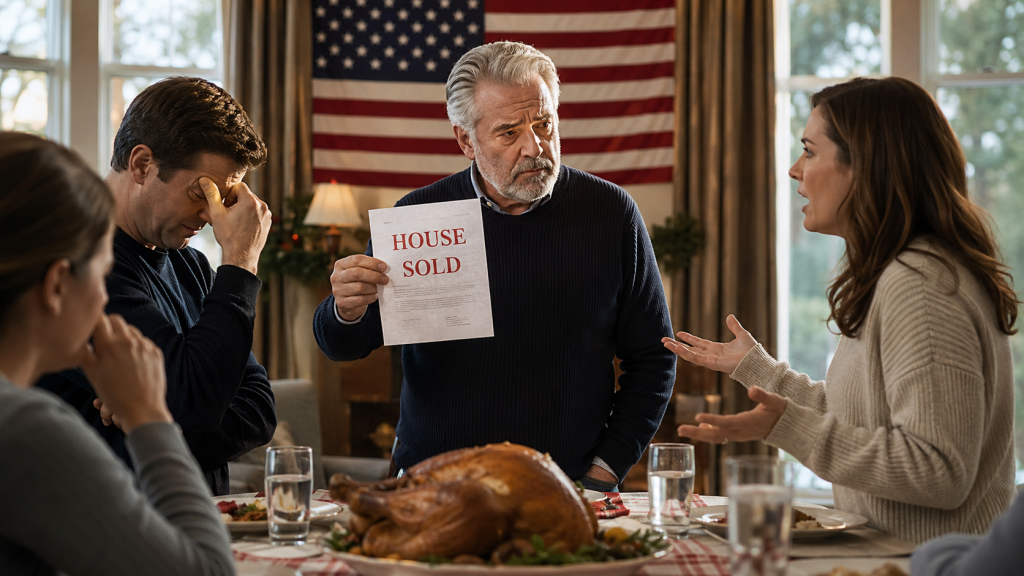
“I sold it.”
For several seconds, there was absolutely no sound.
Then he laughed.
Not because anything was funny.
Because sometimes the mind rejects information before accepting it.
“Very funny.”
“I’m not joking.”
“You sold the house?”
“Yes.”
“When?”
“Two weeks ago.”
“You can’t do that.”
“I already did.”
“But we live here!”
“You have been provided proper notice and a lawful transition period. Stanley has copies of everything.”
“Stanley?”
“My lawyer.”
“You involved a lawyer?”
“I involved a lawyer because I sold a house.”
His voice rose.
“You sold our home without telling us?”
“My home.”
“Stop saying that!”
The anger in his voice surprised me.
Then it saddened me.
“Colin, whose name is on the deed?”
“That isn’t the point.”
“It is exactly the point.”
“You told me this would eventually be mine.”
“I said many years ago that I hoped you would inherit it. That was before you started treating me like an unwanted tenant inside it.”
“That’s ridiculous.”
“Is it?”
“You’re punishing us because Vanessa invited her family for Christmas.”
“No.”
“Then why?”
“Because Christmas was the final example of a problem that has existed for years.”
He said nothing.
So I continued.
“You moved in for six months.”
“We needed help.”
“And I gave it.”
“We were saving.”
“You bought an eighty-thousand-dollar SUV.”
“That’s none of your business.”
“You used the emergency account I funded to make the down payment.”
Another silence.
He had not known I knew.
“How did you—”
“I receive statements.”
“Dad, that money was mine.”
“Yes. It was. And you were free to spend it however you wanted. But don’t tell me you couldn’t afford to move while buying luxury vehicles.”
His breathing became heavier.
“You’ve been keeping score?”
“No. I started keeping records when I realized you were.”
“What does that mean?”
“Every conversation became a calculation of what else you could get from me.”
“That’s not fair.”
“Then tell me the last household bill you paid.”
Nothing.
“Tell me the last property tax payment you made.”
Silence.
“The last grocery bill?”
Nothing.
“The last repair?”
Still nothing.
“Colin, you are thirty-eight years old.”
“Dad—”
“I paid your housing costs. Your utilities. Your insurance shortfalls. Your overdrafts. I gave Vanessa a card for household emergencies, and she used it for clothing, restaurants, beauty appointments, and Christmas decorations.”
“She bought things for the house!”
“She bought a nine-hundred-dollar handbag in October.”
Silence.
Apparently he had not known that either.
“Look,” he said finally. “We can fix this.”
“The house is sold.”
“Cancel it.”
“No.”
“I’ll pay rent.”
“No.”
“We’ll cover utilities.”
“No.”
“We’ll buy the house from you.”
“You can discuss that with the developer after they take possession.”
His voice cracked.
“Dad, where are we supposed to go?”
I closed my eyes.
There was my son.
Not the entitled man.
Not Vanessa’s husband.
My little boy.
The child who used to climb onto my shoulders at county fairs.
The teenager who cried in my garage after his first breakup.
The young man whose mother had kissed his forehead on his wedding morning.
I wanted to rescue him.
Every instinct in me screamed to rescue him.
But that instinct was exactly why he had never learned to rescue himself.
“You have time to arrange somewhere to live,” I said quietly. “Use it.”
Then I added, “I love you.”
He did not answer.
The call ended.
Christmas morning was the first Christmas I had ever spent completely alone.
I expected it to be unbearable.
It wasn’t.
It was sad.
There is a difference.
I made coffee.
I cooked scrambled eggs.
I opened Diane’s recipe box and found her cinnamon-roll recipe.
At the bottom, in her handwriting, she had written:
Frank always adds too much icing. Ignore him.
I laughed.
Then I cried.
Then I added too much icing.
Around eleven, my phone buzzed.
It was a photograph from my daughter, Melissa.
She lived in Colorado with her husband and two daughters.
I had not told her about the house sale because I did not want her involved in the conflict.
The photograph showed my granddaughters standing beside their Christmas tree holding a sign.
WE MISS YOU, GRANDPA.
Then Melissa called.
“Merry Christmas, Dad.”
“Merry Christmas, sweetheart.”
“You sound strange.”
“I’m fine.”
“You’re crying.”
“No.”
“Dad.”
I laughed.
“Maybe a little.”
“Where’s Colin?”
I hesitated.
That was enough.
“What happened?”
So I told her.
Everything.
She remained quiet for nearly ten minutes.
When I finished, she said something I will never forget.
“Dad, I wondered when you were finally going to stop.”
“What?”
“Mom worried about this before she died.”
My chest tightened.
“What are you talking about?”
“She told me you were too afraid of losing Colin to ever tell him no.”
I gripped the phone.
“She said that?”
“Yes.”
“Why didn’t you tell me?”
“Because she made me promise not to interfere.”
I looked at Diane’s photograph.
Melissa continued.
“She said you loved by providing. She worried that after she was gone, people would take advantage of that.”
For a moment, I could not speak.
Then Melissa said, “Come to Colorado.”
“When?”
“Now.”
I smiled.
“I rented this cabin through New Year’s.”
“Then January second.”
“For how long?”
“As long as you want.”
I looked around the small cabin.
“I might take you up on that.”
“You better.”
We talked for another hour.
That evening, Vanessa sent me a message.
Her parents had learned the house had been sold.
Apparently, the news had spread through Christmas dinner.
Several relatives who had assumed Colin and Vanessa owned the property became embarrassed.
Others became angry because Vanessa had described the gathering as “Christmas at our house.”
Her father, Roger, asked why they had invited thirty people into a property they did not own.
For once, Vanessa had no answer.
The next week was even more revealing.
Without my financial support, their lifestyle collapsed remarkably quickly.
Colin discovered I had stopped covering his overdraft protection.
Vanessa discovered her supplemental credit card was permanently canceled.
The household services I had paid for were discontinued.
The cleaning company stopped coming.
The snow-removal service required a new payment method.
Their streaming subscriptions disappeared because several had been charged to my card.
Their cell-phone family plan changed when I removed their lines.
I did not cancel necessities while they remained in the house.
Heat stayed on.
Water stayed on.
Electricity stayed on.
Nobody was endangered.
I simply stopped paying for two healthy adults to live like wealthy teenagers.
On December twenty-seventh, Vanessa’s family left.
According to Colin, the departure was not affectionate.
Her parents were furious.
Not at me.
At her.
Roger called me the following afternoon.
“Frank, I owe you an apology.”
“You don’t owe me anything.”
“Yes, I do.”
He sounded embarrassed.
“Vanessa told us you insisted Christmas be held there.”
I leaned back in my chair.
“She said that?”
“She told us you were lonely after Diane passed and wanted a full house.”
I almost laughed.
“She also said you offered your bedroom.”
That one actually made me laugh.
Roger groaned.
“I thought so.”
We talked for twenty minutes.
Before hanging up, he said, “For what it’s worth, Elaine and I are not expecting you to pay a dime for anything we consumed. Vanessa gave me an estimate. I’m sending you our share.”
“Send it to Vanessa.”
“Why?”
“She bought the groceries.”
There was a pause.
Then Roger laughed.
“Fair enough.”
By New Year’s Day, the house looked almost empty.
Vanessa’s relatives were gone.
My possessions were gone.
The decorations came down.
For the first time in years, Colin and Vanessa were alone with each other and the consequences of their choices.
I returned on January second with Stanley.
I wanted one final walk through the house.
Vanessa was standing in the kitchen when we arrived.
She looked different.
No makeup.
Hair tied back.
Sweatshirt.
Tired eyes.
Colin stood near the sink.
Neither spoke.
Stanley waited in the foyer while I walked through each room.
The living room where Diane and I had danced on our thirtieth anniversary.
The staircase where Melissa had once broken her wrist sliding down the banister.
The kitchen where Colin learned to make pancakes.
Then I went upstairs.
My bedroom was almost empty.
Vanessa’s parents had slept there for six nights.
But the room no longer felt violated.
Because everything that mattered had already been removed.
Diane’s chair.
Her photographs.
Her jewelry box.
Her books.
Her perfume bottle.
The quilt her mother had made.
Those things were safe.
Memories were safe.
A house was wood, brick, nails, glass, and plaster.
Home was something else.
When I returned downstairs, Colin was waiting.
“Can we talk?”
I nodded.
We went into the study.
He closed the door.
“I’m angry with you.”
“I know.”
“But I’m also angry with myself.”
I waited.
He sat in the chair opposite me.
“I called Melissa.”
That surprised me.
“She told me some things.”
“About your mother?”
He nodded.
His eyes filled.
“Mom knew.”
“She knew what?”
“That I depended on you too much.”
I said nothing.
“She apparently told Melissa that I always took the easiest road whenever you offered one.”
“That sounds like your mother.”
He smiled weakly.
Then he looked down.
“I blamed Vanessa.”
“For what?”
“Everything.”
He rubbed his hands together.
“I told myself she was the one spending money. She was the one making demands. She was the reason we stayed here.”
He looked at me.
“But I let it happen.”
“Yes.”
“I liked not paying rent.”
“Yes.”
“I liked knowing you’d fix things.”
“Yes.”
“I liked having money for cars and vacations.”
“Yes.”
He swallowed.
“And when Vanessa told you to give up Mom’s bedroom, I knew it was wrong.”
That one hurt.
“I know.”
“I should have stopped her.”
“Yes.”
“I’m sorry.”
I studied my son.
Not because I doubted his words.
Because I needed to decide whether I believed the man saying them.
“I accept your apology.”
His shoulders dropped.
“But accepting an apology doesn’t reverse consequences.”
“I know.”
“We’re still moving.”
“Yes.”
“I’m not giving you money for another house.”
“I know.”
“You’ll need to budget.”
“I know.”
“And the emergency fund is gone.”
“I know.”
For the first time, he almost smiled.
“Anything else?”
“Yes.”
“What?”
“Stop saying ‘I know’ and actually do something.”
He laughed.
So did I.
Then he cried.
I stood and hugged him.
It was the first honest moment we had shared in years.
Vanessa was harder.
She did not apologize that day.
Or the next week.
She blamed me for humiliating her.
She blamed Colin for failing to warn her.
She blamed her parents for “taking my side.”
She blamed the housing market.
She blamed Christmas.
Eventually, however, blame becomes exhausting when nobody agrees to carry it for you.
Colin and Vanessa rented a two-bedroom townhouse twenty minutes away.
It was not glamorous.
There was no soaking tub.
No double lot.
No free utilities.
No cleaning service.
For the first time in their marriage, they created a household budget.
Three months later, Vanessa called me.
I nearly ignored it.
Then I answered.
“Hello?”
“Frank?”
“Yes.”
“I need to say something.”
“All right.”
She took a breath.
“I was awful.”
I said nothing.
“I treated your home like mine.”
“Yes.”
“I treated your money like ours.”
“Yes.”
“And I treated you like…”
She stopped.
“Like what?”
“Staff.”
That was the word.
I had never used it.
But it was exactly right.
“I’m sorry.”
“Thank you.”
“I mean it.”
“I believe you.”
Then she said, “I started working again.”
Vanessa had left her marketing job two years earlier, claiming she needed a break.
“What are you doing?”
“Marketing coordinator for a medical supply company.”
“That sounds good.”
“It is. I forgot that I actually like working.”
We talked for several minutes.
Nothing was magically repaired.
Trust does not return because somebody gives one good apology.
But it was a beginning.
The developer demolished my old house that spring.
I drove past once.
Only once.
The oak tree remained.
Everything else was gone.
I expected devastation.
Instead, I felt strangely peaceful.
Diane was not buried beneath the foundation.
She was not trapped inside the walls.
She was with me in Colorado when Melissa’s daughters helped me plant tomatoes.
She was in the cinnamon rolls.
She was in the cardinal ornament hanging near my new kitchen window.
She was in every ridiculous note inside her recipe books.
The sale left me with more money than I needed.
I bought a comfortable two-bedroom condominium fifteen minutes from Melissa.
Not huge.
Not impressive.
Mine.
I traveled.
I visited Maine.
Arizona.
California.
I finally took the train through the Canadian Rockies that Diane and I had always postponed.
And something unexpected happened to Colin.
He changed.
Slowly.
He sold the SUV.
Bought a used Honda.
Started contributing more to his retirement account.
He and Vanessa paid off two credit cards.
Then three.
The following Christmas, they invited me to their townhouse.
“Just us,” Colin said.
“How many is ‘us’?”
He laughed.
“Six.”
“Are you sure Vanessa doesn’t have twenty-four cousins hiding somewhere?”
“Dad.”
“I’m asking for planning purposes.”
When I arrived, Vanessa was cooking.
Actually cooking.
She wore an apron dusted with flour.
Colin was washing dishes.
My grandchildren from Colorado were visiting too, and Melissa had brought Diane’s recipe box.
Dinner was simple.
Turkey.
Mashed potatoes.
Green beans.
Homemade rolls.
No photographer.
No imported cheese.
No matching pajamas.
No five-thousand-dollar grocery list.
After dinner, Vanessa carried out a small wrapped box.
“This is for you.”
Inside was a framed photograph.
It had been taken years earlier.
Diane and me standing in front of the old house during a Christmas snowfall.
I had my arm around her.
She was laughing at something outside the frame.
I stared at it for a long time.
“I found it on Colin’s computer,” Vanessa said.
“It’s beautiful.”
“I thought you should have it.”
I looked at her.
“Thank you.”
She nodded.
Then she added quietly, “And thank you for what you did last Christmas.”
Colin nearly dropped his fork.
“Did you just thank Dad for selling the house?”
Vanessa rolled her eyes.
“Not for selling the house.”
“For cutting us off?”
“Stop helping.”
I laughed.
She smiled.
“I hated you for months,” she admitted.
“I noticed.”
“But we needed it.”
Colin raised his glass.
“I definitely could have learned the lesson without losing the house.”
“No,” Vanessa said.
“You couldn’t.”
Everyone laughed.
Even Colin.
Later, after dinner, I stood near the window holding the photograph of Diane.
Snow was falling again.
Colin came beside me.
“Do you miss the house?”
“Sometimes.”
“Do you regret selling it?”
I considered the question.
“No.”
“Really?”
“Really.”
He nodded.
“I thought you were trying to punish me.”
“I know.”
“What were you trying to do?”
I looked at him.
“Stop protecting you from adulthood.”
He absorbed that.
Then he smiled.
“Worked.”
“Eventually.”
Across the room, Vanessa was teaching Melissa’s youngest daughter how to make hot chocolate.
Nothing about the evening was perfect.
That was what made it beautiful.
Nobody was pretending.
Nobody was performing.
Nobody was keeping an invisible ledger of who owed whom.
I had spent years believing family meant giving until there was nothing left to give.
Diane understood something I had forgotten.
Love is generous.
But generosity without boundaries eventually stops being generosity.
It becomes permission.
Permission to avoid responsibility.
Permission to become entitled.
Permission to mistake kindness for weakness.
The previous Christmas, Vanessa had believed she controlled my house because I had spent three years behaving as though she did.
Colin believed my money would always rescue him because I had spent his entire life proving that it would.
They had made mistakes.
So had I.
My mistake simply looked kinder from the outside.
Before leaving that night, Colin walked me to my car.
“Dad?”
“Yes?”
“I’ve been meaning to ask you something.”
“What?”
“What happened to Mom’s reading chair?”
I smiled.
“It’s in my condo.”
“Good.”
“She’d haunt me if I sold that.”
He laughed.
Then his expression softened.
“She would be proud of you.”
I shook my head.
“She would have handled all of this ten years earlier.”
“Probably.”
“She had more backbone than both of us.”
“Definitely.”
We stood in the snow for a moment.
Then Colin hugged me.
“Love you, Dad.”
“I love you too.”
I drove home slowly.
My condominium was quiet when I entered.
I placed Diane’s photograph beside her reading chair.
Then I noticed the cardinal ornament hanging near the window.
I poured myself a small glass of bourbon and sat down.
Outside, Christmas lights glowed across the neighboring balconies.
For the first time in years, silence did not feel lonely.
It felt peaceful.
I thought about that Tuesday dinner when Vanessa had announced that thirty relatives were coming for Christmas.
At the time, I believed the problem was thirty guests.
It wasn’t.
The problem was three years of saying yes when I wanted to say no.
Three years of paying bills I should have stopped paying.
Three years of allowing my son to confuse dependence with security.
Three years of letting someone else behave like the owner while I slowly became a guest inside my own life.
Selling the house did not solve everything.
It did something more important.
It changed the rules.
The next morning, I received a text from Colin.
A photograph.
He was standing beside Vanessa in their little kitchen.
Behind them was a handwritten household budget attached to the refrigerator with magnets.
Under the photograph, he had written:
LOOK, DAD. WE’RE ADULTS NOW.
I laughed so hard I spilled my coffee.
I replied:
DON’T GET CARRIED AWAY.
Three dots appeared.
Then:
MERRY CHRISTMAS, DAD.
I looked toward Diane’s chair.
“Merry Christmas,” I whispered.
And I finally understood something.
Sometimes the greatest gift you can give the people you love is not another rescue.
Sometimes it is the dignity of allowing them to discover that they can survive without one.
I had spent years holding my son up.
The moment I finally let go, I was terrified he would fall.
He did.
A little.
Then he stood.
And so did I.
THE END. THANK YOU FOR READING.