 Reading Time: 14 minutes
My grandpa has loved football for as long as anyone in our family can remember. Every Saturday, he’d sit in the same worn brown recliner in his living room, wearing the same faded blue-and-white team scarf around his neck.
It didn’t matter if it was ninety degrees outside. The scarf stayed on. According to Grandpa, his team played better when he followed the routine.
Same chair.
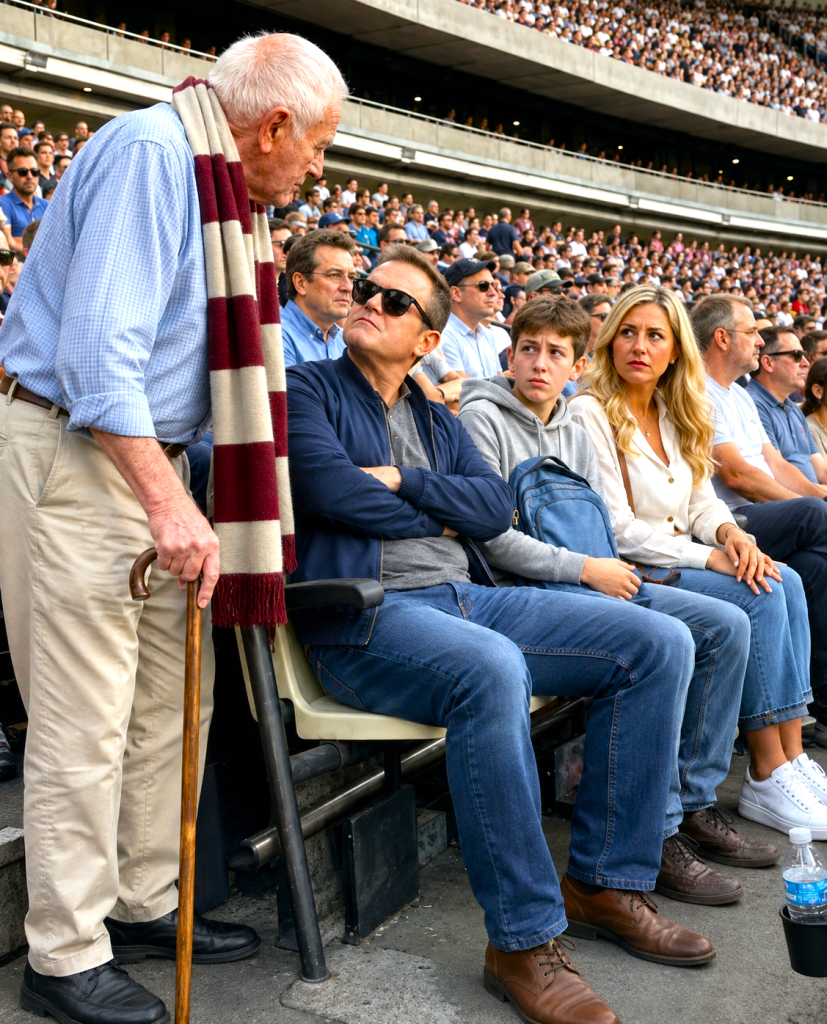
Same scarf.
Same chipped coffee mug.
Same bowl of salted peanuts sitting on the table beside him.
And absolutely nobody was allowed to telephone during the match unless the house was on fire.
When I was little, I believed Grandpa somehow controlled the players through the television.
“Come on, boys,” he’d mutter, leaning forward in his chair. “Keep fighting. Match isn’t over until the final whistle.”
That became his saying.
Every birthday card he ever gave me ended with the same sentence.
Never stop believing until the final whistle.
When I graduated from high school, he wrote it.
When I finished college, he wrote it.
When my first serious relationship ended and I spent two months believing my life was over, Grandpa mailed me a card even though he lived only twenty minutes away.
Inside were seven words.
Never stop believing until the final whistle.
Grandpa’s name is Walter Bennett.
This spring, Walter Bennett turned ninety-two years old.
And for the first time in my life, I had to admit that my grandfather wasn’t going to be around forever.
His mind was still sharp.
Sharper than mine some mornings.
But his body was slowing down.
His knees hurt constantly.
His hearing wasn’t what it used to be.
And his heart had become the biggest concern.
Walking from his bedroom to the kitchen was fine.
Walking through the grocery store required breaks.
Climbing a flight of stairs could leave him breathless for several minutes.
During one of his appointments, his doctor asked me to stay behind after Grandpa went to the restroom.
“He’s doing remarkably well for ninety-two,” she told me quietly. “But if there’s anything important he wants to do that requires traveling, I wouldn’t postpone it.”
I understood immediately.
“How much time?”
She shook her head.
“I’m not saying he’s dying tomorrow. I’m saying there may come a point fairly soon when long trips and crowded events aren’t realistic anymore.”
That conversation stayed with me.
A month later, I saw the announcement.
Grandpa’s team had reached the biggest match they had played in decades.
The kind of match supporters talked about their entire lives.
Tickets were going on sale Friday morning.
I called Grandpa.
He answered after six rings.
“Everything okay?”
“Grandpa, did you see who made the final?”
Silence.
Then he laughed.
“I’ve been supporting them since before your mother was born. Of course I saw.”
“Want to go?”
Another silence.
This one lasted longer.
“Oh, sweetheart. Don’t tease an old man.”
“I’m serious.”
“Those tickets will cost a fortune.”
“I didn’t ask how much they cost. I asked if you want to go.”
His voice softened.
“I’ve wanted to see a match like that in person since I was sixteen.”
“Then we’re going.”
He tried to argue.
I refused to listen.
When the tickets went on sale, I sat at my laptop with three devices open, refreshing the page like my life depended on it.
The prices were painful.
Really painful.
I had been saving money for almost two years.
Some of it was supposed to replace my aging car.
Some was emergency money.
But when two excellent accessible seats appeared near the front of a premium section, I stared at the total for maybe ten seconds.
Then I entered my card information.
Purchase confirmed.
My savings account suddenly looked very lonely.
I didn’t care.
I drove directly to Grandpa’s house.
He was watering the tomato plants beside his porch.
I held up my phone.
“Start packing.”
He frowned.
“What did you do?”
I showed him the confirmation.
For a few seconds, Grandpa didn’t move.
Then his mouth opened slightly.
“You bought them?”
“Two seats.”
“How much?”
“Not important.”
“How much?”
“Walter Bennett, sometimes a gentleman should mind his own business.”
He stared at me.
Then he started crying.
I had seen my grandfather cry only twice before.
At Grandma’s funeral.
And when my mother, his only daughter, died.
This was different.
He laughed while wiping his eyes.
“You foolish kid.”
“Probably.”
“You shouldn’t spend your money on me.”
“This is your dream.”
He pulled me into his arms.
His body felt smaller than I remembered.
“Thank you,” he whispered.
For the next three months, Grandpa counted down the days like a child waiting for Christmas.
Eighty-four days.
Sixty-one.
Forty-three.
Twenty.
Seven.
He called me the night before.
“You still have the tickets?”
“Yes.”
“Check again.”
“I checked.”
“And identification?”
“Yes.”
“Hotel confirmation?”
“Yes.”
“Scarf?”
“You’re wearing the scarf, Grandpa.”
“Good. I don’t trust you with important things.”
The morning of the match, I found him awake before sunrise.
He had carefully shaved.
His silver hair was combed neatly to one side.
He wore pressed gray trousers, polished brown shoes, a pale blue shirt, and that ancient scarf.
The fabric was faded.
One corner had been repaired with mismatched thread.
Grandma had repaired it.
I knew because Grandpa had told me the story approximately eight hundred times.
Before we left, he opened his wallet and tucked a small photograph inside.
I recognized it immediately.
Grandma.
She was maybe twenty-five in the picture, standing beside Grandpa in front of an old car.
“You bringing Grandma?”
“Of course.”
He studied the photograph.
“This was supposed to be something we did together.”
“What was?”
“A match like this.”
He smiled sadly.
“We kept saying someday. But there was always a mortgage, school clothes, broken washing machines, somebody needing something.”
He slipped the photograph into his wallet.
“She would’ve loved every minute.”
“We’ll bring her with us.”
He squeezed my hand.
The journey took several hours.
Grandpa complained about my driving approximately every fifteen minutes.
Apparently I accelerated too quickly, braked too late, followed other cars too closely and didn’t understand how turn signals worked.
“You haven’t driven in eight years,” I reminded him.
“Doesn’t mean I’ve forgotten how.”
By the time we reached the stadium, the streets were packed.
Supporters were singing.
Flags waved above the crowd.
Vendors shouted.
Children sat on their parents’ shoulders.
Grandpa stopped walking.
His eyes widened.
“Would you look at that?”
I looked at him instead.
For a moment, he wasn’t ninety-two.
He was sixteen.
I could see it.
We moved slowly through the crowd because Grandpa needed his cane and several breaks.
A stadium employee noticed us and directed us toward an elevator.
When we finally entered the seating area, Grandpa gripped the railing.
The enormous field stretched beneath us.
Tens of thousands of supporters filled the stadium.
Music thundered through the speakers.
Grandpa’s hands began trembling.
“Grandpa?”
“I’m fine.”
He wasn’t upset.
He was overwhelmed.
He slowly sat down in the seat I’d bought for him.
He ran one hand across the armrest.
“Good seat.”
“Good enough?”
“Best seat I’ve ever had.”
He looked around.
Then he wiped his eyes.
“Your grandmother would’ve complained about the noise.”
I laughed.
“She hated football.”
“No. She hated admitting she liked football.”
For twenty wonderful minutes, everything was perfect.
Then the man arrived.
He looked to be in his late forties.
Expensive jacket.
Designer watch.
Perfectly styled hair.
Behind him walked his wife and a teenage boy carrying a faded blue backpack.
The man stopped beside our row.
He checked his ticket.
Then he looked at our seats.
“I’ll take these.”
I thought I’d misheard him.
“Excuse me?”
“These seats.”
“They’re ours.”
He glanced toward the seats several rows farther back.
Apparently his tickets were in the same section but with a worse view.
“Ours are back there,” he said. “These are better.”
“Yes. That’s why I bought them.”
He smiled.
Not pleasantly.
“Come on. Help me out.”
“No.”
His expression changed.
“Seriously?”
“Seriously.”
His wife looked embarrassed.
The boy stared at the floor.
The man lowered his voice.
“My son has been looking forward to this all year.”
“So has my grandfather.”
He looked at Grandpa.
Actually looked at him.
Then shrugged.
“Come on. The old man won’t even remember the match tomorrow.”
Everything inside me went still.
“What did you say?”
His wife whispered sharply, “Richard.”
But Richard continued.
“He’s ninety-something, right? We’re talking about a kid versus someone who probably won’t remember the score next week.”
I stood.
“You need to leave.”
Grandpa touched my arm.
“It’s all right.”
“No, Grandpa.”
“Please.”
His voice was quiet.
“Let’s not ruin today.”
I looked at him.
His excitement was gone.
Not completely.
But something had changed.
Grandpa had spent ninety-two years learning which battles were worth fighting.
He didn’t want shouting.
He didn’t want security.
He didn’t want his dream day becoming a confrontation.
“Grandpa, these are your seats.”
“I know.”
He smiled gently.
“A seat doesn’t make the match.”
Richard stepped aside as Grandpa slowly stood.
I will remember that moment for the rest of my life.
My grandfather picked up his cane.
Adjusted the scarf Grandma had repaired decades earlier.
And slowly shuffled away from the seat he had dreamed about for seventy-six years.
Richard immediately sat down.
I wanted to scream.
Instead, I followed Grandpa.
We had barely reached the end of the row when someone behind us called out.
“Sir!”
Grandpa turned.
It was Richard’s son.
The teenager had stood up.
He looked maybe sixteen.
His cheeks were red with embarrassment.
His father frowned.
“Ethan, sit down.”
The boy ignored him.
He unzipped his faded blue backpack.
Reached inside.
And removed something.
Then he walked toward Grandpa.
People nearby had started watching.
“Ethan,” Richard said again. “What are you doing?”
The boy stopped in front of my grandfather.
His hands were shaking.
“Sir… my dad doesn’t deserve this anymore.”
He held something out.
“I think you do.”
Grandpa looked down.
His mouth fell open.
It was a football jersey.
Not a normal jersey.
This one was framed inside a clear protective display sleeve.
Across the front were signatures.
Dozens of them.
I recognized several immediately.
Current players.
Former legends.
Even the team manager.
Grandpa stared.
“What is this?”
Ethan swallowed.
“My dad works with one of the team’s sponsors. They gave him this signed jersey at a corporate event yesterday.”
Richard’s face went white.
“Ethan.”
The boy kept talking.
“He told me I could have it after the match.”
Grandpa shook his head.
“No, son. I can’t take that.”
“Yes, you can.”
“Ethan!” Richard snapped.
Everyone nearby went silent.
His wife closed her eyes.
The teenager turned toward his father.
“You said he wouldn’t remember today.”
Richard’s jaw tightened.
“I said sit down.”
“No.”
It was a small word.
But something about the way Ethan said it changed the entire atmosphere.
“You always tell me football is about respect,” Ethan continued. “You tell me I should respect the players, respect the history, respect the supporters.”
“That’s enough.”
“But you didn’t respect him.”
Someone a few seats away started clapping.
Then another person.
Richard looked around.
“Seriously?”
Ethan turned back to Grandpa.
“My dad told me this jersey was valuable because of all the people who signed it.”
He pushed it gently toward him.
“But I think it should belong to someone who actually understands what those signatures mean.”
Grandpa’s eyes filled with tears.
Still, he refused.
“Keep it, young man.”
“Please.”
“No.”
Grandpa placed his hand on Ethan’s shoulder.
“You standing up just now means more than any jersey.”
Ethan looked down.
Then something unexpected happened.
A stadium employee approached.
He had apparently witnessed the argument.
“Is there a problem here?”
Richard immediately stood.
“No problem. Just sorting out seats.”
The employee checked our tickets.
Then checked Richard’s.
His expression hardened.
“These seats belong to this gentleman and his companion.”
Richard sighed.
“They agreed to switch.”
“No,” I said. “My grandfather agreed because he didn’t want an argument.”
The employee looked at Grandpa.
“Sir, would you like your original seats?”
Grandpa hesitated.
Before he could answer, Ethan spoke.
“Yes.”
Richard stared at his son.
The employee gestured.
“Then I’m going to ask you to return to your assigned seats.”
Richard muttered something under his breath.
Unfortunately for him, the employee heard it.
“Sir, we can resolve this very simply, or I can ask security to assist.”
That was enough.
Richard stood.
His wife immediately followed.
But Ethan stayed beside Grandpa.
“Come on,” Richard snapped.
Ethan didn’t move.
“I’m watching from my actual seat.”
“You’re coming with me.”
“No. My ticket says I’m sitting there.”
He pointed to the seat beside Grandpa.
We all looked at the tickets.
Richard had apparently purchased three seats, but only two were together farther back.
Ethan’s ticket was actually beside ours.
Richard had intended to take our two seats so the entire family could sit together.
His selfishness suddenly made perfect sense.
The stadium employee shook his head.
“Sir, you need to go to your assigned location.”
Richard’s wife finally spoke.
“Richard, enough.”
He looked at her.
She wasn’t embarrassed anymore.
She was angry.
“You humiliated that man, embarrassed our son, and now half the section knows exactly what kind of person you are.”
Richard’s face turned bright red.
“Not here.”
“You chose here.”
She looked at Grandpa.
“Sir, I am deeply sorry.”
Grandpa nodded.
“Thank you.”
Then she looked at Ethan.
“Stay.”
Richard stared at her.
“What?”
“I’m going to our seats. You can decide whether you want to join me or spend the match arguing with security.”
People started clapping again.
Richard had nowhere left to go.
He turned and disappeared up the steps.
Grandpa returned to his seat.
Ethan sat beside him.
And the match began.
I thought that would be the end of the story.
I was wrong.
Twenty minutes into the first half, Ethan and Grandpa were talking like they’d known each other for years.
Grandpa told him about listening to matches on the radio as a boy.
Ethan showed Grandpa statistics on his phone.
Grandpa complained that young people relied too much on statistics.
“Football isn’t mathematics,” Grandpa said.
“Actually, modern analytics—”
“No.”
“But expected goals—”
“Made-up nonsense.”
Ethan laughed.
I hadn’t seen Grandpa enjoying himself that much in years.
At halftime, Ethan finally convinced him to hold the signed jersey.
Grandpa carefully examined every signature.
Then he suddenly froze.
“Wait.”
His finger rested on one name.
“Thomas Reed.”
Ethan nodded.
“He played here in the seventies.”
“I know who he is.”
Grandpa’s voice sounded strange.
“He was your grandmother’s favorite player.”
He reached into his wallet.
Pulled out Grandma’s photograph.
Then showed Ethan.
“She’d tease me about him. Said she’d leave me if Thomas Reed ever came knocking.”
Ethan laughed.
“Did he?”
“Fortunately for Thomas Reed, no.”
The teenager smiled.
Then he became serious.
“You really should keep the jersey.”
Grandpa stared at it.
“No.”
“Why?”
“Because your father gave it to you.”
“He doesn’t deserve to decide what it means.”
Grandpa studied the boy for a long moment.
Then he said something I’ll never forget.
“Your father made a bad choice today. Maybe he makes bad choices often. I don’t know. But don’t spend your life measuring your character against his worst moments.”
Ethan went quiet.
“Be better because being better is right. Not because you’re trying to punish him.”
The teenager nodded slowly.
Then Grandpa handed the jersey back.
“Keep it. And every time you look at it, remember today.”
Ethan smiled.
“I will.”
The second half began.
The match was unbelievable.
Our team went behind with twenty minutes remaining.
Grandpa’s shoulders sank.
But then he leaned toward Ethan.
“Never stop believing until the final whistle.”
With nine minutes left, we equalized.
The stadium exploded.
Grandpa jumped halfway out of his seat before remembering that his knees were ninety-two years old.
I grabbed him.
“Careful!”
“I’m fine!”
Three minutes into stoppage time, our team scored again.
I have never heard noise like that.
People screamed.
Strangers hugged each other.
Ethan threw both arms into the air.
Grandpa grabbed my hand.
Tears streamed down his face.
“They did it.”
He looked toward the sky.
“Margaret, they did it.”
The final whistle blew.
Grandpa stood with my help.
He pressed Grandma’s photograph against his chest.
Then he whispered the sentence he’d been telling me my entire life.
“Never stop believing until the final whistle.”
But the story still wasn’t over.
As we were preparing to leave, the stadium employee returned.
This time, another man accompanied him.
He wore an official team jacket.
“Mr. Bennett?”
Grandpa looked confused.
“Yes?”
“We heard you’ve been supporting the club for quite a while.”
Grandpa smiled.
“Seventy-six years.”
The man’s eyebrows rose.
“Seventy-six?”
“Started at sixteen.”
The man smiled.
“Well, one of our staff heard about what happened earlier. And someone mentioned that today was your first major final in person.”
Grandpa nodded.
The man handed him a pass.
“Would you come with me?”
“Where?”
“Pitch side.”
Grandpa stared.
“What?”
“We’d like to introduce you to a few people.”
I thought Grandpa might faint.
We followed the staff member through a corridor beneath the stands.
Ethan came too.
His mother joined us near the entrance.
Richard was nowhere to be seen.
Then we walked toward the edge of the field.
Players were still celebrating.
Grandpa stopped.
His entire body trembled.
One of the veteran players approached.
He shook Grandpa’s hand.
“Seventy-six years supporting us?”
Grandpa laughed.
“Through some terrible seasons.”
The player laughed.
“Especially those.”
Then another player came over.
And another.
Someone handed Grandpa a team shirt.
Players signed it one by one.
But the moment that destroyed me came last.
The team captain removed the medal hanging around his neck.
He didn’t give it to Grandpa.
Instead, he gently placed it around Grandpa’s neck for a photograph.
Grandpa looked down at the medal.
Then at the field.
Then at me.
“I wish your grandmother could see this.”
I couldn’t speak.
Ethan’s mother quietly said, “I think she can.”
Grandpa smiled.
A photographer captured that exact moment.
Grandpa wearing his fifty-year-old scarf.
The captain’s medal around his neck.
Grandma’s photograph in his hand.
Ethan standing beside him.
Three generations connected by one afternoon.
Before leaving, Grandpa asked for one strange favor.
He wanted Ethan in the official photograph.
The photographer looked confused.
“Family?”
Grandpa smiled.
“Today he is.”
Ethan cried.
So did his mother.
Even the stadium employee wiped his eyes.
The photograph was posted by the club that evening.
Within two days, thousands of people had shared it.
Someone in our section had recorded Ethan confronting his father.
That video spread too.
But Grandpa refused every interview request that tried to make Richard the center of the story.
“People make mistakes,” he told me. “Don’t turn one man’s worst five minutes into my best day.”
That was Grandpa.
Even after being insulted, he wouldn’t build his happiness from someone else’s humiliation.
Three days later, something arrived at Grandpa’s house.
A package.
Inside was the signed jersey Ethan had tried to give him.
There was also a letter.
Grandpa asked me to read it aloud.
It said:
Mr. Bennett,
You told me not to measure myself against my father’s worst moments.
I’ve thought about that every day.
My dad apologized to me after the match.
At first, I didn’t believe him.
Then he asked if he could come with me to deliver this jersey personally.
I told him no.
I said an apology isn’t something you perform for an audience.
It’s something you prove afterward.
So I’m sending this myself.
I still want you to have it.
Not because my dad doesn’t deserve it.
Because you taught me what being a real supporter—and a decent man—looks like.
Please keep believing until the final whistle.
Ethan.
Grandpa sat silently for a long time.
Then he wiped his eyes.
“Smart boy.”
We framed the jersey.
It hangs above Grandpa’s worn recliner now.
Beside it is the photograph from the field.
Grandpa.
Ethan.
The captain.
And Grandma’s tiny photograph visible in Grandpa’s hand.
Something else changed after that day.
Every Saturday, Ethan started calling Grandpa.
At first, they talked only about football.
Then school.
College.
Family.
Life.
Richard eventually apologized too.
Not publicly.
Not dramatically.
He wrote Grandpa a private letter.
Grandpa never showed me what it said.
He only told me, “The man understood.”
“Did you forgive him?”
Grandpa looked surprised by the question.
“Of course.”
“That easily?”
“No.”
He smiled.
“Forgiveness and pretending something didn’t happen aren’t the same thing.”
A few months later, Grandpa’s health declined.
Travel became impossible.
His doctor had been right.
The big match really was his last chance.
One Saturday afternoon, I sat beside him during another match.
The signed jersey hung above us.
His scarf rested around his shoulders.
The same chipped mug sat nearby.
Grandpa seemed tired.
But when our team fell behind, he still leaned forward.
“Plenty of time.”
“There are two minutes left.”
He looked at me.
“You should know better.”
I smiled.
“Never stop believing?”
“Until?”
“The final whistle.”
He nodded.
“That’s my girl.”
Our team didn’t win that afternoon.
But it didn’t matter.
Because eventually I understood Grandpa had never really been talking about football.
He was talking about life.
About losing the woman you loved and waking up the next morning anyway.
About burying your daughter and still finding enough love left to help raise your granddaughter.
About growing old while the world becomes unfamiliar.
About needing a cane.
About accepting help.
About watching friends disappear one by one.
About knowing there are fewer days ahead than behind you and still getting dressed in the morning.
Still laughing.
Still caring.
Still believing.
Grandpa taught me that dignity isn’t something another person can steal simply by taking your seat.
Richard thought age had made my grandfather irrelevant.
He looked at a ninety-two-year-old man and saw someone whose memories no longer mattered.
But Ethan looked at him and saw seventy-six years of loyalty.
The stadium staff saw a lifelong supporter.
The players saw someone who had stood behind their club long before they were born.
And I saw what I had always seen.
My grandfather.
The man who taught me that kindness isn’t weakness.
That walking away from an argument can require more strength than winning one.
That forgiveness doesn’t erase accountability.
And that sometimes karma isn’t watching someone get destroyed.
Sometimes karma is simply watching the person they tried to diminish receive everything they deserved.
Richard wanted better seats.
He ended up watching his own son give them back.
Grandpa surrendered his dream seats rather than create a scene.
He ended the day standing beside the field, wearing the captain’s medal and holding the photograph of the woman he’d loved for more than sixty years.
And the teenage boy who stood up for him gained something far more valuable than a signed jersey.
He gained a friend.
Grandpa still keeps that original match ticket inside his wallet.
Right behind Grandma’s photograph.
Sometimes he takes both out and looks at them.
“Best match you ever saw?” I asked him recently.
He thought about it.
“Best day.”
“Because they won?”
He shook his head.
“Because I got to see what people are made of.”
Then he smiled.
“Pressure does that.”
I looked at the signed jersey hanging above his chair.
“And Ethan?”
“Good heart.”
“And Richard?”
Grandpa chuckled.
“Work in progress.”
Then he turned toward the television.
The match was beginning.
He adjusted his faded scarf.
Picked up his chipped mug.
Settled into the same worn recliner.
And for just a moment, he looked exactly like the grandfather I remembered from childhood.
Strong.
Stubborn.
Hopeful.
Ready to believe all over again.
I don’t know how many more Saturdays I’ll get with him.
Maybe a hundred.
Maybe ten.
Maybe fewer.
I’ve stopped trying to count.
Instead, I sit beside him.
I listen to the stories I’ve already heard a thousand times.
I let him complain about modern players.
I refill the peanuts.
I make sure nobody interrupts during important moments.
And whenever the clock starts running out and things look hopeless, Grandpa leans forward and says the words I’ve heard my entire life.
“Still time.”
And I always answer him now.
“Until the final whistle.”
Because one day, his chair will be empty.
The scarf will belong to me.
That chipped mug will probably sit untouched on a shelf.
And Saturdays will never sound quite the same.
But whenever life knocks me down, whenever someone tells me something is finished, whenever hope feels foolish, I know exactly what I’ll hear in my head.
My grandfather’s voice.
Calm.
Certain.
Still believing.
Never stop believing until the final whistle.
THE END. THANK YOU FOR READING.