 Reading Time: 15 minutes
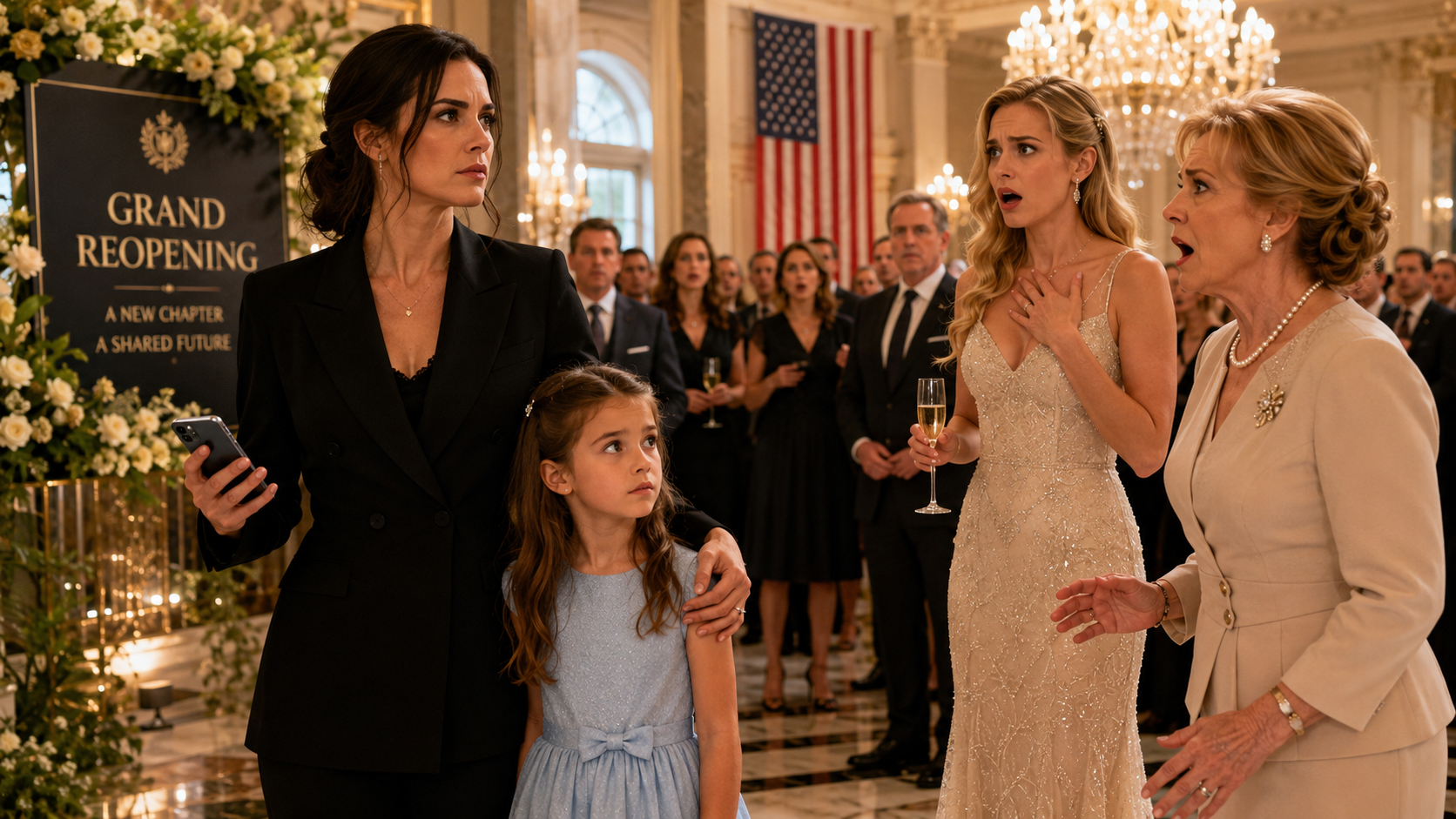
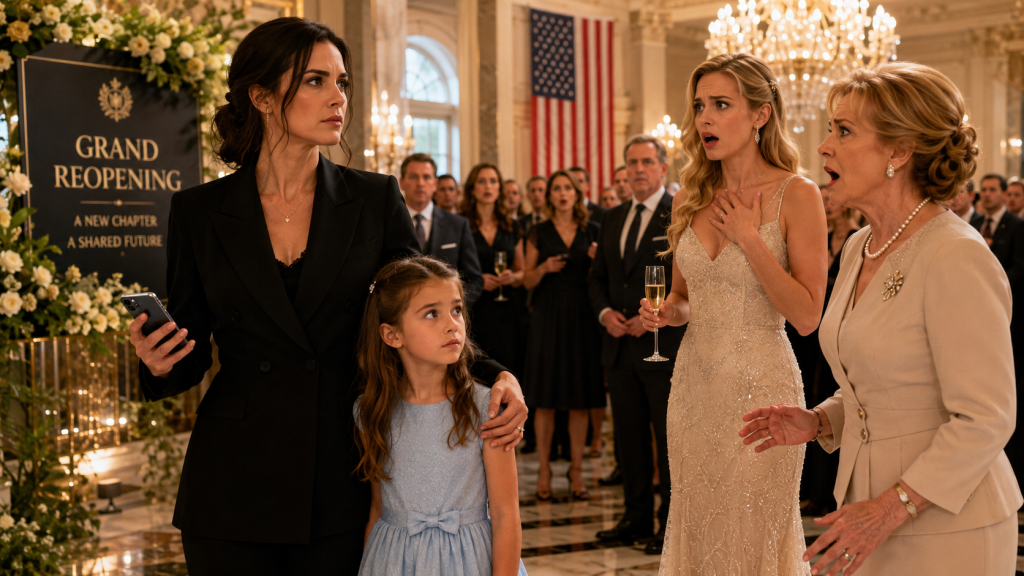
I Never Told My Parents I Was the One Who Repurchased Our Family Home—My Sister Took the Credit Until She Kicked My Eight-Year-Old Daughter in Front of Two Hundred Guests The “Grand Reopening” party for Vance Mansion was in full, ostentatious swing.
Crystal chandeliers flooded the ballroom with warm golden light. A string quartet played near the marble staircase. Waiters in white jackets moved between two hundred guests carrying champagne and silver trays of food.
Above the entrance hung an enormous gold banner. SARAH SAVED OUR HOME. My younger sister stood beneath it in a fitted ivory dress, accepting praise for something she had never done.
“You must be so proud,” Aunt Rebecca told her.
Sarah placed one hand over her heart.
“I simply couldn’t allow our family legacy to disappear.”
Our cousin raised his glass.
“To Sarah—the savior of the Vance family.”
Everyone applauded.
I stood near the back of the ballroom holding a tray of hors d’oeuvres.
No one asked why I was serving food at my own family’s celebration.
They saw what they had always expected to see.
Elena, the disappointing older daughter.
Elena, the divorced mother.
Elena, the woman who had supposedly left town because she could not handle responsibility.
I let them believe it.
For six months, I had remained silent while Sarah accepted credit for repurchasing the mansion after our parents lost it to foreclosure.
She told relatives that she had negotiated with the bank.
She claimed her “business connections” had saved the property days before an auction.
She posted photographs online beside the restored gates, writing captions about sacrifice and family loyalty.
My parents praised her at every opportunity.
I said nothing because I had never purchased the house for applause.
I bought it because it was the last place where I remembered feeling safe.
Vance Mansion had belonged to my grandparents before my father inherited it.
Despite its name, it was not a palace.
It was a large Georgian house outside Richmond, Virginia, surrounded by old oak trees, gardens, and twelve acres of land.
When I was a child, my grandmother taught me to bake in the kitchen.
My grandfather let me read inside his study while summer rain struck the windows.
After they died, the house changed.
My father made reckless investments.
My mother treated social events as necessities rather than luxuries.
Sarah spent freely and called it building her brand.
By the time the bank began foreclosure proceedings, the family had borrowed against nearly everything.
They blamed the economy.
They blamed accountants.
They blamed me for refusing to contribute more money.
No one blamed themselves.
I was thirty-six by then and living in Charlotte with my daughter, Mia.
After my divorce, I had built a small property-rehabilitation company from the ground up.
I purchased neglected homes, restored them, and rented them to families at reasonable rates.
My relatives dismissed it as construction work.
They did not know the company had become highly profitable.
They did not know I had been saving for years.
Most importantly, they did not know that when Vance Mansion appeared on a distressed-property list, my company purchased the debt through a private trust.
The transaction was legal, quiet, and complete.
I became the sole owner.
My parents learned only that a private investor had stopped the auction and offered them a temporary occupancy arrangement.
Sarah discovered the truth two weeks later.
She had searched through documents on my father’s desk and found the name of my attorney, Thomas Holloway.
She called me crying.
“Elena, please don’t tell Mom and Dad yet.”
“Why?”
“They’re already humiliated. Let them believe the family saved it together.”
“That isn’t what you told people.”
She became quiet.
Her first social-media post appeared the following morning.
I Saved Our Family Home.
When I confronted her, she begged for time.
She said public confidence would help her secure investors for a luxury-events company.
She promised to correct the story after the reopening party.
I should have refused immediately.
But my parents sounded happy for the first time in years.
Mia loved visiting the gardens.
And I did not want ownership to become another weapon in our family.
So I allowed them to stay under a conditional management agreement.
The agreement stated that my company would retain ownership while my parents maintained the property.
No one could transfer, borrow against, or commercially exploit the mansion without written permission.
The formal contract was scheduled to be signed on the night of the reopening party.
Until then, the arrangement could be canceled.
Sarah knew that.
She also knew I had funded nearly every part of the restoration.
The roof.
Electrical work.
Plumbing.
Landscaping.
Kitchen repairs.
Insurance.
Even the party she used to glorify herself.
The catering bill had been sent directly to my company.
I agreed because I hoped the evening might become a fresh beginning.
Instead, I arrived through the service entrance because Sarah told security I was assisting the catering staff.
“Just for tonight,” she whispered. “You know how people talk. If they find out you own it now, everything becomes complicated.”
I should have left.
But Mia had been excited for weeks.
She wore a pale blue dress and carried a small silver purse.
“This was Great-Grandma’s house,” she said as we drove up the long lane.
“It still is in some ways.”
“Can I show the cousins the garden?”
“After dinner.”
Inside, no one greeted us warmly.
My mother, Margaret, looked at my simple black dress and frowned.
“You could have made more effort.”
“I came directly from work.”
“You always have an excuse.”
Then she glanced at Mia.
“Make sure she doesn’t touch anything.”
Mia lowered her eyes.
I wanted to leave then too.
Instead, I squeezed her hand and reminded myself that the contract remained unsigned.
My father, Charles, avoided me completely.
He spent the evening beside wealthy guests, allowing them to believe Sarah’s story.
When people asked what role I had played, he changed the subject.
That was familiar.
Sarah had always been the daughter my parents displayed.
She was charming, photogenic, and skilled at turning every room toward her.
I was the daughter they called when a bill arrived, a contractor disappeared, or a problem required actual work.
Sarah received the photographs.
I received the emergencies.
I had accepted that arrangement for too long.
During the first hour of the party, I tried to protect Mia from the tension.
We shared tiny desserts near the kitchen.
She danced quietly to the quartet.
She asked why Aunt Sarah’s name was on the banner.
“Because she likes parties,” I said.
Mia studied me.
Children often know when adults are hiding something.
“Did she really save the house?”
I crouched beside her.
“We’ll talk later.”
Then the accident happened.
Mia was walking past Sarah with a cup of grape juice.
One of the guests stepped backward into her path.
Mia stumbled.
The cup tipped.
Purple juice splashed across Sarah’s cream-colored suede heels.
For one second, everyone froze.
Mia gasped.
“I’m sorry.”
Sarah looked down at her shoes.
Her face transformed.
“Get off me!”
Before I could reach them, Sarah lifted her foot and kicked Mia hard in the chest.
The force sent my daughter backward onto the polished floor.
Her silver purse slid beneath a table.
Mia curled around herself, screaming.
The tray fell from my hands.
Glasses shattered.
I ran to her.
“Mia!”
She struggled to breathe.
I placed one hand behind her shoulders.
“Look at me, sweetheart.”
Her face was pale.
“It hurts.”
Sarah did not ask whether she was injured.
She stared at her stained shoe.
“You little destroyer!” she screamed. “You’re exactly like your mother.”
The ballroom went silent.
Two hundred people watched my eight-year-old daughter clutch her chest while her aunt worried about shoes.
I stood slowly.
“You kicked her.”
My voice trembled, but not from fear.
Sarah pointed at the purple stain.
“Do you have any idea how expensive these are?”
“She is a child.”
“She ruined them.”
“You kicked her in the chest.”
Sarah’s expression flickered.
For a moment, she realized witnesses surrounded us.
Then she recovered.
“It was a reflex. She threw herself at me.”
Mia sobbed behind me.
“You did it on purpose.”
Sarah looked toward the guests.
“You see? Elena has trained her to lie.”
That was when my mother forced her way through the crowd.
I expected her to kneel beside her granddaughter.
She never looked at Mia.
Her gaze went first to Sarah’s shoe.
Then to me.
“What have you done now?”
“Sarah kicked Mia.”
My mother’s jaw tightened.
“Because your daughter has no discipline.”
I stared at her.
“Mia was knocked down.”
“Sarah would never hurt a child without reason.”
Without reason.
As though there could be a reason.
Sarah wiped her shoe with a napkin.
“Elena is trying to ruin the party because she can’t stand seeing me succeed.”
I looked at the banner above us.
The lie had become so comfortable that Sarah spoke as though she truly believed it.
I opened my mouth to tell everyone the truth.
The house.
The restoration.
The money.
The contract.
Sarah saw the decision in my face.
Panic flashed through her eyes.
“She’s been plotting against me,” she announced. “She threatened to take this house away because she’s jealous.”
My mother moved closer.
“What did you say to Sarah?”
“I own this house.”
A few guests gasped.
My father appeared near the staircase.
Sarah laughed loudly.
“She’s delusional.”
“I repurchased the mansion six months ago.”
Mother stared at me for half a second.
Then her expression hardened.
“You cannot stand that your sister saved us.”
“She didn’t.”
“She negotiated everything.”
“I paid for everything.”
The words spread through the ballroom.
My mother looked around and saw the guests watching.
Public image had always mattered more to her than truth.
She raised her hand.
The slap struck my cheek so hard that I stumbled.
Before I regained my balance, she struck me again.
My heel caught on the edge of a rug.
I fell against a side table and hit the floor.
A sharp taste filled my mouth.
Blood ran from my split lip.
Somebody in the crowd cried out.
My father did not move.
Sarah watched with one hand pressed dramatically against her chest.
Mother stood over me.
“What have you ever done for this family?” she shouted. “Sarah saved us, and you are nothing but a parasite.”
Mia crawled toward me.
“Mommy.”
Mother pointed toward the doors.
“Get out! I don’t want to see you or your brat again.”
My daughter flinched at the word.
That hurt more than the slap.
Sarah resumed wiping her shoe.
“Leave, Elena. And teach your kid how to walk properly. Next time, I won’t be so gentle.”
The physical pain vanished.
Something colder took its place.
For years, I had confused endurance with love.
I paid bills because I loved them.
Solved crises because I loved them.
Bought the mansion because I loved what the family might become inside it.
But love did not require allowing them to injure my child.
I wiped the blood from my mouth.
“Fine.”
My voice was quiet but carried through the silent room.
“I’m leaving.”
Mother folded her arms triumphantly.
“But I’m taking what belongs to me.”
I removed my phone.
Sarah’s face changed immediately.
“Elena, don’t.”
I unlocked the screen and tapped a contact saved as Emergency.
The call rang twice.
A deep male voice answered.
“Holloway.”
“Mr. Holloway,” I said, keeping my eyes on Sarah. “Cancel the management contract and revoke every access agreement connected to Vance Mansion.”
No one moved.
The music had stopped.
Even the waiters stood still.
Thomas Holloway answered through the speaker.
“Confirming cancellation by sole owner Elena Carter?”
“Yes.”
My mother’s face tightened.
“What does that mean?”
Thomas continued.
“The conditional occupancy and estate-management agreement scheduled for execution tonight is formally withdrawn. All temporary permissions granted to Charles, Margaret, and Sarah Vance are revoked.”
Sarah rushed toward me.
I lifted one hand.
“Stay away from my daughter.”
My father finally spoke.
“What is he talking about?”
Thomas’s voice remained calm.
“Mrs. Elena Carter is the sole legal purchaser and owner of Vance Mansion, including the residence, land, furnishings acquired during restoration, and all associated operating rights.”
The ballroom erupted in whispers.
Mother stared at me.
“You bought the house?”
“I told you.”
Sarah shook her head frantically.
“She’s lying. She helped with paperwork, that’s all.”
Thomas answered before I could.
“The recorded deed is available through county records. Mrs. Carter’s trust acquired the property after the foreclosure proceedings. Her company funded the restoration.”
My father gripped the back of a chair.
“What about Sarah’s investors?”
“There are no authorized investors,” Thomas said. “Any representations made by Ms. Sarah Vance regarding ownership or commercial authority were made without the owner’s consent.”
Several guests turned toward Sarah.
Her events-company partners stood near the bar.
One of them immediately pulled out his phone.
I looked at the banner.
SARAH SAVED OUR HOME.
“I let Sarah tell the story because she begged me not to embarrass the family.”
Sarah’s eyes filled with tears.
“Elena, please.”
“You kicked my daughter on my property.”
“I panicked.”
“You had enough control to threaten her afterward.”
Mother grabbed my arm.
“We can resolve this privately.”
I pulled free.
“You slapped me in front of two hundred people.”
“You provoked me.”
“Mia spilled juice. That was the only thing that happened before your favorite daughter kicked her.”
Mia leaned against me, breathing shallowly.
I looked toward the estate manager.
“Call an ambulance.”
Sarah stepped backward.
“She doesn’t need an ambulance.”
“You don’t get to decide.”
The main doors opened.
Two police officers entered with the head of estate security.
Thomas had arranged their presence because the contract signing involved significant property transfers.
I had expected paperwork.
I had not expected to need protection.
The officers saw the blood on my mouth and Mia clutching her chest.
One approached us immediately.
“What happened?”
Sarah spoke first.
“It was an accident.”
A guest near the front raised his hand.
“I saw her kick the child.”
Another voice followed.
“So did I.”
Then another.
The silence that had protected Sarah began breaking.
The officers separated her from the crowd.
Mother protested.
“This is a family matter.”
The officer looked at Mia.
“Assaulting a child is not a private family matter.”
Paramedics arrived minutes later.
They examined Mia on the ballroom floor.
The kick had bruised her chest and caused breathing pain, but no bones appeared broken.
They recommended hospital imaging.
As they lifted her onto a stretcher, Mia reached for me.
“Are we losing the house?”
I held her hand.
“No, sweetheart.”
“Are Grandma and Aunt Sarah coming?”
I looked toward them.
“No.”
Sarah began crying.
Not for Mia.
For herself.
“Elena, don’t let them arrest me. Think about what this will do to my business.”
I stared at her.
“You should have thought about that before you kicked a child in front of two hundred witnesses.”
The police escorted Sarah from the ballroom for questioning.
Mother followed them, shouting that I had destroyed the family.
My father remained by the staircase.
He looked older than he had an hour earlier.
“I didn’t know,” he whispered.
“You never asked.”
“We thought Sarah handled the bank.”
“You wanted to believe her.”
He looked toward the fallen banner.
“Why didn’t you tell us?”
“I tried to give you dignity.”
His eyes filled.
“And this is how we repaid you.”
I did not answer.
The catering manager approached.
“What should we do with the event?”
“End it.”
Within minutes, servers stopped pouring drinks.
The quartet packed its instruments.
Security directed guests toward the exits.
Some offered quiet apologies.
Others avoided my eyes because they had praised Sarah too loudly.
Her gold banner began coming down.
I rode with Mia to the hospital.
Doctors confirmed severe bruising but no fracture.
They kept her for observation because the kick had affected her breathing.
She slept with one hand wrapped around mine.
At two in the morning, Thomas arrived with Rebecca Sloan, a family-law attorney he trusted.
They brought photographs, witness statements, and copies of security footage.
The ballroom cameras had recorded everything.
The spill.
Sarah’s kick.
My mother’s slaps.
My fall.
Every word.
Rebecca watched part of the footage, then closed the laptop.
“We’ll request protective orders in the morning.”
“Against Sarah?”
“And your mother.”
The words hurt.
Yet I did not hesitate.
“Yes.”
By sunrise, my family had called forty-three times.
I answered none of them.
The consequences spread quickly.
Sarah’s business partners discovered she had used photographs of Vance Mansion to secure event contracts while falsely claiming ownership.
She had accepted deposits for weddings, charity dinners, and corporate retreats without permission.
Several clients demanded refunds.
Others threatened fraud claims.
My cancellation of the management agreement meant none of those events could occur.
The estate accounts were frozen pending review.
Sarah’s “investors” had not invested in the property.
They had invested in her promises.
My parents faced their own reality.
Their right to occupy the mansion had depended entirely on the unsigned contract.
Without it, they were guests whose permission had been revoked.
Thomas issued a formal thirty-day notice.
I could have required immediate removal because of the violence, but I gave them time to secure housing.
Not for them.
For myself.
I did not want anger to make every decision.
Mother called from an unknown number on the second day.
I answered only because I thought it might concern Sarah’s case.
“Elena,” she said, “you need to stop this.”
“Stop what?”
“Your father hasn’t slept. Sarah’s entire life is collapsing.”
“Mia wakes crying because her chest hurts.”
“It was one mistake.”
“Kicking her or threatening to do worse next time?”
“Sarah was under pressure.”
“And what excuse do you have for hitting me?”
Silence.
Then she began crying.
“I was humiliated.”
“So you humiliated me.”
“You announced that Sarah had lied in front of everyone.”
“She had.”
“You could have protected us.”
I closed my eyes.
That sentence summarized my entire role in the family.
Protect us.
Pay for us.
Lie for us.
Absorb the damage quietly.
“No,” I said. “I could have protected the lie.”
Mother’s voice hardened.
“You’re choosing a house over your family.”
“I’m choosing my daughter over people who hurt her.”
She ended the call.
Sarah was charged with assault against a minor.
Because the injury was not permanent and she had no criminal record, the case did not lead to a long prison sentence.
She accepted a plea agreement involving probation, mandatory counseling, community service, and a restraining order.
The court also required her to pay Mia’s medical expenses.
My mother faced a separate misdemeanor-assault case for striking me.
She too accepted probation and anger-management classes.
The criminal consequences were modest.
The social and financial consequences were not.
Security footage spread after one guest leaked a clip.
It did not show Mia’s face clearly, but it showed Sarah kicking a small child and my mother striking me.
The same people who had praised Sarah began distancing themselves.
Sponsors canceled.
Clients withdrew.
Her social-media pages filled with criticism.
She posted an apology video in which she cried about stress and family pressure.
She never said Mia’s name.
She referred to the kick as “an unfortunate reaction during a chaotic moment.”
That phrase ended any possibility of reconciliation.
An unfortunate reaction.
My daughter’s pain reduced to public-relations language.
The civil review uncovered further deception.
Sarah had created contracts using the mansion’s address and forged my father’s signature as property representative.
She had also charged nearly ninety thousand dollars in party and business expenses to temporary estate accounts funded by my company.
My father claimed he did not understand what he had signed.
That was partly true.
But ignorance did not erase responsibility.
Thomas recovered most of the money through Sarah’s remaining assets and insurance claims.
My parents moved into a two-bedroom rental.
The first week after leaving, Dad came to see me.
We met at a small café because I would not allow him near Mia until she felt safe.
He placed the old mansion keys on the table.
“I’m sorry.”
I looked at them but did not pick them up.
“For which part?”
“For standing there.”
His answer surprised me.
He did not blame Sarah.
He did not explain Mother.
He spoke about himself.
“I watched your mother hit you,” he continued. “I watched Sarah hurt Mia. I did nothing because I was afraid of losing the house and the image we built around it.”
“You had already lost the house.”
“I know.”
His hands shook.
“I spent my whole life believing being the head of a family meant preserving appearances. In the ballroom, I understood I had preserved appearances by sacrificing the people who actually deserved protection.”
I wanted to forgive him.
Part of me still wanted a father.
But forgiveness could not restore trust automatically.
“You may write to Mia,” I said. “She can decide later whether she wants contact.”
He nodded.
“That’s fair.”
Mother’s apology came months afterward.
It arrived by letter because I had blocked her number.
She wrote that she had spent years measuring her daughters by social usefulness.
Sarah made her feel admired.
I made her feel exposed because my competence reminded her of every financial mistake she had ignored.
She admitted resenting me for buying the mansion when she could not save it herself.
Then she wrote:
When Sarah claimed the victory, I accepted the lie because it allowed me to feel proud without feeling indebted to you.
That was the first honest thing my mother had said.
I did not respond.
Not then.
Vance Mansion remained empty for four months.
I could not decide what to do with it.
Every room held conflicting memories.
My grandmother’s kitchen.
Mia crying on the ballroom floor.
My grandfather’s study.
Mother standing over me.
One afternoon, Mia and I walked through the gardens.
Her bruises had faded.
The emotional damage took longer.
“Are we going to live here?” she asked.
“Would you want to?”
She considered the house.
“No.”
I felt relieved.
“Neither do I.”
“What will happen to it?”
That question led to the decision.
I established the Vance House Foundation.
The mansion became a transitional residence and training center for women and children rebuilding after family violence and financial abuse.
The ballroom where Sarah kicked Mia became a community hall.
The guest suites became temporary apartments.
My grandfather’s study became a legal-aid office.
My grandmother’s kitchen became a training space where residents could learn catering and hospitality skills.
Mia chose the colors for the children’s reading room.
We did not erase the past.
We changed what the building would mean afterward.
Some relatives accused me of destroying the family legacy.
They were wrong.
A legacy is not a surname carved above a gate.
It is what a family protects.
My relatives protected wealth, image, and lies.
I chose people.
One year after the reopening party, we held another gathering at Vance Mansion.
There was no gold banner.
No champagne tower.
No speeches praising a false savior.
Families from the foundation filled the garden.
Children played beneath the oak trees.
Volunteers served food.
A small American flag moved beside the front steps.
Mia stood near the fountain with a cup of grape juice.
When she noticed me watching, she smiled.
“Don’t worry, Mom. I’m holding it carefully.”
I walked over and kissed the top of her head.
“You never had to apologize for spilling it.”
She became quiet.
“I know.”
That mattered more than anything.
My father attended the event alone.
He remained near the back and helped carry chairs.
He did not ask to be introduced.
He did not tell anyone the house had once belonged to him.
When Mia saw him, she watched for several seconds.
Then she walked over and handed him a plate.
It was not forgiveness.
It was an opening.
My mother did not come.
She sent flowers without a card.
Sarah attempted to challenge the foundation through attorneys, claiming ancestral rights.
The claim failed immediately.
The mansion had been legally purchased by my trust.
She owned nothing.
Her anger no longer had keys.
People remembered the night I canceled the contract as revenge.
It was not.
Revenge would have meant destroying the property because they loved it.
I did the opposite.
I saved it from becoming a monument to their lies.
My sister believed she was the savior because people clapped for her.
My mother believed I had done nothing because my work happened quietly.
But quiet work still builds roofs.
Pays debts.
Restores walls.
Protects children.
And holds the legal deed.
That night in the ballroom, my family ordered me to leave.
So I did.
I left their version of the family.
The version where one daughter received praise and the other absorbed punishment.
The version where appearances mattered more than an injured child.
The version where love meant financing people who despised you.
I walked away from that family carrying Mia in my arms.
But I took what was mine.
Not only the mansion.
My dignity.
My voice.
My right to decide who entered my life.
The gold banner calling Sarah a savior came down before midnight.
The truth remained long after the guests went home.
I had purchased the house.
I had restored it.
And when my daughter was attacked beneath its chandeliers, I finally understood that saving a home means nothing if you do not protect the people inside it.
Thanks for reading❤️ Follow Page For More Real Life Stories.