 Reading Time: 14 minutes
I went home smiling to surprise my parents. But when I walked in, they were lying motionless on the floor. Doctors later said something harmful had been put in their food. One week later, what my husband found made my whole body shake.
The last time I saw my parents awake, my mother handed me a warm container of homemade chicken soup and told me not to argue. “You sound tired, Emily,” she said, pushing the container into my hands. “Take this home. Heat it up. Eat something real for once.” I laughed, even though my throat felt tight with exhaustion.
“Mom, I’m thirty-six. I can feed myself.” She gave me the same look she had given me since I was six years old.
The look that said: You may be grown, but you are still my child. My father stood on the porch behind her in his old Cleveland baseball cap, one hand tucked into the pocket of his cardigan.
“Listen to your mother,” he said. “She’s right at least once a year.”
Mom turned and smacked his arm with a dish towel.
He grinned.
I remember laughing.
I remember the warm smell of soup through the lid.
I remember kissing my mother’s cheek and promising I would visit again that weekend.
Dad waved as I drove away, as if I were leaving for a year instead of a few days.
That was the last ordinary memory I had of them.
And I would give anything to go back to that porch and stay one minute longer.
But life got in the way.
That was the excuse I kept telling myself.
Work stretched late.
My husband, Michael, picked up extra shifts at the hospital maintenance department.
I caught a cold that turned into three days of coughing and sleeping badly.
One missed visit became two.
Then three.
Every night, I told myself I would call Mom in the morning.
Every morning, I told myself I would stop by after work.
I was not a bad daughter.
I was just busy.
That was what I believed until Tuesday afternoon.
My sister Kara texted me at 2:17 p.m.
Can you stop by Mom and Dad’s house and grab the mail? We’re out for a few days. Basement door still sticks.
I stared at the message for longer than I should have.
Kara lived only fifteen minutes from our parents.
I lived forty-five minutes away.
But Kara had always been the kind of person who made her responsibilities sound like emergencies and other people’s time sound available.
Still, guilt hit me hard.
One quick stop.
One chance not to be the daughter who was always too busy.
I typed back:
Sure. I’ll go after work.
She replied with a thumbs-up emoji.
Nothing else.
No thank you.
No, you’re a lifesaver.
Just a little yellow thumb.
That should have annoyed me.
Instead, I felt relieved to have a reason to go.
After work, I stopped at the grocery store and bought the things my parents loved.
Red grapes.
Sourdough bread.
And the fancy European butter my father pretended was no different from the cheap kind, even though he always spread it twice as thick.
By the time I reached their street, evening had turned soft and gray-blue.
The kind of Ohio evening that made every window glow warmly if someone was home.
Everything looked familiar.
The maple tree near the curb.
The faded mailbox my father kept meaning to repaint.
The little ceramic rabbit by the front steps that Mom changed a scarf on every season.
But the house felt wrong before I even parked.
I cannot explain it better than that.
Wrong.
Too still.
No television noise through the front window.
No kitchen light.
No smell of coffee drifting from the back door.
No sound of my mother calling, “Use your key, honey!”
I got out of the car with the grocery bag in one hand and my purse in the other.
The porch boards creaked under my shoes.
I rang the bell.
Nothing.
I knocked.
“Mom? Dad? It’s me.”
Still nothing.
A thin thread of worry tightened inside my chest.
I tried the door.
Locked.
That was not unusual.
Dad locked every door even when he went to take out the trash.
I took out my spare key and pushed it into the lock.
The moment I opened the door, stale, trapped air greeted me.
Not rotten.
Not smoky.
Just closed-in.
Heavy.
The living room lamp was on, casting a pale yellow glow across the carpet.
The television was off.
The house was silent.
Then I saw them.
My mother was on the floor near the coffee table.
My father lay beside the couch, his glasses crooked on his face.
For a moment, my mind refused to understand what my eyes were seeing.
The grocery bag slipped from my hand.
Grapes scattered across the floor, rolling beneath the coffee table, under the chair, against my father’s slipper.
“Mom?”
My voice sounded thin.
Unfamiliar.
I dropped beside her so fast my knees hit the carpet painfully.
Her skin was cold.
But not gone.
Not gone.
I pressed my fingers to her neck.
There was a pulse.
Weak.
Barely there.
I turned to my father.
“Dad. Dad, wake up.”
His mouth was slightly open.
His breathing was shallow.
But he was breathing.
My hands shook so badly I could hardly dial 911.
The dispatcher’s voice filled my ear, calm and steady.
I answered questions as best I could.
Address.
Ages.
Condition.
Breathing.
Possible fall.
Possible medical emergency.
While she spoke, I looked around the room.
Two mugs sat on the coffee table.
A spoon lay on the carpet.
My father’s pill organizer was open on the side table.
A folded receipt rested near the couch.
There was a covered bowl on the kitchen counter.
A faint smell of soup hung in the air.
I touched nothing except my parents.
I kept saying their names.
“Mom. Dad. Stay with me. Please stay with me.”
Minutes later, the house filled with sirens, boots, and urgent voices.
Paramedics moved quickly.
One lifted my mother carefully.
Another checked my father’s vitals.
A police officer asked me to step back.
I did not want to.
I wanted to hold on to them like a child.
But Michael’s voice was suddenly in my head.
Let them work.
So I moved.
The officer asked who had been in the house.
What they had eaten.
Whether anything seemed unusual.
I said I did not know.
I said my sister had asked me to pick up the mail.
I said my parents were ordinary people.
Kind people.
People who fed neighbors when they were sick.
People who kept spare umbrellas by the door for delivery drivers.
People nobody would want to hurt.
The officer listened without expression.
At the hospital, Michael arrived soaked from the rain, still wearing his work shirt.
He had left his shift the moment I called.
When he saw me in the waiting room, he crossed the space in three long strides and wrapped his arms around me.
I collapsed against him.
“They were on the floor,” I kept saying. “They were just lying there.”
“I know,” he whispered. “I know.”
He held me while doctors moved behind double doors.
He got me water I did not drink.
He called Kara because I could not make my fingers work.
I heard her voice through the phone, hysterical and high.
“What do you mean they’re in the hospital? What happened?”
“I found them,” I said.
She sobbed so loudly Michael took the phone from me.
At 9:37 p.m., a doctor finally came out.
She looked tired.
Too careful.
“They’re alive,” she said.
For one second, the world returned to me.
Then her face changed.
“But something harmful was found in their system.”
The hallway seemed to tilt beneath me.
“What do you mean?”
“We are still waiting for confirmation on the exact substance,” she said gently. “But this does not look like a natural medical event.”
Not a fall.
Not a gas leak.
Not a stroke.
Something had been done to them.
The police opened an investigation that night.
They asked about enemies.
Money.
Family conflict.
Recent visitors.
Medications.
Food deliveries.
Repair workers.
I answered everything I could.
My parents had no enemies.
My father was retired from the post office.
My mother volunteered at the library.
Their biggest argument in the last month had been whether the neighbor’s dog barked too much.
Who would want to hurt them?
Kara arrived just before midnight.
Her husband, Dean, came with her.
Kara ran into my arms, crying so hard she nearly knocked me backward.
“I should have gone,” she sobbed. “I should have checked on them.”
Dean stood behind her, one hand on her shoulder.
He looked pale.
Quiet.
But Dean was always quiet.
He was the kind of man who stood in corners at family gatherings, nodded politely, and laughed half a second later than everyone else.
My parents never disliked him exactly.
But Dad once told me, “There’s something slippery about a man who smiles only when people are watching.”
I had told him he was being dramatic.
Now, in the hospital hallway, Dean looked at me and said, “Did the police say anything?”
“Not yet.”
He glanced toward the nurses’ station.
“What did they eat?”
I frowned.
“I don’t know.”
He nodded quickly.
“Right. Of course.”
At the time, I thought he was worried.
Later, I would remember the question differently.
The next week became a blur.
My mother and father remained in intensive care.
Alive, but weak.
In and out of consciousness.
Doctors were cautious.
Police were quieter than I wanted them to be.
Kara stayed at the hospital for long stretches, crying into tissues and calling herself a terrible daughter.
Dean came and went.
Sometimes he brought coffee.
Sometimes he stepped outside for calls.
Sometimes I caught him watching the nurses’ station too carefully.
Michael noticed too.
One night, while we sat in the hospital cafeteria with untouched sandwiches between us, he leaned toward me.
“Has Dean been acting strange?”
I rubbed my eyes.
“Everything is strange.”
“I know. But he keeps asking what the police know.”
“Kara probably asks him to.”
“Maybe.”
Michael did not push.
That was one of the things I loved about him.
He never tried to make my grief move faster than it could.
But he kept watching.
And because he watched, he saw what the rest of us missed.
A week after I found my parents, Michael went back to their house to meet an officer and collect a few things.
The mail.
My mother’s phone charger.
My father’s spare glasses.
A sweater for Mom.
Dad’s favorite blanket.
I could not go.
I tried.
I got as far as the driveway and started shaking so badly Michael drove me home.
“I’ll handle it,” he said.
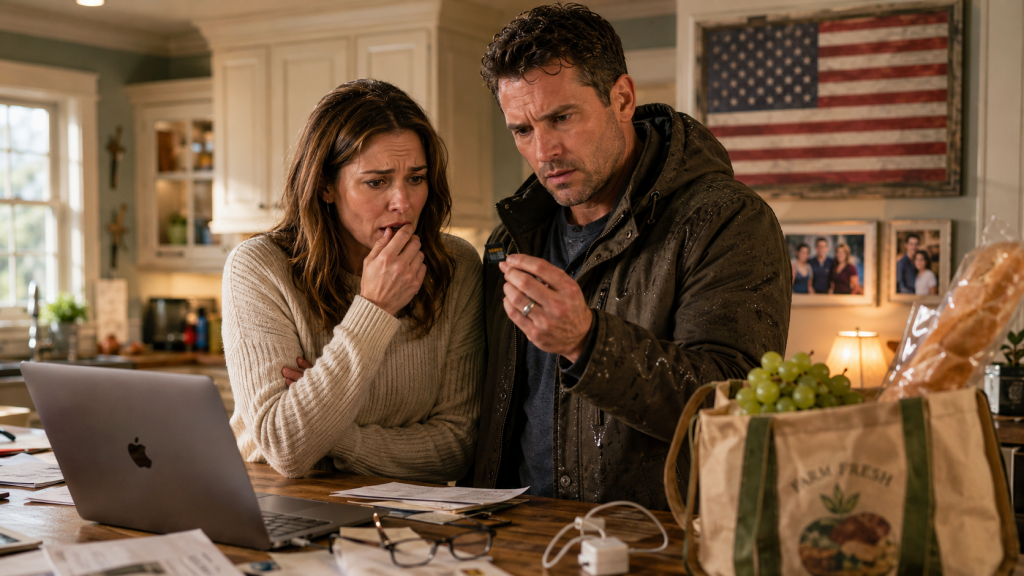
A few hours later, he came back pale and soaked from rain.
He stood in our kitchen without taking off his jacket.
Water dripped from the hem onto the floor.
In one hand, he held a tiny memory card between two fingers.
“Emily,” he whispered.
I stared at it.
“What is that?”
“The old doorbell camera.”
My breath caught.
My father had installed that camera two years earlier after someone stole a package from the porch.
Six months later, he complained it had stopped working.
We all believed it was useless.
He never removed it because, as he said, “A broken camera still makes a thief nervous.”
Michael swallowed.
“It was still recording.”
My body went cold.
He placed the memory card on the kitchen table like it might explode.
“The officer said they’ll take it officially, but I asked if we could copy the footage first. He agreed because I found it and didn’t alter anything.”
“Did you watch it?”
He nodded.
His face told me I did not want the answer.
“Who was it?”
Michael sat down slowly and opened his laptop.
“Emily…”
“Who was on the porch?”
He pressed play.
The screen filled with grainy blue-gray footage of my parents’ front steps.
Rain streaked across the lens.
The porch light glowed.
At 8:14 p.m., someone walked into frame wearing Kara’s red raincoat.
My stomach dropped.
“No,” I whispered.
The figure moved toward the door.
Raised a hand.
Used a key.
Then, just before entering, the person turned slightly toward the camera.
It was not Kara.
It was Dean.
For a few seconds, I forgot how to breathe.
Michael paused the video.
Dean’s face was frozen on the screen.
Calm.
Focused.
Too calm.
“He went inside,” Michael said quietly. “Stayed eleven minutes. Then left carrying something.”
He clicked to the next clip.
Dean emerged from the house with a small wooden box under one arm.
My mother’s recipe box.
The one she kept on top of the refrigerator.
The one filled with handwritten cards, old family notes, and envelopes she said she would organize “one of these days.”
My voice barely came out.
“Why would he take Mom’s recipe box?”
Michael looked at me.
“I think we need to call the detective.”
The police took the memory card that night.
By morning, they had searched Dean and Kara’s house.
Kara called me screaming.
Not angry.
Terrified.
“Emily, police are here. They’re asking Dean questions. What is happening?”
I sat on the edge of my bed, still in yesterday’s clothes.
“Kara, did Dean go to Mom and Dad’s house the night before I found them?”
Silence.
Then, “What?”
“Answer me.”
“No. He said he was at the office.”
“Are you sure?”
“Emily, what are you saying?”
I closed my eyes.
“There’s footage.”
A sound came through the phone.
Not a word.
More like the air leaving her body.
Then she whispered, “No.”
The search found the recipe box hidden in a storage bin in Dean’s garage.
Inside were not just recipe cards.
There were copies of financial documents.
A letter from my father’s attorney.
And my parents’ updated will.
They had changed it six months earlier.
Kara and I were still included.
But Dean had been removed from any financial authority.
More importantly, my parents had quietly revoked a document Dean had convinced them to sign two years before, one that allowed him to “assist” with certain banking matters.
At the time, he had claimed he was helping them simplify estate planning.
But my parents later discovered he had borrowed money using their names.
Not once.
Several times.
Small loans.
Credit applications.
A line of credit tied to a property they had never owned.
When they confronted him, Dean cried.
He told them he was drowning in debt.
He begged them not to tell Kara.
My mother, soft-hearted as ever, wanted to give him a chance to repay everything.
My father wanted to call a lawyer immediately.
In the end, they did both.
They updated the will.
Secured their accounts.
Gathered evidence.
And planned to tell Kara after their anniversary dinner.
They never got the chance.
When investigators searched Dean’s office, they found receipts.
One matched the folded receipt I had seen near the couch the night I found my parents.
Another matched a purchase made the same afternoon before he appeared on the doorbell camera.
The details were not told to me all at once.
Police protect investigations.
Doctors use careful words.
But the shape of the truth became clear enough.
Dean had gone to my parents’ house wearing Kara’s raincoat because he thought it would confuse any witness who saw him from a distance.
He used her spare key.
He stayed eleven minutes.
He left with the recipe box because he believed the papers proving his financial crimes were hidden there.
He did not know the old doorbell camera had recorded everything.
He did not know Michael would find the memory card.
He did not know my father had already copied the documents and given them to his attorney.
The most horrifying part came later.
My mother and father had not invited him over that night.
He had gone there after my father texted him one sentence:
Kara deserves the truth. We tell her tomorrow.
Dean panicked.
That panic nearly killed them.
Kara collapsed when she learned the truth.
I found her sitting on the floor outside my parents’ hospital room, hair tangled, face swollen from crying.
“I didn’t know,” she sobbed when she saw me. “Emily, I swear on my life, I didn’t know.”
I wanted to be angry at her.
Part of me was.
Not because she had done it.
Because she had trusted him.
Because she had missed things.
Because we had all missed things.
But when I saw her shaking on that hospital floor, I knew she had been betrayed too.
Maybe differently.
Not worse.
Not the same.
But deeply.
Dean was arrested two days later.
Kara did not go to the hearing.
I did.
I needed to see him in custody.
I needed to see his calm mask crack.
He walked into the courtroom wearing a wrinkled dress shirt and no tie.
For the first time since I had known him, he looked ordinary.
Not quiet.
Not polite.
Not harmless.
Just small.
When he looked at me, his eyes filled with something like regret.
I looked away.
I did not want his regret.
I wanted my parents awake.
That took time.
Mom woke first.
Her eyes fluttered open three weeks after I found her.
I was sitting beside her bed reading aloud from one of her library books, though I had no idea what page I was on.
Her fingers moved against the blanket.
Then her lips parted.
“Emily?”
I dropped the book.
“Mom?”
Her eyes focused slowly.
She looked smaller than I had ever seen her.
Fragile.
But alive.
I pressed her hand to my cheek and cried so hard the nurse came running.
Mom blinked at me.
“Your hair is a mess,” she whispered.
I laughed through sobs.
“That’s your first comment?”
She closed her eyes for a second.
Then opened them again.
“Kara.”
“She’s here,” I said quickly. “She’s safe.”
Mom’s face tightened with weak urgency.
“I tried to warn Kara.”
My chest ached.
“I know.”
“Dean…”
“We know, Mom.”
Tears slid from the corners of her eyes.
“I didn’t want him to hurt her.”
I kissed her hand.
“He can’t now.”
Dad woke two days later.
His first words were less gentle.
“Where is that snake?”
The nurse nearly dropped his chart.
I laughed for the first time in weeks.
Recovery was slow.
Painfully slow.
Mom had trouble walking at first.
Dad’s hands trembled when he tried to hold coffee.
They needed therapy, rest, medication, patience.
My father hated every second of it.
My mother pretended to be cheerful until she thought no one was watching.
Kara visited every day.
At first, she stood near the door like she did not deserve to come closer.
Then Mom held out a hand.
Kara fell into her arms and sobbed like a child.
“I’m sorry,” she kept saying.
Mom stroked her hair weakly.
“You didn’t do this.”
“I brought him into this family.”
“We all did,” Dad said from his bed.
His voice was rough.
“And we all should have looked harder.”
I thought that was generous.
Maybe too generous.
But healing is not always about assigning blame perfectly.
Sometimes it is about deciding who gets to stay in the room.
Kara stayed.
Dean did not.
The trial took nearly a year.
There were financial records.
Video evidence.
Store receipts.
Expert testimony.
Messages.
The will.
The loans.
The forged documents.
Dean’s attorney tried to paint him as desperate, overwhelmed, and panicked.
Maybe he was.
But desperation does not excuse destroying people who tried to help you.
When the verdict came, Kara held my hand.
My parents sat together in the front row.
Dad used a cane.
Mom wore the blue scarf she always said brought her luck.
Dean did not look at us when the decision was read.
I was glad.
I did not want the final memory of that day to be his face.
I wanted it to be my mother’s hand squeezing my father’s.
I wanted it to be Kara breathing for the first time in months.
I wanted it to be Michael standing behind me, steady as a wall.
Afterward, we went back to my parents’ house.
For a long time, none of us had wanted to gather there.
The living room held too many shadows.
But Mom insisted.
“I want soup,” she said. “In my own kitchen.”
So we made soup.
Chicken, carrots, celery, noodles.
The ordinary smell filled the house again.
At first, it hurt.
Then it healed.
Kara chopped vegetables with shaking hands.
Dad sat at the kitchen table, pretending not to need rest.
Michael fixed the porch light my father had ignored for years.
I stood at the stove beside my mother.
She leaned against the counter, weaker than before but smiling.
“Emily,” she said softly.
“Yes?”
“Stop blaming yourself for not coming sooner.”
I froze.
She knew me too well.
“I should have checked on you.”
“You came when you were meant to.”
“That’s not enough.”
“It was enough to save us.”
I looked at her.
Her eyes were tired, but clear.
“You found us,” she said. “That matters more than when.”
For months, I had lived inside the what-ifs.
What if I had visited sooner?
What if I had answered Kara’s text differently?
What if I had noticed Dean asking too many questions?
What if I had called Mom that morning?
But guilt is a room with no doors.
Love was the only thing that finally led me out.
My parents survived.
Changed, yes.
We all changed.
Kara moved in with them for a while after losing her house in the divorce.
Not because she was helpless.
Because none of us wanted to be alone with silence anymore.
Michael and I visited every Sunday.
Not because of guilt.
Because we wanted to.
Dad still wore his old baseball cap on the porch.
Mom still sent me home with soup.
And the old doorbell camera stayed exactly where it was.
Broken-looking.
Weathered.
Quiet.
Recording.
A year after that night, my father replaced the mailbox.
The faded one he had meant to repaint.
He installed a new black one with gold numbers.
When he finished, he stood back proudly.
“Looks good,” he said.
Mom leaned toward me and whispered, “It’s crooked.”
“It is not,” Dad said immediately.
She smiled.
I laughed.
Kara laughed too.
For a moment, the house felt ordinary again.
Not untouched by pain.
Never that.
But alive.
And sometimes alive is the miracle.
People think danger always looks like a stranger.
A shadow in an alley.
A locked door forced open.
A face you do not recognize.
But sometimes danger sits at your family table.
Sometimes it marries your sister.
Sometimes it borrows money with a smile.
Sometimes it wears someone else’s raincoat and uses a spare key.
And sometimes the thing that saves the people you love is something everyone forgot existed.
An old doorbell camera.
A tiny memory card.
A husband who thinks to check.
A daughter who finally walks through the door.
The night I found my parents, I thought I had arrived too late.
But I had not.
I arrived in time to call for help.
Michael arrived in time to find the truth.
And my parents survived long enough to tell us what love had been trying to warn us all along.
The danger had never come from outside our family.
It had been sitting among us for years.
Quiet.
Smiling.
Waiting.
But truth was quieter.
And it had been recording the whole time.
THE END! THANKS FOR READING!