 Reading Time: 14 minutes
When I got to my parents’ house, my children were sitting in the corner with empty plates while my sister’s children were served first. My sister told them they had been born to survive on leftovers. My father said they needed to understand their place.
I took my children and left. Minutes later, everyone inside was screaming in panic. When I walked into my parents’ house that Sunday afternoon, I expected the usual family dinner. I had grocery bags cutting into my fingers, cold air still clinging to my coat, and the hope—small, foolish, but still alive—that maybe this time would be peaceful.
The house smelled like roasted chicken, buttered rolls, mashed potatoes, green beans, and apple pie.
It smelled like every childhood memory I had tried so hard to keep beautiful.
It smelled like family.
That was the cruelest part.
The house always smelled like love.
But it rarely felt like it.
I shifted the grocery bags in my arms and closed the front door behind me with my hip.
“Mom?” I called.
No one answered.
From the dining room came the clink of forks, the scrape of chairs, and the soft laughter of children who were already eating.
Then I heard my mother’s voice.
Not loud.
Not angry.
Casual. As if she were explaining a rule everyone should already know.
“My sister’s kids eat first, and my kids wait for the crumbs.”
I stopped in the hallway.
For a second, I thought I had misunderstood.
Maybe she had said something else.
Maybe I had walked in at the wrong part of a conversation.
Maybe the sentence had sounded worse from far away.
Then I stepped closer and looked into the dining room.
And I saw my children.
Noah, my eight-year-old son, sat in the corner near the old china cabinet with his knees pressed together, staring down at an empty paper plate in his lap.
Lily, my six-year-old daughter, sat beside him, twisting the edge of her yellow sweater between her tiny fingers.
Her eyes were shiny.
She was trying so hard not to cry that it made my chest ache.
Across the room, my sister Vanessa’s three children were already eating.
Their plates were full.
Chicken.
Mashed potatoes.
Gravy.
Rolls.
Corn.
Pie waiting on the counter.
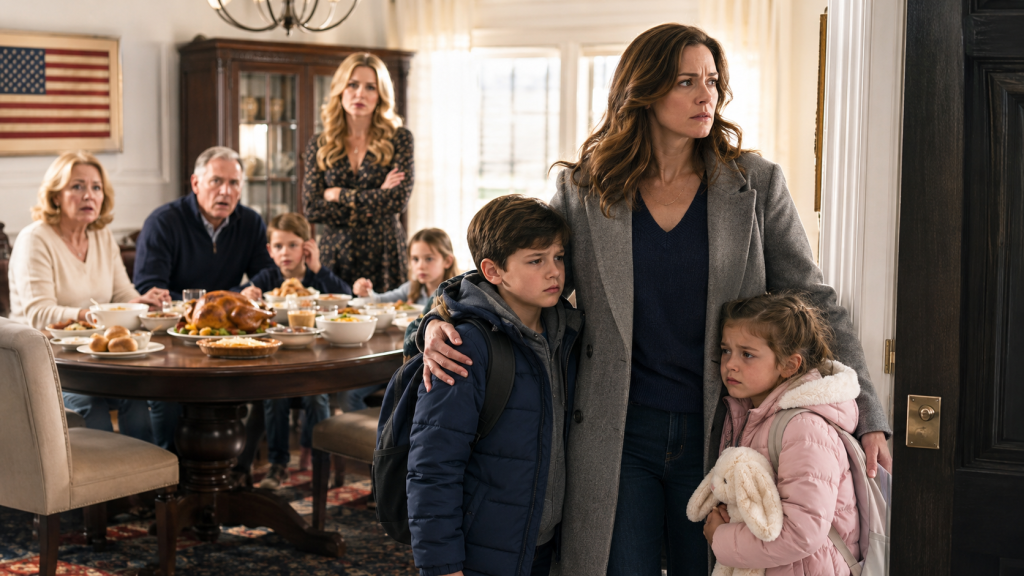
Gravy shone on their mouths as they laughed, reached for more, and asked my mother for extra butter.
My children had nothing.
Not because there was not enough food.
There was plenty.
The table was loaded with it.
They had nothing because they had been told to wait.
My mother, Patricia, stood beside the stove with a serving spoon in her hand like she was in charge of some judgment I had never agreed to.
My sister Vanessa sat at the table in the good chair—the one closest to my father—wearing a soft cream sweater and the satisfied smile she always wore when the room bent itself around her.
Then she looked directly at Noah and Lily.
“Get used to it,” she said. “You were born to live off what’s left.”
For a moment, I could not breathe.
I looked at my father, Richard.
I waited for him to correct her.
Waited for one decent adult in that room to say, That is enough.
These are children.
But my father only leaned back in his chair, folded his napkin across his lap, and said, “They need to learn their place.”
Their place.
My children.
My sweet, quiet children, who had done nothing wrong except be born to me instead of Vanessa.
Something inside me went completely still.
Because suddenly, it was not just that dinner.
It was every dinner.
Every birthday where Vanessa’s children got the first hugs, the first pictures, the first slice of cake.
Every Christmas where my children were handed smaller gifts and told to be grateful because “not everything needs to be equal.”
Every family photo where Vanessa stood in the middle and I was pushed to the side.
Every time my mother praised Vanessa for being busy and told me I was strong enough to handle things alone.
I remembered being a child in that same house.
Vanessa got the bigger bedroom because she “needed space.”
Vanessa got dance lessons because she “had talent.”
Vanessa got college paid for because she “had potential.”
Vanessa got the beautiful wedding in Napa because she “deserved a perfect day.”
I got a part-time job at sixteen.
I got lectures about responsibility.
I got handed bills and told, “Your sister is sensitive. Don’t make things harder.”
For years, I thought if I kept being useful, they would eventually love me.
Then I had children.
And I thought maybe, just maybe, grandparents would be different.
Surely they would not punish Noah and Lily for my place in the family.
Surely they would not make children carry the weight of old favoritism.
But that afternoon, looking at Lily’s trembling chin and Noah’s little fists clenched around his empty plate, I finally understood.
They were not going to stop.
So I did.
I set the grocery bags down on the floor.
The sound made everyone turn.
A carton of juice rolled slightly against the baseboard.
“Noah. Lily. Coats.”
My mother blinked as if I had embarrassed her.
“Claire, don’t be dramatic.”
I kept my eyes on my children.
“Now.”
They moved immediately.
That was the part that hurt.
They did not ask questions.
They did not protest.
They did not beg to stay.
They got up as if some part of them had been waiting for me to finally choose them.
Noah took Lily’s hand, and together they came toward me.
I helped Lily into her coat.
Her hands were cold.
“Mom,” she whispered, “I didn’t touch anything.”
I swallowed hard.
“I know, baby.”
Noah stared at the floor.
“I told her Lily was hungry.”
“I know.”
Vanessa laughed from the table.
“Where are you going? To McDonald’s? That’s more your level.”
Her husband, Mark, looked uncomfortable but said nothing.
He never did.
My sister’s oldest child, Ava, looked between her full plate and Lily’s empty one.
For one second, something like guilt crossed her face.
Then Vanessa snapped, “Ava, eat your dinner.”
And Ava obeyed.
That was how their house worked.
Cruelty passed down like a family recipe.
I picked up Lily’s backpack and grabbed Noah’s inhaler from the side table.
My father’s voice followed me toward the door.
“You walk out that door, don’t expect help from this family.”
I turned back once.
The room was warm and golden behind him.
The chandelier glowed over plates full of food.
My children stood beside me in their coats, hungry and humiliated.
“You have never helped us,” I said.
Then I opened the door and led my children into the cold Ohio afternoon.
The air hit us sharply.
Lily finally started crying when we reached the car.
Noah climbed into the back seat silently and buckled himself in with stiff, angry little movements.
I got behind the wheel and sat there for a moment, hands gripping the steering wheel so tightly my knuckles hurt.
“Mom,” Noah whispered, “did we do something wrong?”
I closed my eyes.
That question nearly broke me.
“No,” I said, turning around to look at both of them. “You did nothing wrong. Nothing. Do you hear me?”
Lily wiped her cheeks.
“Grandma said Vanessa’s kids were guests.”
“You were guests too,” I said. “And even if you weren’t, children should never be treated like that.”
Noah looked out the window toward the house.
“Grandpa doesn’t like us.”
I wanted to lie.
Every mother wants to soften the sharp edges of the world.
But I had done too much softening already.
Too much explaining.
Too much pretending.
So I said, “Grandpa is wrong.”
Noah looked at me.
“So is Grandma?”
“Yes.”
“And Aunt Vanessa?”
I started the car.
“Especially Aunt Vanessa.”
We drove away.
At the corner, Lily asked quietly, “Can we still get food?”
“Yes,” I said. “We’re getting the biggest dinner we can find.”
We had only been driving for a few minutes when my phone began to ring.
First my mother.
Then Vanessa.
Then my father.
I ignored every call.
The screen lit again and again from the cupholder.
Mom.
Vanessa.
Dad.
Mom.
Dad.
Vanessa.
Noah saw it.
“Are you going to answer?”
“No.”
“Are they mad?”
I looked at the road ahead.
“They can be whatever they want.”
Another call came.
Then a voicemail.
I was about to ignore that too when the preview appeared on my screen.
Claire, come back. Please.
Something in the words made my chest tighten.
I pulled into a gas station parking lot, put the car in park, and played the voicemail on speaker.
My mother’s voice filled the car.
But it was not the voice I knew.
It was shaking.
Terrified.
Almost unrecognizable.
“Claire, come back. Please. They’re screaming. Everyone is screaming. Something happened…”
The message ended.
For a few seconds, none of us moved.
Noah leaned forward.
“What happened?”
“I don’t know.”
Then another voicemail arrived.
This time from my father.
I pressed play.
His voice was rough with panic.
“Claire, did you do something to the house?”
I stared at the phone.
The house?
“What?” I whispered.
Then Vanessa’s message came through.
“You selfish witch! You knew, didn’t you? You knew and you just left it there for us to find!”
I sat back slowly.
Find what?
Then I remembered the grocery bags.
The ones I had dropped by the door.
Inside one of them was not food.
It was the certified letter from the probate attorney I had picked up that morning.
My grandmother, Eleanor Whitman, had died three months earlier.
She was my mother’s mother.
The only person in my family who had ever seemed to truly see me.
Grandma Eleanor was not loud.
She was not flashy.
But she noticed everything.
She noticed when Vanessa opened three presents before I opened one.
She noticed when my mother forgot my birthday dinner because Vanessa had “a stressful week.”
She noticed when my father handed Vanessa money for a family vacation while telling me to “budget better.”
And she noticed my children.
She had adored Noah and Lily.
Really adored them.
Not for photos.
Not for holidays.
Not for appearances.
She kept coloring books for Lily in her kitchen drawer.
She had a telescope magazine subscription delivered to Noah every month after he told her he liked space.
When I cried in her kitchen one night after my divorce, she had poured tea and said, “Claire, some families use love like a ladder. They make one child climb and the other carry the weight.”
I never forgot that.
That morning, before driving to my parents’ house, I had stopped at the attorney’s office.
Mr. Dalloway, Grandma’s probate lawyer, handed me a large envelope and said gently, “Your grandmother was very clear.”
I did not open it in the parking lot.
I thought I would bring it to Sunday dinner.
I thought we could read it together.
I thought, stupidly, that maybe inheritance would finally make my mother speak kindly of Grandma.
The letter had been sitting inside the grocery bag along with rolls, juice, and canned cranberry sauce.
When I set the bags down and left, I had left the envelope too.
And now they had found it.
I called Mr. Dalloway immediately.
He answered on the third ring.
“Claire?”
“My family found the letter.”
There was a pause.
“Ah.”
“They’re panicking.”
“I imagine they are.”
My heart beat hard.
“What exactly is in that letter?”
Mr. Dalloway sighed softly.
“Your grandmother left the house to you.”
I went still.
“What house?”
“Your parents’ house.”
I thought I had misheard him.
“My parents’ house?”
“Yes.”
“They own that house.”
“No,” he said. “They have lived there under your grandmother’s ownership for many years. Your grandmother allowed it after your father’s business trouble. She kept the deed in her name.”
My mouth went dry.
“No one told me.”
“Your grandmother suspected they would not.”
I looked through the windshield at the gas station pumps, the gray sky, and my children’s small faces in the rearview mirror.
“There’s more,” he said.
My stomach tightened.
“More?”
“The savings account, the lake cabin, and several investment accounts were also left to you. Not your mother. Not your sister. You are the sole beneficiary.”
I could not speak.
Mr. Dalloway continued gently.
“She changed the will two years ago after witnessing how your children were treated at a Christmas gathering.”
Christmas.
I remembered that Christmas.
Lily had received a doll from Grandma Eleanor.
Vanessa told her own daughter she could “borrow” it, then acted offended when Lily cried.
My mother said Lily needed to learn sharing.
Grandma Eleanor had gone very quiet that day.
I never knew why.
Now I did.
“I’m going back,” I said.
“I’ll stay on the phone.”
By the time I pulled back into the driveway, the house looked different.
Not because the building had changed.
Because I had.
For the first time in my life, that house did not feel like my parents’ kingdom.
It felt like a place they had borrowed and mistaken for a throne.
I parked behind Vanessa’s SUV.
Noah looked nervous.
“Do we have to go in?”
“No,” I said. “You can stay in the car with the doors locked. I’ll be right there.”
Lily grabbed my sleeve.
“Mom, don’t let them yell at you.”
I touched her cheek.
“They can yell. That doesn’t make them right.”
Then I stepped out.
I kept Mr. Dalloway on speakerphone in my coat pocket.
The front door was still unlocked.
Inside, the grocery bags had been torn open.
The food was scattered.
The certified letter lay on the dining room table.
Everyone was standing now.
Vanessa was crying.
Not sad crying.
Angry crying.
The kind she used when the world refused to rearrange itself for her.
My mother clutched the letter with both hands.
My father looked sick.
Mark stood near the fireplace, pale and silent.
The children sat at the table, their plates half-finished and forgotten.
The same food my children had been denied was now growing cold.
My mother turned when she saw me.
“How could you?” she whispered.
I almost laughed.
“How could I?”
“This is cruel,” Vanessa snapped.
“That’s an interesting word from you.”
My father pointed at the paper.
“This is a mistake.”
From my pocket, Mr. Dalloway’s voice came through clearly.
“No mistake, Richard.”
Everyone froze.
My father’s head snapped toward me.
“Who is that?”
“Gerald Dalloway,” the attorney said. “Eleanor Whitman’s probate lawyer.”
My mother’s face crumpled.
“Gerald, tell Claire this is wrong.”
“It is not wrong, Patricia. Your mother was very clear.”
Vanessa grabbed the letter from my mother.
“She wouldn’t leave everything to Claire. I was her granddaughter too.”
“Yes,” Mr. Dalloway said. “And she considered that.”
Vanessa’s mouth opened.
Then closed.
“She wrote a personal statement,” he continued. “Would you like me to read the relevant portion?”
“No,” my mother said quickly.
“Yes,” I said.
The room went silent.
Mr. Dalloway began.
“To my daughter Patricia, my son-in-law Richard, and my granddaughter Vanessa: I have watched for years as Claire and her children were treated as lesser members of this family. I have seen gifts divided unfairly, affection withheld, and cruelty excused as tradition. I have watched Noah and Lily sit quietly while others were celebrated. I will not leave my home or savings to people who made children feel unwanted under my roof.”
Vanessa covered her mouth.
My mother started crying then.
Real tears, maybe.
Or tears for what she had lost.
The attorney continued.
“Claire receives the house because she knows what it is to be made unwelcome, and I trust her to make it a home. Noah and Lily receive protected education funds. The lake cabin is to remain in Claire’s name unless she chooses otherwise. No beneficiary is to be pressured into sharing assets with Patricia, Richard, Vanessa, or their spouses.”
My father sank into a chair.
“But we live here.”
“Yes,” Mr. Dalloway said. “And your mother-in-law allowed that generously. But ownership now transfers to Claire.”
Vanessa’s face twisted.
“So what? She’s going to throw us out?”
I looked at the dining table.
At the full plates.
At the corner where my children had been told to wait for crumbs.
My voice came out calm.
“No.”
My mother looked up with desperate relief.
“Claire—”
“I’m giving you thirty days.”
The relief disappeared.
Vanessa shouted, “You can’t do that!”
“I can.”
“This is our family home!”
“No,” I said. “It was Grandma’s house. Now it’s mine.”
My father stood.
“After everything we’ve done for you—”
I turned to him.
“What have you done for me?”
His mouth snapped shut.
I stepped closer.
“You told my children they needed to know their place. So now I’m telling you yours.”
My mother pressed a hand to her chest.
“Claire, we were just trying to teach them humility.”
“No. You were teaching them shame.”
Vanessa wiped her face.
“You’re acting like your kids are better than ours.”
“No,” I said. “I’m acting like they are equal. That’s what feels like an attack to you.”
Mark finally spoke.
“Vanessa, maybe we should calm down.”
She spun on him.
“Don’t you dare take her side.”
He looked at the table, then at the corner where Noah and Lily had sat.
For once, he did not stay silent.
“She’s right,” he said quietly.
Vanessa stared at him like he had betrayed her.
Maybe he had.
Or maybe the truth had finally become too obvious to ignore.
My mother stepped toward me.
“Honey, we can fix this. Stay for dinner. Bring the children in. I’ll make them plates.”
That made me angrier than the insults.
Because now she could make plates.
Now that the house was mine.
Now that the money was mine.
Now that consequences had arrived.
“No,” I said.
“Claire, please.”
I picked up the certified letter from the table.
Then I looked at the food.
The chicken.
The rolls.
The pie.
The plates full of the dignity my children had been denied.
“Pack your leftovers,” I said calmly. “You’ll need them somewhere else.”
Then I left.
This time, no one followed me.
In the car, Noah asked, “What happened?”
I pulled out of the driveway slowly.
“Grandma Eleanor left us something.”
Lily’s eyes widened.
“Like a present?”
I smiled through tears.
“Yes, baby. Like a present.”
“Is it food?”
Noah gave her a look.
I laughed for the first time that day.
“No. Bigger than food.”
That night, I took them to a diner with red booths and warm lights.
Noah ordered pancakes, fries, and a milkshake because he said it was “an emergency dinner.”
Lily ordered grilled cheese and tomato soup.
When the waitress brought their plates, Lily stared at hers for a long moment.
Then she whispered, “This is all mine?”
The question hurt.
But I smiled.
“Yes. Every bite.”
Noah pushed half his fries toward her.
“Except these. These are also yours if you want.”
Lily giggled.
And something inside me began to heal.
Over the next month, my parents changed tactics every few days.
First came anger.
Then guilt.
Then apology.
Then anger again.
My mother called crying about how humiliating it would be to move.
My father said people at church would ask questions.
Vanessa said Grandma had “manipulated” me from the grave.
I ignored most of it.
When I did respond, I did it through Mr. Dalloway.
That made them furious.
It also made them careful.
By the end of thirty days, my parents moved into a rental condo across town.
Vanessa stopped speaking to me, which was perhaps the first real gift she had ever given me.
Mark sent me a quiet message two weeks later.
I’m sorry I didn’t say anything sooner.
I did not reply immediately.
Then I wrote back:
So am I.
That was enough.
I moved into Grandma Eleanor’s house with Noah and Lily in early spring.
At first, the children were nervous.
Lily asked if she was allowed to sit at the dining room table.
Noah asked if he could use the upstairs bedroom with the window facing the maple tree.
I said yes to everything that should never have required permission.
The first Sunday dinner we hosted there was nothing like the ones I grew up with.
We made spaghetti because Lily liked twirling noodles.
Noah helped make garlic bread.
I bought a chocolate cake from the bakery and let them cut it before dinner because there was no one there to say children had to wait.
We sat at the table.
The good table.
The same table where they had once been shamed.
But this time, their plates were full.
This time, no one ate first because of rank.
This time, no one waited for crumbs.
After dinner, Lily climbed into my lap and said, “This house feels nicer now.”
I kissed the top of her head.
“That’s because it’s ours.”
Months later, I found a letter from Grandma tucked inside a cookbook.
It was addressed to me in her careful handwriting.
My dear Claire,
If you are reading this, then I hope you are standing in the house with your children safe beside you.
I know you may feel guilty.
Do not.
People who enjoy your silence will always call your boundaries cruelty.
Let them.
I could not stop your mother from choosing favorites.
I could not stop Vanessa from learning to enjoy it.
But I can stop them from using my home as a stage for it after I am gone.
Fill the rooms with laughter.
Feed your children first.
Feed yourself too.
Love,
Grandma Eleanor.
I sat on the kitchen floor and cried.
Not the kind of crying that breaks you.
The kind that washes something old away.
That evening, I framed the letter and placed it on the mantel.
My mother saw it once when she came to collect a box she had left behind.
She read it silently.
Her face changed.
For a second, I thought she might apologize.
Instead, she said, “She always favored you.”
I looked at her.
“No, Mom. She noticed me.”
My mother left without answering.
I never got the apology I wanted.
Not from her.
Not from my father.
Not from Vanessa.
But I stopped needing it.
That was the miracle.
For years, I thought healing would come when they finally admitted what they had done.
When they finally said, Claire, we were wrong.
When they finally hugged Noah and Lily the way they hugged Vanessa’s children.
But healing came quietly.
It came the first time Lily ran through the house laughing.
It came when Noah invited his friends over and proudly said, “This is our place.”
It came when I opened the pantry and saw food my children could reach without asking.
It came when Sunday stopped feeling like a test.
The house still smelled like roasted chicken sometimes.
But now, when I cooked it, the smell did not hurt.
It meant warmth.
Safety.
Home.
One year after that terrible dinner, I hosted Thanksgiving.
Not for my parents.
Not for Vanessa.
For friends.
Neighbors.
A single mother from Lily’s school.
An older man from down the street whose wife had passed away.
Two of Noah’s classmates whose parents were working late.
The table was full.
The plates were full.
No one sat in the corner.
Before we ate, Lily stood on her chair and announced, “In this house, everybody gets food at the same time.”
Everyone laughed.
I cried into my napkin.
Noah squeezed my hand under the table.
That was when I knew Grandma Eleanor had not just left us property.
She had left us a way out.
Out of favoritism.
Out of shame.
Out of waiting for love from people who only offered crumbs.
My family thought they were teaching my children their place.
They were.
Just not in the way they intended.
They taught me that my children’s place was not in the corner.
Not behind Vanessa’s children.
Not waiting for leftovers.
Not begging for dignity from people who treated love like inheritance.
Their place was at the table.
Beside me.
Plates full.
Heads high.
Loved without condition.
And anyone who could not accept that no longer had a place in our home.
THE END! THANKS FOR READING!