 Reading Time: 13 minutes
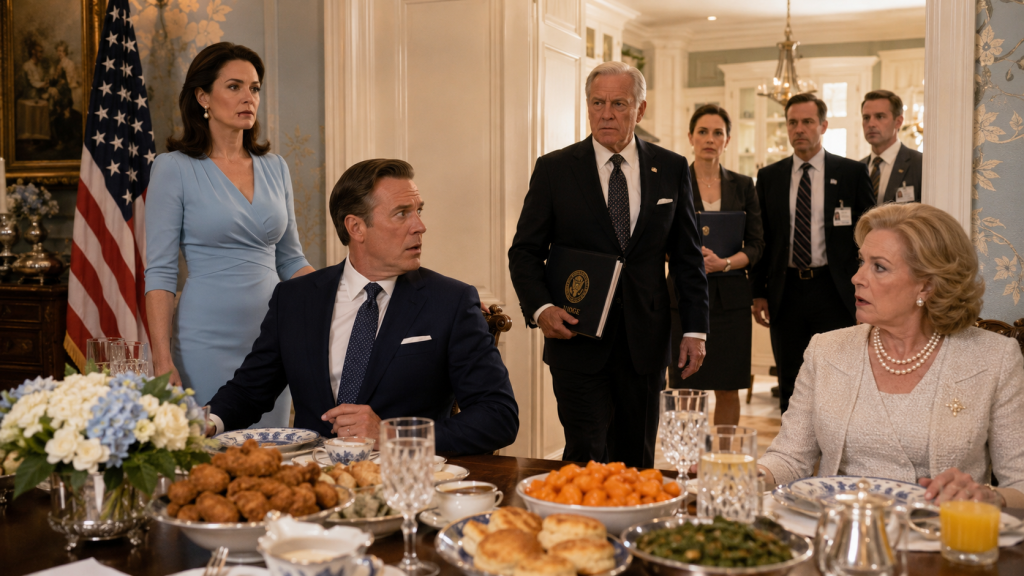
My husband hit me for asking where he had been all night. The next morning, I made his favorite Southern breakfast and served it with a smile. He called me a “proper wife.” Then the kitchen door swung open.
And every bit of color left his face. Everything changed because of one simple question. “Where did you spend last night?” That was all I said. No screaming. No accusation. No dramatic scene.
Just one quiet question spoken from the kitchen doorway while rain tapped softly against the windows.
My husband, Ethan Blackwood, stood beside the stove, pouring himself bourbon into a crystal glass at two in the morning.
His shirt was wrinkled.
His collar was open.
There was a faint trace of perfume on his sleeve.
Not mine.
He looked at me like I had interrupted a meeting I had no right to attend.
“What did you say?” he asked.
His voice was low.
Dangerously calm.
I folded my arms over my robe, mostly to stop my hands from shaking.
“I asked where you spent the night.”
Ethan stared at me for three long seconds.
Then he smiled.
Not warmly.
Not kindly.
The way a man smiles when he has already decided the person in front of him is beneath him.
“You’ve been sitting up waiting?” he asked.
“I woke up and you weren’t home.”
“I am home now.”
“That doesn’t answer my question.”
The smile vanished.
Before I could take a breath, his hand struck my face.
The blow snapped my head to the side and pushed my lip into my teeth.
In an instant, I tasted blood.
For a few seconds, the kitchen went completely still.
Except for the rain tapping the windows.
Except for the soft crackle of grease cooling on the stove from the dinner he had ignored.
Except for my own breath, trembling in my chest.
Ethan stood above me, perfectly calm.
His white dress shirt remained flawless.
His wedding ring shone beneath the kitchen lights.
He adjusted his cufflinks as if he had merely brushed dust from his sleeve.
“Do not question me in my own home,” he said.
His own home.
The house my inheritance had helped save when his family business nearly collapsed.
The house I had decorated, maintained, and filled with warmth.
The house where his mother still walked in without knocking because Ethan had never learned where his authority ended and mine began.
I touched my mouth and looked at the blood on my fingers.
Then I looked up at him.
A smile slowly returned to his face when he realized I would not fight back.
That had always been the part he enjoyed most.
The quiet.
He confused it with fear.
With obedience.
With weakness.
In Ethan’s mind, I was only a well-mannered Southern wife.
The kind who set the table properly.
The kind who sent thank-you notes.
The kind who remembered birthdays, church luncheons, charity committees, and how his mother liked her tea.
The kind who would never make a scene.
What he forgot was that I had been raised in the house of a respected judge.
My father, Robert Whitaker, had spent thirty-eight years on the bench.
He taught me that a calm voice was not the same as surrender.
He taught me that evidence mattered more than outrage.
He taught me that powerful men were often most dangerous when they believed no one was documenting them.
What Ethan never truly valued was that before I became Mrs. Ethan Blackwood, I had spent years working as a forensic accountant.
Financial wrongdoing was not something I guessed at.
It was something I recognized.
Traced.
Organized.
Proved.
And what Ethan did not know was that every suspicious conversation, every missing dollar, every forged signature, every late-night transfer, and every lie he had told during the past six months had been carefully recorded.
Saved.
Copied.
Protected.
Ethan straightened his cufflinks.
“My mother is coming by in the morning,” he said as if nothing had happened. “Make breakfast. And try not to shame me.”
I pressed a napkin to my bleeding lip.
For one small second, I wanted to scream.
I wanted to throw the crystal glass against the wall.
I wanted to tell him I knew about the offshore account.
I knew about the falsified invoices.
I knew about the mistress in Atlanta.
I knew about the plan to drain my inheritance through a shell company with his cousin’s name on it.
Instead, I lowered my eyes.
“Of course.”
That response pleased him.
Ethan liked obedience best when it looked like humiliation.
He stepped closer, touched my chin with two fingers, and turned my face toward the light.
“You’ll need makeup before breakfast,” he said. “Mother notices everything.”
Then he walked out of the kitchen.
I stood there listening to his footsteps climb the stairs.
Only when his bedroom door closed did I move.
Not to cry.
Not to collapse.
I walked to the small cabinet beside the pantry and pulled out the burner phone I had hidden behind the extra flour tin.
My hands were steady when I typed one message.
Tomorrow morning. 8:30. Bring everything.
I sent it to Clara Vance, my attorney.
Then I sent a second message.
Daddy, it’s time.
My father replied in less than one minute.
I’ll be there.
Only then did I press ice to my lip.
Only then did I let one tear fall.
Not because Ethan had hurt me.
Because I had let him believe he could.
The truth was, Ethan Blackwood had not always been cruel.
Or maybe he had been, and I had mistaken charm for kindness.
When I first met him at a fundraiser in Savannah, he had the polished confidence of a man raised on old money and polite lies.
He knew exactly when to smile.
Exactly when to compliment.
Exactly when to make a woman feel like the only person in a crowded room.
He told me he admired my independence.
He said he loved that I had a mind for numbers.
He said I was different from the women his mother pushed toward him.
At the time, I believed him.
I was thirty-four, successful, and still foolish enough to think admiration was the same as respect.
Ethan proposed after eighteen months.
My father was cautious from the beginning.
“Men like him know how to perform dignity,” he told me once.
I laughed it off.
“You think every man is a defendant waiting to confess.”
“No,” my father said. “But I know when a man enjoys being obeyed.”
I should have listened.
After the wedding, the compliments became corrections.
Not all at once.
That would have been too obvious.
First, Ethan did not like the way I challenged him at dinner parties.
Then he preferred I leave financial conversations to him in front of his friends.
Then he said his mother felt “uncomfortable” when I spoke too openly about business.
Then he started calling my work “little investigations,” as if my career were a hobby.
When I caught the first strange transfer, I still wanted to believe there was an explanation.
A fifty-thousand-dollar consulting payment to a company I had never heard of.
Then another.
Then a seventy-five-thousand-dollar invoice for “regional development analysis.”
The company address led to a mailbox.
The registered agent led to Ethan’s cousin.
The bank routing led offshore.
I did not confront him immediately.
I knew better.
People who steal do not stop because you ask nicely.
They hide better.
So I began collecting.
Bank records.
Email screenshots.
Voicemail backups.
Contracts.
Copies of checks.
Late-night phone recordings when Ethan thought I was asleep.
Once, I stood outside his study door and heard him say:
“Lillian won’t notice. She trusts me with everything.”
Lillian.
That was my name.
Lillian Whitaker Blackwood.
But Ethan only used it when he was speaking about me like an asset.
He continued:
“By the time she realizes what moved, it’ll already be protected. If she files for divorce, she’ll look unstable. My mother will testify to that.”
His mother.
Margaret Blackwood.
Of course.
Margaret had never forgiven me for bringing actual money into a family that had been surviving on reputation for years.
To the outside world, the Blackwoods were Southern elegance.
Historic home.
Church pew with their name on it.
Charity galas.
Pearls.
Polished silver.
But behind all that tradition was debt.
Loans.
Failed investments.
Properties mortgaged twice.
Ethan had married me because he loved what I represented.
Cash flow.
Credibility.
Rescue.
Once I understood that, love began to leave me quietly.
Not in one dramatic storm.
But like water draining from a tub.
Slowly.
Completely.
By the night he struck me, the woman who had loved him was already gone.
All he hit was the silence she left behind.
The next morning, I woke before sunrise.
My lip was swollen.
The bruise had begun to darken beneath carefully applied concealer.
In the bathroom mirror, I studied my own face.
For a moment, I barely recognized the woman staring back.
Then I remembered my mother, who died when I was twenty-two.
She used to say, “A lady may bend for grace, but never for fear.”
So I fixed my hair.
Put on a pale blue dress.
Fastened my pearl earrings.
And went downstairs to cook.
By morning light, the whole house smelled of comfort and old tradition.
Warm biscuits.
Peppered gravy.
Fried chicken.
Candied yams.
Buttered vegetables.
Sweet preserves.
Fresh coffee.
I prepared everything Ethan loved.
Not because he deserved it.
Because it was the stage he expected.
And I intended to let him walk onto it smiling.
I shined the family silver until it reflected the chandelier.
Placed the crystal glasses.
Folded linen napkins.
Set magnolias in the center of the table.
Everything appeared perfect.
Exactly how Ethan preferred it.
Controlled.
Beautiful.
False.
Ethan came downstairs at eight fifteen wearing a navy suit and arrogance.
His eyes flicked over the table.
Then over me.
He saw the makeup covering my lip and smiled.
“Much better,” he said.
I poured his coffee.
“Cream?”
“You know how I take it.”
“Yes,” I said. “I do.”
He sat at the head of the table.
Of course he did.
Ethan loved the head of the table.
It made him feel like a patriarch instead of a thief.
His mother arrived ten minutes later without knocking.
Margaret Blackwood moved through the kitchen like she owned the floorboards.
Graceful pearls.
Costly perfume.
Silver hair pinned neatly at the back of her head.
A permanent look of judgment carved into her mouth.
Her gaze landed on my injured lip immediately.
Instead of concern, she gave a smug little smile.
“A wife ought to know when to stop speaking,” she said.
Ethan laughed.
I poured her coffee.
“Good morning, Margaret.”
She sat to Ethan’s right, smoothing her skirt.
“At least the table looks decent.”
“I’m glad it pleases you.”
“Oh, don’t sound wounded, Lillian. Women these days are too delicate.”
Ethan lifted his cup.
“She’s learning.”
Margaret looked at him proudly.
“There’s hope for her yet.”
They ate like honored guests.
Admiring the biscuits.
Praising the gravy.
Discussing church donations.
Speaking around me as if I were not a person, but part of the service.
“What a good wife,” Ethan said eventually, leaning back in his chair. “See? This is what I wanted. Peace.”
Peace.
That word nearly made me laugh.
Men like Ethan always called silence peace when they were the only ones allowed to speak.
I walked to the stove, lifted one last covered dish, and set it in front of him.
“What’s this?” he asked.
“Something special.”
He smiled.
“For me?”
“In a way.”
Then I stepped backward.
At that exact second, the kitchen door opened.
The entire room went silent.
Ethan turned toward the doorway.
The certainty disappeared from his face.
The coffee cup shifted slightly in his hand.
For the first time that morning, he looked frightened.
Because the person stepping through that door was my father.
Judge Robert Whitaker.
He wore a dark suit despite being retired.
His hair was silver now, but his posture still carried the kind of authority that made liars sit up straighter.
Behind him came Clara Vance, my attorney.
And behind Clara came two federal investigators in plain suits.
They had not come for breakfast.
Margaret’s fork slipped from her fingers and hit the china plate with a sharp little sound.
Ethan stood halfway.
“Robert,” he said too quickly. “This is unexpected.”
My father did not look at the table.
He did not look at the food.
His eyes went straight to my face.
To the swelling beneath the makeup.
To the cut on my lip.
Something ancient and terrible moved across his expression.
Not rage.
Worse.
Control.
“Lillian,” he said softly. “Are you safe?”
Ethan laughed.
It was thin and ugly.
“Safe? For God’s sake, this is a private family breakfast.”
Clara stepped forward and placed a thick folder beside the biscuits.
“No, Mr. Blackwood. This is now a legal matter.”
Margaret rose stiffly.
“How dare you enter my son’s home like this?”
“My daughter’s name is on the deed,” my father said. “And unlike you, I was invited.”
Ethan’s jaw tightened.
“What is this about?”
Clara opened the folder.
“Assault is one matter. Financial fraud is another. We are also prepared to discuss offshore transfers, forged authorizations, shell companies, and recorded conversations regarding the planned misappropriation of your wife’s inheritance.”
For one brief second, Ethan looked at me the way he had looked the night before.
Like he wanted to frighten me back into silence.
But that moment was gone.
It would never return.
One investigator stepped forward.
“Mr. Blackwood, we need you to come with us to answer some questions.”
Ethan’s face went pale.
“This is absurd. Lillian is emotional. She has always been dramatic.”
Clara slid a printed transcript across the table.
“Interesting. Because we have you on recording telling your cousin that if she found out, you would make her look unstable.”
Margaret gasped.
Not because she was shocked.
Because she had been named.
My father finally looked at Ethan.
His voice dropped into the calm tone I had heard in courtrooms when I was a girl.
“Son, you should have kept your hands to yourself. And you should never have mistaken my daughter’s manners for ignorance.”
Ethan turned to me.
“Lillian,” he said. “Tell them this is a misunderstanding.”
I looked at him.
The man who once danced with me beneath oak trees in Savannah.
The man who had kissed my hand in public while draining my accounts in private.
The man who hit me and then demanded breakfast.
“There has been a misunderstanding,” I said.
Relief flickered in his eyes.
Then I continued.
“You misunderstood who you married.”
The room went still.
Clara lifted another document.
“We filed an emergency motion this morning. Certain accounts are being frozen. Your access to Mrs. Blackwood’s inheritance funds has been revoked. Your business records are being subpoenaed.”
Ethan looked like the air had been pulled from the room.
Margaret clutched the back of her chair.
“This will ruin the family name.”
I turned to her.
“No, Margaret. Your son did that. I’m only refusing to hide it.”
Her face twisted.
“You ungrateful girl. We brought you into a respected family.”
I almost smiled.
“You brought me into debt with better silver.”
My father made a sound that might have been a cough.
Ethan’s hands curled into fists, but the investigators were watching him now.
He knew better than to move.
For once.
“Lillian,” he whispered, trying a softer voice. “We can fix this.”
I studied him calmly.
“No.”
“We’re married.”
“Temporarily.”
His eyes hardened.
“You’ll regret humiliating me.”
The investigator stepped closer.
“Mr. Blackwood, I suggest you stop speaking unless your attorney is present.”
Ethan looked at the breakfast table.
The biscuits.
The gravy.
The polished silver.
The covered dish still untouched.
“What’s under there?” he asked suddenly.
I lifted the lid.
Inside was not food.
It was a small stack of printed photographs.
Bank records.
And a copy of the first forged authorization bearing my signature.
His face collapsed.
That was when I knew he finally understood.
The breakfast had never been forgiveness.
The smile had never been obedience.
The silence had never been fear.
It had been timing.
One investigator gestured toward the door.
“Mr. Blackwood.”
Ethan whispered my name as if it were an apology.
But I heard no remorse in it.
Only loss.
His loss.
His power.
His access.
His protection.
I lifted my coffee cup.
“Eat before it gets cold,” I said softly. “You always hated wasted effort.”
By noon, Ethan was gone.
By sunset, the accounts were frozen.
By the next morning, every lock in the house had been changed.
Margaret called twenty-seven times.
I did not answer.
She left messages.
First threatening.
Then pleading.
Then crying about reputation, church gossip, and the family legacy.
Not once did she ask if I was hurt.
That answered the last question my heart had been holding.
The investigation did not end quickly.
Things like that rarely do.
There were interviews.
Statements.
Forensic reviews.
Attorneys.
Bank records.
People who had once smiled at Ethan across country club tables suddenly could not remember being close to him.
His cousin tried to deny everything until Clara produced emails.
His business partner cooperated when the investigators found discrepancies in company ledgers.
Margaret attempted to frame herself as an old woman deceived by her son, but the messages she had sent made that difficult.
One of them read:
If Lillian becomes difficult, make sure everyone knows she’s unstable. A woman’s reputation is easier to break than a contract.
When Clara showed me that message, I stared at it for a long time.
Then I laughed.
Not because it was funny.
Because after all their rehearsed elegance, all their pearls and etiquette and church manners, the truth was so ugly it almost looked cheap.
Ethan’s attorney tried to negotiate quietly.
A private settlement.
No public filings beyond what was necessary.
A statement about “marital strain.”
I refused.
Men like Ethan survive because silence protects them.
I had served him silence long enough.
The divorce became final nine months later.
I kept the house.
Not because I loved it.
Because my mother’s inheritance had saved it, and I refused to let the Blackwoods turn it into another monument to their lies.
I sold the antique portraits of Ethan’s ancestors and donated the money to a legal aid fund for women leaving abusive marriages.
Margaret said that was vulgar.
I considered it the first useful thing those portraits had ever done.
I turned Ethan’s study into a reading room.
Painted the walls soft green.
Replaced the heavy mahogany desk with a writing table by the window.
I kept the kitchen table.
For a while, I thought I would hate it.
But one morning, months after the divorce, I sat there with coffee while rain tapped the windows.
The same sound as that night.
Only this time, no footsteps came behind me.
No cold voice.
No hand.
No fear.
Just rain.
Birds.
The slow settling of a peaceful house.
My father came by often after that.
He never pushed me to talk.
Sometimes he sat on the porch and read the newspaper while I worked in the garden.
Sometimes he brought peaches from the farmer’s market.
Sometimes he simply looked at me with quiet sadness, as if apologizing for every warning he had given too gently.
One afternoon, I told him, “You were right about Ethan.”
He folded his newspaper.
“I wish I hadn’t been.”
“So do I.”
He reached across the porch table and covered my hand with his.
“You were brave, Lillian.”
I shook my head.
“I was quiet for too long.”
“Quiet people can still be brave.”
I looked out at the magnolia tree swaying in the yard.
Maybe he was right.
Or maybe bravery was not one thing.
Maybe bravery was surviving until the moment came to act.
Maybe it was hiding a phone behind a flour tin.
Saving screenshots while your hands shook.
Cooking biscuits for a man you planned to expose.
Standing in your own kitchen with a split lip and still knowing the truth belonged to you.
People heard pieces of the story afterward.
Southern gossip travels faster than lightning.
Some said I was cold.
Some said I had planned too much.
Some said a good wife would have handled matters privately.
Those people were usually the same ones who had eaten at Margaret Blackwood’s table for years and pretended not to see the rot beneath the silver.
I stopped caring what they said.
A good wife.
A proper wife.
Those words had been cages dressed in lace.
I no longer lived inside them.
The first Sunday after Ethan’s sentencing hearing, I made breakfast for myself.
Biscuits.
Gravy.
Fresh coffee.
Peach preserves.
I set one place at the table.
Mine.
No crystal glasses.
No polished silver.
No pretending.
Just a white plate, a warm cup, and sunlight spreading across the floor.
I ate slowly.
Peacefully.
And when I was done, I carried my coffee to the porch.
The rain had passed overnight, leaving everything clean and bright.
The magnolias were blooming.
The air smelled like wet grass and freedom.
For the first time in years, I did not feel like Mrs. Blackwood.
I felt like Lillian Whitaker again.
My mother’s daughter.
My father’s daughter.
My own woman.
Ethan once told me not to question him in his own home.
But he was wrong about that too.
It was never his home.
Not really.
A home is not where one person rules and another person survives.
A home is where your voice can rise without fear.
Where your silence belongs to you.
Where breakfast is not a performance.
Where rain against the window does not sound like warning.
The morning after he hit me, Ethan thought I had learned my place.
He looked at the table, the biscuits, the polished silver, and the smile on my face, and believed he had finally made me into the wife he wanted.
A proper wife.
An obedient wife.
A quiet wife.
But he did not understand the woman standing in front of him.
I was not serving surrender.
I was serving evidence.
And when that kitchen door opened, the life he built on fear finally ended.
The next morning, I sat on the porch with fresh coffee and realized peace had a sound.
It sounded like rain.
Birds.
My father’s car pulling safely into the driveway.
And no footsteps behind me.
THE END! THANKS FOR READING!