 Reading Time: 24 minutes
The ambulance doors slammed shut. Marcos Almeida stood frozen for half a second, staring at the vehicle that now carried everything he had left in the world.
His wife, Ana Clara. And their unborn son, Miguel. Just twenty minutes earlier, he had been preparing to say goodbye to both of them forever.
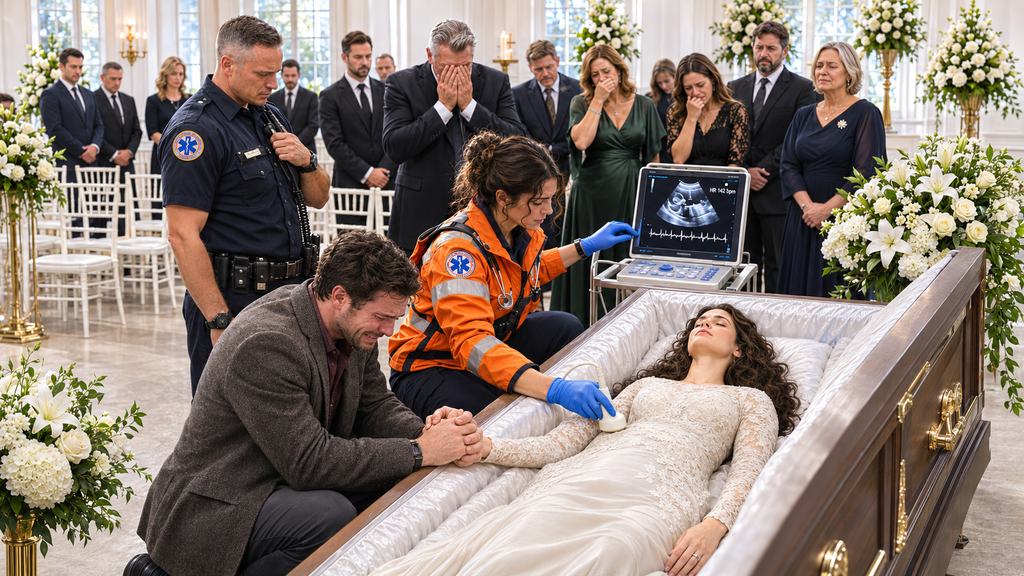
Now, because of one tiny movement beneath the fabric of a funeral dress, his entire world had been turned upside down.
“Mr. Almeida!”
A paramedic leaned out of the ambulance.
“Are you coming?”
Marcos stumbled forward.
“Yes. Yes, I’m coming.”
He climbed inside, barely noticing the rain soaking through his black funeral suit.
Ana Clara lay on the stretcher.
Her face was pale.
Her lips were almost colorless.
Two paramedics were working urgently around her, attaching monitors and checking readings.
Marcos kept staring at her stomach.
“Please,” he whispered. “Please don’t let my son die.”
The female paramedic, whose name tag read Carla, looked at him with an expression he couldn’t understand.
“Sir, I need you to stay calm.”
“Is his heartbeat still there?”
“Yes.”
Marcos pressed a trembling hand over his mouth.
“Thank God.”
But Carla wasn’t looking at the fetal monitor anymore.
She was staring at a second screen.
Then she adjusted an electrode.
“Wait.”
Her colleague turned.
“What?”
“Look at this.”
The two paramedics exchanged a glance.
Marcos felt his stomach tighten.
“What is it?”
Neither answered immediately.
Carla checked Ana Clara’s neck, then her wrist.
She leaned closer to her face.
“There’s something wrong with the death assessment,” she said.
Marcos stared at her.
“What do you mean?”
Carla looked him directly in the eyes.
“Mr. Almeida, I need you to understand something. Your wife may not be dead.”
The words struck him harder than anything he had heard in his entire life.
For a moment, he couldn’t speak.
Then he whispered, “What?”
“We’re detecting extremely weak cardiac activity. Her breathing is dangerously shallow, but there may still be circulation.”
Marcos grabbed the edge of the stretcher.
“No. They told me she died.”
“I understand.”
“They gave me a death certificate.”
“Sir, right now, we need to treat her as a living patient.”
Marcos looked down at Ana Clara.
His wife.
The woman he had kissed goodbye.
The woman whose coffin he had almost authorized for cremation.
He leaned close to her ear.
“Ana?”
No response.
“Ana Clara, sweetheart, can you hear me?”
Her eyes remained closed.
But suddenly, on the monitor, a tiny green line rose.
And fell.
And rose again.
Carla’s voice became urgent.
“Notify the hospital. We have a critically ill pregnant patient with possible prolonged drug-induced suppression and severe hypothermia. Prepare obstetrics, intensive care, and neonatal resuscitation.”
Marcos barely understood the medical language.
He understood only one thing.
There was still a chance.
And someone had nearly taken that chance away from him.
At Santa Helena Hospital, the emergency entrance erupted into activity.
Doctors rushed toward the ambulance.
A stretcher rolled across the polished floor.
Questions flew through the air.
“How long has she been unresponsive?”
“What medications were administered?”
“Who pronounced death?”
“Where was the original hospital evaluation?”
Marcos tried to answer.
But every answer made the situation more confusing.
He didn’t know what medications Ana Clara had received.
He hadn’t been permitted to see her after the accident.
He hadn’t even been allowed to identify her properly before the funeral home took custody.
Everything had happened so quickly.
Gustavo had handled the arrangements.
Gustavo had spoken to the doctors.
Gustavo had brought the paperwork.
And Gustavo had insisted that cremation should happen immediately.
Marcos suddenly remembered something.
The morning after the reported accident, he had begged Gustavo to arrange a second examination.
His brother-in-law had gripped his shoulder.
“Marcos, don’t torture yourself. Ana is gone. Let her rest.”
At the time, those words had sounded compassionate.
Now they sounded like a warning.
A doctor approached him.
“Mr. Almeida?”
Marcos stood immediately.
“My wife?”
“My name is Dr. Daniel Moreira. We’re doing everything possible. Your wife is alive, but she’s critically unstable.”
Marcos closed his eyes.
Alive.
That single word was almost unbearable.
The doctor continued.
“Her body temperature is dangerously low, and we’ve found signs that her nervous system may have been severely suppressed by medication. We need further testing before we can say exactly what happened.”
“What about my baby?”
“The obstetric team is assessing him right now. His heart rate is concerning, and we may need to deliver him.”
Marcos swallowed hard.
“He’s only seven months.”
“I know. Our neonatal intensive care team is prepared.”
“Will he live?”
The doctor hesitated.
And that hesitation frightened Marcos more than any answer could have.
“We’re going to give both of them every chance.”
Before Marcos could respond, an alarm sounded behind the emergency doors.
A nurse called for the obstetric surgeon.
Then the doors swung shut.
Marcos was left standing in a hallway, holding the funeral authorization he had never signed.
His hands shook as he looked at the blank signature line.
If he had signed it, the consequences would have been unimaginable.
He slowly crumpled the paper.
Then he began to cry.
Not quietly.
Not politely.
He cried like a man who had been standing at the edge of a terrible darkness and had suddenly discovered that someone had pushed him there.
Forty-three minutes later, police investigator Beatriz Costa entered the hospital.
She was a woman in her early forties, with tired eyes and a calm voice that seemed impossible to disturb.
She found Marcos sitting outside the operating room.
“Mr. Almeida?”
He looked up.
“Yes?”
“I need to ask you some questions about your wife’s accident.”
“Is this about the medical report?”
“Yes. And several other things.”
She sat beside him.
“Your wife’s official death documentation contains an irregularity.”
Marcos swallowed.
“What kind?”
“The death certificate was electronically prepared before the reported time of the crash.”
For several seconds, he simply stared at her.
“That can’t be right.”
“We checked the system logs twice.”
“How long before?”
“Twenty-nine minutes.”
Marcos felt the blood drain from his face.
Beatriz continued carefully.
“Someone began preparing paperwork to declare your wife dead before emergency services were notified of the accident.”
“That means…”
“It means the sequence we were given cannot be accurate.”
Marcos pressed his fingers against his forehead.
“Gustavo.”
Beatriz watched him.
“Your brother-in-law?”
“He handled everything.”
“Did you authorize him to?”
“No. He said he was helping because I was too devastated to think.”
“Did he tell you which doctor examined your wife?”
Marcos tried to remember.
Then a name surfaced.
“Dr. Raul Nogueira.”
Beatriz wrote it down.
Her expression changed.
“Are you certain?”
“Yes. Why?”
She didn’t answer immediately.
Instead, she asked another question.
“Mr. Almeida, what do you know about your wife’s family business?”
Marcos frowned.
“Her father left a charitable foundation. Ana managed its finances.”
“And Gustavo?”
“He worked there too.”
“Did they get along?”
“Usually.”
“Usually?”
Marcos hesitated.
“Last week, they argued.”
“About what?”
“I don’t know. Ana told me she had discovered something disturbing in the accounts.”
Beatriz leaned forward.
“Did she say what?”
“No. She said she wanted to be certain before telling me.”
He remembered Ana Clara standing in the nursery, folding a tiny blue blanket.
She had seemed distracted.
When he asked what was wrong, she had forced a smile.
“Just a problem at the foundation. I’ll deal with it.”
Then she had kissed his cheek.
“I promise I won’t let it spoil our happiness.”
Marcos looked at the investigator.
“Do you think Gustavo did something to her?”
Beatriz closed her notebook.
“I think someone went to extraordinary lengths to convince you that your wife was dead.”
The hallway suddenly seemed colder.
“And I intend to find out why.”
At 8:17 that evening, Dr. Moreira returned.
Marcos stood before the doctor could speak.
“Please.”
His voice cracked.
“Tell me they’re alive.”
The doctor nodded.
“Your son has been delivered by emergency cesarean section.”
Marcos staggered backward.
“Is he…?”
“He’s alive.”
Marcos covered his face.
“Thank you, God.”
“But he’s premature and very small. He weighs approximately three pounds. He’s receiving respiratory support in neonatal intensive care.”
“Can I see him?”
“Soon.”
“And Ana?”
The doctor’s expression softened.
“Your wife survived the surgery.”
Marcos felt his knees weaken.
“She survived?”
“Yes. But she’s still in critical condition, and we don’t know how much injury her body may have suffered. We also need to understand why she was incorrectly declared dead.”
Marcos gripped the doctor’s hand.
“Please don’t let anyone take her away again.”
Dr. Moreira looked at him.
“We will not release her to anyone without proper authorization.”
Marcos nodded.
But the fear remained.
Because someone had already managed to move his living wife from medical care into a coffin.
And that person was still free.
The neonatal intensive care unit was filled with quiet mechanical sounds.
Small monitors glowed beside tiny incubators.
Nurses moved gently between premature babies.
When Marcos reached Miguel’s bedside, he stopped walking.
His son was so small.
So impossibly small.
His delicate chest rose and fell with the help of breathing equipment.
A tiny knitted cap covered his dark hair.
One miniature hand rested beside his cheek.
Marcos pressed his palm against the incubator.
“Hello, Miguel.”
His voice broke.
“It’s Daddy.”
A nurse stepped closer.
“You can touch his hand through the opening, if you’d like.”
Marcos hesitated.
He was terrified of hurting him.
But the nurse guided him.
He extended one finger.
Miguel’s tiny hand moved.
And closed around it.
Marcos burst into tears.
“Oh, my boy.”
The little fingers were barely strong enough to hold him.
Yet they were holding on.
“You saved your mother,” Marcos whispered.
“I don’t know how you did it, but you saved her.”
The nurse looked away discreetly.
Marcos leaned closer.
“Now it’s my turn to save both of you.”
The next morning, Marcos received a phone call.
Gustavo.
He stared at the screen.
For the first time in eight years of knowing his brother-in-law, Marcos felt genuine fear at the sight of his name.
He answered.
“Hello.”
Gustavo sounded breathless.
“Marcos, I’ve been trying to reach you all night.”
“I was at the hospital.”
A pause.
“How is Miguel?”
“Alive.”
“Thank God.”
Marcos said nothing.
Then Gustavo asked, “And Ana?”
The question came too quickly.
Too sharply.
Marcos looked toward the ICU doors.
“Why do you ask?”
“Because she’s my sister!”
“Then why did you leave the crematorium?”
Silence.
“I was overwhelmed.”
“You didn’t even ask to ride with us.”
“Marcos, please. Don’t start accusing me of things.”
“Did you know she was alive?”
Gustavo’s breathing changed.
“What kind of question is that?”
“Answer me.”
“Of course not.”
“Then why did you insist on cremating her?”
“Because that’s what the family agreed!”
“I never agreed.”
Another silence.
Then Gustavo’s voice lowered.
“Listen carefully, Marcos. There are things about Ana’s condition you don’t understand.”
Marcos felt his skin tighten.
“What things?”
“Some medical decisions are complicated.”
“She was alive, Gustavo.”
“Don’t shout.”
“She was alive inside a coffin!”
“Marcos—”
“You were about to burn my wife and son!”
Suddenly, Gustavo stopped trying to sound sympathetic.
“Be careful what you say.”
Marcos froze.
“What?”
“You’re emotional. You could destroy this family by making accusations you can’t prove.”
Marcos stared at the phone.
There it was.
Not sorrow.
Not concern.
A threat.
He ended the call.
Then he immediately contacted Beatriz.
By noon, investigators had obtained security footage from several locations.
The most important recording came from a fuel station near Rodovia dos Imigrantes.
It showed Ana Clara’s vehicle passing through the forecourt on the morning of the reported accident.
But Ana Clara wasn’t driving.
She was sitting in the passenger seat.
And Gustavo was behind the wheel.
Marcos watched the footage in Beatriz’s office.
His hands went numb.
“That isn’t possible.”
Beatriz paused the video.
“Is that your brother-in-law?”
“Yes.”
“Did your wife ever tell you he would be driving her that morning?”
“No.”
The investigator played another section.
The vehicle stopped briefly.
Gustavo stepped out.
He looked around.
Then he opened the passenger door.
Ana Clara appeared to be moving slowly.
Her head leaned against the seat.
Gustavo reached inside, adjusted something, and closed the door.
Marcos leaned toward the screen.
“What’s wrong with her?”
“We don’t know yet.”
“She’s not moving normally.”
“No.”
Marcos gripped the table.
“Why didn’t anyone tell me he was there?”
Beatriz exchanged a glance with another officer.
“Because your brother-in-law stated that he hadn’t seen Ana Clara on the day of the crash.”
Marcos felt something inside him break.
Gustavo had stood beside the coffin.
He had watched Ana Clara’s mother cry.
He had hugged Marcos.
And he had lied to every one of them.
Then Beatriz showed him a second document.
It was a statement from the funeral director.
According to the statement, Gustavo had personally demanded that the preparations be expedited.
He had provided the death certificate.
He had arranged private transport.
And he had insisted that there be no further viewing of the body.
Marcos remembered the funeral director’s hesitation when he asked to open the coffin.
Now he understood why.
Beatriz folded her hands.
“We also found something else.”
“What?”
“A large payment from an account associated with the family foundation to a company connected to Dr. Raul Nogueira.”
Marcos stared at her.
“How large?”
“Four hundred thousand reais.”
He shook his head.
“Why would a charity pay a doctor that much money?”
“That is exactly what we’re investigating.”
That afternoon, Ana Clara’s mother, Helena, arrived at the hospital.
She looked as though she had aged ten years overnight.
Her silver hair was disheveled.
Her eyes were swollen.
She stood in front of Marcos with both hands trembling.
“Is my daughter really alive?”
He nodded.
“Yes.”
Helena covered her mouth.
Then she began to sob.
“Oh, Ana. My poor girl.”
Marcos helped her into a chair.
For a long time, neither spoke.
Eventually, Helena looked at him.
“I need to tell you something.”
Marcos felt his chest tighten.
“What?”
“Gustavo came to my house before the funeral.”
“When?”
“The evening after they told us about the accident.”
She twisted her rosary between her fingers.
“He said Ana had left instructions.”
“What instructions?”
“He told me she didn’t want a prolonged investigation. That she wanted everything handled quickly.”
Marcos stared at her.
“Ana never said that.”
“I know that now.”
Helena began crying again.
“He brought documents. He said they concerned the foundation and the funeral expenses.”
“Did you sign them?”
She nodded miserably.
“I didn’t read everything. I couldn’t even see properly through my tears.”
Marcos felt anger rise in his throat.
But when he looked at Helena, he saw only a grieving mother who had been manipulated.
“What did the documents say?”
“I don’t know.”
“Do you have copies?”
She reached into her handbag.
“I found this at home.”
She handed him a folded page.
Marcos opened it.
At the top were the words:
Emergency Transfer of Administrative Authority.
Below them was Helena’s signature.
And a paragraph assigning temporary control of the foundation’s assets to Gustavo.
Marcos stared at the paper.
“That son of a…”
He stopped himself.
Helena looked horrified.
“What have I done?”
Marcos took her hand.
“You trusted your son.”
She closed her eyes.
“And he used my daughter’s funeral to steal from her.”
That night, Marcos returned home for the first time since the accident.
Two police officers accompanied him.
The house was painfully quiet.
Ana Clara’s sandals remained beside the sofa.
Her coffee cup sat in the kitchen cabinet.
A half-finished shopping list was attached to the refrigerator.
Milk.
Bread.
Baby wipes.
Marcos stood staring at it.
Such ordinary things.
Such innocent plans.
The world had nearly ended, and their refrigerator still expected another Thursday.
He walked upstairs.
The nursery door was slightly open.
He pushed it.
And stopped.
Someone had been inside.
Drawers stood open.
Clothes lay scattered across the floor.
The crib mattress had been lifted.
The small white bookshelf had been pulled away from the wall.
One of the officers immediately spoke into his radio.
Marcos barely heard him.
He moved toward the crib.
Ana Clara had spent three evenings painting little blue stars above it.
She had laughed when Marcos complained that the stars weren’t perfectly shaped.
“Babies don’t need perfection,” she had told him.
“They need love.”
Now those stars looked down on a room someone had searched in desperation.
Marcos noticed an empty space on the dresser.
Ana Clara’s red document folder was gone.
The one she’d brought home from the foundation.
The one she’d refused to leave in her office.
He turned toward the officer.
“They were looking for evidence.”
The officer surveyed the room.
“Don’t touch anything else, sir.”
Marcos nodded.
Then he noticed something near the base of the rocking chair.
A tiny blue sock.
He picked it up before he could stop himself.
Ana Clara had bought two pairs.
One blue.
One white.
She had held them against his chest and laughed.
“Just imagine our little boy’s feet inside these.”
Marcos sank into the rocking chair.
He held the sock against his heart.
And whispered, “I’m going to bring your mother home, Miguel.”
At 2:43 the following morning, his phone rang.
Beatriz.
“Marcos, are you alone?”
He sat upright.
“Why?”
“Where are you?”
“At home. The officers are downstairs.”
“Good. Do not leave.”
“What happened?”
“We located Dr. Raul Nogueira.”
Marcos stood.
“Where?”
“He attempted to leave São Paulo tonight.”
“Did you arrest him?”
“He’s being questioned.”
Marcos held his breath.
Then Beatriz continued.
“And we found your wife’s missing medical records.”
His fingers tightened around the phone.
“What do they say?”
“They show that Ana Clara had no injuries consistent with an unsurvivable crash.”
Marcos closed his eyes.
The investigator continued.
“Her body showed signs of medication-induced suppression. Her low body temperature and weak vital signs made her condition extremely difficult to assess, but she should have received emergency treatment and monitoring.”
“Instead, they put her in a coffin.”
“Yes.”
“Who did that?”
“We believe the records were falsified to make the declaration of death appear legitimate.”
Marcos swallowed.
“By Gustavo?”
“We are examining his role.”
Then her voice changed.
“There’s another reason I’m calling.”
“What?”
“Someone tried to access your wife’s hospital records tonight using an invalid staff credential.”
Marcos felt a chill run down his spine.
“Who?”
“We haven’t identified the person yet.”
He looked toward the dark hallway.
“Are you saying someone is still trying to reach her?”
“I’m saying we are increasing security around Ana Clara and Miguel.”
Marcos stared at the empty nursery.
The accident hadn’t been the end of the danger.
It had only been the beginning.
Two days later, Ana Clara opened her eyes.
Marcos was sitting beside her hospital bed, holding her hand.
He had fallen asleep with his head resting against the mattress.
A faint movement woke him.
He raised his head.
Ana Clara was looking at him.
For a moment, he thought he was dreaming.
“Ana?”
Her lips moved.
No sound came.
He stood so quickly that his chair fell backward.
“Nurse!”
Ana Clara blinked.
A tear slipped down the side of her face.
Marcos leaned over her.
“Sweetheart. It’s me.”
Her fingers tightened weakly around his.
He began crying.
“I thought I’d lost you.”
Ana Clara tried to speak.
A nurse hurried in.
Then a doctor.
They checked her breathing, her pupils, and the monitors.
Marcos stepped back, trembling.
Finally, the doctor turned to him.
“She’s awake. But she’s still very weak. She may be confused, and she needs rest.”
Marcos nodded.
“Of course.”
But Ana Clara was looking desperately around the room.
Her hand moved toward her stomach.
Her eyes widened.
She tried to sit up.
“M…”
Marcos understood immediately.
“Miguel.”
She stared at him.
“Our baby?”
The words were barely audible.
Marcos took her hand.
“He’s alive.”
Her face crumpled.
“He’s alive, Ana. He’s in the neonatal unit.”
She began to cry.
Marcos kissed her forehead.
“He’s small. He’s getting stronger. And he’s beautiful.”
Ana Clara closed her eyes.
For several seconds, she simply wept.
Then she opened them again.
And whispered something that made Marcos go still.
“Gustavo.”
Marcos leaned closer.
“What about him?”
Ana Clara’s breathing quickened.
“He…”
She swallowed painfully.
“He wasn’t trying to help me.”
Marcos felt cold.
“I know.”
Her fingers gripped his wrist.
“No.”
Her eyes filled with terror.
“Marcos… he planned it.”
The doctor insisted Ana Clara rest before discussing the accident further.
But later that afternoon, with medical approval, Beatriz entered her room.
Marcos sat beside the bed.
Ana Clara’s voice was still weak.
Yet every word came with terrible clarity.
“It started at the foundation,” she whispered.
“Three weeks ago, I noticed payments that didn’t make sense.”
Beatriz opened her notebook.
“What payments?”
“Transfers to companies I’d never approved. Construction invoices. Consulting fees. Equipment orders.”
She paused to catch her breath.
“The money was supposed to renovate maternity clinics.”
Marcos looked at her.
“I remember you were worried.”
Ana Clara nodded.
“I started checking the accounts. Almost three million reais had disappeared.”
Beatriz looked up.
“Did you confront Gustavo?”
“Yes.”
“What did he say?”
“He told me it was a bookkeeping mistake.”
Ana Clara’s face tightened.
“But then I found his signature on the transfer authorizations.”
Marcos felt rage burn through his chest.
“He stole from the foundation?”
She nodded.
“And he wasn’t alone.”
Beatriz leaned forward.
“Who else?”
“Dr. Raul.”
Marcos stared at her.
Ana Clara continued.
“His company had received some of the money. The invoices described medical consulting services that never happened.”
“Did you threaten to report them?”
“I told Gustavo I was contacting an independent auditor and the police.”
She closed her eyes.
“He cried.”
Marcos felt sick.
“He cried?”
“He begged me not to destroy his life. He said he’d made mistakes because he owed money to dangerous people.”
Her voice trembled.
“He promised to return everything.”
Beatriz asked, “What happened the day of the crash?”
Ana Clara looked toward the window.
“Gustavo called that morning. He said he’d found documents proving Dr. Raul had manipulated the accounts.”
She swallowed.
“He asked me to meet him before going to the police.”
“Where?”
“At the old foundation office.”
Marcos reached for her hand.
Ana Clara continued.
“When I arrived, he gave me something to drink. Afterward, I began feeling dizzy.”
Her eyes filled with tears.
“I told him I didn’t feel well.”
“What did he do?”
“He said he’d drive me to the hospital.”
She began shaking.
“I remember getting into the passenger seat.”
Beatriz waited.
“Then?”
Ana Clara looked directly at Marcos.
“I heard Gustavo talking on the phone.”
“What did he say?”
Her voice became barely a whisper.
“He said, ‘She’s not fighting it anymore. But the baby is still moving.’”
Marcos felt the room spin.
Ana Clara began crying harder.
“I tried to tell him to stop the car.”
She pressed a hand against her chest.
“I couldn’t move properly.”
“What happened next?” Beatriz asked gently.
“There was another man waiting near the road.”
“Dr. Raul?”
Ana Clara nodded.
“He opened the door and looked at me.”
She swallowed.
“Then he told Gustavo that everything would be over soon.”
Marcos leaned forward.
“What did Gustavo say?”
Ana Clara stared at him.
“He said, ‘You promised she wouldn’t suffer.’”
Silence filled the hospital room.
Then Ana Clara whispered the words that would haunt Marcos for the rest of his life.
“And Dr. Raul answered, ‘She won’t feel anything by the time they close the coffin.’”
Marcos left the room because he couldn’t bear to let Ana Clara see his anger.
He walked into the hospital stairwell.
Closed the door.
And screamed.
It was a sound that seemed to come from somewhere beneath grief.
He struck the wall with his palm.
Once.
Then again.
Until he forced himself to stop.
His wife had trusted her brother.
She had tried to save him from the consequences of his own dishonesty.
And he had rewarded her by placing her life and their child’s life in danger.
Marcos slowly sank onto the stairs.
He remembered Gustavo standing beside the coffin.
His carefully arranged black suit.
His folded arms.
His pale face when Miguel’s movement was discovered.
He hadn’t been frightened because his sister might be alive.
He had been frightened because the truth might survive with her.
That evening, Beatriz called with another discovery.
“We found the missing financial records.”
Marcos stood beside the NICU window.
“Where?”
“Not in your house.”
He frowned.
“Then where?”
“In an encrypted backup belonging to Ana Clara’s independent accountant. Your wife had sent the files before the accident.”
Marcos closed his eyes.
Of course she had.
Ana Clara had always been careful.
She had once kept three copies of their wedding photographs because she worried that a computer might crash.
She had prepared for everything.
Except betrayal by someone she loved.
Beatriz continued.
“The documents show multiple fraudulent transfers. We also identified payments connected to the falsified medical paperwork.”
“Is that enough to arrest Gustavo?”
“We’ve obtained a warrant.”
Marcos exhaled.
“Where is he?”
A pause.
“That’s the problem.”
“What?”
“Gustavo disappeared before officers reached his residence.”
Marcos looked at the tiny figure of Miguel sleeping inside his incubator.
Then his phone vibrated.
A message from an unknown number.
He opened it.
You should have let the funeral finish.
Marcos stopped breathing.
A second message appeared.
You think you saved them. You have no idea what you’ve done.
He immediately showed the screen to Beatriz over a video call.
Her expression hardened.
“Do not reply.”
Another message arrived.
This time, it was a photograph.
Marcos’s front door.
Taken from the street.
Underneath were five words.
I know where you live.
The police moved Marcos and Helena to a protected location that night.
Hospital security was reinforced.
The messages were preserved as evidence.
For the first time, Marcos understood that someone desperate enough to arrange a false death might also be desperate enough to silence the people who exposed it.
But something else was happening.
Gustavo was making mistakes.
He had abandoned his phone.
Withdrawn cash.
Visited a storage facility.
And attempted to contact a former foundation employee.
Every movement left investigators another piece of his trail.
Then, three days later, Gustavo called Marcos directly.
Marcos was sitting beside Ana Clara when the number appeared.
He looked at Beatriz, who had been briefing them about the investigation.
She nodded for him to answer.
The call was recorded with Marcos’s knowledge and under the investigator’s supervision.
“Gustavo?”
His brother-in-law sounded exhausted.
“Marcos. We need to talk.”
“We’ve been trying to find you.”
“I know.”
“Then turn yourself in.”
“You don’t understand.”
Marcos looked at Ana Clara.
She was watching him quietly.
“What don’t I understand?”
Gustavo began crying.
“I didn’t want Ana to die.”
Marcos felt his jaw tighten.
“Then why did you take her to that doctor?”
“Because I was desperate.”
“You stole from her foundation.”
“I was going to pay it back!”
“You drugged her.”
A sharp silence.
Then Gustavo whispered, “Raul said she’d only be unconscious long enough for us to get the documents.”
Marcos froze.
“What documents?”
“The evidence. The backup. Anything she could give the police.”
“Then why was she declared dead?”
Gustavo’s breathing became ragged.
“Raul changed the plan.”
“Changed it how?”
“He said once she’d discovered everything, she would never stop.”
Marcos felt his pulse pounding.
“And you agreed?”
“No!”
“Then why didn’t you stop him?”
Gustavo began sobbing.
“Because I was a coward.”
Ana Clara closed her eyes.
Marcos stared at his wife.
The woman whose brother had helped destroy her life.
“Gustavo,” Marcos said quietly, “you watched me stand beside her coffin.”
“I know.”
“You watched your mother cry.”
“I know.”
“You knew Miguel was still inside her.”
Gustavo made a broken sound.
“I thought the baby was already gone.”
Marcos gripped the phone.
“You didn’t check.”
Silence.
“You didn’t even check.”
Gustavo whispered, “I’m sorry.”
Marcos looked at Ana Clara.
A tear slid down her cheek.
Then he answered in a voice so quiet it frightened even him.
“Sorry is what you say when you forget someone’s birthday.”
He swallowed.
“Sorry is not what you say when you help bury your sister alive.”
Gustavo was arrested the following morning.
Investigators found him at a small rented apartment outside São Paulo.
He had cash, false identification, and documents connected to the foundation.
But the most devastating evidence was recovered from his laptop.
An exchange of messages between Gustavo and Dr. Raul.
In one, Gustavo had written:
What if she wakes up before the funeral?
Raul’s response was brief.
She won’t.
Another message showed Gustavo asking whether the pregnancy complicated their plan.
Raul had replied that the pregnancy had already been considered.
When Beatriz presented the evidence to Marcos, he sat silently for a long time.
Finally, he asked one question.
“Did either of them ever ask whether she was suffering?”
Beatriz lowered her eyes.
“No.”
Marcos nodded.
Then he stood and walked away.
There was nothing left to say.
The following weeks were the longest of Marcos’s life.
Miguel remained in neonatal intensive care.
Some mornings brought improvement.
Other days brought frightening setbacks.
He needed respiratory support, feeding assistance, and constant monitoring.
Marcos learned to recognize every sound in the unit.
The reassuring rhythm of a stable monitor.
The soft voice of the night nurse.
The sudden alarm that made his heart stop.
Ana Clara continued recovering.
She had survived, but her body had endured a terrible ordeal.
Some days, she was strong enough to sit beside Miguel.
Other days, exhaustion forced her back to bed.
And there were nightmares.
Terrible nightmares.
She dreamed of being trapped somewhere dark.
Of calling for help without making a sound.
Of hearing footsteps move away.
Marcos often woke to find her trembling.
He would wrap his arms around her.
“I’m here.”
She would cling to him.
“Promise you won’t let them take me again.”
He kissed her forehead.
“Never.”
But Ana Clara wasn’t the same woman she had been before the accident.
And Marcos understood that love could not erase what had happened.
Healing would take time.
Some wounds might always remain.
Yet every morning, she asked the same question.
“How is Miguel?”
And every morning, Marcos answered.
“He’s still fighting.”
One afternoon, Helena came to visit her daughter.
For weeks, she had struggled with the knowledge of Gustavo’s crimes.
She entered the room carrying a small wooden box.
Ana Clara looked up.
“Mom?”
Helena sat beside her.
“I brought something.”
She opened the box.
Inside was a tiny silver bracelet.
Ana Clara recognized it immediately.
“That’s mine.”
Helena nodded.
“Your father bought it the day you were born.”
Ana Clara touched the bracelet.
“I thought we’d lost it.”
“I kept it.”
Helena’s voice trembled.
“I always planned to give it to your first child.”
She paused.
“Then I thought I’d lost you both.”
Ana Clara reached for her mother’s hand.
Helena began crying.
“I signed those papers, Ana.”
“I know.”
“I should have read them.”
“Mom…”
“I trusted Gustavo.”
Ana Clara looked at her quietly.
“So did I.”
Helena covered her face.
“What kind of mother raises a son capable of something like this?”
Ana Clara waited until her mother looked up.
Then she said softly, “You didn’t make his choices for him.”
Helena shook her head.
“But I kept making excuses for him.”
The room fell silent.
Then Ana Clara whispered, “That’s something we all have to face.”
Helena nodded.
And for the first time since the funeral, mother and daughter held each other without pretending that everything could return to the way it had been.
Seven weeks after Miguel’s birth, a nurse entered Ana Clara’s hospital room with a smile.
“Mrs. Almeida, I have some news.”
Ana Clara looked up.
“What is it?”
“Your son has been breathing without respiratory support, and he’s feeding well. If he continues improving, we expect to begin preparing your family for discharge.”
Ana Clara stared at her.
“Home?”
The nurse nodded.
“Home.”
Marcos was standing near the window.
He turned.
“Are you serious?”
“Very serious.”
Ana Clara began laughing and crying at the same time.
For the first time in weeks, her tears were almost entirely happy.
That evening, Marcos brought the tiny blue socks to the hospital.
The same socks Ana Clara had bought before the accident.
He placed them beside Miguel.
Ana Clara smiled through her tears.
“They’re still too big.”
Marcos laughed.
“He’ll grow.”
She looked down at their son.
“Yes,” she whispered.
“He will.”
The criminal proceedings continued over the following months.
Dr. Raul’s medical records were examined.
The financial accounts were audited.
Witnesses testified about the falsified reports, the rushed funeral arrangements, and the attempts to prevent further examination.
The investigation also uncovered how the doctor had abused his professional position to conceal Ana Clara’s condition.
Gustavo’s defense argued that he had never intended for his sister to die.
But his own messages, financial records, and conduct told a devastating story.
He had helped arrange the circumstances that put her life in danger.
He had repeatedly lied.
And when Marcos demanded the coffin be opened, Gustavo had tried to stop the truth from emerging.
At one court hearing, Ana Clara was asked whether she wished to address her brother.
She stood slowly.
Marcos remained beside her.
Gustavo looked different.
His expensive clothes were gone.
His confident posture had disappeared.
He looked older.
Smaller.
But when he saw Ana Clara, his face crumpled.
“Ana…”
She raised her hand.
“Please don’t.”
The courtroom became silent.
She took a breath.
“I spent my entire life believing that being your older sister meant protecting you.”
Gustavo lowered his head.
“When you lost money, I helped you.”
Her voice trembled.
“When you made mistakes, I defended you.”
She paused.
“When you were ashamed, I reminded you that you were still my brother.”
Gustavo began crying.
Ana Clara continued.
“But you took my kindness and turned it into a weakness you thought you could use.”
Her eyes filled with tears.
“You knew I was pregnant.”
He covered his face.
“You knew Marcos and I had waited years for our son.”
Her voice broke.
“And you were willing to let us disappear so nobody would discover what you’d done.”
Gustavo whispered, “Forgive me.”
Ana Clara looked at him for a long moment.
Then she answered.
“Maybe one day I’ll find peace with what happened.”
She swallowed.
“But peace does not mean pretending you didn’t do it.”
She stepped back.
“And forgiveness, if it ever comes, will not erase your responsibility.”
Marcos took her hand.
Together, they left the courtroom.
Without looking back.
Nearly a year after the funeral that never happened, Marcos stood in the nursery of their home.
Sunlight streamed through the curtains.
The blue stars still covered the wall.
The crib was finally assembled.
And inside it, Miguel was sleeping peacefully.
He was bigger now.
Healthy enough to fill out the tiny clothes his mother had once folded with so much excitement.
Ana Clara stood beside Marcos.
She rested her head against his shoulder.
“Do you remember the first time we painted this room?” she asked.
Marcos smiled.
“You said my stars looked like potatoes.”
“They did.”
He laughed softly.
Then she looked toward the crib.
“I never imagined we’d have to fight so hard to get here.”
Marcos slipped an arm around her waist.
“Neither did I.”
Ana Clara reached down and gently touched Miguel’s cheek.
Their son stirred.
Opened his eyes.
And smiled.
It was the smallest smile.
But to Marcos, it felt like the entire world had brightened.
He remembered the crematorium.
The smell of incense.
The polished coffin.
The pen waiting for his signature.
The unbearable silence.
And then that tiny movement.
A movement almost too small to notice.
A movement everyone had wanted him to dismiss.
He turned toward his wife.
“Can I tell you something?”
Ana Clara looked up.
“Of course.”
“I almost didn’t ask them to open the coffin.”
Her expression softened.
“I know.”
“I was afraid to see you like that.”
He swallowed.
“I thought it would be easier to remember you the way you were.”
Ana Clara took his hand.
“But you asked anyway.”
He nodded.
“I just wanted one last goodbye.”
She leaned against him.
“And instead, you found us.”
Marcos looked down at Miguel.
Their little boy reached both hands into the air.
Marcos lifted him gently.
Miguel settled against his chest, warm and breathing and alive.
A year earlier, Marcos had stood over a coffin believing that everything he loved had been taken away.
Now he stood in the same home, holding his son, with his wife beside him.
But he also knew something he hadn’t understood before.
Miracles weren’t always bright flashes of light.
Sometimes they arrived disguised as doubt.
Sometimes they were a tiny movement that nobody else believed.
Sometimes they were the courage to question what everyone insisted was certain.
And sometimes they were no miracle at all, but the result of refusing to give up until the truth had been examined.
Several months later, Ana Clara returned to the charitable foundation.
The stolen funds were being recovered through legal proceedings, and an independent board had been appointed to oversee its work.
The first project she chose to visit was a maternity clinic on the outskirts of São Paulo.
It had been waiting for renovations.
The same renovations Gustavo had diverted money away from.
Ana Clara stood in the entrance, looking at the freshly painted walls.
A nurse approached.
“Mrs. Almeida, there’s someone who wants to meet you.”
A young woman stepped forward.
She held a newborn baby wrapped in a yellow blanket.
“I wanted to thank you,” the woman said.
Ana Clara looked surprised.
“For what?”
“For helping reopen this clinic. My baby was born here last week.”
She smiled down at the child.
“I didn’t have money for a private hospital.”
Ana Clara felt tears rise.
The woman continued.
“The nurses told me what happened to you.”
Ana Clara gently shook her head.
“You don’t have to talk about that.”
“But I want to.”
The young mother looked at her.
“You went through something terrible. And instead of letting it destroy the work your father started, you came back.”
Ana Clara looked around the clinic.
She thought of her father.
Of all the years he’d worked to create something that could help families with nowhere else to turn.
And she understood that recovering the money wasn’t only about justice.
It was about restoring what the theft had taken from people who had never known Gustavo’s name.
She smiled at the young mother.
“What’s your baby’s name?”
“Gabriel.”
Ana Clara laughed softly.
“That’s a beautiful name.”
Then she looked at the small child sleeping peacefully.
“Take good care of him.”
The woman smiled.
“I will.”
Ana Clara stepped outside.
Marcos was waiting with Miguel in his arms.
Their son reached toward her.
She took him gently.
“Ready to go home?” Marcos asked.
Ana Clara looked back at the clinic.
Then at their little boy.
“Yes.”
She smiled.
“Let’s go home.”
That evening, after Miguel had fallen asleep, Marcos found Ana Clara standing beside the nursery window.
She was holding the silver bracelet her mother had given her.
He walked up behind her.
“Everything okay?”
She nodded.
“I was just thinking.”
“About what?”
She turned toward him.
“That day at the crematorium.”
Marcos went quiet.
Ana Clara looked down at the bracelet.
“I still wonder what would have happened if you hadn’t noticed Miguel moving.”
He placed his hands gently on her shoulders.
“Don’t do that to yourself.”
“I know.”
She took a breath.
“But sometimes I think about how close we came to losing everything.”
Marcos looked toward their sleeping son.
Then back at his wife.
“We did lose something.”
She nodded.
“Trust.”
“In some people.”
“Peace.”
“For a while.”
She looked into his eyes.
“But not each other.”
Marcos smiled faintly.
“No.”
Ana Clara rested her forehead against his.
“Not each other.”
For a long time, they stood in silence.
Then Miguel made a little sound from his crib.
Both parents turned immediately.
Their son opened his eyes.
He kicked his feet.
And let out a happy squeal.
Ana Clara laughed.
“Well, someone’s awake.”
Marcos walked toward the crib.
Miguel reached up eagerly.
Marcos lifted him.
“There he is,” he whispered.
“My brave little boy.”
Ana Clara joined them.
Miguel placed one tiny hand against his mother’s cheek.
She closed her eyes and kissed his fingers.
Marcos watched them.
And suddenly, a memory returned.
His own voice at the crematorium.
Son, is that you?
He had asked those words in desperation.
At the time, he hadn’t known whether anyone could hear him.
But the little boy he held now had answered in the only way he could.
A tiny movement.
A faint heartbeat.
A fragile sign of life.
That sign had stopped a funeral.
It had exposed a betrayal.
It had led investigators toward a terrible truth.
And it had given a mother, a father, and their child a second chance at the future someone had tried to steal.
Marcos kissed Miguel’s forehead.
Then he kissed Ana Clara.
Outside, the night settled gently over São Paulo.
Inside, their home was filled with the ordinary sounds they had once feared they would never hear again.
A baby’s sleepy breathing.
A mother’s soft laughter.
A father’s whispered goodnight.
And beneath those sounds, three hearts continued beating.
Not because their lives had been untouched by darkness.
But because, when the darkness came, they had somehow found their way back to one another.
And Marcos would always remember one thing: the most important goodbye of his life was the goodbye he refused to finish.
THE END.
THE END! THANK YOU FOR READING!❤️