Reading Time: 9 minutes
“My husband refused to escort my seventeen-year-old daughter on senior night, even though he’d been her stepfather for nine years. ‘That walk is meant for real fathers, Kaylee,’ he told her.”
It happened during Tuesday dinner, forty-eight hours before the ceremony. Kaylee sat across from Travis with her hands in her lap, working up the nerve to ask him something she had clearly rehearsed.
“Travis, will you walk onto the court with me Thursday night?”
Her biological father had not contacted her in six years. Travis had been part of her life since she was eight. He had driven her to volleyball practices, attended her games and spent countless evenings helping her improve her skills. He knew which serves she was trying to master and which coach made her nervous. He was the man who had been there.
He set his fork beside his plate.
“Kay, that honor belongs to your real dad.”
Kaylee looked at him. “He isn’t coming.”
“I know.”
“Then will you?”
Travis kept his eyes on the table. “I don’t want to step into a role that isn’t mine.”
She waited for him to soften the words or take them back. He did neither.
“Okay,” she said.
She carried her plate to the sink, rinsed it and went upstairs. She did not shout or slam her bedroom door. Our eight-year-old son, Mason, looked from the stairs to me, waiting for me to say something that would repair what had just happened.
I said nothing.
I could have told Travis he was wrong. I could have insisted that he walk with Kaylee because, after nine years, he had already earned that place. But I did not want my daughter escorted by a man who was there only because I had forced him.
I wanted him to understand it himself.
That was the part I was ashamed of later. I knew how much the walk mattered to Kaylee, and I still waited for Travis to recognize what he had been to her.
After dinner, Travis went to the seed warehouse. He did not come back with an apology. He did not ask whether Kaylee was all right. When I checked on her later, she was sitting on the edge of her bed with her volleyball schedule folded beside her.
She looked up when I entered.
“Mom, could Grandpa walk with me instead?”
My father, Duane Ostrem, was seventy-nine. He had spent fifty-one years caring for dairy cattle on his Minnesota farm. Since hip surgery, he relied on a sturdy wooden cane and moved more slowly than he once had. Kaylee adored him, and he had never made her explain why she wanted him nearby.
“I’ll ask him,” I said.
She nodded. “Don’t make him feel like he has to.”
“I won’t.”
The next evening, I called Dad and told him what had happened. He listened without criticizing Travis or interrupting me. When I finished, he asked one question.
“What time should I be there, sweetheart?”
I had to turn away from Kaylee before I answered. “Before six.”
“I’ll be there.”
He did not say that Travis was foolish. He did not say Kaylee deserved better. He simply agreed to walk beside her.
On Thursday evening, the school gym was packed. Maroon-and-gold streamers hung from the railings, and the six graduating volleyball players waited along the far side of the court. Each senior would be announced, escorted to center court by family members and presented with a red rose to give to someone special.
Kaylee was fourth.
I sat near the front of the bleachers in my maroon booster-club sweatshirt. Travis sat beside me in his work vest, still unaware that my father was coming. I had not told him. Even then, I wondered whether keeping it from him was unfair or whether I had simply been afraid he would find a reason not to come.
At exactly 6:12 p.m., the side entrance opened.
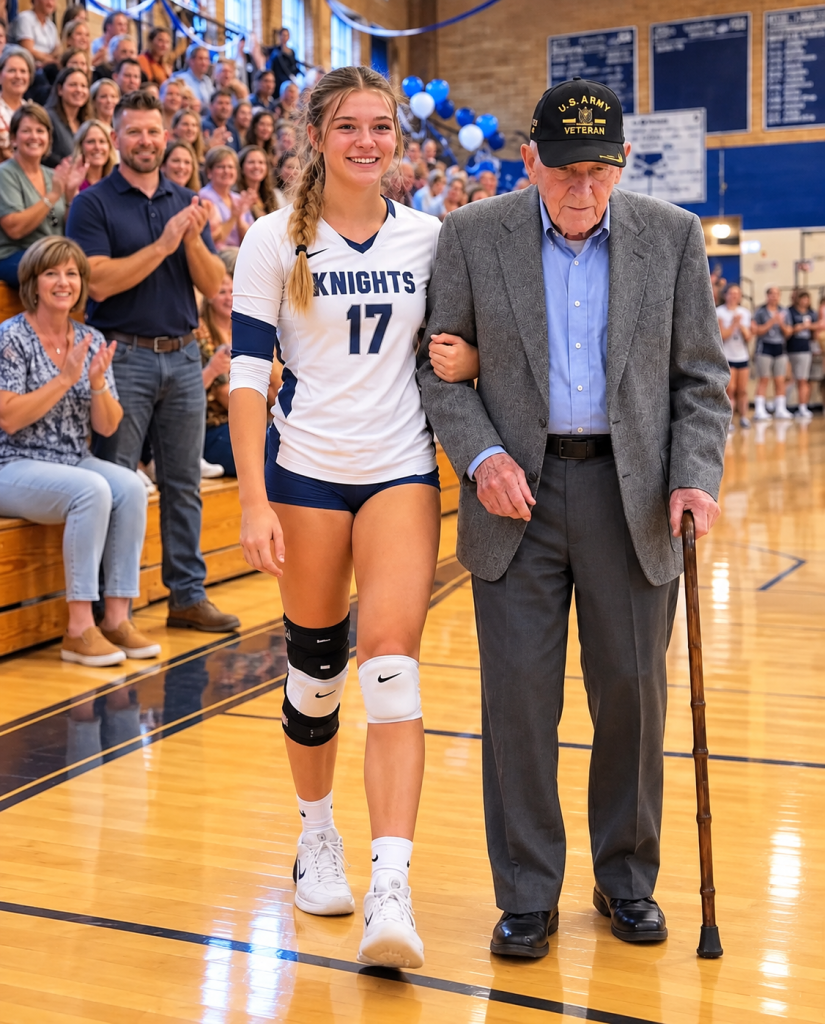
Dad stood there in his tan Sunday jacket, freshly pressed white shirt, polished shoes and favorite green seed-company cap. His hickory cane rested in his right hand. He did not look toward the bleachers. He walked directly to the athletes waiting across the gym.
Kaylee saw him and smiled. She slipped her arm through his.
Beside me, Travis turned.
“Jodi, is that your father?”
I nodded. “Kaylee asked him to escort her.”
Travis looked back at the court. “She asked him?”
“Yes.”
He rubbed his thumb along the edge of the bleacher seat. “You knew she was going to do that?”
“She asked me last night.”
“And you didn’t tell me.”
“I didn’t know what you would do.”
He looked at me then, but the announcer was already lifting the microphone. There was no time for either of us to say more.
“Number seventeen, Kaylee Brandt, escorted tonight by her grandfather, Mr. Duane Ostrem!”
Kaylee gently took Dad’s arm. He planted his cane on the polished floor, and they began walking.
Slowly.
Carefully.
Cane. Step. Step.
The rubber tip made a faint squeaking sound each time it touched the hardwood. Dad kept his eyes on the floor, concentrating on every step. Kaylee adjusted her pace without rushing him.
Someone in the highest row stood. Another person followed. Then an entire section rose. Farmers who had known Dad for decades stood with them. Parents, students, teachers and even the visiting volleyball team joined in.
Within moments, nearly everyone was standing.
I covered my mouth. Dad did not look at the crowd. He kept moving beside his granddaughter, steadying himself on the cane and letting her steady him with her arm.
Then I noticed Travis standing beside me.
He was not clapping. His eyes stayed on Kaylee and Dad. His jaw tightened, and he reached for the metal railing at the end of our row.
He glanced at me once.
Then he took his first step down from the bleachers.
I thought he might leave. I was wrong.
He went down the steps slowly, stopping once to let a family move past him. The applause continued over him. By the time he reached the floor, Kaylee and Dad had almost reached center court.
Travis stayed several feet away. He did not interrupt the announcement or call Kaylee’s name. He stood there while Dad reached the marked spot and received the red rose from the coach.
Kaylee turned toward him.
Dad noticed Travis before she did. He leaned slightly toward her and said, “You want me to stay?”
“Yes,” Kaylee said.
Dad nodded. “I’m right here.”
The announcer spoke about Kaylee’s years on the volleyball team, her position and the work she had put into the season. Travis listened with his hands at his sides. When the applause came again, he looked down at the floor.
Kaylee was given the rose. She held it for a moment, then handed it to Dad.
He accepted it with a small smile.
“Thank you, Grandpa,” she said.
“You’re welcome, sweetheart.”
The coach moved on to the next part of the ceremony, and people began returning to their seats. Travis remained on the court.
“Kaylee,” he said.
She looked at him but did not move closer.
“Can I talk to you?”
“You’re talking.”
His mouth tightened. “I know.”
Dad rested both hands on his cane. He did not leave.
Travis looked at him. “Mr. Ostrem, I’m not trying to take your place.”
Dad answered without hesitation. “You aren’t.”
The words landed harder than an argument would have. Travis looked back at Kaylee.
“I told you that walk was for your real dad,” he said.
“You did.”
“I was wrong.”
Kaylee held the rose against her chest. “You said you didn’t want a role that wasn’t yours.”
“I said that because I was scared of calling it mine.”
She did not respond.
Travis glanced toward the bleachers, where I was still standing near the railing. “I thought if I walked with you, people would think I was pretending to be something I wasn’t.”
Kaylee’s voice stayed quiet. “You didn’t have to pretend.”
“I know that now.”
“No, you knew it before.”
Travis looked down. The next senior’s name echoed through the gym, followed by another burst of applause.
He swallowed. “You asked me, and I made you feel like the nine years didn’t count.”
Kaylee’s face tightened, but she did not cry. “That’s what it felt like.”
“I’m sorry.”
She looked at Dad, then back at Travis. “You don’t get to call yourself my real dad just because you’re sorry now.”
“I’m not asking you to.”
“Then what are you asking?”
He took a breath. “I’m asking if I can still be Travis.”
It was not a perfect apology. That was probably why I believed it. He was not claiming that he had always known the right thing. He was admitting that he had chosen a narrow definition of fatherhood because it protected him from feeling exposed.
Kaylee looked at him for several seconds.
“You were supposed to say yes,” she said.
“I know.”
“You didn’t even say you were proud of me.”
Travis’s eyes moved to the rose in her hands. “I am proud of you.”
“You should have said it Tuesday.”
“I should have.”
Dad looked toward the court, giving them a little space without moving away. Kaylee pressed the stem of the rose between her fingers.
“I’m still giving this to Grandpa,” she said.
Travis nodded. “You should.”
“And he’s still walking me back after the ceremony.”
“I know.”
She studied him. “You can sit with Mom.”
“I will.”
“Don’t make this about you.”
“I won’t.”
That was all she offered him. Travis accepted it and walked back toward the bleachers with me. He did not reach for my hand. He sat down and watched the rest of the ceremony.
For a while, neither of us spoke. The gym settled into the ordinary sounds of a school event: names, applause, squeaking shoes and parents calling to one another. Then Travis leaned toward me.
“You knew I was going to regret it,” he said.
“I knew Kaylee was going to remember it.”
He looked at the court. “That’s worse.”
“Yes.”
He nodded once. “I earned that.”
I did not comfort him. I was still angry, and I was also angry at myself for having waited. The public apology had mattered to Kaylee, but it did not erase the private moment when he had looked at her and decided the word father belonged to someone who had been absent for six years.
After the ceremony, people gathered near the gym entrance. Several farmers stopped to speak to Dad. One of Kaylee’s teachers hugged him and told him she was glad he had made the walk. Dad accepted the attention awkwardly and kept asking whether Kaylee had received her rose.
Travis stood near the doors until the crowd thinned. Then he approached Dad.
“I’m sorry I put you in the position of covering for me,” he said.
Dad frowned. “I wasn’t covering for you.”
“No. I know.” Travis looked at the cane. “I mean, I’m sorry she needed you because I wouldn’t do it.”
Dad studied him for a moment. “She asked me because she wanted me.”
Travis nodded.
Dad added, “You don’t have to compete with me.”
“I thought I did.”
“That was your mistake.”
Travis looked toward Kaylee, who was talking with two teammates. “I don’t know how to fix it.”
“Start by not making her carry your shame.”
Travis’s face tightened. “I’m not trying to.”
“You brought it to the court.”
Dad’s voice was not harsh. That made it harder for Travis to dismiss. He looked down at the polished floor.
“I’ll talk to her again,” he said.
“Talk less,” Dad replied. “Listen when she answers.”
Travis nodded. “I can do that.”
On the drive home, Kaylee rode with me and Dad. Travis followed separately because he had come straight from the warehouse. I kept thinking about the beginning of the evening, when I had feared his step toward the court might be another attempt to reclaim attention.
It had not been.
He had gone down there because he understood that the moment belonged to Kaylee, and because he knew he had to face what he had said where other people could see him.
The next morning, Travis asked Kaylee if he could speak with her before school. She agreed in the hallway outside her room. I heard their voices from the kitchen but did not listen at the door.
A few minutes later, Kaylee came in for her backpack.
“How did it go?” I asked.
“He apologized again.”
“Did you talk?”
“A little.”
“What did you say?”
She put the backpack over one shoulder. “I told him I’m not ready to act like Tuesday didn’t happen.”
“That sounds fair.”
“He said he won’t ask me to.”
She looked tired, but not closed off.
“Are you all right?” I asked.
“I will be.”
At the door, she stopped and turned back. “Grandpa said he’ll come to my last game too.”
“He will.”
“And Travis said he’ll be there.”
I waited.
“He said he’ll sit wherever I want him to sit.”
That was not forgiveness. It was not a return to normal. It was a condition, and Travis had accepted it.
Over the next few weeks, he did not make a public display or keep asking Kaylee to reassure him. He attended her games, sat where she told him to sit and congratulated her without turning every conversation toward the mistake he had made. When she wanted to talk, he listened. When she did not, he let the silence stand.
I also had to speak to him plainly.
“You should have known better,” I told him one evening.
“I did know better,” he said. “I just didn’t want to admit what knowing better required.”
“You hurt her.”
“I know.”
“You hurt me too.”
He looked at me. “Because I made you watch me do it.”
“Yes.”
He took that in without defending himself. “I’m sorry, Jodi.”
This time, I believed him enough to answer. “Then don’t make me be the person who explains your family to you.”
“I won’t.”
I did not promise that everything was repaired. It was not. Kaylee had learned that love could be present for years and still retreat behind a technicality when a meaningful moment arrived. Travis had learned that showing up to practices and games was not the same as letting a child know she had a permanent place in his heart.
My father had never needed a title to walk beside her. He had only needed her to ask.
At the end of the season, Kaylee gave him the framed team photograph she had received from the school. Travis was in the picture too, standing near the back with the other family members. She did not give him the rose from senior night, but she invited him to her graduation.
When the invitation arrived, she handed it to him herself.
“Are you coming?” she asked.
Travis looked at her. “If you want me there.”
“I do.”
“Then I’ll be there.”
She nodded. “Good.”
It was a small exchange, but it was the first time she had given him a place without him trying to claim one. Travis understood that the invitation was not proof that Tuesday had been forgotten. It was proof that he had begun doing the work of being trusted again.
On senior night, my father walked slowly across the court with Kaylee, and the whole gym rose for them. Travis had refused that place when it was offered. Before the evening ended, he admitted that it had always been his to earn, not his to reject.