 Reading Time: 32 minutes
The night my father locked me out of our house, the temperature was twelve degrees below zero. I was twenty-four years old. I was a registered nurse.
And I had just helped save an elderly man’s life during one of the worst blizzards Minnesota had seen that winter. But none of that mattered to my father.
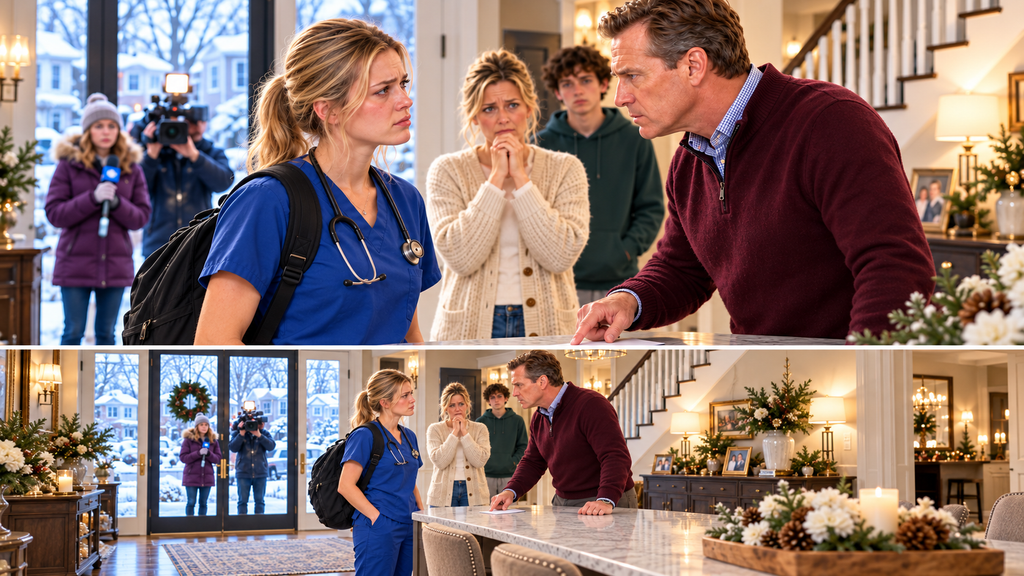
When I reached our front door at 12:20 in the morning, exhausted from a fourteen-hour hospital shift, my fingers were so numb that I could barely turn the key.
I pushed the door open.
It moved three inches.
Then stopped.
The security chain was fastened from the inside.
For several seconds, I stood there, staring at the narrow opening.
Warm yellow light spilled through the gap.
I could smell my mother’s vanilla candle.
I could hear the television playing somewhere in the living room.
Someone was awake.
“Dad?” I called.
No answer.
I knocked again.
“Dad, please. It’s Kayla.”
Then I heard his footsteps.
Relief flooded through me.
Surely, once he saw my wet scrubs, my trembling hands, and the snow covering my hair, he would understand.
His face appeared through the opening.
“You’re late.”
I swallowed.
“I know, Dad. The hospital was understaffed because of the storm. And on my way home, I found a man trapped in a ditch. I had to help him.”
His expression didn’t change.
“What time is curfew?”
I stared at him.
“Dad, please. It’s freezing.”
“What time?”
“Ten.”
“And what time is it now?”
I glanced down at my phone.
“Twenty after midnight.”
He gave a small, satisfied nod.
“Then you know the consequences.”
My stomach dropped.
“You’re not seriously going to leave me out here?”
His eyes hardened.
“Rules are rules, Kayla.”
Then he pushed the door closed.
I heard the chain rattle.
And just like that, I was standing outside my childhood home in a blizzard, while my father remained safely inside.
I didn’t know it yet, but that night would destroy the way I saw my family.
By morning, news cameras would be parked in our driveway.
My father’s phone would be ringing nonstop.
And the one person he had always believed he could control would finally do something he never expected.
But the real turning point didn’t happen in front of the television cameras.
It happened hours earlier, when a stranger asked me a question my own parents hadn’t bothered to ask.
“Sweetheart, are you somewhere warm?”
And for the first time in my life, I couldn’t bring myself to lie.
PART ONE — THE RULES I WAS NEVER ALLOWED TO QUESTION
My name is Kayla Mercer.
At twenty-four, I worked as an emergency department nurse at a hospital in St. Cloud, Minnesota.
I loved my job.
Even on the worst days, when the emergency room was overflowing and I barely had time to drink water, I felt that I was doing something important.
Nursing gave me a purpose.
It gave me responsibility.
It gave me the confidence to make difficult decisions when another person’s life depended on them.
But every evening, the moment I stepped inside my parents’ house, that confidence disappeared.
Because under my father’s roof, I wasn’t Nurse Mercer.
I wasn’t a college graduate.
I wasn’t a grown woman paying her own bills.
I was simply Kayla.
The daughter who was expected to obey.
My father, Richard Mercer, had been an assistant principal for more than twenty years.
He was respected in our community.
He wore neatly pressed shirts, attended church every Sunday, and volunteered at school fundraisers.
Parents praised his discipline.
Teachers admired his consistency.
Students feared being called into his office.
And at home, he ruled with the same unquestioned authority.
The family refrigerator displayed a laminated sheet of rules.
Curfew was ten o’clock on weekdays.
Eleven on Saturdays.
Bedroom doors were not allowed to be locked.
Our phone locations had to remain shared.
Guests required forty-eight hours’ notice.
And the final rule, written in thick blue letters, read:
DOORS OPEN AT 6:00 A.M. NO EXCEPTIONS.
My younger brother Tyler was twenty.
He worked part-time at a tire shop and attended community college.
Some nights, he came home after midnight.
Other nights, he stayed out until two.
My father never seemed especially bothered.
Once, I asked why.
Dad lowered his newspaper.
“Your brother knows how to handle himself.”
“And I don’t?”
“You’re a young woman, Kayla. Different risks.”
“But I work in an emergency department. I handle serious situations every day.”
He smiled the way he did when a student challenged school policy.
“Then you should understand why rules matter.”
That ended the discussion.
It always did.
Eighteen months earlier, when I graduated from nursing school, Dad had offered what he called a generous arrangement.
I could stay home while paying off my student loans.
Six hundred dollars per month for room and board.
Another hundred and fifty for the old blue Toyota Corolla he allowed me to drive.
The car was still registered in his name.
He called that arrangement practical.
At the time, I agreed.
I had thirty-eight thousand dollars in student debt.
Rent in the area was expensive.
And moving out seemed frightening.
Dad made sure I understood that living there was a privilege.
“You save money,” he told me, “and we maintain standards.”
For a while, I convinced myself it was reasonable.
I was lucky, wasn’t I?
Some people didn’t have parents willing to help them.
Some people didn’t have a childhood bedroom to return to.
So I paid my money.
I followed the rules.
I apologized when I was five minutes late.
And I ignored the little voice inside me asking why being an adult still required permission.
There was one event my father frequently used to justify his strictness.
When he was seventeen, his older brother Danny had died in a car accident.
Danny was nineteen.
He had been driving home after a party when his car left the road and struck a tree.
My father never forgot that funeral.
Whenever Tyler or I questioned him, he brought it up.
“I watched my mother bury her son,” he would say. “You’ll never understand what that does to a family.”
And then came the sentence I had heard throughout my childhood.
“Rules are how I keep you alive.”
I believed him for years.
Until the night his rules nearly cost me my own life.
PART TWO — THE BLIZZARD
The storm started shortly before noon.
By three o’clock, snow was sweeping across the hospital parking lot so heavily that I could barely see the ambulances arriving outside the emergency entrance.
By six, several major roads were closing.
Accidents came in one after another.
A teenager with a broken shoulder.
An older man suffering chest pain.
A woman who had fallen on ice and fractured her hip.
Two people injured when their pickup slid into a drainage ditch.
Every treatment room was full.
At 7:45, my supervisor, Marisol, approached the nurses’ station.
Her expression told me what she was about to say.
“Kayla, I need a favor.”
I looked up from a patient’s chart.
“How bad?”
“Two night nurses are stranded on Highway 10. Another called out. Brooke is trying to get here, but the roads are nearly impassable.”
I glanced at the clock.
My shift should have ended at eight.
Marisol sighed.
“I hate asking, but I need you to stay until someone arrives.”
I didn’t hesitate.
“Of course.”
She squeezed my shoulder.
“Thank you.”
At 8:15, I stepped into the supply room and sent a message to our family group chat.
Held over at work. Night nurses stuck in the storm. Roads are terrible. I’ll be home late. I’m sorry.
Mom responded with a heart.
Dad sent one word.
Red.
In our house, red meant a violation.
It meant I had crossed a boundary and could expect consequences.
I stared at my phone.
Then put it away.
There were patients waiting for medication.
An elderly woman needed oxygen.
A frightened teenager was crying because his mother couldn’t reach the hospital.
I had responsibilities.
And for once, I refused to let my father’s anger take precedence over them.
At 10:15, Brooke finally arrived.
Her eyelashes were coated with melting snow.
“I’m so sorry,” she gasped, pulling off her gloves. “There were cars everywhere. I thought I wasn’t going to make it.”
“You’re here now,” I told her.
I finished giving my report and collected my things.
Outside, the wind struck me with such force that I almost lost my balance.
It took nearly fifteen minutes to clear enough ice from my Corolla to drive safely.
When I finally pulled out of the parking lot, my dashboard clock read 10:32.
I was already more than half an hour past curfew.
I knew Dad would be angry.
But I told myself the storm was different.
Surely even he could recognize an emergency.
I was wrong.
And before I discovered just how wrong, I encountered someone who needed me even more than the hospital had.
PART THREE — THE MAN IN THE SNOWBANK
I was driving along County Road 75 when I noticed an orange light flickering through the snow.
At first, I thought it was a road marker.
Then I saw another flash.
Hazard lights.
I slowed down.
Through the blowing snow, I could make out the rear of a sedan buried deep inside a roadside ditch.
Its front end was angled toward a snowbank.
One rear tire was barely visible.
I pulled over in a safe spot and turned on my hazards.
Something about the vehicle made my chest tighten.
There were no tire tracks suggesting anyone had escaped.
No footprints leading toward the road.
I called 911 and explained what I could see.
The dispatcher warned me that emergency crews were delayed.
“Do not put yourself in danger, ma’am.”
“I understand.”
I took my phone, flashlight, and emergency blanket from the trunk.
Then I cautiously approached the ditch.
“Hello?” I shouted.
The wind swallowed my voice.
“Is anybody there?”
A faint sound reached me.
A groan.
I aimed my flashlight toward the driver’s side.
And there he was.
An elderly man was sitting in the snow beside the car, his back pressed against a tire.
His face was pale.
Blood had frozen along his forehead.
One wrist was bent at an unnatural angle.
His lips were turning blue.
“Oh, God,” I whispered.
I carefully made my way down.
“Sir? My name is Kayla. I’m a nurse. Can you hear me?”
He slowly raised his head.
“Deer,” he murmured.
“What?”
“Stupid deer. Ran right in front of me.”
I crouched beside him.
“What’s your name?”
“Walter. But everybody calls me Walt.”
“Okay, Walt. We’re going to get you warm.”
He gave a weak laugh.
“That sounds… pretty good.”
I checked his responsiveness and looked for signs of additional injuries.
His hands were frighteningly cold.
He told me his car engine had stopped and he had tried to climb out.
He slipped.
Then couldn’t stand up again.
“How long have you been here?”
He shook his head.
“Don’t know. Maybe an hour.”
I felt cold spread through my stomach.
An hour.
In that weather.
His condition was serious.
“Listen to me, Walt. Help is coming. But we need to get you out of this wind.”
He looked up the steep ditch.
“Can’t climb.”
“We’ll do it together.”
It took everything I had.
I supported him while he pushed with his legs.
Every few feet, we stopped so he could catch his breath.
Twice, he slipped.
Once, I thought we might both fall.
But finally, we reached my car.
I helped him into the passenger seat and turned up the heat.
Then I removed my winter coat and placed it around his shoulders.
“You’ll freeze,” he protested.
“I’m tougher than I look.”
“That’s what my wife used to say.”
“What’s her name?”
His expression softened.
“Joanie.”
“She waiting for you?”
He looked down.
“Not anymore. Lost her four years ago.”
“I’m sorry.”
He nodded.
“Thirty-eight years married. Still catch myself buying two coffees.”
Something tightened behind my ribs.
I thought of all the things people kept doing after someone they loved was gone.
I thought of a house where nobody would be waiting for Walt tonight.
And suddenly, getting him out of that ditch felt even more important.
I wrapped the emergency blanket around his legs.
Then I checked that snow wasn’t blocking the exhaust pipe before keeping the engine running.
For nearly forty minutes, we waited.
I kept him talking.
He told me he had driven county snowplows for thirty-one years.
He told me about his daughter Dana, who owned a bakery in Sartell.
He told me Joanie used to complain that he loved winter more than her.
“She was wrong,” he whispered.
I smiled.
“She probably knew that.”
At 11:20, a state trooper arrived.
An ambulance followed eighteen minutes later.
When the paramedics moved Walt onto the stretcher, he grabbed my hand.
“Kayla?”
“I’m here.”
“You’re a good girl.”
His voice trembled.
“Joanie would’ve liked you.”
I squeezed his hand.
“I think I would’ve liked her, too.”
Before they loaded him into the ambulance, he looked at me once more.
“Get home safe, sweetheart.”
I promised I would.
That promise would haunt me for the next several hours.
PART FOUR — THE DOOR THAT WOULDN’T OPEN
By the time I reached my parents’ neighborhood, it was after midnight.
Snow covered the lawns.
Most houses were dark.
I pulled into the driveway and sat for a moment, watching the warm light glowing behind our kitchen curtains.
Home.
I was exhausted.
My knees hurt.
My fingers ached.
But I was home.
I thought about calling Dad before stepping outside.
Then I decided against it.
I had already explained the emergency.
He would understand once he saw me.
I grabbed my bag and hurried toward the porch.
The key turned.
The door opened three inches.
And the chain caught.
My heart sank.
“Dad?”
His face appeared.
We argued briefly.
I told him about the hospital.
About Walt.
About the ambulance.
He listened without interrupting.
Then he asked what time curfew was.
I answered.
Ten.
“Exactly,” he said.
“Dad, I couldn’t leave that man to die.”
“And I didn’t tell you to.”
“Then please open the door.”
His voice remained perfectly calm.
“You should have asked permission to stay out.”
I stared at him in disbelief.
“Permission? Dad, a man was freezing in a ditch!”
“Lower your voice.”
“Please.”
“Actions have consequences.”
I felt tears sting my eyes.
“Are you really going to leave me outside?”
He looked at me for one long moment.
Then said the words I would never forget.
“Rules are rules.”
The door closed.
I heard his footsteps retreating.
For a few seconds, I remained on the porch.
Surely this was a bluff.
Surely Mom would come downstairs.
Surely someone would realize that leaving a person outside at twelve below zero wasn’t discipline.
It was dangerous.
I knocked again.
Nothing.
I called Dad.
Voicemail.
I called Mom.
No answer.
At 12:31, my phone vibrated.
It was a message from her.
I’m so sorry, honey. Your father is firm on this. Please keep the engine running. Doors open at six.
I read it three times.
My mother knew.
She knew exactly where I was.
She knew how cold it was.
And she had chosen not to open the door.
That realization hurt more than the wind.
I slowly walked back to my car.
The seat felt like ice.
I started the engine long enough to warm the interior, taking precautions against exhaust buildup, and began planning how to stay safe.
But the more I tried to think like a nurse, the more frightened I became.
Six hours.
They expected me to remain outside for six hours.
I looked up at my bedroom window.
I could see the corner of the curtains I had chosen when I was sixteen.
My diploma hung on the wall behind them.
The bed where I had slept since childhood was only a few yards away.
Yet I was being treated like a stranger who had no right to enter.
I thought about calling the police.
I thought about driving back to the hospital.
I thought about knocking on a neighbor’s door.
But years of conditioning made each option feel like betrayal.
If I left, Dad would say I had embarrassed the family.
If I asked for help, he would accuse me of making trouble.
If I complained, he’d say I was being dramatic.
So I stayed.
And hated myself a little for how quickly obedience still overcame common sense.
PART FIVE — THE CHILDHOOD MEMORY I COULDN’T ESCAPE
Sitting in that freezing car brought back a memory I had tried to bury.
I was seventeen.
It was October.
I had stayed late after a school play rehearsal because a fourteen-year-old girl named Ava was waiting for her mother.
Her mother’s car had broken down.
The parking lot was nearly empty.
I didn’t want Ava standing alone in the dark.
So I waited with her.
We talked about homework and music until her mother finally arrived.
Then I drove home.
It was 10:40.
Twenty minutes before I reached the porch, I already knew what would happen.
The door opened three inches.
The chain was on.
I knocked.
Dad’s bedroom light went out.
I spent that night on the porch swing, wrapped in an old furniture cover.
At six the next morning, Dad opened the door and told me:
“Consistency is love.”
I became ill afterward.
But I learned the lesson he wanted me to learn.
Never be late.
Never question him.
Never put anyone else’s needs before his rules.
For seven years, I obeyed.
Until the night I saved Walt.
Now, sitting outside in the Corolla, I realized something that made my throat tighten.
My father had never really been teaching me safety.
He had been teaching me that his authority mattered more than my circumstances.
At 1:20, headlights suddenly swept across the windshield.
Tyler’s red pickup pulled into the driveway.
Before he reached the garage, its door began opening.
I sat upright.
Through the kitchen window, I saw Dad standing beside the garage controls.
Wearing his robe.
Holding a coffee mug.
Watching.
He was awake.
He had been awake.
My brother drove inside.
The garage door closed.
I stared at it.
Tyler was home after one in the morning.
And Dad had opened the garage for him.
My hands shook as I sent a text.
Tyler, can you please open the front door? I’m in the driveway.
He replied a few minutes later.
Sorry, sis. Dad said no. I asked him earlier if I could stay at Jake’s until the roads improved. He gave me permission.
I looked at the message.
Permission.
There it was again.
Tyler had asked permission.
I had been helping save someone’s life.
And somehow, I was the one who deserved punishment.
For the first time, I stopped looking for a way to make my father understand.
He understood perfectly.
He simply didn’t care enough to change his decision.
PART SIX — THE STRANGER WHO SHOWED UP FOR ME
At 1:48, my phone buzzed again.
An unfamiliar number.
Hi, Kayla. This is Dana, Walt’s daughter. Dad keeps asking whether you made it home. He says you gave him your coat.
I felt the corners of my mouth lift.
Even injured in a hospital, Walt was worrying about me.
I typed back.
I’m so glad he’s okay. Please tell him I’m fine.
Almost immediately, Dana answered.
Are you somewhere warm?
I stared at those words.
I looked toward the house.
I thought of Mom’s message.
Doors open at six.
I started to type:
Yes, I’m home.
Then stopped.
Why was I protecting them?
Why was I lying to someone who had shown me nothing but kindness?
Slowly, I erased the sentence.
I’m sitting in my car outside my parents’ house. My dad locked me out because I missed curfew. I’m okay.
Dana responded so quickly that I wondered whether she had dropped her phone.
WHAT?
Then:
Kayla, it’s twelve below zero.
I know.
Send me your address. Right now.
I tried to reassure her.
But Dana wasn’t interested in reassurance.
You saved my father’s life tonight. You are not sleeping in a freezing driveway.
Twenty minutes later, a vehicle stopped behind me.
A woman wearing a purple winter coat climbed out carrying a thermos and a folded blanket.
She knocked gently on my window.
“Kayla?”
I opened the door.
“I’m Dana.”
Before I could speak, she wrapped the blanket around my shoulders.
It smelled faintly of cedar.
“That’s Dad’s old army blanket,” she explained. “He told me to bring it to you.”
I looked at her.
“You came all the way here?”
“Of course I did.”
“But your dad—”
“He’s stable. He’s got a broken wrist, a nasty cut, and a very strong opinion about the hospital coffee.”
Despite myself, I laughed.
Dana handed me a cup from the thermos.
The coffee was too sweet.
Too hot.
Absolutely wonderful.
Then she glanced at the house.
“Which room is your father’s?”
I stiffened.
“Please don’t.”
She looked back at me.
“Don’t what?”
“Don’t confront him. It’ll only make things worse.”
Her expression changed.
Not to anger.
To sadness.
“Oh, honey.”
Those two words nearly broke me.
She sat beside me in the car.
For a while, neither of us spoke.
Then she said quietly:
“My father spent thirty-one years plowing roads in storms like this. He missed birthdays, Christmas dinners, and anniversaries because somebody had to clear the roads.”
I nodded.
“He told me.”
“He always said the same thing when people complained about him being late.”
“What?”
Dana looked straight at me.
“Better to come home late than not come home at all.”
My eyes filled.
Because an elderly stranger understood something my own father refused to acknowledge.
Dana offered to take me home with her.
She had a warm couch.
A spare room.
Food.
I almost accepted.
But the old fear held me back.
“If I leave, Dad will make this into a huge thing.”
Dana was quiet for a moment.
Then she said:
“Kayla, this is already a huge thing.”
She stayed with me for a while.
Before leaving, she made me promise to seek warm shelter if I began feeling unwell, and I agreed.
As she stepped outside, she paused.
“Someone ought to know what happened here.”
I didn’t understand what she meant.
Not until morning.
PART SEVEN — THE REPORTER AT OUR DOOR
At exactly six o’clock, the chain slid free.
Dad stood in the doorway, shaved and dressed in his usual robe.
He looked rested.
I felt like I had aged ten years.
“Good morning,” he said.
I stared at him.
“Come in.”
I stepped inside.
Warm air rushed against my face.
My knees were stiff.
My hands burned as feeling returned.
Dad watched me remove my shoes.
“Now you understand that the rules still apply.”
I couldn’t answer.
He sipped his coffee.
“The world doesn’t make exceptions, Kayla.”
I looked at him.
“No,” I whispered. “Sometimes it does.”
He frowned.
“What?”
“Nothing.”
I went upstairs.
For the first time, the silence wasn’t surrender.
It was exhaustion.
I took a hot shower, dried my hair, and collapsed onto my bed.
Before sleeping, I checked my savings account.
Five thousand two hundred dollars.
I had been saving to move out in June.
I had also been considering a night-shift position at the hospital.
Four dollars and fifty cents more per hour.
Better training opportunities.
More independence.
I had refused it because the schedule violated Dad’s curfew.
Now I opened my email.
And wrote to Marisol.
Is the night position still available? I’d like to apply.
I pressed send before I could change my mind.
Then I fell asleep.
At 8:45, the doorbell woke me.
It rang again.
Then a third time.
I pulled on a sweatshirt and stepped onto the upstairs landing.
Mom was standing by the open front door in her pale-blue robe.
Outside stood a woman holding a microphone.
A cameraman stood behind her.
A white news van was parked near the curb.
The reporter smiled politely.
“Good morning, ma’am. I’m Nina Alrech with Channel 7.”
Mom looked confused.
Then Nina asked the question that changed everything.
“Is this where the nurse who slept in her car last night lives?”
My mother’s face drained of color.
From the stairs, I saw Dad appear in the hallway.
His expression changed instantly.
He stepped forward.
“There’s been a misunderstanding.”
The reporter glanced at him.
“Sir, we’re here because of a post shared by Walt Brandt’s family. They say your daughter rescued him during last night’s blizzard.”
Dad nodded stiffly.
“Yes, that’s correct.”
“And they mentioned she spent the rest of the night in her car because she wasn’t allowed inside?”
Mom pressed a hand against her mouth.
Dad’s jaw tightened.
“That part has been exaggerated.”
I felt something twist inside me.
Exaggerated.
He had watched me sit outside in twelve-below-zero weather.
He had deliberately opened the garage for Tyler.
He had ignored my calls.
And now, in front of strangers, he was calling it an exaggeration.
The reporter continued.
“We’d love to speak with Kayla about the rescue.”
Dad forced a smile.
“Give us a few minutes.”
He closed the door.
Then turned toward me.
“Kitchen. Now.”
PART EIGHT — THE LIE HE EXPECTED ME TO TELL
Dad gathered us around the kitchen island.
Mom stood beside the sink.
Tyler hovered near the doorway.
I remained across from my father.
He pulled a small index card from his pocket.
“I’ve thought about how we can clear this up.”
He slid it toward me.
Three instructions were written in his neat blue handwriting.
Thank the Brandt family.
Explain the lock froze during the storm.
Say I chose to wait in the car rather than disturb anyone.
I read the card.
Then looked up.
“The lock didn’t freeze.”
Dad’s expression hardened.
“Kayla.”
“The chain was on.”
“Don’t start.”
“You locked me outside.”
He leaned toward me.
“Do you have any idea what this could do to my reputation?”
I blinked.
“Your reputation?”
“Parents from my school watch that channel. People know who I am.”
I couldn’t believe what I was hearing.
“Dad, I could have gotten seriously hurt.”
He waved his hand.
“You were in a car.”
“It was twelve below zero.”
“And you’re standing here perfectly fine.”
Something inside me went very still.
He wasn’t sorry.
Not even a little.
He was afraid of embarrassment.
Mom stepped forward.
“Honey, maybe we can just explain that everyone was stressed because of the storm.”
I turned toward her.
“Mom, you knew I was outside.”
Her face crumpled.
“I know.”
“You texted me to keep the engine running.”
“I was trying to help.”
“You could have opened the door.”
She looked down.
Dad struck the countertop with his palm.
“Enough.”
The room fell silent.
Then he pointed toward the television crew outside.
“You go out there, read what I wrote, and end this.”
I looked at the card again.
My entire childhood seemed to be contained in those three sentences.
Be agreeable.
Protect the family image.
Pretend nothing happened.
I slowly pushed the card back toward him.
“No.”
His eyebrows rose.
“What did you say?”
“I said no.”
He stared at me.
Then his voice dropped.
“Kayla, the vehicle you drove home last night belongs to me. This roof belongs to me. Think carefully about what you want to lose.”
I felt the familiar fear rush through me.
But beneath it was something new.
Clarity.
“Can I have five minutes?”
He studied me.
Then nodded.
“Five.”
I went upstairs and called Dana.
She answered immediately.
“Kayla, I’m so sorry. I should’ve warned you.”
“About the reporters?”
She sighed.
“I posted about Dad’s rescue. And I mentioned what happened afterward. People started sharing it. Channel 7 called.”
I sat on the edge of my bed.
“You shouldn’t have given them my address without asking.”
“I know. You’re right. I’m sorry.”
I took a breath.
“But you didn’t lie.”
“No.”
“Then I won’t either.”
When I returned downstairs, Dad was waiting.
“Well?”
I zipped up my coat.
“I’m going to tell them what happened to Walt.”
“And the rest?”
I met his eyes.
“I’m not going to lie.”
He stepped toward me.
But I walked past him.
And opened the front door.
All the way.
PART NINE — THE WORDS THAT CHANGED EVERYTHING
The television crew had been waiting near the driveway.
Nina approached.
“Kayla? Thank you for speaking with us.”
“You’re welcome.”
She smiled.
“First, tell us what happened on County Road 75.”
That part was easy.
I described seeing the hazard lights.
Calling 911.
Finding Walt injured in the ditch.
Helping him into my heated car.
Waiting for the ambulance.
I talked about how brave he had been.
How he kept making jokes even while he was frightened.
How important it was to check on people during severe weather without placing yourself in danger.
Then I thanked the nurses and emergency workers who had struggled through the storm.
Nina listened carefully.
Finally, she lowered her microphone for a moment.
“There’s something else I’d like to ask, if you’re comfortable.”
I knew what was coming.
“Okay.”
“Walt’s daughter says that after rescuing him, you returned home and found yourself locked out. She says you spent the night in your car because you had missed a ten o’clock curfew.”
Behind me, the storm door creaked.
Dad was standing on the porch.
His arms were crossed.
He gave me a small nod.
The signal I had obeyed all my life.
Say what I told you.
Do not embarrass me.
I looked at him.
For a second, I saw the father who had taught me to ride a bicycle.
The man who had applauded at my nursing graduation.
The person whose approval I had spent years trying to earn.
Then I remembered him standing beside the garage switch at 1:20, opening the door for Tyler while I froze only a few feet away.
I turned back toward the reporter.
“Yes,” I said.
Nina remained quiet.
“I got home at twenty after midnight. The security chain was on the door. I wasn’t allowed inside until six.”
“Because of the curfew?”
“Yes.”
“How cold was it?”
“Twelve degrees below zero.”
The cameraman stopped adjusting his equipment.
Nina’s expression softened.
“I’m sorry you experienced that.”
I swallowed.
“Thank you. But I’d rather focus on Walt. He’s the reason I’m standing here talking to you.”
She nodded.
“Of course.”
The interview ended.
I walked back toward the house.
Dad stepped aside without speaking.
As I passed him, I noticed his hands.
He was gripping his coffee cup so tightly that his knuckles had turned white.
He didn’t yell.
He didn’t threaten me.
He simply stared.
And somehow, his silence told me everything.
For the first time in his life, he had lost control of the story.
PART TEN — WHEN THE WHOLE TOWN STARTED TALKING
By noon, the report had begun spreading.
By afternoon, my phone was filled with messages.
Former classmates.
Coworkers.
Neighbors.
People I hadn’t spoken to in years.
Most wanted to thank me for helping Walt.
Others wanted to know whether I was safe.
One message came from Ava, the girl I had waited with after the school play seven years earlier.
Kayla, I saw the news. You stayed with me when I was fourteen because you didn’t want me alone in the dark. I’ve never forgotten that. I hope someone is looking after you now.
I read her message three times.
Then cried.
Not because of Dad.
Not because of the news.
But because something I had considered insignificant had mattered to someone for seven years.
Dad had made me feel foolish for being late that night.
Ava remembered me for staying.
At 12:47, Marisol responded to my email.
The night position is still available. We’d love to have you. You can start February 9. Proud of you, Kayla.
I stared at the screen.
Proud of you.
No warning attached.
No criticism.
No reminder to remain humble.
Just pride.
I accepted immediately.
Later that afternoon, I drove to the hospital to visit Walt.
He had been moved out of intensive care.
When I entered his room, he was sitting upright, eating red gelatin with a look of deep concentration.
Dana sat near the window.
Walt looked up.
“Well, if it isn’t my favorite snowplow.”
I laughed.
“How are you feeling?”
“Like somebody drove a truck into my wrist.”
“Technically, you drove a car into a ditch.”
He grinned.
“Don’t get technical with an old man.”
I sat beside him.
He studied my face.
Then his smile softened.
“Dana tells me you had a rough night.”
“I’m okay.”
He lifted his good hand.
“Don’t do that.”
“Do what?”
“Tell people you’re okay because it’s easier than telling the truth.”
I looked down.
His voice became gentler.
“Kayla, my wife used to do that. Smile through things that hurt. Took me too many years to learn the difference.”
I couldn’t answer.
Dana leaned forward.
“There’s something we want to offer you.”
I looked between them.
Walt cleared his throat.
“I own a duplex in Sauk Rapids.”
I blinked.
“Okay.”
“The upstairs apartment’s empty. Has been since last summer.”
Dana continued.
“Dad’s going to need some help while his wrist heals. He refuses to let me move in because apparently I hover.”
“I do not need hovering,” Walt grumbled.
She ignored him.
“The apartment usually rents for seven hundred and fifty a month. We’d be happy to rent it to you.”
My heart began beating faster.
An apartment.
My own place.
No curfew.
No permission.
No chain.
“I couldn’t accept special treatment because I helped your dad.”
Walt frowned.
“Who’s asking you to?”
I looked at him.
“I’m saying I’d pay fair rent.”
“Then pay fair rent.”
Dana smiled.
“And Dad gets a nurse living upstairs, which means he’ll probably behave himself for once.”
Walt snorted.
“Highly unlikely.”
I laughed.
But my eyes filled with tears.
Walt reached across the bed and gently patted my hand.
“Think about it, sweetheart.”
Then he added:
“Just don’t do your thinking in a freezing driveway.”
PART ELEVEN — THE DINNER THAT ENDED EVERYTHING
I returned to my parents’ house just before six.
Dad was sitting in the living room.
Mom occupied the edge of the couch.
Tyler stood near the hallway.
Channel 7 was playing.
The report began.
There was Walt in his hospital bed, smiling and giving a thumbs-up.
There was Dana talking about the nurse who had saved her father’s life.
Then the screen showed me standing beside the Corolla.
I heard my own voice.
“The security chain was on the door. I wasn’t allowed inside until six.”
Dad switched off the television.
The room went silent.
Then he said:
“Kitchen.”
We followed him.
He sat at the head of the table.
His phone lay beside his plate.
For several seconds, he said nothing.
Then he turned the screen toward me.
Comments.
Hundreds of them.
Some were angry.
Some were sympathetic.
Several mentioned his school.
One read:
Isn’t that the assistant principal who gives kids detention for being late?
Dad’s face was red.
“Twenty-six years,” he said quietly.
I remained silent.
“Twenty-six years I’ve worked to build a reputation in this community.”
He pointed at the phone.
“And now I’m being humiliated over a household rule.”
“Dad—”
“No.”
He raised his hand.
“You wanted attention. Now you’ve got it.”
My stomach tightened.
“I didn’t ask for attention.”
“You talked to the reporter.”
“Because she was asking about a man I helped save.”
“You could have corrected the misunderstanding.”
“There wasn’t a misunderstanding.”
He stared at me.
Then leaned forward.
“Here’s what’s going to happen. You’re going to post a statement saying the situation was exaggerated. You’re going to tell people the lock froze.”
“No.”
He blinked.
“Excuse me?”
“I’m not saying something that isn’t true.”
His voice rose.
“Then you can move out by next Friday.”
Mom gasped.
“Rick!”
He ignored her.
“And the car stays here. Because it’s mine.”
There it was.
The threat.
The one he had always relied on.
My housing.
My transportation.
My financial security.
For a moment, fear rose so sharply that I almost agreed to everything.
Then I looked at Tyler.
“Tyler, what time did you get home last night?”
Dad struck the table.
“That is irrelevant!”
I kept my eyes on my brother.
“What time?”
Tyler shifted uncomfortably.
“One twenty.”
“And how did you get inside?”
He looked toward Dad.
Then down at his hands.
“Dad opened the garage.”
Mom turned slowly.
“What?”
Dad straightened.
“Tyler requested permission in advance.”
Mom stared at him.
“You were awake?”
Dad didn’t answer immediately.
“Linda—”
“You told me you were asleep.”
“I was trying to maintain order.”
Her voice trembled.
“You told me there was no point opening the door until six because you weren’t getting up.”
Dad sighed.
“That’s not the issue.”
Mom stood.
For the first time in my life, I saw genuine anger replace the fear on her face.
“She was outside in twelve-below-zero weather.”
“She violated curfew.”
“She was helping an injured man!”
“And I never said she shouldn’t have helped him!”
“Then why didn’t you open the door?”
The question hung in the air.
Dad looked at her.
Then at me.
Finally, he said:
“Because she needed to understand that rules have consequences.”
Mom slowly sat down.
Her face looked older.
As though something she had spent decades refusing to see had finally become impossible to ignore.
Dad rubbed his forehead.
Then his voice softened.
“All right.”
He stood and walked to the refrigerator.
He removed the laminated rules.
Picked up his blue pen.
And crossed out the ten o’clock curfew.
“Eleven,” he announced.
He wrote the new time.
“Midnight on work nights, provided you text in advance.”
He placed the sheet on the table.
“There. That’s reasonable.”
Mom looked at me hopefully.
“Kayla, that’s a big compromise.”
And she was right.
For my father, it was enormous.
He had changed a rule.
He had acknowledged that something needed adjusting.
Six months earlier, I would have been grateful.
I would have thanked him.
Maybe even hugged him.
But then he said:
“I’m willing to allow that.”
Allow.
Such a small word.
Yet it felt heavier than the security chain.
I looked at the paper.
Then at my father.
And suddenly I understood.
He was offering me another hour.
But he wasn’t offering respect.
He wasn’t apologizing.
He wasn’t acknowledging that deliberately leaving me in a freezing car had been wrong.
He was simply changing the terms under which he controlled me.
I reached into my pocket.
Removed the house key from my hospital lanyard.
And placed it on the table.
Then I added the Corolla key.
Dad stared.
“What are you doing?”
“I’m moving out.”
Mom covered her mouth.
Tyler looked up.
Dad gave a humorless laugh.
“Where exactly do you think you’re going?”
“I found an apartment.”
“You can’t afford one.”
“I can.”
“Without a car?”
“I’ll figure it out.”
He crossed his arms.
“You’re making a terrible mistake.”
I took a breath.
Then said the words I had spent seven years being too frightened to say.
“No, Dad. The mistake was believing I had to earn the right to feel safe in my own home.”
His expression changed.
“Don’t be dramatic.”
“You knew I was outside. You knew the temperature. You opened the garage for Tyler. You could have opened the front door for me.”
He looked away.
“You needed to learn a lesson.”
I nodded.
“I did.”
For one brief moment, he seemed relieved.
Then I continued.
“I learned that you would rather be right than keep me safe.”
The room went completely silent.
Dad’s face hardened.
But I wasn’t finished.
“And here’s my new rule.”
I pushed the house key toward him.
“I don’t live anywhere someone can lock me out because they’re angry.”
Then I took out my phone.
And called Dana.
PART TWELVE — THE NIGHT I FINALLY LEFT
Dana answered on the second ring.
“Kayla?”
“Is the upstairs apartment still available?”
There was a pause.
Then her voice softened.
“Yes, sweetheart.”
“I’d like to take it.”
“Okay.”
I swallowed.
“Could you possibly pick me up? I don’t have a car anymore.”
“Give me twenty minutes.”
When I ended the call, Dad was staring at me.
“You’re actually leaving?”
“Yes.”
Mom started crying.
“Kayla, please. Don’t leave angry.”
I looked at her.
“I’m not leaving because I’m angry.”
“Then why?”
“Because I’m tired of being afraid.”
Her face crumpled.
Dad pushed his chair back.
“You’ll come crawling back when you realize how difficult the real world is.”
I stood.
“Maybe.”
He looked surprised.
“Maybe it will be difficult,” I continued. “Maybe I’ll struggle. Maybe I’ll make mistakes. But they’ll be my mistakes.”
I walked upstairs.
Packing took forty minutes.
Two suitcases.
Three cardboard boxes.
My nursing books.
My diploma.
A framed photograph of my grandmother.
And the little thank-you card Ava had given me when I was seventeen.
At the bottom of my closet, I found a small wooden box.
Inside were old birthday cards from Dad.
One had been written when I turned ten.
To my little girl. I’ll always keep you safe.
I sat on the edge of my bed holding it.
For the first time that evening, I cried.
Because I didn’t hate my father.
That was the hardest part.
I remembered him teaching me multiplication.
I remembered riding on his shoulders at county fairs.
I remembered how proudly he had taken photographs at my nursing graduation.
I knew he loved me.
But I also knew his love had become tangled with fear and control.
And I couldn’t spend the rest of my life suffering because he refused to untangle them.
I put the card back in the box.
Then closed it.
Downstairs, Tyler was waiting.
He looked at my suitcases.
“Want help?”
I nodded.
“Yeah.”
He carried the boxes without speaking.
When we reached the porch, he stopped.
“Kayla?”
I turned.
He looked uncomfortable.
“I should’ve opened the door.”
I swallowed.
“You were afraid of Dad.”
He nodded.
“Yeah.”
“So was I.”
He looked down.
Then hugged me.
Awkwardly.
Tightly.
Like the little brother I remembered.
“I’ll miss you,” he whispered.
“I’ll miss you, too.”
Dana’s headlights appeared at the end of the driveway.
Mom hurried outside.
She held my winter coat, though I already had another one on.
For a moment, she simply stood there.
Then she draped it over my arm.
“Text me when you get there.”
I looked at her.
The same woman who had texted me to keep my engine running while I froze.
The woman who had finally questioned my father.
I wanted to be angry.
Part of me still was.
But I also saw how frightened she looked.
“I will, Mom.”
She touched my cheek.
“I love you.”
“I love you, too.”
Then I walked toward Dana’s SUV.
I didn’t look back until I reached the passenger door.
Dad was standing behind the living room window.
He wasn’t waving.
He wasn’t calling my name.
He just watched.
For once, I didn’t wait for his approval.
I got into the vehicle.
And left.
PART THIRTEEN — A HOME WITHOUT A CURFEW
Walt’s duplex stood on a quiet residential street in Sauk Rapids.
The upstairs apartment wasn’t fancy.
The kitchen was small.
The floors creaked.
One window stuck when I tried opening it.
But the radiators worked.
The rooms were clean.
And there was a little jar of peppermints on the counter that had belonged to Walt’s wife.
Dana handed me the key.
“Welcome home.”
Those words caught me by surprise.
Home.
I turned the key in the lock.
Opened the door.
And stepped inside.
Nobody asked what time it was.
Nobody demanded an explanation.
Nobody reminded me who owned the building.
I was simply allowed to enter.
Dana helped carry my boxes upstairs.
Before she left, she hugged me.
“You’ll be okay.”
I nodded.
For the first time, I believed it.
That night, I made my bed with sheets from one of my suitcases.
I spread Walt’s army blanket over the top.
Then lay down.
My phone showed 9:40.
I sent Mom a message.
I’m inside.
Her reply came quickly.
Good. I love you.
I stared at the words.
Then turned off my phone.
No alarm.
No curfew.
No listening for footsteps.
I slept for almost ten hours.
And when I woke up, the sun was shining through the window.
For a long moment, I didn’t recognize the room.
Then I remembered.
I had left.
I was free.
And instead of feeling guilty, I felt something I hadn’t experienced in years.
Peace.
PART FOURTEEN — THE CONSEQUENCES NOBODY EXPECTED
Over the next several weeks, my life changed in ways I hadn’t imagined.
I signed a proper lease.
I bought a used Subaru with most of my savings.
I began working the night shift on February ninth.
The hours were exhausting.
The work was demanding.
But the pay was better, and I was gaining valuable experience in emergency nursing.
Every time I drove home after sunrise, I felt grateful.
Not because life had become easy.
It hadn’t.
I still had student loans.
Car repairs.
Rent.
Groceries.
Insurance.
Some months, my budget was tight enough to make me nervous.
But those worries belonged to me.
And somehow, they were easier to bear than the fear of disappointing my father.
Walt recovered slowly.
His wrist required a cast and several follow-up appointments.
He complained about everything.
The brace.
The exercises.
His doctor’s instructions.
Dana’s constant reminders.
But every morning, I heard him moving around downstairs.
And every time I offered to carry groceries or check on him, he’d grin.
“Look at us. You saved me, now I get to boss you around.”
“You’re a terrible patient.”
“And you’re a bossy nurse.”
We developed a routine.
He made coffee.
I brought pastries from Dana’s bakery.
Sometimes, we sat together and talked about Joanie.
He showed me photographs of their wedding.
Their old vacations.
The garden she had loved.
One afternoon, he pointed to the jar of peppermints in my kitchen.
“She used to leave those out for everyone.”
I smiled.
“They’re still there.”
He nodded.
“Good.”
Then he looked toward the window.
“You know something, Kayla?”
“What?”
“Getting old teaches you that people don’t always stay as long as you want them to.”
I waited.
“But sometimes,” he continued, “someone shows up when you need them most.”
My eyes filled.
He patted my hand.
“Works both ways, sweetheart.”
Meanwhile, the attention surrounding my father slowly faded.
He kept his job.
The school didn’t dismiss him.
Life in our town continued.
But according to Tyler, Dad was no longer invited to lead certain school assemblies about discipline and character.
For a man who had built his identity around being respected, that hurt.
Mom began visiting every Tuesday.
Usually with a casserole.
Sometimes cookies.
Occasionally, just herself.
On her first visit, she stood at the bottom of the stairs.
“Can I come up?”
I smiled sadly.
“Of course, Mom.”
She hesitated.
Then asked:
“Does your father know I’m here?”
I looked at her.
And said gently:
“I don’t need his permission to have my mother visit.”
Her eyes filled.
“I know.”
Then she whispered:
“I think I’m finally beginning to understand that.”
We didn’t fix everything overnight.
Some conversations were uncomfortable.
Sometimes she defended Dad.
Sometimes I became frustrated.
But slowly, we learned to speak to each other without making his feelings the center of every discussion.
One afternoon, while washing dishes, Mom said something that surprised me.
“I saw you through the window that night.”
I froze.
She kept her eyes on the sink.
“Just before two. You were sitting in the car with that blanket wrapped around you.”
I didn’t speak.
“I wanted to come outside.”
My throat tightened.
“Why didn’t you?”
She began crying.
“Because I was afraid he’d be angry.”
I stared at her.
For years, I had believed Mom simply agreed with him.
Now I understood that she had been afraid, too.
But understanding didn’t erase what happened.
“Mom,” I said quietly, “I needed you.”
She covered her face.
“I know.”
“I was scared.”
“I know.”
“And you left me out there.”
She nodded.
For a long time, neither of us moved.
Then she whispered:
“I’m sorry, Kayla. Not because people found out. Not because it embarrassed us. I’m sorry because I should have opened that door.”
That was the apology I had been waiting for.
Not an excuse.
Not a justification.
An acknowledgment.
I hugged her.
We cried together.
And while it didn’t undo the night, it gave us somewhere honest to begin.
PART FIFTEEN — THE MESSAGE FROM MY FATHER
Dad contacted me only once during those first weeks.
It was a short text.
Sunday dinner. Six o’clock. If you want.
I looked at the message for a long time.
Once, an invitation like that would have thrilled me.
It meant he was ready to forget the disagreement.
It meant I was welcome again.
It meant everything could return to normal.
But I no longer wanted normal.
Normal had meant silence.
Normal had meant pretending I wasn’t hurt.
Normal had meant accepting a new rule instead of receiving an apology.
So I wrote back:
Dad, I’d be willing to see you. But before we sit down together, I need you to tell me what happened that night in your own words. Not what I did wrong. What you did.
I pressed send.
The message showed as delivered.
Then read.
No reply came.
Not that evening.
Not the next day.
Not the following week.
I wanted him to answer.
I wanted him to say he was sorry.
I wanted him to tell me that when he saw how badly I had suffered, he realized he had made a terrible mistake.
But he didn’t.
And for the first time in my life, I stopped chasing him for the words he wasn’t willing to give.
Sometimes silence is an answer.
Not necessarily forever.
But for now.
I had spent too many years filling that silence with apologies of my own.
I wasn’t going to do it anymore.
PART SIXTEEN — THE FINAL LESSON
Six weeks after moving into the duplex, I was getting ready for another night shift.
It was early March.
Fine snow drifted past the kitchen window.
Nothing like the blizzard that had changed my life.
Just a light, peaceful snowfall.
I pulled on my blue scrubs.
Fastened my hospital badge to my lanyard.
And checked the time.
6:20 p.m.
Months earlier, I would already have been calculating how quickly I could finish work and return home.
I would have worried about traffic.
About the clock.
About whether Dad would be standing in the kitchen when I arrived.
Now I had twelve hours of work ahead of me.
And nobody waiting to punish me for doing it.
I walked downstairs.
Walt was sitting on his porch in a heavy winter coat, a weather radio beside him.
His cast had been removed, though he still wore a brace.
“County 75’s clear!” he called.
I laughed.
“You’re supposed to be resting, Walt.”
“I’m retired. Not useless.”
“Did Dana tell you to sit outside in the cold?”
“Don’t tell Dana.”
I shook my head.
“You’re impossible.”
He grinned.
“Drive safe, Kayla.”
“I will.”
As I approached my Subaru, I glanced at the folded army blanket on the back seat.
The same blanket Dana had brought me that terrible night.
I had offered to return it several times.
Walt always refused.
“That blanket belongs with someone who knows what it’s for,” he had said.
I kept it there.
A reminder.
Of a man in a ditch.
A woman in a purple coat.
And the night strangers showed me the care I had spent years begging for at home.
Before starting the car, I checked that the exhaust pipe was clear.
Then I climbed inside.
The engine came to life.
Warm air moved through the vents.
I looked toward the duplex.
Walt lifted one hand.
I waved.
And drove toward the hospital.
That night, the emergency room was busy.
A little boy had broken his wrist sledding.
An elderly woman was struggling with pneumonia.
Two drivers arrived after a minor collision on Highway 10.
At three in the morning, Marisol appeared beside me carrying a cinnamon roll.
“Courtesy of Dana’s bakery.”
I laughed.
“That woman is going to make me gain twenty pounds.”
Marisol smiled.
“Look at you, owning the night.”
I glanced toward the windows.
Beyond them, the world was dark.
Snow drifted beneath the parking lot lights.
For a second, I remembered my father’s house.
The chain.
The cold.
The terrible feeling of being unwanted.
Then I looked around the emergency department.
At the nurses working beside me.
At the patients depending on us.
At the life I was building with my own decisions.
And I realized something.
I wasn’t afraid of the night anymore.
At 7:30, my shift ended.
The sky was beginning to turn pink.
I drove home through freshly plowed streets.
Coffee steamed in the cup holder.
Soft music played on the radio.
When I reached the duplex, Walt’s kitchen light was glowing downstairs.
I parked.
Collected my bag.
And climbed the outside staircase.
At the top, I took the key from my lanyard.
I stood in front of my door.
For one brief moment, the memory came back so clearly that I could almost feel the freezing wind against my face.
I remembered pushing the door.
Hearing the chain catch.
Begging my father to let me inside.
Then I placed the key in my own lock.
Turned it.
And pushed.
The door swung open completely.
Warm air greeted me.
Sunshine stretched across the kitchen floor.
My coat hook waited beside the wall.
The jar of peppermints sat on the counter.
There was no angry father.
No list of rules.
No curfew.
No one demanding an explanation.
Just the quiet home I had worked so hard to create.
I stepped inside.
Then stopped.
For years, I had believed love meant obeying.
That gratitude meant accepting whatever treatment came with the help I received.
That being a good daughter meant never making my parents uncomfortable.
But the truth was different.
Love should never require someone to endanger themselves to prove obedience.
Protection should never feel like punishment.
And a home should never be a place where safety depends on whether someone believes you’ve earned it.
I thought of Dad.
I still loved him.
Maybe I always would.
I hoped that someday he might understand.
I hoped he would find the courage to acknowledge what he’d done.
Maybe one day we could sit across from each other and have the conversation I had spent my whole life waiting for.
But until then, I had a life to live.
Patients to care for.
A future to build.
People who loved me without demanding obedience in return.
I set my keys on the kitchen counter.
Then turned toward the door.
For a moment, I rested my hand on the handle.
And smiled.
Because the night my father locked me out, he thought he was teaching me that every choice had consequences.
He was right.
He just never imagined the consequence would be losing the power to decide whether his daughter was allowed to come home.
That night, he kept the door closed to prove that his rules mattered.
But in doing so, he taught me the most important lesson of my life.
I did not need his permission to walk through a door of my own.
And for the first time, I understood what home was supposed to feel like.
Not a place where someone could lock me out.
But a place where I could always let myself in.
THE END! THANK YOU FOR READING!❤️