 Reading Time: 61 minutes
The Final Part: A Mother’s Betrayal, a Husband’s Secret, and the Decision That Changed Everything The school secretary’s voice was perfectly calm.
That was what frightened me most. “Mrs. Parker, your husband submitted more than one form. There’s something else you need to see.” I stood in my kitchen with a piece of paper trembling between my fingers.
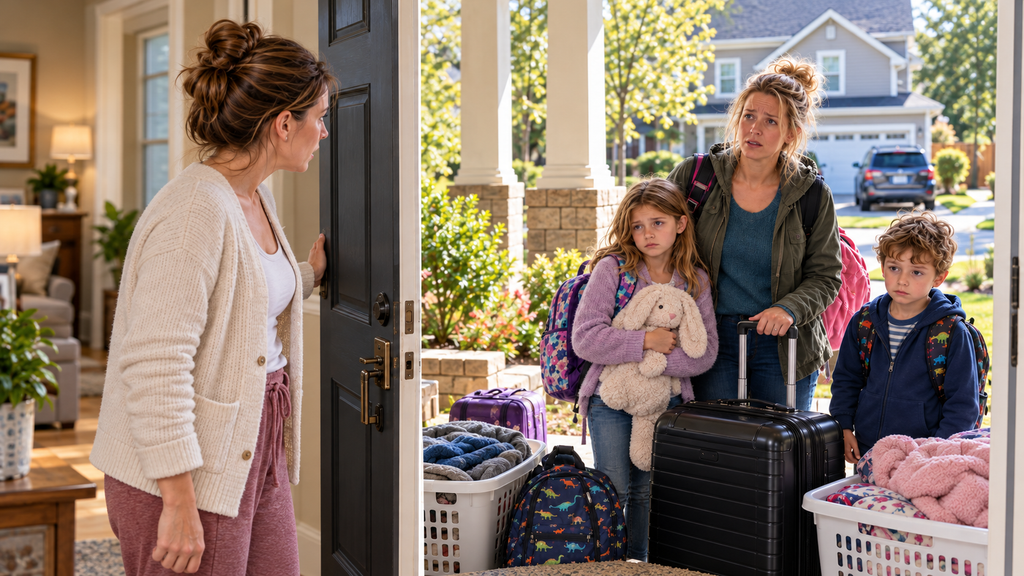
Across the room, my husband, Grant, watched me with an expression I had never seen on his face before.
Not anger.
Not embarrassment.
Fear.
His sister, Kelsey, stood beside the refrigerator with her arms crossed.
She looked irritated.
As though my discovery was an inconvenience.
As though the problem wasn’t that someone had forged my signature.
The problem was that I had noticed.
“What other form?” I asked.
The secretary hesitated.
“I think it would be better if you came to the school.”
“Can you tell me what it concerns?”
Another pause.
Then she said something that made the room tilt beneath my feet.
“It’s regarding the children’s emergency placement arrangements.”
I gripped the counter.
“Emergency placement?”
“Yes, ma’am.”
“Whose emergency?”
She lowered her voice.
“According to the paperwork we received, their mother is relocating, and you and your husband have agreed to assume primary responsibility for both children until further notice.”
I closed my eyes.
Until further notice.
Not two weeks.
Not a few weeks.
Until further notice.
I opened my eyes and looked directly at Grant.
“Did you tell the school I agreed to raise your sister’s children?”
Grant immediately shook his head.
“Megan, that’s not what happened.”
The secretary heard him.
“Mrs. Parker?”
“I’m here.”
“There’s also a document describing a possible change of residence for the children. I can’t determine its legal validity, but the signatures on the school documents are supposed to confirm that both adults in your household consented.”
I looked down at the forged signature.
My name.
My handwriting.
Or a poor imitation of it.
“Megan Parker,” written in blue ink, with the final letter curved in a way I hadn’t written since high school.
“Please don’t process anything else,” I said.
“Of course.”
“And I want copies of every document submitted under my name.”
“We can arrange that after verifying your identity.”
“I’ll be there in thirty minutes.”
I ended the call.
For several seconds, nobody spoke.
The refrigerator hummed.
Somewhere upstairs, Finn was singing to himself.
Outside, the neighbor’s dog barked twice.
It was an ordinary Tuesday morning.
And my marriage had just become something I no longer recognized.
I held up the paper.
“Which one of you signed my name?”
Grant opened his mouth.
Kelsey answered first.
“Don’t be dramatic.”
I turned toward her.
“Excuse me?”
“It’s a school form, Megan. Not a mortgage.”
I stared at her.
She actually rolled her eyes.
“We were going to explain everything.”
“Before or after your airplane landed?”
Her face hardened.
“You know, I’ve been grateful for everything you’ve done, but you’re making this much harder than it needs to be.”
I laughed.
One short, disbelieving sound.
“Harder for whom?”
“For everyone.”
“No, Kelsey. I think you mean harder for you.”
Grant stepped forward.
“Can we please lower our voices?”
I looked at him.
“Did you sign it?”
He didn’t answer.
That was answer enough.
“Grant.”
He rubbed his forehead.
“I filled out some paperwork.”
“Did you sign my name?”
“Megan, I thought—”
“Did you?”
He swallowed.
“Yes.”
The word landed between us.
Small.
Quiet.
Devastating.
I had been married to this man for twelve years.
I’d watched him cry when our son was born.
I’d held his hand through his father’s funeral.
I’d sat beside him in the hospital when doctors told us our second pregnancy was no longer viable.
We had survived sleepless nights, bills, disappointments, arguments, and all the ordinary wear and tear of building a life together.
I had never imagined hearing him admit that he had forged my signature to make a decision about my future.
“You signed my name,” I repeated.
He looked down.
“I thought you would agree once we explained.”
“And if I didn’t?”
He said nothing.
I felt something inside me turn cold.
“That,” I whispered, “is why you didn’t ask.”
Kelsey threw her hands up.
“Oh, for heaven’s sake. They’re children!”
I looked at her.
“Yes.”
“They’re your niece and nephew!”
“Yes.”
“They love you!”
My eyes burned.
“Yes, Kelsey. They do.”
She seemed to think she had won.
But I stepped closer.
“And that’s exactly why what you’ve done is so cruel.”
For the first time, her confidence faltered.
I lowered my voice.
“You told Ruby to be good so we’d want to keep her.”
Kelsey’s face changed.
I watched the color drain from her cheeks.
“What?”
“I heard her telling Finn.”
She looked toward the stairs.
I continued.
“You made your nine-year-old daughter believe that her behavior would determine whether she had somewhere to live.”
“I never said that.”
“Then what did you say?”
Kelsey stared at me.
“What did you tell her?”
Her mouth opened.
Closed.
Then she whispered, “I just told them to behave.”
I looked at Grant.
“And you knew?”
His silence cut deeper than any answer.
I placed the paper on the counter.
“I’m going to the school.”
Grant reached for his car keys.
“I’ll come with you.”
“No.”
“Megan—”
“You’ve already spoken for me enough.”
I picked up my purse.
Then I turned back.
“And Kelsey?”
She glared at me.
“If you leave Thursday without making responsible arrangements for your children, I will not pretend everything is fine.”
Her eyes narrowed.
“Are you threatening me?”
“No.”
I walked toward the door.
“I’m finally being clear.”
The drive to the elementary school took seventeen minutes.
I knew because I counted every single one.
At the first red light, I cried.
Not loudly.
Not dramatically.
Just tears slipping down my cheeks while my hands gripped the steering wheel.
I wiped them away before the light changed.
At the second intersection, I remembered the first night Kelsey and her children arrived.
Ruby had stood in our doorway holding a pink backpack.
Finn had been asleep against his mother’s shoulder.
Kelsey looked exhausted.
Her hair was pulled into a messy bun, and there were dark circles beneath her eyes.
“I don’t know how to thank you,” she’d whispered.
I’d hugged her.
“Don’t worry about that. Just get back on your feet.”
I’d meant every word.
I still meant it.
That was the terrible part.
I didn’t regret helping.
I regretted that my kindness had been turned into permission.
By the time I reached the school, my tears were dry.
Mrs. Alvarez, the school secretary, met me outside the principal’s office.
She was a short woman with silver-rimmed glasses and a gentle face.
She had worked there since Toby started kindergarten.
“Megan,” she said softly. “Come in.”
Principal Denise Carter sat behind her desk.
There was a folder in front of her.
A thick folder.
Too thick.
I felt my stomach tighten.
“Please sit down, Mrs. Parker.”
I sat.
Mrs. Carter exchanged a glance with the secretary.
Then she opened the folder.
“First, I want you to know that we have placed an administrative hold on the requested changes while we verify the information.”
I nodded.
“Thank you.”
She slid the first page toward me.
It was a school emergency contact update.
Grant’s name.
My name.
Our address.
Our phone numbers.
Nothing surprising.
Then she turned to the second page.
It was labeled:
Temporary Caregiver Authorization.
My breath caught.
It described Grant and me as adults who had agreed to provide housing, meals, transportation, and routine daily supervision for Ruby and Finn during their mother’s relocation.
It included our home address.
Our work schedules.
Even the name of Toby’s pediatrician.
At the bottom were two signatures.
Grant’s.
And mine.
I stared at them.
“What is this supposed to authorize?”
Mrs. Carter leaned forward.
“It’s a caregiver document submitted for school administrative purposes. It does not, by itself, establish legal guardianship or transfer parental rights. We would still need appropriate proof of authority for certain decisions.”
I nodded slowly.
That distinction mattered.
But it didn’t make the forgery less disturbing.
“Who brought it?”
“Your husband.”
“When?”
“Friday afternoon.”
Friday.
The same day Kelsey booked her plane ticket.
While I had been working in the bedroom, my husband had come to the school and submitted paperwork saying I had agreed to take responsibility for two children.
Mrs. Carter turned another page.
“This is the document that concerned me most.”
Across the top were the words:
Family Care Transition Plan.
I began reading.
The first paragraph described Kelsey’s move to Denver as an opportunity for long-term career stabilization.
The second said the children would remain in their current school district to preserve consistency.
The third stated that their anticipated stay with us would last through the end of the academic year, subject to further review by the family.
I looked up.
“The end of the academic year?”
Mrs. Carter nodded.
It was October.
The academic year ended in June.
Eight months.
I swallowed.
“They told me two weeks.”
Mrs. Alvarez reached for a tissue box.
I didn’t take one.
I kept reading.
The next paragraph made my skin prickle.
It said that because of the children’s established bond with our household, I would serve as their primary daytime caregiver while working remotely.
My work schedule.
My job.
My availability.
All neatly summarized.
Not as things I had offered.
As resources someone else had allocated.
I looked at the principal.
“Did my husband write this?”
“We can’t confirm who drafted it.”
“But he submitted it?”
“Yes.”
“And you called me because?”
Mrs. Carter hesitated.
“Because Ruby spoke to her teacher yesterday.”
My heart dropped.
“What did she say?”
Mrs. Carter folded her hands.
“She asked whether children could be sent somewhere else if the grown-ups taking care of them changed their minds.”
I pressed my fingertips against my lips.
“She was worried about foster care,” Mrs. Carter continued. “Her teacher asked whether something had happened at home.”
I could barely speak.
“And?”
“She said her mother was going away for a long time, but she wasn’t supposed to tell you that part yet.”
I stared at the folder.
The office grew very quiet.
Mrs. Carter leaned forward.
“Megan, our concern is the children’s emotional well-being and whether everyone understands the arrangements being proposed.”
I nodded.
“Of course.”
“Have you agreed to care for them?”
I looked directly at her.
“I agreed to let them stay temporarily while their mother looked for work.”
“And the extended arrangement?”
“No.”
I took a shaky breath.
“No one asked me.”
Mrs. Carter’s expression softened.
“Then you were right to call.”
I looked down at the document again.
There was one final section.
A small box near the bottom.
It was headed:
Contingency Planning.
Under it, someone had typed:
In the event that the mother cannot resume primary care within the anticipated period, the Parker household has expressed willingness to discuss a longer-term family placement.
I read it twice.
Then a third time.
Because I couldn’t believe what I was seeing.
My husband and his sister hadn’t merely planned two weeks of childcare.
They had prepared an explanation for why the children might remain with us indefinitely.
And they had used my name to make it sound like a family decision.
I looked at Mrs. Carter.
“I need copies.”
She nodded.
“We’ve prepared them.”
“And I need to know whether these documents went anywhere else.”
“We can only confirm what came to this school.”
I placed my hand over the folder.
“Then that’s where I’m starting.”
I sat in the parking lot for almost twenty minutes.
My phone rang six times.
Grant.
Then Kelsey.
Then Grant again.
I didn’t answer.
Instead, I opened my calendar.
I looked at the previous forty-six days.
There were notes everywhere.
Ruby’s dental appointment.
Finn’s school picture day.
Toby’s parent-teacher conference.
Three grocery deliveries.
Two visits to the pediatrician.
An extra laundry day.
The day Kelsey said she was too tired to take Finn to soccer.
The afternoon Grant asked me to watch all three children because he had a late meeting.
I scrolled farther.
On September 18, I’d canceled a work presentation because Finn had been vomiting and Kelsey had “an important phone interview.”
She hadn’t returned until almost six that evening.
On September 24, I’d rearranged my lunch break to pick Ruby up because Kelsey said her car wouldn’t start.
On October 2, I’d worked until midnight to make up hours lost when Kelsey spent the afternoon shopping for interview clothes.
Not once had I complained.
Not because I was a saint.
Because families help each other.
But looking at the calendar, I realized something.
It wasn’t only the forged document that hurt.
It was the assumption beneath it.
Someone had looked at my entire life and decided there was room for two more children.
Without asking what it would cost me.
Without asking how I felt.
Without even wondering whether I might be struggling already.
My phone buzzed.
A message from Grant.
Please come home. We can fix this.
I stared at it.
Then another appeared.
I know I messed up.
I typed a reply.
I have the school documents. Do not submit anything else with my name on it. We will talk when the children are not present.
Three dots appeared.
Disappeared.
Then:
Okay.
I put the phone down.
For the first time that morning, I felt something other than betrayal.
I felt determination.
I wasn’t going to let my marriage collapse in front of three frightened children.
I wasn’t going to punish Ruby and Finn for their mother’s choices.
And I wasn’t going to quietly agree to a future someone else had planned for me.
I started the engine.
But instead of driving home, I made one more stop.
I went to see an attorney.
Her name was Helen Brooks.
She had handled the paperwork when Grant and I purchased our house seven years earlier.
Her office was above a bakery on Main Street.
I walked in without an appointment.
The receptionist recognized me.
“Megan! It’s been ages.”
“I know. I’m sorry to drop in. Is Helen available?”
“She’s with someone, but I can ask.”
I almost said never mind.
Almost told myself I was overreacting.
Almost let embarrassment push me back into silence.
Then I remembered Ruby asking whether children could be sent away if adults changed their minds.
“Please ask her.”
Ten minutes later, Helen brought me into her office.
She looked exactly as I remembered.
Gray hair.
Navy suit.
Reading glasses hanging from a chain.
“What happened?” she asked.
I put the folder on her desk.
She read quietly.
Page after page.
Her expression grew more serious.
When she finished, she removed her glasses.
“Did you sign any of these?”
“No.”
“Did you authorize your husband to sign for you?”
“No.”
“Have you agreed verbally to the arrangements described?”
“No. I agreed to a short-term stay, nothing more.”
She nodded.
“Then we need to address two separate matters.”
I listened.
“First, the inaccurate and unauthorized documents. You should preserve your copies, notify the school in writing, and ask whether any other institution has received documents representing your consent.”
“And second?”
“The actual welfare of the children. Their mother remains responsible for them. We need to distinguish between helping her with an orderly transition and taking on obligations you never agreed to.”
I rubbed my forehead.
“I don’t want them hurt.”
“I know.”
“They’re good kids.”
“I believe you.”
“Ruby thinks we’ll send her away if she makes trouble.”
Helen’s expression changed.
“Then the adults need to stop letting those children carry the uncertainty.”
I looked down.
“I don’t know how to do that without becoming the person who says no.”
Helen leaned forward.
“Megan, you can say no to an arrangement while still saying yes to helping the children reach a safe, appropriate one.”
I sat with that thought.
She continued.
“I also want to ask something difficult. Did your husband tell you why he completed the paperwork?”
“No.”
“Then don’t guess. Find out. Ask for the truth. And if you discover that documents were submitted to employers, agencies, medical providers, or anyone else, deal with those separately.”
I nodded.
She gave me practical steps.
Preserve messages.
Get written clarification from the school.
Avoid making promises about custody or guardianship.
Insist that Kelsey create a real childcare and relocation plan.
If an immediate safety concern arose, contact the appropriate local services.
It wasn’t the dramatic answer I had expected.
There was no magical document that would solve everything.
No single sentence that would undo what happened.
Just boundaries, facts, and difficult conversations.
Before I left, Helen said something that stayed with me.
“Sometimes the most dangerous family decisions aren’t made out of cruelty.”
I looked at her.
“They’re made because one person assumes another person will absorb all the consequences.”
I thought of Grant.
I thought of Kelsey.
Then I thought of myself.
And I realized that was exactly what had happened.
When I returned home, the house was quiet.
Too quiet.
Kelsey’s suitcases were lined up beside the front door.
Three of them.
Not two.
Three large, fully packed suitcases.
Her children’s small backpacks were nowhere near them.
I stood looking at the luggage.
Then I heard voices coming from the kitchen.
Grant and Kelsey.
They hadn’t heard me arrive.
“You said she wouldn’t find out until after I left,” Kelsey whispered.
My fingers tightened around my car keys.
Grant sounded exhausted.
“I said we should tell her.”
“You said she’d calm down.”
“I thought she would.”
“You promised me, Grant.”
Silence.
Then my husband said something that made my blood run cold.
“I didn’t promise she would agree. I promised I wouldn’t let you lose this opportunity.”
Kelsey sniffed.
“Well, now what?”
“We tell her the truth.”
“We can’t.”
“Why not?”
“Because if she knows everything, she’ll never let me go.”
I stood completely still.
Everything?
There was more?
Grant lowered his voice.
“Kelsey, you have to tell her.”
“No.”
“She deserves to know.”
“She’s going to hate me.”
I stepped into the doorway.
“Then maybe you should stop giving me reasons.”
They spun around.
Kelsey clutched the back of a chair.
Grant looked like he hadn’t slept in days.
“Megan,” he said.
I placed the folder on the table.
“Start talking.”
Neither moved.
I pulled out a chair.
“Sit down.”
Something in my voice made them obey.
I sat across from them.
“The school has an eight-month transition plan with my signature on it.”
Kelsey stared at the table.
“I know.”
“Did you help write it?”
She nodded.
“Did you intend to tell me?”
“Yes.”
“When?”
Her eyes filled.
“Eventually.”
I shook my head.
“No. Not eventually. When?”
She began crying.
Grant reached for her hand.
I looked at him.
“Don’t.”
He withdrew it.
I turned back to Kelsey.
“You are flying to Denver Thursday. Your children believe they are staying here. The school has paperwork saying I will be their primary caregiver until June.”
I leaned forward.
“What haven’t you told me?”
Kelsey pressed a tissue against her mouth.
For a long moment, I thought she wouldn’t answer.
Then she whispered, “The job doesn’t start Monday.”
I stared at her.
“What?”
“It starts in November.”
I felt my stomach drop.
“November?”
She nodded.
“Then why are you leaving Thursday?”
She squeezed her eyes shut.
“Because I’m meeting someone.”
I waited.
She looked at Grant.
He turned away.
“Kelsey.”
She took a shaky breath.
“His name is Darren.”
A man.
Of course there was a man.
I felt almost dizzy.
“Who is Darren?”
“My boyfriend.”
“How long?”
“Four months.”
I blinked.
Four months.
Kelsey had been living in my house for six weeks.
She had been telling me every day that she was too overwhelmed to think about dating.
She had said she barely had the energy to apply for jobs.
“Does he live in Denver?”
“Yes.”
“Does he know about Ruby and Finn?”
“Of course.”
“Does he know you’re leaving them here?”
Her silence answered me.
I closed my eyes.
“Kelsey.”
“He wants me to get settled first.”
I opened them.
“What does that mean?”
“He thinks it would be better if we had some time together before bringing the kids.”
I stared at her.
“And you agreed?”
“It’s not like that.”
“Then tell me what it’s like.”
She wiped her nose.
“Darren has a beautiful apartment. He owns his own business. He’s stable. He says he wants a future with me.”
“And your children?”
“He likes children.”
“That’s not what I asked.”
Her jaw tightened.
“Megan, you make everything sound ugly.”
“No. I’m asking you to explain it clearly.”
She looked down.
I waited.
Finally, she whispered, “He wants to be sure about us first.”
I felt something twist in my chest.
A man Kelsey had been dating for four months wanted to test whether he liked living with her before taking in her two children.
And she had agreed to leave those children behind.
Not for a two-week job transition.
Not because she couldn’t afford temporary housing.
But because she wanted to see whether her new relationship would work.
I looked at Grant.
“You knew?”
He nodded.
I couldn’t speak.
For twelve years, I’d loved this man.
Now I was sitting across from him, wondering how much of him I’d never known.
“You knew,” I repeated, “that your sister planned to leave her children here while she tried living with a boyfriend?”
Grant swallowed.
“I knew she was going to stay with Darren temporarily.”
“And the eight months?”
He looked at Kelsey.
She stared at the floor.
My heart began pounding.
“What about the eight months?”
Kelsey whispered, “Darren’s lease doesn’t allow more occupants.”
I almost laughed.
Not because it was funny.
Because the explanation was so grotesquely ordinary.
A lease.
A boyfriend.
A beautiful apartment.
Two children whose entire lives were being rearranged because they didn’t fit the new plan.
“So where were Ruby and Finn supposed to go?” I asked.
Kelsey looked at me.
“With you.”
I felt my throat close.
“For how long?”
She began crying harder.
I didn’t move.
“How long, Kelsey?”
“I don’t know.”
The truth finally arrived.
Not two weeks.
Not a few weeks.
Not even necessarily eight months.
She didn’t know.
And she had expected me to live inside that uncertainty while she built herself a new life.
I wish I could tell you I screamed.
That I threw the folder across the room.
That I delivered some brilliant speech that left both of them speechless.
But the truth is, I was too heartbroken to be dramatic.
I simply sat there.
Looking at my husband and his sister.
And I asked one question.
“When were you going to tell the children?”
Kelsey looked confused.
“They know I’m going.”
“They think you’re leaving for work.”
“I am leaving for work.”
“In November.”
She looked away.
“Did you tell them about Darren?”
“No.”
“Did you tell them you might not come back for them for months?”
“Megan—”
“Did you?”
Her voice broke.
“No.”
I pressed both palms against the table.
“Then they don’t know what you’re planning.”
“They’re too young to understand.”
That was when something inside me finally snapped.
Not into rage.
Into clarity.
“They are not too young to understand that their mother is leaving them.”
Kelsey flinched.
I continued.
“Ruby is nine years old. She has already decided she must behave perfectly so no one sends her away. Finn is six. He asked Toby whether airplanes can fly back from Colorado because he doesn’t understand why his mother hasn’t bought a return ticket.”
Kelsey began sobbing.
I didn’t stop.
“And my son is five. He thinks adults can casually decide who belongs in his house without telling anyone.”
Grant whispered, “Megan, please.”
I looked at him.
“No. You don’t get to ask me to stop telling the truth because it’s uncomfortable.”
His face crumpled.
For a moment, I almost felt sorry for him.
Almost.
Then I remembered the forged signature.
I remembered how he’d looked at me across the dinner table and asked what we were arguing about.
As though my consent was an administrative detail.
I took a breath.
“Here’s what is going to happen.”
Both of them looked at me.
“Kelsey, you are not leaving Ruby and Finn in this house without a clear, appropriate plan agreed to by the responsible adults. You remain their mother, and you need to make arrangements that actually meet their needs.”
Kelsey shook her head.
“I can’t cancel my flight.”
“Then change it.”
“I’ll lose money.”
I stared at her.
“You’re worried about the ticket?”
“You don’t understand. Darren has arranged everything.”
“Then Darren can understand a change of plans.”
Her expression hardened.
“He might not.”
The words hung in the air.
I looked at her carefully.
“Are you afraid he’ll leave you if you bring your children?”
She burst into tears.
And there it was.
The answer beneath every excuse.
Every vague timeline.
Every avoided question.
She was afraid the man would choose a life without her children.
And instead of confronting that possibility, she had decided to make her children disappear from the equation.
I sat back.
“Kelsey, if he doesn’t want your children, what kind of future are you building with him?”
She shook her head.
“You don’t know him.”
“No,” I said softly. “I don’t.”
Then I looked at the packed suitcases.
“But I know Ruby and Finn.”
That night, I slept in Toby’s room.
Not because Grant asked me to leave our bedroom.
He didn’t.
He stood in the hallway while I gathered my pillow and a blanket.
“Megan, please don’t do this.”
I turned toward him.
“Do what?”
“Shut me out.”
I looked at the man holding the bedroom door open.
“You made an eight-month plan for my life without including me.”
His eyes filled.
“I know.”
“You forged my name.”
“I know.”
“You let your sister tell her children they were staying here before you asked me.”
He nodded.
“And now you’re upset because I need one night without you beside me?”
He lowered his head.
“I’m sorry.”
I believed he was sorry.
But I couldn’t tell whether he was sorry for what he’d done or sorry that it had failed.
That distinction would matter later.
I walked past him.
Toby was already asleep.
He’d fallen sideways across his bed with one foot hanging off the mattress.
I lifted him gently.
Tucked his foot beneath the blanket.
Then I lay down beside him.
For a long time, I stared at the glow-in-the-dark stars on his ceiling.
I’d put them there when he was three.
Grant had helped me.
We’d spent an entire Saturday afternoon sticking tiny plastic constellations above the bed.
Toby had insisted on having the Big Dipper directly over his pillow.
Grant had laughed and said it looked more like a crooked frying pan.
That had been a good day.
A happy day.
A day when I thought we were the kind of couple who made decisions together.
I lay there trying to reconcile that man with the one who’d forged my signature.
At some point, Toby stirred.
“Mommy?”
“I’m here, sweetheart.”
He rolled toward me.
“Are you sad?”
I swallowed.
“A little.”
“Because Aunt Kelsey’s leaving?”
I brushed his hair from his forehead.
“Because some grown-up things are complicated.”
He considered that.
Then he whispered, “Ruby cried in the bathroom.”
My heart stopped.
“When?”
“After dinner.”
I held him a little closer.
“Did she tell you why?”
He nodded.
“She said she doesn’t know where she’s gonna live when she’s big.”
I closed my eyes.
Toby continued.
“I told her she can live with me.”
Tears slipped into my hair.
“Oh, baby.”
“She said maybe.”
He nestled against my shoulder.
“Mommy?”
“Yes?”
“You won’t get on an airplane without telling me, right?”
I kissed his forehead.
“No, sweetheart.”
“Promise?”
I held him tightly.
“Promise.”
He fell asleep again within minutes.
I didn’t.
Because that night, I finally understood the true damage.
It wasn’t only about childcare.
It wasn’t about bedrooms or work schedules or grocery bills.
It was about three children learning that adults could make their world unstable and expect them to adjust quietly.
And two grown people who had mistaken love for unlimited permission.
At 2:17 in the morning, my phone lit up.
A message from an unknown number.
Hi, Megan. This is Darren. Kelsey gave me your number. I think there’s been a misunderstanding.
I stared at the screen.
Then another message appeared.
I would never ask her to abandon her kids.
I sat up slowly.
Abandon.
An interesting choice of word.
I typed:
What exactly did Kelsey tell you?
His response came almost immediately.
That you and Grant offered to keep the kids for the school year because moving them midyear would be disruptive.
I felt a cold wave pass through me.
I read it again.
Then again.
I typed carefully.
We made no such offer. I agreed to a temporary stay while she looked for employment. I learned yesterday that she had plans to relocate without the children.
The typing indicator appeared.
Disappeared.
Returned.
Finally:
Are you serious?
I sent a photograph of the transition plan, covering personal information about the children and the forged signature.
Several minutes passed.
Then Darren called.
I stepped into the hallway.
“Hello?”
“Megan?”
His voice was deeper than I’d expected.
“Yes.”
“I’m sorry to call so late.”
“Your messages woke me.”
He exhaled sharply.
“I don’t know what to say.”
“Then start with what you know.”
There was a pause.
“Kelsey told me you and Grant were eager to take the kids for the school year.”
I closed my eyes.
“She said Ruby was struggling in school and that you thought staying with familiar teachers would help.”
I leaned against the wall.
“She said it was your idea?”
“Yes.”
I felt sick.
“And your apartment?”
“What about it?”
“She said your lease doesn’t allow additional occupants.”
He sounded confused.
“My lease has an occupancy limit, but I asked about adding the kids before Kelsey accepted the job. The landlord said we’d need an updated agreement and a larger unit eventually.”
I straightened.
“What?”
“We’ve been looking at three-bedroom rentals. I thought the kids were staying with you until next summer because that was what their mother wanted.”
I pressed my hand over my mouth.
Kelsey had lied to both of us.
Different lies.
Same outcome.
She’d made me believe Darren was the reason she couldn’t bring the children.
She’d made Darren believe I was the reason she didn’t need to.
And somewhere between those stories stood Ruby and Finn, believing they had to be perfect to deserve a home.
Darren spoke again.
“Did Kelsey tell you we’d already talked about getting married?”
I froze.
“Married?”
He went silent.
“Oh, God.”
I gripped the phone.
“Darren.”
“We haven’t set a date.”
I closed my eyes.
He continued.
“I proposed two weeks ago.”
Two weeks.
While Kelsey was eating my groceries and asking whether I could wash Finn’s soccer uniform.
While she was telling me that nobody wanted to hire her.
She was planning a marriage in another state.
“And you thought her children would stay with us until after the wedding?” I asked.
“That’s what she told me she’d arranged.”
My knees felt weak.
“Darren, nothing was arranged with me.”
His voice changed.
“Does Grant know?”
I looked toward the dark bedroom.
“Yes.”
He cursed under his breath.
Then he apologized.
I let him speak.
He told me Kelsey had described Grant and me as financially comfortable, deeply attached to the children, and eager to help.
She had said I loved having the kids around because I worked from home.
She had told him Toby benefited from having older cousins in the house.
She’d presented the entire arrangement as a generous family decision.
I could hear his disbelief growing as he talked.
“Why would she tell me that?” he asked.
I stared at the wall.
“Because you wouldn’t have agreed to her leaving them without a plan.”
He didn’t answer.
Then he said quietly, “No. I wouldn’t.”
We spoke for another twenty minutes.
I didn’t know whether Darren was a good man.
I didn’t know whether his relationship with Kelsey would survive.
And I certainly wasn’t going to trust a stranger simply because he sounded reasonable on the phone.
But I knew one thing.
The story I’d been told was unraveling.
And I had a feeling the worst part was still hidden.
At breakfast, Kelsey was cheerful.
That alone made me suspicious.
She stood at the stove making pancakes.
Pancakes.
In forty-six days, she had made breakfast for the children exactly twice.
Now she was flipping pancakes like a mother in a cereal commercial.
“Morning!” she said brightly.
I looked at Grant.
He was sitting at the table with his coffee untouched.
His eyes met mine.
He looked away.
Kelsey carried a plate to Ruby.
“Extra chocolate chips for my girl.”
Ruby smiled.
Then looked down.
Finn reached for syrup.
Kelsey poured it for him.
“Only a little, buddy.”
I watched her.
I didn’t know whether I was looking at guilt, manipulation, or a desperate attempt to pretend everything was normal.
Possibly all three.
Toby climbed into his chair.
“Can I have extra chips?”
“Of course, sweetheart,” Kelsey said.
I pulled out a chair.
“Kelsey, we need to talk after school drop-off.”
Her smile tightened.
“About what?”
“Darren.”
The spatula slipped from her hand.
It struck the floor.
Ruby flinched.
Grant looked up.
Kelsey bent quickly to retrieve it.
“What about Darren?”
“He called me.”
Her face went white.
For one terrible second, I thought she might faint.
Then she stood.
“Why would he call you?”
I looked at her.
“He had questions.”
“What did you say?”
“The truth.”
She stared at me.
Then she turned toward Grant.
“You gave him her number?”
Grant shook his head.
“No.”
Kelsey looked back at me.
“You had no right to interfere in my relationship.”
I felt anger rise.
But I looked at the children.
They were watching us.
So I kept my voice calm.
“We can discuss that later.”
Kelsey opened her mouth.
I shook my head.
“Not now.”
Ruby lowered her fork.
“Mom?”
Kelsey turned.
“Yes, baby?”
“Are you still going Thursday?”
The entire table went quiet.
Kelsey’s expression crumpled.
She looked at me.
Then at Grant.
Then at her daughter.
“I don’t know yet.”
Ruby nodded.
As though she had expected that answer.
Then she pushed her chair back.
“I’m not hungry.”
She carried her plate to the sink.
Finn watched her leave.
Then he whispered, “Can I go too?”
Kelsey nodded.
He followed his sister.
Toby looked between us.
“Did I do something wrong?”
My heart broke.
I reached for his hand.
“No, sweetheart.”
He looked unconvinced.
I knelt beside him.
“Nothing about this is because of you. The grown-ups are figuring out grown-up things.”
He nodded slowly.
Then he asked a question I would remember for the rest of my life.
“Why are grown-ups so bad at figuring stuff out?”
For the first time in twenty-four hours, I almost smiled.
“Sometimes,” I whispered, “we really are.”
After dropping Toby at kindergarten, I returned home.
Grant had taken a personal day.
Kelsey was waiting in the kitchen.
Her phone lay facedown on the table.
The packed suitcases still stood beside the door.
I sat across from them.
“Darren told me you said keeping the kids was our idea.”
Kelsey crossed her arms.
“I didn’t say it exactly like that.”
“He also told me you two were engaged.”
Her eyes widened.
Grant looked at her.
“Engaged?”
I turned toward him.
“You didn’t know?”
He shook his head.
Kelsey began rubbing her temples.
“It just happened.”
I stared at her.
“Two weeks ago?”
She shot me a look.
“Did he tell you everything?”
“No,” I said. “Apparently nobody has.”
Grant leaned forward.
“Kelsey, are you getting married?”
“Maybe.”
“Maybe?”
“Yes!”
She pushed back her chair.
“Can everyone stop acting like I’m committing a crime because someone finally wants to marry me?”
I stared at her.
“No one is upset because someone wants to marry you.”
“Then what?”
“Because you’ve built an entire new life while quietly assigning your children to someone else.”
She covered her face.
“That’s not fair.”
“Then explain what’s fair.”
Grant sat back.
Kelsey began pacing.
“You don’t understand what it’s been like.”
I stayed silent.
“I lost my job. I lost my apartment. Every bill was overdue. Every morning I woke up feeling like a failure.”
Her voice shook.
“I’d look at Ruby and Finn and feel like I was failing them.”
I listened.
She continued.
“Then Darren came along. He made me feel like I was worth something again.”
Her eyes filled.
“He took me to dinner. He sent flowers. He told me I was beautiful. He didn’t treat me like some exhausted single mother who couldn’t keep her life together.”
For a moment, I saw the frightened woman beneath the lies.
I could understand her desire to be loved.
I could understand her exhaustion.
I could understand why an offer of a fresh start might feel like salvation.
But understanding wasn’t the same as agreeing.
“Kelsey,” I said gently, “there is nothing wrong with wanting happiness.”
She looked at me.
“Then why are you trying to ruin it?”
“Because your children shouldn’t have to disappear for you to have it.”
Her face twisted.
“You think I’m a terrible mother.”
“I think you’ve made some terrible decisions.”
She flinched.
I continued.
“And I think you’re so afraid of losing Darren that you’re risking something much more important.”
“What?”
“Your children’s trust.”
She started crying again.
Grant reached for a tissue.
I watched him.
Then I asked a question that had been sitting inside me since the school meeting.
“Why did you sign my name?”
He closed his eyes.
“Megan—”
“No more vague answers. I want to know.”
He looked at the table.
“Kelsey told me she had to submit the school paperwork before the end of the week.”
“So you signed for me?”
“She said you were overwhelmed and we shouldn’t make things harder.”
I felt my throat tighten.
“And you believed her?”
He nodded.
Then whispered, “I wanted to.”
I looked at him.
That was the first completely honest thing he’d said.
He wanted to believe I would handle it.
Because believing that was easier than confronting his sister.
It was easier than negotiating childcare.
Easier than changing his work schedule.
Easier than accepting that helping family sometimes meant making difficult sacrifices himself.
He had chosen the convenient lie.
And he’d written my name at the bottom.
Then I asked something else.
“Grant, how much money have you given Kelsey?”
His head snapped up.
Kelsey stopped crying.
I looked between them.
There it was again.
That silence.
That quick exchange of glances.
The same look they’d shared over spaghetti.
My pulse quickened.
“How much?”
Grant swallowed.
“A little.”
I laughed without humor.
“Define a little.”
He rubbed his face.
“Megan—”
“Grant.”
“About four thousand.”
I stared.
“Four thousand dollars?”
Kelsey whispered, “I needed help.”
I looked at my husband.
“From where?”
He didn’t answer.
I felt the room shift.
“Grant, from where?”
“Our savings.”
I sat very still.
We had two savings accounts.
One for emergencies.
One for Toby’s future.
Every month, we contributed what we could.
We weren’t wealthy.
We were careful.
We drove used cars.
We clipped coupons when we needed to.
We had postponed replacing our aging dishwasher because we wanted to keep building our savings.
“How much exactly?” I asked.
Grant looked down.
“Six thousand four hundred.”
My heart hammered.
“You just said four thousand.”
“I forgot about the other transfers.”
I stared at him.
“You forgot?”
He closed his eyes.
Then he said the words that changed everything.
“I also used the home equity line.”
For a moment, I didn’t understand.
The words were familiar.
But they didn’t fit together.
I blinked.
“What?”
He looked miserable.
“I borrowed some money.”
“How much?”
“Megan—”
“How much?”
“Eighteen thousand.”
I felt as though I’d been pushed underwater.
Eighteen thousand dollars.
On top of the savings transfers.
I stared at the man across from me.
Our home.
The house we’d worked for.
The place where our son slept beneath glow-in-the-dark stars.
He’d borrowed against it to help his sister.
Without telling me.
Without discussing the impact on our household.
And apparently, without feeling the need to mention it while we were arguing about whether I should raise her children.
My voice came out strangely flat.
“Why?”
Grant looked at Kelsey.
She was pale.
I turned toward her.
“What was the money for?”
She whispered, “Expenses.”
“What expenses?”
“Bills.”
“Which bills?”
She began crying.
Again.
But this time, I didn’t soften.
“Where did eighteen thousand dollars go?”
Grant said quietly, “Some went toward her debts.”
I waited.
“Some went toward the move.”
“Which move?”
“Denver.”
I looked at Kelsey.
Her eyes were fixed on the table.
“And the rest?”
No answer.
I leaned forward.
“Kelsey.”
She whispered, “The wedding.”
I felt my breath leave my body.
“The wedding?”
She nodded.
A strange sound escaped my throat.
Not laughter.
Not crying.
Something between them.
“You used money borrowed against our house to plan a wedding?”
Grant shook his head.
“It wasn’t all for that.”
I stared at him.
“That’s supposed to make me feel better?”
Kelsey suddenly stood.
“I’ll pay it back!”
I looked at her.
“With what?”
“My new job.”
“Your new job hasn’t started.”
“I’ll pay it back when I can.”
I leaned back.
I’d heard those words before.
When she borrowed eighty dollars for groceries.
When Grant covered a past-due phone bill.
When she needed money for a car repair.
Little promises.
Little delays.
Little reasons why repayment could wait.
But this wasn’t eighty dollars.
This was our family’s financial security.
And my husband had made the decision without me.
I looked at Grant.
“Show me the statements.”
His face tightened.
“Right now?”
“Yes.”
He hesitated.
That hesitation told me there was still more.
I whispered, “Grant, if you lie to me again, don’t expect me to keep pretending this is an ordinary disagreement.”
He stood.
Went upstairs.
And returned with his laptop.
I watched him log into our accounts.
I watched him open the transaction history.
I watched the numbers appear.
Six thousand four hundred dollars transferred from savings over five weeks.
Several payments to Kelsey.
A payment to an overdue credit card.
A deposit for a moving company.
Two airline tickets.
A transfer labeled Darren and Kelsey.
Then the home equity account.
Eighteen thousand dollars drawn.
I stared at the screen.
“Where did the second airline ticket go?”
Grant looked confused.
“What?”
“There’s a charge for two tickets.”
Kelsey’s expression changed.
I turned toward her.
“Who else is flying to Denver?”
She swallowed.
“Darren was coming here.”
“To do what?”
She looked down.
“Help me pack.”
I stared at her.
“So he was going to come to my house, help you leave your children here, and fly away with you?”
Kelsey whispered, “That’s not how he understood it.”
Of course it wasn’t.
Because Darren believed I’d volunteered.
I looked at Grant.
“And this transfer?”
He hesitated.
“It’s for a rental deposit.”
I frowned.
“Darren already has an apartment.”
Kelsey closed her eyes.
I felt a chill.
“What rental deposit?”
Grant turned toward his sister.
“Kelsey.”
Her lips trembled.
And then she said something I hadn’t expected.
“For the house.”
I stared.
“What house?”
She began shaking her head.
“It’s not what you think.”
My voice was barely audible.
“What house?”
Kelsey looked at Grant.
He looked utterly confused.
Then she whispered, “The townhouse in Denver.”
I sat back.
“You rented a townhouse?”
She nodded.
“With money from our home equity?”
She didn’t answer.
I looked at Grant.
“Did you know about this?”
He shook his head.
I believed him.
His shock looked genuine.
That didn’t excuse anything else.
But for the first time, I realized Kelsey had been lying to him too.
“What townhouse?” he asked.
She covered her face.
“Darren and I found one.”
“I thought you were staying in his apartment,” Grant said.
“We changed our minds.”
“When?”
“Last week.”
Grant stared.
“You told me you needed money for the relocation costs.”
“I did!”
“You told me you couldn’t afford a place for the children.”
She looked away.
Something settled into place.
A terrible, unmistakable understanding.
I spoke slowly.
“You have a three-bedroom townhouse waiting in Denver.”
Kelsey said nothing.
“And you’re leaving Ruby and Finn here anyway.”
She began sobbing.
But this time, the tears didn’t confuse me.
I looked at Grant.
He stared at his sister as if seeing her for the first time.
“Kelsey,” he whispered, “what have you done?”
There are moments in life when betrayal stops feeling sharp.
It becomes heavy.
Like a stone settling at the bottom of your stomach.
That was how I felt sitting at the kitchen table.
Kelsey had enough money to secure a larger home.
She had a job offer.
She had a partner who, at least according to what he’d told me, knew and expected her children to be part of her future.
But she still intended to leave them.
Because the issue wasn’t simply money.
Or housing.
Or timing.
It was what she wanted.
Freedom.
A fresh start.
A life where she wasn’t responsible for waking two children, packing lunches, scheduling dental appointments, washing uniforms, or sitting beside a feverish six-year-old at three in the morning.
She wanted to be someone other than their mother for a while.
And rather than admit that honestly, she had invented a crisis that made the rest of us responsible for her choice.
I looked at her.
“Tell me the truth.”
She shook her head.
“I have.”
“No, Kelsey. You haven’t.”
I waited.
Then I asked the question I had been afraid to ask.
“Do you want your children to move to Denver with you?”
She began crying.
I didn’t look away.
“Not what Darren wants. Not what Grant thinks. Not what you believe I want to hear.”
I leaned forward.
“Do you want Ruby and Finn to come?”
A long silence filled the kitchen.
Then Kelsey whispered, “Not right away.”
Grant closed his eyes.
I felt the answer settle into my bones.
“Why?”
She looked up at me.
Her face was red.
Her voice shook.
“Because I’m tired.”
I said nothing.
She continued.
“I’m tired of being needed every second. I’m tired of worrying about money. I’m tired of school papers and laundry and fighting about bedtime. I’m tired of never being able to do anything without planning around them.”
Her shoulders shook.
“I love them, Megan. I swear I do.”
I believed she loved them.
And I believed she was exhausted.
But love didn’t erase responsibility.
She wiped her face.
“Sometimes I just want to wake up and be Kelsey. Not Mom.”
I looked at her for a long time.
Then I said softly, “You could have told us you needed a break.”
She shook her head.
“You wouldn’t understand.”
“I would have understood needing help.”
Her eyes lifted.
“I might have offered to take the kids for a weekend. Or helped you research childcare. Or worked with you on a realistic temporary arrangement.”
I paused.
“But you didn’t ask for help.”
I looked at the forged signature.
“You decided I was going to become their mother while you took a break from being theirs.”
She broke down.
And for one brief second, I felt sorry for her.
Then I remembered Ruby’s voice.
Mom said we have to be really good while she’s gone.
My sympathy didn’t disappear.
But it stopped controlling my decisions.
That afternoon, I made three phone calls.
The first was to Helen Brooks.
I explained the financial discoveries and asked how to verify the loan terms, protect my interests, and document the unauthorized use of my signature.
She told me not to assume the legal consequences until we reviewed the actual documents.
That mattered.
I wasn’t going to turn fear into accusations I couldn’t support.
But I was going to understand every obligation attached to our home.
The second call was to our bank.
I requested copies of the relevant loan records and asked about account security, transaction notifications, and what changes would require both account holders’ authorization.
The third call was to my mother.
Not because I needed someone to fight my battles.
Because I needed someone to tell me I wasn’t losing my mind.
Mom answered on the fourth ring.
“Hi, honey.”
I opened my mouth.
And began crying.
Not quietly this time.
I cried so hard I couldn’t get the words out.
Mom didn’t interrupt.
She simply said, “I’m here.”
For several minutes, I sat in my parked car and cried into the phone.
Then I told her everything.
The airplane.
The paperwork.
The forged signature.
The eight-month plan.
Darren.
The townhouse.
The money.
When I finished, she was silent.
Then she asked, “Where is Toby?”
“At school.”
“And the other children?”
“At school too.”
“Good.”
Another pause.
“Where are you?”
“In my car.”
“Come over.”
“Mom, I can’t just—”
“Come over, Megan.”
I hesitated.
“Your father made chicken soup yesterday.”
I laughed through my tears.
“Mom.”
“There’s plenty.”
That was my mother.
She couldn’t solve my marriage.
She couldn’t undo what Grant had done.
But she knew that sometimes a woman needed somewhere to cry where nobody expected her to cook dinner afterward.
I drove to her house.
And for the first time in nearly seven weeks, someone took care of me.
My father was sitting at the kitchen table when I arrived.
He looked up from his newspaper.
One glance at my face, and he put it down.
“Who do I need to talk to?”
Mom gave him a warning look.
“Robert.”
He held up both hands.
“I’m asking.”
I sat between them and tried to explain.
Dad listened without interrupting.
That was unusual.
He was the sort of man who had opinions about everything from dishwasher detergent to the correct way to stack firewood.
But that afternoon, he simply listened.
When I finished, he looked at me.
“Do you know what bothers me most?”
I shook my head.
“Not the money.”
I stared.
“Dad, it’s eighteen thousand dollars.”
“I heard you.”
“Plus the savings.”
“I heard that too.”
He leaned forward.
“What bothers me most is that your husband didn’t give you the chance to be generous.”
I blinked.
Dad continued.
“He took the decision away from you. He assumed you’d carry the burden, and then he made it official on paper.”
My throat tightened.
“That was exactly what it felt like.”
He nodded.
“People like to call that helping family.”
His expression hardened.
“But generosity isn’t generosity when somebody else volunteers your life.”
Mom reached for my hand.
I stared down at our fingers.
“I don’t know if I can forgive him.”
She squeezed gently.
“You don’t have to decide that today.”
I looked at her.
“I don’t even know if I can trust him.”
“Then he has to earn that back.”
“What if he can’t?”
Mom’s eyes filled.
“Then you’ll figure out what comes next.”
I lowered my head.
“I feel like I’m ruining everyone’s life.”
Dad made a sharp sound.
I looked up.
He was shaking his head.
“No.”
He pointed toward me.
“That’s what happens when the person who quietly holds everything together finally says she can’t carry it all.”
His voice softened.
“Everybody notices the weight when she puts it down.”
I began crying again.
Mom pulled me into her arms.
And for a moment, I was no longer a wife.
Or a mother.
Or an employee.
Or the person who knew which child needed library books on Wednesday.
I was simply someone’s daughter.
And I desperately needed that.
By Wednesday evening, Kelsey’s flight was still booked.
The children didn’t know what was happening.
Grant was sleeping in the guest room.
And I had stopped doing Kelsey’s laundry.
That last detail sounds small.
It wasn’t.
For forty-six days, I’d been washing her clothes, folding the children’s pajamas, and making sure everyone had clean socks.
On Wednesday morning, Kelsey came downstairs carrying a basket.
“Do you have any dark clothes to wash?”
I looked up from my laptop.
“No.”
She blinked.
“Oh.”
I returned to work.
She stood there.
Then asked, “Are you doing laundry today?”
“Yes. Toby’s.”
She waited.
I looked up.
“Kelsey, the detergent is in the cabinet. You know how to use the machine.”
She seemed genuinely surprised.
“Oh. Right.”
It wasn’t revenge.
It was a boundary.
One she’d apparently never considered might exist.
That evening, Grant approached me while I was preparing Toby’s lunch.
“Can we talk?”
I kept slicing strawberries.
“Yes.”
He stood beside the counter.
“I called Kelsey’s father.”
I stopped.
Grant and Kelsey’s father, Dennis, lived forty minutes away.
He was remarried.
Retired.
And had a distant, complicated relationship with Kelsey.
“Why?”
“Because this can’t all fall on you.”
I stared at him.
It was the first time he’d said that.
“What did he say?”
Grant looked exhausted.
“He was angry.”
“At me?”
“At Kelsey.”
I waited.
“He said he’d help arrange care for the children if needed, but he won’t agree to anything behind their mother’s back or without a plan.”
I nodded slowly.
That sounded reasonable.
Grant continued.
“I also told him about the paperwork.”
I looked up sharply.
“All of it?”
“Yes.”
“The signature?”
He swallowed.
“Yes.”
“And?”
“He told me I was an idiot.”
I looked back at the strawberries.
“For once, Dennis and I agree.”
Grant gave a weak, humorless laugh.
Then he whispered, “Megan, I’m ashamed.”
I put down the knife.
He continued.
“I kept telling myself I was helping Kelsey. That you loved the kids. That we’d work out the details later.”
He rubbed his eyes.
“But I knew I was doing something you hadn’t agreed to.”
I said nothing.
“And I did it anyway.”
My throat tightened.
He looked at me.
“I need you to know I’m not going to defend it anymore.”
I stared at him.
“That’s a beginning.”
His eyes filled.
“I know.”
“Not a solution.”
“I know.”
“And I don’t know whether our marriage will survive it.”
His face crumpled.
For twelve years, I’d been the person who reached for him when he cried.
That night, I didn’t.
Not because I wanted him to suffer.
Because I finally understood I couldn’t keep protecting him from the consequences of his own choices.
Thursday morning arrived cold and gray.
Kelsey’s flight was scheduled for 10:45.
At seven, I came downstairs and found her standing beside the suitcases.
She was dressed for travel.
Black leggings.
Cream sweater.
Hair straightened.
Makeup perfect.
The woman who’d spent six weeks telling me she could barely get out of bed had managed to look ready for a magazine photo shoot.
I stood in the doorway.
“Are you going?”
She looked at me.
“I don’t know.”
I glanced at the suitcases.
“Your bags seem to think you are.”
Her face tightened.
“Darren says we need to talk in person.”
“Then you can talk in person when appropriate plans are in place for the children.”
She looked away.
“He’s upset with me.”
I said nothing.
“He says I lied.”
I stared at her.
“You did.”
She flinched.
“I know.”
For a moment, she looked very young.
Not thirty-two.
Not the mother of two children.
Just frightened.
Lost.
Desperate for someone to reassure her.
I could have done that.
I could have hugged her and told her everything would work out.
Instead, I asked, “Have you told Ruby and Finn the truth?”
She shook her head.
“Kelsey.”
Her eyes filled.
“I don’t know how.”
I looked at the clock.
Seven twelve.
The children would be awake soon.
“You start by being honest in words they can understand. You don’t promise dates you can’t keep. You don’t make them responsible for making adults happy.”
She nodded.
Then whispered, “Will you help me?”
I looked at her for a long time.
That question was different.
She wasn’t asking me to take over.
She was asking for help doing something difficult herself.
“Yes,” I said.
Relief crossed her face.
“But I won’t speak for you.”
She nodded.
“And I won’t tell them a comforting lie.”
“I know.”
We sat down at the kitchen table.
And waited for the children.
Ruby came downstairs first.
She wore her purple sweatshirt and carried a library book.
Finn followed, dragging his dinosaur blanket.
Toby appeared behind them, sleepy and clutching his favorite stuffed bear.
Three children.
Three innocent faces.
And three adults who had spent days making their world frightening.
Kelsey sat beside Ruby.
“Sweetheart, can we talk?”
Ruby’s shoulders stiffened.
“Are you leaving?”
Kelsey began crying immediately.
I closed my eyes.
This wasn’t going to be easy.
“I’ve been making some plans,” Kelsey said.
Ruby stared at her.
“I know.”
Kelsey swallowed.
“I should have talked to you sooner.”
Ruby nodded.
Finn climbed into the chair beside his sister.
“Are we going to Colorado?”
Kelsey hesitated.
I watched her.
Finally, she said, “I don’t know exactly when.”
Ruby’s face fell.
“But you’re going?”
Kelsey shook her head.
“Not today.”
For a second, Ruby looked relieved.
Then frightened.
“Because we were bad?”
The question hit like a physical blow.
Kelsey stared.
“What?”
Ruby’s voice trembled.
“Because Finn was loud yesterday?”
Finn looked down.
“I didn’t mean to.”
Kelsey made a broken sound.
“Oh, baby, no.”
Ruby continued.
“Mom, I told him to stop. I told him we had to be good.”
Tears ran down her cheeks.
“I tried.”
Kelsey reached for her daughter.
Ruby pulled away.
And I watched something terrible happen.
A mother discovering that her nine-year-old child had spent days believing she needed to earn her place in the family.
“Ruby,” Kelsey whispered, “you didn’t do anything wrong.”
Ruby shook her head.
“Then why don’t you want us?”
The room went silent.
Grant looked down.
My eyes burned.
Kelsey began sobbing.
“I do want you.”
“Then why are you leaving?”
Kelsey couldn’t answer.
Not immediately.
Not with the easy excuses she’d used on adults.
Because children have a way of reducing complicated lies to very simple questions.
Ruby looked at her mother.
“Are we too much?”
Kelsey covered her mouth.
Finn began crying.
And Toby, who had no idea what to do with any of this, reached across the table and took Ruby’s hand.
That was the moment I nearly broke.
Not when I saw the forged signature.
Not when I discovered the money.
Not even when I learned about the townhouse.
It was watching my five-year-old son comfort his cousin because the adults around him had failed her.
I knelt beside Ruby.
“Sweetheart, listen to me.”
She looked at me through tears.
“You and Finn are not too much.”
Her chin trembled.
“You are children. You’re supposed to need things. You’re supposed to make noise and spill juice and forget your homework sometimes.”
Finn sniffed.
“And break crayons?”
I managed a small smile.
“Yes, buddy. Even break crayons.”
Ruby wiped her face.
I continued.
“None of you have to earn love by being perfect.”
Kelsey was crying so hard she could barely breathe.
I looked at her.
“This is your part.”
She nodded.
Then she reached for her daughter’s hand.
“Ruby, Mommy made mistakes.”
Ruby stared at her.
“Big ones.”
Kelsey swallowed.
“I was scared. And I handled things badly. I should have talked to you. I should never have made you think you had to behave so someone would keep you.”
Her voice broke.
“You and Finn are my children. I am responsible for making sure you are safe and cared for. That is not your job.”
Ruby began crying again.
Kelsey opened her arms.
This time, Ruby went to her.
Finn climbed into her lap.
The three of them held one another.
I looked away.
Because despite everything, I wanted that embrace to be real.
I wanted Kelsey to mean every word.
I wanted Ruby and Finn to grow up knowing their mother had once made a terrible mistake, but had chosen to repair it.
I wanted to believe that was possible.
But belief wasn’t enough anymore.
Kelsey had to prove it.
By eleven o’clock, the flight had departed without her.
Her suitcase remained by the door.
The house was quieter.
But nothing was solved.
Kelsey canceled the second ticket and contacted the airline about whatever credit might be available.
Then she called Darren.
I was in the kitchen when I heard her speaking.
At first, her voice was defensive.
Then angry.
Then tearful.
Finally, quiet.
“I know,” she whispered.
A long pause.
“I know I lied.”
Another pause.
“I don’t want to lose you.”
I closed my eyes.
Then she said something I hadn’t expected.
“But I can’t keep pretending the kids aren’t part of my life.”
I looked up.
Her voice shook.
“If we’re going to have a future, they have to be in it.”
For a long time, she listened.
Then she whispered, “Okay.”
The call ended.
She stood in the doorway.
Her eyes were red.
“He wants some time.”
I nodded.
“I’m sorry.”
She looked surprised.
“You are?”
“Of course.”
She stared at me.
“I thought you’d be happy.”
I shook my head.
“Kelsey, I don’t want you punished. I want your children protected, and I want you to make decisions you can live with.”
She looked down.
“I don’t know if he’ll come back.”
I didn’t offer reassurance.
Because I didn’t know either.
Instead, I said, “Then you’ll have to find out who you are without making your children’s future depend on his decision.”
She began crying again.
But this time, she didn’t ask me to fix it.
The following Monday, Kelsey received an email from the Denver company.
Her start date remained in November.
The offer was still valid.
But she’d have to complete onboarding and arrange her relocation appropriately.
For the first time, we discussed actual options.
Not vague assumptions.
Real options.
Kelsey could request a later start.
She could ask whether onboarding could be completed remotely.
She could compare schools and childcare in Denver.
She could contact the rental company about the townhouse.
She could find out what moving both children would actually cost.
And she could stop treating Grant and me as an endless supply of time and money.
Grant sat beside her with a notebook.
I stayed across the table.
Not directing.
Not volunteering.
Listening.
At one point, Kelsey said, “Megan could keep them for the first month.”
Grant immediately shook his head.
“No.”
We both looked at him.
He swallowed.
“You need to ask her, not decide for her.”
I felt something shift.
A small shift.
But real.
Kelsey turned toward me.
“Would you?”
I took a breath.
“No.”
She looked disappointed.
I continued.
“I can help with occasional childcare while you’re here, with notice and when it works for our family. But I am not agreeing to an open-ended placement while you move.”
Kelsey nodded slowly.
“Okay.”
No argument.
No tears.
Just okay.
It was almost shocking.
Grant wrote something in the notebook.
“What?” I asked.
He turned it toward me.
Ask before making plans.
I stared at the words.
They were so simple.
So obvious.
And apparently, so desperately needed.
But our financial problems were not going to disappear because my husband had started taking notes.
The bank records arrived Tuesday.
Helen reviewed them with me.
We learned that the home equity line had been opened jointly years earlier, and Grant had been authorized to draw from it under the account’s terms.
That meant the borrowing itself wasn’t automatically invalid just because he hadn’t discussed it with me.
It also meant our household had a real debt.
A debt that wouldn’t vanish because I was furious.
I sat in Helen’s office staring at the figures.
“Can I make him responsible for it?”
She answered carefully.
“Responsibility between spouses and responsibility to a lender are not necessarily the same thing. We need to review the documents and applicable law before deciding what remedies are available.”
I nodded.
It wasn’t what I wanted to hear.
But it was the truth.
Then she pointed to the transfers.
“Have you asked Kelsey to document what she received?”
“Yes.”
“Has she?”
“Not yet.”
Helen looked at me.
“Then that’s your next conversation.”
I leaned back.
“I don’t want to destroy her.”
“Accountability isn’t destruction.”
I looked up.
She continued.
“You can care about someone and still require them to take responsibility for a debt they promised to repay.”
I thought about that all the way home.
I’d spent so much of my life believing that being kind meant making things easier for other people.
But sometimes kindness required saying something difficult.
Sometimes it required refusing to participate in a lie.
And sometimes it meant insisting that adults solve the problems they’d created.
Even when they cried.
Even when they were family.
That evening, I asked Kelsey for a repayment plan.
She looked stunned.
“Now?”
“Yes.”
“But I haven’t started working.”
“I know.”
“Then how am I supposed to pay you?”
“I’m asking for an accounting and a realistic plan, not a check tonight.”
Grant sat beside me.
He said nothing.
Kelsey looked between us.
“You’re both serious?”
“Yes,” I said.
She folded her arms.
“I thought family helped family.”
I felt the old anger rise.
Then I let it pass.
“We did help you.”
She looked away.
“We opened our home. We fed your children. We rearranged our work and our schedules. Grant gave you money without telling me.”
I paused.
“And now we’re asking you to acknowledge what you owe and what you can realistically repay.”
Her lips tightened.
“You’re acting like I’m a stranger.”
“No, Kelsey. If you were a stranger, I would never have let you stay here for six weeks.”
She looked down.
Grant finally spoke.
“I should never have taken money from our savings without discussing it with Megan. That’s on me.”
He took a breath.
“But the money I gave you wasn’t a gift. We talked about repayment.”
Kelsey whispered, “I know.”
“Then we need to write it down.”
She nodded.
Quietly.
Reluctantly.
But she nodded.
Over the next hour, we worked through the numbers.
Some expenses were clearly Kelsey’s.
Some were household costs Grant had chosen to cover.
Some needed clarification.
We didn’t pretend every dollar would be easy to recover.
And we didn’t turn a repayment conversation into a courtroom.
But for the first time, we had an actual record.
Not a vague promise.
Not I’ll pay you when I can.
A record.
It felt like progress.
Small.
Uncomfortable.
Necessary.
Three days later, Ruby came into my bedroom carrying a folded piece of paper.
I was answering an email.
She stood in the doorway.
“Aunt Megan?”
I turned.
“Hi, sweetheart.”
“Can I ask you something?”
“Always.”
She hesitated.
Then held out the paper.
“It’s for you.”
I unfolded it.
It was a drawing.
A house.
Our house.
With the blue shutters and the big oak tree.
Three children stood in front.
Toby.
Finn.
Ruby.
A woman stood beside them.
Me.
Above the picture, in careful purple letters, Ruby had written:
THANK YOU FOR LETTING US STAY.
My eyes filled.
I looked at her.
“Ruby, come here.”
She stepped closer.
I pulled her into a hug.
“You don’t need to thank me for loving you.”
She leaned against my shoulder.
“I know.”
Then she whispered, “Mom says we’re going to Colorado.”
I held her a little tighter.
“What do you think about that?”
She shrugged.
“I’m scared.”
“That’s understandable.”
“I don’t know anyone there.”
“You’ll meet people.”
She nodded.
Then looked at me.
“Can I still call you?”
My throat closed.
“Oh, sweetheart. Of course.”
“Even if Mom gets mad?”
I pulled back.
“Why would she get mad?”
Ruby studied her hands.
“She said maybe I liked it here better.”
I felt a quiet ache.
“Did she say that to you?”
Ruby nodded.
I chose my words carefully.
“Ruby, you can love being here and still love your mom. You don’t have to choose.”
She stared at me.
“Really?”
“Really.”
She nodded slowly.
Then whispered, “I like it here because nobody gets mad when I need help with homework.”
I felt the words settle inside me.
I stroked her hair.
“You deserve help with your homework anywhere you live.”
She smiled a little.
Then hugged me again.
After she left, I placed the drawing beside my computer.
And I cried.
Not because I wanted to keep her.
Because I wanted her to feel safe wherever she went.
That night, I found Kelsey on the back porch.
She was sitting on the steps with a blanket around her shoulders.
The air smelled of rain.
I opened the door.
“Can I sit?”
She nodded.
I sat beside her.
For a while, neither of us spoke.
Then she said, “Ruby told me she gave you a picture.”
“She did.”
“She spent an hour making it.”
I smiled faintly.
“It was beautiful.”
Kelsey stared into the yard.
Then whispered, “I think she’s happier with you than she is with me.”
I looked at her.
“Kelsey.”
“No, it’s okay. I know.”
Her eyes filled.
“You’re patient. You remember everything. You make the lunches right. You don’t forget school events.”
I listened.
She continued.
“I see how they run to you when they’re upset.”
Her voice broke.
“And I hate that sometimes.”
I looked down.
“Thank you for telling me.”
She gave a bitter laugh.
“You probably think I’m awful.”
“I think you’re hurting.”
She looked at me.
“And I think you’ve made choices that hurt your children.”
She nodded.
I continued.
“But comparing yourself to me isn’t going to repair that.”
She stared out into the darkness.
“How do I repair it?”
I thought carefully.
“By showing up.”
She looked at me.
“Not perfectly. Not magically. Consistently.”
I paused.
“Ruby doesn’t need you to make perfect lunches. She needs to know you’ll be there when she opens her eyes in the morning.”
Kelsey began crying.
“Finn doesn’t need an expensive bedroom. He needs to know you’re not going to disappear because you’re tired.”
She covered her face.
“And both of them need to know they can make mistakes without losing your love.”
For a long time, she cried.
Then she whispered, “I don’t know if I can be the mother they need.”
I looked at her.
“Then ask for help learning.”
She raised her head.
“What?”
“Find a counselor. Take a parenting class if it helps. Talk to someone who understands burnout and family stress. Build a support system that doesn’t depend on lying to people.”
She nodded slowly.
I stood.
Then she reached for my hand.
“Megan?”
I looked down.
“I’m sorry.”
I’d heard that word from her before.
Many times.
But this time, she didn’t add an excuse.
She didn’t say but you have to understand.
She didn’t tell me how hard her life had been.
She simply looked at me.
And said it again.
“I’m sorry.”
I squeezed her hand briefly.
“Thank you.”
Then I went inside.
Forgiveness, I was learning, didn’t happen in one conversation.
And trust couldn’t be restored by tears.
It would have to be rebuilt through actions.
One ordinary day at a time.
By the beginning of November, Kelsey’s plans had changed again.
But this time, everyone knew.
She had spoken with the employer and arranged a later reporting date.
She had contacted the school district in Denver.
She had found out what documentation would be needed to enroll Ruby and Finn.
She had begun preparing them for the move.
And she had stopped speaking about Darren as though he were the solution to every problem in her life.
They were still together.
At least technically.
But the relationship had become uncertain.
He had told her he needed time to understand why she’d lied about the children.
I didn’t know whether that was the whole story.
I didn’t need to.
It was their relationship.
Their decision.
My responsibility was no longer to manage it.
Grant, meanwhile, had started counseling.
He’d made the appointment himself.
I hadn’t suggested the therapist.
I hadn’t researched providers.
I hadn’t reminded him twice.
He’d done it.
At first, I wasn’t sure what to make of that.
It was easy to start counseling after being caught doing something terrible.
Harder to change.
But I decided to pay attention to what he did rather than what he promised.
He began handling the morning school routine twice a week.
He took Toby to the dentist without asking me to remind him.
He started grocery shopping on Saturdays.
And when Kelsey asked whether he could watch the kids one evening, he didn’t immediately say yes.
He asked me first.
That shouldn’t have felt revolutionary.
But it did.
One evening, while we were folding laundry, he looked at me.
“I used to think I was a good husband because I worked hard and loved you.”
I kept folding.
He continued.
“I never realized how many decisions I left you to carry.”
I looked up.
He swallowed.
“I thought because you were good at it, it didn’t cost you anything.”
My eyes burned.
He nodded toward the pile of children’s clothes.
“I was wrong.”
I sat down on the bed.
He sat beside me.
For a long moment, neither of us spoke.
Then he said, “I don’t expect you to forgive me because I’m finally doing what I should have been doing all along.”
I looked at him.
“Good.”
He nodded.
“I just want you to know I’m trying.”
I watched his face.
I believed him.
But I also knew that believing someone was trying wasn’t the same as trusting them again.
And I told him so.
He accepted it.
That mattered more than another apology.
On November 8, something happened that changed the atmosphere in our house.
It was a Saturday.
I was making coffee when I heard Ruby shouting upstairs.
“Mom! Finn threw up!”
I hurried toward the stairs.
Then stopped.
Kelsey was already running.
She reached Finn first.
I stood in the hallway and listened.
“Oh, buddy.”
Finn was crying.
“I’m sorry, Mommy.”
“Hey. Hey. It’s okay.”
“I got it on the blanket.”
“Blankets can be washed.”
A pause.
Then Kelsey said softly, “You didn’t do anything wrong.”
I leaned against the wall.
For the next hour, Kelsey cleaned him up, washed the bedding, checked his temperature, and sat beside him with a bucket.
She didn’t ask me to take over.
She didn’t complain that she was tired.
She didn’t say she had other things to do.
She simply cared for her son.
Later, I found her in the laundry room.
She looked exhausted.
Her sweater had a stain on one sleeve.
Her hair was falling out of its bun.
“Do you need anything?” I asked.
She looked up.
For a moment, I thought she’d say yes.
Instead, she smiled faintly.
“No. I’ve got him.”
Three words.
Simple.
Ordinary.
But they meant something.
Because for the first time in weeks, she sounded like she believed them.
Two weeks later, Kelsey and the children left for Colorado.
Together.
All three of them.
Not because everything was perfect.
Not because we’d solved every problem.
But because Kelsey had finally made a plan that included the people who mattered most.
She had secured appropriate housing.
Arranged the school transfer.
Set aside funds for the first month’s expenses.
And confirmed that her new employer understood her arrival date.
Darren helped with the move.
I met him when he arrived.
He was tall, soft-spoken, and looked more nervous than I felt.
He shook my hand.
“Megan, I’ve wanted to apologize.”
I looked at him.
“For what?”
“For believing everything without checking with you.”
I considered that.
“You were told a story.”
He nodded.
“So was I.”
He smiled sadly.
“I suppose we were.”
I didn’t tell him what to do about Kelsey.
That was his decision.
But before he left, I said one thing.
“Ruby and Finn need stability more than they need another adult making promises.”
He nodded.
“I understand.”
I hoped he did.
Only time would tell.
The morning they left, the house was chaos.
Suitcases.
Backpacks.
Snack bags.
Coats.
Finn couldn’t find his dinosaur.
Ruby had misplaced her favorite hair clip.
Toby was crying because he didn’t want his cousins to go.
For once, I wasn’t the person solving every crisis.
Grant found the dinosaur.
Kelsey located the hair clip.
Darren loaded the car.
I packed sandwiches for the road because I wanted to.
Not because anyone expected me to.
When everything was ready, Ruby approached me.
She was holding the drawing she’d made.
The one of our house.
“I want you to keep it,” she said.
“I will.”
She hugged me tightly.
“I’m going to miss you.”
I swallowed.
“I’m going to miss you too.”
“Can we call on Sundays?”
“Absolutely.”
She pulled back.
Then whispered, “Mom says we can visit in the summer.”
I smiled.
“That would be lovely.”
She studied my face.
“Do you still love us?”
My heart broke all over again.
I knelt in front of her.
“Ruby, listen carefully.”
She nodded.
“My love for you and Finn does not depend on where you live.”
Her eyes filled.
“Or whether you visit.”
She swallowed.
“Or whether you remember to call every Sunday.”
A tear rolled down her cheek.
“You are my niece. You are part of my family. Nothing about moving changes that.”
She threw her arms around my neck.
I held her until she was ready to let go.
Finn came next.
He hugged my waist.
“Can you send me cookies?”
I laughed through tears.
“Yes, buddy.”
“Chocolate chip?”
“Yes.”
“With the soft middles?”
“Absolutely.”
He nodded solemnly.
Then said, “Good. Because Mom burns them.”
Kelsey laughed from behind him.
For a moment, everything felt almost normal.
Then Toby hugged both cousins.
The three children stood together beside the car.
Ruby put one arm around Finn.
The other around Toby.
Grant took a photograph.
And I knew that years from now, I would look at that picture and remember everything.
Not only the betrayal.
Not only the tears.
But the fact that three children had loved one another through a season of adult mistakes.
Kelsey approached me last.
She looked nervous.
“I don’t know what to say.”
I glanced toward the car.
“Then don’t say anything complicated.”
She nodded.
A tear slipped down her cheek.
“Thank you for not giving up on them.”
I looked at her.
“I never considered giving up on them.”
Her face crumpled.
Then she whispered, “I know.”
I hugged her.
Briefly.
Not because everything was forgiven.
Because I wanted her to remember that this door was not closed to her children.
Then I stepped back.
“Take care of them, Kelsey.”
She nodded.
“I will.”
I watched until the car disappeared around the corner.
Then I went inside.
And for the first time in sixty-nine days, our house was quiet.
I thought the quiet would feel wonderful.
Instead, I stood in the kitchen and cried.
The dining table looked enormous.
There were only three chairs pulled out.
No pink backpack hanging from the banister.
No dinosaur blanket on the couch.
No extra cereal bowls in the sink.
I walked upstairs.
The guest room was empty.
Ruby’s drawings were gone from the dresser.
Finn’s socks were no longer under the bed.
I stood in the doorway and realized something.
I’d spent so long fighting not to become their default caregiver that I hadn’t prepared myself for how much I’d miss them.
Both feelings could exist.
Relief.
And grief.
Love.
And exhaustion.
I could miss those children with my whole heart and still know that refusing the indefinite arrangement had been the right decision.
Grant came up behind me.
He didn’t touch me.
He simply stood beside the doorway.
“It’s strange,” he said.
I nodded.
“Very.”
After a moment, he whispered, “I made such a mess of everything.”
I looked at him.
“Yes.”
He swallowed.
“I don’t know how to make it right.”
I stared into the empty room.
“Neither do I.”
Then I turned toward him.
“But I know we can’t go back to pretending.”
He nodded.
“I know.”
I took a breath.
“If we’re going to stay married, things have to change.”
His eyes filled.
“I want that.”
“Then we need complete honesty about our finances. No more decisions that involve my time or our home without both of us agreeing. And we need help working through what happened.”
He nodded.
“I’ll do whatever it takes.”
I looked at him for a long time.
Then said, “Don’t promise whatever it takes.”
He blinked.
“Promise specific things. And do them.”
He nodded slowly.
“Okay.”
It wasn’t a romantic moment.
There was no dramatic embrace.
No swelling music.
No sudden certainty.
Just two tired people standing in an empty bedroom, facing what one of them had broken.
And deciding whether repair was possible.
December arrived quietly.
We started couples counseling.
The first session was awful.
I cried.
Grant cried.
I said things I’d been holding inside for years.
Not only about Kelsey.
About how lonely I’d felt managing our household.
How often I’d asked for help and received praise instead.
How many times Grant had called me amazing when what I really needed was for him to wash the dishes.
I told the counselor about the forged signature.
The loan.
The secret plans.
And the moment Grant had asked what we were arguing about.
Then I said something that surprised even me.
“I don’t think I was angry because he wanted to help his sister.”
The counselor leaned forward.
“What were you angry about?”
I looked at Grant.
“Because he was willing to make me unhappy so he wouldn’t have to disappoint her.”
The room went silent.
Grant began crying.
Not loudly.
He just sat there with tears running down his face.
Then he nodded.
“That’s true.”
I stared at him.
He looked at the counselor.
“I’ve been doing that my whole life.”
The counselor asked him to explain.
Grant spoke about growing up as the oldest child.
His mother had struggled after his parents separated.
Kelsey was younger.
More emotional.
More impulsive.
Whenever she got into trouble, his mother called Grant.
Fix it.
Help your sister.
Be the responsible one.
He had grown up believing his role was to rescue her.
Even when she was wrong.
Even when she lied.
Even when the cost fell on someone else.
And somewhere along the way, he had begun treating me as part of his rescue equipment.
I listened.
I could understand the pattern.
But I also understood something new.
His childhood explained his behavior.
It did not excuse it.
When he finished, I said quietly, “You don’t get to heal your relationship with your sister by damaging your relationship with me.”
He nodded.
“I know.”
The counselor looked at him.
“What would it mean to stop rescuing Kelsey?”
He thought for a long time.
Then whispered, “It would mean letting her be responsible for herself.”
I watched him.
For the first time, I saw how frightening that possibility was to him.
And how necessary.
Christmas came with a smaller tree than usual.
Not because we were sad.
Because we were paying down debt.
We canceled a planned weekend getaway.
Put some discretionary purchases on hold.
And redirected extra money toward the home equity balance.
Kelsey began sending small monthly repayments once she’d received her first paychecks.
Not enough to erase everything.
But enough to demonstrate that she was taking the agreement seriously.
Grant took responsibility for the household decisions he’d made.
We reviewed our financial accounts together every Sunday evening.
At first, it was painfully awkward.
Then it became routine.
Every transfer.
Every bill.
Every payment.
No secrets.
No vague explanations.
No hidden rescue missions.
We also rearranged our household responsibilities.
Not with a decorative chore chart that I’d have to manage.
With actual ownership.
Grant handled groceries, school transportation twice a week, and several recurring household tasks.
I stopped reminding him.
If he forgot, he dealt with the consequences.
Our home didn’t fall apart.
That was almost funny.
After years of believing everything depended on me remembering it, I discovered that another adult could learn where the dishwasher tablets were kept.
It shouldn’t have felt miraculous.
But sometimes the smallest changes are the ones that reveal how unequal things had become.
On Christmas morning, Ruby and Finn called from Denver.
Ruby was wearing red pajamas.
Finn had chocolate around his mouth.
Kelsey appeared behind them, smiling.
Their apartment had a small tree beside the window.
There were stockings on the wall.
Three of them.
I noticed that.
Three.
Not one.
Not two.
Three.
Kelsey looked tired.
But happy.
Not the brittle, desperate happiness I’d seen before.
Something quieter.
Something earned.
Ruby held up a drawing.
“Aunt Megan! Look!”
It was a picture of their new home.
There was a mountain behind it.
A car.
A tree.
And three people standing together.
Kelsey.
Ruby.
Finn.
I smiled.
“It’s beautiful.”
Ruby grinned.
“Mom helped with the mountains.”
Finn shouted, “I made the sun!”
Kelsey laughed.
I felt my throat tighten.
For the first time, I believed they might be okay.
Not because the past had disappeared.
Because their mother was finally showing up for the present.
After the children ran off to open presents, Kelsey stayed on the screen.
She looked nervous.
“Megan?”
“Yes?”
“I wanted to tell you something.”
I waited.
“Darren and I broke up.”
I felt a flicker of surprise.
“I’m sorry.”
She smiled sadly.
“It’s okay.”
She looked down.
“We tried. But there was too much we didn’t know about each other.”
I nodded.
“That’s difficult.”
“It is.”
Then she looked back at me.
“But the strange thing is, I’m not as scared as I thought I’d be.”
I listened.
“I thought if Darren left, I’d have nothing.”
Her voice softened.
“But I have a job. And an apartment. And the kids.”
She smiled.
“And we’re figuring things out.”
My eyes burned.
“I’m glad.”
She hesitated.
“I’m still paying you back.”
“I know.”
“I haven’t forgotten.”
“Thank you.”
She took a breath.
“And I know I can’t fix what I did by sending money.”
I nodded.
“No. You can’t.”
Her eyes filled.
“But I want to keep trying.”
I looked at her for a long time.
Then I said, “That’s what matters now.”
She smiled through tears.
“Merry Christmas, Megan.”
“Merry Christmas, Kelsey.”
When the call ended, I sat for a moment staring at my reflection on the dark screen.
Then Toby climbed into my lap.
“Was that Ruby?”
“Yes, sweetheart.”
“Is she happy?”
I thought about the drawing.
The stockings.
The exhausted mother smiling behind her children.
“I think she’s getting there.”
Toby nodded.
Then reached for another cookie.
And somehow, that felt like enough.
By February, Grant and I had made real progress.
Not perfect progress.
We still argued.
Sometimes badly.
There were nights when a small disagreement brought everything rushing back.
One evening, he mentioned that Kelsey had asked him for help with a car repair.
I went cold.
He noticed immediately.
“I didn’t send her money,” he said.
I stared at him.
“What did you do?”
“I told her I needed to discuss it with you before making any financial commitment.”
I waited.
“And?”
“She said she’d figure something else out.”
I sat back.
“Okay.”
Grant looked at me.
“You don’t believe me.”
It wasn’t an accusation.
Just sadness.
I took a breath.
“I want to.”
He nodded.
“I know.”
I looked down.
“That’s the part that still hurts.”
He sat beside me.
“I know.”
“I used to trust you without thinking.”
His eyes filled.
“And now I have to think.”
He nodded.
We sat quietly.
Then he whispered, “I’ll keep giving you reasons to trust me.”
I looked at him.
“That’s all you can do.”
He didn’t ask me to say I forgave him.
He didn’t complain that I was taking too long.
He simply kept showing up.
Week after week.
Decision after decision.
It wasn’t dramatic.
But it was the only kind of repair I could believe in.
In March, Ruby called me on a Tuesday afternoon.
I was finishing a work report.
Her face appeared on the screen.
She looked excited.
“Aunt Megan!”
“Hi, sweetheart!”
“I have news!”
“What is it?”
“I got picked for the school art show!”
I gasped.
“Ruby! That’s wonderful!”
She beamed.
“They’re putting my picture in the hallway.”
“What did you draw?”
She turned the phone.
It was a painting of two houses.
One had mountains behind it.
The other had a big oak tree.
Between them stretched a bright yellow road.
Along the road were three small figures holding hands.
At the top, she’d written:
FAMILY CAN LIVE IN TWO PLACES.
My eyes filled immediately.
“Oh, Ruby.”
“Do you like it?”
I swallowed.
“I love it.”
She grinned.
“Mom says I can mail you a copy.”
“I’d love that.”
She leaned closer.
“Can I tell you something?”
“Of course.”
She lowered her voice.
“I used to think if I liked living with you, Mom would be mad.”
My heart tightened.
“And now?”
Ruby smiled.
“Now Mom says it’s okay to love everybody.”
I pressed my fingertips against my lips.
“She told you that?”
Ruby nodded.
“She says love doesn’t get smaller when you give some to someone else.”
Tears slipped down my cheeks.
I smiled.
“She’s right.”
Ruby looked proud.
Then she added, “Also, Finn broke the bathroom mirror.”
I blinked.
“What?”
She giggled.
“Not on purpose.”
I laughed.
“Is everybody okay?”
“Yes. Mom was mad for a minute, but she said accidents happen.”
I closed my eyes.
A year earlier, I might have thought that sentence was ordinary.
Now I understood how extraordinary it was.
Ruby no longer sounded afraid.
She sounded like a child.
A normal, happy, occasionally mischievous nine-year-old.
And that was the best news I’d heard in months.
Spring brought its own challenges.
Grant and I had to face the full cost of repairing our finances.
The savings account was slowly rebuilding.
The home equity balance was coming down.
Kelsey’s repayments helped, but the responsibility for our household’s debt was still ours to manage.
There were no shortcuts.
No unexpected inheritance.
No magical bank manager who erased the balance with a dramatic speech.
Just budgets.
Sacrifices.
Accountability.
And the slow, sometimes frustrating work of correcting mistakes.
But there was one thing I insisted on changing.
My home office.
For months, my equipment had been squeezed into the corner of our bedroom.
Even after Kelsey moved out, I had left it there.
Partly from exhaustion.
Partly because restoring my space seemed unimportant compared with everything else.
Then one Saturday in April, Grant came upstairs carrying a tape measure.
“What are you doing?” I asked.
He smiled nervously.
“I thought we could turn the small upstairs room back into your office.”
I stared.
“You did?”
He nodded.
“I know you’ve been working out of the bedroom for months.”
I looked at him.
He continued.
“I can move the furniture. We could paint it. You can choose what you want.”
I studied his face.
“Why?”
He looked surprised.
“Because you need your own space.”
I felt something tighten in my chest.
For twelve years, I’d been the person who noticed everyone else’s needs.
Now my husband was noticing one of mine.
It didn’t erase what he’d done.
But it mattered.
We spent the weekend painting the room a soft green.
Grant assembled a desk.
Toby made a sign for the door.
MOMMY’S OFFICE. KNOCK FIRST.
He drew a crooked flower beneath it.
I hung the sign at eye level.
On Monday morning, I sat at my desk with my coffee.
The sunlight came through the window.
The room was quiet.
My work equipment fit properly.
There were no laundry baskets stacked behind the chair.
No suitcases.
No children’s blankets.
No one else’s belongings occupying the space I’d surrendered.
I sat there for a long moment.
Then I smiled.
It was only a room.
But it felt like getting a piece of myself back.
In June, Kelsey called to ask about a summer visit.
This time, she asked six weeks in advance.
She gave us specific dates.
She explained the children’s school calendar.
She offered to arrange transportation.
And she asked whether hosting them would work for our family.
I nearly laughed.
Not because it was ridiculous.
Because it was so different.
I looked at Grant.
We discussed it.
Actually discussed it.
Our schedules.
Our budget.
Our plans.
Toby’s summer camp.
My workload.
Then we agreed that Ruby and Finn could visit for one week.
One week.
With clear dates.
And a return ticket already booked.
I called Kelsey back.
“That works for us.”
She sounded relieved.
“Thank you.”
I smiled.
“You’re welcome.”
Then she said something that made me laugh.
“I made a spreadsheet.”
I blinked.
“A spreadsheet?”
“Travel details. Emergency contacts. Medical information. School vacation dates.”
I burst out laughing.
Kelsey laughed too.
“I know. I know.”
I wiped my eyes.
“Look at you.”
She smiled.
“I’m learning.”
And she was.
The children arrived on a sunny Saturday.
Ruby ran through the airport doors with her arms open.
“AUNT MEGAN!”
She nearly knocked me over.
Finn followed, dragging a small suitcase decorated with dinosaurs.
Toby ran toward them.
The three cousins collided in a laughing heap.
I stood beside Grant, watching them.
My heart felt full.
Not because I had won some family argument.
Not because Kelsey had failed.
But because the children were safe enough to be joyful.
Their visit was wonderful.
And exhausting.
They made blanket forts.
Ate too many popsicles.
Played in the sprinkler.
Argued about whose turn it was to choose a movie.
Finn lost a shoe at the park.
Ruby cried because Toby accidentally tore a drawing.
Toby had a meltdown over a board game.
It was normal childhood chaos.
And I loved it.
But this time, I wasn’t doing everything.
Grant made breakfasts.
He handled bedtime twice.
He took all three children to the library while I worked.
He knew their routines.
He knew where the sunscreen was.
He knew which snacks Finn liked.
And when someone needed something, the children didn’t automatically come to me.
They went to him too.
One evening, I watched Grant helping Finn tie his shoes.
Ruby sat beside them reading a book.
Toby was building a tower on the rug.
The house was noisy.
Messy.
Alive.
Grant looked up and caught me watching.
He smiled.
I smiled back.
For the first time in a long while, the smile came easily.
On the last night of the visit, Ruby asked if she could sleep in Toby’s room.
We made a blanket fort on the floor.
Finn insisted on joining them.
By nine, all three children were asleep beneath a tangle of quilts.
I stood in the doorway.
Grant came beside me.
For a while, we simply watched.
Then he whispered, “I almost lost all of this.”
I looked at him.
He swallowed.
“You. Toby. Our marriage.”
I didn’t answer.
He continued.
“I thought helping Kelsey made me a good brother.”
I watched Finn shift beneath the blanket.
Grant’s voice trembled.
“But I wasn’t being a good husband.”
I looked at him.
“No.”
He nodded.
“I know.”
We stood quietly.
Then he said, “Thank you for giving us a chance.”
I took a breath.
“I didn’t give us a chance because what you did was small.”
“I know.”
“I gave us a chance because you’ve been willing to face it.”
He nodded.
I turned toward him.
“And because I still love you.”
His eyes filled.
It was the first time I’d said those words in months.
He reached for my hand.
This time, I let him take it.
We stood in the doorway holding hands.
Not because everything was fixed.
But because something real had begun growing where trust had once been broken.
Something slower.
More careful.
More honest.
On Sunday, we drove the children back to the airport.
Ruby hugged Toby.
Finn hugged Grant.
Then Kelsey appeared at the arrival area, having flown in to accompany them home.
She looked different.
Not physically, exactly.
She was still Kelsey.
Same dark hair.
Same quick smile.
Same habit of twisting her bracelet when she was nervous.
But she stood differently.
More grounded.
More present.
When Finn ran toward her, she bent to catch him.
When Ruby began talking about the blanket fort, she listened.
Really listened.
She wasn’t checking her phone.
She wasn’t scanning the room.
She was looking at her daughter.
And when Ruby paused to show her a photograph, Kelsey smiled as though there were nowhere else she’d rather be.
I stood beside Grant.
Watching.
Feeling a quiet, unexpected pride.
Before they boarded, Kelsey approached me.
“Can I ask you something?”
“Of course.”
She hesitated.
“Do you think I’ve changed?”
I looked at her.
It was such a vulnerable question.
And for once, I didn’t rush to reassure her.
I thought about the past eight months.
The mistakes.
The conversations.
The repayment plan.
The children.
The way Ruby now laughed without checking whether adults were angry.
Then I said, “I think you’re changing.”
Kelsey’s eyes filled.
She nodded.
“That’s fair.”
I smiled.
“And I think you should be proud of the work you’re doing.”
She began crying.
I hugged her.
This time, the embrace felt different.
Not like a desperate woman clinging to someone who might save her.
Like two adults who understood that love required responsibility.
When we stepped apart, she whispered, “Thank you for not letting me leave that day.”
I shook my head gently.
“Kelsey, I didn’t stop you from leaving.”
She looked confused.
I glanced toward Ruby and Finn.
“I stopped you from making me responsible for a decision that belonged to you.”
Her eyes filled again.
Then she nodded.
“I understand now.”
I hoped she did.
But I no longer needed her understanding to justify my boundary.
That was the difference.
On the drive home, Toby fell asleep in the back seat.
Grant drove.
The afternoon sun stretched across the windshield.
For several miles, neither of us spoke.
Then Grant reached over and rested his hand between us.
I took it.
We drove past the elementary school.
Past the grocery store.
Past the familiar streets that had carried me through the worst weeks of my marriage.
I thought about the morning I’d walked into that school and discovered my name on documents I hadn’t signed.
I remembered the sick feeling in my stomach.
The fear.
The anger.
The unbearable realization that the people closest to me had made plans for my life without me.
At the time, I’d thought the story was about two children being left behind.
And it was.
But it was also about something I’d spent years refusing to see.
How easily a capable woman can become invisible inside her own competence.
How quickly kindness can become expectation.
How often the person who keeps everything running is treated as though she has no limits.
I’d spent years being proud that I could manage everything.
Work.
Marriage.
Motherhood.
Bills.
Schedules.
Family emergencies.
And somewhere along the way, I’d taught everyone around me that my ability to cope meant they never had to ask how much I was carrying.
But I had learned something.
Being capable didn’t mean being endlessly available.
Being generous didn’t mean giving up my right to choose.
And loving someone didn’t mean protecting them from every consequence.
I looked at Grant.
He was watching the road.
One hand on the wheel.
The other holding mine.
We still had work to do.
We still had debt to pay.
We still had conversations that would hurt.
There were days when trust came easily and days when it didn’t.
But for the first time in our marriage, I felt as though we were both carrying the weight.
Not perfectly.
Not equally every minute.
But together.
That evening, I found the old school form in a folder in my desk.
The one with my forged signature.
I hadn’t looked at it in months.
I unfolded it carefully.
There was my name.
Written by someone who had believed he could decide my future without asking.
I stared at it for a long time.
Then I took out a blank sheet of paper.
And wrote something new.
Not a legal document.
Not a contract.
Just a promise to myself.
I will help the people I love.
I will care when they are hurting.
I will open my heart when I can.
But I will not allow anyone to turn my kindness into an obligation I never chose.
I read the words twice.
Then I folded the paper.
Placed it in my desk drawer.
And closed it.
Downstairs, Grant was making dinner.
Toby was singing loudly in the living room.
The house smelled of garlic and tomato sauce.
Ordinary sounds.
Ordinary smells.
An ordinary Sunday evening.
And suddenly, ordinary felt beautiful.
Grant called up the stairs.
“Megan? Dinner’s almost ready!”
I stood.
“Coming!”
Then Toby shouted, “Mommy! Daddy made spaghetti!”
I laughed.
“Is that good news?”
He paused.
Then yelled, “He used too much cheese!”
Grant shouted back, “There’s no such thing!”
I walked downstairs smiling.
And when I entered the kitchen, I saw two plates on the counter.
One for Grant.
One for Toby.
A third plate waited beside the stove.
Mine.
Grant looked up.
“Sit down. I’ve got it.”
I stood still for a moment.
Then I sat.
I didn’t automatically reach for the water pitcher.
Didn’t get up to check the oven.
Didn’t start clearing the counter.
I just sat at my own kitchen table.
The place where this whole nightmare had begun.
And allowed someone else to serve dinner.
It was such a small thing.
But it felt like freedom.
A year after Kelsey first arrived at our house, we received a package from Denver.
It was addressed to me.
Inside was a framed painting.
Two houses.
One beneath mountains.
One beneath a big oak tree.
A yellow road connecting them.
Three children holding hands in the middle.
Ruby’s painting.
The one from the school art show.
On the back, she’d written a message.
Dear Aunt Megan,
Thank you for letting us stay when we needed help.
Thank you for loving us even when everybody was sad.
Mom says family means helping each other, but also telling the truth.
I think that’s right.
I love you forever.
Love, Ruby.
I sat on the couch holding the frame.
And cried.
Because that little girl had understood something the adults had almost destroyed.
Family didn’t mean never saying no.
Family didn’t mean taking whatever someone demanded.
Family didn’t mean sacrificing one person’s peace so everyone else could avoid discomfort.
Family meant telling the truth.
Showing up.
Taking responsibility.
And loving people enough to let them grow.
I placed the painting on the wall beside our family photographs.
Not because the past was forgotten.
But because it had become part of our story.
A painful part.
A necessary part.
A part that taught us what love should never require.
Sometimes people ask whether I ever truly forgave Grant.
The answer isn’t as simple as yes or no.
I forgave him enough to stay.
But I didn’t forget what he’d done.
And he never asked me to.
We rebuilt our marriage slowly.
Through honesty.
Through shared responsibility.
Through counseling.
Through budgets and difficult conversations and hundreds of ordinary moments in which he had the opportunity to hide something and chose not to.
I learned that trust isn’t restored by one dramatic apology.
It’s restored when someone consistently behaves differently after the apology is over.
Sometimes people ask whether I forgave Kelsey.
I did.
Eventually.
But forgiveness didn’t mean our relationship returned to what it had been.
I no longer rushed to solve every problem she brought me.
When she called, I listened.
When she asked for help, I considered what I could genuinely offer.
Sometimes I said yes.
Sometimes I said no.
And she learned to accept both.
Our relationship became smaller in some ways.
But healthier.
Because it finally had room for two people’s needs.
Not only hers.
And as for Ruby and Finn?
They were doing well.
Ruby continued painting.
Finn joined a soccer team.
Kelsey worked hard, paid her bills, and kept showing up for the little people who needed her most.
She still made mistakes.
So did I.
So did Grant.
But the children no longer believed that making mistakes meant losing their place in the family.
That was the victory I cared about.
Not revenge.
Not humiliation.
Not proving I was right.
Just children who felt safe enough to be children.
And there’s one more thing I want to tell you.
Something I didn’t understand until much later.
That first Monday night, when Toby looked up from his spaghetti and asked who would take Ruby and Finn to school after Aunt Kelsey got on the airplane, I thought he’d accidentally exposed a secret.
But he had done something much bigger.
He had asked the question nobody else was willing to ask.
Who would actually take care of the children?
Not who would make the grand promises.
Not who would arrange the flight.
Not who would announce a wonderful opportunity.
Who would get up every morning?
Who would pack the lunches?
Who would sit through the nightmares?
Who would remember the homework?
Who would comfort the child who believed she was too much trouble to love?
My five-year-old son had seen the missing piece in a plan that three adults had apparently discussed for weeks.
And he had asked about it because, to him, the answer mattered.
It should have mattered to all of us.
I think about that sometimes when I’m making dinner.
When I hear Toby laughing in the next room.
When Ruby calls to show me a painting.
When Finn sends a photograph of his latest dinosaur drawing.
When Grant asks me what I think before committing us to something.
I think about how close we came to letting silence decide our future.
How close we came to teaching three children that love was something adults could withdraw when life became inconvenient.
And how everything changed because one small boy asked one honest question.
Last Sunday, Toby and I made spaghetti together.
He’s six now.
He insisted on stirring the sauce.
He got tomato on the counter.
On his shirt.
Somehow, even on the refrigerator door.
Grant came into the kitchen and laughed.
“Looks like a crime scene.”
Toby grinned.
“I’m a chef.”
I handed him a towel.
“Then Chef Toby can help clean up.”
He sighed dramatically.
“Chefs don’t clean.”
Grant raised an eyebrow.
“This one does.”
We all laughed.
Then Toby looked up at me.
“Mommy?”
“Yes, sweetheart?”
“Are Ruby and Finn coming for Christmas?”
I smiled.
“We’re talking about it.”
He nodded.
“Did you ask Aunt Kelsey?”
“Yes.”
“Did you ask Daddy?”
“Yes.”
He thought for a moment.
Then asked, “Did everybody say okay?”
I felt something warm spread through my chest.
I looked at Grant.
He smiled.
“Yes, buddy,” I said. “Everybody gets a say.”
Toby nodded with great seriousness.
“Good.”
Then he returned to stirring the sauce.
And I stood there watching him.
The same little boy whose innocent question had unraveled an entire plan.
The same child who had watched adults fail, apologize, and learn to do better.
Now he was learning something I hoped would stay with him for the rest of his life.
That love doesn’t mean making decisions for people.
That helping should be a choice.
That nobody gets to volunteer someone else’s time, home, money, or heart.
And that the people we love deserve to be heard.
I kissed the top of his head.
He wrinkled his nose.
“Mommy, you’re distracting the chef.”
I laughed.
“Sorry, Chef.”
Grant slipped his arm around my waist.
For a moment, the three of us stood together in our warm kitchen.
The sauce bubbling.
The windows fogging.
The house filled with laughter.
And I realized something that brought tears to my eyes.
I hadn’t lost my family by finally saying no.
I’d helped us learn how to be one.
Because a family isn’t built by finding the person who will sacrifice the most.
It’s built when everyone learns to carry their share.
And the most loving word I ever spoke that year wasn’t yes.
It was no.
Not to the children.
Never to the children.
But to the lie that loving them meant surrendering myself.
And in the end, that one word helped all of us find our way home.
THE END! THANK YOU FOR READING!❤️