 Reading Time: 60 minutes
Seventeen missed calls. Every single one was from my father. For six months, the man who had refused to attend the funeral of my husband and two children had barely spoken to me.
Now, suddenly, he couldn’t stop calling. I stood in my kitchen, watching his name illuminate my phone for the eighteenth time. Outside, the morning sunlight reflected off the lake.
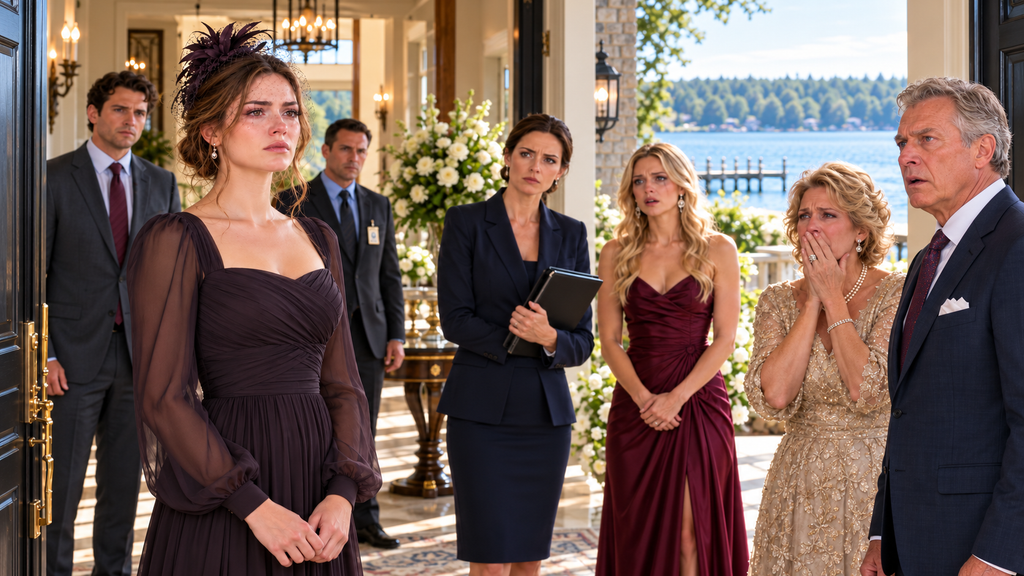
It was the same lake where Eli had taught our son to skip stones.
The same lake where Rose had spent entire afternoons collecting shells she insisted were magical.
The same lake my parents had tried to take from me while I was still struggling to remember how to breathe without my family.
My coffee had gone cold.
On the kitchen table lay the newspaper.
The headline stretched across the front page in enormous black letters.
WIDOW INHERITS $47 MILLION AS FEDERAL INVESTIGATORS EXPOSE MULTIMILLION-DOLLAR FAMILY FRAUD SCHEME.
Beneath it was a photograph of me leaving a federal courthouse beside my attorney.
I looked almost unrecognizable.
My hair was pulled into a tight bun.
I wore a dark blue suit.
My expression was calm.
But nobody looking at that photograph could have imagined what it had cost me to stand upright.
My phone rang again.
I finally answered.
For a moment, there was silence.
Then my father spoke.
“Claire.”
His voice sounded different.
Gone was the bored irritation he had used when I begged him to attend the funeral.
Gone was the commanding tone he had used when he demanded my house.
This time, he sounded frightened.
“Claire, sweetheart, we need to talk.”
I stared at the framed photograph on the windowsill.
Eli stood behind our children, holding Rose on his shoulders while Noah wrapped his arms around his father’s waist.
They were laughing.
They had been laughing when I took that picture.
For a terrible instant, I could almost hear them.
“About what, Dad?”
He cleared his throat.
“About this ridiculous newspaper story.”
“Which part?”
“The investigation. The accusations. The money.”
I said nothing.
He lowered his voice.
“Your mother is very upset.”
I looked toward the lake.
“Was she upset when I buried my children?”
Silence.
“Claire, please don’t start that again.”
Something cold moved through my chest.
“Start what?”
“You know what I mean. We have already discussed what happened.”
“No,” I replied. “You told me Vanessa’s birthday was more important than burying my family. We never discussed it.”
“That isn’t fair.”
I almost laughed.
Fair.
Such a small word.
Such an extraordinary thing for him to say.
“Do you remember what you told me at the cemetery?” I asked.
He sighed.
“Claire—”
“You said Vanessa only turns twenty-nine once.”
“Your mother and I made a mistake.”
“A mistake?”
“Yes.”
I closed my eyes.
“A mistake is forgetting to buy milk, Dad. A mistake is taking the wrong exit. You listened to your daughter beg you to stand beside her while she buried two children and the man she loved, and you chose birthday cake.”
His breathing grew heavier.
“We can’t change the past.”
“No,” I whispered. “But apparently the past can finally catch up with you.”
His voice hardened.
“Listen carefully. Whatever you think you’ve discovered, there are things you don’t understand.”
I glanced at the thick folder beside my newspaper.
Inside were bank statements, forged signatures, corporate records, and a handwritten letter from my dead husband.
“I understand more than you think.”
“Your husband was involved in financial arrangements that could be very embarrassing if certain information became public.”
My hand tightened around the telephone.
There it was.
Not concern.
Not remorse.
A threat.
Even after everything, my father believed he could frighten me by dragging Eli’s name through the mud.
“Be careful what you say next,” I told him.
“I’m trying to protect this family.”
“No. You’re trying to protect yourself.”
“Claire!”
I heard my mother crying in the background.
Then Vanessa’s voice rose sharply.
“Ask her about the money!”
My father moved away from the receiver.
“Vanessa, be quiet.”
“No! She can’t keep all of it!”
I felt a strange calm settle over me.
The kind of calm that arrives after the worst thing imaginable has already happened.
“I have to go, Dad.”
“You cannot just hang up on me!”
“Watch me.”
I ended the call.
Thirty seconds later, my phone buzzed again.
This time it was a message from my attorney.
Do not speak to your father again. Federal investigators have discovered something new. We need to meet immediately.
I read the message twice.
Then a second one appeared.
Claire, this concerns the accident.
My knees nearly gave way.
Because until that moment, I had believed the investigation was about money.
I had believed my father had stolen from the family trust.
I had believed Vanessa and her husband had benefited from the theft.
I had believed Eli’s last recording was a warning about financial betrayal.
But the message on my phone suggested something infinitely worse.
Something I had not allowed myself to imagine.
What if the accident that killed my husband and children had not been an accident at all?
And what if the people who refused to attend their funeral already knew why?
THE LETTER MY HUSBAND LEFT BEHIND
Six months earlier, three days after my parents visited my house to suggest giving it to Vanessa, I had opened the final envelope Eli had left in his office.
I remember every detail of that afternoon.
Rain tapped against the windows.
The dishwasher was running.
A half-empty box of Rose’s crayons sat on the kitchen counter because I hadn’t found the strength to move it.
For two weeks, I had been walking through the house as though I were a stranger trespassing in someone else’s life.
I couldn’t enter the children’s bedrooms.
I couldn’t wash Eli’s favorite sweatshirt.
I couldn’t throw away the half-used bottle of strawberry shampoo in Rose’s bathroom.
Sometimes I stood outside Noah’s bedroom and listened.
Not because I expected him to answer.
But because some primitive, wounded part of my heart still believed that if I stayed quiet enough, I might hear his little feet moving across the floor.
That afternoon, I was searching for our marriage certificate.
My father had mentioned the possibility of placing me under financial guardianship.
He called it “a temporary protective arrangement.”
He claimed I was emotionally incapable of making responsible decisions.
I needed documents proving which assets belonged to me.
That was how I found the envelope.
It had been hidden behind a removable wooden panel in Eli’s filing cabinet.
My name was written across the front.
Not in the careful, professional handwriting he used for work.
In the hurried handwriting he used when leaving little notes inside my lunch.
Claire. If you’re reading this, something has gone terribly wrong.
I sat on the office floor.
For several minutes, I couldn’t bring myself to open it.
I knew his handwriting.
I knew the way he made his capital C.
I knew the tiny hook at the end of his letter E.
Those familiar marks hurt more than any photograph.
Finally, I broke the seal.
Inside were three things.
A small encrypted drive.
A business card.
And a letter.
The first sentence made my blood run cold.
My darling Claire,
If I am gone, please understand that I never intended to leave you frightened or unprotected.
There are things I’ve discovered that involve your father, your sister, and people I once believed were trustworthy.
I have spent the last eighteen months trying to determine how much money disappeared from the Whitmore Family Trust.
The amount is much larger than anyone suspects.
But money is no longer what frightens me.
I stopped reading.
My father’s surname was Whitmore.
The trust had been established by my grandfather, Samuel Whitmore, a real estate developer who had died when I was nineteen.
I knew there was money in it.
But my parents always told me the trust was complicated.
My father managed it.
Vanessa and I received occasional distributions.
I had never questioned the arrangement.
I wasn’t particularly interested in wealth.
I had Eli.
I had Noah.
I had Rose.
I had a house full of noise and mismatched socks and refrigerator drawings.
I thought I already possessed everything that mattered.
My eyes moved down the page.
Your grandfather trusted you more than you know.
There are documents you have never been shown.
I have arranged for copies to be placed with an attorney named Rebecca Hale.
She knows what to do if anything happens to me.
Please don’t confront your father alone.
And Claire, if you ever begin to believe that my investigation caused what happened, remember this: the responsibility belongs to the people who chose to do wrong.
I love you.
I loved you from the moment you spilled coffee on my accounting textbooks in college.
I loved you when you cried over Noah’s first day at school.
I loved you when Rose decided that everyone in the family should wear pink glitter to breakfast.
And I will love you for every tomorrow I never get to see.
Eli.
I pressed the paper against my chest.
Then I cried.
Not the polite crying I had done in front of visitors.
Not the silent tears that came while washing dishes.
I cried until my ribs hurt.
Until my voice broke.
Until there was nothing left inside me but the terrible sound of a woman calling for someone who could never come home.
When I finally stood, the sky outside had darkened.
I took the business card from the envelope.
REBECCA HALE
Attorney at Law — Estate Litigation and Financial Fraud
I called her.
She answered on the second ring.
“Rebecca Hale.”
“My name is Claire Bennett.”
There was a pause.
Then she asked a question that changed my life.
“Are you somewhere safe?”
THE FIRST TRUTH
Rebecca’s office was on the twenty-third floor of a glass building overlooking the city.
She was fifty-eight, with silver-streaked dark hair and an expression that suggested very little escaped her attention.
When I arrived, she did not offer sympathy in the usual empty way.
She didn’t say everything happened for a reason.
She didn’t tell me to be strong.
She simply stood, took both my hands, and said, “Eli loved you very much.”
I nearly collapsed.
She led me to a chair.
For several minutes, she let me cry.
Then she placed a folder on the table.
“Your husband came to see me eighteen months ago.”
I looked up.
“Why?”
“He had discovered discrepancies in your grandfather’s trust.”
“Discrepancies?”
“Transfers that could not be explained by legitimate distributions or expenses.”
“How much?”
Rebecca folded her hands.
“At the time, approximately eleven million dollars.”
I stared at her.
“Eleven million?”
“That was only the beginning.”
She opened the folder.
There were spreadsheets.
Copies of wire transfers.
Corporate ownership diagrams.
Accounts connected through layers of shell companies.
Eli’s handwriting filled the margins.
He had always loved making order out of chaos.
Even when doing our household budget, he used color-coded categories.
I remembered teasing him about it.
“Most men buy flowers,” I used to tell him. “You make spreadsheets.”
And he would grin.
“Flowers die. Spreadsheets are forever.”
The memory hit so hard I had to turn away.
Rebecca waited.
Then she continued.
“Your husband traced a series of transfers from the trust into private entities controlled by your father.”
“That can’t be right.”
I said it instinctively.
Because part of me was still the little girl who believed my father knew everything.
He had taught me to ride a bicycle.
He had attended my high school graduation.
He had held my arm when I walked down the aisle toward Eli.
He had also refused to bury Eli.
Rebecca slid one document toward me.
“Do you recognize this signature?”
I looked.
It was my name.
Claire Elizabeth Whitmore Bennett.
My signature appeared beside a transfer authorization for $275,000.
“I didn’t sign that.”
“Are you certain?”
“I was in the hospital giving birth to Rose that day.”
Rebecca nodded.
“That’s what Eli discovered.”
She produced another document.
And another.
And another.
By the time she finished, I had counted fourteen signatures bearing my name.
I hadn’t signed any of them.
One authorized the sale of a trust-owned commercial building.
Another approved an unsecured loan to a company controlled by Vanessa’s husband, Derek.
A third transferred nearly a million dollars into a private investment account.
My face grew cold.
“What happens now?”
Rebecca looked at me carefully.
“That depends on what you want.”
“I want the truth.”
“Even if it changes everything you believe about your family?”
I remembered my father laughing in the background of Vanessa’s birthday party.
I remembered my mother’s voice telling me not to make the funeral about choosing sides.
I remembered Vanessa opening my refrigerator while discussing how little use I had for a lake house now that my children were dead.
“They already changed everything,” I said.
Rebecca studied me for a moment.
Then she opened a second folder.
“There’s something else Eli discovered.”
She paused.
“Your grandfather left you far more than your parents ever told you.”
THE FORTY-SEVEN MILLION DOLLAR SECRET
My grandfather had been an extraordinary man.
Samuel Whitmore grew up during the Depression, left school at sixteen, and spent most of his adult life building warehouses, apartment buildings, and small commercial centers across three states.
He wore inexpensive watches.
He drove the same pickup truck for twenty-one years.
And every Sunday, he took me fishing.
I was his eldest granddaughter.
Vanessa never liked fishing.
She preferred shopping trips with my mother.
I preferred sitting beside Grandpa Samuel in an old aluminum boat, eating peanut butter sandwiches while he told stories about the buildings he owned.
Once, when I was twelve, I asked why he worked so hard when he already had enough money.
He smiled.
“Because the money isn’t the interesting part, Cricket.”
Cricket.
That was what he called me.
“The interesting part is what you can build with it.”
I hadn’t understood.
Not then.
But Rebecca was about to show me exactly what he had built.
“Your grandfather created a separate trust for your benefit,” she explained.
I frowned.
“I already know about the family trust.”
“Not that one.”
She placed a document before me.
“Samuel established the Samuel Whitmore Legacy Trust three years before his death. It holds real estate interests, investments, and a majority stake in a property management corporation.”
“How much is it worth?”
“According to the most recent independent valuation, approximately forty-seven million dollars.”
I laughed.
Not because anything was funny.
Because the number was so absurd that my mind refused to process it.
“No.”
Rebecca said nothing.
“That’s impossible.”
She turned the document toward me.
My grandfather’s signature sat at the bottom.
Beside it was a handwritten note.
For Claire, who understands that a home is more important than a house.
I covered my mouth.
Rebecca continued.
“Your grandfather deliberately kept this trust separate from the family assets managed by your father.”
“Why?”
“He was concerned about your father’s financial judgment.”
I stared at her.
“He never said that.”
“He may have been trying to protect you without forcing you to choose between them.”
“Why didn’t I know?”
“Your grandfather’s instructions required the trustees to provide formal notice when you reached a specified age. That notice was never properly delivered.”
“Who was responsible?”
“Your father was the administrative contact.”
A terrible realization began to take shape.
“He hid it.”
Rebecca’s silence answered.
“But how could he control something worth that much?”
“He couldn’t lawfully control the underlying assets,” she said. “He controlled the flow of information. He intercepted correspondence, made false representations to certain service providers, and attempted to establish access through forged authorization documents.”
“Did he steal from it?”
“He diverted funds connected to distributions and related entities. We’re still determining the exact amount. Fortunately, the core holdings were protected by independent trustees.”
I looked at the paperwork again.
Forty-seven million dollars.
My entire life, my father had spoken as though I were the irresponsible daughter.
The sentimental one.
The one who married an accountant instead of someone influential.
The one who lived by a lake and spent money on school supplies and children’s birthday parties.
Vanessa was the daughter who understood business.
Vanessa married a man with expensive suits and an investment company.
Vanessa deserved opportunities.
Vanessa needed support.
I had believed my grandfather left us relatively equal inheritances.
Instead, he had trusted me with something my father desperately wanted.
Something he had spent years trying to keep hidden.
I looked at Rebecca.
“Does Vanessa know?”
“We believe so.”
I thought about her standing in my kitchen.
You don’t need the house anymore.
I felt sick.
“Why would they want my house if they already knew about the trust?”
Rebecca hesitated.
“Because your lake house isn’t merely a residence, Claire.”
She opened a property map.
There was my home.
The driveway.
The private dock.
The grove of cedar trees Eli had loved.
And beyond our property line, a large area shaded in blue.
“Your grandfather’s trust owns most of the undeveloped land surrounding the lake.”
I looked closer.
“How much?”
“Approximately four hundred acres.”
“What does that have to do with my house?”
“Your property includes the only practical access route for a proposed high-value development on the eastern shore.”
My throat tightened.
“What development?”
“A resort and luxury residential project. Your father and Derek have been trying to assemble the required property rights for more than two years.”
I stared at the map.
The lake.
Our lake.
The place where my children had learned to swim.
The place where Eli and I planned to grow old.
My family hadn’t come to comfort me.
They had come to secure a driveway.
And the house where my children once lived was the key.
THE LAST NIGHT I SAW THEM ALIVE
There are memories that become sharper after death.
Not softer.
Not kinder.
Sharper.
Every ordinary detail turns into a blade.
The last evening before the accident, Eli made spaghetti.
He always used too much garlic.
Noah, who was eight, complained that his meatballs were touching his vegetables.
Rose, who was five, insisted on drinking water from a teacup because she was hosting a “royal dinner.”
I sat across from them, tired after a long day.
At one point, Eli looked at me over Rose’s head.
He smiled.
Not his usual playful smile.
Something quieter.
Almost sad.
“What?” I asked.
“Nothing.”
“Eli.”
He reached across the table and squeezed my hand.
“Just looking at my favorite people.”
Noah groaned.
“Dad, that’s so embarrassing.”
Rose lifted her teacup.
“I am the queen. Nobody is allowed to be embarrassed.”
We laughed.
I remember that.
I remember the sound.
A family of four laughing over badly shaped meatballs.
Later, after the children went to bed, Eli stood beside the kitchen window staring at his phone.
“Everything okay?” I asked.
He put it away.
“Yes.”
“You sure?”
He turned toward me.
“Claire, if I told you there was something about your father that might hurt you, would you want to know?”
I frowned.
“What kind of something?”
He hesitated.
Then shook his head.
“Not tonight.”
“Eli.”
“I’m handling it.”
I crossed the kitchen and wrapped my arms around him.
“You don’t always have to handle everything alone.”
He kissed my forehead.
“I know.”
The next morning, he planned to take the children to visit his mother.
I was staying home to finish work for a community literacy program.
Noah wanted pancakes for breakfast.
Rose wanted to bring her stuffed rabbit.
Eli kissed me at the door.
“Love you, Cricket.”
I smiled.
“You’re the only person besides Grandpa who calls me that.”
“I earned the privilege.”
Noah shouted from the back seat.
“Dad! We’re going to be late!”
Eli laughed.
Then he looked at me one last time.
“I love you, Claire.”
“I love you too.”
He closed the door.
I watched their car disappear down the driveway.
I did not know I was looking at the last twenty seconds of my old life.
Three hours later, a police officer knocked on my door.
And the world ended.
For months, I had replayed that morning.
Had Rose buckled her seat belt properly?
Had Noah remembered his jacket?
Had Eli been tired?
Had I distracted him with a text message?
The official report said another vehicle crossed into their lane on a rural highway.
The driver of that vehicle fled before police arrived.
Eli lost control trying to avoid the collision.
Their car struck a barrier and overturned down an embankment.
The impact killed all three.
The other vehicle was never conclusively identified.
I had been told it was a tragic hit-and-run.
A stranger’s mistake.
A terrible moment.
But now, six months later, Rebecca was asking me to return to her office because federal investigators had discovered something about the accident.
And I was terrified of what she might say.
THE MESSAGE THAT CHANGED EVERYTHING
I drove to the city with both hands gripping the steering wheel.
Every red light felt unbearable.
Every passing car made my stomach tighten.
At the courthouse entrance, two reporters recognized me.
“Mrs. Bennett!”
“Claire, do you have a comment about your father’s alleged involvement?”
“Is it true you’re worth forty-seven million dollars?”
I kept walking.
One reporter shouted something that stopped me.
“Do you believe your husband’s death was connected to the investigation?”
My feet froze.
Rebecca’s assistant reached me immediately.
“Mrs. Bennett, this way.”
I followed her inside.
Rebecca was waiting with two people.
One was a federal investigator named Daniel Mercer.
The other was a state police detective named Olivia Grant.
I had met Detective Grant after the accident.
She had been gentle with me.
She was the one who returned Eli’s wedding ring in a sealed evidence envelope.
Seeing her again made the room tilt.
“Claire,” she said softly.
I sat down.
Nobody spoke for several seconds.
Finally, I looked at Rebecca.
“Tell me.”
Rebecca folded her hands.
“The fraud investigation uncovered records suggesting that someone connected to your father may have been monitoring Eli’s movements before the accident.”
My heart slammed against my ribs.
“Monitoring?”
Agent Mercer opened a folder.
“We found invoices from a private investigation company.”
He slid a document toward me.
It contained Eli’s name.
His photograph.
His vehicle registration.
And a list of dates.
One date was circled in red.
The day he died.
I gripped the table.
“Who ordered this?”
“We believe the request originated through an account associated with Derek’s company.”
Vanessa’s husband.
I heard myself whisper his name.
“Derek?”
“We haven’t established who ultimately authorized every instruction,” Mercer said. “That’s one reason we’re continuing the investigation.”
Detective Grant leaned forward.
“Claire, we need to ask whether Eli ever mentioned being followed.”
I thought about his behavior during the final weeks.
The way he checked the rearview mirror.
The way he occasionally took different routes home.
The way he had installed a camera near our driveway.
I had teased him.
“You’re turning into one of those people who think the mailman is a spy.”
He smiled.
“Just being careful.”
I looked at Detective Grant.
“Yes.”
She wrote something down.
“Anything else?”
“He asked me a strange question the night before the accident. About my father. About whether I would want to know something painful.”
Mercer exchanged a glance with Rebecca.
I noticed.
“What?”
He hesitated.
“There’s another item.”
He placed a photograph in front of me.
It showed a dark pickup truck.
The image was grainy.
A traffic camera had captured it near the highway exit shortly before the crash.
“We found a possible match for the unidentified vehicle,” Detective Grant said.
“Whose truck?”
“We’re working to confirm the ownership history.”
I looked closer.
Something about the truck bothered me.
The shape.
The black rims.
A pale scratch above the rear wheel.
I had seen it before.
Not recently.
But somewhere.
Then I remembered.
Derek’s company Christmas party.
Two years earlier.
A man had parked a black pickup near the service entrance.
He had argued with Derek outside.
I remembered because I had been standing nearby with Eli.
The man wore a gray jacket.
He had a scar across one eyebrow.
Derek gave him a thick envelope.
When Eli asked who he was, Derek said he handled “difficult collections.”
I pointed at the photograph.
“I think I know someone who drove that truck.”
The room went silent.
Mercer leaned forward.
“Who?”
“I don’t know his name.”
“Can you describe him?”
I told them everything.
The scar.
The jacket.
The envelope.
The argument.
The Christmas party.
Detective Grant took detailed notes.
Then Agent Mercer asked a question I will never forget.
“Claire, did your father know your husband was investigating the trust?”
I swallowed.
“I don’t know.”
“Did your husband ever confront him?”
I remembered a Thanksgiving dinner.
Four months before the accident.
Eli and my father had disappeared into the study.
When Eli came out, his face was pale.
My father followed him.
Smiling.
But it was the kind of smile that never reached his eyes.
I had asked Eli what happened.
He said, “Your father and I disagree about something.”
That was all.
Now I looked at Mercer.
“I think he did.”
The agent nodded slowly.
Then he said, “We have reason to believe your husband was planning to provide evidence to authorities within forty-eight hours of his death.”
I felt the floor vanish beneath me.
Forty-eight hours.
Eli had been so close.
So close to handing over everything.
So close to telling me the truth.
And then my husband and children were gone.
I pressed my hands over my face.
“Please,” I whispered. “Tell me you’re not saying what I think you’re saying.”
Detective Grant’s eyes filled with sympathy.
“We are saying there are enough unanswered questions to formally reopen the crash investigation.”
My chest tightened.
“But we are not yet saying we know who caused it,” she added.
I nodded.
I understood.
Evidence mattered.
Truth mattered.
And the last thing I wanted was to replace one nightmare with a lie.
But as I sat in that room, one thought kept circling through my mind.
My father had refused to come to the funeral.
My mother had defended him.
Vanessa had celebrated.
And somewhere inside that family, there might have been a secret far more terrible than greed.
THE BIRTHDAY PHOTOGRAPHS
That evening, I did something I had avoided for six months.
I opened Vanessa’s birthday photographs.
I had blocked her social media account immediately after the funeral.
At the time, I couldn’t bear to see those images.
But now I wanted to study them.
There were thirty-seven photographs.
Vanessa in a silver dress.
My mother holding champagne.
My father standing beside a towering pink cake.
Derek smiling with one arm around Vanessa’s waist.
A dozen guests.
Gold balloons.
Sparkling lights.
Everything looked perfect.
I began examining the timestamps.
The funeral had started at ten in the morning.
Vanessa’s party photographs began appearing in the afternoon.
That alone proved nothing.
My parents had chosen the party over me.
I already knew that.
But one photograph caught my attention.
My father stood near the dining room, speaking with Derek.
Neither was smiling.
Vanessa had captioned it:
My two favorite businessmen plotting my birthday surprise!
I enlarged the photograph.
Derek held a phone.
My father looked angry.
Behind them, on a side table, sat a brown envelope.
It bore the logo of Derek’s investment company.
Again, it proved nothing.
But the next photograph chilled me.
My mother stood beside Vanessa.
Vanessa was laughing.
In the background, my father had his phone pressed to his ear.
His expression was grim.
The photograph had been posted at 10:42 a.m.
Forty-two minutes after my family’s funeral began.
I remembered something.
During the funeral, while the minister spoke about Noah’s kindness and Rose’s endless curiosity, my phone had vibrated.
A message from my father.
Hope everything goes smoothly today. We’ll talk later.
I had read it beside three coffins.
I had not answered.
Now, looking at the photographs, I wondered who else my father had been speaking to that morning.
I sent the images to Rebecca.
Then I went upstairs.
For the first time in six months, I opened Rose’s bedroom door.
The pink curtains were still tied back.
Her dollhouse stood against the wall.
A drawing lay on her desk.
Four stick figures holding hands.
Above them, in uneven purple letters, she had written:
MY FAMILY FOREVER.
I picked it up.
My hands shook.
On the bottom right corner, she had drawn a tiny yellow sun.
Rose always drew the sun.
Even in pictures of nighttime.
Once, I asked her why.
She looked at me as though the answer were obvious.
“Because the sun is still there, Mommy. Even when we can’t see it.”
I sat on her bed.
And for a long time, I held that drawing against my chest.
“I’m trying, baby,” I whispered.
“I’m trying so hard.”
MY SISTER CAME TO BEG
Three days after the newspaper headline, Vanessa arrived at my gate.
My security camera showed her standing outside in a cream-colored designer coat.
Her sunglasses were enormous.
She looked like someone arriving for a fashion shoot.
Not someone coming to apologize.
She pressed the intercom.
“Claire, open the gate.”
I watched from the kitchen.
She pressed it again.
“I know you’re home.”
I turned on the microphone.
“What do you want, Vanessa?”
She startled.
Then smiled at the camera.
“Can we talk like sisters?”
I looked at her for several seconds.
“Which sisters?”
Her smile disappeared.
“Don’t be difficult.”
“You came to my house two weeks after my children’s funeral and told me I didn’t need it anymore.”
She exhaled loudly.
“Are we really going to keep going over that?”
“Yes.”
“Claire, I came to make peace.”
I thought about refusing.
I should have refused.
Rebecca had warned me not to meet with anyone connected to the investigation without consulting her.
So I didn’t open the gate.
Instead, I told Vanessa to speak through the intercom.
Her expression darkened.
“Are you serious?”
“Completely.”
She looked behind her.
Then lowered her voice.
“Dad is falling apart.”
I said nothing.
“He hasn’t slept.”
Still nothing.
“Mom keeps crying.”
I looked toward the empty breakfast table.
“That’s unfortunate.”
Vanessa’s face twisted.
“You’ve changed.”
“Yes.”
She stared at the camera.
“Money really does change people.”
I felt something almost like amusement.
“Interesting. You wanted my house before you knew I had money.”
“That was different.”
“How?”
“We were trying to help you.”
“By taking the only home my children ever knew?”
She looked away.
For a moment, I saw something shift behind her eyes.
Then she said, “You don’t understand how hard things have been for us.”
I waited.
“Derek’s company is struggling. Dad was helping us get back on our feet. There were investments, Claire. Complicated investments.”
“With my money.”
“It wasn’t just your money!”
Her words echoed through the speaker.
She seemed surprised by her own outburst.
Then she lowered her voice.
“Look, we all benefited from Grandpa’s success.”
“Did we?”
“Don’t do this.”
“You knew about the second trust.”
She froze.
I watched the color drain from her face.
“Who told you that?”
I felt my heartbeat slow.
There it was.
Confirmation.
“You knew,” I repeated.
Vanessa looked toward the road.
“Claire, please.”
“How long?”
She swallowed.
“It’s complicated.”
“How long, Vanessa?”
Her eyes filled with tears.
But they were not the tears I had needed from her six months earlier.
Those would have been tears for Eli.
For Noah.
For Rose.
These tears were for herself.
“Dad told me about it a few years ago.”
“A few years?”
“He said Grandpa made a mistake.”
“A mistake?”
“He said you weren’t capable of managing that kind of money.”
I looked at my sister.
The little girl I used to protect from thunderstorms.
The teenager whose college applications I helped write.
The woman who wore a silver dress and blew out birthday candles while I lowered my children into the ground.
“And you agreed with him.”
Vanessa said nothing.
“Did you ever once think about telling me?”
“He said it would destroy the family.”
I laughed softly.
The sound frightened even me.
“Destroy the family?”
“Claire—”
“Look behind me, Vanessa. You see this house?”
She glanced toward the security camera.
“This was my family. Eli. Noah. Rose. You didn’t care when they died. You only cared when you discovered I could stop paying for your life.”
Her face hardened.
“That’s cruel.”
“No,” I said quietly. “Cruel was calling your birthday more important than three funerals.”
She covered her mouth.
For a moment, I thought she might finally apologize.
Instead, she whispered, “If Dad goes to prison, Mom will never forgive you.”
I looked directly into the camera.
“Then she’ll have something else in common with me.”
Vanessa stared.
“What?”
“I’ll never forgive her for that funeral.”
I turned off the intercom.
She stood outside for nearly ten minutes.
Then she returned to her car.
As she pulled away, my phone buzzed.
A message from Rebecca.
The court has issued temporary restrictions on several accounts connected to Derek’s businesses. We expect a reaction. Please remain cautious.
I looked at the road beyond the gate.
Vanessa’s car disappeared around the bend.
And I knew the worst was still coming.
THE MAN WITH THE SCAR
Five days later, Detective Grant called me.
“Claire, are you alone?”
I was sitting in Eli’s office.
“Yes.”
“Can you come to the station?”
My stomach turned.
“Have you found something?”
“We need you to look at several photographs.”
I drove there immediately.
Grant met me in a small interview room.
Agent Mercer was already waiting.
On the table lay a folder.
“We’ve identified the man you described at Derek’s Christmas party,” Grant said.
I leaned forward.
She opened the folder.
The photograph showed a man in his early forties.
Broad shoulders.
Close-cropped hair.
A scar running through his left eyebrow.
I knew him instantly.
“That’s him.”
“Are you certain?”
“Yes.”
“His name is Marcus Vale.”
I repeated it.
Marcus Vale.
The name meant nothing to me.
Grant continued.
“He previously worked in private security and vehicle recovery. His company performed work for businesses connected to Derek.”
I glanced at Mercer.
“Was it his truck?”
“We have evidence linking him to a black pickup consistent with the vehicle under investigation.”
My hands went cold.
“Where is he?”
Grant hesitated.
“He’s cooperating with investigators.”
I stared.
“Cooperating?”
“He came forward through an attorney.”
I could hardly breathe.
“What did he say?”
Mercer spoke carefully.
“He acknowledges conducting surveillance on Eli before the crash.”
I gripped the edge of the table.
“And?”
“He claims he was hired to obtain documents your husband possessed.”
“By Derek?”
“He identifies Derek as his point of contact.”
My heart pounded.
“What about the accident?”
Mercer paused.
“He says he was following Eli that morning.”
I felt sick.
“He followed them?”
“Yes.”
“My children were in that car.”
“We know.”
“Did he know?”
“We’re still examining his account and other evidence.”
I looked at the detective.
“Tell me what happened.”
She took a slow breath.
“According to Vale, he attempted to stop Eli’s vehicle and force a conversation. He claims he moved into the roadway, and Eli swerved to avoid a collision.”
I couldn’t speak.
“He says he panicked after the crash and drove away.”
The room spun.
I heard Rose’s voice.
Mommy, the sun is still there.
I heard Noah laughing.
I heard Eli telling me he loved me.
Then I heard myself ask, “Did he call for help?”
Grant’s expression changed.
“No.”
The word struck harder than any scream.
“No?”
“Not according to the information we currently have.”
I pressed my fist against my mouth.
There was a long silence.
Then I asked the question that had been burning through me.
“Who told him to stop my husband?”
Mercer looked at Grant.
“We are investigating whether Derek directed that action. Vale’s account is not enough by itself to establish exactly what anyone else intended.”
“And my father?”
“We’re examining his communications and financial records. At this stage, we cannot tell you he authorized the confrontation.”
I nodded.
I wanted certainty.
I wanted someone to give me one name and one clear answer.
But grief had already taught me what happened when people chose comforting stories over difficult truths.
I would not make that mistake.
Still, when I left the police station, I barely made it to my car.
I sat behind the wheel and screamed.
Not words.
Just sound.
A terrible, animal sound that seemed to come from somewhere beneath my bones.
I screamed for my husband.
For my son.
For my daughter.
For every breakfast they would never eat.
Every birthday they would never celebrate.
Every ordinary Tuesday stolen from us.
Then I rested my forehead against the steering wheel.
And whispered, “Eli, I’m so sorry.”
My phone rang.
It was Rebecca.
“Claire?”
I could barely answer.
She listened to me crying.
Then she said something I needed to hear.
“Eli didn’t cause this by discovering the fraud.”
I closed my eyes.
“Rebecca—”
“He had every right to investigate. Every right to protect you. Whatever crimes others committed are their responsibility.”
“But if he’d just walked away—”
“Claire.”
Her voice was firm.
“Your husband was driving your children to see their grandmother. He wasn’t doing anything wrong.”
The words broke something open inside me.
For six months, I had carried countless imaginary versions of that morning.
What if I had gone with them?
What if I had asked Eli to stay home?
What if I had insisted he tell me everything?
What if I had called one minute earlier?
But none of those questions changed who had chosen to drive recklessly and leave my family in a ditch.
I wiped my face.
“What’s next?”
Rebecca exhaled.
“Now we let the evidence lead us.”
I looked through the windshield.
People were walking past.
Living ordinary lives.
Buying coffee.
Talking on their phones.
Planning dinner.
I envied them with an intensity I couldn’t describe.
Then I started the engine.
Because I had something left to do.
THE HOUSE THEY WANTED
Two weeks later, a certified letter arrived from a development company called Silvercrest Holdings.
The envelope was thick.
The language was polite.
The message was not.
The company claimed that an agreement signed years earlier granted it a purchase option covering my lake property.
Under certain conditions, the letter stated, I would be required to transfer the property.
I immediately called Rebecca.
She read the agreement.
Then she said, “Well, this is interesting.”
“Interesting how?”
“The signature on this document is yours.”
I stared at the page.
I had seen enough forged signatures by then to recognize the pattern.
“No.”
“I didn’t think so.”
“Can they take the house?”
“Not based on a forged agreement. But we’ll need to challenge it formally.”
I looked at the final page.
There was my father’s name.
Not as owner.
As a witness.
And beside his signature was Derek’s.
My stomach tightened.
“Rebecca?”
“Yes?”
“Why would my father sign as a witness to an agreement he knew I never signed?”
She paused.
“That is an excellent question.”
Within days, she had filed the necessary papers disputing the agreement.
A document examiner identified significant inconsistencies between the disputed signature and verified examples of mine.
Then another discovery changed everything.
Silvercrest Holdings had been established through a network of companies connected to Derek.
Its proposed development depended on access across my property and surrounding trust land.
The projected value of the entire project exceeded two hundred million dollars.
My house wasn’t merely valuable.
It was an obstacle.
A small, deeply personal obstacle standing between greedy people and enormous money.
One evening, I stood on my dock looking toward the opposite shore.
The sun was setting.
The lake glowed copper.
I remembered Eli standing there with Noah.
“Watch this, Dad!”
Noah threw a stone.
It hit the water once and sank.
Eli applauded anyway.
Rose sat beside me, her feet dangling above the water.
“Mommy, when I’m big, can I live here forever?”
I had kissed her hair.
“Of course, sweetheart.”
Now, six months later, I understood that my family had looked at this place and seen something entirely different.
They saw land.
Access rights.
Development profits.
Collateral.
I saw tiny footprints in wet sand.
I saw Eli’s fishing hat hanging by the back door.
I saw Rose’s pink bicycle.
I saw Noah’s crooked treehouse.
I stood at the end of the dock and made a promise.
Nobody would ever turn my children’s home into a reward for the people who had betrayed them.
Nobody.
MY MOTHER’S SECRET
The first time my mother called me after the investigation became public, I nearly ignored her.
Then I answered.
“Claire?”
Her voice trembled.
“Mom.”
She began crying immediately.
“My beautiful girl.”
I stared at the wall.
For years, those words could have softened me.
Now they sounded rehearsed.
“Why are you calling?”
“Your father is frightened.”
I closed my eyes.
“Of course he is.”
“He’s not eating. He barely sleeps. People are saying terrible things.”
“People are reading court filings, Mom.”
“You know your father. He can be stubborn, but he’s a good man.”
I thought of Eli’s letter.
The forged signatures.
The missing millions.
The property agreement.
“Do you believe that?”
She sniffed.
“He loves his family.”
“Which family?”
“Don’t say that.”
“Were Eli and my children part of your family?”
Silence.
“Answer me, Mom.”
“Of course they were.”
“Then why weren’t you at their funeral?”
Her crying stopped.
“Claire, we’ve apologized.”
“No, you haven’t. You’ve explained. You’ve justified. You’ve said it was complicated. You’ve said I should understand. But you have never apologized.”
She took a shaky breath.
“We thought you’d have plenty of people around you.”
I gripped the phone.
“I needed my parents.”
“I know.”
“No,” I whispered. “You don’t.”
She began crying again.
Then she said something unexpected.
“I didn’t know about the truck.”
My entire body went still.
“What?”
She inhaled sharply.
“Nothing.”
“Mom.”
“I shouldn’t have said that.”
“What truck?”
Silence.
My pulse hammered.
“Mom, what truck?”
She started sobbing.
“I thought Derek was just going to frighten Eli.”
I couldn’t move.
The room seemed to shrink around me.
“What did you just say?”
“I didn’t know what would happen.”
I grabbed a pen.
My hand shook so badly I could barely write.
“Mom, listen carefully. What did you know?”
She was breathing rapidly.
“Your father was angry because Eli had papers. He said Eli was trying to ruin everything. Derek said he knew someone who could convince him to hand them over.”
I pressed the phone closer.
“When?”
“A few days before the accident.”
My mouth went dry.
“And you heard this?”
“Yes.”
“Did Dad approve?”
She made a small, frightened sound.
“I don’t know exactly what they agreed to.”
“Did you warn Eli?”
Silence.
My chest tightened.
“Did you warn me?”
“Claire, your father said nobody would get hurt.”
I looked at the photograph of my children.
Rose’s smile.
Noah’s missing front tooth.
“Three people died, Mom.”
She began pleading.
“Please, you have to understand. I didn’t think—”
“That’s right,” I said. “You didn’t.”
“Your father will go to prison if you tell anyone.”
My voice became very quiet.
“Mom, I need you to tell the investigators everything you just told me.”
“No!”
“You have to.”
“Claire, please!”
“Three people died.”
She started crying harder.
“Your father is still your father.”
I looked toward Eli’s empty chair.
“And Eli was still my husband.”
“Please don’t destroy what’s left of this family.”
I swallowed.
“Mom, you helped destroy it when you kept quiet.”
Then I ended the call.
I immediately contacted Detective Grant and told her what my mother had said.
She asked me to write down the conversation while it was fresh.
I did.
Every word.
Every pause.
Every terrible sentence.
That night, I sat awake until dawn.
Because I had finally discovered the difference between the mother I thought I had and the woman she had chosen to become.
I had always believed she was weak.
That she followed my father because she was afraid of conflict.
But weakness and innocence are not the same thing.
She had heard talk of threatening my husband.
She had done nothing.
Then she had chosen Vanessa’s birthday over his funeral.
I couldn’t decide which part hurt more.
The possibility that she had known something before the accident.
Or the certainty that she had watched me bury my children without telling me.
THE INTERVIEW
My mother’s statement opened another door.
Detective Grant and Agent Mercer interviewed her formally.
At first, she tried to minimize everything.
She said she hadn’t understood the conversation.
She said she was distracted.
She said Derek sometimes exaggerated.
Then investigators showed her phone records.
And a message she had sent my father two days before the accident.
I don’t like what Derek is planning. Tell him not to do anything stupid.
My mother broke down.
She admitted that she had overheard Derek discussing the man hired to retrieve Eli’s documents.
She said my father had been furious.
She said he had shouted that Eli needed to be “stopped before Friday.”
When investigators asked whether she believed violence was intended, she said she didn’t know.
When they asked why she had never contacted police, she claimed she was afraid.
And when they asked why she had refused to attend the funeral, she gave an answer that made me stare at the interview summary for a very long time.
She said my father had forbidden the family from going.
Not because of the birthday.
Not entirely.
He was afraid that attending the funeral would force him to face questions about Eli’s investigation.
Vanessa’s birthday had been the excuse.
The convenient explanation.
The story everyone agreed to repeat.
My father hadn’t merely decided that a birthday mattered more than three lives.
He had also chosen to avoid standing beside the consequences of what his associates might have done.
I read the report alone in Rebecca’s office.
When I reached that paragraph, I stopped.
My hands went numb.
For six months, I had asked myself the same question.
How could they celebrate while I was burying my family?
Now I understood part of the answer.
They had wanted to keep living inside a world where nothing had happened.
Where cake and champagne and smiling photographs could prove that everything remained normal.
Where nobody asked why Eli had been frightened.
Where nobody mentioned the documents he carried.
Where nobody looked too closely at the missing money.
They had chosen the party because the funeral demanded truth.
And truth terrified them.
THE NIGHT MY FATHER CAME TO THE HOUSE
It happened on a Tuesday.
Nine days after my mother’s interview.
At 8:17 p.m., the gate camera alerted me.
A black sedan had stopped outside.
My father stepped out.
He wore a dark overcoat.
His hair, once perfectly groomed, looked disheveled.
He pressed the intercom.
“Claire.”
I watched him from the security monitor.
“Go home, Dad.”
“We need to settle this.”
“Speak to Rebecca.”
“I am not speaking to your lawyer about my own daughter.”
“You can speak to mine.”
He stared at the camera.
“Your mother told me what she said.”
I felt a chill.
“Then you know she finally told someone the truth.”
His jaw tightened.
“Your mother is confused.”
“Really?”
“She has been under tremendous stress.”
I said nothing.
“Claire, open the gate. I want to talk face-to-face.”
“No.”
His expression changed.
The frightened father disappeared.
The man who had controlled our family for decades returned.
“You’ve always been stubborn.”
I almost smiled.
“You used to call it weakness.”
“Don’t twist my words.”
“You said I couldn’t handle money.”
“You couldn’t.”
“And yet Grandpa trusted me with forty-seven million dollars.”
His face reddened.
“That old man made a terrible mistake.”
I leaned closer to the monitor.
“He knew you better than I did.”
My father slammed his palm against the gate.
“Everything I did was for this family!”
I looked at him.
“Was the forged paperwork for the family?”
“Those transactions were legitimate arrangements.”
“Was trying to take my house for the family?”
“You weren’t using the property properly!”
“Was threatening Eli for the family?”
He froze.
For the first time, I saw genuine fear cross his face.
“Watch yourself,” he whispered.
I felt my heart pounding.
But I held his gaze.
“No, Dad. You watch yourself.”
He glanced toward the road.
Then lowered his voice.
“Derek got carried away.”
I stopped breathing.
He continued.
“I never told him to hurt anyone.”
My fingers tightened around the edge of the desk.
“I told him to recover the documents. That was all.”
The words hung in the air.
The security system was recording.
My father knew we had cameras.
But anger had made him careless.
“Did you know Eli’s children were in the car?” I asked.
His face twisted.
“Of course not!”
I swallowed.
“Did you know the man was going to force him off the road?”
“No!”
He struck the gate again.
“I told Derek to handle the situation. I didn’t ask for this!”
I stared at the screen.
Not because I had proof of everything.
I didn’t.
His words still needed to be examined alongside the other evidence.
But I had heard him acknowledge something he had denied for months.
He had authorized efforts to obtain Eli’s documents.
He had known Derek was involved.
And he had kept silent after my family died.
My father put both hands against the gate.
“Claire, please.”
His voice broke.
“I am your father.”
I closed my eyes.
I remembered being six years old.
Falling off my bicycle.
Scraping both knees.
Crying as he carried me inside.
I remembered him telling me that fathers existed to protect their children.
I opened my eyes.
“Where were you when I needed a father?”
He stared at the camera.
“Claire—”
“Where were you when I stood beside Noah’s coffin?”
His mouth trembled.
“Where were you when they lowered Rose into the ground?”
He looked away.
“Where were you when I begged you to come?”
There was no answer.
I whispered, “You told me Vanessa only turns twenty-nine once.”
He began to cry.
I had never seen my father cry.
Not when Grandpa died.
Not when his business failed years earlier.
Not when Eli and the children were killed.
But now, standing outside the gate of the daughter he had abandoned, he cried.
“Please,” he said. “Don’t let them put me in prison.”
Something inside me settled.
I finally understood.
He was not crying because he missed Eli.
He was not crying because he regretted what Noah and Rose had lost.
He was crying because he was afraid of losing the life he had built.
I looked at him for a long moment.
Then I said, “You should have thought about consequences before you made your choices.”
I ended the call.
He stayed outside for another twenty minutes.
Then he left.
I saved the recording.
Sent it to Rebecca.
And for the first time in months, I slept for almost six uninterrupted hours.
THE ARRESTS
The arrests came on a rainy Thursday morning.
Almost seven months to the day after I buried my family.
My father was taken into custody on federal fraud and conspiracy charges.
Derek was arrested at his office.
Marcus Vale faced charges arising from the fatal highway incident, including allegations related to his dangerous driving and failure to seek help.
Vanessa was not arrested that morning.
But investigators seized records from accounts she controlled.
My mother was interviewed again.
The television stations replayed footage of my father being led from his home.
He wore a gray sweater.
His hands were secured in front of him.
A camera flashed as he stepped toward a waiting vehicle.
For years, he had demanded respect.
He corrected waiters.
He intimidated employees.
He spoke loudly at family gatherings.
He believed he could control every room he entered.
Now he kept his head down.
I watched the footage once.
Then turned off the television.
I didn’t feel triumphant.
I didn’t smile.
I didn’t celebrate.
I walked upstairs and sat on Noah’s bed.
His favorite stuffed dinosaur was still tucked under the pillow.
I picked it up.
Its green fabric was worn around the neck because he used to carry it everywhere when he was small.
“Daddy always said dinosaurs never really disappeared,” Noah once told me.
I smiled through tears.
“What did he mean?”
“That they left little pieces of themselves everywhere.”
I held the toy tightly.
My father had been arrested.
The investigation was moving forward.
The money was being recovered.
But Noah was still dead.
Rose was still dead.
Eli was still dead.
Nothing about a courtroom or a prison cell could change that.
That evening, Rebecca came to see me.
She found me sitting on the living room floor beside three photo albums.
She sat down without a word.
For a while, we looked at pictures.
Eli holding newborn Noah.
Rose sleeping on her father’s chest.
Both children covered in flour during Christmas baking.
A family vacation to the mountains.
My husband pretending to be frightened by a tiny frog.
Then Rebecca touched my arm.
“Claire, there’s something I need to tell you.”
I looked up.
“We found another letter.”
My heart stopped.
“From Eli?”
She nodded.
“It was among the materials released by the independent trustee after the trust investigation.”
I stared at her.
“Why didn’t he leave it with the first one?”
“He wrote it earlier. It was included in a packet of personal instructions.”
She handed me an envelope.
On the front, in Eli’s handwriting, were five words.
For Claire, when she’s ready.
I couldn’t open it.
Not then.
Rebecca understood.
She squeezed my hand.
“Whenever you want.”
Then she left.
For three days, the envelope sat on my bedside table.
I looked at it every morning.
Every night.
I was afraid of what it might say.
Afraid of another secret.
Afraid of another goodbye.
Finally, on Sunday morning, I took it downstairs.
I made coffee.
Opened the curtains.
Sat in Eli’s favorite chair.
And unfolded the letter.
THE SECOND LETTER
My beautiful Claire,
If Rebecca has given you this letter, I hope it means the truth has finally come into the light.
I know you.
I know how you carry other people’s burdens.
I know that when Noah falls, you blame yourself for not standing closer.
When Rose gets sick, you replay everything she ate.
When something goes wrong at work, you wonder whether you should have worked harder.
And I know that if something terrible happens to me, you will search for a way to make it your fault.
I stopped reading.
Because he was right.
Even after everything investigators had discovered, there was still a small voice inside me whispering that I should have saved them.
I wiped my eyes.
Then continued.
So let me tell you something clearly.
You are not responsible for the choices other people make.
Not your father.
Not your sister.
Not me.
I chose to investigate because I believed the truth mattered. I chose to protect our family because I love you.
Whatever happens, don’t let fear turn you into someone who spends her entire life looking backward.
I married the girl who rescued an injured bird from a parking lot because she couldn’t bear to leave it alone.
I married the woman who cried when Noah learned to read.
I married the mother who stayed awake sewing a crooked princess costume because Rose wanted to be a queen.
That woman is extraordinary.
Not because she’s rich.
Not because she’s strong every day.
Not because she never makes mistakes.
Because she loves with her whole heart.
And Claire, that is something nobody can steal.
I pressed my fingers against my lips.
The next paragraph made me laugh through tears.
Also, if you find this while I’m alive, please pretend you didn’t. I would never recover from the embarrassment of writing such a dramatic letter.
I could hear his voice.
His exact voice.
Warm.
Playful.
A little self-conscious when he said something deeply romantic.
I kept reading.
There’s one more thing.
Your grandfather told me something shortly before he died.
He said he chose you to protect his legacy because you understood the difference between owning something and caring for it.
He believed the money could do good.
Schools.
Libraries.
Safe places for children.
Homes for people who had nowhere else to go.
He said you’d know what to do.
I believe he was right.
But please don’t feel you have to spend the rest of your life proving him correct.
Live.
Laugh when you can.
Travel.
Make terrible pancakes.
Plant flowers.
And if someday you find another reason to smile, don’t feel guilty.
Loving us doesn’t require you to stop living.
Always yours,
Eli.
At the bottom, he had drawn a tiny crooked heart.
Inside it were four initials.
E.
C.
N.
R.
I held that letter against my chest.
And for the first time since the accident, I cried without wishing I could disappear.
I cried because I loved him.
Because I missed him.
Because he had known me so completely.
And because somewhere inside the pain, I felt the faintest possibility that one day I might learn to live again.
THE TRIAL
The criminal proceedings did not unfold quickly.
There were months of hearings.
Document reviews.
Financial examinations.
Motions.
Witness interviews.
Expert reports.
Evidence disputes.
I learned that justice was not a single dramatic moment.
It was a long road filled with paperwork, delays, and uncomfortable truths.
The financial charges against my father were supported by bank records, forged authorization documents, and testimony from former employees who described how he had instructed them to conceal transactions.
The government alleged that he had diverted millions through related companies while falsely representing the transfers as legitimate trust expenses.
Derek faced additional charges connected to the fraudulent transactions.
He also faced separate criminal proceedings arising from the events leading to the crash.
Marcus Vale eventually entered a plea agreement concerning his role in the fatal incident.
His testimony became central to the case against Derek.
According to Vale, Derek had instructed him to intercept Eli and retrieve a set of financial records.
Vale described aggressive surveillance and a confrontation on the highway that turned catastrophic.
Investigators did not find evidence that my father had explicitly ordered anyone to kill my family.
That distinction mattered.
I wanted the truth.
Not a convenient version designed to satisfy my anger.
But the evidence showed that my father had participated in efforts to pressure Eli over the investigation and had concealed what he knew afterward.
He had also lied repeatedly about the financial scheme.
It was enough to destroy the image he had spent a lifetime carefully constructing.
Vanessa entered an agreement to return certain assets obtained through the fraudulent transfers.
Her role in several transactions remained subject to separate legal scrutiny.
My mother was never the central defendant in the financial case.
But her silence became part of the story told in court.
And during one hearing, something happened that I will remember for the rest of my life.
I was sitting in the gallery when my father turned around.
He found me immediately.
For a moment, we looked at each other.
Then he mouthed two words.
I’m sorry.
Seven months earlier, those words might have saved something between us.
At the cemetery, if he had arrived even after the service, knelt beside the graves, and said them sincerely, perhaps I would have been able to imagine a future where we could still speak.
But now they came after the money was exposed.
After the arrests.
After the cameras.
After the consequences.
I looked at him.
Then I turned away.
Because an apology offered only when escape becomes impossible is not the same as remorse.
THE DAY I TESTIFIED
When the prosecutor asked me to describe Eli, I wasn’t prepared for how difficult it would be.
I had rehearsed the facts.
The dates.
The documents.
The conversations.
I knew how to describe the forged signatures.
I knew how to explain the property agreement.
I knew how to identify the photographs of the man with the scar.
But then the prosecutor asked, “Mrs. Bennett, what kind of father was your husband?”
And all my preparation vanished.
I looked toward the courtroom windows.
Sunlight fell across the polished wooden benches.
My father sat beside his attorneys.
Vanessa was in the gallery.
My mother held a tissue to her mouth.
I took a breath.
“Eli was the kind of father who learned how to braid hair because our daughter didn’t want anyone else doing it.”
A faint smile crossed my face.
“He watched tutorials at midnight. Practiced on dolls. Once he made three different braids in Rose’s hair before school because she couldn’t decide which one was prettiest.”
The courtroom was silent.
“He never missed Noah’s school plays. Even when Noah had only one line.”
My throat tightened.
“He made a ridiculous sign that said, ‘THAT’S MY BOY,’ and held it up during the performance. Noah was mortified.”
A few people smiled.
I looked down.
“He was a good man.”
The words caught.
“A kind man.”
I swallowed hard.
“And he was trying to protect us.”
The prosecutor waited.
Then asked about my children.
I closed my eyes.
“Noah was eight.”
My voice trembled.
“He loved dinosaurs. He wanted to become a scientist because he said the world probably still had secrets waiting underground.”
I paused.
“Rose was five. She wanted to be a veterinarian, a princess, and a firefighter. All at the same time.”
A few people laughed softly.
I smiled.
“She believed that every injured animal could be saved if someone loved it enough.”
My smile disappeared.
“And on the day they died, they were supposed to have lunch with their grandmother.”
The courtroom fell completely still.
The prosecutor gently asked whether I needed a break.
I shook my head.
“No.”
I turned toward the jury.
“I need you to understand something.”
The judge allowed me to continue within the scope of the question.
“My children weren’t numbers in an accident report. They were people.”
My voice grew steadier.
“Noah had a loose tooth. Rose was learning to write her last name. Eli had promised to fix the porch swing that weekend.”
Tears rolled down my face.
“They had plans.”
I looked toward my father.
“People keep talking about the money. Forty-seven million dollars. Stolen transfers. Property development. Investment accounts.”
I took a breath.
“But I would give every dollar of it away to hear my son complain about broccoli again.”
My father lowered his head.
“I would give everything to find another glitter-covered drawing taped to the refrigerator.”
My voice broke.
“And I would give everything to have one more ordinary morning with my husband.”
The courtroom blurred.
I finished quietly.
“No amount of money can buy those things back.”
There was a long silence.
Then the prosecutor thanked me.
I stepped down from the witness stand.
As I passed the gallery, Vanessa began crying.
My mother reached toward me.
I kept walking.
Because for the first time in my life, I understood that I could tell the truth without taking responsibility for everyone else’s feelings about hearing it.
VANESSA’S CONFESSION
Three weeks after I testified, Vanessa sent me a letter.
It arrived in an ordinary white envelope.
No perfume.
No embossed stationery.
No family photographs.
Just my name.
I considered throwing it away.
Instead, I opened it.
Claire,
I know you probably hate me.
I don’t blame you.
There are things I should have told you years ago.
Dad told me Grandpa’s trust was unfair. He said you manipulated Grandpa by spending more time with him.
I believed him.
I wanted what you had.
Not just the money.
Your marriage.
Your house.
The way your children looked at you.
I stopped reading.
My heart pounded.
Vanessa continued.
When Derek’s company began failing, Dad promised he could help us if we secured certain property rights.
He told me you would never agree to sell the lake house.
After the accident, he said you were too overwhelmed to understand how valuable the property was.
I told myself that taking the house would help you move on.
But the truth is uglier.
I wanted your life to be smaller so mine could feel bigger.
My hands began trembling.
I saw you at the hospital after the accident.
You probably don’t remember.
I didn’t.
The hours after the police arrived existed in my memory as disconnected flashes.
A hospital corridor.
A paper cup of water.
Someone asking me to identify a wedding ring.
Vanessa’s letter continued.
You were sitting in a chair holding Eli’s jacket.
You kept saying Rose would be cold.
I stood in the doorway for several minutes.
I wanted to go to you.
But I was afraid.
Afraid you would ask questions I couldn’t answer.
Afraid Dad would be angry.
Afraid of what Derek had done.
I pressed the letter flat against the table.
On the day of the funeral, I knew you needed us.
I knew.
I had already planned to cancel the party.
But Dad said everything would look suspicious if we suddenly changed our plans.
He told us to behave normally.
So I did.
I wore the dress.
I smiled for the photographs.
I blew out twenty-nine candles while you buried Noah and Rose.
There is no excuse for that.
Tears ran down my face.
For the first time, Vanessa wasn’t asking for money.
She wasn’t asking me to make things easier.
She wasn’t telling me to understand.
She was naming what she had done.
The letter ended:
I don’t expect forgiveness.
I don’t deserve it.
But I want you to know I have told investigators everything I know.
I have given them emails, financial records, and messages from Derek.
I should have done it before anyone died.
I should have stood beside you at the funeral.
I should have been your sister.
I’m sorry.
Vanessa.
I read the letter three times.
Then I set it down.
Outside, rain began falling softly.
I thought about the childhood we shared.
Vanessa climbing into my bed during thunderstorms.
Vanessa begging me to help with homework.
Vanessa crying after her first heartbreak.
I had spent so much of my life believing I needed to protect her.
But somewhere along the way, love had turned into an obligation I was expected to fulfill even when she hurt me.
I wanted to forgive her.
Part of me did.
Another part of me could still see those gold balloons.
I could still hear my father’s voice from the cemetery.
I could still picture three coffins.
I folded the letter.
Placed it in a drawer.
And decided that I didn’t have to know what forgiveness would look like yet.
Sometimes the healthiest answer is simply:
Not now.
THE VERDICT
The final verdicts and sentences came over several months.
My father was convicted on multiple counts connected to the fraudulent financial scheme.
The court ordered restitution and imposed a substantial prison sentence.
Derek was convicted in the fraud case and later sentenced in connection with the events that led to the deaths of my husband and children.
Marcus Vale’s sentence reflected the crimes he admitted and the evidence provided in the case.
The court did not erase the distinction between reckless, criminal conduct and an intentional plan to kill.
That was important to me.
I did not need anyone to invent a murder conspiracy to prove that terrible wrongdoing had occurred.
What happened was already devastating enough.
My father had allowed greed and fear to guide him.
Derek had set dangerous events in motion.
Marcus had confronted Eli on the road and fled after the crash.
And three innocent people had died.
When the judge pronounced my father’s sentence, he looked toward me.
His lips trembled.
For a moment, he resembled the man who once carried me home after I fell off my bicycle.
Then the court officers approached him.
He stood.
Turned.
And walked through a side door.
I watched him leave.
I expected to feel relief.
Instead, I felt an enormous emptiness.
The man who had raised me was going to prison.
The man who had loved me was in the ground.
My children would never grow older.
Justice had arrived.
But it did not feel like victory.
Outside the courthouse, reporters crowded the steps.
“Claire, how do you feel about the sentence?”
“Do you believe justice has been served?”
“Will you reconcile with your parents?”
I stopped.
For months, I had avoided speaking publicly.
I wasn’t interested in becoming famous.
I wasn’t interested in being known as the forty-seven-million-dollar widow.
But that day, I looked directly into the cameras.
And answered.
“I’m grateful that the truth was heard and that those responsible are being held accountable.”
The microphones moved closer.
I continued.
“But no sentence will give me another Christmas with my children. No judgment will let me hold my husband’s hand again.”
My voice trembled.
“People keep calling this a story about money.”
I shook my head.
“It isn’t.”
The reporters fell silent.
“It’s a story about what happens when people value money more than the people they’re supposed to love.”
I looked toward the courthouse doors.
“And it’s a reminder that family isn’t defined only by blood.”
I took a breath.
“Family is defined by who shows up when your world falls apart.”
Then I walked away.
THE MONEY
The financial recovery process was complicated.
Some stolen funds were returned.
Some assets were liquidated.
Some debts and claims required further proceedings.
The separate legacy trust remained under independent administration while the court and trustees completed their reviews.
After all the legal turmoil, I finally had access to the inheritance my grandfather intended me to receive, subject to the trust’s terms.
Forty-seven million dollars.
The number still felt unreal.
People imagined that enormous wealth must create instant happiness.
I learned the opposite.
Money could pay attorneys.
Money could secure property.
Money could fund investigations.
Money could build schools and hospitals.
But it could not reach backward through time.
It could not stop Eli from turning the steering wheel that morning.
It could not pull Noah from the wreckage.
It could not make Rose open her eyes.
At first, I didn’t want the money.
I told Rebecca I might give it all away.
She listened patiently.
Then asked, “What would Eli say?”
I looked at her.
“He’d probably make a spreadsheet.”
She laughed.
I laughed too.
It surprised both of us.
Then Rebecca said, “Maybe you don’t have to decide everything while you’re hurting.”
She was right.
For months, I had believed that I needed to make some enormous gesture.
Sell the house.
Donate the entire fortune.
Disappear.
Move to another country.
Become someone new.
But grief doesn’t disappear because you change your address.
And money doesn’t become meaningful simply because you spend it quickly.
So I did something smaller.
I went into Noah’s room.
Sat at his desk.
Opened one of his notebooks.
And wrote down three names.
Eli.
Noah.
Rose.
Then I asked myself what each of them had loved.
Eli loved helping people understand complicated things.
He volunteered every spring to prepare tax returns for low-income families.
Noah loved books.
He would read anything.
Dinosaurs.
Space.
Mysteries.
Encyclopedias.
Rose loved animals and children who felt lonely.
She once gave away every stuffed animal she owned to a little girl who had lost her home in a fire.
Looking at those names, I finally understood what my grandfather had meant.
The interesting part wasn’t the money.
The interesting part was what I could build with it.
THE BENNETT FOUNDATION
Six months after the verdict, I announced the creation of the Bennett Family Foundation.
Its first projects focused on three things.
Financial literacy and fraud-prevention education.
Children’s reading programs.
Support for families facing sudden tragedy.
We funded libraries in communities that had lost them.
We supported counseling services for children who had experienced bereavement.
We created scholarships for students who dreamed of becoming scientists, teachers, accountants, veterinarians, and anything else their hearts could imagine.
I insisted that every major program be independently reviewed.
Eli would have demanded that.
“No sloppy bookkeeping,” I could almost hear him say.
The foundation’s first major project was a children’s learning center on land near the lake.
Not a luxury resort.
Not a gated development.
A place with bookshelves.
Art rooms.
Gardens.
A small theater.
And a science lab.
The entrance carried three names.
THE ELI, NOAH & ROSE BENNETT CENTER
On opening day, hundreds of people came.
Teachers.
Families.
Volunteers.
Neighbors.
Some had known my husband and children.
Others knew only their story.
I stood near the entrance holding a pair of oversized scissors.
The ribbon was bright yellow.
Rose’s favorite color.
Rebecca stood beside me.
So did Eli’s mother, Margaret.
She had been the one person who never stopped showing up.
After the accident, Margaret came every Tuesday.
Sometimes she brought food.
Sometimes she brought flowers.
Sometimes she sat with me in complete silence.
She never asked me to move on.
She never told me to forgive.
She never told me how I should grieve.
She simply stayed.
That day, as we prepared to cut the ribbon, she squeezed my hand.
“He would be so proud of you.”
I looked at her.
“I don’t know how I’ve made it this far.”
Margaret smiled sadly.
“One morning at a time, sweetheart.”
I nodded.
Then I stepped toward the microphone.
My voice shook.
“Thank you all for coming.”
The crowd quieted.
“This center exists because three people I loved believed the world could be kinder.”
I paused.
“My husband believed everyone deserved a fair chance.”
I looked toward the building.
“My son believed there were still wonderful mysteries waiting to be discovered.”
A breeze moved through the trees.
“And my daughter believed that if someone was hurting, the first thing you should do was sit beside them.”
My eyes filled.
“Today, I hope we’ve created a place where those beliefs can live.”
I cut the ribbon.
People applauded.
Children rushed through the doors.
A little boy ran directly toward the dinosaur exhibit.
A little girl in yellow boots stopped beside a mural of painted sunshine.
I watched them.
And for the first time in a long while, the ache in my chest shared space with something else.
Hope.
THE VISITOR I DIDN’T EXPECT
Three weeks after the center opened, I received a handwritten letter from my mother.
She had moved into a small apartment after the family home was sold as part of the financial fallout.
Her marriage had collapsed.
Vanessa lived several hours away and was working to rebuild her life.
The glamorous photographs had disappeared.
There were no more champagne parties.
No elaborate vacations.
No public displays of the perfect Whitmore family.
My mother’s letter was short.
Claire,
I don’t expect you to forgive me.
But I need to tell you something.
I have spent every day since the trial thinking about the morning you called from the cemetery.
I remember hearing your voice.
I remember knowing that you were alone.
And I remember choosing not to come.
I cannot blame your father for that choice.
He pressured me, yes.
But I was your mother.
I could have left the party.
I could have taken a taxi.
I could have driven myself.
I could have walked if I had to.
I didn’t.
There is no excuse.
I am sorry.
I read those words repeatedly.
It was the first time she had accepted responsibility without using my father as a shield.
At the bottom, she had written:
I visited the cemetery yesterday.
I brought three white roses.
I told Eli I was sorry.
I told Noah I remembered how he loved dinosaurs.
I told Rose I still have the drawing she made me for Mother’s Day.
I know I have no right to ask for anything.
But if you ever want to talk, I will listen.
I sat with the letter for a long time.
I didn’t answer immediately.
A week passed.
Then another.
Finally, I called her.
She answered on the first ring.
“Claire?”
Her voice broke.
“Hello, Mom.”
She began to cry.
I waited.
Then said, “I read your letter.”
“Thank you.”
“I don’t know whether I can forgive you.”
“I understand.”
“And I don’t know whether we’ll ever have the relationship we used to have.”
“I know.”
I took a breath.
“But I wanted you to know I received it.”
She cried quietly.
Then whispered, “How are you?”
Such a simple question.
And yet it was the first time in more than a year that I believed she genuinely wanted to know.
I looked toward the lake.
“Some days are harder than others.”
“I imagine they are.”
“Yesterday I found one of Rose’s hair clips behind the sofa.”
My throat tightened.
“I cried for two hours.”
My mother made a small sound.
“I’m so sorry.”
I continued.
“But today, a little boy at the learning center told me he wanted to become a paleontologist because of Noah’s dinosaur exhibit.”
I smiled through tears.
“That was a good moment.”
My mother was quiet.
Then she said, “I’m glad.”
We talked for eleven minutes.
Not about money.
Not about my father.
Not about Vanessa.
Just ordinary things.
The weather.
The lake.
The children’s center.
When we hung up, I didn’t feel healed.
But I felt that I had made a choice for myself.
Not out of guilt.
Not because someone demanded it.
Because I wanted to see whether a small, cautious connection might someday be possible.
And for now, that was enough.
THE VISIT FROM VANESSA
Vanessa came to see me almost two years after the accident.
She called first.
That mattered.
She didn’t demand.
She didn’t arrive unannounced.
She asked whether I would be willing to meet her at a café in town.
I considered it for several days.
Then agreed.
When I walked inside, she was already sitting near the window.
She looked older.
Her face was thinner.
Her hair was tied back in a simple ponytail.
There was no expensive jewelry.
No designer coat.
No carefully arranged appearance.
Just Vanessa.
My little sister.
She stood when she saw me.
“Hi, Claire.”
“Hi.”
We sat.
For a moment, neither of us spoke.
Then she said, “Thank you for coming.”
I nodded.
She looked down at her coffee.
“I’ve been going to counseling.”
“I’m glad.”
“I’ve been trying to understand why I was so angry with you.”
I waited.
She gave a sad little laugh.
“The ridiculous part is that you never did anything to me.”
She wiped her eyes.
“You loved me.”
I looked at her.
“Yes.”
“You helped me with school. You let me stay at your apartment after college. You gave me money when Derek lost his first job.”
I remembered.
“You paid me back.”
“Only some of it.”
I almost smiled.
Vanessa looked at me.
“I used to think you had everything because people liked you more.”
I said nothing.
“But the truth was, you built a life you loved. And I kept waiting for someone else to hand me one.”
Her eyes filled.
“I was jealous of your marriage.”
I looked down.
“Eli was good to you.”
“I know.”
“He helped Derek with his business taxes.”
“I know.”
“He spent an entire weekend fixing your car when you couldn’t afford repairs.”
Vanessa covered her face.
“I know.”
I felt tears gathering.
“And when he died, you went to your party.”
She began sobbing.
“I know.”
I let the silence sit between us.
Then I said something I had wanted to say for nearly two years.
“You didn’t just miss a funeral, Vanessa.”
She looked up.
“You showed me that when my life was falling apart, your comfort mattered more than my pain.”
She nodded.
“Yes.”
“And after that, you came for my house.”
“I know.”
I took a breath.
“I don’t know how to be your sister again.”
Vanessa wiped her face.
“I don’t expect you to.”
We sat quietly.
Then she opened her handbag.
“I brought something.”
She placed a small envelope on the table.
I hesitated.
Inside was a photograph.
It showed Noah and Rose at Vanessa’s wedding.
Noah wore a miniature suit.
Rose wore a flower crown.
Both were laughing.
I had never seen that photograph.
Vanessa touched the edge.
“Eli took it with my camera. I found it when I was going through old files.”
I stared.
Rose was holding Noah’s hand.
My children.
Together.
Happy.
Alive.
A sob escaped me.
Vanessa reached across the table.
Then stopped herself.
She didn’t assume she had the right to touch me.
I looked at her hand.
After a long moment, I placed mine beside it.
Not quite holding.
Not yet.
But close.
“Thank you,” I whispered.
She nodded through tears.
We left the café separately.
I didn’t promise another meeting.
I didn’t say everything was forgiven.
But that night, I placed the photograph on my mantel.
Beside Eli’s favorite family picture.
And when I looked at it, I saw my children smiling.
Not my sister’s betrayal.
That was a beginning.
THE FIRST BIRTHDAY WITHOUT FEAR
For years, birthdays had been complicated for me.
Vanessa’s birthday was the day I buried my family.
The date had become a wound.
Every year, the calendar approached it like a storm moving toward the house.
On the first anniversary, I stayed in bed.
On the second, I visited the cemetery at sunrise.
On the third, I made a different decision.
I invited Margaret and several close friends to the lake house.
Not for a party.
Not for a celebration.
For a day of remembrance.
We cooked Eli’s spaghetti.
Too much garlic.
Just the way he liked it.
We made Noah’s favorite chocolate cupcakes.
We bought yellow flowers for Rose.
Then we sat outside and told stories.
Margaret remembered the first time Eli tried to ride a bicycle.
He crashed into a hedge.
My friend Hannah remembered Rose insisting that all adults at her birthday party wear paper crowns.
Rebecca told us about the first time Eli visited her office.
“He arrived with three enormous binders,” she said.
I laughed.
“That sounds right.”
“And he apologized because he thought they were disorganized.”
Everyone smiled.
I looked around the table.
For the first time, I understood that remembering my family did not always have to mean reliving their deaths.
I could remember their lives.
Their jokes.
Their habits.
Their ridiculous little arguments.
The way Noah said “actually” before explaining a dinosaur fact.
The way Rose sang while brushing her teeth.
The way Eli left his shoes exactly where I was most likely to trip over them.
They were more than the worst thing that happened to them.
They deserved to be remembered for all the beautiful things that came before.
After dinner, we walked down to the dock.
The sun was setting.
I carried three lanterns.
One for Eli.
One for Noah.
One for Rose.
We placed them along the railing and lit them.
Their glow reflected across the water.
Margaret slipped her arm through mine.
“They’re still with us,” she whispered.
I knew what she meant.
Not as a claim that I could reach out and touch them.
Not as a promise that grief would vanish.
But in memory.
In love.
In the people they had changed.
In every child who discovered a book at the Bennett Center.
In every family helped by the foundation.
In every quiet act of kindness inspired by their names.
I looked at the lanterns.
“I know,” I whispered.
And I did.
THE FINAL MESSAGE FROM MY FATHER
Four years after the accident, my father sent me a letter from prison.
It was the first one I chose to read.
There had been others.
Rebecca handled them.
Most were filled with explanations.
Complaints about his sentence.
Claims that the financial investigation had been exaggerated.
Attempts to discuss the trust.
This letter was different.
Claire,
I am not writing to ask for money.
I am not writing to ask you to visit.
I have spent a great deal of time thinking about the man I believed myself to be.
I told myself that everything I did was for the family.
That was a lie.
I wanted control.
I wanted respect.
I wanted everyone to believe I was successful.
When Eli discovered what I had done, I was terrified.
I cared more about protecting my reputation than protecting the people I loved.
I told Derek to recover the documents.
I knew he used people who frightened others.
I did not order the crash, but I made choices that helped create the danger.
Then, when Eli and the children died, I hid behind excuses.
I told myself I could not face the funeral.
I used Vanessa’s birthday because it was easier than telling the truth.
When you called, I heard you crying.
I knew you were standing alone.
And I still chose not to come.
I stopped reading.
My vision blurred.
The letter continued.
I have replayed that telephone call more times than I can count.
If I could return to one moment, it would be that one.
I would leave the house.
I would drive to the cemetery.
I would stand beside you.
But I cannot.
I know that.
I do not deserve forgiveness.
I only want you to know that the daughter I dismissed was the only person in this family who understood what mattered.
Your grandfather saw it.
Eli saw it.
I was too arrogant to see it.
I’m sorry, Claire.
Dad.
I read the letter slowly.
Then folded it.
For a long time, I sat by the window.
I thought about the man who had been my father.
The man who taught me to ride a bicycle.
The man who praised Vanessa for every achievement and told me I was too sensitive.
The man who refused to attend the funeral.
The man who had finally admitted what he had done.
I didn’t know whether I would ever visit him.
I didn’t know whether I would write back.
But I understood something that had taken me years to learn.
A person can be sorry.
Truly sorry.
And still not be entitled to the relationship they destroyed.
Remorse matters.
Accountability matters.
But forgiveness is not a debt the wounded person owes.
I placed the letter in a drawer.
Not because I hated him.
Not because I wanted revenge.
But because I no longer needed his approval to know who I was.
THE LAST SURPRISE
Five years after the accident, something happened at the learning center that I never could have predicted.
A little girl named Emma began visiting every afternoon.
She was seven.
Small for her age.
Quiet.
She had dark curls and enormous brown eyes.
Her mother had died the previous year.
Her father worked long shifts at a local hospital.
Emma came to the center because she loved books.
Especially stories about animals.
One afternoon, I found her sitting alone beneath the mural of the yellow sun.
She was crying.
I sat beside her.
“Bad day?”
She nodded.
I waited.
After a while, she whispered, “I forgot what my mommy’s voice sounds like.”
The words pierced me.
I looked at the little girl.
Her small hands were twisted together.
“I remember her face,” she said. “But sometimes I can’t remember her voice.”
I swallowed.
“I understand.”
Emma looked up.
“Did you lose someone?”
“Yes.”
“Who?”
I took a breath.
“My husband. And my two children.”
Her eyes widened.
“Both?”
“Yes.”
She moved closer.
“Do you forget their voices?”
I looked toward the mural.
“Sometimes I worry I will.”
Emma lowered her head.
“What do you do?”
I thought about it.
Then smiled sadly.
“I tell stories about them.”
“Does that help?”
“Yes.”
“Why?”
“Because every time I tell a story, I remember a little more.”
She considered that.
Then asked, “Can I tell you about my mommy?”
I nodded.
“I’d love that.”
For the next hour, Emma told me everything.
Her mother made pancakes shaped like hearts.
She sang badly in the car.
She hated spiders.
She wore fuzzy blue socks.
She always kissed Emma’s forehead before school.
When Emma finished, she looked lighter.
Not happy exactly.
But less alone.
She leaned against my shoulder.
“Do you think my mommy knew I loved her?”
My throat tightened.
“Yes, sweetheart.”
“How?”
“Because children have a thousand ways of showing love.”
Emma was quiet.
Then she whispered, “I think she knew.”
I wrapped an arm gently around her.
“I think so too.”
That evening, after Emma’s father picked her up, I sat alone beneath the mural.
I looked at the painted yellow sun.
Rose had always drawn the sun.
Even when the rest of the picture was dark.
Because the sun is still there, Mommy. Even when we can’t see it.
For years, I had searched for signs that I was somehow doing the right thing.
That I was honoring my family.
That I was making something meaningful out of what remained.
But sitting beneath that mural, I realized I didn’t need a grand sign.
I had sat beside a grieving little girl.
I had listened.
I had helped her remember her mother’s love.
That was enough for one day.
And perhaps enough was something I could learn to accept.
THE DAY I FINALLY OPENED THE BOX
There was one box I had never opened.
It sat on the top shelf of Eli’s closet.
A plain cardboard box with a blue lid.
Inside were things recovered from the family car after the accident.
The police had returned it to me months later.
I had placed it on the shelf and walked away.
For five years, I couldn’t face it.
Then one Sunday, I took it down.
I carried it to the kitchen table.
Made coffee.
And opened the lid.
Inside were ordinary things.
A pair of sunglasses.
Noah’s library book.
Rose’s hair ribbon.
Eli’s travel mug.
A small bag of unopened crackers.
And a folded piece of paper.
I picked it up.
It was a drawing.
Rose’s handwriting covered the top.
FOR MOMMY.
My breath caught.
I unfolded it.
There were four stick figures.
A blue house.
A yellow sun.
A dog.
We didn’t have a dog.
Rose had been begging for one.
At the bottom, she had written:
I LOVE OUR FAMILY.
I pressed my hand over my mouth.
Then I noticed something on the back.
Another message.
This one in Eli’s handwriting.
Rose wanted to surprise you with this when we got home. Noah helped draw the dog. I think we’re being officially lobbied for a puppy.
Beneath it, he had written:
Love you, Cricket. See you tonight.
I sat completely still.
Five years.
Five years after the accident, I was holding a message from my husband promising to see me that night.
A night that never came.
I began crying.
I cried until the sunlight shifted across the floor.
Then I carefully placed the drawing beside Eli’s letters.
And something occurred to me.
For so long, I had defined that morning by what it took.
The accident.
The phone call.
The hospital.
The graves.
But before any of those things happened, there had been love.
Eli had kissed me goodbye.
Noah had shouted impatiently from the car.
Rose had hidden a drawing because she wanted to surprise me.
Their final morning had not been empty.
It had been full of ordinary, beautiful love.
And though I would always wish the ending had been different, I could finally hold that truth without letting the darkness swallow everything else.
THE HOUSE BY THE LAKE
I never sold the lake house.
People asked me about it constantly.
Wasn’t it too painful?
Wouldn’t I be happier somewhere new?
Didn’t every room remind me of what I had lost?
Yes.
Every room reminded me.
The kitchen reminded me of Eli cooking spaghetti.
The stairs reminded me of Noah racing down in his socks.
The garden reminded me of Rose planting flowers upside down because she thought the roots needed to see the sun.
But the house also reminded me that we had lived.
We had been happy here.
We had loved one another here.
And I refused to let my family’s worst choices erase my family’s best memories.
Over the years, I changed some things.
I repainted the living room.
Replaced old furniture.
Built a small greenhouse.
Adopted a golden retriever named Sunny.
Rose would have loved that.
Sunny slept near Eli’s chair.
Chased squirrels across the yard.
And occasionally stole socks from the laundry basket.
Noah would have considered him a criminal mastermind.
Sometimes I laughed out loud imagining what the children would have said.
Sometimes I cried.
Often I did both.
I learned that grief and happiness are not enemies.
They can live in the same room.
They can sit beside each other at the same table.
They can share the same memory.
The love doesn’t disappear when laughter returns.
And laughter doesn’t mean the loss mattered any less.
THE FAMILY I CHOSE
By the sixth anniversary of the accident, my life looked very different.
Rebecca had become one of my closest friends.
Margaret came for Sunday dinner.
Hannah helped oversee the children’s center.
Emma, now older, volunteered in the library after school.
My mother and I spoke occasionally.
Our relationship remained cautious.
There were boundaries.
There were subjects we could not easily discuss.
There was damage that no apology could completely repair.
Vanessa and I met for coffee a few times a year.
She never asked me for money again.
She never mentioned the inheritance unless I brought it up.
She worked at a nonprofit organization helping families recover from financial exploitation.
I didn’t consider that proof she had become a different person.
Change wasn’t a single gesture.
It was something she would have to keep choosing.
But I appreciated the effort.
As for my father, I never visited him.
I sent one letter.
It contained only a few paragraphs.
I told him I had read his apology.
I told him I hoped he would continue taking responsibility for the harm he caused.
And I told him I could not offer a relationship simply because he wanted one.
I didn’t know whether that would ever change.
For once, I allowed myself not to decide.
I had spent most of my childhood and marriage trying to keep everyone comfortable.
Trying to smooth over arguments.
Trying to make my parents proud.
Trying to ensure Vanessa never felt left behind.
Now I understood that love was not the same as endless sacrifice.
A healthy family did not require one person to disappear so everyone else could feel important.
I had lost the family I built.
But I had also discovered people who knew how to stand beside me without asking for anything in return.
People who came when I called.
People who brought soup.
People who remembered birthdays.
People who listened when I cried.
People who weren’t frightened by my grief.
They had taught me that family could also be chosen.
And sometimes the people who choose to stay are the ones who save you.
THE FINAL HEADLINE
On the seventh anniversary of the accident, a national newspaper published another story about me.
This time, the headline had nothing to do with fraud.
Nothing to do with prison sentences.
Nothing to do with stolen money.
It read:
WIDOW WHO LOST HUSBAND AND CHILDREN TURNS FAMILY INHERITANCE INTO A LEGACY OF HOPE FOR THOUSANDS.
The article described the Bennett Family Foundation.
Its libraries.
Its scholarships.
Its grief-support programs.
The families it had helped.
The children who had learned to read.
The students who had gone to college.
The parents who received counseling after unimaginable losses.
The article included a photograph of me standing outside the learning center.
A group of children surrounded me.
Sunny sat at my feet.
I was laughing.
The reporter asked whether I considered the foundation my greatest achievement.
I told her no.
She looked surprised.
“Then what is?”
I thought about Eli.
About Noah.
About Rose.
And I answered.
“My greatest achievement was loving my family while I had them.”
She was quiet.
Then asked, “And what about everything you’ve built since?”
I looked toward the children playing in the garden.
“That’s what their love taught me to build afterward.”
The article ended with a sentence I had spoken almost without thinking.
“I couldn’t save the three people I loved most, but I can spend the rest of my life making sure their love continues to help someone else.”
That morning, the story spread everywhere.
People sent messages.
Donations arrived.
Families shared their own experiences of loss.
And my phone began ringing.
For one terrible second, I remembered the first headline.
Seventeen missed calls.
My father demanding answers.
Vanessa asking about money.
My mother begging me to protect the family.
But this time, the calls were different.
A school principal thanking us for a new library.
A young woman sharing that a scholarship had helped her become a teacher.
A father explaining that grief counseling had helped his son begin speaking again after his mother’s death.
I sat at the kitchen table and listened.
Outside, the lake shimmered beneath the morning sun.
And I realized that the inheritance my grandfather left me had finally become what he intended.
Not a weapon.
Not a trophy.
Not a prize for winning a family war.
A way to build something good.
THE LAST VISIT TO THE CEMETERY
That afternoon, I went to the cemetery.
I brought three bouquets.
White roses for Eli.
Blue flowers for Noah.
Yellow daisies for Rose.
The sky was clear.
A warm breeze moved through the trees.
I walked slowly toward the graves.
Three headstones stood together beneath an old oak tree.
I knelt beside Eli’s.
“Hi, sweetheart.”
My voice trembled.
“It’s me.”
I smiled sadly.
“I know. You probably already guessed that.”
I placed the white roses beside his name.
“I finally opened the box from the car.”
My throat tightened.
“I found Rose’s drawing.”
I looked toward her headstone.
“The one with the dog.”
I laughed softly.
“We have a dog now. His name is Sunny. He’s ridiculous. He steals socks and thinks every squirrel is a personal enemy.”
I paused.
“You would all love him.”
I placed the blue flowers beside Noah.
“The science lab is finished, buddy.”
Tears filled my eyes.
“They have dinosaur fossils now. Real ones. You’d never leave.”
Then I moved to Rose.
I placed the yellow daisies beside her stone.
“And sweetheart, the garden is full of sunflowers.”
I touched the cool stone.
“Just like you wanted.”
For a long time, I sat between them.
I talked about the foundation.
About Emma.
About Margaret.
About the children who came to the center.
About the letters I received from parents.
I told Eli that Rebecca still teased me about spreadsheets.
I told Noah that scientists had made discoveries he would have loved.
I told Rose that I had finally learned to braid hair properly.
Then I fell quiet.
The breeze moved through the oak leaves.
For seven years, I had carried a question that never entirely disappeared.
Why them?
Why my family?
Why that morning?
I knew I would never receive an answer that made the loss fair.
No explanation could.
No verdict could.
No inheritance could.
But I no longer believed that my life had ended the day theirs did.
Something enormous had ended.
The future I expected.
The family dinners I imagined.
The grandchildren Eli and I might have held.
All of that was gone.
But love had survived.
Not in the way I wanted.
Not in the way I would ever have chosen.
But it survived.
I stood slowly.
Placed my hand on Eli’s headstone.
And whispered, “I miss you every day.”
My voice broke.
“Every single day.”
I looked at Noah and Rose.
“And I’m going to keep living.”
Tears streamed down my cheeks.
“Not because I’ve forgotten you.”
I smiled through them.
“But because I remember.”
I kissed my fingertips and touched each stone.
Then I walked toward the cemetery gate.
I didn’t look back immediately.
When I finally turned, sunlight filtered through the oak branches.
Three bouquets rested beneath three names.
The same three names I had once believed marked the end of everything.
Now I knew they also marked the beginning of something I had built in their honor.
EPILOGUE — WHAT MY FATHER NEVER UNDERSTOOD
My father once told me that family loyalty meant never turning against your own blood.
For most of my life, I believed him.
I believed that being a good daughter meant accepting hurtful words.
That being a good sister meant making sacrifices.
That being a good person meant forgiving everyone, even when they were not sorry.
Then I stood in a cemetery parking lot wearing a black dress soaked with rain.
I called my parents.
I begged them to come.
And my father said, “Today is your sister’s birthday. We can’t come.”
I thought those words had destroyed me.
In some ways, they did.
They destroyed the illusion that blood automatically meant love.
They destroyed the belief that my parents would always protect me.
They destroyed the hope that everyone I loved would love me with the same devotion.
But they also forced me to see something I had spent years refusing to understand.
The people who abandon you in your darkest moment do not get to demand a place in your brightest one.
My father wanted access to my inheritance.
Vanessa wanted my house.
My mother wanted silence.
They thought my grief would make me weak.
They thought I would sign whatever they placed in front of me.
They thought I would surrender because I had already lost so much.
What they never understood was that my husband had spent years showing me what real love looked like.
Eli never demanded that I become smaller.
He never treated kindness as weakness.
He never measured my worth by the amount of money I possessed.
And when he discovered that people I trusted were betraying me, he tried to protect me.
Even after death, his careful work helped reveal the truth.
But the greatest thing he left behind wasn’t evidence.
It wasn’t the files.
It wasn’t the recordings.
It wasn’t even the financial protection.
It was the memory of a life in which I had been loved without conditions.
That memory became the foundation on which I rebuilt myself.
I never became the woman I had been before the accident.
I couldn’t.
That woman belonged to a world where her husband came home for dinner and her children fought over the television remote.
A world where the biggest problem on a Thursday morning was whether Noah remembered his homework.
I would have given anything to return to that world.
But I couldn’t.
So I learned to live in this one.
I learned that strength sometimes means getting out of bed.
Sometimes it means telling the truth in a courtroom.
Sometimes it means refusing to sign away your home.
Sometimes it means accepting help.
And sometimes it means sitting beside a little girl who misses her mother and saying, “Tell me about her.”
Seven years after the funeral, I stood once more on my dock.
The evening air was warm.
Sunny slept beside my chair.
Across the lake, lights glowed from the children’s learning center.
I could hear distant laughter.
The kind of laughter Noah and Rose once filled our house with.
For a moment, tears rose in my eyes.
Then I looked up.
The sky was turning gold.
And I remembered something Grandpa Samuel used to say.
“Cricket, money can buy you a thousand houses. But love is what makes one of them a home.”
I smiled.
He had been right.
My father had spent years chasing money, power, and admiration.
In the end, he lost the trust of the people who mattered.
Vanessa had spent years comparing her life to mine.
She lost years she could never recover.
My mother had chosen silence over courage.
She spent the rest of her life learning what that silence had cost.
And I had been given forty-seven million dollars after losing everything I would have chosen instead.
For a long time, I thought that made me the unluckiest woman alive.
But standing there, hearing children laugh across the water, I finally understood what I wanted to do with the years ahead.
I would not spend them making my father suffer.
I would not spend them proving Vanessa wrong.
I would not spend them begging my mother to love me differently.
I would spend them building.
Helping.
Remembering.
Living.
I took Eli’s final letter from the pocket of my cardigan.
The paper was soft and worn from being unfolded so many times.
I read the last lines again.
Live.
Laugh when you can.
Plant flowers.
And if someday you find another reason to smile, don’t feel guilty.
I closed my eyes.
“I’m trying, Eli.”
Then I corrected myself.
“No.”
I looked out across the lake.
The children’s center shone beneath the evening sky.
The garden was full of yellow sunflowers.
Sunny lifted his head and rested it against my knee.
I smiled through tears.
“I’m doing it.”
And in that quiet moment, I finally understood something my father never would.
He had been willing to sacrifice his family for money.
I had taken the money he tried to steal and used it to honor the family I lost.
He had mistaken my kindness for weakness.
He had mistaken my silence for surrender.
He had mistaken my grief for helplessness.
But love had never made me weak.
Love was the reason I survived.
The reason I fought for the truth.
The reason I opened my doors to hurting children.
The reason I was still standing.
My father missed the funeral because he said my sister’s birthday mattered more.
Seven years later, on that same date, hundreds of children gathered at the Bennett Family Center for its annual Day of Kindness.
They planted flowers.
Read books.
Shared stories.
And wrote little notes about the people they loved.
At the entrance stood three photographs.
Eli.
Noah.
Rose.
Beneath them was a simple inscription:
“THEY WERE LOVED BEYOND MEASURE. THEIR LOVE LIVES ON IN EVERY LIFE TOUCHED HERE.”
And beneath that, one final sentence.
“FAMILY IS NOT ONLY WHO SHARES YOUR BLOOD. FAMILY IS WHO SHOWS UP WHEN YOUR HEART IS BREAKING.”
That was the legacy my husband and children left me.
Not the inheritance.
Not the headline.
Not the verdict.
Love.
And at last, after years of darkness, I had learned how to carry that love forward.
THE END! THANK YOU FOR READING!❤️