 Reading Time: 67 minutes
My hands went cold as I stared at the screenshot Jenna had sent me. For several seconds, I couldn’t understand what I was reading. Not because the words were complicated.
But because I couldn’t believe they had come from my own mother. Carol had posted a photograph of Lily in her little red velvet Christmas dress.
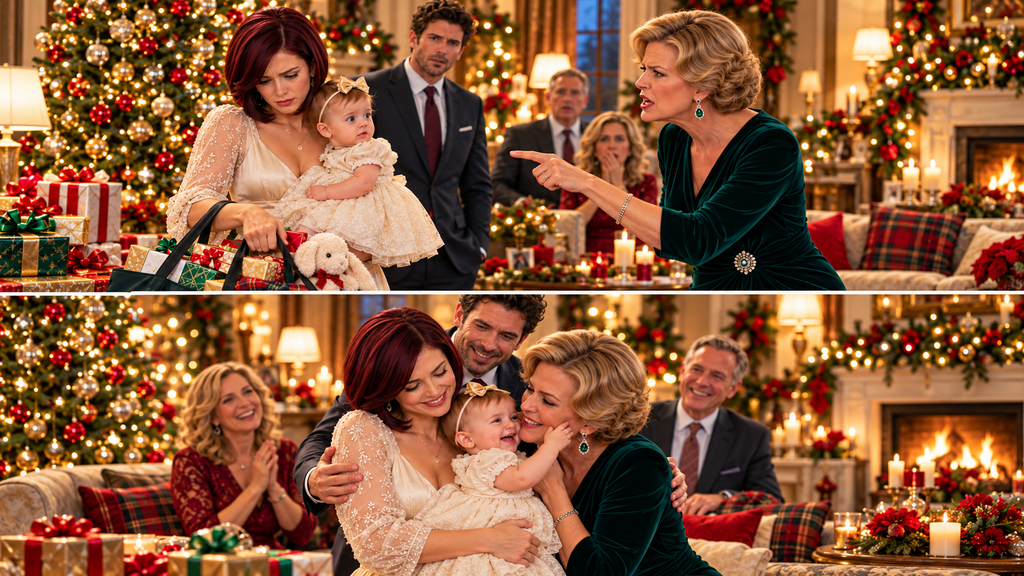
My beautiful eight-month-old daughter was smiling in the picture, one tiny hand wrapped around the stuffed reindeer she’d carried everywhere that morning.
Beneath it, my mother had written:
“It breaks my heart to watch a child suffer because her parents refuse to acknowledge that something is wrong. Some mothers care more about protecting their pride than getting their babies the help they need. Please keep my precious granddaughter in your prayers.”
I read it once.
Then again.
Then a third time.
My heart began pounding so hard that I could hear it in my ears.
Below the photograph were dozens of comments.
People offering sympathy.
People asking whether Lily was seriously ill.
People praising my mother for being such a concerned grandmother.
And then I saw one comment that made my stomach turn.
A woman named Patricia, one of Mom’s oldest friends, had written:
“Carol, you’re such a wonderful grandmother. I know how worried you’ve been about that poor little girl. Have her parents finally agreed to take her to a specialist?”
My mother had replied:
“Unfortunately, they’re still in denial. I’m doing everything I can.”
I stopped breathing for a moment.
Still in denial.
Those three words seemed to burn through the screen.
My daughter was healthy.
Her pediatrician had reassured us repeatedly.
She was smaller than other babies her age because she’d been born six weeks premature, but she was growing steadily, smiling, laughing, and developing beautifully.
My mother knew all of that.
She had heard it directly from me.
She had even attended one of Lily’s appointments when Evan had been out of town for work.
And yet she’d deliberately created the impression that we were neglecting a seriously ill child.
I sat down on the edge of our bed.
Evan was downstairs preparing Lily’s afternoon bottle.
I heard the refrigerator open.
Then the quiet clinking of glass.
The ordinary sounds of our home continued around me while something inside my chest seemed to collapse.
My phone rang.
Jenna.
I answered immediately.
“Tell me this isn’t real.”
Her voice was barely above a whisper.
“I wish I could.”
“When did she post it?”
“Yesterday morning.”
I closed my eyes.
Yesterday morning.
Two days after Christmas.
Two days after I’d told my mother we needed distance.
Two days during which I’d ignored her increasingly angry messages because I thought she simply needed time to calm down.
Instead, she’d been busy telling everyone that my husband and I were failing our daughter.
“There’s more,” Jenna said.
I felt my fingers tighten around the phone.
“What do you mean?”
She hesitated.
And something about that hesitation frightened me more than the screenshot itself.
“Carol has been calling people. Not just family. Friends. Neighbors. People from church.”
“What is she telling them?”
“That Lily needs medical attention and you’re refusing to listen.”
A terrible silence opened between us.
Then Jenna added quietly, “She told my mother that she’s considering getting someone involved.”
I sat perfectly still.
“Getting who involved?”
Jenna didn’t answer immediately.
“Jenna.”
“She mentioned child protective services.”
The room seemed to tilt.
For a moment, I couldn’t hear anything except the rushing sound of blood in my ears.
My mother.
The woman who had criticized my appearance, my education, my marriage, and nearly every important decision I’d ever made.
The woman who had mocked my premature baby’s size in front of our entire family on Christmas Day.
Was now threatening to involve authorities in our daughter’s life because we had refused to tolerate her cruelty.
I looked toward the bedroom door.
Downstairs, Lily squealed.
Evan laughed.
That beautiful, ordinary sound nearly broke me.
“Why?” I whispered.
Jenna exhaled shakily.
“I think she’s trying to scare you into apologizing.”
I stared at the photograph again.
My little girl.
Her bright eyes.
Her tiny fingers.
The innocent smile of a child who had no idea her grandmother was using her image to punish her mother.
And something changed inside me.
The fear was still there.
But beneath it, something stronger began to rise.
“No,” I said.
Jenna sounded confused.
“No, what?”
“I’m not apologizing.”
“I didn’t think you would.”
“And I’m not going to let her turn Lily into a weapon.”
There was a pause.
Then Jenna said something I would remember for a long time.
“Good. Because I think your mother has been counting on you being too frightened to fight back.”
I ended the call a few minutes later.
Then I went downstairs.
Evan was sitting on the living room rug.
Lily was lying on her little play mat in front of him, kicking her feet while he held a stuffed elephant above her.
Every time he made the elephant sneeze, she laughed.
Not a polite little giggle.
A full-bodied, delighted baby laugh.
The kind that made me believe the world could still be a beautiful place.
Evan looked up when he saw me.
His smile vanished.
“What happened?”
I handed him my phone.
He read the screenshot.
His expression changed slowly.
First confusion.
Then disbelief.
Then an anger so quiet that it frightened me.
He read the comments.
Scrolled farther.
And finally looked at me.
“She posted our daughter’s picture?”
I nodded.
“And she’s telling people we’re neglecting her?”
“Yes.”
He looked down at Lily.
She was still laughing at the elephant.
Evan set the toy aside.
Then he stood.
“Call our pediatrician.”
I blinked.
“What?”
“Tomorrow morning. Call Dr. Patel. Explain what’s happening. Ask her office for copies of Lily’s medical records and the summaries from her recent appointments.”
“Evan—”
“And save everything your mother has posted.”
I swallowed.
“Jenna says Mom threatened to call child protective services.”
His jaw tightened.
For a moment, I thought he might shout.
But he didn’t.
He simply reached for my hand.
“Then we make sure every fact is documented.”
I felt tears gathering in my eyes.
“I never thought she’d do something like this.”
“I know.”
“She knows what those weeks in the hospital were like.”
“I know.”
“She saw me crying beside Lily’s incubator.”
Evan stepped closer.
“She saw us almost lose ourselves from fear, and now she’s using that fear against us.”
My voice cracked.
“What kind of mother does that?”
He didn’t answer.
Because there was no answer that could make it hurt less.
Instead, he pulled me into his arms.
And for the first time since Christmas, I let myself cry.
Not quietly.
Not politely.
I cried with the exhaustion of a woman who had spent her entire childhood trying to earn affection from someone determined to make love feel conditional.
I cried for the little girl I’d once been.
For every birthday ruined by a comment.
Every achievement reduced to a comparison.
Every apology I’d offered simply to restore peace.
And I cried because the same woman who had made me doubt myself as a daughter was now trying to make me doubt myself as a mother.
Evan held me until the tears slowed.
Then he said, “Listen to me.”
I looked up.
“Your mother’s opinion does not determine whether you’re a good parent.”
“I know.”
“No. I need you to really hear me.”
He brushed a tear from my cheek.
“You sat beside Lily every single day in that hospital. You learned how to feed her when she was too tired to finish a bottle. You watched every monitor. You asked every question. You celebrated every ounce she gained.”
My chin trembled.
“You are the reason she came home to a house filled with love.”
I shook my head.
“We both are.”
He smiled sadly.
“Yes. We both are.”
Then he glanced toward Lily.
“And neither of us is going to let Carol convince her that being loved means being criticized.”
That night, after our daughter fell asleep, we sat at the kitchen table with our laptops open.
And we began saving everything.
The social media post.
The comments.
The messages.
The photographs.
The increasingly aggressive texts my mother had sent since Christmas.
I hadn’t answered most of them.
Now I read them carefully.
The first message had arrived less than an hour after we’d left her house.
“I hope you’re satisfied with yourself. You completely ruined Christmas.”
An hour later:
“Your father is devastated. Everyone thinks you behaved terribly.”
Then:
“You owe me an apology for embarrassing me in my own home.”
On December twenty-sixth:
“You can’t keep my granddaughter away from me just because you’re sensitive.”
And finally, the message I’d received that morning:
“If you won’t listen to reason, I may have to find someone who will make you listen.”
I stared at that final sentence.
Until then, I’d assumed she meant another relative.
Perhaps my father.
Perhaps Mark.
Perhaps Grandma.
Now I wasn’t so sure.
Evan read it over my shoulder.
“Save that one separately.”
I did.
Then my phone vibrated again.
A new message.
From Mom.
“I know Jenna contacted you. Don’t believe everything she says. She’s always enjoyed creating drama.”
I let out a bitter laugh.
“Apparently, she’s monitoring the family now.”
Evan leaned back in his chair.
“Don’t respond tonight.”
“I wasn’t going to.”
But then another message appeared.
“You have until New Year’s Eve to bring Lily over and apologize. Otherwise, I’ll do what I have to do.”
I stared at the screen.
New Year’s Eve.
A deadline.
My mother had decided that access to my daughter was something she could demand under threat.
And for the first time in my life, I didn’t feel the familiar urge to fix things.
I felt something else.
Clarity.
I typed a response.
Then deleted it.
I typed another.
Then deleted that too.
Finally, Evan placed his hand gently over mine.
“You don’t have to answer right now.”
I looked at him.
“I know.”
And I meant it.
For thirty-four years, I’d lived as though every message from my mother required an immediate response.
Every accusation required a defense.
Every complaint required an explanation.
Every uncomfortable silence required me to repair something.
But sitting there in our quiet kitchen, with our daughter sleeping safely upstairs, I realized something extraordinary.
I could simply stop participating.
So I put the phone face down.
And for the first time in my adult life, I went to bed without trying to make my mother happy.
The next morning, I called Lily’s pediatrician.
Dr. Patel had been caring for Lily since her discharge from the neonatal intensive care unit.
She was a calm, practical woman with silver-framed glasses and a habit of speaking directly to babies before addressing their parents.
At Lily’s most recent appointment, she’d smiled while watching our daughter reach for a colorful toy.
“She’s doing beautifully,” she’d said. “Remember, we’re looking at her individual growth pattern, not comparing her with every other baby in the waiting room.”
Those words had been a tremendous comfort.
Now, sitting in the doctor’s office with Evan beside me, I felt embarrassed explaining why we’d requested an extra appointment.
“My mother has been telling people Lily is seriously underweight,” I said.
Dr. Patel looked at me over her glasses.
“Has Lily had any new symptoms?”
“No.”
“Any feeding difficulties?”
“No.”
“Has she been less active?”
“Not at all.”
“Any changes in her diapers or sleep that concern you?”
I shook my head.
Dr. Patel looked toward Lily, who was sitting on Evan’s lap attempting to chew the ear of her stuffed elephant.
Then she smiled.
“Well, she certainly looks enthusiastic about life.”
I laughed despite myself.
But my voice broke when I explained the rest.
The Christmas comment.
The argument.
The social media post.
The threat.
Dr. Patel listened without interrupting.
When I finished, she folded her hands.
“I want to make one thing very clear,” she said. “Lily’s medical history is something we monitor carefully, as we do with many babies born prematurely. But based on my examinations and her growth trend, I have no reason to believe you’re neglecting her medical needs.”
I began crying again.
I hated that.
I hated how easily my mother could still make me feel like a frightened little girl.
Dr. Patel handed me a tissue.
“Have you been worried about Lily’s health because of anything you’ve observed?” she asked gently.
“Not until my mother started saying these things.”
She nodded.
“Then try to separate your mother’s statements from the actual medical information.”
Evan squeezed my hand.
We left with copies of Lily’s recent appointment summaries and a follow-up plan that was exactly what it had been before Christmas.
Routine monitoring.
Normal developmental care.
Nothing dramatic.
Nothing alarming.
Nothing resembling the frightening story my mother was telling everyone.
I should have felt relieved.
And part of me did.
But as we walked toward the parking lot, my phone rang.
An unfamiliar local number.
I almost ignored it.
Then something made me answer.
“Hello?”
A woman’s voice responded.
“May I speak with Lily’s mother?”
My stomach tightened.
“This is she.”
“My name is Rebecca Collins. I’m calling from the county child welfare office.”
I stopped walking.
Evan turned immediately.
The woman continued in a calm, professional tone.
“We’ve received a report concerning your daughter, and I’d like to speak with you about the information provided.”
For a moment, the entire world seemed to become painfully bright.
Cars moved through the parking lot.
A shopping cart rattled nearby.
Someone laughed outside the pharmacy.
And I stood beside our car, holding my daughter’s medical records, while a stranger told me someone had reported us.
I looked at Evan.
He saw my expression.
And understood.
Without a word, he reached for the phone.
I shook my head.
I needed to do this myself.
“Of course,” I managed.
The woman explained the next steps.
She did not tell me who had made the report.
She did not confirm whether the allegation had come from a relative.
And she did not treat the report as proof that anything was wrong.
Still, hearing the questions made my chest ache.
Was Lily receiving regular medical care?
Was she eating adequately?
Had we missed appointments?
Were there concerns about her weight?
I answered everything.
Slowly.
Carefully.
Truthfully.
When she asked whether we could provide medical documentation, I looked down at the papers in my hand.
“Yes,” I said. “We can.”
She arranged to speak with us further.
Before ending the call, she said, “I understand this may be upsetting. Our role is to assess the information we’ve received and make sure the child is safe.”
I thanked her.
Then I hung up.
For several seconds, I couldn’t move.
Evan opened the passenger door and gently placed Lily in her car seat.
When he returned, I was still standing in the same spot.
“She did it,” I whispered.
He looked at me.
“We don’t know that yet.”
I shook my head.
“Evan.”
“I know what it looks like.”
“She gave me a deadline.”
He said nothing.
“She told me she’d do what she had to do.”
My voice rose.
“She threatened me, and now someone has reported us.”
Evan stepped closer.
“Then we handle it properly.”
I wanted to scream.
I wanted to call my mother and demand to know how she could have done this.
I wanted to drive to her house and confront her in front of every person who had ever believed she was a wonderful woman.
But Lily was sitting safely in the car.
And I had promised myself something on Christmas Day.
I would protect her peace.
Not just from my mother’s cruelty.
But from the chaos that cruelty created.
So I took a trembling breath.
And got into the car.
That afternoon, my father called.
I hadn’t spoken to him since Christmas.
Dad had always been a quiet man.
His name was Richard, though almost everyone called him Rick.
He spent most of his life avoiding conflict.
When Mom criticized me as a child, he’d usually retreat behind his newspaper.
When she embarrassed me at family gatherings, he’d suddenly discover something urgent that needed doing in the garage.
And when I cried, he’d offer the same explanation.
“You know how your mother is.”
For years, I believed that was comfort.
Now I understood it had been permission.
Permission for her to continue.
Permission for him to remain uninvolved.
Permission for me to absorb the damage quietly.
I answered on the fourth ring.
“Hi, Dad.”
“Sweetheart.”
His voice sounded tired.
“Are you all right?”
I nearly laughed.
It was such a strange question after everything that had happened.
“No,” I said.
He was quiet.
“Your mother says things have gotten out of hand.”
“They have.”
“She says you’ve been refusing to let her see the baby.”
“Yes.”
He sighed.
“Honey, it’s Christmas. Emotions are running high.”
“Christmas was four days ago.”
“I know.”
“And my mother has spent those four days telling strangers that I’m neglecting my daughter.”
He hesitated.
“She says she’s worried.”
“Did she tell you what she posted?”
Silence.
“Dad?”
“I saw it.”
My heart sank.
“And you didn’t call me?”
He exhaled.
“I thought it would blow over.”
I closed my eyes.
There it was.
The answer to almost every question I’d asked about my childhood.
He thought it would blow over.
If he waited long enough, surely the shouting would stop.
The tears would dry.
The wounded person would apologize.
And the family could return to its familiar arrangement.
“Dad, someone reported us to child welfare today.”
The silence that followed was absolute.
Then I heard him breathe in sharply.
“What?”
“Someone made a report about Lily.”
“Oh, sweetheart.”
“Did Mom tell you she was going to do that?”
He didn’t answer.
And suddenly, I knew.
“Dad.”
“I told her not to.”
My knees weakened.
I sat down at the kitchen table.
“You knew?”
“I didn’t think she’d actually do it.”
I pressed my free hand against my forehead.
“Did you know she threatened me?”
“She was upset.”
“Did you know she was telling everyone Lily needed medical help we were refusing to provide?”
“She said she had concerns.”
“Did you know she was going to report us?”
His voice became barely audible.
“She said someone needed to make sure the baby was all right.”
I stared at the wall.
My father had known.
He had known my mother was threatening to involve authorities in our lives.
He had heard her describe her plans.
And he’d done nothing beyond telling her not to.
No warning.
No phone call.
No attempt to protect his granddaughter from a false accusation.
Just silence.
Again.
“Dad,” I said, “do you understand what she’s done?”
“Yes.”
“Do you?”
My voice cracked.
“She has turned our daughter’s medical history into a punishment because I wouldn’t let her insult us anymore.”
He said nothing.
“She knows Lily was premature. She knows we follow every medical recommendation. She knows Evan and I spent three weeks living in terror because we didn’t know whether our baby would be all right.”
“I know.”
“And she did this anyway.”
He breathed heavily.
Then he said something that made me realize how deeply the problem ran.
“Maybe if you just brought Lily over for a little while, your mother would calm down.”
I stared at the phone.
I couldn’t believe it.
After everything.
After the threats.
After the lies.
After the report.
His solution was still the same.
Give Carol what she wants.
“Dad,” I said quietly, “I’m going to ask you one question.”
“All right.”
“If someone outside this family made false claims about Lily’s health and threatened us because we wouldn’t let them have access to her, would you tell us to bring our daughter to that person’s house?”
He said nothing.
“Would you?”
“No.”
“Then why is it acceptable because she’s my mother?”
The silence stretched so long that I thought the call had disconnected.
Finally, he whispered, “It isn’t.”
I covered my mouth.
I hadn’t expected him to say that.
Not after thirty-four years.
But then he added, “I just don’t know what you want me to do.”
And something inside me ached.
Because I’d spent my whole life wanting him to do one simple thing.
Stand beside me when I was being hurt.
“Dad,” I said, “I needed you to tell the truth.”
He started to speak.
I stopped him.
“And I still do.”
The next two days felt like walking through fog.
We cooperated with the child welfare office.
We provided Lily’s medical information through the proper channels.
We answered questions.
We explained the family conflict without exaggerating or minimizing anything.
We made sure our daughter attended every scheduled appointment, as she always had.
And we tried to keep our home peaceful.
That was the hardest part.
Because my phone kept ringing.
My mother called repeatedly.
Sometimes she left angry messages.
Sometimes she cried.
Sometimes she sounded almost cheerful, as though she expected me to pick up and resume an ordinary conversation.
On December thirtieth, she left a voicemail that made my blood run cold.
“I don’t know why you’re making this so difficult. All you have to do is admit you overreacted at Christmas, bring Lily over, and we can forget this entire mess. I’m your mother. I shouldn’t have to beg to see my own granddaughter.”
Then, after a pause, she added:
“And don’t forget, tomorrow is New Year’s Eve.”
I played it once.
Then saved it.
Evan listened.
He didn’t say anything for a long time.
Finally, he asked, “How are you feeling?”
I looked down at my hands.
“Tired.”
He nodded.
“Anything else?”
I considered lying.
But I was exhausted from pretending.
“Scared.”
He came around the table and sat beside me.
“Of what?”
I swallowed.
“That she’ll never stop.”
Evan was quiet.
Then he said, “She might not.”
I looked at him.
I wanted reassurance.
I wanted him to tell me my mother would eventually understand.
That she’d apologize sincerely.
That everything would become easier once the truth came out.
But he loved me enough not to promise something he couldn’t know.
“She might never become the mother you deserved,” he said.
The words hurt.
Not because they were cruel.
But because they were true.
I lowered my head.
“I keep thinking about when I was little.”
He waited.
“When she was nice to me, I felt like the luckiest girl in the world. She’d take me shopping, or brush my hair, or tell me I looked pretty. And I’d spend the next week trying not to do anything wrong because I wanted her to stay that way.”
My throat tightened.
“I thought if I could just be good enough, she’d love me without hurting me.”
Evan took my hand.
“And now?”
I looked toward the baby monitor on the counter.
Lily was sleeping on her back, one tiny fist resting beside her cheek.
“Now I look at Lily and I can’t imagine making her work that hard to feel loved.”
His eyes softened.
“Then you’re already doing something different.”
I sat there for a long time.
Thinking about the invisible rules I’d learned as a child.
Don’t upset Mom.
Don’t embarrass Mom.
Don’t tell outsiders about Mom.
Don’t make family problems public.
Don’t challenge her in front of relatives.
Don’t expect Dad to intervene.
Don’t insist on an apology.
And above all—
Don’t leave.
Because leaving would make you the problem.
On Christmas Day, I had broken that final rule.
And now my mother was doing everything she could to teach me what disobedience would cost.
But she had made one enormous mistake.
She believed I was still that little girl.
The one who would apologize just to end the silence.
She hadn’t understood that becoming Lily’s mother had changed the meaning of courage for me.
I no longer needed to protect my place in Carol’s family at the expense of my own child.
And I was finally beginning to understand that peace wasn’t something I had to earn.
The next morning, New Year’s Eve, my phone rang at 8:12.
The caller was Grandma.
Her name was Evelyn.
She was eighty-one years old, sharp-minded, stubborn, and one of the few people in our family who had never seemed afraid of my mother.
But she rarely interfered in arguments between us.
I’d always assumed she preferred staying neutral.
That morning, I discovered I was wrong.
“Sweetheart,” she said, “are you home?”
“Yes.”
“Is Evan there?”
“He’s making breakfast.”
“Good. I need to come over.”
Something in her voice made me sit straighter.
“Is everything all right?”
“No.”
My stomach dropped.
“Grandma?”
She sighed.
“I should have spoken up years ago.”
I didn’t understand.
“About what?”
“Your mother.”
There was a pause.
Then she said, “And there’s something I need to show you before tonight.”
I glanced at the clock.
“What’s happening tonight?”
Grandma was quiet for a moment.
Then she said, “Carol has invited the family over for a New Year’s Eve dinner.”
I frowned.
“I know she usually does.”
“She told everyone you and Evan are coming.”
My breath caught.
“What?”
“She said you’ve finally admitted you were wrong.”
I stood so quickly that my chair scraped across the floor.
“We haven’t spoken to her.”
“I know.”
“She knows we’re not coming.”
“I know that too.”
“Then why would she tell everyone—”
“Because,” Grandma interrupted gently, “she’s planning to make an announcement.”
A chill moved down my spine.
“What announcement?”
Grandma’s answer was barely audible.
“She says she’s going to save Lily.”
I stood frozen.
Then Grandma added, “And I think she’s been lying to all of us about a lot more than your daughter’s health.”
Grandma arrived an hour later.
She wore her usual navy wool coat and carried a brown leather handbag that looked nearly as old as I was.
Evan took her coat.
I offered coffee.
She declined both coffee and tea.
That frightened me more than anything.
Grandma never declined tea.
Instead, she sat at our kitchen table, folded her hands, and looked toward the living room, where Lily was playing quietly in her activity center.
For a moment, Grandma’s face softened.
“Oh, that beautiful baby.”
I smiled weakly.
“She just learned how to clap.”
As though she understood, Lily slapped her palms together.
Grandma laughed.
Then her expression became serious again.
“Your mother has always had a terrible need to control how other people see her.”
I sat across from her.
“I know.”
“No,” Grandma said. “I don’t think you know how far it goes.”
Evan pulled out a chair.
Grandma opened her handbag.
Inside was a small envelope, yellowed at the edges.
She placed it on the table.
I looked at it.
“What is that?”
“A letter.”
“From who?”
“Your grandfather.”
My heart gave a strange little thump.
Grandpa Henry had died when I was seventeen.
He’d been a quiet, affectionate man who made terrible jokes, carved wooden birds, and always kept butterscotch candies in his coat pocket.
When I was little, he’d let me help him in his workshop.
He never criticized my clumsy efforts.
He’d simply smile and say, “That’s how you learn, sweetheart.”
I had adored him.
Grandma touched the envelope.
“Your grandfather understood your mother better than most people.”
I frowned.
“What does he have to do with this?”
She hesitated.
Then slid the letter toward me.
“Read it.”
I opened the envelope carefully.
Inside was a single sheet of lined paper.
The handwriting was unmistakably Grandpa’s.
But what I read made my chest tighten.
Evelyn,
If Carol ever starts using the children to punish someone, please don’t pretend it’s only a family disagreement.
I’ve watched her do it with our daughter for too long.
I know you believe she’ll soften with age. I hope you’re right.
But if she doesn’t, someone needs to tell that little girl she has never been the problem.
Please don’t let our silence become another thing she has to survive.
Love, Henry.
I read it twice.
Then looked at Grandma.
“Why did he write this?”
Her eyes filled.
“Because he’d been watching.”
“Watching what?”
“The way Carol treated you.”
My throat closed.
“He knew?”
Grandma nodded.
“He saw the comments. The comparisons. The way she could make you cry and then convince everyone you’d misunderstood her.”
I stared at the letter.
All those years.
I’d thought nobody noticed.
I’d believed my pain was invisible.
“Why didn’t anyone stop her?” I whispered.
Grandma’s face crumpled.
“Because we were cowards.”
The bluntness of her answer stunned me.
She took a trembling breath.
“Your grandfather tried. Sometimes he confronted her. Sometimes he took you into the garden or his workshop just to get you away from her. But we convinced ourselves it wasn’t our place to interfere with how she raised you.”
A tear slipped down her cheek.
“And after he died, I became even quieter.”
I looked at the paper again.
Someone needs to tell that little girl she has never been the problem.
My vision blurred.
For a moment, I was ten years old again.
Standing in front of my mother with a school photograph I had been proud of.
Waiting for her approval.
And hearing her say my smile looked unfortunate.
I remembered trying not to cry.
Because crying would only make things worse.
I pressed the letter against my chest.
Grandma reached across the table.
“I should have told you sooner.”
I shook my head.
“I didn’t know he understood.”
“He did.”
Her voice trembled.
“He loved you terribly.”
I laughed through my tears.
“He always gave me the biggest piece of birthday cake.”
“He used to tell me you had the kindest heart in the family.”
That broke me.
I cried so hard that Grandma stood, walked around the table, and wrapped her arms around me.
For a few minutes, I wasn’t a mother defending her child.
I wasn’t a grown woman trying to establish boundaries.
I was simply a granddaughter discovering that someone she’d loved had seen her pain.
And wished he could protect her.
Eventually, I wiped my eyes.
But Grandma wasn’t finished.
“There is something else.”
I looked up.
She reached into her handbag again.
This time, she removed her phone.
“I asked Mark to help me take screenshots.”
I frowned.
“Screenshots of what?”
“Your mother’s messages.”
I looked at Evan.
He leaned forward.
Grandma opened a conversation.
A family group chat.
One I’d never been included in.
At the top were several familiar names.
My mother.
My father.
Mark.
Aunt Diane.
Two cousins.
And Grandma.
I stared at the screen.
“How long has this group existed?”
Grandma looked ashamed.
“Years.”
A cold feeling spread through my chest.
“Years?”
She nodded.
“Your mother created it to organize holidays. Then she started using it to discuss you.”
My stomach twisted.
I scrolled.
The messages went back months.
At first, they seemed ordinary.
Holiday plans.
Birthday reminders.
Photographs.
But then I found messages about my pregnancy.
Mom had written:
“She’s already acting like she’s the first woman in history to have a baby.”
A cousin had responded with a laughing emoji.
I kept scrolling.
A message from the day Lily was born.
“Baby arrived early. I told her she needed to take better care of herself.”
My breath caught.
I remembered that day.
The terror.
The emergency hospital admission.
The desperate hours.
The doctor explaining that early labor can happen for reasons no one can control.
And my mother had turned it into proof that I’d done something wrong.
I scrolled farther.
Another message.
“She’s become completely obsessive about the baby. Evan encourages it. I worry about their judgment.”
Then one from November.
“If the doctors aren’t worried about how small that child is, perhaps they aren’t very good doctors.”
I looked up at Grandma.
“Did anyone tell her to stop?”
Grandma nodded miserably.
“Sometimes.”
“Who?”
“Jenna. Mark occasionally. Your grandfather would have, if he’d still been here.”
I swallowed.
“And you?”
Her eyes filled.
“Not nearly enough.”
I handed the phone back.
“I can’t read anymore.”
Grandma nodded.
But then she said, “There is one message you need to see.”
She scrolled to Christmas Eve.
My mother had written:
“Tomorrow I’m going to make her understand that Lily needs better care. Maybe hearing the truth in front of everyone will finally embarrass her enough to take action.”
I felt my stomach drop.
Christmas Eve.
Before the family dinner.
Before she’d insulted Lily.
Before I’d walked out.
My mother had planned to humiliate me.
It hadn’t been a thoughtless comment.
It hadn’t been an unfortunate joke.
It had been deliberate.
Grandma showed me the next message.
It had come from Jenna.
“Carol, please don’t discuss Lily’s size in front of everyone. Her doctor says she’s healthy. This is cruel.”
My mother had replied:
“Stay out of it. I know what’s best for my granddaughter.”
I stared at those words.
Then Grandma scrolled to the most recent message.
Sent the night before.
“If she doesn’t bring Lily tomorrow, everyone will understand how unstable she’s become. I’m tired of being portrayed as the villain when I’m the only one willing to protect that child.”
Evan stood.
He paced toward the window.
Then turned back.
“She planned all of this.”
Grandma nodded.
“I believe she did.”
I felt strangely calm.
The kind of calm that comes when something you’ve spent years trying not to believe becomes impossible to deny.
My mother hadn’t accidentally crossed a line.
She had seen the line.
Watched me draw it.
And decided to punish me for believing I had the right.
I looked at Grandma.
“What are you going to do tonight?”
She sat straighter.
“I’m going to tell the truth.”
I shook my head.
“Grandma, you don’t have to—”
“Yes,” she interrupted.
“I do.”
Her voice was stronger now.
“Your grandfather asked me not to let our silence become another thing you had to survive.”
She looked toward Lily.
“I failed you once. I’m not going to fail her too.”
By noon, the situation had become even stranger.
Jenna called again.
She sounded furious.
“Have you seen the latest post?”
I closed my eyes.
“What now?”
“She deleted the original one.”
For a moment, hope flickered.
“Really?”
“Yes. But she replaced it.”
My heart sank.
“What does the new one say?”
Jenna read it aloud.
“Sometimes being a loving grandmother means making difficult decisions. Families aren’t always grateful when you tell the truth, but a child’s safety must come first. I’m praying for healing, forgiveness, and the strength to keep doing what’s right.”
I rubbed my forehead.
“She’s making herself sound like a hero.”
“Exactly.”
“Did anyone challenge her?”
Jenna paused.
“Mark did.”
I sat straighter.
“What?”
“He commented that Lily was receiving appropriate medical care and that your mother needed to stop spreading rumors.”
My eyes widened.
“Mark said that publicly?”
“Yes.”
My brother had spent most of our childhood avoiding conflict almost as carefully as Dad.
He was older than me by three years.
And because he rarely received the worst of Mom’s criticism, he’d often told me I was overreacting.
He wasn’t unkind.
But he had a habit of treating our mother’s behavior like bad weather.
Unpleasant.
Unavoidable.
Not worth discussing.
The idea of him publicly contradicting her stunned me.
“What happened?” I asked.
“Carol deleted his comment and called him immediately.”
I could imagine the conversation.
The accusations.
The outrage.
The reminders of everything she’d done for him.
“And?”
Jenna hesitated.
“He told her he wasn’t bringing the kids tonight.”
I sat down.
My brother had three children.
Mom adored having them at family gatherings.
Especially when she could arrange matching outfits and take photographs for social media.
“He’s not coming?”
“No.”
“Because of me?”
Jenna’s voice softened.
“Because of what she’s doing.”
I looked across the room.
Lily was sitting on Evan’s lap, carefully studying the buttons on his shirt.
My eyes filled.
For the first time, someone in my family was refusing to participate in Mom’s version of events.
Not privately.
Not through quiet sympathy.
But openly.
“Can you tell Mark I love him?” I whispered.
Jenna laughed softly.
“I think you should tell him yourself.”
So I did.
I sent my brother a message.
Thank you for standing up for Lily. I know it wasn’t easy.
He responded almost immediately.
It should have been easy. I’m sorry it took me so long.
I read that sentence several times.
Then another message appeared.
I need to tell you something about Christmas. Can I come over?
Mark arrived at three that afternoon.
He looked exhausted.
His hair was messy.
He hadn’t shaved.
And when he stepped into our kitchen, he avoided my eyes.
Jenna had stayed home with their children.
Evan poured coffee.
I sat across from my brother.
For a moment, neither of us spoke.
Then Mark said, “I owe you an apology.”
I swallowed.
“For what?”
He looked down.
“For about twenty years.”
I blinked.
He let out a humorless laugh.
“I used to think you and Mom just had difficult personalities.”
I said nothing.
“I thought you argued because you were both stubborn.”
He rubbed his forehead.
“And when you told me she was cruel, I thought you were exaggerating.”
My chest tightened.
“Mark—”
“No. Let me finish.”
He looked at me.
“I saw the way she talked to you. I heard the comments. I remember her making you cry over stupid things when we were kids.”
His voice broke slightly.
“And I did nothing.”
I stared at him.
He continued.
“Do you know why?”
I shook my head.
“Because she was nicer to me.”
The honesty of it stunned me.
He swallowed.
“When she was angry at you, she usually wasn’t angry at me. And I think some part of me was relieved.”
My eyes filled.
“I understand.”
“No,” he said. “That doesn’t make it right.”
For a long moment, he looked at his hands.
Then he said, “Something happened on Christmas that you didn’t see.”
My stomach tightened.
“What?”
He took a deep breath.
“After you left, Mom started telling everyone that Evan was controlling you.”
I frowned.
“What?”
“She said he was isolating you from your family.”
I felt anger rising.
“She knows that’s not true.”
“I know.”
“She criticized Evan for years because he didn’t agree with everything she said.”
Mark nodded.
“Then she said he was the reason you wouldn’t let her see Lily.”
I folded my arms.
“And what did you say?”
“At first, nothing.”
He looked ashamed.
“Then Jenna told her to stop.”
I smiled sadly.
“Of course she did.”
Mark nodded.
“Mom started shouting that Jenna had turned against her too.”
I sighed.
“Sounds familiar.”
“But that’s not the part you need to know.”
Something in his voice made me look up.
He leaned forward.
“Dad told her to leave you alone.”
I blinked.
“Dad?”
“Yeah.”
“What happened?”
Mark hesitated.
“Mom told him to stay out of it.”
My heart sank.
Of course.
Then Mark continued.
“And he said, ‘No, Carol. You went too far this time.’”
I stared.
My father had actually confronted her.
Not enough.
Not soon enough.
But still.
“What did Mom do?”
Mark’s expression darkened.
“She told him if he took your side, he could find somewhere else to spend Christmas.”
I closed my eyes.
“She said that?”
“Yes.”
“And?”
“He left.”
I opened my eyes.
“What?”
Mark nodded.
“He walked out.”
I couldn’t speak.
“Where did he go?”
“To Grandma’s.”
I remembered Grandma mentioning Dad had been quiet.
But she hadn’t told me that.
Mark leaned back.
“Dad came home later that night. But he told me yesterday he doesn’t know how much longer he can keep living like this.”
I sat perfectly still.
For years, I’d thought my father was simply comfortable with silence.
Now I wondered whether he had been trapped in it too.
That didn’t excuse his choices.
But it made them more complicated.
Mark looked at me.
“And there’s something else.”
I almost laughed from exhaustion.
“Apparently, everyone has something else.”
He didn’t smile.
Instead, he reached into his jacket pocket and took out his phone.
“I recorded part of what Mom said after you left.”
My stomach dropped.
“Why?”
“Because Jenna told me we needed to stop pretending these conversations never happened.”
He opened a recording.
For a second, there was only background noise.
Dishes.
Voices.
A chair scraping.
Then my mother’s voice filled the kitchen.
Sharp.
Angry.
Completely recognizable.
“She’ll come crawling back. She always does.”
My breath caught.
Someone asked her to calm down.
Mom continued.
“She thinks because she has a husband and a baby she can suddenly make rules for me? Absolutely not.”
Then another voice.
Jenna.
“Carol, you insulted a baby who spent three weeks in intensive care.”
My mother scoffed.
“Oh, please. That child’s been home for months. She needs to stop acting like she deserves a medal for giving birth.”
I flinched.
Even though I knew what my mother was capable of saying, hearing those words aloud hurt more than I expected.
The recording continued.
Mom said, “And that baby is too small. Everybody can see it. If she won’t listen to me, maybe someone official will make her listen.”
The room fell silent.
On the recording, Dad’s voice appeared.
“Carol, don’t you dare.”
My mother laughed.
“Then she should have thought about that before humiliating me.”
Mark stopped the audio.
I stared at him.
My hands were trembling.
“She said it.”
He nodded.
“She threatened to report us because I embarrassed her.”
Mark’s eyes filled.
“Yes.”
For a moment, I couldn’t speak.
I had spent days wondering whether Mom truly believed her own claims.
Whether, somewhere beneath all the cruelty, there was genuine concern.
But the recording stripped away that comforting possibility.
She had been angry.
She had wanted control.
And she had chosen the most frightening weapon she could imagine.
My daughter’s safety.
My identity as a mother.
My greatest vulnerability.
Evan broke the silence.
“Mark, can you send us the original recording?”
“Of course.”
“And are you willing to explain when and where you made it, if necessary?”
Mark nodded.
“Yes.”
Then he turned toward me.
“I should have told you immediately.”
I looked at him.
There were so many things I could have said.
That he should have defended me years ago.
That his silence had hurt.
That one recording didn’t erase an entire childhood.
All of those things were true.
But so was something else.
My brother was here.
He had chosen to tell the truth.
Even though it meant admitting he had been wrong.
So I reached across the table.
And took his hand.
“Thank you,” I whispered.
He squeezed my fingers.
Then said something unexpected.
“You know, Mom told me once that you were born difficult.”
I looked at him.
He shook his head.
“I used to believe her.”
I felt a familiar sting.
“But when Jenna and I had our daughter,” he continued, “I started thinking about it.”
His voice softened.
“Babies aren’t born difficult because they need love. Children aren’t bad because they have feelings.”
My eyes filled.
“And you weren’t difficult because you wanted Mom to be kind.”
I began crying.
Mark came around the table and hugged me.
For years, I’d wanted my older brother to understand.
Not agree with every choice I made.
Not fight every battle for me.
Just understand.
And suddenly, there he was.
Holding me in our kitchen.
Saying the words I’d needed to hear when we were children.
“I’m sorry,” he whispered.
I held on tighter.
“So am I.”
At five that evening, my mother sent a family-wide message.
She included me.
Evan.
Mark.
Jenna.
Dad.
Grandma.
Aunt Diane.
And several cousins.
It read:
“Tonight’s dinner begins at seven. I expect everyone to attend. This family has been divided long enough. I will be making an important announcement about Lily’s future, and I hope we can finally move forward with honesty and forgiveness.”
I stared at the message.
Lily’s future.
The arrogance of those words took my breath away.
My daughter was eight months old.
She had two loving parents.
She had doctors who knew her medical history.
She had a safe home.
She had an entire life ahead of her.
And my mother was announcing to the family that she had something to say about that child’s future.
I showed Evan.
He read it.
Then looked at me.
“We’re not going.”
“No.”
“Good.”
But my phone immediately rang.
Grandma.
I answered.
“Sweetheart,” she said, “don’t come tonight.”
“I wasn’t planning to.”
“Good.”
Her voice sounded firm.
“Your mother is expecting a confrontation. She wants an audience.”
I sighed.
“I know.”
“Then don’t give her one.”
I looked toward Lily.
She was beginning to rub her eyes.
Almost bedtime.
I imagined dragging her into a crowded house full of angry adults just to defend our parenting.
The thought made me feel sick.
“We’re staying home,” I said.
Grandma exhaled.
“I’m glad.”
“Are you going?”
“Yes.”
I frowned.
“Grandma—”
“I have some things to say.”
I hesitated.
“Please don’t feel like you have to fight for me.”
Her answer came immediately.
“I’m not fighting for you because you’re helpless.”
Her voice softened.
“I’m standing beside you because you shouldn’t have had to stand alone.”
I covered my mouth.
“Grandma.”
“And sweetheart?”
“Yes?”
“Keep that precious little girl close tonight.”
I glanced toward Lily.
“I will.”
“Then you’ve already made the right choice.”
At seven o’clock, Evan and I were sitting on the living room floor in our pajamas.
Lily had just finished her bottle.
She was sleepy, warm, and wearing a pale pink onesie covered in tiny stars.
Evan held her against his chest, gently patting her back.
Outside, a few neighbors had begun setting off early fireworks.
Soft flashes appeared beyond the curtains.
Our Christmas tree was still standing in the corner.
We hadn’t taken it down.
I loved the way Lily stared at the lights.
And after the holiday we’d endured, I wasn’t ready to let go of the quiet happiness they brought her.
My phone sat on the coffee table.
Silent.
For the first time all week, I wasn’t checking it every few minutes.
Evan noticed.
“Proud of you,” he said.
I smiled faintly.
“For what?”
“Not letting your mother run our evening.”
I leaned against his shoulder.
“I’m trying.”
“That’s enough.”
Lily made a tiny sleepy sound.
We both looked down.
Her eyes fluttered.
Then closed.
Evan kissed her forehead.
And I felt something I hadn’t felt in days.
Peace.
Not complete peace.
Not the kind that erased every worry.
But a small, precious moment of calm.
Our daughter was safe.
Our home was quiet.
And nobody was demanding that we apologize for loving her.
At 7:42, my phone vibrated.
A message from Jenna.
“Dinner has started. Carol is furious you aren’t here.”
I showed Evan.
He shook his head.
Then the next message arrived.
“She’s telling everyone you admitted Lily wasn’t getting enough medical care.”
My chest tightened.
I started typing.
Then stopped.
Jenna sent another message.
“Don’t respond. Mark is handling it.”
I put the phone down.
Ten minutes later, it rang.
Dad.
I answered.
“Hello?”
For several seconds, I heard only muffled voices.
Then Dad spoke.
“Sweetheart, are you home?”
“Yes.”
“Good.”
His voice sounded strange.
Tense.
“Dad, what’s happening?”
He took a breath.
“Your mother has just told everyone she’s arranged a consultation with an attorney.”
I sat up.
“What?”
“She says she wants to establish grandparent visitation.”
I stared at Evan.
He saw my expression and reached for my hand.
Dad continued.
“She told everyone you’re emotionally unstable and that Evan is preventing you from making your own decisions.”
I closed my eyes.
Of course.
If she couldn’t control me directly, she would try to convince everyone I wasn’t capable of controlling my own life.
“Dad,” I said quietly, “we’re already addressing her threats through the proper channels.”
“I know.”
“She has no right to make medical decisions for Lily.”
“I know.”
“And we’re not bringing our daughter into that house tonight.”
“I know.”
There was a pause.
Then Dad said something I’d never heard him say before.
“And you shouldn’t.”
I went still.
“What?”
His voice strengthened.
“You shouldn’t bring her here.”
I swallowed.
“Dad—”
“Your mother has gone too far.”
In the background, I heard Mom shouting.
“Richard! Who are you talking to?”
Dad didn’t answer her.
He continued speaking to me.
“I should have protected you when you were little.”
Tears sprang to my eyes.
“Dad.”
“I should have told her to stop.”
His voice broke.
“I kept thinking that keeping the family together meant keeping the peace.”
I pressed my hand against my mouth.
“But all I did was teach you that your pain mattered less than her temper.”
A sob escaped me.
Evan put his arm around me.
Dad continued.
“I can’t change what happened when you were a child.”
He paused.
“But I can tell the truth now.”
Behind him, I heard a sudden crash.
Then Mom’s voice rose.
“Give me that phone!”
The call disconnected.
I stared at the screen.
My heart began pounding.
“Evan.”
He looked at me.
“What?”
“Something’s happening.”
Before he could answer, my phone rang again.
This time it was Mark.
I picked up immediately.
“Mark?”
His voice was breathless.
“Don’t come over.”
My stomach dropped.
“What’s wrong?”
“Mom just lost it.”
“What happened?”
“Dad told everyone about the report.”
I froze.
“He did?”
“Yes.”
“And?”
Mark exhaled.
“Grandma stood up and asked Mom whether she cared more about Lily’s safety or making you apologize.”
My heart hammered.
“What did Mom say?”
“She told Grandma to sit down and mind her business.”
I closed my eyes.
“Oh, no.”
Mark continued.
“Then Grandma read Grandpa’s letter.”
I stopped breathing.
“She what?”
“She brought it with her.”
My eyes filled.
“And she told everyone that Grandpa had been worried about how Mom treated you for years.”
I covered my mouth.
“What happened?”
There was a long pause.
Then Mark said, “Mom started crying.”
I knew those tears.
I’d seen them all my life.
The sudden trembling voice.
The wounded expression.
The accusations that nobody appreciated her sacrifices.
But Mark wasn’t finished.
“She said Grandma was betraying her.”
I shook my head.
“Of course.”
“And then Dad said something.”
“What?”
Mark’s voice softened.
“He said, ‘Carol, telling the truth isn’t betrayal. What you’ve done to our daughter is.’”
I began crying.
Not because those words could undo the past.
But because my father had finally spoken.
After thirty-four years.
He had finally said aloud what I’d spent my life hoping he understood.
Mark continued.
“Mom threw a wineglass into the sink.”
I flinched.
“Is anyone hurt?”
“No. Everyone’s fine.”
“Good.”
“But then she said something else.”
The tone of his voice changed.
And I felt dread crawl up my spine.
“What?”
He hesitated.
“She said she hadn’t actually made the report herself.”
I sat perfectly still.
“What?”
“She said someone else contacted the authorities.”
I looked at Evan.
He frowned.
“Who?” I asked.
Mark’s voice became almost inaudible.
“She said it was Aunt Diane.”
I stared at the wall.
Aunt Diane.
My mother’s younger sister.
The woman who had always smiled politely, brought homemade cookies to family gatherings, and avoided arguments with the same practiced skill as my father.
She’d held Lily on Thanksgiving.
She’d kissed her cheek.
She’d told me she was beautiful.
And now Mom was claiming Diane had made the report.
“Is she there?” I asked.
Mark sighed.
“Yes.”
“What did she say?”
“She started crying.”
My stomach twisted.
“Did she admit it?”
“Not exactly.”
I squeezed my eyes shut.
“Mark.”
“She said Carol had asked her to call someone because she was worried about Lily.”
I felt sick.
“And she did?”
Mark was quiet.
“Yes.”
I stared at the floor.
My aunt had made the report.
Or at least she had acknowledged contacting someone about our daughter.
But my mother had encouraged it.
And according to Mark’s recording, she’d been threatening to do exactly that since Christmas.
Aunt Diane hadn’t created the accusations.
She’d carried them.
Like a messenger delivering a weapon someone else had loaded.
“Does Diane understand what she did?” I whispered.
Mark sounded miserable.
“I think she’s starting to.”
In the background, I heard shouting again.
Then Jenna’s voice.
“Mark, come here.”
He sighed.
“I have to go.”
“Is everything okay?”
“Yes. Just family drama.”
I almost laughed.
Family drama.
Such a small phrase for so much damage.
“Mark?”
“Yeah?”
“Please don’t let them turn this into another argument about me being difficult.”
His answer came without hesitation.
“I won’t.”
Then he added, “You don’t have to defend yourself tonight. We’re finally doing what we should have done years ago.”
The call ended.
I sat motionless.
Evan reached for my phone and placed it gently on the table.
“Come here.”
I leaned into him.
For a while, neither of us spoke.
Then I whispered, “My aunt called them.”
He nodded.
“That’s what Mark says.”
“Because Mom told her to.”
“Apparently.”
I stared at the Christmas tree.
“Do you know what’s the worst part?”
“What?”
“I can almost hear Mom explaining it.”
Evan waited.
“She’ll say she was worried. That she never wanted anyone to get hurt. That Diane misunderstood her. That everyone is exaggerating.”
My voice trembled.
“And somehow, she’ll still find a way to make herself the victim.”
Evan brushed my hair away from my face.
“Maybe.”
I looked at him.
“But we don’t have to participate.”
He nodded.
“Exactly.”
At that moment, Lily stirred in his arms.
She opened her eyes.
Looked at me.
And smiled.
Just smiled.
With complete trust.
As though the entire world was safe because her parents were near.
I reached for her.
Evan gently passed her over.
She rested against my chest.
And I whispered into her hair, “I’m right here, sweetheart.”
Her tiny fingers curled around my shirt.
“I’ve got you.”
Then I kissed her forehead.
And made a promise I would spend the rest of my life keeping.
“You will never have to earn my love.”
At 9:16 that evening, Aunt Diane called.
I almost didn’t answer.
But something told me I needed to hear what she had to say.
I stepped into the kitchen.
Evan stayed in the living room with Lily.
I answered.
“Hello, Diane.”
For a moment, I heard only crying.
Then my aunt whispered, “I’m so sorry.”
I gripped the edge of the counter.
“For what?”
She inhaled shakily.
“For making the call.”
I closed my eyes.
Hearing her admit it made everything painfully real.
“Why?” I asked.
Diane began crying harder.
“Carol told me Lily wasn’t getting proper medical care.”
I stared at the wall.
“She knows that’s not true.”
“I didn’t know that.”
“You were at Thanksgiving. You saw Lily. You held her.”
“I know.”
“You told me she looked healthy.”
“I know.”
My voice shook.
“Then why didn’t you call me?”
Silence.
“Why didn’t you ask how she was doing?”
Diane sniffed.
“Carol said you wouldn’t tell the truth.”
I swallowed.
“And you believed her.”
She didn’t answer.
That was answer enough.
I leaned against the counter.
For a moment, anger flooded me.
Not only toward Diane.
But toward the entire machinery of our family.
The whispers.
The assumptions.
The willingness to accept my mother’s version of events without ever asking me what had actually happened.
I thought about every time someone had said I was too sensitive.
Too dramatic.
Too difficult.
And I wondered how many of those opinions had begun with a story my mother told when I wasn’t in the room.
“Diane,” I said quietly, “do you understand what your call did to us?”
She sobbed.
“I never wanted to hurt you.”
“But you did.”
“I know.”
“You made an accusation about my daughter’s medical care without speaking to her parents or knowing her medical records.”
“I know.”
“And you did it because Mom told you I couldn’t be trusted.”
She was silent.
I took a breath.
“Do you believe that now?”
“No.”
The word came quickly.
“No, sweetheart. I don’t.”
I closed my eyes.
“Then what changed?”
She hesitated.
“Your mother.”
I frowned.
“What?”
Diane took a shaky breath.
“Tonight, when everyone started asking questions, Carol said she only wanted to teach you a lesson.”
My heart stopped.
I gripped the counter.
“She said what?”
Diane began crying again.
“She said she hadn’t expected it to go this far. She thought someone would call you, frighten you, and make you realize you couldn’t keep Lily away from her.”
For a moment, I couldn’t speak.
The kitchen seemed unnaturally quiet.
My mother’s plan hadn’t been to protect a vulnerable baby.
It had been to frighten that baby’s parents.
Diane continued.
“I asked her what she meant.”
My hands trembled.
“And?”
“She said, ‘Well, sometimes people need consequences before they learn respect.’”
I closed my eyes.
There it was.
The word I’d heard throughout my childhood.
Respect.
In my mother’s world, respect meant obedience.
It meant agreeing.
It meant accepting criticism without protest.
It meant giving her access to every part of my life, no matter how she behaved.
And if I refused?
I needed consequences.
I thought about Lily sleeping upstairs.
About those three weeks in the NICU.
About the tiny medical bracelet we’d saved in a memory box.
About my desperate prayers beside her hospital bed.
My mother had used all of it to teach me a lesson.
I opened my eyes.
“Diane.”
“Yes?”
“Are you willing to tell the truth if someone asks you about the report?”
She hesitated.
Then whispered, “Yes.”
“Everything?”
“Yes.”
“Even if Mom gets angry?”
A long silence.
Then Diane said, “She’s already angry.”
I waited.
“And I think I’ve spent too much of my life being afraid of that.”
My throat tightened.
For the first time, I heard something in my aunt’s voice that sounded like courage.
Not complete courage.
Not enough to undo what she’d done.
But perhaps enough to stop doing it again.
“I can’t forgive you tonight,” I said.
“I understand.”
“And I’m not comfortable having you around Lily right now.”
Her breathing hitched.
“I understand that too.”
I swallowed.
“But I appreciate you telling me.”
She began crying softly again.
Then said, “You were always such a sweet little girl.”
I closed my eyes.
“I tried to be.”
“I know.”
“No,” I whispered. “I don’t think any of you really knew how hard I tried.”
She didn’t answer.
Because there was nothing she could say.
After we hung up, I stood alone in the kitchen for several minutes.
Then I opened the drawer where we kept Lily’s medical papers.
Inside was a photograph taken during her second week in the NICU.
She looked so impossibly small.
Her hand barely covered the tip of Evan’s finger.
There were wires against her skin.
A tiny blanket tucked around her body.
But her eyes were open.
Bright.
Determined.
I touched the edge of the photograph.
And remembered the first time a nurse let me hold her without the usual tangle of equipment.
I’d been terrified.
Afraid of moving the wrong way.
Afraid of hurting her.
Afraid of loving someone so much that the possibility of losing her felt unbearable.
The nurse had smiled gently.
“She’s stronger than she looks.”
I had never forgotten those words.
Now, standing in my kitchen on New Year’s Eve, I realized they described more than my daughter.
They described the woman I was becoming.
At 10:03, my mother called.
I stared at the screen.
Carol.
For a moment, I considered ignoring it.
Then another thought occurred to me.
I’d spent days hearing her words through other people.
Screenshots.
Recordings.
Messages.
Accusations.
Excuses.
Perhaps it was time to hear what she would say when she knew I was listening.
I answered.
“Hello, Mom.”
Her voice came immediately.
Loud.
Furious.
“Are you happy now?”
I looked toward the living room.
Evan was reading a board book to Lily.
Our daughter had one hand wrapped around the corner of the page.
I lowered my voice.
“What are you talking about?”
“You’ve turned my entire family against me.”
I closed my eyes.
“No, Mom.”
“Your father humiliated me in front of everyone. Mark and Jenna left early. Your grandmother accused me of being a terrible mother.”
I remained silent.
“And now Diane is crying because you apparently made her feel guilty for trying to protect a baby.”
I stared at the wall.
“Mom, Diane admitted that you asked her to make the report.”
A pause.
Then Carol scoffed.
“She misunderstood.”
My chest tightened.
“She said you wanted to teach me a lesson.”
“That’s ridiculous.”
“She said you expected the authorities to frighten us into bringing Lily back to your house.”
Mom’s voice sharpened.
“I never said that.”
I took a breath.
“Then what did you say?”
Silence.
“Mom?”
“I said you needed to understand that actions have consequences.”
There it was again.
Not remorse.
Not concern.
Consequences.
I sat down slowly.
“Do you hear yourself?”
“Oh, don’t start.”
“You used a report about my child’s welfare to punish me because I left Christmas dinner.”
“I did no such thing.”
“Mom.”
“I was worried about Lily.”
“Then why didn’t you speak to her pediatrician when we offered to explain her growth?”
“Because doctors don’t know everything.”
I stared at the phone.
“And you do?”
“I’m her grandmother.”
“That doesn’t make you her doctor.”
She gasped.
“How dare you speak to me that way?”
My pulse quickened.
For a split second, the old instinct returned.
Apologize.
Make it better.
Say you didn’t mean it.
But then I looked at Lily.
And I let the instinct pass.
“Mom,” I said, “we need to talk about what happened on Christmas.”
She sighed dramatically.
“Oh, for heaven’s sake.”
“No. I need you to listen.”
I waited.
She didn’t answer.
“You looked at my eight-month-old daughter in front of our entire family and said—”
I stopped.
Even now, remembering the words hurt.
On Christmas Day, my mother had looked at Lily’s small body, smiled at our relatives, and announced:
“Poor little thing. She’s so tiny she barely looks like a real baby. Maybe if her mother knew how to take care of her properly, she’d actually grow.”
Then she’d laughed.
As though my daughter’s difficult beginning was a joke.
As though the weeks I’d spent praying beside her hospital bed were evidence of my incompetence.
As though the most precious person in my life was somehow defective.
I took a trembling breath.
“You told everyone Lily barely looked like a real baby.”
Mom scoffed.
“Oh, please. It was an expression.”
“You said maybe she’d grow if I knew how to take care of her.”
“I was concerned.”
“You laughed.”
“I was trying to lighten the mood.”
“You humiliated me.”
“You embarrassed yourself by overreacting.”
I closed my eyes.
And there it was.
The familiar circle.
She hurt me.
I reacted.
Then my reaction became the problem.
For years, I’d walked around that circle until I was dizzy.
This time, I stepped out.
“Mom,” I said quietly, “you don’t get to decide whether your words hurt me.”
She went silent.
“And you don’t get to insult my daughter and demand that I let you continue.”
Her voice became icy.
“I am your mother.”
“I know.”
“I raised you.”
“I know.”
“I sacrificed for you.”
“I know.”
“And this is how you repay me?”
I looked down at my wedding ring.
For a moment, I thought about all the things she’d done for me.
The birthday parties.
The school lunches.
The rides to appointments.
The holidays.
The clothes.
The college application fees.
Those things were real.
But so was the cruelty.
And I was finally ready to accept that gratitude did not erase harm.
“Mom,” I said, “I can appreciate what you provided and still refuse to let you hurt my daughter.”
She laughed bitterly.
“You sound just like Evan.”
“Evan loves Lily.”
“So do I!”
“Then why did you use her medical history to frighten us?”
Silence.
I waited.
Finally, she whispered, “I just wanted you to listen to me.”
My heart cracked.
Because beneath all the anger, beneath all the excuses, she had finally told the truth.
Not the whole truth.
But enough.
She hadn’t wanted to hear us.
She’d wanted obedience.
I swallowed.
“I listened to you for thirty-four years.”
Her breathing changed.
“What?”
“I listened every time you criticized my appearance.”
“Don’t bring up ancient history.”
“I listened every time you compared me to Mark.”
“That isn’t fair.”
“I listened when you told me I was too sensitive.”
“You were.”
“I listened when you made me feel like every good thing in my life was somehow disappointing.”
“Stop being dramatic.”
“And when Lily was born,” I continued, my voice trembling, “I listened while you questioned everything I did.”
She tried to interrupt.
I kept going.
“But something changed when you started doing it to her.”
My eyes filled.
“I finally understood that if I continued accepting your cruelty, I would be teaching my daughter that love comes with humiliation.”
Mom was silent.
“And I won’t teach her that.”
For a long moment, neither of us spoke.
Then my mother said, “So you’re choosing your husband over your family.”
I shook my head.
“No.”
“Then what are you doing?”
I looked toward the living room.
Evan had fallen asleep on the couch.
Lily was sleeping safely in her crib upstairs.
Our little home was warm.
The Christmas tree lights glowed softly.
And suddenly, the answer felt beautifully simple.
“I’m choosing the family I built.”
Mom gasped.
“After everything I’ve done for you—”
“Mom.”
My voice was steady now.
“We won’t be visiting you.”
Silence.
“We won’t be sending Lily for visits.”
Her breathing became sharp.
“And until you can acknowledge what you’ve done, stop spreading false claims, and respect our decisions as parents, we won’t be having contact.”
She laughed.
A harsh, disbelieving sound.
“You can’t do that.”
I felt something inside me settle.
“Yes,” I said.
“I can.”
“You’ll regret this.”
“Maybe I’ll grieve it.”
My throat tightened.
“But I won’t regret protecting my daughter.”
She was silent.
Then she whispered, “You’re dead to me.”
The words struck harder than I expected.
For a moment, I couldn’t breathe.
My own mother.
The woman whose approval I’d chased for decades.
Had just told me I was dead to her.
The little girl inside me wanted to beg.
To apologize.
To promise I’d come over tomorrow.
To say anything that might make her take those words back.
But I didn’t.
Instead, I looked at the photograph of Lily on the refrigerator.
Her first smile.
Her first Christmas ornament.
Her tiny handprints.
All the beautiful beginnings waiting for her.
And I understood something.
My mother was trying to make losing her love feel like the worst thing that could happen to me.
But I had already discovered something worse.
Allowing her to teach my daughter that love required surrendering her dignity.
I wiped a tear from my cheek.
“I’m sorry you feel that way,” I said.
Then I ended the call.
For several minutes, I sat in complete silence.
I expected to feel triumphant.
I expected relief.
I expected some enormous release after finally saying everything I’d been too frightened to say.
Instead, I felt hollow.
Because even when you know you’ve made the right choice, losing the mother you wished you had can still feel like losing something precious.
Evan found me at the table.
He didn’t ask what happened.
He simply sat beside me.
I leaned against him.
And cried.
“She said I’m dead to her.”
His arm tightened around my shoulders.
“I’m sorry.”
“I know she’s trying to hurt me.”
He nodded.
“But it still hurts.”
“Of course it does.”
I wiped my eyes.
“I feel stupid.”
He gently lifted my chin.
“Why?”
“Because some part of me still wants her to call back and say she didn’t mean it.”
Evan’s expression softened.
“That’s not stupid.”
I looked away.
“I should be stronger.”
He shook his head.
“You are strong.”
“Then why am I crying?”
“Because strength doesn’t mean you stop loving people the moment they hurt you.”
I stared at him.
He continued.
“Sometimes strength means accepting that loving someone doesn’t make them safe to be around.”
I lowered my head.
And cried again.
We sat together until the clock neared midnight.
Then Evan stood.
“Come on.”
I sniffed.
“Where?”
“Upstairs.”
“Why?”
He smiled gently.
“Because there’s someone who deserves a New Year’s kiss.”
We walked into Lily’s nursery.
She was asleep beneath the soft glow of her night-light.
Her stuffed reindeer rested on a shelf nearby, safely out of her crib.
Evan placed one hand on my back.
We stood there for a moment.
Watching her breathe.
The sight was so ordinary.
And so miraculous.
Eight months earlier, I’d been standing beside a hospital incubator, wondering whether we’d ever bring her home.
Now she was here.
Safe.
Warm.
Loved.
The clock downstairs began striking midnight.
Outside, fireworks crackled.
I leaned over Lily’s crib and whispered, “Happy New Year, sweetheart.”
She stirred.
Made a tiny sound.
Then settled again.
Evan kissed my temple.
“Happy New Year.”
I turned toward him.
“Happy New Year.”
He smiled.
“Ready for a better one?”
I looked at our daughter.
Then at my husband.
And for the first time in days, I smiled without forcing it.
“Yes.”
New Year’s Day arrived quietly.
Sunlight poured through our bedroom curtains.
Lily woke earlier than usual and announced her presence with a series of enthusiastic squeals.
Evan groaned dramatically.
“Your daughter has no respect for holidays.”
I laughed.
“My daughter?”
“Definitely yours before eight in the morning.”
I nudged him.
He laughed, rolled out of bed, and went to get her.
A few minutes later, he returned carrying Lily against his shoulder.
Her hair stuck up in several directions.
Her cheeks were pink from sleep.
And when she saw me, she smiled so widely that my chest ached.
“Good morning, beautiful girl.”
I reached for her.
She grabbed my necklace.
Evan sat beside us.
For a while, we simply enjoyed being together.
No tense holiday gathering.
No criticism about Lily’s clothes.
No comments about her size.
No demand for photographs.
No instructions about how a perfect family should look.
Just us.
I thought the day might remain peaceful.
Then my phone rang.
The caller was Rebecca Collins.
The child welfare worker.
My heart jumped.
I answered immediately.
“Hello?”
“Good morning,” she said. “I wanted to follow up about the information you’ve provided.”
I sat straighter.
Evan saw my expression and moved closer.
Rebecca explained that the medical information and other details we’d supplied had been reviewed as part of the assessment.
She clarified that the allegation concerning Lily’s medical care was not substantiated by the information collected.
She also explained that the office would complete its documentation according to its procedures.
I listened carefully.
Asked questions.
Wrote down what she told me.
And thanked her.
When the call ended, I sat motionless.
Evan looked at me.
“Well?”
I took a trembling breath.
“The allegation wasn’t substantiated.”
His shoulders dropped.
For a moment, neither of us spoke.
Then he pulled me into his arms.
I began crying.
Again.
But these tears were different.
They came from relief.
From exhaustion.
From the release of fear I’d been carrying since the parking lot outside Dr. Patel’s office.
Lily, who was sitting between us, seemed delighted by the sudden embrace.
She squealed.
Then clapped.
Evan laughed through his own tears.
“That’s right, sweetheart.”
He kissed her forehead.
“Your mom and dad have got you.”
I hugged them both.
And thought about what my mother had expected.
She had believed that involving authorities would frighten me into obedience.
That I’d rush back to her house.
Apologize.
Beg her to stop.
Hand Lily over for photographs.
Pretend Christmas had never happened.
But instead, her actions had forced me to confront something I’d avoided my entire life.
My mother wasn’t simply someone who said hurtful things.
She was someone willing to create real consequences for other people when they refused to submit to her.
And once I’d seen that clearly, I couldn’t unsee it.
Three days later, a letter arrived.
The envelope was cream-colored.
My name was written across the front in familiar handwriting.
Carol’s.
I stood at the kitchen counter holding it.
For several moments, I considered throwing it away unopened.
But I knew myself.
If I didn’t read it, I’d spend days wondering what she’d said.
So I opened it.
Inside were four handwritten pages.
The first sentence read:
“I hope you’re proud of what you’ve done to this family.”
I felt my chest tighten.
I kept reading.
She accused Evan of manipulating me.
She accused Jenna of turning Mark against her.
She claimed Grandma had been waiting years for an opportunity to humiliate her.
She insisted Diane had misunderstood her instructions.
She described the report as an act of love.
And she said I had destroyed New Year’s Eve by refusing to attend.
There was no apology.
No acknowledgment that her Christmas comment had been cruel.
No recognition of the fear she’d caused.
No concern about how Lily was doing.
Just page after page explaining why everyone else was wrong.
Near the bottom of the final page, she wrote:
“One day, when Lily is old enough, she will understand what kind of daughter you were to me.”
I stopped reading.
That sentence stayed with me.
One day, when Lily is old enough.
My mother was already imagining a future in which she could tell my daughter stories about me.
Stories designed to turn her against me.
Stories in which Carol was the suffering grandmother and I was the cruel daughter who had kept them apart.
I folded the letter.
Placed it back in the envelope.
And put it in the folder with the other documentation.
Not because I wanted revenge.
But because I was learning that remembering the truth mattered.
Especially in a family where the truth had been rewritten so many times.
That evening, Evan asked whether I wanted to respond.
I shook my head.
“No.”
He nodded.
“Okay.”
I looked at the envelope.
“For years, every time she sent me something like this, I’d write a long reply.”
He smiled sadly.
“I remember.”
“I’d explain every detail. I’d apologize for anything I thought might have upset her. I’d tell her I loved her.”
I swallowed.
“And somehow, we’d end up in the exact same place.”
Evan reached for my hand.
“So what are you going to do differently?”
I looked toward Lily.
She was playing with a soft fabric book.
Her little fingers explored every page with serious concentration.
Then I smiled.
“I’m going to spend my energy on someone who can actually grow from it.”
January became a month of quiet changes.
Some were practical.
We updated the emergency contacts on Lily’s medical records.
We made sure her daycare information reflected exactly who was authorized to pick her up when she eventually started attending.
We reviewed the boundaries we wanted to maintain with extended family.
And we spoke with a family-law attorney about how to respond appropriately if my mother pursued further threats.
The attorney listened carefully.
Reviewed the documentation.
And explained that family access and legal rights depended on the specific circumstances and applicable law.
She encouraged us to continue keeping accurate records and to avoid escalating the conflict unnecessarily.
We followed that advice.
But the more important changes were emotional.
I started seeing a therapist.
Her name was Dr. Morgan.
During our first session, I spent almost twenty minutes explaining why my mother wasn’t always terrible.
How she’d helped pay for my wedding dress.
How she’d driven me to college.
How she’d brought meals after Lily came home from the hospital.
How she could be funny.
Charming.
Generous.
How other people genuinely liked her.
Dr. Morgan listened.
Then asked a question that stopped me.
“Do you believe someone has to be cruel all the time for their cruelty to matter?”
I stared at her.
“No.”
“Then why do you feel the need to prove your mother had good qualities before you’re allowed to discuss how she hurt you?”
I opened my mouth.
Then closed it.
Because I didn’t know.
Or perhaps I did.
I’d spent my whole life defending my mother’s intentions.
Explaining her personality.
Balancing every painful memory with something pleasant.
As though the happy moments were evidence that the hurtful ones weren’t real.
Dr. Morgan waited.
Finally, I whispered, “Because I don’t want people to think I’m ungrateful.”
She nodded.
“And what would being grateful require you to tolerate?”
I looked down.
That question stayed with me for days.
Because gratitude had become the leash my mother used whenever I tried to walk away.
I owed her respect because she’d raised me.
I owed her obedience because she’d sacrificed.
I owed her access to my daughter because she was a grandmother.
I owed her silence because family problems should stay private.
But nobody had ever asked what she owed me.
Basic kindness.
Honesty.
Respect for my boundaries.
The willingness to apologize when she caused harm.
And perhaps most importantly—
The understanding that my daughter was not a prize she could demand.
During another session, Dr. Morgan asked what I wanted Lily to believe about love.
I answered without hesitation.
“That she doesn’t have to be perfect to deserve it.”
My voice broke.
“That she can make mistakes. Be angry. Be sad. Be different from what people expect.”
I swallowed.
“And still know she’s loved.”
Dr. Morgan smiled gently.
“Then you already understand what you needed as a child.”
I began crying.
Not because the realization was new.
But because hearing it spoken aloud felt like someone had finally opened a window in a room I’d lived in for too long.
My father visited for the first time in mid-January.
He came alone.
He brought a small stuffed rabbit for Lily and a bag of groceries, even though we hadn’t asked for anything.
When I opened the door, he looked nervous.
More nervous than I’d ever seen him.
“Hi, sweetheart.”
“Hi, Dad.”
He stood awkwardly on the porch.
“Can I come in?”
I stepped aside.
“Of course.”
He entered slowly.
As though he was afraid the house might reject him.
Evan greeted him politely.
Lily was sitting in her high chair, experimenting with a spoon.
When Dad saw her, his face softened.
“Oh, there’s my girl.”
He approached carefully.
Then stopped.
He looked at me.
“May I?”
The question surprised me.
For years, my parents had acted as though access to my life was automatic.
Something they were entitled to.
Not something built on trust.
I nodded.
“Yes.”
Dad smiled.
He leaned down.
“Hello, Miss Lily.”
She studied him seriously.
Then held out her spoon.
Dad laughed.
“Well, thank you.”
He pretended to taste it.
Lily squealed.
For a few minutes, the tension eased.
But after Evan took Lily into the living room, Dad and I sat at the kitchen table.
The same table where Grandma had shown me Grandpa’s letter.
Dad wrapped both hands around his coffee mug.
Then said, “I owe you an apology.”
I looked at him.
He swallowed.
“A real one.”
I waited.
“I was wrong.”
His voice trembled.
“For years, I watched your mother hurt you and convinced myself that staying quiet was the best way to keep the family together.”
My eyes filled.
“I told myself she didn’t mean the things she said.”
He looked down.
“But I knew they hurt you.”
I pressed my lips together.
“And I did nothing.”
A tear slipped down his cheek.
“I am so sorry.”
For a long moment, I couldn’t speak.
Then I asked the question that had lived inside me since childhood.
“Why didn’t you protect me?”
Dad closed his eyes.
His shoulders shook slightly.
“Because I was afraid of her anger.”
I stared at him.
He continued.
“And because I was selfish.”
The honesty surprised me.
“When she was angry at you, she wasn’t angry at me.”
My breath caught.
The same thing Mark had admitted.
Dad rubbed his face.
“I let you carry things a child should never have had to carry.”
I began crying.
He reached toward me.
Then stopped.
“May I hug you?”
That nearly broke me.
I nodded.
He stood and came around the table.
I rose too.
And for the first time in years, my father held me while I cried about something he’d actually acknowledged.
He didn’t tell me to calm down.
Didn’t say my mother meant well.
Didn’t remind me that family was important.
He simply held me.
And whispered, “I’m sorry.”
Eventually, we sat again.
I wiped my eyes.
“Dad, I love you.”
His face crumpled.
“I love you too.”
“But I need you to understand something.”
He nodded.
“I’m listening.”
“If you want to be part of Lily’s life, I need to trust that you won’t pass information about us to Mom.”
He swallowed.
“I understand.”
“And I need you to stop asking me to fix things with her.”
He nodded again.
“I won’t.”
“Even if she’s upset.”
“Yes.”
“Even if she tells you I’m tearing the family apart.”
His expression grew sad.
“Sweetheart, I’m finally beginning to understand that a family held together by fear isn’t really together.”
I stared at him.
He looked toward the living room.
“Your mother and I have a lot to work through.”
I hesitated.
“Are you leaving her?”
He exhaled.
“I don’t know.”
I nodded.
It was an honest answer.
And for once, I preferred honesty to reassurance.
He continued.
“But whatever happens between your mother and me, I want to become someone you and Lily can trust.”
I smiled through my tears.
“Then start there.”
He reached for my hand.
“I will.”
At the end of January, Grandma invited us to Sunday lunch.
Not at my mother’s house.
At hers.
She promised there would be no surprise guests.
No confrontation.
No attempt at reconciliation.
Just a quiet meal.
Evan and I talked about it.
Then agreed to go.
When we arrived, Grandma had decorated her small dining table with a vase of yellow flowers.
She’d made roast chicken.
Mashed potatoes.
Green beans.
And the apple pie Grandpa used to love.
Mark and Jenna were there with their children.
Dad arrived a little later.
Aunt Diane was not invited.
Neither was Mom.
For the first time in my life, I attended a family gathering without spending the drive there rehearsing explanations for things I hadn’t done wrong.
Nobody commented on Lily’s size.
Nobody criticized her outfit.
Nobody demanded a photograph.
Instead, Grandma held her for nearly an hour, singing an old lullaby while Lily tugged at the pearl buttons on her cardigan.
Mark’s youngest child brought Lily a soft toy.
Jenna helped me prepare her bottle.
Dad sat beside Evan and asked about his work.
It was ordinary.
Beautifully ordinary.
Halfway through lunch, Grandma raised her glass of lemonade.
“I’d like to say something.”
Everyone became quiet.
She looked around the table.
“This family has spent too many years pretending that peace means nobody speaks.”
My throat tightened.
She continued.
“But peace isn’t silence.”
She looked at me.
“Peace is being able to sit at a table without worrying that someone will make you feel small.”
My eyes filled.
“And I want this home to be that kind of place.”
She lifted her glass.
“To being kinder than we’ve been.”
Mark raised his glass.
Jenna followed.
Then Dad.
Then Evan.
I looked at Lily.
She was sitting on my lap, fascinated by the reflection of sunlight in Grandma’s glass.
I raised mine too.
“To being kinder.”
We drank.
And for the first time in years, I felt like I belonged at a family table without having to disappear inside myself.
But my mother wasn’t finished.
Of course she wasn’t.
In early February, a package arrived for Lily.
There was no return address.
But I recognized the handwriting immediately.
Inside was an expensive designer baby coat.
A matching hat.
And a card.
“To my precious granddaughter. Grandma loves you more than anyone will ever understand. I’m sorry your parents won’t let us be together.”
I stared at the words.
There it was again.
The attempt to make Lily responsible for a conflict she had no part in.
The attempt to present herself as a loving victim.
The implication that we were cruel for maintaining boundaries.
I placed the card on the counter.
Evan examined the coat.
“It’s beautiful,” he admitted.
“It is.”
He looked at me.
“What do you want to do?”
I considered it.
A year earlier, I would have felt obligated to call Mom and thank her.
Then she’d ask whether Lily liked the gift.
Then she’d demand photographs.
Then she’d begin discussing a visit.
And before I knew it, I’d be back inside the same cycle.
Now I understood something.
A gift wasn’t always just a gift.
Sometimes it came attached to expectations.
Sometimes it was an attempt to reopen a door without addressing why the door had been closed.
I looked at the coat.
Then at the card.
“We can donate the coat,” I said.
Evan nodded.
“And the card?”
“Keep it with the documentation.”
He smiled faintly.
“Okay.”
That afternoon, I donated the coat to a local organization that supported families with young children.
I hoped another baby would stay warm in it.
A baby whose parents could enjoy the gift without having to pay for it with their peace.
February also brought a surprise I hadn’t expected.
My mother began losing the audience she’d worked so hard to impress.
Not because I attacked her publicly.
I didn’t.
I never posted a long explanation online.
I never shared the family recordings.
I never tried to humiliate her in return.
But people began asking questions.
And for the first time, some family members answered honestly.
Mark corrected the story whenever someone claimed Evan was controlling me.
Jenna explained that Lily was receiving appropriate medical care and that her growth was being monitored by professionals.
Grandma refused to pretend the Christmas comment had been harmless.
Dad stopped defending Mom’s behavior.
And Aunt Diane, to her credit, admitted to several relatives that she’d made the report after relying on information she hadn’t verified.
Slowly, the story changed.
Not everywhere.
Some people continued believing Carol.
Some told me I should forgive her because she was my mother.
Others insisted family disagreements should remain private.
One woman from Mom’s church sent me a long message explaining that grandparents deserved respect.
I read it.
Then replied with one sentence.
Respect does not require allowing someone to frighten or endanger your family.
She didn’t answer.
And I didn’t lose sleep over it.
That was another new experience.
For years, I’d been terrified of being misunderstood.
I’d explained myself until I was exhausted.
Now I was beginning to accept that people could be wrong about me without being entitled to unlimited access to my time.
The people who genuinely cared about Lily asked how she was doing.
The people who cared more about gossip asked what had happened.
The difference became easier to recognize.
One afternoon in March, I received a message from a woman I barely knew.
Her name was Melissa.
We’d attended the same high school, though we’d never been close.
She wrote:
“I hope this isn’t intrusive, but I saw some of the things your mother posted about your daughter. I wanted to tell you something.”
I hesitated.
Then replied.
“Okay.”
Her response came a few minutes later.
“When we were teenagers, your mother volunteered at a school fundraiser. I remember her making a comment about your weight in front of several adults. You looked so embarrassed. I wanted to say something but didn’t.”
I stared at the screen.
I remembered that fundraiser.
I had been sixteen.
I’d worn a blue dress I loved.
Mom had looked at me in front of several parents and said, “Maybe skip the cupcakes, sweetheart. That dress is already working hard.”
People had laughed awkwardly.
I’d laughed too.
Because I didn’t know what else to do.
Later that night, I’d cried in the bathroom.
I had almost forgotten the details.
Or perhaps I’d buried them.
Melissa continued.
“I’ve thought about that day more than once. I was just a kid, but I knew it was wrong. I’m sorry nobody spoke up.”
My eyes filled.
Then another message appeared.
“Your daughter is lucky to have a mother who won’t let people speak to her that way.”
I began crying.
Not because Melissa had changed anything.
But because she had confirmed something I’d spent years questioning.
It had been real.
The humiliation.
The cruelty.
The way my mother could wound me while smiling.
Other people had seen it.
I hadn’t imagined it.
I hadn’t been too sensitive.
I hadn’t misunderstood.
And that realization helped me release something I’d been carrying for decades.
The need to prove my pain was legitimate.
By the time Lily turned one, our lives looked very different.
Not perfect.
But different.
She was standing while holding onto furniture.
She had two tiny teeth.
She loved strawberries.
She hated peas.
And whenever Evan came home from work, she greeted him with a delighted squeal that made him drop everything to pick her up.
Her pediatrician remained pleased with her growth and development.
She was still petite.
Still our little miracle.
And still absolutely herself.
We planned a birthday party in our backyard.
Nothing extravagant.
A few balloons.
A small cake.
Paper decorations shaped like butterflies.
Grandma offered to bake cupcakes.
Jenna volunteered to help decorate.
Mark promised to bring folding chairs.
Dad asked whether he could build Lily a small wooden toy chest.
That request made me smile.
Because Grandpa Henry had loved woodworking.
And Dad had inherited some of his tools.
“Of course,” I said.
He sounded relieved.
“I’ll make it special.”
The night before the party, I was folding tiny napkins when my phone vibrated.
An unfamiliar number.
The message read:
“I hear Lily is turning one tomorrow. I can’t believe you’re really going to keep her grandmother away from her first birthday.”
I stared at it.
No signature.
But I knew who it was.
Mom had been blocked on my usual phone number for weeks.
Now she’d found another way to reach me.
A second message appeared.
“I bought her a beautiful present. I deserve to see her open it.”
I felt my chest tighten.
Deserve.
That word again.
As though Lily’s birthday was something my mother had earned.
As though being a grandmother gave her ownership of our daughter’s milestones.
I didn’t answer.
Then another message arrived.
“Your grandfather would be ashamed of you.”
I stopped breathing.
Grandpa.
The man who’d written that letter.
The man who’d worried about me.
The man who’d asked Grandma not to let their silence become another burden I had to carry.
My mother had no idea I’d read his words.
And now she was trying to use his memory against me.
For a moment, I felt anger so sharp that my hands shook.
I wanted to send her a photograph of the letter.
I wanted to quote every line.
I wanted to tell her that Grandpa had seen what she was doing long before I understood it myself.
But then I looked at the little butterfly decorations spread across our table.
Tomorrow was Lily’s first birthday.
Her very first.
A day we’d once prayed desperately to see.
And I realized my mother had managed to insert herself into my thoughts again.
Even from a distance.
I took a breath.
Saved the messages.
Blocked the number.
And returned to folding napkins.
Evan watched me quietly.
“Everything okay?”
I smiled.
“Yes.”
He raised an eyebrow.
“Really?”
I looked at the decorations.
Then at the tiny pink birthday hat waiting on the counter.
And this time, I meant it.
“Yes.”
Lily’s birthday was one of the happiest days of my life.
The weather was warm.
Sunlight danced across the backyard.
Pink and yellow balloons swayed gently in the breeze.
Grandma’s cupcakes sat on a little table beside Lily’s cake.
There were paper butterflies hanging from the branches of our maple tree.
Jenna’s children ran around the lawn.
Mark was in charge of the grill.
Dad stood near the patio, proudly showing Evan the toy chest he’d made.
It was beautiful.
Smooth wood.
Rounded corners.
A little butterfly carved into the front.
Inside the lid, he’d engraved:
For Lily. May your world always be full of wonder.
I ran my fingers over the words.
Then looked at Dad.
His eyes were shining.
“Do you like it?”
I hugged him.
“I love it.”
He held me tightly.
Then whispered, “I wish I’d made more things like this when you were little.”
My throat tightened.
I pulled back.
“Dad, you can still make things.”
He smiled sadly.
“I know.”
And I understood that he wasn’t only talking about furniture.
He was talking about a relationship.
About trust.
About memories.
About the years we’d lost.
We couldn’t remake my childhood.
But perhaps we could build something better now.
When it was time for cake, Evan lifted Lily into her high chair.
Everyone gathered around.
Grandma began singing.
The rest of us joined in.
Lily looked completely bewildered.
Then delighted.
Then deeply suspicious of the tiny cake placed in front of her.
She poked the frosting with one finger.
Stared at it.
Then tasted it.
Her eyes widened.
Everyone laughed.
Evan leaned toward me.
“She’s definitely your daughter.”
I laughed.
“Why?”
“Because she takes dessert very seriously.”
Lily grabbed a handful of cake.
Smeared it across her cheek.
And squealed.
I laughed so hard that tears ran down my face.
For a brief moment, I remembered Christmas.
The shame.
The anger.
The sound of my mother’s cruel remark.
The fear after the report.
The nights I’d cried.
Then I looked at my daughter.
One year old.
Healthy.
Happy.
Surrounded by people who loved her without needing her to be anything other than herself.
And I realized that the best thing about the party wasn’t what we’d planned.
It was what was missing.
Nobody made a joke about her body.
Nobody criticized her appetite.
Nobody suggested she wasn’t growing properly.
Nobody made me feel as though I needed to defend her existence.
People simply celebrated her.
Exactly as she was.
After the guests left, I found Grandma sitting on the porch.
She was holding a cup of tea and watching the sunset.
I sat beside her.
For a while, neither of us spoke.
Then she smiled.
“Your grandfather would have loved today.”
I looked toward the backyard.
Evan and Dad were carrying chairs into the garage.
Mark was helping Jenna load the children into their car.
Inside, Lily was sleeping after the excitement of her first birthday.
“I wish he could have met her,” I whispered.
Grandma nodded.
“He would have adored her.”
I smiled.
“He would have taught her to make wooden birds.”
“Oh, absolutely.”
We laughed.
Then Grandma became quiet.
“There’s something I’ve wanted to ask you.”
I turned toward her.
“What?”
“Are you happy?”
The question surprised me.
Not because it was complicated.
But because it was so simple.
For most of my life, family conversations had revolved around expectations.
What I should do.
What I should wear.
Who I should impress.
How I should behave.
Whether I was being polite enough.
Successful enough.
Grateful enough.
Rarely had anyone simply asked whether I was happy.
I considered the question.
Then nodded.
“Yes.”
Grandma studied my face.
“Truly?”
I smiled.
“Not every minute.”
She laughed softly.
“Nobody is.”
“But yes.”
I looked toward the open back door.
Through it, I could see Lily’s birthday decorations.
The tiny cake stand.
The toy chest.
The family photographs we’d taken.
And I felt warmth spread through my chest.
“I’m happy.”
Grandma reached for my hand.
“Good.”
I hesitated.
“Can I ask you something?”
“Anything.”
“Do you think Mom will ever change?”
Grandma looked toward the sunset.
For a long time, she was silent.
Then she said, “I don’t know.”
I nodded slowly.
“She could,” Grandma continued. “People can surprise us.”
I looked at her.
“But wanting someone to change doesn’t mean we have to stand close enough for them to keep hurting us while we wait.”
I let those words settle.
Then whispered, “I still miss her sometimes.”
Grandma squeezed my hand.
“Of course you do.”
“I miss the good days.”
“I know.”
“I miss the mother she could be when she wanted to.”
Grandma’s eyes filled.
“That doesn’t mean you have to accept the mother she becomes when she doesn’t get her way.”
A tear slipped down my cheek.
I wiped it away.
Grandma smiled gently.
“You know what your grandfather used to say?”
I shook my head.
“He used to say that love should make a home feel bigger, not smaller.”
I looked at her.
She continued.
“When someone loves you well, you have room to breathe. Room to make mistakes. Room to grow.”
Her voice softened.
“And your little girl is going to have plenty of room.”
I began crying again.
Grandma wrapped her arm around me.
And we sat together until the sky turned pink.
Summer arrived.
Then autumn.
Lily took her first steps.
Not gracefully.
Not confidently.
She stood in the living room one afternoon, holding the edge of the couch.
Evan sat a few feet away, holding out his arms.
“Come on, sweetheart.”
Lily looked at him.
Then at me.
Then back at him.
She released the couch.
Took one unsteady step.
Then another.
Then collapsed into Evan’s arms.
He shouted with joy.
I screamed.
Lily laughed.
For the next fifteen minutes, we celebrated as though she’d won an Olympic gold medal.
We sent the video to Grandma.
Dad.
Mark.
Jenna.
They all responded with excitement.
Grandma called immediately.
“Oh, look at my girl!”
Dad sent back a message filled with exclamation marks.
Mark joked that we’d better start locking every cabinet in the house.
Jenna said she’d bring over some extra babyproofing supplies.
It was simple.
Joy shared with people who were happy for us.
I thought about sending the video to Mom.
Just for a second.
The old longing appeared.
Perhaps she’d watch it and smile.
Perhaps she’d realize what she was missing.
Perhaps it would soften her.
Then I remembered the threats.
The report.
The letter.
The accusations.
And I understood that Lily’s milestones weren’t invitations to reopen unresolved wounds.
So I put my phone down.
And joined Evan on the rug.
Where our daughter was attempting to take another step.
In October, nearly ten months after that terrible Christmas, I received an unexpected call from Dad.
He sounded nervous.
“Can we talk?”
“Of course.”
There was a pause.
“Your mother and I are separating.”
I sat down slowly.
“Oh, Dad.”
He exhaled.
“I moved into a small apartment last week.”
My chest tightened.
“Are you okay?”
He laughed sadly.
“I’m trying to figure that out.”
I looked toward the kitchen window.
Leaves were turning gold on the trees outside.
“Do you want to come over?”
He hesitated.
“Would that be all right?”
“Of course.”
He came that evening.
Evan made dinner.
Lily greeted Dad by running toward him with both arms raised.
He picked her up.
And for a moment, I saw his face transform.
The worry softened.
The sadness eased.
He kissed her cheek.
“Hello, sunshine.”
She giggled.
Later, after Lily went to bed, Dad told us what had happened.
Mom had continued insisting that everyone owed her an apology.
She’d refused to acknowledge that the report had been inappropriate.
She’d blamed Grandma.
Mark.
Jenna.
Evan.
Me.
Even Diane.
According to Dad, she believed everyone had conspired to destroy her reputation.
He’d suggested counseling.
She’d refused.
He’d tried to discuss boundaries.
She’d accused him of betrayal.
And finally, after months of arguments, he’d realized he couldn’t keep participating in the same pattern.
“I don’t know what happens next,” he admitted.
I reached for his hand.
“You don’t have to decide everything tonight.”
He nodded.
Then looked at me.
“I need you to know something.”
“What?”
“I’m not leaving because of what happened between you and your mother.”
I blinked.
He continued.
“I’m leaving because I’ve spent too many years ignoring problems I should have faced.”
His voice cracked.
“And I don’t want to waste whatever time I have left pretending everything is fine.”
I squeezed his hand.
For the first time, I saw my father as more than the quiet man who had failed to protect me.
I saw someone who was finally confronting the cost of his silence.
I couldn’t erase the past.
But I could recognize his effort to change.
And that mattered.
The following Christmas, we made a new plan.
A small gathering at our house.
Grandma.
Dad.
Mark.
Jenna.
The children.
Aunt Diane was still rebuilding trust with the family, and although we’d spoken occasionally, I wasn’t ready to invite her into Lily’s life.
Mom was not invited.
I knew some people might consider that cruel.
But a boundary doesn’t become cruelty simply because someone dislikes it.
Our home was not a punishment.
It was a place we were responsible for keeping safe.
And Lily deserved a Christmas filled with laughter, not tension.
On Christmas Eve, Evan and I decorated the tree together.
Lily, now twenty months old, insisted on helping.
Her version of helping involved removing ornaments from the bottom branches and carrying them around the living room.
At one point, she placed a small silver bell inside one of Evan’s shoes.
He discovered it twenty minutes later.
I laughed until my stomach hurt.
Then we hung a new ornament near the center of the tree.
It was shaped like a little red velvet dress.
On the back, I’d written the date of Lily’s first Christmas.
Evan looked at it.
“You sure you want to keep that memory?”
I studied the ornament.
For a moment, I saw the old scene again.
My mother’s smile.
The relatives gathered around.
The cruel remark.
My daughter’s tiny face.
The presents beneath the tree.
My own hands trembling as I collected them.
Then I looked at Evan.
“Yes.”
He raised an eyebrow.
“Why?”
I touched the ornament gently.
“Because that was the day I finally stopped asking Mom for permission to protect our daughter.”
His expression softened.
I smiled.
“It was a terrible day.”
He nodded.
“But it changed everything.”
He stepped closer.
“And look where we are now.”
I glanced around the living room.
The softly glowing tree.
The stockings above the fireplace.
The little wooden toy chest Dad had made.
The family photographs.
Lily giggling on the rug.
And I felt my heart fill.
“We’re home,” I whispered.
Evan kissed me.
“Yes.”
“We are.”
Christmas morning began with Lily shouting, “Mama! Santa!”
I opened my eyes.
For one delicious second, I forgot everything except the joy in her voice.
Then she shouted again.
“Santa came!”
Evan laughed beside me.
“Well, I guess we’re getting up.”
We hurried downstairs.
Lily stood in the doorway, staring at the presents beneath the tree.
Her mouth fell open.
Then she squealed.
I watched her little face light up.
And felt tears sting my eyes.
Last Christmas, I’d left my mother’s house carrying presents while trying not to cry.
This Christmas, my daughter was surrounded by love in a home where nobody was waiting to criticize her.
Evan handed her a small wrapped box.
She tore the paper with enthusiastic determination.
Inside was a wooden puzzle.
She gasped.
As though it was the most magnificent thing she’d ever seen.
Then she hugged it.
Evan whispered, “Worth every penny.”
I laughed.
A few hours later, the family arrived.
Grandma wore a red scarf.
Dad brought homemade cinnamon rolls.
Mark carried a tray of food.
Jenna arrived with bags of gifts and three excited children.
The house filled with noise.
Laughter.
Footsteps.
Music.
The scent of roasted vegetables and warm bread.
At one point, Lily climbed onto Grandma’s lap.
Grandma began singing the same lullaby she’d sung to her when she was a baby.
I watched them from the kitchen doorway.
And something inside me softened.
I had spent so many years believing family gatherings had to include tension.
That holidays required endurance.
That loving someone meant accepting whatever they said.
But here was proof that another kind of family was possible.
One where people laughed without humiliating someone.
Where disagreements didn’t become threats.
Where children could spill juice, cry, make noise, and simply be children.
Where love wasn’t a performance.
It was an atmosphere.
Late that afternoon, I stepped outside onto the porch.
Snow was beginning to fall.
Tiny flakes drifted through the pale winter light.
I wrapped my cardigan tighter around myself.
And breathed.
For the first time in my life, Christmas felt peaceful.
Not because everything had been repaired.
But because I’d stopped forcing myself to remain in a place that kept breaking me.
The front door opened behind me.
Dad stepped outside.
He carried two mugs of hot chocolate.
He handed one to me.
“Thought you might want this.”
I smiled.
“Thanks.”
We stood together watching the snow.
After a while, he said, “Your mother asked about Lily.”
My chest tightened.
I turned toward him.
“When?”
“Yesterday.”
I looked down.
“What did you tell her?”
He took a breath.
“That Lily is happy and healthy.”
I nodded.
Then he added, “And that if she ever wants a relationship with you again, she’ll have to stop blaming everyone else and take responsibility for what she did.”
I stared at him.
Dad looked nervous.
“Was that okay?”
For a moment, I couldn’t speak.
Then I smiled.
“Yes.”
His shoulders relaxed.
“Good.”
I took a sip of hot chocolate.
Then asked, “What did she say?”
He sighed.
“She told me I was being disloyal.”
I winced.
“I’m sorry.”
Dad shook his head.
“Don’t be.”
He looked toward the open door.
Inside, Lily was laughing while Mark pretended to be a reindeer.
Dad smiled.
“I used to think being loyal meant defending someone no matter what they did.”
He looked at me.
“Now I think it means being honest enough to tell them when they’re wrong.”
My eyes filled.
I leaned against his shoulder.
We stood there together as the snow fell.
And for the first time, I didn’t feel like I had to choose between loving my father and protecting myself.
He was learning.
Slowly.
Imperfectly.
But genuinely.
And I was learning to let people show me who they were through their actions.
Not their promises.
That evening, after everyone left, I found a small envelope tucked beneath the Christmas tree.
My name was written on the front.
But the handwriting wasn’t Mom’s.
It was Grandma’s.
I opened it.
Inside was a photograph.
A picture of me at six years old.
I was standing beside Grandpa Henry in his workshop.
My hair was tied into uneven pigtails.
I was wearing an oversized plaid shirt.
And in my hands was a small wooden bird.
Grandpa stood behind me, smiling proudly.
I stared at the photograph.
Then unfolded the note attached to it.
Sweetheart,
Your grandfather took this picture the day you made your first wooden bird.
You were so proud of it.
When your mother criticized the uneven wings, you started crying.
Henry told you something I’ve never forgotten.
“A bird doesn’t have to be perfect to deserve the sky.”
I wish we’d reminded you of that more often.
I hope Lily grows up knowing what your grandfather already knew about you.
You were always enough.
Love, Grandma.
I sat down beneath the tree.
And cried.
Not with the sharp pain I’d felt the previous Christmas.
But with a sadness that seemed to be making room for something gentler.
I looked at the little girl in the photograph.
She was smiling.
A wide, unguarded smile.
Before anyone had told her it looked unfortunate.
Before she learned to hide her excitement.
Before she believed every imperfect thing about herself needed to be corrected.
I touched the photograph.
And whispered, “You were enough.”
Evan came into the room.
He found me sitting beneath the tree.
“Hey,” he said softly.
“Hey.”
He noticed the photograph.
Sat beside me.
And waited.
I handed him Grandma’s note.
He read it carefully.
Then looked at the picture.
“That’s you?”
I nodded.
He smiled.
“You were adorable.”
I laughed through my tears.
“Even with the uneven pigtails?”
“Especially with the uneven pigtails.”
I leaned against him.
For a while, we sat in silence.
Then Lily appeared in the doorway.
She was wearing her Christmas pajamas.
Her hair was messy.
And she carried her stuffed reindeer under one arm.
“Mama?”
I opened my arms.
“Come here, sweetheart.”
She hurried toward me.
Climbed onto my lap.
And pointed at the photograph.
“Baby?”
I smiled.
“Yes.”
She studied it.
Then looked at me.
“Mama baby?”
I laughed softly.
“Yes. That’s Mama when she was little.”
Lily touched the picture.
Then smiled.
“Pretty.”
My breath caught.
Such a small word.
Spoken so innocently.
Without judgment.
Without comparison.
Without any attempt to make me feel like I wasn’t enough.
I kissed her forehead.
“Thank you, sweetheart.”
She looked up at me.
Then wrapped her arms around my neck.
“Love Mama.”
My eyes filled instantly.
I held her tightly.
“I love you too.”
She pulled back.
Studied my face.
Then pressed a tiny hand against my cheek.
“Mama sad?”
I swallowed.
“No, baby.”
I smiled through my tears.
“Mama’s happy.”
She giggled.
Then kissed my nose.
And in that moment, something inside me finally settled.
Not because my childhood had been repaired.
It hadn’t.
Not because my mother had apologized.
She hadn’t.
Not because every relationship in our family had become perfect.
It hadn’t.
But because my daughter had just shown me something I’d spent most of my life trying to understand.
Love could be simple.
It could be warm.
It could be freely given.
It didn’t have to arrive wrapped in criticism.
It didn’t have to be earned through obedience.
It didn’t have to disappear when someone made a mistake.
And it didn’t have to hurt.
People sometimes ask whether I regret what happened that Christmas.
Whether I wish I’d stayed at the table.
Whether I think I should have ignored my mother’s comment.
Whether the argument was worth everything that followed.
The family conflict.
The report.
The separation.
The months of anxiety.
The difficult conversations.
The relationships that changed.
And I always think carefully before answering.
Because the truth is complicated.
I regret that my daughter’s first Christmas became the setting for such an ugly moment.
I regret the years I spent convincing myself that my mother’s behavior was harmless.
I regret the times I apologized when I hadn’t done anything wrong.
I regret how long it took me to recognize that my silence was not keeping the peace.
It was simply protecting the person who kept destroying it.
But I do not regret walking out.
Not for one second.
Because the moment I stood beneath that Christmas tree and gathered my daughter’s presents, I wasn’t only carrying gifts.
I was carrying away a future.
A future in which Lily might have grown up hearing comments about her body.
Her appearance.
Her intelligence.
Her choices.
Her dreams.
A future in which she’d learn to smile when someone embarrassed her.
A future in which she’d apologize for having feelings.
A future in which she’d spend her adulthood trying to earn affection from someone who always moved the finish line.
I knew that future.
I’d lived it.
And I refused to hand it to my daughter as an inheritance.
My mother had spent thirty-four years teaching me that love meant accepting whatever she gave.
Even when what she gave was pain.
But Lily taught me something different before she could even speak.
She taught me that love means protection.
That a parent’s responsibility isn’t to make a child convenient for everyone else.
It’s to help that child feel safe enough to become herself.
And sometimes, protecting your child means disappointing people who expected unlimited access to your life.
Sometimes it means walking away from a beautiful house filled with Christmas decorations.
Sometimes it means refusing to answer another cruel message.
Sometimes it means allowing relatives to misunderstand you.
Sometimes it means grieving someone who is still alive.
And sometimes it means accepting that the family you were born into may not be the family where you finally find peace.
I still think about my mother.
Especially around the holidays.
Sometimes I remember the good moments.
The Christmas cookies we decorated when I was little.
The way she’d sing while wrapping gifts.
The afternoon she taught me how to make pie crust.
The rare moments when she looked at me with uncomplicated affection.
Those memories matter.
I don’t need to erase them.
But I no longer use them to excuse the hurtful ones.
I can acknowledge that my mother gave me beautiful memories.
And also acknowledge that she caused damage.
Both things can be true.
I don’t know whether she’ll ever take responsibility.
I don’t know whether she’ll ever understand why I left.
Perhaps one day she’ll seek genuine help.
Perhaps she’ll apologize without excuses.
Perhaps she’ll demonstrate, over time, that she can respect the family Evan and I have built.
If that day comes, I’ll decide what is safe and appropriate for us then.
But I won’t build Lily’s childhood around the possibility.
I won’t ask my daughter to wait for someone else to become kind.
I won’t teach her that family titles are more important than behavior.
And I won’t allow my own longing for a loving mother to outweigh my responsibility to be one.
Last Christmas, I thought walking away meant losing my family.
Now I understand that walking away was the moment I began protecting it.
Because family is not just the people who share your blood.
It is the people who can celebrate your happiness without needing to control it.
The people who can hear the word no without turning it into a war.
The people who apologize when they hurt you.
The people who make room for your mistakes.
The people who love your children without making them feel like something is wrong with them.
And above all—
The people who help you feel safe enough to be yourself.
That is the kind of family I want Lily to know.
The kind of family I am determined to build.
One Christmas morning, I carried my daughter out of a house where her grandmother had made her the subject of a cruel joke.
I thought I was simply protecting her from one terrible afternoon.
I didn’t realize I was ending a pattern that had lasted generations.
I didn’t realize I was teaching my father that silence wasn’t enough.
Or my brother that avoiding conflict wasn’t the same as doing the right thing.
Or my grandmother that speaking up, even late, could still matter.
And I certainly didn’t realize I was finally teaching myself something my grandfather had known all along.
I had always been enough.
My daughter was enough.
And neither of us needed my mother’s approval to make that true.
Tonight, as I finish telling this story, Lily is asleep upstairs.
Her stuffed reindeer is resting on the shelf beside her bed.
Her little wooden bird sits on top of the toy chest Dad made.
And beside it is the photograph of me standing in Grandpa’s workshop all those years ago.
Sometimes Lily points at that photograph and says, “Mama little.”
And I smile.
“Yes, sweetheart. Mama was little once.”
Then she asks, “Grandpa?”
And I tell her about Henry.
About his wooden birds.
His terrible jokes.
His butterscotch candies.
And how he believed every child deserved to grow at their own pace.
One day, when she’s older, I’ll tell her more.
Not to make her hate her grandmother.
Not to burden her with adult pain.
But to help her understand something I wish I’d learned sooner.
That people can love you and still hurt you.
That forgiveness doesn’t require surrendering your boundaries.
That kindness isn’t weakness.
And that walking away from cruelty doesn’t make you cruel.
It makes you responsible for what you allow into your life.
I’ll tell her that her first Christmas was difficult.
But that the Christmases afterward were beautiful.
And if she asks why we stopped visiting Grandma Carol’s house, I’ll answer honestly, in a way she can understand.
“Because grown-ups have to treat each other kindly too.”
Then I’ll remind her of something far more important.
That she never has to shrink herself to make someone else comfortable.
She never has to accept humiliation to prove she loves someone.
She never has to earn a place in her own family.
And she will never have to wonder whether her mother loves her.
Because I will tell her.
Every day.
When she’s happy.
When she’s angry.
When she’s stubborn.
When she makes mistakes.
When she succeeds.
When she fails.
When she grows into someone completely different from the person I once imagined she’d become.
I’ll tell her again and again.
Until the words become something she knows as surely as her own name.
“You are loved.”
“Exactly as you are.”
“Without conditions.”
And perhaps that will be the greatest gift I ever give her.
Not the presents beneath the Christmas tree.
Not the beautiful dresses.
Not the photographs.
Not the birthday parties.
But the quiet certainty that home will always be a place where she is safe to be herself.
My mother once laughed when I told her that Christmas would be Lily’s last in her house.
She thought I was being dramatic.
She thought I’d come back.
She thought I would apologize.
She thought she could frighten me into surrendering my boundaries.
But she was wrong.
Because by New Year’s Day, she had discovered that the daughter she’d spent a lifetime teaching to obey had finally learned to say no.
And the mother I’d become was someone she could no longer control.
I didn’t win by humiliating her.
I didn’t win by turning the family against her.
I didn’t win by making her suffer.
I found peace by refusing to pass that suffering on.
And when I look at Lily now, laughing freely, growing confidently, and running toward me with her arms wide open, I know exactly why I walked away.
I didn’t leave because I stopped loving my mother.
I left because I loved my daughter enough to stop the cycle.
And if I could return to that Christmas afternoon, stand once more beneath my mother’s perfect tree, and hear her make that terrible remark, I know exactly what I’d do.
I would pick up every present bearing Lily’s name.
I would take my husband’s hand.
I would walk toward the door.
And this time, I wouldn’t be trembling.
Because I know something now that I didn’t fully understand then.
The most important Christmas gift I ever gave my daughter wasn’t wrapped beneath a tree.
It was the promise that she would never have to spend her childhood recovering from the people who were supposed to love her.
And that is a promise I intend to keep.
THE END! THANK YOU FOR READING!❤️