 Reading Time: 41 minutes
Howard opened the blue folder, but before he could speak, I saw Ethan’s eyes lock onto the first page. His expression changed instantly. Not confusion. Not surprise. Recognition.
His fingers tightened around the stem of his champagne glass until I honestly thought it might snap. Howard hesitated. Then he looked toward Noah.
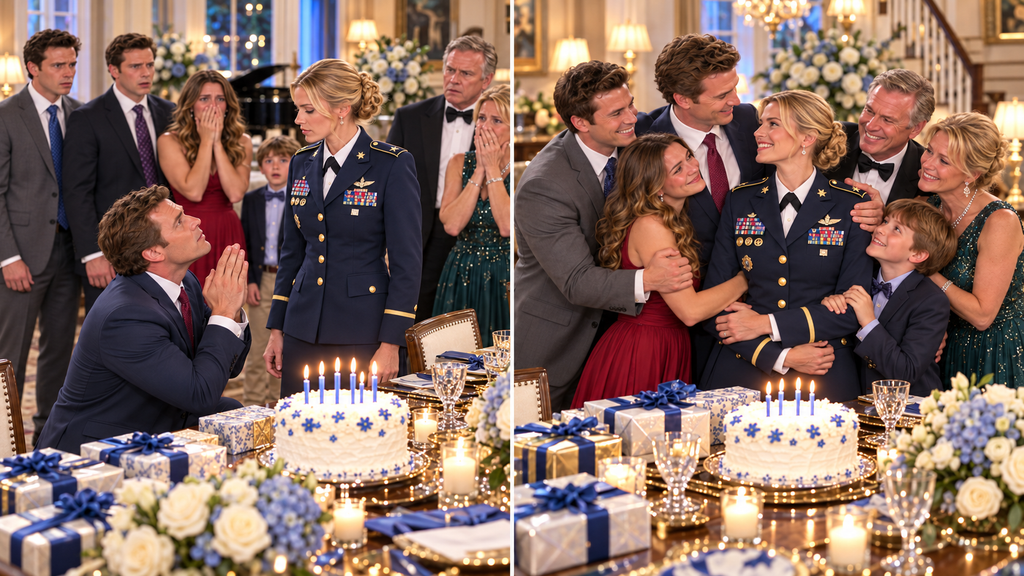
My son was still standing beside the enormous birthday cake, his little paper crown tilted sideways on his dark hair.
Seven candles waited to be lit.
Around him stood nearly sixty guests who had arrived expecting an elegant birthday celebration hosted by the prestigious Whitmore family.
Instead, they were watching my marriage come apart in the foyer.
Howard lowered his voice.
“Claire, there’s something in here you need to see first.”
Margaret stepped forward.
“What exactly is in that folder?”
No one answered her.
Ethan stared at me.
And then he said the words that changed everything.
“You weren’t supposed to find out about that.”
The room became so quiet that I could hear the soft instrumental music still playing through the speakers.
I looked at him.
“Find out about what?”
Ethan swallowed.
“Claire, not here.”
Howard’s expression hardened.
“That might have been good advice several weeks ago.”
“Howard.”
Ethan’s voice dropped.
“Don’t.”
Howard closed the folder halfway.
I held out my hand.
“Give it to me.”
Ethan moved toward us.
“Claire, please.”
That word stopped me.
Please.
Twelve hours earlier, he had not said please when he told me not to attend my own son’s birthday.
He had not said please when he suggested I hide upstairs in my own home.
He had not said please when his mother informed me that my presence would embarrass their important guests.
But now?
Now that a blue folder was open?
Now he knew the word.
I took the folder from Howard.
The first page was a copy of a corporate resolution.
At the top was the name of the holding company I had created five years earlier.
Redwood Residential Holdings.
The company that owned the house.
My company.
My eyes moved down the page.
There was my name.
Claire Bennett Whitmore.
Managing Member.
Below it was a signature.
Mine.
Except it wasn’t mine.
I stared at it for several seconds.
Then I looked at Ethan.
“What is this?”
He said nothing.
I looked back at the document.
The resolution purported to authorize a new loan secured against the property.
Eight million dollars.
I read the number twice.
Then a third time.
Eight.
Million.
Dollars.
My mouth went dry.
Howard spoke quietly beside me.
“This was submitted as part of a financing package approximately three weeks ago.”
I looked at him.
“Submitted by whom?”
Howard didn’t answer immediately.
He didn’t have to.
My eyes returned to Ethan.
His face told me.
“Ethan?”
He glanced around the room.
Several of his investors were now watching him very carefully.
One of them, a gray-haired man named Robert Hayes, slowly lowered his coffee cup.
Ethan rubbed his forehead.
“It’s complicated.”
“No.”
My voice was surprisingly calm.
“It’s eight million dollars. That’s actually a very uncomplicated number.”
Margaret stepped closer.
“What are you talking about?”
I turned the document toward her.
“Someone attempted to borrow eight million dollars against this house.”
She blinked.
“What?”
“And apparently I authorized it.”
I pointed at the signature.
“I didn’t.”
Her face changed.
She looked at Ethan.
“Tell her.”
Ethan exhaled sharply.
“Mom, stay out of this.”
That was the first moment I realized Margaret didn’t know.
For all her cruelty, arrogance and obsession with appearances, she genuinely had no idea what her son had done.
Howard removed another document.
“The lender requested verification yesterday because there were discrepancies in the ownership records. Their counsel contacted my office this morning after I began making inquiries regarding the property.”
My stomach tightened.
“This morning?”
Howard nodded.
“When you called me at 3:41, I reviewed the ownership documents. That triggered a broader title search. I found the pending financing notice.”
I looked at Ethan.
“You forged my signature?”
“No.”
The answer came too quickly.
Howard’s eyes narrowed.
“Then who did?”
Ethan said nothing.
“Who signed my name?”
“Claire—”
“Who?”
Noah flinched.
That brought me back to reality.
I closed my eyes for half a second.
Not here.
Not like this.
I turned toward my son.
He looked terrified.
And suddenly none of the adults mattered.
Not Ethan.
Not Margaret.
Not the investors.
Not the uniform.
Not the house.
My son mattered.
I crossed the room and crouched in front of him.
The movement pulled slightly at the fabric of my uniform, but I barely noticed.
“Hey.”
Noah looked at me.
“Are you and Dad fighting?”
I heard Ethan inhale behind me.
I kept my eyes on Noah.
“Your dad and I have something important we need to talk about.”
“Because you came downstairs?”
The question nearly broke me.
“No, sweetheart.”
“Grandma said you weren’t supposed to.”
Behind me, Margaret made a tiny sound.
I took Noah’s hands.
“Listen carefully. You didn’t do anything wrong. This is still your birthday. And nobody is angry with you.”
His lower lip trembled.
“You promised front row.”
“I know.”
“You came.”
I smiled.
“Of course I came.”
He looked at my uniform.
“Is that your work?”
“Yes.”
His eyes moved over the ribbons.
“Are you a soldier?”
“Yes.”
For the first time that morning, wonder pushed some of the fear out of his face.
“Like Uncle Mason from school?”
I almost laughed.
“I don’t know Uncle Mason from school.”
“He’s not my uncle. He’s Tyler’s uncle.”
“Then maybe.”
The uniformed officer who had saluted me at the door was still standing near the foyer.
Lieutenant Colonel Daniel Reeves had worked with me for nearly three years.
He had walked into rooms where the decisions made inside them carried consequences thousands of miles away.
But at that moment, he seemed to understand perfectly that the most important person in the room was a seven-year-old boy in a paper crown.
He stepped forward.
“Sir?”
Noah looked at him.
Reeves smiled.
“Your mother is my boss.”
Noah’s eyes widened.
“You have a boss?”
A few nervous laughs escaped from the guests.
Reeves nodded solemnly.
“Everybody has a boss.”
Noah pointed at me.
“She tells you what to do?”
“Frequently.”
“Do you listen?”
“Always when I’m smart.”
That finally made Noah smile.
I silently thanked him.
Then I stood.
I looked at Ethan.
“We are not doing this in front of him.”
Ethan nodded quickly.
“Fine.”
Margaret started to speak.
I raised one hand.
“No.”
She stopped.
“This party continues.”
“Claire—”
“This is Noah’s birthday. Whatever Ethan has done will still be true in two hours.”
I looked around the room.
Some people immediately looked away.
Good.
Let them.
I turned toward the woman who had spent the previous three weeks helping me organize the party.
“Maria?”
Our house manager stepped forward.
“Yes, ma’am?”
“Would you please light the candles?”
She smiled.
“Of course.”
I looked down at Noah.
“Ready?”
He nodded.
“But you’re staying?”
I bent and kissed his forehead.
“Front row.”
And I was.
We sang.
Every single person in that room sang.
It was probably the most uncomfortable rendition of “Happy Birthday” ever performed in the Commonwealth of Virginia.
I didn’t care.
Noah blew out his candles.
Everyone applauded.
He cut the first slice with my hand over his.
He got frosting on the sleeve of my dress uniform.
Margaret gasped.
I laughed.
Actually laughed.
Noah stared at the white frosting smeared near my cuff.
“Are you in trouble?”
“Probably.”
“With the Army?”
“Possibly.”
Lieutenant Colonel Reeves called from behind us.
“I didn’t see anything, ma’am.”
Noah giggled.
For twenty minutes, I gave my son his birthday back.
And Ethan stood across the room watching me.
He didn’t come near us.
He knew better.
Eventually Noah disappeared into the backyard with his friends and two hired entertainers.
I waited until I saw him through the windows, laughing as he chased another child around an inflatable obstacle course.
Then I turned around.
“Library.”
Ethan’s shoulders dropped.
Margaret followed.
So did Ethan’s father, Charles.
Howard came with us.
Reeves remained outside.
I stopped at the library door.
“Margaret and Charles can stay.”
Ethan looked surprised.
“Why?”
“Because your mother participated in humiliating me this morning, and your father spent twelve years treating me like an intellectually challenged charity case.”
Charles stiffened.
“I never said that.”
“You introduced me to Senator Walsh as ‘the girl Ethan married who does clerical work.’”
His cheeks reddened.
“That was years ago.”
“Yes.”
I looked directly at him.
“I remember years.”
Nobody responded.
We entered the library.
Howard closed the door.
I placed the blue folder on the desk.
“Start talking.”
Ethan walked toward the windows.
“It wasn’t supposed to happen like this.”
I almost smiled.
It was such a predictable sentence.
People rarely plan to be caught.
“What wasn’t?”
“My company has been having liquidity problems.”
“Again?”
He turned.
“This is different.”
“How?”
“Two projects stalled. Material costs went up. One investor pulled out. We had bridge financing, but—”
“How much?”
He looked away.
“Ethan.”
“About six million.”
Howard corrected him.
“Six point four.”
Ethan shot him a furious look.
Howard didn’t react.
I stared at my husband.
“You owe six point four million dollars?”
“It’s business debt.”
“That distinction stops being comforting when you forge my signature to secure it against my home.”
“I didn’t forge it.”
“Then tell me who did.”
Silence.
Charles suddenly stood straighter.
“Ethan.”
His son didn’t look at him.
“Who signed her name?”
Ethan’s jaw tightened.
“I had someone in the office prepare the paperwork.”
“That isn’t what I asked.”
“I told them Claire had approved it.”
My blood went cold.
Margaret whispered, “Oh my God.”
Ethan turned toward me.
“I was going to tell you.”
“When?”
“As soon as the Arlington project closed.”
“And if it didn’t?”
“It will.”
Howard spoke.
“The Arlington project lost its primary investor eleven days ago.”
Ethan spun toward him.
“How the hell do you know that?”
Howard’s expression didn’t change.
“Because after discovering an attempted eight-million-dollar encumbrance on my client’s property, I did my job.”
My client.
Two words.
And suddenly Ethan understood something else.
Howard wasn’t our attorney.
He was mine.
Ethan stared at me.
“How long has Howard represented you?”
“Seven years.”
“You told me he handled estate planning.”
“He does.”
“For us.”
“For me.”
His face hardened.
“So you’ve been planning this?”
I stared at him.
“Planning what?”
“This.”
He gestured wildly.
“The house. The company. Lawyers. Secret accounts. Whatever this performance is.”
I could hardly believe him.
“You forged my signature.”
“I said I didn’t personally sign it.”
“And somehow I’m the deceptive one?”
“You hid all of this!”
He pointed toward my uniform.
“You hid who you were!”
I looked down at myself.
Then back at him.
“I told you I was in the Army on our third date.”
“You said you worked for the government.”
“I told you I was an Army officer.”
“You never said you were this.”
“What does ‘this’ mean?”
He hesitated.
Charles answered before he could.
“Colonel.”
Everyone looked at him.
Charles was staring at the insignia on my uniform.
“You’re a colonel.”
“Yes.”
Margaret sat slowly in one of the leather chairs.
“You told me you worked in administration.”
“No, Margaret. You told yourself I worked in administration.”
She stared at me.
I continued.
“The first Christmas after Ethan and I married, you asked what I did. I said I was serving on active duty in the Army. You asked whether I filed paperwork. Before I could answer, you started telling everyone about Ethan’s promotion.”
Her face reddened.
I looked at Charles.
“You asked me once where I was stationed. I answered. You said you didn’t know women could do serious operational work there, then spent forty minutes talking about golf.”
He looked down.
Then Ethan.
“You knew more than either of them.”
He shook his head.
“Not this much.”
“You never asked.”
“That’s not fair.”
“Isn’t it?”
“No!”
For the first time, his voice cracked.
“We’ve been married twelve years!”
“Exactly.”
I let that word settle.
“Twelve years, Ethan.”
My voice became quieter.
“You slept beside me for twelve years.”
“You raised a child with me.”
“You watched me leave at four in the morning.”
“You watched me come home after midnight.”
“You watched me disappear for weeks at a time.”
“You watched me receive calls I had to take in another room.”
“You attended exactly one military function with me in twelve years, complained that the dinner was boring, and left before the speeches.”
He opened his mouth.
I didn’t let him interrupt.
“When I was promoted, I asked you to attend the ceremony.”
His face changed.
He remembered.
“You said you had a meeting.”
“It was an important meeting.”
“So was mine.”
Silence.
“My soldiers were there.”
My throat tightened.
“My commander was there. People I had served beside for years were there.”
I paused.
“Noah was there.”
Ethan blinked.
“What?”
“He was four.”
“You never told me.”
“I did.”
He looked genuinely lost.
And somehow that hurt worse than deliberate cruelty.
I remembered that morning perfectly.
I had stood in our kitchen in uniform while Ethan answered emails.
I had reminded him one final time.
My promotion ceremony was at eleven.
He had said, “I know, Claire.”
At ten thirty, he texted.
Can’t make it. Client issue. You understand.
So Maria had brought Noah.
My four-year-old son had stood beside me while the new rank was pinned to my uniform.
He had clapped louder than anyone.
Ethan had forgotten the entire thing.
“You knew,” I whispered.
He sat down.
For the first time since we entered the room, he looked small.
Margaret stared at her son.
“You missed her promotion?”
He snapped toward her.
“Do not start pretending you cared about her career.”
Margaret recoiled.
He was right.
And she knew it.
Charles walked toward the desk.
“What about the house?”
I looked at Howard.
He nodded.
I answered.
“Five years ago, Ethan’s company was approximately seventy-two hours away from defaulting on several obligations.”
Ethan closed his eyes.
Margaret looked confused.
“What?”
Charles stared at his son.
“That was when you told us the Richmond project was temporarily overleveraged.”
“It was.”
“You asked me for money.”
“I remember.”
Charles looked at me.
“I refused.”
“Yes.”
“How much did he need?”
“Initially?”
I looked at Ethan.
“Three point two million.”
Margaret’s mouth opened.
I continued.
“He also had personal guarantees attached to several obligations. If the company collapsed, there was a real possibility this house would have been exposed.”
Charles frowned.
“But Ethan owned the house.”
“No.”
He stared at me.
I said it clearly.
“The bank did.”
Nobody spoke.
“We had substantial debt against the property. Ethan had also borrowed against other assets. He didn’t tell me how serious it was until the week everything was going to collapse.”
Ethan rubbed both hands over his face.
I remembered that week.
I remembered him sitting on the floor of our bedroom at one in the morning.
Crying.
I had never told anyone that.
Not even Howard.
He had looked at me and said, “I destroyed everything.”
And I had believed I was looking at a frightened husband who had made terrible business decisions.
Not a man who would eventually decide the wife who rescued him was too embarrassing to attend their son’s birthday.
“I had money,” I said.
Margaret stared at me.
“From where?”
“There it is.”
She blinked.
“What?”
“The question none of you ever asked until you discovered I had something you valued.”
She looked ashamed.
I continued anyway.
“My grandfather left me assets. Not a fortune when I inherited them, but substantial investments. I managed them carefully for years. I also invested in two technology companies through a private fund before either became widely known.”
Charles stared.
“How much are you worth?”
I smiled without humor.
“Still asking the wrong questions.”
He looked away.
“I created Redwood Residential Holdings and purchased the distressed note associated with the property through a negotiated transaction. The debt was restructured. Eventually, the holding company obtained full ownership.”
Margaret looked around the library as if the walls had changed.
“So this entire house…”
“Belongs to Redwood.”
“And Redwood…”
“Belongs to me.”
She whispered, “Ethan told us he bought this place.”
“I know.”
Everyone looked at him.
Ethan stood abruptly.
“I made the payments before the crisis.”
I stared at him.
“For two years.”
“I renovated it.”
“With money from a joint account.”
“My company—”
“Was saved because I injected capital into it.”
That stopped him.
Charles turned slowly.
“You invested in his company too?”
Howard pulled another document from the folder.
Ethan’s head snapped toward him.
“Don’t.”
I noticed the panic immediately.
“What now?”
Howard looked at me.
“This is the second issue.”
Ethan moved toward the desk.
“Howard, I swear to God—”
Charles stepped between them.
“Sit down.”
Something in his voice changed the room.
For all his arrogance, Charles Whitmore had spent forty years in business.
And he recognized fear.
Ethan sat.
Howard placed several pages in front of me.
“These are the capitalization records from the emergency restructuring five years ago.”
“I’ve seen them.”
“Look at the amendment.”
I did.
At first, nothing seemed unusual.
Then I saw the date.
Six months earlier.
My eyes narrowed.
“What is this?”
Howard pointed.
“Your preferred interest was apparently converted.”
I stared at him.
“Apparently?”
“There is another authorization bearing your signature.”
The room tilted.
I picked up the paper.
Another signature.
Another Claire Whitmore.
Another lie.
This one was worse.
Much worse.
Five years earlier, when I rescued Ethan’s company, I had not given him the money.
I had invested it.
Howard had insisted.
I remembered arguing with him.
“He’s my husband.”
Howard had replied, “And marriage is not a substitute for documentation.”
So my investment had been structured through another entity.
I never interfered in Ethan’s company.
Never demanded a board seat.
Never used my ownership interest to control him.
I wanted him to rebuild.
I wanted him to feel that his success remained his.
Apparently, he had eventually decided even that silent protection was too threatening.
I looked at the amendment.
“This says I surrendered my preferred interest.”
Howard nodded.
“I did not.”
“I know.”
“How much?”
Howard’s eyes met mine.
“At the valuation Ethan’s company used for its most recent investor presentation, your converted interest would be worth approximately eleven million dollars.”
Margaret covered her mouth.
Charles whispered something I couldn’t hear.
I stared at Ethan.
“Eleven million?”
He stood.
“That valuation is theoretical.”
I almost laughed.
“That’s your defense?”
“No. Claire, listen to me.”
“I am listening.”
“The company needed a clean capitalization table.”
“So you stole my equity?”
“I didn’t steal anything.”
“You fabricated my authorization.”
“I was going to restore your interest after the next financing round.”
Howard actually laughed.
It was a short, disbelieving sound.
Ethan turned on him.
“You think this is funny?”
“No.”
Howard’s face became cold.
“I think you should stop speaking until you retain counsel.”
That sentence finally frightened Ethan.
Not embarrassed him.
Not angered him.
Frightened him.
“Counsel?”
“Yes.”
“Why?”
Howard looked at the forged documents.
“You know why.”
Margaret rose.
“Ethan, tell me you didn’t know those signatures were false.”
He didn’t answer.
“Tell me.”
“Mom—”
“Tell me!”
“I knew.”
Her hand flew to her mouth.
Charles walked away from everyone.
He stood facing the bookshelves.
For several seconds, I thought he might be sick.
Then he turned.
“Why?”
Ethan exploded.
“Because I was drowning!”
His voice shook the room.
“You want to know why? Because every person in this family expected me to be you!”
He pointed at Charles.
“Every investor expected me to turn five dollars into fifty because Charles Whitmore’s son couldn’t possibly fail.”
He looked at Margaret.
“You introduced me to people as your brilliant developer son before I had even built anything!”
Then he looked at me.
“And you—”
I waited.
His anger collapsed.
“You kept succeeding.”
There it was.
The truth.
Quiet.
Ugly.
Pathetic.
“You kept succeeding,” he repeated.
“I would close a project and think I had finally done something, and then some person would call you from Washington and suddenly you had to leave.”
His eyes moved over my uniform.
“I knew you were important.”
I said nothing.
“I didn’t know exactly how important because I stopped asking.”
“Why?”
He laughed bitterly.
“Because I didn’t want to know.”
That confession hurt more than I expected.
He sat again.
“When we first got married, I loved telling people my wife was an Army officer.”
I remembered.
He had.
Once.
A long time ago.
“But then you kept advancing.”
He stared at the floor.
“And I kept telling myself I didn’t care.”
His voice grew quieter.
“Then my company nearly collapsed. I came home and told you we might lose everything.”
He looked up at me.
“And you fixed it.”
“I helped you.”
“You fixed it.”
His eyes were wet now.
“My father said no. My investors said no. Banks said no.”
He pointed toward me.
“You said yes.”
“That made you hate me?”
“No.”
He wiped his face.
“It made me hate myself.”
Nobody moved.
“And instead of dealing with that,” I said, “you decided to make me smaller.”
His face crumpled slightly.
I finally understood.
The jokes about my clothes.
The comments about my salary.
The vague introductions.
The way he allowed Margaret to dismiss me.
The way he gradually stopped attending anything connected to my career.
It wasn’t because Ethan truly believed I was insignificant.
It was because he needed everyone else to believe it.
If I was merely Claire who “handled paperwork,” then he could remain the impressive person in the marriage.
If my money didn’t exist, he could pretend he saved his own company.
If my career remained vague, he could pretend his work mattered more.
And if I stayed upstairs during Noah’s birthday, surrounded by people Ethan wanted to impress, then the illusion could survive one more day.
I looked at him.
“Why today?”
He knew exactly what I meant.
“Why did I have to disappear today?”
He rubbed his hands together.
“There were people coming who are part of the new financing.”
“And?”
“Mom had invited Senator Walsh.”
I frowned.
“What does he have to do with anything?”
Ethan looked at my uniform.
“He knows who you are.”
I went still.
Of course.
Senator Walsh had attended a defense-related ceremony two years earlier.
We had spoken briefly.
Not enough to know each other personally.
Enough for him to recognize me.
“You were afraid he would recognize me.”
“Yes.”
Margaret stared at Ethan.
“You told me Claire’s clothes would embarrass the investors.”
“I needed her upstairs.”
“You used me.”
He looked at her.
“You didn’t exactly require much convincing.”
That landed.
Margaret sat back down.
For perhaps the first time in twelve years, she had been forced to look directly at what her contempt for me had made possible.
She had been useful to Ethan.
Every insult.
Every joke.
Every exclusion.
She had helped maintain his lie.
Charles spoke.
“What was supposed to happen today?”
Ethan didn’t answer.
Howard did.
“The potential lenders and investors would see a prosperous founder in a ten-million-dollar residence apparently owned by him, surrounded by influential people.”
Charles’s expression became disgusted.
“You were using Noah’s birthday as an investor event?”
My head turned toward Ethan.
That detail was new.
“Is that true?”
“It wasn’t like that.”
“Was it true?”
He hesitated.
“Yes.”
I felt something inside me go completely still.
That was the moment my marriage ended.
Not the forged signature.
Not the house.
Not the eleven million dollars.
Not even the text at 2:07 a.m.
My son had spent three weeks talking about his birthday.
He had chosen the cake.
He had selected the dinosaur magician.
He had carefully written names on invitations in uneven seven-year-old handwriting.
And his father had looked at that day and seen an opportunity to impress investors.
I closed the folder.
“We’re done.”
Ethan stood.
“Claire.”
“We’re done.”
“Don’t make a decision while you’re angry.”
“I’m not angry.”
That frightened him more.
“Claire, please.”
I turned to Howard.
“I want copies of everything preserved.”
“They already are.”
“Notify the lender that I did not authorize either transaction.”
“Done.”
Ethan stared at him.
“You already contacted them?”
Howard nodded.
“The moment Claire confirmed the signature wasn’t hers.”
“You had no right.”
Howard’s eyebrows rose.
“I had every right.”
Ethan looked at me.
“You’re going to destroy the company.”
“No.”
I stepped closer.
“You did that.”
“We have employees.”
“I know.”
“Three hundred people depend on that company.”
“I know.”
“Then think about what happens if this gets out.”
“I am.”
His voice rose.
“Are you?”
“Yes.”
I looked him directly in the eyes.
“That’s why I’m not going to walk downstairs and announce what you did.”
He stopped.
Margaret looked up.
Even Howard seemed slightly surprised.
I continued.
“I will not destroy three hundred livelihoods because you couldn’t manage your ego.”
Ethan stared at me.
Hope appeared on his face.
He misunderstood.
Again.
“But you are finished.”
The hope vanished.
“What?”
“You will step down.”
“Claire—”
“You will resign from operational control pending an independent review.”
“You can’t force me.”
Howard cleared his throat.
Ethan looked at him.
Howard removed another document.
“You might want to reconsider that statement.”
Ethan’s face went pale.
I frowned.
“What is that?”
Howard handed it to me.
I read.
Then looked at him.
“My preferred shares.”
He nodded.
“The attempted conversion was never valid because Claire never authorized it.”
Ethan said nothing.
Howard continued.
“Under the original restructuring agreement, certain acts of fraud, unauthorized dilution, or attempted disposition of Claire’s interest trigger enhanced voting rights.”
I had forgotten.
Five years earlier, I had barely read that section.
Howard hadn’t.
“How enhanced?” I asked.
He answered calmly.
“Enough.”
Ethan sank into the chair.
For the first time all morning, I understood why Howard had arrived in person.
This was no longer simply about my house.
I could remove Ethan.
Not forever without process.
But immediately enough to prevent him from doing more damage.
I stared at the man I had married.
“Did you know?”
He didn’t answer.
“You knew.”
“Yes.”
“So when you tried to erase my interest…”
“I thought the amendment would override the old agreement.”
Howard shook his head.
“It doesn’t.”
Ethan laughed once.
A broken sound.
Then he leaned forward and covered his face.
Nobody spoke for a long time.
Finally, Margaret whispered, “What happens now?”
I looked through the glass doors toward the backyard.
Noah was laughing.
The magician had apparently produced a rabbit.
Children were screaming happily.
“What happens now,” I said, “is my son gets his birthday.”
I turned to Ethan.
“You will go outside.”
He looked up.
“You will smile.”
“You will watch Noah open his presents.”
“You will not discuss this.”
“You will not blame me.”
“You will not whisper to your mother.”
“You will not call your business partners.”
“And you will not leave until Noah is finished celebrating.”
His mouth opened.
I continued.
“Tomorrow morning, you will retain an attorney.”
His eyes filled.
“And tonight?”
“Tonight you pack a bag.”
Margaret gasped.
“Claire—”
I looked at her.
She stopped.
Ethan whispered, “You’re throwing me out?”
“No.”
I shook my head.
“I’m telling you our marriage is over.”
He stared at me.
“You can’t mean that.”
“I do.”
“Twelve years?”
“Yes.”
“You’re ending twelve years over one mistake?”
I looked at the blue folder.
“One?”
He lowered his eyes.
I moved toward the door.
His voice stopped me.
“Did you ever love me?”
I turned.
That question hurt.
Because the answer was easy.
“Yes.”
He looked at me.
“I loved you enough to protect your dignity when your business failed.”
My voice shook for the first time.
“I loved you enough never to tell your parents that the daughter-in-law they mocked had saved their son.”
“I loved you enough to invest in your company without demanding credit.”
“I loved you enough to let people think this house was yours because I thought your pride would heal.”
A tear slid down his cheek.
“And I loved you enough to believe that eventually you would become secure enough to stand beside me without needing me to shrink.”
I swallowed.
“But you didn’t.”
I opened the door.
“You just kept asking me to become smaller.”
Then I walked out.
The party lasted another ninety minutes.
It was surreal.
I stood beside Noah while he opened presents.
I took pictures.
I ate cake.
I let six children ask me questions about my uniform.
One little girl wanted to know whether I had ever driven a tank.
One boy asked whether I knew the president.
Noah answered every question on my behalf whether he knew the answer or not.
“My mom is in charge of basically the whole Army.”
“I am absolutely not.”
“She has secret missions.”
“Noah.”
“She can’t tell you because then you would know.”
The adults laughed.
And slowly, somehow, the tension loosened.
Not disappeared.
Loosened.
Several guests approached me privately.
Some apologized.
That was uncomfortable.
One woman named Diane, who had met me perhaps twenty times at Margaret’s dinners, touched my arm.
“I owe you an apology.”
“For what?”
“I believed what they said.”
I studied her.
“What did they say?”
She looked embarrassed.
“That you didn’t really work. That Ethan supported you. That you were… socially awkward.”
I almost smiled.
“I am socially awkward.”
She laughed nervously.
“I don’t think that’s what they meant.”
“No.”
I looked across the lawn.
Margaret was standing alone.
“No, it wasn’t.”
Senator Walsh eventually arrived forty minutes late.
The instant he saw me, recognition crossed his face.
“Colonel Whitmore?”
Ethan, standing ten feet away, closed his eyes.
I shook the senator’s hand.
“Sir.”
“What on earth are you doing here?”
I glanced at Noah.
“Birthday duty.”
Walsh smiled.
“Yours?”
“My son’s.”
He looked genuinely surprised.
“I didn’t realize Ethan Whitmore was your husband.”
The irony nearly made me laugh.
Neither, apparently, had Ethan.
Walsh spoke to me for less than five minutes.
Nothing classified.
Nothing dramatic.
He congratulated me on a recent assignment and told Noah that birthdays outranked senators.
Then he moved on.
But the damage to Ethan’s carefully manufactured image was complete.
People understood.
Not every detail.
Enough.
They understood that the quiet wife Ethan had allowed them to dismiss was not who they had been told she was.
And I never had to humiliate him.
I never announced my assets.
I never mentioned his forged documents.
I simply existed openly for the first time.
That was enough.
Near noon, the final guests began leaving.
The government vehicle had waited.
Reeves approached me.
“Ma’am, we need to depart in twenty minutes.”
“I know.”
He glanced toward the house.
“Everything okay?”
“No.”
He nodded once.
“Understood.”
That was another thing I appreciated about soldiers.
Sometimes they knew when not to ask.
I found Noah upstairs changing out of his birthday clothes.
He was sitting on his bed surrounded by opened presents.
“Mom?”
“Yeah?”
“Are you leaving?”
“I have to go to work.”
His face fell.
“For how long?”
“Just until tomorrow.”
“Promise?”
I sat beside him.
“Promise.”
He leaned against me.
For several seconds, neither of us spoke.
Then he asked, “Is Dad in trouble?”
Children always know.
Adults fool themselves into believing they can hide storms from children simply because children don’t understand meteorology.
“Yes,” I said.
“What did he do?”
“He made some bad decisions.”
“Because he told you not to come?”
“That was one of them.”
Noah picked at a ribbon on one of his presents.
“Grandma said important people were coming.”
“I know.”
“Are you important?”
I looked at him.
“That’s a complicated question.”
“You have people who salute you.”
I smiled.
“That doesn’t make someone important.”
“Then what does?”
Seven years old.
And somehow he had asked the question every adult downstairs had gotten wrong.
I thought about it.
“Being important isn’t really about people knowing your name.”
He listened.
“It’s about what you’re responsible for. If people trust you, you take care of that trust. If somebody depends on you, you show up.”
His little face became serious.
“Like birthdays?”
My throat tightened.
“Especially birthdays.”
He smiled.
Then he hugged me.
I held him tightly.
“Mom?”
“Yes?”
“Dad said you embarrassed him sometimes.”
There are sentences children say that cut more deeply than anything an adult could invent.
I pulled back.
“When?”
“A while ago.”
“What exactly did he say?”
Noah shrugged.
“That you don’t know how to act around his work people.”
I closed my eyes briefly.
“Do you think I’m embarrassing?”
“No.”
He answered so quickly I laughed.
“You wear old sneakers.”
“That’s true.”
“And you sing wrong in the car.”
“Debatable.”
“You do.”
“Anything else?”
“You say ‘roger’ when I ask if I can have cereal.”
I laughed harder.
“Occupational hazard.”
He grinned.
Then his expression changed.
“I like when you come places.”
That almost undid me.
I kissed his forehead.
“I like coming places with you too.”
When I walked downstairs twenty minutes later, Ethan was waiting near the front door.
He had removed his jacket.
His tie was loose.
He looked like he had aged five years since breakfast.
“Can we talk?”
“I have four minutes.”
He nodded.
“I’ll take them.”
We stepped onto the side terrace.
For once, he didn’t try to justify himself.
“I’m sorry.”
I waited.
“I know that doesn’t fix anything.”
“No.”
“I don’t know when I became this person.”
I looked out across the lawn.
“I think you do.”
He nodded.
“Probably.”
He wiped his mouth with one hand.
“I was jealous of you.”
“I know.”
“I was ashamed that you saved me.”
“I know.”
“And every time my mother said something insulting about you…”
He looked down.
“I should have stopped her.”
“Yes.”
“Sometimes I encouraged it.”
That hurt.
I turned toward him.
“What?”
He couldn’t look at me.
“I didn’t invent everything she thought about you.”
A cold feeling spread through my chest.
“What did you tell her?”
“That you weren’t ambitious.”
I said nothing.
“That you preferred being home.”
“What else?”
“That your government job was mostly administrative.”
I stared at him.
“What else?”
His eyes filled.
“That the money for the house came from a deal I closed.”
There it was.
The architecture of twelve years of disrespect.
Brick by brick.
Built by my husband.
Margaret hadn’t simply misunderstood me.
Ethan had curated her misunderstanding.
“Why?”
He looked miserable.
“Because I wanted my father to respect me.”
“And making me look insignificant accomplished that?”
“In my head?”
He gave a bitter laugh.
“Yes.”
I stared at him.
Then something occurred to me.
“The Thanksgiving dinner.”
His face changed.
“What?”
“The dress.”
Margaret had laughed in front of everyone and asked whether I bought it at a grocery store.
Ethan had laughed too.
I remembered driving home afterward.
I remembered staring out the passenger window while he told me I was being too sensitive.
“Did you tell her where I bought my clothes?”
He closed his eyes.
That was my answer.
“Ethan.”
“I made a joke once.”
“What joke?”
He whispered, “That you dressed like someone who used coupons for everything.”
I almost couldn’t speak.
The dress Margaret mocked had cost eighty dollars.
I had liked it.
That was all.
I had stood in the store, tried it on, liked how I looked, and bought it.
There had been no tragedy attached to it until people who measured human value in labels decided there should be.
“You fed her contempt.”
“Yes.”
“And then when it grew bigger than you expected, you pretended you were trapped between us.”
“Yes.”
I nodded.
“Thank you.”
He looked confused.
“For what?”
“For finally telling the truth.”
The vehicle waited in the driveway.
I started walking.
“Claire.”
I stopped.
“I love you.”
I didn’t turn around.
Maybe he did.
That was the saddest part.
Love without respect can become a very elegant form of cruelty.
“I believe you,” I said.
Then I looked back at him.
“But I don’t want Noah growing up believing that this is what love looks like.”
And I left.
The next forty-eight hours moved quickly.
My command briefing consumed most of the first day.
That was almost a relief.
There is something clarifying about sitting in a room where everyone is focused on the problem in front of them.
Nobody cared about my house.
Nobody cared about Ethan’s family.
Nobody cared what designer had made my clothes.
They cared whether I had prepared.
Whether my judgment was sound.
Whether I could lead.
For twelve years, I had moved between two worlds.
In one, people trusted me with enormous responsibility.
In the other, people wondered whether I knew which fork to use at dinner.
I had allowed that contradiction to continue because I believed ignoring petty people was a form of strength.
Sometimes it is.
Sometimes silence simply gives other people room to write your story for you.
I understood that now.
When I returned home the following evening, Ethan was gone.
His closet was half empty.
There was a note on the kitchen counter.
I didn’t read it immediately.
Noah ran toward me.
“Mom!”
I dropped my bag and caught him.
He wrapped both arms around my waist.
“You came back.”
“I promised.”
“Dad is staying at Grandpa’s.”
“I know.”
“Grandma cried.”
That surprised me.
“Did she?”
“Yeah.”
He thought for a moment.
“She cries weird.”
Despite everything, I smiled.
“How?”
“Quiet.”
I understood.
Margaret had always done everything loudly.
Perhaps quiet crying was new.
After Noah went to bed, I finally read Ethan’s note.
It was six pages.
I expected excuses.
There were some.
But fewer than I expected.
He admitted he had spent years resenting the very qualities that first attracted him to me.
My independence.
My calm.
My competence.
He wrote that when we met, he loved that I never seemed impressed by money.
Later, he began interpreting that same quality as judgment.
He admitted something else.
He had known exactly what my rank was.
Not every promotion.
But enough.
He had pretended ignorance that morning because acknowledging it in front of his family meant admitting how much he had hidden.
One sentence stayed with me.
“I kept telling people you were less because I was terrified they would realize you were more than me.”
I read that sentence three times.
Then I folded the letter.
Because he was still wrong.
I had never been more than him.
That was the poison underneath everything.
Marriage was never supposed to be a ranking.
There was no first place.
No second place.
No podium.
No medal.
I had wanted a partner.
Ethan had wanted to win.
The following morning, Howard called.
“We have another problem.”
I was making coffee.
“Of course we do.”
“This one may actually help.”
“I’m listening.”
“The lender’s internal review identified the person who submitted the forged authorizations.”
I stopped pouring.
“Who?”
“Ethan’s chief financial officer.”
“Martin?”
“Yes.”
I knew Martin Cole.
He had been with Ethan’s company for eight years.
He had eaten at our table.
He had brought Noah a train set when he turned five.
“Did Ethan instruct him?”
“That’s where things get interesting.”
I put down the coffee.
“Howard.”
“Martin’s attorney contacted me this morning.”
“His attorney?”
“He wants to cooperate.”
“With what?”
“An internal investigation.”
I closed my eyes.
“What else happened?”
“Martin claims Ethan knew about the documents, but says the financial problems are worse than Ethan told you.”
“How much worse?”
“Potentially catastrophic.”
My stomach tightened.
“Explain.”
“There may be investor funds that were moved between projects improperly.”
I sat down.
“How improperly?”
“Money raised for one development may have been used to cover obligations on another.”
“Is that illegal?”
“It can be, depending on the representations made to investors and the structure of the funds.”
“And Martin?”
“He says he warned Ethan.”
I stared at the kitchen wall.
“When?”
“Repeatedly.”
I thought of Ethan telling me the previous day that he was drowning.
Apparently, he had been deeper underwater than I knew.
“Howard.”
“Yes?”
“Protect the employees.”
He paused.
“That may not entirely be within our control.”
“Do what we can.”
“I will.”
“And Howard?”
“Yes?”
“No cover-up.”
Another pause.
“I didn’t expect you to ask for one.”
“I need it said aloud.”
“Understood.”
“If Ethan committed crimes, we do not hide them to protect Noah’s last name.”
“Understood.”
That afternoon, Margaret came to the house.
For the first time in twelve years, she rang the doorbell.
That sounds insignificant.
It wasn’t.
Margaret had always walked into our house.
She believed it was her son’s.
Therefore, in her mind, she belonged there automatically.
This time she waited.
Maria found me in the study.
“Mrs. Whitmore is at the door.”
“Which one?”
Maria tried very hard not to smile.
“Your mother-in-law.”
“Send her in.”
Margaret entered carrying no handbag.
No sunglasses.
No armor.
She looked older.
“May I sit?”
Another first.
“Yes.”
She sat opposite me.
For several seconds, she said nothing.
Then she looked at my desk.
“I owe you an apology.”
“Yes.”
She blinked.
Apparently she had expected me to rescue her from the discomfort.
I didn’t.
“I was cruel to you.”
“Yes.”
“I judged you.”
“Yes.”
“I humiliated you.”
“Yes.”
Her eyes became wet.
“Are you going to make me say all of it?”
“No.”
“Then why do you keep saying yes?”
“Because you’re telling the truth.”
She looked away.
“I don’t know how to talk to you right now.”
“You could start by not talking about me.”
Her eyes returned to mine.
“Talk to me.”
She swallowed.
“I’m sorry.”
I waited.
Not because I wanted her to suffer.
Because apologies often reveal themselves in the silence after the word sorry.
Some people rush to explain why they weren’t really responsible.
Margaret didn’t.
“I’m sorry I treated you as though your value depended on whether I understood your life.”
That was better than I expected.
“I’m sorry I made jokes about your clothes.”
Her voice cracked.
“I’m sorry I talked about you in front of Noah.”
That mattered most.
I leaned back.
“He heard more than you realized.”
She closed her eyes.
“I know.”
“He asked me whether I embarrass people.”
A tear rolled down her cheek.
“I’m sorry.”
“You don’t apologize to me for that part.”
She looked confused.
“You apologize to him.”
She nodded immediately.
“I will.”
“No.”
My voice sharpened.
“You don’t tell a seven-year-old that Grandma was wrong because Mommy is actually a colonel and owns an expensive house.”
She stared at me.
“You tell him Grandma was wrong because nobody deserves to be treated as less valuable because of their job, clothes, accent, income or social status.”
Her face crumpled.
“You understand?”
“Yes.”
“I don’t want him learning the wrong lesson from this.”
“What wrong lesson?”
“That you should respect someone once you discover they have power.”
Margaret went very still.
“That is not respect.”
I continued.
“If I really had been an unemployed housewife, your behavior would still have been wrong.”
She lowered her eyes.
“If I really bought every dress at a grocery store, it would still have been wrong.”
“Yes.”
“If I had never commanded anyone, never inherited money and never owned this house, I would still have deserved a seat at my son’s birthday.”
Margaret began crying.
Quietly.
Exactly as Noah had described.
“I know.”
I watched her for a moment.
Then I pushed a box of tissues across the desk.
She took one.
After a while, she said, “There’s something you don’t know.”
I almost laughed.
“I’m developing a serious dislike for that sentence.”
Despite herself, she smiled.
Then the smile vanished.
“It’s about Ethan.”
“What?”
“He came to us six months ago.”
My body tensed.
“He asked Charles for money.”
“How much?”
“Ten million.”
I stared at her.
“Ten?”
“Charles refused.”
“Why didn’t you tell me?”
“Because Ethan asked us not to.”
Of course.
“What did he say the money was for?”
“Expansion.”
“And you believed him?”
“Charles didn’t.”
That interested me.
“Why?”
“He said the numbers didn’t make sense.”
“Did Charles know the company was in trouble?”
“He suspected.”
“And said nothing to me.”
Margaret looked ashamed.
“We thought it was Ethan’s business.”
I almost laughed.
“It became my business when he forged my name.”
“I know.”
She twisted the tissue in her hands.
“Claire, there’s more.”
I waited.
“Ethan told Charles that if we wouldn’t help him, he had another asset he could use.”
The house.
I knew before she said it.
“This house.”
She nodded.
“When?”
“Six months ago.”
The attempted loan paperwork was only three weeks old.
Which meant the plan had existed much longer.
My chest tightened.
“He had been planning this for six months.”
“I think so.”
“Did Charles know Ethan didn’t own it?”
“No.”
“Did you?”
“No.”
She shook her head.
“We truly believed it belonged to him.”
I stood and walked toward the window.
Six months.
Not panic.
Not one desperate decision.
A plan.
That changed something.
Ethan had asked me to forgive a drowning man grabbing for anything within reach.
But he had been measuring the distance to my life raft for half a year.
Margaret stood.
“I should go.”
“Yes.”
At the door, she stopped.
“Claire?”
I looked at her.
“I don’t expect you to forgive me.”
I said nothing.
“But I would like the opportunity to become someone Noah can be proud to have as a grandmother.”
For once, there was no performance in her voice.
“That depends on what you do next.”
She nodded.
“I understand.”
And she left.
The company investigation began Monday.
It was worse than expected.
Not because Ethan had stolen millions and hidden them offshore.
Reality was less cinematic.
And, in some ways, sadder.
He had made one desperate decision after another.
A project ran over budget.
He shifted money.
A second project stalled.
He borrowed against the first.
An investor threatened to leave.
Ethan concealed losses.
He told himself the next deal would fix the previous one.
Then the next.
Then the next.
Every lie required another lie to protect it.
Martin had participated in some of it.
He had also kept records.
Lots of records.
The board held an emergency meeting.
For the first time in years, I attended.
Ethan was already seated when I entered.
He looked exhausted.
The other directors stood when I came in.
“Please,” I said. “Sit.”
Ethan watched me take the chair opposite him.
No uniform this time.
Plain navy suit.
No ribbons.
No dramatic entrance.
Just me.
The board’s outside counsel presented the preliminary findings.
I listened.
Twenty-three minutes into the presentation, Ethan interrupted.
“I resign.”
Everyone stopped.
His attorney leaned toward him.
“Ethan—”
“I said I resign.”
He looked at me.
“I’m not going to make her remove me.”
For several seconds, nobody spoke.
Then the chairman asked, “Effective when?”
“Immediately.”
His attorney whispered something.
Ethan shook his head.
“No.”
He signed the prepared document.
Then pushed it across the table.
I expected satisfaction.
I felt none.
This was the father of my child.
The man who had once held my hand in a hospital room while Noah struggled to breathe through a respiratory infection at eleven months old.
The man who used to bring me coffee on Sunday mornings.
The man who had danced barefoot with me in our first apartment because we couldn’t afford furniture for the living room.
People are rarely monsters from beginning to end.
That would make leaving easier.
Ethan had good pieces.
Beautiful pieces.
But eventually his fear, pride and dishonesty had become the structure holding everything else together.
He stood.
Before leaving, he stopped beside me.
“I’m sorry.”
I nodded.
Then he walked out.
The investigation continued.
Several projects were sold.
Others were restructured.
The company survived.
Smaller.
Bruised.
But alive.
Most employees kept their jobs.
Martin lost his.
The matter involving the false documents was referred through the appropriate legal channels.
I did not interfere.
I did not ask for special treatment.
I did not ask anyone to punish Ethan.
And I did not ask anyone to save him.
For once, I allowed consequences to belong entirely to the person who created them.
Our divorce began quietly.
That disappointed Margaret’s social circle enormously.
There was no public war.
No screaming courthouse confrontation.
No tabloid-worthy battle over the mansion.
Ethan’s attorney initially raised questions about marital interests in the property.
The documentation answered them.
My ownership structure had been established years earlier.
The agreements were clear.
The forged authorizations did not improve Ethan’s position.
If anything, they did the opposite.
We negotiated.
We argued.
We negotiated again.
The most difficult issue was Noah.
Not because Ethan tried to take him from me.
He didn’t.
To his credit, he never used our son as a weapon.
One evening, about two months after the birthday, Ethan came to the house to pick Noah up for the weekend.
I met him at the door.
He looked different.
Not poorer.
Not defeated.
Just stripped down somehow.
No tailored jacket.
No expensive watch.
Jeans.
Sweater.
He glanced into the foyer.
“I still forget this isn’t my house.”
I leaned against the doorframe.
“It was your home.”
He nodded.
“That’s different.”
“Yes.”
Noah came thundering downstairs carrying a backpack.
“Dad!”
Ethan’s entire face changed.
Whatever else had happened, he loved our son.
I never doubted that.
“Ready, buddy?”
“Yes.”
Noah stopped.
“Mom, can Dad come to my soccer game Sunday?”
I looked at Ethan.
He looked uncomfortable.
“If that’s okay.”
“Of course.”
Noah smiled.
“Can you sit together?”
That one was harder.
Ethan looked at me.
I looked at my son.
“Yes.”
Noah ran toward the car.
Ethan remained on the porch.
“Thank you.”
“He shouldn’t have to divide the bleachers because we couldn’t make our marriage work.”
Ethan nodded.
Then he said, “I’m seeing someone.”
My eyebrows rose.
“That was fast.”
His eyes widened.
“A therapist.”
I laughed.
Actually laughed.
He smiled for the first time in months.
“I probably should have phrased that differently.”
“Probably.”
He became serious.
“I should have done it years ago.”
“Yes.”
“I’m beginning to understand some things.”
I waited.
“My father never told me I had to outperform him.”
That surprised me.
“I just decided I did.”
He looked toward the car.
“And I don’t want Noah doing that.”
“Good.”
“I told him last weekend that I lost my company.”
“You resigned from it.”
“To a seven-year-old, same difference.”
“What did he say?”
Ethan smiled.
“He asked whether I needed to get a government job like Mom.”
I covered my mouth.
“I’m sorry.”
“No, you’re not.”
“No.”
We both laughed.
For one brief second, I could see the people we had been before everything became a competition.
Then it passed.
Some relationships can become kinder after they stop trying to remain marriages.
Ethan stepped off the porch.
“Claire?”
“Yes?”
“I’m sorry about your promotion ceremony.”
That surprised me more than anything else.
He looked back.
“I remembered it.”
I said nothing.
“I remembered you standing in the kitchen that morning.”
His voice grew quiet.
“I remembered you asking me to come.”
I felt tears prick my eyes.
“I chose a client meeting.”
“Yes.”
“I can’t fix that.”
“No.”
“But I remember now.”
I nodded.
Sometimes an apology cannot restore what was lost.
It can still tell the truth about it.
“That matters,” I said.
He left.
Margaret changed too.
Slowly.
Imperfectly.
At first, she overcorrected.
The next time she attended Noah’s school event, she introduced me to another grandmother by saying, “This is Claire. She’s a colonel.”
I stared at her.
Margaret immediately winced.
“Right.”
The other woman looked confused.
Margaret tried again.
“This is Claire. She’s Noah’s mother.”
I smiled.
“Better.”
Six months earlier, that exchange would have been impossible.
Now we both laughed.
Charles took longer.
Men like Charles often mistake silence for innocence.
He had rarely insulted me directly.
He had simply watched other people do it.
Eventually, he came to see me.
He stood in my study almost exactly where Margaret had stood.
“I owe you an apology.”
“Apparently this room has become popular.”
He almost smiled.
Then he became serious.
“I knew Margaret was cruel to you.”
“Yes.”
“I knew Ethan minimized your career.”
“Yes.”
“I didn’t know the truth, but I knew enough to know you were being treated badly.”
I waited.
“And I did nothing.”
That was the apology.
Not ignorance.
Not excuses.
“I’m sorry.”
I nodded.
“Thank you.”
He looked around.
“I also owe you thanks.”
“For what?”
“Saving my son’s company five years ago.”
“I didn’t do it for you.”
“I know.”
He nodded.
“That makes it worse.”
I almost smiled.
Then he said something I never expected.
“I was hard on Ethan.”
I remained quiet.
“I thought pressure made strong men.”
His jaw tightened.
“Maybe sometimes it just makes frightened ones.”
There was nothing I could say to that.
It was his truth to carry.
A year passed.
The legal consequences from Ethan’s business conduct were complicated.
Some claims were resolved civilly.
Other matters took longer.
He accepted responsibility for authorizations he should never have made.
He sold most of what remained of his personal investments.
The giant lifestyle disappeared.
So did many of the friends who had filled our house that birthday morning.
That taught him something too.
People who love your table sometimes vanish when the table becomes smaller.
Ethan moved into a modest townhouse about fifteen minutes away.
Noah loved it.
Mostly because Ethan let him choose the color of his bedroom.
Bright green.
Violently green.
A color that seemed capable of generating electricity.
When I saw it, I stared at the wall.
“Interesting.”
Ethan laughed.
“You’re enjoying this.”
“Deeply.”
“You have white walls.”
“I have peaceful walls.”
“Your son wanted radioactive avocado.”
“He is your son this weekend.”
From upstairs, Noah yelled, “I HEARD THAT!”
We laughed.
Healing did not look the way I once imagined.
It wasn’t forgiveness arriving dramatically one morning.
It was ordinary.
Soccer games.
Parent-teacher conferences.
Birthday pickups.
Learning where the new boundaries were.
Choosing not to reopen old wounds simply because you knew exactly where to cut.
My career continued.
Several months after the divorce was finalized, I received another assignment.
This one came with a ceremony.
I told Noah first.
“Do I get to come?”
“Absolutely.”
“Front row?”
I smiled.
“Front row.”
Then, after a long hesitation, I called Ethan.
“I have a ceremony next month.”
Silence.
“What kind?”
I told him.
He became quiet.
Then he asked, “Would it be inappropriate if I came?”
I looked out my office window.
“You don’t have to.”
“I know.”
That mattered.
“I’d like to.”
So he came.
Noah sat between Ethan and Margaret.
Charles sat beside them.
Howard came too.
When my name was called, I walked across the stage.
I had spent most of my life believing recognition didn’t matter.
Maybe that was partly true.
You should not need applause to know your own worth.
But there is a difference between not needing applause and accepting erasure.
I understood that now.
When I looked toward the front row, Noah was standing.
Clapping wildly.
Margaret was crying.
Charles was clapping.
And Ethan—
Ethan was standing too.
Our eyes met.
He didn’t look ashamed.
He didn’t look threatened.
He simply applauded.
Afterward, Noah ran toward me.
“You did it!”
I caught him.
“I did.”
Ethan approached more slowly.
“Congratulations, Claire.”
“Thank you.”
He held out his hand.
For a moment, I looked at it.
Then I hugged him.
Briefly.
Not romantically.
Not as a promise.
As acknowledgment.
We had survived each other.
When we separated, I believed the opposite of love was hatred.
It isn’t.
Sometimes the opposite of love is finally seeing someone clearly and accepting that you cannot build a life with who they have chosen to become.
Ethan stepped back.
“I’m proud of you.”
There was a time when those words would have meant everything.
Now they simply felt kind.
And that was enough.
Noah tugged my sleeve.
“Can we get pizza?”
I looked down at my uniform.
“Pizza?”
“Yes.”
“After this ceremony?”
“Yes.”
Margaret immediately said, “I made reservations.”
Noah groaned.
“Grandma.”
She stopped.
A year earlier, Margaret would have insisted.
This time she smiled.
“Pizza it is.”
We ended up in a crowded neighborhood restaurant.
Me in uniform.
Noah with cheese stretching from his mouth to his plate.
Margaret drinking soda from a plastic cup.
Charles arguing with Noah about whether pineapple belonged on pizza.
Ethan sitting across from me.
No investors.
No senators.
No country-club friends.
No ten-million-dollar backdrop.
Nobody important.
And everybody important.
At one point, Noah looked around the table.
“This is better than my birthday.”
The adults went silent.
He was referring to the expensive birthday party that had started everything.
Ethan looked at me.
Margaret lowered her eyes.
I asked Noah, “Why?”
He shrugged.
“Nobody’s pretending.”
I froze.
Children hear everything.
But sometimes they understand even more.
Ethan looked at our son.
“No.”
His voice was soft.
“Nobody’s pretending.”
Two years after that birthday, I sold the house.
That surprised everyone.
Especially Margaret.
“You fought to keep it.”
“No.”
I corrected her.
“I fought to keep someone from taking it without my permission.”
There was a difference.
The house was beautiful.
Ten million dollars of stone, glass, landscaped gardens, heated floors and memories.
But eventually I realized I didn’t need it.
For years, that house had been Ethan’s symbol of success.
Then it became my symbol of vindication.
I didn’t want either.
So I sold it.
I bought a smaller home with a wide porch, a big kitchen and a backyard Noah could destroy without a landscaping company sending me an invoice.
The first night there, we ate Chinese food on unopened moving boxes.
Noah looked around.
“I like this house.”
“Why?”
“It sounds different.”
“What does that mean?”
He shrugged.
“The other house echoed.”
He was right.
This one didn’t.
A few months later, while unpacking the last boxes in my study, I found the original blue folder.
Howard had given it back after the legal matters were resolved.
I sat on the floor and opened it.
There was the attempted loan authorization.
My forged signature.
The corporate documents.
The records that had detonated my old life.
I stared at them for a long time.
Then I found something else behind them.
A photograph.
I had forgotten Howard put it there.
It was the formal military portrait I had carried downstairs on Noah’s birthday.
I was standing straight.
Uniform perfect.
Expression serious.
Decorations aligned precisely.
For years, that photograph had lived inside a safe.
Not because it was classified.
Because I had somehow absorbed the idea that displaying my achievements in my own home would make Ethan uncomfortable.
I looked at the woman in the photograph.
I felt sorry for her.
Not because she was weak.
She wasn’t.
She had survived difficult deployments.
She had made decisions under pressure.
She had led people through situations that demanded more courage than anyone in Ethan’s social circle would ever know.
But she had confused endurance with obligation.
She knew how to defend everyone except herself.
I took the photograph downstairs.
There was an empty space on the bookshelf.
I put it there.
Noah noticed immediately when he came home.
“You put your Army picture up.”
“I did.”
“Why?”
I thought about my answer.
“Because I like it.”
He nodded.
That was enough for him.
Maybe it should always have been enough for me.
On Noah’s ninth birthday, we held a party in the backyard.
Nothing extravagant.
Pizza.
Water balloons.
A rented bounce house.
Chocolate cake.
Ethan came early to help set up.
Margaret brought paper plates.
Cheap ones.
I noticed.
She noticed me noticing.
“Don’t say anything.”
I smiled.
“I wasn’t going to.”
“They were on sale.”
“Margaret.”
She pointed a finger at me.
“I have evolved.”
I laughed.
Charles arrived carrying ice.
Howard came because Noah had somehow decided my attorney was his friend.
Reeves stopped by briefly with his family.
At two in the afternoon, nine children gathered around the cake.
I lit the candles.
Everyone began singing.
Halfway through, I felt someone beside me.
Ethan.
He leaned closer.
“Do you remember his seventh?”
I looked at him.
“How could I forget?”
He winced.
“Fair.”
We watched Noah.
Then Ethan said quietly, “That was the worst day of my life.”
I thought about it.
“It wasn’t mine.”
He looked surprised.
“No?”
“No.”
I watched our son blow out his candles.
“It felt like it at the time.”
Everyone applauded.
“But it wasn’t.”
“What was it?”
I smiled.
“The day I stopped disappearing.”
Ethan stared at me for a moment.
Then nodded.
“I think it was the day I started seeing you.”
There was sadness in that sentence.
But no bitterness.
“You were twelve years late.”
“I know.”
We stood quietly.
Then Noah yelled, “MOM! DAD! CAKE!”
And that was that.
Life rarely ends with a courtroom victory.
Or a dramatic speech.
Or someone standing ruined while everyone else applauds.
Those endings work beautifully in stories because they give pain a clean edge.
Real endings are messier.
Ethan didn’t become evil.
I didn’t become invincible.
Margaret didn’t transform overnight into a perfect mother-in-law.
Charles didn’t suddenly understand every mistake he had made as a father.
And I didn’t emerge from the experience without scars.
But we changed.
Some of us because we chose to.
Some because consequences gave us no alternative.
The investigation eventually ended.
The divorce became final.
The company survived under new leadership.
Ethan built a smaller consulting business several years later.
This time, he started with his own money.
No mansion.
No giant office.
No glossy magazine profile.
He seemed happier.
One afternoon, he called me.
“I landed my first major client.”
“Congratulations.”
“I wanted you to know.”
“Why?”
He paused.
“Because this time I didn’t lie to get them.”
I smiled.
“That’s a good reason.”
“Claire?”
“Yes?”
“Thank you for not destroying me.”
I became quiet.
“I could have.”
“I know.”
“No, Ethan. You misunderstand.”
I looked through the kitchen window at Noah doing homework at the patio table.
“I could have tried to destroy you.”
He listened.
“But I don’t think I ever actually had that power.”
“What do you mean?”
“You destroyed parts of your life yourself.”
Silence.
“And then you rebuilt them yourself.”
Another silence.
“I just stopped protecting you from the consequences.”
He breathed out slowly.
“That sounds like something a colonel would say.”
“No.”
I smiled.
“That sounds like something your ex-wife would say.”
He laughed.
“Fair enough.”
Before hanging up, he said, “Tell Noah I’ll pick him up at six.”
“Roger.”
There was a pause.
Then Ethan laughed harder.
I hung up smiling.
Years later, when Noah was old enough to understand what had really happened on his seventh birthday, he asked me about it.
We were sitting on the porch.
He was fourteen.
Tall.
Hungry constantly.
Embarrassed by almost everything his parents did.
He had discovered an old photograph from the party.
I was in uniform.
Ethan stood in the background.
Margaret looked like she had just seen a ghost.
Noah held it up.
“Okay. What actually happened that day?”
I smiled.
“You don’t remember?”
“I remember pieces.”
He sat beside me.
“I remember Grandma being weird.”
“That does not narrow it down.”
He laughed.
“I remember Dad being upset. And I remember the Army cars.”
He studied the photograph.
“Why were you in uniform at my birthday?”
I thought about how much to tell him.
Then I remembered the promise I had made to myself.
No pretending.
“Your father asked me not to attend.”
His head snapped toward me.
“What?”
“He was ashamed.”
“Of you?”
“Yes.”
Noah looked genuinely offended.
“Dad was an idiot.”
I tried not to smile.
“He was struggling with some things.”
“That’s adult language for idiot.”
“Possibly.”
“Why was he ashamed?”
“He had spent years telling people a version of me that wasn’t true.”
“Why?”
“Because he thought my success made his smaller.”
Noah frowned.
“That’s stupid.”
“Yes.”
“What did you do?”
“I came downstairs.”
“That’s it?”
“That was enough.”
He looked at the picture again.
Then he asked, “Is that why you divorced?”
“Partly.”
I explained some of the financial issues.
Not every legal detail.
Enough.
He listened silently.
When I finished, he stared across the yard.
“Dad never told me.”
“I asked him not to.”
“Why?”
“Because you were seven.”
“No. I mean now.”
I thought about it.
“Maybe because he’s ashamed.”
Noah nodded.
Then he said something that made me realize Ethan had changed more than I knew.
“He tells me being ashamed of something doesn’t mean you should hide it.”
I looked at him.
“When did he say that?”
“A lot.”
Noah shrugged.
“He says if I screw something up, I should tell him before the lie gets more expensive than the mistake.”
I laughed softly.
“That sounds like your father.”
Noah studied my face.
“Do you hate him?”
“No.”
“Did you?”
I thought carefully.
“There were moments.”
“Why don’t you now?”
“Because carrying hatred keeps someone inside your life in a different way.”
He absorbed that.
“Do you forgive him?”
“That’s more complicated.”
“Everything with adults is complicated.”
“You’ve discovered our secret.”
He rolled his eyes.
I continued.
“Forgiveness doesn’t mean pretending something was okay. It doesn’t mean trusting someone the same way again. Sometimes it just means you stop demanding that yesterday become different.”
He looked at the photograph.
“Grandma looks terrified.”
I laughed.
“She was.”
“Because you were a colonel?”
“Partly.”
He grinned.
“Were you trying to scare her?”
“No.”
“Not even a little?”
I considered lying.
“No comment.”
He laughed.
Then he rested his head briefly against my shoulder.
At fourteen, those moments had become rare.
I treasured it.
“Mom?”
“Yes?”
“I’m glad you came downstairs.”
I looked at the old photograph.
So was I.
For years, I believed strength meant tolerating things.
Insults.
Dismissal.
Being underestimated.
Being excluded.
I told myself none of it mattered because I knew who I was.
There is truth in that.
You should know your own worth without requiring everyone else to confirm it.
But self-respect is not only knowing who you are.
Sometimes self-respect is refusing to remain in places where everyone benefits from pretending you are less.
That was what I had failed to understand.
Ethan’s family thought my silence meant I had nothing to say.
Ethan thought my loyalty meant I would always protect him.
Margaret thought my plain clothes meant I had no money.
Charles thought my quietness meant I had no influence.
Investors thought the mansion belonged to the man shaking their hands.
And I had allowed every misunderstanding to remain because correcting people felt petty.
Until the misunderstanding reached my son.
Until a seven-year-old boy stood beside his birthday cake asking why his mother wasn’t there.
That was the line.
Not my rank.
Not my money.
Not the house.
Noah.
Years after everything happened, someone once asked me what I would change if I could go back to that night at 2:07 a.m.
Would I answer Ethan differently?
Would I confront him immediately?
Would I tell Margaret exactly what I thought of her?
Would I reveal the truth about the house before the guests arrived?
Would I walk downstairs earlier?
I thought about it for a long time.
My answer surprised them.
“No.”
Because that text gave me something I had been avoiding for years.
Clarity.
“There will be important people there,” Ethan had written.
He meant investors.
Executives.
Politicians.
People with money.
People with titles.
People whose approval he desperately wanted.
He was right about one thing.
There were important people in that house.
He was simply wrong about who they were.
The most important person there was a seven-year-old boy waiting for his mother.
And the second most important person, at least in the life I was responsible for living, was the woman upstairs who had spent twelve years making herself smaller so her husband could feel taller.
That woman finally looked in the mirror.
She put on her uniform.
She walked downstairs.
And she never hid upstairs again.
Not for Ethan.
Not for Margaret.
Not for investors.
Not for anyone.
The house is gone now.
The blue folder is locked away.
My old SUV finally died at 186,000 miles, although I maintain it could have survived another year if Noah hadn’t treated every pothole in Virginia like a personal challenge.
Margaret bought me a designer handbag for Christmas once.
I returned it.
She bought me hiking boots instead.
Progress.
Charles stopped introducing people by their net worth.
Mostly.
Ethan became a better father once he stopped trying so hard to look like a successful man and started doing the much less glamorous work of becoming one.
And Noah?
Noah grew up knowing exactly what I hoped he would learn from all of it.
Not that his mother was secretly powerful.
Not that Grandma was wrong because Mom turned out to have money.
Not that Dad deserved humiliation because he had made terrible decisions.
Something simpler.
Something harder.
Never make someone you love become smaller so you can feel bigger.
Never confuse money with importance.
Never mistake silence for weakness.
And when you make a promise to someone who trusts you—
show up.
Years after that birthday, I asked Noah whether he remembered what he had wished for when he blew out those seven candles.
He smiled.
“I do.”
“You never told me.”
“You’re not supposed to tell birthday wishes.”
“You’re older now.”
“That’s not how wishes work.”
I nudged him.
“Come on.”
He laughed.
Then his expression softened.
“I wished you wouldn’t leave.”
My heart stopped for a second.
“Because you thought I was going to work?”
“No.”
He shook his head.
“I thought you and Dad were going to make me choose.”
I stared at him.
Seven years old.
Paper crown.
Chocolate frosting.
And while the adults were fighting over millions of dollars, ownership documents, pride and reputation, my child had been afraid his family was about to split him in half.
I took his hand.
“I’m sorry.”
“It worked.”
“What?”
“My wish.”
He smiled.
“You didn’t leave me.”
I felt tears burn behind my eyes.
“No.”
I squeezed his hand.
“I never will.”
He leaned against me.
And finally I understood something about that terrible, beautiful morning.
I had thought walking down those stairs was about revealing who I was.
It wasn’t.
It was about deciding who I would no longer allow myself to become.
Invisible.
Apologetic.
Conveniently small.
A woman hidden upstairs while other people celebrated inside the life she had helped build.
At 2:07 that morning, my husband told me important people were coming.
By noon, his investors knew my name.
His parents knew the truth.
His company’s secrets had begun unraveling.
The house he claimed as proof of his success was revealed to belong to the wife he had asked to hide.
But none of that was the victory.
The victory happened much earlier.
It happened when I reached the top of the staircase and saw my son below.
It happened when I took the first step.
Then another.
Then another.
Because sometimes the most powerful thing a woman can do isn’t destroy the people who underestimated her.
Sometimes it is simply to stop cooperating with their version of her.
And walk into the room exactly as she is.
THE END! THANK YOU FOR READING!❤️