 Reading Time: 30 minutes
Daniel stood frozen in the doorway. For several seconds, nobody spoke. Not Patricia. Not Melissa. Not Chief Cole. Not even me.
The only sound in the room was Lily crying softly against the nurse’s shoulder as the officer carefully carried her back toward me.
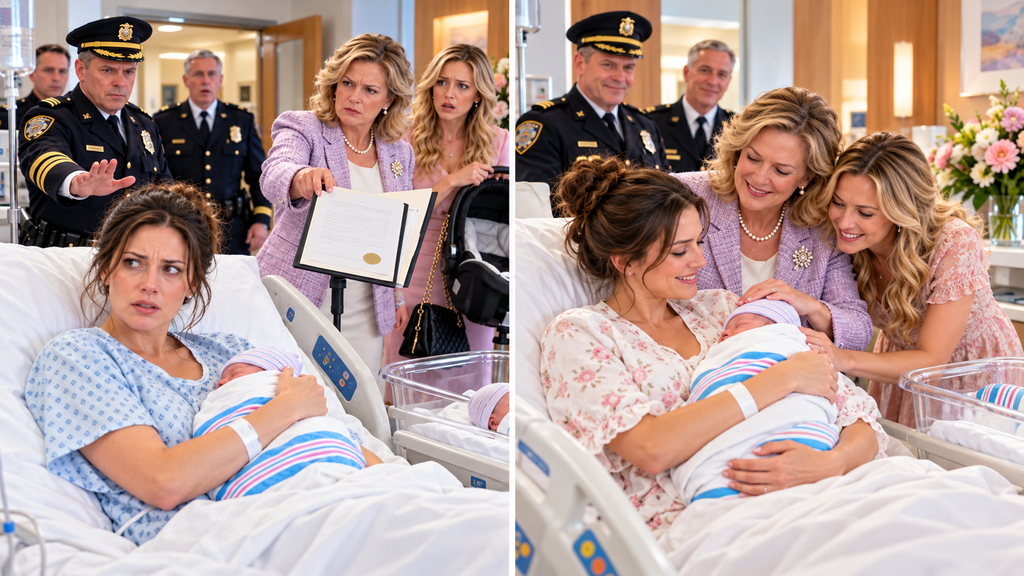
Daniel’s eyes moved from his mother to the forged documents in Chief Cole’s hand.
Then they landed on me.
And I saw it.
Guilt.
Not confusion.
Not shock.
Guilt.
My stomach dropped.
There are moments when your entire marriage can collapse without anyone saying a word.
That was mine.
“Daniel,” I whispered.
His lips parted.
“Emma, I can explain.”
Four words.
Four words every betrayed wife learns to fear.
I looked at Chief Cole.
“Please give us a moment.”
The chief hesitated.
“Judge Bennett—”
“I’m not asking anyone to leave the room. I just need to hear what my husband has to say.”
Chief Cole nodded.
The nurse placed Lily carefully beside me.
I gathered both babies against my body despite the pain tearing through my abdomen.
Noah stirred.
Lily’s tiny fingers opened against my hospital gown.
My children.
Mine.
Not Patricia’s bargaining chips.
Not Melissa’s consolation prize.
Not Daniel’s property to redistribute among his family.
Mine.
I looked at my husband.
“What did you sign?”
Daniel swallowed.
“Emma—”
“What did you sign?”
His mother suddenly interrupted.
“Daniel, don’t answer her.”
Chief Cole turned sharply.
“Mrs. Bennett, I strongly suggest you remain silent.”
Patricia’s face tightened.
Daniel looked at the floor.
“It wasn’t supposed to be adoption paperwork.”
My heart pounded.
“What was it supposed to be?”
“A family agreement.”
I stared at him.
“What family agreement involves one of my children?”
He rubbed both hands over his face.
“My mother said Melissa was struggling.”
Melissa gave a small sob.
I didn’t even look at her.
“Continue.”
Daniel stepped farther into the room.
“She’s been struggling for years, Emma. You know that.”
“No. I know she wanted children.”
“She’s had four failed IVF cycles.”
“That is heartbreaking.”
Melissa’s eyes filled.
For one second, genuine sympathy moved through me.
Then I looked at the empty infant carrier she had brought into my hospital room.
“But grief does not entitle someone to steal another woman’s child.”
“I wasn’t stealing her!” Melissa snapped.
Lily startled against me.
Chief Cole immediately stepped between us.
“Lower your voice.”
Melissa pointed at me.
“She has two!”
The room became completely still.
Melissa seemed to realize what she had said.
But it was too late.
I stared at her.
“Yes,” I said quietly. “I have two.”
Tears spilled down her cheeks.
“And I have none.”
I felt something inside me harden.
“Children are not portions of food, Melissa. Having two does not mean I have one to spare.”
Patricia scoffed.
“You’re deliberately being cruel.”
I looked at her.
“No. Cruel was bringing an empty infant carrier into a maternity ward because you expected to leave with my daughter.”
Her face changed.
Chief Cole glanced toward the carrier.
So did one of the officers.
And suddenly, what had seemed outrageous became something darker.
Planned.
Prepared.
Intentional.
Chief Cole turned toward Melissa.
“Why did you bring that?”
She hugged herself.
“I thought Emma had agreed.”
“Then why were you told to come six hours after surgery?”
Melissa said nothing.
“Why not wait until discharge?”
Silence.
“Why bring an infant carrier if these were merely documents for a future adoption?”
Her mouth opened.
Nothing came out.
Patricia stepped forward.
“This interrogation is ridiculous.”
Chief Cole raised one hand.
“Do not interfere.”
Then he looked at Daniel.
“Mr. Bennett, what exactly did you sign?”
Daniel’s face had gone pale.
“A document my mother gave me two weeks ago.”
“Did you read it?”
He hesitated.
That hesitation told me everything.
“Daniel.”
He finally looked at me.
“No.”
Something inside me broke.
Not loudly.
There was no dramatic scream.
No glass shattering.
Just the quiet realization that the man I had trusted beside me while doctors cut open my body had signed papers concerning our unborn children without even reading them.
“Why?”
“My mother told me it was an agreement saying that if anything happened to us during the delivery, Melissa would temporarily help care for the twins.”
I stared at him.
“And you signed it?”
“She said it was routine.”
“You’re an accountant.”
He flinched.
“You read forty-page financial contracts before buying office equipment, Daniel.”
“I know.”
“You once spent three days reviewing the warranty on our refrigerator.”
“Emma—”
“But when someone handed you paperwork involving our children, you didn’t read it?”
His eyes filled.
“I made a mistake.”
“No.”
My voice came out quieter than I expected.
“You made a choice.”
That hurt him.
I could see it.
But I wasn’t interested in protecting him from pain anymore.
Not while I was holding two newborns his choice had endangered.
Patricia suddenly laughed bitterly.
“Oh, please. Stop acting like he committed murder.”
I looked at her.
“You forged my signature.”
“You can’t prove that.”
Chief Cole lifted the papers.
“We’ll determine that.”
She folded her arms.
“My lawyer will destroy this nonsense.”
I almost smiled.
There it was.
The arrogance I had watched for three years.
Money.
Connections.
Threats.
The belief that consequences belonged to other people.
Chief Cole turned toward one of his officers.
“Separate them.”
Patricia’s confidence finally cracked.
“What?”
“You and your daughter will be interviewed separately.”
“You cannot detain me.”
“I can investigate an allegation of forged legal documents, unwanted physical contact with a recovering surgical patient, and attempted removal of a newborn against the mother’s expressed wishes.”
Patricia looked at me.
“This is your doing.”
“No.”
I adjusted Noah carefully against my chest.
“This is yours.”
The officers escorted Patricia and Melissa into separate rooms.
Patricia shouted the entire way.
“This family will never forgive you!”
I watched the door close behind her.
Then I looked at Daniel.
He was still standing there.
My husband.
The father of my children.
A man I had loved for seven years.
And suddenly he looked like a stranger wearing my husband’s face.
Chief Cole quietly approached.
“Your Honor, I need to ask you something.”
“Yes?”
“Would you like your husband removed as well?”
Daniel’s head jerked up.
“Emma.”
I stared at him for a long time.
Then I said, “Not yet.”
The chief nodded and stepped outside with the officers.
A nurse remained near the door.
Daniel came closer.
I immediately raised my hand.
“Stay there.”
He stopped.
“Please.”
“Don’t.”
“Emma, please let me explain.”
“You already explained.”
“No, you don’t understand everything.”
Something in his voice made me look at him more carefully.
Fear.
Not just fear of losing me.
Something else.
“What don’t I understand?”
He glanced toward the nurse.
Then toward the door.
“Can we talk privately?”
“No.”
“Emma.”
“The last time I trusted your family privately, your mother walked into my hospital room with forged adoption papers.”
He closed his eyes.
“I deserve that.”
“You deserve much worse than that.”
He nodded slowly.
Then he reached into his coat.
The nurse immediately stepped forward.
Daniel froze.
“It’s my phone.”
He slowly removed it and placed it on the counter.
“There are messages.”
My pulse quickened.
“What messages?”
“From my mother.”
“How many?”
“A lot.”
“How far back?”
He looked at me.
“Months.”
My blood went cold.
“Months?”
He nodded.
“She started talking about Melissa raising one of the babies after we learned we were having twins.”
I stared at him.
That ultrasound had happened almost five months earlier.
“You knew for five months?”
“No. Not like this.”
“Stop saying that.”
He looked startled.
“Stop saying you didn’t know ‘like this.’ Either you knew your mother wanted my child or you didn’t.”
“I knew she talked about it.”
“And what did you say?”
“I told her it was ridiculous.”
“Did you tell me?”
“No.”
“Did you tell her never to mention it again?”
Silence.
“Daniel?”
“I thought she was joking at first.”
“And later?”
He sat down heavily.
“Later she said Melissa was becoming depressed.”
My jaw tightened.
“She said having a baby in the family was making things worse.”
“So your solution was to hide your mother’s obsession from your pregnant wife?”
“I was trying to protect you from stress.”
I almost laughed.
“Protect me?”
My voice shook.
“You protected me so well that six hours after major abdominal surgery, your sister walked into my room with an infant carrier to take my daughter.”
He covered his face.
“I know.”
“No, Daniel.”
I felt tears finally burning behind my eyes.
“You don’t know.”
He looked up.
“You didn’t feel Melissa lift Lily out of that bassinet.”
His face crumpled.
“You didn’t hear your mother tell police that I was dangerous so they would take my babies away.”
“Emma—”
“You didn’t lie here unable to stand while people decided whether you were sane enough to hold your own child.”
A tear slid down my cheek.
I hated it.
I had remained composed through murder trials.
Gang threats.
Courtroom evacuations.
Defendants screaming threats while deputies dragged them away.
But this was different.
This was my family.
My babies.
My husband.
“I trusted you.”
Daniel started crying.
“I know.”
“I trusted you more than anyone.”
“I know.”
“And you gave them access.”
He shook his head.
“I didn’t know they would do this.”
“But you gave them the opportunity.”
He had no answer.
I looked at his phone.
“Unlock it.”
He hesitated.
“Emma…”
“Unlock the phone.”
He entered his passcode.
I gestured toward the nurse.
“Please call Chief Cole back.”
Daniel’s face changed.
“Wait.”
“No.”
“Some of those messages—”
“Are relevant?”
He looked down.
“Yes.”
“Then the police should see them.”
“Emma, please.”
That was when I understood.
There was more.
Much more.
“What did you do?”
He said nothing.
“What did you do, Daniel?”
He whispered, “I gave my mother the hospital information.”
I stopped breathing.
“What information?”
“The scheduled C-section date.”
I stared at him.
“And?”
“The room reservation.”
My hands began trembling.
“And?”
He couldn’t look at me.
“The security code.”
The nurse gasped.
My entire body went cold.
Private maternity wards used controlled visitor access for a reason.
Daniel had personally arranged our privacy restrictions because of my judicial position.
Only approved visitors were supposed to reach my room.
Patricia had not forced her way through security.
My husband had given her the code.
“You gave her access?”
“She said she wanted to visit.”
“After I explicitly said I didn’t want visitors for twenty-four hours?”
“I thought seeing the babies might calm things down.”
“Calm what down?”
He said nothing.
“Daniel!”
“Melissa.”
There it was again.
Melissa.
Always Melissa.
Her sadness.
Her infertility.
Her disappointment.
Her needs.
Her grief.
And somehow my newborn daughter had become medicine for another woman’s pain.
Chief Cole returned.
I pointed at Daniel’s phone.
“Take it.”
Daniel stood.
“Emma—”
“Take his phone.”
Chief Cole looked at him.
“Mr. Bennett, are you voluntarily providing your device?”
Daniel hesitated.
I watched him.
Then he whispered, “Yes.”
Chief Cole accepted it.
“Passcode?”
Daniel gave it to him.
“Chief.”
Cole turned toward me.
“There are messages between him and Patricia going back several months. Preserve everything.”
“I will.”
Daniel looked devastated.
I felt nothing.
Or perhaps I felt too much.
The nurse checked my blood pressure.
It had climbed dangerously high.
She called the doctor.
Within minutes, the room filled with medical staff.
Daniel tried approaching.
A nurse stopped him.
“Sir, you need to step back.”
“She’s my wife.”
“And she is my patient.”
Those words mattered more than they should have.
My patient.
Not his wife.
Not Patricia’s daughter-in-law.
Not Melissa’s obstacle.
A patient.
A human being.
Someone whose body had just been cut open.
Someone who deserved protection.
The doctor examined me and ordered everyone except essential staff out.
Daniel stood near the doorway.
“Emma, can I come back?”
I looked at him.
“No.”
He looked as though I had slapped him.
“Please.”
“No.”
“Can I see the twins?”
That question nearly destroyed me.
Because despite everything, he was their father.
And I remembered the night we learned I was pregnant.
Daniel had fallen to his knees in our kitchen and pressed his forehead against my stomach.
When we learned there were two heartbeats, he cried.
He assembled the cribs himself.
He painted the nursery three times because the first shade of green felt “too serious.”
He talked to my stomach every night.
I had believed those moments.
I still believed them.
And that made his betrayal worse.
“You can see them later,” I said. “With someone else present.”
His face collapsed.
But he nodded.
“Okay.”
Then he left.
I thought that was the worst revelation of the day.
I was wrong.
Two hours later, Chief Cole returned with a woman I recognized immediately.
Assistant District Attorney Rachel Kim.
We had worked in the same courthouse for years.
She looked uncomfortable standing beside my hospital bed.
“Emma.”
“Rachel.”
“I wish I were visiting under different circumstances.”
“So do I.”
She glanced at the twins.
“They’re beautiful.”
“Thank you.”
Then her professional expression returned.
“Because of your position, the district attorney has already requested an outside prosecutor from the neighboring county.”
“Good.”
“We want absolutely no appearance of preferential treatment.”
“Exactly.”
She sat down.
“There’s something you need to know before the outside team arrives.”
I felt my stomach tighten.
“What?”
“The paperwork wasn’t created this morning.”
“I assumed that.”
“It was prepared three weeks ago.”
I stared at her.
“Three weeks?”
“Yes.”
“And my forged signature?”
“Also appears to predate today.”
I looked toward the window.
Rain streaked the glass.
“Who prepared the documents?”
Rachel hesitated.
“A private attorney.”
“Name?”
“Gerald Pike.”
I knew the name.
Not personally.
Professionally.
He had appeared in my courtroom twice.
Both times on civil matters.
“Did Pike know the signature was forged?”
“We don’t know yet.”
“Who hired him?”
Rachel looked directly at me.
“Your husband.”
For a moment, everything disappeared.
The room.
The machines.
The rain.
Even the pain.
“What?”
“Daniel paid Pike’s retainer.”
“No.”
“Emma—”
“No.”
I shook my head.
“He said his mother gave him the paperwork.”
“I know.”
“He said he didn’t read it.”
Rachel remained silent.
And silence from a prosecutor is often more revealing than words.
“What else?”
“We recovered an email.”
My throat tightened.
“From Daniel?”
“Yes.”
“To Pike?”
“Yes.”
“What did it say?”
Rachel looked genuinely sorry.
“Emma, you should probably wait until—”
“Read it.”
She hesitated.
“Read it.”
Rachel opened a folder.
“Daniel wrote: ‘My wife will never agree if this is presented as permanent adoption. Is there a way to establish temporary guardianship first and address permanency later?’”
My heart shattered.
Not cracked.
Shattered.
I stared at her.
“There’s more?”
“Yes.”
“Read it.”
“Pike replied that both biological parents would generally need to consent absent extraordinary circumstances or a court order.”
“And Daniel?”
Rachel swallowed.
“He asked what would happen if I were considered temporarily incapacitated after surgery.”
I closed my eyes.
Noah made a tiny sound against me.
I held him tighter.
My own husband had researched how to bypass my consent while I was recovering from childbirth.
“Did he forge my signature?”
“We don’t know.”
“Did Patricia?”
“We don’t know yet.”
“But Daniel lied to me.”
Rachel didn’t answer.
She didn’t need to.
I looked at the nurse.
“Please ask Chief Cole to bring my husband back.”
Rachel touched my arm gently.
“Emma, you just had surgery.”
“I know exactly what I just had.”
“Your blood pressure—”
“Bring him back.”
Daniel entered ten minutes later.
He looked terrible.
His eyes were swollen.
His tie was gone.
His shirt was wrinkled.
For one irrational second, I remembered straightening that same collar before we left home that morning.
I had kissed him.
He had kissed my forehead.
“You’re going to be amazing,” he had whispered.
Now I looked at him and wondered whether anything from that morning had been real.
Rachel stood near the wall.
Chief Cole remained by the door.
I asked one question.
“Who is Gerald Pike?”
Daniel went completely still.
There.
The truth.
Again.
Written across his face.
“You hired him.”
Daniel lowered his head.
“Yes.”
“You asked him how to establish guardianship without my consent.”
His shoulders shook.
“Yes.”
“Why?”
“I never intended to give Lily away.”
“Then explain it.”
“My mother kept pressuring me.”
“So?”
“She said Melissa was falling apart.”
“So?”
“She said it could be temporary.”
“So?”
“She said maybe Melissa could care for Lily for a few months.”
“A few months?”
My voice cracked.
Daniel stepped forward.
“Just while we adjusted to twins.”
“Stop.”
“Emma—”
“Stop calling it adjusting.”
I could barely speak.
“You were planning to send my newborn daughter away.”
“No.”
“That is exactly what you were planning.”
“Temporarily.”
“There is no temporary version of stealing my baby.”
“I wasn’t stealing her!”
“Then why did you need a lawyer to figure out how to do it without my consent?”
He froze.
No answer.
I nodded slowly.
“Exactly.”
He started crying harder.
“My mother convinced me you’d never understand.”
I laughed once.
It sounded broken.
“She was right.”
He looked up hopefully, misunderstanding.
“I will never understand.”
His hope disappeared.
“I will never understand how the man who watched me inject hormones, survive a miscarriage, endure months of bed rest, and carry these children for thirty-seven weeks could decide that one of them should be handed to his sister.”
“I was scared.”
“Of what?”
“Twins.”
I stared at him.
“Money. Sleep. Childcare. Everything.”
“You could have talked to me.”
“I tried.”
“No. You complained.”
“That’s not fair.”
“Fair?”
My voice rose.
“Do not talk to me about fairness while I’m lying here with stitches across my abdomen and police preserving evidence because your family tried to take my daughter.”
He looked away.
Then Rachel spoke.
“There’s something else.”
Daniel turned sharply.
“Rachel.”
She ignored him.
My blood turned cold again.
“What?”
“The financial records.”
Daniel whispered, “Please.”
I looked at him.
“What financial records?”
Rachel answered.
“Pike’s retainer wasn’t paid from Daniel’s personal account.”
I waited.
“It was paid from your joint account.”
I stared at Daniel.
“How much?”
“Eight thousand dollars.”
My chest tightened.
“You used my money to hire an attorney to figure out how to take my child without my permission?”
Daniel covered his face.
“I was going to replace it.”
Something inside me went completely calm.
That calm frightened even me.
For fifteen years, defendants had mistaken my silence for weakness.
Lawyers had mistaken patience for uncertainty.
Witnesses had mistaken composure for ignorance.
They learned.
Daniel was about to learn too.
“Chief Cole.”
“Yes, Your Honor?”
“I want my husband removed from my room.”
Daniel looked up.
“Emma.”
“Now.”
“Please don’t do this.”
I looked at him.
“You already did.”
Two officers approached.
Daniel backed away.
“I love you.”
The words hit me like an insult.
I stared at him.
“You loved the version of me that trusted you.”
He started sobbing.
“Emma.”
“You should call a lawyer.”
His face changed.
I continued.
“And Daniel?”
He stopped at the door.
“Do not authorize anyone from your family to approach me or the children.”
“They’re my children too.”
“Yes.”
I looked directly into his eyes.
“And if you want to remain in their lives, start behaving like their father instead of Patricia’s son.”
He left.
I did not cry until the door closed.
Then I broke.
Not gracefully.
Not quietly.
I pressed my face against Noah’s blanket and sobbed so violently the nurse had to help support Lily against my chest.
“I’m sorry,” I whispered.
I didn’t know whether I was apologizing to my babies or myself.
“I’m so sorry.”
The nurse sat beside me.
“You don’t have to apologize.”
But I did.
Because mothers blame themselves for things they never caused.
We search backward through every conversation.
Every warning.
Every uncomfortable dinner.
Every red flag we explained away.
Patricia calling me lazy.
Patricia telling Daniel that wives came and went but mothers were forever.
Melissa making jokes about taking one twin because “you’ll have an extra.”
Daniel laughing.
Me laughing too.
Because I thought they were jokes.
They weren’t.
They were rehearsals.
By evening, the story had changed again.
The hospital’s security department reviewed footage.
Patricia and Melissa had arrived forty minutes before entering my room.
They had not come directly upstairs.
They had met Daniel in the parking garage.
My husband had been there.
I stared at Chief Cole when he told me.
“He met them?”
“Yes.”
“For how long?”
“Approximately eleven minutes.”
“Before my surgery?”
“After.”
My mouth went dry.
Daniel had told me he was going downstairs for coffee.
Instead, he had met his mother and sister.
“Did he give them the paperwork?”
“We can’t tell from the video.”
“Did he give them access?”
“He appears to hand Patricia something.”
My eyes closed.
A visitor badge.
Of course.
Chief Cole continued.
“There’s another issue.”
I almost laughed.
“Of course there is.”
“Melissa brought more than an infant carrier.”
He placed an evidence photograph on the table.
Inside the carrier’s storage compartment were diapers.
Formula.
Blankets.
Newborn clothing.
A pacifier.
A knitted hat.
And an airline itinerary.
I stared at the photograph.
“Airline?”
“Two tickets.”
“Where?”
“Phoenix.”
“When?”
“Tonight.”
I felt sick.
Melissa had planned to leave the state with my daughter.
“This wasn’t temporary guardianship.”
“No.”
Chief Cole’s expression hardened.
“It appears she expected to leave the hospital with Lily and fly to Arizona tonight.”
“Why Arizona?”
“She owns a condominium there.”
I knew about that condo.
Melissa used it during winters.
“She was taking my baby across state lines.”
“That is one possibility investigators are examining.”
One possibility.
Legal language.
Careful language.
The language I had used hundreds of times from the bench.
Now I hated it.
I wanted someone to say what it felt like.
They were taking my daughter.
They had packed her clothes.
Bought her formula.
Reserved a seat on an airplane.
Chosen her new name.
Claire.
They were going to make Lily disappear before I could even walk without assistance.
I vomited.
The nurse barely reached me in time.
That night, I refused sleep.
Every time my eyes closed, I imagined waking to an empty bassinet.
So I stayed awake.
Noah on one side.
Lily on the other.
At three in the morning, someone knocked softly.
Chief Cole entered.
“You should sleep.”
“I will eventually.”
He pulled up a chair.
“You probably don’t remember the first time we met.”
“I do.”
He smiled faintly.
“Gang task force case.”
“Martinez.”
“You remembered.”
“You testified terribly.”
He laughed quietly.
“I was twenty-nine.”
“You answered questions nobody asked.”
“I was nervous.”
“You were sweating through your uniform.”
“That courtroom was terrifying.”
For the first time all day, I almost smiled.
Then his expression softened.
“I’m sorry this happened.”
“Thank you.”
“I also want you to know something.”
“What?”
“The officers who initially responded have been spoken to.”
I sighed.
“They were responding to a report of an unstable patient.”
“They should still have slowed down.”
“Yes.”
“One of them feels terrible.”
“He shouldn’t.”
Cole looked surprised.
“They entered a chaotic situation. Patricia manipulated the circumstances deliberately.”
“You’re defending them?”
“I’m explaining them.”
He nodded.
“Still a judge.”
“No.”
I looked at my sleeping daughter.
“Tonight I’m just a mother.”
Chief Cole left a few minutes later.
Morning arrived slowly.
Gray light filled the room.
At 7:12 a.m., Rachel returned.
She carried coffee.
And news.
“Patricia has retained counsel.”
“Expected.”
“Melissa too.”
“Expected.”
“Daniel hasn’t.”
That surprised me.
“Why?”
“He’s cooperating.”
I looked away.
“Completely?”
“So far.”
“Why?”
Rachel hesitated.
“Because apparently last night Patricia blamed everything on him.”
I almost smiled.
Of course she did.
“She said the plan was Daniel’s idea.”
“And Melissa?”
“Claims she believed the adoption was consensual.”
“The airline ticket?”
“She says she planned to travel alone if the adoption fell through.”
I looked at Rachel.
“With newborn supplies?”
“Exactly.”
“What does Daniel say?”
“That his mother created the forged signature.”
“Does he have proof?”
“He claims he does.”
That caught my attention.
“What proof?”
“A recording.”
I stared at her.
“Of what?”
“A conversation with Patricia from four days ago.”
“Why was he recording his mother?”
“Because by then he was apparently getting nervous.”
I felt anger rise.
“So he knew enough to secretly record her but not enough to warn me?”
“That will certainly be a question.”
“What’s on the recording?”
Rachel hesitated.
Then said, “Patricia tells him that once Melissa gets Lily out of the state, you’ll eventually stop fighting.”
I felt my entire body go rigid.
“What did Daniel say?”
“He told her that wasn’t the agreement.”
“And Patricia?”
“She laughed.”
My hands clenched around the blanket.
“She said, ‘Once the baby bonds with Melissa, no judge is going to rip her away from the only mother she knows.’”
I stared at Rachel.
The cruelty of it was breathtaking.
Patricia had planned beyond the hospital.
Beyond Arizona.
Beyond my immediate recovery.
She had imagined months of litigation.
Delays.
Custody fights.
Emotional arguments.
She believed possession would become leverage.
She had been preparing to turn my daughter’s infancy into evidence against me.
“What else?”
“Daniel tells her he wants out.”
My heart stopped.
“He did?”
“Four days ago.”
“What did she say?”
“That it was too late.”
I closed my eyes.
There it was.
The complicated truth I hadn’t wanted.
Daniel had betrayed me.
But somewhere before the final act, he had become frightened by what he helped create.
He tried to back out.
Too late.
Far too late.
But he had tried.
I hated that this mattered.
I wanted the world divided cleanly.
Good.
Bad.
Victim.
Villain.
Courtrooms teach you that life rarely cooperates.
People can love you and betray you.
People can commit terrible acts while convincing themselves they are helping.
People can realize the truth before catastrophe and still fail to stop it.
Daniel had not planned every detail.
But he had opened the door.
Patricia had simply walked through it.
Three days later, I left the hospital.
Not through the main entrance.
Security took us through a private exit because reporters had learned something had happened.
They did not know everything.
Not yet.
I carried Noah.
A nurse carried Lily.
Rachel walked beside us.
And waiting near the car was Daniel.
He stood alone.
He looked exhausted.
He did not approach.
“Can I say goodbye?”
I stopped.
“To whom?”
His face twisted.
“The babies.”
I looked at Rachel.
She stepped away slightly but remained close.
Daniel approached slowly.
He looked at Noah first.
“Hey, buddy.”
His voice broke.
Noah slept.
Then Daniel looked at Lily.
He started crying.
“I’m sorry.”
I watched him.
“I’m so sorry, sweetheart.”
He reached toward her.
Then stopped before touching her.
He looked at me.
“May I?”
I hesitated.
Then nodded.
He touched one finger gently to Lily’s tiny hand.
She wrapped her fingers around it.
Daniel nearly collapsed.
“I love you.”
I believed him.
That was the tragedy.
He did love her.
He had simply allowed cowardice, guilt, and his mother’s control to become stronger than his responsibility to protect her.
Love without courage can still destroy people.
Daniel looked at me.
“Are you going home?”
“No.”
He nodded.
“Where?”
“I’m not telling you.”
Pain crossed his face.
“I understand.”
“I filed for an emergency protective order this morning.”
He closed his eyes.
“Against me?”
“Against Patricia and Melissa. Your access to the children will be determined separately.”
He looked surprised.
“You’re not keeping them from me?”
“I’m not making that decision emotionally.”
“You could.”
“Yes.”
I stared at him.
“But I will not become your mother.”
He flinched.
I continued.
“You will have due process. You will have counsel. You will have an opportunity to show whether you can be a safe father.”
Tears rolled down his face.
“And us?”
I knew what he meant.
Our marriage.
Our home.
The nursery.
The green walls.
The rocking chair.
The photographs.
The future we had planned.
I looked at him for a long time.
“There is no us right now.”
He nodded.
“Could there ever be?”
“I don’t know.”
It was the truth.
Sometimes the cruelest answer is not no.
It is uncertainty.
We left.
For six weeks, I stayed at a secure residence owned by a close friend.
I took maternity leave seriously for the first time.
No courtroom.
No robe.
No hearings.
No decisions involving strangers’ lives.
Just diapers.
Feedings.
Sleepless nights.
Tiny socks disappearing mysteriously in the laundry.
Noah developed a habit of sneezing exactly three times after feeding.
Lily refused to sleep unless someone rubbed the space between her eyebrows.
I learned their cries.
Hungry.
Tired.
Lonely.
Uncomfortable.
And slowly, I began learning myself again.
The criminal investigation continued without my involvement.
I insisted on it.
Whenever someone tried giving me inside information, I stopped them.
“I’m a witness,” I reminded them.
Not a judge.
Not in this case.
Never in this case.
Gerald Pike eventually turned over his complete file.
That produced the biggest twist of all.
He had never prepared adoption papers.
He had prepared a draft guardianship petition after Daniel contacted him.
But Pike had repeatedly written that nothing could proceed without my informed consent unless a court independently found legal grounds.
The documents Patricia brought to the hospital had been altered.
Pages had been replaced.
Signatures had been copied.
Not only mine.
Pike’s too.
Patricia had forged the attorney’s signature as well.
And investigators discovered where she had done it.
Her home printer.
The metadata from the files matched.
So did the printer identification marks.
Melissa claimed she knew nothing about the forgery.
Then investigators recovered deleted text messages from her phone.
One message from Patricia read:
“Once we have Lily, Emma will be too weak to fight immediately.”
Melissa replied:
“How fast can we leave?”
Another:
“Daniel is getting scared.”
Melissa replied:
“Then don’t tell him everything.”
And finally, the message that destroyed her claim of innocence:
“Mom, make sure Emma’s signature looks right.”
There was no misunderstanding after that.
No grieving sister innocently believing a voluntary adoption had been arranged.
Melissa knew.
She had known enough.
The empty carrier.
The plane tickets.
The new name.
Claire.
Every piece fit.
Patricia and Melissa were both charged.
Daniel was not initially charged with participating in the attempted removal because investigators found credible evidence that he had withdrawn from the plan before the hospital incident and had not known about the forged adoption documents or interstate travel plan.
But he was not innocent.
He had lied.
He had concealed.
He had used marital funds without telling me.
He had consulted a lawyer about transferring temporary guardianship.
He had provided Patricia access information despite my wishes.
And there were consequences for those choices too.
Not all consequences come from a judge.
Some arrive in divorce papers.
I filed eight weeks after the twins were born.
Daniel came to my attorney’s office personally to receive them.
He didn’t fight.
When I saw him afterward, he looked at the envelope and whispered, “I knew this was coming.”
I said nothing.
“I’m sorry.”
“I know.”
“I would undo it.”
“I know.”
“I was weak.”
“Yes.”
That answer seemed to hurt most.
He looked at me.
“I kept trying to make everybody happy.”
“No, Daniel.”
He waited.
“You kept trying to avoid making your mother unhappy.”
His eyes lowered.
“That isn’t the same thing.”
He nodded.
“You’re right.”
For the first time in our marriage, he said those words without defensiveness.
Too late.
But sincerely.
“I started therapy.”
“Good.”
“I moved out.”
“I know.”
“I haven’t spoken to my mother.”
I studied him.
“Because your attorney told you not to?”
“At first.”
“And now?”
“Because I finally understand something.”
“What?”
He looked at me.
“My whole life, I thought keeping peace meant giving her whatever she wanted.”
I said nothing.
“She would punish everyone if she didn’t get her way. Silent treatment. Threats. Money. Guilt. So we all learned to surrender before she exploded.”
His voice shook.
“And then I married someone she couldn’t control.”
Me.
“She hated that,” he continued.
“I thought if I gave her little victories, she would leave us alone.”
My chest tightened.
“But every little victory taught her that if she pushed hard enough, you would eventually give her something.”
“Yes.”
“And eventually that something was Lily.”
Daniel started crying.
“Yes.”
I let the silence sit between us.
Then I said, “I hope therapy helps you.”
His expression softened.
“But it won’t save our marriage.”
His face fell.
“No.”
“Because therapy can explain why you betrayed me. It cannot make the betrayal disappear.”
He nodded slowly.
“I understand.”
And for once, I believed he did.
The custody arrangement came months later.
Supervised visits at first.
Then longer visits after Daniel completed therapy and parenting evaluations.
Some people expected me to use my position to destroy him.
I didn’t.
Because power reveals character most clearly when you have every opportunity to misuse it.
I recused myself from everything.
Different judges.
Different county.
Independent attorneys.
Independent child specialists.
Daniel had to earn trust through the same process anyone else would.
And slowly, painfully, he did.
He became a better father after becoming a worse husband.
Life is strange that way.
Noah adored him.
Lily made him work harder.
She would stare at him suspiciously for the first twenty minutes of every visit before finally crawling into his lap.
The first time she called him “Dada,” Daniel cried.
I was there.
I cried too.
Not because I wanted him back.
Because my daughter deserved a father worth calling Dad.
Patricia’s case took almost a year.
By then, the twins were walking.
The woman who had once entered my hospital room wearing pearls and contempt now entered court wearing a plain navy suit.
I was not the judge.
I sat in the gallery.
She looked back once.
Our eyes met.
For the first time since I had known her, Patricia looked small.
Not physically.
The arrogance was gone.
So was the certainty that money could rearrange reality.
Melissa sat beside her attorney.
She looked different too.
Grief had hardened into something quieter.
The prosecution presented the documents.
The recordings.
The security footage.
The plane tickets.
The messages.
The infant carrier.
My testimony came last.
When I walked to the witness stand, Patricia stared straight ahead.
The prosecutor asked, “Judge Bennett, did you ever agree to give your daughter to Melissa Bennett?”
“No.”
“Did you authorize anyone to sign adoption or guardianship documents on your behalf?”
“No.”
“Did you tell Melissa she could remove Lily from the hospital?”
“No.”
“Did you give Patricia permission to physically restrain you?”
“No.”
“What did you tell them?”
I looked at the jury.
“I told them to get out.”
The defense attorney rose.
He tried to suggest postpartum confusion.
He tried to suggest family misunderstanding.
He tried to suggest that Daniel’s earlier involvement created ambiguity.
Then he asked the wrong question.
“Judge Bennett, isn’t it possible that because you were medicated after surgery, your memory of the confrontation is imperfect?”
I looked at him.
“My memory does not need to be perfect.”
“Why not?”
“Because the hospital recorded it.”
Silence.
The prosecutor played the audio.
Patricia’s voice filled the courtroom.
“You have two. Melissa needs one.”
Then mine.
“Put my daughter down.”
Then Melissa.
“She’ll get used to me.”
Several jurors visibly reacted.
Then Patricia:
“Once this is over, you’ll thank us.”
I closed my eyes.
Hearing it again transported me back.
The pain.
The helplessness.
Lily screaming.
Noah against my chest.
The panic button under my fingers.
When the recording ended, nobody moved.
The defense attorney had no more questions.
The verdict came three days later.
Guilty on multiple counts related to forgery, conspiracy, and the attempted unlawful removal.
Not every charge.
Real trials rarely end as neatly as stories.
But enough.
Enough for accountability.
Enough for the truth.
At sentencing, Patricia finally asked permission to speak.
She turned toward me.
For one foolish second, I thought she might apologize.
Instead she said, “I only wanted my daughter to know what motherhood felt like.”
I stared at her.
Then the judge asked whether I wished to respond.
I stood.
“Yes.”
The courtroom waited.
I looked at Patricia.
“You wanted Melissa to experience motherhood.”
My voice remained calm.
“But you were willing to make me experience the loss of a child to accomplish it.”
Patricia’s face changed.
“You called that love.”
I shook my head.
“It wasn’t.”
I sat down.
Those were the last words I ever spoke to my mother-in-law.
Melissa eventually entered a plea agreement on some remaining matters and received a sentence that included custody restrictions, probation after confinement, and mandatory counseling.
I did not celebrate.
There was nothing to celebrate.
Two women had nearly destroyed multiple lives because they confused longing with entitlement.
Daniel lost his marriage.
I lost the future I thought I had.
My children would someday have to learn why their grandmother and aunt disappeared from their lives.
Nobody won.
Justice and victory are not always the same thing.
Sometimes justice simply means the damage stops spreading.
Two years passed.
Then three.
I returned to the bench.
The first morning I put on my robe again, I stood in chambers staring at myself in the mirror.
I looked different.
Older, perhaps.
Stronger in places I hadn’t wanted to strengthen.
There was a photograph on my desk.
Noah and Lily at the beach.
Lily had sand all over her face.
Noah was laughing at something outside the frame.
Beside it was another photograph.
Daniel with both children at their preschool graduation.
We had become something I once thought impossible.
Not friends exactly.
Not enemies.
Co-parents.
Respectful.
Careful.
Bound together by two children we both loved.
Daniel never asked me to reconcile again.
I respected him for that.
He eventually apologized without asking forgiveness in return.
That mattered.
One evening when the twins were four, he brought them home after a weekend visit.
Lily ran through the front door shouting about butterflies.
Noah carried a plastic dinosaur he insisted was “definitely real.”
Daniel handed me their bags.
“They already ate.”
“Baths?”
He grimaced.
“I attempted.”
I looked at Noah.
His hair appeared to contain pancake syrup.
“I can tell.”
Daniel laughed.
Then his expression became serious.
“Emma?”
“Yes?”
“Thank you.”
“For what?”
“For not teaching them to hate me.”
I looked toward the living room.
Lily was telling Noah that dinosaurs could not sit on the sofa because “Mommy has rules.”
I smiled faintly.
“They’ll decide who you are by watching you.”
Daniel nodded.
“That’s fair.”
He started toward his car.
Then stopped.
“I got offered a job in Denver.”
I looked at him.
“Are you taking it?”
“No.”
“Why?”
“The kids are here.”
Something warm and sad moved through me.
Years earlier, Daniel would have asked his mother what he should do.
Now he already knew.
“Goodnight, Daniel.”
“Goodnight, Emma.”
I closed the door.
That night, after the twins were asleep, I walked into Lily’s bedroom.
She was curled beneath a blanket covered in stars.
On her nightstand sat a photograph from the hospital.
The first photograph of the three of us.
Me exhausted.
Noah sleeping.
Lily red-faced and furious at the world.
I picked it up.
Sometimes I still remembered that hospital room.
Patricia’s hand around my wrist.
Melissa lifting my daughter.
The officer telling me to put Noah down.
Daniel’s guilty face.
Chief Cole saying:
“Judge Bennett?”
People often assume that was the moment everything changed.
The moment they learned who I was.
The moment the police chief recognized me.
But they’re wrong.
Being a judge did not save my children.
The title helped people understand quickly that Patricia’s story about me was false.
But titles are temporary.
Robes come off.
Courtrooms close.
Careers end.
What saved us was evidence.
The emergency recording.
The security footage.
The messages.
The documents.
The truth.
And most importantly, the refusal to surrender simply because I was vulnerable.
I had been cut open six hours earlier.
I couldn’t stand.
I couldn’t walk across the room without help.
I was exhausted, medicated, frightened, and in pain.
Patricia mistook vulnerability for powerlessness.
That was her greatest mistake.
Years later, when Lily was seven, she asked me a question while I braided her hair.
“Mom?”
“Yes?”
“Why don’t we have Grandma Patricia?”
My hands stopped.
I had known the question would eventually come.
Noah looked up from the floor.
“Dad says she made a really bad choice.”
I sat between them.
“She did.”
“What choice?”
I had promised myself never to lie.
But children deserve truth in portions they can carry.
“Your grandmother loved your aunt very much,” I said.
Lily nodded.
“Aunt Melissa?”
“Yes.”
“She wanted Aunt Melissa to be happy so badly that she forgot something important.”
“What?”
“That wanting something doesn’t make it yours.”
Noah frowned.
“Like stealing?”
“Something like that.”
Lily looked at me.
“Did she steal something from you?”
My throat tightened.
I touched her cheek.
“She tried.”
“What?”
I looked into my daughter’s eyes.
“You.”
Lily blinked.
“Me?”
“Yes.”
Noah immediately scooted closer to his sister.
“Why?”
“Because Aunt Melissa wanted a baby.”
Lily thought about this.
Then she said the simplest thing in the world.
“But I was your baby.”
Tears filled my eyes.
“Yes.”
She wrapped her arms around my neck.
“I’m still your baby.”
I laughed through tears.
“You’re getting pretty heavy for a baby.”
She giggled.
Noah piled on top of us.
“I’m your baby too!”
“You’re both crushing me.”
They laughed.
And suddenly the old hospital room disappeared.
That is how healing happens sometimes.
Not with one grand moment.
But with thousands of ordinary ones.
Birthday cakes.
Missing teeth.
School mornings.
Fevers.
Bedtime stories.
Soccer games.
Pancakes.
Braided hair.
The life someone tried to steal becomes the life you get to live.
I never told the children every ugly detail.
Maybe someday I will.
When they are adults.
When they can understand that people are rarely monsters every second of every day.
Patricia loved her daughter.
That was true.
She also committed terrible acts in the name of that love.
Melissa was grieving.
That was true.
She also chose to participate in taking another woman’s child.
Daniel loved me.
That was true too.
He also betrayed me because he lacked the courage to confront his mother.
Two truths can exist at once.
That may be the hardest lesson I ever learned.
Years after everything happened, Chief Cole retired.
I attended his retirement dinner.
When he saw me, he laughed.
“Still terrifying attorneys?”
“Only the ones who deserve it.”
He smiled.
Then he asked about the twins.
I showed him photographs.
Noah playing baseball.
Lily performing in a school play.
“They got big.”
“They keep doing that despite my objections.”
He laughed.
Then his expression changed.
“I’ve always wondered something.”
“What?”
“That day in the hospital.”
I waited.
“Why didn’t you tell the officers immediately that you were a judge?”
I smiled.
“Because it shouldn’t have mattered.”
He looked at me.
“I was a mother saying someone had forged my signature and taken my baby from the bassinet.”
I paused.
“That should have been enough.”
Chief Cole nodded slowly.
“You’re right.”
“I know.”
He laughed.
“Definitely still a judge.”
On the drive home, I thought about his question.
Why hadn’t I said it?
I’m Judge Emma Bennett.
I could have.
Maybe everything would have stopped thirty seconds earlier.
But some instinct prevented me.
Perhaps because deep down, I needed to know whether the system I served would protect Emma the patient.
Emma the mother.
Emma the woman lying helpless after surgery.
Not Judge Bennett.
Just Emma.
The answer had not been perfect.
But people corrected course.
Evidence mattered.
Truth mattered.
Accountability mattered.
When I arrived home, Lily and Noah were waiting on the porch with Daniel.
They were ten now.
Ten.
Sometimes I still couldn’t believe it.
Lily ran toward me.
“Mom!”
I barely had time to put down my bag before she hugged me.
“What happened?”
“I got it!”
“Got what?”
“The solo!”
She had auditioned for the school musical.
“You got the solo?”
She screamed.
I screamed.
Noah covered his ears.
“Why are girls so loud?”
Daniel laughed.
We celebrated with pizza.
Nothing fancy.
Nothing dramatic.
Just four people around a kitchen table.
A family in a different shape than the one I had once imagined.
After dinner, Daniel left.
The children went upstairs.
I stood alone in the kitchen.
On the refrigerator was a drawing Lily had made years earlier.
Three stick figures.
Me.
Noah.
Lily.
Later she had added Daniel at the edge.
Underneath, in shaky childhood handwriting, she had written:
MY FAMILY.
I touched the paper.
For years, I thought the most important thing I had done that morning in the hospital was press the emergency button.
It wasn’t.
The most important thing was refusing to let other people define what I deserved.
Patricia believed I deserved less because she thought I was unemployed.
When she discovered I was a judge, she suddenly saw power.
But I had not become powerful when Chief Cole recognized me.
I was powerful before he walked through that door.
I was powerful when I said no.
I was powerful when I demanded my daughter back.
I was powerful when I refused to protect Daniel from the consequences of his choices.
And I was powerful when, years later, I allowed my children to love their father without making them carry my anger.
Power is not making everyone afraid of you.
It is knowing where your boundaries are and refusing to surrender them.
The twins are twelve now.
Lily still hates the name Claire.
I told her the story behind it once, carefully.
She wrinkled her nose.
“I don’t look like a Claire.”
I laughed.
“What do you look like?”
“A Lily.”
Noah nodded solemnly.
“She definitely looks like a Lily.”
I looked at them.
My impossible babies.
My two heartbeats.
My two reasons for surviving the hardest day of my life.
Sometimes people ask whether I regret keeping my career private from Patricia.
Maybe if I had told her earlier, she would have treated me differently.
Perhaps she would have respected me.
Perhaps she would have feared me.
But that thought always makes me sad.
Because I should not have needed a title to deserve respect.
No woman should.
No mother should have to say, “I’m important,” before someone believes her when she says, “That is my child.”
And no person should be judged worthless simply because someone misunderstands their job, income, status, education, or background.
Patricia thought she knew me.
She saw quiet clothes.
A private life.
A daughter-in-law who rarely argued.
And she decided quiet meant weak.
She was wrong.
Very wrong.
But the greatest consequence she faced was not the criminal conviction.
It was something far simpler.
She missed everything.
Lily’s first step.
Noah’s first word.
Their first day of kindergarten.
Their birthdays.
Christmas mornings.
School concerts.
Baseball games.
Lost teeth.
Halloween costumes.
All the tiny moments she might have enjoyed if she had simply understood that love does not require ownership.
She wanted one grandchild so badly that she lost access to both.
That was the tragedy of Patricia Bennett.
She spent her entire life trying to control her family.
And eventually, there was nobody left willing to be controlled.
Melissa moved away after completing her sentence and treatment requirements.
Years later, she sent me a letter.
I almost threw it away.
Instead, I opened it.
It contained no excuses.
No requests.
No demands for forgiveness.
Only three sentences.
She wrote that therapy had forced her to understand how grief had turned into obsession.
She said she was ashamed of what she had done.
And she ended with:
“I hope Lily knows that her name was always hers.”
I cried after reading that.
Then I placed the letter in a locked drawer.
I did not answer.
Forgiveness is personal.
So is silence.
Sometimes healing does not require reconciliation.
Sometimes it simply requires refusing to let the past keep occupying the present.
Daniel eventually remarried.
Her name is Sophie.
The first time he told me, he looked terrified.
I laughed.
“Daniel, we’ve been divorced for eight years.”
“I know.”
“Are you asking permission?”
“No.”
“Good.”
Sophie was kind.
More importantly, she respected boundaries.
The twins liked her.
So did I.
At their wedding, I attended for exactly forty-five minutes.
Long enough to congratulate them.
Long enough for Lily and Noah to take photographs with their father.
Long enough to look Daniel in the eye and realize the pain was finally gone.
Not forgotten.
Gone.
There is a difference.
He hugged me before I left.
“Thank you.”
“You already thanked me.”
“For giving me a chance to become better.”
I looked at him.
“I didn’t give you that chance.”
He frowned.
“You gave it to yourself.”
Then I smiled.
“Keep earning it.”
He did.
And so did I.
Because survival was only the beginning.
Building a life afterward was the real work.
Today, when I walk into my courtroom, people stand.
“All rise.”
For years, those words meant authority to me.
Now they mean something different.
Rise.
After betrayal.
Rise.
After humiliation.
Rise.
After someone underestimates you.
Rise.
After the people you trusted fail you.
Rise even when you are frightened.
Rise even when you cannot physically stand.
Because that morning in the hospital, six hours after surgery, I could not rise from my bed.
But I could still refuse.
I could still speak.
I could still press one small button beneath a blanket.
And I could still say:
“No.
You do not get to take my child.”
That was enough.
Patricia entered my hospital room believing she had chosen the weakest possible moment to defeat me.
She saw a woman exhausted after childbirth.
She saw stitches.
Medication.
Tears.
Two crying newborns.
She saw vulnerability.
What she failed to understand was that vulnerability and weakness are not the same thing.
She believed the most important revelation that day was that her unemployed, freeloading daughter-in-law was actually a Superior Court judge.
It wasn’t.
The most important revelation was hers.
She discovered that the woman she had spent three years belittling had finally stopped tolerating her.
And once that happened, no title was necessary.
No robe.
No courtroom.
No gavel.
Just a mother holding her babies.
A mother saying no.
And this time, everyone listened.
Years later, Lily once asked me what I had thought when Chief Cole walked into that room and recognized me.
I told her the truth.
I hadn’t thought about revenge.
I hadn’t thought about Patricia going to prison.
I hadn’t thought about Daniel.
I hadn’t even thought about being a judge.
I had looked at Lily crying in another woman’s arms and thought only one thing.
Give me my daughter.
That was all.
And when they finally placed Lily back against my chest, she stopped crying almost immediately.
Her tiny cheek rested over my heart.
Noah slept against the other side.
I remember lowering my face between their heads.
I remember smelling their newborn skin.
I remember closing my eyes.
And while Patricia shouted in the hallway and police collected evidence and Daniel’s lies began collapsing around us, I whispered something neither of my children could possibly understand.
“You’re safe.”
At the time, I was making them a promise.
Today I understand that I was making one to myself too.
We were going to be safe.
Maybe not untouched.
Maybe not unchanged.
But safe.
And we were.
We are.
That is how our story ends.
Not with Patricia.
Not with prison.
Not with divorce papers.
Not with a courtroom.
It ends on an ordinary Sunday morning.
Sunlight through the kitchen window.
Noah arguing that sixteen is absolutely old enough to borrow my car.
Lily stealing strawberries from the cutting board.
My coffee getting cold because nobody in this family lets me finish a cup while it’s hot.
There is laughter upstairs.
Shoes scattered by the door.
Homework on the table.
A photograph of two newborn babies on the refrigerator.
And sometimes, when nobody is looking, I stop and stare at that photograph.
I see the exhausted woman I used to be.
I wish I could reach backward through time and tell her something.
Not that everything will be easy.
It won’t.
Not that nobody will betray her.
Someone will.
Not that justice will erase what happened.
It can’t.
I would simply tell her:
Hold them tight.
Press the button.
Tell the truth.
And do not be afraid when the door opens.
Because they think they are about to discover who you are.
But the person who is about to discover that…
is you.
THE END! THANK YOU FOR READING!❤️