 Reading Time: 37 minutes
General Vance’s hand rose sharply to the brim of his cap. His heels came together. And in front of my father, my stepmother, my stepbrother, the Secret Service agents, and nearly forty wealthy guests waiting to enter the White House, one of the most powerful four-star generals in the United States military saluted me.
“Lieutenant General Mercer,” he said. The entire security lane went silent. Not quieter. Silent. For one long second, nobody moved. Arthur’s mouth remained slightly open.
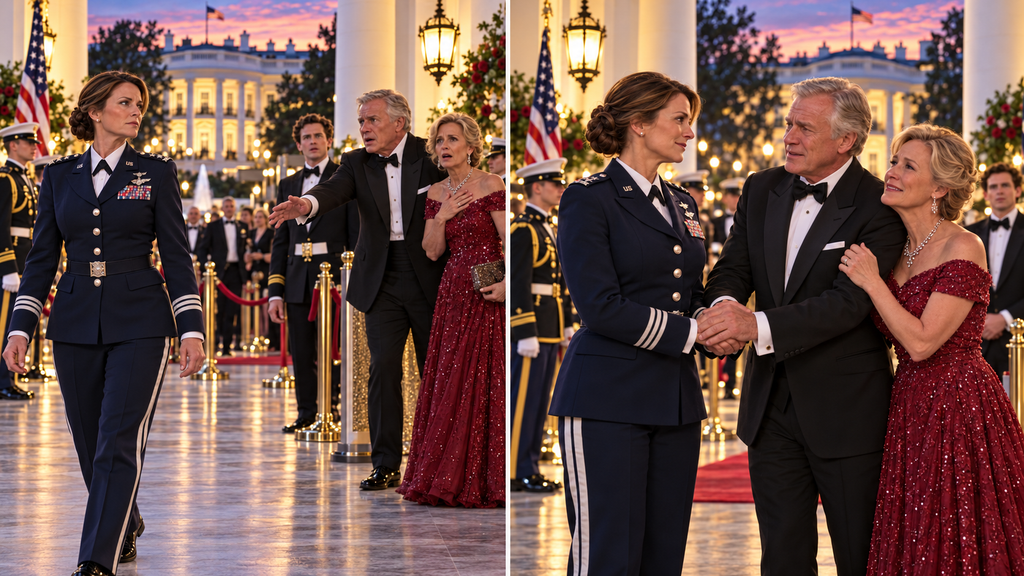
His hand was still half extended toward General Vance.
The same hand the General had walked past without touching.
Then General Vance lowered his salute.
I returned it.
“General.”
His expression hardened.
“I apologize for the delay, ma’am. We were told your vehicle had already cleared the south entrance.”
“It was redirected because of the security closure.”
“I heard.”
He glanced toward the Secret Service supervisor.
The supervisor immediately stepped forward.
“Our apologies, General Mercer. We weren’t informed you had arrived on foot.”
“No apology necessary.”
I looked at Arthur.
He had gone completely pale.
Twenty-six years.
Twenty-six years since he had told me I was throwing my life away.
Twenty-six years since he had called my military service an embarrassment.
Twenty-six years since he had erased my photographs from his home and replaced me with Trevor in every family portrait.
And less than two minutes earlier, he had put his finger against the ribbons on my chest and called me a bottom-rank sentry.
General Vance followed my gaze.
“Is there a problem here?”
Arthur recovered just enough to speak.
“No.”
His voice cracked.
He cleared his throat.
“No, General. Absolutely not. This is simply…”
He looked at me.
For the first time since I had been twenty-two years old, my father seemed unsure what to call me.
“…a family misunderstanding.”
General Vance’s eyes moved to the faint red marks Arthur’s fingers had left on my sleeve.
“A misunderstanding?”
“It’s nothing,” I said.
Arthur visibly relaxed.
That was his mistake.
He thought I was protecting him.
I wasn’t.
I simply had more important business waiting inside.
General Vance turned back toward me.
“The delegation is assembled in the East Room. We’re waiting for you.”
Trevor finally found his voice.
“Waiting for her?”
General Vance looked at him.
Trevor immediately seemed to regret speaking.
General Vance’s expression was not angry.
It was worse.
It was puzzled.
As if he genuinely could not understand how someone standing ten feet away from me could have failed to recognize what everyone else in the building apparently knew.
“Yes,” he said.
“For General Mercer.”
Arthur swallowed.
“General?”
His eyes moved toward my shoulders.
Then, finally, he actually looked.
Not at the fabric.
Not at the ribbons he had mocked.
Not at the uniform he considered evidence of my failure.
He looked at the insignia.
Three silver stars.
His face changed.
Evelyn noticed them next.
Her lips parted.
Trevor whispered, “Wait.”
General Vance looked at me.
“Shall we?”
I nodded.
But before I could move, Arthur stepped forward.
“Katherine.”
I stopped.
He hadn’t called me that in twenty-six years.
He had called me Kate when he was angry.
Girl when he was dismissive.
Disappointment when he wanted to hurt me.
But Katherine had belonged to another life.
Sunday breakfasts.
Christmas mornings.
The bicycle he taught me to ride.
The father I once believed could do anything.
I turned.
Arthur forced a smile.
It was astonishing how quickly he could manufacture one.
“Well.”
He laughed awkwardly.
“This is certainly a surprise.”
I said nothing.
“Three stars.”
He looked me over again.
“My goodness.”
Evelyn suddenly joined him.
“You never told us.”
I almost laughed.
Instead, I looked directly at her.
“You never asked.”
That landed harder than I expected.
Evelyn’s expression tightened.
Arthur quickly stepped between us.
“Katherine, whatever happened between us…”
“Twenty-six years happened.”
His smile disappeared.
People around us were listening now.
Arthur noticed.
Of course he noticed.
He had spent his entire adult life managing appearances.
He lowered his voice.
“This isn’t the place.”
“You were comfortable discussing my failures here thirty seconds ago.”
General Vance looked away.
I suspected he was hiding the beginning of a smile.
Arthur’s jaw flexed.
“I didn’t know.”
“No.”
I nodded slowly.
“You didn’t.”
And that was the truth.
Not knowing was the entire story of Arthur Mercer.
He didn’t know where I had been stationed.
He didn’t know I had married.
He didn’t know my husband had died.
He didn’t know how many times I had deployed.
He didn’t know how many soldiers I had commanded.
He didn’t know that I had spent Christmases in tents and birthdays inside command centers.
He didn’t know I had once spent six hours sitting beside a nineteen-year-old private in a military hospital because his parents couldn’t get there until morning.
He didn’t know that I had been promoted to brigadier general.
Then major general.
Then lieutenant general.
He didn’t know because knowing would have required something he had never been willing to give me.
Attention without control.
Arthur had wanted a daughter he could design.
When I became a woman he could not control, he simply stopped looking.
General Vance stepped slightly closer.
“General Mercer, we should go.”
I nodded.
Then Arthur said the one thing that made me stop again.
“Katherine, wait. Mercer Tech is here today regarding the Sentinel contract.”
General Vance’s expression changed immediately.
So did mine.
Arthur noticed.
And suddenly the businessman replaced the father.
His eyes sharpened.
“Yes.”
He straightened his jacket.
“The Sentinel Integrated Defense Platform.”
I knew exactly what Sentinel was.
Everyone in my office knew.
It was a proposed battlefield command-and-control system intended to integrate communications, drone surveillance, logistics, and threat analysis into a single platform.
The contract was worth billions over its lifetime.
Mercer Defense Tech had spent years pursuing it.
Arthur had spent millions positioning his company to win.
And now I understood why he had paid fifty thousand dollars for access to this event.
He hadn’t come to celebrate anyone.
He had come hunting.
He smiled carefully.
“You’re familiar with it?”
General Vance looked at me.
Then back at Arthur.
“Oh, she’s familiar with it.”
Arthur’s smile grew.
For perhaps the first time in twenty-six years, my father looked genuinely pleased to be related to me.
That hurt more than his insults.
Because suddenly I could see the calculation happening behind his eyes.
Three stars.
White House access.
Joint Chiefs.
Defense procurement.
His estranged daughter had transformed, in less than five minutes, from humiliation into opportunity.
“Katherine,” he said warmly, “perhaps this is providence.”
I stared at him.
“Providence?”
“Us meeting here.”
“You grabbed my arm.”
His smile twitched.
“I was shocked.”
“You called me a mall cop.”
Trevor looked down.
Evelyn’s face tightened.
Arthur lowered his voice.
“Must we do this publicly?”
“You started it publicly.”
General Vance cleared his throat.
“Arthur.”
My father immediately turned.
“Yes, General?”
“You may want to stop talking.”
Arthur blinked.
“I beg your pardon?”
General Vance looked at him for several seconds.
Then he said quietly:
“Your daughter is chairing the strategic evaluation panel for Sentinel.”
Arthur stopped breathing.
At least, that was what it looked like.
His chest simply froze.
Trevor stared at me.
Evelyn’s hand slowly slipped away from his arm.
Arthur whispered:
“What?”
General Vance continued.
“General Mercer was selected because of her operational experience, procurement oversight background, and technical-defense command history.”
Arthur looked at me.
Then at Vance.
Then back at me.
I could almost see twenty-six years collapsing inside his head.
The daughter he had disowned for choosing the military now occupied a position directly connected to the largest contract his company had ever pursued.
But I didn’t enjoy the realization.
Not yet.
Because Arthur still didn’t understand.
And the worst part was coming.
He stepped toward me.
“Katherine…”
I raised one hand.
“Don’t.”
He stopped.
“You should understand something immediately.”
My voice remained calm.
“My relationship to you has never been disclosed to anyone involved in evaluating Mercer Tech because I recused myself from every decision directly affecting your company.”
Arthur blinked.
“I see.”
“No,” I said. “You don’t.”
General Vance watched silently.
“I declared the conflict the moment Mercer Tech entered the process. Every recommendation concerning your company has been handled by independent personnel.”
Arthur’s shoulders relaxed slightly.
Apparently, he believed that was good news.
Then I continued.
“However, I was asked to attend today because the Sentinel review uncovered irregularities requiring senior-level attention.”
His relief disappeared.
Trevor’s head snapped toward him.
Evelyn whispered, “Arthur?”
My father stared at me.
“What irregularities?”
General Vance answered.
“Those are being discussed inside.”
Arthur’s eyes narrowed.
“Are you saying there’s an investigation?”
“I’m saying,” Vance replied, “that you should go through security and wait for your scheduled meeting.”
Arthur tried to smile again.
“Of course.”
But his forehead had begun to shine with sweat.
And suddenly I remembered something.
Twenty-six years earlier.
The night before I left home.
Arthur standing in his library with a glass of bourbon.
My ROTC paperwork on his desk.
“You walk out that door in uniform,” he had told me, “and you will spend the rest of your life wishing you had stayed.”
I had cried that night.
Not where he could see me.
I had packed my duffel bag, sat on the floor of my childhood bedroom, and cried into both hands because I was twenty-two and terrified.
I didn’t want his money.
I wanted my father.
There is a difference.
For years, I wondered whether I had made the wrong decision.
Standing outside the White House twenty-six years later, watching Arthur Mercer panic over a government contract while wearing the uniform he had once despised, I finally understood something.
I had never abandoned my family.
Arthur had abandoned me because I refused to become an extension of him.
That distinction had taken me half a lifetime to understand.
General Vance gestured toward the doors.
“General Mercer?”
I walked with him.
Nobody stopped us.
Behind me, I heard Arthur speaking urgently.
“Evelyn, call Mason.”
Then:
“Now.”
I didn’t turn around.
The doors closed behind me.
And for the first time in twenty-six years, my father was the one left outside.
Inside, General Vance waited until we were beyond the security vestibule before speaking.
“You all right?”
“I’m fine.”
“That wasn’t what I asked.”
I glanced at him.
General Thomas Vance had known me for almost fifteen years.
He had been my commander once.
Then my mentor.
Eventually, somehow, my friend.
He had also developed an irritating ability to recognize when I was lying.
“I wasn’t expecting them.”
“I gathered.”
“You heard everything?”
“Enough.”
I exhaled.
“He always did have terrible timing.”
Vance stopped walking.
“Katherine.”
I stopped too.
His expression softened.
“You don’t have to be made of steel every second.”
“I know.”
“Do you?”
I looked toward the tall windows overlooking the grounds.
For a moment, I saw my reflection.
Forty-eight years old.
Gray beginning at my temples.
Three stars on my shoulders.
Ribbons representing a life my father had dismissed without ever understanding.
“I used to imagine seeing him again.”
Vance waited.
“In every version, I thought I’d say something brilliant.”
“That sounds exhausting.”
“It was.”
“And now?”
I smiled faintly.
“Now I mostly wish he hadn’t touched my sleeve.”
Vance laughed once.
Then his expression became serious.
“The meeting is going to be difficult.”
“I know.”
“Mercer Tech’s problems are bigger than we expected.”
“How much bigger?”
He looked toward the closed doors behind us.
“Big enough that your father may leave this building with concerns far more serious than whether you embarrassed him.”
My stomach tightened.
“What did they find?”
Vance handed me a thin red folder.
I opened it.
Three pages.
That was all.
Three pages capable of destroying an empire.
I read the first paragraph.
Then the second.
By the third, my throat had gone dry.
“No.”
Vance said nothing.
I looked up.
“This is verified?”
“Preliminary verification is complete.”
“Component substitutions?”
“Yes.”
“Without disclosure?”
“Yes.”
I turned the page.
My eyes stopped on a number.
“Seventeen percent?”
“Across the test units examined.”
I looked at him.
“They certified those systems.”
“I know.”
“They signed compliance declarations.”
“I know.”
I read further.
And then I saw the name.
TREVOR MERCER
Executive Vice President, Strategic Programs.
My stepbrother.
My fingers tightened around the folder.
Vance noticed.
“Keep reading.”
I did.
There were internal messages.
Procurement changes.
Testing exemptions.
Pressure on quality-control personnel.
Several communications appeared to originate from Trevor’s office.
Then another name appeared repeatedly.
ARTHUR MERCER.
My father.
I closed the folder.
For several seconds, I couldn’t speak.
General Vance lowered his voice.
“This is why we needed you physically present.”
“I’m recused.”
“From procurement decisions.”
“Yes.”
“This isn’t procurement anymore.”
I understood immediately.
“This is readiness.”
Vance nodded.
“If the allegations are substantiated, equipment intended for operational use may not meet the specifications represented to the government.”
My stomach turned.
This wasn’t about money anymore.
Contracts were numbers.
Readiness was people.
Young men and women trusting that the equipment placed in their hands would function when someone was trying to kill them.
That distinction changed everything.
“When were the units deployed?”
“None of the flagged Sentinel prototypes reached combat deployment.”
I exhaled.
“But related components from the same manufacturing stream are being reviewed.”
“Where?”
“Multiple locations.”
“How many?”
“We’re determining that now.”
I looked back toward the doors.
My father was somewhere outside.
Probably making calls.
Probably trying to control the situation.
Exactly as he had always controlled everything.
Only this time, he wasn’t controlling a family dinner.
He wasn’t controlling an inheritance.
He wasn’t controlling me.
This involved soldiers.
“Who else knows?”
“Enough people.”
“Investigators?”
Vance nodded.
“Already involved.”
I handed the folder back.
“Then my family relationship needs to be formally documented again before I enter that room.”
“Already prepared.”
“Good.”
“And Katherine?”
“Yes?”
“This meeting isn’t yours to prosecute.”
“I know.”
“You’re here for the readiness assessment.”
“I know.”
He studied me.
Then nodded.
“Good.”
We continued walking.
At the end of the corridor stood a young Army captain holding a tablet.
The moment she saw me, she straightened.
“General Mercer.”
“Captain.”
“The Secretary’s staff is ready.”
“Thank you.”
She glanced down at her tablet.
Then back at me.
“And, ma’am…”
She hesitated.
“Yes?”
“It’s an honor.”
I smiled.
“Thank you, Captain.”
Her face reddened slightly.
She stepped aside.
As I walked past her, something unexpected happened.
I remembered myself at twenty-two.
A second lieutenant.
Terrified.
Trying desperately not to look terrified.
The first morning I put on my uniform, I had stood in front of a mirror for almost ten minutes.
My hands shook while I pinned everything into place.
I had no idea where my life was going.
I only knew I wanted it to belong to me.
Maybe that was the victory.
Not the stars.
Not the White House.
Not watching Arthur’s face collapse.
The victory was that the frightened twenty-two-year-old girl had made a decision for herself.
And she had survived the price.
The East Room glittered beneath chandeliers.
Senior officers.
Defense officials.
Diplomats.
Industry representatives.
Members of military families.
A string quartet played softly near the far wall while uniformed staff moved discreetly between clusters of guests.
The event was partly ceremonial, partly strategic.
Several defense initiatives were being recognized.
Senior leaders were scheduled to speak.
I was supposed to deliver remarks about military modernization and the responsibility attached to technological advantage.
Twenty minutes earlier, I had expected that speech to be the most uncomfortable part of my day.
I had been wrong.
General Vance and I had barely crossed the room when someone called my name.
“Kate!”
I turned.
A tall man in his early fifties approached, smiling.
Colonel David Ramirez.
Retired.
He had served under me years earlier.
Now he worked with wounded veterans transitioning into civilian careers.
He embraced me briefly.
“You disappeared.”
“Security issue.”
“Everything okay?”
“Ask me tomorrow.”
He raised an eyebrow.
“That good?”
“That good.”
His wife, Maria, joined us.
Then two former officers.
Then another.
Within minutes, I was surrounded by people from different chapters of my life.
People Arthur had never met.
People who knew exactly who I was without knowing anything about my inheritance.
That mattered.
More than I could explain.
Then the doors opened.
Arthur entered.
Evelyn beside him.
Trevor behind them.
The three of them stopped almost immediately.
Because from across the room, they could see me.
Not alone.
Not guarding a doorway.
Not checking identification.
Surrounded.
Respected.
Arthur watched a two-star admiral shake my hand.
Then a senior official approached and touched my elbow while speaking quietly.
Then a group of younger officers stepped aside for me automatically.
My father’s expression became something I had never seen before.
Confusion.
Not because he couldn’t understand my rank anymore.
Because he was beginning to understand my world.
And he had no place in it.
Trevor leaned toward him.
I couldn’t hear the words.
Arthur snapped something back.
Then his eyes found mine.
He started walking toward me.
Vance saw him coming.
“So much for subtlety.”
“I’ll handle it.”
“You sure?”
“Yes.”
Arthur stopped in front of us.
“General Vance.”
Vance nodded.
“Mr. Mercer.”
Not Arthur.
Not sir.
Mr. Mercer.
Arthur noticed.
“Katherine, I need a word.”
“I’m working.”
“This is important.”
“So is my job.”
His face reddened.
Then he remembered where he was.
He lowered his voice.
“What exactly have you been told about my company?”
I stared at him.
“You know I can’t discuss that.”
“I’m your father.”
“You made it very clear twenty-six years ago that you weren’t.”
Evelyn flinched.
Trevor stared at the floor.
Arthur’s voice hardened.
“Do not play games with me.”
General Vance stepped forward.
But I raised my hand.
I had this.
“I’m not playing anything.”
“Katherine, billions of dollars and thousands of jobs are involved.”
“Then I would suggest you treat the process seriously.”
“I built that company.”
“I know.”
“I built it from nothing.”
“No, you didn’t.”
His face changed.
That was the first time I had ever said it aloud.
Arthur stared at me.
“What?”
“You didn’t build Mercer Tech from nothing.”
“Katherine,” Evelyn warned.
I looked at her.
“My grandfather started Mercer Engineering in a rented machine shop.”
Arthur’s jaw tightened.
“My mother mortgaged property she inherited to keep it alive during the recession.”
Arthur’s face darkened.
“You know nothing about what happened.”
“I know what Mom told me.”
That silenced him.
My mother.
Margaret Mercer.
Dead for twenty-eight years.
The one subject Arthur never allowed anyone to discuss.
“She told me more than you realized.”
Arthur’s eyes changed.
For the first time that day, I saw something other than arrogance.
Fear.
Trevor noticed it too.
“What did she tell you?” Arthur asked.
I held his gaze.
“That you didn’t build the dynasty you spent my childhood taking credit for.”
His voice dropped.
“Be very careful.”
I almost smiled.
There it was.
The old Arthur.
The warning.
The threat.
The assumption that fear still worked.
“I spent twenty-six years learning to remain calm while people were shooting at me, Arthur.”
I leaned slightly closer.
“You raising your voice doesn’t have the effect it used to.”
He stepped back.
Evelyn touched his arm.
“Arthur.”
He shook her off.
Then Trevor suddenly spoke.
“Dad, what is she talking about?”
“Nothing.”
“Grandma helped start the company?”
“Trevor.”
“You always said she never had anything to do with it.”
Arthur turned sharply.
“This is neither the time nor the place.”
I watched Trevor’s face.
Something about his reaction bothered me.
Not anger.
Recognition.
“You knew something,” I said.
Trevor looked at me.
“What?”
“About the company.”
His eyes flickered.
Just once.
But I saw it.
So did General Vance.
Arthur immediately stepped between us.
“My son doesn’t know what you’re implying.”
I looked at Trevor.
“I wasn’t asking you.”
Trevor swallowed.
Then an aide approached.
“Mr. Mercer?”
Arthur turned.
“Yes?”
“Your delegation is requested in Conference Room Two.”
Arthur’s face lost color again.
“Now?”
“Yes, sir.”
“Who requested it?”
The aide remained expressionless.
“You’ll be briefed inside.”
Arthur looked at me.
I gave him nothing.
He adjusted his jacket.
Then he looked toward Trevor.
“Come.”
Trevor didn’t move.
“Trevor.”
“I need to use the restroom.”
“Now?”
“Yes.”
Arthur stared at him.
Something silent passed between them.
Then Trevor walked away.
Fast.
Too fast.
I watched him disappear into the crowd.
General Vance quietly said:
“That was interesting.”
“Yes.”
Arthur followed the aide with Evelyn beside him.
I waited until they were gone.
Then I looked at Vance.
“Someone should make sure Trevor doesn’t leave.”
Vance nodded toward a security officer.
The message traveled without another word.
Ten minutes later, I was standing alone near a tall window when Trevor approached me.
His face was damp.
His bow tie had been loosened.
He looked younger than forty-two.
For the first time, he reminded me of the little boy I had met when I was nineteen.
Back then, Trevor had been four.
His mother had brought him to one of Arthur’s corporate Christmas parties.
Arthur introduced Evelyn as a consultant.
Three years later, after my mother died, he married her.
I had never asked questions about the timeline.
Perhaps I had been afraid of the answers.
Trevor stopped beside me.
“Can we talk?”
“Depends.”
“Privately.”
“No.”
His eyes widened.
“No?”
“We can talk right here.”
“Katherine.”
“You haven’t called me that since you were a child.”
He looked down.
“I know.”
“Say what you came to say.”
He glanced around.
Then whispered:
“I didn’t know about the components at first.”
Every muscle in my body tightened.
I kept my face neutral.
“Trevor.”
“I need you to listen.”
“You should speak to counsel.”
“I already have.”
That surprised me.
“When?”
“This morning.”
Before Arthur recognized me.
Before the gate.
Before any of this.
I studied him.
“You knew there was a problem before you arrived.”
Trevor nodded.
“How much?”
“Enough.”
“Then why are you here?”
“Dad made me come.”
“You’re forty-two.”
A bitter laugh escaped him.
“You think that matters to Arthur?”
That sentence hit somewhere unexpected.
For the first time in my life, I looked at Trevor and saw something familiar.
Not my replacement.
Not the favored son.
A prisoner with a nicer cell.
He rubbed both hands over his face.
“You got out.”
I said nothing.
“You have no idea how lucky you were.”
“Lucky?”
“He cut you off.”
“He disowned me.”
“I know.”
“He told people I was dead to him.”
“I know.”
“You got the company.”
Trevor laughed again.
“No.”
He looked directly at me.
“The company got me.”
I didn’t answer.
He continued.
“Do you know what happened the day after you left?”
“No.”
“He took me into your old bedroom.”
My stomach tightened.
“I was sixteen.”
Trevor swallowed.
“He showed me your empty closet and told me that was what happened to children who betrayed him.”
For a moment, I couldn’t breathe.
“He said?”
“He told me you were weak. Ungrateful. Stupid. He said I was his only child now, and that if I ever embarrassed him, I would disappear too.”
I stared at Trevor.
All these years, I had imagined him enjoying everything Arthur denied me.
The money.
The praise.
The company.
The inheritance.
Maybe he had.
But there had been a price.
There was always a price with Arthur.
Trevor’s voice shook.
“I went to the college he picked.”
He looked toward the conference-room doors.
“I studied what he told me to study. Married the woman he approved of. Divorced her when he decided her family wasn’t useful anymore.”
“Trevor…”
“I joined Mercer Tech at twenty-three. I’ve never worked anywhere else.”
His eyes filled.
“I’m forty-two years old, Katherine, and until six months ago, I had never signed a lease without asking my father first.”
The anger I had carried toward him for years shifted.
Not vanished.
Shifted.
“What happened six months ago?”
Trevor looked around again.
“I found the test reports.”
There it was.
“What reports?”
“The original component-failure reports.”
My voice became very quiet.
“What did you do?”
“I took them to Dad.”
“And?”
“He told me they were preliminary.”
Trevor swallowed.
“He said engineering would fix it.”
“Did they?”
“No.”
“What happened?”
“They changed suppliers.”
“Without disclosure.”
He nodded.
“Why?”
“Cost. Schedule. Mostly schedule.”
My stomach hardened.
Trevor continued.
“The approved components couldn’t be produced fast enough to meet the demonstration deadline. Dad had already promised the board we would deliver.”
“So he substituted.”
“At first, he said temporarily.”
“At first?”
Trevor looked sick.
“The cheaper components passed basic bench tests.”
“But not the required stress standards.”
His silence answered me.
I felt cold.
“How many people knew?”
“I don’t know.”
“Trevor.”
“I don’t know!”
Several guests looked toward us.
He lowered his voice.
“I swear.”
“What did you do after you found out?”
His eyes dropped.
And that was when I knew.
“You signed something.”
He closed his eyes.
“What did you sign?”
“Compliance documentation.”
I stared at him.
“You certified it.”
“He told me legal had cleared everything.”
“You certified equipment you knew had failed required testing.”
“I didn’t know everything then.”
“But you knew enough.”
His eyes filled with tears.
“Yes.”
There are moments when family disappears.
Not emotionally.
Structurally.
The person standing in front of you stops being your brother or father or child.
The facts become larger than blood.
This was one of those moments.
“You need to tell investigators everything.”
“I am.”
“Everything, Trevor.”
“I know.”
“No protecting Arthur.”
His face twisted.
“You think I’m protecting him?”
“I think you’ve spent twenty-six years being trained to.”
That stopped him.
I stepped closer.
“If you leave out one document because you’re afraid of him, one conversation because you think it makes you look guilty, one email because he tells you the family has to stick together, then he still owns you.”
Trevor stared at me.
I lowered my voice.
“You said I got out.”
He nodded.
“Then get out.”
His mouth trembled.
“I might go to prison.”
“I know.”
“You say that like it’s easy.”
“It isn’t.”
“You’re my sister.”
“Yes.”
“Does that mean anything?”
I looked at him for a long moment.
“Yes.”
Hope appeared in his face.
Then I finished.
“It means I’m going to tell you the truth instead of helping you hide from it.”
His hope disappeared.
But something else replaced it.
Respect.
Maybe.
Or resignation.
“I was afraid you’d say that.”
“I think part of you hoped I would.”
He looked down.
Then nodded.
A security official appeared several feet away.
“Mr. Mercer?”
Trevor looked at me.
“They’re ready for you.”
He took one step.
Then stopped.
“Katherine?”
“Yes?”
“There’s something else.”
My stomach tightened again.
“What?”
“Dad knows why you were really disinherited.”
I frowned.
“I know why.”
“No.”
Trevor shook his head.
“You know what he told you.”
The room seemed to shift around me.
“What does that mean?”
Trevor looked toward the approaching official.
Then back at me.
“It wasn’t because you joined the Army.”
My pulse slowed.
“What was it?”
He opened his mouth.
“Mr. Mercer.”
The official had reached us.
Trevor went silent.
“Sir, we need you now.”
Trevor looked at me one last time.
“Ask him about your mother’s trust.”
Then he walked away.
I stood completely still.
My mother’s trust.
I had never heard those words before.
The ceremony began thirty minutes later.
I barely remembered walking to my seat.
General Vance sat beside me.
He noticed immediately.
“What happened?”
“Trevor spoke to me.”
“And?”
“He says he’s cooperating.”
“That aligns with what I’ve heard.”
I looked at him.
“You knew?”
“I knew someone from inside Mercer Tech had approached investigators.”
“Why didn’t you tell me?”
“Because you were recused, and until today I didn’t know it was him.”
Fair.
Still, my mind was elsewhere.
My mother’s trust.
Arthur had always told me there was no separate inheritance from her.
Everything had transferred to him when she died.
I had been twenty.
I had never questioned it.
Two years later, when he disowned me, he told me I was forfeiting my future interest in his estate.
His estate.
Not hers.
The distinction suddenly felt enormous.
Applause filled the East Room.
I looked toward the stage.
I had missed half the introduction.
General Vance leaned toward me.
“You’re up in four minutes.”
Perfect.
I was about to deliver the most important public speech of my career while wondering whether my father had lied to me about my dead mother for nearly three decades.
I closed my eyes briefly.
Breathe.
Separate the compartments.
That was something the Army taught you.
Fear could wait.
Grief could wait.
Anger could wait.
The mission in front of you could not.
When my name was announced, I stood.
The applause rose.
I walked toward the stage.
And then I saw Arthur.
He had returned.
He stood near the rear of the room.
Evelyn was beside him.
Trevor was nowhere in sight.
Arthur’s face was gray.
Whatever happened in Conference Room Two had not gone well.
Our eyes met.
For a moment, I was twenty-two again.
Waiting for approval.
Waiting for permission.
Waiting for my father to tell me I mattered.
Then I reached the podium.
And the feeling disappeared.
I looked across the room.
Hundreds of faces.
Military families.
Officers.
Civilians.
Scientists.
Engineers.
People whose names I knew.
People whose names I didn’t.
I set my prepared remarks aside.
General Vance raised one eyebrow.
I began.
“When I was twenty-two years old, someone told me that choosing military service meant I was throwing away my future.”
Arthur’s face changed.
The room became very still.
“I believed him for a while.”
I paused.
“I was a young officer, and like many young officers, I discovered quickly that confidence and certainty are not the same thing.”
A few smiles.
“I made mistakes. I got lost during an exercise I had confidently assured everyone I understood. I once saluted someone from an embarrassing distance because I couldn’t see his rank clearly.”
Laughter moved through the room.
I smiled.
“But I learned.”
I looked toward several young officers.
“I learned that leadership is not about being the most important person in a room.”
Arthur watched me.
“It is about remembering who will pay the price for your decisions after you leave that room.”
The laughter disappeared.
I continued.
“Technology matters. Contracts matter. Schedules matter. Budgets matter.”
I paused.
“But none of them matter more than the soldier who trusts that the equipment we place in her hands will work when she needs it.”
General Vance became completely still.
Arthur’s jaw tightened.
“That trust is sacred.”
I looked across the audience.
“It cannot be negotiated away for convenience.”
Silence.
“It cannot be accelerated past because a deadline is inconvenient.”
Arthur stared at me.
“And it cannot be purchased by influence.”
The words hung in the air.
I had named no company.
No investigation.
No person.
I didn’t need to.
This wasn’t about Arthur.
That was what he would never understand.
It was bigger than him.
“Our obligation is simple to describe and difficult to practice.”
I gripped the podium lightly.
“Tell the truth.”
A pause.
“Especially when the truth is expensive.”
I saw Trevor standing at a side doorway.
He had returned.
His eyes were red.
He looked at me.
“Especially when telling it costs you something.”
Trevor lowered his head.
“Because integrity that costs nothing is easy.”
I looked at the young captain I had passed earlier.
“Integrity becomes character when there is a price.”
The room remained silent.
I finished with the words I wished someone had told me at twenty-two.
“To every young person wondering whether choosing service, principle, or purpose means disappointing someone you love…”
My voice almost broke.
I steadied it.
“You can honor where you came from without surrendering where you are going.”
Arthur looked down.
“Sometimes the life others planned for you is not the life you were meant to live.”
I stepped back.
“Thank you.”
For half a second, nothing happened.
Then the room rose.
Not everyone.
But enough.
Applause thundered beneath the chandeliers.
I saw General Vance standing.
David Ramirez.
The young captain.
Maria.
Officers I had served beside.
People I had never met.
And near the back, Trevor slowly stood too.
Arthur remained seated.
I didn’t care.
That surprised me.
For decades, some invisible part of me had been waiting for him to stand.
Waiting for applause.
Waiting for acknowledgment.
Waiting for my father to finally look at me and say:
I was wrong.
But standing at that podium, I realized I no longer needed it.
I had built a life strong enough to survive without his approval.
The realization felt less like triumph than freedom.
Arthur cornered me twenty minutes later.
“Katherine.”
I kept walking.
“Not now.”
He followed.
“We need to talk.”
“Then make an appointment.”
“This is family.”
That stopped me.
I turned.
“Family?”
He looked around.
We were in a quieter corridor away from the main reception.
Evelyn stood several yards behind him.
“You don’t get to use that word only when you need something.”
His face hardened.
“This has gone far enough.”
“What has?”
“This performance.”
I stared at him.
He lowered his voice.
“You think humiliating me in front of these people makes you powerful?”
“My speech wasn’t about you.”
“Don’t insult my intelligence.”
“Then stop making everything about yourself.”
His eyes flashed.
“You knew Mercer Tech was under scrutiny.”
“I knew concerns existed.”
“And you let me walk into this building blind.”
“You arrived intending to lobby officials about a procurement matter.”
“I came to advocate for my company.”
“You came to buy access.”
His nostrils flared.
“Careful.”
I almost laughed.
“Still doing that?”
“What?”
“Warning me.”
He stared.
“You keep speaking as though I’m still twenty-two.”
His voice became cold.
“You will always be my daughter.”
“No.”
That word came easily.
“Biologically? Yes.”
I stepped closer.
“But being my father was a role you resigned from twenty-six years ago.”
Evelyn approached.
“Katherine, that’s cruel.”
I looked at her.
“Cruel?”
“Arthur was devastated when you left.”
I stared at her.
“He told everyone he didn’t have a daughter.”
“He was hurt.”
“He removed me from family photographs.”
“He was angry.”
“He returned my letters unopened.”
Evelyn said nothing.
“He refused to come when I got married.”
Arthur’s face shifted.
“He wasn’t right for you.”
“You never met him.”
Silence.
“He was a helicopter pilot.”
Arthur looked away.
“His name was Michael.”
“I know his name.”
“Do you?”
My voice shook for the first time.
“Because when he died, you didn’t call.”
Evelyn looked at Arthur.
Apparently, she hadn’t known that.
Arthur’s face became rigid.
“You had made your choice.”
“My husband died.”
“You had people around you.”
“I wanted my father.”
There.
Twenty-six years compressed into four words.
I wanted my father.
Arthur looked at me.
And for one second, something broke through.
Regret.
Real regret.
Then pride sealed it again.
“You chose that life.”
I nodded.
“Yes.”
I swallowed.
“And that sentence is why I stopped waiting for you.”
He looked wounded.
Good.
Not because I wanted revenge.
Because truth sometimes hurts before it heals anything.
Then I remembered Trevor’s words.
“Tell me about Mom’s trust.”
Arthur’s expression vanished.
Evelyn looked sharply at him.
“What trust?”
I watched his face.
“Interesting.”
“Katherine…”
“What trust?”
“There was no trust.”
“Trevor says otherwise.”
Arthur’s eyes hardened.
“Trevor is under enormous stress.”
“That isn’t an answer.”
“There were estate instruments.”
My heart began pounding.
“What estate instruments?”
“Routine planning.”
“What did Mom leave me?”
Evelyn stepped closer.
“Arthur?”
He ignored her.
“Katherine, this is ancient history.”
“What did she leave me?”
“Nothing you were entitled to after you abandoned the family.”
My blood went cold.
Not because of what he said.
Because of the way he said it.
“You told me everything passed to you.”
“It effectively did.”
“Effectively?”
Arthur turned away.
I stepped in front of him.
“What did Mom leave me?”
His eyes met mine.
And finally, after twenty-eight years, my father answered.
“Shares.”
My breath stopped.
“How many?”
He said nothing.
“Arthur.”
“Your mother created a trust holding twelve percent of Mercer Engineering.”
Evelyn gasped.
I stared at him.
Twelve percent.
Even before the company’s expansion, that would have been substantial.
Today?
Potentially enormous.
“Where are those shares?”
Arthur’s silence told me everything.
“Where?”
“The structure changed.”
“What does that mean?”
“The company was reorganized.”
“You took them.”
“I protected the company.”
“You took them.”
“You were twenty years old!”
“They were mine?”
“You had no understanding of corporate governance.”
“They were mine?”
Arthur’s voice rose.
“You were going to destroy everything!”
People at the far end of the corridor turned.
He lowered his voice.
“Your mother was sentimental. She believed ownership should be divided equally between family members regardless of competence.”
I could barely hear him over the blood pounding in my ears.
“What happened to the trust?”
He looked away.
“Answer me.”
“There were amendments.”
“Signed by whom?”
Silence.
My stomach dropped.
“Signed by whom, Arthur?”
His face tightened.
Then Evelyn whispered:
“Oh my God.”
Arthur turned toward her.
“Evelyn.”
“What did you do?”
“Stay out of this.”
“What did you do?”
For the first time that day, Evelyn sounded afraid of him.
Arthur looked at both of us.
Then said:
“Everything was legal.”
That sentence told me more than a confession would have.
People who have done nothing wrong rarely begin with everything was legal.
I stepped backward.
Arthur reached for me.
I moved away before he could touch me.
“Do not.”
His hand dropped.
“You need to understand the circumstances.”
“I understand enough.”
“You understand nothing.”
“I understand that my mother left me something and you spent twenty-eight years telling me she didn’t.”
“It would have torn the company apart.”
“Then you should have told me.”
“You were a child.”
“I was twenty.”
“You were reckless.”
“I joined the Army.”
“Exactly!”
There it was.
I stared at him.
The truth.
He hadn’t disowned me because military service embarrassed him.
Not entirely.
He disowned me because my independence threatened his control over something my mother had left me.
“You needed me gone.”
Arthur said nothing.
My voice became a whisper.
“That’s why.”
“Katherine.”
“You didn’t remove me from the family because I chose the military.”
“That was part of it.”
“You needed a reason to portray me as having abandoned everything.”
His face changed.
I knew.
I knew.
“You needed me to look like I walked away voluntarily.”
Arthur stepped toward me.
“You are creating a fantasy.”
“No.”
My eyes burned.
“For the first time in twenty-six years, I’m seeing the whole thing clearly.”
“Katherine—”
“You didn’t disown me because I disappointed you.”
I shook my head.
“You disowned me because you were afraid I might eventually discover what Mom left me.”
Evelyn stared at her husband.
Arthur said nothing.
And his silence was the closest thing to an admission I needed.
I did not scream.
That surprised me.
I did not slap him.
I did not threaten to destroy him.
I simply walked away.
“Katherine!”
I kept walking.
“Katherine, come back here!”
For twenty-six years, those words would have stopped me.
Not anymore.
I found General Vance near the reception hall.
He saw my face.
“What happened?”
“I need five minutes.”
He didn’t ask questions.
He pointed toward an empty office.
I entered.
Closed the door.
And finally broke.
Not dramatically.
There was no screaming.
I sat in a chair and covered my mouth with one hand while tears came.
I cried for my mother.
For Michael.
For the twenty-two-year-old girl who believed her father hated her because she had failed him.
For every Christmas card returned unopened.
For every promotion I secretly wished he knew about.
For every ceremony where I searched the audience despite knowing he wouldn’t come.
The worst wounds are not always created by hatred.
Sometimes they come from hope refusing to die.
I had carried hope for twenty-six years.
And now I finally let it go.
A knock came at the door.
“Katherine?”
General Vance.
I wiped my face.
“Come in.”
He entered.
Saw me.
Closed the door.
He didn’t speak.
That was one of the reasons I trusted him.
Some people see tears and immediately try to stop them.
Vance understood that sometimes tears are the stopping.
They are what happens when carrying something becomes heavier than releasing it.
After a while, I told him.
Not everything.
Enough.
He listened.
When I finished, he leaned against the desk.
“What are you going to do?”
“Get an attorney.”
“Good.”
“Separate from anything involving Mercer Tech’s government review.”
“Also good.”
“And go back to work tomorrow.”
He smiled faintly.
“That sounds like you.”
I stared at the floor.
“Do you know what’s ridiculous?”
“What?”
“I spent twenty-six years thinking he won.”
Vance frowned.
“How?”
“He had the company. The house. The money. Trevor. Everything.”
I wiped my eyes.
“I thought being disowned meant I had lost.”
Vance sat opposite me.
“And now?”
I looked at the three stars reflected faintly in the dark window.
“Now I think getting thrown out might have saved my life.”
Vance nodded slowly.
“Sometimes a locked door keeps you out.”
He paused.
“Sometimes it keeps something else in.”
I looked at him.
“That’s annoyingly profound.”
“I’ve been saving it.”
“For what?”
“Seemed like a three-star occasion.”
I laughed.
A real laugh.
It hurt.
But it felt good.
By early evening, the event was ending.
The atmosphere around Arthur had changed completely.
When he arrived, people approached him.
Now people avoided him.
Not because anyone had announced charges.
Nobody had.
But Washington had its own weather system.
People sensed storms before the rain started.
Arthur stood near the exit speaking intensely into his phone.
Evelyn was nowhere near him.
Trevor was gone.
I collected my coat.
Then I heard:
“Kate.”
Evelyn.
I turned.
She looked exhausted.
The pearls were still around her neck.
But the polished society expression had disappeared.
“Where’s Arthur?”
“I don’t know.”
“He’s twenty feet away.”
“I meant I don’t know where my husband is.”
I understood.
She wasn’t talking about geography.
“I’m sorry.”
She laughed bitterly.
“Are you?”
“I don’t know.”
“Fair.”
She looked toward Arthur.
“He told me your mother left everything to him.”
“So he told both of us.”
“I never questioned it.”
“Neither did I.”
Evelyn looked at me.
“I thought you hated me.”
“I did.”
She flinched.
“At nineteen, I thought you replaced my mother.”
Her eyes lowered.
“And now?”
“Now I think Arthur made sure every woman in his life blamed another woman instead of looking too closely at him.”
Evelyn’s eyes filled.
That was another truth I hadn’t expected to discover.
Arthur had kept us divided.
Me against Evelyn.
Me against Trevor.
Trevor against the ghost of me.
Everyone competing.
Everyone afraid.
And Arthur at the center.
“What happens now?” Evelyn asked.
“I don’t know.”
“To the company.”
“That isn’t mine to decide.”
“To Arthur.”
“That isn’t mine either.”
She looked surprised.
“You don’t want revenge?”
I considered the question.
Twenty-six years earlier, maybe I would have.
At thirty, definitely.
At forty, perhaps.
But now?
“No.”
“Why?”
“Because revenge would still make my life about him.”
Evelyn stared at me.
I buttoned my coat.
“I’ve already given him enough years.”
I turned to leave.
Then she said:
“Kate?”
I looked back.
“For whatever it’s worth…”
She struggled.
“I’m sorry I laughed at you outside.”
I nodded.
“Thank you.”
“And the mall cop comment…”
Despite everything, I smiled.
“That one may take a while.”
She gave a small, embarrassed laugh.
“Fair.”
I walked away.
Arthur was waiting outside.
Of course he was.
Night had fallen over Washington.
The air was cold.
Black vehicles waited along the curb.
Security lights reflected against the pavement.
I stepped down the stairs.
“Katherine.”
I stopped.
Arthur stood beside a sedan.
No Evelyn.
No Trevor.
No audience.
Just my father.
He looked older.
Not twenty-six years older.
Twenty-six years older in a single day.
His shoulders sagged.
His tie had been removed.
The top button of his shirt was open.
“I need five minutes.”
“You’ve had twenty-six years.”
“I know.”
That answer surprised me.
I looked at him.
He stepped closer.
Not too close.
He had finally learned that much.
“I handled today badly.”
I almost laughed.
“Today?”
His face tightened.
“Fine.”
He looked toward the White House.
“I handled many things badly.”
“That’s still an interesting choice of words.”
“What do you want me to say?”
“The truth would be new.”
He closed his eyes.
For several seconds, he said nothing.
Then:
“Your mother did leave you twelve percent.”
Hearing it again hurt.
“She established the trust when you were seventeen.”
“Why?”
“She didn’t trust me.”
At least that was honest.
Arthur looked at the ground.
“Our marriage was already difficult.”
“Were you with Evelyn?”
He looked at me.
I had my answer.
“How long?”
“Katherine.”
“How long?”
“Before your mother became ill.”
My stomach turned.
Evelyn may not have been innocent.
But Arthur had lied to everyone.
“Did Mom know?”
“Yes.”
The word was almost inaudible.
I looked away.
“She knew.”
“Yes.”
“And she still stayed?”
“For you.”
That hurt worst of all.
Arthur continued.
“She wanted to make sure you had independent ownership in the company.”
“So you couldn’t control me.”
His jaw tightened.
“Yes.”
There it was.
“She knew you.”
“Yes.”
“What happened to the shares?”
He hesitated.
Then spoke.
“After she died, the trust required a trustee until you were twenty-five.”
“Who was trustee?”
“I was.”
Of course.
“You had fiduciary control.”
“Yes.”
“But not ownership.”
“No.”
My hands became cold.
“When I joined the Army…”
“You announced you had no interest in Mercer Tech.”
“That is not the same as surrendering ownership.”
“I know.”
My breath caught.
He knew.
All these years.
He knew.
“So what did you do?”
Arthur looked toward the street.
“There was a restructuring.”
“Stop speaking like a CEO.”
He looked at me.
“What did you do?”
His voice became quiet.
“I used documents you had signed years earlier.”
“What documents?”
“Corporate authorizations.”
“I was a teenager.”
“Some were signed later.”
“When?”
“Around the time you left.”
I tried to remember.
Arthur had shoved papers at me constantly back then.
Tax documents.
Trust forms.
Insurance.
Corporate filings.
I had signed whatever he placed in front of me because he was my father.
Because I trusted him.
“You moved my shares.”
“Yes.”
“Into what?”
“A holding structure.”
“Controlled by you?”
“Yes.”
“Did you forge my signature?”
“No.”
The answer came too quickly.
I stared at him.
“Did someone else?”
Silence.
“Arthur.”
“There were signatures.”
“That isn’t what I asked.”
His eyes closed.
I felt sick.
“You forged my signature.”
“I did what I believed necessary to protect the company.”
I stepped backward.
“You stole from your own daughter.”
“I preserved your grandfather’s company.”
“It was partly my company.”
“You didn’t want it!”
“That was my decision to make!”
My voice echoed across the drive.
A security officer glanced toward us.
I lowered it again.
“You stole my choice.”
Arthur’s face crumpled for half a second.
Then the businessman returned.
“If I hadn’t done it, Mercer Tech might not exist today.”
“You don’t know that.”
“I do.”
“No.”
I shook my head.
“You know the story you’ve told yourself long enough to sleep at night.”
He stared at me.
I continued.
“You told yourself I was reckless.”
He said nothing.
“You told yourself Mom was sentimental.”
Nothing.
“You told yourself the company mattered more.”
His eyes glistened.
“And every time you needed something that belonged to someone else, you found a reason why taking it was actually protecting them.”
Arthur looked away.
I suddenly understood the defense investigation differently.
The details were separate.
I would not assume guilt before the process established facts.
But the pattern in the man standing before me was painfully familiar.
Control first.
Justification second.
Truth last.
“Kate…”
“No.”
My voice softened.
“Don’t call me that right now.”
He nodded.
For once.
He actually nodded.
“What happens now?” he asked.
“I hire counsel.”
His face tightened.
“You’re going to sue me?”
“I’m going to learn the truth.”
“You could destroy Mercer Tech.”
“If learning the truth destroys something, I’m not the person who destroyed it.”
He looked at me.
For once, Arthur Mercer had no answer.
A black government sedan pulled forward.
My driver stepped out.
I reached for the door.
“Katherine.”
I stopped.
My father’s voice broke.
“I was proud of you.”
I froze.
He continued.
“I watched.”
Slowly, I turned.
“What?”
“Your promotions.”
I stared at him.
“I knew.”
My chest tightened.
“I knew when you made colonel.”
He swallowed.
“Brigadier general.”
I couldn’t speak.
“Major general.”
His eyes moved to the stars on my shoulders.
“And this.”
My throat closed.
“You knew?”
“Yes.”
“You knew?”
The grief became anger so quickly it frightened me.
“You knew where I was?”
“Yes.”
“You knew Michael died?”
His silence answered.
I stepped toward him.
“You knew my husband died, and you didn’t call me?”
Tears finally appeared in Arthur’s eyes.
“I didn’t know what to say.”
“You say, ‘I’m your father.’”
“I thought you hated me.”
“I needed you!”
“I know.”
“No, you don’t!”
My voice cracked.
“You don’t get to stand here and tell me you secretly watched my life like that makes it better.”
He flinched.
“It makes it worse.”
“Katherine—”
“You knew.”
Tears ran down my face.
“You knew I was alive.”
I pointed toward my chest.
“You knew what I became.”
My hand shook.
“And you chose silence every single time.”
Arthur cried then.
I had seen my father angry.
Drunk.
Triumphant.
Cold.
I had never seen him cry.
Twenty-six years ago, it would have broken me.
Tonight, it simply made him human.
And humans are responsible for the choices they make.
“I’m sorry,” he whispered.
The words I had waited decades to hear.
I imagined they would heal something.
They didn’t.
Not immediately.
Maybe some wounds don’t close when the apology arrives.
Maybe the apology simply stops them from getting deeper.
I looked at him.
“I believe you’re sorry.”
Hope appeared in his eyes.
I continued.
“But being sorry does not erase what happened.”
His hope dimmed.
“I know.”
“You may have to answer legally for what happened with Mom’s trust.”
“I know.”
“And whatever happens with Mercer Tech’s government investigation is separate from me.”
“I understand.”
“I will not interfere.”
“I know.”
“And I will not save you.”
He closed his eyes.
“I know.”
I opened the car door.
Then Arthur said:
“Is there any chance…”
I waited.
“…that someday we could talk?”
I looked at my father.
Not the CEO.
Not the tyrant from my childhood.
Not the man who had grabbed my arm at the gate.
Just an old man standing alone beneath cold lights.
“I don’t know.”
He nodded.
And for the first time in our relationship, he accepted an answer he didn’t like.
“That’s fair.”
I got into the car.
The door closed.
As we pulled away, I looked back once.
Arthur remained standing there.
He became smaller in the rear window.
Then disappeared.
The next six months changed everything.
Not overnight.
Real consequences rarely arrive with dramatic music.
They arrive as letters.
Meetings.
Lawyers.
Depositions.
Audits.
Phone calls at inconvenient hours.
Documents nobody wants to read but everyone has to.
I hired an attorney specializing in trusts and corporate litigation.
What we discovered about my mother’s estate was complicated.
Painfully complicated.
But the central fact was simple.
My mother had intended to leave me an independent interest in the company.
That intention had not been honored.
I did not handle the matter through military channels.
I did not use my rank.
I did not call General Vance.
I handled it as Katherine Mercer.
Daughter of Margaret Mercer.
Nothing more.
Meanwhile, I maintained my recusal from decisions involving Mercer Tech.
The government review proceeded through its own channels.
Some allegations were substantiated.
Others were not.
Contracts were paused.
Independent testing expanded.
Executives were questioned.
Records were examined.
Trevor cooperated.
And for the first time in his life, he stopped asking Arthur what to do.
He called me once.
Three months after the White House event.
I almost didn’t answer.
Then I did.
“Hello?”
“Katherine?”
“Yes.”
“It’s Trevor.”
“I know.”
Silence.
Then:
“I moved out.”
“Of Arthur’s house?”
“My entire life.”
I smiled despite myself.
“Where are you?”
“An apartment.”
“You sound horrified.”
“It has beige carpet.”
“That sounds serious.”
“And my upstairs neighbor has a dog that apparently weighs nine hundred pounds.”
I laughed.
Trevor laughed too.
Then he became quiet.
“I resigned from Mercer Tech.”
“I heard.”
“I’m cooperating fully.”
“Good.”
“I don’t know what happens next.”
“No one does.”
“I might lose everything.”
“You might.”
Silence.
Then he said:
“You really don’t sugarcoat things.”
“No.”
“Is that a military thing?”
“No. That’s an older-sister thing.”
He went quiet.
I realized what I had said.
So did he.
“Older sister?”
“Don’t make a big deal out of it.”
“I wasn’t.”
“You’re making a big deal.”
“I’m literally sitting alone in a beige apartment.”
I smiled.
Then Trevor said something that stayed with me.
“I used to think you were the family failure.”
“I know.”
“Dad made sure I thought that.”
“I know.”
“But you were the only one who actually had a life.”
I looked out my office window.
“Trevor.”
“Yes?”
“You still have time.”
He didn’t answer immediately.
Then:
“I hope so.”
“You do.”
That was one thing I was willing to promise.
My legal dispute with Arthur eventually reached a settlement.
I won’t pretend it was simple.
It wasn’t.
There were arguments over valuations.
Corporate restructurings.
Old documents.
Signatures.
Statutes.
Tax implications.
Twenty-eight years of decisions stacked on top of one another.
But eventually, Arthur stopped fighting the central truth.
My mother had wanted me protected.
He had overridden her wishes.
The settlement was substantial.
More money than I needed.
More money than I wanted.
When my attorney showed me the final figure, I stared at it for almost a minute.
“Are you okay?” she asked.
“Yes.”
“What are you thinking?”
I thought about my mother.
Then about the young soldiers I had commanded.
Then Michael.
Then all the military spouses who had rebuilt careers every few years while moving from base to base.
I smiled.
“I know what I want to do with part of it.”
One year later, the Margaret Mercer Foundation opened its first program.
Not for corporate heirs.
Not for executives.
For military families.
Education grants.
Emergency support.
Career-transition assistance for spouses.
Scholarships for children who had lost a parent in service.
I put my mother’s name on it.
Not mine.
Arthur attended the opening.
I didn’t invite him.
Trevor did.
When I saw Arthur standing near the back, I almost asked security to remove him.
Then I changed my mind.
He didn’t approach me.
He didn’t ask for photographs.
He didn’t tell anyone he had funded it.
Because he hadn’t.
He simply stood in the back.
Listened.
And left.
Sometimes change is not a grand apology.
Sometimes it is a man who spent his life demanding the front row finally learning to stand quietly in the back.
Two years after the White House event, I retired from active service.
Thirty years.
My final ceremony took place on a bright autumn morning.
I had insisted on something small.
The Army ignored me.
Of course.
There were chairs across the lawn.
Former commanders.
Soldiers.
Friends.
Families.
People from assignments I had nearly forgotten.
General Vance gave the retirement remarks.
He told several stories I specifically asked him not to tell.
Including the one about me getting a vehicle stuck during an exercise early in my career.
“It was mud,” I muttered from my chair.
Vance looked at the audience.
“She has maintained for twenty-seven years that the terrain was responsible.”
Laughter.
I shook my head.
Then his voice softened.
“I have served with many officers.”
The lawn became quiet.
“Some were brilliant.”
He looked at me.
“Some were courageous.”
He paused.
“Some understood that authority is something you borrow from the people you lead.”
My eyes burned.
“Lieutenant General Katherine Mercer was all three.”
I looked down.
Vance continued.
“But what I will remember most is that she never confused rank with worth.”
My throat tightened.
“She treated privates with the same attention she gave generals.”
I saw the young captain from the White House event.
She was a major now.
“She understood that leadership is not about making people feel small enough to obey you.”
General Vance looked directly at me.
“It is about helping them become strong enough to succeed without you.”
I had to look away.
Then came the final salute.
The final flag.
The final time hearing my official title spoken as an active-duty officer.
When it was over, people gathered around.
Hugs.
Photographs.
Old stories.
Then the crowd slowly thinned.
And I saw him.
Arthur.
Standing beneath an oak tree.
Alone.
He looked much older now.
Mercer Tech had survived, though smaller and under different leadership.
Arthur had stepped down.
Publicly, it was described as retirement.
Privately, everyone understood that his era had ended.
He no longer wore the armor of a CEO.
Just a gray suit.
No entourage.
No Evelyn.
They had separated the previous year.
Not because of me.
Their marriage had contained fractures long before I returned.
Trevor had started consulting independently.
He and I spoke every few weeks.
It was awkward.
Imperfect.
Real.
Arthur waited.
He did not approach until I nodded.
Then he walked toward me.
“Congratulations.”
“Thank you.”
He looked at the folded flag in my hands.
“Thirty years.”
“Thirty.”
“I thought it was twenty-six.”
“It was when you called me a mall cop.”
He closed his eyes.
“I’m never escaping that, am I?”
“No.”
A tiny smile appeared.
Then disappeared.
“I brought something.”
He reached inside his jacket.
My body instinctively tensed.
Arthur noticed.
Pain crossed his face.
But he said nothing.
He pulled out an envelope.
Old.
Yellowed.
My name was written across the front.
Not in Arthur’s handwriting.
My knees nearly gave way.
I recognized it immediately.
My mother’s handwriting.
“Katherine.”
My fingers trembled.
“What is this?”
“I found it in a safe-deposit box.”
“When?”
“Years ago.”
My eyes lifted.
“Years?”
His face filled with shame.
“I couldn’t give it to you.”
“Why?”
“Because she knew.”
“Knew what?”
“She knew what kind of man I was becoming.”
I stared at the envelope.
“She wrote that before she died.”
“Why didn’t you give it to me?”
Arthur swallowed.
“Because I was afraid it would make you leave me.”
A bitter laugh escaped me.
“So you hid it, and then drove me away yourself.”
“Yes.”
The simplicity of the answer stunned me.
No defense.
No explanation.
Just yes.
I looked at the envelope.
“Have you read it?”
“No.”
“Why should I believe that?”
“You shouldn’t.”
That answer surprised me.
Arthur looked at me.
“But I didn’t.”
He handed it over.
His fingers shook.
Then he stepped backward.
“I’ll let you go.”
I stared at him.
“Arthur.”
He stopped.
For years, I had imagined what forgiveness might look like.
A hug?
Tears?
A dramatic reconciliation?
But forgiveness is not the same as restoration.
I could release my anger without pretending trust had magically returned.
I could acknowledge his humanity without handing him control again.
“I don’t hate you.”
His eyes filled.
“That’s more than I deserve.”
“Maybe.”
He nodded.
Then turned away.
“Dad.”
He stopped.
I hadn’t called him that in twenty-eight years.
His shoulders froze.
Slowly, he turned.
I wasn’t sure why I had said it.
Maybe for him.
Maybe for me.
Maybe for the twenty-two-year-old girl who had spent decades waiting.
“I’m having dinner Sunday.”
He stared at me.
“Trevor’s coming.”
Arthur didn’t breathe.
“At six.”
His mouth opened.
Nothing came out.
“This isn’t everything being fixed,” I said.
“I understand.”
“It doesn’t erase anything.”
“I know.”
“And if you insult my cooking, you’re leaving.”
A laugh broke through his tears.
“I understand.”
I nodded.
“Six.”
“I’ll be there at five-thirty.”
“Six.”
“Six.”
I watched him walk away.
Then I sat beneath the oak tree.
Alone.
I opened my mother’s letter.
The paper trembled in my hands.
My mother had been gone almost thirty years.
But when I saw her handwriting, I could hear her voice.
My darling Katherine,
If you are reading this, there are things I may no longer be there to tell you myself.
First, you do not owe anyone the life they imagined for you.
Not me.
Not your father.
Not the Mercer name.
Your life belongs to you.
I stopped reading.
Tears blurred the page.
I wiped them away and continued.
Your father believes love means protecting people by deciding for them.
I hope someday he learns that love without freedom becomes another form of possession.
My breath caught.
She had known.
All those years ago.
She knew.
I continued.
You will make choices I would not make.
You will make mistakes I cannot prevent.
Good.
That means you are living your own life.
I laughed through tears.
Near the bottom was one final paragraph.
Whatever name is on a company, whatever money remains, whatever people say about our family, none of it will tell me whether I raised a good daughter.
Your character will do that.
Choose courage when you can.
Choose kindness when courage is not enough.
And if you ever have to choose between becoming impressive and becoming good, choose good.
I love you beyond anything I know how to write.
Mom.
I lowered the letter.
The lawn had almost emptied.
Flags moved gently in the wind.
For years, I had measured my life against Arthur’s rejection.
Every promotion proved him wrong.
Every medal proved him wrong.
Every command proved him wrong.
Three stars proved him wrong.
The White House proved him wrong.
But my mother’s letter finally made me understand something none of those achievements had.
I had never needed to prove him wrong.
I only needed to live according to what I believed was right.
The uniform had never been valuable because powerful people saluted it.
It mattered because of what I had learned while wearing it.
Duty.
Service.
Responsibility.
Integrity.
And the humility to understand that none of those words mean much unless they cost you something.
I folded my mother’s letter carefully.
Then I looked at my uniform.
The ribbons.
The badges.
The three silver stars.
I remembered Arthur’s finger pressing against them outside the White House.
“Bottom-rank sentry.”
I laughed softly.
If I could have returned to that moment, I wouldn’t have changed anything.
I wouldn’t have told him my rank.
I wouldn’t have shouted.
I wouldn’t have humiliated him.
I would have done exactly what I did.
Stand still.
Let him speak.
And let the truth arrive on its own.
Because people like Arthur spend their lives believing power means controlling the room.
But real power is different.
Real power is knowing who you are before anyone important recognizes you.
It is doing the right thing when nobody applauds.
It is walking away when someone offers you wealth in exchange for yourself.
It is telling the truth when lying would protect your family.
It is accepting consequences.
It is forgiving without forgetting.
And sometimes…
it is standing at a security checkpoint while the man who once disowned you orders you to pretend you don’t know him.
Then watching a four-star general walk straight past him…
raise his hand…
and salute.
Not because you are someone’s daughter.
Not because you inherited a dynasty.
Not because your name opens doors.
But because twenty-six years earlier, when someone told you that choosing your own path would ruin your life…
you chose it anyway.
And you kept walking.
I stood beneath the oak tree and tucked my mother’s letter safely inside my coat.
Then I walked toward the parking lot.
No security detail.
No cameras.
No ceremony.
Just Katherine.
For the first time in a very long time, that felt like enough.
Behind me, thirty years of military service had ended.
Ahead of me was something I had never really possessed before.
A life that did not need to prove anything to anyone.
And on Sunday evening, at exactly six o’clock, someone knocked on my front door.
I opened it.
Arthur stood on the porch.
Trevor stood behind him carrying a pie.
Arthur looked nervous.
Actually nervous.
I folded my arms.
“You’re on time.”
“You said six.”
“I did.”
Trevor lifted the pie.
“I brought dessert.”
I looked at it.
“Did you make that?”
“No.”
“Good.”
Trevor laughed.
Arthur almost did.
Then silence settled between us.
Arthur looked past me into the house.
Family photographs covered one wall.
Michael.
My mother.
Friends.
Soldiers.
Trevor noticed there were no photographs of Arthur.
Not yet.
Arthur noticed too.
His eyes returned to mine.
I stepped aside.
“You can come in.”
He swallowed.
“Thank you.”
He crossed the threshold.
No trumpets sounded.
Nothing magically healed.
Nobody forgot twenty-six years.
But the door stayed open.
And sometimes that is how a family begins again.
Not with pretending the past never happened.
Not with money.
Not with power.
Not even with forgiveness.
With truth.
With boundaries.
With consequences.
And with one person finally deciding that the next chapter does not have to be written by the wounds of the last one.
Arthur had once told me that if I walked out his door in uniform, I would spend the rest of my life regretting it.
He was wrong.
Walking out that door was the first decision that truly belonged to me.
And twenty-six years later, after three stars, thirty years of service, one devastating truth about my mother, and a White House encounter none of us would ever forget…
I finally understood what that frightened young lieutenant had done.
She hadn’t walked away from her future.
She had walked toward it.
And she never looked back.
THE END! THANK YOU FOR READING!❤️