 Reading Time: 24 minutes
The tea bag dropped straight into the large plastic container I had positioned beneath his usual throwing spot. I looked down at it. Then I looked up.
For the first time in weeks, I didn’t feel irritated. I didn’t feel helpless. I didn’t even feel angry. I felt calm. Because that little brown tea bag had just become evidence.
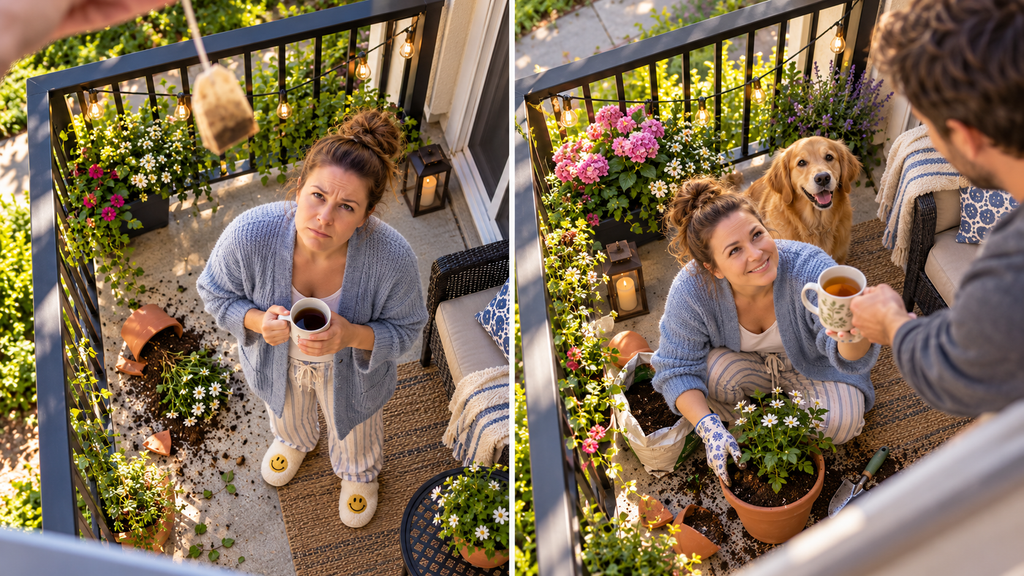
And upstairs, my neighbor had absolutely no idea how carefully I had prepared for that morning.
At 7:10, I heard the knock on his door.
Three firm knocks.
Not mine.
I stayed on my balcony.
I didn’t move.
Above me, footsteps crossed the floor.
The door opened.
“What’s this about?”
His voice was instantly recognizable.
Casual.
Annoyed.
Almost offended that someone had interrupted his morning.
Then another voice answered.
Our property manager.
“Good morning, Mr. Palmer. We need to discuss several complaints.”
There was a pause.
“Complaints?”
“Yes.”
“From who?”
Another pause.
Then the manager said calmly, “I think you know.”
I leaned back in my chair.
My coffee suddenly tasted better.
“What, the woman downstairs?”
The woman downstairs.
Not my name.
Not the neighbor who had collected his deliveries for months.
Not the person who had asked politely three separate times.
Just the woman downstairs.
He laughed.
Actually laughed.
“She complained about tea bags?”
The property manager’s voice stayed level.
“She provided photographs, dated incident records, damaged-property documentation, and video.”
Silence.
Then:
“Video?”
That single word sounded very different from everything else he had said.
There was no laughter in it.
“No one told me I was being recorded.”
“The building has exterior security cameras covering the shared courtyard and portions of the balcony frontage.”
“That sounds illegal.”
“It isn’t.”
Another silence.
Longer this time.
I could almost picture his face.
The confidence draining away.
The little smirk disappearing.
Then he tried a different strategy.
“Look, I don’t know what she told you, but this is ridiculous. Maybe a tea bag fell once or twice.”
The property manager replied, “We have footage from eleven separate mornings.”
My eyebrows rose.
Eleven.
I hadn’t even known that.
When I contacted the manager the previous afternoon, I had expected her to send him a warning.
Nothing more.
But apparently the building cameras had caught far more than I had realized.
“Eleven?” he repeated.
“Yes.”
“That can’t be right.”
“It is.”
“I never deliberately threw anything.”
The manager answered immediately.
“The footage shows your hand extending beyond your railing.”
I covered my mouth.
Not because I was laughing.
Because somehow hearing it stated so plainly made the entire situation absurd.
For weeks, this man had acted as though I was imagining something.
As though wet tea bags were somehow growing wings and drifting independently onto my balcony.
Now someone else had watched him do it.
Repeatedly.
And suddenly his version of reality was collapsing.
He lowered his voice.
“I think we’re making too much of this.”
“No,” the manager said. “We are addressing it before it becomes a larger issue.”
“A larger issue?”
“Throwing objects from upper-level balconies violates building safety rules.”
“It’s a tea bag.”
“It could be anything.”
“It’s tea.”
“It is still an object being intentionally dropped from height.”
He scoffed.
“Oh, come on.”
The manager’s tone sharpened.
“Mr. Palmer.”
Silence.
“This conversation is not a debate.”
That was the first moment I realized he might actually be in trouble.
Not dramatic trouble.
Not police-at-the-door trouble.
But the kind of trouble arrogant people hate most.
Administrative trouble.
Documented trouble.
The sort that comes with emails, warnings, signatures, dates, and consequences.
People like him could shrug off anger.
They could laugh at arguments.
But paperwork terrified them.
Because paperwork remembered.
The manager continued.
“You are being issued a formal written warning.”
“For a tea bag?”
“For repeated violations after a neighbor directly asked you to stop.”
He didn’t answer.
“And for damaging her belongings.”
“That wasn’t intentional.”
“The behavior was intentional.”
Another silence.
I heard him exhale.
“What exactly does she want?”
That question almost made me stand.
What did I want?
For one ridiculous second, I remembered every time I had climbed the stairs.
Every calm conversation.
Every attempt to give him the benefit of the doubt.
Every stained piece of fabric.
Every morning I had walked outside already knowing what I would find.
I remembered his smile when he said:
You should probably be grateful it’s only tea.
I wanted to walk upstairs and repeat that sentence to him.
Instead, I stayed where I was.
Because this was bigger than having the last word.
The manager replied, “She has requested reimbursement for the damaged cushion and towel.”
He laughed again.
But now it was nervous.
“You’re kidding.”
“No.”
“How much?”
“Eighty-seven dollars.”
There was a pause.
“That’s ridiculous.”
“The replacement receipts are attached to the complaint.”
“Eighty-seven dollars for a towel and a cushion?”
“Would you prefer to dispute the amount formally?”
“No.”
“Then I’ll need confirmation by Friday.”
I stared into my coffee.
Eighty-seven dollars wasn’t much.
That wasn’t the point.
The point was that until that morning, he had believed the cost belonged entirely to me.
My towel.
My cushion.
My time.
My frustration.
My problem.
Now, for the first time, part of the inconvenience had climbed back upstairs.
I heard his door close.
Hard.
Not a slam.
But close enough.
Then silence.
I expected that to be the end.
I truly did.
I thought he would be embarrassed, pay for the damage, stop throwing things, and move on.
In hindsight, I underestimated him.
The next tea bag never came.
Neither did the evening one.
The following morning passed quietly.
So did the next.
For the first time in months, I sat outside without looking above me.
I watered my flowers.
Drank coffee.
Read three chapters of a novel.
And enjoyed something that suddenly felt luxurious.
Peace.
By Friday afternoon, the property manager emailed me.
Mr. Palmer had paid the reimbursement.
No message.
No apology.
Just payment.
I stared at the email and smiled.
Problem solved.
Or so I thought.
That evening, I was carrying groceries into my apartment when Mrs. Donnelly from 3A stepped into the hallway.
She was seventy-two, tiny, sharp-eyed, and knew everything that happened in the building at least twenty minutes before management did.
She held the elevator door for me.
“So,” she said.
“So?”
“You finally dealt with tea-boy.”
I almost dropped a bag.
“Tea-boy?”
She waved a hand.
“Don’t pretend you don’t know.”
I stepped into the elevator.
“How do you know about that?”
Mrs. Donnelly pressed three.
“Because your upstairs neighbor has spent two days telling anyone who’ll listen that you’re trying to get him evicted.”
My smile disappeared.
“What?”
“Oh, yes.”
The elevator started moving.
“He told Martin in 2C that you secretly filmed him.”
“I didn’t.”
“I know.”
“He told Lana near the mailboxes that you exaggerated everything because you don’t like noise.”
I stared at her.
“I never complained about noise.”
“I know.”
“And he told you?”
“No.”
Mrs. Donnelly smiled sweetly.
“He doesn’t talk to me anymore.”
“Why not?”
“Because I once told him his cologne smells like windshield washer fluid.”
I laughed despite myself.
The elevator doors opened.
Then her expression changed.
“Be careful, though.”
Something in her voice made me stop.
“What do you mean?”
She lowered her voice.
“He’s embarrassed.”
“So?”
“Embarrassed men sometimes do stupid things.”
I wanted to dismiss it.
I really did.
I was not afraid of him.
He had never threatened me directly.
He had been rude.
Petty.
Disrespectful.
But not dangerous.
Still, Mrs. Donnelly’s warning followed me back downstairs.
That night, nothing happened.
Saturday, nothing happened.
Sunday was quiet.
By Monday, I decided I had worried for no reason.
Then I found the note.
It was taped to my front door.
No envelope.
No name.
Just a white sheet of printer paper.
YOU HAPPY NOW?
Four words.
Black ink.
Large letters.
I stood in the hallway holding my grocery bag and stared at it.
At first, anger rose.
Fast.
Hot.
Then I forced myself to stop.
No assumptions.
No confrontation.
No dramatic reaction.
I took a photo.
Then another.
Then I carefully removed the note by the tape and placed it inside a plastic folder.
At 6:02 p.m., I emailed the property manager.
I attached the photograph.
I did not accuse anyone.
I wrote only:
“I found this attached to my door when I returned home. I don’t know who left it, but given the recent complaint, I wanted to document it.”
Then I locked my door.
That was all.
The next morning, there was no tea bag.
The morning after that, still nothing.
The note had unsettled me, but I refused to let it change how I lived.
Then, three nights later, I woke at 1:17 a.m.
A noise.
Metal scraping lightly outside.
My eyes opened.
For several seconds, I lay completely still.
There it was again.
Scrape.
Pause.
Scrape.
I sat up.
My bedroom opened toward the balcony.
The curtains were closed.
I reached for my phone.
The sound stopped.
I waited.
Twenty seconds.
Thirty.
Then I heard a soft tap against the glass.
My heart started pounding.
Not because the noise was loud.
Because it was deliberate.
I got out of bed without turning on the lights.
Slowly, I moved toward the living room.
Another tap.
This time lower.
Near the balcony door.
I didn’t open the curtain.
I didn’t step outside.
I called building security.
Within four minutes, someone was knocking at my apartment door.
I checked the peephole.
Building security.
I opened it.
A guard named Samuel stood outside.
“Are you okay?”
“I think someone was on the balcony.”
His eyebrows rose.
“Your balcony?”
“Yes.”
We were on the third floor.
That was exactly why his face changed.
He stepped inside.
I pointed toward the glass.
Samuel used a flashlight from inside first.
Then he unlocked the balcony door.
“Stay here.”
He stepped outside.
I watched from behind him.
He checked the railing.
The floor.
The neighboring dividers.
Then he crouched.
“What?”
He didn’t answer immediately.
He lifted something.
A length of nylon cord.
Thin.
Dark.
One end had a metal clip attached.
“What is that?”
Samuel looked upward.
Then he shined the flashlight toward the underside of the balcony above mine.
The cord continued up.
My stomach tightened.
Someone had lowered it from upstairs.
“What was attached to it?” I whispered.
Samuel pulled gently.
Something scraped across the concrete near my chair.
A plastic grocery bag emerged from behind the planter.
Inside were six soaked tea bags.
For several seconds, neither of us spoke.
It was so childish that it should have been funny.
But at 1:20 in the morning, standing barefoot in my living room while a security guard held a nylon line connected to the balcony above me, it didn’t feel funny at all.
Samuel looked at me.
“Do you know whose balcony is above yours?”
“Yes.”
“Have you had problems with them?”
I hesitated.
Then said, “Yes.”
He nodded slowly.
“I’m going upstairs.”
“No.”
He looked at me.
“Not alone.”
He understood immediately.
He radioed another guard.
Two minutes later, both men went upstairs.
I stayed inside.
My hands were shaking now.
That surprised me.
Not because of the tea bags.
Because I had realized something important.
This wasn’t about tea anymore.
It was about proving he still had control over my space.
He couldn’t toss them openly anymore.
So he had apparently found another way.
A more elaborate way.
At one in the morning.
That was not careless.
That was intentional.
Ten minutes later, Samuel returned.
His expression was strange.
“What happened?”
“No answer.”
“He’s not home?”
“We can hear movement.”
I stared at him.
“He won’t open the door?”
“No.”
The second guard was already calling the property manager.
I sat at my kitchen table until nearly three.
Management came.
Photos were taken.
The cord was removed and stored as evidence.
The security cameras were checked.
And then came the twist none of us expected.
Mr. Palmer hadn’t lowered the cord.
At least not that night.
The hallway camera showed him leaving the building at 6:40 p.m.
He hadn’t returned.
I stared at the property manager.
“Then who was inside his apartment?”
She looked at Samuel.
He looked at her.
Then they both looked upstairs.
Movement.
Someone had definitely moved inside apartment 4B.
Security had heard it.
I had heard the cord.
But the registered tenant had not been home.
The manager called him.
No answer.
She called again.
Nothing.
Finally, she used the emergency contact listed on the lease.
A woman answered.
His sister.
Within twenty minutes, she was in the lobby.
Her name was Claire.
She looked confused and embarrassed.
“My brother is at my place,” she said. “He came over for dinner and fell asleep on my couch.”
The manager frowned.
“Is anyone staying in his apartment?”
Claire hesitated.
That hesitation told us everything.
“Claire?”
She looked toward the elevator.
“My nephew.”
The manager’s eyes narrowed.
“Your nephew?”
“Evan.”
“How old?”
“Nineteen.”
“Is he authorized to stay there?”
Claire bit her lip.
“He’s been having some trouble at home.”
“For how long?”
“A couple of weeks.”
I looked at her.
A couple of weeks.
That overlapped perfectly.
The note.
The hallway gossip.
The nighttime incident.
The property manager closed her eyes briefly.
“Does your brother know?”
“Yes.”
“And he didn’t notify management?”
“No.”
The manager’s voice became firmer.
“His lease requires any guest staying longer than seven consecutive nights to be registered.”
Claire nodded.
“I know.”
Then she looked at me.
“I’m sorry.”
I didn’t say anything.
What could I say?
I didn’t even know whether Evan had done it.
The manager continued.
“We need to speak with him.”
Claire called.
At first, he refused to come downstairs.
Then, when the manager threatened to involve police because someone had deliberately accessed the lower balcony using an object from the unit, he changed his mind.
Ten minutes later, the elevator doors opened.
Evan stepped out.
Thin.
Messy hair.
Gray sweatshirt.
He looked younger than nineteen.
And terrified.
Samuel held up the cord.
“Is this yours?”
Evan stared at it.
Then at me.
Then at the floor.
No one spoke.
Finally, he muttered, “It was a joke.”
My stomach dropped.
There it was.
That phrase.
The universal shelter of people who don’t want responsibility.
It was a joke.
Samuel’s expression hardened.
“You lowered this onto her balcony after midnight.”
Evan shrugged.
“My uncle said she freaks out over tea bags.”
I looked at Claire.
Her face went pale.
“What?”
Evan realized instantly that he had said too much.
The property manager stepped closer.
“Explain.”
He hesitated.
“My uncle was mad.”
“About what?”
“The complaint.”
“Go on.”
“He said she was making his life miserable over nothing.”
I stared at him.
His life miserable.
I had asked him to stop throwing garbage.
That was apparently persecution now.
Evan continued reluctantly.
“He told me about the tea bags.”
“And?”
“He joked that I should throw some down there while he was gone, so she’d think he was still doing it.”
Claire covered her face.
“Oh my God.”
The property manager asked, “He told you to do this?”
Evan shook his head quickly.
“No. Not like seriously.”
“Those were your words.”
“He was joking.”
Samuel said, “Did he give you the cord?”
“No.”
“Did he give you the tea bags?”
“No.”
“Then why did you do it?”
Evan looked at me.
For the first time, he seemed genuinely ashamed.
“I thought it would be funny.”
I finally spoke.
“It was one in the morning.”
He looked down.
“I know.”
“You were lowering garbage onto the balcony of a woman you had never met.”
Silence.
“Because your uncle told you I was unreasonable.”
He swallowed.
“Yes.”
“Did you leave the note on my door?”
His face changed.
Small.
But enough.
Claire noticed too.
“Evan?”
He said nothing.
“Did you?”
“I don’t know.”
“That means yes.”
He shook his head.
“It wasn’t threatening.”
I laughed once.
Not because it was funny.
Because I couldn’t believe what I was hearing.
“You taped ‘YOU HAPPY NOW?’ to the door of a woman living alone after her complaint against your uncle.”
His cheeks reddened.
“I didn’t think—”
“No.”
I interrupted him.
“You didn’t.”
Everyone went quiet.
I rarely raise my voice.
That night, I still didn’t.
But something in me had reached its limit.
“I asked your uncle three times to stop throwing trash onto my balcony.”
Evan stared at the floor.
“I didn’t scream at him.”
Nothing.
“I didn’t embarrass him publicly.”
Nothing.
“I didn’t call the police.”
Nothing.
“I simply asked him to stop.”
I pointed toward the cord.
“And because he didn’t like being held accountable, he turned me into a joke at dinner.”
Claire looked mortified.
Evan whispered, “I’m sorry.”
“Are you?”
He nodded.
I believed he was.
At least partly.
But apologies are strange things.
People often think saying them erases the path that led there.
It doesn’t.
It only acknowledges the path exists.
The property manager took over.
“Evan, you cannot stay in the apartment tonight.”
Claire nodded immediately.
“He’s coming home with me.”
Then the manager said something that changed everything.
“And Mr. Palmer will receive a lease violation tomorrow.”
Claire’s eyes widened.
“For the guest?”
“For the unregistered occupant, the harassment issue, and the fact that the occupant acted based on statements he says Mr. Palmer made about another resident.”
“That could get him evicted.”
The manager didn’t blink.
“It could.”
For the first time all night, I felt uneasy.
I had never wanted him homeless.
I had wanted him to stop throwing tea bags.
That was it.
Something small had become something enormous because he refused to stop.
Because every opportunity to end the problem had been treated as weakness.
Because each time someone drew a boundary, he turned it into a challenge.
Claire noticed my expression.
“This isn’t your fault,” she said quietly.
I looked at her.
“I never asked for any of this.”
“I know.”
Evan left with her.
Management finished documenting everything.
By the time the hallway became quiet again, dawn was approaching.
I didn’t sleep.
At 7:04, I was standing on the balcony.
The exact time the morning tea bag usually fell.
Nothing came.
No balcony door above me.
No footsteps.
No shadow.
Just pale light.
Birds.
Traffic in the distance.
I suddenly realized how much of my routine had been shaped around someone else’s disrespect.
Every morning, I had waited for the sound.
Every evening, I had checked the cushion.
Every time I washed something outside, I had wondered whether it would be stained.
It seemed ridiculous.
But small violations become exhausting precisely because they are small.
You start asking yourself whether you are allowed to care.
Whether you are making too much of it.
Whether speaking up makes you difficult.
And sometimes the other person depends on that uncertainty.
At 9:15, there was a knock on my door.
I froze.
Then checked the peephole.
Mr. Palmer.
I did not open it.
He knocked again.
“Nora?”
That was the first time he had used my name in weeks.
“Nora, I know you’re in there.”
I stayed silent.
“I just want to talk.”
No answer.
He sighed.
“This has gotten way out of control.”
I nearly laughed.
Out of control.
As though weather had caused it.
As though no human choices had been involved.
“I didn’t tell Evan to do that.”
Still I said nothing.
“He took a joke too far.”
There was that word again.
Joke.
His voice softened.
“Look, I’m sorry about the tea bags.”
I stared at the door.
Weeks ago, I would have opened it.
I would have accepted the apology.
Maybe too quickly.
But apologies given only when consequences arrive are complicated.
Sometimes they are sincere.
Sometimes they are simply negotiation.
He continued.
“I didn’t realize management would treat this like some huge thing.”
That sentence told me more than the apology.
He wasn’t sorry that I had been bothered.
He was sorry the building cared.
“I’ve lived here six years,” he said. “I could lose my apartment.”
I moved closer to the door but did not open it.
Finally, I spoke.
“That is something you need to discuss with management.”
He went quiet.
Then:
“Nora.”
“What?”
“Can we talk face-to-face?”
“No.”
There was a pause.
“Why not?”
“Because I already tried talking face-to-face three times.”
That landed.
Silence.
Then he said, “I know.”
I waited.
“I was an ass.”
I said nothing.
“I thought it was harmless.”
“You knew it damaged my things.”
Silence.
“I told you.”
“I know.”
“You laughed.”
“I know.”
“You told me to be grateful it was only tea.”
Another pause.
Longer.
“I know.”
There was no defense in his voice now.
For the first time, he sounded small.
“I shouldn’t have said that.”
“No.”
“You’re right.”
Another silence.
Then he surprised me.
“I’ll replace the chair.”
“You already paid for the cushion.”
“No. The whole chair.”
“That isn’t necessary.”
“I want to.”
I nearly said yes.
Then I realized I didn’t want anything else from him.
“No.”
“Nora—”
“I don’t want a chair.”
“What do you want?”
I looked toward the balcony.
At my plants.
My table.
The clean concrete.
“I want you to leave me alone.”
Silence.
Then:
“Okay.”
His footsteps moved away.
For the rest of the day, I expected another confrontation.
None came.
The property manager called that afternoon.
She explained the building’s decision.
Mr. Palmer would not be immediately evicted.
Instead, he would receive a final conduct warning.
Any further harassment, object throwing, threatening communication, or unauthorized long-term guest violation could trigger termination of his lease.
Evan was banned from staying overnight for thirty days unless properly registered and approved.
I agreed.
That should have been the end.
But two days later, I discovered something that changed how I saw the entire situation.
Mrs. Donnelly knocked on my door.
She had a folder.
“You’re going to want to see this.”
“What is it?”
She stepped inside.
“I wasn’t going to get involved.”
I looked at the folder.
“Then why are you here?”
“Because I heard about what happened the other night.”
I motioned toward the table.
She sat.
Then she opened the folder.
Inside were photographs.
Balconies.
Different balconies.
Tea bags.
Cigarette butts.
Napkins.
I looked at her.
“What is this?”
“Old complaints.”
“What?”
She tapped the photographs.
“You weren’t the first.”
I stared at them.
“How did you get these?”
“I was on the resident committee three years ago.”
I slowly picked up one photograph.
A wet paper napkin stuck to a patio table.
Another showed sunflower-seed shells scattered across a balcony.
Another showed what looked like coffee grounds.
Mrs. Donnelly pointed.
“Apartment 2B complained when he first moved in.”
“Why didn’t management do anything?”
“They did.”
I looked up.
“He got warned.”
My stomach tightened.
“When?”
“About five years ago.”
Five years.
That meant his surprise when I confronted him had been an act.
Oh, wow. Did that fall from my balcony?
I remembered his expression.
The apology.
The forehead rub.
The embarrassment.
All fake.
“He knew,” I whispered.
“Yes.”
I sat back.
Mrs. Donnelly continued.
“Then the tenant in 2B moved.”
“Because of him?”
“I don’t know. Maybe partly.”
She tapped another photograph.
“After that, he got quieter.”
I stared toward the ceiling.
Every part of the story shifted.
I had spent weeks thinking I was dealing with careless behavior.
Then rude behavior.
Then stubborn behavior.
But apparently, it had happened before.
He knew the rules.
He knew someone below would have to clean up after him.
And when confronted, he knew how to perform innocence.
Mrs. Donnelly studied me.
“You look angry.”
“I am.”
“Good.”
I raised an eyebrow.
She smiled.
“Anger is useful when it arrives after the evidence.”
I laughed softly.
Then my expression changed.
“Does management know about these?”
“They should.”
“Should?”
“The old manager handled it.”
She slid the folder toward me.
“I made copies.”
That afternoon, I called the current manager.
She went very quiet when I mentioned the previous complaints.
“Can you send me the documentation?”
“Yes.”
“Please do.”
An hour later, she called again.
Her tone had changed completely.
“We located archived correspondence.”
“So it’s true?”
“Yes.”
“How many complaints?”
She hesitated.
“Three.”
My jaw tightened.
“All from the same resident?”
“No.”
I closed my eyes.
There had been others.
Not just me.
And suddenly I understood why his second response had become dismissive so quickly.
He wasn’t simply annoyed.
He recognized the pattern.
He had heard the same complaint before.
The property manager continued.
“This changes the disciplinary situation.”
“What does that mean?”
“We need to review his lease history.”
“I’m not trying to get him thrown out.”
“I understand.”
“I just want it to stop.”
She was quiet for a moment.
“Sometimes ensuring it stops requires addressing the pattern.”
I knew she was right.
That didn’t make it comfortable.
Two days later, Mr. Palmer knocked again.
This time, I was already expecting him.
Management had apparently contacted him about the archived complaints.
He stood outside my door for a full minute before knocking.
I could see him through the peephole.
He didn’t look angry.
He looked tired.
I opened the door but kept the chain locked.
He noticed.
For half a second, hurt crossed his face.
Then embarrassment.
“Hi.”
“Hi.”
“Can I say something?”
“Yes.”
He looked down the hallway.
Then back at me.
“You found the old complaints.”
“Yes.”
He nodded.
“I figured.”
I waited.
He exhaled.
“I was younger.”
I almost laughed.
“You were in your thirties.”
“I know.”
“You’re talking like it happened when you were sixteen.”
His face reddened.
“That’s not what I mean.”
“Then what do you mean?”
He rubbed his jaw.
“I used to smoke.”
I stared at him.
“What does that have to do with anything?”
“The cigarette butts.”
I didn’t answer.
“I stopped years ago.”
“The napkins?”
He sighed.
“I don’t know.”
“The coffee grounds?”
His eyes closed briefly.
“I was careless.”
“Repeatedly.”
“Yes.”
“After being warned.”
“Yes.”
“So when you acted surprised the first time I brought you the tea bag—”
“I remembered.”
There it was.
The truth.
Plain.
Uncomfortable.
“You lied to me.”
“Yes.”
“Why?”
He looked at me.
And what he said next surprised me.
“Because I didn’t want you to think badly of me.”
I stared at him.
For several seconds, neither of us spoke.
Then I said, “That’s exactly what made me think badly of you.”
He nodded.
“I know that now.”
I almost closed the door.
Then he said, “My dad used to do stuff like that.”
I frowned.
“What?”
“Throw things.”
I didn’t respond.
“He’d finish a beer in the garage and toss the bottle into the yard. Leave trash wherever. If my mother complained, he’d laugh and say somebody would pick it up.”
He shrugged.
“I guess I got used to thinking that way.”
I watched him carefully.
This wasn’t an excuse.
He seemed to know that.
“I’m not telling you this so you’ll feel sorry for me,” he continued. “I just realized how stupid it sounds when I say it out loud.”
I didn’t soften completely.
But something in my anger shifted.
Not forgiveness.
Understanding.
There is a difference.
“Then why didn’t you stop the first time?”
He looked embarrassed.
“Because you were polite.”
That answer hit harder than I expected.
“What?”
“You were polite.”
He swallowed.
“And I took that as meaning you weren’t serious.”
I stared at him.
He continued.
“Then the second time, I felt embarrassed. So instead of admitting I was wrong, I got defensive.”
“And the third?”
He looked at the floor.
“By then, I knew I was being a jerk.”
“Yet you still laughed.”
“Yes.”
“Why?”
His voice dropped.
“Because I thought if I made you feel ridiculous, you’d stop bringing it up.”
For a moment, the hallway seemed completely silent.
That was the heart of it.
Not tea.
Not carelessness.
Not apartment living.
He had intentionally tried to make me doubt whether I had the right to complain.
I felt something inside me settle.
Not rage.
Clarity.
“You wanted me embarrassed enough to accept your behavior.”
He nodded.
“Yes.”
“Do you understand how ugly that is?”
“Yes.”
I studied him.
He didn’t ask me to withdraw the complaint.
He didn’t mention the lease.
He didn’t blame Evan.
For once, he simply stood there.
Then he said, “I’m sorry.”
And this time, strangely, I believed him.
That didn’t erase anything.
But I believed him.
I nodded once.
“Thank you.”
He seemed relieved.
Then I added:
“But things are not going back to how they were.”
His relief disappeared slightly.
“I understand.”
“I won’t collect your packages anymore.”
He nodded.
“I understand.”
“I won’t water your plants.”
Another nod.
“I understand.”
“And I don’t want you coming to my door unless it’s genuinely necessary.”
He hesitated.
Then said, “Okay.”
I started to close the door.
“Nora?”
I stopped.
He looked at me.
“For what it’s worth, I’m not going to contest whatever management decides.”
That surprised me.
“Why not?”
He gave a tired laugh.
“Because apparently there’s a five-year paper trail proving I’m an idiot.”
Despite myself, I almost smiled.
Almost.
He walked away.
Two weeks passed.
No tea bags.
No notes.
No nighttime noise.
No gossip.
Then management posted a notice in the lobby.
It reminded residents that throwing or dropping objects from balconies violated safety rules.
No names.
No apartment numbers.
Just policy.
For three days, people talked about it.
Rumors spread.
Some people knew.
Some guessed.
Most moved on.
Then something unexpected happened.
Residents started talking.
Not about me.
About their own small problems.
Mrs. Alvarez from 5C complained that someone kept leaving trash bags beside the recycling bin instead of inside it.
A young couple in 2A reported cigarette ash landing on their windowsill.
Someone from the opposite wing finally reported a tenant who had been shaking rugs over lower balconies.
The building manager sent another notice.
Then another.
Within a month, the balconies were cleaner than I had seen them in years.
It felt almost ridiculous that one tea bag had started any of it.
Except it hadn’t.
The tea bag was just the visible part.
Underneath it was a larger habit.
People assuming someone else would deal with what they discarded.
People assuming quiet neighbors would stay quiet.
People treating courtesy like weakness.
One Saturday morning, I was outside repotting basil when I heard the balcony door above me slide open.
I froze.
Old reflex.
Then a voice.
“Nora?”
I looked up.
Mr. Palmer stood behind his railing.
He held a mug.
No tea bag in sight.
“Yes?”
He raised the mug slightly.
“Don’t worry. Trash can’s inside.”
For one second, I thought he was making fun of me.
Then I saw his expression.
Nervous.
Almost sheepish.
I shook my head.
“Good.”
He nodded.
“Have a nice morning.”
“You too.”
That was all.
No dramatic reconciliation.
No friendship.
No magical transformation.
Just two neighbors acknowledging a boundary.
And strangely, that felt more satisfying than any revenge ever could.
Three months later, winter arrived.
My balcony plants came inside.
The chair cushion was replaced.
The towel was long gone.
Life became ordinary again.
Then, one cold evening, someone knocked.
It was Claire.
His sister.
I opened the door.
She was holding a small box.
“Hi.”
“Hello.”
“I hope this is okay.”
“What is it?”
She handed me the box.
Inside was a new set of balcony chair cushions.
I stared at her.
“Claire—”
“I know you told him no.”
“Then why—”
“They aren’t from him.”
I looked at her.
“They’re from Evan.”
I blinked.
“Evan?”
She smiled faintly.
“He got a job.”
I didn’t know what to say.
“At a hardware store.”
She continued.
“He’s been saving money.”
I touched the edge of the box.
“He didn’t have to do this.”
“I told him that.”
“Then why did he?”
Claire looked at me.
“Because what happened scared him.”
I frowned.
“He thought he was going to be arrested.”
“He wasn’t.”
“I know. But it made him realize how easily stupid behavior can become serious.”
She paused.
“He wanted to apologize properly.”
I looked down at the cushions.
“He could have come himself.”
“He wanted to.”
“Why didn’t he?”
Claire laughed softly.
“He’s terrified of you.”
I laughed.
“Good.”
Then I immediately regretted saying it.
But Claire laughed harder.
“No, honestly, I think it’s healthy.”
I carried the box inside.
Before she left, she said one more thing.
“My brother changed too.”
I raised an eyebrow.
“Did he?”
“A little.”
“How?”
“He bought a countertop compost bin.”
I burst out laughing.
For the first time since the whole mess began, the story felt genuinely funny.
Not because what happened was funny.
Because the symbol of the whole disaster was apparently now being disposed of responsibly in a little metal container with a charcoal filter.
Claire smiled.
“I thought you’d appreciate that.”
“I do.”
She started down the hallway.
Then turned.
“And Nora?”
“Yes?”
“Thank you for not trying to destroy him.”
I looked at her.
“I never wanted to.”
“I know.”
After she left, I stood in the doorway for a long moment.
That sentence stayed with me.
Destroy him.
That was the strange part about conflict.
Once another person faced consequences, some people assumed that meant you had wanted those consequences.
But I hadn’t wanted humiliation.
I hadn’t wanted eviction.
I hadn’t wanted anyone dragged through misery.
I had wanted one simple thing.
Stop throwing your garbage into my space.
That was all.
Every consequence after that came from the refusal to respect such a basic request.
Spring returned.
I replanted the balcony.
New basil.
Rosemary.
Geraniums.
One Sunday morning, I was carrying soil outside when I noticed something strange.
A small package sat beside my door.
No note.
Inside was a ceramic tea-bag dish shaped like a tiny trash can.
I stared at it.
Then started laughing.
There was only one person it could have come from.
I carried it upstairs.
For the first time in nearly six months, I knocked on 4B.
Mr. Palmer opened the door.
He looked startled.
“Nora?”
I held up the ceramic dish.
“Really?”
His face turned red.
“I thought it was funny.”
I tried not to smile.
“You’re taking a risk.”
“I know.”
I handed it back.
He looked confused.
“You don’t want it?”
“No.”
“Oh.”
“Keep it.”
“For what?”
I raised an eyebrow.
“Your tea bags.”
He stared at me.
Then laughed.
Not the old laugh.
Not the smug one.
A real laugh.
Embarrassed.
Human.
“Fair enough.”
I turned to go.
“Nora.”
I looked back.
He held up the little dish.
“For what it’s worth, this is where they go now.”
“Good.”
I walked downstairs.
And that should have been the absolute end.
But life loves one final twist.
Six months later, our building held its annual residents’ meeting.
I almost didn’t attend.
Those meetings usually involved twenty minutes of discussion about parking permits, thirty minutes of complaints about elevator maintenance, and at least one passionate argument about hallway carpet.
Mrs. Donnelly convinced me.
“You started a revolution,” she said.
“I complained about tea bags.”
“Same thing.”
I went.
About thirty residents sat in folding chairs in the community room.
The property manager stood at the front.
After discussing maintenance, landscaping, and security, she introduced a new section in the building handbook.
“Balcony conduct.”
Several people laughed.
I looked at the floor.
Mrs. Donnelly elbowed me.
The manager continued.
“Due to repeated issues over several years, the building is formalizing rules regarding disposal, shaking rugs, smoking debris, liquids, food waste, and objects dropped from balconies.”
A man near the back raised his hand.
“What happens if someone violates it?”
The manager explained the warning system.
Then she said:
“And we want to thank the residents who documented problems instead of escalating conflicts directly.”
Mrs. Donnelly whispered, “That’s you.”
“Stop.”
Then another voice came from across the room.
Mr. Palmer.
“I’d like to say something.”
My stomach dropped.
Every head turned.
He stood.
For half a second, I feared the old version of him had returned.
The defensive version.
The man who hated being embarrassed.
Then he looked directly at me.
“I’m probably the reason half this policy exists.”
The room went quiet.
Someone laughed awkwardly.
He continued.
“I was a bad neighbor.”
No one moved.
“I thought small things didn’t matter if they were small to me.”
He glanced toward the manager.
“That was stupid.”
Then back at me.
“And I made someone else spend weeks dealing with something I could’ve solved in ten seconds by using a trash can.”
The room was completely still.
I felt heat rise into my face.
He continued.
“I don’t recommend learning basic manners through formal lease warnings.”
Laughter broke through the room.
Even I laughed.
Then his expression became serious.
“But I learned.”
He sat down.
Mrs. Donnelly leaned toward me.
“Well.”
I whispered, “Do not.”
“He practically gave a TED Talk about tea bags.”
I covered my mouth to keep from laughing louder.
After the meeting, people stayed behind talking.
Mr. Palmer approached me.
“Too much?”
“A little.”
“I thought so.”
“But not terrible.”
“That’s progress.”
I nodded.
He shoved his hands into his pockets.
“I’m moving, by the way.”
I blinked.
“What?”
“Next month.”
“Because of this?”
“No.”
He shook his head.
“My girlfriend and I are getting a place together.”
I smiled.
“Congratulations.”
“Thanks.”
Then he added, “Ground floor.”
I stared at him.
He grinned.
“Thought I’d eliminate temptation.”
I laughed.
He laughed too.
And for the first time, I felt no anger when I looked at him.
Not because everything was forgotten.
It wasn’t.
But the story had finally reached the point where the past no longer controlled the room.
The day he moved out, a truck arrived at eight in the morning.
I watched boxes disappear through the lobby.
At noon, someone knocked.
He stood outside holding his keys.
“Last trip.”
I nodded.
“Good luck.”
“You too.”
He started walking away.
Then stopped.
“Oh.”
He reached into his jacket pocket.
He pulled out the ceramic tea-bag dish.
The tiny trash can.
I stared at it.
He held it toward me.
“No.”
“Come on.”
“No.”
“I can’t take this into my new relationship.”
I laughed.
“Why?”
“My girlfriend already knows the story.”
“Oh no.”
“Oh yes.”
He shook his head.
“She calls me Earl Grey.”
That did it.
I laughed so hard I had to hold the doorframe.
He laughed too.
Then he set the ceramic dish on the floor outside my apartment.
“Consider it a peace treaty.”
I picked it up.
“Fine.”
He nodded.
Then he became serious.
“I really am sorry.”
“I know.”
“For all of it.”
“I know.”
He looked relieved.
“Take care, Nora.”
“You too.”
He walked toward the elevator.
The doors opened.
He stepped inside.
Then, just before they closed, he called out:
“Use a coaster under that thing. It might stain.”
The doors shut.
I stood in the hallway holding the tiny ceramic trash can.
And laughed.
Months later, it still sat on my kitchen windowsill.
Not because I liked tea.
I barely drank it.
I kept it because it reminded me of something I had learned.
People often tell you to ignore small disrespect.
Don’t make a scene.
Don’t be difficult.
Don’t cause tension.
Be the bigger person.
Most of the time, that sounds wise.
Sometimes it is.
But being peaceful does not mean being passive.
Being patient does not mean accepting behavior that keeps crossing your boundaries.
And being polite does not mean your “no” matters less.
The first time I asked him to stop, I had been kind.
The second time, calm.
The third time, clear.
When none of those worked, I didn’t need to become cruel.
I only needed to stop protecting him from the consequences of ignoring me.
That was the part he never expected.
He expected shouting.
He expected revenge.
He expected drama he could use to make me look unreasonable.
Instead, he got dates.
Photos.
Receipts.
Building rules.
Security footage.
And a plastic container positioned at exactly 7:04 in the morning.
Nothing dramatic.
Nothing destructive.
Just proof.
Sometimes the most powerful response isn’t louder than the disrespect.
It’s calmer.
Better documented.
And impossible to laugh away.
The balcony stayed peaceful after he moved.
No tea bags.
No cigarette ash.
No mystery notes.
No midnight scraping.
Just flowers.
Morning coffee.
Rain on the railing.
And the occasional memory of how absurd the whole thing had been.
Every so often, Mrs. Donnelly would stop me in the hallway.
“Any tea today?”
“No.”
“Shame.”
“Why?”
“I miss the entertainment.”
“You weren’t the one cleaning it up.”
“That’s why I miss it.”
I’d roll my eyes.
She’d laugh.
Life returned to normal.
But one morning the following summer, I heard something land on the balcony.
Plop.
I froze.
For one ridiculous second, my entire body remembered.
I stepped outside.
Near the flowerpot sat a small brown object.
My heart sank.
Then it moved.
A sparrow hopped away from it.
I walked closer.
It was a dry leaf.
I stared at it.
Then burst out laughing alone on the balcony.
I picked it up.
Looked toward the empty apartment above.
And dropped the leaf into my own trash can.
Because after everything that had happened, I knew one thing for certain.
Some things really do just fall.
But tea bags?
Tea bags need someone to throw them.
And after three warnings, dozens of stains, one ridiculous midnight prank, archived complaints, lease violations, apologies, and one tiny ceramic trash can…
Nobody in that building ever threw one onto my balcony again.
Not once.
And every morning at 7:04, when nothing landed beside my flowers, the silence felt like the best apology of all.
THE END! THANK YOU FOR READING!❤️