 Reading Time: 27 minutes
“Widow 6… your left gear isn’t coming down.” The fighter pilot’s words settled over the cockpit like a death sentence. Mark stared at the warning panel.
“No,” he whispered. Pauline didn’t answer. Her eyes moved rapidly across the instruments. Hydraulic pressure was falling. Left engine shut down.
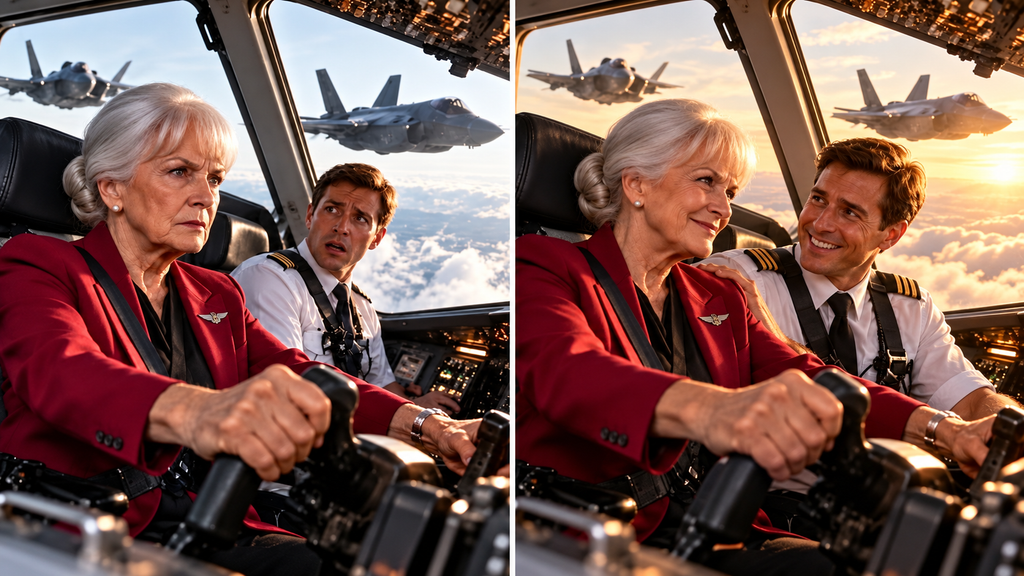
Right engine strained under the extra load.
Captain Evans was conscious again, but barely.
And somewhere behind the cockpit door, nearly two hundred passengers were waiting for someone to save them.
Pauline pulled gently on the controls.
The response was sluggish.
Too sluggish.
She had flown damaged aircraft before.
She had landed machines engineers later said should have broken apart in the sky.
But that had been decades ago.
Her hands were older now.
Her reflexes were slower.
And this was not an experimental fighter carrying one pilot.
This was a passenger aircraft filled with mothers.
Fathers.
Children.
Grandparents.
People who had boarded that morning expecting nothing more dramatic than bad coffee and turbulence.
Mark swallowed.
“What do we do?”
Pauline glanced at him.
Twenty minutes earlier, he had threatened to have her arrested.
Now he was looking at her like a frightened student staring at his instructor.
“We keep flying.”
His mouth opened.
“That’s it?”
“That’s always it.”
Pauline reached for the radio.
“Havoc 1, Widow 6.”
The response came immediately.
“Go ahead, Widow.”
“I’ve lost most hydraulic pressure. Left main gear indication is unsafe. I need visual confirmation.”
“Copy.”
The F-35 on the left wing moved closer.
Passengers pressed against the windows.
Phones appeared instantly.
Some people had no idea what was happening.
Others understood too well.
Chloe stood near the front galley, gripping the back of a seat as the fighter jet moved close enough for passengers to see the pilot’s helmet.
A little boy whispered to his mother.
“Are they here to save us?”
His mother forced a smile.
“Yes.”
Chloe heard her.
She wished she believed it too.
In the cockpit, Pauline kept the aircraft steady.
The F-35 pilot circled beneath them.
Seconds passed.
Then the radio crackled.
“Widow 6…”
Pauline heard the hesitation.
Her stomach tightened.
“Say it.”
“Your left main gear is partially deployed. Looks like maybe twenty degrees from locked.”
Mark closed his eyes.
Pauline nodded slowly.
Exactly what she had feared.
A partially deployed landing gear could be worse than no gear at all.
If it collapsed at touchdown, the aircraft could spin.
A wing could strike the runway.
Fuel could ignite.
They could lose the entire left side of the fuselage.
Captain Evans stirred behind them.
His voice was weak.
“Manual extension.”
Mark turned.
“Captain?”
Evans opened his eyes.
“Use the gravity extension.”
Mark immediately reached toward the emergency checklist.
Pauline stopped him.
“Wait.”
Mark froze.
“What?”
Pauline looked toward the hydraulic pressure.
“If the gear is mechanically jammed, gravity extension might make it worse.”
Captain Evans frowned.
“You’re sure?”
“No.”
Mark stared at her.
That single word scared him more than anything else she had said.
Pauline noticed.
“Flying isn’t about being sure, Lieutenant.”
“I’m not a lieutenant.”
She glanced at him.
“Today you are.”
Despite everything, Captain Evans laughed weakly.
Then pain crossed his face.
He pressed a hand against his chest.
Pauline looked back.
“You need oxygen.”
“I need my airplane.”
“You need a hospital.”
Evans looked toward Mark.
Then at Pauline.
Recognition slowly appeared in his face.
“Widow 6?”
Pauline’s expression changed.
“You know the name.”
Evans gave a faint smile.
“My father knew the name.”
Pauline stared at him.
“What was his name?”
“Thomas Evans.”
For the first time since entering the cockpit, Pauline forgot the airplane.
She turned fully toward him.
“Tommy Evans?”
Captain Evans nodded.
“My father.”
Pauline stared.
The cockpit alarms seemed to fade into the distance.
For one impossible moment, she was no longer an eighty-year-old woman sitting in a crippled passenger jet.
She was twenty-nine again.
Standing beneath the California sun.
Watching a young engineer with oil on his sleeves argue with military brass because he refused to sign off on an aircraft he believed was unsafe.
Thomas Evans.
Tommy.
The engineer who had once saved her life without ever climbing into the cockpit.
Pauline looked at Captain Evans again.
“You have his eyes.”
Evans smiled.
“He used to tell stories about you.”
Pauline looked forward.
“I’m surprised any were allowed outside classified rooms.”
“He didn’t tell me details.”
Evans paused.
“He just said Widow 6 was the best pilot he ever saw.”
Pauline felt something tighten in her throat.
She had not heard Tommy’s name in thirty years.
“Is he alive?”
Captain Evans’ smile disappeared.
“No.”
Pauline said nothing.
“He died eight years ago.”
For several seconds, she stared straight ahead.
Then she whispered,
“I’m sorry.”
“He would’ve liked this.”
Pauline glanced at him.
“This?”
“He always said if the world ever fell apart, he wanted you flying the airplane.”
Pauline almost laughed.
Almost.
Then another alarm screamed.
Mark looked down.
“Right engine temperature rising!”
The moment shattered.
Pauline’s eyes snapped back to the panel.
“How high?”
Mark read the number.
Pauline swore quietly.
Captain Evans tried to sit upright.
“We’re losing the second engine?”
“Not yet.”
“Can it handle the approach?”
Pauline didn’t answer.
That was answer enough.
She keyed the radio.
“Nellis Approach, we need direct runway. No delay.”
A controller responded instantly.
“Widow 6, you are cleared straight-in Runway Two-One-Right. Wind two-one-zero at nine. Emergency crews standing by.”
Pauline studied the distance.
Too far.
“How many miles?”
“Twenty-three.”
She shook her head.
“Negative. We may not have twenty-three.”
Mark stared.
“What do you mean?”
“The right engine is overheating.”
“We have to land.”
“We are landing.”
“At Nellis?”
Pauline looked toward the desert.
Then something appeared through the haze.
A narrow strip of concrete.
Old.
Long.
Almost forgotten.
Her eyes narrowed.
“Havoc 1.”
“Go ahead.”
“What’s twelve o’clock, approximately nine miles?”
A pause.
“Stand by.”
Mark looked outside.
“I don’t see anything.”
Pauline did.
She had spent half her life recognizing runways before other people could.
The fighter pilot returned.
“Widow 6, that’s an inactive auxiliary runway. Old test range strip. Closed years ago.”
Pauline’s expression changed.
“How long?”
“Approximately nine thousand feet.”
“Surface condition?”
“Unknown.”
Mark looked at her.
“You’re not considering that.”
Pauline said nothing.
“Pauline.”
Captain Evans’ voice was sharper now.
“That runway isn’t maintained.”
“Nellis is twenty-three miles.”
Evans looked at the engine temperatures.
Then toward the distant runway.
He understood.
Mark did too.
“If we lose the right engine before Nellis…”
Pauline finished the thought.
“We become a glider.”
Mark stared at the old runway.
“Could we glide twenty-three miles?”
“No.”
“How far?”
Pauline glanced at their altitude.
“Not far enough.”
Silence.
Then Pauline turned the aircraft.
Mark grabbed the armrest.
“You’re going for the abandoned strip?”
“Yes.”
“There won’t be emergency crews.”
“There also won’t be twenty-three miles of desert between us and the ground.”
Mark stared at her.
“Captain?”
Evans looked from Mark to Pauline.
Then nodded.
“Her airplane.”
Mark blinked.
Evans repeated himself.
“Her airplane.”
Pauline keyed the intercom.
Chloe heard the chime.
Then Pauline’s voice filled the cabin.
Calm.
Clear.
Steady.
“This is Pauline Sanders speaking from the cockpit.”
Passengers went silent.
“I know some of you have seen the fighter aircraft beside us.”
People looked through the windows.
“I know some of you are frightened.”
A woman began crying softly.
Pauline continued.
“We have experienced an engine failure and a landing gear malfunction.”
Chloe closed her eyes.
So much for the comforting lie.
“But we are still flying.”
Pauline paused.
“And as long as this aircraft is flying, we have options.”
The cabin became completely still.
“We will be landing shortly.”
A man shouted from three rows back.
“Where?”
Chloe turned.
Pauline continued before anyone could answer.
“Our landing may be rough. Listen carefully to your flight attendants. Follow every instruction immediately.”
A little girl clutched her stuffed rabbit.
Pauline’s voice softened.
“I need everyone to do one more thing.”
Passengers waited.
“When fear tells you this is the end, don’t believe it.”
Chloe felt tears gathering in her eyes.
Pauline stared through the windshield toward the abandoned runway.
“I’ve heard that voice before.”
Mark looked at her.
Pauline continued.
“And it has been wrong every time.”
Then she released the intercom.
For several seconds, nobody spoke.
Then Chloe stood straighter.
She wiped her eyes.
“Okay, everyone!”
Her voice carried down the cabin.
“You heard her! Seat belts tight! Shoes on! Bags under the seats! We’re going to prepare for an emergency landing!”
The crew moved quickly.
Passengers began helping each other.
A teenage boy held an oxygen mask for the elderly man beside him.
A mother tightened her daughter’s seat belt.
A businessman who had spent the entire flight complaining about Wi-Fi now helped a stranger secure her infant.
Fear had erased all the meaningless differences between them.
For the next few minutes, they were simply human beings trying to get home.
Inside the cockpit, Pauline lined up with the abandoned runway.
“Havoc 1, inspect the strip.”
The fighter jet accelerated ahead.
Mark watched it disappear.
The right engine temperature continued climbing.
Captain Evans looked at Pauline.
“How long since you flew?”
“Twenty-eight years.”
Mark stared.
“Twenty-eight?”
Pauline glanced at him.
“You preferred not knowing?”
He swallowed.
“A little.”
The fighter pilot returned.
“Widow 6, runway appears intact. Some surface debris. No major obstructions. Recommend touchdown beyond first thousand feet.”
Pauline nodded.
“Copy.”
Then the radio went quiet for a moment.
“Havoc 1?”
“Yes, ma’am?”
Pauline hesitated.
“If we don’t make it…”
Mark looked at her sharply.
The fighter pilot responded.
“You’re going to make it.”
Pauline almost smiled.
“Pilots shouldn’t lie to each other.”
Silence.
Then Havoc 1 said,
“If you don’t make it, ma’am, we’ll be on the ground before the smoke clears.”
Pauline looked toward the runway.
“Good answer.”
They descended.
Seven thousand feet.
Six thousand.
Five thousand.
Mark called the numbers.
Pauline handled the controls with small, precise movements.
She could feel the airplane talking to her.
Not through words.
Through vibration.
Resistance.
Sound.
Every aircraft had a language.
Young pilots often trusted screens.
Old pilots learned to trust what the machine whispered through their hands.
The right engine coughed.
Mark looked at the gauges.
“Temperature redline!”
“Reduce power.”
“We’ll sink.”
“Reduce it.”
Mark pulled the throttle slightly.
The aircraft began descending faster.
“Sink rate increasing.”
“I know.”
“Three thousand feet.”
The runway grew larger.
The desert stretched endlessly on both sides.
No city.
No airport terminal.
No fire trucks.
Just concrete surrounded by sand.
Pauline stared at the landing gear indicator.
Left unsafe.
Right locked.
Nose locked.
One bad wheel.
One chance.
Mark looked at her.
“Should we retract all the gear and belly land?”
Pauline shook her head.
“Too late.”
“Couldn’t that be safer?”
“Not with the left gear hanging partially down.”
Mark breathed out.
“So what are we doing?”
Pauline looked at him.
“We’re going to convince that wheel it has no choice.”
Mark blinked.
“What does that mean?”
“You’ll see.”
At two thousand feet, Pauline banked slightly left.
Mark looked alarmed.
“What are you doing?”
“Unloading the left gear.”
Then she rolled right.
Harder.
The aircraft groaned.
Passengers screamed.
Chloe grabbed a seatback.
“BRACE POSITIONS!”
Inside the cockpit, Pauline reversed the bank.
The partially deployed gear swung.
Mark’s eyes widened.
“You’re trying to shake it loose?”
“Yes.”
“That could tear it off!”
“Yes.”
“That’s your plan?”
“It’s one of them.”
“What’s the other?”
Pauline didn’t answer.
They heard a metallic bang beneath them.
Mark looked at the indicator.
Still red.
“Nothing!”
Pauline rolled the aircraft again.
Captain Evans grabbed his harness.
“Pauline…”
“One more.”
The right engine coughed violently.
Mark shouted.
“Power fluctuation!”
Pauline ignored it.
Left bank.
Right bank.
Another deep metallic clang.
Then—
A green light appeared.
Mark stared.
“Gear down!”
Pauline immediately leveled the aircraft.
Mark shouted again.
“LEFT GEAR LOCKED!”
Captain Evans laughed.
Actually laughed.
“You crazy old woman.”
Pauline smiled.
“Been called worse.”
Then the right engine failed.
Completely.
The cockpit became strangely quiet.
The deep vibration disappeared.
Mark froze.
“No thrust.”
Pauline looked toward the runway.
They were low.
Fast.
And still short.
“Glide speed.”
Mark responded instantly.
“Setting.”
“Flaps fifteen.”
“Fifteen.”
“No more.”
Mark looked at her.
“That’ll increase landing speed.”
“It will also keep us from dropping into the desert.”
The runway threshold approached.
Too slowly.
Mark watched the altitude.
“Five hundred.”
Pauline’s jaw tightened.
They might not make it.
Four hundred.
The runway seemed impossibly distant.
Three hundred.
Sand passed beneath them.
Mark whispered,
“Come on…”
Pauline gently lowered the nose.
“Speed.”
“One-fifty-eight.”
“Hold.”
“One-fifty-five.”
“Hold.”
The abandoned runway filled the windshield.
“Two hundred.”
Pauline could see cracks in the concrete now.
Old tire marks.
Weeds growing near the edges.
“One hundred.”
Mark’s voice trembled.
They crossed the threshold.
Barely.
Pauline flared.
The right main landing gear struck first.
BOOM.
The cabin erupted with screams.
Then the left.
BANG.
The gear held.
“Nose coming down.”
The nose wheel hit hard.
Pauline fought the rudder.
Without engines, without proper hydraulic pressure, the aircraft became a speeding mass of metal and momentum.
“Brakes!”
Mark pushed.
“Pressure weak!”
Pauline knew.
They weren’t slowing enough.
The runway rushed beneath them.
Seven thousand feet remaining.
Six thousand.
Five.
Mark looked ahead.
“End of runway!”
Pauline saw it.
Beyond the runway lay sand.
A ditch.
Then rocky terrain.
“We’re too fast!”
Captain Evans shouted.
“Use emergency braking!”
Mark pulled the handle.
The wheels screamed.
Smoke appeared behind them.
Passengers cried out.
The aircraft began drifting left.
Pauline corrected.
The left brake seized.
The plane jerked violently.
Mark shouted.
“We’re turning!”
“Hold it!”
Pauline fought the controls.
The aircraft swung right.
Then left.
Four thousand feet.
Three thousand.
Tires exploded.
A deafening bang shook the cabin.
A luggage bin opened and bags fell into the aisle.
Chloe screamed,
“HEADS DOWN! STAY DOWN!”
Two thousand feet.
The speed finally began dropping.
Still too fast.
Pauline saw the end of the runway.
“Brace.”
Mark looked at her.
“What?”
“Brace!”
The aircraft left the pavement.
Sand erupted around them.
The nose gear collapsed instantly.
Metal screamed against earth.
Passengers were thrown forward against their belts.
Sparks flew beneath the fuselage.
The left wing dipped.
Pauline slammed her shoulder against the harness.
Mark’s head snapped forward.
For several horrifying seconds, the aircraft seemed determined to tear itself apart.
Then—
Silence.
Dust surrounded them.
Nobody moved.
Pauline opened her eyes.
Her ears rang.
The cockpit was tilted slightly forward.
Mark sat frozen beside her.
Captain Evans groaned.
Pauline looked at Mark.
“You alive?”
He blinked.
“I think so.”
“Captain?”
Evans lifted one hand.
“Unfortunately.”
Pauline laughed.
Then she heard something behind them.
Crying.
Dozens of people crying.
Some screaming.
Others praying.
But those sounds meant something wonderful.
They were alive.
Pauline reached for the intercom.
Her hand shook now.
For the first time.
She pressed the button.
“Ladies and gentlemen…”
Her voice cracked.
She stopped.
Took a breath.
Then tried again.
“Welcome to Nevada.”
For half a second, there was silence.
Then the cabin exploded in cheers.
People screamed.
Cried.
Clapped.
Strangers hugged each other.
Chloe covered her mouth with both hands.
She had never heard anything so beautiful.
Pauline leaned back in the captain’s seat.
Her eyes closed.
She had done it.
Again.
Only this time, something felt different.
When she had been young, surviving a dangerous landing had filled her with adrenaline.
Pride.
Defiance.
Now she felt only gratitude.
Mark stared at her.
“I’m sorry.”
Pauline opened her eyes.
“For what?”
His face reddened.
“For everything.”
She waited.
“I saw an old woman.”
Pauline looked toward him.
He swallowed.
“I didn’t see a pilot.”
“No.”
“I treated you like you were confused.”
“Yes.”
“I threatened you.”
“You did.”
Mark looked down.
“I could’ve killed everyone.”
Pauline studied him.
Then she unfastened her harness.
“You know what arrogance is?”
Mark shook his head slowly.
“Fear wearing expensive shoes.”
He looked at her.
Pauline continued.
“You were terrified.”
He nodded.
“But you didn’t want anyone to know.”
Another nod.
“So you became angry.”
Mark wiped sweat from his forehead.
“I thought admitting I needed help meant I wasn’t good enough.”
Pauline looked toward the broken runway.
“No pilot is good enough to never need help.”
Mark said nothing.
Pauline touched his shoulder.
“The dangerous ones are the ones who think they are.”
A distant roar approached.
The two F-35s passed low overhead.
Passengers cheered again.
One fighter rocked its wings.
Then the other.
A salute.
Pauline watched them through the windshield.
For a moment, her eyes became wet.
Mark noticed.
“You okay?”
She smiled.
“Old memories.”
Within minutes, military vehicles appeared in the distance.
Fire trucks.
Ambulances.
Security vehicles.
They raced toward the aircraft through clouds of dust.
Flight attendants opened the exits.
Emergency slides inflated.
Passengers began evacuating.
Pauline remained in the cockpit.
Captain Evans looked at her.
“You should go.”
“You first.”
He smiled.
“That an order?”
“Yes.”
“Still bossy.”
“Ask your father.”
Evans’ smile faded gently.
“I wish I could.”
Pauline looked down.
“So do I.”
Paramedics entered.
They placed Captain Evans onto a stretcher.
Before they carried him away, he caught Pauline’s hand.
“My father kept something.”
Pauline frowned.
“What?”
“A photograph.”
Her breath stopped.
Evans continued.
“You standing beside a prototype aircraft. Him next to you.”
Pauline stared.
“He kept that?”
“My whole childhood.”
Evans smiled faintly.
“It was in his workshop.”
Pauline said nothing.
“He said it was from the day he almost lost his best friend.”
Pauline felt tears gather.
“That idiot.”
Evans laughed.
“He said you called him worse.”
They carried him away.
Pauline stayed seated for another moment.
Then Mark stood.
He hesitated.
“Mrs. Sanders?”
“Pauline.”
“Pauline…”
He looked embarrassed.
“Can I ask you something?”
“You’ve been asking questions for half an hour.”
He almost smiled.
“Why did you stop flying?”
Pauline’s expression changed.
The question hit somewhere deeper than he knew.
She looked out through the cracked windshield.
“Because eventually, everyone stops.”
“That’s not an answer.”
“No.”
Mark waited.
Pauline sighed.
“There was an accident.”
His face became serious.
“One of your test flights?”
“No.”
“My husband’s.”
Mark said nothing.
“He was a pilot too.”
Pauline’s voice softened.
“David Sanders.”
Mark frowned.
The name sounded familiar.
“He flew reconnaissance?”
Pauline looked surprised.
“You know him?”
“I studied Cold War aviation.”
Pauline smiled.
“Apparently not enough to recognize Widow 6.”
Mark winced.
“Fair.”
Pauline looked toward the desert again.
“David flew because he loved the sky.”
She paused.
“So did I.”
“What happened?”
Pauline’s fingers tightened around the armrest.
“He died during a training flight.”
Mark waited.
“The investigators said mechanical failure.”
Pauline continued.
“They told me there was nothing anyone could have done.”
She gave a small, humorless smile.
“I hated that sentence.”
Mark nodded.
“After that, every cockpit reminded me of him.”
“So you stopped.”
“Not immediately.”
She stared at her hands.
“I flew for another four years.”
“But every time something went wrong, I didn’t think like a pilot anymore.”
Mark remained silent.
“I thought like a widow.”
The words sat heavily between them.
“One day, I realized I was hesitating.”
Pauline looked at him.
“A pilot can be afraid. A pilot can shake. A pilot can cry after landing.”
Her eyes hardened.
“But hesitation at the wrong moment can kill people.”
Mark nodded.
“So I retired.”
He looked around the damaged cockpit.
“Seems like you got over the hesitation.”
Pauline laughed softly.
“Apparently.”
Then shouting came from outside.
Not frightened shouting.
Excited shouting.
A group of military personnel had gathered near the aircraft.
Pauline climbed carefully from the cockpit.
When she reached the forward door, Chloe was waiting.
The young flight attendant stared at her.
“You saved us.”
Pauline shook her head.
“We saved each other.”
Chloe immediately hugged her.
Pauline stiffened.
She had never been comfortable with public affection.
Then she hugged Chloe back.
“You were good today,” Pauline whispered.
“I was terrified.”
“So was I.”
Chloe pulled away.
“You?”
Pauline smiled.
“Especially me.”
They descended the emergency slide.
The moment Pauline’s feet touched the ground, every firefighter, medic, airman, and officer nearby stopped.
Pauline looked around.
“What?”
Then one man stepped forward.
A colonel.
Mid-fifties.
Sharp uniform.
Silver hair.
He stared at Pauline as though seeing a ghost.
“Ma’am.”
Pauline recognized the expression.
People had been giving it to her since the radio call.
“Yes?”
The colonel came to attention.
Then saluted.
Pauline froze.
Another officer saluted.
Then another.
Within seconds, nearly every uniformed person around the aircraft was standing at attention.
Mark came down the slide behind her.
He stopped when he saw them.
Pauline stared.
“You people don’t need to do that.”
The colonel lowered his hand.
“With respect, ma’am, yes we do.”
Pauline looked uncomfortable.
Passengers gathered nearby.
Phones recorded everything.
The colonel extended his hand.
“Colonel Robert Hayes.”
“Pauline Sanders.”
“I know.”
She raised an eyebrow.
“Apparently everyone does today.”
He smiled.
“Ma’am, my father worked at Edwards.”
Pauline sighed.
“Here we go.”
“He was a mechanic.”
“What name?”
“Samuel Hayes.”
Pauline’s expression changed.
“Sammy?”
The colonel laughed.
“He hated that nickname.”
“That’s why we used it.”
Hayes smiled.
“He used to talk about you.”
Pauline shook his hand.
“The world’s getting too small.”
Then another voice came from behind him.
“General wants to see her.”
Pauline frowned.
“Why?”
Hayes looked toward the damaged airliner.
“I think that’s fairly obvious.”
“I’m not joining anything.”
Several people laughed.
Pauline pointed at Mark.
“He needs medical evaluation.”
Mark protested.
“I’m fine.”
Pauline glared.
“You hit your head.”
Mark touched his forehead.
“I barely—”
“Medical.”
“Yes, ma’am.”
Hayes stared at him.
“Did Widow 6 just order you around?”
Mark sighed.
“All day.”
Pauline smiled.
Then she noticed something unusual.
One of the F-35 pilots was walking toward them.
Still wearing his flight suit.
Helmet under one arm.
Young.
Maybe thirty.
He stopped in front of Pauline.
“You Havoc 1?”
“Yes, ma’am.”
Pauline held out her hand.
“Good flying.”
He stared at her hand.
Then shook it.
“You’re telling me good flying?”
“You stayed close without making things harder.”
“I was trying not to scare the passengers.”
“You scared them.”
He smiled.
“Sorry.”
“What’s your name?”
“Major Daniel Cole.”
Pauline nodded.
“Daniel Cole.”
He looked at the aircraft.
“I thought we were going to lose you.”
“So did I.”
Cole stared at her.
Then laughed nervously.
“I listened to recordings of your test flights in training.”
Pauline raised an eyebrow.
“They let you hear those?”
“Some of them were declassified.”
“God help us.”
He smiled.
“There’s one recording…”
Pauline knew immediately.
“No.”
Cole laughed.
“You know which one?”
“Probably.”
Mark looked curious.
“What happened?”
Cole grinned.
“She lost hydraulic control in a prototype at thirty thousand feet.”
Pauline rolled her eyes.
“Ancient history.”
Cole continued.
“And air traffic control asked whether she wanted to eject.”
Mark looked at Pauline.
“What did you say?”
Pauline sighed.
Cole answered.
“She said, ‘I haven’t finished flying it yet.’”
Mark stared.
Pauline shrugged.
“It seemed reasonable at the time.”
Everyone laughed.
Then a paramedic approached.
“Mrs. Sanders, we need to examine you.”
“I’m fine.”
The paramedic smiled.
“I was warned you’d say that.”
“By whom?”
Mark raised his hand.
Pauline glared at him.
“Traitor.”
He smiled for the first time since the emergency began.
“Yes, ma’am.”
Three hours later, Pauline sat in a small medical room at Nellis.
She had bruising across her shoulder.
Minor cuts.
Nothing broken.
Captain Evans was hospitalized for what doctors believed was a cardiac arrhythmia.
Mark had a mild concussion.
Twenty-three passengers had minor injuries.
No one had died.
Pauline kept repeating that final number in her head.
Zero.
Zero dead.
Someone knocked.
Pauline looked up.
Colonel Hayes entered.
“You decent?”
“I’m eighty-two, Colonel. At this point nobody cares.”
Hayes laughed.
“I brought someone.”
A woman entered behind him.
Mid-seventies.
White hair.
Sharp eyes.
Pauline stared.
The woman stared back.
Neither spoke.
Hayes suddenly seemed uncomfortable.
“I’m going to…”
He pointed outside.
“Stand somewhere else.”
He left.
Pauline slowly stood.
The woman smiled.
“You look terrible.”
Pauline’s mouth fell open.
“Margaret?”
Margaret Cole crossed the room.
Pauline hugged her.
Hard.
“Oh, my God.”
They had not seen each other in forty years.
Margaret had been one of the engineers on Pauline’s test program.
One of the few women in the room during those years.
Often the only other one.
Margaret pulled back.
“I heard Widow 6 on the radio.”
Pauline laughed through tears.
“You’re still listening to military frequencies?”
“My grandson flies F-35s.”
Pauline froze.
“Daniel?”
Margaret grinned.
“My grandson.”
Pauline sat down slowly.
“You’re kidding.”
“No.”
“Havoc 1 is your grandson?”
“Yes.”
Pauline covered her face.
“This day needs to stop.”
Margaret sat beside her.
“I told him stories.”
“Apparently everybody told everybody stories.”
Margaret studied her.
“You disappeared.”
Pauline looked away.
“After David.”
“I know.”
“I couldn’t stay around airplanes.”
Margaret nodded.
“I understood.”
Pauline looked toward her.
“Did you?”
“Yes.”
A pause.
“But I was angry.”
Pauline looked surprised.
Margaret’s eyes filled with emotion.
“You didn’t just leave airplanes, Pauline.”
Pauline stared.
“You left us.”
The words hurt.
Margaret continued.
“I called.”
“I know.”
“Tommy called.”
Pauline’s eyes lowered.
“I know.”
“Sam called.”
“I know.”
“We thought you hated us.”
“No.”
“Then why didn’t you answer?”
Pauline struggled for words.
“Because all of you reminded me of the happiest years of my life.”
Margaret’s expression softened.
“And that was unbearable.”
Pauline looked down.
“I’m sorry.”
Margaret took her hand.
“So am I.”
They sat in silence.
Two old women remembering young versions of themselves.
Finally Margaret spoke.
“You know what David told me once?”
Pauline looked up.
“When?”
“About a year before he died.”
Pauline waited.
“He said the only thing he feared more than dying was you surviving him and forgetting how to live.”
Pauline’s face crumpled.
Margaret squeezed her hand.
“He knew you.”
Pauline wiped her eyes.
“That sounds like him.”
“There’s something else.”
Margaret reached into her bag.
She removed a small envelope.
Old.
Yellowed.
Pauline frowned.
“What is that?”
“Something Tommy gave me.”
Pauline’s heartbeat changed.
“Thomas Evans?”
“Yes.”
“When?”
“Years ago.”
“Why didn’t he give it to me?”
“He tried.”
Pauline looked at the envelope.
Her name was written on the front.
PAULINE.
Her hands began trembling.
Margaret placed it in her lap.
“After you disappeared, Tommy kept it.”
Pauline stared.
“What is it?”
“He never told me.”
“Then how did you get it?”
“When Tommy became ill, he mailed it to me.”
Margaret swallowed.
“He said if I ever saw you again, I should give it to you.”
Pauline touched the envelope.
She didn’t open it.
Not yet.
“What if we never met?”
Margaret smiled sadly.
“I guess Tommy had more faith than we did.”
That evening, Pauline finally opened the letter.
She sat alone in a quiet room at the base.
The page inside had been folded twice.
Tommy’s handwriting was instantly recognizable.
Pauline,
If you are reading this, then either I finally found you or someone more stubborn than both of us did.
I know why you left.
I don’t blame you.
But there is something David wanted you to know.
Pauline stopped breathing.
She continued reading.
The day before his last flight, David came to the hangar.
He knew something was wrong with the aircraft.
Pauline’s hands tightened.
He wasn’t certain.
But he told me that if something happened, I was not to let you blame yourself.
You had argued with him that morning.
I know because he told me.
You told him not to fly.
He went anyway.
That was his decision.
Not yours.
Pauline covered her mouth.
A memory returned.
David standing at the kitchen door.
Flight bag over his shoulder.
Pauline angry.
“I don’t like that aircraft.”
“You don’t like half the aircraft I fly.”
“This one feels wrong.”
He had smiled.
“You’re superstitious now?”
“I’m serious.”
“So am I.”
“Stay home.”
“I can’t.”
“You can.”
“Pauline…”
“If you walk out that door, don’t expect me to sit around pretending I’m okay with it.”
David had kissed her forehead.
“You never pretend anything.”
She had turned away.
Those were nearly the last words she ever said to him.
For forty years, she had carried them like punishment.
She continued reading.
David loved you.
He knew you loved him.
Your last argument was not your last truth.
Your life together was.
Pauline’s vision blurred.
Then came the final lines.
And if you ever find yourself in a cockpit again, don’t be afraid.
David always said the sky made more sense when you were in it.
Your friend,
Tommy
Pauline pressed the letter against her chest.
For several minutes, she cried harder than she had cried in decades.
Not because the pain disappeared.
It didn’t.
But because something inside her finally loosened.
A knot she had mistaken for part of herself.
A knock came at the door.
Pauline quickly wiped her face.
“Come in.”
Mark entered.
He stopped.
“Bad time?”
Pauline folded the letter.
“No.”
He sat across from her.
There was a bandage on his forehead.
“You look ridiculous.”
He laughed.
“So I’ve been told.”
“Why are you here?”
He became serious.
“I wanted to tell you something before the investigators interview us.”
Pauline waited.
Mark rubbed his hands together.
“I lied.”
Pauline’s expression changed.
“About what?”
His eyes stayed on the floor.
“The captain.”
“What about him?”
Mark hesitated.
“When Captain Evans collapsed…”
Pauline leaned forward.
“I didn’t immediately declare an emergency.”
Silence.
“How long?”
“Three minutes.”
Pauline stared.
Mark swallowed.
“I thought I could handle it.”
Her expression hardened.
“You had an unconscious captain and engine trouble.”
“I know.”
“And you waited?”
“Yes.”
“Why?”
Mark looked ashamed.
“Because I was being evaluated.”
Pauline said nothing.
“There was a check captain report from a previous flight.”
He continued.
“I had been told I sometimes became overwhelmed during high-workload situations.”
Pauline’s eyes narrowed.
“And you were afraid declaring an emergency would prove them right.”
“Yes.”
“So instead, you hid the problem.”
“For three minutes.”
Pauline stood.
Mark immediately looked up.
“Those three minutes could have killed everyone.”
“I know.”
“No, you don’t.”
Her voice rose.
“You don’t know because they survived.”
Mark flinched.
“You don’t get to measure a mistake only by whether people died.”
“I know.”
Pauline stepped closer.
“You were worried about your career?”
“Yes.”
“So you gambled with two hundred lives?”
Tears appeared in his eyes.
“Yes.”
Pauline stared at him.
Then Mark said,
“I’m going to tell the investigators.”
Pauline’s anger paused.
“All of it?”
“All of it.”
“You’ll probably lose your job.”
“I know.”
“Possibly your license.”
“I know.”
Pauline studied him.
“Why tell me?”
“Because you saved my life.”
He swallowed.
“And because if I hide it again, then I learned nothing.”
Pauline sat back down.
Her anger remained.
But something else appeared beside it.
Respect.
Not for what he had done.
For what he was choosing now.
“You were arrogant today.”
“Yes.”
“You were reckless.”
“Yes.”
“You were rude.”
Mark almost smiled.
“Yes.”
Pauline leaned closer.
“But you listened eventually.”
He nodded.
“And now?”
“I’m trying.”
Pauline sat back.
“That’s where pilots begin.”
Mark looked confused.
“Begin?”
“The moment you understand the airplane doesn’t care about your ego.”
She glanced toward the door.
“That’s when training actually starts.”
Mark stared.
“You think I should fly again?”
Pauline shook her head.
“That’s not my decision.”
He nodded.
“But if they let you?”
Mark waited.
Pauline looked at him.
“Become the pilot you pretended to be today.”
His eyes filled.
He stood.
“Thank you.”
“Don’t thank me yet.”
He paused.
Pauline pointed toward the door.
“You owe Chloe an apology.”
Mark smiled.
“Yes, ma’am.”
“And stop calling elderly passengers confused unless they actually are.”
“Yes, ma’am.”
“And never insult someone’s pin.”
Mark laughed.
“Definitely.”
The next morning, Pauline expected to leave quietly.
That had been the plan.
A military driver would take her to a hotel.
She would call her daughter.
She would explain why her face was on every television screen in America.
Then she would go home.
Instead, when she walked out of the building, she stopped.
Hundreds of people stood outside.
Passengers.
Crew.
Airmen.
Mechanics.
Firefighters.
Families.
And reporters behind barricades.
Pauline immediately turned around.
Colonel Hayes blocked the doorway.
“No.”
“Move.”
“No, ma’am.”
“I survived an engine failure for this?”
He grinned.
“You survived worse.”
“I’ll climb out a window.”
“It’s second floor.”
“I’ve done harder things.”
Hayes laughed.
“You need to see something.”
He led her outside.
The passengers began applauding.
Pauline froze.
A little girl ran toward her.
The same child who had held the stuffed rabbit during landing.
She stopped in front of Pauline.
“My mommy says you saved us.”
Pauline knelt slowly.
“What’s your name?”
“Emma.”
“Emma, your mommy helped save you too.”
The girl frowned.
“How?”
“She held you tight.”
Emma looked toward her mother.
Then back to Pauline.
She held out the stuffed rabbit.
“This is for you.”
Pauline’s face softened.
“Oh, sweetheart, I can’t take him.”
“He was brave.”
Pauline looked at the rabbit.
Then at the child.
“Then you should keep him.”
Emma thought for a moment.
Then hugged Pauline.
The crowd applauded louder.
Pauline closed her eyes.
When the girl ran back to her mother, Colonel Hayes stepped forward.
“There’s someone else.”
Captain Evans stood several yards away.
Hospital bracelet still around his wrist.
Pauline stared.
“What are you doing out of bed?”
Evans smiled.
“Escaping.”
“Your doctor allowed this?”
“No.”
“Good. Your father would be proud.”
Evans walked closer.
He held something.
A framed photograph.
Pauline recognized it immediately.
Her younger self stood beside a sleek prototype aircraft.
Tommy Evans stood beside her.
David was in the background, laughing at something outside the frame.
Pauline’s breath caught.
“I thought you might want it.”
She took the photograph carefully.
Her fingers touched David’s image.
For a long time, she said nothing.
Captain Evans spoke quietly.
“My father kept it all those years.”
Pauline smiled through tears.
“Then I’ll keep it for the rest of mine.”
He nodded.
Reporters began shouting questions.
“Mrs. Sanders!”
“How did you remember how to fly after nearly thirty years?”
“Were you afraid?”
“Did the copilot really refuse to let you into the cockpit?”
“Do you consider yourself a hero?”
Pauline groaned.
“I liked the engine failure better.”
Hayes laughed.
Then one reporter shouted something that made Pauline stop.
“Mrs. Sanders, is it true you were denied recognition during your original test career because you were a woman?”
The crowd quieted.
Pauline looked toward the reporter.
She could have walked away.
Instead, she stepped toward the microphones.
“When I started flying,” she said, “there were rooms I wasn’t invited into.”
Silence.
“There were aircraft I was told I shouldn’t fly.”
She glanced toward Margaret.
“There were men who believed courage had a gender.”
Margaret smiled.
Pauline continued.
“Some changed their minds.”
A few people laughed.
“Some didn’t.”
Her tone softened.
“But yesterday wasn’t about proving what women can do.”
She looked toward the damaged aircraft in the distance.
“It was about what happens when we decide someone has nothing to offer because of how they look.”
Mark stood behind the crowd.
Listening.
Pauline continued.
“You can underestimate someone because she’s old.”
She touched the silver pin on her jacket.
“Because she’s young.”
She looked at Chloe.
“Because she’s a woman.”
Margaret lowered her eyes.
“Because he’s frightened.”
Pauline looked at Mark.
“Because someone made a mistake.”
Mark’s face changed.
Pauline paused.
“And sometimes the person you dismiss is the person you will need five minutes later.”
The crowd became still.
A reporter asked,
“Do you forgive First Officer Jensen?”
Pauline looked at Mark.
Then back toward the microphones.
“That’s between him and the people he endangered.”
Mark lowered his head.
“But people are more than the worst five minutes of their lives.”
Mark looked up.
Pauline continued.
“What matters is what they do after.”
The press conference ended soon after.
Pauline thought that would finally be the end.
She was wrong.
Two weeks later, a package arrived at her house.
Inside was an official invitation from the United States Air Force.
Pauline stared at it.
Her daughter, Rebecca, read over her shoulder.
“They want you at Nellis.”
“I can read.”
“There’s a ceremony.”
“I noticed.”
Rebecca smiled.
“You’re going.”
“No.”
“Mom.”
“No.”
“They’re honoring you.”
“I already have too many plaques.”
“You have three.”
“That’s too many.”
Rebecca sat across from her.
“You know what your problem is?”
Pauline looked up.
“I have several. Choose carefully.”
“You spent forty years trying to disappear.”
Pauline said nothing.
Rebecca continued.
“And now people finally know what you did.”
“I don’t need strangers knowing.”
“Maybe not.”
Rebecca touched the silver pin.
“But maybe some young girl does.”
Pauline looked at her daughter.
Rebecca smiled gently.
“You always told me I could become anything.”
“I meant it.”
“Then let them see why you believed it.”
Pauline looked back at the invitation.
Three weeks later, she stood on the flight line at Nellis.
Hundreds of people attended.
Military officers.
Aviation historians.
Former test pilots.
Passengers from the flight.
Chloe.
Captain Evans.
Even Mark.
He was no longer flying commercially.
The investigation remained open.
He had voluntarily surrendered his flying duties while completing additional training and psychological evaluation.
When he saw Pauline, he approached carefully.
“You came.”
“Apparently.”
“You hate ceremonies.”
“Yes.”
“Then why are you here?”
Pauline looked toward a group of young female cadets standing near the front.
“For them.”
Mark followed her gaze.
He nodded.
The ceremony began.
Speeches were made.
Far too many, in Pauline’s opinion.
Then Colonel Hayes stepped toward the microphone.
“Today we recognize a pilot whose name was once known only in classified rooms…”
Pauline whispered to Margaret,
“If he gets dramatic, I’m leaving.”
Margaret elbowed her.
“…a woman whose skill saved countless lives during her career…”
Pauline muttered,
“There he goes.”
“…and whose courage saved one hundred eighty-seven passengers and crew during an emergency that should have ended very differently.”
Pauline looked toward the people from the flight.
Emma sat with her mother.
The stuffed rabbit in her lap.
Captain Evans stood beside Chloe.
Mark stood farther back.
Colonel Hayes continued.
“But there is something else we are recognizing.”
Pauline frowned.
Hayes smiled.
“Some records remained classified far longer than necessary.”
Margaret’s eyes widened.
Pauline whispered,
“What did you do?”
Margaret smiled innocently.
Hayes continued.
“Last week, portions of Project Blackbird Echo were officially declassified.”
Pauline’s mouth opened.
“No.”
Margaret whispered,
“Yes.”
Pauline stared at her.
“You knew?”
“Maybe.”
“You’re dead.”
“You’ve been threatening me since 1968.”
Hayes looked toward Pauline.
“For decades, aviation historians believed Widow 6 was a myth.”
A large screen behind him activated.
Black-and-white photographs appeared.
Pauline.
Young.
Helmet under one arm.
Standing beside aircraft the public had never seen her associated with.
Another photograph.
Pauline climbing from a cockpit after an emergency landing.
Another.
A group of engineers surrounding her.
Another.
David beside her.
Pauline stopped breathing.
The photograph remained on screen.
David was young.
Smiling.
Alive forever in that frozen second.
Then audio played.
Static.
A controller’s voice.
“Widow 6, recommend eject.”
A younger Pauline responded.
“I haven’t finished flying it yet.”
The crowd laughed and applauded.
Old Pauline covered her face.
“Oh, Lord.”
Then another voice appeared in the recording.
David.
“Tell Pauline if she bends my airplane, she’s paying for it.”
Young Pauline replied,
“Tell David it’s my airplane until I land.”
The crowd laughed again.
But Pauline didn’t.
She was crying.
Margaret took her hand.
The recording continued.
David’s voice returned.
“Bring it home, Widow.”
Pauline closed her eyes.
Bring it home.
Those had been his words then.
And somehow, nearly sixty years later, she had done exactly that again.
Colonel Hayes waited until the applause faded.
Then he said,
“Ladies and gentlemen, Pauline Sanders.”
Pauline approached the microphone.
She looked at the crowd.
At the young cadets.
At her daughter.
At old friends.
At people who had almost died beside her.
She had prepared a speech.
It was folded inside her jacket.
She ignored it.
“I’m not a legend.”
The crowd became quiet.
“I know that disappoints some of you.”
A few people laughed.
“I made mistakes.”
She looked at Margaret.
“I ran away from people who loved me.”
Margaret squeezed Rebecca’s hand.
“I spent years thinking grief was something I had to carry alone.”
She looked toward Captain Evans.
“I confused survival with living.”
Her voice became softer.
“And last month, I got onto an airplane because my daughter said I needed to stop being afraid of everything.”
Rebecca smiled through tears.
Pauline looked at her.
“She was right.”
Laughter.
Pauline continued.
“I thought I had finished with flying.”
She looked toward the runway.
“But maybe flying wasn’t finished with me.”
The cadets smiled.
Pauline touched the old silver pin.
“This little thing was mocked on that flight.”
Mark looked down.
Pauline smiled gently.
“I don’t mention that to embarrass anyone.”
Mark looked up.
“I mention it because symbols only matter if we remember the people behind them.”
She removed the pin.
The crowd watched.
Pauline walked away from the microphone.
Toward the young cadets.
She stopped in front of a young woman standing in the first row.
The cadet looked stunned.
Pauline held out the pin.
“What’s your name?”
“Cadet Sarah Mitchell, ma’am.”
“You want to fly?”
“Yes, ma’am.”
“What?”
“Fighters.”
“Why?”
Sarah hesitated.
“Because people keep telling me I’m too cautious.”
Pauline smiled.
“Good pilots are cautious.”
The cadet looked surprised.
“Fearless pilots scare me.”
A few people laughed.
Pauline continued.
“Courage isn’t lack of fear.”
She placed the silver pin into Sarah’s hand.
“It’s knowing which fear deserves to be listened to.”
Sarah stared at the pin.
“I can’t take this.”
“Yes, you can.”
“But it’s yours.”
Pauline smiled.
“It was.”
Sarah’s eyes filled.
“What do I do with it?”
Pauline leaned closer.
“Earn your own story.”
The crowd rose to its feet.
Pauline returned to the microphone.
She looked embarrassed by the applause.
“Sit down. You’re making this strange.”
They laughed.
Eventually, the ceremony ended.
People gathered around.
Photographs were taken.
Stories were shared.
Near sunset, Pauline escaped.
She walked alone toward the edge of the flight line.
The desert glowed gold.
An F-35 taxied in the distance.
She heard footsteps.
Margaret joined her.
“You gave away your pin.”
“Yes.”
“You loved that pin.”
“I loved what it represented.”
Margaret looked toward the cadets.
“And now?”
“Now it represents something else.”
They stood quietly.
Then Margaret smiled.
“Daniel wants to take you up.”
Pauline turned.
“In what?”
“T-38.”
“No.”
“He says you can sit in back.”
“No.”
“He already got permission.”
“No.”
Margaret grinned.
“He bet me you’d say yes.”
“He’s going to lose.”
A roar passed overhead.
Pauline looked up instinctively.
A T-38 climbed into the evening sky.
Fast.
Elegant.
Familiar.
Margaret watched Pauline’s face.
“You miss it.”
Pauline said nothing.
“You do.”
“No.”
“You’re smiling.”
“I have gas.”
Margaret burst out laughing.
The next morning, Pauline stood beside a T-38.
Flight suit on.
Helmet beneath her arm.
Major Daniel Cole approached.
He tried not to grin.
“Morning, Widow 6.”
“Don’t start.”
“You nervous?”
“Yes.”
Daniel blinked.
He had not expected the answer.
Pauline looked at the aircraft.
“I’d be worried if I wasn’t.”
Daniel nodded.
“You want to cancel?”
Pauline looked toward the cockpit.
Then toward the desert.
For an instant she remembered David.
Tommy.
The people she had lost.
The years she had hidden.
Then she remembered Emma.
Chloe.
Captain Evans.
Mark.
Sarah.
Rebecca.
All the lives that had somehow crossed hers because an engine failed on an ordinary flight.
Pauline put on her helmet.
“No.”
Daniel smiled.
“No?”
Pauline climbed the ladder.
“I haven’t finished flying yet.”
Two hours later, Rebecca stood beside Margaret watching the T-38 return.
The aircraft touched down smoothly.
Perfectly.
As it taxied toward them, Margaret wiped her eyes.
Rebecca noticed.
“You okay?”
Margaret laughed.
“I’ve been waiting forty years to see that woman come back.”
The canopy opened.
Pauline climbed down.
Her hair was flattened.
Her face was flushed.
And she was smiling wider than Rebecca had seen in years.
Daniel climbed out behind her.
Colonel Hayes approached.
“How was she?”
Daniel shook his head.
“Terrifying.”
Pauline slapped his arm.
“You loved it.”
“I absolutely did.”
Hayes laughed.
“Think you’ll fly again?”
Pauline looked at him.
“No.”
Everyone became quiet.
Then she smiled.
“Not today.”
Margaret grinned.
“That’s progress.”
Pauline looked toward the sky.
For most of her life, people had told stories about Widow 6.
The fearless woman.
The Cold War legend.
The pilot who refused to eject.
But the stories had always missed something.
She had never been fearless.
Not once.
She had been afraid on nearly every dangerous flight she had ever made.
Afraid before takeoff.
Afraid when systems failed.
Afraid when warning lights turned red.
Afraid when David died.
Afraid when she walked away from aviation.
Afraid when she stepped into that passenger cockpit nearly thirty years later.
Courage had never been the absence of fear.
It had been the decision to keep moving while fear sat beside her.
Sometimes courage meant pulling back on a control stick.
Sometimes it meant admitting you needed help.
Sometimes it meant confessing your mistake.
Sometimes it meant answering a phone call after forty years.
Sometimes it meant opening an old letter.
And sometimes—
it meant simply getting back into the airplane.
Six months later, Pauline received a photograph in the mail.
Cadet Sarah Mitchell stood beside a training aircraft.
Pinned to the inside of her flight suit was the old silver dart.
On the back she had written:
Mrs. Sanders,
First solo today.
I was terrified.
I did it anyway.
Thank you for teaching me the difference.
—Sarah
Pauline read the note twice.
Then she placed the photograph beside the old picture of herself, Tommy, and David.
Her living room wall now held three generations of pilots.
One from the past.
One from the present.
One from the future.
That evening, Pauline sat on her porch as the sun disappeared.
A commercial aircraft crossed high overhead.
Its navigation lights blinked against the darkening sky.
For years, she had heard aircraft and looked away.
Now she followed it until it disappeared beyond the horizon.
Rebecca stepped outside.
“Tea?”
“Yes.”
She handed Pauline a mug and sat beside her.
For a while they watched the sky together.
Then Rebecca smiled.
“You know people are still talking about you.”
Pauline groaned.
“I was hoping they’d get bored.”
“There’s a documentary.”
“No.”
“A book.”
“No.”
“A movie studio called.”
“Absolutely not.”
Rebecca laughed.
“They want Helen Mirren.”
Pauline considered.
“Well.”
Rebecca stared.
Pauline took a sip of tea.
“She’s acceptable.”
They both laughed.
Another aircraft appeared overhead.
Rebecca rested her head against her mother’s shoulder.
“Do you miss Dad?”
Pauline looked toward the stars.
“Every day.”
“Does it hurt?”
“Yes.”
Rebecca waited.
Pauline smiled softly.
“But not the same way.”
She reached into her pocket.
Tommy’s letter was still there.
She carried it often now.
Not because she needed proof anymore.
Because she liked knowing those words existed.
Your last argument was not your last truth.
Your life together was.
Rebecca squeezed her hand.
“I’m glad you got on that plane.”
Pauline laughed.
“I’m not.”
Rebecca looked surprised.
Pauline smiled.
“But I’m glad I landed it.”
They sat beneath the evening sky until the lights disappeared.
And somewhere far above them, another pilot guided another aircraft through the darkness.
Maybe frightened.
Maybe tired.
Maybe doubting themselves.
But still flying.
Pauline understood now that life was much the same.
You rarely got the perfect runway.
Systems failed.
Plans changed.
People disappointed you.
You disappointed yourself.
Sometimes the people you trusted disappeared.
Sometimes strangers became the reason you survived.
Sometimes the person everyone dismissed was carrying exactly the experience everyone needed.
And sometimes, after decades of believing one chapter had ended forever, life placed your hands back on the controls and whispered:
Not yet.
Pauline looked toward the fading horizon.
Then she smiled.
Because Widow 6 had finally come home.
And this time—
she intended to stay.
THE END! THANK YOU FOR READING!❤️