 Reading Time: 29 minutes
My father didn’t read the remaining pages in the car. He read them right there in my kitchen. And when he reached the final paragraph, his hands began to shake.
Not dramatically. Not enough for anyone else to notice at first. But I noticed. I had spent forty-two years watching Frank Mercer control a room with nothing more than a look.
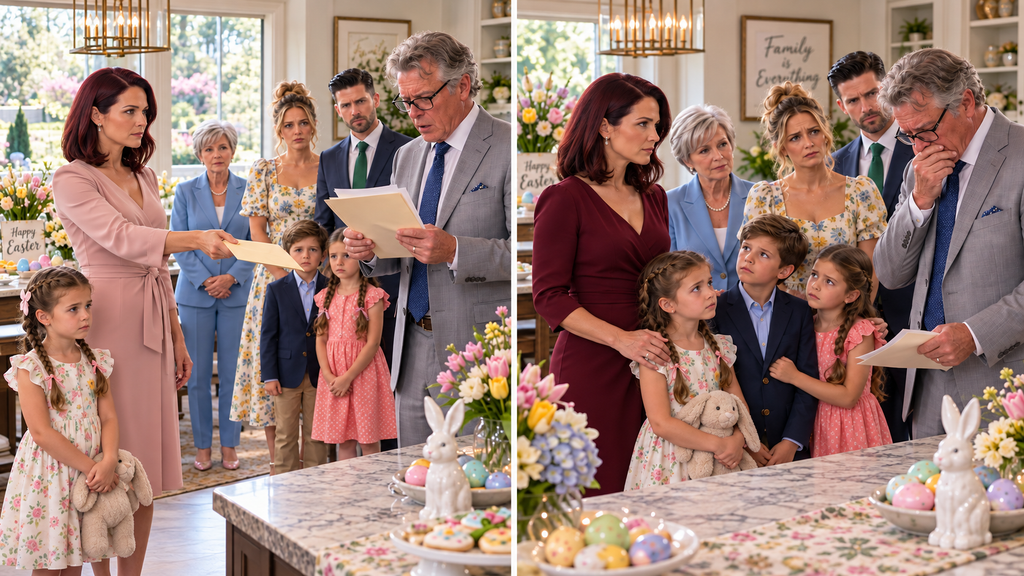
My father did not shake.
Not when my grandmother died.
Not when his business nearly collapsed in 2008.
Not when Mom had emergency surgery and the doctor told us to prepare for complications.
But now, standing beneath the paper Easter decorations Lucy and I had hung the night before, he stared at those documents as though they had reached through the page and grabbed him by the throat.
Mom rose slowly from her chair.
“Frank?”
He didn’t answer.
Tessa did.
“This is ridiculous.”
She stepped forward.
“Whatever June thinks she discovered, there’s obviously an explanation.”
I looked at her.
“That’s interesting.”
“What?”
“You haven’t even asked what I discovered.”
Her mouth opened.
Then closed.
Greg noticed.
He stared at his wife.
“Tessa.”
She ignored him.
“Tessa, what real estate broker was June talking about?”
“I don’t know.”
“Yes, you do.”
“No, Greg. I don’t.”
He gave a short, humorless laugh.
“You just went white when she mentioned one.”
Tessa folded her arms.
“Because this entire thing is insane.”
Dad finally lowered the papers.
“Tessa.”
His voice was quiet.
That was worse than shouting.
My sister looked at him.
“What?”
Dad lifted the second page.
“Did you contact Keller & Reed Realty?”
Silence.
Greg turned toward her.
“What?”
Tessa looked at Mom.
Mom looked down.
That tiny movement told me something I hadn’t known.
Mom knew too.
Maybe not everything.
But enough.
My stomach tightened.
I had spent three weeks telling myself there was still a possibility Mom had been kept in the dark.
That hope disappeared in one second.
Dad repeated the question.
“Did you contact Keller & Reed Realty about this house?”
Tessa exhaled.
“I made an inquiry.”
Greg stared at her.
“About June’s house?”
“It wasn’t like that.”
“Then what was it like?”
Tessa looked at me.
And somehow she still managed to sound offended.
“We were trying to help.”
I almost laughed.
Lucy’s fingers tightened around mine.
I looked down at her.
Mud streaked her yellow dress.
Her cheeks were still wet.
Her hair was tangled around her face.
She looked frightened.
Not because she understood the documents.
She didn’t.
She was six.
She understood something simpler.
The grown-ups were angry.
And somehow, once again, Aunt Tessa was making everything feel like Lucy’s fault.
I crouched beside her.
“Sweetheart?”
She sniffled.
“Yes?”
“Go upstairs and change into your bunny pajamas.”
“But it’s Easter.”
“I know.”
“My dress is ruined.”
“We’ll wash it.”
“What if it doesn’t come clean?”
“Then we’ll find you another yellow dress.”
She looked toward the adults.
“Are they mad at me?”
That question hurt more than anything Tessa had said.
I touched Lucy’s cheek.
“No.”
Tessa started to speak.
I raised one hand without looking at her.
“Don’t.”
For once, she listened.
I looked back at my daughter.
“Nobody is mad at you. And none of this happened because you cried. Understand?”
Lucy nodded uncertainly.
“You told them to stop,” I said. “They should have stopped.”
Another nod.
“You didn’t ruin Easter.”
Her bottom lip trembled.
“Promise?”
“I promise.”
I kissed her forehead.
“Go change. I’ll come upstairs in a few minutes.”
She started toward the stairs.
Then stopped.
She turned toward Tessa’s twins.
Noah and Nate were suddenly fascinated by the floor.
Lucy looked at them for several seconds.
Then she went upstairs.
Her bedroom door closed.
Only then did I turn around.
“All right.”
My voice had changed.
I could hear it myself.
“Now we can talk.”
Dad slapped the papers onto the kitchen island.
“What exactly is going on?”
I looked at Tessa.
“Would you like to tell him?”
She scoffed.
“Tell him what?”
I nodded.
“Fine.”
I walked toward the dining room.
On the sideboard sat my laptop.
I brought it into the kitchen and opened it.
Tessa watched every movement.
Greg looked increasingly confused.
Mom looked sick.
Dad looked angry.
But not at me anymore.
I turned the screen toward them.
The first thing displayed was an email.
Dad leaned closer.
Greg read over his shoulder.
The subject line said:
PRELIMINARY LISTING STRATEGY — 1847 WILLOWBROOK LANE.
My address.
My house.
My property.
Greg whispered, “What the hell?”
Tessa immediately said, “That doesn’t prove anything.”
I clicked the attachment.
Photographs appeared.
My living room.
My kitchen.
The upstairs hallway.
The primary bedroom.
Lucy’s bedroom.
The backyard.
The finished basement.
My father stared at the screen.
Mom covered her mouth.
Greg slowly looked at Tessa.
“You had pictures taken inside June’s house?”
“I didn’t take them.”
“Then who did?”
“The broker.”
The answer came too quickly.
Tessa realized it immediately.
So did everyone else.
Greg stepped backward.
“You just said you didn’t know what broker she was talking about.”
Tessa’s face flushed.
“I meant—”
“No.”
Greg shook his head.
“No, don’t do that.”
“Greg—”
“You lied to me.”
“Oh, stop being dramatic.”
“YOU LIED TO ME.”
The twins jumped.
I immediately said, “Keep your voice down. Lucy is upstairs.”
Greg looked ashamed.
“Sorry.”
Tessa glared at me.
“This is exactly what you wanted.”
I stared at her.
“What?”
“You wanted everyone against me.”
That sentence was so perfectly Tessa that I almost admired it.
She had been caught arranging the sale of a house she didn’t own.
And somehow I had orchestrated her humiliation.
“No,” I said. “I wanted you to stop.”
“Stop what?”
I clicked another email.
“This.”
A renovation estimate appeared.
Kitchen remodel.
Bathroom upgrades.
Floor refinishing.
Interior paint.
Landscaping.
Staging consultation.
Estimated total: $48,600.
Dad stared at it.
“What is this?”
“A contractor’s estimate.”
“I can see that.”
“He came here eleven days ago.”
Mom looked at me.
“Here?”
“Yes.”
“Why?”
“Because Tessa sent him.”
Dad turned toward my sister.
“Tessa?”
She raised both hands.
“Can everyone calm down?”
“No,” Greg said.
She glared at him.
“Stay out of this.”
“I’m your husband.”
“Exactly. So support me.”
“I don’t even know what you did!”
Dad pointed toward the laptop.
“Why were you getting estimates for renovations on June’s house?”
Tessa looked around the kitchen.
I watched her calculate.
I knew that expression.
I had seen it since childhood.
When we were girls, Tessa could break a lamp and convince Dad I had distracted her.
She could steal money from Mom’s purse and explain that she had merely “borrowed” it because Mom would have said yes anyway.
She never thought of herself as dishonest.
She thought of herself as someone whose intentions were more important than everyone else’s boundaries.
Finally she said, “Because this house needs work.”
I laughed.
I couldn’t help it.
“You were planning to renovate my house without asking me?”
“No.”
“Then explain.”
“We were discussing possibilities.”
“With a contractor?”
“Yes.”
“And a real estate broker?”
“Yes.”
“For property you don’t own?”
Tessa’s voice rose.
“Because Dad helped you buy it!”
There it was.
The sentence underneath everything.
Dad closed his eyes.
Mom whispered, “Tessa.”
“No, Mom. I’m tired of pretending.”
She pointed at me.
“She acts like she did everything herself.”
“I’ve never said that.”
“Dad gave you this house.”
“No.”
“Yes, he did!”
“No. He loaned me money for the down payment.”
“That’s the same thing.”
“It absolutely is not.”
Tessa turned toward Dad.
“Tell her.”
Dad said nothing.
“TELL HER.”
His silence seemed to frighten her.
She grabbed the documents.
“This is ridiculous. You gave June the money.”
Dad finally spoke.
“I loaned it to her.”
Tessa froze.
I didn’t.
I had known.
The promissory note was sitting on the counter between us.
But hearing him say it mattered.
Dad continued.
“She paid it back.”
Mom sat down.
Tessa stared at him.
“All of it?”
“Yes.”
“When?”
Dad swallowed.
“Years ago.”
“How many years?”
I answered.
“Eleven.”
Greg blinked.
“You paid Frank back eleven years ago?”
“Yes.”
“Then why does everybody talk like your parents bought this place?”
I looked at my mother.
She couldn’t meet my eyes.
“That,” I said, “is a very good question.”
Tessa’s face hardened.
“Dad still made it possible.”
“I’ve never denied that.”
“You couldn’t have bought it without him.”
“At the time? Probably not.”
“Exactly.”
“But helping someone does not give you ownership of everything they build afterward.”
Tessa rolled her eyes.
“You always have to make everything sound so noble.”
I stared at her.
“I borrowed forty thousand dollars from Dad.”
“Which was a fortune!”
“Yes.”
“I knew it!”
“And I repaid forty-seven thousand, eight hundred dollars including interest.”
Silence.
Greg’s eyebrows rose.
Dad looked uncomfortable.
Tessa blinked.
“What?”
I slid the canceled check toward her.
“That was the final payment.”
She looked at it.
The check was dated eleven years earlier.
The memo line read:
FINAL LOAN PAYMENT — WILLOWBROOK.
Dad had endorsed it.
The bank had processed it.
There was nothing ambiguous about it.
Tessa stared at the check for several seconds.
Then she shoved it away.
“Fine.”
I waited.
“So Dad didn’t technically own it.”
“Technically?”
“You know what I mean.”
“No. I don’t.”
“He helped you.”
“Yes.”
“And family helps family.”
I nodded.
“Apparently only when it gives you leverage later.”
Her face changed.
“That’s not fair.”
“No?”
“No.”
“Then why did you tell a realtor Dad had an ownership interest in my property?”
Dad snapped his head toward her.
“She did what?”
I clicked another email.
This one was worse.
The broker had written:
Based on our conversation regarding your father’s financial interest in the home, we should confirm title before proceeding. If your sister is amenable to an off-market sale, we can potentially avoid unnecessary delays.
Dad read it twice.
Then he turned toward Tessa.
“What financial interest?”
Tessa looked trapped.
“It was shorthand.”
“For what?”
“The family contribution.”
“There is no family contribution.”
“You gave her forty thousand dollars!”
“And she paid me back!”
“But—”
“No.”
Dad’s voice cracked across the kitchen.
Everyone fell silent.
I had never heard him speak to Tessa that way.
Not once.
Not when she wrecked his car at seventeen.
Not when she dropped out of college after he paid a year’s tuition.
Not when she borrowed fifteen thousand dollars for a business that lasted four months.
Tessa looked stunned.
Dad pointed toward the documents.
“You told someone I had a financial interest in June’s house.”
“I was trying to figure out options.”
“For what?”
She didn’t answer.
Dad stepped closer.
“Options for what, Tessa?”
I answered for her.
“For after I moved.”
Greg frowned.
“Moved where?”
I looked at him.
“That depends which version you want.”
Tessa whispered, “June.”
“The version she told the realtor?”
“Stop.”
“The version she told the contractor?”
“June.”
“Or the version she told Mom and Dad?”
“STOP.”
Greg stared at his wife.
“What versions?”
I opened another file.
Tessa lunged toward the laptop.
I shut it before she could reach it.
“Do not touch my computer.”
“You have no right!”
“I have no right to emails concerning my property?”
“You went through my private messages!”
“No.”
That stopped her.
“I didn’t go through anything.”
“Then how did you get them?”
“The realtor sent them to me.”
Tessa went pale.
“What?”
“The realtor became uncomfortable.”
“That’s impossible.”
“She looked up the deed.”
Nobody spoke.
I continued.
“She expected to find Dad’s name.”
Dad’s jaw tightened.
“She didn’t.”
I looked directly at Tessa.
“She found mine.”
Greg rubbed both hands over his face.
“Oh my God.”
“The realtor called me because she thought there had been a misunderstanding.”
Tessa said nothing.
“She told me my sister had contacted her regarding the possible sale of my home.”
Dad lowered himself into a chair.
I continued.
“She also told me you said I was considering downsizing.”
Mom suddenly whispered, “You were.”
I looked at her.
“No, Mom.”
“You said this house was becoming a lot.”
“I said cleaning four bedrooms was annoying.”
“Well—”
“That is not the same as wanting to sell my home.”
Mom looked away.
Something clicked.
“You told her that.”
Mom said nothing.
“Mom.”
“I may have mentioned that you complained about maintaining the place.”
“To Tessa?”
“Yes.”
“When?”
“A few months ago.”
I stared at her.
“And what else did you tell her?”
“Nothing important.”
“What else?”
Mom’s hands twisted together.
“I told her you had mentioned maybe wanting something smaller someday.”
“I said that five years ago.”
“Well, I remembered it.”
“And somehow that became permission to list my house?”
“No one listed anything.”
“Because I stopped it.”
Tessa slammed her palm onto the counter.
“YOU ARE MAKING THIS SOUND CRIMINAL.”
I stared at her.
“I haven’t used that word.”
“You hired a corporate attorney!”
“I hired the attorney who handles my business contracts because I trust her.”
“To threaten your family!”
“To document what was happening.”
“You could have called me!”
“I did.”
That stopped her again.
“What?”
“Three weeks ago.”
She frowned.
“No, you didn’t.”
“Yes.”
I remembered the conversation perfectly.
“Tessa, do you remember when I asked why you wanted to know whether I had ever considered selling?”
Her face changed.
“That was casual conversation.”
“I asked you directly.”
“You asked whether I thought the market was good.”
“No. You asked me whether I knew how much this house was worth.”
“That’s normal.”
“Then you asked whether Dad was still on the mortgage.”
Greg stared at her.
“You asked that?”
She ignored him.
“I was curious.”
“And I told you there was no mortgage.”
“You said it was paid off.”
“Yes.”
“And?”
“Four days later, a contractor showed up.”
Dad looked up.
“Without you hiring him?”
“Yes.”
“What did he say?”
“He said he was there to prepare a renovation estimate.”
Mom whispered, “Oh dear.”
“I told him there had been a mistake.”
I looked at Tessa.
“He showed me the work order.”
She looked down.
“Your name was on it.”
Greg stepped away from his wife.
“Tessa.”
She reached for him.
“Greg, please.”
“No.”
“Listen to me.”
“I have been listening.”
“You don’t understand.”
“You told me your dad was selling this house.”
That was new.
I stared at him.
Dad did too.
“What?” Dad said.
Greg looked embarrassed.
“She told me Frank was finally selling this place.”
Tessa’s face crumpled with anger.
“Greg!”
“What?”
“You promised—”
“I promised because you told me it was settled!”
My pulse quickened.
“What exactly did she tell you?”
Greg looked at me.
“That your dad had bought this house years ago.”
I nodded slowly.
“And?”
“And he’d let you live here because you were going through your divorce.”
“That was fourteen years ago.”
“I know.”
“What else?”
Greg looked at Tessa.
She shook her head.
“Don’t.”
He turned back to me.
“She said your daughter was getting older and you didn’t need this much space anymore.”
My throat tightened.
“What did Lucy have to do with it?”
“Nothing.”
“Apparently something.”
Greg rubbed the back of his neck.
“She said your parents wanted to simplify the family finances.”
Dad laughed once.
There was no humor in it.
“What family finances?”
Greg looked confused.
“She said the proceeds were going to be divided.”
The kitchen became completely silent.
Even I hadn’t known that.
“Divided how?” I asked.
Greg hesitated.
“Greg.”
“Four ways.”
Dad stood.
“Four?”
“Frank, Linda, Tessa and June.”
I stared at my sister.
“You were planning to divide the proceeds from selling my house?”
“No.”
“That is what you told your husband.”
“I was explaining what might happen.”
“With money that belongs entirely to me?”
Tessa’s voice suddenly broke.
“Because it isn’t fair!”
There it was.
Not a misunderstanding.
Not concern.
Not helping.
Fairness.
Her version of fairness.
The kind where anything I had was evidence that she had been cheated.
“You have this huge house,” she said.
“You have a successful company.”
“You have savings.”
“You have Lucy.”
Her voice caught slightly on my daughter’s name.
“And what do I have?”
Greg stared at her.
“Excuse me?”
She waved at him.
“You know what I mean.”
“No, actually, I don’t.”
She kept going.
“You’ve always had everything work out for you, June.”
I almost couldn’t believe what I was hearing.
“My husband left me when Lucy was eight months old.”
“At least he pays support.”
“He disappeared for fourteen months.”
“You recovered.”
“I built a business while raising a baby.”
“With Dad’s help.”
“Dad loaned me money for this house.”
“He helped with Lucy.”
“Twice.”
Mom flinched.
Tessa continued.
“You got lucky.”
That word.
Lucky.
I thought about sleeping four hours a night.
Taking client calls while Lucy napped against my chest.
Working at the kitchen table until two in the morning.
Skipping vacations.
Selling my engagement ring to cover payroll during my first bad year.
Driving a ten-year-old Honda while Tessa leased a new SUV every thirty-six months.
I looked at her.
“You think I’m lucky?”
“You know what I mean.”
“No.”
I shook my head.
“I really don’t.”
Dad interrupted.
“What was your plan?”
Tessa looked at him.
“What?”
“The house.”
“There was no plan.”
“You contacted a realtor.”
“Just for information.”
“You contacted a contractor.”
“Potential improvements.”
“You told your husband I owned the property.”
Silence.
“You told him the sale proceeds would be divided.”
Tessa crossed her arms.
“I thought that was what we had discussed.”
Dad stared at her.
“We never discussed that.”
Mom whispered, “Frank.”
He turned toward her.
“What?”
Mom looked frightened.
And suddenly I knew.
“Oh my God.”
Everyone looked at me.
I stared at Mom.
“You discussed it with her.”
“No.”
“Mom.”
“It wasn’t a plan.”
“What was it?”
“A conversation.”
Tessa closed her eyes.
Dad turned toward his wife.
“Linda?”
Mom’s voice became defensive.
“I was worried.”
“About what?”
“June being alone in this big house.”
I almost laughed.
“I’m forty-two.”
“I know.”
“I have a six-year-old daughter.”
“I know.”
“I’m not an eighty-year-old widow wandering around twenty empty rooms.”
“June, don’t mock me.”
“Then explain it.”
Mom’s eyes filled with tears.
“I just thought maybe we could all benefit.”
There it was.
Dad looked as though someone had struck him.
“Benefit?”
Mom rushed to explain.
“This house is worth much more than June paid for it.”
“Yes,” Dad said slowly. “That is generally what happens when someone owns property for fourteen years.”
“But she doesn’t need all that equity.”
I stared at my mother.
I had expected entitlement from Tessa.
Not this.
“Who decides what I need?”
Mom looked at me helplessly.
“You have plenty.”
“So?”
“Tessa is struggling.”
Greg’s head snapped toward his wife.
“We are?”
Tessa muttered, “Not now.”
“No. Right now.”
He stepped toward her.
“You told your mother we’re struggling?”
“We have bills.”
“Everybody has bills.”
“You know how expensive things are.”
“We make almost two hundred thousand dollars a year!”
Dad blinked.
Mom looked surprised.
Apparently Tessa had told different stories to different people.
Greg continued.
“You told me Frank needed money.”
Dad said, “I don’t.”
“You said your parents wanted to sell June’s house because they were worried about retirement.”
Dad’s face went red.
“Tessa.”
She looked cornered.
“It was complicated.”
“No,” I said.
Everyone turned toward me.
“It actually wasn’t.”
I opened my laptop again.
“There was one thing I couldn’t understand.”
Tessa’s eyes narrowed.
“What?”
“Why the urgency?”
Nobody spoke.
“You contacted the broker six weeks ago.”
I clicked.
“The contractor eleven days ago.”
Click.
“The staging company nine days ago.”
Mom whispered, “Staging company?”
Dad looked at her.
“You didn’t know about that?”
She shook her head.
Interesting.
I continued.
“And three days ago, someone requested an expedited preliminary title report.”
Tessa stopped breathing.
Greg whispered, “What?”
I looked at him.
“That usually happens when someone wants to know whether there are liens, mortgages or ownership complications before moving quickly.”
Dad looked at Tessa.
“Why quickly?”
She said nothing.
I reached into the envelope.
There had been one document Dad hadn’t reached yet.
Because I had placed it separately.
I removed it.
“Tessa?”
Her eyes locked onto the page.
“Don’t.”
I held it up.
“Tell them.”
“June.”
“Tell them why you needed my house sold.”
Her eyes filled.
Greg looked from her to me.
“What is that?”
I handed it to him.
Tessa lunged.
“GREG, DON’T.”
He stepped away.
His eyes moved across the page.
Then stopped.
His face changed.
Not anger.
Not yet.
Shock.
Pure shock.
“What is this?”
Tessa started crying.
Greg looked at her.
“What is this?”
“It’s not what you think.”
“You took out a loan?”
Nobody moved.
Greg looked back at the document.
“One hundred and eighty thousand dollars?”
Dad whispered, “Jesus.”
Mom covered her mouth.
I had discovered it accidentally.
My attorney had found a financing application connected to the property inquiry.
Not a loan secured against my house.
That would have been impossible without my signature.
But a private bridge-loan application.
Tessa had represented that she expected access to proceeds from a pending family property sale.
My property.
The lender had asked for documentation.
That was why she needed the title information.
That was why she needed a broker.
That was why she had been rushing.
Greg’s hands trembled.
“Why do you need one hundred and eighty thousand dollars?”
Tessa cried harder.
“Greg.”
“WHY?”
“Please.”
“What did you do?”
She collapsed into a chair.
And finally, the truth came out.
Not elegantly.
Not all at once.
It came in fragments.
A failed investment.
Then another.
Money borrowed against credit cards.
Money moved from savings.
A business opportunity with a friend.
Then cryptocurrency.
Then an attempt to recover the cryptocurrency losses.
Then another loan.
Then interest.
Then late payments.
Greg stood completely motionless.
“How much?”
Tessa cried.
“How much, Tessa?”
She whispered something.
“What?”
“Two hundred and sixty-three.”
He frowned.
“Two hundred and sixty-three what?”
She looked up.
“Thousand.”
Mom gasped.
Dad sat down.
Greg looked like he might fall.
“You lost two hundred and sixty-three thousand dollars?”
“I was trying to fix it.”
“With what money?”
“I thought—”
“With what money?”
Her eyes moved toward me.
That was the answer.
Mine.
She had looked at my home.
My equity.
My security.
The place where Lucy slept.
And she had seen an escape hatch.
Greg sat down slowly.
“You were going to sell your sister’s house to cover money I didn’t even know you lost?”
“I thought Dad owned part of it.”
“No, you didn’t,” I said.
Tessa looked at me.
“Yes, I did.”
“No.”
“How would you know?”
“Because you asked the realtor to check.”
Silence.
“You knew there was a possibility Dad didn’t own any of it.”
She stared at me.
“And when the realtor told you the deed was entirely in my name, you didn’t stop.”
Dad whispered, “Is that true?”
Tessa said nothing.
I answered.
“She didn’t stop.”
I opened the final email.
“The broker told her she could not market the property without my authorization.”
Greg closed his eyes.
“Tessa replied asking whether a family trust could have an unrecorded beneficial interest.”
Dad stared at his daughter.
“You asked what?”
“She was looking for a loophole.”
“I wasn’t!”
“Then what were you doing?”
“I was trying to understand!”
“No,” I said quietly. “You were trying to find some legal fiction that would make my house partly yours.”
She stood.
“I was desperate!”
Finally.
The first honest sentence she had spoken.
“I was desperate, June!”
Her voice cracked.
“I made mistakes.”
“Yes.”
“I thought I could fix them.”
“With my money.”
“I was going to pay it back.”
I stared at her.
“With what?”
She didn’t answer.
“You were going to sell my house, take money from the proceeds, and someday pay me back?”
“I didn’t know what else to do!”
“You could have told your husband.”
She looked at Greg.
His expression hardened.
“You could have told Mom and Dad.”
“I was ashamed.”
“You could have told me.”
“You would have said no.”
I nodded.
“Yes.”
She blinked.
“Yes, Tessa. I would have said no.”
Her face twisted.
“Exactly!”
“No. That doesn’t prove you were justified.”
I stepped closer.
“It proves you knew you didn’t have permission.”
She cried harder.
For years, Tessa’s tears had been a family emergency.
If Tessa cried, Dad softened.
Mom rushed toward her.
Everyone lowered their voices.
Someone apologized.
Usually me.
This time, nobody moved.
Then footsteps sounded on the stairs.
I turned.
Lucy stood halfway down.
She had changed into pink bunny pajamas.
Her hair was still dirty.
She was holding one white shoe.
“I found it,” she said.
Every adult in the kitchen fell silent.
She came downstairs.
“I found my shoe outside.”
I walked toward her.
“Good job.”
She looked around.
“Why is Aunt Tessa crying?”
Nobody answered.
Lucy looked at her cousins.
Then at me.
“Is Easter over?”
That broke my heart.
I knelt.
“No.”
“But everybody’s leaving.”
“Yes.”
“Because of me?”
“No.”
I took her little face between my hands.
“Listen carefully.”
Her brown eyes met mine.
“You did not cause this.”
“But I cried.”
“You’re allowed to cry when someone hurts you.”
Behind me, someone inhaled sharply.
I didn’t know who.
“You asked them to stop.”
“Yes.”
“They didn’t.”
She nodded.
“That wasn’t okay.”
“No.”
“And asking someone to apologize to you when they hurt you is not ruining anything.”
Lucy thought about that.
Then she whispered, “Okay.”
I kissed her forehead.
“Go pick a movie.”
“Can we still eat the bunny cake?”
I smiled.
“Absolutely.”
“All of it?”
“Probably not all of it.”
A tiny smile appeared.
“Most?”
“We’ll negotiate.”
She hugged me.
As her arms went around my neck, I saw my father watching.
His eyes were wet.
Lucy went into the living room.
The kitchen stayed silent for several seconds.
Then Dad looked at Tessa’s boys.
“Noah. Nate.”
They looked up.
“Tell me what happened outside.”
Tessa immediately said, “Dad, leave them out of this.”
He ignored her.
“Noah?”
The boy looked at his brother.
Then at his mother.
That told us everything.
Dad crouched slightly.
“You are not in trouble for telling the truth.”
Noah whispered, “We were playing.”
“Did Lucy ask you to stop?”
Silence.
“Nate?”
Nate nodded.
Tessa closed her eyes.
Dad continued.
“How many times?”
Nate shrugged.
“A lot.”
“Did you stop?”
“No.”
“Did she fall?”
Noah whispered, “Nate pushed her.”
“I barely pushed her!”
“You said you didn’t do anything!” Tessa snapped.
Dad turned.
“Tessa.”
She stopped.
Nate’s eyes filled with tears.
“I didn’t mean for her to fall.”
And there it was.
The apology that could have ended everything twenty minutes earlier.
Dad looked at him.
“What should you do when you hurt somebody?”
Nate wiped his nose.
“Say sorry.”
“Yes.”
The twins walked toward the living room.
Tessa started after them.
I stepped into her path.
“Let them do it themselves.”
She stared at me.
For once, she didn’t argue.
We heard Nate’s little voice from the living room.
“Lucy?”
A pause.
“I’m sorry I pushed you.”
Then Noah.
“I’m sorry we didn’t stop.”
Lucy said something too quiet to hear.
A moment later, the television came on.
Children.
They had managed in thirty seconds what the adults had failed to do for decades.
Admit harm.
Apologize.
Move forward.
Dad looked at me.
“June.”
I waited.
“I owe you an apology too.”
Tessa looked shocked.
Mom looked down.
Dad continued.
“For more than forty years, I’ve asked you to be the reasonable one.”
My throat tightened.
“You were easier.”
I almost laughed.
He shook his head.
“That’s not a compliment.”
No.
It wasn’t.
“You were the child I didn’t worry about,” he said. “So whenever there was conflict, I asked you to bend.”
I looked away.
“Because Tessa wouldn’t.”
“Yes.”
He swallowed.
“And I told myself that meant you were stronger.”
My eyes burned.
“But really,” he said, “I was rewarding the person who caused the trouble and punishing the person who could tolerate it.”
Nobody spoke.
That sentence landed harder than the documents had.
Dad looked toward the living room.
“And today I watched it happen to Lucy.”
I pressed my lips together.
“I watched those boys hurt her, and my first instinct was to ask you not to make a scene.”
His voice cracked.
“I heard myself.”
Tears filled his eyes.
“And for the first time, I heard how cowardly it sounded.”
Mom whispered, “Frank.”
He shook his head.
“No, Linda.”
He looked at her.
“We did this.”
Mom began crying.
“We thought we were keeping the family together.”
“No,” Dad said.
“We were keeping ourselves comfortable.”
I had waited years to hear that.
And when it finally came, it didn’t feel triumphant.
It felt sad.
Because apologies don’t return time.
They don’t erase every Christmas dinner where I swallowed an insult.
Every birthday where Tessa changed the plans and everyone expected me to accept it.
Every loan.
Every favor.
Every excuse.
But apologies can do something else.
They can stop the next generation from inheriting the same pattern.
I looked toward the living room.
Lucy was laughing.
Apparently the twins had joined her movie.
Children really are remarkable that way.
They don’t need decades of resentment.
They need adults to show them what repair looks like.
I turned back.
“Dad, I appreciate you saying that.”
He nodded.
“But you still need to leave.”
His expression fell.
“I understand.”
Mom looked surprised.
“June, surely now—”
“No.”
“But the boys apologized.”
“Yes.”
“And Frank apologized.”
“Yes.”
“So why can’t we finish Easter?”
Because this was the moment.
The old June would have surrendered.
An apology would have been treated like a reset button.
Everyone would eat ham.
Tessa would cry.
Mom would pour wine.
Dad would change the subject.
By dessert, everyone would pretend the afternoon had been “a misunderstanding.”
Then nothing would change.
“No,” I said.
Mom stared at me.
“I love you.”
Her eyes filled.
“But boundaries don’t disappear because somebody finally says sorry.”
Dad nodded slowly.
Mom looked wounded.
Tessa looked furious.
Greg looked exhausted.
I continued.
“Today is over.”
Nobody argued.
Almost nobody.
Tessa picked up her purse.
“You’re really doing this.”
“Yes.”
“You’re destroying this family.”
I looked at her.
“No.”
I glanced toward the living room.
“I’m changing what my daughter learns a family is allowed to do to her.”
Tessa flinched.
Good.
Not because I wanted to hurt her.
Because for once, I wanted the truth to reach her.
Greg gathered the twins.
They hugged Lucy goodbye.
Nate whispered another apology.
Lucy accepted it.
Then they left.
Dad hugged me at the door.
For several seconds, he held on.
“I’m proud of you.”
I almost told him not to say that.
I wasn’t a child waiting for approval.
But then I realized something.
Maybe he wasn’t giving approval.
Maybe he was acknowledging something he should have acknowledged long ago.
So I simply said, “Thank you.”
Mom hugged me next.
She whispered, “I’m sorry.”
“I know.”
“Can I call you tomorrow?”
“Give me a few days.”
That hurt her.
I could see it.
But she nodded.
Then Tessa reached the doorway.
She didn’t hug me.
She didn’t apologize.
She just stared.
“I hope you’re happy.”
“No.”
That surprised her.
“I’m not happy.”
I looked toward Lucy.
“I’m just finished.”
Tessa’s eyes filled again.
“You’re my sister.”
“Yes.”
“That should mean something.”
“It does.”
“Then help me.”
I stared at her.
“I will.”
Hope flashed across her face.
“I will help you find a financial counselor.”
Her expression collapsed.
“I’ll help you find an attorney if the debt situation requires one.”
“That’s not what I meant.”
“I know.”
“I need money.”
“No.”
“June—”
“No.”
“You could take out an equity loan.”
“No.”
“You wouldn’t even feel it!”
There it was again.
My resources becoming her entitlement.
I stepped backward.
“Goodbye, Tessa.”
“June!”
I closed the door.
Not slammed.
Closed.
Locked.
And stood there with my hand on the deadbolt.
For several seconds, I heard voices outside.
Then car doors.
Engines.
Silence.
Behind me, Lucy said, “Mommy?”
I turned.
She was holding two plates.
One had a giant piece of bunny cake.
The other had an even bigger one.
“I negotiated.”
I laughed.
For the first time all afternoon, I really laughed.
“You certainly did.”
We ate Easter dinner in pajamas.
Ham.
Cold rolls.
Deviled eggs.
And ridiculous amounts of cake.
Lucy sat cross-legged on the couch with a blanket around her shoulders.
Halfway through the movie, she rested her head against me.
“Mommy?”
“Hmm?”
“Were you scared?”
The question surprised me.
“Today?”
She nodded.
“A little.”
“Even grown-ups get scared?”
“All the time.”
She considered that.
“But you still made everybody leave.”
“Yes.”
“Why?”
I brushed her hair from her forehead.
“Because being scared doesn’t mean you have to let people treat you badly.”
She thought about that.
Then she smiled.
“I like our Easter.”
I looked around the quiet living room.
So did I.
But the story wasn’t over.
Not even close.
Because at 8:17 the next morning, my phone rang.
It was Greg.
I almost didn’t answer.
Then I did.
“Hello?”
His voice sounded terrible.
“June.”
“What happened?”
“I need to ask you something.”
“Okay.”
“Did Tessa ever ask you to sign anything?”
My stomach tightened.
“What kind of thing?”
“Anything involving the house.”
“No.”
“Are you sure?”
“Yes.”
Silence.
“Greg?”
“I found something.”
I sat upright.
“What?”
He exhaled.
“A file.”
“What file?”
“On her laptop.”
I closed my eyes.
“Greg, I don’t think you should be going through—”
“It has your signature on it.”
I stopped.
“What?”
“Your name.”
My hand tightened around the phone.
“On what?”
“A letter.”
“What letter?”
He swallowed.
“A letter authorizing the sale.”
The room seemed to tilt.
“That’s impossible.”
“I know.”
“Because I never signed one.”
“I know.”
“Send it to me.”
“June—”
“Send it.”
Two minutes later, the email arrived.
I opened the attachment.
My name appeared at the bottom.
June Mercer.
It looked like my signature.
Almost.
But whoever had created it had made one mistake.
A tiny one.
My legal signature had changed after my divorce.
For business contracts, I signed June A. Mercer.
The forged document said June Mercer.
The signature looked copied from something older.
My hands went cold.
I called my attorney.
Then Dad.
Then, finally, Tessa.
She answered on the fourth ring.
“What?”
I said one sentence.
“Greg found the authorization letter.”
Silence.
Then she hung up.
That told me everything.
The next forty-eight hours were brutal.
My attorney told me not to confront Tessa again.
The realtor provided copies of every communication.
The contractor did the same.
The supposed authorization had never been accepted as sufficient documentation for a sale, but it had been used to make Tessa appear more legitimate.
Then we discovered where the signature came from.
Twelve years earlier, when Lucy was a baby, I had signed paperwork making Tessa my temporary medical proxy while I underwent minor surgery.
She had kept a copy.
My signature had been lifted from that document.
When Dad learned that, he sat at my kitchen table and cried.
Not because of the house.
Because he finally understood that this wasn’t sibling rivalry.
It wasn’t jealousy.
It wasn’t “Tessa being Tessa.”
A line had been crossed.
A serious one.
I won’t pretend everything became simple after that.
It didn’t.
There were attorneys.
Statements.
Financial records.
Meetings.
And consequences that belonged to Tessa, not to me.
Greg separated their finances immediately.
He didn’t leave her right away.
He told me he had two children to think about and needed to understand what had happened before making permanent decisions.
I respected that.
Mom struggled the most.
She called me one night and said, “I keep thinking there must be some explanation.”
I replied, “There is.”
“What?”
“She wanted something that belonged to me.”
Mom cried.
“That sounds so terrible.”
“It is terrible.”
“She’s still your sister.”
“Yes.”
“And you still love her.”
I was quiet for a long time.
Then I said, “Those things can both be true.”
That became one of the hardest lessons of my life.
You can love someone and still refuse to rescue them from consequences.
You can understand why someone became desperate without volunteering to become their solution.
You can forgive someone someday without giving them access to hurt you again.
Three months passed.
Then four.
Summer arrived.
Lucy’s yellow Easter dress never came completely clean.
There was a faint brown stain near the hem that survived every wash.
One afternoon, I found her wearing it in the backyard.
She was barefoot.
Running through the sprinkler.
“Lucy!”
She froze.
“What?”
“That’s your Easter dress!”
She looked down.
“So?”
“It’s going to get dirty.”
She shrugged.
“It already has a stain.”
I stared at her.
Then I started laughing.
She laughed too.
“Come here.”
She ran toward me.
I picked her up even though she was getting too big.
Water soaked my shirt.
“Mommy!”
“You started it.”
“No, the sprinkler started it!”
That evening, Dad came over for dinner.
Alone.
He had started doing that once a week.
Not because we had magically repaired everything.
Because relationships are repaired the same way they are damaged.
Repeatedly.
Through choices.
Dad helped Lucy build a birdhouse.
He burned hamburgers.
He washed dishes without being asked.
And when he disagreed with me, he no longer said, “Can’t you just let it go?”
That mattered.
Mom came sometimes too.
But she had more work to do.
She still wanted peace too quickly.
She still occasionally said things like, “Maybe you and Tessa could just talk.”
And every time, I answered the same way.
“When I’m ready.”
Eventually, Mom stopped asking.
Six months after Easter, a letter arrived.
Not from an attorney.
From Tessa.
I almost threw it away.
Instead, I left it unopened for three days.
Then one night, after Lucy went to sleep, I sat at the kitchen table.
The same table.
The same room.
The place where everything had exploded.
I opened it.
The letter was eight pages long.
The first two pages were terrible.
Excuses.
Stress.
Fear.
Debt.
Shame.
Childhood jealousy.
Then somewhere on page three, something changed.
She wrote:
I keep wanting to explain why I did it because explaining feels easier than admitting that I knew it was wrong.
I stopped reading.
Then started again.
She wrote about the Easter afternoon.
About Lucy.
About her boys.
About watching me comfort my daughter.
She admitted something I never expected.
She said she had been angry at Lucy for crying because Lucy’s tears forced everyone to acknowledge that her sons had done something wrong.
And that frightened her.
Because Tessa had built her entire adult life around avoiding exactly that feeling.
Being wrong.
She wrote:
I taught my boys the same thing Mom and Dad taught me—that if you become upset enough, someone else will eventually make the consequences disappear.
That sentence made me cry.
Not because it fixed anything.
Because it was true.
At the end she wrote:
I don’t expect you to trust me. I don’t expect money. I don’t expect forgiveness. I just wanted to finally apologize without asking you to make me feel better afterward.
I folded the letter.
I didn’t call her.
Not that night.
Not that week.
But I kept it.
Two months later, Lucy had a school play.
She was a sunflower.
She had one line.
One.
She practiced it for six weeks.
The morning of the performance, she asked me a strange question.
“Is Aunt Tessa coming?”
I looked at her.
“Why?”
She shrugged.
“She used to come to stuff.”
“Do you want her there?”
Lucy thought carefully.
“I want Noah and Nate there.”
That was different.
The boys had been seeing Lucy occasionally at my parents’ house.
Supervised.
They had changed too.
Not because they were bad children transformed into good ones.
They had never been bad children.
They had been children learning what adults taught them.
Once the adults changed the lesson, the children changed quickly.
I called Greg.
He brought the boys.
Tessa didn’t come.
She knew she wasn’t invited.
After the play, Noah gave Lucy flowers.
Nate gave her a chocolate bar that had melted in his pocket.
Lucy declared it the better gift.
As we were leaving, Greg stopped beside me.
“Tessa is doing better.”
I nodded.
“She’s in counseling.”
“I’m glad.”
“We’re working through things.”
“I’m glad.”
“She asks about you.”
I looked toward the children.
“I’m not ready.”
“I know.”
And that was all.
No pressure.
No guilt.
No “but she’s your sister.”
Just:
I know.
Another four months passed.
Almost a year after that Easter, I received a text.
From Tessa.
I stared at it for a long time.
It said:
I know Easter is next Sunday. I will not come unless you invite me. I just wanted you to know I remember what happened last year, and I am sorry.
No excuses.
No manipulation.
No request.
I showed Dad.
He read it.
“What are you going to do?”
The old Dad would have said:
Invite her.
Be the bigger person.
Life is short.
She’s your sister.
Instead, he asked:
“What do you want to do?”
I smiled.
“I don’t know yet.”
He nodded.
“Then don’t decide yet.”
That might have been the moment I knew he had really changed.
On Saturday night, I asked Lucy.
“Do you remember last Easter?”
She nodded.
“My yellow dress.”
“Yes.”
“And the mud.”
“Yes.”
“And bunny cake.”
I smiled.
“Yes.”
“Why?”
“How would you feel if Aunt Tessa came tomorrow?”
Lucy thought.
“Will she be mean?”
“I don’t think so.”
“Will Noah and Nate come?”
“Yes.”
She smiled.
“Okay.”
Children sometimes make room where adults build walls.
But I still had one condition.
I texted Tessa.
You can come from 2:00 to 4:00. Greg and the boys too. We are not pretending last year didn’t happen. If anyone becomes disrespectful, the visit ends.
Her reply arrived one minute later.
Understood. Thank you.
The next afternoon, at exactly 2:03, the doorbell rang.
I opened it.
Tessa stood there.
She looked different.
Not physically.
Something about the way she held herself.
Less certain that the world would move around her.
She carried a small box.
“Hi.”
“Hi.”
The boys rushed past us when Lucy shouted their names.
Greg smiled.
“Happy Easter.”
“You too.”
Tessa remained on the porch.
“I brought something.”
She handed me the box.
Inside was a pair of little white shoes.
Lucy’s size.
I looked at her.
She swallowed.
“I know shoes don’t fix anything.”
“No.”
“I know.”
She looked toward the living room.
“Can I apologize to her?”
“If Lucy wants to hear it.”
I called my daughter.
Lucy came bouncing over.
Tessa crouched.
For once, she didn’t make a speech.
“Lucy, I was mean to you last Easter.”
Lucy stared at her.
“You were crying because you were hurt, and I made you feel like your crying was the problem.”
Lucy nodded.
Tessa’s eyes filled.
“I’m sorry.”
Lucy looked at me.
I didn’t prompt her.
This mattered.
She didn’t owe anyone forgiveness on command.
Finally Lucy said, “Okay.”
Then she looked inside the box.
“Are those for me?”
Tessa laughed through her tears.
“Yes.”
“They’re sparkly.”
“I noticed.”
Lucy hugged the box.
Then ran away.
Tessa stood.
“That’s it?”
“What were you expecting?”
“I don’t know.”
“Children don’t usually need a courtroom.”
She smiled sadly.
“No.”
We walked into the kitchen.
The same kitchen.
Dad was carving ham.
Mom was arranging rolls.
Greg was helping the kids dye eggs.
For a second, it looked like every Easter we had ever had.
But it wasn’t.
Because looking peaceful and being healthy are not the same thing.
The difference was invisible.
But I could feel it.
Nobody expected me to absorb everyone else’s discomfort.
Nobody told Lucy to stop being sensitive.
Nobody excused the twins when they argued.
When Nate grabbed an egg from Lucy, Greg immediately said:
“Nate.”
Nate put it back.
“Sorry.”
Lucy said:
“That’s okay.”
Ten seconds.
That was all repair required when people weren’t fighting accountability.
At 3:47, Tessa found me alone on the back porch.
“June?”
I looked at her.
She held an envelope.
My stomach tightened.
She noticed.
“It’s not bad.”
“What is it?”
“Read it later.”
I hesitated.
Then took it.
That night, after everyone left, I opened it.
Inside was a cashier’s check.
Not enormous.
Five thousand dollars.
And a note.
This is the first repayment.
I frowned.
Repayment?
Then I understood.
Years earlier, I had loaned Tessa money twice.
Seven thousand for her business.
Three thousand after Nate needed surgery and their insurance deductible crushed them.
I had never asked for it back.
I had forgotten about most of it.
Apparently she hadn’t.
The note continued:
I know you never demanded this. That’s partly the point. I spent years treating your generosity as evidence that I deserved access to whatever you had.
I don’t.
This will take time.
But I want to return what I borrowed.
No shortcuts.
No house.
No rescue.
Just me fixing what I can.
I sat at my kitchen table for a long time.
Then I cried.
Not because everything was healed.
It wasn’t.
Maybe some things never fully heal.
But healing isn’t returning to what existed before.
Sometimes what existed before was the problem.
Sometimes healing means building something entirely different.
Something with doors.
And locks.
And boundaries.
And apologies.
And the understanding that love does not require unlimited access.
The following morning, Lucy found me putting the cashier’s check into my desk.
“What’s that?”
“Something Aunt Tessa gave me.”
“Money?”
“Yes.”
“Why?”
I smiled.
“She owed me something.”
Lucy nodded seriously.
Then asked, “Can we buy donuts?”
I laughed.
“Not with five thousand dollars.”
Her eyes widened.
“FIVE THOUSAND?”
Apparently six-year-olds understand money only when it relates to donuts.
“How many donuts is that?”
“A horrifying number.”
She gasped.
“Can we get twelve?”
“Yes.”
So we did.
We drove to the bakery with the windows down.
Lucy wore the sparkly shoes Tessa had given her.
And that old yellow Easter dress.
The stain was still visible near the hem.
I had offered to throw it away months earlier.
Lucy refused.
“I like it,” she said.
“Even with the stain?”
She looked down.
“It just shows what happened.”
I stopped.
Sometimes children say something profound without knowing they’ve done it.
It just shows what happened.
Not everything damaged has to be discarded.
Not everything stained has to be hidden.
And not every scar is evidence that something remained broken.
Sometimes a scar simply proves something happened.
And you survived it.
A year earlier, I had stood in my kitchen believing I was throwing my family out over a muddy dress.
That was how everyone else framed it.
Too sensitive.
Too dramatic.
Too harsh.
Overreacting.
But I understand now that boundaries often look unreasonable to the people who benefited from you having none.
I hadn’t destroyed Easter.
I hadn’t destroyed my family.
I had interrupted a pattern.
A pattern my parents had created without meaning to.
A pattern Tessa had learned too well.
A pattern I had participated in every time I swallowed my feelings to keep the room comfortable.
And a pattern Lucy would have inherited if I had stayed silent.
That was the part that mattered most.
Not the house.
Not the realtor.
Not the contractor.
Not even the forged letter.
The most valuable thing I protected that Easter wasn’t the deed sitting in a county records office.
It was the little girl standing beside me in a muddy yellow dress.
Because someday Lucy will be grown.
Someday someone will ask her to tolerate something cruel because speaking up would make everyone uncomfortable.
Someday someone may tell her:
Don’t make a scene.
Be nice.
Let it go.
Keep the peace.
They’re family.
And when that day comes, I hope she remembers Easter.
I hope she remembers standing in our kitchen with mud on her tights and tears running down her cheeks.
I hope she remembers that her mother looked around a room full of people who wanted silence more than fairness…
and chose her.
I hope she remembers that she was never required to stop crying just because her pain made somebody else uncomfortable.
I hope she remembers that forgiveness can be offered freely…
but access must be earned.
And most of all, I hope she remembers what happened when everyone told her mother to keep the peace.
Her mother finally understood something.
Peace that requires one person to remain silent while everyone else crosses her boundaries isn’t peace.
It’s surrender.
And that Easter…
for the first time in my life…
I stopped surrendering.
Lucy climbed into the car beside me carrying our box of donuts.
“Mom?”
“Yes?”
“Next Easter, can I wear blue?”
I laughed.
“Absolutely.”
“Because yellow gets dirty.”
“Blue gets dirty too.”
She considered this horrifying revelation.
“Purple?”
“Also gets dirty.”
She sighed.
“Fine.”
I started the engine.
She opened the donut box before we had even left the parking lot.
“Lucy.”
“What?”
“Breakfast first.”
“This is breakfast.”
I looked at her.
She grinned.
I shook my head.
“One.”
“Two.”
“One.”
“One and a half?”
I smiled.
“Deal.”
And as we drove home, my daughter beside me, sunlight pouring through the windshield and powdered sugar already covering her sparkly new shoes, I realized something else.
For years, I had thought keeping a family together meant making sure nobody walked away angry.
I had been wrong.
Sometimes a family becomes stronger because somebody finally walks away.
Sometimes a closed door teaches people how they must behave before it opens again.
Sometimes the kindest word you can say is no.
And sometimes the most important inheritance you can leave your daughter isn’t a house.
It isn’t money.
It isn’t jewelry.
It isn’t even the security of knowing she will always have somewhere to come home to.
It’s teaching her that the word family never gives anyone ownership over her voice, her dignity, her choices, her property, or her right to say:
Enough.
That was what I gave Lucy that Easter.
And strangely enough…
it was also what I finally gave myself.
THE END! THANK YOU FOR READING!❤️