 Reading Time: 37 minutes
I stopped the recording. For several seconds, nobody moved. Nobody whispered. Nobody even seemed to breathe. The last words Grant had spoken two days earlier still hung beneath the wooden beams of the reception barn.
“Honestly? I’m tired of pretending I enjoy that noisy little household. I just need to get through Saturday.” The silence afterward was worse than shouting.
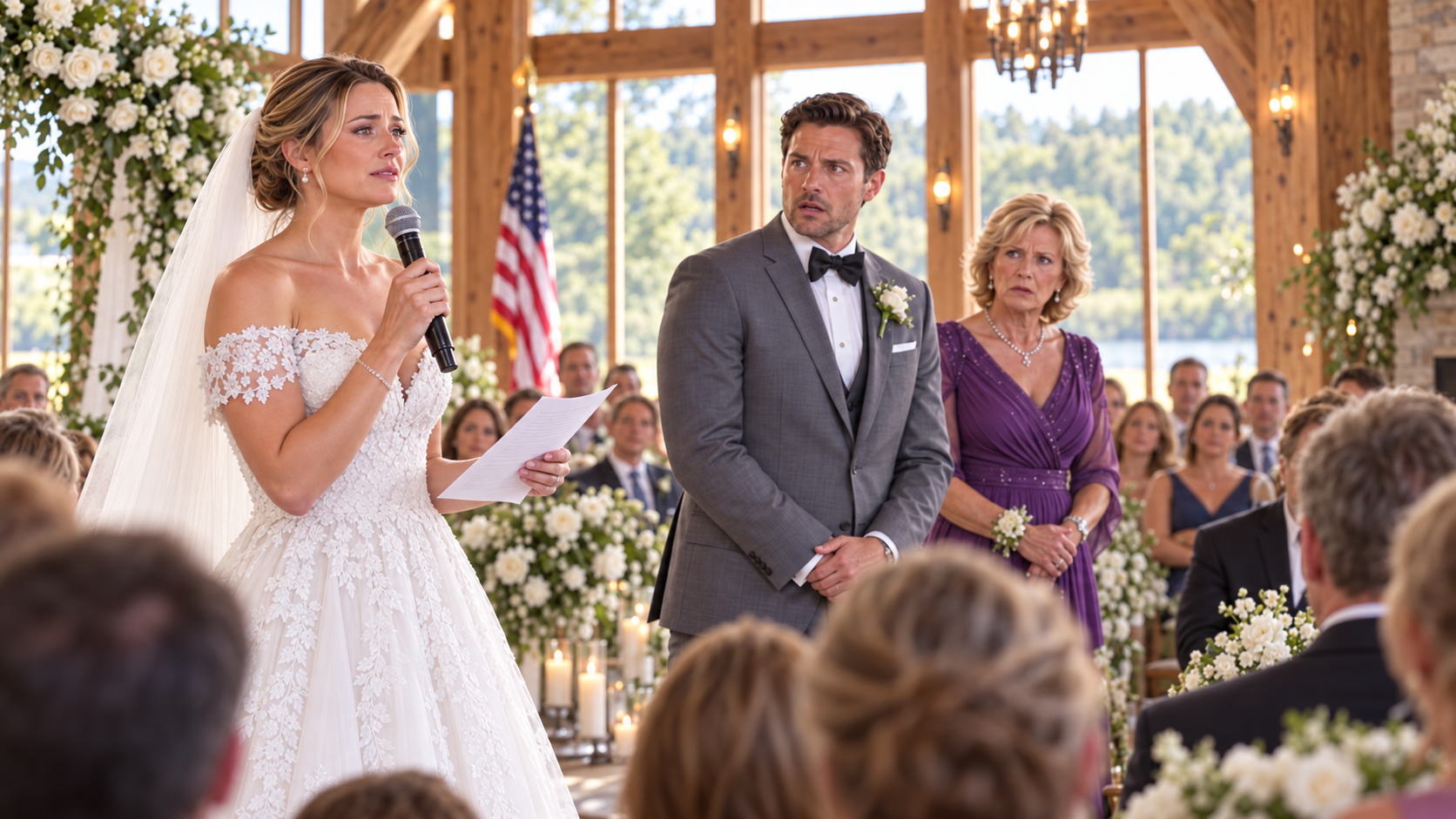
Grant stood beneath the wedding arch with his face completely drained of color.
Behind him, white roses climbed around polished cedar beams.
Tiny lights glowed above our heads.
The string quartet had stopped playing.
Almost one hundred guests were staring at the man I had nearly married.
Some looked horrified.
Some looked confused.
A few looked angry.
But I wasn’t watching them.
I was watching Grant.
And for the first time in three years, I saw him clearly.
Not the man who had brought me coffee before work.
Not the man who had helped Caleb build a model bridge for his science project.
Not the man who had sat cross-legged on the floor helping Maisie and June decorate Christmas cookies.
Not the man who had kissed my forehead and told me he loved the chaos of our house.
I saw the man behind all of those performances.
And strangely, once I finally saw him, I felt calmer than I had in two days.
Grant swallowed.
“Mara.”
His voice sounded small inside that enormous room.
I lifted one hand.
“No.”
He took a step toward me anyway.
“Please.”
“No.”
“Mara, you heard one conversation. You heard me angry. You heard things completely out of context.”
A laugh came from somewhere behind me.
Not a happy laugh.
A disbelieving one.
Grant looked toward the crowd.
That was his first mistake.
Because until then, I think some part of him still believed he could manage the room.
Grant was good at managing rooms.
He knew how to smile.
How to lower his voice.
How to appear reasonable while someone else became emotional.
He had done it to me more times than I could count.
But there was no charming his way around his own recorded voice.
Colleen rose from the front row.
She looked furious.
Not ashamed.
Not embarrassed.
Furious.
Her pale blue mother-of-the-groom dress shimmered beneath the lights as she stepped into the aisle.
“This is disgusting,” she said.
My best friend Elena turned toward her.
“Which part?”
Colleen blinked.
Elena folded her arms.
“The part where Mara played the recording, or the part where you planned to take her house?”
Several guests murmured.
Colleen’s jaw tightened.
“That isn’t what happened.”
I looked at her.
“Then explain it.”
She stared at me.
I waited.
So did everyone else.
“You don’t understand financial planning,” Colleen finally said.
I almost smiled.
I had founded an architecture firm twelve years earlier.
I had negotiated commercial leases.
Managed payroll.
Purchased property.
Handled investment accounts.
Sat through enough meetings with lawyers and accountants to know exactly what Grant had been discussing.
Yet somehow, in Colleen’s version of reality, I was still the naive woman who needed someone else to explain my own money to me.
“Please,” I said quietly.
“Explain financial planning.”
She hesitated.
Grant stepped between us.
“This shouldn’t be happening here.”
I looked around.
At the flowers.
The candles.
The rows of chairs.
The expensive place settings.
The photographs of Grant and me placed around the room.
Then I looked back at him.
“You’re right.”
Relief flickered across his face.
“It should have happened two days ago when you had the courage to tell me the truth yourself.”
His relief disappeared.
“But you didn’t.”
“Mara—”
“You smiled at me yesterday.”
He went silent.
“You came to my house last night.”
His eyes shifted.
“You ate dinner with Caleb.”
I felt my voice tremble.
That was the first moment emotion nearly broke through the wall I had built around myself.
“You asked him whether he was nervous about walking me down the aisle.”
Grant opened his mouth.
Nothing came out.
“You told Maisie her flower-girl basket looked beautiful.”
I could hear someone crying quietly among the guests.
“You fixed June’s bracelet when the clasp broke.”
I swallowed.
“And you knew the entire time that you had told your mother you were tired of pretending you could tolerate them.”
“Mara, I was frustrated.”
“No.”
“I didn’t mean it that way.”
“No.”
“I love those kids.”
“No.”
This time my voice came out louder.
Grant flinched.
The barn went silent again.
“You do not get to use that word right now.”
His face hardened slightly.
There.
That tiny shift.
I knew it.
I had seen it during arguments before.
When charm stopped working, irritation appeared.
When irritation stopped working, blame followed.
“Mara,” he said, lowering his voice, “you are humiliating me.”
I stared at him.
Of everything he could have said, that was what he chose.
Not I’m sorry.
Not I hurt you.
Not I hurt the children.
Not I lied.
Not I betrayed your trust.
He was worried about humiliation.
“You’re right,” I said.
Grant blinked.
“This is humiliating.”
His shoulders relaxed slightly.
Then I continued.
“But I didn’t create the humiliation.”
His face changed again.
“You did.”
I pointed toward the speakers.
“Those are your words.”
Then toward Colleen.
“Those are her questions.”
Then back to him.
“And that was your plan.”
Colleen suddenly stepped closer.
“You’re making this sound criminal.”
Rebecca stood from the second row.
Until that moment, she had remained quiet.
She was dressed in dark green, her black hair pinned neatly behind her head.
Grant knew Rebecca was my attorney.
What he did not know was that she had been working almost continuously since Thursday afternoon.
Rebecca picked up the slim leather folder resting beside her chair.
“Perhaps everyone should be very careful about which words they use from this point forward.”
Grant stared at her.
“Why is she here?”
I almost laughed.
“She was invited to my wedding.”
“You know what I mean.”
“Yes,” Rebecca said calmly. “I do.”
Grant’s expression changed.
For the first time, fear appeared.
Real fear.
Not embarrassment.
Not anger.
Fear.
He looked at me.
“What did you do?”
Those words almost amazed me.
Not What did you discover?
Not What did you protect?
What did you do?
As though the betrayal belonged to me now.
I looked at Rebecca.
She gave me the slightest nod.
I turned back toward Grant.
“I listened.”
He stared.
“I listened to what you said when you thought I couldn’t hear you.”
I removed my engagement ring.
A three-carat diamond Grant had spent months pretending was proof of his commitment.
For two days, wearing it had felt like carrying something rotten on my hand.
I placed it on the table beside the microphone.
“You were right about one thing.”
Grant looked at me.
“I am sentimental.”
My eyes burned.
“I kept the birthday cards my sister wrote me before she died.”
I looked toward the room where Maisie and June had been taken after the ceremony began.
“I kept the tiny bracelets the twins wore in the hospital.”
Then I thought of Caleb.
His missing front teeth when he was seven.
His first day of middle school.
The night he cried after realizing he could no longer remember the exact sound of his father’s laugh.
“I kept every drawing Caleb ever made me.”
My voice cracked.
“And yes, I wanted a family.”
Grant’s expression softened.
Perhaps he thought this was the opening he needed.
He reached toward me.
I stepped back.
“But sentimental doesn’t mean stupid.”
His hand fell.
“And loving people doesn’t mean giving them permission to destroy you.”
Applause started somewhere behind me.
One person.
Then another.
Then several more.
I turned.
“Please.”
The applause stopped.
“This isn’t something I want celebrated.”
My throat tightened.
“This was supposed to be my wedding day.”
That sentence nearly broke me.
Because beneath the anger was grief.
Real grief.
I had chosen flowers.
Written vows.
Ordered invitations.
Spent months imagining Grant standing across from me.
I had believed I was walking toward another chapter of my life.
Instead, I had spent forty-eight hours planning how to protect my children from the man waiting at the altar.
“I loved him,” I said.
The words surprised even me.
Grant’s eyes lifted.
“I really did.”
Tears blurred the lights above me.
“That is why this hurts.”
Grant stepped closer.
“Mara, then don’t do this.”
I looked at him.
He almost sounded sincere.
“We can fix it,” he whispered.
For one dangerous second, memory tried to betray me.
Sunday mornings.
His hand on the back of my neck while I cooked breakfast.
Road trips.
Inside jokes.
His toothbrush beside mine.
His shoes near the front door.
Three years of ordinary moments.
That was the hardest thing about betrayal.
The bad memories did not erase the good ones.
They poisoned them.
They made you wonder whether you had ever understood what you were living inside.
Grant saw hesitation on my face.
And he moved immediately.
“We go home,” he said softly. “Just you and me. Forget everyone else. We talk.”
I almost smiled.
There he was again.
The man who knew exactly what promise I wanted to hear.
Private conversation.
Soft voice.
Second chance.
Family.
He reached for my hand.
I moved it away.
“You still think you know me better than I know myself.”
His face tightened.
“Mara—”
“You said sentimental people are easy once you know which promise they need to hear.”
His eyes closed.
A few guests reacted quietly.
I looked at him.
“So which promise were you about to give me?”
Grant said nothing.
“That you love me?”
Silence.
“That you love the kids?”
His jaw clenched.
“That we can repair this?”
Still nothing.
“That your mother misunderstood?”
Colleen snapped, “I didn’t misunderstand anything.”
Grant whipped around.
“Mom.”
That one word carried pure panic.
Colleen realized too late what she had done.
Several people turned toward her.
Her face reddened.
Rebecca raised one eyebrow.
I nodded slowly.
“Thank you, Colleen.”
She stared at me.
“For finally telling the truth.”
Grant rubbed both hands over his face.
“This is insane.”
“No,” I said.
“It is finally very simple.”
I turned toward our guests.
Some were Grant’s friends.
Some were mine.
Some were clients.
Neighbors.
Cousins.
Coworkers.
People who had traveled from three states to watch us promise forever.
“I’m sorry you were brought into something so painful.”
Grant scoffed quietly.
I ignored him.
“The catering has been paid for.”
I heard a few startled laughs.
“The band has been paid.”
More laughter.
“And apparently there are two hundred miniature lemon tarts in the kitchen.”
That earned a genuine laugh.
Even I smiled.
“So please stay.”
Grant stared at me.
“You’re having the reception?”
I looked around.
“No.”
Then I looked toward the side room.
“I’m having dinner with my family.”
Caleb was standing in the hallway when I opened the door.
He had heard enough.
I could tell from his face.
The twins were behind him.
Maisie held June’s hand.
Their matching green dresses suddenly looked painfully small.
I had wanted to protect them from the recording.
I had arranged for Elena’s husband to take them into the side room before it played.
But sound travels.
And children understand far more than adults like to believe.
Caleb looked over my shoulder.
“Is it over?”
I nodded.
“Yes.”
He stared at me.
“The wedding?”
“Yes.”
His chin trembled.
I wanted him to cry.
Instead, he squared his shoulders.
“Okay.”
That hurt more.
I walked toward him.
“Caleb.”
“I’m okay.”
“No, you’re not.”
His face crumpled.
Neither was I.
I wrapped my arms around him.
For twelve years, I had known the weight of my son.
As a newborn asleep against my chest.
As a toddler clinging to my leg.
As a frightened six-year-old after his father died suddenly from an aneurysm.
But twelve-year-old boys rarely collapse into their mothers anymore.
That day, Caleb did.
He buried his face against my shoulder.
“I thought he liked us.”
The sentence tore straight through me.
I held him tighter.
“I know.”
“He said he wanted to be my dad.”
I shut my eyes.
“I know.”
“Was all of it fake?”
There are questions a mother wants desperately to answer.
And then there are questions where honesty is the only kindness you have left.
“I don’t know.”
He pulled away.
Tears streamed down his face.
“Then why did he do all that stuff with me?”
“I don’t know.”
“Baseball?”
“I don’t know.”
“Camping?”
“I don’t know.”
“He helped me with the bridge.”
“I know.”
Caleb wiped his face angrily.
“I hate him.”
I knelt despite the layers of my wedding dress gathering around me.
“Listen to me.”
He looked away.
“You are allowed to be angry.”
His shoulders shook.
“You are allowed to feel hurt.”
Maisie and June moved closer.
“You are allowed to miss him too.”
Caleb looked at me sharply.
“I don’t.”
“Maybe you won’t.”
I brushed tears from his cheek.
“But if you ever do, that doesn’t make what he did okay.”
Caleb swallowed.
I continued softly.
“You cared about who you thought he was. There is no shame in that.”
June started crying.
“Does Grant hate us?”
God.
I pulled her toward me.
“No.”
She looked confused.
“Then why did he say he couldn’t tolerate us?”
I searched for words.
How do you explain selfishness to a nine-year-old without teaching her to question her own worth?
“Sometimes,” I said slowly, “people pretend to be kinder than they really are because they want something.”
Maisie’s face hardened.
“The house.”
I looked at her.
“The house was part of it.”
“And money?”
“Yes.”
She squeezed her sister’s hand.
June whispered, “Did he want our money too?”
I hesitated.
That hesitation answered her.
June covered her mouth.
Maisie’s eyes widened.
Then something shifted in her.
My niece had always been the bolder twin.
June felt things openly.
Maisie collected them.
She stepped past me.
I caught her arm.
“Where are you going?”
“I want to talk to him.”
“Maisie.”
“I’m not going to yell.”
That worried me more.
She looked at me.
“I want to ask him one thing.”
I stood.
“You don’t have to.”
“I know.”
“Are you sure?”
She nodded.
So the four of us walked back into the barn.
The room had changed.
Some guests had begun moving toward the reception tables.
Others remained near the ceremony area.
Grant stood with his mother beside the arch.
His best man, Trevor, was speaking quietly to him.
When Grant saw the children, his face changed.
“Caleb.”
My son stopped.
Grant took a step toward him.
Caleb moved behind me.
Grant froze.
Maisie walked forward.
I stayed close.
She looked impossibly young standing there in her green dress.
Grant stared at her.
“Maisie, sweetheart—”
“Don’t call me that.”
Grant stopped.
Colleen whispered something under her breath.
Maisie ignored her.
She looked directly at Grant.
“When Aunt Mara and Mom were little, did you know they shared a bedroom?”
Grant blinked.
“What?”
“My mom.”
Maisie’s voice remained steady.
“She was Aunt Mara’s sister.”
“Yes. Of course.”
“After Mom got sick, Aunt Mara slept beside her in the hospital for almost two months.”
I felt the air leave my lungs.
Maisie looked toward me.
“She told us.”
Then she looked back at Grant.
“When Mom died, Aunt Mara promised she would take care of us.”
Grant lowered his eyes.
Maisie continued.
“The trust money came from Mom’s life insurance and some money Grandpa left us.”
Grant said nothing.
“That money is for me and June.”
“I know.”
“If you knew, why did you want it?”
Colleen stepped forward.
“No one wanted your money.”
Maisie looked at her.
“Yes, you did.”
Colleen stiffened.
“I heard the recording.”
“You misunderstood an adult conversation.”
“No.”
One word.
Soft.
Certain.
“I’m nine. I’m not stupid.”
Several guests looked away.
Colleen flushed.
Maisie turned back to Grant.
“You said you were pretending.”
Grant’s mouth opened.
She waited.
“You said our house was noisy.”
“It is,” Grant said desperately. “But that doesn’t mean—”
“We like it noisy.”
That nearly destroyed me.
Maisie glanced toward June.
“Because when it’s quiet, June thinks about Mom.”
June began crying again.
I covered my mouth.
Maisie’s own tears finally appeared.
“When Aunt Mara took us home after Mom died, June couldn’t sleep if the house was quiet.”
Her voice shook.
“So Caleb started playing music in the hallway.”
Caleb stared at her.
“I remember.”
“And Aunt Mara bought that little fountain for our room because the sound helped.”
Maisie wiped her face.
“So maybe you hate the noise.”
She looked at Grant.
“But it means we’re home.”
No one spoke.
Grant looked like he had been struck.
Maisie took one more breath.
“That was my question.”
“What?”
“If you knew our money came from our mom, why would you try to take it?”
Grant looked at the floor.
Maisie waited.
He had no answer.
That was the answer.
She turned around.
I opened my arms.
She walked directly into them.
I held all three children.
For years afterward, people would tell me that the recording was the moment the wedding ended.
They were wrong.
The wedding ended when a nine-year-old girl asked the man I was supposed to marry why he wanted money left behind by her dead mother.
Everything after that was paperwork.
Grant refused to leave.
At first.
The venue manager approached him discreetly.
Grant brushed him away.
“This is my wedding too.”
“No,” I said.
He stared at me.
“It isn’t.”
“You don’t get to make every decision.”
“I canceled the marriage.”
“That doesn’t mean you own the venue.”
Actually, there was something almost funny about that.
Rebecca stepped forward.
“Mara signed the venue contract.”
Grant looked at her.
“She paid the balance from her business account.”
His mouth tightened.
Rebecca continued.
“Your name appears as the groom, not the purchaser.”
Colleen scoffed.
“This is ridiculous.”
The venue manager cleared his throat.
“Mr. Bennett, I’m going to have to ask you to leave.”
Grant looked around.
He seemed genuinely shocked.
Perhaps he had expected his friends to stand beside him.
Some did.
At least at first.
His best man, Trevor, pulled him aside.
The conversation grew tense.
I couldn’t hear every word.
Then Trevor said loudly enough for several of us to hear:
“You told me the agreement was about protecting her assets.”
Grant glanced toward me.
Trevor’s face had changed.
“You told me she wanted it.”
“She did.”
“No,” Rebecca said.
Trevor turned.
Rebecca remained calm.
“Mara’s original agreement protected premarital property on both sides. Grant repeatedly requested revisions.”
Grant glared at her.
“This isn’t attorney-client information.”
“No,” Rebecca replied. “It isn’t.”
Trevor looked at Grant.
“What revisions?”
I answered.
“The later draft would have made it easier to convert separate property into marital property.”
Trevor stared.
Grant shook his head.
“That is an oversimplification.”
Rebecca opened her folder.
“Would you prefer the exact language?”
Grant went silent.
Trevor took a step back.
“Man.”
Grant’s expression hardened.
“Don’t.”
Trevor rubbed his jaw.
“You asked me to stand beside you.”
“I know.”
“You told me Mara didn’t trust you.”
Grant looked at him.
“You told me that was why she kept delaying the paperwork.”
“It was complicated.”
Trevor shook his head slowly.
“No.”
Then he removed the small boutonniere from his jacket.
He placed it on a chair.
“You made it complicated.”
And he walked away.
Grant watched his best friend leave the ceremony area.
Something in him finally snapped.
He turned toward me.
“This is what you wanted?”
His voice rose.
I stiffened.
“You wanted everyone against me?”
“No.”
“You played a private conversation in front of my family.”
“You planned to use my family against me in private.”
His face darkened.
“That isn’t the same thing.”
“You’re right.”
I nodded.
“It’s worse.”
Grant pointed toward Rebecca.
“You’ve been poisoning this since the beginning.”
Rebecca didn’t respond.
“I should have known the moment you hired her.”
I stared at him.
“I hired an attorney to review a legal agreement.”
“You hired someone who convinced you marriage was a business transaction.”
A bitter laugh escaped me.
“You were literally discussing leveraging my house to pay your debt.”
His mother interrupted.
“That debt was temporary.”
I looked at her.
“How much?”
Silence.
Grant turned.
“Mom.”
“How much debt?”
Colleen crossed her arms.
“That isn’t your business anymore.”
Rebecca answered.
“Four hundred and eighty-three thousand dollars that we have identified so far.”
The room erupted.
Not loudly.
A collective intake of breath.
Whispers.
Grant looked murderous.
I had learned the full number the previous afternoon.
Hearing it aloud still made my stomach twist.
When Grant and I met, he told me his consulting business was doing well.
He drove a beautiful car.
Owned a downtown condominium.
Traveled.
Invested.
At least, that was the picture he gave me.
But the truth was different.
The condo had been refinanced twice.
The car was leased.
His business carried loans.
He had significant personal debt.
And during the previous eighteen months, the pressure had become worse.
Much worse.
He had hidden all of it.
I looked at him.
“You could have told me.”
Grant laughed bitterly.
“And what would you have done?”
“I don’t know.”
“Yes, you do.”
He stepped closer.
“You would have left.”
“No.”
He hesitated.
I shook my head.
“If you had come to me eighteen months ago and said your business was failing, I would have listened.”
His expression changed.
“If you had said you were terrified, I would have listened.”
He looked away.
“If you had asked me for help, maybe I would have helped.”
Colleen stared at me.
Grant looked back.
“Then what difference does it make?”
My eyes narrowed.
“All the difference.”
“Money is money.”
“No.”
I stepped toward him.
“Help is not the same as theft.”
His face hardened.
“It wasn’t theft.”
“Love offered freely is not the same thing as manipulation.”
“Mara—”
“And a family choosing to help someone is not the same as that person secretly designing a way to gain control.”
He shook his head.
“You always have to make yourself the hero.”
That one surprised me.
Grant saw it.
So he kept going.
“You do.”
His voice grew sharper.
“Perfect Mara.”
Colleen watched silently.
“Successful architect.”
He gestured around the room.
“Perfect house. Perfect children. Perfect little tragic story where you rescued your sister’s kids.”
My body went cold.
“You don’t get to talk about my sister.”
Grant ignored me.
“You never needed anybody.”
“That bothered you?”
“Yes!”
The word echoed.
Grant froze.
So did I.
Finally.
Something honest.
He stared at me.
“Yes.”
His voice dropped.
“It did.”
I said nothing.
“You had everything before I arrived.”
“I had a life.”
“You had a house.”
“Yes.”
“A business.”
“Yes.”
“Investments.”
“Yes.”
“People who worship you.”
I almost laughed.
“My children do not worship me.”
“You know what I mean.”
“No. I don’t.”
Grant dragged a hand through his hair.
“With me, everything was unstable.”
I watched him.
“My business started failing.”
His anger began collapsing into something uglier.
Shame.
“I made bad investments.”
Colleen touched his arm.
He shook her off.
“I borrowed against the condo.”
I said nothing.
“I thought I could fix it.”
His voice cracked slightly.
“And then I met you.”
For one second, I saw the man I had loved.
Not because he was innocent.
But because he was finally telling the truth.
“You were so secure.”
He laughed bitterly.
“You had a retirement account before forty.”
A few people shifted awkwardly.
“You had college funds.”
“Because I had children depending on me.”
“I know.”
“Do you?”
His eyes lowered.
“I thought if we got married, maybe I could breathe.”
There it was.
Maybe the saddest truth of the day.
I looked at him.
“You could have breathed beside me.”
He raised his eyes.
“You didn’t have to climb on top of me to do it.”
Grant looked away.
“And the children?”
I asked.
He stiffened.
“What about them?”
“The money explains the agreement.”
I pointed toward the side room.
“It does not explain them.”
He swallowed.
“You called our home a noisy little household.”
“I was venting.”
“You said you were tired of pretending.”
“I was angry.”
“At whom?”
He didn’t answer.
“At Caleb?”
“No.”
“At Maisie?”
“No.”
“At June?”
“No.”
“Then who?”
“You.”
The word landed softly.
Almost gently.
I stared.
Grant laughed once.
There was no humor in it.
“You want the truth?”
“Yes.”
“Fine.”
He looked around the barn.
“You always chose them first.”
I felt something inside me settle.
Not break.
Settle.
The final piece.
“Of course I did.”
His expression hardened.
“Exactly.”
I nodded slowly.
“They are children.”
“I know.”
“They depend on me.”
“I know.”
“My sister trusted me with her daughters.”
“I KNOW.”
Grant’s shout echoed through the barn.
Several guests stepped closer.
The children were no longer in the room.
Thank God.
Grant took a breath.
“I know.”
He lowered his voice.
“But there was never room where I came first.”
I stared at him.
“You are a grown man.”
His jaw tightened.
“Yes.”
“You wanted me to put you ahead of three children.”
“That’s not what I said.”
“It is exactly what you said.”
“No.”
“You resented them.”
“I resented always being fourth.”
My heart stopped hurting in that moment.
Not completely.
But differently.
The grief changed shape.
Because suddenly, I understood something I should have seen earlier.
Grant had not simply wanted love.
He wanted priority.
Control.
Evidence that being loved meant being placed above everyone else.
And no amount of love I gave him could have satisfied someone who measured affection as a competition.
I looked at him for a long moment.
Then I said the sentence that finally ended everything.
“My children were never competing with you.”
Grant looked away.
“You were competing with them.”
Silence.
“And you lost a competition that existed only in your head.”
His face went blank.
I turned away.
He called my name.
I kept walking.
“Mara.”
I stopped but did not turn around.
“I did love you.”
His voice cracked.
That hurt.
Because maybe part of him had.
People are rarely one thing.
Grant could have loved me and still tried to use me.
He could have cared for Caleb and still resented him.
He could have laughed with the twins and still coveted their trust.
Human beings can hold contradictions terrible enough to destroy everyone around them.
I turned back.
“I believe you loved what being with me could give you.”
Grant flinched.
“And maybe somewhere inside that, you loved me too.”
His eyes filled.
“But I cannot build a marriage on needing to guess which part is real.”
I walked away.
The venue manager escorted Grant and Colleen outside.
Neither came back.
For the first hour after they left, nobody knew what to do.
That was almost funny.
A wedding has instructions.
Sit.
Stand.
Watch.
Toast.
Dance.
A canceled wedding has no etiquette.
My Aunt Teresa came over first.
She hugged me so tightly my veil caught against her earrings.
“I’m sorry,” she whispered.
I cried against her shoulder.
Not elegantly.
Not quietly.
I cried the way people cry when something they have been holding together finally gives way.
Three years.
I cried for all of it.
The first date.
The first Christmas.
The night Grant proposed.
The wedding dress.
The vows I had written and hidden in the nightstand.
The future that had existed in my head until Thursday afternoon.
I cried because I had loved a man who did not exist in exactly the way I believed he did.
And grief does not care whether the person is dead.
Sometimes you mourn people who are still alive.
Sometimes you mourn futures that never happened.
Sometimes you mourn the version of yourself who believed them.
Aunt Teresa held me.
When I finally pulled away, my makeup was ruined.
Her shoulder was stained.
“Sorry.”
She looked at her dress.
“I hated this thing anyway.”
I laughed.
A wet, broken laugh.
Then Elena appeared carrying two glasses of champagne.
I stared at her.
She handed me one.
“Is this inappropriate?”
“Extremely.”
“Good.”
I took it.
She lifted hers.
“To not getting married.”
I shook my head.
“Terrible toast.”
“Fine.”
She thought.
“To listening when people accidentally tell you exactly who they are.”
That one I accepted.
We drank.
Someone started the music again.
Quietly at first.
People moved toward the tables.
The caterers served dinner.
And somehow, the worst day of my life became something else.
Not a celebration of the marriage that almost happened.
A celebration of the family that was still standing.
Caleb changed out of his suit jacket after twenty minutes.
June ate three lemon tarts.
Maisie ate four and denied the fourth when questioned.
My employees stayed.
My neighbors stayed.
Even some of Grant’s relatives stayed.
His cousin Natalie came over while I was sitting with the children.
She looked uncomfortable.
“I don’t know whether I’m supposed to apologize.”
“You didn’t do anything.”
She nodded.
“I had no idea.”
“I know.”
She glanced toward the door.
“Colleen has always been…”
She stopped.
I smiled faintly.
“You don’t have to explain her.”
Natalie looked relieved.
Then she reached into her purse.
“I brought you a wedding gift.”
I almost laughed.
“You can take it home.”
“No.”
“Natalie.”
“It’s a waffle maker.”
I stared at her.
She shrugged.
“You’re still going to eat waffles.”
Caleb burst out laughing.
So did I.
It was the first real laugh I had managed all day.
“Fine.”
She put the envelope containing the receipt beside me.
“Keep the waffle maker.”
And that became the mood.
People did not pretend nothing had happened.
They also refused to let what had happened destroy everything.
The photographer stayed.
At first I told her she could leave.
Instead, she asked one question.
“Would you like family pictures?”
I looked at the children.
My wedding photographs were supposed to show Grant and me beginning our lives together.
Instead, I have photographs of Caleb in his navy suit.
Maisie and June in green dresses.
Elena holding champagne.
Aunt Teresa laughing so hard her head is thrown backward.
Rebecca standing beside me with one hand around my shoulders.
And one photograph that now hangs in my bedroom.
The four of us.
Me in my wedding dress.
Caleb on one side.
The twins on the other.
All of us barefoot because the children had complained about their shoes.
My veil was gone.
My makeup was nearly gone.
My eyes were swollen.
But I was smiling.
Really smiling.
Not because everything was fine.
Because I finally understood what had survived.
At eight that evening, Caleb found me outside.
The sun had dropped behind the hills.
My dress dragged through the grass as I walked toward the old oak tree behind the barn.
I heard footsteps.
“Mom?”
I turned.
He had loosened his tie.
“Hey.”
“Can I ask something?”
“Always.”
He shoved his hands into his pockets.
“Did you know before today that you weren’t going to marry him?”
“Yes.”
“How long?”
“Since Thursday.”
He looked down.
“Why didn’t you tell us?”
There was no accusation in his voice.
That made it worse.
“I wanted you to have two more normal days.”
He kicked at the grass.
“Was that wrong?”
I asked.
He thought about it.
“I don’t know.”
“Neither do I.”
He looked toward the barn.
“I would have wanted to know.”
I nodded.
“That’s fair.”
He seemed surprised.
“You’re not going to say you were protecting me?”
“I was protecting you.”
He looked at me.
“But that doesn’t automatically mean I made the best decision.”
Caleb considered that.
Then nodded.
I loved that about him.
He didn’t need adults to pretend they were perfect.
He needed them to be honest.
“Did you really think he was going to be my dad?”
I sat on the wooden bench beneath the tree.
Caleb sat beside me.
“Yes.”
“Like Dad?”
“No.”
He looked at me.
“No one will ever replace your dad.”
“I know.”
“But I thought Grant could be another person who loved you.”
Caleb stared at his shoes.
“Dad would have hated him.”
I smiled faintly.
“Your father hated anybody who borrowed tools and didn’t return them.”
Caleb laughed.
“So probably.”
We sat quietly.
His father, Daniel, had died when Caleb was six.
Daniel was not perfect.
Neither was our marriage.
We argued about bills.
Laundry.
His habit of leaving cabinet doors open.
My tendency to answer emails during dinner.
But he loved our son in a way that never felt performative.
After my sister died two years before Daniel, he welcomed her daughters into our lives without hesitation.
He built bunk beds.
Learned how to braid hair from online videos.
Burned pancakes every Saturday morning.
He never called the house noisy.
He called it alive.
Sometimes losing one good person makes it easier to mistake a convincing person for another good one.
Grant knew how badly I missed partnership.
I had confused his willingness to step into our routines with his willingness to belong to them.
“Mom?”
“Yes?”
“Are we okay?”
I looked at my twelve-year-old son.
Then toward the barn where my nieces were chasing each other around tables in flower-girl dresses.
“No.”
His face fell slightly.
“Not yet.”
I slipped my hand into his.
“But we will be.”
He squeezed it.
After a moment, he smiled.
“Can we eat the top layer of the wedding cake?”
“That’s supposed to be frozen until the first anniversary.”
He raised an eyebrow.
“Well.”
I laughed.
“Excellent point.”
We ate the entire top layer.
Grant called nineteen times that night.
I answered none.
He sent messages.
At first apologetic.
Then defensive.
Then angry.
Then apologetic again.
Please let me explain.
You misunderstood parts of that conversation.
My mother pushed the financial discussion.
I shouldn’t have said what I said about the kids.
I love you.
You embarrassed me in front of everyone.
You had no right to share a private recording.
Please just answer.
Mara, three years cannot disappear because of nine minutes.
That last message hurt.
Because he was right about one thing.
Three years did not disappear.
That was precisely the problem.
I remembered all three.
And now I had to reevaluate them.
At 11:47 p.m., another message appeared.
I’m outside your house.
My stomach dropped.
I was home with the children.
Elena had insisted on staying.
Her husband had taken their kids home, but Elena sat in my kitchen wearing sweatpants beneath the silk blouse she had worn to the wedding.
Rebecca had already warned me this might happen.
I looked through the camera.
Grant stood at the front gate.
Still wearing his wedding trousers and white shirt.
His tie was gone.
He looked exhausted.
For one second, pity stirred inside me.
Then he pressed the buzzer repeatedly.
Caleb appeared at the top of the stairs.
“Is that him?”
“Yes.”
Elena stood.
“I’ll call someone.”
“I’ve got it.”
I used the intercom.
“Grant.”
His head lifted.
“Mara.”
“You need to leave.”
“Please open the gate.”
“No.”
“Five minutes.”
“No.”
“I need my things.”
“You can arrange collection through Rebecca.”
“I lived there.”
The word lived struck me strangely.
He had stayed at my house most nights for nearly a year.
But he maintained his condo.
We had deliberately avoided fully merging households until after the wedding.
At the time, I thought that was mature.
Now I was grateful.
“Your belongings will be packed.”
“This is insane.”
“Leave.”
He moved closer to the camera.
“Mara, I am begging you.”
My hand trembled.
Elena watched me.
I looked toward the stairs.
Caleb was still there.
Listening.
Watching what I would do.
That mattered.
Maybe more than anything.
Children learn boundaries from the boundaries adults allow to be broken.
“No.”
Grant stared at the camera.
“Do you really want this to be the last memory we have?”
“It isn’t.”
He frowned.
“We have three years of memories.”
My voice softened.
“Some of them were beautiful.”
His expression broke.
“So don’t throw them away.”
“I’m not.”
He looked hopeful.
“I’m letting them stay in the past.”
His face crumpled.
I nearly cried.
“You cannot come inside.”
“Mara.”
“Goodbye, Grant.”
I disconnected the intercom.
He remained outside for seventeen minutes.
Then he left.
I stood in the dark kitchen afterward.
Elena poured me tea.
Neither of us spoke.
Finally she asked:
“Do you want me to tell you that you did the right thing?”
I looked at her.
“No.”
“Good.”
She sat opposite me.
“Because tonight it probably doesn’t feel right.”
Tears filled my eyes.
“It feels horrible.”
“I know.”
“I miss him.”
“I know.”
“I hate that I miss him.”
Elena reached across the table.
“You don’t miss what he did.”
I looked at her.
“You miss who you thought was coming home with you tonight.”
That broke me.
I covered my face.
And my best friend sat beside me on the kitchen floor while I cried in the remains of my wedding makeup until almost two in the morning.
The financial story became uglier over the following weeks.
Rebecca uncovered more.
There had been no completed transfer.
No signed agreement giving Grant access to my house.
No legal claim on the twins’ trust.
That mattered.
Very much.
But Grant had been preparing.
Emails.
Draft proposals.
Questions to financial advisers.
Notes about refinancing.
He had told one lender that after our marriage, his “household asset position” would change significantly.
He had discussed selling his condominium after the wedding.
He had investigated borrowing options secured by real estate he did not own.
Some of what he had done was merely dishonest.
Some raised questions Rebecca believed needed professional review.
I followed her advice.
Quietly.
No social media war.
No public campaign.
No revenge.
I did not need one.
The recording had already shown enough people exactly who Grant was when he believed I could not hear him.
My job was no longer to punish him.
My job was to protect what remained mine.
The house.
My company.
My children.
My peace.
Colleen threatened to sue me for defamation.
Rebecca responded with one letter.
We never heard about the lawsuit again.
Grant demanded reimbursement for wedding expenses.
The accounting showed I had paid approximately eighty-six percent.
He had paid for his tuxedo, several vendor deposits, and part of the rehearsal dinner.
Rebecca proposed that we simply walk away from each other’s contributions.
Grant refused.
For nine days.
Then accepted.
The engagement ring became another argument.
Technically, depending on the circumstances and jurisdiction, engagement rings can create legal disputes when weddings do not occur.
I had no emotional attachment to keeping it.
I returned it through Rebecca.
Not because Grant asked.
Because every time I saw that diamond, I remembered him standing beneath white roses asking why I had humiliated him.
I wanted nothing from him.
Not even something beautiful.
Especially not something beautiful.
The children struggled in different ways.
June became quiet.
For several weeks, she stopped asking people to stay over.
Whenever Elena visited, June asked exactly when she was leaving.
When Aunt Teresa came for dinner, June asked if she was coming back next week.
Abandonment had already entered her life once when her mother died.
Grant awakened it again.
So we started therapy.
All of us.
Not because we were broken.
Because we had been hurt.
There is a difference.
Maisie became angry.
At everything.
Shoes.
Homework.
Breakfast.
One morning she burst into tears because I bought the wrong cereal.
She screamed that I never listened.
Then she apologized so intensely she could barely breathe.
I held her.
“This isn’t about cereal, is it?”
She shook her head.
“Are you mad at me?”
She shook it again.
“Grant?”
She nodded.
“I hate him.”
“I know.”
“I hate that I miss movie nights.”
“I know.”
“I hate that too.”
She looked at me.
“You miss him?”
“Yes.”
She seemed relieved.
Children sometimes think adults heal by magic.
It comforted her to know grief was confusing for me too.
“I miss who I thought he was,” I explained.
Maisie wiped her nose.
“That’s weird.”
“Very.”
She leaned against me.
“Can we still hate him?”
“You can feel whatever you feel.”
“What do you feel?”
I thought about it.
“Different things on different days.”
That became our family rule.
No one had to choose one emotion.
Caleb had the hardest time trusting himself.
That surprised me.
He had liked Grant.
Really liked him.
Grant had attended his baseball games.
Helped him practice presentations.
Taken him camping.
Taught him how to change a tire.
Caleb began questioning every memory.
“Do you think he really wanted to go fishing with me?”
“I don’t know.”
“Do you think he meant it when he said my bridge was good?”
“I don’t know.”
“Do you think he cared when I got sick?”
“I don’t know.”
One evening, after weeks of those questions, I sat on the edge of his bed.
“Caleb.”
He looked at me.
“You may never know which moments were real for him.”
His face fell.
“But they were real for you.”
He frowned.
“The fishing trip happened.”
“Yeah.”
“You had fun.”
“Yeah.”
“You learned how to use the new reel.”
“Yeah.”
“You saw that huge deer.”
He smiled despite himself.
“It was massive.”
“So Grant cannot take that memory away just because he turned out to be someone different from the person you believed.”
Caleb looked at me.
“Is that what you’re doing?”
“What?”
“Keeping the good memories.”
I thought about Grant dancing with me in the kitchen.
Helping me repaint the guest room.
Driving through a snowstorm because June had forgotten her stuffed rabbit at his condo.
“Yes.”
Caleb looked surprised.
“You don’t have to destroy every good memory to accept a bad truth.”
He nodded slowly.
That lesson saved me too.
Three months after the canceled wedding, Grant came to my office.
He did not make it past reception.
My assistant called upstairs.
“Mara?”
“Yes?”
“There’s someone here.”
I knew before she said his name.
“Grant Bennett.”
My stomach tightened.
“Is Rebecca here?”
“No.”
“Security?”
“Downstairs.”
I almost told her to send him away.
Then I looked through the glass wall of my office.
Outside, my team was discussing a new housing development.
Plans were spread across long tables.
Phones rang.
Printers hummed.
Life had continued.
I had continued.
“Give me five minutes with him in the conference room.”
“You sure?”
“Yes.”
Grant looked different.
Not dramatically.
Just diminished.
He had lost weight.
His hair was longer.
The expensive watch he always wore was gone.
He stood when I entered.
“Hi.”
“Hello.”
“I won’t stay.”
I sat opposite him.
“That would be best.”
He nodded.
For a moment, neither of us spoke.
Then he placed an envelope on the table.
“What is that?”
“A letter.”
“To me?”
“And the kids.”
My body tightened.
“No.”
“Mara.”
“No.”
He pulled his hand back.
“I don’t want you contacting them.”
“I’m not asking to see them.”
“Then why the letter?”
“Because I owe them an apology.”
I stared at him.
“You owed them honesty before you planned to marry their guardian.”
“I know.”
The simplicity of his answer stopped me.
No argument.
No excuse.
He looked down.
“I started therapy.”
I said nothing.
“I know that doesn’t change anything.”
“It doesn’t.”
“I know.”
He looked toward the envelope.
“My therapist told me writing apologies doesn’t mean people have to accept them.”
“That sounds accurate.”
A faint smile touched his face.
Gone quickly.
“I lost the condo.”
I had heard.
He had sold it under financial pressure.
“I’m sorry.”
He looked surprised.
“You are?”
“Yes.”
“Why?”
“Because losing your home is painful.”
Grant stared at me.
“You’re unbelievable.”
I stiffened.
He shook his head quickly.
“No. Sorry. I didn’t mean that badly.”
He rubbed his forehead.
“I spent so long thinking your kindness was weakness.”
I said nothing.
“And then after everything I did, you can sit there and say you’re sorry I lost my condo.”
He laughed softly.
“I really didn’t understand you.”
“No.”
“I didn’t.”
He looked at me.
“I also didn’t understand myself.”
Silence.
He leaned back.
“For years, my mother solved everything.”
I resisted reacting.
“When my dad left, she told me the world takes advantage of people who aren’t prepared to take advantage first.”
I listened.
“She helped me hide mistakes.”
“Grant—”
“I’m not blaming her.”
“Good.”
“I did that for a long time.”
He looked at his hands.
“Blamed everybody.”
His business partner.
Banks.
Clients.
The economy.
Me.
The children.
“Turns out I made a lot of my own problems.”
“Yes.”
He almost laughed.
“I expected that one.”
I folded my hands.
“Why are you here?”
He looked at me.
“To say something without asking you for anything afterward.”
I waited.
“I’m sorry.”
My throat tightened.
“For the agreement.”
He swallowed.
“For the money.”
His eyes grew wet.
“For talking about the twins’ trust as though it were an opportunity instead of something their mother left to protect them.”
I looked away.
“And for Caleb.”
He breathed slowly.
“I liked him.”
My eyes returned to his.
“I know you probably don’t believe me.”
“I believe complicated things can both be true.”
He nodded.
“I did like him.”
His voice cracked.
“He’s a great kid.”
“Yes.”
“I also resented how much you loved him.”
I said nothing.
“That’s one of the ugliest things I’ve had to admit.”
“It should be.”
He nodded.
“I know.”
We sat in silence.
“And the twins?”
“I liked them too.”
I raised an eyebrow.
He almost smiled.
“Even the noise.”
I looked away.
“But there were days I felt invisible in your house.”
“Then you should have told me.”
“I know.”
“You should have told me before you proposed.”
“I know.”
“You should have told me before you let them love you.”
His eyes filled.
“I know.”
I looked at the envelope.
“You can leave it.”
He nodded.
“I’m not promising they’ll read it.”
“I understand.”
“And you won’t contact them directly.”
“I won’t.”
He stood.
For a moment, he remained beside the chair.
Then he looked at me.
“There’s one more thing.”
“What?”
“You were right.”
I almost laughed.
“That narrows it down very little.”
He smiled.
A real smile.
Small.
Sad.
“You said I was competing with children in a competition that only existed in my head.”
I remembered.
“I was.”
He slipped his hands into his pockets.
“And you were never asking me to come fourth.”
I watched him.
“You were asking me to become part of the same team.”
My eyes burned.
“Yes.”
“I understand that now.”
“That’s good.”
He looked at me for a long time.
“Too late.”
“Yes.”
He nodded.
“Too late.”
He walked toward the door.
“Grant.”
He stopped.
I had not planned to say anything else.
Maybe I shouldn’t have.
But healing had taught me that kindness and boundaries could occupy the same sentence.
“I hope therapy helps.”
He looked at me.
“Really?”
“Yes.”
His eyes filled.
“Thank you.”
“But I do not want you back.”
He nodded.
“I know.”
“I need you to understand both statements are true.”
“I do.”
Then he left.
I opened his letter that evening.
I read mine.
The children’s letters remained sealed.
I told each of them they existed.
Maisie read hers immediately.
June waited six months.
Caleb never opened his.
As far as I know, he still has it in a box beneath his bed.
That was his choice.
Healing should never require accepting an apology on somebody else’s schedule.
A year passed.
Then another.
Life became ordinary again.
Beautifully ordinary.
Caleb grew six inches and started eating everything that wasn’t physically nailed down.
Maisie quit dance and joined robotics.
June discovered theater and turned our upstairs hallway into a rehearsal stage.
The house remained noisy.
Gloriously noisy.
Doors slammed.
Music played.
Friends came over.
Shoes accumulated near the entryway.
Someone was always looking for a charger.
Someone was always hungry.
Someone always had homework due tomorrow that they had known about for three weeks.
I never complained about the noise again.
Not seriously.
Sometimes I would stand in the kitchen while three conversations happened simultaneously and remember Grant’s recorded voice.
Tired of pretending I enjoy that noisy little household.
And I would look around.
At backpacks.
Half-finished cereal.
Dance costumes that had become theater costumes.
Caleb’s enormous sneakers.
The photograph of my sister on the refrigerator.
And think:
He had no idea what he was looking at.
The noise was life.
It was grief surviving long enough to become laughter again.
It was children who felt safe enough to argue.
It was music being played badly.
It was friends arriving without knocking.
It was doors opening.
People coming home.
Love is not always quiet.
Sometimes love sounds like someone shouting from upstairs asking where their socks are.
Two years after the wedding that never happened, Caleb turned fourteen.
I found him in the garage working on a bicycle.
He had grown taller than me.
That felt deeply unfair.
“Need help?”
He looked up.
“Do you know how to fix a derailleur?”
“No.”
“Then no.”
I leaned against the doorway.
“I raised you.”
“Yes.”
“I fed you.”
“Yes.”
“I paid for that bicycle.”
He grinned.
“Still no.”
I threw a rag at him.
He laughed.
Then his expression changed.
“Mom?”
“Yes?”
“Do you ever want to get married again?”
The question surprised me.
“I don’t know.”
“You could.”
“I know.”
“I wouldn’t care.”
“Thank you for your permission.”
He rolled his eyes.
“I mean it.”
I walked closer.
“Why are you asking?”
He shrugged.
“I don’t want you to think you can’t because of us.”
My chest tightened.
“Caleb.”
“I know Grant was weird about it.”
“Weird is generous.”
He smiled.
“But if you meet somebody, you don’t have to pick us over them.”
I looked at my son.
There it was again.
The scar Grant had left.
Even years later.
I sat beside him.
“There is something I need you to understand.”
Caleb waited.
“The right person will never ask me to choose between loving them and loving you.”
He nodded.
“And if someone makes love feel like a competition, they are not the right person.”
“What if they feel left out?”
“Then we talk.”
“What if they need more time with you?”
“We talk.”
“What if—”
“We talk.”
He smiled.
“That’s your answer to everything.”
“No. Sometimes my answer is tacos.”
“That’s true.”
I nudged his shoulder.
“But healthy families talk about needs. They don’t secretly punish each other for having them.”
Caleb nodded.
Then he looked at the bicycle again.
“Would you?”
“Would I what?”
“Get married.”
I thought about it.
“Maybe.”
He smiled.
“Cool.”
“Are you trying to get rid of me?”
“No.”
He tightened a bolt.
“But you date terrible.”
I stared at him.
He burst out laughing.
For the record, he was not entirely wrong.
I did date eventually.
Badly at first.
On my first date after Grant, I asked a perfectly nice man whether he had any hidden debt before the appetizers arrived.
He nearly choked on an olive.
Elena laughed for eleven straight minutes when I told her.
The second man spent the entire evening talking about cryptocurrency.
There was no second date.
The third introduced himself by explaining that women were “too independent now.”
I left before dessert.
Then I stopped trying.
Not because I had given up on love.
Because I no longer needed marriage to prove my life was complete.
That realization changed everything.
I had spent years believing partnership was the missing piece.
After Daniel died, I wanted someone beside me again.
Someone to share the bills.
The parenting.
The worries.
The quiet moments after children went to bed.
That desire was not wrong.
But desire can become dangerous when we start treating it like hunger.
Hungry people sometimes eat things that hurt them.
I learned to enjoy my life without waiting for someone to complete it.
Sunday breakfasts.
Road trips with the kids.
Late evenings designing projects at my kitchen table.
Vacations where nobody complained that the children talked too much.
Birthdays.
School plays.
Baseball.
Robotics competitions.
Normal days.
Especially normal days.
Four years after the canceled wedding, I received an invitation.
Grant was getting married.
I stared at the envelope for almost a minute.
There was no dramatic reaction.
No shaking hands.
No tears.
Just surprise.
The invitation had been sent by his cousin Natalie, not Grant.
Inside was a small note.
I wasn’t sure whether sending this was strange. Grant said not to contact you. I thought you might prefer hearing it from someone rather than accidentally online. No response needed. — Natalie
I appreciated that.
Grant was marrying a woman named Hannah.
The ceremony would be small.
Colorado.
October.
I sat at the kitchen table looking at the invitation.
Then June walked in.
She was thirteen now.
“What’s that?”
I hesitated.
“Grant is getting married.”
She froze.
“Oh.”
“Are you okay?”
“Yeah.”
Then:
“Are you?”
I thought about it.
“Yes.”
And I was.
That surprised me too.
June sat opposite me.
“Do you think he changed?”
“I don’t know.”
“You said he went to therapy.”
“He did.”
“Maybe he did.”
“Maybe.”
She picked up the invitation.
“Do you hope he’s happy?”
The question took longer.
Finally I nodded.
“Yes.”
June looked surprised.
“Really?”
“Yes.”
“After what he did?”
“What he did doesn’t require me to spend the rest of my life hoping he suffers.”
She considered that.
“That sounds exhausting.”
“It is.”
She pushed the invitation back.
“Are you going?”
I laughed.
“No.”
“Good.”
“Why?”
“Because that would be incredibly weird.”
I laughed harder.
Thirteen-year-olds have a gift for cutting through emotional complexity.
I threw the invitation away.
Not angrily.
Not symbolically.
I simply did not need it.
Grant belonged to another chapter.
I hoped he had become someone better.
I also hoped never to find out.
Years later, people still occasionally asked about my “almost wedding.”
Usually after enough wine at dinner.
They expected a revenge story.
And I understand why.
A bride discovers a plot.
Walks down the aisle anyway.
Exposes the groom in front of everyone.
Keeps the cake.
It makes a good story.
But when people ask me what I remember most, it isn’t Grant’s face when the recording played.
It isn’t Colleen standing in the aisle.
It isn’t Rebecca announcing the debt.
It isn’t even the moment I removed my engagement ring.
It is Caleb offering me his arm before we walked down the aisle.
I remember standing behind those closed barn doors in my wedding dress.
My hands were shaking so badly I could barely hold my bouquet.
Caleb looked up at me.
“Are you scared?”
“Yes.”
“Good.”
I stared at him.
He shrugged.
“You always tell me courage isn’t not being scared.”
At twelve years old, my son reminded me of something I had spent forty years forgetting.
Courage is not feeling powerful.
Sometimes courage is trembling so badly you can hear your earrings moving and walking forward anyway.
Sometimes courage is disappointing one hundred guests.
Sometimes courage is wasting thousands of dollars.
Sometimes courage is walking away from somebody you still love because loving them is no longer safe.
Sometimes courage is admitting you were fooled.
Sometimes courage is telling your children the truth.
Sometimes courage looks ridiculous.
A wedding dress.
An empty altar.
A ruined mascara line.
A microphone in your hand.
A room full of people waiting to see what you will do.
When Caleb graduated from high school, he asked me to help him choose photographs for a slideshow.
We sat at the dining table surrounded by old albums.
He found one from the canceled wedding.
The four of us barefoot.
Me in white.
The twins in green.
Caleb leaning against my shoulder.
He held it for a long time.
“Can we use this one?”
I looked at him.
“For graduation?”
“Yeah.”
“Why?”
He shrugged.
“Because that was kind of when everything changed.”
I studied the picture.
“I thought you hated that day.”
“I did.”
He smiled.
“But it was also the day you picked us.”
My heart stopped.
“Caleb.”
“What?”
“I didn’t pick you.”
He frowned.
“Yes, you did.”
“No.”
I reached across the table.
“There was never a choice.”
He looked at me.
“That matters.”
His expression softened.
“Okay.”
I tapped the photograph.
“Grant made it sound like loving him required choosing less of you.”
Caleb nodded.
“That was his mistake.”
I swallowed.
“I didn’t walk away because I chose you instead of him.”
“Then why?”
“Because anyone who truly belonged in this family would never have asked me to prove my love by protecting you less.”
Caleb looked at the photograph again.
“Still putting it in.”
I smiled.
“Fine.”
At his graduation party, the photograph appeared on the screen.
Most people there did not know the story.
They simply saw a mother and three children smiling at some formal event.
But I knew.
Caleb knew.
The twins knew.
And perhaps that was enough.
The house Grant wanted access to is still ours.
I paid it off three years early.
Not because I needed to prove anything.
Because mortgage-burning night seemed like a good excuse to order too much pizza.
We stood in the backyard beside the fire pit.
Caleb was home from college.
Maisie and June were seventeen.
I held a photocopy of the final mortgage statement.
“The original is staying inside,” I warned them.
Maisie rolled her eyes.
“We know.”
“I’m serious.”
June laughed.
“We know.”
Caleb held out the lighter.
“Ready?”
I looked at the house.
Nearly twenty years of my life existed inside those walls.
Daniel carrying Caleb through the front door as a newborn.
My sister sleeping on the couch during chemotherapy.
Maisie and June arriving with two tiny suitcases after she died.
Grant painting the guest room.
The canceled wedding.
Therapy.
Homework.
Christmas mornings.
Arguments.
Burned dinners.
First dates.
College acceptance letters.
Life.
So much life.
I lit the paper.
The flame curled along one corner.
Maisie cheered.
June filmed it.
Caleb opened a bottle of sparkling cider because he claimed champagne made me “aggressively sentimental.”
I denied this.
He had evidence.
We watched the paper turn black.
Then ash.
And disappear.
Later that evening, after the twins had gone upstairs and Caleb was helping clean the kitchen, he found something in the junk drawer.
“Mom.”
“What?”
He held up a small digital recorder.
My stomach tightened.
I knew immediately what it was.
The backup copy of Grant’s call.
I had forgotten it existed.
Caleb looked at it.
“Is this…”
“Yes.”
He turned it over.
“Have you listened to it since?”
“No.”
“Do you need it?”
I thought about Rebecca.
The legal matters had been resolved years earlier.
Copies remained in archived files if ever necessary.
I shook my head.
“No.”
Caleb held it over the trash.
“Can I?”
I looked at the little device.
Once, those nine minutes had felt powerful enough to destroy my entire future.
Now it looked cheap.
Plastic.
Ordinary.
“No.”
Caleb paused.
I took it from him.
Then I walked outside.
He followed.
The fire pit still glowed faintly.
I stared at the recorder.
“You sure?”
Caleb asked.
“Yes.”
I tossed it into a metal disposal box we used for old electronics, not the fire.
Caleb laughed.
“That was extremely anticlimactic.”
“Lithium batteries explode.”
“I know.”
“I’m an architect, not an idiot.”
He grinned.
“So much for symbolism.”
I wrapped one arm around him.
“Real life rarely cooperates with symbolism.”
He leaned against me.
We stood there in the dark.
The house behind us was glowing through every window.
Someone upstairs turned music on.
Too loud.
I smiled.
Caleb heard it.
“What?”
“Nothing.”
He followed my gaze toward the house.
Then he understood.
“Noisy?”
“Very.”
“Want me to tell them to turn it down?”
I listened.
June was singing.
Maisie shouted something.
A door closed.
Then opened again.
“No.”
Caleb smiled.
“Me neither.”
I used to believe the worst thing that could happen to a person was finding out someone they loved had lied.
I was wrong.
The worst thing would have been never finding out.
Signing the agreement.
Marrying Grant.
Gradually allowing guilt and pressure to reshape my boundaries.
Watching money move.
Watching control change hands.
Watching my children sense that they were becoming inconvenient inside their own home.
Maybe I would have noticed quickly.
Maybe not.
That question used to keep me awake.
What if Grant had ended the call properly?
What if Colleen had waited another five seconds?
What if my phone had not recorded it?
What if I had signed?
Eventually I stopped asking.
Because there is no life inside what if.
There is only the life that happened.
And in the life that happened, my fiancé forgot to disconnect a call.
I heard him tell the truth.
I believed him.
That last part matters.
For years, women in my family had been taught to explain away cruelty.
Maybe he is stressed.
Maybe he didn’t mean it.
Maybe you misunderstood.
Maybe love requires patience.
Maybe marriage requires compromise.
And yes, sometimes it does.
But compromise is not self-erasure.
Patience is not permission.
Forgiveness is not access.
And understanding why someone hurt you does not require giving them another opportunity to do it.
I loved Grant.
I forgave parts of Grant.
Eventually.
From a distance.
But I never married him.
Those truths can exist together.
On the fifth anniversary of the wedding that never happened, Elena sent me a message.
Happy Not-Wedding Anniversary. Lemon tarts tonight?
I laughed aloud.
By then, the date no longer hurt.
We ordered dinner.
The children came over.
Even Caleb drove home for the weekend.
Elena arrived carrying a white bakery box.
Inside were twelve lemon tarts.
Maisie immediately reached for one.
Elena slapped her hand.
“Speech first.”
Maisie groaned.
“What speech?”
Elena lifted her glass.
“To Mara.”
“No.”
“Yes.”
“Absolutely not.”
Everyone laughed.
Elena ignored me.
“To the woman who walked down an aisle knowing she would walk back without a husband.”
I covered my face.
Caleb smiled.
“To Caleb, who walked her there.”
He raised his glass.
“To Maisie, who asked the question none of the adults were brave enough to ask.”
Maisie bowed dramatically.
“To June, who ate enough lemon tarts that day to financially damage a catering company.”
June laughed.
“And to this incredibly noisy house.”
Everyone raised their glasses.
For a second, I couldn’t speak.
Then I looked around the table.
Caleb.
Tall now.
Older.
Maisie with her wild curls.
June laughing.
Elena beside me.
My sister’s photograph hanging on the wall.
Daniel’s old wooden bowl in the center of the table.
Evidence of people lost.
Evidence of people who stayed.
Evidence of life continuing anyway.
I lifted my glass.
“To the noise.”
They repeated it.
“To the noise.”
And we drank.
I never regretted walking down the aisle.
People sometimes assume I did it for revenge.
I didn’t.
If revenge had been my goal, there were crueler things I could have done.
I walked because Grant had spent three years observing me.
Learning me.
He knew I valued loyalty.
Family.
Keeping promises.
He built his entire plan around the belief that once enough people were seated, enough money had been spent, and enough emotion was attached to the day, I would become too embarrassed to stop it.
He thought the wedding itself would trap me.
He thought my sentimentality would finish the job.
So I needed to prove something.
Not to him.
To myself.
I needed to stand at the very place where pressure was supposed to become unbearable and discover that I could still say no.
And I did.
In a white dress.
In front of one hundred people.
With shaking hands.
With a broken heart.
I said no.
Then I went inside and ate cake with my children.
Looking back, I think that was the moment my life changed.
Not when I heard the recording.
Not when I discovered the debt.
Not when Grant left.
The moment I changed was when I realized something I wish every person understood before they ever fall in love:
Walking away from the wrong future is not destroying your life.
Sometimes it is the first act of protecting it.
Grant believed my love for my family made me easy to manipulate.
He was wrong.
My love for my family was exactly what gave me the strength to stop him.
And every evening, when the front door opens, when someone drops a backpack in the hallway, when music comes through the ceiling, when two people are talking at once and someone is laughing too loudly from the kitchen, I remember the sentence that was supposed to insult us.
That noisy little household.
I smile every time.
Because the house is still standing.
The savings are still protected.
The twins’ trust still belongs entirely to them.
My son grew into a good man.
My nieces grew into strong young women.
And the family Grant thought he had to tolerate became the family that carried me through the worst day of my life.
So no, I never got the wedding I planned.
I got something better.
I got the truth before the vows.
I got my future back before I signed it away.
And when my twelve-year-old son walked me down that aisle, neither of us knew it yet, but he wasn’t walking me toward a marriage.
He was walking me toward the moment I finally chose the life waiting on the other side of one very difficult word.
No.
And that one word saved everything that mattered.
THE END! THANK YOU FOR READING!❤️