 Reading Time: 43 minutes
My thirteen-year-old son had been lying to me for six months. I just didn’t know it yet. Every Saturday morning,
Evan left our house wearing the same faded jeans, the same gray hoodie, and an old pair of sneakers that had belonged to him long enough for the soles to be nearly smooth.
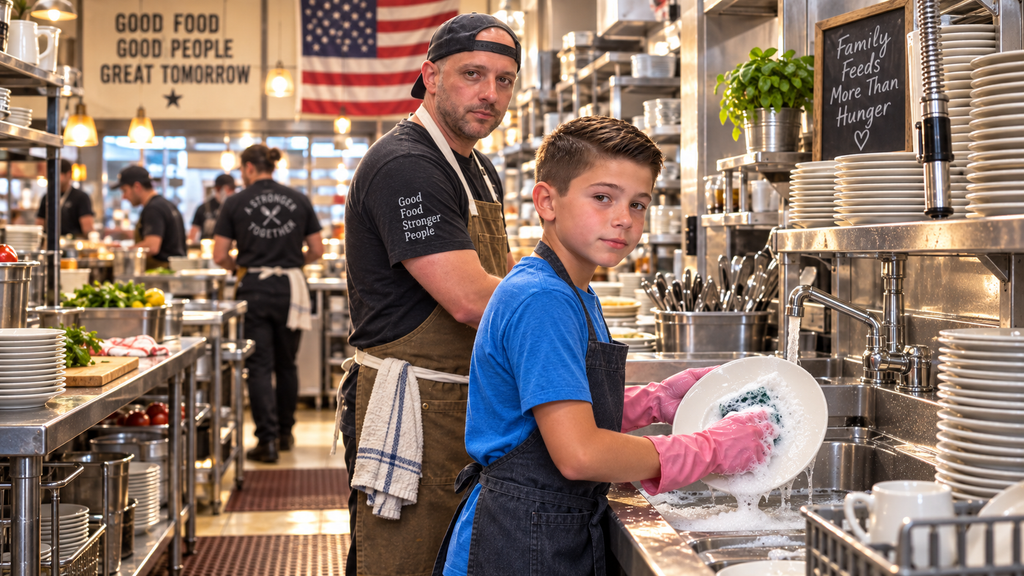
He would grab a piece of toast, sling his backpack over one shoulder, kiss me quickly on the cheek, and say the same thing.
“See you after work, Mom.”
Then he would walk three blocks to the bus stop and disappear toward Sal’s Diner on Cherry Street.
For months, I believed I knew exactly why he was working.
A bicycle.
Not just any bicycle.
The bicycle.
Matte-black frame.
Orange lettering.
Twenty-one gears.
Front suspension.
Hydraulic brakes.
Evan knew every detail about it.
He had memorized the model number.
He knew how much it weighed.
He knew what kind of tires came on it.
Most importantly, he knew the price.
Six hundred and nineteen dollars.
Every time we drove past Peterson’s Sporting Goods on Route 9, his head turned toward that bicycle in the window as naturally as a sunflower turning toward the sun.
He never asked me to stop.
He never begged.
He never said, “Mom, can you buy it for me?”
That was what hurt.
Because I knew he wanted it.
And I also knew why he refused to ask.
Three years earlier, when Evan was only ten years old, his father had died.
Suddenly.
Cruelly.
Without warning.
There was no long illness.
No chance to prepare.
No opportunity for one last family vacation, one last birthday, one last father-son conversation.
One ordinary Tuesday morning, my husband Marcus stood in our driveway teaching Evan how to change a tire.
Less than two weeks later, I was wearing a black dress I could barely remember putting on while neighbors carried casseroles through our front door.
People kept saying things to me that I knew were supposed to help.
“He’s in a better place.”
“Everything happens for a reason.”
“God only gives us what we can handle.”
I wanted to scream at all of them.
I didn’t want Marcus in a better place.
I wanted him in our kitchen.
I wanted him leaving his boots beside the back door even though I had told him a thousand times not to.
I wanted him complaining about the thermostat.
I wanted to hear him snore.
I wanted his coffee mug sitting in the sink.
I wanted to argue with him about stupid things and make up ten minutes later.
I wanted my husband.
And Evan wanted his father.
But grief does strange things to children.
Adults imagine grief in obvious ways.
Crying.
Anger.
Tantrums.
Nightmares.
Evan did some of those things at first.
For the first few weeks, he slept wearing Marcus’s old Chicago Bears sweatshirt even though the sleeves hung halfway past his hands.
He kept one of his father’s baseball caps on the nightstand.
Sometimes I heard him crying behind his bedroom door.
But then something changed.
My ten-year-old son stopped behaving like a ten-year-old.
He became responsible.
Too responsible.
Before Marcus died, Evan would leave cereal bowls on the table and socks underneath the couch.
Afterward, he began washing his plate immediately after eating.
He started taking the trash outside without being asked.
If I came home exhausted from work, he would say, “I can make myself a sandwich.”
If the washing machine stopped, he would quietly move the clothes into the dryer.
When his shoes became too small, he didn’t tell me.
I discovered it because I noticed him limping.
“Why didn’t you say something?” I asked.
He shrugged.
“They still fit.”
They didn’t.
His toes were curled against the front.
At Christmas that year, I asked him what he wanted.
“Nothing.”
“Nothing?”
“I’m good.”
Every answer was the same.
I’m good.
I don’t need anything.
Don’t worry about me.
At first, I thought he was growing up.
Later, I understood the heartbreaking truth.
At ten years old, my son had silently decided that he was now the man of the house.
He had seen things I thought I had hidden.
The unopened bills on the counter.
The electricity notice tucked beneath a grocery flyer.
The nights I sat at the kitchen table moving numbers around on a piece of paper, trying to determine whether groceries, heating, or the mortgage deserved money first.
He had heard me crying in the bathroom with the shower running because I didn’t want him to know.
He remembered the week Mrs. Delgado from next door brought grocery bags and pretended she had “accidentally bought too much.”
He remembered when someone from church anonymously paid our heating bill.
He remembered eating pasta three nights in a row because pasta was cheap.
And somewhere inside that grieving ten-year-old boy, a promise had formed.
I won’t make Mom worry about me.
I didn’t know it then.
If I had, I would have taken him into my arms and told him that children were allowed to need things.
Children were allowed to be expensive.
Children were allowed to make messes.
Children were allowed to want bicycles.
Children were allowed to be children.
But I didn’t understand what was happening.
Not until years later.
Not until the phone call.
It had all started with that bicycle.
One evening, Evan came into the kitchen while I was making spaghetti.
He stood near the refrigerator with his shoulders unusually straight.
I glanced over.
“What?”
“Nothing.”
“Evan.”
“What?”
“You’ve been standing there staring at me for thirty seconds.”
He shifted his weight.
Then he said, “I got a job.”
I stopped stirring the sauce.
“You got a what?”
“A job.”
“You’re thirteen.”
“I know.”
“That generally makes having a job slightly complicated.”
He smiled nervously.
“It’s just Saturdays.”
“Doing what?”
“Washing dishes.”
“Where?”
“Sal’s Diner.”
I knew Sal’s.
Everyone in town did.
It had been on Cherry Street longer than I had been alive.
Red vinyl booths.
Chrome stools.
A jukebox that only worked when it felt like it.
Coffee strong enough to peel paint.
I had eaten there with Marcus dozens of times.
“Sal hired you?”
Evan nodded.
“He said I could work Saturdays. Maybe sometimes during school vacations.”
I stared at him.
“Why?”
He hesitated.
Then smiled.
“The bike.”
Immediately, I understood.
“You don’t have to do that.”
“I know.”
“We can save for it.”
“No.”
The answer came quickly.
Almost defensively.
“I want to earn it.”
“Evan—”
“Please, Mom.”
Something in his expression stopped me.
Pride.
Hope.
Maybe a little desperation.
He wanted this.
Not merely the bicycle.
The feeling of buying something for himself.
The feeling of not asking me.
So I agreed.
“School comes first.”
“I know.”
“If your grades drop, the job stops.”
“Deal.”
“If you’re tired—”
“I’ll tell you.”
“And I’m talking to Sal before your first shift.”
His smile widened.
“Okay.”
Then he hugged me.
It was quick.
Thirteen-year-old boys generally act as if hugging their mothers in broad daylight is a violation of international law.
But he hugged me.
And as I wrapped my arms around him, I looked over his shoulder toward the photograph of Marcus sitting on the bookshelf.
It had been taken at Lake Michigan.
Marcus was squinting into the sunlight, one arm around Evan.
Evan was nine.
Both were laughing.
For one strange, painful second, I imagined Marcus standing beside me.
Look at him, I thought.
Look at our boy.
You should be here for this.
The next Saturday, Evan started working.
He came home smelling like dish soap, coffee, syrup, and fryer oil.
His hair looked damp.
There was a small stain on his shirt.
“How was it?”
“Good.”
“Good?”
“Busy.”
“Did you break anything?”
“One plate.”
“One?”
“Maybe two.”
I laughed.
“How much did Sal charge you?”
“Nothing.”
“Then you’re already profitable.”
He rolled his eyes.
Sal paid him sixty dollars.
Cash.
Evan held the bills up proudly.
“First sixty.”
“For the bike?”
“For the bike.”
He disappeared upstairs.
I remember smiling.
I remember thinking Marcus would have been proud.
I remember feeling grateful that my son seemed excited about something again.
I had no idea that I was watching the beginning of a secret that would frighten me half to death.
Every Saturday after that, Evan worked.
Rain.
Cold.
School stress.
It didn’t matter.
He went.
He returned smelling exactly the same.
Fryer oil.
Coffee.
Bleach.
Dish soap.
Sometimes his hands were red.
Eventually, small cracks formed along his knuckles.
One evening I noticed him flexing his fingers.
“They hurt?”
“A little.”
I took his hand.
The skin was dry and rough.
“You need lotion.”
“I’m fine.”
“You’re thirteen and already have the hands of a fifty-year-old mechanic.”
He smiled.
“Dad had rough hands.”
The sentence hit me harder than he intended.
Marcus had rough hands.
He worked with them constantly.
He repaired everything.
Cars.
Cabinets.
Bicycles.
Broken toys.
Once, when the washing machine failed, he took the entire thing apart in the laundry room.
I was convinced we would never have a functioning washer again.
Two hours later, it worked perfectly.
There were three mysterious screws left over.
I asked him where they belonged.
He shrugged.
“Optional screws.”
Evan had laughed until milk came out of his nose.
That memory flashed through me as I held my son’s cracked hands.
“You still need lotion,” I said quietly.
Every few weeks, I asked the same question.
“How much have you saved?”
And every time, Evan gave the same answer.
“Almost enough.”
At first, I didn’t question it.
Saving six hundred dollars took time.
But then two months passed.
Then three.
Then four.
Then five.
Still no bicycle.
One afternoon we drove past Peterson’s Sporting Goods.
The black-and-orange bike was still in the window.
Evan looked at it.
For just a second.
Then he looked away.
“How close are you?”
“To what?”
“The bicycle.”
“Oh.”
He stared through the windshield.
“Pretty close.”
“How much?”
He shrugged.
“I don’t know exactly.”
That was strange.
Evan knew exactly how much money he had.
He had always been like that.
When he was seven, he once saved seventeen dollars and forty-three cents for a remote-controlled truck.
He could tell you the total every night.
Yet now, after months of working, he supposedly didn’t know what he had saved?
That evening, I started doing the math.
Sixty dollars every Saturday.
Even if he missed some shifts, he should have earned over a thousand dollars.
The bicycle cost six hundred and nineteen.
Even after taxes—which didn’t really apply because Sal was paying him cash for occasional weekend work—he should have had enough.
He should have purchased the bicycle months earlier.
I sat at the kitchen table holding a calculator.
$60.
Times twenty Saturdays.
$1,200.
I stared at the number.
Where was the money?
For the first time, suspicion entered my mind.
Not serious suspicion.
Something harmless.
Maybe he had changed his mind.
Maybe he was saving for a more expensive bike.
Maybe there was some gaming console I didn’t know about.
Maybe there was a girl.
I smiled at that possibility.
Evan had recently started spending an unreasonable amount of time fixing his hair before school.
Thirteen-year-old boys were allowed secrets.
I reminded myself of that.
His life did not belong entirely to me.
He was growing.
Changing.
Becoming his own person.
I didn’t want to become the kind of mother who searched every drawer and interrogated every conversation.
So I let it go.
Then, several weeks later, I woke up thirsty.
It was after midnight.
The hallway was dark except for a thin strip of light beneath Evan’s bedroom door.
I walked toward the kitchen.
As I passed his room, I realized the door was slightly open.
I glanced inside.
Evan was sitting on the floor beside his bed.
Money surrounded him.
Dozens of bills.
On the carpet.
On his mattress.
In his hands.
He was counting quietly.
“Forty… sixty… eighty…”
I froze.
That was not sixty dollars.
It looked like hundreds.
Maybe more.
For a moment, I simply watched him.
Then the floorboard beneath my foot creaked.
Evan looked up.
The reaction on his face made my heart stop.
Fear.
Not embarrassment.
Not irritation.
Fear.
Real fear.
He swept the money together with both hands.
Bills crumpled.
Some fell beneath the bed.
He shoved everything into his backpack and zipped it closed.
“Mom.”
His breathing had changed.
“What are you doing?”
“Nothing.”
“That looked like something.”
He forced a laugh.
“Just counting.”
“Counting what?”
“My money.”
“For the bicycle?”
“Yeah.”
I leaned against the doorframe.
“That looked like quite a lot of bicycle money.”
“It isn’t.”
“There were bills everywhere.”
“Sal pays me in small bills.”
He hugged the backpack against his chest.
“So it looks like more.”
“How much is there?”
He hesitated.
“Almost enough.”
Those words again.
Almost enough.
Something in me tightened.
“Evan.”
“What?”
“You know you can talk to me, right?”
His face softened slightly.
“I know.”
“About anything.”
“I know.”
“You’re not in trouble.”
“I’m not doing anything.”
“I didn’t say you were.”
He looked down.
I wanted to ask more.
I wanted to demand the backpack.
I wanted to count the money myself.
But then I remembered what it had felt like to be thirteen.
To want one corner of the world that belonged only to you.
So I stepped back.
“Don’t stay awake too late.”
“I won’t.”
I walked away.
But I didn’t sleep much.
The questions had started.
And once fear is given even a tiny opening, it knows how to make itself comfortable.
Over the next several weeks, I watched him differently.
I hated myself for it.
I noticed every phone notification.
Every time he closed his bedroom door.
Every time he seemed distracted.
Every time he came home five minutes later than usual.
I began searching for patterns.
Was he meeting someone?
Was he spending money somewhere?
Was someone giving him money?
The most frightening thought came quietly.
What if the sixty dollars from Sal wasn’t the only money he was getting?
The bills on his floor looked like more than his weekly wages.
What if someone else was paying him?
For what?
My mind immediately produced every nightmare a mother can imagine.
Drugs.
Stealing.
Older teenagers.
Gang activity.
Some adult exploiting him.
The rational part of my brain told me I was being ridiculous.
This was Evan.
My Evan.
The child who apologized to furniture after accidentally bumping into it.
The boy who carried spiders outside because he felt bad killing them.
The kid who once returned five dollars he found in a grocery-store parking lot because, according to him, “Someone might need this.”
But fear is rarely rational.
Especially when you have already lost someone you love.
Once you know that your entire life can change because of one unexpected phone call, you become suspicious of silence.
You begin imagining disaster before it arrives.
Then came the Saturday that changed everything.
Evan usually returned from Sal’s around six-thirty.
At six-forty-five, I checked the clock.
At seven, I texted.
No answer.
At seven-fifteen, I called.
Voicemail.
At seven-thirty, I walked to the front window for the tenth time.
Rain had started.
The street glistened beneath the yellow lamps.
At seven-forty-two, I called again.
Voicemail.
By eight o’clock, panic had climbed into my throat.
I grabbed my keys.
I was about to drive toward the diner when the back door opened.
“Evan?”
He stepped inside.
I froze.
His jeans were covered in mud.
His sneakers were filthy.
The shoulder of his jacket was ripped.
A bloody scrape ran along his cheek.
“Oh my God.”
I crossed the kitchen.
“What happened?”
“Nothing.”
“Nothing?”
“I fell.”
“You fell?”
“Near the creek.”
He tried to walk past me.
I caught his arm.
“Stop.”
“I’m fine.”
“Let me look at your face.”
“Mom.”
“Evan.”
He sighed and stood still.
I tilted his chin toward the light.
The scrape wasn’t deep.
But there were several smaller marks along his jaw.
His jacket wasn’t simply torn.
It looked stretched.
Pulled.
“What happened?”
“I told you.”
“You fell.”
“Yes.”
“Where?”
“Near the creek.”
“How?”
“I slipped.”
“Why were you near the creek?”
“It’s a shortcut.”
“It’s dark.”
“I know.”
“You’re almost two hours late.”
“I know.”
“And your phone?”
“Dead.”
I stared at him.
Every answer sounded possible.
None felt true.
Then I asked the question that would haunt me for days.
“Where’s your paycheck?”
He stopped.
His eyes dropped toward the floor.
The silence lasted only two seconds.
But a mother notices two seconds.
“I put it somewhere safe.”
My stomach tightened.
“Where?”
“Somewhere safe.”
“Evan.”
“It’s fine.”
“What does that mean?”
He looked exhausted.
“Can I please take a shower?”
“No. I need you to tell me what happened.”
“I fell.”
“You’re lying.”
His face changed.
Not guilt.
Pain.
“Mom…”
“Someone did this to you.”
“No.”
“Were you robbed?”
“No.”
“Did someone take your money?”
“No.”
“Then where is it?”
“It’s safe.”
“Where?”
He swallowed.
“I can’t tell you.”
Those four words terrified me.
I can’t tell you.
“What are you involved in?”
His eyes widened.
“Nothing.”
“Then tell me.”
“I can’t.”
“Why?”
“Because…”
He stopped.
“Because what?”
His voice became almost a whisper.
“You wouldn’t understand.”
Something inside me broke.
“I’m your mother.”
“I know.”
“I lost your father. I am not going to lose you because you’re too stubborn to tell me what’s happening.”
The words came out sharper than I intended.
Evan flinched.
I instantly regretted them.
“Evan—”
“I’m going upstairs.”
“Wait.”
But he was already walking away.
A moment later, I heard the bathroom door close.
Then the shower.
I stood alone in the kitchen.
The refrigerator hummed.
Rain tapped against the windows.
Marcus’s photograph sat on the shelf.
I looked at it.
“What do I do?”
Of course, the picture did not answer.
“What am I supposed to do, Marcus?”
My voice broke.
“You were better at this.”
That wasn’t true.
Marcus and I had always figured parenting out together.
Neither of us knew what we were doing.
That was the secret nobody tells you.
Parents spend most of their lives pretending they understand situations they are experiencing for the first time.
But when Marcus died, I lost more than my husband.
I lost the person who helped me carry decisions.
Now every choice belonged entirely to me.
Do I push Evan harder?
Do I search his room?
Do I call Sal?
Do I take away the job?
Do I call the police?
Do I follow him next Saturday?
And beneath every question was the same terror.
What if I make the wrong decision?
That night, I barely slept.
I heard Evan’s bedroom door close sometime after eleven.
At midnight, I walked down the hallway.
His room was dark.
I stood outside.
My hand hovered near the doorknob.
I could search his backpack.
I could look through his drawers.
I could check his phone.
Part of me believed I had the right.
Another part knew that once trust breaks between a parent and child, it can take years to rebuild.
I lowered my hand.
The next morning, Evan ate cereal in silence.
His cheek had started to bruise.
I sat across from him.
“We need to talk.”
“I know.”
“Tonight.”
He nodded.
“No more vague answers.”
Another nod.
“I need the truth.”
He looked at me.
And for one moment, I saw something unexpected.
Not defiance.
Fear.
But not fear of me.
Fear for something.
Or someone.
“Okay,” he whispered.
I went to work believing that evening would finally give me answers.
It didn’t.
Because at 2:17 that afternoon, my phone rang.
Unknown number.
I nearly ignored it.
I was working at my desk, trying to finish payroll reports before the end of the day.
The phone kept ringing.
I answered.
“Hello?”
“Is this Evan’s mother?”
The voice belonged to an older man.
Rough.
Gravelly.
“Yes.”
“This is Sal.”
Immediately, every muscle in my body tightened.
“Sal from the diner?”
“Yes.”
“What happened?”
There was a pause.
Not a long pause.
But long enough.
“I need to talk to you about your son.”
My hand stopped above my keyboard.
“Is he okay?”
“He’s here.”
“Why is he there? It’s Monday.”
Another pause.
“He came after school.”
“Why?”
“That’s part of why I’m calling.”
My heartbeat accelerated.
“Did he do something?”
Sal exhaled.
“I honestly don’t know how to answer that.”
I stood.
“What does that mean?”
“I’ve been debating whether I should call you for weeks.”
“For weeks?”
“Yes.”
“Why?”
He lowered his voice.
“Do you know what Evan does with every paycheck I give him?”
Everything inside me became still.
“He’s saving for a bicycle.”
Silence.
“That’s what he told you?”
My mouth went dry.
“Yes.”
Another pause.
Then Sal said something I will never forget.
“Ma’am, you should probably sit down.”
I gripped the edge of my desk.
“Why?”
“Because everything that boy has told you about that money is a lie.”
The room seemed to tilt.
The money.
The backpack.
The bruises.
The mud.
The fear.
Almost enough.
Months of secrets crashed together inside my head.
“What is he doing?”
My voice sounded distant.
“What is my son doing with that money?”
Before Sal answered, I heard shouting behind him.
A voice.
Evan.
“Sal!”
My blood went cold.
“Evan?”
I heard my son yelling.
“Please! Don’t tell her!”
The words ripped through me.
“Evan!”
Another voice shouted.
An adult man.
Then a crash exploded through the phone.
Glass.
Plates.
Something smashing.
I shot upright.
“What happened?”
More shouting.
“Sal!”
He came back onto the line.
His breathing was heavy.
“Ma’am, you need to come down here.”
“Is Evan hurt?”
“No.”
“What happened?”
“Just come.”
“What is happening?”
“Your son tried to do it again, and this time—”
He stopped.
“Did what again?”
No answer.
“Sal!”
“Please come now.”
The line disconnected.
For a second, I stood there staring at my phone.
Then panic took over.
I grabbed my purse.
My coat remained hanging behind my chair.
I don’t remember explaining anything to my supervisor.
I remember running.
I remember almost dropping my keys.
I remember reversing out of the parking lot too quickly.
I remember my hands shaking on the steering wheel.
And I remember praying.
Not quietly.
Out loud.
“Please.”
Traffic blurred around me.
“Please, God.”
The light ahead turned red.
I stopped.
Barely.
“Not Evan.”
A horn sounded behind me when the light turned green.
I accelerated.
“You already took Marcus.”
Tears blurred the road.
“Please don’t take my son too.”
Sal’s words played repeatedly in my head.
Everything he told you about the money is a lie.
He tried to do it again.
Again.
Do what again?
Steal?
Was Evan taking money from the register?
Was he carrying drugs?
Had he gotten involved with older kids?
Were the men near the creek connected?
Had I been so consumed by my own grief that I failed to notice my child disappearing into something dangerous?
That thought destroyed me.
Because mothers are supposed to know.
That is what everyone tells you.
A mother knows.
A mother can tell.
A mother sees everything.
But I hadn’t.
Whatever was happening, it had been happening beneath my own roof for months.
I pulled into the diner parking lot so quickly the car jumped the curb.
I barely put it into park before opening the door.
The bell above Sal’s entrance rang violently when I rushed inside.
“Evan!”
Then I stopped.
Everything I had imagined during the drive vanished.
Completely.
My son stood in the middle of the diner.
He wasn’t injured.
He wasn’t fighting.
He wasn’t being arrested.
He was crying.
Not quietly.
Not the embarrassed tears teenagers wipe away before anyone notices.
He was sobbing.
My Evan almost never cried.
He had not cried openly in front of me since Marcus’s funeral.
But now tears ran freely down his cheeks.
His hands were clenched around a fistful of money.
Across from him sat a woman in a booth.
She was crying too.
Two children sat beside her.
A little boy.
Maybe six.
A girl who looked four.
Prescription bottles lay on the table.
Beside them sat several envelopes.
Utility bills.
A rent notice.
A child’s drawing of a blue house beneath a yellow sun.
Sal stood between Evan and the woman.
Broken dishes covered the floor near the counter.
That was the crash I had heard.
Plates.
Not a body.
Not a fight.
Just dishes.
Relief should have washed through me.
Instead, confusion replaced terror.
“Evan?”
My son turned.
The moment he saw me, his face collapsed.
“Mom.”
He looked guilty.
Terrified.
Heartbroken.
“I’m sorry.”
I rushed toward him.
“Sorry for what?”
He shook his head.
“I didn’t want you to know.”
“Know what?”
He stared at the money.
Sal stepped toward me.
“I think my phone call gave you the wrong impression.”
I turned on him.
“You told me my son had been lying to me and then I heard people screaming and dishes breaking.”
“I know.”
“I thought he was hurt.”
“I’m sorry.”
“What is going on?”
Sal looked at Evan.
Then at the woman.
Finally, back at me.
“Your son hasn’t done anything bad.”
I stared at him.
“Then explain this.”
Sal rubbed both hands over his face.
“I’ve been running this diner forty years.”
His voice softened.
“I’ve seen every kind of kid come through that kitchen.”
Evan looked down.
“Lazy ones.”
Sal continued.
“Troublemakers. Kids whose parents forced them to get jobs. Kids saving for cars. Kids who spend every paycheck before they leave the parking lot.”
He placed a hand on Evan’s shoulder.
“But I’ve never seen one like yours.”
I looked at Evan.
“What has he been doing?”
Sal nodded toward the woman.
“Her name is Carla.”
The woman wiped her eyes.
“I’m sorry.”
I shook my head.
“For what?”
Carla couldn’t answer.
Sal did.
“Every Saturday, I pay Evan sixty dollars.”
“Yes.”
“And every Saturday, immediately after I hand him that money…”
Sal paused.
“…he gives it away.”
I stared at him.
“What?”
“To Carla.”
My eyes moved toward the woman.
Then the children.
Then the prescription bottles.
Then back to Evan.
“I don’t understand.”
Carla covered her mouth.
“I tried to stop him.”
Her voice trembled.
“Every week.”
Evan stared at the floor.
Sal continued.
“Carla started coming here about six months ago.”
Her husband had left.
Not gradually.
Not responsibly.
He disappeared.
He emptied their checking account first.
Left behind unpaid bills.
Rent.
A broken car.
Two children.
And a four-year-old son with severe asthma.
Carla had worked as a receptionist at a dental office.
Two months after her husband left, the office closed.
Suddenly she had no income.
No savings.
No husband.
Two children.
And medication she could not afford to skip.
She sometimes came to Sal’s Diner because it was warm.
Sal had noticed that she ordered coffee for herself and one meal for the children.
The kids shared it.
Fries cut in half.
Sandwiches divided carefully.
Sometimes Sal slipped extra food onto their table.
“You made a mistake,” he would say.
“I ordered one.”
“Kitchen made two.”
Carla knew he was lying.
She was too proud to challenge him.
Evan noticed everything.
Of course he did.
My son had always noticed things adults missed.
He noticed when someone was embarrassed.
He noticed when people pretended to be okay.
He noticed when I was tired even if I smiled.
Most importantly, he recognized something in Carla’s face.
Fear.
Not dramatic fear.
Quiet fear.
The kind adults hide from their children.
The kind I had worn for months after Marcus died.
One Saturday, Sal handed Evan his sixty dollars.
Evan walked from the kitchen.
Still wearing his apron.
Hands wet.
Hair damp from steam.
He stopped beside Carla’s table.
And placed the money in front of her.
“What’s this?” Carla had asked.
“For your kids.”
She immediately pushed it back.
“No.”
Evan pushed it toward her again.
“It’s okay.”
“No, sweetheart.”
“My name’s Evan.”
Carla almost laughed.
“Evan, I cannot take your money.”
“You need it.”
“And you worked for it.”
“So?”
“You’re a child.”
“I’m thirteen.”
Apparently he said that with such seriousness that Sal had to turn away to hide a smile.
Carla tried again.
“Buy yourself something.”
Evan shook his head.
“I don’t need anything.”
The familiar words pierced me.
I don’t need anything.
He left the money there.
Before Carla could return it, he disappeared into the kitchen.
The following Saturday, he did it again.
Another sixty dollars.
And again.
And again.
Every Saturday.
For months.
My son stood over a sink scrubbing dried syrup from plates.
Burning his hands in hot water.
Coming home exhausted.
Smelling like fryer oil.
Then giving every dollar to a family we had never met.
“There was never any bicycle money?” I whispered.
Evan shook his head.
My chest tightened.
“The bicycle was…”
“A story,” he whispered.
“Why?”
“So you’d let me work.”
I stared at him.
“You wanted the bicycle.”
He nodded.
“Yeah.”
“Then why didn’t you buy it?”
He glanced toward Carla’s children.
The little boy was holding an inhaler.
Evan’s voice became very quiet.
“They needed stuff more.”
I felt something crack inside me.
“What about the money I saw in your room?”
Sal looked at Evan.
Evan rubbed his sleeve across his eyes.
“That was for them.”
“What do you mean?”
“I was counting it.”
“I know.”
“I was trying to make sure there was enough for her rent.”
Carla started crying harder.
“I had an eviction warning.”
My breath caught.
The bills scattered across Evan’s floor flashed through my memory.
His fear.
The backpack.
The frantic way he shoved the money away.
I had believed I was seeing evidence of something dangerous.
Instead, my thirteen-year-old was calculating whether another family would still have a home.
“Where did all of it come from?” I asked.
“Work.”
“There was more than sixty dollars.”
He hesitated.
“Allowance.”
My heart sank.
“What allowance?”
“The money Grandma sends sometimes.”
“You saved that too?”
He nodded.
“And birthday money?”
Another nod.
“How much have you given them?”
He shrugged.
“I don’t know.”
Sal answered.
“Close to two thousand dollars.”
My knees weakened.
I sat down.
Two thousand dollars.
From a thirteen-year-old.
Not because anyone asked.
Not because he wanted recognition.
He had hidden it.
He had lied so nobody would stop him.
Then another memory slammed into me.
The ripped jacket.
I looked at him.
“The creek.”
Evan became still.
“What really happened?”
He didn’t answer.
“Tell me.”
Sal’s expression hardened.
“You need to tell her.”
Evan stared at his shoes.
“Some boys followed me.”
My stomach dropped.
“What boys?”
“Older kids.”
“How old?”
“Maybe sixteen.”
“Why?”
He glanced at Carla.
“They saw me giving her money.”
“When?”
“A few weeks ago.”
“What happened?”
“They thought I carried cash.”
My hands went cold.
“They tried to rob you.”
Evan swallowed.
“They waited near the path.”
“Oh my God.”
“I ran.”
His voice became smaller.
“They chased me.”
The room disappeared around me.
I saw only my son.
“They chased you?”
He nodded.
“One grabbed my jacket.”
“That’s why it ripped?”
“Yes.”
“And your face?”
“I fell climbing the creek bank.”
I remembered examining the scrape.
Believing his story did not make sense.
Part of it had been true.
He had fallen.
He simply hadn’t told me why.
“Did they hit you?”
“No.”
“Did they get the money?”
“No.”
A strange flash of relief went through me.
Then anger.
“You could have been seriously hurt.”
“I know.”
“You could have been killed.”
“I know.”
“And you told nobody?”
He looked at me.
His eyes filled again.
“I thought you’d make me stop.”
That sentence hurt more than anything else.
“Why would you think that?”
He almost laughed through his tears.
“Because you would.”
I opened my mouth.
Then closed it.
Because he was right.
If my thirteen-year-old told me older teenagers had chased him for cash, there was no universe in which I would have cheerfully sent him back the next Saturday.
“I would’ve protected you.”
“I know.”
“That is my job.”
“I know.”
“Then why?”
His face crumpled.
“Because Carla still needed help.”
Carla covered her mouth.
“Evan…”
He turned toward her.
“Your kids needed medicine.”
“Not enough for you to get hurt.”
“You didn’t hurt me.”
“No.”
Carla wiped her eyes.
“But you could have been hurt because of me.”
“It wasn’t because of you.”
“Yes, it was.”
“No.”
Their argument had clearly happened before.
Then Evan looked back at me.
“We don’t have a lot either.”
“No.”
“I knew you’d say we couldn’t afford to give money away.”
He was right again.
“But they had less.”
His voice broke.
“Evan…”
“I remember, Mom.”
Everything in me became still.
“What?”
“I remember after Dad died.”
My eyes filled.
“I remember you crying.”
I shook my head.
“You were ten.”
“I still remember.”
He took a breath.
“I remember the power notice.”
I closed my eyes.
I had hidden that notice.
Or thought I had.
“I remember you turning the heat down.”
“Evan…”
“I remember sleeping in Dad’s sweatshirt because the house was cold.”
A tear slipped down my cheek.
He continued.
“I remember Mrs. Delgado bringing groceries.”
“She was helping.”
“I know.”
“And I remember asking why we had so much food suddenly.”
I nodded.
“You said she bought too much by accident.”
A tiny smile touched his face.
“I knew she didn’t.”
I stared at him.
“I remember the church lady.”
“What church lady?”
“The one who came to the door.”
My stomach tightened.
A woman from Marcus’s church had stopped by one afternoon.
She never gave me her full name.
She handed me an envelope.
Inside was enough money to pay the heating bill.
I had gone into the bathroom and cried.
“I remember her,” Evan whispered.
“I thought you were upstairs.”
“I was on the stairs.”
I pressed my fingers to my lips.
“I heard you crying after she left.”
The diner blurred through my tears.
“I remember everything.”
He looked toward Carla.
“When I saw her counting quarters, I remembered you counting change.”
My heart broke.
“I saw her kid coughing.”
He looked at the little boy.
“And I remembered being scared when you got sick because we didn’t have money for a doctor.”
“You never told me you were scared.”
“You had enough stuff to worry about.”
There it was again.
The sentence he had built his childhood around.
You had enough stuff to worry about.
I stood.
“Come here.”
He hesitated.
“Evan.”
He stepped toward me.
I wrapped my arms around him.
For a second, he remained stiff.
Then he collapsed against me.
Suddenly he wasn’t the responsible boy.
Not the dishwasher.
Not the secret provider.
Not the little man who had spent three years trying to replace his father.
He was my child.
Thirteen years old.
Terrified of disappointing me.
I held him tighter.
“You never have to protect me from needing you.”
He cried against my shoulder.
“You understand?”
He nodded.
“You are my son.”
Another nod.
“You’re allowed to need things.”
“I know.”
“No, you don’t.”
I pulled back and held his face.
“You are allowed to want the bicycle.”
His lips trembled.
“You are allowed to spend your birthday money.”
He looked down.
“You are allowed to tell me you’re scared.”
Tears ran over my fingers.
“You are allowed to come home and say, ‘Mom, I need help.’”
He started sobbing again.
“Your father dying did not make you responsible for everyone.”
His shoulders shook.
“I know.”
“No.”
I pulled him close again.
“You don’t know.”
For the first time, I understood how deeply Marcus’s death had changed him.
I thought grief had made Evan mature.
But underneath that maturity was fear.
Fear of becoming another burden.
Fear that loving someone meant protecting them from your needs.
Fear that if he acted enough like his father, maybe our family would stop feeling broken.
“Why did you do all this?” I whispered.
He pulled away slightly.
“I told you.”
“No.”
I touched his chest.
“Why?”
He looked at me.
Then at the photograph of two children on Carla’s table.
Then he said the words that broke me completely.
“Dad would’ve done it.”
I stopped breathing.
“What?”
“You always told me Dad helped everybody.”
I nodded slowly.
Marcus did.
He once spent an entire Saturday repairing a neighbor’s roof without accepting a dollar.
He carried jumper cables everywhere because, according to him, “Somebody always needs a jump.”
When temperatures dropped below freezing, he kept blankets in his truck.
He never told anyone when he helped them.
He hated being thanked.
“Your dad had a big heart,” I whispered.
Evan nodded.
“You said he’d give someone his coat if they needed it.”
“He probably would’ve.”
“So…”
His voice became fragile.
“So what?”
His lower lip trembled.
“If I can’t have Dad anymore…”
He paused.
“…maybe I can at least be like him.”
I sank into the chair.
There are moments when grief returns with such force that three years vanish.
Suddenly I was standing in the hospital again.
Listening to a doctor explain that my husband was gone.
Looking through a glass door at a body that still looked like Marcus but somehow wasn’t.
Watching Evan at the funeral.
Ten years old.
Holding my hand.
Trying not to cry because he thought he needed to be strong for me.
All this time, I believed I had been helping him carry grief.
I hadn’t realized he had been trying to carry mine.
“Come here,” I whispered.
He stepped toward me.
I wrapped both arms around him.
“I’m sorry I lied,” he said.
“I know.”
“I really did want the bike.”
A broken laugh escaped me.
“I know.”
“But Carla needed—”
“I know.”
“I wasn’t trying to—”
“Evan.”
He stopped.
I kissed the top of his head.
“I’m not angry.”
His body went still.
“You’re not?”
“No.”
“Even about lying?”
“We’ll talk about lying.”
He almost smiled.
“But right now…”
I pulled back enough to look at him.
“…I need you to hear something.”
He waited.
“I have never been prouder of anyone in my entire life.”
His face collapsed again.
I wiped his tears.
“Your father would be proud too.”
He closed his eyes.
For several seconds, neither of us spoke.
Then Carla approached.
“I owe you an apology.”
I looked at her.
“You don’t owe me anything.”
“I should have contacted you.”
“Yes.”
Her face fell.
I softened my voice.
“But I understand why you didn’t.”
“I tried to refuse.”
“I believe you.”
“Every week.”
Sal laughed softly from behind us.
“She did.”
Carla looked at Evan.
“He’s stubborn.”
“That part definitely came from his father.”
For the first time that afternoon, Evan smiled.
Carla explained how it had happened.
The first sixty dollars paid for medication.
The next helped with groceries.
Another week covered part of the electric bill.
Then school supplies.
Then rent.
Every time she told Evan enough was enough, he found a way around her refusal.
Once, she tried slipping the money into his backpack.
He discovered it before leaving and hid it beneath her coffee cup.
Another week, she waited near the kitchen door intending to return his wages directly.
He escaped through the back.
Sal laughed.
“I’ve never seen anyone dodge generosity like those two.”
Eventually, Carla accepted because there were moments when refusing help became more irresponsible than accepting it.
Her son needed an inhaler.
Her daughter needed food.
Pride did not fill a refrigerator.
Pride did not keep electricity running.
Pride did not prevent eviction.
Still, every dollar hurt her.
Because she knew where it came from.
A boy.
A grieving thirteen-year-old boy washing dishes.
“I promised myself I’d pay him back.”
She wiped her cheeks.
“I wrote down everything.”
She pulled a folded notebook from her purse.
Dates.
Amounts.
Every payment.
“You don’t owe me,” Evan said.
“Yes, I do.”
“No.”
“Evan.”
“You don’t.”
Her eyes filled.
“Then someday I’ll help someone else.”
Evan considered that.
Finally, he nodded.
“Okay.”
That was the first time I truly understood what my son had been trying to do.
He didn’t want repayment.
He wanted the kindness that once saved us to continue moving.
Someone helped us.
So he helped Carla.
Someday Carla might help someone else.
Grief had created a chain.
But instead of passing pain forward, my son was trying to pass compassion.
Sal finally explained why he called.
After the incident near the creek, he became worried.
He had noticed the torn jacket.
Evan initially gave him the same story he gave me.
He fell.
Eventually, Sal discovered the truth.
He told Evan to stop carrying cash.
He offered to drive him home.
He told him the situation had become dangerous.
Evan promised to be careful.
But that Monday afternoon, Carla arrived with news.
She had been offered temporary work.
She no longer wanted Evan’s paycheck.
He had come straight from school anyway.
Sal paid him for some extra cleaning he had done.
Evan tried handing the cash to Carla.
She refused.
He insisted.
She pushed it back.
He pushed it forward.
Both began crying.
Sal attempted to intervene.
Someone backed into a server carrying dishes.
Crash.
That was what I heard through the phone.
When Sal said, “He tried to do it again,” he meant Evan was trying to give away another paycheck.
Nothing criminal.
Nothing dangerous.
Except perhaps the size of his heart.
Sal stared at Evan.
“In forty years, kid, I’ve never had an employee who refused his own paycheck.”
Evan shrugged.
“I took it.”
Sal pointed toward Carla.
“For approximately twelve seconds.”
A small laugh moved through the diner.
Even Carla smiled.
Then Sal looked at me.
“I figured his mother should know.”
I nodded.
“You were right.”
“I should’ve told you sooner.”
“Yes.”
He accepted that.
“But…”
I looked at my son.
“…maybe I needed to hear it when I was ready to understand.”
We left the diner almost two hours later.
Before going home, I drove somewhere else.
Peterson’s Sporting Goods.
Evan looked confused when I parked.
“What are we doing?”
“Come inside.”
“Mom.”
“Come on.”
The black-and-orange bike still stood in the window.
Under the bright store lights, it looked even more beautiful than I remembered.
Evan stopped in front of it.
His face changed.
For one second, he was simply thirteen.
No bills.
No grief.
No responsibility.
Just a boy looking at a bicycle.
I wanted to buy it.
Right then.
I wanted to hand the clerk my credit card.
I wanted to watch Evan ride home.
But when I looked at the price tag, reality returned.
Six hundred and nineteen dollars.
I could not casually spend six hundred dollars.
We were better financially than three years earlier.
But not wealthy.
I had savings.
Some.
Enough that emergencies no longer terrified me every morning.
Still, buying that bicycle immediately would have meant using money meant for other things.
So I did something else.
I stood beside my son.
“You still want it?”
He nodded.
“Yeah.”
“Okay.”
He looked at me.
“What?”
“We’re getting it.”
His eyes widened.
“Today?”
“No.”
He tried to hide his disappointment.
I smiled.
“But we’re getting it.”
“How?”
“We’ll save.”
“Mom—”
“Together.”
He became quiet.
“You don’t need to.”
“I know.”
“But—”
“That is the point.”
He stared at me.
“You’ve been trying to prove you don’t need anything.”
I touched his shoulder.
“I’m going to prove that needing something doesn’t make you weak.”
His eyes filled.
“Deal?”
After a moment, he nodded.
“Deal.”
That evening, we created a jar.
An actual glass jar.
I wrote BIKE FUND on a piece of masking tape.
Evan laughed.
“This is embarrassing.”
“Good.”
“You could’ve used an envelope.”
“No.”
“Why?”
“Because this is dramatic.”
He rolled his eyes.
I put twenty dollars inside.
He added ten.
The bicycle fund started with thirty dollars.
For the first time, he was saving for himself.
And I was going to make sure he learned that generosity and self-neglect were not the same thing.
In the weeks that followed, our lives changed in unexpected ways.
Carla did not disappear.
Neither did her children.
Her son, Tyler, became obsessed with Evan.
To Tyler, my thirteen-year-old was suddenly some kind of superhero.
He followed Evan around asking hundreds of questions.
“Can you ride a motorcycle?”
“No.”
“Can you drive?”
“No.”
“Have you ever fought a shark?”
“No.”
“Could you?”
“Probably not.”
“Could your dad?”
That question made the room quiet.
Evan glanced at me.
Then smiled.
“My dad would’ve tried.”
I laughed.
Marcus absolutely would have claimed he could fight a shark.
Whether he actually could was another question.
Carla’s daughter, Lily, liked drawing.
She began leaving pictures on our refrigerator.
Houses.
Flowers.
People holding hands.
One showed our family.
Me.
Evan.
Carla.
Tyler.
Lily.
And above us, floating near the clouds, she had drawn another man.
I stared at it.
“Who’s that?”
“Evan’s daddy.”
My throat tightened.
She had never met Marcus.
But Evan had told her enough stories that she included him anyway.
I kept that drawing.
I still have it.
Helping Carla became different once adults became involved.
Because no matter how generous Evan was, a thirteen-year-old’s dishwashing wages could not solve a family’s long-term problems.
Carla needed stability.
So I made phone calls.
A friend of mine worked for a medical office looking for a receptionist.
Carla interviewed.
She got the job.
Sal connected her with a local church program offering emergency rental assistance.
I helped her fill out forms for benefits she had no idea she qualified for.
Within two months, things began to change.
Not magically.
Real life rarely changes magically.
There were still bills.
Still difficult weeks.
Still stress.
But the electricity stayed on.
The rent became manageable.
Tyler’s inhaler was filled before it ran out.
Groceries appeared regularly in the refrigerator.
Carla started smiling without looking guilty afterward.
One evening, she came to our house carrying a grocery bag.
“What’s this?”
“Dinner.”
Inside were ingredients for lasagna.
“You don’t have to bring us food.”
She smiled.
“I know.”
The sentence hit me.
I know.
That’s the point.
I let her cook.
Afterward, we sat around the table.
Tyler spilled milk.
Lily colored on a napkin.
Evan complained about homework.
For the first time since Marcus died, the house felt full.
Not repaired.
Grief does not work that way.
People love saying time heals wounds.
I think that is only partly true.
Some wounds do not heal.
You simply build a life around them.
Eventually, the wound is no longer the only thing you see.
That was happening to us.
Marcus was still missing.
His chair remained empty.
His laugh still existed only in memory.
But joy had started returning without asking permission.
That terrified me at first.
Then I understood something.
Being happy did not mean we had forgotten him.
If anything, happiness made me remember him more clearly.
Because Marcus had loved laughter.
He hated quiet houses.
He would have looked at our crowded table, seen Tyler making bubbles in his milk, heard Lily arguing that purple should count as a “vegetable color,” and smiled.
He would have loved every second.
Evan kept working for Sal.
But there were new rules.
First, Sal drove him home if his shift ended after dark.
Second, Evan stopped carrying large amounts of cash.
Third, I knew exactly when he started and finished.
Fourth, he had to keep part of every paycheck for himself.
He complained about that rule.
“I earned it.”
“Correct.”
“So I should decide what happens to it.”
“You are thirteen.”
“That doesn’t answer my argument.”
“It answers every argument until you’re eighteen.”
He groaned.
Eventually, we compromised.
He could donate part.
Save part.
Spend part.
Sal approved.
“You can’t pour from an empty cup,” he told Evan.
Evan frowned.
“What does that mean?”
“It means if you give away everything you have, eventually you won’t have anything left to give.”
Sal pointed at him.
“Big hearts need boundaries.”
I loved that.
Big hearts need boundaries.
I wrote it on a piece of paper and taped it to Evan’s bedroom door.
He removed it.
I taped it back.
He removed it again.
I put it inside a frame.
He threatened to move out.
I reminded him he could barely cook scrambled eggs.
He stayed.
A few weeks later, police identified the older boys who had chased him.
Nothing catastrophic happened.
Their parents became involved.
School officials became involved.
The boys apologized.
Whether the apology was sincere, I don’t know.
But Evan learned something important.
You tell people when you’re in danger.
Helping someone does not require suffering in silence.
Being brave does not mean handling everything alone.
That lesson took time.
Because Evan had spent three years believing strength meant never needing rescue.
Then his birthday approached.
Fourteen.
I had saved nearly enough for the bicycle.
Evan had added part of his own wages.
But a week before his birthday, Sal called me.
This time, my heart did not stop when his number appeared.
“Everything okay?”
“Fine.”
“What did he break?”
“Nothing.”
“Then why are you calling?”
“Need you to stop by tomorrow without the kid.”
That sounded suspicious.
The next afternoon, I went to the diner.
Sal was waiting near the counter.
So were several people I recognized.
Regular customers.
Two waitresses.
The cook.
Carla.
On the counter sat an envelope.
“What is this?”
Sal smiled.
“Bike money.”
I frowned.
“No.”
“You haven’t even opened it.”
“No.”
“Why?”
“Because I know what you’re doing.”
Sal crossed his arms.
“Do you?”
“You collected money.”
“Maybe.”
“He doesn’t need charity.”
Sal raised one eyebrow.
Interesting.
It was the exact expression Marcus used whenever he thought I was saying something ridiculous.
“This isn’t charity.”
“What is it?”
“People heard what he did.”
“How?”
He looked slightly guilty.
“Small town.”
“Sal.”
“Fine. I told a few people.”
I sighed.
He continued.
“Folks wanted to do something.”
I looked around.
One waitress spoke.
“He washed my station dishes for three months without complaining.”
Another said, “He covers for me when my daughter gets sick.”
The cook laughed.
“He burned approximately two hundred pancakes learning how to use the grill.”
“Why does that deserve money?”
“It doesn’t.”
Sal pushed the envelope toward me.
“But what he did for Carla reminded people of things others once did for them.”
One regular customer raised his coffee mug.
“My wife had cancer eight years ago. Whole town helped us.”
Another man said, “Somebody paid my rent once.”
A woman near the window added, “My son got a scholarship from strangers.”
I stared at them.
Suddenly I understood.
This was not repayment.
It was the same chain.
Kindness moving from person to person.
Marcus to others.
Strangers to us.
Evan to Carla.
Carla to her children.
Now the town back to Evan.
I opened the envelope.
There was enough to pay the rest of the bicycle.
And more.
I started crying.
Sal pretended not to notice.
“Something in your eye?”
“Yes.”
“Must be dusty.”
“This place is disgusting.”
“I know.”
On Evan’s birthday, we told him we were going to dinner.
He complained because he had homework.
I almost laughed.
Fourteen and already acting seventy.
Instead, we drove to Peterson’s.
When he saw the sporting-goods store, he looked at me.
“No.”
“Yes.”
“Mom.”
“Get out.”
“You said we weren’t there yet.”
“We are now.”
He stepped out of the car slowly.
Inside, the bicycle was waiting.
Not in the window.
Beside the counter.
A large orange bow was tied around the handlebars.
Evan stopped walking.
His mouth opened.
Nothing came out.
Sal stepped from behind a display.
“Happy birthday, dishwasher.”
Carla appeared.
Then Tyler and Lily.
Several diner employees.
Even Mrs. Delgado.
Evan turned toward me.
His face crumpled.
“Mom…”
I handed him the handlebars.
He touched the frame as if afraid it might disappear.
“You didn’t have to do this.”
I smiled.
“I know.”
His eyes filled.
“That’s the point.”
He started crying.
Then laughing because he was embarrassed about crying.
Then crying harder because everyone laughed.
He hugged me.
A real hug.
Not a teenage half-hug.
Both arms.
Tight.
“Thank you.”
“You earned more than a bicycle.”
He shook his head.
“No.”
“Yes.”
“I didn’t do anything.”
Sal groaned loudly.
“Kid, if you say that one more time, I’m charging you for every plate you’ve broken.”
Evan laughed.
He rode that bicycle home.
I followed slowly in the car.
The sunset turned the sky orange.
His hoodie fluttered behind him.
For a few seconds, I saw another bicycle.
Another driveway.
Another afternoon.
Marcus running alongside a nine-year-old Evan.
“Pedal!”
“I am!”
“Stop looking down!”
“You’re holding it?”
“I’m holding it!”
Then Marcus let go.
Evan rode alone for ten feet before realizing.
He shouted.
“Dad!”
Then crashed into our hedge.
Marcus laughed so hard he had to sit down.
That night, Evan had a scraped knee.
He also learned to ride.
I blinked back tears as fourteen-year-old Evan pedaled ahead of me.
“Look at him, Marcus,” I whispered.
Sometimes I still talk to my husband.
Maybe that sounds strange.
I don’t care.
I tell him about important things.
Birthdays.
School awards.
Bad days.
Funny stories.
I tell him when our son reminds me of him.
Which happens more often as Evan grows older.
Sometimes it is physical.
The way he walks.
The way he raises one eyebrow.
The little crease near his left eye when he smiles.
Other times, it is something deeper.
The instinct to notice.
To stop.
To help.
Not long after his birthday, Evan began volunteering at a downtown shelter on Sundays.
I went with him the first time.
He helped distribute meals.
At one table sat an elderly man named Walter.
Walter rarely spoke.
He wore a brown coat even indoors.
Evan sat beside him during lunch.
For almost fifteen minutes, neither spoke.
Then Walter said something.
Evan listened.
That was it.
No dramatic gesture.
No money.
No heroic moment.
Just listening.
On the drive home, I asked what they discussed.
“He used to have a dog.”
“What kind?”
“German shepherd.”
“What happened?”
“Dog died.”
I waited.
“And?”
“And what?”
“That’s all?”
“Yeah.”
I smiled.
Because I understood.
Sometimes people do not need saving.
Sometimes they need someone willing to sit beside them.
Evan understood that naturally.
His father had too.
Months passed.
Carla eventually saved enough for a small apartment closer to her job.
On moving day, all of us helped.
Sal brought his truck.
I packed kitchen boxes.
Evan carried furniture.
Tyler mostly stood in doorways giving instructions no one requested.
“Put that there.”
“No, there.”
“Actually, maybe there.”
Sal finally handed him an empty box.
“Congratulations. You’re management.”
Tyler carried it proudly.
That evening, after everything was moved, Carla stood in her new kitchen.
It was tiny.
The cabinets were old.
The floor squeaked.
The refrigerator made a strange humming noise.
She looked around as though she had been given a mansion.
Then she hugged me.
“Thank you.”
“You did this.”
“No.”
“Yes.”
“You helped.”
“So did Evan.”
She looked toward him.
He was sitting on the living-room floor assembling Lily’s bookshelf.
For once, he was actually following instructions.
Mostly.
Carla smiled.
“He saved us.”
I shook my head.
“No.”
She looked confused.
“He helped.”
I touched her arm.
“But you saved yourself.”
Her eyes filled.
“You kept going.”
She nodded.
“You kept applying.”
Another nod.
“You kept getting out of bed.”
Tears slipped down her cheeks.
“You did that.”
She looked toward her children.
“I had to.”
“I know.”
That sentence stayed with me.
I had to.
Parents say those words constantly.
We survive because we have to.
We work because we have to.
We smile because we have to.
But sometimes surviving requires allowing someone else to help carry the weight.
That was something all of us were learning.
Carla.
Me.
Evan.
Especially Evan.
He gradually stopped hiding when things hurt.
One afternoon, he came home angry.
“What happened?”
“Nothing.”
I raised one eyebrow.
He sighed.
“Math test.”
“How bad?”
“Seventy-one.”
I waited.
“That’s not the end of civilization.”
“It’s terrible.”
“It’s not great.”
“Thanks.”
“Want help?”
He hesitated.
Then nodded.
That small nod mattered more to me than any perfect grade.
He was asking.
Needing.
Trusting.
Later that year, he got sick.
Nothing serious.
Flu.
Fever.
Cough.
Previously, Evan would have insisted he was fine until collapsing.
This time, he came into my room at two in the morning.
“Mom?”
I woke immediately.
“What?”
“I feel bad.”
Those three words nearly made me cry.
Not because he was sick.
Because he told me.
I sat up.
“Come here.”
He lay beside me the way he had when he was little.
His head rested against my shoulder.
He was almost as tall as I was.
“Dad used to make that terrible soup,” he murmured.
I smiled.
“Chicken soup?”
“No. The weird one.”
“He thought ginger cured everything.”
“It tasted like spicy dishwater.”
“He was very proud of it.”
“I pretended to like it.”
“So did I.”
We laughed quietly.
Then Evan became serious.
“Do you think Dad knows?”
“Knows what?”
“Stuff.”
“What kind of stuff?”
“All of it.”
I looked at the ceiling.
“I don’t know.”
It was the most truthful answer I had.
I didn’t know what existed after death.
I didn’t know whether Marcus could see us.
I didn’t know whether the people we lose remain near us somehow or whether that idea is something grieving people create because absence is too painful.
“I hope so,” I said.
Evan nodded.
“I hope he saw the bike.”
“Me too.”
A long silence followed.
Then he whispered, “Do you think he’d be proud?”
I turned toward him.
“Yes.”
No hesitation.
No uncertainty.
“Yes, Evan.”
“Even though I lied?”
I smiled.
“He’d probably lecture you about that part.”
Evan laughed.
“And the creek.”
“Oh, he’d lose his mind about the creek.”
“Yeah.”
“But everything else?”
I touched his forehead.
“He’d be unbelievably proud.”
Evan closed his eyes.
“Good.”
Within minutes, he was asleep.
I stayed awake longer.
Watching him breathe.
Remembering a ten-year-old boy holding my hand at a funeral.
Remembering a thirteen-year-old standing in a diner with sixty dollars clenched in his fist.
Remembering all the versions of my child I had misunderstood.
For months, I believed something dark was happening.
In a way, something dark had happened.
Grief.
Loss.
Fear.
Poverty.
A family abandoned.
Children struggling.
Older boys chasing a younger one.
Those things were dark.
I simply misunderstood what my son was doing inside that darkness.
I thought it was swallowing him.
Instead, he had walked into it carrying light.
Not because he was fearless.
He was afraid.
Not because he was wealthy.
He wasn’t.
Not because anyone told him to help.
Nobody did.
He helped because he remembered what helplessness felt like.
He remembered sitting in a cold house.
He remembered his mother crying.
He remembered strangers arriving with groceries.
He remembered a bill being paid by someone whose name he barely knew.
And when he recognized that same fear in Carla, he made a decision.
Maybe I can be that stranger this time.
That was all.
No publicity.
No reward.
No expectation.
Just a boy deciding another child should breathe easier.
Years have passed since that phone call.
Evan is older now.
Taller than me.
His voice changed.
His shoes became enormous.
The black-and-orange bicycle eventually became scratched.
The tires were replaced twice.
One handlebar grip tore.
For a long time, he rode it to the shelter almost every Sunday.
Even when he eventually outgrew it, he refused to throw it away.
It hangs in our garage now.
Sometimes I look at it and remember the beginning.
The sporting-goods window.
The dishwashing job.
The hidden money.
The ripped jacket.
The phone call.
The drive to Sal’s when I believed my worst nightmare was waiting.
And I remember the moment I walked through the diner doors and discovered that everything I feared was wrong.
Almost everything.
I had been right about one thing.
Marcus’s death had changed our son.
Completely.
But grief had not pulled him toward darkness.
It had made him notice darkness in others.
There is a difference.
Pain can make people bitter.
Sometimes understandably.
But pain can also make people gentle.
Because once you know what drowning feels like, you recognize the person struggling beside you.
Evan recognized Carla.
He recognized Tyler.
He recognized Lily.
He reached out.
That does not mean I believe children should carry adult burdens.
They shouldn’t.
If I could change anything about those months, I would want Evan to tell me sooner.
I would want him to know that compassion does not require secrecy.
That helping someone does not mean sacrificing your safety.
That he never needs to become his father.
Because Marcus never asked that of him.
Neither did I.
For years, I thought Evan wanted to replace Marcus.
Eventually, I realized he didn’t.
He simply wanted to keep something his father gave him.
Kindness.
Marcus once told me something when we were newly married.
We had stopped on a highway because another driver had a flat tire.
It was raining.
Cold.
I sat in the car while Marcus helped.
Twenty minutes later, he climbed back inside soaked from head to toe.
“You’re insane,” I said.
He laughed.
“Probably.”
“You don’t even know that guy.”
“That’s usually how strangers work.”
“He could’ve called roadside assistance.”
“Maybe.”
“You’re soaked.”
“Also true.”
I shook my head.
“Why do you do things like this?”
He looked genuinely confused.
“Because I could.”
At the time, I rolled my eyes.
Years later, standing beside my son in a diner, I remembered those exact words.
Because I could.
Not because someone deserved it.
Not because repayment was guaranteed.
Not because helping was convenient.
Simply because you were there.
Because you noticed.
Because you could.
That became something we talked about often.
Eventually, Evan wrote it inside the cover of one of his school notebooks.
HELP BECAUSE YOU CAN.
Underneath, I added another sentence.
ASK FOR HELP WHEN YOU NEED IT.
He complained that I ruined his quote.
I told him I improved it.
He disagreed.
Some things never change.
Carla eventually became an office manager.
She married again several years later.
A good man.
Kind.
Patient.
The type who shows up when he says he will.
Tyler’s asthma became easier to manage.
Lily kept drawing.
When she graduated elementary school, Evan attended.
When Evan graduated high school, Carla and both children sat three rows behind me.
Sal came too.
He complained about the uncomfortable folding chairs for approximately forty minutes.
When Evan’s name was announced, Sal stood before anyone else.
So did Carla.
Tyler whistled.
Lily screamed his name.
And I cried.
Of course I cried.
Mothers cry at graduations.
It is practically required.
But while everyone applauded, I looked toward the empty space beside me.
The seat I imagined Marcus occupying.
I could almost hear him.
That’s our boy.
Yes.
That was our boy.
Still is.
After the ceremony, Evan found me in the crowd.
He was wearing his graduation gown open over a white shirt.
He hugged me.
“Mom.”
“What?”
“Stop crying.”
“I’m not.”
“You are.”
“It’s allergies.”
“In June?”
“Very aggressive allergies.”
He laughed.
Then he became quiet.
“I wish Dad was here.”
I swallowed.
“Me too.”
He looked across the parking lot.
“I think about him a lot.”
“I know.”
“Sometimes I wonder if I’m remembering him right.”
That question surprised me.
“What do you mean?”
“I was ten.”
I nodded.
“Some memories get blurry.”
“Yes.”
“What if I made parts up?”
I took his hand.
“You probably did.”
He looked shocked.
“Mom.”
“We all do.”
“That’s depressing.”
“No.”
I smiled.
“Memory isn’t a recording.”
He listened.
“You don’t need to remember every word your father said.”
“But—”
“You remember how he made you feel.”
Evan became quiet.
“You remember that he loved you.”
He nodded.
“You remember he showed up.”
Another nod.
“You remember he helped people.”
“Yes.”
“That’s enough.”
He looked down.
Then smiled.
“I remember the optional screws.”
I laughed loudly.
“There were always optional screws.”
That evening, after the graduation celebration, Evan went into the garage.
I found him standing beneath the old bicycle.
The black frame was dusty.
The orange lettering faded.
“You okay?”
“Yeah.”
He touched one handlebar.
“Remember this?”
“How could I forget?”
“I thought I was so cool.”
“You were.”
“I looked ridiculous.”
“You also wore neon-green sneakers.”
“Why did you let me?”
“Parents have limits.”
He smiled.
Then said, “I’m glad you bought it.”
“So am I.”
“I’m glad I didn’t.”
I looked at him.
“What?”
“The first time.”
He shrugged.
“If I bought it then, Carla might’ve lost the apartment.”
His expression changed.
“Tyler might not have gotten his inhaler.”
I understood.
“But you know you weren’t responsible for saving them.”
“I know.”
“Do you?”
“Yes.”
He smiled slightly.
“You’ve told me approximately twelve thousand times.”
“Good.”
“But I’m still glad.”
I nodded.
“So am I.”
He stared at the bicycle.
Then said, “Dad would’ve helped.”
“Yes.”
“And you helped too.”
I looked at him.
“What?”
“Carla.”
“That was different.”
“No.”
He shook his head.
“You helped her get the job.”
“That was a phone call.”
“You helped with paperwork.”
“That was easy.”
“You let them into our lives.”
“That wasn’t charity.”
“I know.”
He smiled.
“That’s why it mattered.”
I didn’t have an answer.
Sometimes your children become adults and begin explaining your own life back to you.
It is deeply annoying.
And beautiful.
Before leaving for college, Evan took the bicycle down.
He cleaned it.
Changed the tires.
Adjusted the brakes.
Then he gave it away.
To a twelve-year-old boy at the shelter.
When he told me, I laughed.
“Of course you did.”
“What?”
“Nothing.”
“It was too small for me.”
“Uh-huh.”
“And he needed one.”
“Obviously.”
“You’re making fun of me.”
“A little.”
He smiled.
Then added, “I told him he has to wear a helmet.”
“Good.”
“And I made his mom promise he won’t ride after dark.”
“Excellent.”
“And—”
“Evan.”
“What?”
“You sound exactly like me.”
His face fell.
“No.”
“Yes.”
“That’s horrible.”
I laughed.
He hugged me.
Then whispered, “Maybe that’s not so bad.”
That evening, after he went upstairs, I stood alone in the garage.
The hook where the bicycle had hung for years was empty.
For some reason, that empty hook made me cry.
Not sad tears.
Not exactly.
It represented time.
The boy who wanted the bicycle was gone.
The boy who secretly washed dishes was gone.
The boy sitting on the floor counting money was gone.
Children disappear slowly.
One shoe size at a time.
One birthday at a time.
One closed bedroom door at a time.
And before you realize it, the child asking you to tie his shoes is standing in the kitchen telling you his college orientation schedule.
That is parenting.
A thousand tiny goodbyes hidden inside ordinary days.
But something remained.
The heart.
That never changed.
Before Evan left for college, he placed something on my kitchen table.
An envelope.
I opened it.
Inside were sixty dollars.
I stared at him.
“What is this?”
“My first paycheck.”
“What?”
“Not the first ever.”
He smiled.
“First one from my new summer job.”
“Why are you giving it to me?”
“I’m not.”
I raised an eyebrow.
“Then why is it on my table?”
“Use it for someone.”
“Who?”
“You’ll know.”
I laughed softly.
“Evan.”
“What?”
“Keep your money.”
“I kept some.”
“How much?”
“Enough.”
“That answer sounds suspiciously familiar.”
He grinned.
“Almost enough.”
I pointed at him.
“Do not start.”
He laughed.
I kept the sixty dollars in my purse.
For almost three weeks.
Then one afternoon, I was standing at the grocery store.
A woman ahead of me was buying food with two children.
Her card was declined.
She removed cereal.
Declined again.
She removed milk.
Another decline.
Her face changed.
Quiet fear.
The expression.
I knew it instantly.
So did something inside me.
I stepped forward.
“I think you dropped this.”
I handed her sixty dollars.
She stared at it.
“That’s not mine.”
“I’m pretty sure it is.”
“No.”
“Please.”
Her eyes filled.
“I can’t.”
I smiled.
“I know.”
Then I heard my husband’s voice in memory.
Because I could.
And my son’s voice.
Maybe I can be the person who helps this time.
The woman accepted.
I left the store before she could ask my name.
Sitting in my car, I cried.
Then I laughed.
Because suddenly I understood the true ending of Evan’s story.
There wasn’t one.
Kindness does not end.
Not when it is done correctly.
It travels.
Someone helps you.
You survive.
Years later, you notice another person barely keeping their head above water.
You remember.
Then you reach out.
Marcus helped strangers.
After he died, strangers helped us.
Evan helped Carla.
Carla built a new life.
Others helped Evan buy a bicycle.
Evan gave that bicycle away.
Years later, sixty dollars returned to my kitchen table.
Then those sixty dollars bought groceries for another family whose name I never learned.
A circle.
Maybe that is how people survive terrible things.
Not because pain disappears.
Not because life becomes fair.
But because sometimes someone stands beside you when it isn’t.
People ask me whether I regret worrying so much during those months.
Sometimes.
I wish I had trusted Evan more.
But parents know fear.
Especially parents who have lost someone.
Once death enters your life unexpectedly, you understand how fragile ordinary days truly are.
A person can leave for work and never come home.
A child can walk toward a diner and something terrible can happen.
A phone can ring at 2:17 on an ordinary Monday and divide your life into before and after.
That is why Sal’s call terrified me.
I already had one phone call change everything.
I thought this would be another.
In a way, it was.
But not every life-changing phone call brings tragedy.
Some reveal who the people you love have become while you weren’t looking.
That day, I discovered my son had been lying.
He hid money.
He hid danger.
He hid what he was doing.
We dealt with those things.
But beneath the lies was something I had completely misunderstood.
Love.
Not perfect love.
Not always wise love.
But love.
A thirteen-year-old trying to honor a father he missed.
A boy wanting another child to have medicine.
A kid deciding that if someone once helped his family, he should someday help another.
For years, I believed my job after Marcus died was to teach Evan how to survive grief.
How to stay strong.
How to keep moving.
How to build a life around absence.
But somewhere along the way, my son taught me something too.
Grief does not have to become only grief.
Pain can become empathy.
Loss can become awareness.
The worst thing that ever happened to you can make you notice the person everyone else walks past.
You do not have to become hard simply because life was hard to you.
Evan wanted to become like his father.
That was what he told me in the diner.
“If I can’t have Dad anymore, maybe I can at least be like him.”
For years, those words stayed with me.
But eventually, I realized something.
My son did not need to become Marcus.
He carried pieces of his father.
The compassion.
The stubbornness.
The ridiculous determination to help people who never asked.
But Evan became something entirely his own.
Something his father would have been proud to know.
And whenever someone asks me what happened to the thirteen-year-old boy who worked Saturdays at Sal’s Diner, I usually smile.
Because I remember him standing beneath those fluorescent lights.
Apron stained.
Hands cracked.
Tears on his face.
Sixty dollars clenched inside his fist.
He thought I might be angry.
He thought I might stop him.
He thought he needed to apologize for caring too much.
Instead, I hugged him.
And I told him the truth.
I was proud.
I still am.
More than he will ever fully understand.
Sometimes, late at night, I pull out the old photograph of Marcus and Evan at Lake Michigan.
Marcus has one arm around him.
Evan is squinting into the sun.
They are both laughing.
For years, looking at that photograph hurt.
Now it brings something different.
Gratitude.
Marcus only had ten years with his son.
Far fewer than either of them deserved.
But perhaps love is not measured only in years.
Maybe it is measured in what remains.
The lessons.
The gestures.
The instincts.
The stories.
The way a father who has been gone for years can still influence whether a frightened child gets an inhaler.
That thought gives me comfort.
Because Marcus is gone.
But the good he put into our son is still moving through the world.
And sometimes I think that is the closest thing human beings get to immortality.
Not monuments.
Not money.
Not names carved somewhere permanent.
But kindness repeated by the people who remember you.
Marcus helped people.
Evan remembered.
Evan helped Carla.
Tyler remembered.
Lily remembered.
I remembered.
Maybe someday someone else will too.
So yes.
My thirteen-year-old son hid his dishwashing money from me.
He lied about saving for a bicycle.
He terrified me for months.
And one phone call from his boss changed everything I thought I knew.
I expected to discover my son was heading down a dangerous path.
Instead, I discovered he had quietly become the kind of person his father always hoped he would be.
I thought grief was dragging him somewhere dark.
I was wrong.
Grief had taught him how to recognize darkness.
And when he saw someone trapped inside it…
he did what his father would have done.
He reached out his hand.
Years later, when I think about that boy standing in the diner, there is one thing I wish I could go back and tell him.
Evan, you never had to become the man of the house.
You never had to replace your father.
You never had to carry me.
You never had to save everyone.
You were allowed to be a child.
You were allowed to want the bike.
You were allowed to need help.
You were allowed to cry.
But I would tell him something else too.
Your father would have been proud of you.
Not because you gave away your money.
Not because you worked until your hands cracked.
Not because you tried to solve problems too big for a thirteen-year-old.
He would have been proud because you noticed.
Because when another family was frightened and struggling, you did not walk past.
You cared.
And in a world where people are often too busy, too hurt, or too afraid to notice one another, caring is never a small thing.
Evan once told me he did everything because he wanted to become like his father.
But after watching him grow…
after watching the boy he was become the man he is…
I think the truth is much simpler.
He never needed to become like his father.
Somewhere inside him, in all the ways that mattered most…
he already was.
And I like to believe that somewhere, somehow, Marcus knows it too.
THE END! THANK YOU FOR READING!❤️