 Reading Time: 43 minutes
“The kind where you cannot trust the person standing closest to you.” Chloe had stared at the black card for several seconds. Then she looked back at me.
“You’re serious.” “Completely.” “What do I do with it?” “Keep it somewhere safe.” “And if I ever have to call?” I paused. “If you call, say your full name first.”
“Then what?”
“Tell them you are Caroline Hayes’s emergency family contact.”
Her eyebrows had risen.
“Emergency family contact sounds kind of important.”
“It sounds more interesting than it is.”
That had been a lie.
One of the few I had ever deliberately told her.
Chloe had slipped the card into her wallet.
For three years, she never mentioned it again.
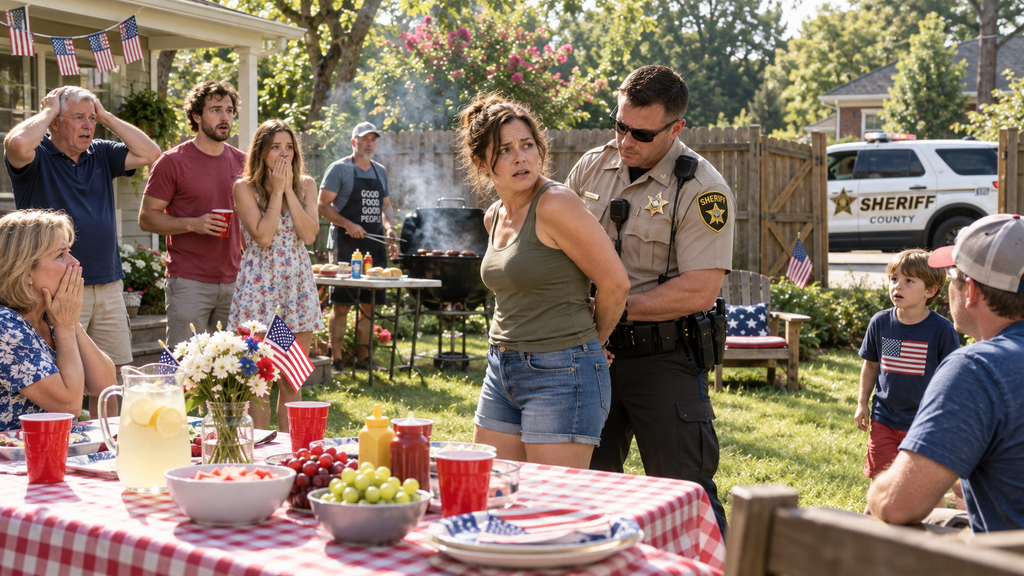
Until that Fourth of July.
Brad Finds His Excuse
The sun had moved lower by the time Brad finally approached me.
I was standing beside the patio table, helping Chloe separate paper plates that had stuck together in the humidity.
Brad stopped about six feet away.
“Caroline.”
There was something ceremonial about the way he said my name.
Not friendly.
Not casual.
A performance was beginning.
I put the plates down.
“Yes?”
He pointed toward the driveway.
“You need to move your car.”
“Why?”
“You’re blocking access.”
I looked through the side gate.
My blue sedan was exactly where I had left it.
It wasn’t blocking the garage.
It wasn’t blocking the street.
It wasn’t blocking the mailbox, sidewalk, or another vehicle.
“Access to what?”
Brad smirked.
“Don’t start.”
“I’m asking you a question.”
“You parked illegally.”
I glanced at him.
Then at the driveway.
Then back at him.
“We’re on private property.”
Several people nearby had gone quiet.
That was what Brad wanted.
He had an audience now.
My aunt turned slightly in her lawn chair.
Uncle Ray lowered his beer.
My mother looked up from the plate on her lap.
Brad shifted his weight.
“You’re obstructing an emergency-access path.”
“No, I’m not.”
His smile disappeared.
“Excuse me?”
“The driveway is eighteen feet wide. My vehicle occupies approximately six feet. There is more than adequate clearance.”
His face changed.
Only slightly.
But I saw it.
Men like Brad rarely became angry because someone was wrong.
They became angry because someone did not immediately accept that they were right.
He stepped closer.
“You always do this.”
“Do what?”
“Act like you know everything.”
I almost laughed.
I didn’t.
“Brad, if Laura wants me to move my car, I’ll move it.”
Laura was standing near the back door.
Suddenly, everyone looked at her.
She hesitated.
That hesitation told me everything.
“Well,” she said, “maybe it would just be easier if you moved it.”
I nodded.
“Fine.”
I reached toward the patio table for my purse.
Brad stepped sideways and blocked me.
“No.”
I stopped.
“You just told me to move it.”
“I’m not finished talking.”
That sentence changed the atmosphere.
Until then, a few relatives had been smiling.
Now the smiles looked uncertain.
I studied him.
“Then finish.”
Brad hooked his thumbs behind his duty belt.
“You think because you work for the Army, you can come in here and talk down to everybody.”
I said nothing.
“You’ve always thought you were smarter than everyone.”
Still nothing.
“Brad,” Melissa finally said from behind the food table, “she said she’d move the car.”
“Stay out of it.”
Melissa immediately looked down.
There it was.
The little mechanism that had protected Brad his entire life.
He pushed.
People retreated.
He pushed again.
People laughed nervously.
Eventually, his behavior became everyone’s normal.
My mother gave me the look she had given me since childhood.
The one that meant:
Just let it go.
Just keep the peace.
Just be the bigger person.
Which, translated honestly, usually meant:
Let Brad do whatever he wants because stopping him will make everyone uncomfortable.
I picked up my purse.
Brad reached out and put one hand over it.
“Did I say you could leave?”
That time, nobody laughed.
I looked at his hand.
Then at him.
“Remove your hand.”
Maybe it was my tone.
Maybe something in my face finally reached him.
His hand moved away.
But his pride had already trapped him.
He could not back down in front of twenty relatives after turning the moment into a demonstration of authority.
So instead of ending it, he escalated.
“What are you going to do?”
“Move my car.”
“No. What are you going to do about me?”
“Nothing.”
That answer seemed to offend him more.
He stepped closer.
“You think I’m a joke?”
“I think this conversation is unnecessary.”
“See?”
He turned toward the family.
“That. That right there.”
Nobody answered.
Brad laughed.
“She talks like she’s running some Pentagon briefing.”
My cousin Eric chuckled.
Aunt Denise smiled.
My mother’s mouth tightened.
Brad looked back at me.
“You push papers for the Army, Caroline.”
I remained silent.
“You’re not a soldier.”
That got my attention.
My eyes met his.
He noticed.
And because Brad was Brad, noticing that he had finally touched something important only encouraged him.
“You wear office shoes and answer phones.”
“Brad.”
My voice was quiet.
He continued.
“You probably haven’t seen anything more dangerous than a paper cut in twenty years.”
A few people laughed.
Not many.
But enough.
I felt something old move inside me.
Not anger.
I had spent too many years learning what anger did to judgment.
It was disappointment.
Because these were people who had known me all my life.
People who had watched me miss Christmases without asking why.
People who complained when I canceled vacations with forty-eight hours’ notice.
People who rolled their eyes when I could not tell them where I had been.
People who teased me for never posting about work online.
People who had taken my silence and filled the empty spaces with the least generous explanation available.
And I had allowed it.
For years, I told myself their opinions did not matter.
Standing in Laura’s backyard that afternoon, I realized that wasn’t entirely true.
You can know who you are and still be hurt when the people who raised you never bother to learn.
I reached for my purse again.
Brad grabbed my wrist.
Everything inside me became still.
Not emotionally.
Professionally.
My shoulders relaxed.
My breathing slowed.
My eyes dropped briefly to his hand.
His thumb was across the inside of my wrist.
His stance was too narrow.
His weight was forward.
His right hip—the side carrying his service weapon—was within easy reach.
If Brad had understood even half of what I had actually spent my career learning, he would have recognized the change in me.
He didn’t.
“Let go,” I said.
“Oh, relax.”
“Brad.”
“I’m not hurting you.”
“Remove your hand.”
My voice was softer this time.
That should have frightened him more than shouting would have.
Instead, he grinned.
“What are you going to do, file paperwork on me?”
Someone laughed.
I never learned who.
Brad released my wrist dramatically.
Then he reached behind him.
I heard the metallic click before I saw what he was holding.
Handcuffs.
Laura’s eyes widened.
“Brad, come on.”
“What?” he said.
He dangled them from one finger.
“We’re having fun.”
I stared at him.
“You are going to put those away.”
He laughed.
“You giving me orders now?”
“No.”
I looked directly into his eyes.
“I’m giving you an opportunity.”
The backyard went completely quiet.
The First Click
Brad stepped forward.
“Hands behind your back.”
Nobody moved.
A bird chirped somewhere beyond the fence.
The sprinkler continued ticking across the far lawn.
I could smell charcoal, sunscreen, and grilled onions.
It was strange what the mind noticed when danger entered an ordinary place.
“Brad,” my sister said again, “that’s enough.”
He didn’t even look at her.
“Hands behind your back, Caroline.”
I studied him for another second.
“Am I under arrest?”
That question made several relatives glance at one another.
Brad shrugged.
“Maybe.”
“For what?”
“Obstruction.”
“Of what?”
“My investigation.”
“What investigation?”
He smiled.
“The one happening right now.”
My mother’s voice came from behind him.
“Caroline, just do what he says.”
I looked at her.
I will remember that moment for the rest of my life.
Not because my mother understood what was happening.
Because she didn’t.
She simply knew Brad had a badge.
And I did not.
Therefore, in her mind, the quickest path back to comfort was my obedience.
“Mom,” I said quietly, “he is not acting as a law enforcement officer right now.”
Brad laughed.
“You don’t get to decide that.”
I turned back to him.
“Are you officially detaining me?”
His grin widened.
“Sure.”
“For what suspected offense?”
“Disorderly conduct.”
Several people shifted uncomfortably.
I nodded once.
“State the conduct.”
“Your attitude.”
That was when Chloe stood up.
She had been sitting near the porch.
“That’s not illegal.”
Brad turned.
“Stay out of this, Chloe.”
She didn’t sit.
“She’s literally just standing there.”
“Chloe,” Laura snapped. “Don’t get involved.”
My niece looked at her mother.
Then at me.
Her face had gone pale.
I saw the moment she remembered the black card.
I gave her nothing.
No nod.
No spoken instruction.
Not yet.
Brad pointed at me again.
“Turn around.”
“Brad, think very carefully about what you’re doing.”
“Are you threatening me?”
“No.”
“Sounded like a threat.”
“It is advice.”
“I don’t need advice from a secretary.”
That word drew another uncomfortable laugh.
I breathed in slowly.
Then I turned around.
Not because he had legal authority.
Not because I feared him.
Because there were children ten yards away.
Because Brad was carrying a loaded firearm.
Because humiliation is survivable.
A bullet sometimes isn’t.
I placed my hands behind my back.
Somewhere behind me, I heard my mother exhale in relief.
Brad took my left wrist.
The first cuff closed.
Click.
He tightened it more than necessary.
Then the second.
Click.
Metal pressed into bone.
I had worn restraints before.
Training.
Survival exercises.
Mock-capture scenarios.
Once, many years earlier, something far less controlled.
Brad did not know any of that.
He leaned close enough for only me to hear.
“Not so important now, are you?”
For the first time that afternoon, I almost smiled.
Not because something was funny.
Because I understood with perfect clarity that Brad had just crossed a line he would spend years wishing he could uncross.
I lifted my head.
Chloe was staring at me.
I moved the first two fingers of my right hand.
Once.
Twice.
A tiny motion against my left wrist.
The signal.
Her eyes widened.
Three years earlier, when I had given her that card, I had explained only one additional thing.
“If you ever see me do this and I cannot safely use my phone, you call.”
She had practiced it once.
Then laughed because it felt ridiculous.
She wasn’t laughing now.
She quietly stepped backward.
Nobody noticed.
Except me.
The Call
Chloe later told me exactly what happened.
She slipped through the side door into the laundry room, pulled her wallet from her back pocket, and found the black card behind her driver’s license.
Her hands were shaking so badly she dropped it.
Twice.
She dialed the number.
The call connected before the second ring.
A woman answered.
No company name.
No greeting beyond:
“Identify.”
Chloe swallowed.
“My name is Chloe Bennett.”
Silence.
“I am Caroline Hayes’s emergency family contact.”
The woman’s voice changed immediately.
“Authentication phrase?”
Chloe nearly panicked.
Then remembered the words printed in tiny letters on the reverse side of the plastic sleeve.
“Blue lantern.”
A pause.
“Where is General Hayes?”
Chloe froze.
General.
She had never heard anyone call me that.
Not Colonel.
Not Major.
Not General.
Nothing.
To Chloe, I had always been Aunt Caroline.
The boring government employee with an old sedan who sent birthday cards exactly one week early because I was often traveling.
“Where is General Hayes?” the woman repeated.
“Outside.”
“Is she conscious?”
“Yes.”
“Injured?”
“I don’t think so.”
“Why did you call?”
Chloe moved toward the laundry-room window.
Through the blinds she could see Brad standing behind me.
His hand was on my shoulder.
The cuffs were still around my wrists.
“My uncle is a sheriff’s deputy,” she whispered. “He put handcuffs on her.”
The woman went silent for less than a second.
“Is the deputy armed?”
“Yes.”
“Is anyone else armed?”
“I don’t know.”
“Did General Hayes give you the signal?”
“Yes.”
“Do not return outside.”
“But—”
“Chloe, listen carefully. Do not approach the armed individual. Do not attempt to release General Hayes. Stay inside and away from windows.”
“Who are you?”
“Her security operations desk.”
Chloe’s heart began pounding harder.
“Security?”
“Units are already moving.”
“How far away?”
The answer made Chloe sit down.
“Less than four minutes.”
What My Family Didn’t Know
There was a reason help could arrive that quickly.
I had not driven to Richmond alone.
The old blue sedan was mine.
The security team was not.
Nine months earlier, I had accepted temporary responsibility for a joint defense initiative involving several agencies and foreign partners.
Most of my work was mundane in the way genuinely serious work often looks mundane from the outside.
Meetings.
Secure briefings.
Encrypted calls.
Budgets.
Assessments.
Threat models.
Personnel decisions.
Thousands of pages of documents.
But the program itself was sensitive enough that, after a credible threat against two senior officials connected to it, protection protocols were temporarily expanded.
I hated it.
I had spent most of my career moving through airports with one bag and sitting anonymously in coffee shops.
Suddenly I had drivers, advance teams, route assessments, and people asking whether a family cookout had controlled access.
I had told my protective detail that I was going to my sister’s Fourth of July party.
I had also told them they were not coming into the backyard.
Captain Daniel Mercer had objected.
“Ma’am, with respect—”
“No.”
“We can maintain distance.”
“Excellent. Maintain a lot of it.”
He had stared at me.
I stared back.
Finally he sighed.
“How far?”
“Two streets.”
“One.”
“Two.”
“One and a half.”
“Fine.”
That was why two vehicles were staged nearby.
Three more were at a temporary operations site less than three miles away.
My family had no idea.
They thought I had arrived alone.
That was how I wanted it.
For one afternoon, I had wanted ribs, watermelon, bad family jokes, and a folding chair under a maple tree.
I did not want people standing when I entered.
I did not want anyone calling me ma’am.
I didn’t want radios.
I didn’t want security sweeps.
I wanted to be Caroline.
Just Caroline.
Ironically, Brad had spent years mocking me for being ordinary.
Ordinary was the thing I had been fighting hardest to keep.
Brad’s Little Show
Outside, Brad was enjoying himself.
“Maybe we should take a picture,” Eric joked.
Brad laughed.
“Family Christmas card.”
Aunt Denise said, “Oh, stop.”
But she was smiling.
My wrists burned.
Brad had double-locked neither cuff, and the ratchets had tightened as he moved me.
I could have told him.
I didn’t.
Every second of what he was doing was evidence now.
He guided me toward the center of the yard.
“Walk.”
“Where?”
“Over there.”
“Why?”
“Because I said so.”
He pushed between my shoulder blades.
Hard enough that I took a quick step to keep my balance.
My mother stood.
“Brad.”
“What?”
“Maybe you made your point.”
“I haven’t made anything.”
He looked at me.
“She needs to learn some respect.”
Something in my mother’s expression changed.
Maybe she finally heard the sentence for what it was.
This had nothing to do with parking.
Or disorderly conduct.
Or police work.
It was punishment.
Brad had handcuffed me because I had not acted impressed by him.
My sister came closer.
“Take them off.”
Brad ignored her.
“Brad.”
“I said I have it handled.”
Laura stopped.
Old habits are powerful.
Even then, she obeyed.
I looked across the yard.
The laundry-room curtain moved.
Good.
Chloe was inside.
Brad stepped in front of me.
“How’s that Army training working out?”
I said nothing.
“You know what’s funny? Everybody acts like military people are tough. Half of you sit at desks.”
Still nothing.
He leaned closer.
“Bet nobody at your office has ever put you in cuffs before.”
That time, I did smile.
Very slightly.
Brad saw it.
“What?”
“Nothing.”
“No. Say it.”
I looked at him.
“You would be happier if you stopped asking questions you are not prepared to hear answered.”
His face reddened.
“You really can’t help yourself, can you?”
I heard it then.
Not sirens.
Engines.
Several.
Coming fast.
Brad heard them too.
So did everyone else.
Heads turned toward the street.
The sound grew louder.
Heavy engines.
Tires.
Then brakes.
The first black SUV stopped in front of Laura’s house.
A second pulled behind it.
Then a third.
Then two more.
Nobody laughed anymore.
The Black SUVs
Doors opened almost simultaneously.
Men and women stepped out.
Dark suits.
Plain clothes.
Two military uniforms.
Radios.
Earpieces.
Controlled movement.
No shouting.
No confusion.
That was what made the scene frightening.
Professionals rarely need theatrics.
They moved with purpose.
One person stayed near each vehicle.
Two secured the street.
Three approached the gate.
At the front was Captain Daniel Mercer.
He had been with me for almost a year.
Thirty-nine years old.
Former infantry officer.
One of the calmest human beings I had ever met.
I had seen him remain polite while an incoming security alert evacuated half a building.
I had seen him speak gently to a frightened embassy employee while everyone else panicked.
I had never seen his face look the way it looked when he came through my sister’s gate and saw handcuffs around my wrists.
He stopped.
For half a second.
Then every trace of emotion disappeared.
“Ma’am.”
Brad looked around.
“Who the hell are you?”
Daniel ignored him.
His eyes stayed on me.
“General, are you injured?”
Nobody moved.
Nobody breathed.
My mother stared at Daniel.
Then at me.
Then back at Daniel.
Brad laughed once.
A tiny, confused sound.
“What did you call her?”
Daniel finally looked at him.
“Sir, remove your hands from Major General Hayes.”
Silence.
Complete silence.
Even the children had stopped running.
Brad’s hand was still wrapped around my upper arm.
He looked down at it.
Then released me.
“What?”
A woman in a dark jacket entered behind Daniel.
Special Agent Lena Ortiz.
She was carrying credentials.
“Deputy, step away from her.”
Brad instinctively reached toward his belt.
Five people moved at once.
Not dramatically.
Not with weapons drawn.
Just enough.
Daniel’s voice hardened.
“Do not touch your firearm.”
Brad froze.
“I am law enforcement.”
Lena held up her credentials.
“So am I.”
His eyes moved across the group.
“This is a family matter.”
“No,” Lena said. “The moment you used restraints while representing yourself as acting under official authority, it stopped being merely a family matter.”
Brad’s mouth opened.
Closed.
Opened again.
“I had probable cause.”
“For what?”
“She was interfering.”
“With?”
Brad pointed toward my car.
“Parking obstruction.”
Daniel looked through the gate at the sedan.
Then back at Brad.
For a moment, I thought even his training might fail him.
But he kept a straight face.
Lena walked toward me.
“General, may I?”
I nodded.
She looked at the cuffs.
“Do you have the key?”
Brad said nothing.
“Deputy.”
He fumbled at his belt.
His fingers were shaking now.
Lena took the key from him.
She unlocked my right wrist.
Then my left.
Blood rushed back beneath the compressed skin.
Red marks circled both wrists.
Daniel noticed.
His jaw tightened.
“Medic.”
“No.”
“Ma’am.”
“I’m fine.”
“You are bleeding.”
I looked down.
A thin line of blood had formed beneath my left thumb where the cuff had pinched the skin.
“I have had paper cuts worse than this.”
Daniel stared at me.
That was intentional.
Brad heard it.
His face changed.
He remembered his joke from minutes earlier.
Nobody laughed.
“Major General?”
My mother spoke first.
Her voice was barely audible.
“Caroline?”
I turned.
She was staring at the two silver stars on Daniel’s superior’s insignia—
then at me—
as if some hidden door inside her own house had suddenly opened.
“Major General?”
Brad looked at me.
“No.”
It sounded less like disagreement than prayer.
“No way.”
Lena gave him a flat look.
Brad pointed at me.
“She drives a fifteen-year-old Ford.”
That was the first moment I nearly laughed.
Daniel actually looked away.
I rubbed my wrist.
“Fourteen years.”
Brad blinked.
“What?”
“The Ford is fourteen years old.”
My mother sat down.
Aunt Denise covered her mouth.
Uncle Ray whispered something I couldn’t hear.
My sister was staring at me as though she had never seen my face before.
Brad shook his head.
“No. No, she’s a secretary.”
Nobody answered him.
“She does paperwork.”
I looked at him.
“Yes.”
He stared.
I continued.
“Quite a lot of it.”
Daniel coughed into his fist.
I gave him a warning glance.
His face went neutral again.
Brad’s voice rose.
“You’ve told everyone for twenty years you have some little office job.”
“No.”
I looked around the backyard.
“I told everyone I worked for the Army.”
Aunt Denise spoke.
“You said you did administrative work.”
“I do.”
“That made it sound like—”
She stopped herself.
“Like what?”
Nobody answered.
I looked at my mother.
She looked away.
That hurt more than the cuffs.
Not because I needed admiration.
I didn’t.
But suddenly the entire family was being forced to confront something uncomfortable.
I had never actually told them I was insignificant.
They had decided it.
I had never said I was unsuccessful.
They had decided that too.
I had never asked them to mock my career.
They had simply found it entertaining.
The story they believed about me had not come from my deception.
It had come from their assumptions.
The Question Daniel Asked
Daniel stepped closer.
“General, do you want us to relocate you?”
“No.”
“Ma’am, this site is no longer secure.”
“I understand.”
“We have an alternate location prepared.”
“I know.”
I looked at Brad.
“I am not leaving yet.”
He swallowed.
Lena turned toward him.
“Deputy, I need your name, badge number, department, and supervisor contact information.”
Brad’s old confidence returned for about three seconds.
“You don’t have jurisdiction over me.”
Lena nodded.
“Possibly.”
Brad seemed relieved.
Then she continued.
“Which is why your watch commander is already on his way.”
His face drained.
“You called my department?”
“We called several people.”
Daniel glanced at his watch.
“I believe the sheriff’s office is approximately six minutes out.”
Brad looked at me.
“You did this.”
“No.”
He stared.
I nodded toward the house.
“Chloe made the call.”
Everyone looked toward the back door.
My niece stood inside behind the glass.
She had tears streaming down her face.
I gave her a small nod.
She opened the door.
My sister rushed toward her.
“You called these people?”
Chloe looked at her mother.
“Aunt Caroline told me to.”
“When?”
“Three years ago.”
Laura’s face went blank.
“What?”
Chloe pulled the black card from her pocket.
“I had an emergency number.”
My mother looked at me.
“You gave Chloe an emergency number?”
“Yes.”
“Why her?”
The question came out more sharply than she intended.
For a moment, I said nothing.
Then I answered truthfully.
“Because she listens.”
That sentence landed harder than any accusation I could have made.
My mother’s eyes lowered.
Laura’s face tightened.
Chloe walked toward me.
“Are you okay?”
“Yes.”
She looked at my wrists.
“No, you’re not.”
I smiled.
“I’ve been worse.”
Her lower lip trembled.
“You said if you gave the signal, I had to call.”
“You did exactly right.”
“They called you General.”
Behind her, Brad muttered:
“This is insane.”
Daniel turned.
And then he asked the question that finally wiped the last trace of arrogance from Brad’s face.
“Deputy, did you conduct a weapons check before placing a two-star general in restraints?”
Brad stared at him.
“What?”
Daniel’s voice remained calm.
“You claimed this was a lawful detention. So I am asking whether you conducted the procedures your department requires when detaining an individual you believed posed sufficient risk to require handcuffs.”
Brad’s mouth opened.
Nothing came out.
Daniel continued.
“Did you inform dispatch?”
Silence.
“Did you activate your body camera?”
Brad looked down.
“Did you state the basis for detention?”
Silence.
“Did you search for weapons?”
Nothing.
Lena looked at Brad’s chest.
“Where is your body camera?”
“I’m off duty.”
She nodded.
“Yet you are wearing a full uniform, displaying a badge, carrying a department-issued firearm, using department-issued restraints, and repeatedly claiming law-enforcement authority.”
Brad’s face became pale.
Daniel looked toward the relatives.
“How many people witnessed the detention?”
Almost every hand in the yard could have gone up.
Nobody moved.
Then Chloe raised hers.
Slowly.
A second hand rose.
Melissa’s.
Then Uncle Ray’s.
Then my sister’s.
Soon nearly everyone was acknowledging what they had seen.
Brad looked around at them.
For the first time in his life, the crowd was not protecting him.
The Sheriff Arrives
The marked vehicles arrived several minutes later.
No sirens.
Two sheriff’s cruisers and an unmarked SUV.
A captain I didn’t know entered first.
Behind him came a gray-haired man wearing command insignia.
Brad whispered:
“Oh, God.”
That told me who he was.
Sheriff Nolan.
He walked through the gate, looked at Brad, looked at me, looked at the federal personnel near the patio, and then slowly removed his sunglasses.
“Bradley.”
Brad straightened.
“Sheriff, I can explain.”
“I certainly hope so.”
“It’s not what it looks like.”
I saw Lena’s eyebrow move slightly.
Sheriff Nolan glanced at my wrists.
“What does it look like?”
Brad looked toward me.
“She was being belligerent.”
“I asked what it looks like.”
Silence.
The sheriff turned to Lena.
“Agent?”
She showed him credentials.
They stepped aside briefly.
I could not hear everything.
I heard enough.
Unlawful restraint.
Off-duty conduct.
Possible color-of-law issue.
Failure to notify dispatch.
Department equipment.
Witnesses.
Video.
The word video caught Brad’s attention.
He turned quickly.
“What video?”
Nobody answered.
Then I looked toward the driveway.
“My dash camera.”
Brad’s expression changed.
“The car was recording?”
“Yes.”
“All of it?”
“I don’t know.”
That was true.
Its forward camera would have captured part of the driveway and gate.
Maybe audio.
Maybe not.
Brad exhaled slightly.
Then Chloe lifted her phone.
“I recorded it too.”
His relief disappeared.
My sister looked at her daughter.
“You recorded?”
Chloe nodded.
“From when he grabbed Aunt Caroline.”
Brad stared at her.
“Delete that.”
Lena stepped between them.
“Do not instruct a witness to destroy potential evidence.”
“I wasn’t—”
“Don’t.”
One word.
Brad stopped.
Sheriff Nolan returned.
“Deputy Bennett.”
Brad flinched at the formality.
“Give me your weapon.”
“Sheriff—”
“Now.”
Everyone watched.
Brad’s face became bright red.
“Can we not do this here?”
The sheriff looked around the backyard.
“Did you put your cousin in handcuffs here?”
Brad said nothing.
“Then I think here is appropriate.”
Slowly, Brad removed his sidearm.
He cleared it under the sheriff’s direction and surrendered it.
Then his badge.
Then his department radio.
My mother began crying.
Quietly.
Brad saw her.
For an instant, something like fury entered his face.
Not at himself.
At me.
“You ruined me.”
The words came out before he could stop them.
The sheriff closed his eyes.
Lena looked at the ground.
Daniel remained perfectly still.
I walked toward Brad.
He actually stepped backward.
I stopped several feet away.
“No.”
My voice was calm.
“You did this.”
He shook his head.
“You could have stopped it.”
“I tried.”
“No, you could’ve told me!”
“Told you what?”
“Who you were!”
The sentence echoed across the backyard.
I looked at him for several seconds.
Then I said the one thing I knew he would remember.
“You should not need someone’s rank before deciding whether to treat them with dignity.”
Nobody spoke.
Brad’s eyes shifted away.
“You thought I was nobody,” I continued.
“That was the test you failed.”
The Secret Everyone Wanted
Once Brad was escorted toward the front yard, the cookout effectively ended.
Nobody had officially said so.
The food remained on the tables.
The sprinkler still moved back and forth.
Music still played softly from a speaker near the porch.
But the gathering itself was over.
Something had cracked open.
My relatives stood in small groups, whispering.
Daniel remained near me.
“Ma’am, we really should move.”
“I know.”
He looked at my wrists.
“We need photographs first.”
“Of course we do.”
He hesitated.
“My blood pressure is probably going to be worse than yours.”
I smiled.
“That sounds like a personal problem, Captain.”
“Yes, ma’am.”
Chloe laughed through her tears.
It broke some of the tension.
Then my mother approached.
“Caroline.”
I looked at her.
She seemed smaller somehow.
Not physically.
Certainty had always given my mother a kind of height.
She had spent decades knowing exactly who everyone in the family was.
Laura was responsible.
Brad was successful.
Eric was funny.
Denise was dramatic.
I was difficult.
I was disappointing.
I was the one who had never quite figured life out.
Suddenly that tidy arrangement had collapsed.
“Can we talk?”
“Not right now.”
“Please.”
Daniel glanced at me.
I nodded.
He stepped away but remained within sight.
My mother stared at the marks around my wrists.
“Did he hurt you?”
“Yes.”
She flinched.
Not because the injury was serious.
Because I had not softened the answer for her.
She reached toward my arm.
Then stopped before touching me.
“Why didn’t you tell me?”
“About Brad?”
“No.”
Her eyes searched my face.
“About you.”
I almost asked what that meant.
Instead, I waited.
“All these years,” she whispered. “You never told us.”
“I told you what I was allowed to tell you.”
“You never said you were a general.”
“No.”
“Why?”
“Because my rank wasn’t relevant when I came home for Thanksgiving.”
“Of course it was relevant.”
“Why?”
She looked genuinely confused.
“Because you’re my daughter.”
“I was your daughter before you knew.”
That stopped her.
“You knew where I worked.”
“Yes, but—”
“You knew I had served for more than twenty years.”
“Yes.”
“You knew I traveled constantly.”
She nodded.
“You knew I missed birthdays because of work.”
Another nod.
“You knew I couldn’t discuss most of what I did.”
She stared at the grass.
I continued.
“You never asked me what I was proud of.”
Her eyes lifted.
“You asked why I wasn’t married.”
She swallowed.
“You asked why I drove an old car.”
Tears filled her eyes.
“You asked whether I regretted never having children.”
“Caroline—”
“You asked whether I thought I’d ever get a real promotion.”
My voice cracked slightly on the last word.
That surprised me.
I had stood in rooms where decisions affected thousands of people and kept my composure.
But standing in my sister’s backyard, talking to my mother, I could feel the little girl inside me who had spent her life wanting someone at home to say:
I see you.
Not your uniform.
Not your title.
You.
“I didn’t know,” she whispered.
“No.”
I looked at her.
“You didn’t.”
She began crying harder.
I wish I could say I hugged her immediately.
I didn’t.
Forgiveness and comfort are not always the same thing.
Sometimes love means refusing to rush past a wound simply because the person who caused it has finally noticed the blood.
Laura’s Question
My sister waited until Mom stepped away.
Then she came toward me.
She looked angry.
Not at Brad.
At herself.
That was new.
“So you’re really a major general?”
“Yes.”
“How long?”
“Three years.”
“Before that?”
“Brigadier general.”
“And before that?”
“Colonel.”
She laughed once.
There was no humor in it.
“Oh my God.”
I said nothing.
“You were a colonel when we joked about your job at Dad’s birthday.”
“Yes.”
She covered her face.
“That was six years ago.”
“Seven.”
“Oh God.”
“Laura.”
She lowered her hands.
“Do you remember what I gave you for your birthday that year?”
She stared.
“A scarf?”
“That was Christmas.”
She thought.
Then slowly:
“You took me to Charleston.”
“Yes.”
“You paid for that hotel.”
“Yes.”
“You told me you’d gotten a discount.”
“I had points.”
“Caroline.”
“I did.”
She laughed despite herself.
Then immediately started crying.
“All those years I thought you were struggling.”
“I never said I was struggling.”
“You let us think it.”
“I stopped correcting people who had already decided.”
“That isn’t fair.”
I looked at her.
“No?”
She fell silent.
I wasn’t trying to be cruel.
I was tired.
There is a difference.
Laura wiped her face.
“Why Chloe?”
I knew exactly what she meant.
“Why did you trust my daughter with that emergency number instead of me?”
“Because she was eighteen.”
“That doesn’t answer me.”
“Yes, it does.”
I paused.
“She was old enough to understand the responsibility and young enough that she hadn’t yet learned our family’s favorite habit.”
Laura’s expression hardened.
“What habit?”
“Explaining people instead of listening to them.”
She looked away.
I softened my voice.
“Chloe asks questions because she wants answers.”
“And I don’t?”
“You ask questions when you already know what answer you prefer.”
That hurt her.
I could see it.
But she nodded.
Slowly.
“That’s fair.”
It was the first time in years I heard my sister accept criticism without defending herself.
What I Actually Did
By then, curiosity was overtaking shock.
Aunt Denise approached carefully.
“So what do you actually do?”
I almost laughed.
Even now.
Even after everything.
The question.
The one they could have asked twenty years earlier.
I looked around.
Several relatives were listening.
“There are things I cannot discuss.”
Everyone nodded immediately.
Amazing what two black SUVs and a pair of silver stars could do for people’s respect for confidentiality.
I continued.
“I entered the Army after college.”
My mother frowned.
“We know that.”
“No. You know I joined.”
I glanced at her.
“You don’t know what came after.”
Nobody interrupted.
“I started in logistics.”
That disappointed some of them.
I could see it.
They expected secret missions immediately.
Life is rarely that cinematic.
“I spent my early years learning how incredibly difficult it is to move people, equipment, intelligence, fuel, medicine, food, and communications where they need to be while everyone assumes supplies simply appear.”
Uncle Ray nodded.
I continued.
“I deployed.”
My mother’s face changed.
“How many times?”
“Enough.”
“Where?”
“Some places you know about.”
“And some?”
I looked at her.
She understood.
I continued.
“I moved into strategic planning. Joint operations. Interagency coordination.”
Brad’s brother Eric stared.
“What does that mean?”
“It means rooms full of people arguing over maps.”
Daniel, standing nearby, smiled.
I continued.
“Sometimes cyber defense. Sometimes infrastructure. Sometimes personnel recovery. Sometimes contingency planning.”
Aunt Denise blinked.
“Personnel recovery?”
“Helping get people home.”
That was as much as I would say.
There were memories behind those words I had no intention of opening at a barbecue.
A helicopter landing in darkness.
A young lieutenant with blood on his sleeve.
A satellite phone pressed against my ear at three in the morning.
A mother on another continent who would never know how many strangers had worked through the night so her son could come home.
Those things belonged to the people who had lived them.
Not to my family’s curiosity.
“I’ve worked in Washington,” I continued. “Overseas. Several joint commands. The last few years have involved strategic security programs.”
My cousin Melissa whispered:
“That’s why you disappear.”
“Sometimes.”
“You always say you’re at a conference.”
“Sometimes I am.”
Daniel cleared his throat.
I looked at him.
He said nothing.
I knew what he was thinking.
Technically, three weeks inside a secure operations center could probably qualify as a very intense conference.
A few people laughed.
The tension softened.
Then my mother asked:
“Have you ever been in danger?”
Silence returned.
I thought carefully.
“Yes.”
Her hand covered her mouth.
“What kind?”
“The kind I am not discussing at a cookout.”
She nodded.
Her eyes filled again.
Suddenly all the canceled holidays looked different to her.
All the missed calls.
All the vague answers.
All the times I had returned after weeks away and said:
Work was busy.
She had interpreted those words as dullness.
Now she realized they might have been mercy.
My Father’s Secret
Then Uncle Ray said something unexpected.
“Your dad knew.”
I turned.
“What?”
My mother looked at him sharply.
“Ray.”
He ignored her.
“Your dad knew you were doing more than you told us.”
My throat tightened.
My father had died nine years earlier.
Cancer.
Fast.
He had been a quiet man who fixed lawn mowers on weekends and never threw away a screw because he was certain every screw would eventually find its purpose.
I loved him.
We had also been terrible at saying things out loud.
“What do you mean?”
Ray rubbed the back of his neck.
“About twelve years ago, your dad came over one night.”
I waited.
“He’d been drinking coffee. Not alcohol. You know your father.”
A faint smile touched my face.
“He said he’d seen you on television.”
“That doesn’t make sense.”
“He said it was for maybe two seconds. Some Pentagon briefing. People walking into a room.”
I searched my memory.
There had been hundreds.
“He paused the television.”
Ray continued.
“He said there were a bunch of officers walking with some cabinet official. You were behind them.”
My mother was staring at him.
“He never told me.”
Ray shrugged.
“He asked me if I thought that was you.”
“What did you say?”
“I said probably not.”
Despite everything, I laughed.
Ray looked embarrassed.
“Your hair was shorter.”
“What did Dad say?”
Ray looked at me.
“He said, ‘That’s my girl.’”
The backyard disappeared.
For one second, I was back in my father’s garage.
Seventeen years old.
Holding a flashlight wrong while he worked beneath our station wagon.
He always complained I pointed it everywhere except where he needed it.
That’s my girl.
Three words.
That was all.
I looked away.
My eyes burned.
“He knew?” I whispered.
“I think he knew enough.”
“Why didn’t he ask me?”
Ray smiled sadly.
“He said if you wanted him to know, you’d tell him.”
That sounded exactly like my father.
No interrogation.
No demand for proof.
No wounded pride because my life contained rooms he could not enter.
Just trust.
Suddenly I missed him with an intensity that felt almost physical.
My mother began crying again.
“He should have told me.”
I looked at her.
“Maybe he knew you would ask questions I couldn’t answer.”
She flinched.
But she didn’t argue.
Brad Comes Back
About forty minutes later, while statements were being collected, Brad returned to the backyard.
He was no longer wearing his duty belt.
Without it, he looked smaller.
His uniform shirt was still immaculate.
But the man inside it seemed to have lost structure.
Sheriff Nolan walked beside him.
“We’re retrieving his personal belongings,” the sheriff explained.
Brad had left his phone near the grill.
Nobody spoke as he crossed the yard.
He picked it up.
Then he looked at me.
There was anger there.
Fear too.
Mostly humiliation.
“I hope you’re happy.”
Sheriff Nolan closed his eyes again.
“Bradley.”
“No.”
Brad turned toward him.
“She gets to stand there pretending she’s innocent?”
I stared at him.
“What exactly do you believe I did?”
“You set me up.”
“How?”
“You knew those people were nearby.”
“Yes.”
A murmur moved through the family.
Brad pointed toward the street.
“You knew a whole damn team was sitting out there.”
“Yes.”
“And you let me put handcuffs on you.”
That accusation was so extraordinary that for several seconds I simply stared.
Then I said:
“I told you not to.”
“You could have said who you were.”
“I did.”
“No, you didn’t!”
“My name is Caroline Hayes.”
“You know what I mean.”
“Yes.”
I did.
He wanted me to admit there should be different rules depending on status.
That his actions would have been acceptable if I truly had been the insignificant office worker he imagined.
But because I possessed a rank he respected, his behavior suddenly became outrageous.
I would not give him that escape.
“You believed I was a civilian administrative worker.”
“Yes.”
“And that made this acceptable?”
Brad’s face tightened.
“You were disrespecting me.”
“No.”
“You were.”
“I disagreed with you.”
“Same thing.”
Sheriff Nolan looked at him.
Something in the sheriff’s face broke.
Maybe that sentence answered questions he had been asking about Brad for years.
He spoke quietly.
“Deputy Bennett, go to the vehicle.”
Brad ignored him.
“You always thought you were better than me.”
I shook my head.
“No.”
“Yes, you did.”
“No, Brad.”
My voice softened.
“I thought you were capable of being better than this.”
That hurt him more.
I could see it.
For a moment, I saw the boy he had once been.
The cousin who cheated at Monopoly.
The teenager who borrowed my bicycle without asking.
The young man who stood outside the hospital when his father had surgery and cried where nobody could see him.
People are rarely monsters from beginning to end.
Most are mixtures.
Good moments.
Bad instincts.
Choices repeated until they become character.
Brad could have become someone else.
At a hundred points along the way, someone could have told him no.
Most of us hadn’t.
Including me.
Silence had protected him too.
“I didn’t want this,” I said.
He laughed bitterly.
“Sure.”
“I wanted hamburgers.”
Nobody expected that.
Even Sheriff Nolan smiled faintly.
“I wanted to sit under that tree, eat too much potato salad, listen to Uncle Ray complain about taxes, and leave before anyone brought out karaoke.”
Ray muttered:
“I don’t complain that much.”
Everyone looked at him.
He shrugged.
“Okay.”
A few nervous laughs.
I looked back at Brad.
“You turned this into something else.”
His anger flickered.
For a moment, embarrassment replaced it.
Then he turned and left.
The Investigation
There was no dramatic arrest in the backyard.
Real accountability is often less cinematic than people imagine.
There are forms.
Statements.
Evidence logs.
Interviews.
Administrative hearings.
Attorneys.
Waiting.
Brad was placed on administrative leave that evening.
His department collected his badge, weapon, and department-issued equipment pending investigation.
Chloe gave investigators the original video file from her phone.
My dash camera had captured part of the confrontation and enough audio to establish the sequence.
Three relatives independently confirmed that Brad had announced no valid reason for placing me in restraints.
Four remembered him saying I needed to “learn respect.”
Two remembered the secretary comment.
Melissa remembered me asking directly whether I was under arrest and Brad answering, “Maybe.”
Brad claimed it had been a joke.
That explanation lasted approximately twelve hours.
Then investigators obtained messages he had sent before the cookout.
One was to a colleague.
Caroline thinks she’s hot stuff because she works for Uncle Sam. Maybe I’ll put her in cuffs this year and finally shut her up.
Another message read:
Would be hilarious watching Miss Pentagon beg.
He had sent it three days before the party.
The investigation changed after that.
What Brad had described as spontaneous horseplay now looked planned.
The sheriff’s office opened a formal internal investigation.
The county attorney reviewed the case.
There were debates over jurisdiction and charging.
I stayed out of them.
That surprised my family more than anything.
My mother called me four days later.
“You could destroy him.”
“No.”
“You have people.”
That phrase bothered me.
“Mom, I don’t have people.”
“You know what I mean.”
“I have colleagues.”
“You could make one phone call.”
“That is exactly the kind of abuse of authority I have spent my career trying to prevent.”
She fell silent.
I continued.
“Brad will face whatever process applies to anyone else.”
“But he humiliated you.”
“Yes.”
“Aren’t you angry?”
“Very.”
“Then how can you just let them handle it?”
“Because power matters most when you’re angry.”
She didn’t answer.
“If you only follow rules when you’re calm,” I told her, “you don’t actually believe in rules.”
That sentence later became the one my mother repeated more than anything else from that summer.
The Family Group Chat
The family group chat became unbearable.
At first, nobody knew what to say.
Then everyone knew too much.
Aunt Denise wrote:
I still cannot believe Caroline never told us!!!
Melissa responded:
Maybe because we made fun of her every time work came up.
Denise:
We were joking.
Chloe:
She wasn’t laughing.
Silence.
Then Uncle Ray:
I owe Caroline an apology.
Then Eric:
Same.
Then someone asked whether I had met the president.
I left the group chat.
Chloe texted privately.
Best decision you’ve ever made.
I responded:
I have coordinated evacuations with fewer complications than our family group chat.
She sent seventeen laughing emojis.
The next morning, my sister called.
“Mom thinks you’re angry.”
“I am angry.”
“She thinks you’re never coming back.”
“I didn’t say that.”
“You left the chat.”
“That is not exile, Laura.”
She sighed.
“What do you want us to do?”
The question mattered.
For years, my family had treated apology like a reset button.
Say sorry.
Hug.
Move on.
Never examine the machinery that caused the problem.
This time, I wanted something different.
“I want everyone to stop talking about my rank.”
Laura paused.
“What?”
“I mean it.”
“But that’s the whole reason—”
“No.”
I interrupted gently.
“My rank is not the lesson.”
She became quiet.
“If Brad had handcuffed a cashier, would it have been wrong?”
“Yes.”
“A teacher?”
“Yes.”
“A mechanic?”
“Yes.”
“Someone unemployed?”
“Yes.”
“A person with a criminal record?”
She hesitated.
Then:
“Yes.”
“Someone you disliked?”
Another pause.
“Yes.”
“Then my stars do not matter.”
“I understand.”
“No. You understand intellectually.”
I looked out the window of my office.
Washington traffic moved below.
“I need you to understand emotionally.”
“How?”
“Stop telling the story as ‘Brad accidentally handcuffed a general.’”
I paused.
“The story is that Brad humiliated someone he believed had less power than he did.”
Laura said nothing.
“That is the part worth remembering.”
The Photograph
A photograph from the cookout spread through the family within a week.
Chloe had not taken it.
One of the teenagers had.
It showed me standing near the patio after the cuffs were removed.
My wrists were red.
Daniel stood several feet behind me.
Lena was talking to the sheriff.
My mother sat in a chair staring into the distance.
It wasn’t dramatic.
But something about it bothered me.
Maybe because it reduced the entire experience to a single frozen moment.
My mother asked permission to post it with a long apology.
I said no.
Aunt Denise wanted to tell friends.
I asked her not to.
Eric suggested the local news might be interested.
Absolutely not.
For the first time, my family seemed confused by my refusal to exploit the situation.
They expected revelation to turn me into the person Brad had accused me of being.
They expected me to enjoy status.
To make calls.
To punish.
To show off.
I didn’t.
Because the truth was simpler.
I had spent twenty-five years learning that authority was not a trophy.
It was a responsibility.
The more power you possessed, the less casually you were allowed to use it.
Brad had never learned that.
I did not want his mistake to become mine.
The Call From Brad
Six weeks passed before Brad called me.
I almost didn’t answer.
Almost.
“Hello?”
Silence.
Then:
“Caroline.”
His voice sounded different.
Exhausted.
“Brad.”
“Do you have a minute?”
“Yes.”
He breathed out.
“I’ve been suspended without pay.”
I said nothing.
“My lawyer says they’re probably terminating me.”
Silence.
“They’re reviewing three older complaints now.”
That got my attention.
“What complaints?”
He laughed bitterly.
“You really don’t know?”
“No.”
“I figured you’d already heard everything.”
“I specifically asked not to receive unofficial updates.”
Another silence.
“Of course you did.”
Something in his tone was almost respectful.
Almost.
He continued.
“There was a traffic stop two years ago.”
I remembered hearing vague family stories about someone “overreacting” to Brad.
“A guy complained I kept him cuffed too long.”
“What happened?”
“Nothing.”
“Why?”
He didn’t answer.
I understood.
Another complaint involved a teenager.
Another involved a domestic-dispute call where witnesses alleged Brad escalated an argument after one person questioned his instructions.
None had resulted in discipline beyond informal counseling.
Now investigators were reviewing patterns.
Brad sounded close to tears.
“I might lose my pension.”
“How long until you’re vested?”
“Nine months.”
That was brutal.
I did not celebrate.
Consequences can be deserved and still tragic.
He cleared his throat.
“Did you ask them to do this?”
“No.”
“Would you tell me if you had?”
“Yes.”
“Can you stop it?”
There it was.
The reason for the call.
I closed my eyes.
“No.”
“You mean you won’t.”
“I mean both.”
“You could make a statement.”
“I already did.”
“No, I mean for me.”
“What would you like me to say?”
“That it was a misunderstanding.”
“It wasn’t.”
“That you don’t want charges.”
“That decision isn’t entirely mine.”
“You know how this works.”
“Yes.”
“That means you can help.”
I was silent for several seconds.
Then I asked:
“Brad, if nobody had come that day, when were you planning to remove the cuffs?”
He didn’t answer.
“After another joke?”
Silence.
“After a photograph?”
Nothing.
“After I apologized to you?”
His breathing changed.
“Were you waiting for me to beg?”
“No.”
“Then what?”
“I don’t know.”
I believed him.
That was worse.
He had not had a plan.
Power had carried him forward one impulse at a time.
Grab the wrist.
Show the cuffs.
Close one cuff.
Close the second.
Push.
Humiliate.
And at each point, he expected everyone else to adjust around him.
“That’s the problem,” I said.
“What?”
“You didn’t know when you would stop.”
His voice broke.
“I’m sorry.”
I remained still.
It was the first time he had said it.
Not:
I’m sorry this happened.
Not:
I’m sorry you took it wrong.
Not:
I’m sorry everybody overreacted.
Just:
I’m sorry.
I let the words sit there.
Then I said:
“I believe you are sorry now.”
He started crying.
Quietly.
I had heard grown men cry before.
There is no shame in it.
Sometimes tears are simply the body admitting what pride refused to say.
“Is that enough?” he whispered.
“No.”
He inhaled sharply.
I continued.
“But it’s a beginning.”
What Happened to Brad
Brad was terminated from the sheriff’s department four months later.
The official findings concluded that he had improperly used law-enforcement authority and department equipment during an off-duty personal dispute, failed to follow detention procedures, and made statements inconsistent with department policy and witness accounts.
His attorney appealed.
The appeal was unsuccessful.
The criminal side resolved separately.
He eventually entered an agreement involving probation, mandatory training, community service, and surrender of his law-enforcement certification for a defined period.
He did not go to prison.
Some relatives thought that was too lenient.
Others thought losing his career was too harsh.
I refused to join either argument.
He had received due process.
That mattered to me more than revenge.
The older complaints did not all result in findings against him.
Some could not be substantiated.
One did.
A man Brad had detained during a traffic stop received an official apology from the department.
I thought about that stranger more than Brad probably realized.
Someone whose family had not had a black card.
Someone who had not been surrounded by security personnel.
Someone without rank.
Without stars.
Without connections.
Someone who might have gone home after an unnecessary humiliation and been told:
You should have just complied.
That thought stayed with me.
It still does.
My Mother’s Visit
In October, my mother came to Washington.
She had never visited me there.
Not once.
For years, she claimed traffic made her nervous.
This time she took the train.
I met her at the station.
She stepped onto the platform carrying a suitcase large enough for a six-month expedition.
I stared at it.
“How long are you staying?”
“Three days.”
“What is in there?”
“Things.”
“Mom.”
“A woman needs options.”
That part of her had not changed.
I was glad.
We drove to my apartment.
Not a mansion.
Not a secret penthouse.
Just a comfortable two-bedroom place I had owned for years.
Mom walked around slowly.
She stopped at a wall covered in framed photographs.
For the first time, she really looked.
There I was twenty-three years earlier.
Young.
Thin.
Standing with my first unit.
Another photo showed me several years later with soldiers overseas.
Another showed a promotion ceremony.
Another showed my father pinning new rank onto my uniform.
Mom reached toward that one.
“I’ve never seen this.”
“You were there.”
She turned.
“What?”
“You left early.”
Her face changed.
Then she remembered.
Laura had called because her water heater broke.
Mom had driven away before the ceremony.
“Oh.”
She stared at the photograph.
Dad’s hands were fastening the insignia.
I was smiling at him.
Mom touched the frame.
“I missed so much.”
It wasn’t an accusation.
It wasn’t self-pity.
Just fact.
“Yes.”
She nodded.
We stood there together.
Then she said:
“I thought being a good mother meant helping the child who needed me most.”
I waited.
“Laura always had crises.”
True.
“Your brother needed money.”
Also true.
“Brad always had trouble.”
Very true.
She looked at me.
“You never needed anything.”
“That wasn’t true.”
Tears entered her eyes.
“No.”
She whispered.
“It wasn’t.”
I sat beside her.
This time, when she reached for my hand, I let her take it.
“What did you need?”
I thought for a long time.
“Interest.”
She began crying.
Not help.
Not money.
Not rescue.
Interest.
I had wanted her to ask about the photograph.
Ask why I looked tired.
Ask what I enjoyed about my work.
Ask whether I was lonely.
Ask whether I was proud.
Ask something without already deciding the answer.
She squeezed my hand.
“I’m sorry.”
“I know.”
“I can’t get those years back.”
“No.”
“Can I do better with what’s left?”
That was a different question.
One I could answer.
“Yes.”
The Ceremony
My retirement ceremony took place eleven months after the cookout.
Twenty-six years.
Four months.
Eleven days.
Not that I counted.
I had delayed retirement once.
Then twice.
There was always another mission.
Another transition.
Another person who was almost ready to take over.
Eventually Daniel told me:
“Ma’am, if you wait until the Army no longer needs you, you’re going to be here until you’re 140.”
He had a point.
The ceremony was held in an auditorium on a military installation outside Washington.
Nothing classified about it.
No secrecy.
No excuses.
For the first time, I invited my entire family into the part of my life they had spent decades misunderstanding.
My mother came.
Laura came.
Chloe came.
Uncle Ray.
Aunt Denise.
Melissa.
Eric.
Even several younger cousins.
Brad did not.
Not because I excluded him.
I sent an invitation.
He wrote back:
I don’t think I belong there.
I responded:
That’s your decision.
He did not attend.
I understood.
Before the ceremony began, my family sat together in the third row.
Chloe later told me they were unusually quiet.
Around them were people from different parts of my career.
Officers.
Enlisted personnel.
Civilian analysts.
Foreign partners.
Retired commanders.
Young soldiers I had mentored.
People my family had never met.
People who knew versions of me my relatives did not.
When I walked in, the room stood.
My mother told me afterward that was the moment everything became real.
Not the black SUVs.
Not the stars.
Not the title.
The room standing.
Hundreds of people rising not because I demanded it—
but because they respected what the uniform represented and what we had done together.
I walked to the front.
Took my place.
Listened while someone summarized twenty-six years of my life in less than ten minutes.
Assignments.
Commands.
Deployments.
Awards.
Programs.
Operations described in language vague enough for public consumption.
My mother cried through most of it.
So did Laura.
Chloe did not.
She was smiling.
Afterward, I gave a short speech.
I thanked the soldiers who had trusted me.
The civilians who had taught me.
The leaders who had corrected me.
The subordinates who had been brave enough to tell me when I was wrong.
Then I looked toward my family.
I had not planned to say anything about the cookout.
But there they were.
And somehow it felt dishonest to ignore it.
“People often think leadership is the ability to make people obey.”
The room became quiet.
“It isn’t.”
I glanced toward Chloe.
“Fear can produce obedience.”
Then toward Daniel.
“Rank can produce obedience.”
Then toward my mother.
“Power can produce obedience.”
I paused.
“But leadership is what remains when people are free to walk away.”
Nobody moved.
“The most important lesson of my career is that authority never increases a person’s value.”
I looked across the room.
“It increases their responsibility.”
My voice tightened.
“A title does not make you more deserving of dignity than the person without one.”
In the third row, my mother lowered her head.
“And a uniform does not give you permission to forget that.”
I took a breath.
“Many years ago, somebody I respected told me that the true test of character is how you treat someone who cannot do anything for you.”
I smiled faintly.
“I would add something.”
The room waited.
“The true test of power is how you treat someone you believe cannot do anything to you.”
Chloe’s eyes filled with tears.
I finished the speech.
And for the first time in twenty-six years, I walked away from military service with no next assignment waiting.
The Empty Uniform
Retirement was harder than I expected.
For decades, every morning had structure.
There was always somewhere to be.
Someone waiting.
Something unfinished.
Then suddenly there wasn’t.
I woke at 5:15 the first Monday after retirement out of habit.
Showered.
Made coffee.
Got dressed.
Then stood in my kitchen.
No convoy.
No briefing book.
No secure phone vibrating.
No aide reminding me I had nineteen minutes before a meeting.
I laughed.
Then I cried.
Not for long.
Just enough.
I walked into the spare bedroom where my uniform hung.
Two stars.
Ribbons.
Badges.
Twenty-six years reduced to cloth and metal.
I touched the sleeve.
For most of my adult life, that uniform had answered questions before I opened my mouth.
Now it would not.
And I realized something strange.
I was relieved.
I drove my old blue Ford to Richmond two weeks later.
Alone.
No detail.
No radios.
No black SUVs.
Just me.
The Second Cookout
Laura invited everyone for Labor Day.
I almost declined.
Then Chloe called.
“If you don’t come, Brad wins.”
“That’s manipulative.”
“Yes.”
“You learned that from your mother.”
“I prefer to think I improved it.”
I laughed.
So I went.
Same backyard.
Same maple tree.
Same grill.
Different atmosphere.
When I arrived, nobody announced me.
That was good.
Aunt Denise hugged me and did not mention my rank.
Better.
Uncle Ray handed me lemonade.
Best.
Mom was sitting beneath the tree.
There was an empty chair beside her.
I sat down.
For twenty minutes, nobody asked about the Pentagon.
Nobody asked about presidents.
Nobody asked whether I knew secrets about aliens.
Eric had already asked that three times by text.
Instead, Mom asked:
“Are you sleeping better since retirement?”
I looked at her.
“Yes.”
“What do you miss?”
That question nearly undid me.
Not:
Do you miss being important?
Not:
Do you miss having people salute you?
What do you miss?
“The people,” I said.
She nodded.
“What don’t you miss?”
“PowerPoint.”
She laughed.
“Really?”
“Mom, if hell exists, I am convinced it includes a briefing slide with forty-seven bullet points.”
She laughed harder.
So did I.
It was ordinary.
Beautifully ordinary.
For twenty years, I had wanted exactly that.
Then Brad Walked In
The side gate opened.
Conversation stopped.
Brad stood there.
Jeans.
Gray polo shirt.
No uniform.
No belt.
No badge.
He looked like someone attending the wrong party.
Laura stood.
“I invited him.”
Nobody objected.
Brad’s eyes found me.
I remained seated.
He approached slowly.
“Caroline.”
“Brad.”
“Can we talk?”
Mom started to stand.
I touched her arm.
“It’s fine.”
Brad and I walked toward the far side of the yard.
The same place where he had cuffed me fourteen months earlier.
He shoved his hands into his pockets.
“I almost didn’t come.”
“I know.”
“How?”
“You’re predictable.”
He smiled slightly.
Then the smile disappeared.
“I got a job.”
“Good.”
“Warehouse operations.”
“Do you like it?”
He looked surprised that I asked.
“Actually?”
“Yes.”
“Yeah.”
He nodded.
“I do.”
“What do you do?”
“Coordinate drivers. Shipments. Inventory.”
I smiled.
He noticed.
“What?”
“Logistics.”
He blinked.
Then laughed.
“You’re kidding.”
“No.”
“So I’m basically doing your first Army job?”
“A much safer version.”
He shook his head.
“That’s unbelievable.”
For the first time since the incident, we laughed together.
Then Brad looked at his hands.
“I’ve been going to counseling.”
I said nothing.
“Court didn’t require all of it.”
“Okay.”
“I kept going.”
“That sounds useful.”
He nodded.
“My therapist says I spent my whole life confusing respect with submission.”
“That sounds expensive.”
He laughed.
“Very.”
Then he became serious.
“She asked me something last week.”
“What?”
“She asked why I hated you.”
I waited.
Brad looked toward the grass.
“I told her I didn’t.”
“Did she believe you?”
“No.”
“Smart woman.”
He smiled faintly.
“Then she asked why I needed you to feel smaller.”
That answer mattered.
“What did you tell her?”
He swallowed.
“I didn’t know.”
I waited.
“Then I realized I did.”
His eyes filled.
“When we were kids, everybody said you were the smart one.”
I remembered.
“You left town. Went to college. Joined the Army. Every year you came home, you seemed… I don’t know.”
“What?”
“Certain.”
I nearly laughed.
If only he knew.
“You never needed anybody to clap for you.”
He looked toward the house.
“I always did.”
That was perhaps the most honest thing Brad had ever told me.
“So every time everyone made fun of your job and you didn’t care…”
He paused.
“It made me hate you more.”
“I did care.”
He looked surprised.
“I just didn’t show it.”
Brad stared at me.
“Really?”
“Yes.”
“I thought none of it bothered you.”
“Almost all of it bothered me.”
“Why didn’t you say something?”
I looked toward our family.
“Because I thought silence made me stronger.”
“And did it?”
“Sometimes.”
I paused.
“Sometimes silence just makes room for bad behavior.”
Brad nodded.
His eyes filled again.
“I’m sorry.”
This time, I believed he understood more of what he was apologizing for.
“I know.”
“Can you forgive me?”
There are questions people want answered quickly because uncertainty hurts.
I did not want to punish him.
But I also did not want to lie.
“I’m working on it.”
He nodded.
“Fair.”
He started to walk away.
“Brad.”
He turned.
“You can sit with us.”
His face changed.
Not dramatically.
Just enough.
“Okay.”
We returned to the table.
Nobody clapped.
Nobody made a speech.
Nobody announced reconciliation.
Brad pulled out a chair.
Mom handed him corn.
Uncle Ray complained about property taxes.
And slowly, awkwardly, imperfectly, our family did something it had rarely done well.
We moved forward without pretending the past had never happened.
Chloe’s Decision
Months later, Chloe called me from college.
“I’ve decided what I want to do.”
“Please don’t say intelligence.”
“Why?”
“Because your mother would blame me.”
She laughed.
“No.”
“Military?”
“No.”
“Thank God.”
“Law school.”
I groaned.
“What?”
“I was hoping for something less stressful. Like bomb disposal.”
She laughed again.
“I’m serious.”
“So am I.”
She became quiet.
“I keep thinking about that day.”
“So do I.”
“Not the SUVs.”
“Good.”
“Everyone thinks that’s the cool part.”
“It was mostly paperwork afterward.”
“I figured.”
“What do you think about?”
She paused.
“When Brad told you he was detaining you.”
I said nothing.
“You knew he was wrong.”
“Yes.”
“You could have fought him.”
“Yes.”
“You didn’t.”
“No.”
“Why?”
I looked out the window.
Autumn rain streaked the glass.
“Because being right does not guarantee you’ll be safe.”
She was quiet.
“And because I had more information than he did.”
“What information?”
“I knew help was available.”
“Okay.”
I continued.
“I also knew he was armed, emotional, embarrassed, and surrounded by an audience.”
“So you thought he’d do something worse?”
“I thought the possibility existed.”
“You were scared?”
That question surprised her more than me.
“Yes.”
“You didn’t look scared.”
“That is not the same thing.”
Silence.
Then she said:
“I want to work on cases where people don’t have a black card.”
I closed my eyes.
There it was.
The lesson.
Not my rank.
Not Brad’s humiliation.
Not the SUVs.
The people without a black card.
I smiled.
“Then you should go to law school.”
What My Family Knows Now
Two years have passed since that Fourth of July.
My family knows more about me now.
Not everything.
They never will.
Some stories belong behind secure doors.
Some belong to people who died.
Some belong to governments.
Some belong only to me.
But my mother knows I hate mushrooms.
She somehow forgot that for forty years.
She knows I wake early even when I have nowhere to go.
She knows retirement frightened me more than I expected.
She knows I miss my father every October.
She knows I once wanted to learn the piano and never did.
She knows I keep three novels beside my bed and rarely finish any of them.
She knows I prefer roadside diners to expensive restaurants.
She knows the blue Ford finally died.
For the record, it reached 287,411 miles.
Daniel called its retirement “a national security improvement.”
I hung up on him.
My sister knows that I spent years worrying about her even when I sounded detached.
Aunt Denise no longer asks whether I have met famous politicians.
Uncle Ray still complains about taxes.
Some institutions cannot be reformed.
Chloe is studying for the LSAT.
And Brad?
Brad supervises twenty-three people at the warehouse now.
According to him, his team has the best shipping accuracy in the region.
He says logistics is “surprisingly complicated.”
I remind him regularly that the Army discovered that several thousand years ago.
We are not close.
Not yet.
Maybe never in the way families sometimes imagine forgiveness should work.
But when he calls, I usually answer.
He no longer calls me General.
I’m glad.
He calls me Caroline.
That is enough.
The Question My Mother Finally Asked
Last Christmas, Mom and I were washing dishes after dinner.
Everyone else was in the living room.
Chloe and Laura were arguing over a board game.
Brad was helping Uncle Ray fix something that was not actually broken.
Mom handed me a plate.
Then she asked:
“Were you happy?”
I looked at her.
“When?”
“All those years.”
I dried the plate slowly.
It was the question she should have asked decades ago.
But people cannot ask yesterday’s questions yesterday.
They can only ask them now.
“Sometimes.”
She nodded.
“And sometimes?”
“No.”
She handed me another plate.
“Were you lonely?”
“Yes.”
Her eyes filled.
I touched her shoulder.
“Mom.”
“I should have known.”
“How?”
“I’m your mother.”
“That doesn’t make you psychic.”
“I should’ve asked.”
“Yes.”
She looked at me.
I could have protected her.
Told her it didn’t matter.
Told her everything had worked out.
But love should not require lying about pain.
“Yes,” I repeated.
“You should have.”
She nodded.
Then dried the next plate.
That may not sound like forgiveness.
But it was closer than pretending.
A minute later, she said:
“Are you happy now?”
I thought about it.
About mornings without alarms.
About Chloe.
About my father’s photograph.
About Brad sitting in the living room without a badge.
About my sister learning to listen.
About my mother finally asking questions she did not already know how she wanted answered.
“Yes.”
I smiled.
“I think I am.”
The Black Card
A few months later, Chloe handed the emergency card back to me.
We were sitting in a coffee shop.
“I guess you don’t need this anymore.”
I turned it over between my fingers.
The edges were worn.
Three years in her wallet.
One phone call.
One moment that changed our family.
“No.”
I slipped it into my purse.
“You know,” Chloe said, “when those SUVs showed up, I thought you were secretly some kind of superhero.”
I laughed.
“I spent most of the next week reviewing incident reports.”
“That ruins the image.”
“Good.”
She stirred her coffee.
“Were you ever going to tell us?”
“About my rank?”
“Yes.”
“Eventually.”
“When?”
“Probably retirement.”
She stared.
“So Brad only found out eleven months early.”
“Essentially.”
“That has to annoy you.”
“It does.”
She grinned.
I shook my head.
Then she became serious.
“Aunt Caroline?”
“Yes?”
“I’m glad you gave me the card.”
“So am I.”
“Why did you really choose me?”
I had answered that question before.
But there was another answer.
One I had never said.
“Because you reminded me of myself.”
She blinked.
“How?”
“You watched.”
I took a sip of coffee.
“When everyone else was deciding what was happening, you watched what was actually happening.”
Her eyes dropped.
“That can be lonely.”
She looked up again.
“Was it lonely for you?”
“Yes.”
“Would you change it?”
I thought for a moment.
“No.”
Then I reconsidered.
“Actually, yes.”
“What?”
“I would have spoken sooner.”
“About your career?”
“No.”
I shook my head.
“About how people treated me.”
That answer seemed to surprise her.
“For years, I thought ignoring disrespect proved I was strong.”
I looked through the café window.
“Sometimes it did.”
Then back at her.
“But sometimes it taught people there was no cost to disrespecting me.”
Chloe nodded.
“So what should I do?”
“When?”
“If something like that ever happens to me.”
I smiled.
“You decide based on the situation.”
“That sounds annoyingly vague.”
“Welcome to adulthood.”
She rolled her eyes.
I continued.
“Sometimes you walk away.”
“Okay.”
“Sometimes you speak.”
“Okay.”
“Sometimes you call for help.”
“Okay.”
“And sometimes?”
She waited.
“You make sure you’re not becoming the person causing someone else to need help.”
She sat with that.
Then nodded.
The Last Fourth of July
The next Fourth of July, we gathered again.
Same house.
Same yard.
Same maple tree.
Laura had considered canceling the cookout permanently.
I told her not to.
One terrible day should not be allowed to own a tradition forever.
I arrived at 3:48 p.m.
Four minutes earlier than the year before.
Mom noticed.
“You’re early.”
I handed her a bowl of fruit.
“Document it.”
She laughed.
My new car was parked in almost exactly the same spot as the old Ford.
Brad was already there.
He looked toward the driveway.
Then toward me.
For a second, neither of us spoke.
Finally he said:
“Parking looks questionable.”
The whole family froze.
Brad held his expression for two seconds.
Then smiled.
I stared at him.
“Do you have handcuffs?”
“No.”
“Good.”
Everyone burst out laughing.
Real laughter.
Not the cruel kind.
Not the nervous kind.
The kind that releases something.
Brad walked over.
“Need help carrying anything?”
“There are drinks in the trunk.”
“I’ll get them.”
“Thanks.”
He took my keys.
Then hesitated.
“Caroline?”
“Yes?”
“I’m glad you came.”
I looked around the yard.
My mother beneath the tree.
Laura arguing with a grill lighter.
Chloe carrying plates.
Uncle Ray already telling someone about taxes.
Aunt Denise wearing a hat large enough to be detected from orbit.
Ordinary people.
Complicated people.
My people.
“So am I.”
Brad walked toward the driveway.
My mother called from the tree.
“Caroline! Come sit before everyone eats!”
“I’m coming.”
I crossed the grass.
No security team waited down the street.
No earpieces.
No convoy.
No emergency card.
No title.
No stars.
Just Caroline.
And for the first time, that name felt like enough for everyone.
Including me.
For more than twenty years, my family thought my silence meant I had accomplished nothing.
They were wrong.
But that was never the most important thing they were wrong about.
They thought a person’s value could be measured by rank, salary, marriage, clothing, cars, titles, or how many people stood when they entered a room.
I had spent my career learning the opposite.
Some of the bravest people I ever knew wore no stars.
Some wore no uniform at all.
Some cleaned offices after midnight.
Some carried stretchers.
Some translated frightened voices over radios.
Some raised children alone.
Some signed forms nobody would ever remember.
Some simply stood beside another person on the worst day of their life.
Power does not make someone important.
Money does not make someone important.
A badge does not make someone important.
Stars do not make someone important.
They only change what others can see.
That afternoon in my sister’s backyard, Brad believed he had placed handcuffs on the least important person at the party.
Minutes later, black SUVs filled the street and everyone discovered how wrong he had been.
But the real lesson was not that I secretly outranked him.
It was that he should never have needed to know.
Because dignity is not something another person earns by proving they are powerful.
It is what we owe one another before we know anything else.
Brad learned that after losing the badge he thought made him somebody.
My family learned it after discovering the woman they mocked had spent decades carrying responsibilities they never imagined.
And I learned something too.
Silence can protect secrets.
Silence can protect missions.
Silence can protect lives.
But silence should never be used to protect cruelty.
Sometimes strength is walking away.
Sometimes strength is staying calm.
And sometimes strength is looking directly at the people who decided your worth without knowing your story and allowing the truth to arrive in its own time.
I never asked for the black SUVs.
I never wanted my family to stand speechless in the yard.
I never wanted Brad to lose his career.
I never wanted my mother to cry over years she could not recover.
What I wanted was much smaller.
I wanted to come home.
Sit beneath a tree.
Eat with my family.
And be treated with respect without having to prove that I deserved it.
It took us far too long to understand that.
But eventually, we did.
And in the end, the most powerful moment was not when five black SUVs came speeding down my sister’s street.
It was one year later, when I pulled into that same driveway completely alone.
No escort.
No uniform.
No stars.
No title.
I stepped out carrying a bowl of fruit salad.
My mother smiled when she saw me.
My sister opened the gate.
Brad took the drinks from my trunk.
Chloe saved me a chair.
And nobody needed an explanation of who I was.
They already knew.
Not Major General Caroline Hayes.
Not the woman from secret meetings.
Not the officer with a security detail.
Not the person important enough to make black SUVs appear.
Just Caroline.
Their daughter.
Their sister.
Their aunt.
Their cousin.
A woman who had spent twenty years believing she needed no one’s understanding.
And a family that had finally learned understanding should have been offered long before they knew there were stars hidden behind her silence.
That was the part I remembered.
Not the handcuffs.
Not the engines.
Not the stunned faces.
The chair beneath the maple tree.
The sound of my mother laughing.
The weight of Chloe’s shoulder against mine.
And the simple peace of finally being seen.
Not because the world had revealed how powerful I was.
But because the people I loved had finally learned that they should have valued me even if I had been exactly who they thought I was.
THE END! THANK YOU FOR READING!❤️