 Reading Time: 29 minutes
The former class president stood in front of Julian with a drink in his hand and the same crooked smile he had worn ten years earlier in the school hallways.
“Well, well,” Derek Lawson said. “Look who crashed the party.” He glanced around at the people gathered behind him, clearly expecting them to laugh.
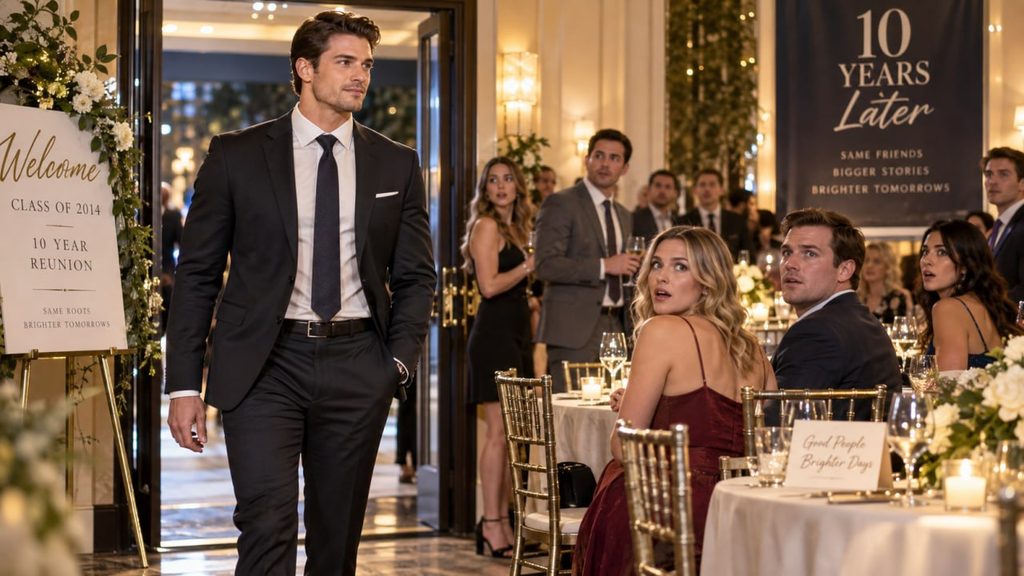
A few did.
Quietly.
Nervously.
The kind of laugh people make when they are no longer seventeen but have never quite learned how to stop acting like it.
Derek lifted his glass.
“Didn’t realize you had an invitation, Vance.”
Julian looked at him.
For one second, nobody moved.
Then my son smiled.
“No,” he said calmly.
“I didn’t.”
That answer seemed to satisfy Derek.
His grin widened.
“There it is.”
He turned toward the people beside him.
“Some things never change, right?”
Another scattered laugh.
Julian didn’t react.
He didn’t lower his eyes.
He didn’t put his hands into his pockets.
He didn’t shrink himself the way he used to when he was fifteen years old and surrounded by boys who had learned that humiliating the quiet kid earned them attention.
He simply stood there.
Tall.
Calm.
Still.
Derek noticed it too.
I think that was the first thing that bothered him.
Julian wasn’t embarrassed.
He wasn’t angry.
He wasn’t pleading.
He wasn’t acting like the boy Derek remembered.
Derek took another drink.
“So what?” he asked.
“You saw the pictures online and figured you’d just show up?”
Julian gave a tiny shrug.
“Something like that.”
A woman standing beside Derek whispered something into his ear.
Julian recognized her immediately.
Melissa Grant.
She had been homecoming queen senior year.
She had also once convinced Julian that a girl from chemistry class wanted to meet him behind the gym after school.
Julian had believed her.
He had stood there for forty-five minutes holding a flower he had bought with money from his lunch account.
Nobody came.
What he hadn’t known was that Melissa and six other students had been watching from a second-floor classroom window.
They had recorded him.
The video had circulated around school for weeks.
Someone had even added sad violin music to it.
Julian had never told me about that video.
Not then.
I learned about it years later.
Mothers know when their children are hurting.
But sometimes we never learn the exact shape of the knife.
Melissa stared at Julian now.
“You look different,” she said.
Julian smiled slightly.
“So do you.”
Her smile vanished.
Derek laughed.
“Still weird, though.”
And there it was.
Ten years disappeared in one sentence.
The ballroom.
The expensive suits.
The champagne.
The careers.
The marriages.
The children.
The mortgages.
All of it vanished.
And for one ugly little second, they were seventeen again.
Derek was standing beside a locker.
Julian was carrying books against his chest.
And everyone else was deciding whether to laugh.
Except Julian wasn’t seventeen anymore.
And this time he didn’t walk away.
He looked directly at Derek.
“Do you remember the cafeteria?”
Derek frowned.
“What?”
“The cafeteria.”
Derek laughed.
“Yeah, Julian. I remember the cafeteria.”
“Do you remember senior year?”
“Parts of it.”
“October?”
Derek rolled his eyes.
“Are we doing some kind of therapy session now?”
A few people chuckled.
Julian continued.
“You and Chris took my backpack.”
The laughter faded slightly.
Derek looked around.
“Oh, come on.”
“You dumped everything inside it onto the cafeteria floor.”
Derek sighed.
“Jesus, man. That was high school.”
“You poured chocolate milk into it.”
“Okay.”
“And when I tried to pick everything up, you put your shoe on my notebook.”
Derek’s face changed.
Not much.
Just enough.
Because he remembered.
Julian did too.
“I asked you to move your foot.”
Derek stared at him.
“You said…”
Julian paused.
The entire group was listening now.
“You said, ‘Make me.’”
Nobody laughed.
Julian nodded slowly.
“I couldn’t.”
Derek shifted his weight.
“Julian, seriously.”
“So I waited.”
Julian’s voice stayed calm.
“I waited until you got bored.”
Something strange began happening around the ballroom.
People who had been talking near the bar stopped.
A few turned toward them.
Someone lowered the music.
Derek noticed.
His smile became tighter.
“You came here to complain about something that happened ten years ago?”
“No.”
“Then what the hell do you want?”
Julian glanced at his watch.
“About four more minutes.”
Derek stared.
“What?”
“Four minutes.”
“For what?”
Julian didn’t answer.
Derek laughed again, but this time there was no confidence in it.
“What is this? Some dramatic revenge thing?”
“No.”
Julian looked around the ballroom.
“I spent too many years letting people in this room decide how I felt about myself.”
His eyes returned to Derek.
“I’m not giving you that much power again.”
Before Derek could answer, a woman in a black blazer approached.
She wore the country club’s gold name badge.
“Mr. Vance?”
Julian turned.
“Yes?”
“We’re ready for you.”
The room became quieter.
Derek blinked.
“Ready for him?”
The woman smiled professionally.
“Yes.”
Derek pointed toward Julian.
“You know him?”
The woman looked confused by the question.
“Of course.”
She turned back to Julian.
“The microphone is prepared. Your presentation is loaded, and Mr. Harrison asked me to tell you the board members have arrived.”
Derek lowered his glass.
“What presentation?”
Julian adjusted one cuff.
“The reason I came.”
And then he walked away from Derek.
Not around him nervously.
Not with his head down.
Straight past him.
Through the middle of the ballroom.
And something extraordinary happened.
People moved.
They stepped aside.
Ten years earlier, Julian had walked through school hallways trying not to be noticed.
That night, the room seemed to open for him.
One person whispered his name.
Then another.
Phones appeared.
People began searching.
A woman near the bar suddenly covered her mouth.
“Oh my God.”
Her husband looked at her.
“What?”
She held her phone toward him.
“That’s him.”
“What?”
“That’s Julian Vance.”
“I know.”
“No.”
She shook her head.
“You don’t understand.”
Behind them, someone else was already reading.
“Vance Systems…”
Another voice.
“Wait, he founded that?”
Someone farther back said, “Are you serious?”
Derek’s face had gone still.
Melissa grabbed her phone.
Julian heard fragments as he approached the stage.
“Cybersecurity…”
“Education software…”
“Forty-seven countries…”
“Wasn’t he on—”
“His foundation…”
“How did nobody know this?”
There was a simple answer.
Because Julian hadn’t told them.
He had never returned to impress them.
He had never posted his accomplishments into the old class Facebook group.
He had never attended alumni events.
He hadn’t spent ten years waiting for the people who bullied him to notice his success.
He had simply lived.
And apparently, he had lived very well.
Julian stepped onto the small stage at the front of the ballroom.
The music stopped completely.
A large screen behind him turned black.
Then white letters appeared.
THE EMPTY CHAIR PROJECT
The room went silent.
Julian stood behind the microphone.
For several seconds, he said nothing.
He just looked at them.
Faces from classrooms.
Faces from hallways.
Faces from old photographs.
Some had been cruel.
Some had laughed.
Some had watched.
Some had done nothing.
And some looked genuinely ashamed.
Julian took a breath.
“Hi.”
A few nervous chuckles.
He smiled.
“I guess I should begin by admitting something.”
He glanced toward Derek.
“I wasn’t invited.”
This time nobody laughed.
Julian continued.
“I found out about the reunion by accident. A friend from another graduating class sent me a screenshot because he assumed I was attending.”
He paused.
“I checked my email.”
“Nothing.”
“I checked the class page.”
“Nothing.”
“I thought maybe it was an oversight.”
His smile was faint.
“Then I learned it wasn’t.”
Across the ballroom, several members of the reunion committee looked at the floor.
Julian nodded.
“That hurt.”
Those three words changed the room.
Because he didn’t say them dramatically.
He simply told the truth.
“I’m thirty-eight years old.”
“I have a life I’m proud of.”
“I have people who love me.”
“I have work that matters to me.”
“I’ve stood in rooms with governors, engineers, teachers, business leaders, and people much smarter than I will ever be.”
He looked toward the tables.
“And somehow…”
“A ten-year reunion invitation still hurt.”
He gave a small laugh.
“Which annoyed me, actually.”
A few people smiled.
“Because I thought I was done caring.”
Julian’s expression changed.
“But that’s the strange thing about being bullied when you’re young.”
“You grow.”
“Your life changes.”
“You move away.”
“You build a career.”
“You meet people who treat you differently.”
“And then some small thing happens…”
“A photograph.”
“A name.”
“A hallway.”
“A reunion invitation that never comes.”
“And suddenly part of you is fifteen years old again.”
No one moved.
Julian looked toward the back of the ballroom.
“I almost stayed home.”
He paused.
“Then I remembered a chair.”
The screen changed.
A photograph appeared.
It was an ordinary school cafeteria.
Long tables.
Plastic trays.
Fluorescent lights.
Nothing special.
Julian looked at it.
“For three years, I ate lunch alone more days than I didn’t.”
His voice became quieter.
“I learned how to make forty minutes last a very long time.”
He smiled sadly.
“I read ketchup packets.”
A few people looked uncomfortable.
“I memorized posters on the walls.”
“I pretended to do homework so people wouldn’t know I didn’t have anyone to sit with.”
His eyes moved slowly across the crowd.
“Sometimes I walked around carrying my tray until most people had already sat down, because sitting alone feels less embarrassing when you can pretend there just wasn’t any room.”
Someone near the front wiped her eye.
Julian continued.
“There are people in this room who probably don’t remember me eating alone.”
“You shouldn’t.”
“You were busy being teenagers.”
“Some of you were kind to me.”
“Some of you weren’t.”
“Some of you never spoke to me at all.”
“And some of you…”
He paused.
“…made sure I knew there was no seat for me.”
Derek crossed his arms.
Julian saw him.
Still, he continued.
“One day during senior year, I sat in my car after school for almost two hours because I didn’t want to go home.”
That sentence hit me differently when Julian told me about it later.
Because I remembered that day.
He had arrived home after dark.
I had asked where he had been.
He told me the library.
I believed him.
For ten years, I had believed him.
But he hadn’t been at the library.
He had been sitting in our old Honda Civic in a high school parking lot, trying to gather enough strength to come home and pretend he was okay.
Julian continued.
“I didn’t want my mother to see me crying.”
His voice cracked slightly.
It was the first crack of the night.
He looked down.
Then he looked back up.
“My mother had enough problems.”
“She worked constantly.”
“She did everything she could to give me a good life.”
“I thought admitting how bad school had become would break her heart.”
He stopped.
Across town, I didn’t know any of this was happening.
I was at home.
Waiting.
Looking at the clock.
Wondering how long a reunion lasted.
Julian continued.
“So I lied.”
“I said I was fine.”
“A lot.”
Someone in the room whispered, “I’m sorry.”
Julian heard it.
He nodded slightly.
“After graduation, something strange happened.”
“The world got bigger.”
He smiled.
“Much bigger.”
“I went to community college first.”
A few people seemed surprised.
“I couldn’t afford the university I wanted.”
“My mother certainly couldn’t afford it.”
“I worked nights.”
“I slept very little.”
“I studied computer science.”
“I discovered something important.”
He paused.
“I wasn’t stupid.”
Several heads lowered.
“I know that sounds ridiculous.”
“But when enough people laugh every time you speak, eventually you start wondering whether they’re laughing because they know something about you that you don’t.”
He looked around.
“They didn’t.”
“I was quiet.”
“I was awkward.”
“I was poor.”
“My clothes didn’t always fit.”
“I didn’t understand which shoes were cool.”
“I had acne.”
“I talked too much about computers.”
“None of those things meant there was something wrong with me.”
He leaned closer to the microphone.
“It just meant I was a kid.”
The room stayed silent.
“A few years later, I developed a piece of software.”
The screen changed again.
A photograph appeared of Julian at twenty-two.
Skinny.
Long hair.
Wearing a wrinkled hoodie.
Standing beside a laptop held together with silver tape.
People laughed softly.
This time warmly.
Julian smiled.
“Yes.”
“I was apparently still terrible at fashion.”
That earned the first genuine laughter.
“My first office was my bedroom.”
“My second office was my friend Mateo’s garage.”
“My third office actually had heating.”
More laughter.
“We built software designed to identify digital harassment patterns in school communication systems.”
Derek’s arms slowly uncrossed.
Julian continued.
“The idea came from something I understood.”
“Bullying.”
Not a sound.
“I understood what it felt like when a joke stopped being a joke.”
“I understood what it felt like when fifty people saw something humiliating about you before you even knew it existed.”
“I understood what it felt like when adults said…”
He made quotation marks with his fingers.
“‘Kids can be cruel.’”
His expression hardened.
“As though cruelty becomes harmless because children are doing it.”
Several teachers who had attended the reunion exchanged glances.
“So I built something.”
“We failed.”
“We built it again.”
“We failed again.”
“We almost ran out of money.”
“We ate instant noodles for months.”
“My mother thought I was destroying my future.”
Back at home, when Julian later told me about that line, I laughed.
Because it was true.
I had absolutely thought he was destroying his future.
Julian smiled at the memory.
“Then one school district tried our software.”
“Then another.”
“Then fourteen.”
“Then a state contract.”
“And then things got…”
He searched for the word.
“…strange.”
Someone laughed.
The screen changed.
Articles appeared.
VANCE SYSTEMS EXPANDS NATIONAL SCHOOL SAFETY NETWORK
TECH ENTREPRENEUR JULIAN VANCE ANNOUNCES EDUCATION GRANT
DIGITAL SAFETY PLATFORM REACHES TEN MILLION STUDENTS
Several people stared at the screen.
Derek’s face had lost all color.
Julian didn’t linger on the articles.
He clicked again.
They disappeared.
“I’m not showing you that because I want applause.”
Nobody clapped.
“I’m showing you because the strangest thing happened after those articles were published.”
He paused.
“Kids started writing to me.”
The screen filled with blurred handwritten letters.
Names were hidden.
Faces were hidden.
Only fragments remained.
I eat lunch in the library because nobody wants me at their table.
They made a group chat about me.
I told my teacher but it got worse.
My mom thinks I have friends.
I pretend I’m sick on Mondays.
Sometimes I sit in the bathroom during lunch.
Julian stopped speaking.
The ballroom became so quiet that ice shifting inside someone’s glass sounded loud.
“A twelve-year-old boy from Ohio wrote that last sentence.”
Julian swallowed.
“He reminded me of myself.”
He clicked again.
Another photograph appeared.
An empty chair.
Just one plastic cafeteria chair.
“That is why I started the Empty Chair Project.”
Julian stepped away from the podium.
“We partner with schools, youth organizations, counselors, and local businesses to create programs for students experiencing chronic social isolation, harassment, or bullying.”
The screen changed.
Photos appeared.
Teenagers sitting together.
A new youth center.
Counselors.
Tutoring rooms.
Computer labs.
Art spaces.
A cafeteria filled with round tables instead of long rows.
“One of the things we teach sounds almost embarrassingly simple.”
Julian smiled.
“Notice the empty chair.”
He looked at his classmates.
“The kid sitting alone.”
“The person standing at the edge of the group.”
“The student pretending to read because nobody saved them a seat.”
“The child who is always picked last.”
“Notice them.”
His voice softened.
“Because sometimes changing someone’s life begins with four words.”
Julian paused.
“Sit here with us.”
A woman at table seven began crying.
Her name was Rachel.
Julian remembered her.
Sophomore year, Rachel had been sitting with Melissa when they hid Julian’s gym clothes.
She had never touched his things.
She had laughed, though.
Sometimes people remember the laugh longer than the hand.
Julian continued.
“When I discovered I wasn’t invited tonight, my first reaction was embarrassment.”
“My second was anger.”
“My third…”
He smiled.
“…was apparently to make a phone call.”
A few people shifted.
Julian looked toward the country club manager.
The man nodded.
Julian turned back to the crowd.
“This reunion cost a little more than the committee expected.”
Heads turned toward the reunion organizers.
“The original venue canceled.”
One committee member closed her eyes.
“The replacement deposit was due within forty-eight hours.”
Derek looked toward her.
“What is he talking about?”
She didn’t answer.
Julian did.
“They were going to cancel the reunion.”
Whispers spread.
Julian continued.
“Three weeks ago, the committee received an anonymous alumni sponsorship.”
Derek froze.
Julian placed both hands on the podium.
“I paid for tonight.”
Silence.
Not surprise.
Not murmuring.
Silence.
Derek stared at him.
Julian continued.
“The ballroom.”
“The food.”
“The staff.”
“The sound equipment.”
“The bar.”
He looked toward Derek’s glass.
“Although in retrospect, maybe the open bar was too generous.”
A nervous ripple of laughter moved through the room.
Derek did not laugh.
Melissa whispered, “Oh my God.”
Julian nodded.
“Yes.”
“You didn’t invite me.”
“And I paid for your reunion.”
That was the moment, according to the videos people later sent me, when almost every phone in the room pointed toward the stage.
But Julian wasn’t finished.
Derek stepped forward.
“This is insane.”
Everyone looked at him.
Julian remained quiet.
Derek pushed through the crowd.
“So what?”
He raised his voice.
“You bought your way in?”
Julian shook his head.
“No.”
“That’s exactly what you did.”
“No.”
“You want everyone standing here looking at you like you’re some kind of hero because you got rich?”
Julian looked at him for a long moment.
Then he said something I will remember for the rest of my life.
“No, Derek.”
His voice was almost gentle.
“I came because I finally understood that the worst thing you ever convinced me of wasn’t that I was poor.”
Derek said nothing.
“It wasn’t that I was awkward.”
“It wasn’t that I was ugly.”
Julian paused.
“It was that I needed people like you to decide whether I deserved to enter the room.”
The ballroom went still.
Julian shook his head.
“I don’t.”
Derek’s jaw tightened.
“You think money makes you better than everybody now?”
Julian smiled sadly.
“No.”
“If money made people better, you would have been kind when your father bought you everything.”
A sound moved through the room.
Not laughter.
Something sharper.
Derek’s face reddened.
Julian continued before he could respond.
“Money did not fix me.”
“Success did not fix me.”
“Because I was never broken.”
“What changed was that I stopped measuring myself with rulers handed to me by people who wanted me to feel small.”
Derek stared.
Then Julian said:
“And I didn’t pay for tonight to embarrass you.”
“Then why?”
Julian looked toward the screen.
“Because I needed everyone here.”
He clicked.
The photograph changed.
An old brick building appeared.
Their high school.
Or what used to be their high school.
The school district had built a newer campus four years earlier.
The old building had been sitting partly vacant ever since.
Julian looked at the screen.
“You all recognize that.”
Whispers.
“Jefferson High.”
“Technically, former Jefferson High.”
He smiled.
“The school district approved the sale last month.”
Derek frowned.
“So?”
Julian took a breath.
“My foundation purchased it.”
The reaction came instantly.
“What?”
“Seriously?”
“The whole school?”
“Why?”
Julian waited.
Then the image changed.
An architectural rendering appeared.
The old gray school building had been transformed.
The front courtyard had trees.
Glass doors.
Warm lighting.
A sign over the entrance read:
THE JEFFERSON COMMUNITY CENTER
HOME OF THE EMPTY CHAIR PROJECT
Someone gasped.
Julian’s voice became softer.
“Next spring, that building opens again.”
“A free community center.”
“After-school tutoring.”
“Counseling.”
“Technology labs.”
“College application assistance.”
“Career training.”
“Sports programs.”
“Art rooms.”
“Meals.”
“Family support.”
“A place where teenagers who don’t know where else to go can go.”
He paused.
“The cafeteria is staying.”
The room fell silent again.
Julian smiled.
“But we’re changing the tables.”
A few people wiped their eyes.
“There will always be room for one more chair.”
Rachel covered her face.
Julian looked around.
“That’s why I came tonight.”
“Because this building belongs to our history.”
“All of us.”
“And whether that history was good or bad…”
“It shaped us.”
“The Empty Chair Project will also provide twenty scholarships every year to students from this district.”
Applause started.
Julian raised one hand.
“Please.”
The applause stopped.
“There’s one more thing.”
He looked toward someone beside the stage.
A gray-haired man stood slowly.
Julian smiled.
“Mr. Bennett?”
Several people recognized him immediately.
Mr. Bennett had taught history for thirty-six years.
He was retired now.
Older.
Thinner.
But still unmistakably himself.
He walked toward the stage.
Julian met him halfway.
They shook hands.
Then Mr. Bennett did something nobody expected.
He hugged Julian.
Julian closed his eyes.
Just for a moment.
When they separated, Mr. Bennett took the microphone.
“I asked Julian if I could say something tonight.”
His voice shook.
“I don’t know whether I have earned the right.”
Julian stood beside him.
Mr. Bennett looked across the room.
“I was a teacher at Jefferson High when all of you attended.”
“We were supposed to protect students.”
He swallowed.
“And sometimes we failed.”
Someone shifted in a chair.
Mr. Bennett continued.
“Julian came to me once.”
Julian looked down.
“He was sixteen.”
“He told me some boys had locked him in the equipment storage room after gym.”
Derek’s eyes moved away.
Mr. Bennett’s voice tightened.
“I told him I would look into it.”
He paused.
“I did not.”
No one moved.
“I had papers to grade.”
“A meeting.”
“A basketball game that evening.”
“I told myself boys played stupid pranks.”
Mr. Bennett looked at Julian.
“I forgot about it.”
Julian blinked hard.
“I forgot.”
“But he didn’t.”
Mr. Bennett turned toward the audience.
“There are failures we recognize immediately.”
“And there are failures that look small until you understand who had to carry them.”
His hands trembled.
“Years later, I saw an interview with Julian.”
“He talked about isolation.”
“He talked about school.”
“And I remembered that conversation.”
Mr. Bennett’s eyes filled.
“I remembered his face.”
He looked directly at Julian.
“I am sorry.”
Julian swallowed.
The room waited.
Finally, he nodded.
“Thank you.”
Mr. Bennett stepped away.
Julian returned to the microphone.
He looked shaken now.
Not weak.
Human.
There is a difference.
“My mother once asked me why I never talked about high school.”
He paused.
“I told her there wasn’t much to say.”
At home, sitting on my couch, I suddenly sneezed.
I remember because later Julian joked that somehow I must have known people were talking about me.
He continued.
“That was another lie.”
“There was plenty to say.”
“I just didn’t know how to say it without sounding like that kid again.”
Then a voice came from the crowd.
“Julian?”
He looked toward the sound.
Rachel stood.
Her face was wet with tears.
“I’m sorry.”
Julian stared at her.
Rachel covered her mouth.
“I’m really sorry.”
Nobody interrupted.
She lowered her hand.
“I laughed.”
Julian’s face remained still.
“At things people did to you.”
She shook her head.
“I never started anything.”
Her voice broke.
“And I used that as an excuse for years.”
She wiped her cheek.
“But I laughed.”
Julian nodded.
“I remember.”
That hurt her.
You could see it.
She closed her eyes.
“I’m sorry.”
Julian looked at her for several seconds.
“Thank you.”
Rachel sat down.
Then someone else stood.
Chris Palmer.
One of Derek’s closest friends in high school.
The boy who helped pour chocolate milk into Julian’s backpack.
Chris was now broad-shouldered and balding.
He had two daughters.
He looked terrified.
“I did worse than laugh.”
Derek turned toward him.
“Chris.”
Chris ignored him.
He looked at Julian.
“The backpack.”
Julian nodded.
“I remember.”
“I know.”
Chris rubbed both hands across his face.
“My oldest daughter is thirteen.”
His voice cracked.
“She came home crying last year because girls at school made an account posting pictures of her.”
He paused.
“I wanted to tear the world apart.”
Julian said nothing.
Chris stared at the floor.
“And then one night I remembered you.”
Nobody breathed.
“I remembered that stupid video.”
“The flower.”
Melissa went pale.
Chris continued.
“I remembered sending it to people.”
His eyes filled.
“And I realized…”
His voice broke.
“…I had once been exactly the person I was begging God to keep away from my daughter.”
The room was completely silent.
Derek muttered, “Come on.”
Chris turned.
“No.”
Derek blinked.
Chris’s voice hardened.
“No, Derek.”
“This isn’t funny anymore.”
Derek stared at him.
Chris turned back to Julian.
“I’m sorry.”
Julian looked at him.
For a moment, something old crossed my son’s face.
The sixteen-year-old boy.
The boy carrying his books.
The boy waiting behind the gym with a flower.
The boy sitting alone.
And then it passed.
“I appreciate you saying that.”
Chris nodded.
“I don’t expect forgiveness.”
Julian answered quietly.
“Good.”
Several people looked surprised.
Julian continued.
“Because forgiveness isn’t something people should apologize in order to receive.”
Chris nodded slowly.
“That’s fair.”
Julian looked around.
“You don’t apologize to erase your guilt.”
“You apologize because the other person deserved better.”
The sentence hung over them.
Chris sat down.
Then another person stood.
And another.
Not everyone apologized.
Some couldn’t.
Some wouldn’t.
Some probably still believed they had done nothing wrong.
Memory is convenient that way.
People often remember the things done to them in perfect detail.
And the things they did to others as harmless jokes.
One woman admitted she had excluded Julian from a birthday party after initially inviting the whole class.
Another remembered mocking his shoes.
A man named Tyler confessed that he had once written something cruel inside Julian’s yearbook and spent years pretending he couldn’t remember what it said.
Julian remembered.
Of course he did.
Then something happened that Julian had not planned.
A woman walked toward the stage.
Her name was Emily Park.
Julian recognized her instantly.
She had been quiet in high school.
Not unpopular.
Not popular.
She existed somewhere between groups.
Emily stopped near the stage.
“I didn’t bully you.”
Julian nodded.
“I know.”
“But I watched.”
He said nothing.
Emily’s eyes filled.
“I watched a lot.”
She looked around.
“And I always told myself I wasn’t part of it.”
Julian listened.
“I saw them dump your backpack.”
She swallowed.
“I saw someone knock your lunch tray over.”
Derek stared at the floor.
“I saw you sitting alone.”
Emily began crying.
“And I remember thinking I should sit with you.”
Julian’s face changed.
“But I didn’t.”
She wiped her eyes.
“Because I was scared that if I sat beside you, they’d start treating me like they treated you.”
Julian closed his eyes briefly.
Emily whispered, “I’m sorry.”
Julian stepped away from the microphone.
For the first time that night, he came down from the stage.
He walked toward her.
Emily looked confused.
Then Julian hugged her.
Not because what she had done was okay.
Not because silence doesn’t hurt.
It does.
But perhaps because Julian understood fear better than anyone.
When they separated, he said quietly:
“Thank you for telling the truth.”
Emily nodded.
Julian returned to the stage.
Derek was still standing.
His glass was empty now.
His face had hardened.
“So what now?”
Julian looked at him.
“What do you mean?”
Derek gestured around the room.
“You got your moment.”
Nobody said anything.
“You made everybody feel guilty.”
Julian shook his head.
“I didn’t make anyone feel anything.”
“Oh, please.”
Derek laughed bitterly.
“You show up in an expensive suit, tell everybody how rich and successful you are, buy the reunion, buy the school—”
“I never told you how rich I am.”
A few people laughed.
Derek flushed.
“That’s not the point.”
“Then what is?”
Derek stared at him.
“The point is, you’re still obsessed with high school.”
Julian considered that.
Then he nodded.
“For a long time, yes.”
Derek hadn’t expected that answer.
Julian continued.
“I hated you.”
Silence.
Derek blinked.
“For years.”
Julian looked at him.
“I imagined meeting you again.”
“I imagined humiliating you.”
“I imagined becoming successful enough that someday you would hear my name and feel small.”
He paused.
“That fantasy got me through some bad nights.”
Derek stared.
“But then something disappointing happened.”
Julian smiled faintly.
“I grew up.”
Someone chuckled.
Julian shook his head.
“I realized revenge is expensive.”
“Not financially.”
“Emotionally.”
“You keep renting space in your head to someone who probably isn’t thinking about you at all.”
Derek’s expression shifted.
“I spent years trying to become somebody you would regret bullying.”
Julian’s voice softened.
“Then one day I realized I had become somebody I respected.”
He paused.
“And that was enough.”
Derek looked away.
Julian watched him.
“Tonight isn’t revenge.”
“Then what is it?”
Julian glanced toward the screen displaying the community center.
“It’s conversion.”
Derek frowned.
“Conversion?”
“Taking something ugly and making it useful.”
Julian pointed toward the old school.
“That building gave me some of the worst memories of my life.”
“Next year, it might give someone else their best.”
He looked at Derek.
“That’s enough for me.”
Derek didn’t answer.
Then Julian said something no one expected.
“There is a scholarship application in your son’s name.”
Derek’s head snapped up.
The room went silent.
“What?”
Julian nodded.
“Evan Lawson.”
Derek stared.
“How do you know my son?”
“I don’t.”
Derek stepped forward.
“Then how—”
“The scholarship applications are reviewed without parents’ names whenever possible.”
Julian paused.
“Your son applied three months ago.”
Derek’s face drained.
“No.”
Julian nodded.
“He wants to study engineering.”
Derek said nothing.
“He wrote an essay about being afraid he isn’t good enough.”
Derek’s mouth opened.
Nothing came out.
“He wrote that his father was a star athlete in high school and that sometimes he worries he’ll never become the kind of person his father expects him to be.”
The ballroom disappeared from Derek’s face.
For the first time that night, he wasn’t the former quarterback.
He wasn’t the class president.
He wasn’t Julian’s bully.
He was a father.
A stunned father.
Julian continued gently.
“His application was strong.”
Derek whispered, “Did he…”
He cleared his throat.
“Did he get it?”
Julian nodded.
“Yes.”
Derek stared at him.
“What?”
“He was selected last week.”
No one moved.
Derek’s eyes flickered toward the screen, then back to Julian.
“You knew?”
“I learned yesterday.”
Derek’s jaw tightened.
“Are you going to take it away?”
Julian looked genuinely surprised.
“No.”
Derek swallowed.
“Why not?”
Julian’s eyebrows lifted slightly.
“Why would I?”
“Because…”
Derek stopped.
Because of me.
He didn’t say it.
He didn’t need to.
Julian understood.
“Your son didn’t bully me.”
Derek looked at him.
“Children shouldn’t inherit punishments for things their parents did before they were born.”
Derek lowered his head.
Julian continued.
“And if Evan wants to become an engineer, I hope he becomes a great one.”
Derek stood completely still.
Julian watched him.
“I mean that.”
Derek’s eyes filled.
He turned away quickly.
That was when something inside him seemed to break.
Not dramatically.
There was no collapse.
No theatrical speech.
His shoulders simply lowered.
Ten years of confidence vanished from his posture.
He looked at Julian again.
“Why?”
Julian frowned.
“Why what?”
“Why help my kid?”
Julian stared at him.
Then he answered.
“Because someone should.”
Derek closed his eyes.
The room stayed silent.
Julian stepped away from the microphone.
He thought the night was over.
But Derek spoke again.
“I remember the storage room.”
Julian stopped.
Mr. Bennett looked toward him.
Derek swallowed.
“I was there.”
Julian’s face went still.
“I know.”
Derek shook his head.
“No.”
His voice cracked.
“You don’t.”
Julian waited.
Derek looked around as though deciding whether he could survive the truth.
Finally, he said:
“It was my idea.”
A woman near him inhaled sharply.
Derek stared at the floor.
“I told Chris to hold the door.”
Chris looked sick.
Derek continued.
“We thought you’d be in there for five minutes.”
Julian’s jaw tightened.
“But Coach called us outside.”
Derek swallowed.
“And…”
He stopped.
“And we forgot.”
The sentence landed like a stone.
Julian didn’t move.
Derek looked at him.
“You were in there almost an hour.”
“Fifty-three minutes.”
Derek’s face crumpled slightly.
Julian remembered exactly.
Of course he did.
Derek whispered, “I’m sorry.”
Julian said nothing.
“I really am.”
Derek’s voice broke.
“I didn’t think…”
Julian interrupted.
“I know.”
Derek blinked.
“That was the problem.”
Nobody moved.
Julian continued.
“You didn’t think.”
“You didn’t have to.”
“You did something.”
“You walked away.”
“And I lived with it.”
Derek’s eyes filled.
“I’m sorry.”
Julian nodded once.
“I hear you.”
Derek waited.
Maybe he expected forgiveness.
Maybe he hoped for absolution.
Julian didn’t give it.
Not because he was cruel.
Because some things don’t have to be wrapped in a neat bow.
An apology can be real.
And a wound can still be real.
Both truths are allowed to exist.
Julian stepped back to the microphone.
“I didn’t come here tonight to collect apologies.”
He looked around.
“I came because twenty years from now, none of us are going to care who sat at the popular table.”
“None of us will care who won homecoming.”
“Who had the nicest car.”
“Who wore the right shoes.”
“Who got invited to which party.”
“But people remember how you made them feel when they were powerless.”
His eyes moved across the room.
“And someday…”
“Your children will come home from school.”
“They may be crying.”
“They may have been bullied.”
“Or…”
Julian paused.
“They may be the bully.”
Several parents looked uncomfortable.
“When that happens, please don’t tell them cruelty is normal.”
“Don’t tell them everyone gets teased.”
“Don’t tell them the person they hurt needs to toughen up.”
“Teach them something better than what some of us learned.”
Julian took a breath.
“Teach them that strength is not making someone smaller.”
“Strength is being the person who moves their backpack off the empty chair and says…”
“Sit here.”
Silence.
Then one person began clapping.
Mr. Bennett.
Slowly.
Deliberately.
Then Rachel.
Chris.
Emily.
A few more.
Then dozens.
Then nearly everyone.
Within seconds, the ballroom filled with applause.
People stood.
Julian looked overwhelmed.
This was not what he had expected.
He lowered his head.
The applause continued.
People who once wouldn’t sit beside him were standing for him.
But the strangest thing was this:
It didn’t feel like victory.
Not the kind Julian had imagined years earlier.
There was no sweetness in watching old classmates look ashamed.
No satisfaction in seeing Derek speechless.
The victory was quieter.
Julian realized he could leave.
That was it.
He could simply walk away.
He didn’t need one more apology.
One more compliment.
One more moment of recognition.
They no longer controlled the door.
Julian took the microphone one last time.
“Enjoy the reunion.”
A few people laughed through tears.
“And please tip the staff.”
More laughter.
Julian smiled.
“Good night.”
Then he stepped off the stage.
People immediately approached.
Too many.
Some wanted photographs.
Some wanted to apologize.
Some wanted to talk business.
Some wanted to tell him about their children.
Some wanted to explain that they had never personally bullied him.
Julian listened politely.
But he did not stay long.
One man introduced himself as though Julian had forgotten him.
Julian hadn’t.
A woman mentioned that she had always secretly thought he was smart.
Julian smiled.
Another former classmate asked whether Vance Systems was hiring.
Julian nearly laughed.
For ten years, he had imagined returning to high school as someone everyone wanted to know.
Standing there, he discovered how little he wanted it.
Then Melissa approached him.
She stood alone.
No champagne glass.
No smile.
“Julian.”
He turned.
“Melissa.”
She looked down.
“The flower.”
Julian said nothing.
Her eyes filled.
“I’m sorry.”
He waited.
“That video…”
She covered her mouth.
“I forgot about it for years.”
Julian’s expression changed.
“I didn’t.”
Melissa nodded.
“I know.”
For several seconds, neither spoke.
Finally she whispered:
“I was awful to you.”
Julian gave a small nod.
“Yes.”
The directness surprised her.
She wiped her cheek.
“I don’t know why.”
Julian looked toward the crowd.
“I do.”
She blinked.
“You were seventeen.”
“That’s not an excuse.”
“No.”
Julian looked back at her.
“But it’s part of the explanation.”
Melissa swallowed.
“I wanted people to like me.”
Julian smiled sadly.
“So did I.”
The difference between those four words cut through her.
Melissa started crying.
Julian didn’t comfort her.
He didn’t punish her either.
He simply allowed the truth to exist between them.
Finally, she said:
“I hope you’re happy.”
Julian nodded.
“I am.”
And for the first time in the entire conversation, there was no performance in either of them.
Melissa stepped away.
Near the exit, Derek stood alone.
Julian almost walked past him.
Then Derek spoke.
“Vance.”
Julian stopped.
Derek had both hands in his pockets now.
No audience.
No drink.
No swagger.
“My son really got the scholarship?”
“Yes.”
“He didn’t know you and I…”
“No.”
Derek nodded.
“He likes building things.”
Julian waited.
“Robots.”
A faint smile appeared on Derek’s face.
“Little machines all over our garage.”
Julian smiled too.
“I was that kid.”
Derek looked at him.
“I know.”
Silence.
Then Derek said:
“He’s nothing like me.”
Julian considered the statement.
“Maybe he’s exactly enough like you to understand you.”
Derek’s eyes lowered.
“I’m going to talk to him.”
“Good.”
Derek nodded.
Julian turned to leave.
“Julian.”
He stopped again.
Derek’s voice was quiet.
“I know saying sorry doesn’t fix it.”
Julian looked back.
“No.”
“I know you don’t owe me forgiveness.”
“No.”
Derek swallowed.
“But I am sorry.”
Julian studied him.
For a long moment, he saw two versions of the man.
The seventeen-year-old boy laughing beside a locker.
And the thirty-eight-year-old father standing beneath chandelier light with tears in his eyes.
Julian couldn’t erase the first.
But he didn’t have to deny the second.
Finally, Julian nodded.
“I believe you.”
Derek’s face changed.
That was all.
Julian left.
Outside, the night air was cold.
The country club doors closed behind him.
And for several moments, my son simply stood there.
Alone.
Ten years earlier, being alone had felt like proof that nobody wanted him.
That night, standing alone beneath the entrance lights, it felt completely different.
It felt peaceful.
His phone buzzed.
A message from me.
Are you okay?
Julian smiled.
Then he called.
I answered before the first ring finished.
“Julian?”
“Hey, Mom.”
His voice sounded strange.
My heart jumped.
“What happened?”
“Nothing bad.”
“Are you sure?”
“Yeah.”
I stood from the couch.
“Did they let you in?”
He laughed.
“Yes.”
“What happened?”
A pause.
“A lot.”
“What does that mean?”
Another pause.
Then my son said:
“Mom?”
“Yes?”
“Can I come over?”
I looked around my living room.
As though perhaps there were a reason my own child couldn’t come home.
“Of course.”
“I’ll be there in twenty minutes.”
“Julian?”
“Yeah?”
“Are you sure you’re okay?”
This time his answer came quietly.
“I think I am.”
Twenty-three minutes later, headlights moved across my front curtains.
I opened the door before he knocked.
Julian stood on the porch.
His tie was loose.
His hair had fallen slightly out of place.
His eyes were red.
I didn’t ask anything.
I hugged him.
He wrapped both arms around me.
And suddenly my thirty-eight-year-old son was my little boy again.
He buried his face against my shoulder.
I felt him shake once.
Then again.
“Baby.”
That was all I said.
He started crying.
Not loudly.
Not dramatically.
The tears seemed to come from somewhere very old.
Somewhere deep.
I held him.
I didn’t ask him to stop.
I didn’t tell him everything was okay.
Because sometimes everything was not okay.
Sometimes a person simply survives long enough to finally cry safely.
We stood in my doorway for several minutes.
Then I brought him inside.
I made tea.
He laughed when he saw it.
“Mom, I’m not sick.”
“You came home crying. You’re getting tea.”
He smiled.
“Yes, ma’am.”
We sat at my kitchen table.
The same table where he had done homework.
The same table where he had once told me school was fine.
The same table where I had believed him.
I looked at him.
“So.”
He stirred his tea.
“So.”
“What did you do?”
He smiled.
“Made a speech.”
My eyes narrowed.
“What kind of speech?”
“A speech speech.”
“Julian.”
He laughed.
Then he told me.
Everything.
The reunion.
Derek.
The stage.
The old school.
The project.
The apologies.
Mr. Bennett.
Chris.
Emily.
The scholarship.
The storage room.
I listened.
At some point, I stopped drinking my tea.
When Julian told me about sitting in the parking lot for two hours at sixteen because he didn’t want me to see him cry, I put my cup down.
“You told me you were at the library.”
“I know.”
I stared at him.
“You lied to me.”
“I know.”
“Why?”
He looked surprised.
“I told you.”
“No.”
My eyes filled.
“You said you didn’t want me worrying.”
“Mom—”
“Julian, I was your mother.”
He looked down.
“I know.”
“You should have told me.”
His face tightened.
“I was embarrassed.”
My heart broke.
“Of what?”
He didn’t answer.
“Of being bullied?”
His eyes filled again.
“I thought it meant something was wrong with me.”
I reached across the table.
“Oh, Julian.”
He covered my hand.
“I know better now.”
“But you didn’t then.”
“No.”
I shook my head.
“All those nights…”
He squeezed my fingers.
“Mom.”
“I should have known.”
“You did know.”
“Not enough.”
“You knew enough to love me.”
“That wasn’t enough.”
“It was to me.”
I started crying.
Julian moved around the table and knelt beside my chair.
He took my hands.
“Mom.”
I looked at him.
“I used to think you were the only person in the world who liked me.”
His voice broke.
“And that kept me alive some days.”
I stopped breathing.
“Julian…”
He immediately realized what he had said.
“No.”
He shook his head.
“Not like that.”
I stared at him.
“I mean…”
He searched for the words.
“It kept me going.”
I pulled him toward me.
He rested his forehead against my shoulder.
My hands went into his hair the same way they had when he was ten years old.
“I wish I could go back.”
“I know.”
“I would have gone into that school.”
He laughed softly.
“I know.”
“I would have torn the roof off.”
“I definitely know.”
“I mean it.”
“I know, Mom.”
We stayed there.
Then I whispered:
“Are you glad you went tonight?”
Julian lifted his head.
He thought about it.
“Yes.”
“Did you get closure?”
He smiled.
“No.”
I frowned.
“No?”
“No.”
“Then what did you get?”
My son looked toward the dark kitchen window.
His reflection stared back at him.
Older.
Stronger.
Free.
“Something better.”
“What?”
He smiled.
“I stopped needing it.”
I understood.
Closure sounded like a door someone else had to close.
But Julian had spent enough of his life waiting for other people to decide when he was allowed to leave the room.
That night, he decided for himself.
Six months later, the old Jefferson High School reopened.
I stood outside that building on a bright Saturday morning watching hundreds of people gather beneath a new sign.
THE JEFFERSON COMMUNITY CENTER
HOME OF THE EMPTY CHAIR PROJECT
Julian stood near the entrance greeting families.
Students walked past him carrying backpacks.
Parents toured counseling rooms.
Children filled the computer lab.
A group of teenagers played basketball in the renovated gym.
And the cafeteria…
The cafeteria was almost unrecognizable.
The long tables were gone.
There were smaller round tables.
Comfortable chairs.
Bright windows.
Plants.
Murals.
And written across one wall, in letters large enough for every student to see:
THERE IS ALWAYS ROOM FOR YOU HERE.
I cried when I saw it.
Julian caught me.
“Mom.”
“I’m fine.”
“You’re crying.”
“I’m allowed.”
He laughed.
“Yes, ma’am.”
I walked through the room slowly.
Then I noticed one table near the window.
A small brass plaque was attached to it.
I leaned closer.
FOR EVERYONE WHO EVER ATE ALONE.
I covered my mouth.
Julian stood beside me.
“You did this?”
He smiled.
“Had to.”
Before I could answer, someone called his name.
“Mr. Vance?”
We turned.
A teenage boy stood several feet away beside his father.
I recognized Derek immediately.
He looked different without the confidence of that reunion.
Older.
More ordinary.
Beside him stood a thin boy with messy brown hair and glasses.
He carried a robotics club sweatshirt over one arm.
Derek looked at Julian.
“This is Evan.”
Julian smiled.
“The engineer.”
Evan looked embarrassed.
“Hopefully.”
Julian shook his hand.
“Congratulations on the scholarship.”
Evan’s face brightened.
“Thank you.”
“I read your essay.”
Evan glanced at his father.
Derek looked away.
Julian continued.
“You’re a good writer.”
“Really?”
“Really.”
Evan smiled.
“Dad said you used to go to school together.”
The air changed.
Derek looked at Julian.
Julian looked at Derek.
“Yes,” Julian said.
“We did.”
Evan grinned.
“Dad says you were way smarter than everybody.”
Julian’s eyebrows rose.
Derek cleared his throat.
“I might have said something like that.”
Julian smiled.
“That’s a very generous rewrite of history.”
Derek laughed nervously.
Evan didn’t understand.
That was fine.
Children don’t need every wound their parents carried.
Sometimes healing means refusing to hand them the knife.
Evan hurried toward the robotics room.
Derek remained behind.
He looked around the cafeteria.
“This is incredible.”
“Thanks.”
Derek noticed the brass plaque.
His face changed.
For a moment, neither man spoke.
Then Derek looked toward one empty chair.
He pulled it away from the table.
He sat down.
And he gestured toward the chair opposite him.
“Coffee?”
Julian stared.
There was something almost painfully simple about it.
Two chairs.
Two men.
Thirty years of mistakes between them.
Julian could have walked away.
Nobody would have blamed him.
Instead, he sat.
Not because he had forgotten.
Not because the past had disappeared.
Not because Derek had suddenly become his friend.
He sat because forgiveness, when it comes at all, does not always arrive as a dramatic moment.
Sometimes it begins with a chair.
A conversation.
An acknowledgment.
A choice not to keep carrying the heaviest thing in the room.
I left them alone.
As I walked toward the hallway, I heard laughter behind me.
Not cruel laughter.
Just two grown men talking.
I stopped for one second.
Then kept walking.
Near the entrance, a girl sat by herself.
Maybe thirteen.
Maybe fourteen.
She wore a huge sweatshirt and held a sketchbook against her chest.
Students moved around her.
She watched them quietly.
I recognized that look.
I had seen it on my son.
Years ago.
Before I could move, another girl walked past.
Then stopped.
She turned around.
She looked at the girl sitting alone.
Then she pulled out the chair beside her.
“Hey.”
The lonely girl looked up.
The other girl smiled.
“You can sit with us if you want.”
She pointed toward a group near the window.
The girl with the sketchbook hesitated.
Then she stood.
I watched them walk away together.
Four words.
That was all.
You can sit with us.
Four words that would have meant everything to my son once.
Four words that might mean everything to somebody else today.
That evening, Julian and I stood outside the center after the last families left.
The sun was setting.
Light touched the old brick walls.
“Do you ever wish it had been different?” I asked.
Julian looked at the building.
“High school?”
“Yes.”
He thought for a long time.
“Of course.”
I nodded.
“I wish you hadn’t suffered.”
“Me too.”
I looked at him.
“But would you change it?”
Julian smiled.
“That’s harder.”
“Why?”
“Because people always say the bad things made them stronger.”
He shook his head.
“I hate that.”
“Why?”
“Because nobody should have to be hurt in order to become worth something.”
I looked at him.
“I wasn’t successful because they bullied me.”
“I became successful even though they bullied me.”
He paused.
“That matters.”
I nodded.
“But…”
He looked toward the building.
“I can decide what I do with what happened.”
The doors reflected the evening light.
“So no.”
“I’m not grateful for it.”
“I wouldn’t wish it on anybody.”
“But if I can turn something that nearly destroyed me into something that protects someone else…”
He slipped his hands into his pockets.
“…then at least it doesn’t get the last word.”
I smiled.
“That sounds like closure.”
Julian laughed.
“Maybe.”
He put an arm around my shoulders.
We started walking toward the parking lot.
Behind us, the lights inside the cafeteria clicked off one row at a time.
I looked through the windows.
Dozens of chairs sat around dozens of tables.
Tomorrow, students would fill them again.
Some confident.
Some frightened.
Some loud.
Some invisible.
And perhaps somewhere among them would be another boy like Julian.
A child wondering whether something was wrong with him because people had decided he was an easy target.
Maybe he would enter that cafeteria expecting to eat alone.
Maybe he would look for the most distant table.
Maybe he would keep his eyes down and pretend not to care.
And maybe…
Before he reached the corner…
Someone would notice.
Someone would move a backpack.
Someone would pull out a chair.
Someone would say:
“Sit here.”
And perhaps that would be enough to change everything.
Years ago, my son believed being excluded meant he had no value.
Ten years later, the same people who once laughed when he entered a room fell silent when he walked through the doors.
But that was never the real victory.
The expensive suit wasn’t the victory.
The company wasn’t the victory.
The money wasn’t the victory.
Buying the old school wasn’t the victory.
Even watching his former bullies apologize wasn’t the victory.
The victory was that Julian no longer needed their invitation.
He had spent his childhood waiting for someone to save him a seat.
So he grew up…
Built a bigger table…
And made sure nobody else would ever have to ask if they were allowed to sit down.
THE END! THANK YOU FOR READING!❤️