 Reading Time: 35 minutes
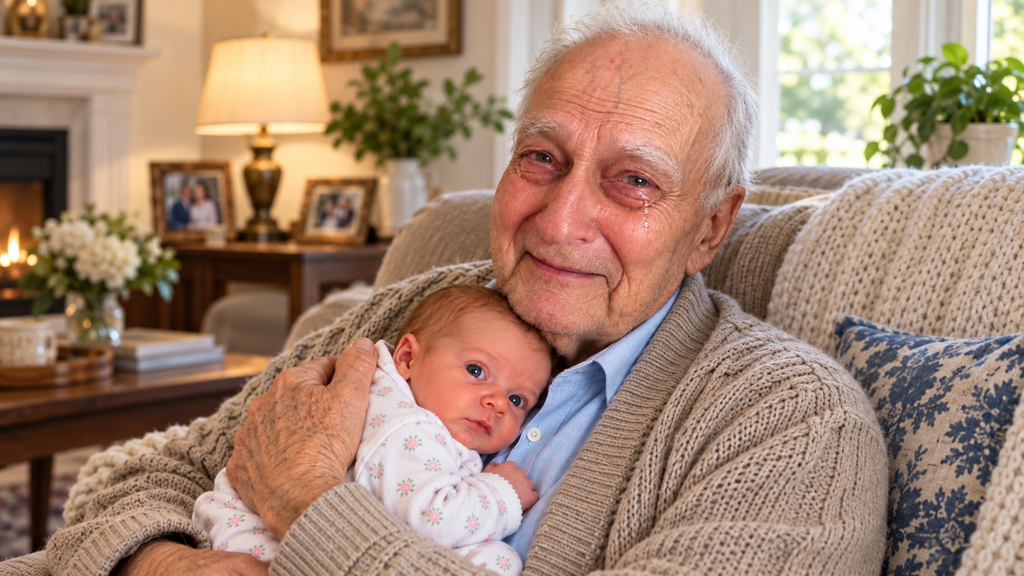
For several seconds, I couldn’t hear anything except the blood pounding inside my ears. randpa still held Brucie against his chest.
My daughter had fallen asleep, completely unaware that the two adults standing above her looked as though the earth had just cracked open beneath their feet.
I stared at Grandpa.
“What promise?”
He swallowed.
“The promise I made your mother.”
“What are you talking about?”
His eyes dropped toward Brucie again.
That blue eye.
That dark brown eye.
Even asleep, the difference was unmistakable.
Grandpa’s thumb trembled against the edge of her blanket.
“Those eyes belonged to someone else before they belonged to Luke.”
I felt something cold slide down my spine.
“Who?”
Grandpa looked at me.
“Your father.”
My mouth opened.
Nothing came out.
“My father had brown eyes.”
“The one you remember in photographs did,” Grandpa said quietly. “From a distance.”
“What does that even mean?”
“Thomas had sectoral heterochromia when he was young. His left eye darkened as he got older, so most photographs made them look nearly identical. But when he was a boy, one eye was almost black and the other was bright blue.”
He took a broken breath.
“Exactly like hers.”
I stared at Brucie.
Then at Grandpa.
Then back at Brucie.
“No.”
I almost laughed.
It was the kind of laugh a person makes when something is so ridiculous that the mind rejects it before the heart can understand it.
“No. Luke has those eyes. She got them from Luke.”
“I know.”
The porch suddenly seemed too small.
The sky too bright.
The world too normal.
A truck passed somewhere on the county road.
Birds chirped in the maple tree beside the house.
Somewhere in the distance, a lawn mower started.
How could the world still sound like an ordinary Saturday?
“What are you telling me?”
Grandpa slowly lowered himself into his rocking chair.
He looked eighty years old for the first time in my life.
Not seventy-three.
Not the strong man who had built half the furniture in his house with his own hands.
Not the grandfather who could still carry two bags of soil over one shoulder.
Eighty.
Maybe ninety.
A man suddenly crushed beneath the weight of something he had carried too long.
“Sit down, Clover.”
“No.”
“Please.”
“No.”
My voice cracked.
“You’re going to tell me right now.”
He nodded.
Then he looked past me toward the gravel driveway as if he expected ghosts to come walking up it.
“Before your mother married your father, Thomas had been involved with another woman.”
My stomach tightened.
“Her name was Helena Sterling.”
Sterling.
I gripped the porch railing.
“Luke’s mother?”
Grandpa nodded.
My knees nearly gave out.
“No.”
“Thomas and Helena were young. Twenty-one, maybe twenty-two. They were together for over a year. Then Thomas met your mother.”
“No.”
“Clover—”
“No.”
I backed away.
Grandpa rose carefully, still holding Brucie.
“Your father ended things with Helena. Several months later, she contacted him and told him she was pregnant.”
The porch blurred around me.
“No.”
“Thomas didn’t believe the baby was his at first.”
“No.”
“After Luke was born, a blood test was done. This was before modern home DNA kits. But the doctors said Thomas couldn’t be excluded, and later—”
“Stop.”
Grandpa stopped.
I pressed both hands against my mouth.
Luke.
Thomas.
My father.
Blue eye.
Brown eye.
I remembered Luke smiling at me across that coffee shop two years earlier.
I remembered thinking his eyes were the strangest, most beautiful thing I had ever seen.
I remembered touching the tiny cleft in his chin the first night he fell asleep beside me.
I remembered the way he used to tilt his head when he was thinking.
The way my mother did in old videos.
The way I sometimes did.
My stomach heaved.
I turned away and barely made it past the porch steps before I vomited into the hydrangeas.
“Clover!”
Grandpa rushed toward me.
I threw up again.
My incision from the delivery burned.
My entire body shook.
Grandpa handed Brucie back to me once I could stand.
I held her automatically.
Instinctively.
Her warm little body settled against mine.
And suddenly I was terrified to look at her.
That realization broke something inside me.
I squeezed my eyes closed.
“No.”
Grandpa touched my shoulder.
“Sweetheart—”
“Don’t touch me.”
His hand dropped immediately.
I hated myself for saying it.
But I couldn’t stop.
I turned around.
“You knew?”
He stared at me.
“You knew Luke existed?”
“I knew Thomas had a son named Lucas Sterling.”
“And you never told me?”
“Your mother begged me not to.”
“Why?”
“Because Thomas had never been part of Luke’s life. Helena wanted nothing to do with him after what happened between them. Your mother believed dragging you into that history would only destroy your memory of your father.”
“My memory?”
I laughed again.
This time the sound frightened even me.
“My memory?”
Tears flooded my eyes.
“My father is dead, Grandpa. My mother is dead. Luke disappeared. And now you’re standing here telling me that I might have had a baby with my own—”
I couldn’t say the word.
My throat refused to form it.
Grandpa began crying harder.
“I didn’t know.”
“You knew enough!”
“I didn’t know his last name until today.”
“You knew Lucas Sterling!”
“I knew a baby named Lucas existed twenty-eight years ago. I didn’t know the man you were seeing was him.”
“Because I didn’t tell you.”
“Yes.”
“And because you never told me.”
His face crumpled.
“Yes.”
That one word destroyed what little anger was holding me upright.
I sank onto the porch step.
Brucie stirred.
Immediately, despite everything, I pulled her closer.
Her tiny face wrinkled.
Then she yawned.
One miniature fist escaped the blanket.
She wrapped three fingers around the edge of my shirt.
And I began sobbing.
Not the controlled tears I had cried when Luke disappeared.
Not the silent tears I had cried beside Brucie’s incubator.
These were ugly, breathless sobs that came from somewhere deeper than pain.
Grandpa knelt in front of me.
“I am so sorry.”
I couldn’t answer.
“I thought I was protecting you.”
I looked at him through tears.
“From what?”
“The truth about your father.”
“And how did that work out?”
He closed his eyes.
It was cruel.
I knew it was cruel the moment the words left my mouth.
But neither of us could take them back.
Grandpa sat beside me.
For a long time, we said nothing.
Then one thought cut through everything else.
Luke knew.
He had to.
The timing suddenly made horrifying sense.
He hadn’t disappeared the week after I told him I was pregnant.
He hadn’t disappeared a month later.
He had disappeared that exact night.
I had told him at 7:14 p.m.
I remembered because I had looked at the microwave clock while standing in his kitchen.
I had expected fear.
Shock.
Maybe even tears.
Instead, Luke had stared at the pregnancy test, then at me.
For several seconds, he’d looked terrified.
I thought he was terrified of becoming a father.
He had kissed my forehead.
He had whispered, “I need to think.”
Then he’d left.
By morning, his phone was off.
By evening, his apartment was empty.
Two days later, his manager told me Luke had resigned from work by email.
It hadn’t been cowardice about fatherhood.
Or at least not only that.
Something had happened after he left me.
Something had made him run.
I looked at Grandpa.
“Luke found out.”
Grandpa’s expression changed.
“What?”
“He found out.”
“Clover—”
“He must have.”
I stood.
The sudden movement woke Brucie.
She made a tiny sound.
I rocked her against my shoulder.
“He disappeared the same night I told him.”
Grandpa stared at me.
I could see him putting the pieces together too.
“Maybe he called Helena,” he whispered.
His mother.
Of course.
Luke had talked about her occasionally.
Not often.
He’d said they weren’t especially close but that she lived about three hours north.
I knew she had raised him alone.
I knew he had never met his biological father.
I knew the only thing Luke had ever been told about the man was that he had died young.
I had never known his name.
Luke had never known his name.
Or so he claimed.
“Do you know where she lives?” I asked.
“Helena?”
“Yes.”
“No.”
“Do you know anything?”
Grandpa hesitated.
That hesitation was enough.
“What else are you hiding?”
His shoulders sagged.
“Come inside.”
I almost refused.
Then Brucie began crying.
That sound overruled everything.
We went inside.
Grandpa’s cottage smelled exactly as it always had.
Coffee.
Cedar.
Old books.
The faint trace of sawdust that seemed permanently embedded in his clothes and furniture.
It made what was happening feel even more unreal.
I sat at the kitchen table nursing Brucie while Grandpa disappeared down the hallway.
He returned carrying an old metal lockbox.
I recognized it immediately.
It had belonged to my mother.
Grandpa kept birth certificates, insurance documents, old photographs and other family records inside it.
He set it on the table.
His hands hovered above the lid.
“Your mother gave me this after the accident.”
I frowned.
“After?”
“She lived for nineteen hours.”
I knew that.
I had always known that.
My parents’ car had been struck by a drunk driver.
My father died at the scene.
My mother died the following morning.
I had been four.
I remembered almost nothing except flashing red lights and Grandpa’s coat around my shoulders.
“She was conscious for a little while that night,” he continued. “She knew Thomas was gone. She knew she wasn’t going to survive.”
Grandpa unlocked the box.
Inside were envelopes.
Photographs.
Documents.
At the bottom sat a bundle of letters tied with a faded ribbon.
Grandpa removed them.
“Your mother told me there were things about her marriage she never wanted you burdened with.”
He untied the ribbon.
“She told me about Helena.”
He passed me a photograph.
I almost dropped it.
My father stood beside a young woman I had never seen before.
They couldn’t have been older than twenty-two.
She was beautiful.
Long black hair.
Sharp cheekbones.
And she was visibly pregnant.
On the back, in my father’s handwriting, were four words.
Helena and our little man.
My heart stopped.
“Our little man.”
Grandpa nodded.
“There are more.”
I didn’t want more.
I took them anyway.
Another picture.
A newborn wrapped in a blue hospital blanket.
One bright eye open.
One dark.
On the back:
Lucas Thomas Sterling.
My hands started shaking.
Luke’s full first name was Lucas.
He hated it.
He had told me only his mother used it when she was angry.
I pushed the photograph away.
“I need to call him.”
“You don’t have his number.”
“I’ll find him.”
“Clover.”
“I’ll find him.”
Grandpa reached across the table.
This time I let him touch my hand.
“You just came home from the hospital.”
“I don’t care.”
“Your daughter needs you.”
“Exactly.”
My voice hardened.
“My daughter deserves to know who her father is.”
Grandpa nodded.
“And I deserve to hear from Luke’s mouth why he abandoned us.”
That afternoon, while Grandpa held Brucie, I searched for Luke Sterling like my life depended on it.
Maybe part of it did.
His old number was disconnected.
His social media accounts had vanished months earlier.
His former employer wouldn’t release information.
Friends claimed they hadn’t heard from him.
Then I remembered something.
Luke had once mentioned an uncle who owned a boat repair shop near Lake Winslow.
His mother’s older brother.
I didn’t know the man’s name.
But I knew the town.
I called every marine repair business around Lake Winslow.
The fourth call changed everything.
“Sterling Marine.”
My hand tightened around the phone.
“Is this owned by Helena Sterling’s brother?”
Silence.
Then a man’s voice said, “Who’s asking?”
“My name is Clover Hale.”
Another silence.
Longer.
Then:
“Oh, hell.”
I stood.
Grandpa looked at me from across the room.
The man’s voice became quieter.
“You’re the girl.”
My heart hammered.
“You know who I am?”
“Yeah.”
“Where is Luke?”
“I can’t tell you.”
“Then tell him Clover Hale just gave birth to his daughter.”
Nothing.
“And tell him his daughter spent almost two weeks in the NICU.”
The man inhaled sharply.
“And tell him if there is one ounce of decency left in him, he’ll call me before I have to spend the rest of my life explaining to her why her father disappeared before she was even born.”
“Clover—”
“Do not tell me you’re sorry.”
“I wasn’t going to.”
“Good.”
He sighed.
“He’s here.”
My legs nearly buckled.
“What?”
“He’s been here for months.”
I couldn’t breathe.
“He’s been there?”
“Helping at the shop.”
Three hours away.
Luke had been three hours away.
While I vomited through my first trimester alone.
While Grandpa drove me to appointments.
While I sat in the nursery folding tiny onesies, wondering whether my daughter’s father was alive.
While Brucie’s heartbeat dipped during labor.
While doctors rushed her from my arms.
Luke had been three hours away.
“Put him on the phone.”
“He won’t—”
“PUT HIM ON THE PHONE.”
My shout startled Brucie.
She began crying.
Guilt stabbed through me.
I covered my mouth.
Grandpa immediately rocked her.
On the other end, I heard muffled voices.
Then silence.
Then breathing.
I knew that breathing.
My body recognized it before my mind did.
“Clover.”
My knees stopped working.
I lowered myself into the chair.
Luke.
His voice.
After nine months.
One word.
My name.
I hated him.
I loved him.
I wanted to scream.
I wanted to hear him say my name again.
Instead I whispered:
“Is it true?”
Silence.
“Luke.”
“Yes.”
The room tilted.
“You knew?”
His breathing shook.
“Yes.”
“How long?”
“The night you told me.”
I squeezed my eyes shut.
I had known.
Somewhere inside me, I had known.
“How?”
“I called my mother.”
“Why?”
“Because I was terrified.”
“About becoming a father?”
“At first.”
I heard him take a breath.
“I called her because I didn’t know what to do. I told her you were pregnant. She asked your name.”
My fingers dug into the table.
“When I said Clover Hale, she went silent.”
Grandpa sat opposite me.
His face had gone gray.
Luke continued.
“She asked what your mother’s name was.”
A tear slipped down my cheek.
“I told her Abigail.”
Grandpa bowed his head.
“And then?”
“She started crying.”
Luke’s voice broke.
“She said there was something she should’ve told me years ago.”
I couldn’t speak.
“She had a box. Letters. Photographs. The same things your grandfather probably has.”
I stared at the picture of baby Lucas on the table.
“She told me Thomas Hale was my biological father.”
I pressed my fist against my mouth.
“And that you were his daughter.”
The silence that followed was unbearable.
Finally, I whispered:
“So you ran.”
“Yes.”
“You didn’t call me.”
“No.”
“You didn’t text.”
“No.”
“You didn’t tell me anything.”
“I didn’t know how.”
Something inside me snapped.
“You didn’t know how?”
Brucie flinched at my voice.
I lowered it immediately.
“You didn’t know how to tell the woman carrying your baby that you thought you were her brother?”
“I was in shock.”
“So was I when you disappeared.”
“I know.”
“No, you don’t.”
“Clover—”
“You don’t know anything about it.”
I stood.
“You don’t know what it was like waking up every morning and checking my phone before I even opened both eyes.”
“I know.”
“No.”
I was crying now.
“You don’t know what it was like wondering whether you’d been hit by a car. Whether you’d killed yourself. Whether I’d done something wrong. Whether you had another woman. Whether you had decided our baby was some kind of punishment you could simply run away from.”
Luke said nothing.
“You don’t know what it was like sitting in an ultrasound room while every other woman had someone holding her hand.”
Grandpa looked down.
“You don’t know what it was like hearing our baby’s heartbeat and wondering whether you even cared that it existed.”
“I cared.”
His voice cracked.
I laughed bitterly.
“From three hours away?”
“I thought staying away was the only thing I could do.”
“You thought?”
“Yes.”
“Did you think I deserved the truth?”
“Yes.”
“But you still didn’t tell me.”
“No.”
“Why?”
He was quiet for so long I thought the call had disconnected.
Then he whispered:
“Because I was ashamed.”
Those words landed differently.
Not enough to erase my anger.
But enough to make me listen.
“I couldn’t look at myself, Clover.”
His voice sounded hollow.
“I spent two days vomiting. I couldn’t sleep. Every time I closed my eyes, I saw you. I saw the baby. I kept thinking about every time we’d kissed, every night we’d spent together, every plan we’d made.”
His breath hitched.
“I felt sick.”
I closed my eyes.
“So did I ten minutes ago.”
“I know.”
“And you left me to experience it alone.”
“Yes.”
There was no defense in his voice.
No excuse.
Just surrender.
“That was unforgivable.”
“Yes.”
His answer surprised me.
“I don’t expect you to forgive me.”
“Good.”
“But I need you to hear one thing.”
“What?”
“I never left because I didn’t love you.”
I almost hung up.
Then he said:
“I left because I did.”
My fingers froze above the screen.
“I thought I had destroyed your life.”
I could hear him crying now.
“I thought if I stayed, every time you looked at me you’d see what we’d done.”
“We didn’t know.”
“I know that now.”
“Now?”
I frowned.
“What do you mean now?”
Luke didn’t answer.
“Luke?”
“I’ve spent eight months trying to prove something.”
My heartbeat changed.
“Prove what?”
“That my mother was wrong.”
I gripped the phone.
“What?”
“I kept thinking there had to be some mistake.”
His words came faster now.
“A wrong name. A lie. A different Thomas Hale. Something.”
He inhaled.
“So I started looking.”
Grandpa leaned toward me.
“Looking for what?”
“Records.”
I put the phone on speaker.
Grandpa heard Luke’s voice for the first time.
Luke continued.
“My mother still had letters from Thomas. Photographs. A copy of an old blood typing report. Everything said the same thing.”
Grandpa closed his eyes.
“But something bothered me.”
“What?”
“The blood types.”
Grandpa’s eyes opened.
Luke said, “Thomas was type AB positive.”
Grandpa nodded slowly.
“Yes.”
“My mother is O positive.”
“What are you saying?”
“I’m AB positive.”
I frowned.
I remembered enough high-school biology to know something about blood types.
But not enough.
Luke continued.
“If Thomas was AB and my mother was O, AB is possible depending on—”
Grandpa interrupted.
“It isn’t.”
I looked at him.
“What?”
He leaned toward the phone.
“If the mother is truly type O, she contributes an O allele. An AB child can’t result from an AB father and an O mother.”
Silence.
Luke exhaled.
“Exactly.”
My heart began pounding.
“What does that mean?”
“I asked my mother to get retested.”
Luke paused.
“She wasn’t O positive.”
Grandpa frowned.
“She was A positive.”
“So the old medical record was wrong?”
“Maybe.”
Luke sounded exhausted.
“But once I found one inconsistency, I started looking at everything.”
I could barely breathe.
“And?”
“I found your birth announcement.”
“My what?”
“In an archived newspaper.”
I stared at Grandpa.
“Your birthday is March 12.”
“Yes.”
“Thomas and Abigail married on June 19 the year before.”
I didn’t understand.
“So?”
“Clover…”
Luke stopped.
“What?”
“Have you ever had your DNA tested?”
The question hit me so hard I actually looked down at my hands.
“No.”
Grandpa stood abruptly.
“Luke.”
“Mr. Bruno?”
Hearing Luke address him made something twist inside me.
Grandpa said, “What exactly are you suggesting?”
“I don’t know.”
“Yes, you do.”
“I have a possibility.”
“What possibility?”
Luke hesitated.
Then:
“That Clover may not be Thomas’s biological daughter.”
Grandpa stared at the phone.
Then at me.
I almost laughed.
“This is insane.”
“I know.”
“No. This is ridiculous.”
“Clover—”
“My mother was married to Thomas.”
“Yes.”
“He was my father.”
“I know.”
“He died with her.”
“I know.”
“Then stop saying things you know nothing about!”
Luke fell silent.
I reached for the phone.
Then Grandpa whispered:
“Wait.”
I looked at him.
He wasn’t looking at me.
He was staring at the metal lockbox.
“Grandpa?”
He sat down slowly.
“There was one envelope.”
I felt my pulse in my fingertips.
“What envelope?”
“Your mother told me never to open it.”
The air changed.
Grandpa reached into the box.
He removed everything.
Photographs.
Letters.
Documents.
At the very bottom was a thin cream envelope.
My name was written across the front.
Clover.
Nothing else.
The seal remained intact.
Grandpa stared at it.
“I forgot.”
I couldn’t believe him.
“You forgot?”
“I haven’t opened this box properly in years.”
“Grandpa.”
“I thought it was a letter your mother wrote for you.”
“It is.”
“She told me to give it to you if…”
He stopped.
“If what?”
His hands began trembling.
“If something ever made you question who your father was.”
Nobody moved.
Even Luke was silent on the phone.
I reached for the envelope.
Grandpa didn’t release it immediately.
His eyes filled.
“I’m scared.”
I stared at the man who had raised me.
The man who had taught me to ride a bicycle.
The man who had sat on the bathroom floor holding my hair when I had the stomach flu at seven.
The man who had scared away my first date by sharpening garden shears at the kitchen table.
The man who had never been afraid of anything.
“What are you scared of?”
“That I don’t know my own daughter as well as I thought I did.”
I gently pulled the envelope from his fingers.
The paper was brittle.
Twenty-three years old.
My name looked strange in my mother’s handwriting.
I had seen her writing only a handful of times.
Birthday cards Grandpa had saved.
Recipes.
A note she had written on the back of one of my childhood drawings.
I slid my finger beneath the seal.
Then I stopped.
My entire life seemed divided into two halves.
Before I opened that envelope.
And after.
“Clover?” Luke whispered through the phone.
I opened it.
Inside were four pages.
The first line made my vision blur.
My darling Clover,
If you are reading this, then a truth I prayed would never matter has finally found you.
I stopped breathing.
Grandpa sat beside me.
I continued.
There is something I need you to know before anyone else defines it for you.
Thomas Hale was your father in every way that mattered.
He loved you before you were born.
He chose your name.
He painted your bedroom twice because the first shade of yellow wasn’t cheerful enough.
He slept on the floor beside your crib when you had pneumonia.
He taught you to say “Dada,” although I maintain you were actually trying to say “dog.”
He was your father.
But he was not the man whose blood made you.
My hands dropped.
The letter slid into my lap.
Grandpa made a sound I had never heard from him before.
Not a cry.
Something deeper.
Like grief reopening after twenty-three years.
I picked the letter up again.
Before Thomas and I married, we separated for several months.
I had learned something about his past that broke my trust.
During that separation, I returned home.
I was angry.
Heartbroken.
Confused.
And I spent time with someone I had loved long before Thomas.
His name was Owen Mercer.
Grandpa suddenly stood.
The chair crashed backward.
I looked up.
His face was white.
“You know him.”
Grandpa stared at me.
“Owen?”
“Yes.”
He pressed a hand over his mouth.
“Oh, Abigail.”
“Who is he?”
Grandpa walked to the window.
For several seconds he couldn’t answer.
Then:
“Your mother’s best friend growing up.”
I kept reading.
Owen and I had known each other since we were children.
For one brief moment, while Thomas and I were apart, we believed perhaps we had been meant to find our way back to each other.
Then I learned I was pregnant.
Thomas returned.
He admitted his mistakes.
He told me about Helena and the child she had carried.
He wanted to make things right.
I told him there was a possibility my baby was Owen’s.
Thomas did not hesitate.
He said, “Then I will love that baby twice as much, because she will need to know that being chosen can be just as powerful as being made.”
My tears fell onto the page.
Grandpa sat again.
I continued.
After you were born, Thomas arranged a paternity test privately.
He was not your biological father.
Owen was.
Luke made a strangled sound through the phone.
My hand flew to my mouth.
Grandpa began sobbing.
Not quietly.
He buried his face in both hands.
I kept reading because I had to.
Owen wanted to be involved.
I was afraid.
Thomas was afraid.
We were young and selfish and convinced that keeping everything simple would protect you.
Eventually Owen agreed to step away.
I don’t know whether we made the right choice.
I suspect now that we didn’t.
But please understand this:
Thomas knew.
He always knew.
He never loved you one ounce less.
If anything, he loved you more fiercely because loving you was a choice he made every morning.
If one day the truth comes out, do not let anyone tell you that Thomas was not your father.
Blood can explain where you came from.
It cannot measure who stayed.
My hands were shaking so violently I could hardly read the last lines.
And if this truth has somehow become tangled with Thomas’s son, Lucas, then please know this:
You and Lucas do not share a biological father.
You are not blood relatives.
I read that sentence once.
Twice.
Three times.
Then I screamed.
Not from fear.
Not exactly.
It was something between a laugh and a sob.
Grandpa grabbed the letter.
“What?”
I pointed.
He read.
His knees nearly buckled.
“Oh, thank God.”
He sank into the chair.
“Oh, thank God.”
On the phone, Luke was crying.
I pressed both palms against my face.
“We’re not related.”
“No,” he whispered.
“We’re not related.”
“No.”
Grandpa looked upward.
“Abigail, you stubborn girl.”
He laughed through tears.
“Twenty-three years and you’re still cleaning up our messes.”
Then reality crashed in again.
I stared at Luke’s name on the phone screen.
“Wait.”
My relief vanished almost instantly.
“This letter isn’t proof.”
Silence.
Grandpa nodded.
He understood.
It was a letter.
A claim.
Not science.
If my mother had been wrong…
If Thomas had been my biological father despite what she believed…
Then nothing changed.
“We need DNA tests,” I said.
Luke answered immediately.
“Yes.”
“Real ones.”
“Yes.”
“Accredited.”
“Yes.”
“Not some internet kit.”
“I already contacted a lab.”
I stared at the phone.
“You what?”
“I found one six weeks ago.”
“And you didn’t tell me?”
“I didn’t know how to contact you without destroying your life again.”
My anger returned so fast it almost made me dizzy.
“You really need to stop deciding what information I can survive.”
Silence.
“You don’t get to choose that anymore.”
“You’re right.”
“If you have information about me or my daughter, you tell me.”
“Yes.”
“If you’re scared, you tell me.”
“Yes.”
“If you think I’m going to hate you, you tell me anyway.”
“Yes.”
I swallowed.
“And if you disappear again…”
My voice broke.
“You will never see me or Brucie again.”
Luke didn’t speak for several seconds.
Then he whispered:
“I understand.”
“Good.”
I wiped my cheeks.
“When can the test be done?”
“Tomorrow, if you want.”
I looked at Grandpa.
He nodded.
“Tomorrow.”
Luke inhaled.
“Should I come there?”
Every part of me went rigid.
The thought of seeing him suddenly terrified me more than anything else.
Nine months.
Nine months of imagining his face.
Imagining punching him.
Kissing him.
Screaming at him.
Closing the door.
Throwing my arms around him.
Now he was three hours away.
“I don’t know.”
“I’ll do whatever you want.”
For once, he sounded like he understood that the decision wasn’t his.
I looked down at Brucie.
She was asleep in Grandpa’s arms again.
Her tiny lips moved as though she were dreaming of milk.
Her father had never seen her.
Something inside me softened.
Not toward Luke.
Toward her.
“Come tomorrow.”
Grandpa looked at me.
Luke stopped breathing.
“But you’re coming for the test,” I added. “Not for me.”
“I understand.”
“And don’t expect anything.”
“I won’t.”
I ended the call.
That night, I barely slept.
Not because Brucie kept waking.
She actually slept almost three hours straight at one point.
I stayed awake because every time I closed my eyes, I saw Luke.
I saw my father.
I saw my mother’s handwriting.
I saw the photograph of Helena holding baby Lucas.
And underneath everything else was one sentence.
You and Lucas do not share a biological father.
I wanted to believe it.
I was terrified to believe it.
Hope had become dangerous.
At four in the morning, I found Grandpa sitting alone on the porch.
He held my mother’s letter.
I sat beside him.
For a long time, neither of us spoke.
Then he said:
“I failed you.”
I looked at him.
“No.”
“Yes.”
“Grandpa—”
“I convinced myself secrecy and protection were the same thing.”
His voice was quiet.
“They aren’t.”
I didn’t answer.
He stared out into the darkness.
“When your mother asked me to keep Thomas’s past from you, I thought I was honoring her.”
“You were.”
“No.”
He shook his head.
“I was honoring her fear.”
That sentence stayed with me.
“She loved you. Your mother loved you more than anything. But parents make mistakes trying to protect their children.”
He looked at me.
“So do grandfathers.”
I leaned my head against his shoulder.
He smelled like cedar.
For the first time since coming home, I felt four years old again.
“I was horrible to you today.”
“You were terrified.”
“You were terrified too.”
“I had twenty-seven more years to learn how to behave.”
I almost smiled.
He covered my hand with his.
“Whatever that test says tomorrow, you and Brucie are not facing it alone.”
That was Grandpa.
Even when the foundation cracked beneath him, he became the wall everyone else leaned against.
At 10:17 the following morning, a dark gray truck pulled into Grandpa’s driveway.
I was standing at the living room window.
My heart stopped.
Luke stepped out.
For one terrible second, I forgot everything except how much I had loved him.
He looked thinner.
His dark curls were longer.
A beard shadowed his jaw.
He wore jeans, a black T-shirt and the brown boots I had once teased him about wearing with everything.
Then he looked toward the house.
Those eyes.
One blue.
One dark brown.
My daughter’s eyes.
My knees weakened.
Grandpa came to stand beside me.
“You don’t owe him forgiveness.”
“I know.”
“You don’t owe him a relationship.”
“I know.”
“But you deserve answers.”
I nodded.
Luke reached the porch.
He didn’t knock immediately.
He stood there for several seconds.
Then three soft taps.
Grandpa opened the door.
Luke looked at him.
Grandpa looked at Luke.
Something strange passed between them.
Recognition without memory.
The face of a dead man appearing faintly inside the face of his son.
Luke spoke first.
“Mr. Bruno.”
Grandpa’s jaw tightened.
“You look like him.”
Luke swallowed.
“So I’ve been told.”
Grandpa stepped aside.
Luke entered.
Then he saw me.
Neither of us moved.
His mouth opened.
My name almost came out.
Then Brucie made a sound from the bassinet beside the sofa.
Luke froze.
Every trace of color left his face.
His eyes moved toward her.
I watched his expression break apart.
He didn’t walk over.
That mattered to me.
He looked at me first.
Asking permission without words.
I nodded once.
Luke crossed the room.
Slowly.
He stopped beside the bassinet.
Brucie was awake.
Her mismatched eyes stared upward.
Luke covered his mouth.
His shoulders shook.
“Oh my God.”
He crouched.
He didn’t touch her.
He just stared.
“She’s…”
His voice disappeared.
I folded my arms around myself.
“Her name is Brucie.”
Luke looked at me.
“You named her after Bruno?”
“Her full name is Brucia Abigail Hale.”
Grandpa had cried when I told him.
Luke smiled through tears.
“That’s beautiful.”
Then Brucie sneezed.
Luke laughed.
A tiny broken laugh.
He sat on the floor.
And cried.
I wanted to remain angry.
I was angry.
But watching the father of my child see his daughter for the first time did something painful to my chest.
He looked at her fingers.
Her curls.
Her nose.
Then her eyes.
“She has my eyes.”
“Yes.”
He lowered his head.
“I missed everything.”
“Yes.”
No comfort.
No lie.
He had.
He looked up at me.
“I am so sorry.”
“I know.”
“I should’ve told you.”
“Yes.”
“I should’ve come back.”
“Yes.”
“I was a coward.”
I didn’t disagree.
Grandpa quietly walked into the kitchen.
Luke remained on the floor.
“Can I touch her?”
I hesitated.
Then nodded.
He extended one finger.
Brucie’s hand closed around it.
Luke made a strangled sound.
His forehead dropped against the edge of the bassinet.
And for the next minute, he cried without trying to hide it.
We drove to the laboratory together.
Grandpa came too.
Nobody trusted anybody enough to leave room for misunderstanding.
The technicians took samples from Luke and me.
They also collected a cheek swab from Brucie to establish paternity separately.
The lab director explained the process.
Results would take several days.
Several days.
After nine months of uncertainty, another seventy-two hours felt impossible.
Luke stayed at a motel.
I refused his offer to stay nearby at Grandpa’s.
He didn’t argue.
He came by only when I invited him.
The second day, he brought diapers.
Not flowers.
Not jewelry.
Diapers.
Formula for emergencies.
A pack of burp cloths.
Newborn socks.
Grandpa raised an eyebrow.
“At least the boy knows what currency matters around here.”
Luke almost smiled.
The third day, Luke came with something else.
A small wooden box.
“I made this.”
I stared at him.
“You made it?”
“My uncle has woodworking tools.”
Grandpa examined the joints.
“Dovetail.”
Luke nodded.
“I tried.”
Grandpa turned it over.
“Not bad.”
From Bruno, that was practically a standing ovation.
Inside the box was every letter Luke had written me during my pregnancy.
None had been mailed.
The first was dated two days after he disappeared.
Clover,
I don’t know how to explain what I learned without destroying you.
The second:
I drove past your apartment tonight. I almost knocked. I sat across the street for forty minutes and hated myself for being there and hated myself more when I left.
Another:
Today would be twelve weeks. I know because I’ve been counting.
Another:
I saw a father buying a crib today. I had to leave the store.
Another:
I’m beginning to understand that silence isn’t protecting you. It’s only protecting me from seeing what I’ve done.
The final letter had been written three weeks earlier.
Clover,
If I ever see you again, I will not ask you to forgive me.
I only want the chance to tell our child that her father was afraid, ashamed and wrong—but never indifferent.
I closed the box.
Luke sat across from me.
“Why didn’t you send them?”
“Because sending them would’ve made me feel better.”
“And?”
“You deserved something that helped you.”
“So you chose nothing?”
He lowered his eyes.
“Yes.”
“Which helped no one.”
“Yes.”
For the first time, I understood something important.
Luke wasn’t trying to convince me that his disappearance had been noble.
He wasn’t calling himself a victim.
He wasn’t asking me to erase what he had done because he had been frightened.
He knew he had failed.
That didn’t fix anything.
But it mattered.
The call from the laboratory came at 4:38 p.m. on Thursday.
I almost dropped the phone.
The woman on the other end asked me to confirm my identity.
Then she said the report had been uploaded.
My hands shook so badly Grandpa had to open it.
Luke stood on the opposite side of the kitchen.
Nobody breathed.
Grandpa scrolled.
His lips moved silently.
“What?”
I grabbed his arm.
“What does it say?”
He looked at me.
Tears filled his eyes.
“You’re not siblings.”
I collapsed into the nearest chair.
Luke grabbed the counter.
Grandpa kept reading.
“The relationship analysis does not support a half-sibling relationship.”
I covered my face.
A sound escaped me.
Half laugh.
Half sob.
Grandpa suddenly pulled me into his arms.
I clung to him.
“We’re not related.”
“No.”
“We’re not related.”
“No.”
Across the kitchen, Luke slid down the cabinet and sat on the floor.
He began crying.
Grandpa read the second result.
Then looked at Luke.
“And you…”
Luke looked up.
“You’re Brucie’s father.”
Luke closed his eyes.
Ninety-nine point nine nine percent probability of paternity.
For the first time since he walked away from me, Luke Sterling had nowhere left to run.
And this time, he didn’t.
He stayed.
Not in my house.
Not in my bed.
Not even in my life the way he had once been.
He stayed in Brucie’s.
There was a difference.
And I made sure he understood it.
The following morning, we sat on Grandpa’s porch.
Brucie slept between us in her carrier.
Luke looked exhausted.
Neither of us had slept much.
“I need to know what you want,” I said.
He looked at Brucie.
“To be her father.”
“That isn’t what I asked.”
He looked at me.
“What do you want from me?”
He was silent.
Then:
“Nothing you’re not willing to give.”
I studied him.
“And if I never want to be with you again?”
His face tightened.
“I’ll live with it.”
“And you’ll still be her father?”
“Yes.”
“If I marry someone else someday?”
He swallowed.
“Yes.”
“If you meet someone else?”
“I’ll still be her father.”
“If we’re angry with each other?”
“Yes.”
“If it’s inconvenient?”
“Yes.”
“If she wakes up screaming at three in the morning?”
“Yes.”
“If she gets sick?”
“Yes.”
“If she hates you when she’s thirteen?”
Luke almost smiled.
“Especially then.”
I looked at him for a long time.
“Words aren’t enough anymore.”
“I know.”
“You have to prove it.”
“I know.”
“For years.”
“I know.”
Then Grandpa opened the screen door.
“Good.”
We both turned.
He handed Luke a broom.
“What is this?”
Grandpa pointed toward the workshop.
“If you’re planning to prove you’re useful, that floor hasn’t swept itself yet.”
For the first time in months, I laughed.
Luke looked at me.
The sound surprised him.
It surprised me too.
He took the broom.
“Yes, sir.”
Grandpa grunted.
“Don’t call me sir. Makes me feel dead.”
The months that followed were not a fairy tale.
I think that matters.
Luke didn’t walk back into my life and magically repair everything.
Trust doesn’t work like that.
He rented a small apartment twenty minutes away.
He found a job with an engineering company in town.
He attended every pediatric appointment.
Every one.
Even the routine ones where Brucie screamed through vaccinations and then fell asleep before we reached the parking lot.
He learned how to change diapers without making the room look like a hazardous waste site.
He learned that Brucie hated peas.
Loved mashed banana.
Refused to sleep unless someone rubbed the bridge of her nose three times.
He learned how to sterilize bottles.
How to install a car seat.
How to walk the hallway at two in the morning while humming terribly off-key.
He never complained.
Not once.
One night, when Brucie was four months old, she developed a fever.
I called Luke at 1:12 a.m.
He answered before the second ring.
“What’s wrong?”
No hello.
No sleepy confusion.
Just:
What’s wrong?
“Her temperature is 102.”
“I’ll be there in ten minutes.”
He arrived in seven.
We spent the rest of the night in urgent care.
Brucie had a virus.
Nothing dangerous.
By four in the morning, she was asleep against Luke’s chest.
I watched him from the plastic chair across the examination room.
His head rested against the wall.
His eyes were closed.
His hand covered nearly her entire back.
For the first time, I didn’t see the man who abandoned me.
I saw my daughter’s father.
That scared me almost as much.
Because anger had been simple.
Love wasn’t.
A week later, Grandpa found me sitting alone in the workshop.
“You’re falling in love with him again.”
“I never stopped.”
Grandpa nodded.
“That’ll make it harder.”
“You’re supposed to give wise advice.”
“That was wise advice.”
I rolled my eyes.
He sat beside me.
“Loving somebody doesn’t mean trusting them.”
“I know.”
“Trust is built from repetition.”
“I know.”
“Day after day.”
“I know.”
“Especially when nobody is applauding.”
I looked at him.
“You rehearse these things?”
“All night.”
I laughed.
Then my expression fell.
“What if he runs again?”
Grandpa shrugged.
“Then it’ll hurt.”
“That’s comforting.”
“You want me to lie?”
“No.”
“Good.”
He took my hand.
“You survived him leaving once.”
“That doesn’t mean I want to do it again.”
“No. It means fear doesn’t get to choose everything for you.”
I leaned against him.
“When did you get so smart?”
“Somewhere between raising one stubborn girl and helping her raise another.”
We eventually found Owen Mercer.
My biological father.
That sentence still feels strange.
He was alive.
Sixty-two years old.
Living in Oregon.
Married.
Two sons.
A retired high-school music teacher.
Grandpa found him through an old address and a friend of a friend.
I stared at his phone number for three days before calling.
When he answered, I almost hung up.
“Hello?”
His voice sounded nothing like Thomas’s.
Nothing like Grandpa’s.
Nothing familiar.
“My name is Clover Hale.”
Silence.
Then something dropped on his end.
“Oh my God.”
My heart stopped.
“You know who I am.”
He started crying before I did.
“I’ve known who you are every day for twenty-seven years.”
We talked for three hours.
Owen told me Thomas hadn’t stolen me from him.
Not exactly.
He said he’d been twenty-six, broke, unstable and terrified.
Thomas had been willing to raise me.
My mother had wanted her marriage.
Owen had convinced himself stepping away was sacrifice.
He admitted now that some of it had been cowardice.
Apparently I had a type in biological fathers.
That joke made Grandpa choke on his coffee when I told him.
Owen had kept photographs.
Newspaper clippings.
A copy of my high-school graduation announcement he’d found online years later.
He had never contacted me because he believed he didn’t have the right.
I told him adults seemed strangely talented at making life-changing decisions on behalf of children who eventually became adults themselves.
He agreed.
We didn’t become father and daughter overnight.
Thomas was still my father.
Nothing could take that away.
But Owen became something else.
A person I was allowed to know.
A piece of myself I didn’t have to hate or worship.
Just know.
Six months after the DNA test, Owen came to visit.
Grandpa answered the door.
The two men stared at each other for nearly thirty seconds.
Then Owen said:
“You still hate me?”
Grandpa considered it.
“Less than I did in 1998.”
Owen laughed.
Grandpa didn’t.
Then Grandpa opened the door wider.
It wasn’t forgiveness.
But it was a beginning.
Owen met Brucie.
When she looked up at him with those mismatched eyes, he smiled.
“Those definitely aren’t from my side.”
I laughed.
For once, those eyes didn’t frighten anyone.
They were simply hers.
Beautiful.
Rare.
A reminder that genetics could tell part of a story without owning the whole thing.
Luke came by that afternoon.
He and Owen shook hands.
“This family tree is ridiculous,” Luke said.
I laughed so hard I nearly dropped my coffee.
Grandpa muttered:
“More like a family shrub.”
Even Owen laughed at that.
One year after Brucie’s birth, we held her first birthday party in Grandpa’s backyard.
Nothing elaborate.
Paper lanterns.
Cupcakes.
A crooked banner Luke hung too low.
Grandpa grilled enough food for forty people even though only eighteen were coming.
Owen flew in with his wife.
Luke’s mother came too.
Helena.
Meeting her was harder than meeting Owen.
She stood at the edge of the yard for several minutes before approaching me.
She looked older than the photograph, obviously.
But I recognized her immediately.
Same cheekbones.
Same dark hair, now streaked with silver.
She carried a gift bag.
“I don’t expect you to like me.”
Not exactly hello.
I crossed my arms.
“That’s convenient.”
She nodded.
“I deserve that.”
“You told Luke we were siblings.”
“I believed you were.”
“And then you let him disappear.”
Pain crossed her face.
“I told him to call you.”
That surprised me.
“He said he couldn’t.”
“I told him running would make everything worse.”
I looked toward Luke.
He was helping Brucie walk across the grass.
She held one of his fingers in each hand.
Step.
Wobble.
Step.
Wobble.
Then collapse into laughter.
Helena watched him.
“I failed him in plenty of ways,” she said. “But leaving you wasn’t advice I gave.”
“Why didn’t you call me?”
Her eyes filled.
“Because I was ashamed too.”
I let out a humorless laugh.
“Apparently that’s hereditary.”
She almost smiled.
Then grew serious.
“I’m sorry.”
I looked at her.
She didn’t ask me to forgive her.
I appreciated that.
“What did Thomas do to you?”
The question had been waiting inside me for months.
Helena looked toward the house where a photograph of my father still sat on Grandpa’s mantel.
“He was young.”
“That isn’t an answer.”
“No.”
She exhaled.
“He loved your mother.”
“And you?”
“He thought he loved me until she came along.”
Her mouth tightened.
“When I told him I was pregnant, he thought I was trying to trap him.”
“Was Luke his?”
“Yes.”
“How do you know?”
“We eventually had a proper DNA test when Luke was six.”
My eyebrows lifted.
“Luke doesn’t know that.”
“He does now.”
I glanced toward him.
He caught me looking.
I looked away.
Helena continued.
“Thomas offered financial support afterward. I refused most of it.”
“Why?”
“Pride.”
She looked at Brucie.
“Pride has ruined almost as many families as lies.”
I understood that better than I wanted to.
“Did my mother know?”
“Yes.”
“All of it?”
“Yes.”
“Did she hate you?”
Helena smiled sadly.
“Initially.”
“And later?”
“She wrote me.”
“What?”
“Twice.”
Helena opened her purse.
She removed two envelopes.
My mother’s handwriting.
Again.
My chest tightened.
“I’ve kept these for twenty-eight years.”
I opened the first.
Abigail had written:
Helena,
I cannot change what Thomas did before we rebuilt our life.
I cannot ask you to forgive him.
But there is a child who did not create any of this.
Lucas deserves to grow up without believing his existence was someone’s mistake.
Please never let our failures become his shame.
My eyes blurred.
The second letter had been written three months before the accident.
If our children ever meet someday, I hope we have become wise enough by then to tell them the truth before the truth finds them first.
I stopped reading.
A chill went through me.
She had almost predicted everything.
I looked toward Grandpa.
He was standing several feet away.
He had heard.
His face crumpled.
“My girl,” he whispered.
My mother had understood the danger.
She just hadn’t lived long enough to prevent it.
That afternoon, after the guests left, Luke and I sat on the porch steps.
Brucie was asleep inside.
The yard was covered in deflated balloons and abandoned paper plates.
“You survived one year,” Luke said.
“We survived one year.”
He nodded.
There was a difference now.
We.
Not the old we.
Something new.
Something cautious.
Something earned.
Luke looked at his hands.
“I’ve been wanting to ask you something.”
I raised an eyebrow.
“If you pull out a ring, I’ll hit you.”
He laughed.
“No ring.”
“Good.”
“Eventually?”
“Luke.”
“Sorry.”
I smiled despite myself.
“What?”
He became serious.
“Would you go on a date with me?”
I stared at him.
“A date.”
“Yes.”
“We have a child.”
“I noticed.”
“We’ve known each other three years.”
“I also noticed.”
“You’ve seen me give birth.”
“Technically, I missed that part.”
“Not helping your case.”
He laughed.
Then his expression softened.
“I don’t want to pick up where we left off.”
That caught me.
“I don’t think we can.”
“I know.”
He looked toward the house.
“I don’t want the old relationship back.”
My chest tightened.
“I want to see if we can build another one.”
I didn’t answer immediately.
He waited.
That mattered too.
A year earlier, Luke had made the most important decision of our lives without me.
Now he had learned to wait for my answer.
Finally, I said:
“One date.”
His eyes widened.
“One?”
“One.”
“Dinner?”
“Coffee.”
“Coffee isn’t a date.”
“Our first date was coffee.”
Luke smiled.
“Right.”
“And if you’re late…”
“I’ll be early.”
“If you disappear…”
“I won’t.”
I held his gaze.
“You can’t promise you won’t ever be afraid.”
“I know.”
“You can’t promise you won’t ever mess up.”
“I know.”
“You can’t promise you won’t hurt me.”
His smile disappeared.
“I know.”
I nodded.
“But you can promise not to hide when you do.”
Luke looked at me for a long time.
Then:
“I promise.”
Our second first date happened at the same coffee shop where we’d met.
Same corner table.
Same terrible cinnamon muffins.
The barista wasn’t the same.
That would’ve been too perfect.
Luke ordered my coffee exactly right.
I pretended not to notice.
We talked.
Not about Brucie’s feeding schedule.
Not about DNA.
Not about our parents.
About movies.
Books.
Work.
The stupid neighbor who had been trying for three months to trap a raccoon under his deck.
Ordinary things.
I’d forgotten how intimate ordinary conversation could feel.
At the end, Luke walked me to my car.
He didn’t kiss me.
That mattered.
Three dates later, I kissed him.
He froze so completely I started laughing against his mouth.
“What’s wrong?”
“I don’t want to ruin this.”
“Then don’t.”
His hand touched my cheek.
“Are you sure?”
For once, the question came before the decision.
“Yes.”
We moved slowly.
Painfully slowly.
Sometimes I hated it.
Sometimes he did.
Sometimes one of us would say something innocent and accidentally reopen the entire wound.
The first time Luke didn’t answer his phone for three hours, I had a panic attack.
His battery had died during a construction-site inspection.
He came to my apartment and found me crying.
“I wasn’t leaving.”
“I know.”
“No. Look at me.”
I did.
“I wasn’t leaving.”
My hands shook.
Luke sat on the floor in front of me.
“I’m sorry.”
“You didn’t do anything.”
“Yes, I did.”
He shook his head.
“I taught your nervous system that silence means abandonment.”
That sentence destroyed me.
He stayed until I fell asleep.
Not in my bed.
On the floor beside the sofa.
Exactly where I could see him when I opened my eyes.
A month later, I started therapy.
Luke did too.
Separately.
Then eventually together.
Not because we were broken.
Because love alone had already proven insufficient.
We needed honesty.
Skills.
Boundaries.
Language for things our families had spent generations burying.
Grandpa pretended to think therapy was “people paying strangers to ask why their mothers ruined them.”
Then six months later I discovered he had started going too.
I didn’t say anything.
I just hugged him extra hard.
Two years after Brucie’s birth, Luke proposed.
Not publicly.
No restaurant.
No crowd.
No hidden photographer.
He asked me on Grandpa’s porch.
The place where the whole truth had begun.
Brucie was toddling around the yard wearing yellow rain boots although there wasn’t a cloud in the sky.
Grandpa sat in his rocker pretending not to watch.
Luke held no ring at first.
He just took my hand.
“Three years ago, I thought love meant protecting you from the worst thing I knew.”
I looked at him.
“I was wrong.”
He swallowed.
“Love isn’t deciding what truth another person can handle.”
Grandpa nodded subtly behind him.
“Love is standing there when the truth arrives.”
Luke’s eyes filled.
“I ran once.”
My throat tightened.
“I’ve spent every day since choosing to stay.”
He reached into his pocket.
Then he paused.
“If the answer is no, I’m still staying.”
That mattered more than anything he said afterward.
He knelt.
The ring was simple.
Beautiful.
My mother’s small diamond set into a new band Grandpa had helped design.
Luke looked terrified.
And this time, he didn’t run from the fear.
“Clover Abigail Hale, would you let me keep choosing you?”
I cried.
Grandpa cried.
Luke cried.
Brucie screamed, “CAKE!”
Because she had seen the little celebration cupcake Grandpa was hiding behind his chair.
I laughed so hard I couldn’t answer.
Luke looked genuinely panicked.
“Is that a yes?”
“Cake!” Brucie shouted again.
Grandpa wiped his eyes.
“Girl, answer the poor idiot.”
I looked at Luke.
At the man I had loved.
Lost.
Hated.
Mourned.
Found.
The man who had hurt me more deeply than anyone except death itself.
The man who had then spent years showing me that regret could become responsibility if someone was willing to do the work.
“Yes.”
Luke closed his eyes.
I touched his face.
“Yes.”
He stood and kissed me.
Behind us, Grandpa shouted:
“Not in front of the baby.”
Brucie immediately yelled:
“CAKE!”
That became our family’s favorite story.
Not the DNA test.
Not the secrets.
Not the almost-tragedy.
Cake.
Our wedding was small.
Grandpa walked me down the aisle.
Halfway there, he stopped.
Everyone looked confused.
I whispered:
“Grandpa?”
He turned toward me.
His eyes were already wet.
“I need to tell you something before I give you away.”
I smiled.
“You’re not supposed to literally give me away.”
“Let an old man have his moment.”
He took both my hands.
For a second, the guests disappeared.
The music disappeared.
It was just us.
The man who had raised me and the little girl he had refused to let the world break.
“I spent most of your life believing my job was to keep bad things from reaching you.”
His voice cracked.
“I know better now.”
I squeezed his hands.
“My job was never to keep you from the truth.”
Tears rolled down his cheeks.
“It was to raise you strong enough to face it.”
I couldn’t speak.
He kissed my forehead.
“And you did.”
“No.”
I shook my head.
“You did.”
Grandpa smiled.
Then he walked me the rest of the way.
Owen attended.
Helena attended.
There was an empty chair in the front row with photographs of my mother and Thomas.
Both of them.
Because biology didn’t erase Thomas.
Truth didn’t require me to choose one father and discard another.
Thomas had loved me.
Owen had made me.
Grandpa had raised me.
Human beings like simple definitions.
Life rarely cooperates.
Luke held my hands at the altar.
Brucie stood between us wearing a crooked flower crown and very loudly telling everyone she needed to pee.
It was not elegant.
It was perfect.
Five years later, Grandpa still keeps the old metal lockbox.
But it isn’t locked anymore.
That’s important.
All the letters are inside.
My mother’s.
Thomas’s.
Helena’s.
Luke’s unsent letters.
Even the DNA report.
Someday Brucie will ask questions.
Children always do.
When she does, we won’t invent a simpler story.
We won’t tell her her family was perfect.
We won’t hide the uncomfortable parts because we think shame disappears when nobody names it.
We’ll tell her the truth.
Her grandfather Thomas made mistakes.
Her grandmother Abigail made mistakes.
Helena made mistakes.
Owen made mistakes.
Grandpa made mistakes.
Luke made an enormous one.
So did I.
Nobody in our family gets protected by mythology anymore.
But nobody gets reduced to their worst moment either.
That’s another thing Grandpa taught me.
A terrible choice tells you what someone was capable of in one moment.
What they do afterward tells you who they’re trying to become.
Brucie is six now.
Her name is still Brucia Abigail Sterling-Hale on her school documents, but almost nobody calls her that.
She’s Brucie.
She has Grandpa wrapped around her little finger.
She follows him into the workshop wearing pink safety glasses and insists every piece of scrap wood is “for an important project.”
Last Christmas, she built me something that looked like a chair designed by a committee of squirrels.
I keep it in my bedroom.
Grandpa says it’s structurally offensive.
Brucie says he’s jealous.
They adore each other.
Her eyes never changed.
One ocean blue.
One deep brown.
For years, those eyes represented fear to me.
The secret.
The possibility.
The terrible moment on Grandpa’s porch when one glance at my daughter nearly destroyed everything I thought I knew.
Now they’re simply the first thing strangers notice.
“Wow,” people say.
“Her eyes are incredible.”
I always smile.
“They’re her father’s.”
Sometimes Luke hears me.
Every time, he looks at me.
There is still gratitude in his face.
Not because I gave him some magical forgiveness.
Forgiveness wasn’t one moment.
It happened in thousands.
At pediatric appointments.
During midnight fevers.
Across therapy couches.
While packing daycare lunches.
During arguments where neither of us walked away.
During ordinary Tuesdays when staying was so uneventful nobody noticed.
That was the lesson neither of us understood when we were twenty-seven.
Staying isn’t one decision.
It’s a thousand small ones.
Maybe ten thousand.
Grandpa turned eighty last spring.
We threw him a party on that same porch.
Owen came.
Helena came.
Luke’s uncle came from Lake Winslow.
Half the neighborhood came.
Grandpa complained about “all the fuss” while secretly checking every ten minutes to make sure nobody had forgotten his chocolate cake.
After everyone left, I found him in his rocker with Brucie asleep against his chest.
For one second, I saw the image from six years earlier.
The newborn.
The porch.
His face turning white.
His shaking hands.
The terror.
I sat beside him.
“What are you thinking about?”
He looked down at Brucie.
“First day you brought her here.”
“So was I.”
He smiled faintly.
“I thought those eyes were proof the worst thing imaginable had happened.”
I leaned against the railing.
“And instead?”
Grandpa looked toward the workshop.
Toward the house.
Toward the wedding photograph hanging just inside the living-room window.
“Instead they forced all of us to stop lying.”
I smiled.
“That sounds almost philosophical.”
“Don’t spread it around.”
I laughed.
Brucie stirred.
Grandpa adjusted the blanket around her.
Then his expression grew serious.
“You know what your mother got wrong?”
“What?”
“She thought secrets disappear if the people who know them die.”
He looked at me.
“They don’t.”
I waited.
“They become shadows.”
The evening wind moved through the trees.
“And shadows get longer when nobody turns on the light.”
I took his hand.
“So we turn on the light.”
Grandpa smiled.
“Exactly.”
A few minutes later, Luke pulled into the driveway.
He had been grocery shopping.
Brucie woke instantly.
“Daddy!”
She launched herself off Grandpa’s lap and ran barefoot across the porch.
Luke barely got the bags down before she crashed into him.
He lifted her into the air.
She screamed with laughter.
Grandpa watched them.
Then he looked at me.
“You happy?”
The question was so simple.
Once, I would’ve answered automatically.
Yes.
Of course.
Everything worked out.
But happiness isn’t that clean.
So I thought about it.
I thought about my mother.
My two fathers.
The man beside me who was more father than either.
The man carrying grocery bags with one arm and our laughing daughter with the other.
The years of hurt.
The years of healing.
The truths we had lost.
The truths we had found.
“Yes,” I said.
Grandpa nodded.
“Good.”
Then he leaned back in his rocker.
Luke climbed the porch steps with Brucie hanging around his neck.
“Your granddaughter convinced me we need three kinds of cereal.”
Grandpa frowned.
“She’s six.”
“Exactly.”
Brucie raised one finger.
“And cookies.”
“Four kinds of cereal,” Luke corrected.
I laughed.
And standing there beneath the porch light, surrounded by the people whose mistakes had nearly destroyed us and whose choices afterward had slowly rebuilt us, I realized something.
Families are not made cleanly.
Not ours.
Maybe not anyone’s.
They’re made through accidents.
Promises.
Secrets.
Blood.
Choice.
Fear.
Forgiveness.
And sometimes through the painful discovery that the people who loved us most were never as perfect as we needed them to be.
My mother’s letter is framed now.
Not the entire thing.
Only one sentence.
Thomas was your father in every way that mattered.
Beside it is another sentence I wrote myself years later.
Blood may tell you where a story started.
It doesn’t get to decide how it ends.
And beside both sits a photograph.
Grandpa.
Luke.
Me.
And Brucie between us.
Her blue eye catching the sunlight.
Her brown eye fixed on the camera.
The same eyes that once made an old man burst into tears and whisper:
“This is impossible.”
He had been wrong.
Brucie wasn’t proof of something impossible.
She was proof that the truth can look terrifying before you understand the whole story.
She was proof that secrets eventually demand a price.
She was proof that running away doesn’t erase love, but love doesn’t erase the damage caused by running either.
And most importantly, she was proof that one terrible chapter doesn’t have to become the ending.
Sometimes the moment you believe your family has been destroyed is actually the moment the lies holding it together finally collapse.
And if you’re brave enough to stop rebuilding with lies…
If you’re brave enough to tell the truth…
You can build something stronger in their place.
That is what we did.
Not perfectly.
Not quickly.
But together.
And this time, nobody disappeared.
THE END! THANK YOU FOR READING!❤️