 Reading Time: 29 minutes
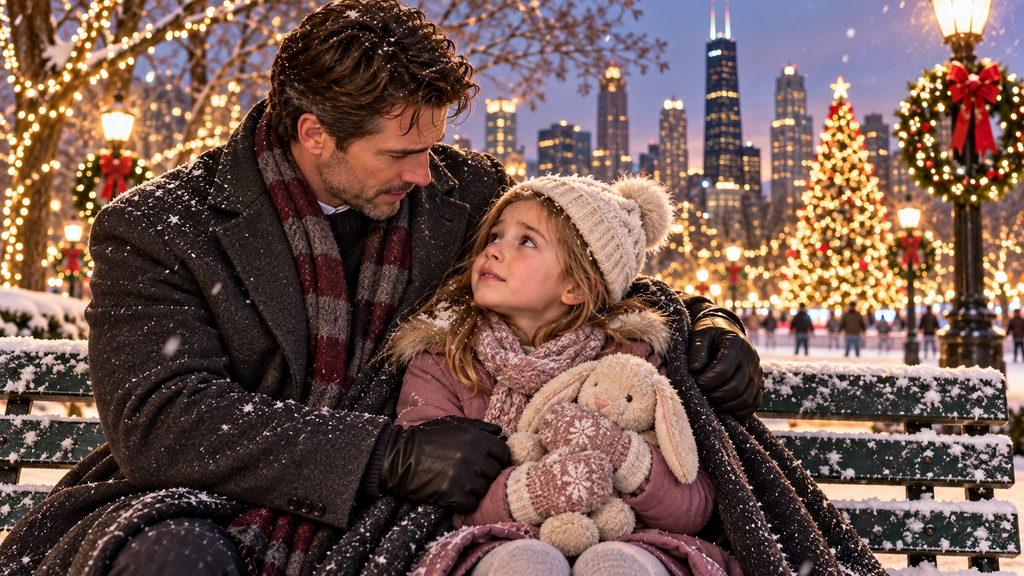
By the time we reached the car, Norah’s shaking had become violent. Not ordinary shivering. Her whole little body trembled beneath my coat as if the cold had worked its way into her bones.
My driver, Marcus, jumped out the moment he saw us. “Mr. Whitmore?” “Turn the heat all the way up.” He opened the rear door. Then he noticed the child in my arms.
“What happened?”
“I found her in the park.”
Marcus stared at me.
“In this weather?”
I climbed into the back seat with Norah still pressed against my chest.
“Call the gala. Tell them I’m not coming.”
Marcus hesitated.
“Sir, there are nearly four hundred people—”
“They’ll survive without me.”
He nodded immediately.
Norah’s head rested against my shoulder.
Her cheeks were bright red from the cold.
Her lips looked almost colorless.
I rubbed her back through the oversized coat.
“Norah, I need you to stay awake for me.”
Her eyelashes fluttered.
“I’m sleepy.”
“I know.”
“My mama says sleeping makes time go faster.”
Something inside me twisted.
I knew exactly what her mother had probably meant.
A scared child.
A dangerous situation.
A promise to return.
And a mother trying to make the waiting easier.
“Not right now,” I said gently. “Right now I need you to talk to me.”
Norah opened her eyes again.
“About what?”
I looked down at the stuffed rabbit trapped beneath her arm.
“What’s his name?”
She glanced at it.
“Her.”
“My mistake.”
“Her name is Clover.”
I smiled faintly.
“Clover.”
“She likes pancakes.”
“Good choice.”
“And she doesn’t like thunderstorms.”
“Neither do I.”
Norah studied my face carefully.
“You’re a grown-up.”
“I’ve been accused of that.”
Her mouth moved.
Not quite a smile.
But close.
Marcus looked at me through the rearview mirror.
“Hospital?”
I almost said yes.
Then Norah jerked upright.
“No!”
The force of it startled me.
“No hospital.”
Her small hands seized my jacket.
“Please.”
“Norah—”
“No hospital.”
Terror had replaced exhaustion.
She stared at the windows as though she expected someone to appear outside them.
“My mama said not to let him find me.”
I felt every muscle in my body tighten.
Marcus’s eyes met mine in the mirror.
“Who?” I asked.
Norah immediately looked down.
“I don’t know.”
“You don’t know his name?”
She shook her head.
“Do you know what he looks like?”
Another shake.
Too fast this time.
A child’s lie.
Not malicious.
Protective.
She knew something.
And she was terrified to say it.
I kept my voice soft.
“Did this man hurt you?”
“No.”
“Did he hurt your mother?”
Norah stopped breathing for a moment.
That was answer enough.
I looked at Marcus.
“Call 911.”
Norah panicked.
“No!”
“It’s okay.”
“No police!”
“Norah, listen to me.”
She tried to pull away, but there was nowhere to go.
Her breath came fast.
“They’ll tell him where I am.”
“No one is going to tell him anything.”
“You don’t know that.”
Her voice cracked.
Those four words did something to me.
Because they didn’t sound like something a seven-year-old should know how to say.
You don’t know that.
Someone had already taught this child that adults could not always be trusted.
That promises failed.
That uniforms didn’t always mean safety.
That sometimes danger had a friendly face.
I looked at Marcus again.
“Call Detective Elena Ruiz.”
He blinked.
“You still have her number?”
“Yes.”
Detective Ruiz had been one of the officers who came to the hospital the night Juniper died.
Not because anyone had committed a crime.
Because I had lost control.
I had screamed at a doctor.
Punched a wall.
Collapsed in a hallway.
Ruiz had sat beside me on the floor for nearly an hour while my five-year-old daughter lay dead thirty feet away.
She never told me to calm down.
Never gave me some empty speech about God having a plan.
She simply sat there.
Later, when the Whitmore Foundation started funding emergency housing for domestic violence victims, Ruiz became one of the people who advised us.
If I trusted anyone in Chicago with a frightened child, it was her.
Marcus dialed.
I turned back to Norah.
“Someone is coming who I trust.”
Norah whispered, “My mama trusted somebody too.”
I didn’t ask who.
Not yet.
We took Norah to the private office suite connected to the Whitmore Foundation headquarters six blocks away.
There were security guards.
Cameras.
Locked elevators.
Most importantly, there were no public entrances after nine.
Marcus brought hot chocolate.
One of the night staff found blankets.
I called our on-call physician, Dr. Hannah Lee, who arrived fifteen minutes later.
Norah did not like the idea of a doctor.
But Hannah had three children of her own and understood immediately that a white coat would only frighten her.
So she arrived wearing jeans, snow boots, and a ridiculous Christmas sweater covered in dancing penguins.
Norah stared at it.
Dr. Lee noticed.
“Terrible, right?”
Norah nodded solemnly.
“My husband bought it.”
“Why?”
“That is an excellent question.”
For the first time, Norah smiled.
Dr. Lee checked her temperature.
Listened to her lungs.
Examined her fingers and toes.
Then she pulled me aside.
“She’s lucky.”
“How lucky?”
“No frostbite. Mild hypothermia, dehydration, probably hasn’t eaten properly since this morning.”
My jaw tightened.
“How long do you think she was out there?”
“Several hours.”
Several hours.
Seven years old.
Alone.
On Christmas Eve.
Waiting because her mother had told her not to move.
I looked across the room.
Norah sat wrapped in three blankets, feeding tiny marshmallows to Clover.
“She needs a hospital?” I asked.
“Medically? Not necessarily, if she stays warm, drinks, eats, and we monitor her.”
I lowered my voice.
“She’s terrified of hospitals.”
Hannah studied me.
“Do you know why?”
“No.”
“Then I’d find out.”
The elevator opened.
Detective Elena Ruiz stepped out wearing a dark winter coat dusted with snow.
She looked almost exactly as I remembered her.
Short black hair.
Sharp eyes.
The kind of face that seemed calm even when everything around her was falling apart.
“Gideon.”
“Elena.”
Her gaze moved immediately toward Norah.
“What do we know?”
“Her name is Norah. Seven. Says her mother told her to wait in Grant Park and disappeared. She says a man is looking for her.”
Elena’s expression changed.
“Last name?”
“She won’t say.”
“Mother’s name?”
“Won’t say that either.”
“Address?”
I shook my head.
Elena sighed quietly.
“Smart kid.”
“That’s what worries me.”
“Me too.”
She walked over slowly.
Not directly.
She stopped several feet away from Norah and sat on the floor.
Norah watched her.
Elena pointed at Clover.
“That rabbit looks like she’s survived some things.”
Norah hugged Clover tighter.
“She fell in a washing machine once.”
“Terrifying.”
“She was okay.”
“Strong rabbit.”
Norah nodded.
Elena didn’t show her badge.
Didn’t ask questions.
She talked about snow.
Then Christmas lights.
Then hot chocolate.
Ten minutes passed.
Twenty.
Eventually, Elena asked, “Do you know your mama’s phone number?”
Norah’s eyes dropped.
“Yes.”
“Can you tell me?”
“No.”
“Okay.”
No pressure.
No disappointment.
Just okay.
Norah looked surprised.
Elena stood.
“I’m going to get coffee. Gideon, come with me.”
I followed her into the hallway.
The moment the door shut, her face hardened.
“This doesn’t feel random.”
“I know.”
“Did you search the park?”
“Marcus called building security. They’re reviewing street cameras around where I found her.”
Elena nodded.
“I’m going to check missing persons and emergency admissions.”
I stared at her.
“Emergency admissions?”
“Mother says wait here, disappears, never returns. She might have abandoned the child.”
“She didn’t.”
“You don’t know that.”
“She didn’t.”
Elena gave me a long look.
“You sound very sure.”
“Norah isn’t angry with her.”
“That doesn’t prove anything.”
“She’s scared for her.”
“Children can still love parents who fail them.”
I looked through the glass at Norah.
She had fallen asleep sitting upright.
Clover pressed against her chest.
“No,” I said quietly. “Her mother meant to come back.”
Elena studied me for another second.
Then nodded.
“All right.”
Her phone rang.
She answered.
“Ruiz.”
Silence.
Her eyes shifted toward me.
“When?”
Another pause.
“Description?”
Something changed in her face.
She turned away from Norah.
“Send it to me.”
She hung up.
“What?”
Elena looked at me.
“A woman was brought into Northwestern Memorial shortly after six tonight.”
My stomach dropped.
“Unidentified?”
“Initially.”
“What happened?”
“Found unconscious in an alley near East Randolph. Head trauma. Severe concussion. Possible fracture. Her purse was missing.”
“Age?”
“Early thirties.”
My eyes moved through the glass.
Norah was asleep.
“Does she have a daughter?”
“They found a folded photograph in the lining of her coat.”
Elena unlocked her phone.
She turned it toward me.
The photograph was grainy.
A woman with auburn hair kneeling beside a Christmas tree.
Her arms were wrapped around a little girl.
Gray-blue eyes.
Same narrow chin.
Same stuffed rabbit.
Norah.
I felt the blood drain from my face.
“That’s her.”
Elena nodded.
“We found the mother.”
I exhaled for what felt like the first time in minutes.
“She’s alive?”
“Yes.”
“Conscious?”
“No.”
“What’s her name?”
“Evelyn Mercer.”
I repeated it quietly.
“Evelyn.”
Elena slipped the phone back into her pocket.
“There’s more.”
Of course there was.
There is always more.
“What?”
“Hospital security reported something strange about an hour ago. A man came asking whether an unidentified woman matching Evelyn’s description had been admitted.”
My skin went cold.
“Who?”
“He claimed to be her husband.”
“Is he?”
“We don’t know.”
“What did he say her name was?”
“Elena Mercer.”
“That’s not her name.”
“No.”
“Did he see her?”
“Security stopped him because he couldn’t provide identification.”
“Did he ask about a child?”
Elena’s eyes met mine.
“Yes.”
The office suddenly felt much colder.
“He specifically asked whether anyone had brought in a little girl.”
I looked through the glass.
Norah slept ten feet away.
Completely unaware.
“He’s looking for her.”
“Yes.”
“Why?”
“That’s what we need to find out.”
Norah woke at 11:17 p.m.
The second I told her we had found her mother, she began crying.
Not the loud crying children do after skinning a knee.
This was silent.
Tears simply spilled down her face.
“You found Mama?”
“Yes.”
“Where?”
“At a hospital.”
She stiffened.
Then she looked toward the door.
“Is he there?”
“We don’t know.”
Her face turned white.
I sat beside her.
“Norah, we need your help.”
She shook her head.
“You told me someone hurt your mother.”
Another shake.
“You don’t have to tell me everything. But if there’s something we need to know to keep her safe, you have to tell us.”
“I promised.”
“Your mother?”
Norah nodded.
“What did you promise her?”
Her fingers twisted one of Clover’s ears.
“That I wouldn’t tell anybody.”
Elena sat across the room without interrupting.
I leaned forward.
“Norah, sometimes promises change when someone is in danger.”
Her lip trembled.
“Mama said he would find us.”
“Who?”
Silence.
“Norah.”
She looked directly at me.
“Mr. Vale.”
Elena’s posture changed immediately.
“First name?”
Norah frowned.
“I don’t know.”
“Is he a friend of your mother?”
“No.”
“Family?”
“No.”
“Someone she worked with?”
Norah nodded.
Elena and I exchanged a glance.
“What does your mom do?” I asked.
“She works with numbers.”
“An accountant?”
“I think.”
“Where?”
Norah looked down.
“Mercer and Lowe.”
Elena was already typing.
Within seconds, she found it.
“Mercer & Lowe Forensic Accounting.”
I knew the name.
Not personally.
But their firm had appeared in business papers.
Corporate audits.
Financial fraud investigations.
Expert testimony.
Elena kept reading.
“Evelyn Mercer. Senior forensic accountant. Thirty-four.”
“What about Vale?”
She scrolled.
Her expression went still.
“There’s a board member named Adrian Vale.”
I knew that name.
Everyone in Chicago finance knew that name.
Adrian Vale was one of those men whose photograph appeared beside words like visionary, philanthropist, entrepreneur.
He ran Vale Development Group.
Luxury hotels.
Commercial properties.
Government contracts.
And, if rumor was accurate, half the aldermen in the city owed him favors.
I looked at Elena.
“That Adrian Vale?”
“It appears so.”
Norah started crying again.
“Mama said he steals.”
The room went silent.
Elena put down her phone.
“What did your mother tell you?”
“Nothing.”
“Norah.”
“I heard them.”
Her voice was tiny.
“She told him she had proof.”
Proof.
Elena pulled her chair closer.
“Where were you?”
“At Mama’s office.”
“When?”
“Yesterday.”
“What happened?”
Norah squeezed Clover.
“Mama said we had to leave.”
“Leave the office?”
“Chicago.”
That changed everything.
Norah continued.
“She packed clothes in the blue suitcase. She kept calling somebody named Mr. Lowe. But he didn’t answer.”
“Did she tell you why?”
“She said we were going on an adventure.”
Children always know when adults are lying.
Even when the lie is meant to protect them.
Norah swallowed.
“But she was scared.”
“What happened today?”
“Mama took me to the train station.”
“Union Station?”
Norah nodded.
“She bought tickets.”
“Where to?”
“I don’t know.”
“What happened next?”
“We were walking.”
“To the station?”
“Yes.”
“And?”
Norah closed her eyes.
“A black car followed us.”
Elena leaned forward.
“Make?”
Norah looked confused.
“Was it big?”
“Yes.”
“SUV?”
“I don’t know.”
“That’s okay.”
Norah breathed deeply.
“Mama grabbed my hand and we ran.”
I felt my pulse pounding in my throat.
“She took me through a building. Then across a street. Then we hid in a store with Christmas things.”
“Then what?”
“She was crying.”
Norah’s voice cracked.
“I’d never seen Mama cry before.”
I reached for her hand.
She let me take it.
“She told me we were going to play a game.”
“What game?”
“I had to stay somewhere and not move.”
The bench.
My stomach knotted.
“She brought you to the park.”
Norah nodded.
“She said she had to go get something.”
“What?”
“I don’t know.”
“Did she say where?”
“No.”
“She told you she’d return?”
“Yes.”
“What happened after she left?”
Norah went completely still.
This was the part she had been avoiding.
I could see it.
Elena could too.
“Norah,” she said carefully, “did you see something?”
Norah’s eyes filled with fresh tears.
“I followed Mama.”
My chest tightened.
“I thought she forgot Clover’s scarf.”
The absurd innocence of those words nearly broke me.
A seven-year-old child had followed her terrified mother into danger because she thought a stuffed rabbit might be cold.
“I only went a little bit,” Norah whispered.
“What did you see?”
“A man.”
“Vale?”
She nodded.
“He grabbed Mama.”
My hand tightened around hers.
“She yelled at him.”
“What did she say?”
“I don’t remember everything.”
“That’s okay. Anything you remember helps.”
Norah looked at Elena.
“She said, ‘You killed him.’”
Elena stopped writing.
“Who?”
Norah shook her head.
“She said Mr. Lowe.”
Silence.
Elena immediately pulled out her phone.
I understood before she spoke.
“Check on Daniel Lowe.”
Three minutes later she had an answer.
Daniel Lowe had been reported dead that morning.
Official cause:
Single-vehicle accident on Lake Shore Drive.
His car had crossed two lanes, smashed through a barrier, and struck a concrete support.
Police believed he had fallen asleep at the wheel.
Maybe he hadn’t.
Norah kept talking.
“Mr. Vale told Mama she should have stopped looking.”
The child’s voice was trembling harder now.
“He said bad things happen to people who don’t mind their business.”
I felt rage rising inside me.
Pure.
Cold.
Focused.
“What happened to your mother?”
“He hit her.”
My jaw clenched.
“With his hand?”
Norah shook her head.
“He had something.”
She touched the back of her own head.
“She fell.”
I closed my eyes for one second.
When I opened them again, Elena was watching me.
She knew exactly what I was feeling.
She gave the smallest shake of her head.
Not now.
Stay calm.
For Norah.
“What did you do?” I asked.
“I ran.”
“Did he see you?”
Norah whispered, “Yes.”
There it was.
That was why he was searching.
Not because Norah knew where financial documents were.
Not because she understood corporate fraud.
Because she had seen Adrian Vale attack her mother.
Maybe she had seen enough to connect him to Daniel Lowe’s death.
And Adrian Vale knew it.
Norah looked at me.
“He chased me.”
Every instinct inside me screamed.
“Did he touch you?”
“No.”
“I hid under a delivery truck.”
My eyes burned.
“And then?”
“I waited until he left.”
“You went back to the bench?”
She nodded.
“Because Mama told me to stay there.”
A sob escaped her.
“I thought she would come back.”
I pulled her into my arms.
She resisted for half a second.
Then collapsed against me.
“I’m sorry,” she cried.
“For what?”
“I didn’t stay.”
“Oh, sweetheart.”
I held her tighter.
“You did nothing wrong.”
“I promised her.”
“You survived.”
“She’s going to be mad.”
“No.”
“She told me not to move.”
I closed my eyes.
For a moment, Norah wasn’t Norah.
She was Juniper.
Five years old.
A paper hospital bracelet around her wrist.
Asking me whether I was angry because she couldn’t swallow her medicine.
Apologizing because she had thrown up on my shirt.
Children apologize for things that should never belong to them.
Pain.
Illness.
Fear.
Survival.
I pulled back and wiped Norah’s cheeks.
“Your mother is going to open her eyes, see you, and be grateful you’re alive.”
“You promise?”
I froze.
Three years earlier, I had promised Juniper she would come home.
I had promised her we would decorate the tree.
Promised pancakes Christmas morning.
Promised she would get better.
None of it happened.
For three years, the word promise had tasted like failure.
So I did not lie to Norah.
“I promise we’re going to do everything we can.”
Her mouth trembled.
“Okay.”
At 11:48 p.m., security called.
A man was standing outside the Whitmore Foundation building.
He wore a charcoal overcoat.
No hat.
Snow collected on his shoulders.
And he was looking directly at the security camera.
Marcus brought the footage up on the office monitor.
Elena went rigid.
“Adrian Vale.”
He had found us.
Norah saw the screen.
The reaction was immediate.
She screamed.
Not cried.
Screamed.
“That’s him!”
I moved between her and the monitor.
“Turn it off.”
Marcus killed the feed.
Norah grabbed my sleeve.
“He found me.”
“No.”
“He found me!”
“Norah, look at me.”
“He knows!”
“He is outside.”
I crouched.
“You are inside.”
“He’s going to hurt Mama.”
“He isn’t going near either of you.”
“You don’t know!”
“No.”
I looked directly into her terrified eyes.
“But I know this building.”
I knew every exit.
Every camera.
Every guard.
Every elevator.
And unlike the hospital, this place belonged to me.
I stood.
“Lock down the building.”
Marcus nodded.
Elena reached for her radio.
“Chicago PD is already en route.”
I looked at the monitor again.
Vale had not moved.
He simply stood outside.
Watching.
Then my phone rang.
Unknown number.
Every person in the room looked at it.
I answered.
“Gideon Whitmore.”
A smooth male voice responded.
“Mr. Whitmore.”
I stared at the dark monitor.
“Mr. Vale.”
Silence.
Then he laughed softly.
“I suppose there’s no point pretending.”
“No.”
“I believe you’ve found something that belongs to me.”
My blood went cold.
“She belongs to no one.”
“I’m referring to property.”
“Funny. Because you sound like you’re talking about a seven-year-old girl.”
His voice became harder.
“You have no idea what you’ve involved yourself in.”
“That makes two of us.”
“You’re a businessman, Gideon.”
Hearing my first name in his mouth made my skin crawl.
“We move in similar circles. We know many of the same people.”
“I doubt that.”
“I assure you, we do.”
He paused.
“I’m trying to spare you complications.”
“And I’m trying to resist the urge to walk downstairs.”
Elena’s eyes snapped toward me.
Vale chuckled.
“I’ve read about you.”
“Then you know threatening children tends to put me in a bad mood.”
“This is not a threat.”
“Good. Then leave.”
“I simply need something Evelyn took from me.”
“What?”
“A drive.”
So that was it.
Evidence.
“She doesn’t have it.”
“I believe she gave it to the child.”
I looked at Norah.
She stared back at me.
Confused.
Vale continued.
“Ask her about the rabbit.”
My eyes dropped to Clover.
The room changed.
Norah pulled the rabbit tight against her chest.
“No.”
Vale laughed softly.
“There it is.”
I ended the call.
Elena immediately took Clover.
Norah protested.
“No!”
“It’s okay,” Elena said. “I’m not hurting her.”
She turned the rabbit over.
Old stitching ran along its back.
Pink thread.
Same as the repaired ear.
Elena pressed gently.
Something hard was hidden beneath the stuffing.
She looked at me.
“Knife.”
Marcus brought a small utility cutter.
Elena opened three stitches.
Inside Clover was a black USB drive no bigger than my thumb.
Nobody spoke.
A seven-year-old stuffed rabbit had been carrying enough evidence to make one of Chicago’s most powerful businessmen hunt a child through the snow on Christmas Eve.
Elena held the drive between gloved fingers.
“This could be motive.”
“It could be everything,” I said.
Norah stared at Clover’s opened seam.
“Mama put something in her?”
“Yes.”
“Is Clover okay?”
Despite everything, I almost smiled.
“She’ll survive.”
Norah nodded seriously.
“She always does.”
Police arrived three minutes later.
Vale was gone.
But for once, money did something useful.
The Whitmore Foundation had cameras covering the entire block.
We had video of his arrival.
Video of his departure.
Audio recording of his phone call.
And a frightened little girl who had identified him.
By Christmas morning, everything moved very quickly.
The USB contained copies of financial ledgers.
Bank transfers.
Shell companies.
Bribery payments.
Fake construction invoices.
Millions of dollars moved through companies that existed only on paper.
There were also emails.
Hundreds of them.
Daniel Lowe had discovered the fraud first.
Evelyn had helped him document it.
They had planned to take everything to federal authorities after Christmas.
Vale found out.
Daniel died less than forty-eight hours later.
And Evelyn nearly followed him.
Elena called me at 5:14 Christmas morning.
I had not slept.
Neither had Norah.
She lay curled on the sofa in my office wearing one of Juniper’s old blankets.
I hadn’t used that blanket in three years.
It had stayed folded inside a cedar chest in my bedroom.
Yellow.
Tiny embroidered stars.
Juniper had called it her sunshine blanket.
When I brought it from home, my hands shook.
I almost couldn’t unfold it.
But Norah had been cold.
And somehow that mattered more than the grief.
I answered Elena’s call.
“What happened?”
“Federal investigators have Vale in custody.”
I exhaled slowly.
“For the assault?”
“For starters.”
“Evelyn?”
“She woke up.”
I stood so quickly my chair rolled backward.
“What?”
“About ten minutes ago.”
“Is she okay?”
“Confused. In pain. But awake.”
I looked at Norah.
She had heard me.
She sat straight up.
“Mama?”
I put the call on speaker.
Elena’s voice softened.
“Yes, sweetheart.”
Norah threw off the blanket.
“I want her.”
“I know.”
“I want to see her now.”
Elena hesitated.
“There’s something else, Gideon.”
I hated that sentence.
“What?”
“Evelyn woke up asking for Norah.”
“That’s good.”
“And then she said not to bring Norah to the hospital.”
I felt my stomach sink.
“Why?”
“She’s afraid Vale has people inside.”
Norah whispered, “I told you.”
Elena continued.
“Federal agents are securing the floor now.”
“Then we wait.”
Norah shook her head violently.
“No.”
“Norah—”
“I want Mama.”
“She wants you too.”
“Then take me.”
Her voice broke.
“Please.”
There are moments when adults believe they are protecting children by making decisions over their heads.
Sometimes we are.
Sometimes we are only making them powerless again.
I knelt in front of her.
“Agents are making sure the hospital is safe. The second they say it is, I’ll take you.”
“How long?”
“I don’t know.”
She stared at me.
“You’re not going to disappear?”
“No.”
“You promise?”
That word again.
This time I answered.
“Yes.”
I promised.
And this one I intended to keep.
At 7:42 Christmas morning, Elena called again.
The hospital floor was secure.
Twenty-two minutes later, Norah and I walked down a quiet hospital corridor together.
I hated hospitals.
The smell alone could still destroy me.
Disinfectant.
Plastic.
Coffee.
Warm air coming through vents.
My body remembered before my mind did.
Juniper’s room had been on the fifth floor.
Room 512.
I remembered every inch of it.
The crooked snowman she taped to the window.
The beeping machine that never stopped.
Her pink socks.
The way she asked me to lie beside her because hospital beds were lonely.
For three years, I had avoided every hospital except when absolutely necessary.
Now I was walking into one on Christmas morning holding the hand of another little girl.
Norah stopped outside room 814.
“What if she looks different?”
“She probably will.”
“Because she’s hurt?”
“Yes.”
“Will she have tubes?”
“Maybe.”
Norah squeezed my fingers.
“I don’t like tubes.”
“I know.”
She took a deep breath.
Then pushed open the door.
Evelyn Mercer lay against white pillows.
A bandage wrapped around her head.
There were bruises along one side of her face.
An IV ran into her arm.
Machines surrounded the bed.
But she was awake.
And the instant she saw Norah, something in her face broke open.
“Baby.”
Norah ran.
“Mama!”
Evelyn cried out as Norah climbed onto the bed, but she wrapped both arms around her anyway.
They were both sobbing.
“I’m sorry,” Norah cried.
“No.”
“I left the bench.”
“No, baby.”
“I didn’t stay.”
Evelyn kissed her hair again and again.
“You did exactly right.”
“He found us.”
“I know.”
“A man helped me.”
Evelyn looked over Norah’s shoulder.
At me.
For several seconds, neither of us spoke.
Then she mouthed two words.
Thank you.
I nodded.
That was all I could manage.
Because the sight of them had ripped something open inside me.
Three years earlier, I had stood beside another hospital bed on Christmas week.
I had begged.
Prayed.
Offered every dollar I owned.
I would have traded houses.
Companies.
Years of my life.
Anything.
But Juniper never opened her eyes again.
Now Norah had her mother back.
I was happy for her.
Truly.
And somehow that happiness hurt almost as badly as grief.
I turned toward the door.
Norah noticed.
“Where are you going?”
I stopped.
“I thought you two might want some time.”
“No.”
She reached her hand toward me.
“Stay.”
I stared at her tiny fingers.
Evelyn wiped her eyes.
“Please.”
So I stayed.
I sat beside the window while mother and daughter held each other.
For the next hour, I learned the whole story.
Evelyn and Daniel Lowe had spent almost six months reviewing accounts connected to Vale Development Group.
They found millions in fraudulent expenses.
Bribes disguised as consulting fees.
Safety inspection payoffs.
Payments connected to city contracts.
At first, they thought it was financial corruption.
Then they discovered something worse.
A building Vale had renovated the previous year had suffered a partial structural collapse.
Three workers died.
Officially, the accident was blamed on subcontractor negligence.
But the records showed Vale had knowingly approved cheaper support materials.
He had then bribed inspectors to certify the work.
Daniel wanted to go to authorities immediately.
Evelyn insisted they copy everything first.
Then Daniel died.
“I knew,” Evelyn whispered from the hospital bed.
Norah slept against her side.
“I knew the moment they called me.”
“You knew his accident wasn’t an accident.”
Evelyn nodded.
“Daniel never drove tired. Ever. His younger brother died when they were teenagers because a driver fell asleep at the wheel. Daniel was obsessive about it.”
She swallowed.
“I called the FBI from a prepaid phone.”
“What happened?”
“They told me where to meet an agent after Christmas.”
“But Vale found out.”
“I think someone inside our firm told him.”
She looked down at Norah.
“Yesterday, I realized we were being followed.”
“So you ran.”
“Yes.”
“Why hide the drive inside Clover?”
A sad smile touched her face.
“Because nobody ever takes Clover away from Norah.”
That had nearly been true.
Evelyn looked at me again.
“I put the drive in there weeks ago. Daniel and I had copies in three places. His disappeared after he died. Someone broke into my apartment yesterday.”
She rubbed her temple.
“I knew mine would be next.”
“You should’ve gone straight to police.”
“I didn’t know who Vale owned.”
She looked ashamed.
“I didn’t know who to trust.”
“You were trying to protect your daughter.”
“I left her alone on a park bench.”
Her eyes filled.
“In December.”
“You were being chased.”
“I told her I’d come back in ten minutes.”
Her voice broke.
“I remember cutting through the alley. I remember Vale stepping out of the car.”
She closed her eyes.
“Then nothing.”
I looked at Norah.
“She waited for you.”
“I know.”
“For hours.”
Evelyn began crying.
I regretted saying it immediately.
But then she whispered, “She always believes me.”
I leaned forward.
“She believes you because you’ve given her reasons to.”
She looked at me.
“You don’t know me.”
“No.”
I paused.
“But I know what she sounded like when she talked about you.”
Evelyn wiped her face.
“She wasn’t abandoned.”
“No.”
“She was waiting.”
Evelyn nodded.
Sometimes there is a difference between those two things big enough to save a person.
A nurse entered around nine.
She asked Evelyn some questions.
Checked her IV.
Then smiled at Norah.
“Someone told me Santa had trouble finding you last night.”
Norah’s eyes widened.
The nurse held up a small wrapped package.
“He left this at the nurses’ station.”
Norah looked at me suspiciously.
I raised both hands.
“Not me.”
It was absolutely me.
Marcus had found a pharmacy open twenty-four hours and somehow convinced an employee to let him buy a children’s art set, two books, a scarf, and enough candy to destroy a dentist’s Christmas.
Norah opened the present.
Then looked at Clover.
“Clover didn’t get anything.”
I pretended to think.
“Maybe Santa assumed Clover was included.”
“That’s lazy.”
Evelyn laughed.
It was weak.
Painful.
But it was laughter.
And somehow, in that hospital room on Christmas morning, the sound did something to all of us.
It reminded us we were still alive.
Vale’s arrest became national news before noon.
By evening, cameras surrounded the courthouse.
His attorneys released statements denying everything.
They called Evelyn unstable.
They called Daniel’s death tragic but unrelated.
They called Norah’s account unreliable because of her age.
They called the USB fabricated.
Rich guilty men have always had expensive ways to call the truth a lie.
But this time, there was too much.
The video.
The financial records.
The call he made to me.
Hospital security footage.
Traffic cameras showing Vale’s SUV near the alley where Evelyn was found.
And eventually, one of his own employees turned.
A driver named Paul Serrano.
He admitted Vale ordered him to follow Evelyn.
Then, after receiving immunity on several lesser charges, he told investigators what had happened to Daniel Lowe.
Vale had not driven Daniel’s car.
He didn’t need to.
Someone had tampered with it.
A small adjustment to the steering system.
Enough to fail at highway speed.
Daniel’s death had been murder.
The case grew.
One arrest became three.
Then five.
Two city inspectors resigned.
A contractor disappeared briefly before surrendering.
Federal investigators seized records from six Vale properties.
The newspapers called it the biggest municipal corruption scandal Chicago had seen in years.
I didn’t care about any of that.
Not really.
I cared about one room on the eighth floor of Northwestern Memorial.
I cared about a little girl eating gelatin from a plastic cup beside her mother.
I cared that she no longer jumped whenever the elevator bell rang.
I cared that Evelyn would live.
Three days after Christmas, she was discharged.
She had nowhere safe to go.
Her apartment had been compromised.
Her parents were dead.
Her closest friend lived in Oregon.
So I offered one of the Whitmore Foundation’s protected apartments.
Evelyn refused.
“I’ve already accepted too much.”
“You haven’t accepted anything from me.”
She gave me a look.
“You saved my daughter’s life.”
“No.”
“Yes.”
“I found her.”
“In below-freezing weather.”
“Anyone would have stopped.”
Evelyn stared at me.
We both knew that wasn’t true.
People had passed Norah.
Security footage later showed at least eleven pedestrians crossing near the park before I arrived.
Some probably never saw her.
Some might have assumed an adult was nearby.
Some saw a bundle on a bench and decided it belonged to someone else’s problem.
I had been one of those people once.
Not cruel.
Just busy.
Busy enough to believe the suffering I passed belonged to somebody else.
Juniper changed that.
Her death changed everything.
Evelyn finally accepted the apartment.
“For a week.”
“Fine.”
It was six weeks before she moved out.
During those six weeks, Norah became part of my life almost by accident.
She came to the Foundation office after school.
She drew on my whiteboards.
She rearranged books on my shelves according to colors instead of subjects.
She informed Marcus that his ties were “too serious.”
She decided my penthouse needed a goldfish.
Then two.
Then, after learning goldfish could live for years, she decided that was “too much responsibility.”
She talked constantly.
About school.
About Clover.
About a girl named Hannah who cheated at hopscotch.
About cereal.
About penguins.
About why adults kept saying “actually” before telling children they were wrong.
Sometimes, unexpectedly, she talked about the bench.
Never for long.
“I thought Mama was dead.”
Or:
“I thought Mr. Vale would find me.”
Or:
“I didn’t like when the snow got inside my shoes.”
Then she would move on.
Children are strange that way.
They can carry enormous trauma beside ordinary things.
Fear beside crayons.
Nightmares beside spelling tests.
Grief beside requests for more syrup.
I recognized that.
I had done the same thing.
For three years, I carried Juniper into board meetings.
Into elevators.
Into restaurants.
Into sleep.
Nobody saw her.
But she was always there.
One Saturday in February, Norah found her photograph.
I had left it on the piano.
Juniper at four years old.
Yellow rain boots.
Wild curls.
Gap-toothed smile.
Norah picked it up.
“Who’s this?”
I stopped breathing.
Evelyn, standing in the kitchen doorway, immediately understood.
“Norah—”
“It’s okay.”
I walked over.
“That’s my daughter.”
Norah looked at the picture.
“She’s pretty.”
“Yeah.”
“Where is she?”
The question children ask without understanding that adults sometimes spend years trying not to answer it.
“She died.”
Norah looked up at me.
“When?”
“Three years ago.”
Her face changed.
“Oh.”
I sat on the piano bench.
Norah climbed up beside me.
“What was her name?”
“Juniper.”
“That’s a tree.”
“Yes.”
“Did you name her after a tree?”
“Her mother did.”
“Where’s her mother?”
Another wound.
“Her mother died when Juniper was two.”
Norah went quiet.
I had lost them both.
My wife, Amelia, to ovarian cancer.
Juniper, three years later, to a rare infection after what should have been routine pneumonia.
Two hospital rooms.
Two funerals.
One house that became painfully silent.
Norah stared at the photograph.
“Did Juniper like rabbits?”
I laughed softly.
“No.”
“Why?”
“She was terrified of them.”
Norah looked offended.
“Rabbits aren’t scary.”
“She thought their teeth were suspicious.”
Norah considered this.
“That makes sense.”
I laughed again.
A real laugh.
It surprised me.
Then Norah asked the question I wasn’t ready for.
“Do you miss being a dad?”
The room went still.
Evelyn closed her eyes.
She looked like she wanted to pull Norah away.
But I answered.
“Every day.”
Norah nodded.
“I’d miss being a kid if I wasn’t one anymore.”
There was no logic to it.
And somehow there was perfect logic.
I looked at Juniper’s photograph.
For years, I thought loving my daughter meant remaining loyal to the worst day of my life.
That if I laughed too much, I betrayed her.
If I decorated at Christmas, I betrayed her.
If I let another child matter to me, I betrayed her.
Grief had convinced me that healing meant forgetting.
Norah, with all the brutal simplicity of a child, was teaching me the opposite.
Healing didn’t erase anything.
It just made room.
Spring came slowly to Chicago.
The criminal case against Vale moved toward trial.
Evelyn testified before a grand jury.
Norah met with child psychologists and prosecutors.
I expected the process to crush her.
Instead, she surprised everyone.
When a prosecutor asked whether she was afraid to tell the truth, Norah said:
“Yes.”
Then she added:
“But Mama says you can do things while you’re afraid.”
I wrote that sentence down.
I still have it.
In June, Adrian Vale accepted a plea agreement after two co-defendants agreed to testify.
He pleaded guilty to racketeering, fraud, obstruction, witness intimidation, conspiracy connected to Daniel’s death, and aggravated assault against Evelyn.
The sentence was effectively life.
When the news came, Evelyn sat at my kitchen table.
She read the message twice.
Then placed her phone down.
“It’s over.”
I shook my head.
“No.”
She looked at me.
“The court part is over.”
That was different.
People talk about justice as if a prison door closes and pain disappears.
It doesn’t.
Daniel was still dead.
Three workers were still dead.
Norah still had nightmares.
Evelyn still flinched around black SUVs.
I still visited Juniper’s grave.
Justice does not restore what was stolen.
It only draws a line and says the stealing stops here.
Evelyn eventually opened her own forensic accounting firm.
She called it Lowe Mercer Group.
Daniel’s name first.
She said it was the least she could do.
She moved into a small house twenty minutes from mine.
Norah picked the house because there was a maple tree in the yard.
I thought that would be the end of our story.
Not because I wanted it to be.
Because I had learned not to expect people to stay.
That is one of grief’s ugliest lessons.
If you lose enough, eventually every goodbye feels prewritten.
But Norah kept showing up.
Saturday pancakes.
Museum trips.
Foundation events.
My birthday.
Her birthday.
School plays where she forgot half her lines but bowed like she had just finished performing Shakespeare.
And Evelyn kept showing up too.
At first because of Norah.
Then for coffee.
Then for dinner.
Then because some evenings neither of us wanted to be alone.
Nothing happened quickly.
I am grateful for that.
There was no dramatic kiss in the rain.
No grand declaration.
We were two adults who had been frightened by how easily life could break.
So we became friends first.
Real friends.
She knew when December became hard for me.
I knew the anniversary of Daniel’s death was difficult for her.
She never told me to “move on” from Juniper.
I never told her she should be “over” what Vale did.
We learned each other’s silences.
That mattered more than romance.
But romance came anyway.
Quietly.
Like spring.
The following Christmas Eve, exactly one year after I found Norah in the snow, I went back to the park.
Alone.
I stood beside the same bench.
Snow had started falling.
Not as heavily as the year before.
Enough to cover the ground in white.
I touched the cold metal.
For months, I had imagined that bench only as the place where Norah nearly died.
But standing there again, I realized something.
It was also the place where my life had changed.
I heard footsteps behind me.
Norah’s voice said, “You weren’t supposed to come without us.”
I turned.
She wore a bright red coat.
Clover was tucked beneath one arm.
Evelyn stood beside her.
“What are you doing here?”
Evelyn smiled.
“Apparently we are following a man who has a terrible habit of wandering into parks on Christmas Eve.”
Norah ran toward me.
I caught her.
She was heavier now.
Warmer.
Louder.
Alive.
That last word mattered most.
Alive.
“We brought something,” she said.
Evelyn handed me a small box.
“What is this?”
“Open it.”
Inside was a Christmas ornament.
A small silver star.
Engraved across the front were two names.
JUNIPER
NORAH
My throat closed.
I couldn’t speak.
Norah pointed at the engraving.
“Mama said we should ask first.”
“Ask what?”
“If Juniper can be part of our Christmas tree.”
I looked at Evelyn.
Her eyes were shining.
“You never have to put her away to make room for us,” she said.
That sentence broke something in me.
Or maybe it repaired something.
I’m still not sure.
For three years, I had believed the dead and the living occupied different rooms inside the heart.
That opening one door meant closing another.
But Evelyn was right.
Love is not a room.
It does not run out of chairs.
I pulled them both close.
And for the first time since Juniper died, I cried without trying to hide it.
Norah hugged my waist.
Evelyn rested her cheek against my shoulder.
Snow fell around us.
Cars moved beyond the trees.
Church bells rang somewhere in the city.
And Christmas Eve did not feel like an anniversary of death.
It felt like something else.
A beginning.
Two years later, Evelyn and I married.
Small ceremony.
Thirty-two guests.
Norah was the only bridesmaid.
She insisted Clover needed a matching dress.
She also informed the photographer that I cried more than her mother did.
She was correct.
After the ceremony, Norah disappeared for almost ten minutes.
We found her beside a small memorial table near the back of the garden.
Juniper’s photograph stood there beside Amelia’s.
Norah had placed Clover between them.
“What are you doing?” I asked.
She looked up.
“Introducing them.”
I swallowed.
“What did you say?”
“That I’m taking care of you.”
I had no answer.
So I hugged her.
She groaned.
“You’re crushing Clover.”
“Sorry.”
“And me.”
“Sorry.”
“You say sorry too much.”
“That sounds familiar.”
Years passed.
Not magically.
Not perfectly.
There were difficult days.
Norah had nightmares for a long time.
Certain alleys frightened her.
Black SUVs made her nervous until she was almost eleven.
Evelyn still checked locks twice.
I still hated hospitals.
Every December, grief returned.
It probably always will.
But grief stopped being the only thing that arrived with Christmas.
There was also laughter.
Wrapping paper.
Burned cookies.
Norah complaining that I bought terrible gifts.
Evelyn pretending not to know she had secretly chosen them.
Juniper’s silver star hanging near the top of our tree.
And Clover.
Always Clover.
The rabbit became almost threadbare.
One eye had to be replaced.
The pink stitching across the ear became a mess of repairs.
When Norah turned fourteen, I offered to buy her a new stuffed animal.
She looked at me like I had suggested replacing her mother.
“No.”
“Clover has seen better days.”
“So have you.”
Evelyn laughed for five straight minutes.
I never made the suggestion again.
When Norah was sixteen, she wrote an essay for school about the night we met.
She let me read it.
Only once.
The last paragraph said:
When I was seven years old, I thought being saved meant someone came and defeated the bad guy.
But now I think being saved can mean someone sits beside you while you’re scared.
Someone believes you.
Someone stays.
Mr. Gideon found me in the snow.
But I think maybe we found each other.
I made it through the first four sentences.
Then I had to stop.
Norah rolled her eyes.
“You always cry.”
“Yes.”
“It’s embarrassing.”
“I paid for your braces.”
“That doesn’t make crying less embarrassing.”
“It should.”
She took the essay back.
But before leaving the room, she hugged me.
By then she called me Dad.
The first time happened accidentally.
She was twelve.
She was running late for school.
“Dad, where are my—”
She stopped.
I stopped.
Evelyn froze near the refrigerator.
Norah turned bright red.
“I meant Gideon.”
I couldn’t speak.
She stared at me.
“You’re being weird.”
“I’m not being weird.”
“You look weird.”
“I always look like this.”
She grabbed her backpack.
“Okay, bye.”
Then she left.
The door slammed.
Evelyn looked at me.
“You okay?”
“No.”
I sat down.
Then cried into my coffee.
Evelyn kissed the top of my head.
“Very masculine.”
“Go away.”
She laughed.
Norah pretended the moment never happened.
Then she called me Dad again the next week.
And the week after that.
Eventually it stopped feeling like a miracle.
It became normal.
That might have been the greatest miracle of all.
Years later, when Norah graduated from college, I sat beside Evelyn in a crowded auditorium.
Norah crossed the stage.
Confident.
Brilliant.
Alive.
She had studied child psychology.
When I asked why, she shrugged.
“Kids should have someone who understands scared doesn’t mean broken.”
There are sentences your children say that make you understand their entire life at once.
That was one of them.
After graduation, she handed me a box.
Inside was Clover.
I looked up.
“No.”
Norah laughed.
“She’s not dying.”
“You’re giving me Clover.”
“For safekeeping.”
“Why?”
“Because I’m moving to Seattle.”
“I know.”
“And she shouldn’t live in a moving truck.”
“So I’m rabbit storage.”
“Basically.”
I held that battered stuffed animal.
The same rabbit she had clutched on a frozen Chicago bench twenty years earlier.
Pink stitches.
Replacement eye.
Faded fur.
The little seam along the back where her mother once hid the USB drive that brought down Adrian Vale.
“Take care of her,” Norah said.
“I will.”
“She likes pancakes.”
“I remember.”
“And thunderstorms still make her nervous.”
“Of course.”
Norah hugged me.
Then whispered into my shoulder:
“You stayed.”
Three words.
That was all.
You stayed.
All those years ago, on that first night, I thought I had rescued a child from the snow.
I was wrong.
Norah did not need a hero.
She needed warmth.
Safety.
Someone who believed her.
Someone who refused to walk away.
And maybe that was what I needed too.
Three years after losing Juniper, I had been walking through Christmas like a ghost.
I had wealth.
Success.
A foundation with my name on the building.
People called me generous.
Powerful.
Important.
But I had forgotten how to live.
Then a seven-year-old girl looked at me from beneath falling snow and said:
“I’m waiting for my mama.”
I could have called the police and left.
I could have handed her to someone else.
I could have gone to the gala.
I could have returned to my quiet house and continued surviving instead of living.
Instead, I stopped.
Sometimes that is all fate requires.
That you stop.
That you notice.
That you refuse to convince yourself someone else will help.
Years later, Evelyn once asked me whether I believed Juniper had somehow led me to that park.
I told her I didn’t know.
I still don’t.
Maybe there was no grand plan.
Maybe my driver simply took the right street.
Maybe I looked through the window at the right moment.
Maybe Norah moved beneath that blanket just enough for me to notice.
Maybe life is made of accidents.
Beautiful ones.
Terrible ones.
Moments that become entire futures without anyone realizing it.
But every Christmas Eve, I still visit that bench.
Sometimes alone.
Sometimes with Evelyn.
Sometimes Norah comes home and joins us.
And every year I leave something there.
A pair of gloves.
A blanket.
A stuffed animal.
A card with the number of a shelter.
Something for whoever might need it.
Last Christmas, I stood there watching snow gather along the path when a little girl walked up beside me.
Not Norah.
A stranger.
Maybe eight years old.
Her father stood several feet away drinking coffee.
The girl pointed at the worn rabbit tucked under my arm.
“You have a stuffed animal.”
I looked down at Clover.
Norah had let me keep her permanently after moving west.
“I do.”
“Aren’t you too old?”
I smiled.
“Probably.”
“What’s her name?”
“Clover.”
The girl reached out but stopped before touching her.
“She looks really old.”
“She is.”
“How old?”
I looked across the park.
At the bench.
At the snow.
At the city glowing beyond the trees.
Then I thought about Juniper.
About Evelyn.
About Norah.
About one Christmas Eve that had begun with grief and ended with a frightened child asleep beneath my daughter’s blanket.
“She’s old enough to have a very long story.”
The little girl considered that.
“Is it a happy story?”
I looked down at the pink stitching along Clover’s ear.
There was a time I might have said no.
Because Daniel died.
Because Evelyn was attacked.
Because Norah was terrified.
Because Juniper never came home.
But happy stories are not stories where nothing bad happens.
Those are fairy tales.
Real happy endings carry scars.
They remember who was lost.
They acknowledge what hurt.
And still, somehow, they make room for tomorrow.
So I smiled.
“Yes.”
The girl smiled back.
Then ran toward her father.
I stood there another moment.
Snow landed on Clover’s crooked ear.
Behind me, someone called my name.
“Gideon!”
I turned.
Evelyn was walking toward me carrying two cups of coffee.
Beside her was Norah.
Thirty years old now.
Home for Christmas.
Her husband followed with their little boy bundled against his chest.
My grandson.
Norah reached me first.
“You started without us.”
“You’re late.”
“We are three minutes late.”
“Unacceptable.”
She rolled her eyes.
Then her son saw Clover.
His whole face lit up.
“Bunny!”
I knelt.
His tiny hands reached toward her.
For half a second, I hesitated.
Then I handed him Clover.
Norah watched quietly.
Her son hugged the old rabbit.
The same rabbit his mother had once held beneath the snow.
I looked at Norah.
Her eyes were wet.
“Careful,” I told her.
“You’re crying.”
“Shut up, Dad.”
I laughed.
She hugged me.
Evelyn leaned against my shoulder.
And my grandson held Clover beneath the Christmas lights.
Around us, Chicago glittered again.
Just as it had that night so many years earlier.
But this time I noticed.
I noticed all of it.
The music from the church.
The snow on the rooftops.
The lights wrapped around the trees.
The warmth of Evelyn’s hand in mine.
Norah laughing beside me.
A child hugging a worn stuffed rabbit.
And somewhere inside all of it, Juniper.
Still loved.
Still remembered.
Still part of us.
For years, I thought Christmas had taken my daughter from me.
But I understand now that dates do not belong to tragedy.
December does not belong to death.
Christmas Eve does not belong to the worst night of your life forever.
Sometimes, if you keep going long enough, the calendar gives something back.
Not what you lost.
Nothing replaces that.
But something new.
Something you never expected.
Something waiting quietly beneath the snow.
That night, decades ago, I found a seven-year-old girl on a park bench whispering that she was waiting for her mama.
I thought I was carrying Norah out of the cold.
I didn’t understand that she was carrying me out too.
And that is the truth about some of the people who save us.
They don’t arrive looking like heroes.
Sometimes they are seven years old.
Sometimes they are frightened.
Sometimes they are freezing.
Sometimes they are holding a battered rabbit with pink stitches in one ear.
And sometimes the moment that looks like the end of everything…
is only the place where another story begins.
THE END! THANK YOU FOR READING!❤️