 Reading Time: 44 minutes
Instead of following them toward the exit, I stood beside my chair and picked up the white bakery box containing Lily’s strawberry cake.
“Excuse me,” I said. Claire glanced back with mild irritation. “What now?” I looked at Ethan. He would not meet my eyes. Not after telling me to remember my place.
Not after sitting silently while his wife decided a glass of water was enough for the woman who had once skipped dinner so he could eat.
I tucked the cake carefully against my side.
“I need to speak with someone before I leave.”
Claire gave a little laugh.
“If this is about the bill, Eleanor, don’t embarrass yourself. We’ve already taken care of dinner.”
I looked at the table.
Four half-empty wineglasses.
Four lobster shells.
Four dessert plates.
And one untouched glass of water.
“No,” I said quietly.
“This isn’t about the bill.”
That was when I saw him.
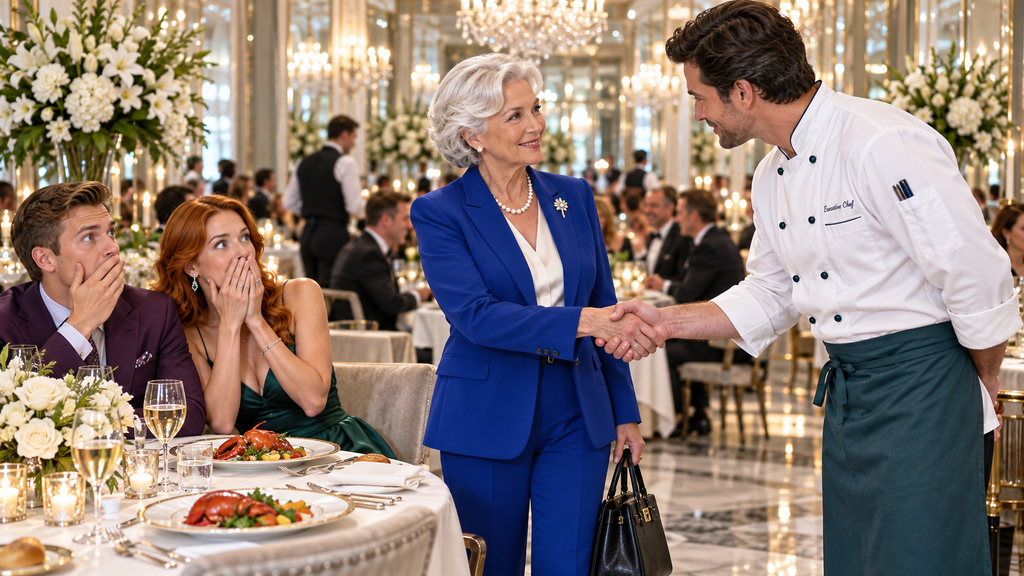
A tall man in a white chef’s coat had stepped through the double doors at the far end of the dining room.
Silver threaded through his dark hair now.
There were lines around his eyes that had not been there the last time I saw him.
But I recognized him immediately.
And judging by the way he stopped in the middle of the dining room, he recognized me too.
For three seconds, neither of us moved.
Then his face changed.
The professional expression disappeared.
His eyes widened.
And, right there between tables covered in white linen and crystal, the executive chef of one of the most celebrated restaurants in the city broke into the warmest smile I had seen all evening.
“Mrs. Hayes?”
Claire turned.
Ethan looked up.
The chef walked toward us quickly.
Not toward Claire.
Not toward her parents.
Not toward Ethan in his tailored suit.
Toward me.
When he reached me, he took both my hands.
“Mrs. Hayes,” he said again.
His voice was softer now.
Almost emotional.
“My goodness. Why didn’t anyone tell me you were here?”
I smiled.
“Hello, Gabriel.”
Claire’s expression changed.
Only slightly.
But I saw it.
The confusion.
Executive Chef Gabriel Moreno was not the kind of man Claire expected to know someone like me.
His photograph hung near the entrance.
His name appeared in magazines.
People waited months for reservations at this restaurant.
And he was holding my hands like I was an old friend.
Actually, that wasn’t quite true.
He was holding them like I was someone he respected.
Someone who mattered.
Gabriel looked at the table.
Then at my place.
His eyes fell on the glass of water.
He looked at the other plates.
Then back at me.
“Have you eaten?”
The room suddenly felt very quiet.
I could hear the soft clink of silverware from another table.
I could hear the piano near the bar.
I could even hear Claire’s father clear his throat.
I shook my head.
“No.”
Gabriel’s expression hardened.
Not dramatically.
Gabriel had never been a dramatic man.
That was one of the things I liked about him.
He simply looked at the table again.
Then he looked at the waiter standing nearby.
“Mrs. Hayes hasn’t been served?”
The waiter’s face went pale.
“I was told she wasn’t dining, Chef.”
Gabriel’s eyes shifted to Claire.
Claire straightened immediately.
“There’s been a misunderstanding.”
I almost smiled.
Ten minutes earlier, there had been no misunderstanding.
There had been a deliberate humiliation.
But people often discover the word misunderstanding when cruelty becomes inconvenient.
Gabriel looked back at me.
“Come with me.”
Claire blinked.
“I’m sorry?”
Gabriel ignored her.
He took the cake box gently from my hands.
“You are not leaving this restaurant without eating.”
“Gabriel—”
“I mean it.”
There was affection beneath his sternness.
The same affection I remembered from a much younger man standing in a cramped kitchen twenty-eight years earlier with a burn across his wrist and terror in his eyes.
He turned toward the dining room.
“Please prepare Mrs. Hayes’s table.”
The waiter hesitated.
“Which table, Chef?”
Gabriel looked almost offended by the question.
“Table One.”
That changed everything.
I saw it happen in Claire’s face.
Her mother’s hand froze around her purse.
Her father sat up straighter.
Even Ethan looked confused.
Because in restaurants like this, there are tables and then there are tables.
Table One was tucked behind a glass wine display near the open kitchen.
It was larger than the others.
More private.
People who followed food magazines knew about it.
Chefs from other cities sat there.
Famous actors sat there.
Politicians.
Business owners.
People the restaurant considered special.
Claire knew.
Of course Claire knew.
“That table is reserved,” she said before she could stop herself.
Gabriel finally looked at her.
“Yes.”
There was a pause.
“It is.”
Then he turned back to me.
“For her.”
Claire stared.
Gabriel smiled at me again.
“You know it always is.”
Nobody spoke.
I could have enjoyed that moment.
Maybe a younger version of me would have.
I could have smiled at Claire.
I could have said something clever.
I could have asked her whether I had finally found my place.
But after sixty-five years of living, I had learned that the most powerful moments rarely require a speech.
So I simply said:
“Thank you, Gabriel.”
Then I followed him.
Behind me, I heard Claire whisper to Ethan.
“What is going on?”
Ethan answered honestly.
For once.
“I don’t know.”
Neither did he.
And that was part of the problem.
My son had spent years being embarrassed by a woman he had never bothered to truly know.
Gabriel led me toward Table One.
Several members of the kitchen staff looked through the open service window.
One of them recognized me.
Then another.
A young woman in a pastry jacket covered her mouth.
“Oh my God.”
Gabriel laughed.
“You see? You’ve still got admirers.”
I shook my head.
“They’re probably wondering why an old woman is carrying cake into their kitchen.”
“They know exactly who you are.”
Claire and Ethan were still at the original table.
They had not moved.
I sat down.
Within seconds, someone placed a linen napkin in my lap.
Another server brought warm bread.
A third brought sparkling water with lemon.
I looked at it.
Gabriel noticed.
“Would you prefer still water?”
“No.”
I smiled.
“This is fine.”
He understood why I was smiling.
The irony was hard to miss.
Then a young sous-chef approached our table.
He couldn’t have been older than thirty.
“Mrs. Hayes?”
“Yes?”
He smiled nervously.
“My mother attended your culinary scholarship program.”
For a second, I said nothing.
He continued.
“She was in the 2009 group. Teresa Brooks.”
I remembered her immediately.
“Teresa from Baltimore?”
His smile widened.
“Yes.”
“She made the best peach cobbler in that class.”
He laughed.
“She still does.”
“Tell her Eleanor says hello.”
“I will.”
He hesitated.
“And thank you. She always said that program changed our lives.”
My throat tightened.
“You’re welcome.”
After he walked away, I looked down at my hands.
Sometimes you do things years ago without knowing where the ripples will end.
A scholarship.
A recommendation.
A second chance.
A meal.
A bus ticket.
A babysitter paid for three evenings so a mother can attend class.
Small things.
Until twenty years pass and a stranger tells you they changed a family.
Gabriel pulled out the chair across from me.
“Are you all right?”
I looked toward Ethan.
He was watching me now.
Claire was whispering rapidly beside him.
“I will be.”
Gabriel studied my face.
“You want me to ask them to leave?”
“No.”
“Eleanor.”
That was how I knew he was genuinely angry.
He almost never called me by my first name.
Not even after all these years.
“I saw your table.”
“I know.”
“Who tells a woman she can’t eat at my restaurant?”
I glanced toward Claire.
“She does, apparently.”
Gabriel’s jaw tightened.
“I can have them removed.”
“No.”
“Then at least let me send their bill back.”
That made me smile.
“They already paid.”
“Good.”
He leaned closer.
“Because after what I just saw, I was afraid I might accidentally charge them for the chairs.”
A laugh escaped me.
A real one.
The first of the night.
And it felt so good I nearly cried.
Gabriel reached across the table.
“You haven’t changed.”
“Oh, I’ve changed.”
“You still laugh exactly the same.”
“That’s because you’re still ridiculous.”
He smiled.
Then his expression softened.
“I wish you had told me you were coming.”
“I didn’t know we were eating here until yesterday.”
“Even so.”
“Gabriel, you don’t need to make a fuss.”
He leaned back and stared at me.
“Mrs. Hayes, when I was nineteen years old, broke, terrified, and sleeping in my cousin’s laundry room, you fed me every night for six months. Allow me one fuss.”
I lowered my eyes.
Across the dining room, Claire had gone completely still.
She had heard him.
I knew because her face had changed again.
Gabriel didn’t lower his voice.
Maybe deliberately.
Maybe not.
“When every respectable restaurant in the city refused to hire me because my English was bad and I didn’t have formal training, you gave me a knife and told me onions didn’t care what language I spoke.”
I laughed.
“I remember.”
“You taught me how to hold it.”
“I taught you not to cut off your fingers.”
“You made me apply to culinary school.”
“You complained for three months.”
“I was stubborn.”
“You were impossible.”
He smiled.
“And you paid my first semester.”
Across the room, Ethan stared at me.
I wish I could say I enjoyed his shock.
I didn’t.
Mostly, it made me sad.
Because none of this was secret.
Not exactly.
He had simply stopped asking questions about my life years ago.
When he was little, he knew everything.
He knew the smell of onions in my hair when I came home.
He knew which nights I worked late.
He knew the scar on my wrist came from hot sugar.
He knew I kept recipe cards in a wooden box above the refrigerator.
Then he grew older.
He went to college.
He met people with parents who had titles instead of hourly wages.
Somewhere along the way, the story changed.
I became the mother who “worked in kitchens.”
Nothing more.
That was all Ethan needed to know.
And because I loved him, I never corrected him.
I should have.
Not because I needed him to be impressed.
Because nobody should be allowed to become ashamed of a person they have deliberately stopped seeing.
A plate arrived.
Not lobster.
Gabriel knew better.
It was something much simpler.
Fresh pasta.
Tomatoes slow-roasted with garlic.
Basil.
A little cheese.
The kind of meal we used to make after midnight when our shifts ended and everyone was too tired to cook anything complicated.
I stared at it.
“You remember.”
“Of course I remember.”
I took a bite.
For one strange second, I was thirty-seven again.
My feet hurt.
My uniform smelled like fryer oil.
Ethan was asleep in the manager’s office because the babysitter had canceled.
Gabriel was nineteen and washing pans.
We had twenty-three dollars between us and payday was two days away.
Life had been hard.
But I had never felt ashamed.
Not once.
That was the strange part.
I had spent years with almost nothing and still possessed more dignity than I had felt sitting at that expensive table with my own son.
“Good?” Gabriel asked.
I nodded.
“Very.”
He stood.
“I’ll let you eat.”
Before he left, he glanced toward Ethan.
“He looks like you.”
“He used to.”
Gabriel understood what I meant.
He squeezed my shoulder.
“People sometimes find their way back.”
“Sometimes.”
“And sometimes they don’t.”
“Yes.”
His eyes softened.
“Either way, you’ll be all right.”
I believed him.
That surprised me.
I was halfway through my meal when Ethan finally approached.
He came alone.
Claire remained behind with her parents.
He stopped several feet from my table.
“Mom?”
I kept eating.
“Mom, can we talk?”
I placed my fork down.
“You may sit.”
He sat across from me.
For a few seconds, he said nothing.
He kept looking around.
At Table One.
At the kitchen.
At Gabriel.
At the young chef who had thanked me.
Then back at me.
“I don’t understand.”
I folded my hands.
“What part?”
“All of this.”
“Dinner?”
“You know what I mean.”
I did.
But I wanted him to say it.
“Explain.”
He lowered his voice.
“Chef Moreno knows you.”
“Yes.”
“He said you paid for culinary school.”
“Part of it.”
“The waiter said this table is always reserved for you.”
“That is Gabriel being sentimental.”
“Mom.”
He leaned closer.
“What is going on?”
I looked at my son.
My beautiful son.
The baby whose fever I once checked every fifteen minutes through an entire night.
The seven-year-old who insisted I sit in the front row at his school play.
The teenager who cried in my kitchen when his first girlfriend broke his heart.
The young man who once hugged me outside his college dorm and whispered, “Everything I do will be because of you.”
Where had that boy gone?
Maybe nowhere.
Maybe he was still inside the man sitting across from me.
Buried under ambition.
Fear.
Status.
A marriage built partly around appearances.
Or maybe that was simply something mothers tell themselves because admitting their children can become strangers hurts too much.
“You never asked,” I said.
His brow tightened.
“Asked what?”
“About my life.”
“I know about your life.”
“No, Ethan.”
My voice remained quiet.
“You know the parts you decided were worth remembering.”
He looked offended.
“That’s not fair.”
“Isn’t it?”
I gestured gently toward the other table.
“You sat there tonight while your wife told a waiter I didn’t need food.”
His face flushed.
“Claire was upset.”
“Was she?”
“She’s been under stress.”
“Stress causes people to order lobster for four people and water for one?”
“That’s not what I mean.”
“Then explain it.”
He rubbed his hands together.
“Things have been complicated.”
“With me?”
“With everyone.”
I waited.
Ethan looked over his shoulder.
Claire was watching us.
So were her parents.
Then he looked back at me.
“Claire thinks you judge her.”
I almost laughed.
“She spent dinner explaining that I damage your family’s image.”
“She doesn’t mean it like that.”
“How does she mean it?”
“She just…”
He stopped.
There was nowhere useful for that sentence to go.
I leaned forward.
“Ethan, she looked at me and asked what I contribute.”
His eyes dropped.
“And you allowed it.”
“Mom—”
“You told me to remember my place.”
He shut his eyes.
Just for a second.
“I shouldn’t have said that.”
“No.”
I waited.
“You shouldn’t have thought it.”
His eyes opened.
That landed harder.
Good.
Some truths should.
He stared at the tablecloth.
“Why didn’t you ever tell me?”
“Tell you what?”
“That you know people like Chef Moreno.”
“People like Chef Moreno?”
“You know what I mean.”
“I’m not sure I do.”
He grew frustrated.
“Successful people.”
There it was.
I leaned back.
“Gabriel was successful before anyone put his photograph in a magazine.”
“That isn’t what I—”
“He was successful the night he worked a fourteen-hour shift and still stayed to help me scrub the floor because my back hurt.”
“Mom.”
“He was successful when he sent half his first paycheck to his mother.”
“I understand.”
“No. I don’t think you do.”
My voice cracked slightly.
That surprised both of us.
I looked away.
Then I steadied myself.
“Do you know why I kept working after you went to college?”
“You needed money.”
“At first.”
He frowned.
“What does that mean?”
“It means I stopped needing it sooner than you think.”
His confusion deepened.
I sighed.
There was no reason to hide anything anymore.
Not after tonight.
“When you were fourteen, the restaurant where I worked changed owners. The new owner wanted to throw away half the old menu and replace it with trendy nonsense nobody wanted.”
Ethan almost smiled.
“That sounds like you.”
“It does.”
“So I argued.”
“Of course.”
“For six weeks.”
His smile grew despite himself.
“And?”
“And eventually the owner told me if I knew so much, I should prove it.”
“So you did.”
“Yes.”
I redesigned seven dishes.
Three became the restaurant’s biggest sellers.
Then I created a dessert menu.
Then another restaurant asked for help.
Then another.”
Ethan stared.
“You were consulting?”
“We didn’t call it that then.”
“What did you call it?”
“Helping.”
Despite everything, that made him laugh softly.
I continued.
“A small food company asked to bottle two of my sauces. They sold well. Much better than anyone expected.”
His face went blank.
“Sauces?”
“The tomato-pepper sauce you used to put on eggs.”
“The one in the jar?”
“The original one.”
He blinked.
“Hayes Kitchen?”
I nodded.
For the first time that evening, my son looked genuinely speechless.
Hayes Kitchen had not made me famous.
Most consumers probably never connected the brand to a person.
But it had become a successful regional specialty-food company.
Grocery stores carried the sauces.
Hotels bought them.
Restaurants ordered them by the case.
Years earlier, I had sold the majority share while keeping a small percentage and licensing rights to several recipes.
I did not become a billionaire.
I did not own private jets.
I did not suddenly move into a mansion.
But I became comfortable.
More comfortable than Ethan ever knew.
He stared at me.
“You’re Hayes Kitchen?”
“I was.”
“You never told me.”
“You were there when I made the first batch.”
“I was twelve.”
“You complained it was too spicy.”
“Mom.”
“What?”
“How much did you make?”
There are questions that tell you where a person’s mind has gone.
That one hurt.
I saw him realize it immediately.
His face changed.
“I’m sorry. That came out wrong.”
“Yes.”
“I didn’t mean—”
“I know.”
He looked miserable.
Maybe that was the first honest thing on his face all night.
“I just can’t believe this.”
“I know.”
“Why do you still live in that apartment?”
“Because I like it.”
“But you could live somewhere else.”
“Yes.”
“Why don’t you?”
“Because I have sunlight in the kitchen at six-thirty in the morning, Mrs. Alvarez across the hall brings me tamales every Christmas, the bus stop is three minutes away, and your father and I brought you home to that apartment when you were born.”
He said nothing.
“I don’t hate my life, Ethan.”
“I never said you did.”
“No.”
I looked toward Claire.
“But you let people speak about it as though I should.”
His eyes followed mine.
“Claire doesn’t know.”
“That excuses nothing.”
“I know.”
“And neither did you.”
His face fell.
“No.”
“That is the point.”
I picked up my water.
“It would be easy for you to apologize now that you know I have money.”
“I’m not apologizing because of money.”
“Aren’t you?”
“No.”
He sounded hurt.
I held his gaze.
“Then imagine Gabriel never walked over.”
His mouth closed.
“Imagine I really was the woman Claire thought I was.”
He looked away.
“Imagine I had nothing except a small pension, an old dress, a strawberry cake, and love for my granddaughter.”
My voice shook now.
I let it.
“Would I deserve dinner?”
He whispered:
“Yes.”
“Would I deserve respect?”
“Yes.”
“Would I deserve my son defending me?”
His eyes filled.
“Yes.”
I swallowed.
“That is the only answer that matters.”
Claire came over before Ethan could say anything else.
Her heels clicked hard against the floor.
She stopped beside our table.
“Ethan.”
He wiped quickly beneath one eye.
Claire noticed.
Then she looked at me.
Her smile was tight.
Controlled.
The same smile she used at fundraisers and business dinners.
“Eleanor, I think we all got off on the wrong foot tonight.”
I stared at her.
“I arrived at seven.”
She blinked.
“What?”
“If we got off on the wrong foot, it happened sometime after seven.”
Ethan looked down.
Claire forced a laugh.
“I’m trying to apologize.”
“No, you aren’t.”
Her smile disappeared.
“Excuse me?”
“You’re trying to erase what happened because you’ve discovered I am not who you thought I was.”
“That is not true.”
“Then tell me who you thought I was.”
Silence.
Claire folded her arms.
Her mother and father were still watching us from the table.
“I never said you were a bad person.”
“No. You said I had nothing useful to contribute.”
“I was talking about social circumstances.”
“You told a waiter not to feed me.”
Her cheeks colored.
“That was inappropriate.”
“Yes.”
“And I regret it.”
“Do you regret doing it?”
I tilted my head.
“Or do you regret Chef Moreno seeing it?”
Her eyes flashed.
“You’re enjoying this.”
That accusation told me more than any apology could.
I sat back.
“No, Claire.”
My voice softened.
“That is what you still don’t understand.”
I looked at Ethan.
“I would give almost anything for this dinner never to have happened.”
Ethan closed his eyes.
Claire’s posture shifted.
For a moment, she looked uncertain.
Then pride returned.
“Well, I think everyone said things they didn’t mean.”
“I meant everything I said.”
“You barely said anything.”
“Exactly.”
She stared at me.
I continued.
“I spent years allowing you to insult me in small ways because I thought protecting Ethan’s marriage was more important than protecting my dignity.”
Claire’s jaw tightened.
“You are exaggerating.”
“Am I?”
I counted quietly.
“You refused to let me hold Lily at her first birthday because my dress was ‘too casual’ for the photographer.”
“That isn’t what happened.”
“You asked me to enter through the service entrance at your Christmas party because your guests were arriving.”
“The front foyer was crowded.”
“You introduced me to your friends as Ethan’s ‘old babysitter’ and laughed after.”
Claire’s face went pale.
Ethan turned sharply toward her.
“You did what?”
She looked at him.
“It was a joke.”
I continued.
“You moved my place card at your anniversary dinner.”
“Eleanor—”
“You returned the handmade quilt I made for Lily because you said it didn’t fit the nursery aesthetic.”
Ethan stared at her.
“What quilt?”
Claire’s lips parted.
I saw him remembering something.
Lily had once mentioned a pink blanket at my apartment.
The one she always curled beneath when she visited.
He looked at me.
“That was for her?”
“Yes.”
“Why is it at your place?”
“Because Claire gave it back.”
He turned to his wife.
“Why?”
Claire’s voice sharpened.
“Because the nursery was professionally designed, Ethan.”
He stared at her.
“That was my mother’s quilt.”
“I know who made it.”
“My grandmother taught her to sew.”
Claire said nothing.
Ethan looked sick.
I almost felt sorry for him.
Almost.
Because discovering a truth you helped ignore is painful.
But pain and innocence are not the same thing.
I went on.
“The first year, I told myself you were adjusting.”
Claire looked at me.
“The second year, I told myself you were insecure.”
Her eyes narrowed.
“The third year, I told myself keeping peace was best for Ethan.”
I took a breath.
“Then Lily was born.”
That changed Claire’s face.
I could see the wall rising.
“Do not bring my daughter into this.”
“I’m not criticizing Lily.”
“Then leave her out of it.”
“I can’t.”
“Why?”
“Because she is the reason I kept coming back.”
Claire looked confused.
I smiled sadly.
“Do you think I kept attending birthdays because I enjoyed being ignored?”
Nobody answered.
“Do you think I kept bringing casseroles you threw away?”
Claire’s head snapped toward me.
“I never—”
“Your housekeeper told me.”
Her mouth closed.
“Do you think I kept sitting in rooms where you corrected my pronunciation, laughed at my shoes, and made sure photographs were taken after I left because I liked being humiliated?”
Ethan’s face had turned gray.
“No.”
I shook my head.
“I came for Lily.”
The tears finally arrived.
I blinked them back.
“I came because she runs toward me when I open the door.”
My voice broke.
“She thinks my strawberry cake is the best thing ever made even though the middle sinks almost every time.”
Ethan laughed through his tears.
“It does.”
I smiled.
“Yes.”
I looked at Claire.
“I came because she sits on my kitchen counter while we make pancakes. Because she thinks dandelions are beautiful. Because she saves buttons in a jar at my house and tells me each one is treasure.”
Claire’s eyes flickered.
For the first time, she looked less angry than ashamed.
“I love that little girl.”
I placed my hand over my chest.
“And I tolerated you because I was afraid that if I stood up for myself, you would punish me by taking her away.”
The silence that followed was brutal.
Claire said nothing.
She didn’t need to.
Because we both knew that fear had been reasonable.
She had threatened it before.
Never directly.
Not enough to quote.
Just little remarks.
“If things stay tense, maybe Lily needs some space from certain relatives.”
Or:
“Children pick up on negative energy.”
Or:
“I’m very careful who has access to my daughter.”
Each sentence sounded innocent alone.
Together, they built a cage.
Ethan looked at his wife.
“Did you threaten Mom with Lily?”
“I did not threaten anyone.”
“Claire.”
“She’s twisting things.”
“Did you tell her she might not see Lily?”
Claire looked toward her parents.
Neither helped her.
Finally, she said:
“I said boundaries might be necessary.”
Ethan pushed his chair back.
“Oh my God.”
“Do not do this here.”
“Here?”
His voice rose.
“This is where you chose to humiliate my mother.”
Several diners looked over.
Gabriel glanced toward us from the kitchen.
I lifted one hand.
He stayed where he was.
Claire hissed:
“Lower your voice.”
“No.”
It was the first time all night my son said that word firmly.
No.
I should not have felt proud.
Not yet.
But I did.
A little.
Maybe mothers are foolish that way.
Claire stood straighter.
“Fine.”
Her voice became cold.
“If we’re going to drag everything out, then let’s do it.”
She looked at me.
“You never liked me.”
“That’s not true.”
“You thought I wasn’t good enough for Ethan.”
“I thought you were beautiful, confident, and ambitious.”
“That isn’t an answer.”
“It is the truth.”
“You judged my family.”
“No.”
“My parents worked very hard for what they have.”
“I’m sure they did.”
“You always acted uncomfortable around us.”
“Because your mother once asked me whether people in my neighborhood had indoor laundry.”
From across the room, Claire’s mother suddenly became fascinated by her purse.
Ethan looked over.
“She asked you that?”
“Yes.”
Claire shook her head.
“You remember every little comment.”
“People tend to remember being insulted.”
“You could have said something.”
“I should have.”
That stopped her.
I nodded.
“You are right about that.”
Claire had not expected agreement.
“I should have spoken sooner.”
I looked at Ethan.
“I should have told my son the first time you treated me badly.”
He looked down.
“I should have refused the second insult.”
Then I looked at Claire.
“And I should never have taught you that access to my family was worth accepting disrespect.”
Her face hardened again.
“So this is what? You finally reveal you’re secretly rich, everyone suddenly treats you like royalty, and now you get to punish us?”
“No.”
“That’s exactly what this looks like.”
I almost smiled.
“Claire, you still think this is about money.”
“Isn’t it?”
“No.”
I gestured toward the plate in front of me.
“Gabriel knew me when I had holes in both shoes.”
Her expression changed.
“He respected me then.”
I pointed gently toward the kitchen.
“Most of the people who came over tonight didn’t mention money once.”
I let that settle.
“They remembered kindness.”
Claire’s eyes dropped.
“That is the difference between status and character.”
Ethan flinched slightly.
Because he knew that sentence belonged to him too.
Gabriel approached again carrying a small leather folder.
He stopped beside me.
“Sorry to interrupt.”
“You aren’t.”
He placed the folder on the table.
“I thought you would want this.”
I looked at it.
I knew immediately what it was.
I had almost forgotten.
“What is that?” Ethan asked.
Gabriel glanced at me.
I nodded.
He answered.
“The annual foundation report.”
Ethan frowned.
“What foundation?”
“The Hayes-Moreno Culinary Foundation.”
Claire stared at him.
Gabriel continued.
“It provides culinary training, emergency grants, childcare assistance, and scholarships for restaurant workers.”
Ethan looked at me.
“Hayes?”
“Yes.”
“How many people?”
Gabriel thought for a moment.
“This year?”
“Yes.”
“Two hundred and eleven direct scholarships. Emergency assistance to approximately four hundred families. The food incubator supports twenty-three small businesses.”
Claire’s father had left his table now.
I noticed him standing several feet behind Claire.
His expression was completely different from before.
Interested.
Very interested.
I knew that look.
I had seen it in business meetings.
A person recalculating someone’s value.
He approached.
“Excuse me.”
Gabriel turned.
Claire’s father smiled.
“Richard Bennett.”
He held out his hand.
“Bennett Capital.”
Gabriel looked at the hand.
Then shook it politely.
“Yes. I know the name.”
Richard’s smile broadened.
“We’ve actually been looking at hospitality investments.”
Of course he had.
Ten minutes earlier, he had spent half the evening talking about people who failed to reach “the right level.”
Now he had discovered that the old woman at the end of the table might be useful.
He turned to me.
“Eleanor, you never mentioned any of this.”
I looked at him.
“You never asked.”
His smile flickered.
“Well.”
He chuckled.
“I suppose we’ve all been guilty of assumptions tonight.”
“No.”
I took a sip of water.
“Not all of us.”
His smile disappeared.
Claire stared at me.
Ethan looked like he wanted the floor to open.
Gabriel coughed into his fist to hide what might have been a laugh.
Richard recovered.
“In any event, I’d love to speak with you about the foundation sometime. Perhaps there are opportunities for collaboration.”
I knew exactly what kind of collaboration he meant.
His firm had recently been seeking entry into restaurant and boutique hotel developments.
I also knew something he did not.
One of his proposals had been sitting on my attorney’s desk for three weeks.
Not because of the foundation.
Because of my investments.
That was another part of my life Ethan did not know.
After selling the majority of Hayes Kitchen, I did not spend the money.
I invested it.
Slowly.
Carefully.
Mostly in buildings.
Small commercial properties at first.
Then several restaurant spaces.
Then a modest stake in a local hotel group.
I preferred things I understood.
Kitchens.
Storefronts.
Places where people worked.
Over the years, small investments grew.
One of the buildings happened to be the one we were sitting in.
Not the restaurant business itself.
The property.
The restaurant leased it from a company partly owned by me and Gabriel.
That fact had never seemed important before tonight.
Richard Bennett was about to discover why it mattered.
“I believe we already have a meeting scheduled,” I said.
His brow furrowed.
“We do?”
“Tuesday.”
“With whom?”
“Hayes Property Group.”
He froze.
Claire turned toward her father.
Ethan stared at me again.
Richard’s face changed very slowly.
“Hayes Property Group.”
“Yes.”
He swallowed.
“You’re Eleanor H. Hayes?”
Gabriel looked between us.
“Oh.”
He knew immediately.
Apparently, I had not mentioned the connection to him either.
Richard’s face lost color.
Three months earlier, Bennett Capital had approached several property owners about a redevelopment package involving restaurants, retail spaces, and a boutique hotel.
The project could be profitable.
It could also displace several independent businesses.
My attorneys had serious concerns.
Richard did not know the quiet woman his daughter had denied dinner happened to hold the deciding interest in two key parcels.
I watched him realize it.
“Mrs. Hayes…”
His tone had changed completely.
That hurt more than the insults.
I held up one hand.
“Please don’t.”
He stopped.
“Do not treat me differently now.”
“I’m not.”
“You are.”
His mouth closed.
“Ten minutes ago, you laughed while your daughter explained that I had no useful connections.”
His face reddened.
“I didn’t realize—”
“That is precisely the problem.”
I looked at him.
“You should not need to know someone’s bank balance before deciding whether they deserve courtesy.”
Richard had no response.
I continued.
“And before you worry, Tuesday’s meeting will remain scheduled.”
He looked surprised.
“I don’t mix family anger with business decisions.”
Gabriel nodded slightly.
“But the proposal will be judged on whether it treats tenants fairly.”
Richard stiffened.
“Of course.”
“And if your numbers require pushing long-term family businesses out of their spaces, then the answer will be no.”
He stared.
I smiled politely.
“That would have been my answer yesterday too.”
Richard nodded.
“Understood.”
I wasn’t sure he did.
But Tuesday would tell me.
He returned to the other table.
For the first time that evening, he walked without swagger.
Claire stared at me as though I had transformed in front of her.
“You own this building?”
“Part of it.”
“And you let us sit here talking like…”
She stopped.
“Like what?”
She looked away.
I finished for her.
“Like people without money are failures?”
Her face reddened.
Ethan whispered:
“Mom, how much are you worth?”
I looked at him.
He immediately shook his head.
“Sorry.”
“Better.”
Despite the tension, Gabriel laughed.
Ethan actually smiled.
A tiny crack.
Maybe the first opening in something that had been closed for years.
Then Claire said:
“So you tested us.”
“No.”
“What?”
“You invited us here knowing all of this.”
“I didn’t invite anyone.”
“You knew Chef Moreno would recognize you.”
“I assumed he might.”
“So you sat there deliberately letting me—”
“Letting you what?”
She stopped.
I waited.
“Finish the sentence.”
Her eyes filled suddenly.
Maybe anger.
Maybe humiliation.
Maybe both.
“You let me make a fool of myself.”
I looked at her for a long moment.
“No, Claire.”
My voice was gentle.
“You did that without my help.”
Her mouth trembled.
She looked away.
And despite everything, I felt no triumph.
That surprised me.
For years, I had imagined standing up to her.
In my imagination, I always felt powerful afterward.
Vindicated.
Instead, I felt tired.
Because winning against family often feels suspiciously like losing.
A small voice interrupted us.
“Grandma?”
Every adult at the table froze.
Lily stood near the entrance to the private dining area.
Claire’s mother had apparently brought her from the lounge where a babysitter had been watching her during dinner.
She wore a little red coat over a white dress.
Her curls were messy.
In one hand, she clutched a stuffed rabbit.
She looked at all of us.
Then at the cake box.
Her whole face lit up.
“You brought my strawberry cake!”
Every wall inside me collapsed at once.
I stood.
“There’s my girl.”
She ran toward me.
Claire opened her mouth.
Maybe to stop her.
Maybe not.
But Ethan shook his head.
Claire stayed silent.
Lily wrapped both arms around my waist.
“You said you were coming for dinner.”
“I did.”
“Did you eat?”
The innocence of the question nearly broke me.
I looked at the water on the table.
Then at Claire.
“Yes, sweetheart.”
“Did you save room for cake?”
“Always.”
She pulled away.
“Mommy said we were taking it home.”
Claire’s eyes closed.
Of course she had.
Lily looked confused.
“Are you mad?”
“No.”
I crouched in front of her.
“Not at you.”
She touched my cheek.
“You look sad.”
Children see everything adults spend years hiding.
“I had a hard evening.”
“Did somebody be mean?”
The room went silent again.
I could have lied.
Instead, I said:
“Some grown-ups forgot how to be kind.”
Lily considered that.
Then she frowned.
“That’s bad.”
“Yes.”
“Do they have to say sorry?”
I looked at Ethan.
Then Claire.
“Yes.”
Lily nodded seriously.
“At school, we have to say what we did, not just sorry.”
Gabriel turned away.
His shoulders shook.
I suspected he was laughing.
Claire actually covered her face for a second.
Ethan whispered:
“Your daughter is terrifying.”
For once, Claire almost smiled.
Lily tugged my sleeve.
“Can we eat cake?”
“Yes.”
Gabriel stepped forward.
“I think we can arrange that.”
Lily looked up at him.
“Are you the cooker?”
Gabriel placed one hand dramatically over his chest.
“I am the cooker.”
“Grandma is a cooker too.”
Gabriel looked at me.
“The best one.”
Lily grinned.
“I know.”
And there it was.
The only review I had ever truly cared about.
Gabriel carried the strawberry cake into the kitchen.
Five minutes later, it came back transformed.
He had refused to alter the cake itself.
“Sacrilege,” he said.
But the pastry team surrounded it with fresh berries, cream, and tiny sugar flowers.
Lily gasped.
“It looks like a princess cake.”
“It is,” I said.
She climbed into the chair beside me.
Gabriel brought plates for everyone.
Everyone.
I noticed that.
So did Ethan.
He looked down.
No one had to explain the symbolism.
Claire remained standing.
Lily looked at her mother.
“Mommy, sit.”
Claire hesitated.
Then she sat.
Her parents came over slowly.
For the first time that evening, all of us occupied the same table.
Not divided by status.
Not grouped by who belonged.
One table.
Seven chairs.
Seven plates.
I cut the cake.
The middle had sunk.
Of course it had.
Lily pointed.
“It did the hole thing!”
Everybody laughed.
Even me.
Especially me.
I placed the first slice in front of Lily.
The second in front of Gabriel.
The third in front of myself.
Then I stopped.
I looked at Ethan.
He remembered.
When he was little, he always stole the strawberries from the top.
I placed the fourth slice in front of him.
He stared at it.
“Extra strawberry?”
I put one on his plate.
His mouth twisted.
He was trying not to cry.
“Thanks, Mom.”
I looked at Claire.
For one second, I considered skipping her.
I am not proud of that.
But pain can make petty ideas feel righteous.
Then Lily said:
“Mommy needs big cake.”
I cut Claire a large piece.
Lily approved.
“Daddy too.”
I gave Ethan another half slice.
He laughed.
“Apparently I need big cake too.”
“You do,” Lily said.
“Why?”
“Because you look sad.”
Ethan stopped laughing.
Children.
Always seeing.
We ate in an uncomfortable peace for several minutes.
Finally, Claire spoke.
“Eleanor.”
I looked at her.
She placed her fork down.
Her voice was different.
No polish.
No social smile.
“I’m sorry I told the waiter not to serve you.”
I said nothing.
She continued.
“It was cruel.”
Lily was busy explaining sugar flowers to Gabriel and did not seem to hear.
Claire looked at me.
“I did it because I was angry.”
“Why?”
She took a long breath.
“Because Ethan told me last week that he wanted Lily to spend more time with you.”
That surprised me.
I looked at him.
He shrugged weakly.
“I did.”
Claire continued.
“I felt like everyone preferred you.”
I blinked.
“What?”
She laughed once, bitterly.
“That sounds ridiculous now.”
“No.”
I leaned back.
“It sounds honest.”
Her eyes became wet.
“My daughter talks about you constantly.”
I glanced at Lily.
“She loves you.”
“I know.”
“That should make me happy.”
“It doesn’t?”
“It does.”
Claire looked ashamed.
“And it doesn’t.”
That was probably the first truly honest thing she had ever said to me.
“She asks to go to your apartment instead of my parents’ house.”
Claire’s mother looked away.
“She wants your pancakes.”
A small smile.
“Your stupid button jar.”
“It’s an excellent button jar.”
Claire almost laughed.
“She tells people her grandma knows how to fix everything.”
My throat tightened.
Claire wiped under one eye quickly.
“And sometimes I feel like…”
She struggled.
“Like I’m failing.”
There it was.
Not an excuse.
But maybe an explanation.
I waited.
“My mother made everything about appearances.”
Claire glanced toward her.
Her mother said nothing.
“If I brought home a B, she wanted to know who got an A.”
Her voice shook.
“If I wore the wrong dress, she changed it.”
Claire’s mother finally said:
“We wanted the best for you.”
Claire looked at her.
“You wanted me to look like the best.”
Her mother went silent.
Claire turned back to me.
“I told myself I was different.”
Tears slipped down her face.
“Then I had Lily.”
She looked at her daughter.
“And suddenly every other mother looked happier. More natural. Better.”
I knew that feeling.
Most mothers do.
At least once.
Maybe a thousand times.
Claire continued.
“You never seemed nervous.”
I nearly laughed.
“Claire.”
“You didn’t.”
“I once took Ethan to school with two different shoes.”
Ethan nodded.
“Third grade.”
“I cried in a grocery store because I couldn’t afford cough medicine and cereal in the same week.”
Claire looked at me.
“I screamed at him when he was eleven because I hadn’t slept properly in four days.”
“I deserved it,” Ethan said.
“No, you didn’t.”
“What did I do?”
“You spilled orange juice.”
“Oh.”
“You definitely didn’t deserve it.”
He nodded solemnly.
“Good to know.”
I looked back at Claire.
“You saw the finished version.”
Her expression softened.
“You saw a grandmother.”
I pointed at Ethan.
“You didn’t see the terrified twenty-eight-year-old mother who used to check that boy’s breathing every fifteen minutes because she was convinced he would stop.”
Ethan raised an eyebrow.
“Seriously?”
“For months.”
“I didn’t know that.”
“You were a baby.”
“I thought you were always…”
He searched for the word.
“Strong.”
“No.”
I smiled sadly.
“I was responsible.”
“There’s a difference.”
Everyone grew quiet.
I looked at Claire.
“You do not have to compete with me.”
She swallowed.
“I know.”
“Lily loving me does not reduce what she has for you.”
Claire glanced toward her daughter.
“I know.”
“And humiliating me will never make you feel more secure.”
A tear rolled down her cheek.
“I know.”
This time, I believed she might.
Not completely.
But perhaps for the first time.
I leaned closer.
“However.”
Claire looked back.
“Understanding why you behaved badly does not erase what you did.”
Her face fell.
“I know.”
“You do not get instant forgiveness because you explained yourself.”
“I understand.”
“And I will never again accept disrespect to keep access to my granddaughter.”
She nodded.
“If you ever use Lily to control me again, I will step away before I let you treat me like tonight.”
Ethan looked startled.
“Mom—”
I held up my hand.
“I love her enough not to teach her that love means tolerating cruelty.”
That stopped everyone.
Even Lily, who had turned toward us.
“What’s cruelty?”
Gabriel answered smoothly.
“Not sharing cake.”
Lily gasped.
“That’s terrible.”
We all laughed.
The tension broke just enough to breathe.
After cake, Gabriel took Lily to the edge of the open kitchen to show her how pasta was rolled.
She had to wear a tiny paper hat.
It swallowed half her head.
I watched through the glass as she stood on a stool between two cooks, taking her job very seriously.
Ethan moved his chair beside mine.
“Mom?”
“Yes?”
“I’m sorry.”
I looked at him.
He did not rush.
He did not defend himself.
“I’m sorry I let Claire treat you badly.”
His voice cracked.
“I’m sorry I pretended not to notice because admitting it would have forced me to choose a side.”
I listened.
“I’m sorry for tonight.”
He swallowed.
“And I’m sorry for all the other nights.”
My eyes filled.
“Keep going.”
He almost laughed.
“You always did make me finish the assignment.”
“Half apologies are like half-cooked chicken.”
“Dangerous?”
“Exactly.”
He nodded.
Then he became serious again.
“I was ashamed of you.”
That one hurt.
Even though I already knew.
He saw it.
“Not because of anything you did.”
I waited.
“That doesn’t make it better.”
“No.”
“When I started working at Grant & Fellows, everyone came from families with money.”
He looked down.
“They talked about ski houses, private schools, investment accounts. Their fathers played golf together.”
His voice tightened.
“I started lying.”
“What did you say?”
“That you had retired from the restaurant industry.”
I almost smiled.
Technically, not entirely false.
“That Grandpa had owned businesses.”
“He owned a lawn mower.”
Ethan laughed through his tears.
“I know.”
“Secondhand.”
“I know.”
“The wheel fell off every summer.”
“I remember.”
He wiped his face.
“The more I tried to fit in, the more embarrassed I became by anything that reminded me where I came from.”
My heart broke a little more.
Because suddenly I understood.
Not excused.
Understood.
He looked at me.
“And then I met Claire.”
I said nothing.
“Her family was everything I thought successful people were supposed to be.”
He glanced toward Richard.
“I wanted them to respect me.”
“So you let them disrespect me.”
“Yes.”
The word was barely audible.
“I’m so sorry.”
A tear rolled down my cheek.
“You wanted to escape being the poor kid.”
“Yes.”
“You thought I represented everything you escaped.”
He looked devastated.
“Yes.”
I nodded.
That truth needed room.
After a while, I said:
“Do you remember the winter you were nine?”
“Which one?”
“The furnace broke.”
He frowned.
“Sort of.”
“We didn’t have heat for five days.”
His eyes widened.
“I remember sleeping in the living room.”
“We made a tent with blankets.”
“You told me it was camping.”
“I lied.”
He smiled sadly.
“I thought it was fun.”
“I know.”
I stared at the table.
“I had forty-eight dollars until payday and the repair was two hundred and ten.”
“What did you do?”
“I worked two overnight shifts at the hotel kitchen.”
His eyes filled again.
“You told me you were helping with a wedding.”
“I was.”
“That part was true?”
“Mostly.”
He shook his head.
“You never told me it was that bad.”
“You were nine.”
“Still.”
“What would telling you have accomplished?”
“I don’t know.”
“Exactly.”
I looked at him.
“I did not work that hard so you would spend your adult life ashamed of where you came from.”
He nodded.
“I know.”
“I worked so you would have options.”
“I know.”
“But somewhere, you mistook options for permission to look down on people without them.”
His face tightened.
“Yes.”
“That ends tonight.”
He looked directly at me.
“It does.”
“Not because you learned I have money.”
“No.”
“Say it.”
His eyes did not leave mine.
“It ends because I was wrong before I knew any of this.”
I nodded.
“That’s better.”
He reached for my hand.
I let him.
“I don’t expect you to forgive me tonight.”
“Good.”
A wet laugh escaped him.
“But I want to fix it.”
“Then fix it.”
“How?”
I squeezed his hand once.
“Start by becoming someone who does not need me to be impressive before you are proud of me.”
His face crumpled.
He covered his eyes.
For the first time since he was a little boy, my son leaned toward me and cried without trying to hide it.
I put my arms around him.
Not because everything was forgiven.
Not because one apology repaired years.
I held him because I was still his mother.
And because accountability and love do not cancel each other out.
Sometimes they require each other.
Claire did not interrupt.
That mattered.
She sat several chairs away, quietly crying.
Her parents had returned to their table.
For once, nobody seemed concerned with appearances.
When Ethan finally sat upright, he laughed awkwardly.
“I got your dress wet.”
“It has survived worse.”
“Is this your good navy one?”
“Yes.”
“The one you wore to my graduation?”
“The very same.”
He looked horrified.
“Mom, that dress is twenty years old.”
“Nineteen.”
“You own part of this building.”
“Yes.”
“And you’re wearing a nineteen-year-old dress.”
“It still fits.”
Gabriel returned just in time to hear.
“That dress has attended more important dinners than most politicians.”
I laughed.
“Exactly.”
Ethan looked at both of us.
“I don’t understand either of you.”
“That’s fine,” Gabriel said.
“It took me fifteen years.”
Lily came running back with flour on her nose.
“Grandma!”
“Yes?”
“I made a noodle!”
She held up something that looked more like a shoelace.
“It’s beautiful.”
“It’s ugly.”
“It has personality.”
Gabriel nodded.
“Exactly what I told her.”
Lily climbed into my lap.
“Can I sleep at your house?”
Claire went still.
I did too.
Usually, this was the moment tension entered.
Claire would say they had plans.
Or maybe next week.
Or Lily needed her own bed.
This time, Claire looked at me.
Not at Lily.
At me.
Then she said quietly:
“If Grandma wants you.”
Lily squealed.
I looked at Claire.
“Are you sure?”
She nodded.
“Very.”
That small decision did not erase anything.
But it mattered.
I looked at Lily.
“You may come tomorrow night.”
“Why not tonight?”
“Because Grandma needs to sleep for approximately fourteen hours.”
Gabriel pointed at me.
“She used to say that twenty years ago too.”
“Did she?”
“She never actually did it.”
Lily shook her head.
“Grandma, you have to listen.”
I smiled.
“Yes, ma’am.”
The restaurant had nearly emptied by the time we prepared to leave.
Claire’s parents left first.
Richard approached me before going.
For once, his voice carried no false warmth.
“Mrs. Hayes.”
“Yes?”
“I owe you an apology.”
I waited.
“I behaved badly.”
“Yes.”
He accepted that without flinching.
“I’ve spent years telling myself success gave me good judgment.”
He glanced toward Claire.
“Tonight suggested otherwise.”
I nodded.
“That can happen.”
His wife stood beside him.
She looked uncomfortable.
Then she said:
“I’m sorry about the laundry comment.”
I almost laughed.
“You remember it?”
She gave me a small, embarrassed smile.
“Unfortunately.”
“Good.”
Her eyebrows rose.
“I mean that kindly.”
I gathered my coat.
“If we forget the things we’re ashamed of, we tend to repeat them.”
She nodded slowly.
“You’re right.”
Richard cleared his throat.
“And Tuesday?”
“Still Tuesday.”
He nodded.
“No special treatment.”
“None.”
He almost smiled.
“I wouldn’t dare ask.”
“That shows improving judgment.”
He laughed.
Genuinely.
Then they left.
I watched them go.
People can change.
I believe that.
But I no longer confuse the possibility of change with proof of it.
Proof takes time.
Claire remained.
She and Ethan stood near the table while Gabriel brought my coat.
“Mrs. Hayes,” he said ceremoniously.
“I am capable of putting on a coat.”
“I know.”
“Then stop hovering.”
“No.”
I sighed.
“Chefs become unbearable when people write nice things about them.”
“Old mentors become impossible when people don’t visit often enough.”
“Fair.”
He helped me into the coat anyway.
I hugged him.
A real hug.
“Thank you.”
His voice softened.
“You never need to thank me.”
“I do.”
“No.”
He stepped back.
“If you hadn’t taken a chance on me, none of this would exist.”
I looked around the restaurant.
“That’s not true.”
“It is.”
“You built this.”
“You opened the first door.”
I shook my head.
“You walked through it.”
He smiled.
“Still arguing.”
“Always.”
He looked at Ethan.
“Take care of her.”
Ethan lowered his eyes.
“I’m going to try.”
Gabriel’s expression remained firm.
“Don’t try.”
Ethan looked up.
“Do it.”
There was a pause.
Then Ethan nodded.
“I will.”
Gabriel turned to Claire.
“And you.”
Claire straightened.
He held her gaze.
“My kitchen has one rule more important than all the others.”
She waited.
“Everyone eats.”
Her eyes filled.
She nodded.
“I understand.”
“Good.”
He turned toward me.
“Thursday lunch?”
“Maybe.”
“That means yes.”
“It means maybe.”
“I’ll reserve Table One.”
“Reserve something near the kitchen.”
“Table One is near the kitchen.”
“Fine.”
He grinned.
I walked toward the door.
Then I heard him call:
“Mrs. Hayes?”
I turned.
He was holding the bakery box.
One small piece of strawberry cake remained.
“You forgot the important part.”
I took it.
“Thank you.”
Lily would want it tomorrow.
Assuming I didn’t eat it first.
Outside, the night air was cold.
The city glittered around us.
Ethan immediately moved toward the valet stand.
“I’ll drive you home.”
“No.”
He stopped.
“Mom.”
“I took the bus.”
“You took the bus here?”
“Yes.”
“In that dress?”
“The bus does not have a dress code.”
He stared at me.
Claire actually laughed.
I looked at her.
She covered her mouth.
“Sorry.”
“No. That was funny.”
Ethan shook his head.
“I’m driving you.”
“I would rather walk for a little while.”
“It’s cold.”
“I own a coat.”
“Mom.”
I turned toward him.
“I need some time alone.”
He understood.
His shoulders dropped.
“Okay.”
Then he asked:
“Can I call you tomorrow?”
“You can.”
“What time?”
“Not before nine.”
He nodded.
“Nine-thirty?”
“Acceptable.”
He smiled a little.
Then the smile disappeared.
“Do you love me?”
The question nearly stopped my heart.
He was forty years old.
But for a moment, I saw nine.
I walked back to him.
“Of course I love you.”
He started crying again.
I placed both hands on his face.
“Love is not what is in question.”
He nodded.
“Trust is.”
“I know.”
“Respect is.”
“I know.”
“Those can be rebuilt.”
His eyes closed.
“Okay.”
“But not with promises.”
“With actions.”
“Yes.”
He nodded.
“With actions.”
I kissed his forehead.
Then I turned to Claire.
She looked frightened.
Not of me.
Of what came next.
“Eleanor…”
“Yes?”
“Could I call you too?”
I considered it.
“Not tomorrow.”
She nodded quickly.
“Okay.”
“Give Ethan and me a few days.”
“I will.”
“And Claire?”
“Yes?”
“Do not explain tonight away.”
She looked confused.
“Don’t go home and tell yourself you were tired.”
Her eyes lowered.
“Or stressed.”
She nodded.
“Or provoked.”
Another nod.
“Remember exactly how easy it felt to decide I didn’t deserve dinner.”
Her face crumpled.
I hated hurting her.
But some wounds need cleaning before they close.
“If you genuinely want to change, start there.”
She wiped her face.
“I will.”
I believed she wanted to.
Whether she would was another matter.
Time would answer.
It always does.
I walked six blocks before getting on the bus.
The city felt different.
Or perhaps I did.
My heels hurt.
The bakery box was awkward under my arm.
My navy dress was wrinkled.
And somewhere in a restaurant behind me, half a dozen people were probably still discussing what had happened.
But for the first time in years, my shoulders felt light.
At the bus shelter, I sat beside an older man carrying grocery bags.
He smiled.
“Fancy dinner?”
I looked down at my dress.
“You could say that.”
“Good?”
I thought about lobster.
Water.
Tears.
Cake.
Apologies.
A son rediscovering his mother.
“A little complicated.”
He laughed.
“Aren’t they all?”
The bus arrived.
I climbed aboard.
No chauffeur.
No black car.
No special treatment.
I sat by the window and watched the expensive restaurant disappear behind us.
And I was perfectly happy.
Because I had spent years learning something my son had forgotten.
There is a difference between living simply and having nothing.
I had never had nothing.
Even in the worst years.
I had had skill.
Friends.
Courage.
A child I loved.
Hands capable of working.
Recipes from my mother.
A neighbor who watched Ethan when my shift ran late.
A young dishwasher named Gabriel who once brought me coffee when I was too tired to stand.
Wealth had come later.
Value had been there all along.
The next morning, Ethan did not call at nine.
Or nine-fifteen.
At precisely nine-thirty, my phone rang.
I smiled despite myself.
“Hello.”
“Hi, Mom.”
“Good morning.”
There was a pause.
“I barely slept.”
“That sounds unfortunate.”
He laughed nervously.
“Yeah.”
Then:
“I wrote something down.”
“What?”
“Everything I remember.”
I sat at the kitchen table.
“Everything?”
“Every time I let Claire disrespect you.”
My stomach tightened.
“That sounds cheerful.”
“There are more than I thought.”
“I know.”
“I’m sorry.”
“I know.”
“I also wrote down every time I did it myself.”
That surprised me.
“Okay.”
“I don’t want to send it to you.”
“Good.”
“I thought you might think I was trying to make you comfort me.”
He was learning fast.
“That would have irritated me.”
“I figured.”
“What are you going to do with the list?”
“Read it whenever I’m tempted to tell myself last night was just one mistake.”
I stared out my kitchen window.
Morning light had begun creeping across the floor.
“That’s a start.”
“I also called Claire’s therapist.”
I blinked.
“Claire has a therapist?”
“Had. She stopped going.”
“Why?”
“She said she didn’t need it anymore.”
I made a small sound.
He laughed.
“Yeah.”
“What did you call the therapist for?”
“To ask for a couples-therapy referral.”
I said nothing.
“Claire agreed.”
“That is between the two of you.”
“I know.”
“Do not save your marriage for me.”
“I’m not.”
“Good.”
“I want to understand why I became someone who could look at my mother sitting with a glass of water and do nothing.”
That sentence hit me harder than I expected.
I closed my eyes.
“Ethan…”
“No, Mom.”
His voice shook.
“I need to say this.”
I let him.
“You taught me better.”
Tears filled my eyes.
“And I knew better.”
His breath caught.
“That’s the part I hate.”
I wiped my cheek.
“Then don’t waste the feeling.”
“What do you mean?”
“Shame is useful for about five minutes.”
He went quiet.
“After that, it either becomes change or self-pity.”
He laughed softly.
“Is that one of your kitchen sayings?”
“No.”
“It sounds like one.”
“Write it on your list.”
“I am.”
I smiled.
“Good.”
Before we hung up, he said:
“Mom?”
“Yes?”
“Can I come over Sunday?”
I looked around my little apartment.
The old yellow curtains.
The scuffed cabinet beside the stove.
The jar of buttons.
“Why?”
“To see you.”
“Just me?”
“Just you.”
“No Claire?”
“Not unless you want her.”
“Not yet.”
“Okay.”
“No Lily either.”
That was harder to say.
He hesitated.
“Okay.”
“I love Lily.”
“I know.”
“But you and I need to sit in this kitchen alone.”
“I understand.”
“Sunday at noon.”
“I’ll be there.”
“And Ethan?”
“Yes?”
“Bring bread.”
“What kind?”
I smiled.
“The cheap kind.”
He laughed.
“I remember.”
Of course he did.
When he was little, we used to toast cheap white bread in a pan with butter and garlic.
He thought it was a feast.
Maybe we both needed reminding.
Claire wrote me a letter.
Not a text.
Not an email.
A letter.
It arrived three days later.
I almost threw it away unopened.
Instead, I placed it on my kitchen table and stared at it while my coffee went cold.
Finally, I opened it.
The first line surprised me.
She did not ask for forgiveness.
She wrote that her therapist had asked her to describe what happened at dinner without explaining why she had done anything.
No childhood.
No stress.
No insecurities.
Just actions.
I invited you to dinner.
I excluded you from the meal.
I used food to humiliate you.
I watched your son fail to defend you.
I spoke about your worth as if it depended on what you could offer socially.
I used your relationship with Lily to keep you quiet.
I treated you as less important because I believed you had less money and status than my family.
I had to stop reading.
I cried.
Not because the letter fixed anything.
Because for the first time, Claire had described the same reality I lived.
Cruelty becomes especially painful when the person causing it insists it is imaginary.
I continued.
She wrote that learning about my business success had initially made her feel embarrassed.
Then her therapist asked a question.
Would what I did have been acceptable if Eleanor had actually been poor?
Claire wrote:
I knew the answer immediately.
No.
She said that was the moment her excuses collapsed.
I folded the letter.
Then unfolded it.
At the end, she wrote:
I do not expect you to trust me because I finally understand something I should have understood years ago.
I only want you to know I am going to work on becoming a person Lily can safely imitate.
That sentence stayed with me.
Not becoming someone I would forgive.
Someone Lily could imitate.
I placed the letter in the wooden recipe box above my refrigerator.
Not because everything was repaired.
Because some words are recipes too.
Instructions for what might be made next.
Sunday came.
At exactly noon, Ethan knocked.
He held two loaves of the cheapest white bread he could find.
I stared.
“Why two?”
“You said bring bread.”
“For two people, Ethan.”
“I panicked.”
I laughed.
“Come in.”
He stepped inside.
For several seconds, he stood in the doorway looking around.
He had been there dozens of times.
But not recently.
Not alone.
His eyes moved across the room.
The old sofa.
The framed school pictures.
The chipped ceramic bowl he made in fourth grade.
“You still have that?”
He pointed.
“It’s ugly.”
“I was nine.”
“You had artistic limitations.”
He picked it up.
“You told me it was beautiful.”
“I lied because I loved you.”
He laughed.
Then cried.
Apparently we were doing a lot of that.
We made garlic toast.
Eggs.
Coffee.
Nothing expensive.
Nothing fancy.
We sat at the same kitchen table where he used to do homework.
For three hours, we talked.
Not about Claire.
Not much.
About us.
He told me things I did not know.
How afraid he was during his first year of college.
How he lied about his neighborhood.
How he stopped inviting friends home because he felt embarrassed by the building.
How he learned to imitate people with money.
The watches they wore.
The restaurants they liked.
The way they spoke about vacations.
I listened.
Then I told him things he did not know.
How close I came to losing the apartment twice.
How Gabriel once watched him while I worked a double shift.
How the sauce company almost failed.
How terrified I was signing my first licensing agreement because I barely understood the legal language.
“You should have told me,” he said.
“You were studying for finals.”
“You always protected me.”
“Yes.”
“Too much.”
I considered that.
“Maybe.”
He looked around the kitchen.
“Did Dad really never send money?”
“No.”
“Not once?”
“No.”
His face hardened.
“I always assumed there was something.”
“There was one birthday card.”
“Money inside?”
“A coupon for a hardware store.”
He stared.
I laughed.
“I’m serious.”
“Why a hardware store?”
“I have no idea.”
He began laughing too.
Hard.
So hard he nearly spilled coffee.
For a few minutes, we laughed until we cried for a completely different reason.
That felt good.
When he left, he hugged me for a long time.
Then he pulled away.
“Same time next Sunday?”
I looked at him.
“Bring better bread.”
He grinned.
“Yes, Mom.”
That became our ritual.
Every Sunday.
No spouses.
No granddaughter.
No business.
Just us.
Sometimes we cooked.
Sometimes we walked.
Sometimes we argued.
Once I told him he was becoming self-pitying.
He told me I was emotionally evasive.
I threw a dish towel at him.
Progress is not always elegant.
But it was progress.
Claire did not come to my apartment for six weeks.
That was my choice.
She respected it.
That mattered more than repeated apologies would have.
She sent no expensive gifts.
No flowers.
No performative gestures.
She simply changed small behaviors.
When Lily had a school program, my seat was beside Ethan’s.
Not in the back.
Not near the aisle.
Beside him.
When photographs were taken, Claire called me over before the photographer asked.
“Eleanor, you’re family.”
I nearly cried.
Not because the sentence was extraordinary.
Because it should have always been ordinary.
At Lily’s fifth birthday, I arrived carrying another strawberry cake.
The party was at Claire’s house.
I expected a dessert table filled with elaborate bakery creations.
There were cupcakes.
Cookies.
Candy.
But the center of the table was empty.
Claire pointed.
“That spot is for your cake.”
I looked at her.
“You planned around it?”
She nodded.
“Lily insisted.”
From across the room, Lily yelled:
“Because Grandma’s cake is the real birthday cake!”
Everyone laughed.
I placed it in the center.
The middle sank.
Again.
Claire noticed.
I waited for her to say something.
She looked at the cake.
Then at me.
“Perfect.”
I smiled.
“Don’t push it.”
She laughed.
It was the first time I laughed with her without tension.
Not at her.
Not politely.
With her.
A small thing.
But relationships are mostly small things.
So are their destructions.
So are their repairs.
Three months after the restaurant dinner, I attended Lily’s preschool family day.
Children had been asked to draw their families.
Lily’s paper was taped to the classroom wall.
There was Ethan with enormous ears.
Claire had purple hair.
Their dog looked like a potato.
And there I was.
Right in the middle.
Much larger than everyone else.
I crouched beside Lily.
“Why am I a giant?”
She looked surprised.
“Because you’re Grandma.”
Apparently that explained everything.
“What is this?”
I pointed at the red square in my hand.
“Cake.”
“And this?”
She had drawn something around my neck.
“A medal.”
“A medal for what?”
She shrugged.
“For being Grandma.”
I turned away before she saw me cry.
Claire saw.
She came to stand beside me.
For a while, neither of us spoke.
Then she said:
“She adores you.”
“I adore her.”
“I know.”
Her voice sounded peaceful now.
Not threatened.
That was new.
After a moment, she said:
“I’m glad she has you.”
I looked at her.
“I’m glad she has you too.”
Claire blinked rapidly.
“Thank you.”
I meant it.
Because by then, she was trying.
Not perfectly.
But genuinely.
And genuine effort deserves to be recognized.
The meeting with Richard Bennett happened that Tuesday, just as promised.
He arrived early.
His presentation was polished.
The numbers were good.
The tenant protections were not.
I rejected the proposal.
He did not argue.
Instead, he asked what would need to change.
We spent two hours revising it.
Six months later, the project moved forward with protections for existing businesses, relocation assistance, and affordable commercial leases built into the agreement.
Richard made less money than originally projected.
He still made plenty.
At the opening ceremony, he found me standing near the back.
“No ribbon cutting?” he asked.
“I hate giant scissors.”
He smiled.
“I believe you.”
Then he said:
“That dinner cost me several million dollars.”
I raised an eyebrow.
“The redevelopment?”
“No.”
He nodded toward Claire, who was helping Lily chase a balloon.
“My daughter informed me she will leave the room every time I make a joke about someone’s income.”
I laughed.
“That sounds expensive.”
“Extremely.”
Then he became serious.
“I’m glad.”
I looked at him.
“So am I.”
He had changed too.
A little.
Enough that when one of the restaurant tenants invited him to a neighborhood cookout, he actually went.
Claire sent me a photograph.
Richard Bennett, millionaire investor, standing beside a smoking grill in an apron that read KISS THE COOK.
I saved it.
Some evidence should never be lost.
A year after the dinner, Gabriel held the foundation’s annual scholarship ceremony.
He insisted I speak.
I resisted.
He threatened to tell everyone about the time I accidentally used salt instead of sugar in a lemon tart.
I agreed to speak.
There are limits to dignity.
The ballroom was filled with cooks, servers, dishwashers, bakers, restaurant owners, students, parents, and children.
People whose jobs are often invisible to the diners they serve.
I stood behind the podium.
Ethan sat in the front row.
Claire beside him.
Lily between them.
Gabriel stood off to the side.
I had written a speech.
Three pages.
I used none of it.
Instead, I looked at the room and said:
“When I was twenty-eight years old, I believed success meant earning enough money to stop being afraid of the electricity bill.”
People laughed softly.
“When I was thirty-five, I thought success meant giving my son opportunities.”
I looked at Ethan.
His eyes filled.
“When I was forty-five, I thought success meant building something that could survive without me.”
I glanced at Gabriel.
“When I was fifty-five, I thought success meant leaving something useful behind.”
Then I paused.
“At sixty-five, I think success may be much simpler.”
The room quieted.
“It is knowing the value of a person before you know what they own.”
Ethan lowered his head.
Claire reached for his hand.
I continued.
“I have eaten in expensive restaurants and in kitchens where six people shared one pot of soup.”
I smiled.
“I have met generous millionaires and selfish people with empty pockets.”
A few people laughed.
“Money can make life easier.”
I nodded.
“I would never insult anyone by pretending otherwise.”
The room remained quiet.
“But money does not create character.”
I looked toward several scholarship recipients.
“A person’s job does not determine whether they deserve respect.”
Then toward the dishwashers.
“Their clothes do not.”
Toward the parents.
“Their address does not.”
Then I looked at my granddaughter.
“Their usefulness to you certainly does not.”
Lily waved.
The room laughed.
I waved back.
“Every person deserves to be seen before they are evaluated.”
My voice shook.
“And if there is one thing I hope this foundation teaches, it is this:
Feed people.
Teach people.
Open doors when you can.
And never confuse a person’s circumstances with their worth.”
When I finished, everyone stood.
I hated that part.
Gabriel loved it.
He clapped louder than anyone.
I stepped away from the podium.
Ethan met me at the stairs.
“Mom.”
“What?”
He hugged me.
“I’m proud of you.”
A year earlier, that sentence might have meant something different.
He might have been proud because of the foundation.
The business.
The investments.
The room applauding.
But I knew my son better again.
And he knew me better.
So I smiled.
“Even if I go home on the bus?”
He laughed.
“Especially then.”
That night, after the ceremony, the family returned to Gabriel’s restaurant.
The same restaurant.
The same dining room.
The same chandeliers.
I had not sat at the original table since that night.
Gabriel tried to lead us toward Table One.
I stopped him.
“No.”
He frowned.
“What?”
“I want that one.”
I pointed.
The table at the far end.
The table where I had once sat with a glass of water.
Everyone went quiet.
Gabriel understood first.
He nodded.
“Of course.”
We sat.
This time, Ethan pulled my chair out himself.
Claire sat beside me.
Lily climbed into the chair on my other side.
Richard and his wife joined us.
Gabriel refused to let us order.
“Kitchen’s choice.”
Claire smiled.
“Does everyone get food this time?”
Silence.
Then I laughed.
A second later, she did too.
Soon all of us were laughing.
Even Gabriel.
“That joke took courage,” I told Claire.
“I’ve been saving it for nine months.”
“It was risky.”
“I know.”
“Worth it.”
She smiled.
“Thank you.”
The first course arrived.
Seven plates.
Exactly seven.
Gabriel stood at the head of the table.
“Before anyone starts…”
He looked directly at me.
“There will be no glasses of water masquerading as dinner tonight.”
Lily frowned.
“Water isn’t dinner.”
Gabriel nodded solemnly.
“Exactly.”
She looked at the adults as though we were all stupid.
That seemed fair.
We ate.
We talked.
Nobody discussed status.
Nobody discussed useful connections.
Richard told Lily an embarrassing story about Claire cutting her own hair when she was six.
Claire threatened revenge.
Ethan stole a strawberry from my dessert.
Some things never change.
I slapped his hand.
“Forty-one years old.”
“Still your son.”
“Unfortunately.”
Lily laughed so loudly the next table looked over.
After dinner, Claire touched my arm.
“Eleanor?”
“Yes?”
“I’ve wanted to ask you something.”
“What?”
She looked nervous.
“Will you teach me to make the strawberry cake?”
I stared at her.
“You?”
“Yes.”
“You once called it rustic.”
She winced.
“I know.”
“You meant ugly.”
“I did.”
“You said the frosting looked homemade.”
“It is homemade.”
“You said it like an infection.”
Ethan nearly choked on his water.
Claire covered her face.
“I was awful.”
“You were.”
She lowered her hands.
“Will you teach me anyway?”
I pretended to think.
“There are conditions.”
She nodded seriously.
“Anything.”
“First, no stand mixer.”
Her eyes widened.
“Why?”
“Character.”
“Eleanor.”
“Second, Lily gets to lick the spoon.”
“Obviously.”
“Third, if the middle sinks, you leave it.”
She smiled.
“Because that’s what it does.”
“Exactly.”
“And fourth?”
I looked at her.
“No one gets excluded from the table.”
Her smile disappeared.
Emotion filled her face.
She reached over and took my hand.
“No one.”
I squeezed hers.
“Then yes.”
The following Saturday, Claire came to my apartment wearing jeans, an old sweatshirt, and no makeup.
I almost did not recognize her.
“You own jeans?”
She rolled her eyes.
“I deserved that.”
Lily came running behind her carrying strawberries.
“We’re making cake!”
“Yes.”
Ethan appeared last with coffee.
I pointed toward the door.
“What are you doing here?”
“Claire said I could come.”
“I’m teaching her.”
“I’m quality control.”
“You steal strawberries.”
“That is a form of quality control.”
Claire laughed.
“Make him stay.”
I sighed.
“Fine.”
For the next two hours, my kitchen became chaos.
Flour on the floor.
Sugar on the counter.
Lily cracking an egg mostly onto her hand.
Ethan stealing strawberries.
Claire trying too hard to make everything perfect.
“Stop measuring like that,” I told her.
She stared at me.
“The recipe says one cup.”
“It means approximately.”
“What does approximately mean?”
“One cup.”
“That makes no sense.”
“It does when you’ve done it long enough.”
“This is why I hate family recipes.”
“This is why family recipes hate you.”
She laughed.
At one point, she got frosting on her nose.
Ethan took a picture.
She chased him around the table with a spatula.
Lily screamed with laughter.
I stood by the stove watching them.
My family.
Imperfect.
Complicated.
Still healing.
Mine.
The cake came out.
The center sank.
Claire stared through the oven door.
“Oh no.”
Lily cheered.
“It did the hole thing!”
Claire looked at me.
I held my breath.
Then she smiled.
“Perfect.”
That time, I believed her.
We ate the cake at my small kitchen table.
Not crystal.
No imported wine.
No lobster.
Just four mismatched plates and coffee mugs I had owned for years.
Ethan reached across the table and took my hand.
“Mom?”
“Yes?”
“I was thinking about that night.”
“Again?”
“I think I’ll always think about it.”
“That sounds exhausting.”
He smiled.
“It probably should be.”
Then he grew serious.
“When Claire pushed that glass of water toward you…”
I looked at him.
“I wish I could go back.”
“You can’t.”
“I know.”
“I wish I had defended you immediately.”
“I know.”
He swallowed.
“I wish I had been the son you deserved.”
My heart tightened.
I squeezed his hand.
“Be him now.”
His eyes filled.
“That’s enough?”
“No.”
He laughed through his tears.
“It’s never enough with you.”
“It’s enough for today.”
He nodded.
“I can do today.”
“That is usually how people change.”
Claire was watching us.
Then she quietly reached across and placed her hand over ours.
I looked at it.
A year earlier, I might have pulled away.
This time, I did not.
Lily saw the pile of hands.
She immediately slapped hers on top.
“Me too!”
We laughed.
“Of course you,” I said.
She grinned.
“I’m family.”
Three words.
That simple.
I looked around the little kitchen.
At my son.
At his wife.
At my granddaughter.
At the sinking strawberry cake.
I thought about the woman who had sat at the far end of that expensive restaurant table a year earlier.
Quiet.
Humiliated.
Wondering whether love required her to swallow one more insult.
I wished I could reach back through time and place a hand on her shoulder.
I would tell her what I know now.
You do not have to prove your value to people committed to misunderstanding you.
You do not have to display your accomplishments before you deserve respect.
You do not have to be wealthy enough, connected enough, educated enough, fashionable enough, or useful enough.
You are not a chair someone can move to the edge of the room.
You are not the meal people decide you have earned.
And you are certainly not a glass of water pushed toward the end of a table while everyone else feasts.
Your place is not whatever someone else is willing to give you.
Your place begins wherever you refuse to abandon yourself.
That night, my son told me to remember my place.
It took losing mine for a moment to understand what I should have told him.
So if he ever said those words again, I know exactly how I would answer.
I would look at him calmly.
I would look at the woman beside him.
I would think of hot kitchens, unpaid bills, sauce jars, college tuition, restaurant floors, scholarship students, my granddaughter’s button jar, Gabriel’s first semester, and every difficult year I survived before anyone knew my name.
Then I would smile.
And I would say:
“I remember my place perfectly.”
“At the table.”
“With a plate.”
“With dignity.”
“And beside anyone wise enough to understand that I belonged there long before they learned what I was worth.”
And then I would cut the strawberry cake.
The piece with the biggest sunken middle.
Because Lily was right.
That was the best part.
THE END! THANK YOU FOR READING!❤️