 Reading Time: 38 minutes
THE PROMISE WE CARRIED ACROSS THE STAGE For several seconds, I couldn’t move. I couldn’t breathe. I couldn’t even look up.
The tiny object lay in the palm of my hand, barely heavier than a coin. Yet somehow it felt like it weighed more than everything that had happened during the past seventeen years.
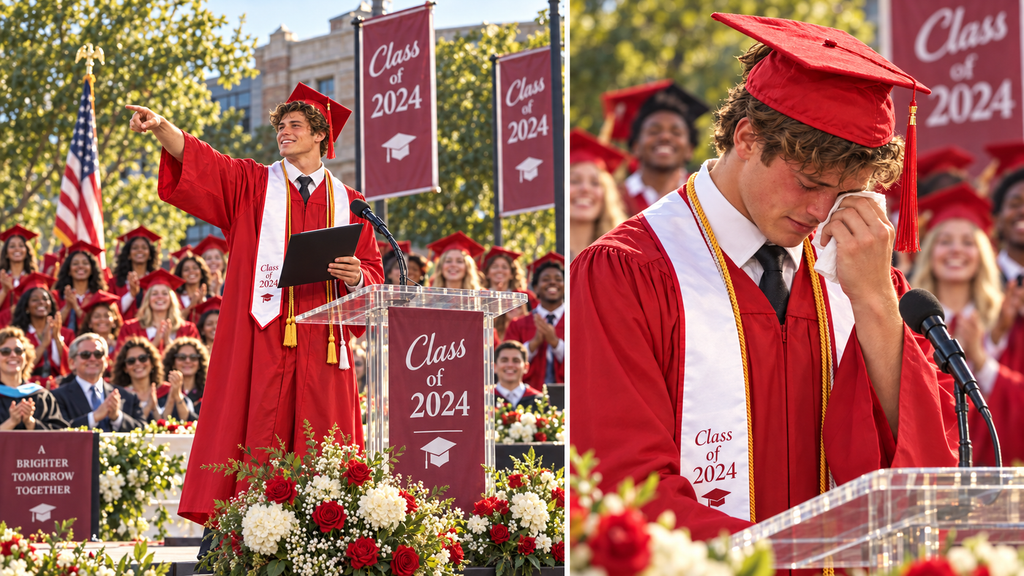
Ethan stood in front of me.
Still wearing that bright red dress.
Still surrounded by hundreds of people.
But the boy who had walked across that stage a few minutes earlier seemed different now.
Older.
Not because he had graduated.
Because suddenly, I understood that there were things my son had been carrying that I had never seen.
My fingers trembled as I touched the edge of the object.
It wasn’t jewelry.
It wasn’t a medal.
It wasn’t a note.
It was a school identification card.
The plastic had been scratched.
One corner was slightly cracked.
The picture was already beginning to fade.
But I would have recognized that face anywhere.
Dark brown eyes.
A crooked smile.
A tiny freckle beside the left eyebrow.
And underneath the photograph were the words:
EMMA HAYES
WILLOWCREST HIGH SCHOOL
CLASS OF 2026
My daughter.
Ethan’s twin sister.
The child who should have been sitting somewhere in that auditorium with us.
The child whose name should have been called only a few minutes after Ethan’s.
The child who had died eleven months earlier.
I stared at Emma’s face.
And the entire auditorium disappeared.
The whispering disappeared.
The laughter disappeared.
The stage lights disappeared.
For one terrible, beautiful second, I could almost hear her voice again.
“Mom, stop crying. You’re making your mascara look weird.”
That was exactly the kind of thing Emma would have said.
Even in the hospital.
Even when she was frightened.
Even when the rest of us couldn’t pretend anymore.
A sound came out of me.
Not quite a sob.
Not quite a word.
I pressed the card against my chest.
“Ethan…”
His mouth trembled.
That was when I saw the small strip of red thread tied through a hole punched into one corner of the card.
I knew that thread.
I had watched Emma cut it herself.
Eleven months earlier.
In a hospital room on the fourth floor of St. Matthew’s Children’s Center.
Suddenly, I remembered everything.
Not pieces.
Not fragments.
Everything.
And I finally understood the promise.
Not the version Ethan had told me.
The whole promise.
The one my children had made when they thought I was asleep.
Eleven months earlier, Emma had been seventeen years old and furious at everyone for treating her like she was dying.
Especially me.
She hated when nurses lowered their voices around her.
She hated when relatives showed up carrying flowers and wearing expressions that looked like apologies.
She hated when people started sentences with, “If there’s anything you need…”
Most of all, she hated pity.
“Mom,” she told me once, “if Aunt Carol brings me one more stuffed bear, I’m going to need another hospital room just for the bears.”
I laughed.
Then I cried in the bathroom where she couldn’t see me.
The truth was that by then, we all knew.
The leukemia had returned.
The first round of treatment had worked for a while.
Eight beautiful months.
Eight months when Emma went back to school.
Eight months when her hair began growing again.
Eight months when she argued with Ethan about the bathroom mirror, complained about homework, and rolled her eyes when her father reminded them to be home by eleven.
Eight months when we allowed ourselves to believe the nightmare had ended.
Then a routine blood test changed everything.
The cancer was back.
More aggressive.
Less responsive.
The doctors talked about options.
Clinical trials.
A different combination of drugs.
Another transplant.
Percentages.
Possibilities.
Risks.
I listened to every word while pretending numbers meant certainty.
Emma listened too.
But she understood before I did.
One night, after another long day of tests, she asked me to bring her laptop.
“What for?”
“I’m shopping.”
“For what?”
“My graduation dress.”
I stared at her.
Graduation was almost a year away.
She was lying in a hospital bed with an IV in her arm, her skin pale beneath the fluorescent lights.
“Sweetheart…”
“No.”
Her voice hardened immediately.
I knew that tone.
She had inherited it from me.
“Don’t do that.”
“Do what?”
“Make the sad face.”
“I’m not making a sad face.”
“You absolutely are.”
She opened the laptop.
“I am graduating next June, and I’m not wearing something ugly because you waited until the last minute.”
So we shopped.
For nearly two hours.
Emma rejected everything.
Too boring.
Too shiny.
Too old-lady.
Too bridesmaid.
Too much lace.
Too little fabric.
Finally, she found it.
Bright red.
Simple neckline.
Soft fabric.
A fitted waist.
The kind of dress that entered a room before the person wearing it.
I laughed when she showed it to me.
“That’s subtle.”
“Exactly.”
“Emma, everybody will be looking at you.”
“That’s generally the purpose of looking amazing.”
She grinned.
I bought it that night.
Neither of us said what we were both thinking.
Neither of us said:
Please still be here when it arrives.
Three days later, the package came to the hospital.
Emma insisted on trying it on.
The nurses helped disconnect what they could.
I helped her step into the dress.
It hung loosely from her shoulders because she’d lost so much weight.
But when she looked at herself in the mirror, something changed.
For the first time in weeks, I didn’t see a sick girl.
I saw my daughter.
My impossible, stubborn, dramatic daughter.
She turned slowly.
“What do you think?”
I swallowed.
“You look beautiful.”
“Obviously.”
“Ethan’s going to make fun of you.”
“Ethan wears the same hoodie four days in a row. His opinion is invalid.”
She laughed.
I laughed.
And then both of us started crying.
Emma reached for my hand.
“Hey.”
I looked down.
She squeezed my fingers.
“I’m going to wear it.”
I nodded.
“I know.”
“Say it.”
“You’re going to wear it.”
“At graduation.”
“At graduation.”
She smiled.
“Good.”
I carried that dress home a week later.
I hung it on the outside of her closet door.
And for months, none of us touched it.
Because touching it felt like admitting there might come a day when she wouldn’t.
That day came on October 14.
Rain had been tapping against the hospital window since before sunrise.
Emma had stopped asking what her blood counts were.
That was how I knew.
My daughter, who had memorized every number for nearly two years, didn’t ask anymore.
Her father, Daniel, stood beside the window for most of the morning.
He had barely spoken in two days.
Ethan sat in the chair beside her bed.
He was doing homework.
Or pretending to.
The twins had always been different.
Emma filled every silence.
Ethan respected silence.
Emma entered rooms like fireworks.
Ethan noticed details nobody else saw.
When they were five, Emma climbed the tallest tree in our backyard and got stuck.
Ethan stayed underneath for forty minutes telling her stories until Daniel got the ladder.
When they were nine, Ethan broke his wrist falling off his bicycle.
Emma punched the neighbor boy who laughed.
When they were thirteen, Emma got her first period during science class.
Ethan walked three blocks in the rain to bring her a sweatshirt without telling anyone why.
They fought constantly.
They protected each other constantly.
They were two halves of something I never fully understood because it belonged only to them.
That afternoon, Emma woke from a long sleep.
“E.”
Ethan looked up immediately.
Nobody called him E except her.
“Yeah?”
“Come here.”
He pulled his chair closer.
Emma glanced toward me.
“Mom.”
“I’m here.”
“I want a blue slushie.”
The hospital cafeteria didn’t sell blue slushies.
She knew that.
I think she also knew that if she asked, I would have walked to another state to find one.
Daniel stood up.
“I’ll go.”
“No.”
Emma shook her head.
“Mom.”
So I went.
I found one at a convenience store four blocks away.
It was raining hard by then.
I didn’t care.
I returned nearly thirty minutes later with my hair soaked and two blue slushies because I couldn’t decide which size she wanted.
Emma was sleeping.
Ethan was sitting beside her.
His eyes were red.
I thought he had been crying because of her condition.
I didn’t know they had spent those thirty minutes making a promise.
I didn’t know until graduation night.
I looked up at Ethan in that crowded auditorium.
“You had this with you?”
He nodded.
“All night?”
“Since we left the house.”
I touched the red thread.
“She tied this.”
Another nod.
My voice broke.
“That day at the hospital?”
His expression changed.
He knew I understood.
“Mom…”
“What did she make you promise?”
Ethan looked around.
People near us were no longer laughing.
The woman beside me had one hand covering her mouth.
The teenage boy behind us stared at Emma’s ID card.
Ethan lowered his voice.
“She didn’t make me.”
“What?”
“She asked me.”
“Asked you what?”
His eyes filled.
“To take her with me.”
My heart seemed to stop.
Ethan crouched beside my chair.
The red fabric gathered around his knees.
“That day you left to get the slushie, Emma asked me if I thought she was going to graduate.”
I closed my eyes.
Oh, God.
“Ethan…”
“I lied.”
A tear slipped down his cheek.
“I told her yes.”
I reached for him.
He kept speaking.
“She told me I was a terrible liar.”
Despite everything, a tiny laugh escaped me.
That sounded exactly like Emma.
Ethan smiled through his tears.
“Then she said she needed me to promise something.”
“What?”
“She said if she couldn’t walk at graduation, one of us still had to wear the red dress.”
I covered my mouth.
“And I told her absolutely not.”
Another broken smile.
“I told her she was insane.”
“What did she say?”
“She said, ‘You’ve got better shoulders for it anyway.'”
I laughed.
And sobbed at the same time.
Several people around us were crying now.
Ethan’s voice dropped lower.
“Then she gave me her school ID.”
He pointed toward the card in my hand.
“She had kept it in the bedside drawer.”
I looked down at Emma’s photograph.
“She used a pair of nail scissors to cut a thread from the inside hem of the dress.”
The red thread.
“She tied it through the card and said…”
Ethan stopped.
His face collapsed for the first time that night.
For seventeen years, I had watched my son cry.
When he scraped his knee.
When our dog died.
When Emma was diagnosed.
When Emma died.
But this was different.
This was grief that had been sealed shut for almost a year.
I put my hand against his cheek.
“What did she say, sweetheart?”
He took a shaky breath.
“She said, ‘Don’t let them graduate without me.'”
I broke.
Completely.
All the strength I’d forced myself to carry for eleven months disappeared.
I leaned forward and wrapped both arms around my son.
Ethan held me.
His shoulders shook.
The auditorium was silent.
Not the polite silence of a ceremony.
A real silence.
The kind that happens when hundreds of people suddenly realize they have misunderstood something.
Behind me, someone whispered:
“Oh my God.”
Another voice answered:
“That was his sister?”
“His twin.”
“I didn’t know.”
I did.
I knew every second of the life that should have been sitting beside Ethan that night.
And yet even I hadn’t known everything.
Emma died three days after making him that promise.
October 17.
4:11 in the morning.
Ethan was asleep with his head against the side of her bed.
Daniel stood beside me.
I held Emma’s hand.
There was no dramatic final sentence.
No speech.
No miracle.
Her breathing simply became quieter.
Then slower.
Then stopped.
For the first few seconds, I honestly believed the room itself had stopped.
There are moments in your life that divide everything into before and after.
That was ours.
Before October 17, I had two children.
After October 17, I still had two children.
But only one of them could come home with me.
Nobody prepares a mother for that.
Nobody tells you how cruel ordinary things become.
Two toothbrushes.
Two cereal bowls.
Two names on the family calendar.
Two sets of school pictures on the refrigerator.
Two bedrooms.
One suddenly silent.
For weeks, I kept expecting Emma to yell from upstairs.
I kept buying her favorite yogurt.
I kept leaving space beside Ethan at the dinner table.
Daniel couldn’t enter her bedroom at all.
I couldn’t close the door.
Ethan went in every night.
I discovered that months later.
He would sit on the floor beside her bed and do homework.
Sometimes he played music.
Sometimes he didn’t.
He never told us.
That was Ethan.
He carried things quietly.
And because he carried them quietly, we sometimes forgot how heavy they were.
The funeral nearly destroyed Daniel.
People assumed it destroyed me more because I cried more openly.
They were wrong.
Grief doesn’t have one shape.
Mine was visible.
Daniel’s became anger.
He hated the hospital.
He hated doctors.
He hated anyone who told him Emma was “in a better place.”
He hated himself for not being able to save her.
Most of all, he hated anything that reminded him the world had continued without her.
Christmas arrived.
Daniel refused to put up the tree.
I did it for Ethan.
Emma’s birthday arrived.
Daniel worked until midnight.
I made her favorite cake.
He couldn’t eat it.
Then graduation announcements began arriving.
That was when he got worse.
Every envelope felt like an insult.
Every photograph of smiling seniors felt like evidence of what had been taken from us.
Willowcrest High contacted us in January.
They wanted to include Emma’s photograph in the yearbook memorial page.
Daniel refused.
In February, they asked if we wanted her name included in the graduation program.
He said no.
“They don’t get to put her name in parentheses and call that closure.”
I understood his anger.
But Ethan didn’t.
One night I heard them arguing in the garage.
“She went to that school!” Ethan shouted.
“I know where she went.”
“She was part of our class.”
“Was.”
Silence.
Then Ethan said something I would never forget.
“Don’t say it like that.”
Daniel’s voice softened.
“Ethan…”
“Don’t say ‘was’ like she disappeared.”
“That isn’t what I meant.”
“Then stop trying to erase everything that hurts you.”
Daniel walked out.
He slept on the couch that night.
Neither of them apologized.
That was the distance growing between my husband and my son.
And somehow, caught between losing my daughter and trying not to lose my family, I kept convincing myself time would fix it.
Time didn’t.
Time simply carried us toward graduation.
Two weeks before the ceremony, I found Ethan sitting in the kitchen at 2:07 in the morning.
The red dress was folded on the table.
For months, it had remained inside Emma’s closet.
Daniel wouldn’t let me donate anything.
I couldn’t bring myself to.
So everything stayed exactly where she had left it.
The books.
The perfume.
The photographs.
The dress.
When I saw it lying in front of Ethan, I knew immediately.
“No.”
He didn’t even look surprised.
“Mom.”
“No.”
“I’m doing it.”
“Please don’t.”
He looked at me.
And I saw Emma in his expression.
That same impossible stubbornness.
“They’ll be cruel to you.”
“I know.”
“People will film you.”
“I know.”
“They’ll post it online.”
“I know.”
“Your father…”
“I know.”
I grabbed his hand.
“Then why?”
He looked down at the dress.
“Because I made a promise.”
I assumed I knew what he meant.
I assumed Emma had asked him to do something silly.
Something private.
I didn’t know about the ID card.
I didn’t know about the red thread.
I didn’t know she’d said:
Don’t let them graduate without me.
I only knew my son wanted to wear his dead twin sister’s bright red dress across a stage in front of hundreds of teenagers.
And I was terrified.
Not ashamed.
Never ashamed.
Terrified.
Teenagers could be merciless.
Adults could be worse.
I knew people would misunderstand.
I knew some would make jokes.
I knew strangers online might turn my son’s grief into entertainment.
“Ethan, you don’t have to prove you loved her.”
His eyes lifted.
“I’m not proving anything.”
“Then what are you doing?”
“Keeping my word.”
I wanted to stop him.
Every instinct inside me screamed to protect him.
But grief had already taught me one terrible lesson.
Love and protection are not always the same thing.
Sometimes protecting someone means standing between them and pain.
Sometimes it means standing beside them while they walk directly toward it because the thing waiting on the other side matters more.
So I stopped arguing.
Daniel didn’t.
When Daniel discovered the dress was gone from Emma’s closet, he came downstairs holding the empty hanger.
His face was white.
“Where is it?”
Nobody answered.
“Ethan.”
My son stood.
“I’m wearing it.”
Daniel stared at him.
“No.”
“It isn’t your decision.”
“That dress belonged to your sister.”
“I know.”
“You are not turning her into some spectacle.”
Ethan flinched.
“I’m not.”
“Do you have any idea what people will say?”
“Yes.”
“They’ll laugh.”
“Probably.”
“They’ll take pictures.”
“I know.”
“People who never knew her will turn this into some joke.”
Ethan’s jaw tightened.
“Then they can laugh.”
“I won’t.”
Daniel pointed at the dress.
“You put that back.”
“No.”
“Ethan.”
“No.”
Daniel’s voice rose.
“She is not a costume!”
The room went still.
I saw the moment the words hit Ethan.
His face changed.
Daniel saw it too.
But anger moved faster than regret.
Ethan spoke quietly.
“You’re right.”
For one second, I thought he was giving in.
Then he said:
“She’s my sister.”
Daniel closed his eyes.
“Ethan…”
“And she asked me.”
Daniel froze.
“Asked you what?”
Ethan looked away.
He almost told him.
I know that now.
But something stopped him.
Maybe Daniel’s anger.
Maybe his own.
Maybe the promise still felt too private.
“It doesn’t matter.”
“It clearly matters.”
“I’m wearing it.”
“If you walk into graduation dressed like that, I won’t be there.”
I stood up.
“Daniel.”
He didn’t look at me.
Ethan didn’t blink.
“Okay.”
“Don’t test me.”
“I’m not.”
“Then don’t expect me to sit there while hundreds of people turn your sister into a joke.”
Ethan’s eyes filled.
“They wouldn’t be turning her into a joke.”
Daniel walked out.
The door slammed.
And that was that.
Or so I thought.
Now, in the auditorium, Ethan was kneeling beside me while Emma’s school ID rested against my heart.
The woman next to me wiped her eyes.
She whispered:
“I’m sorry.”
I looked at her.
She had been laughing five minutes earlier.
I had seen her cover her mouth.
I had seen the smile.
For a moment, anger rose inside me.
I wanted to say something cruel.
I wanted her to feel ashamed.
Then I looked at Ethan.
He wasn’t angry.
He was exhausted.
I realized he hadn’t walked across the stage to punish anyone.
Not his classmates.
Not his father.
Not the school.
Not the strangers who laughed.
This wasn’t about them.
It had never been about them.
So I nodded.
“Thank you.”
Behind us, the ceremony had stopped.
I hadn’t even noticed.
The principal, Dr. Alvarez, was standing at the podium.
She had known Emma.
Everyone at Willowcrest had.
Emma was hard to miss.
Before she became the girl with leukemia, she had been the girl who talked too loudly during assemblies, organized ridiculous theme days, and somehow convinced three teachers to participate in a student talent show.
After she got sick, the school held blood drives.
Students wore red ribbons.
Teachers sent assignments to the hospital.
But eleven months is a long time in high school.
New gossip comes.
New relationships.
New problems.
Life keeps moving.
By graduation night, many people had trained themselves not to look at the empty place where Emma should have been.
Until Ethan walked across the stage wearing her dress.
Dr. Alvarez stepped away from the microphone.
“Ethan?”
He looked toward her.
She hesitated.
Then asked:
“Would you come back up here for a moment?”
Ethan immediately shook his head.
“No.”
Not loudly.
But I heard him.
He hadn’t planned a speech.
He didn’t want one.
Dr. Alvarez seemed to understand.
Instead of insisting, she walked down from the stage.
Hundreds of students watched.
She approached our row.
Ethan stood.
Dr. Alvarez looked at the ID card in my hand.
The second she saw Emma’s picture, her expression changed.
She touched her lips.
“Oh.”
Ethan swallowed.
Dr. Alvarez looked at the red thread.
“You carried her card?”
“Yes.”
“Across the stage?”
He nodded.
Dr. Alvarez’s eyes filled.
Then she did something I will remember for the rest of my life.
She didn’t take the microphone.
She didn’t make a speech about courage.
She didn’t turn my children into a lesson.
She simply placed one hand over her heart and said:
“Then Emma crossed too.”
Ethan closed his eyes.
That sentence broke whatever remained of his composure.
He cried.
Not quietly.
Not carefully.
He cried the way a seventeen-year-old boy cries when he has spent eleven months trying to be strong for everyone else.
I held him.
Dr. Alvarez held his shoulder.
The woman next to me cried.
The boy behind us cried.
And slowly, something began happening throughout the auditorium.
People stood.
At first, only one.
A teacher near the aisle.
Then another.
Then several students.
Within seconds, hundreds of people were rising to their feet.
There was no announcement.
Nobody instructed them.
They simply stood.
Not for the dress.
Not for Ethan’s bravery.
For Emma.
Someone started clapping.
Ethan stiffened.
Then more people joined.
The sound grew.
Rows of students who had laughed were now standing.
Parents who had whispered were wiping their faces.
Teachers were crying openly.
I looked toward the stage.
And for the first time that night, I could imagine Emma there.
Not sick.
Not pale.
Not lying beneath hospital blankets.
Seventeen.
Healthy.
Annoyingly confident.
Rolling her eyes because everybody was being too dramatic.
I could almost hear her.
“Took them long enough.”
I laughed through my tears.
Ethan looked at me.
“What?”
“Nothing.”
I pressed Emma’s ID into his hand.
“You keep this.”
He closed his fingers around it.
“No.”
“What?”
He placed it back in mine.
“She wanted you to have it after.”
“After what?”
“After we graduated.”
We.
Not I.
We.
That one word destroyed me all over again.
The ceremony eventually continued.
But it was different.
People were different.
Or maybe we were.
When Ethan returned to his seat, nobody laughed.
A girl named Sophie, who had known the twins since middle school, reached for his hand as he walked past.
Another boy touched Ethan’s shoulder.
Then someone in the student section began tying a red ribbon around his wrist.
I later discovered it had been part of a decoration from one of the graduation programs.
Within fifteen minutes, red strips appeared everywhere.
Around wrists.
Around fingers.
Tied to purse straps.
Looped through buttonholes.
It wasn’t organized.
It wasn’t perfect.
Emma would have loved that.
When the final student received her diploma, Dr. Alvarez returned to the microphone.
She looked down at her prepared remarks.
Then pushed them aside.
“There is one thing I need to correct.”
The auditorium became quiet.
“This graduating class began its high school journey with more students than are physically here with us tonight.”
My chest tightened.
Dr. Alvarez looked toward Ethan.
“Some moved away.”
She paused.
“Some took different paths.”
Another pause.
“And one young woman should have been seated among you.”
I grabbed Ethan’s hand from across the aisle.
Dr. Alvarez continued.
“Emma Hayes loved this school loudly.”
A ripple of soft laughter moved through the room.
That was true.
“She challenged teachers, annoyed administrators…”
More laughter.
“…and somehow convinced this principal that allowing seniors to wear pajamas for an entire school day was an essential educational experience.”
Even I laughed.
Dr. Alvarez smiled.
“Emma did not reach this stage in the way all of us hoped.”
Her voice trembled.
“But tonight, because of the promise between a brother and his sister, she crossed it anyway.”
Silence.
Then Ethan bowed his head.
Dr. Alvarez didn’t ask us to stand.
Didn’t ask for applause.
She simply said:
“Emma Hayes. Class of 2026.”
And hundreds of voices answered with applause.
This time, Ethan clapped too.
After the ceremony, chaos filled the lobby.
Families crowded together for photographs.
Graduates tossed caps.
Grandparents searched for grandchildren.
People shouted names across the room.
Ethan wanted to leave.
I could tell.
Too many people were approaching him.
“I’m sorry, man.”
“That was incredible.”
“I didn’t know.”
“Your sister was awesome.”
Some comments were sincere.
Some were awkward.
Some came from students who had laughed.
Ethan accepted all of them quietly.
Then a boy stepped in front of us.
Noah.
Ethan’s best friend.
Or former best friend.
He was holding his graduation cap in both hands.
For twelve years, Noah had been almost another child in our house.
He and Ethan met in kindergarten.
They built forts in our living room.
Played soccer badly.
Spent entire weekends gaming in Ethan’s room.
Emma teased both of them relentlessly.
After she died, Noah was one of the only people who could get Ethan out of the house.
Then two weeks before graduation, when rumors about the red dress spread, Noah stopped answering Ethan’s texts.
I’d watched what that did to my son.
Now Noah looked terrified.
“Ethan.”
My son stopped.
“What?”
Noah swallowed.
“I owe you an apology.”
Ethan said nothing.
“I knew why.”
That surprised me.
Ethan’s eyes narrowed.
“What do you mean?”
“You told me about the promise last year.”
“When?”
“At the lake.”
Ethan looked away.
Apparently, he’d forgotten.
Noah continued.
“When people started talking about the dress, I should’ve defended you.”
“Yeah.”
“I didn’t.”
“No.”
“I was scared they’d start on me too.”
Ethan finally looked at him.
Noah’s eyes were red.
“And that’s pathetic.”
Neither boy spoke.
Noah took a breath.
“I kept typing messages.”
He held up his phone.
“I wrote, like, twenty of them.”
“Then why didn’t you send one?”
“Because every version sounded like I was asking you not to do it.”
Ethan’s jaw tightened.
“And were you?”
“At first.”
The honesty surprised both of us.
Noah stared at the floor.
“Then tonight I saw you walk out there.”
He shook his head.
“I realized I couldn’t even handle people making jokes about my friend. You handled them making jokes about you because you loved Emma more than you cared what they thought.”
Ethan looked at him for a long time.
Noah wiped his face.
“I’m sorry.”
Ethan didn’t hug him.
Not immediately.
He said:
“You hurt me.”
“I know.”
“Emma would’ve called you an idiot.”
Noah laughed through tears.
“She called me worse.”
That made Ethan smile.
Then he hugged him.
It wasn’t a magical repair.
It didn’t erase what had happened.
But it was a beginning.
When we finally reached the parking lot, the night air felt almost cold after the crowded auditorium.
I expected to see Daniel’s car.
I don’t know why.
He had told us he wasn’t coming.
He had kept his word.
Part of me still hoped he might be waiting somewhere.
He wasn’t.
Ethan didn’t mention him.
That hurt more.
We drove home in silence.
The dress filled the passenger seat like a red flame.
Ethan had removed his shoes.
His feet hurt.
Halfway home, he suddenly said:
“Do you think Dad hates me?”
I nearly drove onto the shoulder.
“What?”
He stared out the window.
“Do you?”
“No.”
“Then why couldn’t he come?”
I gripped the steering wheel.
“Because your father is hurting.”
“So am I.”
“I know.”
“Then why does his pain get to hurt everybody else?”
I didn’t have an answer.
Not a good one.
Because Ethan was right.
Pain explains things.
It doesn’t excuse everything.
“I don’t know.”
He nodded.
We drove another mile.
Then he whispered:
“I wanted him there.”
That broke my heart.
“I know.”
“He didn’t even have to like the dress.”
“I know.”
“He just had to be there.”
I reached over and squeezed his hand.
“I know.”
When we pulled into our driveway, one light was on downstairs.
Daniel was home.
Ethan stared at the house.
“I’m tired.”
“You can go straight upstairs.”
He nodded.
I followed him inside.
Daniel was sitting at the kitchen table.
His laptop was open.
The graduation livestream was frozen on the screen.
The image showed Ethan onstage.
In the red dress.
Holding his diploma.
Ethan stopped.
Daniel looked up.
His eyes were swollen.
He had watched.
Maybe not from the auditorium.
But he’d watched.
Ethan’s expression hardened.
“You saw it?”
Daniel closed the laptop.
“Yes.”
“All of it?”
“Yes.”
“Good.”
Ethan started toward the stairs.
Daniel stood.
“Ethan.”
My son stopped but didn’t turn around.
“I was wrong.”
Silence.
Daniel took one step forward.
“I was completely wrong.”
Ethan slowly faced him.
His father looked smaller than I had ever seen him.
Daniel was a big man.
Six-foot-two.
Broad shoulders.
A voice that usually filled a room.
But grief had stripped something away from him.
“I thought…”
He stopped.
Tried again.
“I told myself I was protecting your sister.”
Ethan said nothing.
“I thought if people laughed at that dress, they were laughing at Emma.”
“They did laugh.”
Daniel nodded.
“I know.”
“So you were right.”
“No.”
Daniel’s voice cracked.
“Because I cared more about stopping them from laughing than I cared about standing beside you while they did.”
Ethan’s expression changed.
Daniel wiped his eyes.
“I should’ve been there.”
“Yeah.”
“I know.”
“No, Dad.”
Ethan’s voice rose.
“You don’t know.”
Daniel took the words without defending himself.
“I looked for you.”
That hurt even me.
“When I was waiting for my name, I looked for you.”
Daniel closed his eyes.
“I know.”
“You said you wouldn’t come, but I still looked.”
“I’m sorry.”
“You missed it.”
“I know.”
“You missed both of us.”
Daniel began crying.
I had seen my husband cry exactly three times.
The day Emma was born.
The day the doctor told us the leukemia had returned.
The morning she died.
This was the fourth.
“I know.”
Ethan’s anger cracked.
He looked away.
Daniel approached carefully.
“Your mother told me you made Emma a promise.”
Ethan didn’t respond.
“I didn’t understand what that meant.”
Daniel’s eyes moved toward the red dress.
“I couldn’t look at that dress without seeing her in the hospital.”
His voice shook.
“Every time I opened her closet, I saw all the things she never got to do.”
College.
Birthdays.
Marriage.
Children.
Life.
“I saw that dress and thought about the fact that she never got to wear it.”
Daniel looked at Ethan.
“You saw it and thought about the promise she asked you to keep.”
Ethan swallowed.
“She wanted to graduate.”
“I know.”
“No.”
Ethan shook his head.
“I don’t think you do.”
Then he reached into the hidden pocket.
For a moment, I thought it was empty.
But Ethan pulled out another folded piece of paper.
I stared at him.
“What is that?”
He looked at me.
“The other thing she gave me.”
My breath caught.
“Ethan.”
He unfolded it.
The paper was worn soft from being opened many times.
Daniel didn’t move.
“What is it?”
“A note.”
“From Emma?”
Ethan nodded.
“Why didn’t you tell us?”
“Because she said not to give it to you until graduation.”
Daniel’s face changed.
“To me?”
“To both of you.”
I covered my mouth.
Ethan held the paper out.
Neither Daniel nor I reached for it.
Finally, Daniel whispered:
“Read it.”
Ethan stared at the page.
Then began.
“Mom and Dad,
If E is reading this to you, that means one of two things.
Either I am standing beside him threatening him until he reads it correctly, or things didn’t work out the way we wanted.”
Ethan stopped.
His lips trembled.
I laughed through my tears.
Of course.
Of course Emma had written it like that.
He continued.
“First, Mom, you were right about the red dress.
It is too expensive.
Do not get excited. I am only admitting that because I might not have to hear you say ‘I told you so.'”
I cried harder.
Daniel smiled.
Barely.
But he smiled.
“Second, Dad, if you canceled the streaming subscriptions after I left, I am haunting you.
E knows the passwords.
Don’t make him pay for everything.”
Daniel covered his face.
Ethan waited.
Then continued.
“Now for the important part.
I know everyone is going to be sad.
I am sad too.
I am actually terrified.
But please don’t turn the rest of your lives into a funeral.
That would make me furious.”
My knees weakened.
I pulled out a chair and sat.
Ethan’s voice shook.
“Mom, keep putting too much cinnamon in French toast.
Dad, keep making terrible jokes when nobody wants to hear them.
And please take care of E.
He’s going to pretend he’s okay.
He’s good at that.
Don’t believe him.”
Ethan stopped reading.
He stared at the page.
Daniel looked at our son.
Something passed between them.
Regret.
Understanding.
Love.
All of it.
Ethan read the next line.
“And E,
if you’re reading this part out loud, I told you not to.
Skip it.”
He laughed.
So did I.
Then Ethan whispered:
“I’m reading it anyway.”
He continued.
“You are my favorite person.
Don’t tell Mom and Dad because they’ll get jealous.
You were my first friend.
You are the only person who remembers everything I remember.
You remember when we buried Dad’s car keys in the sandbox.
You remember the purple popsicles at Grandma’s.
You remember the night we stayed awake until sunrise because we thought there was a ghost in the hallway.
You remember me before hospitals.
That’s important.
Please remember me before hospitals.”
Daniel bowed his head.
I couldn’t see the paper anymore through my tears.
Ethan continued.
“I don’t want my whole story to become cancer.
I was here before cancer.
I was annoying before cancer.
I was loud before cancer.
I was awesome before cancer.”
Ethan smiled.
“Accurate.”
He cleared his throat.
“Graduate for both of us.
Wear the dress if you have the guts.
Take my ID with you.
And if people laugh, let them.
They don’t know what it means.
You do.”
Silence.
Ethan looked at his father.
Then read the final lines.
“Mom.
Dad.
E.
I love you.
Don’t spend so much time missing me that you miss each other.
That would be the stupidest thing any of you could do.
Love,
Emma.
P.S. The dress looks better on me.”
Nobody spoke.
The refrigerator hummed.
A car passed outside.
Somewhere down the street, people were celebrating another graduate.
Daniel sank into the chair opposite me.
For eleven months, our family had been slowly breaking apart because each of us was trying to survive Emma’s death alone.
And Emma, somehow, had known.
Don’t spend so much time missing me that you miss each other.
Daniel reached across the table.
Not toward me.
Toward Ethan.
“I’m sorry.”
Ethan stared at his father’s hand.
Daniel didn’t pull it back.
“I’m sorry I wasn’t there tonight.”
Ethan’s eyes filled again.
“I’m sorry I made you think there was anything you could wear or do that would make me stop loving you.”
That did it.
Ethan grabbed his father’s hand.
Daniel stood.
Then father and son collided.
Not a careful hug.
Not polite forgiveness.
They held each other like both had been drowning.
Daniel buried his face against Ethan’s shoulder.
“I’m sorry.”
“I know.”
“I should have been there.”
“I know.”
“I wish I could change it.”
“I know.”
Then Ethan whispered something I almost didn’t hear.
“I needed you.”
Daniel’s knees seemed to buckle.
“I know.”
Ethan held him tighter.
And finally, for the first time since Emma died, the three of us cried together.
Not in separate rooms.
Not behind closed doors.
Together.
Later that night, after Ethan went upstairs, Daniel and I sat in the kitchen.
The red dress hung over a chair.
Emma’s letter lay between us.
Neither of us touched it.
Daniel stared at the fabric.
“I failed him.”
“You made a terrible mistake.”
He looked at me.
“That’s a gentle way of saying it.”
“I’m not trying to be gentle.”
I took a breath.
“You failed him tonight.”
Daniel lowered his eyes.
“But you don’t have to keep failing him tomorrow.”
He looked toward the stairs.
“I don’t know how to do this.”
“Neither do I.”
“I thought I had to be strong.”
“So did Ethan.”
Daniel covered his face.
“I told him not to turn Emma into a spectacle.”
“I know.”
“I missed my son’s graduation because I was afraid strangers might laugh.”
“I know.”
“And they laughed anyway.”
“Yes.”
He closed his eyes.
“God.”
I reached across the table.
“Daniel.”
He looked at me.
“Grief doesn’t give us permission to abandon the people who are still here.”
He nodded slowly.
“I know that now.”
“So do something with it.”
“I will.”
And he did.
The next morning, Ethan came downstairs around eleven.
Still half asleep.
Hair pointing in six directions.
Wearing one of his old gray T-shirts.
For one strange second, everything looked normal.
Then he noticed Daniel standing at the stove.
His father was attempting to make French toast.
Too much cinnamon.
Way too much.
Ethan looked at me.
I said nothing.
Daniel turned.
“Breakfast?”
Ethan stared at the blackened bread.
“Is it supposed to be that color?”
Daniel looked at the pan.
“Probably not.”
Ethan sat down.
I poured coffee.
Nobody said anything about the previous night.
Not immediately.
Sometimes reconciliation doesn’t begin with speeches.
Sometimes it begins with burnt French toast.
Halfway through breakfast, Daniel cleared his throat.
“Ethan.”
“Yeah?”
“I want to go see Emma today.”
Ethan stopped chewing.
“We haven’t gone together in a while.”
That was true.
Daniel usually went alone.
So did I.
So did Ethan.
Three people visiting the same grave separately.
Ethan nodded.
“Okay.”
Daniel glanced toward the living room where the red dress had been carefully folded.
“Would you bring the dress?”
Ethan looked surprised.
“Why?”
Daniel swallowed.
“Because I think I owe your sister an apology too.”
That afternoon, we drove to Greenlawn Cemetery.
The sky was impossibly blue.
Emma would have complained about the heat.
Her grave was beneath a maple tree near the eastern fence.
EMMA ROSE HAYES
BELOVED DAUGHTER, SISTER, FRIEND
2008–2025
Someone had left fresh flowers.
Probably Sophie.
There were three red ribbons tied around the vase.
Ethan carried the dress over his arm.
Daniel stood in front of Emma’s headstone.
For a long time, he said nothing.
Then:
“Hey, Em.”
My throat tightened.
Daniel crouched.
“I messed up.”
Ethan looked away.
“I know you’re probably enjoying that sentence.”
A breeze moved through the branches.
Daniel laughed softly.
“I missed graduation.”
His voice cracked.
“Ethan kept his promise.”
He looked at our son.
“I didn’t keep mine.”
Ethan frowned.
“What promise?”
Daniel looked back at Emma’s name.
“The one I made the day you two were born.”
My heart stopped.
Daniel touched the headstone.
“I promised I’d always show up.”
Tears rolled down his cheeks.
“I couldn’t save you.”
He inhaled shakily.
“And somewhere along the way, I started acting like losing you gave me permission to disappear from everyone else.”
Ethan knelt beside him.
Daniel continued.
“I’m sorry.”
Then he laughed.
“And for the record, you were wrong.”
Ethan looked confused.
Daniel nodded toward the red dress.
“It looked pretty good on your brother.”
Ethan laughed.
A real laugh.
Loud enough that birds flew from the tree above us.
And for the first time, laughter beside Emma’s grave didn’t feel wrong.
It felt necessary.
By Monday morning, the video had spread online.
I wish I could say nobody posted it.
Of course they did.
Someone filmed Ethan crossing the stage.
Another video showed him kneeling beside me.
A third captured the standing ovation.
At first, the captions were exactly what I’d feared.
“Guy wears red dress to graduation.”
“Wildest graduation ever.”
“What is happening at Willowcrest?”
Then someone who knew our family explained.
His twin sister died.
The dress was hers.
He promised her.
He carried her school ID.
The tone changed almost instantly.
People deleted cruel comments.
Others apologized.
Thousands of strangers shared the story.
Some called Ethan brave.
Some called him inspirational.
Some tried to turn him into an argument about things that had absolutely nothing to do with Emma.
Ethan hated that part.
“Why does everybody have to make everything into something else?”
I was sitting beside him on the couch while he scrolled.
“Because strangers like simple stories.”
“Ours isn’t simple.”
“No.”
He put the phone down.
“I don’t want to be famous.”
“You aren’t famous.”
“My video has four million views.”
“Temporarily internet famous.”
“That is worse.”
I laughed.
He didn’t.
Then he looked at me.
“Can we not talk to reporters?”
Three local stations had already called.
“Absolutely.”
“And no morning shows.”
“Definitely.”
“And if anybody offers me a book deal, tell them I’m illiterate.”
I laughed.
“Ethan.”
“I’m serious.”
“What do you want people to know?”
He thought for a moment.
Then said:
“Her name.”
“Emma?”
“Yeah.”
He looked toward the framed photograph on the mantel.
“If they’re going to share the video, I just want them to know her name.”
So that was all we posted.
One photograph.
Emma laughing beside Ethan at sixteen.
And underneath it:
Her name was Emma Hayes.
She was more than the girl who died.
She was a daughter, sister, student, terrible singer, excellent friend, ruthless Monopoly player, and the funniest person we knew.
Her brother made her a promise.
He kept it.
That was enough.
Three days later, a package arrived from Willowcrest High.
Inside was a graduation program.
One of the original programs.
Beside Ethan’s name, someone had handwritten another.
Emma Hayes.
Class of 2026.
There was also a letter from Dr. Alvarez.
She explained that several members of the graduating class had asked the school to establish an annual scholarship.
Not in Ethan’s name.
Not for “courage.”
In Emma’s.
The Emma Hayes Memorial Scholarship would go each year to a graduating student who had missed significant school because of serious illness or family hardship but continued working toward graduation.
I read the letter twice.
Then handed it to Ethan.
He stared at it.
“What do you think?”
He didn’t answer immediately.
Then:
“She’d complain that they used her middle name on the form.”
I laughed.
“Probably.”
“And she’d want to pick the winner.”
“Definitely.”
He looked at the letter again.
Then smiled.
“She’d like it.”
We accepted.
The weeks after graduation were strange.
For the first time, there was no school schedule controlling our lives.
No appointments for Emma.
No graduation deadline.
No next thing we had to survive.
Ethan had been accepted to State University.
He planned to study architecture.
Emma had once told him architects just “draw houses and pretend it’s math.”
He still had the text message.
He showed it to me when we started packing for college.
His room was chaos.
Boxes.
Clothes.
Books.
Three years of old notebooks.
One disgusting gym bag I wanted to burn.
At the back of his closet, we found a shoebox.
Inside were dozens of things belonging to Emma.
Movie tickets.
Bracelets.
A broken pair of sunglasses.
A birthday card.
Photographs.
“What is all this?”
Ethan sat on the floor.
“Stuff she gave me.”
“You kept everything?”
“Pretty much.”
I picked up a tiny plastic dinosaur.
“What is this?”
“Third grade.”
“Meaning?”
“No idea.”
We laughed.
Then I found another photograph.
The twins were seven.
Standing beneath a sprinkler.
Emma wore a red swimsuit.
Ethan was missing a front tooth.
On the back, in my handwriting:
MY TWO TROUBLEMAKERS.
I sat beside him.
“Can I ask you something?”
“Sure.”
“Why didn’t you tell me the whole promise?”
He looked down.
“I almost did.”
“When?”
“That night in the kitchen.”
“Why didn’t you?”
He thought for a long time.
“Because if I said exactly what she asked me to do, I was afraid you’d talk me out of it.”
“I might have tried.”
“I know.”
“Would you have listened?”
“No.”
I smiled.
“Then you could’ve told me.”
He smiled too.
Then his face became serious.
“There was another reason.”
“What?”
“I wanted one thing that was just mine and Emma’s.”
That hurt.
But I understood.
Not everything between siblings belongs to parents.
Even when we desperately wish it did.
I nodded.
“That’s fair.”
He looked at me.
“You aren’t mad?”
“No.”
“Really?”
“Really.”
I touched the old photograph.
“Your sister belonged to all of us differently.”
Ethan nodded.
“Yeah.”
“And you had her before anybody else did.”
He smiled.
“By seven minutes.”
“Seven minutes she never let you forget.”
“Never.”
He picked up the photograph.
“She always said she was older and wiser.”
“She was half right.”
He laughed.
In August, we took Ethan to college.
Daniel drove.
I sat in the passenger seat surrounded by pillows and storage boxes.
Ethan sat in the back complaining that we had brought too much.
“You don’t need four blankets,” he said.
“You get cold.”
“I have heating.”
“Heating breaks.”
“Mom.”
“And you need the first-aid kit.”
“There is a campus health center.”
“What if it’s closed?”
“Then I apparently die from a paper cut.”
Daniel laughed.
For a few minutes, we were just a family taking our child to college.
Then I looked out the window and felt the familiar ache.
Emma should have been coming too.
Maybe not to the same college.
She wanted New York.
Or California.
Or Paris, depending on which week you’d asked her.
There should have been two cars.
Twice the boxes.
Twice the arguments.
I turned toward the window so Ethan wouldn’t see me cry.
But he saw.
He leaned forward between the seats.
“Mom.”
“I’m okay.”
“No, you’re doing the thing.”
“What thing?”
“The window stare.”
“I don’t have a window stare.”
“You absolutely have a window stare.”
Daniel looked at me.
“What are you thinking about?”
I didn’t lie.
“Your sister.”
Ethan nodded.
“Me too.”
That was new.
We had spent so long protecting each other from Emma’s name.
Now we said it.
We allowed it to hurt.
We allowed it to make us smile.
Both things could exist at once.
When we reached Ethan’s dorm, he opened one suitcase.
The red dress was inside.
I stared.
“You brought it?”
He shrugged.
“I didn’t know where else to put it.”
“You don’t have to take it.”
“I know.”
“Are you sure?”
He lifted the fabric carefully.
For months, I had thought the dress belonged in Emma’s room.
A museum piece.
Something sacred.
But Emma had never wanted us to build a shrine.
She wanted life.
Messy, loud, inconvenient life.
Ethan hung the dress in the back of his new closet.
Beside hoodies and button-down shirts.
It looked completely out of place.
Which made it perfect.
Daniel stood beside me.
“Think he’ll ever wear it again?”
I smiled.
“I hope he never has to.”
Ethan heard us.
“Absolutely not.”
Daniel laughed.
“Once was enough?”
“More than enough.”
Ethan touched the pocket where Emma’s school ID had rested.
Then looked at us.
“But I’m keeping it.”
“Good,” I said.
Before we left, Ethan handed me something.
Emma’s ID card.
I shook my head.
“I told you to keep this.”
“No.”
“Why?”
“Because the promise is finished.”
I stared at the faded photograph.
“Are you sure?”
He nodded.
“She crossed.”
Two words.
She crossed.
I pressed my lips together.
“Okay.”
“But don’t put it in a drawer.”
“I won’t.”
“And don’t do anything weird like sleep with it.”
“Ethan.”
“I’m just establishing boundaries.”
I laughed.
Then hugged him.
Longer than he wanted.
“Mom.”
“Thirty more seconds.”
“You’re counting?”
“Twenty-nine.”
He groaned but hugged me tighter.
At home, I knew exactly what to do with the card.
I bought a large shadow box.
Not fancy.
Simple wood.
Inside, I placed Ethan’s graduation photograph.
The one where he stood in the bright red dress holding his diploma.
Beside it, I placed Emma’s senior-year school photograph.
She had taken it only weeks before the cancer returned.
Underneath both photographs, I placed her school ID.
The red thread remained attached.
At the bottom, I added a copy of the final line from her letter.
DON’T SPEND SO MUCH TIME MISSING ME THAT YOU MISS EACH OTHER.
Daniel hung the shadow box in the hallway.
Not in Emma’s room.
Not hidden somewhere private.
In the middle of our home.
Where we passed it every day.
Months later, Daniel and I attended the first meeting for Emma’s scholarship.
No reporters.
No viral videos.
Just teachers, parents, and students sitting around a library table deciding how to help someone else.
Ethan joined by video call from college.
He looked exhausted.
There were architectural drawings taped to the wall behind him.
Dr. Alvarez asked whether he wanted to say anything.
Ethan shook his head.
Then changed his mind.
“Actually…”
Everyone waited.
He leaned closer to the camera.
“My sister would hate that we’re all sitting around being serious.”
People laughed.
“So just make sure whoever gets the scholarship actually needs it.”
He paused.
“And maybe give them enough money to buy a ridiculous graduation outfit.”
More laughter.
I watched my son’s face on the screen.
For the first time, I saw something I hadn’t seen since Emma died.
Peace.
Not the kind people write about in sympathy cards.
Not closure.
I don’t believe in closure anymore.
You don’t close a person you loved.
You carry them differently.
That was what Ethan had understood before the rest of us.
You don’t move on from love.
You move forward with it.
A year after graduation, we returned to Willowcrest.
The new graduating class filled the same auditorium.
Daniel sat beside me this time.
Ethan had come home from college for the weekend.
He sat on my other side.
The auditorium looked exactly the same.
Same stage.
Same curtains.
Same uncomfortable chairs.
For a moment, I could see everything from the year before.
Ethan walking toward the stage.
The bright red dress.
The laughter.
The whispers.
The ID card in my hand.
My son’s face as he said:
She asked me to take her with me.
Then Dr. Alvarez approached the microphone.
She announced the first recipient of the Emma Hayes Memorial Scholarship.
A girl named Lily Chen.
Lily had spent most of her junior year caring for her mother during chemotherapy while keeping up with school.
She planned to study nursing.
When Lily walked onto the stage, she wore a small red ribbon around her wrist.
I covered my mouth.
Daniel reached for my hand.
Ethan whispered:
“Did you know about that?”
I shook my head.
Lily accepted the scholarship.
Then Dr. Alvarez pointed toward our family.
The audience applauded.
I expected Ethan to look uncomfortable.
Instead, he smiled.
And for a second, the empty seat inside me didn’t feel quite so empty.
Afterward, we visited Emma.
We brought Lily’s scholarship program.
Ethan placed it beside the headstone.
“Hey, Em.”
He sat cross-legged in the grass.
“Your scholarship kid seems cool.”
Daniel added:
“She wants to be a nurse.”
“Which means she’s smarter than Ethan.”
“Dad.”
“What?”
“I’m studying architecture.”
“Exactly.”
I laughed.
Ethan looked at the headstone.
“You’d hate my haircut.”
A breeze moved through the maple tree.
We stayed for almost an hour.
Talking.
Laughing.
Remembering.
Before we left, Ethan pulled a tiny piece of red thread from his pocket.
I stared at him.
“Where did you get that?”
“The dress.”
“You cut it?”
“Relax. From the inside hem.”
I smiled through sudden tears.
Just like Emma.
He tied the thread around one of the stems in the flower vase.
Then he stood.
“What was that for?”
Ethan looked at his sister’s name.
“No reason.”
But I knew.
Promises don’t always need words.
People sometimes ask me about graduation night.
They usually say:
“That must have been so hard.”
It was.
They say:
“You must have been proud of Ethan.”
I was.
They ask:
“Didn’t it bother you that people laughed?”
Yes.
Of course it did.
I wanted to stand up and scream at every person who laughed.
I wanted to tell them they knew nothing about the boy they were judging.
But I’ve thought about that night many times since.
And I’ve realized something.
Those people weren’t the most important part of the story.
The laughter wasn’t the point.
The dress wasn’t even the point.
The promise was.
A seventeen-year-old girl lying in a hospital bed knew she might never reach graduation.
She knew her parents might drown in grief.
She knew her twin brother would pretend he was stronger than he was.
And somehow, in the middle of her own fear, she left us instructions.
Keep living.
Keep laughing.
Take care of each other.
Remember who I was before I got sick.
And don’t let them graduate without me.
Ethan did exactly what she asked.
He put on the red dress.
He placed Emma’s school ID in the hidden pocket.
He tied the thread she had cut from the hem.
And while hundreds of people watched, he walked.
People laughed.
He kept walking.
Someone insulted him.
He kept walking.
His father wasn’t there.
He kept walking.
His best friend had abandoned him.
He kept walking.
Because sometimes courage doesn’t look like winning a fight.
Sometimes it looks like refusing to stop.
Sometimes love asks you to cross a room while everyone misunderstands you.
Sometimes keeping a promise means allowing people to laugh because explaining yourself would make the promise belong to them.
Ethan never needed those six hundred people to understand.
He only needed Emma to know.
And somehow, I believe she did.
I still have her school ID.
The photograph has faded a little more.
The crack in the corner is still there.
So is the thread.
Sometimes I stop in the hallway and look at it.
I see Emma at seventeen.
Then I look beside it.
Ethan.
Same dark eyes.
Same crooked smile.
Wearing the loudest red dress I have ever seen.
Holding his diploma.
For a long time after Emma died, I thought grief meant counting everything we had lost.
Her eighteenth birthday.
College.
Graduation.
The first apartment.
The career.
The wedding she might have had.
The children she might have raised.
All the photographs that would never be taken.
Grief is partly that.
But it is also learning to see what remains.
A joke.
A letter.
A red thread.
A brother who remembers.
A father who finally learned that avoiding pain isn’t the same as surviving it.
A mother who learned she could say her daughter’s name without falling apart every single time.
A scholarship.
A promise.
A bright red dress hanging in a college closet hundreds of miles away.
Two years after graduation, Ethan came home for Christmas.
He was taller somehow.
Or maybe college had changed the way he carried himself.
Daniel and I were decorating the tree when he walked in.
He dropped his backpack.
“Please tell me there’s food.”
“Hello to you too.”
“Hi, Mom. I love you. Where’s the food?”
Daniel shouted from the kitchen:
“Your standards are too high.”
Ethan smiled.
Then he walked into the hallway.
He stopped in front of the shadow box.
I watched him.
He touched Emma’s photograph.
Just once.
“Hey, E,” I said.
He looked at me.
Nobody called him that anymore.
I hadn’t done it intentionally.
The name simply escaped.
For a moment, his eyes widened.
Then he smiled.
“Yeah?”
“Dinner’s almost ready.”
“Okay.”
He looked at Emma’s photograph one more time.
Then joined us.
That was life after loss.
Not forgetting.
Not healing into the people we were before.
We would never be those people again.
It was learning how to leave the hallway and walk into the kitchen.
Learning how to eat dinner.
Learning how to laugh.
Learning how to celebrate the child in front of you without feeling that doing so betrays the child who isn’t.
Learning that love doesn’t divide.
It expands around the empty chair.
That Christmas, Daniel brought down a box from the attic.
Inside were decorations we hadn’t used since Emma died.
Her ornaments.
A glitter-covered reindeer she’d made in second grade.
A horribly painted snowman from kindergarten.
A red glass heart she’d bought when she was fourteen.
Daniel held it.
“You want to put this one up?”
Ethan took it.
He walked toward the tree.
For almost a minute, he searched for the right branch.
Then he hung it near the top.
“Too high,” I said automatically.
Emma had been short.
She always complained we hung ornaments where she couldn’t reach.
Ethan smiled.
“Exactly.”
I laughed.
Then Daniel did.
And we stood there together looking at the ridiculous red heart.
It hurt.
It was beautiful.
Those two things were no longer opposites.
Years from now, the dress will probably fade.
The school ID may become too fragile to touch.
The red thread may finally break.
The graduation video will disappear beneath millions of newer videos.
Most of the people who sat in that auditorium will forget the details.
They’ll forget what Ethan’s diploma looked like.
They’ll forget who sat beside them.
They may even forget the boy in the red dress.
But I won’t.
I will remember exactly how he looked walking down that aisle toward me.
His face pale.
His eyes shining.
His hands trembling even though he tried to hide it.
I will remember him stopping in front of my seat.
I will remember the hidden pocket.
The tissue paper.
Emma’s faded photograph.
And the words:
“This is for you, Mom.”
Then:
“And for both of us.”
At first, I thought he meant him and me.
I didn’t understand.
Now I do.
He meant the twins.
Ethan and Emma.
The two babies I’d brought home from the hospital seventeen years earlier.
The two children who had shared birthdays, secrets, punishments, holidays, jokes, fights, dreams and memories.
The two children I thought death had separated.
But love had found a way to carry both of them across that stage.
The night before Ethan left after that Christmas visit, I found him asleep on the couch.
The television was still on.
A blanket had fallen onto the floor.
I bent down to pick it up.
Something slipped from the pocket of his jacket.
A small photograph.
I picked it up.
It was one I’d never seen.
Emma and Ethan were sitting on the hospital roof terrace.
Both were sixteen.
Emma had a knit cap over her bald head.
Ethan had his arm around her.
Neither was looking at the camera.
They were looking at each other.
Laughing.
On the back, in Emma’s handwriting, were five words:
SEE YOU AT GRADUATION, LOSER.
I sat on the edge of the couch.
I stared at those words for a long time.
Then I kissed Ethan’s forehead.
He stirred.
“Mom?”
“Go back to sleep.”
“What time is it?”
“Late.”
He closed his eyes.
I placed the photograph carefully back into his jacket.
Then I looked toward the hallway.
Toward the shadow box.
Toward the red thread.
And for the first time, I understood exactly what Emma had been trying to tell all of us.
Death had taken her future.
It had taken her voice.
It had taken the graduation she deserved.
But it had not taken her place in our family.
That place was not something death had the authority to remove.
So whenever somebody tells me about that night and says:
“I can’t believe your son had the courage to wear that dress.”
I tell them something different.
The courageous part wasn’t wearing it.
The courageous part was loving someone enough to keep a promise after they were gone.
The courageous part was walking while people laughed.
The courageous part was grieving without hiding.
The courageous part was allowing the world to misunderstand him for a few minutes because his sister had waited eleven months for that walk.
And when people ask me whether Ethan regrets it, I always give them the same answer.
No.
Not once.
Because when six hundred people laughed, he kept walking.
When one person shouted something cruel, he kept walking.
When he couldn’t find his father in the audience, he kept walking.
When he reached the end of the stage, he didn’t turn toward the cameras.
He came straight to me.
And he placed his sister’s school ID in my hand.
Only then did I understand.
The bright red dress had never been about making a statement.
It had never been rebellion.
It had never been attention.
It was transportation.
A promise.
A way for one twin to carry the other through a moment she had fought desperately to reach.
Sometimes late at night, when the house is quiet, I still think about the thirty minutes I spent searching for that blue slushie.
For years, part of me hated those thirty minutes.
Because that was when Emma and Ethan had their conversation.
That was when she admitted to him what she couldn’t admit to me.
That she was afraid she wouldn’t make it.
Sometimes I wondered whether I should have been there.
Whether I should have heard those words.
Whether I should have held her.
But now I think Emma needed that time with her brother.
She needed to be something other than my dying daughter.
With Ethan, she was simply Emma.
His annoying twin.
His best friend.
The girl who could tell him to wear a red dress to graduation and somehow know he actually would.
That conversation belonged to them.
And I am grateful it did.
On Emma’s twenty-first birthday, Ethan called me from his apartment.
He was finishing college.
“Mom.”
“What’s wrong?”
Nothing good ever begins with your adult child calling at midnight.
“Nothing.”
“Then why are you calling?”
He laughed.
“Relax.”
“I gave birth to you. I don’t relax.”
“I know.”
There was a pause.
Then he said:
“I wore the dress.”
I sat upright.
“What?”
“Not outside.”
“Thank God.”
“Wow. Supportive.”
“Ethan.”
He laughed.
“I was cleaning out my closet. I found it.”
My throat tightened.
“And?”
“It barely fits.”
“You’re taller.”
“And wider.”
“That’s called adulthood.”
“Anyway…”
He became quiet.
“I put it on.”
I didn’t speak.
“For like thirty seconds.”
“Why?”
Another pause.
“Today’s her birthday.”
I looked at the clock.
12:08 a.m.
Technically, Emma’s birthday had just begun.
“And I guess I wanted to remember.”
“Remember what?”
“What it felt like.”
My eyes filled.
“Did it help?”
“Not really.”
I smiled.
“Then why are you laughing?”
“Because I looked ridiculous.”
I laughed too.
Then Ethan said:
“She would’ve loved that.”
“Yes.”
“Mom?”
“Yeah?”
“Do you ever worry you’ll forget what her voice sounded like?”
My laughter disappeared.
“Yes.”
“Me too.”
I closed my eyes.
“Then we’ll remind each other.”
He was quiet.
“Okay.”
“And Ethan?”
“Yeah?”
“Happy birthday.”
There was a pause.
The twins had always shared the same birthday.
After Emma died, celebrating Ethan’s birthday became complicated.
He felt guilty.
We felt guilty for being happy.
That year, for the first time, he simply said:
“Thanks, Mom.”
Then:
“Happy birthday to her too.”
We stayed on the phone until almost two in the morning.
Talking about nothing.
Talking about everything.
Talking about Emma.
Keeping her voice alive between us.
I no longer wish Ethan had chosen something easier for graduation.
For a while, I did.
I wished he had carried a photograph.
Worn a red tie.
Pinned a ribbon to his jacket.
Something quiet.
Something nobody could laugh at.
Something safe.
But safe would not have been Emma.
Emma was bright red.
Emma was inconvenient.
Emma was dramatic.
Emma was impossible to ignore.
Of course her final request involved a dress that made six hundred people stare.
Of course it did.
And of course the one person willing to do it was her brother.
On the fifth anniversary of her death, our entire family returned to Greenlawn.
Daniel brought flowers.
I brought Emma’s favorite cinnamon cookies.
Ethan brought nothing.
At least, I thought he brought nothing.
After we’d been there awhile, he reached into his coat.
He pulled out the graduation photograph.
The one of him in the dress.
He leaned it against the headstone.
“Five years,” he said.
Daniel put a hand on his shoulder.
Ethan smiled.
“I still think I wore it better.”
I gasped.
“Your sister is going to haunt you.”
“She already does.”
Daniel laughed.
Then Ethan became quiet.
“I kept it, Em.”
Nobody needed to ask what he meant.
The promise.
“I got you across.”
Wind moved through the maple branches.
A single red leaf fell onto the grass between us.
I know what logic says.
I know trees lose leaves.
I know wind blows.
I know grief makes people search for meaning in ordinary things.
But I picked up that leaf anyway.
And I kept it.
Today it sits beside Emma’s school ID.
The red has faded almost brown.
The edges are brittle.
But I still see that auditorium every time I look at it.
Hundreds of faces.
A bright stage.
My son walking toward me.
People laughing because they didn’t understand.
Then silence.
Then tears.
Then hundreds of people standing when they finally did understand.
And perhaps that is the thing I remember most.
How quickly ridicule disappeared when people learned the truth.
It taught me something I wish all of us learned sooner.
We see such a small piece of other people’s lives.
A dress.
A reaction.
A mistake.
A strange choice.
A moment.
And from that tiny piece, we decide who they are.
We laugh.
We judge.
We whisper:
“What is wrong with that guy?”
Without ever considering that there might be a school ID hidden in his pocket.
A red thread.
A hospital room.
A dead sister.
A promise.
A story we know nothing about.
That night taught me to be slower with people.
Softer.
Not because every strange choice hides a tragedy.
But because every human being is carrying something we cannot see.
Sometimes it is grief.
Sometimes fear.
Sometimes loyalty.
Sometimes love.
And sometimes, beneath a bright red dress, it is all four.
Emma never walked onto that graduation stage.
Not physically.
I know that.
I know what happened to my daughter.
I know where she is buried.
I know there are no miracles that undo October 17.
But when Ethan’s name was called, he carried her school ID against his body.
He wore the dress she had chosen.
He carried the thread she had cut with trembling fingers.
He stepped onto that stage.
And he kept the promise.
So in every way that mattered to Emma…
she graduated.
And whenever I think back to the moment Ethan stopped in front of me and placed that tiny object into my hands, I no longer remember the laughter first.
I remember my son’s voice.
I remember his tears.
I remember the photograph on the card.
I remember a stubborn seventeen-year-old girl lying in a hospital bed, planning for a future she somehow knew she might never see.
And I remember realizing something that changed the way I understood grief forever.
Ethan hadn’t walked across that stage alone.
His sister had been with him in every step.
In the bright red fabric.
In the hidden pocket.
In the tiny plastic card.
In the thread.
In the promise.
In his heart.
And when my son crossed that stage…
both of my children came with him.
One carrying the diploma.
And one being carried by love.
THE END! THANK YOU FOR READING!❤️