 Reading Time: 41 minutes
By the time I reached the penthouse, the four boys were asleep in places no child should have been forced to consider luxurious. Cormac had curled up at one end of the sectional with his shoes still on.
Connor had fallen asleep sideways in an armchair. Callan was wrapped in one of the expensive cashmere throws my interior designer had chosen because she said it softened the room.
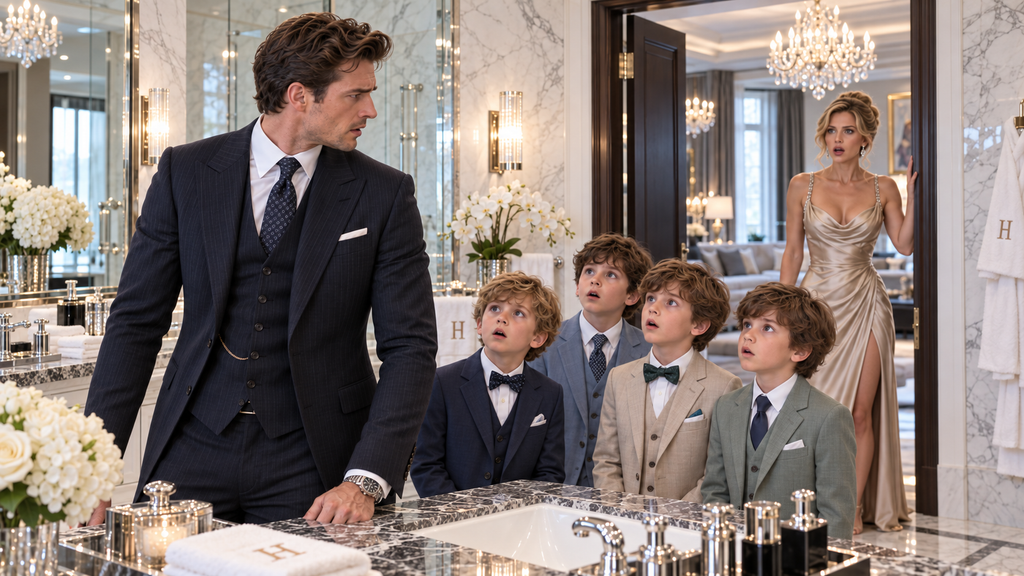
Cillian was lying on the rug beside the glass doors, one hand tucked beneath his cheek, facing the lights of Miami.
Four small bodies.
Four identical profiles.
Four children who had apparently been living only miles away from a family with more empty bedrooms than most hotels.
I stood in the doorway and stared at them.
For thirty-four years, the Farrington name had opened every door in front of me.
Banks.
Country clubs.
Boardrooms.
Private terminals.
Restaurants where reservations were supposedly impossible.
Universities that suddenly discovered space when my grandfather made a phone call.
Yet my own sons—if they were my sons—had spent that afternoon sitting beside two battered duffel bags because they had nowhere safe to sleep.
The thought made something inside me feel sick.
Kelsey stood near the kitchen island with her arms folded tightly across herself.
She had changed out of her server’s apron.
Underneath, she wore black pants, a faded gray sweater, and exhaustion.
Six years had changed her.
Not in the way time changes people in photographs.
It had changed the way she occupied a room.
The Kelsey I remembered had laughed before she finished telling jokes.
She used to dance barefoot in my apartment while making terrible pasta.
She used to interrupt me in the middle of arguments because she could not stand letting me become too serious.
This woman measured every doorway.
Every sound.
Every possibility of danger.
“Kelsey.”
“Don’t.”
Her voice was low because of the sleeping boys.
“I need answers.”
She looked toward them.
“So do they.”
I stepped closer.
“Are they mine?”
Her jaw tightened.
“That’s the first question you ask?”
“What question should I ask?”
She stared at me for several seconds.
Then she whispered, “Why didn’t you come?”
The anger disappeared from my throat.
“What?”
“Why didn’t you come for us?”
“I didn’t know there was an us.”
Her eyes glistened.
For the first time since I had found her, some of that hardened control cracked.
“I wrote to you.”
“No.”
“I called you.”
“No, you didn’t.”
“I called your number until it was disconnected.”
“My number was never disconnected.”
“I went to your apartment.”
“I lived there another eight months.”
“No, you didn’t.”
“Yes, I did.”
Her voice sharpened.
“I stood outside that building seven months pregnant and watched another man carry your boxes out.”
I froze.
“What man?”
“I don’t know. A driver. Security. Somebody.”
“That never happened.”
She laughed once.
There was no humor in it.
“Of course. Here we go.”
“Kelsey, I swear to you—”
“You swore you loved me too.”
“I did.”
“Then why did you send me this?”
She crossed the room, knelt beside one of the duffel bags, unzipped a side compartment, and pulled out a plastic folder.
The folder was worn at the corners.
She removed a sheet of paper.
Then handed it to me.
I recognized my name at the bottom before I read a single word.
ETHAN JAMES FARRINGTON.
My signature.
My handwriting.
Or something close enough to make my stomach turn.
The letter was dated six years earlier.
Kelsey,
What happened between us was a mistake that has gone far enough. My family has made me understand what I was unwilling to accept before. We come from different worlds, and pretending otherwise will only make things harder.
If the child is mine, my attorneys will arrange appropriate financial support after paternity is established. Do not contact me personally again.
I am moving forward with my life.
Ethan.
For several seconds, I could hear nothing except the air-conditioning.
I read it again.
And again.
Then I looked at her.
“I didn’t write this.”
She didn’t react.
“Kelsey, look at me.”
“I’ve looked at that signature for six years.”
“I did not write this.”
“It came in an envelope from your family office.”
My hand tightened around the paper.
“Who gave it to you?”
“A courier.”
“Name?”
“I don’t remember.”
“What company?”
“I don’t know. I was twenty-four years old, terrified, pregnant with four babies, and the man I loved had supposedly decided I was an inconvenience. Forgive me for not asking the courier for his business card.”
I shut my eyes.
Four babies.
The words hit differently hearing them said aloud.
“You knew you were having quadruplets?”
“By then, yes.”
“And I never knew you were pregnant.”
“You knew.”
“I didn’t.”
“I told you.”
“When?”
“The night before you left for London.”
I stared at her.
“That night you told me you were late.”
“I told you I had taken three tests.”
“No. You said you thought you might be pregnant.”
“I said, ‘Ethan, I’m pregnant.’ You sat on the floor in my kitchen and laughed because you were nervous.”
My breathing slowed.
Memory came back in pieces.
Her small apartment.
Rain hitting the windows.
Takeout containers.
Kelsey pacing.
Me sitting on the floor because my knees had suddenly stopped feeling reliable.
Then a phone call.
My mother.
Grandfather hospitalized.
London trip moved forward.
I remembered holding Kelsey’s face before leaving.
I remembered telling her I would call the moment I landed.
And then—
Nothing.
Except that there had been something.
A message from Kelsey.
A message that had ended everything.
I crossed to my phone.
“Wait.”
I searched six years of archived cloud backups.
Kelsey watched me without moving.
Most people in my life had learned not to watch me work.
She had always watched.
Finally, I found it.
An old screenshot.
I turned the screen toward her.
Her face went white.
The message had arrived from her number three days after I landed in London.
Ethan, I’m sorry. I panicked about the pregnancy. There isn’t one. I made it up because I thought it would make you commit to me. I know how disgusting that is. Please don’t contact me again. I need to start over.
Kelsey shook her head.
“No.”
“You sent that.”
“No.”
“It came from your number.”
“I never wrote that.”
“And I never wrote your letter.”
Silence filled the penthouse.
The kind of silence that changes the shape of everything that came before it.
Kelsey lowered herself into a chair.
Her hands started trembling.
“I changed my number a week after you left.”
“Why?”
“Your mother.”
The room became very still.
“What did she do?”
Kelsey looked at the boys again.
Then at me.
“She came to see me.”
The anger I had been holding all afternoon sharpened into something colder.
“When?”
“Two days after you went to London.”
“Where?”
“My apartment.”
“What did she say?”
Kelsey’s mouth tightened.
“At first? Nothing cruel.”
That sounded exactly like my mother.
Beatrice Farrington almost never began with cruelty.
She began with concern.
With tea.
With soft voices.
With sentences designed to make cruelty sound like wisdom.
“She said she had heard about the pregnancy,” Kelsey continued. “She told me you had called her from London in a panic. She said you were too kind to tell me the truth yourself.”
“I never called her about you.”
“I know that now.”
“What else?”
“She said your grandfather had suffered another cardiac episode because of the stress.”
My stomach turned.
“My grandfather had pneumonia.”
“I didn’t know that.”
“She lied.”
“Yes.”
Kelsey rubbed her palms together.
“She said the Farrington family had spent generations building something that couldn’t survive scandal.”
“What scandal?”
“Me.”
The single word struck harder than shouting would have.
“Kelsey…”
“She didn’t call me trash. Your mother was too polished for that. She said I was ‘unprepared for the expectations attached to your position.’ She said I would be miserable. That your friends would humiliate me. That your family would never trust me. That eventually you would resent me.”
“She had no right.”
“No. She didn’t.”
“What did she offer you?”
Kelsey’s eyes hardened.
“Three million dollars.”
I stared at her.
“To disappear?”
“To terminate the pregnancy.”
Something savage moved through me.
“What?”
“She had papers.”
Kelsey’s voice shook now.
“She told me nobody needed to know. She said the procedure could be arranged privately. She said three million dollars would be transferred into an account afterward and I could start over anywhere I wanted.”
I could feel the blood pounding behind my eyes.
“And you refused.”
“Immediately.”
“What did she do?”
“She stopped smiling.”
I looked toward the sleeping children.
For one terrible moment, I imagined the world without them.
No Cormac extending his little hand in a restaurant bathroom.
No Callan copying the nervous habit I had inherited from my father.
No Connor asleep sideways in a chair.
No Cillian curled beneath Miami’s skyline.
My mother had looked at four beating hearts and reduced them to an obstacle.
“What happened after you refused?”
“She told me I was making a mistake.”
“And?”
“She left.”
“That wasn’t the end.”
“No.”
Kelsey swallowed.
“The next morning, my landlord called.”
“What about?”
“My lease.”
She laughed faintly.
“He suddenly discovered I had violated some occupancy clause. I had seven days to leave.”
“Did my mother own the building?”
“I found that out later. One of the holding companies connected to Farrington Properties had bought it two months earlier.”
My hands curled into fists.
“Then my job disappeared.”
“What job?”
“The architecture firm.”
“You loved that job.”
“I know.”
Her voice cracked.
“They said a client had raised concerns about me. I had never even met the client.”
“Farrington?”
She nodded.
“I tried to call you. Your assistant told me you were unavailable. I emailed you. Everything bounced back. Then I received the letter.”
The forged letter trembled slightly in my hand.
“And you believed it.”
“What was I supposed to believe?”
“That I loved you.”
“I did.”
She looked at me.
“That was why it destroyed me.”
I had no answer.
Not one good enough.
Not one that could give either of us six years back.
“So you left?”
“I tried.”
“What does that mean?”
“Your mother came back.”
Kelsey’s eyes drifted toward the windows.
“This time she wasn’t alone.”
“Who was with her?”
“A man named Harold Vane.”
I knew the name.
Everyone in the Farrington world knew the name.
My grandfather’s former general counsel.
A man who had handled family trusts, acquisitions, divorces, settlements, scandals, and anything else the family wanted to disappear behind sealed documents.
Harold Vane had retired three years ago.
Or so I had been told.
“What did Vane do?”
“He put a contract in front of me.”
“What kind of contract?”
“A confidentiality agreement.”
“Did you sign it?”
“No.”
Her answer came immediately.
“I refused.”
Something in my chest loosened.
Then tightened again when she continued.
“So he changed tactics.”
“How?”
“He told me that if I claimed the babies were yours, the Farrington family would demand paternity tests, psychological evaluations, custody reviews, financial investigations—anything they could use to show I was unstable.”
My face went cold.
“He threatened to take the boys?”
“He said wealthy families don’t lose custody battles to unemployed single mothers.”
I looked away.
Because I knew enough about my world to know why she had believed him.
Money didn’t make you right.
It simply gave you more opportunities to exhaust the person who was.
“I was twenty-four,” she whispered. “I had no job. No apartment. No parents to help me. My mother had died when I was nineteen. My father wanted nothing to do with me. I was carrying four high-risk babies.”
She pressed a hand over her mouth.
“And I was terrified.”
I moved toward her.
She immediately stiffened.
So I stopped.
“I’m sorry.”
Her eyes filled.
“Don’t say that yet.”
“Why?”
“Because you still don’t know everything.”
I felt my pulse slow.
“What else?”
She opened the folder again.
This time she removed a bank document.
Then a second.
Then a third.
Each had the Farrington Private Holdings logo.
Each showed money being deposited into an account under Kelsey’s name.
Two hundred fifty thousand dollars.
Another two hundred fifty thousand.
Then five hundred thousand.
One million dollars total.
I looked at her.
“You took money?”
“No.”
“It’s in your name.”
“That account was never mine.”
I looked closer.
There was an account number.
An electronic signature.
A mailing address in Nevada.
“Kelsey—”
“I never saw a dollar of it.”
“Then what is this?”
“The reason nobody believed me.”
She pushed another document across the island.
An affidavit.
Signed.
Notarized.
Supposedly by Kelsey Morgan.
It stated that she acknowledged Ethan Farrington was not the biological father of her unborn children and that she had fabricated the relationship in an attempt to obtain financial benefit.
I stared at it.
“That isn’t your signature.”
“No.”
“How do you know?”
“Because I was in a hospital bed when it was supposedly notarized.”
I looked up.
“What?”
“I went into labor at twenty-nine weeks.”
The penthouse suddenly felt too cold.
“Twenty-nine?”
“They were born premature.”
She looked toward the boys.
“Connor weighed two pounds, eleven ounces. Cillian was barely over three pounds. Cormac stopped breathing twice during the first week. Callan needed heart surgery before he was three months old.”
My eyes moved toward the couch.
Cormac.
The confident one.
The child who had offered me his hand.
I had missed all of it.
Incubators.
Surgeries.
Tiny diapers.
Machines breathing.
Kelsey sitting alone beside four plastic hospital bassinets while my family held charity galas and Christmas parties twenty minutes away.
“Where was I?” I whispered.
“You were in London.”
“I came home before they were born.”
“I know.”
I looked at her.
“How?”
“Your photograph was in the newspaper.”
The words hit me like a physical blow.
“What photograph?”
“You were at a yacht-club fundraiser with Genevieve.”
I remembered.
A photograph arranged by my mother.
Genevieve beside me.
Her arm through mine.
I had barely known her then.
The headline had called her my “longtime companion.”
It had been ridiculous.
I had objected.
My mother had dismissed it as harmless society gossip.
Kelsey had seen it from a hospital bed.
“I thought the forged letter was real,” she said. “Then I saw you smiling next to her.”
“I wasn’t smiling because—”
“It didn’t matter.”
No.
Of course it hadn’t.
Truth mattered.
But timing could murder truth before it had a chance to speak.
Kelsey stood and walked toward the balcony doors.
“I had four premature babies,” she said. “Medical bills I couldn’t understand. No job. No apartment. Then someone opened a bank account in my name and created paperwork saying I had extorted your family.”
“Why?”
“To make sure that if I ever came back, I would look like the liar.”
I stared at the affidavit.
It was elegant.
Ugly, but elegant.
Beatrice had not simply removed Kelsey.
She had constructed evidence around her.
An escape route for herself.
A narrative for everyone else.
Kelsey, the unstable girlfriend.
Kelsey, the gold digger.
Kelsey, the woman who lied about pregnancy.
Kelsey, the woman who took money.
And me?
The obedient son.
Kept safely ignorant.
“What happened to the million dollars?”
“I don’t know.”
“We can find out.”
She shook her head.
“I stopped trying years ago.”
“I haven’t.”
“You started five minutes ago.”
The sentence cut deep because it was true.
I lowered my voice.
“Then give me the chance to start now.”
Before she could answer, my phone vibrated.
BEATRICE FARRINGTON.
Again.
The screen showed twenty-three missed calls.
Then a text.
Do not do anything reckless. Come home immediately. We will discuss this privately.
I stared at it.
Kelsey saw the name.
“You should go.”
“No.”
“Ethan.”
“No.”
“She will come here.”
“Good.”
Kelsey’s face changed.
“You don’t understand your mother.”
“I understand her perfectly.”
“No, you understand the version she allowed you to see.”
I picked up my phone.
Then called the one person my mother had spent my entire life making sure I never questioned.
My grandfather.
Charles Farrington answered on the second ring.
“Ethan?”
His voice was weaker than it had been a year earlier, but still carried the authority that had built three generations of wealth.
“I need you to come to the penthouse.”
“At this hour?”
“Yes.”
“What happened with the engagement?”
“There won’t be one.”
Silence.
Then—
“Why?”
I looked at the four boys.
“Because I think you have four great-grandsons no one told you about.”
For once in his life, Charles Farrington said nothing.
Then I heard him inhale.
“Where are you?”
“Miami.”
“I’ll be there.”
My mother arrived first.
Of course she did.
Twenty-eight minutes later, the private elevator opened.
Beatrice stepped out wearing the pale blue gown she had chosen for my engagement announcement.
Pearls at her throat.
Diamonds at her ears.
Her hair immaculate.
Behind her came my father, Alexander.
And behind him—
Genevieve.
Nobody spoke.
My mother’s gaze found Kelsey.
For half a second, the mask slipped.
Just half a second.
But I saw it.
Fear.
Then her eyes moved toward the couch.
Toward four sleeping boys.
Her face drained of color.
My father followed her gaze.
He stopped breathing.
Genevieve whispered, “Oh my God.”
My mother recovered first.
“Ethan, may I speak to you privately?”
“No.”
“This is a family matter.”
I looked at Kelsey.
“It became a family matter six years ago.”
Beatrice’s mouth tightened.
My father walked toward Cormac.
“Dad,” I said.
He stopped.
His eyes never left the boy.
“That dimple,” he whispered.
I knew exactly what he meant.
My father had the same one.
So had my grandfather before age softened his face.
The Farrington dimple.
The family joke.
The kind photographers always tried to catch because it made men with serious surnames look approachable.
My father turned to my mother.
“Beatrice?”
She lifted her chin.
“Children resemble people. It doesn’t prove anything.”
Kelsey laughed quietly.
My mother looked at her.
There it was again.
Not embarrassment.
Not confusion.
Recognition.
“You knew,” I said.
“Ethan.”
“You knew.”
“I knew there had been allegations.”
Kelsey took one step forward.
“Allegations?”
Beatrice ignored her.
“Six years ago, Ethan, you were young and vulnerable. That woman—”
“Finish that sentence carefully.”
My voice had changed.
My mother heard it.
So did everyone else.
She stared at me.
I had never spoken to her that way.
Not once.
Maybe that had been the problem.
“You were twenty-eight,” she said. “You had responsibilities.”
“I was twenty-eight, not eight.”
“The company was entering the Ashford negotiation. Your grandfather’s health was unstable. Your father had stepped back. Everything depended on you.”
“And therefore you decided who I was allowed to love?”
“You have no idea how much pressure this family was under.”
Kelsey shook her head.
“No. Please don’t do that.”
My mother finally looked directly at her.
“Do what?”
“Make what you did sound like sacrifice.”
The room went silent.
Kelsey’s hands trembled, but her voice did not.
“You came into my apartment and asked me to end four pregnancies because they were inconvenient to your family name.”
Genevieve looked sharply at Beatrice.
My father whispered, “What?”
Beatrice’s eyes flashed.
“She is twisting—”
“You offered me three million dollars.”
“Beatrice.”
My father’s voice sounded broken.
“Is that true?”
My mother looked at him.
“Alexander, you weren’t well at the time.”
“What does my health have to do with that question?”
“I handled things that needed handling.”
My father stared at her.
I had never seen him look at my mother that way.
For most of my childhood, I had thought theirs was the perfect marriage.
In reality, perhaps it had merely been a marriage in which my father had surrendered too many questions.
Genevieve stepped back.
“You told my father Ethan wanted this engagement.”
My mother turned.
“This isn’t your concern.”
Genevieve laughed in disbelief.
“I was supposed to get engaged to him tonight.”
“Our families have discussed this alliance for years.”
“An alliance?”
Genevieve’s voice rose.
“You mean marriage?”
Beatrice looked irritated now.
As if emotion were clutter.
“You knew what was expected.”
“No.”
Genevieve shook her head.
“I knew what my father hoped. I knew what you encouraged. You told me Ethan had finally agreed because he wanted stability.”
My stomach twisted.
I looked at her.
“Genevieve.”
She faced me.
“I wasn’t in love with you either.”
Somehow, despite everything, that almost made me smile.
She gave a weak, miserable laugh.
“I thought we were two adults making a practical decision.”
“We were.”
“No. Apparently, we were two adults making a decision because our parents edited reality.”
My mother opened her mouth.
The private elevator chimed.
Everyone turned.
My grandfather stepped out leaning on a silver-handled cane.
Harold Vane stood beside him.
For a moment, my blood stopped.
Kelsey went rigid.
“That’s him.”
She whispered it so softly I almost missed it.
Harold’s face changed.
Only slightly.
But enough.
My grandfather looked around the room.
Then his eyes reached the sleeping children.
His cane froze against the marble.
Cormac stirred.
He opened his eyes.
Four seconds later, Callan woke too.
Then Connor.
Then Cillian.
They all stared at the old man by the elevator.
My grandfather stared back.
Cormac sat up.
“Are you another Farrington?”
Nobody moved.
Grandfather’s eyes widened.
Cormac touched the back of his neck.
My grandfather’s hand rose unconsciously.
And he touched the exact same place.
Kelsey covered her mouth.
My father turned away.
I felt tears burn unexpectedly behind my eyes.
My grandfather crossed the room slowly.
“Which one of you is Cormac?”
Cormac raised his hand.
“How did you know my name?”
“I heard Ethan say it on the phone.”
He looked at the other three.
“And Callan?”
A hand.
“Connor?”
Another.
“Cillian?”
The smallest boy nodded.
My grandfather sank into the chair opposite them.
He stared for a long time.
Then he said something I never expected from Charles Farrington.
“I’m sorry.”
Cormac frowned.
“For what?”
Grandfather looked toward me.
Then Kelsey.
“I’m not entirely sure yet.”
He turned to Harold.
“But I suspect I am about to find out.”
Harold Vane cleared his throat.
“Charles, perhaps the children should be taken somewhere private while the adults—”
“No.”
My grandfather’s voice hardened.
“No more private rooms, Harold.”
Something in Vane’s expression told me more than any confession could have.
He knew.
I walked to the island.
Then placed the forged letter, affidavit, and bank records in front of my grandfather.
His face changed as he read.
He read slowly.
Carefully.
When he reached the affidavit, he lifted his eyes toward Harold.
“Did your office prepare this?”
Vane did not answer.
“Harold.”
“I would need to review the file.”
“That is not what I asked.”
“Charles—”
“Did your office prepare this document?”
Beatrice cut in.
“Father, I think everyone is tired and emotional. Nothing productive—”
My grandfather slammed his cane against the marble floor.
The crack echoed across the penthouse.
The boys jumped.
My mother went silent.
I had seen Charles Farrington furious only twice in my life.
Both times billion-dollar deals had been involved.
This was different.
This was personal.
“You will not speak again,” he told my mother, “until I ask you a question.”
Beatrice looked stunned.
Grandfather faced Harold.
“Answer me.”
Harold’s face had gone gray.
“My office prepared several draft instruments at Mrs. Farrington’s request.”
Kelsey inhaled sharply.
My mother closed her eyes.
I stared at Harold.
“Draft instruments?”
“Agreements.”
“Forgery?”
“No.”
I held up the affidavit.
“Kelsey didn’t sign this.”
“I cannot verify that.”
“She was hospitalized on the date it was notarized.”
Vane loosened his tie.
Grandfather looked at Beatrice.
“Did you authorize this?”
She said nothing.
“Beatrice.”
She finally lifted her chin.
“I protected Ethan.”
“By forging documents?”
“I did not forge anything.”
“Then who did?”
No answer.
My grandfather turned back to Harold.
The old lawyer looked smaller than he had ten minutes before.
“There was a paralegal,” he said.
“What paralegal?”
“I don’t remember.”
“Try.”
“Charles—”
“Try.”
Harold’s shoulders sagged.
“Marianne Cole.”
I knew the name.
She had later become deputy compliance officer at Farrington Private Holdings.
A job that paid more than most law-firm partners earned.
Grandfather apparently knew it too.
“Interesting promotion.”
Harold said nothing.
I looked at the bank records.
“Where did the million dollars go?”
My mother finally spoke.
“It was put aside for Kelsey.”
Kelsey spun toward her.
“I never received it.”
“I never said you did.”
The room went silent.
Even Harold turned toward Beatrice.
I felt cold spread through me.
“Explain.”
My mother looked at me.
“The money was placed into a custodial reserve.”
“In her name.”
“Yes.”
“Without her knowledge.”
“Yes.”
“And afterward?”
“It was returned.”
“To whom?”
She did not answer.
Grandfather looked at the documents.
Then at Harold.
“To whom?”
Vane stared at the floor.
“Farrington Strategic Ventures.”
My father laughed once.
A hollow sound.
“That company doesn’t exist anymore.”
“It was dissolved.”
“Where did the assets go?”
Vane’s silence answered.
I knew enough corporate structure to trace the likely path.
Strategic Ventures had merged into Beacon Harbor Capital.
Beacon had later been absorbed by Ashford-Farrington Development.
The joint enterprise that my engagement to Genevieve was supposed to cement.
I looked at her.
Her face had gone pale.
“Oh my God.”
Grandfather understood too.
“Your father?”
Genevieve shook her head quickly.
“I don’t know.”
“Call him.”
She hesitated.
“Now.”
Genevieve took out her phone.
My mother stepped forward.
“This is ridiculous.”
“No,” I said. “This is six years late.”
Genevieve dialed.
“Dad?”
We could hear Robert Ashford’s voice faintly through the phone.
She pressed speaker.
“Dad, did you know about money being routed through Farrington Strategic Ventures six years ago?”
Silence.
Then—
“Where are you?”
“At Ethan’s penthouse.”
Another pause.
“Is Beatrice there?”
Everyone looked at my mother.
Genevieve’s face collapsed.
“You knew.”
“Genevieve—”
“You knew.”
Her father exhaled.
“It was business.”
Kelsey made a tiny sound.
Not a sob.
Something worse.
Disbelief exhausted beyond tears.
Genevieve stared at her phone.
“What was business?”
“A liability needed to be contained.”
I grabbed the phone from her.
“Four children were a liability?”
Robert went silent.
“Ethan.”
“You knew Kelsey was pregnant.”
“I knew there was a situation.”
“And you helped my mother bury it?”
“I helped protect a transaction involving thousands of employees.”
I laughed.
I couldn’t help it.
“Of course.”
“Don’t be naive.”
His voice sharpened.
“The Ashford-Farrington merger employed nine thousand people. Your family’s financing was unstable. Charles was ill. Investors were nervous. A paternity scandal involving an unmarried heir and a woman with no—”
I hung up.
Genevieve stood perfectly still.
Then she removed the diamond bracelet my mother had given her for the engagement dinner.
She placed it on the island.
“I’m done.”
Beatrice stared at her.
“Don’t be dramatic.”
Genevieve looked at her.
“I just learned my father helped your family erase four children because their existence was bad for a merger.”
“You are oversimplifying.”
“No.”
Genevieve’s voice shook.
“I think that is exactly the problem. People like you use big words so you don’t have to hear what you actually did.”
She turned to me.
“I’m sorry.”
“You didn’t know.”
“Neither did you.”
She looked at Kelsey.
“I’m sorry.”
Kelsey gave a small nod.
Genevieve left without another word.
My mother watched her go.
Then she looked at me.
“You have destroyed an alliance worth hundreds of millions of dollars over something that happened six years ago.”
“No.”
I stepped closer.
“You destroyed it six years ago.”
For the first time, anger broke through her composure.
“You think life is simple because everyone around you has spent decades making it simple for you.”
“That includes you.”
“Yes.”
She hit her palm against the island.
“Yes, Ethan. Me.”
The boys stared.
My father moved between us.
“Lower your voice.”
My mother ignored him.
“You grew up protected because I protected you. Every scandal, every mistake, every bad investment, every reckless friendship—I handled it.”
“Kelsey wasn’t a mistake.”
“She was twenty-four years old with no family, no money, and no understanding of the world you were entering.”
“She understood enough not to sell her children for three million dollars.”
My mother flinched.
Kelsey looked away.
I regretted saying it only because the boys might understand.
Cormac did.
His little face changed.
“What does that mean?”
Everything stopped.
Kelsey immediately went to him.
“Nothing you need to worry about.”
“Did somebody try to buy us?”
“No, baby.”
“Mom.”
He looked at her.
Cormac was six.
But there was something old in his eyes.
Something children developed when childhood had asked too much of them.
Kelsey knelt.
“No one bought you.”
“Did they try?”
She closed her eyes.
My grandfather looked down.
My mother finally seemed unable to meet the boy’s gaze.
Kelsey took Cormac’s hands.
“When you were still in my tummy, somebody thought our lives would be easier if things were different.”
“Grandma?”
The word came innocently.
The effect was devastating.
Cormac was looking at my mother.
Beatrice stared at him.
He had no idea that the title might belong to her.
He had simply recognized an older woman in the family.
My mother’s lips parted.
Nothing came out.
For the first time in my life, Beatrice Farrington had no prepared answer.
Cormac waited.
Then Kelsey gently turned his face back toward her.
“You and your brothers were wanted.”
“By you?”
“With everything I had.”
He nodded.
That was enough for him.
For now.
Kelsey helped the boys settle in the guest suite.
I watched her disappear down the hallway with four small hands reaching for her.
When the door closed, my grandfather stood.
“Harold.”
Vane looked up.
“You will turn over every file involving Kelsey Morgan, Ethan, the boys, Strategic Ventures, Marianne Cole, and Beatrice.”
“Charles—”
“Tonight.”
“I don’t have access to everything anymore.”
“You have access to enough.”
Grandfather’s voice became lethal.
“If one document disappears, I will spend whatever remains of my life proving where it went.”
Harold swallowed.
“You’re threatening me.”
“No.”
My grandfather looked at him.
“I’m promising you professional consequences.”
Harold left.
My father remained beside the windows.
My mother stood alone near the island.
Grandfather turned to her.
“Did you know the children had been born?”
She stared straight ahead.
“Yes.”
My father closed his eyes.
I felt the answer inside my ribs.
“Did you know there were four?”
“Yes.”
“When?”
“A week after delivery.”
“How?”
“The hospital sent notification through the medical liaison.”
I could barely speak.
“You monitored her hospital?”
“It was necessary to understand the situation.”
I stepped closer.
“Did you see them?”
My mother hesitated.
That hesitation told me.
“Did you see them?”
“Yes.”
Kelsey’s bedroom door remained closed down the hallway.
Thank God.
My voice dropped.
“You saw my sons.”
“Yes.”
“Where?”
“Neonatal intensive care.”
My father turned.
“Beatrice.”
She ignored him.
I could hardly breathe.
“What did they look like?”
Her face changed.
For a second, something almost human broke through.
“Tiny.”
The word came quietly.
“Cormac was under three pounds. Connor had a blue cap. One of them—Cillian, I think—was under a warming lamp.”
“You stood there.”
“Yes.”
“You looked at them.”
“Yes.”
“And then you walked away.”
Tears filled her eyes.
But I felt no comfort seeing them.
“Ethan—”
“You walked away.”
“I believed I was protecting you.”
“No.”
I shook my head.
“You were protecting the life you designed for me.”
“You don’t understand what your grandfather expected.”
Grandfather stepped forward.
“Do not put this on me.”
She turned.
“You wanted him to inherit.”
“I wanted him to become capable of inheriting.”
“You told me scandal could destroy confidence.”
“I was talking about securities fraud allegations!”
His voice thundered through the room.
“Not babies!”
Beatrice’s face crumpled for one split second.
“You spent Ethan’s entire childhood telling me the Farrington name came first.”
Grandfather’s fury softened into something heavier.
“Then perhaps I helped create this.”
Nobody answered.
He looked at me.
Then toward the hallway where the boys slept.
“I taught your mother that reputation was survival.”
His eyes lowered.
“I did not imagine she would decide reputation mattered more than people.”
My mother wiped one tear from beneath her eye.
“You are all judging me with the benefit of hindsight.”
“No.”
My father’s voice came quietly.
We turned.
Alexander Farrington looked older than he had that morning.
“I’m judging you as your husband.”
Beatrice stared at him.
He continued.
“You told me Kelsey left Ethan because she wanted money.”
“She did want—”
“No.”
“You showed me bank records.”
“Alexander—”
“You told me she received one million dollars and disappeared.”
My father’s voice broke.
“I told my son she wasn’t worth chasing.”
I stared at him.
He looked at me.
Shame filled his face.
“I believed her.”
For six years, I had wondered why my father had become cold whenever Kelsey’s name surfaced.
Now I knew.
My mother had poisoned every well.
“You knew I loved her.”
“I thought she used you.”
“You never asked me.”
“I should have.”
His answer came without defense.
That mattered more than I expected.
He turned to Beatrice.
“You made me help you break him.”
My mother shook her head.
“I saved this family.”
“No.”
My father removed his wedding ring.
My mother watched his fingers.
“Alexander.”
He placed the ring on the counter beside Genevieve’s bracelet.
“You saved the company.”
Then he looked toward the hallway.
“And abandoned the family.”
He walked out.
My mother stood perfectly still.
Her breathing changed.
For the first time, she looked small.
Not harmless.
Never that.
But small.
She looked at me.
“Ethan.”
I pointed toward the elevator.
“Leave.”
Her face tightened.
“I am your mother.”
“Yes.”
“That has to mean something.”
“It did.”
My voice cracked despite everything.
“It meant so much that I believed you.”
That hurt her.
I saw it.
Good.
“I believed you when you told me Kelsey was manipulative.”
“Ethan—”
“I believed you when you said she had moved away.”
“She had.”
“Because you pushed her out.”
“I—”
“I believed you when you told me Genevieve was the kind of woman who could stand beside me.”
“She is.”
“I didn’t ask who could stand beside me.”
My eyes burned.
“I wanted the woman I loved.”
Her chin trembled.
“I was afraid.”
The admission surprised me.
“Of what?”
“That you would leave us.”
I stared at her.
“Kelsey made you different.”
“Yes.”
“You stopped asking me before making decisions. You were talking about moving to Seattle with her. You wanted to step away from some of the company responsibilities.”
She gave a broken laugh.
“You were becoming your own person, and I thought you were throwing away everything we built for you.”
I could almost see the frightened logic.
Almost.
But fear explained cruelty.
It did not erase it.
“So you destroyed her life.”
“I thought eventually you would thank me.”
“I spent six years believing the person I loved had lied to me.”
My voice fell.
“She spent six years raising four children who should have known me.”
“I know.”
“No, you don’t.”
I looked toward the hallway.
“You knew they existed.”
That was the unforgivable part.
“You knew where they were.”
Her eyes dropped.
“And you let them become homeless.”
“I didn’t know that.”
“You made sure you wouldn’t have to.”
She looked up.
“Ethan—”
“Leave.”
She stood there for several seconds.
Then she turned.
The elevator doors closed around her.
My grandfather and I were left alone.
He sat heavily.
“I failed you.”
I looked at him.
“Yes.”
He nodded.
No argument.
No defense.
Just acceptance.
“I can’t repair six years.”
“No.”
“But I can tell the truth.”
I looked toward him.
“And if the truth destroys the company?”
Grandfather smiled sadly.
“Then perhaps the company was standing on something rotten.”
At nine the next morning, I called the board.
At nine fifteen, I called our independent counsel.
At nine thirty, I instructed them to place Beatrice Farrington, Harold Vane, Marianne Cole, and every executive connected to the Strategic Ventures transfers under internal investigation.
At ten, I froze discretionary accounts tied to the old arrangement.
At ten twenty, Robert Ashford called.
I declined.
At ten twenty-two, he called again.
Declined.
At ten thirty-one, my assistant entered the room.
“Kelsey’s awake.”
I left a conference call involving six attorneys without apologizing.
Kelsey was sitting at the breakfast table.
The boys were eating pancakes.
My pancakes.
Technically, my chef’s pancakes.
Cormac had already discovered the syrup warmer.
Connor was fascinated by the motorized blinds.
Callan had asked someone how much the refrigerator cost.
Cillian was feeding strawberries to himself with both hands.
The scene was so ordinary that it hurt.
Kelsey looked at me.
“How bad?”
I sat opposite her.
“Worse than I thought.”
She gave a small nod.
“I’m sorry.”
“For what?”
“For your family.”
I stared at her.
“You spent six years surviving what my family did to you.”
“I’m still sorry.”
That was Kelsey.
Even now.
I looked toward the boys.
“We need DNA tests.”
Her expression hardened.
I continued quickly.
“Not because I doubt you.”
“Then why?”
“Because if this becomes legal—and it will—I want nobody to be able to question them.”
She looked at me for a long moment.
Then nodded.
“Okay.”
Cormac looked between us.
“What’s a DNA test?”
“A science test,” I said.
His eyes widened.
“Do we get to explode anything?”
“No.”
“Then that’s not a good science test.”
Callan nodded solemnly.
“I agree.”
Kelsey laughed.
It was tiny.
Almost accidental.
But I heard the woman I remembered inside it.
Later that afternoon, a private laboratory technician came to the penthouse.
Cheek swabs.
Nothing dramatic.
The boys complained for thirty seconds and then became more interested in the technician’s equipment bag.
I waited forty-eight hours.
Forty-eight hours can be nothing.
Or they can contain an entire lifetime.
I did not sleep much.
Neither did Kelsey.
On the second night, I found her on the balcony after midnight.
The boys were sleeping.
Miami glittered below us.
“You always hated heights,” I said.
She didn’t look at me.
“I had four babies at once. Heights lost some of their authority.”
I smiled.
Then the smile disappeared.
“Kelsey.”
“Hmm?”
“Why didn’t you ever try again?”
“To find you?”
“Yes.”
She was quiet.
“I did.”
I waited.
“When the boys were two, Connor needed another procedure.”
She leaned against the railing.
“I was working two jobs. We were living outside Fort Lauderdale. I couldn’t cover everything.”
“You contacted my family.”
“I went to Farrington headquarters.”
My stomach tightened.
“What happened?”
“Security escorted me out.”
I closed my eyes.
“Did you ask for me?”
“For you. Your father. Your grandfather. Anyone.”
“Who ordered security?”
“I don’t know.”
We both knew.
“I left an envelope.”
“What was in it?”
“Copies of birth certificates.”
She looked at me.
“And photographs.”
I could barely breathe.
“What photographs?”
“The boys.”
“How old?”
“Two.”
“Do you still have copies?”
“Yes.”
She took out her phone.
Scrolled.
Then handed it to me.
Four toddlers sat on an old blue blanket.
Same gray-blue eyes.
Same dark hair.
One laughing.
One serious.
One pulling at his brother’s sleeve.
One looking directly into the camera.
I enlarged the photograph.
My throat closed.
“You sent this?”
“Yes.”
“And nobody gave it to me.”
“No.”
I kept staring.
There were birthdays in those faces.
First words.
First steps.
Fevers.
Christmas mornings.
Nightmares.
All the small moments that build a father before a child understands what a father is.
“I can’t get that back.”
“No.”
Her answer was gentle this time.
I handed the phone back.
“I don’t know what to do with how angry I am.”
“I spent years learning.”
“How?”
“You keep living.”
She shrugged.
“Eventually, anger gets tired before you do.”
I looked at her.
“Did you hate me?”
“Yes.”
The answer came so quickly I almost laughed.
She looked at me.
“I hated you more than anyone.”
“I deserved that.”
“You didn’t know.”
“I didn’t look hard enough.”
“That part is true.”
I let it land.
“I searched for you for six months.”
She turned.
“What?”
“I hired an investigator.”
Kelsey stared at me.
“My mother told me you had moved to Canada.”
“I’ve never been to Canada.”
“I know that now.”
“What did the investigator find?”
“A lease in Vancouver. Utility bills. A bank account.”
Her face changed.
“All fake.”
“Yes.”
We both stared into the distance.
The scale of it was becoming clearer.
Beatrice had not merely lied.
She had created an alternate Kelsey.
One who lived in Canada.
One who took money.
One who denied the pregnancy.
One who disappeared voluntarily.
A paper ghost designed to replace the real woman.
“The investigator told me you didn’t want to be found,” I said.
Kelsey laughed bitterly.
“I was living in a motel in Broward County with four bassinets.”
I felt something tear inside me.
“I’m sorry.”
This time she let me say it.
The DNA results arrived at 7:06 the next morning.
Probability of paternity:
99.9998%.
Four times.
I stared at the report until the numbers blurred.
Then I walked into the guest room.
The boys were building a fort from pillows.
Cormac looked up.
“You’re our dad, right?”
Children had a terrifying way of stepping over all the language adults used to protect themselves.
I sat on the floor.
“Yes.”
Four faces stared at me.
Connor tilted his head.
“Like actual dad?”
“Yes.”
Callan asked, “Do we have to call you Dad?”
“No.”
Cillian looked relieved.
“Good. Because I already practiced Ethan.”
Kelsey laughed from the doorway.
I looked at her.
She was crying.
Cormac studied my face.
“Did you know about us?”
Every instinct in me wanted to protect him.
But I had spent enough of my life inside other people’s edited truths.
“No.”
His eyebrows pulled together.
“Why?”
“Someone made a very bad decision.”
“Who?”
I looked at Kelsey.
She slowly nodded.
“My mother.”
Cormac considered that.
“Our grandma?”
“Yes.”
“The fancy one?”
Despite everything, I nearly smiled.
“Yes.”
He was quiet.
“Does she hate us?”
That destroyed me.
I moved closer.
“No.”
“How do you know?”
“Because if she does, that is a problem inside her. Not inside you.”
He stared at me.
Then said, “Okay.”
And went back to building his fort.
Children sometimes accepted truths adults spent years running from.
Three days later, the investigation found the first smoking gun.
Marianne Cole had kept old emails.
Not because of conscience.
Because she had spent years protecting herself.
One message from my mother to Harold Vane read:
Ethan must believe Miss Morgan chose to leave. Under no circumstance should there be a permanent record connecting the children to him before the Ashford arrangement is secured.
Another read:
Create a clean evidentiary trail showing voluntary financial settlement. If she resurfaces later, we need documentation that makes further claims appear opportunistic.
And another:
Alexander must not know the children were born.
I read that line twice.
Then a fourth email appeared.
Grandfather must not be informed unless paternity becomes public.
My grandfather read it in silence.
Then he walked out of the room.
I found him ten minutes later alone in the library.
He was crying.
Charles Farrington did not cry.
Not when his brother died.
Not when his first company nearly collapsed.
Not even at my grandmother’s funeral.
But he sat beside the window with his hands trembling.
“She stole six years from me too.”
I did not comfort him.
Some grief needed room.
“They’re wonderful boys,” he whispered.
“I know.”
“Cormac asked if I fought pirates.”
I smiled despite myself.
“What did you tell him?”
“That hostile takeovers are similar.”
I laughed.
Grandfather wiped his face.
Then his expression changed.
“There is something else.”
“What?”
“The family trust.”
I sat down.
“What about it?”
He hesitated.
That immediately worried me.
“When your great-grandfather established the primary Farrington inheritance structure, he included an unusual provision.”
“What provision?”
“The first biological great-grandchildren in your branch receive beneficial ownership of a specific block of family shares at birth.”
I stared at him.
“How much?”
“Twelve percent.”
I stopped breathing.
“Twelve percent of Farrington Holdings?”
“Yes.”
“Together?”
“Yes.”
“Three percent each.”
“Yes.”
Suddenly, six years of manipulation rearranged themselves into something even uglier.
My mother had not only been protecting an engagement.
She had been protecting control.
If the boys’ births were acknowledged, twelve percent of voting-linked economic ownership would move into trusts benefiting them.
Control my mother had expected eventually to consolidate through me.
Control that would instead be divided.
“Did she know?”
Grandfather looked at me.
“Yes.”
I stood.
The anger returned so fast I became dizzy.
“She knew before they were born.”
“Yes.”
“So the Ashford merger wasn’t the only reason.”
“No.”
“She was protecting shares.”
“Partly.”
“Four babies.”
I could barely say it.
“She tried to erase four babies for twelve percent.”
Grandfather’s face twisted.
“I believe she convinced herself the shares were symbolic of a larger problem.”
“Control.”
“Yes.”
There it was.
The oldest addiction in wealthy families.
Not money.
Control.
Money was only the instrument.
I called independent counsel immediately.
By evening, the board had convened an emergency session.
My mother arrived wearing cream.
She always wore cream when she expected conflict.
It made her look calm.
Unstained.
She entered the conference room and found twelve directors, outside counsel, my grandfather, my father, and me waiting.
For the first time, nobody stood for her.
She sat.
Our lead investigator placed the emails on the screen.
My mother read them without expression.
Then the trust provision.
Then the financial transfer records.
Then Marianne Cole’s sworn statement.
Then Harold Vane’s cooperation agreement.
At last, counsel asked, “Mrs. Farrington, do you dispute the authenticity of these materials?”
She looked at me.
Not the lawyer.
Me.
“No.”
A director inhaled sharply.
“Did you instruct Mr. Vane’s office to create records suggesting Ms. Morgan voluntarily accepted a financial settlement?”
“Yes.”
“Did Ms. Morgan receive that money?”
“No.”
“Did you knowingly conceal the births of four beneficiaries from the trust administrator?”
“Yes.”
“Did you direct employees to mislead Ethan Farrington regarding Ms. Morgan’s location?”
“Yes.”
My father covered his face.
The lawyer continued.
“Why?”
My mother looked toward my grandfather.
Then me.
Finally she said, “Because I believed Ethan would throw away his future.”
I stared at her.
“And you believed his sons were disposable.”
Her eyes flashed.
“I never said that.”
“You behaved like it.”
“I made sure they received indirect support.”
I froze.
“What?”
My mother realized too late she had said too much.
“What indirect support?”
She looked away.
“Certain medical bills.”
Kelsey had mentioned anonymous charity grants.
A neonatal assistance fund.
Connor’s surgery.
A housing subsidy for six months.
At the time, she had believed she was lucky.
Now I understood.
“You paid some bills anonymously.”
“Yes.”
“And that made it acceptable?”
“No.”
Her voice finally cracked.
“No, Ethan. It made it possible for me to sleep.”
The room fell quiet.
For the first time, I saw the full ugliness of what she had done.
She had watched from a distance.
Paid enough to prevent catastrophe.
Never enough to reveal herself.
A surgeon paid here.
A motel bill there.
A charity grant.
Just enough to keep four children alive while keeping them outside the gates.
“You knew where they were the entire time.”
“Not every day.”
“Enough.”
“Yes.”
“And when they lost their apartment?”
“I didn’t know.”
“When Kelsey got fired?”
“No.”
“When they were sleeping beside two duffel bags?”
“No.”
My voice shook.
“But you designed a world where you would never have to know.”
She said nothing.
Counsel finally closed the folder.
“The board will deliberate.”
My mother stood.
I stopped her.
“One more thing.”
She turned.
“You will not contact Kelsey.”
Her face tightened.
“I deserve to apologize.”
“No.”
“She may want—”
“No.”
I stepped closer.
“You spent six years deciding what she wanted. You are finished doing that.”
Pain flashed across her face.
“You may write one letter.”
I continued.
“I will give it to her attorney. Kelsey will decide whether she ever reads it.”
My mother nodded.
“And the boys?”
My throat tightened.
“You will not see them unless Kelsey and I both agree.”
“I’m their grandmother.”
“You knew that six years ago.”
She closed her eyes.
That was the sentence that ended the argument.
The board voted ninety minutes later.
Beatrice Farrington was removed from every executive and fiduciary role.
Her authority over family entities was suspended.
All trust-related decisions were transferred to an independent fiduciary.
Harold Vane surrendered his advisory status and faced a professional misconduct investigation.
Marianne Cole entered a cooperation agreement.
Robert Ashford resigned from the joint venture after his own board received the evidence.
The Ashford-Farrington engagement announcement became something else entirely.
A public corporate scandal.
Reporters camped outside headquarters.
Financial channels used words like governance crisis.
The newspapers called it a battle for control.
They were wrong.
It had stopped being about control.
At least for me.
Kelsey watched none of the coverage.
She spent the afternoon helping Cillian make a cardboard spaceship.
That taught me more about priorities than thirty-four years of Farrington business dinners ever had.
A week later, I took the boys to the aquarium.
No security inside.
No private tour.
No closed exhibit.
Just five people standing in line.
Kelsey came too.
Connor pressed both palms to the shark tunnel glass.
Callan informed me that stingrays “look like pancakes with emotions.”
Cillian became obsessed with a jellyfish.
Cormac stayed beside me.
At one point, he slipped his hand into mine.
Not dramatically.
He simply did it.
I nearly stopped walking.
He looked up.
“What?”
“Nothing.”
“Why are your eyes wet?”
“Air-conditioning.”
He studied me suspiciously.
“There’s no air-conditioning outside.”
Kelsey was three steps behind us.
She heard.
Her smile was quiet.
That night, after the boys fell asleep, she and I sat on the floor of the penthouse kitchen eating pizza from the box.
Exactly the kind of thing my mother would have hated.
For that reason alone, it tasted excellent.
“What happens now?” Kelsey asked.
“With the trust?”
“With us.”
I put down my slice.
“I don’t know.”
She nodded.
“I don’t either.”
“I’m not going to ask you to pretend six years didn’t happen.”
“Good.”
“I’m not going to ask you to forgive me because technically I was deceived.”
She looked at me.
“Good.”
“I am going to be their father.”
Her expression softened.
“If they want you to be.”
“Yes.”
“And you don’t get to buy your way into it.”
“I know.”
“No giant gifts.”
“I bought four bicycles.”
“Ethan.”
“They need bicycles.”
“They have bicycles.”
“Those things had rust.”
“They worked.”
“Callan’s brake was held together with electrical tape.”
“It was good tape.”
I stared at her.
She laughed.
A real laugh this time.
It filled the kitchen.
For a few seconds, six years disappeared.
Then silence returned.
Not uncomfortable.
Just honest.
“I missed that,” I said.
She knew what I meant.
Her smile faded.
“So did I.”
I wanted to touch her hand.
I didn’t.
That mattered.
The old Ethan would have assumed history entitled him to closeness.
This Ethan was learning that love without permission could become another form of control.
So I waited.
Three weeks passed.
Then four.
I rented a house near the boys’ school.
Not bought.
Kelsey insisted.
“You don’t know if they’ll even like having you around every day.”
“They like me.”
“Cillian likes vending machines.”
“Cillian has good instincts.”
I started taking them to school twice a week.
Then three times.
I learned that Cormac hated bananas.
Callan slept with one sock off.
Connor became quiet when he was scared.
Cillian cried whenever anyone raised their voice.
That last one hurt.
I asked Kelsey why.
She said they had spent several months living next door to a couple who fought constantly.
Another thing I had not been there to fix.
But fatherhood, I discovered, was not an accounting ledger.
I could not repay missed years with enough future attention.
I could only show up.
Again.
And again.
And again.
Until showing up became ordinary.
My father started joining us on Sundays.
The first time, he brought four remote-controlled cars.
Kelsey looked at him.
“I told Ethan no giant gifts.”
My father held up the boxes.
“These were on sale.”
I stared at the price stickers.
“Dad.”
He peeled them off.
The boys adored him.
My grandfather was worse.
He arrived with a telescope that probably belonged in an observatory.
Cormac asked if it could see aliens.
Grandfather said, “With proper financing, anything is possible.”
Kelsey rolled her eyes.
Yet slowly, carefully, a strange new family began to form.
Not the polished family my mother had curated.
Something messier.
Better.
Then one morning, Kelsey received the letter.
Beatrice’s letter.
Her attorney had forwarded it unopened.
Kelsey left it on the table for three days.
On the fourth, she asked me to sit with her while she read it.
I almost refused.
“It’s yours.”
“I know.”
“You don’t need me here.”
“I know.”
She looked at me.
“I want you here.”
So I sat.
Kelsey opened the envelope.
The letter was handwritten.
Eight pages.
My mother had probably not handwritten eight pages in twenty years.
Kelsey read silently.
Halfway through, tears ran down her cheeks.
I did not ask why.
At the end, she folded the pages.
Then sat still.
“What did she say?”
Kelsey wiped her face.
“She apologized.”
“That doesn’t seem enough for eight pages.”
“It wasn’t.”
She looked toward the window.
“She told me about the hospital.”
My body tensed.
“She said she stood outside the NICU for forty-five minutes.”
I said nothing.
“She said she watched Cormac stop breathing.”
My stomach dropped.
“What?”
“A nurse rushed over. She said alarms went off.”
Kelsey pressed the folded letter between her hands.
“She wrote that she almost walked inside.”
“Almost.”
“Yes.”
“But she didn’t.”
“No.”
Kelsey’s tears fell again.
“She said that was the moment she knew she had become someone she didn’t recognize.”
I struggled to breathe.
“What else?”
“She said she went home and transferred fifty thousand dollars to the neonatal assistance fund.”
“The anonymous grant.”
“Yes.”
I looked away.
“She kept saving them in secret.”
“Sometimes.”
“And hiding them.”
“Yes.”
Kelsey looked at me.
“She said she wanted me to know she never hated them.”
“That matters to you?”
“I don’t know.”
She stared at the letter.
“Maybe.”
I understood.
Humans wanted monsters to be simple.
But often they weren’t.
Sometimes monsters loved you.
Sometimes they convinced themselves cruelty was protection.
Sometimes they paid your hospital bill after making sure your father never knew you existed.
Complexity did not erase guilt.
It merely made hatred harder to carry.
“Are you going to answer?”
“Not yet.”
That became Kelsey’s answer for several months.
Not yet.
Beatrice moved out of the estate.
My father filed for legal separation.
My grandfather rewrote the family governance rules to require independent oversight.
The boys’ twelve-percent interest was formally recognized.
Every dollar of missed distributions was restored with interest.
Kelsey refused personal compensation beyond reimbursement for documented expenses.
“You’re entitled to more.”
“I don’t want hush money with a prettier name.”
“It wouldn’t be hush money.”
“Then put it in the boys’ education accounts.”
So I did.
Connor wanted to become a veterinarian.
Callan wanted to build rockets.
Cillian wanted to own “the biggest ice cream store in America.”
Cormac wanted to be a lawyer.
I asked why.
“So nobody can trick Mom with papers again.”
I had to leave the room after that.
Six months after the restaurant bathroom, Kelsey and I returned to the same restaurant.
This time as customers.
The manager had been replaced.
The new owner recognized Kelsey and immediately offered us the best table.
She declined.
“We’d like the booth near the kitchen.”
That had been where the boys used to sit during her shifts when childcare fell through.
We ate burgers.
The boys argued about fries.
At one point, Cormac needed the bathroom.
“I’ll go,” I said.
All four boys stood.
Kelsey laughed.
“You all need to go?”
“No,” Callan said. “We want to see the mirror.”
So the five of us walked into the same bathroom.
The same sinks.
The same mirror.
The same place my life had split open.
Cormac wet his hands.
Pushed his hair off his forehead.
Callan copied him.
Connor followed.
Cillian too.
And without thinking—
So did I.
All five of us stared at our reflections.
Cormac grinned.
“You’re doing it again.”
This time I smiled.
“I know.”
Callan pointed.
“Grandpa does it too.”
“Apparently.”
“And Great-Grandpa.”
“Yes.”
Cillian looked pleased.
“So it’s definitely genetic.”
I laughed.
“Apparently.”
Then Cormac grew serious.
“Were you scared when you saw us?”
The question surprised me.
“Yes.”
“Because there were four?”
“That was part of it.”
“What was the other part?”
I looked at our reflections.
Five faces.
One history.
“I think I realized my whole life might be different than I thought.”
“Was that bad?”
I thought about the engagement ring that had once been in my pocket.
The board seat.
The estate.
My mother’s plans.
Kelsey working in an apron.
Four duffel bags.
A forged letter.
A hospital photograph.
A small hand slipping into mine at the aquarium.
“No.”
I smiled at him.
“It was the best terrifying thing that ever happened to me.”
Cormac considered that.
“Can we get dessert?”
Children had excellent timing.
“Yes.”
“All of us?”
“Yes.”
“Two desserts?”
“No.”
He shrugged.
“Worth trying.”
When we returned to the table, Kelsey looked at me.
Something passed between us.
Not forgiveness.
That word was too simple.
Something quieter.
Trust returning in millimeters.
Later, we walked along the waterfront.
The boys ran ahead.
Miami was warm.
Kelsey slipped her shoes off and carried them.
Exactly as she used to.
I watched her.
She caught me.
“What?”
“Nothing.”
“You’re staring.”
“I know.”
“Why?”
I took a breath.
“Because I spent six years remembering you at twenty-four.”
She looked away.
“And?”
“I like thirty.”
That made her smile.
“Thirty comes with four children.”
“I noticed.”
“And debt.”
“Handled.”
“Ethan.”
“Sorry.”
“And trust issues.”
“Reasonable.”
“And I don’t need saving.”
“I know.”
She stopped walking.
The boys were twenty yards ahead, trying to race a seagull.
Kelsey looked at me.
“Do you?”
“Do I what?”
“Know.”
“Yes.”
“You keep trying to fix everything.”
“I’m a Farrington. We solve problems.”
“You organize problems.”
“That too.”
She stepped closer.
“I survived without you.”
“I know.”
“I became someone without you.”
“I know.”
“If there is ever an us again, you don’t get the woman you lost six years ago.”
My throat tightened.
“I’m not asking for her.”
Kelsey studied me.
“Who are you asking for?”
“The woman standing here.”
For several seconds, the world seemed to disappear around us.
She reached for my hand.
Just once.
Just briefly.
Then let go.
“Good answer.”
I smiled.
“Does that mean—”
“It means it was a good answer.”
“Kelsey.”
“Don’t ruin it.”
So I didn’t.
A year after the night I cancelled my engagement, my mother saw the boys for the first time since the hospital.
Kelsey decided it.
Not me.
Not my grandfather.
Kelsey.
Beatrice arrived at the park alone.
No driver.
No pearls.
No attorney.
She wore jeans.
I had seen my mother in jeans perhaps three times in my entire life.
She stood near a bench with her hands clasped.
Nervous.
Then four boys ran across the grass.
They stopped several feet away.
Cormac looked at Kelsey.
“Is that her?”
Kelsey nodded.
My mother’s face collapsed.
She crouched.
Not elegantly.
Not carefully.
She simply crouched on the grass.
“Hello.”
Nobody answered.
Then Cillian stepped forward.
“Are you Fancy Grandma?”
My mother laughed through tears.
“Yes.”
Apparently, the nickname had survived.
Callan asked, “Are you rich?”
“Callan,” Kelsey warned.
Beatrice wiped her cheeks.
“I suppose.”
Connor frowned.
“Then why didn’t you help Mom?”
Every adult went still.
My mother looked at him.
There was no boardroom answer available.
No polished sentence.
No lawyer standing beside her.
“Because I was selfish.”
Connor considered that.
“Mom says selfish is when you only think about what you want.”
“Yes.”
“That’s bad.”
“Yes.”
“Are you still selfish?”
My mother looked toward Kelsey.
Then me.
“I’m trying not to be.”
Cormac stepped closer.
“Dad said you made bad decisions.”
“I did.”
“A lot?”
My mother smiled sadly.
“A lot.”
“Are you sorry?”
“Yes.”
“How sorry?”
Beatrice glanced at me.
“I don’t know how to measure it.”
Cormac nodded.
“Okay.”
Then Cillian held out a plastic dinosaur.
“Can you hold this?”
My mother stared at it.
“Yes.”
He placed it in her palm.
That was all.
No dramatic embrace.
No instant absolution.
Just a dinosaur.
Sometimes grace entered quietly.
Beatrice sat on the grass while the boys explained an elaborate game involving dinosaurs, spaceships, and a rule system no adult understood.
Kelsey stood beside me.
“You okay?”
“I don’t know.”
“Me neither.”
I looked at her.
“You didn’t have to do this.”
“I know.”
“Why did you?”
She watched my mother.
“Because the boys deserve the truth.”
I nodded.
“And because I don’t want what she did to turn me into someone who spends the rest of my life building walls.”
I looked at Kelsey.
That was when I knew.
Not that she had forgiven my mother.
Not that she had forgiven me.
But that she had survived without letting cruelty choose the shape of her heart.
That was more extraordinary than anything my family had ever built.
Two years after the restaurant bathroom, I stood on the beach behind a small rented house in Key Biscayne.
Not the Farrington estate.
Not a ballroom.
No board members.
No journalists.
No strategic alliance.
My grandfather sat under an umbrella complaining about sand.
My father was trying to help Connor assemble a kite.
Beatrice was allowed to attend.
She stayed quietly near the back.
Genevieve came too.
By then she had married a documentary filmmaker from Chicago who wore sneakers to weddings and apparently horrified her father.
I liked him immediately.
The boys wore white shirts with sleeves rolled to their elbows.
Cormac carried a small wooden box.
Inside it was an engagement ring.
Not the one my mother had selected years earlier.
I had sold that one.
The money went to the neonatal unit where my sons had spent their first months.
This ring was simple.
Kelsey had once shown me something similar in a shop window when we were twenty-three.
She probably didn’t remember.
I did.
The boys knew what was happening.
Sort of.
“Don’t drop it,” I told Cormac.
“I won’t.”
“You dropped my phone in the toilet yesterday.”
“That was different.”
“How?”
“The toilet was closer.”
Callan nodded.
“Scientifically true.”
Kelsey walked toward us barefoot.
She wore a simple ivory dress.
Her hair moved in the breeze.
No orchestra.
No photographers.
No merger.
No mother’s approval.
Nothing arranged except flowers the boys had chosen badly.
There were sunflowers.
Roses.
Daisies.
And, for reasons nobody could explain, two branches of eucalyptus almost as tall as Cillian.
Kelsey stopped in front of me.
“You’re staring again.”
“I know.”
“Still weird.”
“Still doing it.”
Cormac shoved the box into my hand.
“Dad.”
“Right.”
I looked at the woman in front of me.
There were speeches I could have given.
Words about destiny.
Second chances.
Fate.
But our story had been damaged by too many people using beautiful words to hide ugly choices.
So I told her the truth.
“Kelsey, I loved you when I was twenty-eight.”
Her eyes filled.
“I thought that was the greatest love I would ever have.”
The boys went quiet.
“But that love was easy.”
She smiled through tears.
“We were young. We had plans. We thought wanting each other would be enough.”
I took her hand.
“Then six years were stolen from us.”
Her fingers tightened around mine.
“I can’t give them back.”
A tear slid down her cheek.
“I can’t erase what happened. I can’t become the man who held your hand in the hospital. I can’t hear their first words or see their first steps.”
My voice broke.
“But I can be here for everything that comes next.”
Kelsey covered her mouth.
“I love the woman you became.”
I looked at the boys.
“And I love every loud, impossible, expensive, pancake-faced piece of the life that came with you.”
“Hey,” Callan protested.
Everyone laughed.
I knelt.
Kelsey stared down at me.
“This time, nobody arranged anything.”
She laughed through tears.
“Clearly. Look at those flowers.”
Cormac looked offended.
I opened the box.
“Kelsey Morgan, will you marry me?”
She stared at me.
Then at the boys.
Cormac whispered, “Say yes.”
Connor elbowed him.
“You’re not supposed to tell her.”
“I’m helping.”
Cillian shouted, “MOM, SAY YES!”
Kelsey laughed so hard she cried harder.
Then she looked back at me.
“Yes.”
The boys screamed.
Actually screamed.
Cormac tackled me first.
Then the others followed.
I almost dropped the ring.
Kelsey was laughing.
My father clapped.
My grandfather stood.
Genevieve cried.
And when I looked toward the back, my mother had one hand over her mouth.
She was crying too.
She did not approach.
She did not try to insert herself into the moment.
That mattered.
Kelsey held out her hand.
I slid the ring onto her finger.
No photographers.
No business announcement.
No approval.
Just us.
That evening, after everyone left, the six of us stayed on the beach.
The boys dug a trench that they claimed would protect us from the tide.
It failed immediately.
Kelsey sat beside me.
Her head rested against my shoulder.
“You know something funny?” she asked.
“What?”
“If those boys hadn’t needed to use the bathroom that afternoon, we might never have found you.”
I looked at them.
Cormac was shouting instructions.
Callan was ignoring them.
Connor was trying to save a sandcastle.
Cillian had somehow lost one shoe.
“What were they doing in the men’s bathroom without you anyway?”
Kelsey groaned.
“Cormac insisted they were old enough.”
“I was,” Cormac shouted from twenty feet away.
“You were six!”
“Exactly!”
I laughed.
Kelsey smiled.
“The manager was yelling at me. I was distracted.”
“And four Farrington boys walked into a bathroom.”
“And found another Farrington boy.”
“I was thirty-four.”
She patted my knee.
“Still counts.”
We watched the sun lower over the water.
For most of my life, I had believed inheritance meant property.
Shares.
Names carved into stone.
Trusts written by dead men.
Land passed from one generation to another.
I had been wrong.
Inheritance was also the nervous movement of a hand through dark hair.
Gray-blue eyes.
A dimple in the left cheek.
A child reaching for your hand without knowing that it was the first time.
It was damage passed down.
And healing.
Fear.
And courage.
Secrets.
And the decision to finally stop keeping them.
My sons inherited my face.
But I hoped that would be the least important thing I gave them.
I hoped they would inherit something my family had taken generations to learn.
That love without truth becomes control.
That money without conscience becomes a weapon.
That family means nothing if the name matters more than the people carrying it.
And that forgiveness is not the same as pretending nothing happened.
Sometimes forgiveness means opening a door an inch.
Sometimes it means allowing someone to sit on the grass with a plastic dinosaur.
Sometimes it means saying, not yet.
And sometimes it means looking at the person who was taken from you, knowing neither of you is who you used to be, and choosing each other anyway.
The following spring, Kelsey and I married.
Cormac carried the rings.
Connor forgot his shoes.
Callan corrected the officiant twice.
Cillian cried before Kelsey even started walking toward me.
Then denied it.
My father stood beside me.
My grandfather sat in the first row.
Beatrice sat in the third.
Kelsey had chosen that seat herself.
Not the front.
Not outside.
The third row.
A boundary.
And an invitation.
Both could exist at once.
When Kelsey reached me, she whispered, “You’re doing the thing.”
“What thing?”
She moved her fingers toward the back of her neck.
I realized I had been touching mine.
Nervous.
I smiled.
“So are they.”
Behind her, all four boys were doing it too.
Kelsey laughed.
Then the officiant asked me to take her hand.
I did.
There had once been another engagement planned for me.
A diamond chosen by committee.
A bride chosen by compatibility.
A future polished until nothing unpredictable remained.
That future disappeared because four little boys walked into a restaurant bathroom.
For years, I thought my mother had stolen my life.
In some ways, she had.
Six years could never be returned.
There would always be photographs where I was missing.
Birthdays I would only know through videos.
Hospital bracelets I had never seen.
Tiny footprints made while I was attending meetings in London.
There would always be grief inside the happiness.
I stopped expecting one to erase the other.
Life did not work that way.
The best things sometimes grew around the places that had been broken.
After the ceremony, Cormac pulled me aside.
“Dad.”
“What?”
“Does this mean Mom is a Farrington now?”
I looked toward Kelsey.
She was laughing with Connor near the cake.
“No.”
Cormac frowned.
“But you married her.”
“I know.”
“Then how is she not?”
I crouched beside him.
“Your mom doesn’t need our name to become anything.”
He thought about that.
“So what happens?”
“I think the Farringtons become part of her family.”
His face brightened.
“That makes more sense.”
It did.
Maybe that had been the lesson all along.
Kelsey had never needed to fit into the Farrington world.
The Farrington world needed to become worthy of fitting into hers.
Years later, people would ask how we found one another again.
At charity dinners.
School events.
Occasionally in interviews after the governance scandal became a case study at business schools.
They expected something grand.
An investigator.
A confession.
A mysterious letter.
A dramatic inheritance dispute.
Those things were part of the story.
But they were not where it began.
So I always told the truth.
“I walked into a bathroom.”
People would laugh.
Then I would explain.
“There were four boys standing in front of a mirror.”
And sometimes Cormac, if he was nearby, would interrupt.
“Five.”
I would look at him.
He would grin.
“There were five boys standing in front of the mirror.”
And every time, I would correct myself.
Because he was right.
There had been five.
Four little boys who did not know their father.
And one grown man who did not yet know himself.
All five of us walked out different.
Only four of us understood it at the time.
The fifth took a little longer.
But eventually, I understood too.
I had spent my entire life surrounded by people determined to tell me exactly what my future should look like.
My mother had chosen the woman.
My grandfather had chosen the company.
The board had chosen the timing.
The attorneys had chosen the contracts.
The Ashfords had chosen the alliance.
Everyone had planned my life so carefully that there was almost no room left for me inside it.
Then four six-year-old boys appeared.
Cormac.
Callan.
Connor.
Cillian.
They ruined every plan.
Thank God.
Because the future everyone had prepared for me ended at 4:18 that afternoon when I cancelled an engagement I never wanted.
My real life began five minutes earlier.
In front of a bathroom mirror.
With four little boys staring back at me.
And one of them asking,
“Mister, why are you doing what we’re doing?”
At the time, I didn’t know the answer.
Now I do.
Because they were mine.
And somehow, despite every lie, forged signature, hidden bank account, sealed document, expensive threat, and six stolen years—
I was theirs too.
And this time,
nobody was going to make either of us disappear.
THE END! THANK YOU FOR READING!❤️