 Reading Time: 33 minutes
At 8:43 p.m., my phone lit up. TRANSFER COMPLETE. I stared at those two words until the screen dimmed in my hand. For twenty-two years, my father had treated the Grand Meridian as if it were the monument to his success.
For six months, Vivian had treated it like the throne she had finally married into. And for most of my adult life, I had allowed both of them to forget something my mother had made certain I would never forget.
The hotel was never really Richard Carter’s to give away.
Neither was the ground beneath it.
And neither was the money tied to it.
My phone rang.
DAD.
I watched it vibrate against my palm.
I did not answer.
It stopped.
Three seconds later, it rang again.
DAD.
Then Miriam called.
I answered her.
“Emma.”
Her voice was calm.
Professional.
But underneath it, I could hear something else.
Relief.
“It’s done?”
“Yes.”
“All three transfers?”
“All three.”
I leaned my head against the leather seat of the town car.
“Walk me through it one more time.”
Miriam exhaled softly.
“The Grand Meridian operating company is now held entirely by the Eleanor Carter Legacy Trust.”
My throat tightened when she said my mother’s name.
“The land beneath the hotel,” Miriam continued, “has been transferred from the dormant family holding entity into the trust, pursuant to the authority your mother gave you when you turned thirty-five.”
“And the investment reserve?”
“Seventeen million, four hundred and twelve thousand dollars.”
I closed my eyes.
“Also transferred?”
“Yes.”
There was a pause.
Then Miriam added quietly:
“Your father’s access has been suspended.”
The words should have felt victorious.
They didn’t.
They felt like closing a door on a room I had spent half my life hoping my father would someday walk back into.
My phone buzzed again.
Then again.
Then again.
Messages began piling over one another.
DAD: CALL ME.
DAD: EMMA WHAT DID YOU DO?
DAD: PICK UP THE PHONE RIGHT NOW.
Another number.
The hotel’s chief financial officer.
Another.
The bank.
Another.
My father’s business attorney.
Another.
Vivian.
I almost laughed when I saw her name.
Not because anything was funny.
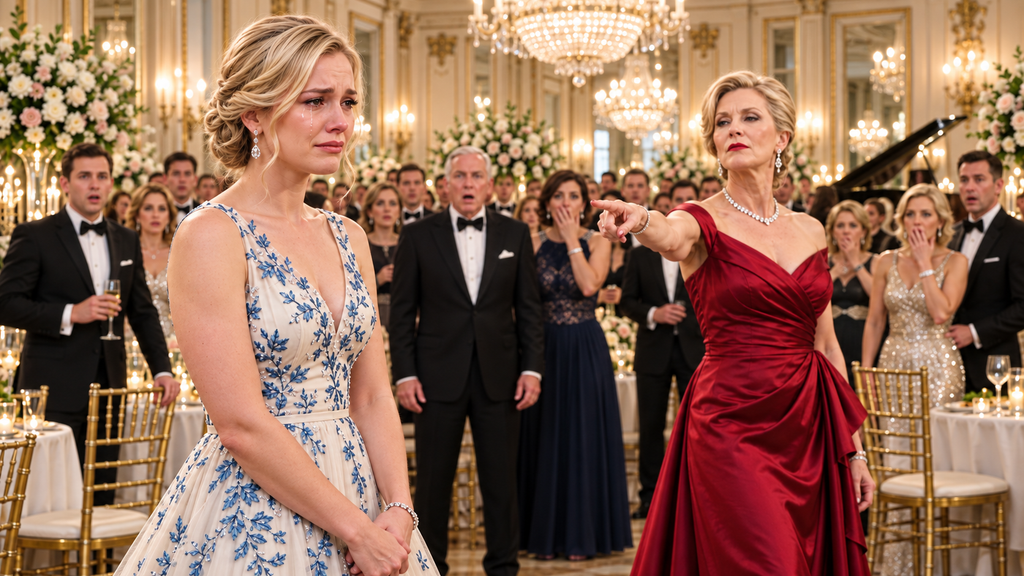
Because twenty minutes earlier, she had looked at me beneath those chandeliers as if I were a stray dog that had wandered into her house.
Now she needed something from me.
I declined the call.
A message arrived immediately.
VIVIAN: Whatever childish stunt you are pulling, undo it immediately.
I read it twice.
Then I placed my phone facedown.
The driver glanced at me through the mirror.
“Everything all right, Ms. Carter?”
I looked out the window.
The city moved past in streaks of gold and red.
Couples crossed sidewalks.
Restaurants glowed.
People laughed behind windows.
The whole world seemed completely unaware that one family had just come apart inside a ballroom.
“Yes,” I said.
And for the first time all evening, I realized I meant it.
“I think it finally is.”
My mother’s name was Eleanor Carter.
Most people who knew the Grand Meridian knew my father’s name.
That was one of the cruelest things about success.
History usually remembered the person who stood beneath the lights.
Not the one who built the stage.
Twenty-six years earlier, the Grand Meridian had been a rotting brick warehouse along the river.
Broken windows.
Flooded basement.
Pigeons nesting in the rafters.
Dad thought it was worthless.
Mom didn’t.
She saw the tall arched windows and exposed beams.
She saw a ballroom where there were piles of rusted machinery.
She saw suites overlooking the river.
She saw weddings.
Anniversaries.
Families.
She saw something beautiful where everyone else saw decay.
My mother had inherited the riverfront property from her grandfather.
The land was hers.
The initial redevelopment money was largely hers too.
My father had the personality for investors.
Mom had the property, the plan, and enough quiet intelligence to make sure enthusiasm never replaced protection.
Before construction began, she placed the land into a trust.
Years later, when the hotel became profitable, she reorganized the ownership structure again.
My father was given management authority.
He could operate it.
Expand it.
Represent it.
He could draw income from it.
But he could not permanently sell the land.
He could not pledge certain protected assets.
And most importantly, he could never strip my mother’s controlling interest away from the beneficiary she named.
Me.
I did not understand any of that when I was eleven.
I only understood that my mother loved the hotel.
Sometimes on Sunday mornings, before guests came downstairs for breakfast, she would take me through the lobby.
She would straighten flowers herself.
She would know the names of the night clerks.
She would stop in the kitchen to ask whether Miguel’s wife had recovered from surgery.
She remembered housekeepers’ children.
Birthdays.
College applications.
Illnesses.
Once I asked her why she bothered.
“You own this place,” I told her.
“You could make other people do that.”
Mom stopped walking.
She crouched so that we were eye to eye.
“No, sweetheart.”
Then she touched the center of my chest.
“Ownership doesn’t mean everyone below you.”
She pointed toward the ceiling.
“It means everything underneath that roof is partly your responsibility.”
I never forgot that.
My father did.
After she died, the hotel became less of a responsibility to him and more of a mirror.
Awards.
Magazine covers.
Charity galas.
Photographs.
Politicians.
Celebrities.
People began calling it Richard Carter’s Grand Meridian.
At first I corrected them.
Eventually I stopped.
Dad seemed happy.
And after losing Mom, I thought maybe he needed something to hold together.
So I let him have the story.
That was my mistake.
When you let someone borrow your silence long enough, sometimes they begin believing it belongs to them.
At 9:12 p.m., I arrived at my apartment.
There were twenty-three missed calls.
I kicked off my shoes, walked into the kitchen, and poured myself a glass of water.
My hands were trembling.
That surprised me.
Not because I was afraid of what I had done.
Because my body had finally caught up with the humiliation I had refused to show at the gala.
I could still hear Vivian.
Security, remove her.
I could still see two hundred faces turning toward me.
But most of all, I could still see my father standing there.
Silent.
I had spent years forgiving his silence.
When Vivian interrupted me at dinner.
Silence.
When she moved photographs of my mother out of the hotel offices.
Silence.
When she told guests that I had “never really understood business.”
Silence.
When I stopped receiving notices for board meetings.
Silence.
When my office at the Grand Meridian was reassigned to Vivian’s personal assistant.
Silence.
And that night, when security came toward me like I was trespassing inside the building my mother had built—
Silence.
My phone rang again.
Thirty-one missed calls.
I opened the latest voicemail.
Dad’s voice exploded through the speaker.
“Emma, I don’t know what the hell you think you’re doing, but the bank has frozen access to the reserve account. Call me back immediately.”
I deleted it.
Another voicemail.
His attorney.
“Emma, this is Lawrence. There appears to be a significant misunderstanding regarding certain legacy trust documents. I strongly recommend no additional action until all parties can discuss—”
Delete.
Then Vivian.
Her voice was different now.
Still angry.
But underneath the anger was something I had never heard from her before.
Fear.
“Emma, your father has spent decades building that hotel. Whatever paperwork you found does not give you the right to destroy his life because your feelings got hurt at a party. Call us immediately.”
I stared at the phone.
Whatever paperwork you found.
That was the problem.
Vivian thought I had found something.
She still did not understand.
I had known about the trust since I was twenty-one.
Mom had told me shortly before she died.
Not every detail.
Just enough.
We were sitting in her hospital room.
She had become so thin by then that the wedding ring she never removed had begun slipping on her finger.
She asked me to close the door.
Then she said:
“Emma, your father is a good man when he remembers who he is.”
At twenty-one, I was offended on his behalf.
“Mom—”
She squeezed my hand.
“Listen.”
So I did.
“He loves you.”
Her eyes filled.
“But your father loves being admired too.”
I stayed silent.
“One day those two things may compete.”
“Dad would never choose strangers over me.”
Mom gave me the saddest smile I had ever seen.
“I hope you are right.”
Then she told me about Miriam.
The trust.
The authority that would become mine later.
And the reason she had structured everything so carefully.
“I’m not protecting you from your father,” she said.
“I’m protecting all of you from what grief, pride, money, or another person might someday convince him to become.”
For years, I thought she had been too cautious.
That night, sitting alone in my kitchen with thirty-eight missed calls glowing on my phone, I finally understood.
Mom had not predicted Vivian.
She had simply understood human nature.
At 9:36 p.m., Miriam called again.
“Something else has happened.”
“What?”
“The board chair contacted me.”
I stood straighter.
“Daniel?”
“Yes.”
Daniel Reeves had been my mother’s closest business friend.
He was seventy-three now.
Formal.
Reserved.
The kind of man who still mailed handwritten thank-you notes.
He had been at the gala.
He was also the man who had lowered his eyes when Vivian ordered security to remove me.
The memory burned.
“What does he want?”
“To speak with you.”
“I don’t.”
“I understand.”
“No. You don’t.”
My voice broke slightly.
“He watched them humiliate me.”
Miriam was quiet.
Then she said:
“Yes.”
That one word stopped me.
No excuses.
No defense.
Just yes.
“He watched it,” she continued. “And I suspect he knows exactly what that cost him.”
I sat down.
“Why is he calling now?”
“Because the board received notice of the ownership transfer.”
“How?”
“The corporate registry updates automatically triggered notice to certain officers.”
“And?”
“And your father apparently told the board for years that the Eleanor Carter Legacy Trust was ceremonial.”
I almost laughed.
“Ceremonial?”
“That appears to be the word he used.”
“Did Daniel believe him?”
“I don’t know.”
I looked toward the photograph of my mother on the bookshelf.
“No.”
“What?”
“I said I don’t know either.”
A new text appeared.
DANIEL REEVES: Emma, I failed your mother tonight. I failed you too. I will not insult you by pretending otherwise. If you allow it, I would like five minutes to explain what happened.
I stared at it.
Then another message appeared.
DANIEL: Whether you answer or not, you deserved better.
I set the phone down.
That one hurt worse than Vivian’s insults.
Because apologies from people you once trusted have a way of revealing exactly how much they understood while they were hurting you.
By 10:00 p.m., the calls had reached forty-six.
The gala had apparently dissolved into chaos.
I knew because three employees texted me.
MARIA – FRONT OFFICE: Miss Emma, are you okay? People are leaving. Mr. Carter is shouting upstairs.
JONAH – BANQUETS: I don’t know what happened, but Mrs. Carter told staff nobody should speak with you. Just wanted you to know a lot of us remember your mom.
Then a message from a number I had not saved.
This is Luis from engineering. Your mother paid for my apprenticeship when I was nineteen. Whatever happens, thank you for protecting what she built.
That was when I cried.
Not at the gala.
Not in the car.
Not when my father called me childish.
I cried in my kitchen because a maintenance engineer remembered my mother.
I sat on the floor against the cabinets and covered my mouth with my hand.
For six months, Vivian had been working very hard to convince people that I was the problem.
And maybe, somewhere along the way, I had begun wondering if she was right.
That is one of the most dangerous things about being slowly pushed out of your own life.
It rarely happens all at once.
Nobody takes everything on Monday.
Instead, Tuesday you stop being invited to lunch.
Wednesday someone forgets to copy you on an email.
Thursday your office is needed “temporarily.”
A month later, somebody jokes that you were never very involved anyway.
Then family members begin repeating it.
Then employees believe it.
Then one evening you walk into a building filled with memories and someone points toward the door.
And suddenly you realize everyone has been rehearsing your disappearance.
The transfer was not revenge.
It was me refusing to disappear.
At 10:17 p.m., my father finally sent the message I had been waiting for.
Not because I wanted it.
Because I knew eventually anger would give way to bargaining.
DAD: Emma. Please. Answer me.
I stared at the word.
Please.
My father rarely said please to anyone.
Another message arrived.
DAD: We need to talk privately before Vivian does something stupid.
I actually laughed then.
It came out bitter.
Too late, Dad.
Much too late.
The phone rang.
I declined it.
Then he sent:
DAD: This can still be fixed.
I typed three words.
Nothing is broken.
My thumb hovered.
Then I pressed send.
The typing bubbles appeared immediately.
Stopped.
Appeared.
Stopped.
Finally:
DAD: What does that mean?
I answered:
It means Mom’s trust is functioning exactly as she designed it to.
Nothing came back for nearly a minute.
Then my phone rang again.
I let it ring.
Voicemail.
This time when I listened, Dad was not shouting.
“Emma.”
Long pause.
“I didn’t know you were going to do this.”
Another pause.
“I know tonight got out of hand.”
I closed my eyes.
Got out of hand.
As if humiliation were a spilled drink.
“I should have handled Vivian differently.”
Differently.
Not stopped her.
Not defended me.
Handled her differently.
“But transferring the property? Freezing those accounts? You’re putting hundreds of employees at risk because of a family disagreement.”
My eyes opened.
There it was.
The move I knew would come.
Guilt.
Use the employees.
Use the hotel.
Use my mother’s memory.
Make me responsible for the consequences of behavior I did not create.
Dad continued.
“Call me. We can undo this before tomorrow.”
The voicemail ended.
I immediately called Miriam.
“Are employees at risk?”
“No.”
“Payroll?”
“Protected.”
“Vendor payments?”
“Protected.”
“Bookings?”
“Unaffected.”
“Pensions?”
“Unaffected.”
“The reserve transfer?”
“Capital reserve funds are now under trust control, but legitimate operating expenses continue normally.”
I exhaled.
“I needed to hear that.”
“I know.”
“Miriam?”
“Yes?”
“Send my father written confirmation that employees, payroll, vendors, guest deposits, and operations are protected.”
“You want to reassure him?”
“No.”
I looked at the latest voicemail.
“I want him to know he can’t use them to manipulate me.”
For the first time all night, Miriam laughed.
“I knew your mother for thirty-four years.”
“And?”
“You sound exactly like her.”
I did not cry again.
But I came close.
At 10:42 p.m., Daniel Reeves called.
This time I answered.
“Emma.”
His voice sounded older than it had three hours earlier.
“You have five minutes.”
“I deserve fewer.”
I said nothing.
He took a breath.
“Three months ago, Richard told us you had voluntarily stepped away from hotel operations.”
“That was a lie.”
“I know that now.”
“You could have called me.”
“Yes.”
“You had my number.”
“Yes.”
“You knew me since I was nine.”
“Yes.”
Every answer was quiet.
No excuses.
That almost made me angrier.
“Why didn’t you call?”
“Cowardice.”
I was not prepared for that answer.
Daniel continued.
“Your father said you were struggling after an investment loss. Vivian implied you had become emotionally unpredictable. Lawrence presented documents indicating management authority had been consolidated under Richard.”
“My ownership?”
“Never discussed.”
“Did you ask?”
Long pause.
“No.”
“Why?”
“Because Richard had run the Grand Meridian for years. Because it was easier to believe him.”
I swallowed.
“And tonight?”
“I knew you were on the invitation list.”
My hand tightened around the phone.
“Then why did you look away?”
His voice cracked.
“Because when Vivian ordered security to remove you, I realized immediately that something was wrong.”
“That doesn’t explain why you looked away.”
“No.”
He breathed in.
“I looked away because I was ashamed.”
That silenced me.
“I had helped create the room where she believed she could do that to you.”
I walked toward the window.
Cars moved far below.
Daniel continued.
“Your mother would have crossed that ballroom.”
I closed my eyes.
“Yes.”
“She would have stood beside you.”
“Yes.”
“I didn’t.”
“No.”
“I am sorry.”
My throat hurt.
“Sorry doesn’t undo it.”
“I know.”
“Then why are you calling?”
“Because I have resigned as chairman.”
I turned from the window.
“What?”
“I submitted my resignation eleven minutes ago.”
“Daniel, I didn’t ask you to.”
“No.”
His voice became steadier.
“Eleanor would not have needed to ask.”
For several seconds, neither of us spoke.
Then he added:
“I also sent you every board communication from the last six months.”
My pulse changed.
“Why?”
“Because you need to know what has been happening.”
“What has been happening?”
A long silence.
Then:
“Your father and Vivian were preparing to sell the hotel.”
Everything inside me stopped.
“What?”
“The board had not formally approved it. But negotiations were advanced.”
“To whom?”
“Falcon Ridge Hospitality.”
I knew the name.
A national luxury hotel group famous for acquiring independent properties, cutting staff, standardizing operations, and stripping away anything that did not fit their brand.
“No.”
My voice was barely audible.
“They couldn’t.”
“They believed they could.”
“The trust prohibits sale of the land without beneficiary approval.”
“I know that now.”
“Dad knows that.”
Daniel hesitated.
“Emma…”
“What?”
“I don’t think your father intended to sell the land.”
My stomach tightened.
“What was he planning?”
“A ninety-nine-year lease.”
I went cold.
Technically, in some structures, it would not count as a sale.
Practically, it would surrender control for the rest of my lifetime.
My mother had protected the hotel from being sold.
My father had apparently spent months looking for a way around her wishes.
“And the seventeen million?”
I asked.
“That was part of the transaction.”
“How?”
“Falcon Ridge wanted the reserve retained inside the operating company at closing.”
I sat slowly.
The room felt strangely far away.
So that was why Vivian had been removing me.
Not because she hated me.
Not only because she hated me.
Because I was an obstacle.
Board meetings.
Foundation meetings.
My office.
My reputation.
The gala.
None of it had been random.
They needed me socially discredited before I became legally inconvenient.
“Daniel.”
“Yes?”
“Send me everything.”
“I already did.”
My email chimed.
More than forty attachments.
“Emma?”
“Yes?”
“There is something else.”
I waited.
“The gala tonight wasn’t primarily a donor event.”
I stared at nothing.
“What was it?”
“A celebration.”
My skin prickled.
“Of what?”
“The Falcon Ridge deal.”
Suddenly the chandeliers in my memory looked different.
The champagne.
The investors.
The photographers.
The strangers.
The unusual number of attorneys.
Vivian’s confidence.
The envelope I had carried inside.
And my father telling me not to make a scene.
They had not merely excluded me from a party.
They had attempted to remove the one person who could stop them from giving away my mother’s life’s work.
“Did they intend to announce it tonight?”
“Tomorrow morning.”
I looked at my mother’s photograph.
“That’s why Vivian wanted me out.”
“Yes.”
My voice was very calm when I asked:
“Did my father know?”
Daniel did not answer immediately.
He did not need to.
I already knew.
“Yes,” he finally said.
The word landed harder than anything Vivian had done.
I thanked Daniel.
Then I hung up.
There are betrayals that make you scream.
And there are betrayals so complete they make you quiet.
I sat in my mother’s chair.
The one piece of furniture I had taken from her office after she died.
For years it had been beside my window.
Brown leather.
Worn on one arm where she used to rest her hand while reading.
I opened Daniel’s files.
The first was a preliminary term sheet.
The second was an internal board presentation.
The third was correspondence between my father and Falcon Ridge.
Then I found the email.
From Richard Carter.
My father.
Sent four months earlier.
Emma’s involvement is sentimental rather than operational. Vivian and I are handling the family side. Any legacy consent issues can be managed when necessary.
I read it once.
Then again.
Sentimental rather than operational.
I remembered being sixteen, folding hotel towels because housekeeping was short-staffed.
Twenty-two, learning revenue management.
Twenty-four, staying in the building for seventy-two hours after a flood.
Twenty-seven, negotiating the restaurant lease that saved us nearly nine hundred thousand dollars over ten years.
Thirty-one, restructuring the hotel’s insurance after Dad called the details “boring.”
Thirty-three, sitting beside employees during layoffs we ultimately managed to avoid.
Sentimental.
I scrolled.
Another email.
This one from Vivian.
The daughter issue should not interfere. Richard has assured me her authority is limited and she can be kept away from negotiations.
The daughter issue.
Not Emma.
Not beneficiary.
Not owner.
Issue.
I kept reading.
A message from Dad:
She won’t challenge me publicly. Emma hates conflict.
That one hurt the most.
Because it was true.
Or had been.
My father had not underestimated my intelligence.
He had underestimated my willingness to disappoint him.
There is a difference.
I think many parents confuse obedience with love.
And when the obedient child finally says no, they act as if love itself has been withdrawn.
But sometimes no is simply the first honest word left.
At 11:08 p.m., my phone showed sixty-one missed calls.
I turned it off.
Then I called Miriam.
“I need you to read the Falcon Ridge documents Daniel sent.”
“I already have.”
Of course she had.
“What can Dad do?”
“Tonight?”
“Yes.”
“Nothing useful.”
“And tomorrow?”
“Challenge the trust authority.”
“Would he win?”
“No attorney should promise outcomes.”
“Miriam.”
She sighed.
“Your mother’s documents are unusually clear.”
That sounded like Mom.
“She anticipated leasing?”
“Anything over twenty years requires beneficiary approval.”
I closed my eyes.
Of course she did.
“The transaction is dead?”
“If you refuse approval, yes.”
“I refuse.”
“I assumed.”
“What happens to Dad?”
“As manager?”
“Yes.”
“You now have authority to remove him.”
The sentence sat heavily between us.
I had known that too.
But knowing a power exists and deciding to use it are different things.
“What would Mom do?”
Miriam was silent for a long moment.
Then:
“She wouldn’t ask me.”
I smiled sadly.
“No. She wouldn’t.”
“She would ask herself whether Richard could still be trusted with the responsibility.”
My mother’s voice returned to me from twenty-five years earlier.
Ownership means responsibility.
Not privilege.
Not punishment.
Responsibility.
“Prepare his removal.”
Miriam did not respond immediately.
“Emma?”
“Prepare it.”
“And Vivian?”
“She has no official position.”
“She has been operating as executive advisor.”
“Not anymore.”
“Understood.”
“Effective immediately, neither of them can authorize contracts, transfers, loans, leases, changes to reserve accounts, executive appointments, or vendor terminations.”
“I’ll draft it.”
“One more thing.”
“Yes?”
“No announcement tonight.”
Miriam sounded surprised.
“You don’t want them to know?”
“They’ll know enough.”
I looked at the time.
11:19 p.m.
“I want to speak to my father before I decide what version of this becomes public.”
“That’s generous.”
“No.”
I stared at the email calling me sentimental.
“It’s private.”
At 11:37 p.m., someone buzzed from downstairs.
I already knew who it was.
The concierge called.
“Ms. Carter, your father and Mrs. Carter are here.”
I looked toward the front door.
“Did you invite them up?”
“No.”
“Good.”
There was loud talking in the background.
Then the concierge lowered his voice.
“Mrs. Carter is insisting.”
“I’m sure she is.”
“Would you like me to call security?”
For a moment, the irony was almost perfect.
Three hours earlier:
Security, remove her.
Now Vivian was the one standing outside a place where she was not welcome.
“No.”
I stood.
“Send them up.”
I almost added:
Both of them.
But I didn’t need to.
The knocking began before midnight.
Not polite knocking.
Not hesitant.
Hard.
Fast.
Desperate.
The kind of knocking people use when they believe a closed door is the only thing standing between them and disaster.
I opened it.
Vivian entered first.
Of course she did.
Her perfect gala makeup had begun to crack around the eyes.
Her hair was slightly loose.
The diamond earrings were still there.
The expensive black gown too.
But the woman inside it looked very different from the one who had stood beneath the chandeliers.
Richard came behind her.
My father seemed twenty years older.
His bow tie was gone.
His collar open.
His face gray.
He looked at me for several seconds.
Then at the apartment behind me.
As if he had never noticed before that I had a life he did not control.
Vivian did not wait.
“What have you done?”
I closed the door.
“Would either of you like water?”
She stared.
“Water?”
“Yes.”
“You have frozen accounts, hijacked the ownership of a hotel, sabotaged a major corporate transaction, and you are asking if I want water?”
“It’s late.”
“Emma!”
My father’s voice filled the room.
I looked at him.
He stopped.
Maybe because I did not flinch.
Dad had always been able to silence me with volume.
Not that night.
“You transferred the hotel.”
“Yes.”
“The land.”
“Yes.”
“The reserve.”
“Yes.”
His eyes widened slightly at each answer.
“You had no right.”
I looked at him for a long time.
Then I walked to the dining table.
I had placed the original trust copy there.
I turned it toward him.
“You should read page fourteen.”
“I know what the trust says.”
“Apparently not.”
“I have managed that hotel for twenty-two years.”
“Managed.”
I emphasized the word.
“You managed it.”
Vivian stepped forward.
“Oh, spare us the legal games.”
I looked at her.
“You should be very careful with the word legal tonight.”
Something flickered across her face.
Good.
“You humiliated us in front of half the city,” she snapped.
I actually smiled.
“No.”
“What?”
“You threw me out in front of half the city.”
I pointed toward the table.
“I transferred property privately.”
“That’s semantics.”
“No. That’s the difference between humiliation and consequences.”
Dad pressed his palms to the table.
“Emma, enough.”
There it was.
The old command.
Enough.
The word fathers use when they do not like hearing the ending to a story they helped write.
“No,” I said.
The room went silent.
Dad stared.
I had probably never said the word to him like that in my life.
Not loudly.
Not angrily.
Simply completely.
“No, Dad.”
His face tightened.
“You will undo this.”
“No.”
“You don’t understand the consequences.”
“I understand them better than you do.”
“You’ll destroy the deal.”
“Yes.”
His mouth opened.
Then closed.
Vivian looked between us.
“You knew?”
I asked.
Dad’s eyes changed.
That was all the answer I needed.
“Knew what?” Vivian said quickly.
I ignored her.
“You knew the trust restricted long-term leases.”
“Emma—”
“You knew.”
“Your mother wrote those documents in another era.”
I laughed once.
It sounded hollow.
“Another era?”
“The hotel is worth more today than Eleanor could ever have imagined.”
“Don’t use her first name like she’s an outdated contract.”
Dad recoiled.
Vivian stepped between us.
“Your father built that hotel.”
I turned to her.
“My mother owned the land.”
“He made it successful.”
“My mother funded the redevelopment.”
“Richard made the name.”
“My mother created the concept.”
“You were a child.”
“Yes.”
My voice softened.
“And I remember more than you think.”
Vivian folded her arms.
“Do you think your mother would be proud of this?”
That was the moment something inside me settled.
For months she had been using my mother’s absence as empty space she could decorate however she wanted.
That ended there.
“You don’t get to speak for my mother.”
Vivian opened her mouth.
I lifted one hand.
“No.”
She froze.
“You removed her photographs from the executive hall.”
“That was part of the redesign.”
“You replaced the Eleanor Carter Scholarship plaque with a photograph of you and my father.”
“That hallway needed modernization.”
“You stopped inviting three of her oldest employees to the annual dinner.”
“They’re retired.”
“You changed the foundation name.”
“It needed broader branding.”
“And tonight you ordered me removed from her hotel.”
Vivian’s face hardened.
“Because you were not supposed to be there.”
“I was on the invitation list.”
“You had become disruptive.”
I almost whispered:
“I had not said a single word.”
She had no answer.
I looked at Dad.
“You let her do all of it.”
He straightened.
“Vivian did not force me to do anything.”
That surprised her.
I saw it immediately.
Her eyes moved toward him.
Dad continued.
“I made those decisions.”
“Richard—”
“No.”
Now he silenced her.
For the first time that evening, my father finally looked directly at the truth.
“I approved the redesign.”
My throat tightened.
“I approved removing Emma from the committees.”
Vivian’s lips parted.
“I told the board she was stepping away.”
“Richard!”
“I authorized tonight.”
The room became utterly still.
I stared at him.
Even though I already knew.
Even though the emails had told me.
Hearing it was different.
“You knew she was going to have security remove me?”
Dad looked down.
“Yes.”
One word.
That was all.
The child inside me finally stopped waiting for her father to cross the ballroom.
He never had been about to.
He had chosen the other side before I entered the room.
I nodded slowly.
“Thank you.”
Dad looked up.
“For what?”
“For finally telling me the truth.”
His face crumpled for half a second.
“Emma, I thought you would make a scene.”
“I never do.”
“I know.”
His voice became quiet.
“That was the problem.”
I frowned.
He sank into one of the dining chairs.
“I knew you wouldn’t fight.”
Vivian stared at him.
“Richard, stop talking.”
He ignored her.
“Your mother fought me on everything.”
A sad smile touched his face.
“Everything.”
I remembered.
Mom and Dad arguing over menus.
Carpets.
Budgets.
Expansion.
He would explode.
She would stare at him until he ran out of noise.
Then somehow they would figure it out.
“When Eleanor died,” he said, “you became quiet.”
“I was grieving.”
“I know.”
“No.”
My voice cracked.
“You clearly don’t.”
He flinched.
I continued.
“I was twenty-one.”
“I know.”
“I lost my mother.”
“So did I.”
“Then why did I have to become easy for you?”
Dad looked at me.
“What?”
“I stopped arguing because you were falling apart.”
His face went still.
“I attended meetings you forgot.”
I stepped closer.
“I signed the paperwork you left unopened.”
Another step.
“I handled the staff when you disappeared for days.”
His eyes lowered.
“I sat beside you at Mom’s funeral and spent the entire service worrying whether you were going to survive it.”
My chest hurt now.
“And somewhere along the way, you decided my quiet meant I was weak.”
“Emma—”
“You married Vivian, and I was polite.”
Vivian’s face tightened.
“You moved her things into Mom’s office, and I was polite.”
Dad rubbed one hand across his face.
“You took Mom’s portrait down, and I was polite.”
My tears finally came.
Not dramatic.
Just steady.
“You removed me from meetings, and I kept telling myself you needed space.”
Dad looked devastated.
“You let her call me unstable, and I thought maybe defending myself would make everything uglier.”
I wiped my cheek.
“Then tonight you had security walk toward me.”
My voice dropped.
“And I finally understood something.”
Neither of them moved.
“You didn’t keep hurting me because you didn’t know it hurt.”
Dad stared at me.
“You kept doing it because you had learned I would absorb it quietly.”
That sentence broke something in him.
I watched it happen.
His shoulders dropped.
His eyes filled.
“Emma.”
“No.”
I shook my head.
“You don’t get to cry and make me comfort you.”
He covered his face.
And for once, I let my father carry his own pain.
Vivian did not.
She stood rigid beside the table, looking furious that emotion had replaced negotiation.
Finally she snapped:
“This is absurd.”
Dad lowered his hands.
“Vivian.”
“No. Enough with the family therapy.”
She pointed at me.
“She took seventeen million dollars.”
“I transferred assets belonging to the trust.”
“You stole them.”
“Be very careful.”
“Oh, stop threatening me with lawyers.”
“I’m not threatening you.”
I picked up my phone.
“I’m telling you Miriam has already preserved every email regarding Falcon Ridge.”
Vivian stopped breathing for a moment.
Dad looked at her.
“What emails?”
That was interesting.
I turned toward him.
“You didn’t know?”
“Know what?”
Vivian stepped forward.
“Emma is trying to manipulate—”
I held up the printed email.
The one Daniel had sent.
“Would you like to read Vivian’s message about ‘the daughter issue’?”
Dad slowly looked toward his wife.
Vivian’s face lost color.
“Richard, that was business language.”
I placed the page in front of him.
He read.
His jaw tightened.
Then I placed another page down.
“And here is the draft consulting agreement.”
Vivian moved toward the table.
“Give me that.”
I pulled it back.
Dad looked at me.
“What consulting agreement?”
For the first time, my anger shifted.
Because his confusion looked real.
I handed it to him.
“You should ask your wife.”
He read the first page.
Then the second.
His hand began shaking.
“Vivian.”
She said nothing.
“Three million?”
His voice was nearly a whisper.
She folded her arms.
“It was part of the transition.”
“Three million dollars?”
“For advisory services.”
“To you?”
“I facilitated the relationship with Falcon Ridge.”
Dad stood.
“You told me their advisory payment was an outside brokerage expense.”
“It essentially was.”
“You were receiving it?”
“Richard—”
“You were receiving three million dollars?”
Her composure cracked.
“For once in my life, yes, something was going to be mine!”
Dad recoiled as if she had struck him.
Vivian realized what she had said.
Too late.
The whole room changed.
She looked at me.
Then him.
“You know what I mean.”
“No,” Dad said.
His voice was low.
“I don’t.”
She laughed bitterly.
“Oh, please. Do you think I enjoyed spending six years smiling at donors and entertaining your ancient board members? Do you think I enjoyed hearing Eleanor’s name everywhere I went?”
My blood chilled.
Dad’s face hardened.
“Watch yourself.”
“No.”
Vivian pointed toward the photograph of Mom.
“There she is again.”
My entire body went still.
“That woman has been dead for twenty-two years, and somehow every room still belongs to her.”
Dad stared.
“Vivian.”
“The hotel was hers.”
She laughed.
“The scholarship was hers. The foundation was hers. The trust was hers. Emma walks through those doors, and everyone whispers that she looks like Eleanor.”
She turned toward me.
“That was the real problem.”
Finally.
There it was.
Not business.
Not concern.
Not my alleged instability.
Jealousy.
A dead woman had been living inside my stepmother’s marriage.
And instead of competing with memory honestly, she had tried to erase the daughter who carried it.
“You thought getting rid of me would get rid of her,” I said.
Vivian said nothing.
I almost felt sorry for her.
Almost.
“You were never competing with Mom.”
My voice softened.
“You were competing with the part of Dad that knew what he had become after she died.”
Dad closed his eyes.
Vivian’s face twisted.
“You think you’re so much better than me.”
“No.”
I looked at her.
“I just think I finally understand you.”
I pointed toward the door.
“And now I want you to leave.”
She laughed.
“You’re throwing me out?”
“Yes.”
“Richard?”
Dad did not move.
She stared at him.
“Richard.”
He looked at the consulting agreement.
Then at her.
“Go.”
One word.
Her mouth dropped open.
“You cannot be serious.”
“Go home, Vivian.”
“That is my home too.”
“Then go there.”
“What about you?”
Dad looked at me.
“I need to speak to my daughter.”
Vivian’s eyes filled with rage.
“She’s destroying everything.”
“No,” Dad said quietly.
“She stopped us from doing that.”
Vivian looked as though he had betrayed her.
Maybe he had.
Maybe betrayal always looks different depending on which side of truth you are standing on.
She grabbed her purse.
At the door, she turned toward me.
“This won’t make you happy.”
I nodded.
“You’re right.”
That seemed to surprise her.
“I didn’t do it to be happy.”
“Then why?”
I thought about Mom.
The employees.
The land.
The email calling me an issue.
The security guard approaching me.
“Because some things should survive the people willing to sell them.”
Vivian left.
The door clicked shut.
My father and I stood alone.
For several minutes, neither of us spoke.
No lawyers.
No Vivian.
No board.
No gala.
Just a father and daughter standing inside the wreckage of twenty-two years of things we had never said.
Finally Dad looked toward my mother’s chair.
“You kept it.”
“Of course.”
He ran his fingers along the worn leather arm.
“She used to sit like this.”
He lowered himself into it.
Then immediately stood again.
“No.”
I looked at him.
“That’s your chair.”
The correction was small.
But I understood.
He sat in the chair across from me instead.
“Are you removing me?”
I could have lied.
I didn’t.
“Yes.”
His face changed.
“From management?”
“Yes.”
“For how long?”
“I don’t know.”
He nodded slowly.
“And the hotel?”
“Will open tomorrow morning exactly as it opened today.”
“The deal?”
“Dead.”
He closed his eyes.
“Falcon Ridge will sue.”
“They can try.”
“We spent months negotiating.”
“I know.”
“You read everything?”
“Enough.”
He rubbed his forehead.
“You think I betrayed your mother.”
“No.”
He looked up.
“I think you betrayed yourself.”
That hurt him more.
I could see it.
“Mom gave you management because she trusted you.”
“I made that hotel worth hundreds of millions.”
“Yes.”
He blinked.
I continued.
“You did.”
His face softened with surprise.
“I’m not going to erase what you accomplished because you tried to erase me.”
His eyes filled.
“You built relationships Mom could never have built.”
I leaned forward.
“You expanded the hotel.”
He swallowed.
“You guided it through recessions.”
His mouth trembled.
“You deserve credit.”
Then I added:
“But credit is not ownership.”
He nodded once.
“Mom protected the property from you.”
He looked down.
“She did.”
“And she protected you from yourself.”
A tear slipped down his cheek.
“I hated that trust.”
“I know.”
“For years.”
“I know.”
“I thought it meant she didn’t trust me.”
“Maybe she knew you.”
He gave a broken laugh.
“That’s worse.”
“No.”
I shook my head.
“Being known isn’t the same as being condemned.”
Dad looked at me.
“Then what am I?”
“My father.”
“That’s not what I mean.”
“I know.”
He struggled for the words.
“After everything I did tonight… what am I to you?”
I was quiet.
There are questions people ask hoping forgiveness will arrive quickly enough to save them from consequences.
But forgiveness and access are not the same thing.
Neither are forgiveness and trust.
“You’re still my father.”
His eyes closed.
“But you don’t get the old relationship back because you’re sorry.”
“I understand.”
“No, Dad.”
I waited until he looked at me.
“You need to really understand.”
He nodded.
“You helped Vivian push me out of my mother’s legacy.”
His jaw trembled.
“You lied to people about me.”
“Yes.”
“You allowed them to question my stability.”
“Yes.”
“You hid a deal from me because you knew I could stop it.”
“Yes.”
“You planned to have me removed tonight so you could celebrate surrendering control of the hotel without me interfering.”
His voice disappeared.
“Yes.”
“And when I looked at you for help…”
I had to stop.
That was the part that still hurt.
Not the trust.
Not the money.
Not the hotel.
I was still his daughter standing beneath a chandelier waiting for my father to defend me.
My voice broke.
“You looked away.”
Dad began crying.
“I know.”
This time I let him.
“I’m sorry.”
I wiped my face.
“I believe you.”
He looked up.
“But believing you’re sorry does not make me ready to trust you.”
“I understand.”
“And tomorrow morning, your access to the Grand Meridian will be suspended.”
His expression collapsed.
“For now.”
“For now.”
He took a shaky breath.
“What am I supposed to do?”
The question was so childlike that it almost broke me.
But I remembered what Mom had taught me.
Responsibility.
Not rescue.
“You figure out who Richard Carter is when he isn’t standing inside a hotel people admire.”
He stared at me.
“That’s cruel.”
“No.”
I spoke gently.
“That’s the question you’ve been avoiding for twenty-two years.”
Dad looked toward Mom’s photograph.
And for the first time, he did not argue.
At 12:26 a.m., my father left.
He did not ask me to reverse the transfer again.
He did not hug me.
I did not hug him.
At the doorway, he stopped.
“Emma?”
“Yes?”
“I did love your mother.”
“I know.”
His eyes filled.
“And I love you.”
I swallowed.
“I know that too.”
He looked surprised.
Maybe he expected me to deny it.
But love was never the question.
That was one of the hardest truths I learned that night.
People can love you and still fail you.
People can love you and choose cowardice.
Love does not automatically create courage.
It does not automatically create respect.
Sometimes the deepest heartbreak comes from realizing someone loved you genuinely and still did not love you well enough.
Dad nodded.
Then he left.
I locked the door.
My phone sat on the table.
Sixty-eight missed calls.
I took a screenshot.
Not as a trophy.
As a reminder.
Three hours earlier, nobody in that ballroom believed my voice mattered.
They only started calling when my silence had consequences.
I slept for forty-three minutes.
At 5:30 a.m., I got up.
Showered.
Put on a charcoal suit.
Pinned my hair back.
And drove to the Grand Meridian.
The streets were nearly empty.
Dawn spread pale gold across the river.
As the hotel came into view, my chest tightened.
There it was.
Twelve stories of brick, glass, stone, memory, arguments, weddings, funerals, Christmas brunches, late-night room service, spilled champagne, exhausted employees, my father’s ambition, and my mother’s fingerprints.
The doorman saw me and froze.
Then he opened the door.
“Good morning, Ms. Carter.”
“Good morning, Henry.”
His eyes watered.
“You remember my name?”
“You’ve worked here eighteen years.”
He smiled.
“Twenty-one next March.”
“Then I owe you an apology.”
He laughed.
“No, ma’am.”
Inside, overnight employees had gathered near the front desk.
Someone had apparently told them I was coming.
Maria stood first.
Then Jonah.
Luis.
Several housekeepers.
Two cooks.
A bellman.
Night security.
They looked nervous.
Nobody knew whether the hotel was being sold.
Whether jobs were disappearing.
Whether my family was imploding.
Probably all three.
I walked behind the front desk.
There was a small brass bell there from the original warehouse days.
My mother had kept it when the building was renovated.
She used to ring it during staff celebrations.
I touched it.
Then I looked at everyone.
“The Grand Meridian is not being sold.”
The lobby erupted.
Not cheers.
Not immediately.
First came exhalations.
Actual exhalations.
People looking at each other.
One woman covered her mouth.
Luis lowered his head.
“The hotel will remain independent,” I continued.
“No current employee is losing a job because of last night’s ownership transfer.”
Maria began crying.
“Payroll is protected. Guest deposits are protected. Pensions and benefits are protected. Vendors will be paid.”
A voice from the back asked:
“What about Mr. Carter?”
Silence.
I answered.
“Richard Carter has temporarily stepped down from all management authority.”
Nobody spoke.
I did not humiliate him.
I would not.
Whatever he had done, I was not going to become Vivian.
“An interim leadership team will be appointed today.”
Luis raised his hand slightly.
“Are you taking over?”
I smiled.
“No.”
Several people looked surprised.
“I am taking responsibility.”
I paused.
“But responsibility and running a hotel are not the same thing.”
Mom would have liked that distinction.
“We will hire the best operators we can find. People who understand what this place is.”
I looked around the lobby.
“And before any major decision is made, employees will have a voice.”
Someone began clapping.
I shook my head.
“Please don’t.”
They stopped.
“This isn’t a victory speech.”
I looked toward the portrait space beside the staircase.
It was empty.
Vivian’s redesign had removed Mom months earlier.
“Luis?”
“Yes?”
“Do you know where my mother’s portrait went?”
He smiled slowly.
“Storage room B.”
“Can you bring it back?”
His eyes brightened.
“Yes, ma’am.”
“Today.”
“Yes, ma’am.”
Thirty minutes later, Eleanor Carter returned to the Grand Meridian.
The portrait was taller than I remembered.
Mom stood beside the original warehouse doors wearing a cream suit and holding rolled architectural drawings.
Some employees stopped working just to watch it being hung.
Dad’s photograph remained on the opposite wall.
I had no intention of taking it down.
History should not be rewritten simply because part of it hurts.
His achievements were real.
So were his mistakes.
There was room for both truths.
Beneath Mom’s portrait, I placed a new plaque.
Not grand.
Just twelve words:
ELEANOR CARTER
SHE SAW WHAT THIS PLACE COULD BECOME—AND PROTECTED WHAT IT SHOULD REMAIN.
By 9:00 a.m., the story had reached the press.
Headlines appeared.
GRAND MERIDIAN SALE COLLAPSES AFTER SURPRISE TRUST TRANSFER
CARTER FAMILY SHAKEUP HALTS FALCON RIDGE ACQUISITION
RICHARD CARTER STEPS AWAY FROM HOTEL MANAGEMENT
Vivian’s name did not appear in our statement.
That bothered her.
I know because she called Miriam nine times.
By noon, her attorney had sent an aggressive letter claiming reputational harm.
Miriam replied with four pages of documentation and a request that Vivian preserve all communications relating to Falcon Ridge.
We never received another threatening letter.
Three weeks later, a forensic accounting review uncovered more.
The three-million-dollar consulting agreement was not the only arrangement Vivian had attempted to secure.
There was a relocation payment.
A “brand transition” fee.
And an agreement promising her a paid advisory role for five years after the lease.
Nearly $4.8 million in total potential compensation.
Dad knew none of it.
That did not absolve him.
He had created the environment where Vivian believed she could hide it.
But it did change something.
Their marriage did not survive.
I did not celebrate that.
People expected me to.
Some relatives even called to tell me that Vivian was “finally getting what she deserved.”
I hated those calls.
Pain is not cleaner simply because it happens to someone who caused pain.
Six months after the gala, my father filed for divorce.
I learned from Miriam.
He never called to complain about Vivian.
Never asked me to take sides.
That was probably the first sign he had started changing.
Dad and I did not speak for eleven weeks.
Not because I was punishing him.
Because I needed to discover what my life felt like without managing his emotions.
That was harder than I expected.
For years, before making almost any decision involving family, I had automatically asked myself:
How will Dad react?
Not:
What is right?
Not:
What do I want?
How will Dad react?
Removing that question from my life felt like learning to walk differently.
During those eleven weeks, handwritten letters began arriving.
One each Sunday.
From Dad.
The first said:
I’m sorry.
Nothing else.
The second was three pages.
I did not read it for four days.
When I did, there were no excuses.
That mattered.
He wrote about Mom.
About how angry he had been when she died.
About how he turned the hotel into proof that losing her had not defeated him.
Then how admiration became addictive.
How Vivian had understood that addiction.
How easy it had become to dismiss anyone who reminded him of limits.
Especially me.
One sentence stayed with me:
Your mother protected the hotel because she understood that my greatest strength and greatest weakness were the same thing: I always believed I could make the next deal work.
I folded the letter.
Put it away.
The next Sunday another arrived.
Then another.
Dad never asked me to restore his position.
Never mentioned the trust.
Never asked about the seventeen million.
He wrote about me.
Specific memories.
The first time I rode a bicycle.
The summer I broke my wrist.
The night Mom died.
The months after.
Things I did not know he remembered.
In the seventh letter he wrote:
I have spent most of my life confusing being needed with being loved. When you stopped needing me to make decisions for you, I treated your independence like rejection. Vivian made it easy to believe that story. But she did not invent it. I did.
That was the first letter that made me cry.
In the eleventh, he wrote:
I miss you. I am not asking you to fix that.
I called him the next morning.
He answered on the first ring.
“Emma?”
His voice was careful.
“Hi, Dad.”
Neither of us knew what to say.
Finally he asked:
“Coffee?”
I smiled.
“Coffee.”
We met at a tiny diner two neighborhoods away from the hotel.
Not the Grand Meridian.
That was my condition.
Dad arrived early.
He was wearing jeans.
I had almost never seen my father in jeans.
Without the hotel around him, he looked smaller.
Not weak.
Human.
We talked for two hours.
Not about business.
Not about Vivian.
Not about lawyers.
We talked about Mom’s terrible driving.
My childhood dog.
His first job.
The ridiculous wallpaper in our old kitchen.
At one point he laughed so hard he started coughing.
I realized I had not heard my father laugh like that in years.
When the check came, he reached for it.
Then stopped.
“May I?”
I laughed.
“Yes, Dad.”
He paid for my coffee.
It was the first thing I had let him give me in months.
It felt enormous.
Before we left, he asked:
“Will I ever go back?”
I knew what he meant.
The hotel.
I was quiet.
“I don’t know.”
He nodded.
“I can live with that.”
And I believed him.
A year after the gala, the Grand Meridian posted its strongest operating profit in nine years.
Not because I was some business genius.
Because we stopped treating the hotel like a trophy.
We promoted Maria to director of guest services.
Luis became chief building engineer.
We restored the employee scholarship program.
We created a profit-sharing structure for long-term staff.
We stopped three vanity renovation projects and invested the money into kitchens, staff spaces, maintenance, and guest rooms instead.
Daniel Reeves returned to the board.
Not as chairman.
He refused.
He said he had forfeited the privilege.
I disagreed eventually.
But I respected the choice.
Miriam remained trust counsel.
She also became the person most likely to call me at 6:00 a.m. and say:
“Your mother would haunt you for this contract.”
Which usually meant the contract was terrible.
The seventeen million remained protected.
We used a portion of the investment income to establish the Eleanor Carter Hospitality Scholarship, covering tuition and training for employees and their children.
The first recipient was Henry the doorman’s granddaughter.
When we announced her name, Henry cried harder than anyone.
So did I.
Two years after the gala, my father asked if he could come to the hotel.
Not return.
Visit.
There is a difference.
I said yes.
He arrived on a Tuesday morning.
No suit.
No driver.
No photographers.
Just Dad.
He stopped in the lobby when he saw Mom’s portrait restored.
For a long time he did not move.
Then he walked toward it.
Touched the frame.
And whispered:
“I’m sorry.”
I stood twenty feet away.
I don’t know whether he was apologizing to her for the Falcon Ridge deal.
For Vivian.
For me.
For losing himself.
Probably all of it.
He turned and saw his own portrait still hanging opposite hers.
His eyes widened.
“You kept it.”
“Yes.”
“Why?”
“Because you belong here too.”
His face crumpled.
“Emma.”
I walked closer.
“You did terrible things at the end.”
He nodded.
“But you also spent decades building this place.”
He looked at Mom.
“Your mother would’ve removed my picture.”
I laughed.
“No.”
“You think?”
“She would’ve moved it closer to the bathrooms for six months.”
Dad laughed so loudly that Maria looked out from behind the desk.
It felt good.
Not because everything was healed.
Some things do not heal back into what they were.
Sometimes they heal into something different.
Less innocent.
More careful.
Maybe more honest.
Dad never returned as chief executive.
That chapter was over.
But eventually, with board approval, he became a volunteer mentor for the hospitality scholarship program.
No salary.
No authority.
No private office.
His first assigned student was a nineteen-year-old dishwasher named Mateo who wanted to study hotel management.
Dad took the assignment more seriously than any multimillion-dollar deal I had ever seen him negotiate.
Maybe because for the first time, success had nothing to do with his own name.
As for Vivian, I saw her once more.
Three years after the gala.
I was leaving a charity luncheon.
She was entering the restaurant.
We both stopped.
She looked different.
Still elegant.
But quieter.
For a second, I wondered whether she would walk past me.
Instead she said:
“Emma.”
“Vivian.”
Long silence.
Then:
“I hated your mother.”
I was shocked by the directness.
She continued.
“And I never met her.”
I said nothing.
“I thought if Richard stopped talking about her, he would love me differently.”
Her eyes moved away.
“When he didn’t, I blamed you.”
I waited.
“I’m not asking you to forgive me.”
“Good.”
A tiny smile crossed her face.
“I suppose I deserved that.”
“I don’t know what you deserve.”
She looked at me again.
“I spent too many years deciding things like that.”
Vivian nodded.
Then she said something I never expected.
“You saved that hotel.”
I shook my head.
“No.”
“Yes.”
“I stopped a deal.”
“You stopped all of us.”
Her eyes shone.
“Sometimes that’s the same thing.”
She walked away.
We never spoke again.
I do not hate her.
That surprises people.
Hatred is expensive.
Vivian already took enough of my time.
She doesn’t get the rest.
Five years have passed since the night I walked into the Grand Meridian gala carrying an envelope.
The hotel still stands along the river.
The original brick glows red at sunset.
Weddings still fill the ballroom.
People still celebrate anniversaries beneath the chandeliers where I was once told to leave.
Sometimes I attend those events.
Sometimes I don’t.
The building no longer feels like a test of whether I belong.
That is perhaps the greatest thing I got back.
Not control.
Belonging.
My father and I have dinner twice a month.
Some months we argue.
Real arguments.
I no longer become quiet just to keep him comfortable.
Funny enough, he seems to like me more now.
Or maybe he finally knows me.
There is a photograph on my desk.
Mom.
Dad.
Me.
Taken during the Grand Meridian’s opening week.
I was eleven years old.
Dad looks impossibly young.
Mom is laughing.
I am standing between them with two missing teeth.
Behind us is the brass bell.
Sometimes visitors ask why I kept a photograph of my father after everything that happened.
The answer is simple.
Because people are more than their worst night.
But that does not mean their worst night should be ignored.
Forgiveness without memory is just permission for history to repeat itself.
So I remember.
I remember Vivian raising her hand.
I remember the orchestra going quiet.
I remember security walking toward me.
I remember holding that invitation.
I remember looking at Dad.
And I remember walking away.
For years, I used to imagine what would have happened if I had stayed in that ballroom.
If I had argued.
If I had opened the envelope.
If I had shouted that the land belonged to the trust.
If I had humiliated them in front of everyone.
Maybe people would have applauded.
Maybe Vivian would have screamed.
Maybe Dad would have denied everything.
Maybe security would have removed me anyway.
But I am glad I left.
Because leaving taught me something I wish my younger self had understood.
You do not have to win every argument in the room where someone disrespects you.
Sometimes the strongest thing you can do is walk out quietly—
and make your decisions somewhere their applause cannot reach you.
That night, Vivian thought she was removing me from the Grand Meridian.
She thought the worst thing she could do was embarrass me in front of two hundred people.
My father thought my silence meant surrender.
The board thought I was uninvolved.
Falcon Ridge thought the deal was finished.
And I think, somewhere inside myself, even I had forgotten exactly how much power my mother had placed in my hands.
Then my phone displayed two words.
TRANSFER COMPLETE.
The hotel.
The land beneath it.
Seventeen million dollars.
Sixty-eight missed calls.
And two terrified people knocking on my door before midnight.
But none of that was the real victory.
The real victory happened hours earlier.
It happened when a security guard walked toward me.
When everyone waited for me to beg my father to choose me.
And I didn’t.
I simply turned around.
Because by then, even if I had not fully realized it yet, I was done begging for a seat at a table built on land that already belonged to me.
My mother once told me:
“Ownership doesn’t mean everyone below you. It means everything under your roof is partly your responsibility.”
For most of my life, I thought she had been teaching me about hotels.
She wasn’t.
She was teaching me about myself.
My choices are my responsibility.
My boundaries are my responsibility.
The way I allow people to treat me is my responsibility.
And preserving myself does not make me cruel.
Sometimes closing the door is the only way to stop someone from destroying the house.
So if there is one thing I remember most clearly from that night, it is not Vivian’s face when she learned about the trust.
It is not my father crying at my dining table.
It is not the headlines.
Not the money.
Not the failed sale.
Not even those sixty-eight missed calls.
It is the feeling of walking through those ballroom doors.
Humiliated.
Heartbroken.
Still shaking.
But walking.
Because sometimes the moment people think they have thrown you away is the exact moment they discover they never understood your value.
And sometimes your life does not change when you finally make them respect you.
It changes when you realize you no longer need them to.
THE END! THANK YOU FOR READING!❤️