 Reading Time: 39 minutes
There it was. The sentence Lila could never take back. “I already sent the files to someone who will actually pay us.” For several seconds, nobody in the kitchen moved.
The refrigerator hummed behind me. A faucet dripped into the sink beside the broken pieces of my glasses.
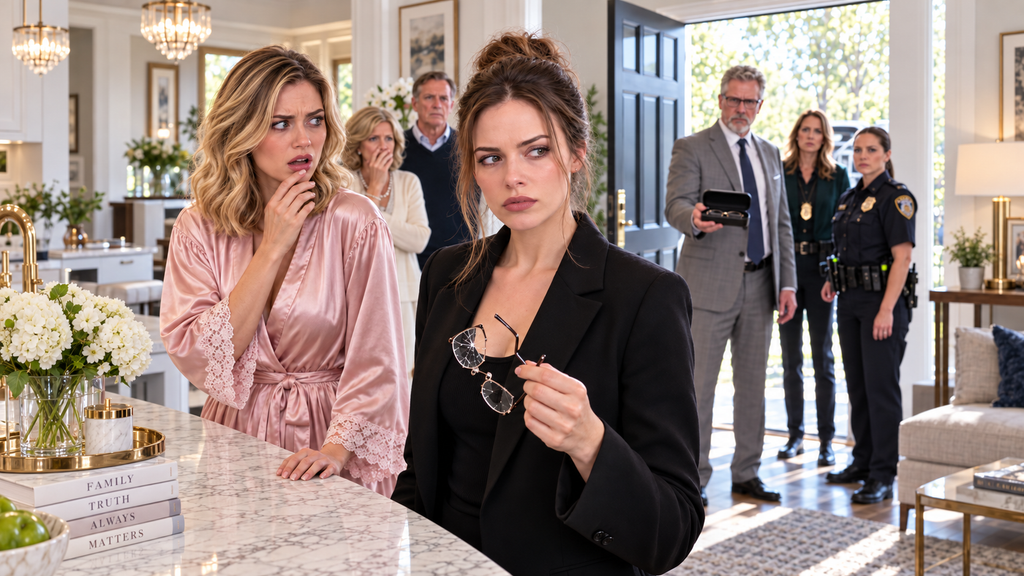
Outside, a car passed our house as if this were just another ordinary Thursday morning in an ordinary neighborhood.
Inside, my family had just collapsed.
Detective Renata Cole stared at my sister.
Not angrily.
Not dramatically.
That somehow made it worse.
She simply reached into the inside pocket of her jacket and removed a small notebook.
“Miss Voss,” she said, “I need you to be very careful about what you say next.”
Lila’s lips parted.
Professor Shaw looked at me.
Dr. Mercer looked at my parents.
My father seemed to age ten years in the space of five seconds.
Mom was the first one to recover.
She stepped between Lila and Detective Cole.
“This has gotten completely out of control.”
Cole’s eyes shifted to her.
“Ma’am, step aside.”
“My daughter made a stupid comment. That’s all.”
“Which daughter?”
Mom froze.
Nobody missed it.
I felt something cold move through my chest.
Even now.
Even with my glasses broken in the sink.
Even with my phone in Lila’s pocket.
Even after hearing Lila admit she had sent my research to someone for money…
Mom’s instinct was still to protect her.
Not me.
Lila.
Always Lila.
Mom swallowed.
“You know what I mean.”
Detective Cole closed her notebook.
“No, Mrs. Voss. I don’t.”
My mother’s face tightened.
“This family doesn’t need police involved.”
Professor Shaw gave a humorless laugh.
“This stopped being a family disagreement the moment confidential university research was transferred without authorization.”
Dad suddenly stood straighter.
“Now hold on.”
Everyone looked at him.
My father had always been the kind of man who found his courage only when consequences reached him personally.
When Lila mocked me, he stayed quiet.
When Mom dismissed me, he stayed quiet.
When my belongings disappeared, he told me I was forgetful.
When I said someone had entered my room, he told me not to accuse my sister without proof.
But now police were standing in his kitchen.
Now a university official was watching.
Now there were words like “cybercrime,” “protected research,” and “unauthorized transfer.”
Now Dad had opinions.
“We need an attorney.”
Detective Cole nodded.
“You’re entitled to contact one.”
Dad looked at Lila.
“You’re not saying anything else.”
Lila’s eyes snapped toward him.
“What?”
“Nothing else.”
“Dad—”
“I said stop talking.”
That frightened her.
I saw it.
Because Lila had spent her entire life believing Dad would clean up whatever mess she created.
Parking tickets disappeared.
Credit-card bills got paid.
Jobs she quit somehow became the employer’s fault.
Boyfriends who left were cruel.
Friends who stopped speaking to her were jealous.
When she crashed Dad’s car at twenty-two after drinking at a party, Mom spent an entire week telling relatives that the other driver had “come out of nowhere.”
There was always a new version of reality waiting for Lila.
A softer one.
A safer one.
A version where nothing was ever really her fault.
But Dad wasn’t giving her one now.
Lila looked at me.
And I watched fear replace arrogance.
“You’re enjoying this,” she whispered.
I shook my head.
“No.”
“Liar.”
“I’m not enjoying any of it.”
“You’ve hated me for years.”
I stared at her.
That accusation almost made me laugh.
Instead, something sad settled inside me.
“You really believe that, don’t you?”
She folded her arms.
“You always thought you were better than me.”
“No, Lila.”
“Yes, you did.”
“I spent most of my life trying to make myself smaller so you wouldn’t feel threatened.”
Her expression flickered.
I continued.
“When I got into graduate school, Mom asked me not to talk about it at dinner because you had just lost your job.”
Mom looked away.
“When I won my first research fellowship, Dad told me not to post the announcement because you were going through a breakup.”
Dad said nothing.
“When I published my first paper, you cried because Grandma congratulated me twice on the phone.”
“That is not what happened.”
“It is exactly what happened.”
“You made everything about you.”
“No.”
My voice stayed quiet.
“You made everything I accomplished feel like something I had to apologize for.”
Lila stared at me.
I could feel years moving through that kitchen.
Birthdays.
Graduations.
Christmas dinners.
Little comments.
Small humiliations.
Things that looked meaningless when separated but became unmistakable when placed side by side.
Mom would buy Lila a new dress because she was “having a difficult month.”
I would get a card.
Dad would drive two hours to help Lila move apartments after she quit another job.
When I asked him to attend a conference where I was presenting my first major paper, he said traffic would be bad.
When I got sick during my second year of graduate school, Mom told me to take an aspirin.
When Lila caught the flu that same winter, Mom slept at her apartment for three nights.
I had noticed all of it.
Of course I had.
Children always notice where love is distributed.
Even adult children.
We just learn not to mention it.
Lila laughed suddenly, but there were tears in her eyes.
“Oh, please. You’re the genius. You’re the successful one. You’re the one everybody praises. What more did you want?”
I looked at her.
“A sister.”
That silenced her.
My voice trembled for the first time that morning.
“I wanted a sister, Lila.”
Her jaw tightened.
“I didn’t want your money. I didn’t want Mom and Dad to love you less. I didn’t want to win some competition.”
I pointed toward the sink.
“I wanted to be able to leave a pair of glasses on the table without wondering whether you’d destroy them because I had something important that day.”
Nobody spoke.
Even Detective Cole lowered her eyes for a moment.
Then Professor Shaw checked his watch.
“Mara.”
I turned toward him.
His tone changed.
Gentler now.
“The committee is still assembled.”
I blinked.
“What?”
“Your defense.”
I stared at him.
Dr. Mercer nodded.
“We delayed the formal start.”
I looked at the kitchen clock.
8:26.
My defense had been scheduled for eight.
“I’m almost half an hour late.”
Professor Shaw gave me a look I had seen dozens of times in the laboratory when some experiment failed spectacularly.
“So?”
I almost smiled.
“Professor—”
“You think five years of research disappears because you’re twenty-six minutes late?”
My throat tightened.
He stepped closer.
“Mara, six faculty members are sitting in that room because they came to hear you defend your work.”
I looked at my parents.
Then at Lila.
The morning had already exhausted me.
My hands were trembling.
My heart had been racing for so long that I had almost forgotten what calm felt like.
Professor Shaw saw my hesitation.
“You have every right to postpone.”
That mattered.
He wasn’t ordering me.
He wasn’t telling me to be strong.
He wasn’t turning resilience into another obligation.
“You can postpone and nobody will hold it against you,” he said. “Not after this.”
I stared at the broken glasses beside the sink.
Five years.
Five years of late nights.
Failed experiments.
Grant applications.
Rejected papers.
Revised papers.
Clinical datasets.
Ethics reviews.
Thousands of lines of code.
More coffee than any human being should consume.
More moments of doubt than I could count.
I thought about the first time my model correctly identified a retinal abnormality on an image collected by a low-cost device.
I had been alone in the lab at 1:13 in the morning.
The result appeared on my screen.
I reran it three times because I didn’t trust myself.
Then I sat on the floor and cried.
Not because I knew it would make money.
Not because I thought anyone would call me brilliant.
I cried because somewhere there was a clinic that couldn’t afford the expensive equipment used by larger hospitals.
And maybe one day my work would matter there.
That was why I started.
Somewhere along the way, my family had turned my research into money.
Status.
Competition.
A prize.
But it had never been theirs.
And this morning wasn’t going to be theirs either.
I looked at Professor Shaw.
“How fast can we get there?”
His face changed immediately.
“Eight minutes if security drives.”
“Then let’s go.”
Lila stepped toward me.
“Mara.”
I turned.
Her expression was different now.
Not apologetic.
Desperate.
“You can’t leave.”
I almost laughed.
“Why not?”
“You need to explain this.”
“I already did.”
“To them.”
She gestured wildly toward the detective.
“To Mom and Dad. To everybody.”
“I have a thesis to defend.”
Her face twisted.
“Are you serious?”
Professor Shaw opened the front door.
I picked up my bag.
“Yes.”
Lila grabbed my wrist.
The room changed instantly.
The university security officer moved forward.
Detective Cole said sharply, “Let go of her.”
Lila released me.
I rubbed my wrist.
Her eyes burned into mine.
“You’re really going to walk out of here while the police question me?”
I met her gaze.
“You tried to make sure I couldn’t walk into that defense.”
The words landed between us.
“I’m going anyway.”
And for the first time in my life, I turned my back on my family without waiting for permission.
The security vehicle was parked at the curb.
Professor Shaw sat beside me in the back.
Dr. Mercer stayed behind with Detective Cole because the integrity investigation had suddenly become much larger than anyone anticipated.
As we pulled away, I looked through the window.
Mom stood in the doorway.
Dad was behind her.
Lila was no longer visible.
For one ridiculous second, part of me wanted Mom to run after the car.
I wanted her to knock on the window.
I wanted her to say she was sorry.
I wanted Dad to call my name.
Neither did.
Professor Shaw must have noticed where I was looking.
He didn’t say anything.
I appreciated that.
We reached the biomedical sciences building at 8:35.
My defense had been moved to Conference Room 4B because a class needed the original lecture hall.
When the elevator doors opened, my legs suddenly felt weak.
Professor Shaw noticed.
“You all right?”
“No.”
He smiled slightly.
“Good.”
I looked at him.
He adjusted the folder under his arm.
“If you told me you were perfectly fine after the morning you just had, I’d be concerned.”
A laugh escaped me.
Small.
Unexpected.
Needed.
Then he looked at me carefully.
“One thing before we go in.”
“What?”
“Whatever happened at that house stays outside this room unless you decide otherwise.”
I swallowed.
He continued.
“In there, you are not a victim of your sister.”
His voice was quiet.
“You are the researcher who wrote one of the strongest dissertations I’ve supervised in twenty-seven years.”
My eyes burned.
“Don’t make me cry before the defense.”
“Cry afterward. Preferably after answering Committee Question Three correctly.”
“You don’t know what Question Three is.”
“I know faculty. It’ll be statistics.”
That time I actually laughed.
He opened the conference-room door.
Everyone inside stood.
I stopped.
Six faculty members sat around a long oval table.
A projector displayed the title slide of my dissertation.
My name was underneath it.
MARA VOSS
For five years, I had imagined this moment.
I imagined walking in nervous but prepared.
Maybe carrying coffee.
Maybe making a joke about the weather.
Maybe Mom and Dad would be sitting in the back.
Maybe Lila would surprise me and come too.
Instead, I walked in wearing my lab spare glasses while a detective questioned my sister ten minutes away.
Life rarely honors the versions we rehearse.
Dr. Helen Park, the committee chair, came toward me.
“Mara.”
“I’m so sorry.”
She held up a hand.
“No.”
I stopped.
“You do not owe this committee an apology.”
I nodded.
My throat tightened.
She lowered her voice.
“Professor Shaw gave us the minimum necessary information. We can postpone.”
“I want to continue.”
“Are you sure?”
I looked at the title slide.
Then at the people around the table.
“Yes.”
Dr. Park studied me for another second.
“All right.”
She returned to her seat.
“Take whatever time you need to set up.”
I opened my laptop.
My hands shook so badly that I mistyped my password twice.
Nobody commented.
Professor Shaw sat against the far wall.
He wasn’t allowed to answer questions for me.
He wasn’t even supposed to signal approval or disapproval.
He simply folded his arms.
I connected the projector.
My presentation appeared.
I took one breath.
Then another.
“My dissertation is titled ‘Adaptive Low-Cost Retinal Image Classification for Resource-Limited Clinical Environments.’”
My voice sounded distant.
Like someone else was speaking through me.
I clicked the first slide.
“Current diagnostic imaging systems provide excellent clinical performance, but access remains uneven due to cost, infrastructure requirements, and specialist availability.”
Another slide.
Then another.
Something strange happened around minute four.
The house disappeared.
Not literally.
But mentally.
Lila disappeared.
My parents disappeared.
The broken glasses disappeared.
There was only the work.
I explained the architecture of the model.
The preprocessing pipeline.
The training sets.
The validation protocol.
Bias controls.
False-positive rates.
Hardware limitations.
Clinical implications.
One committee member interrupted.
“Your sensitivity falls under lower-light capture conditions.”
“Yes.”
“Why?”
I answered.
Another asked about dataset diversity.
I answered.
Another challenged an assumption in my normalization method.
I paused.
Then answered.
Professor Shaw had been right.
Question Three was statistics.
I answered that one too.
At one point, Dr. Park leaned forward.
“Suppose this is deployed outside an academic hospital. What is the greatest danger?”
Six months earlier, I would have given her a technical answer.
I might have discussed calibration drift.
Poor image quality.
Improper training data.
But something about that morning had sharpened everything.
“The greatest danger,” I said, “is mistaking a useful tool for a replacement for clinical judgment.”
She nodded slightly.
I continued.
“The purpose of this system is not to replace physicians. It’s to help identify patients who need further evaluation in places where specialist care is limited. A model can assist with access. It should never become an excuse to remove accountability.”
For some reason, that word caught in my throat.
Accountability.
Dr. Park noticed.
But she didn’t interrupt.
The questioning continued.
Forty-seven minutes.
Then fifty.
Then sixty-three.
By the end, my water glass was empty.
My shoulders hurt.
I felt like I had run a marathon while standing still.
Finally Dr. Park closed her folder.
“Thank you, Mara.”
I nodded.
“We’ll ask you and Professor Shaw to step outside.”
My heart dropped.
Of course I knew this was standard procedure.
Still, every doctoral student secretly believes this is the moment everyone inside the room finally admits the dissertation was terrible.
Professor Shaw followed me into the hallway.
The door closed.
I leaned against the wall.
“How bad?”
He stared at me.
“What?”
“My answers.”
“You’re asking me that now?”
“Yes.”
“You just defended a five-year dissertation after your sister smashed your glasses, stole your phone, allegedly stole your research, and triggered a cybercrime investigation.”
“Professor.”
He sighed.
“You were excellent.”
My eyes closed.
“Really?”
“Yes.”
“How excellent?”
“Stop fishing.”
“I need a scale.”
“No.”
“Out of ten.”
“Mara.”
“Out of ten.”
He looked irritated.
That was reassuring.
“Nine.”
I stared at him.
“Nine?”
“Nobody gets ten.”
“Why?”
“Humility.”
I smiled.
My phone wasn’t with me, so I couldn’t check the time.
I wasn’t sure how long we waited.
Probably twelve minutes.
It felt like an hour.
Then the door opened.
Dr. Park stood there.
“Mara?”
My stomach dropped.
“Yes?”
“Come inside.”
I walked in.
Nobody was smiling.
That terrified me.
I stopped beside the projector.
Dr. Park closed the door.
She looked down at a page.
Then at me.
“Mara Voss, the committee has reached a unanimous decision.”
My heart slammed.
Professor Shaw stood behind me.
“We are pleased to accept your dissertation pending minor editorial revisions.”
I didn’t understand.
Not immediately.
My brain kept waiting for the rest.
Dr. Park smiled.
“Congratulations, Dr. Voss.”
The room erupted.
Applause.
Actual applause.
I covered my mouth.
Everything blurred.
For one terrible second, I thought my spare glasses were failing too.
Then I realized I was crying.
Professor Shaw was clapping.
Dr. Park hugged me.
Someone said, “Well deserved.”
Someone else said, “Extraordinary work.”
I heard the word doctor again.
Dr. Mara Voss.
Five years.
Thousands of hours.
One morning designed to destroy everything.
And I had finished anyway.
I laughed through tears.
Professor Shaw came over.
“Now you may cry.”
I turned and hugged him.
He stiffened.
Professor Shaw was not a hugging man.
Everyone knew that.
After exactly two seconds, he patted my shoulder awkwardly.
“Enough.”
I laughed harder.
“I thought we were having a moment.”
“We were not.”
“You brought my spare glasses.”
“That was logistical.”
“You came to my house with university security.”
“Administrative.”
“With a detective.”
“Coincidental.”
I pulled back.
His eyes were wet.
He immediately looked away.
That was when my phone rang.
Except it wasn’t my phone.
It was Professor Shaw’s.
He looked at the screen.
His face changed.
“Dr. Mercer.”
The room went quiet.
He answered.
“Adrian.”
A pause.
“Yes.”
Another pause.
His eyes moved toward me.
“I understand.”
My happiness tightened into fear.
“What?”
He ended the call.
Nobody spoke.
Professor Shaw looked at me.
“They found the recipient.”
My stomach dropped.
“The person Lila sent my files to?”
“Yes.”
“Who?”
His jaw tightened.
“A private medical technology consultant named Garrett Vale.”
The name meant nothing to me.
Then Professor Shaw added:
“He works for one of the companies that approached the university about licensing your model.”
I stared at him.
“What?”
“They believe he was attempting to circumvent the university negotiation process.”
The room tilted.
One of the committee members muttered something under his breath.
I sat down.
“How long?”
“Dr. Mercer doesn’t know yet.”
My mind raced backward.
The strange questions.
The open drawer.
Lila suddenly asking about patents.
Money.
Ownership.
Licensing.
“Lila didn’t come up with this herself.”
Professor Shaw’s expression told me I was right.
“No.”
By noon, I was sitting in an interview room at university security.
My parents were somewhere else in the building.
Lila had been taken downtown for questioning after Detective Cole discovered evidence that she had deleted several messages that morning.
I had my phone back.
It sat on the table inside an evidence bag.
I wasn’t allowed to use it yet.
Detective Cole entered carrying a thick folder.
She sat across from me.
“Dr. Voss.”
I looked up.
Nobody had called me that outside the defense room yet.
She noticed my expression.
“Congratulations.”
“Thank you.”
“Interesting day?”
I almost laughed.
“That’s one word.”
She opened the folder.
“Do you know Garrett Vale?”
“No.”
“Ever met him?”
“No.”
“Spoken to him?”
“No.”
“Emails?”
“Not knowingly.”
She nodded.
Then slid a printed photograph toward me.
A man in his late forties.
Expensive suit.
Gray at the temples.
I shook my head.
“I’ve never seen him.”
Detective Cole leaned back.
“Your sister has.”
I looked at her.
“How?”
“She attended a charity event six months ago with a friend. Vale was there representing Ardent Medical Technologies.”
I knew that name.
Ardent had requested preliminary licensing information.
Professor Shaw had mentioned them.
“They were interested in the model.”
“Yes.”
Cole opened the folder again.
“According to messages we recovered, Vale approached your sister after discovering the relationship.”
My mouth went dry.
“He knew she was my sister?”
“He appears to have searched your publicly available background.”
A chill moved through me.
“What did he tell her?”
Cole hesitated.
“He told her your research could be worth millions if commercialized.”
I stared at the table.
“And she believed him.”
“Yes.”
“He offered her money?”
“Eventually.”
“How much?”
“Initially twenty thousand dollars for copies of early model documentation.”
My head snapped up.
“Twenty thousand?”
“Yes.”
“Did she take it?”
Cole looked at me steadily.
“We found a payment of five thousand dollars to an account belonging to your sister three months ago.”
Three months.
The emergency protocol.
The attempted breach.
Three months earlier, someone had tried to access my university account.
I whispered, “That was her.”
“We’re still investigating.”
“It was her.”
Cole didn’t answer.
She didn’t need to.
I pressed both hands against my forehead.
“Why didn’t she just ask me about the research?”
Cole said nothing.
Because we both knew the answer.
Lila didn’t want information.
She wanted ownership of something that wasn’t hers.
“When she couldn’t access the repository remotely,” Cole continued, “Vale appears to have encouraged her to obtain materials another way.”
I thought about my open desk drawer.
My missing notebooks.
One flash drive I thought I had misplaced.
My stomach turned.
“What did she send him?”
“Several documents.”
“Which ones?”
“Preliminary architecture notes, some testing summaries, and screenshots.”
I closed my eyes.
“Was it enough?”
“To reproduce your model?”
“Yes.”
“We don’t believe so.”
I breathed again.
“The critical repository files were protected by university credentials and encryption. That appears to be why the access attempt occurred this morning.”
I opened my eyes.
“This morning.”
Cole nodded.
I suddenly understood.
The glasses.
The phone.
Dad telling me they had already started without me.
Lila wasn’t only trying to make me miss my defense.
She needed time.
“How long did she need?”
Detective Cole’s expression sharpened.
“What do you mean?”
“If I went to the defense, I would have been gone for hours. She had my phone. She knew passwords were protected by two-factor authentication.”
Cole slowly nodded.
“She needed the phone for authentication.”
“Yes.”
My stomach twisted.
“She smashed my glasses so I’d miss the defense or waste time trying to fix them. Then she stole my phone so she could approve a login request.”
Detective Cole wrote something down.
“I think you’re correct.”
I felt sick.
My family had spent the morning telling me I was overreacting.
“It’s just glasses.”
“Fix them yourself.”
“They’ve already started without you.”
But the glasses had never been the objective.
They were the lock on the cage.
My phone was the key.
I looked at Cole.
“Did my parents know?”
That was the question I had been avoiding.
She stopped writing.
“I don’t know yet.”
“Lila couldn’t have taken my phone from the kitchen without them seeing.”
“We’ll determine what they knew.”
“My father told me the defense had started without me.”
“Yes.”
“He didn’t offer to drive me.”
Cole remained quiet.
“My mother gave me tape.”
Still quiet.
I hated her professionalism in that moment.
I wanted someone to tell me my parents were innocent.
I wanted certainty.
I wanted to be five years old again and believe grown-ups always knew the right thing to do.
Instead, Detective Cole said:
“There are different kinds of knowledge, Mara.”
I looked at her.
“They may not have known about the data theft. That doesn’t mean they didn’t understand your sister was trying to sabotage your defense.”
The truth hurt more because it was careful.
I nodded.
That afternoon, I learned the difference.
Dad had not known about Garrett Vale.
Neither had Mom.
They had not known about the payments or the attempted data theft.
But they had known Lila planned to stop me from leaving for the defense.
She had told them the night before that I needed to be “taken down a peg.”
Dad thought she was going to hide my car keys.
Mom knew she planned to take my phone.
Neither expected her to break my glasses.
But when she did…
They still helped her.
Mom gave me tape.
Dad lied that the committee had started without me and suggested postponing until the next semester.
Why?
Because Lila had convinced them that if I defended successfully, I would sign a licensing agreement and “cut the family out.”
There was no family share.
There had never been one.
My parents simply believed there should be.
When Detective Cole asked my father why, his answer was almost worse than the crime.
“She’s our daughter,” he said.
Cole asked, “Which one?”
Dad didn’t answer.
I didn’t go home that night.
Professor Shaw and his wife offered me their guest room, but I couldn’t bear the thought of being around anyone.
So the university arranged a small room at the faculty guest residence.
Technically I wasn’t faculty.
Yet.
But apparently becoming “Doctor” before lunch had certain benefits.
I sat on the edge of the bed at 11:40 that night.
For the first time all day, nobody needed anything from me.
No questions.
No defense.
No police interview.
No forms.
No signatures.
I put my glasses on the bedside table.
Then stared at them.
I started crying.
Not gracefully.
Not the quiet tears people cry in movies.
I folded over and sobbed until my chest hurt.
I cried for the glasses in the sink.
For the phone in Lila’s pocket.
For my parents standing there.
For every accomplishment I had softened so she could feel bigger.
For every time Mom told me to understand.
For every time Dad told me to be the mature one.
For every birthday where Lila got to ruin the evening because attention had drifted away from her.
For the sister I wanted.
For the parents I kept hoping would notice.
For the home that suddenly didn’t exist anymore.
My phone finally rang at 12:03.
The police had returned it.
Mom.
I watched her name flash.
I didn’t answer.
She called again.
Then Dad.
Then Mom.
Then Dad.
A message appeared.
Please come home. We need to talk as a family.
I stared at it.
As a family.
Those words had controlled me for years.
Do it for the family.
Don’t embarrass the family.
Help Lila because she’s family.
Forgive because we’re family.
Share because we’re family.
Stay quiet because family matters.
Interesting how “family” always seemed to mean I owed something.
I typed three words.
Not tonight. Dad.
Then deleted them.
I typed again.
I am safe. I will contact you when I am ready.
I sent it.
Then I turned off the phone.
The next morning, Ardent Medical Technologies suspended Garrett Vale.
By Monday, they fired him.
The company issued a statement saying his actions had violated internal policy and that they would cooperate fully with the investigation.
Their legal department withdrew from all licensing discussions involving my model.
That was fine with me.
Two other companies remained interested.
But the university made another decision.
All commercialization discussions were frozen until the investigation ended.
At first, I thought I would be angry.
Instead, I felt relieved.
For the first time in months, nobody was asking me how much the work was worth.
Only whether it worked.
That felt cleaner.
Lila was charged initially with unauthorized computer access, attempted theft of protected research material, and unlawful possession of my phone.
Other charges related to the commercial scheme were evaluated later.
The smashed glasses alone were minor compared with everything else.
But Detective Cole photographed every piece.
The broken frame.
The lenses.
The tape Mom had handed me.
I never understood why the tape affected me most.
Maybe because it said everything.
My sister had deliberately destroyed something I needed to function.
And my mother’s response was not to defend me.
Not to scold Lila.
Not to ask whether I was hurt.
She handed me tape.
Fix it yourself.
That sentence followed me for weeks.
Three days after the defense, Dad appeared outside my laboratory.
Professor Shaw intercepted him before he reached me.
I was sitting behind the glass wall of the imaging suite when I saw them speaking in the hallway.
Dad looked smaller than I remembered.
Professor Shaw entered.
“Your father is here.”
“I can see that.”
“Want me to remove him?”
I looked at him.
“You say that like you’re a nightclub bouncer.”
“I contain multitudes.”
Despite myself, I smiled.
Then I looked at Dad.
“No. I’ll talk to him.”
Professor Shaw stayed nearby.
I appreciated that too.
I met Dad in an empty conference room.
He sat.
I remained standing.
For several seconds, neither of us spoke.
Then he said, “You look tired.”
I almost walked out.
Of all the things he could say.
Congratulations.
I’m sorry.
Are you okay?
Instead:
You look tired.
“I am.”
He nodded.
“Your mother hasn’t slept.”
I looked at him.
“Is that why you came?”
“No.”
“Because if this conversation is going to be about how hard this is for Mom—”
“It isn’t.”
I waited.
He rubbed his palms against his trousers.
“I’m sorry.”
I said nothing.
His voice cracked.
“I failed you.”
That was different.
Not “mistakes were made.”
Not “things got out of hand.”
Not “your sister went too far.”
I failed you.
Dad looked at the table.
“I knew Lila planned to stop you from leaving.”
My chest tightened even though I already knew.
“I didn’t know about the research theft.”
“I know.”
“I swear to you, Mara. I didn’t.”
“I know.”
“She told us you were going to sign something after the defense and that once you did, your research would belong to the university forever.”
“That isn’t true.”
“I know that now.”
“You could have asked me.”
He closed his eyes.
“I should have.”
“You could have believed me.”
“Yes.”
“You could have stopped her.”
“Yes.”
“Instead, you looked at your watch and told me they’d already started without me.”
His eyes filled.
“I know.”
“No, Dad.”
My voice shook.
“You don’t know.”
He looked up.
“I was standing there unable to see.”
His face crumpled.
“And neither of you cared.”
“I cared.”
“Then why didn’t you act like it?”
He had no answer.
I had spent so many years explaining my parents to myself.
Dad doesn’t express emotions well.
Mom worries about Lila because she’s fragile.
They know I can handle things.
They expect more from me because they trust me.
Maybe that was partly true.
But there was another truth underneath it.
They neglected the child who coped because caring for the difficult child demanded more attention.
And once that pattern became comfortable, they called it fairness.
“I kept thinking,” Dad whispered, “that you were stronger.”
I looked at him.
“There it is.”
“What?”
“The excuse.”
“It isn’t an excuse.”
“It is.”
He blinked.
“You thought I was stronger, so I got less.”
He looked down.
“Less patience. Less protection. Less help. Less forgiveness.”
“Mara—”
“And because I survived getting less, you used my survival as proof I didn’t need more.”
He covered his face.
I let him sit with it.
For once, I did not rescue him from discomfort.
After a while, he lowered his hands.
“What can I do?”
The old me would have answered immediately.
I would have given him steps.
Instructions.
A way to earn forgiveness.
Because even when other people hurt me, I often became responsible for teaching them how to repair it.
Not anymore.
“I don’t know.”
He nodded slowly.
“I want to make it right.”
“You can’t make that morning not happen.”
“I know.”
“You can’t make five years of this disappear.”
“I know.”
“You can’t ask me to forgive Lila.”
He stiffened.
I saw it.
There was still a tiny part of him hoping for exactly that.
“Not now,” he said.
I laughed softly.
“You still don’t understand.”
“What?”
“Not ever, Dad.”
His face changed.
“I’m not saying I’ll hate her forever.”
I swallowed.
“I’m saying I may never have a relationship with her again.”
“That’s your sister.”
And there it was.
The reflex.
I stood.
Dad immediately realized his mistake.
“Mara, wait.”
I picked up my bag.
“You came here to apologize, and within ten minutes you’re already asking me to protect Lila from the consequences of what she did.”
“I didn’t mean—”
“Yes, you did.”
He stood.
“I’m trying.”
“I know.”
I looked at him.
“And I’m tired of being the practice field where this family learns how to try.”
That hurt him.
I could see it.
But some truths are supposed to hurt.
I walked toward the door.
Dad spoke behind me.
“Are you coming home?”
I stopped.
“No.”
“For how long?”
“I moved my things yesterday.”
He stared.
“What?”
“The university helped me arrange temporary housing.”
“You moved out?”
“Yes.”
“Without telling us?”
I turned.
“You destroyed my ability to trust that house.”
He sat back down.
I opened the door.
“Mara.”
I paused.
“I really am proud of you.”
My eyes burned.
Five years.
Five years, and there it finally was.
I wished it had come before the police.
Before the broken glasses.
Before everything shattered.
“Thank you,” I said.
Then I left.
Mom waited another week before coming to see me.
She did not arrive at the lab.
She waited outside my apartment building.
I almost turned around.
She held a small shopping bag.
“Mara.”
I stopped.
“How did you get this address?”
“Your father.”
I made a mental note to deal with that later.
Mom looked terrible.
Her hair was uncombed.
Dark circles sat under her eyes.
For years, seeing my mother upset instantly activated something in me.
Fix it.
Comfort her.
Tell her everything would be okay.
That instinct rose.
I forced it back down.
“What do you want?”
She held out the bag.
“I brought you something.”
I didn’t take it.
“What?”
She opened the bag.
Inside was a new pair of eyeglasses.
I stared at them.
For a moment, I felt absolutely nothing.
Then anger came so quickly it frightened me.
“You bought me glasses.”
Her eyes filled.
“I know they won’t replace—”
“You bought me glasses.”
“I wanted—”
“Mom, do you think this is about the glasses?”
“No.”
“It feels like you do.”
She lowered the bag.
“I didn’t know what else to bring.”
“An apology.”
Her mouth opened.
“I am sorry.”
“No.”
My voice shook.
“Not ‘I’m sorry everything happened.’ Not ‘I’m sorry Lila went too far.’ Tell me what you did.”
She stared at me.
“Mara—”
“What did you do?”
Her face crumpled.
“I gave you tape.”
The words were barely audible.
“Louder.”
She flinched.
I hated myself a little for saying it.
But I needed to hear her own it.
“I gave you tape.”
“And?”
“I knew Lila had your phone.”
My throat closed.
“And?”
“I knew she wanted you to miss the defense.”
Tears ran down her face.
“And I let her.”
I said nothing.
Mom wiped her cheek.
“I thought she was upset because she believed you were going to make a lot of money and leave everyone behind.”
“Why would you believe that?”
“I don’t know.”
“Yes, you do.”
She looked away.
“Because Lila said it.”
“That’s not enough.”
Mom’s shoulders shook.
“You always leave.”
I froze.
“What?”
She swallowed.
“You leave.”
“I went to college.”
“You moved away.”
“For school.”
“You built this entire life that didn’t need us.”
The anger inside me suddenly shifted.
I understood something.
Not an excuse.
But an explanation.
Mom had mistaken independence for rejection.
Because Lila constantly needed rescuing, Mom felt needed by her.
I didn’t.
So instead of being proud that one daughter could stand on her own, she resented me for standing.
“You punished me for growing up.”
She began crying harder.
“No.”
“Yes.”
“No, Mara, I—”
“You needed Lila to need you.”
She stared at me.
“And because I didn’t need to be rescued every week, you decided I loved you less.”
Her face went white.
I knew I was right.
It was written all over her.
I continued, softer now.
“Mom, I left because children are supposed to leave.”
She covered her mouth.
“I went to school. I worked. I built a career.”
I blinked back tears.
“That wasn’t me abandoning you.”
She whispered, “I know.”
“Do you?”
“I’m beginning to.”
The hallway stayed quiet.
Finally Mom held the bag out again.
I looked at the glasses.
Then shook my head.
“I don’t want them.”
She lowered her hand.
“Okay.”
That word surprised me.
No argument.
No guilt.
No “after everything I’ve done.”
Just okay.
Maybe that was the first real sign that something in her was changing.
She turned to leave.
“Mom.”
She stopped.
“I don’t know when I’ll be ready to see you normally again.”
She nodded.
“I understand.”
“No, you don’t.”
She looked at me.
“But I hope someday you will.”
She cried.
So did I.
I still didn’t hug her.
Healing is not always a hug.
Sometimes healing is finally refusing one before you are ready.
The investigation lasted four months.
Garrett Vale had done more than anyone initially realized.
He had approached researchers through relatives before.
Not successfully.
My family was simply the first one where he found someone willing to cooperate.
He had convinced Lila that my university was planning to “steal” my invention.
Then he positioned himself as the person who could help the family profit before that happened.
Every lie he told her contained just enough truth to sound plausible.
Universities did have intellectual-property agreements.
Companies did negotiate licenses.
Researchers did sometimes receive financial benefits.
But he twisted all of it into a fantasy where Lila believed she was rescuing millions of dollars from people who wanted to cheat us.
Us.
That word became central.
Because nothing in the research belonged to her.
Nothing belonged to my parents.
The project involved university infrastructure, grant funding, collaborators, clinical partners, and my own work.
It was complicated.
But “complicated” is fertile ground for greed.
Lila took a plea agreement.
She avoided prison.
That made some people angry.
It didn’t make me angry.
She received probation, community service, financial penalties, and restrictions related to unauthorized computer access.
She was also required to surrender the money Garrett had paid her.
Garrett’s outcome was worse.
His case involved broader conduct beyond mine.
I didn’t follow every hearing.
I stopped reading every update.
At some point, I realized I did not want the rest of my life measured by what happened to the people who hurt me.
That was another kind of prison.
The best consequence was not watching them fall.
It was becoming uninterested in the fall.
Six months after my defense, I stood inside a small rural clinic three hours from the university.
A nurse named Teresa adjusted a retinal imaging device on a metal table.
“This thing is ancient,” she said.
I smiled.
“That’s why we’re here.”
Our pilot program had finally been approved.
Not through Ardent.
The university partnered with a nonprofit healthcare network instead.
Less money.
More clinics.
I preferred that.
Professor Shaw pretended he didn’t care.
“I always advocated for maximum clinical impact,” he said.
“You complained about the budget for two straight weeks.”
“That was fiscal stewardship.”
“You called the finance officer a bureaucratic raccoon.”
“A private remark.”
“You said it in a meeting.”
“Privacy is contextual.”
I laughed.
He stared at the computer.
The first patient image loaded.
An older man named Mr. Delgado sat in the exam chair.
His daughter waited beside him.
The model processed the image.
A warning appeared.
Possible abnormality.
Further specialist evaluation recommended.
Teresa leaned closer.
“That would have been missed during today’s standard screening.”
My chest tightened.
She looked at me.
“We’ll send him for evaluation.”
Mr. Delgado’s daughter touched his shoulder.
“Is something wrong?”
Teresa explained calmly.
Nothing was diagnosed yet.
The model had only detected something worth investigating.
That was exactly what it was designed to do.
Give someone a chance to look closer.
I stepped into the hallway.
Professor Shaw followed.
“You okay?”
I wiped my eyes.
“Fine.”
“You’re crying.”
“I know.”
“Why?”
I looked through the window.
Mr. Delgado was putting on his jacket.
His daughter helped him with the zipper.
“Because it worked.”
Professor Shaw was quiet.
Then he said:
“It always worked.”
I shook my head.
“Not like this.”
Five years of charts and percentages were suddenly a person.
A father.
A daughter.
A jacket being zipped.
That was the moment I understood something my family never had.
The value of my work had never been the licensing estimate.
It was this.
One person receiving a warning early enough to do something about it.
I laughed through tears.
“You know the worst part?”
“What?”
“Lila thought I was hiding millions from her.”
Professor Shaw nodded.
“And?”
“I would have given her money if she ever really needed it.”
He looked at me.
“I know.”
That hurt in a completely different way.
My parents began therapy.
I learned that through Dad.
Not because he told me as leverage.
He mentioned it once in a text.
Your mother and I have started seeing someone. No need to respond. I just wanted you to know we are trying to understand how we allowed things to become what they became.
That was the first message from either parent that asked nothing of me.
I saved it.
I still didn’t go home.
Eventually, Dad began meeting me for coffee.
Once a month.
Neutral places.
No Lila.
No pressure.
The first few conversations were painfully awkward.
He asked about work.
I gave short answers.
He asked about my apartment.
I said it was fine.
He talked about the weather.
I almost laughed.
But he kept coming.
And more importantly, he stopped demanding progress.
A year earlier, Dad would have said:
How long are you going to punish us?
Now he said:
Take whatever time you need.
That difference mattered.
Mom took longer.
She had built so much of her identity around being the mother who held the family together that admitting she had helped break it nearly destroyed her.
Eventually, she stopped trying to call me directly.
Instead, she wrote letters.
Real letters.
Paper.
Envelopes.
No expectation that I respond.
The third one stayed on my desk unopened for nearly a month.
When I finally read it, one paragraph made me sit down.
She wrote:
I used your strength as permission to neglect you. I told myself you were fine because admitting you were hurt would have required me to confront the fact that I was the one allowing it.
I cried after reading that.
Not because it fixed everything.
It didn’t.
But because for once, Mom was describing my pain without making herself the victim of it.
I replied with one sentence.
Thank you for finally seeing it.
That was enough.
Lila tried to contact me seven months after the defense.
Her first email began:
I know you hate me.
I closed it.
A week later, another arrived.
I’m not asking you to forgive me.
I read that one.
It was long.
Lila wrote about jealousy.
About feeling like the stupid daughter.
Those were her words, not mine.
She said that every family dinner where Dad asked about my research made her feel invisible.
Every time Mom told someone I was “our scientist,” she heard an unspoken comparison.
She wrote:
You never actually treated me like I was stupid. I know that now. I did that part myself.
I sat with that sentence.
For years I had wondered what I did to make her hate me.
Maybe nothing.
Sometimes people don’t resent what you do to them.
They resent what your existence forces them to feel about themselves.
She continued.
Garrett Vale had made her feel important.
He listened.
He asked her opinion.
He told her she understood business better than I did.
Then he told her the family deserved a share.
He transformed jealousy into righteousness.
That was how she justified everything.
The snooping.
The stolen files.
The phone.
The glasses.
She wrote:
Breaking your glasses was my idea. Garrett never told me to do that. I need you to know that because I don’t want to pretend I was manipulated into every part of this. I wanted you to fail that morning. I wanted one room full of people to look at you and be disappointed. I wanted you to feel the way I had convinced myself I felt around you.
I stopped reading.
My hands shook.
There it was.
No excuse.
No minimizing.
She wanted me to fail.
I walked away from the computer.
Three hours later, I came back.
The email ended:
I am ashamed of myself. I don’t know whether being ashamed changes anything. Probably not. I am trying to become someone who would never do that again. You do not have to watch me become that person.
I read that last line three times.
You do not have to watch me become that person.
For the first time, Lila understood something everyone else had struggled with.
Her improvement was not my responsibility.
I didn’t reply.
Not then.
A year after my defense, I received an invitation to speak at the university’s incoming doctoral student orientation.
Professor Shaw said I should accept.
I said no.
He sent another email.
I said no again.
Then he appeared at my office.
“You’re doing it.”
“You have boundary issues.”
“So do you.”
“I said no.”
“You said no because you think they want you to tell the dramatic story about overcoming adversity.”
“Don’t they?”
“No.”
“What do they want?”
He handed me the invitation.
I had only skimmed it.
The topic was:
Failure, Uncertainty, and Why Research Survives Both.
I looked at him.
“You recommended me.”
“Yes.”
“Why?”
“You fail constantly.”
I stared at him.
“Your mentorship style remains inspirational.”
“You’re welcome.”
I accepted.
The auditorium held nearly three hundred students.
I stood behind the podium.
For the first ten minutes, I talked about research.
Failed datasets.
Bad assumptions.
Rejected grant applications.
Models that performed beautifully in one environment and collapsed in another.
Then someone asked from the audience:
“What was the hardest moment of your PhD?”
The room became quiet.
I could have told them about my qualifying exam.
The paper rejection that almost made me quit.
The year my dataset was corrupted.
Instead, I touched the edge of my glasses.
“The morning of my dissertation defense, my sister broke my glasses.”
The audience laughed uncertainly.
They thought I was joking.
“I’m very nearsighted.”
The laughter stopped.
“She also took my phone.”
Silence.
“My family told me the defense had already started and implied I had lost my chance.”
I looked across three hundred young faces.
“Ten minutes later, my advisor arrived at my house with my spare glasses.”
Somebody in the back murmured, “Wow.”
I smiled.
“The full story gets complicated.”
A little laughter.
“But here’s the part that matters.”
I paused.
“For a long time, I believed strength meant not needing help.”
Professor Shaw sat in the front row.
I looked at him.
“I was wrong.”
The room was completely still.
“Strength is not becoming so independent that nobody can hurt you. That isn’t possible.”
I swallowed.
“Strength is building a life where the people around you don’t require your weakness in order to feel strong.”
I heard someone inhale sharply.
I continued.
“And when you discover that someone does…”
I paused.
“You are allowed to leave.”
Afterward, students lined up to speak with me.
One young woman waited until everyone else had gone.
She hugged a notebook against her chest.
“My family hates that I’m here.”
I looked at her.
“They think graduate school means I believe I’m better than them.”
Her eyes filled.
“What do I do?”
I thought of Lila.
Mom.
Dad.
The kitchen.
The tape.
“Don’t spend your entire life failing on purpose to make other people comfortable.”
She cried.
So did I.
Two years passed.
The retinal screening system expanded into twenty-seven clinics.
Then forty-three.
A larger hospital network adopted a modified version.
We never became the billion-dollar story Lila imagined.
I didn’t become a celebrity scientist.
I still forgot where I left my coffee.
I still argued with code.
I still received reviewer comments that made me wonder whether the reviewer had actually read the paper.
Real scientific life is much less glamorous than people imagine.
But one afternoon, our program coordinator sent me a report.
More than twelve thousand patients had been screened.
Hundreds had been referred for specialist evaluation.
Dozens had received earlier treatment because abnormalities were detected during screenings they otherwise might not have had.
I printed the report.
Not because I needed paper.
Because some things deserve to be held.
I put it in my desk drawer.
The same afternoon, Mom called.
I answered.
That was no longer unusual.
Our relationship had become something new.
Not what it was before.
Better in some ways.
More cautious.
More honest.
She told me Dad had started gardening.
I accused him of becoming eighty years old overnight.
He yelled from somewhere in the background that tomatoes require discipline.
I laughed.
Then Mom grew quiet.
“Lila is coming over Sunday.”
I stopped smiling.
Mom immediately added:
“I’m not asking you to come.”
I relaxed.
“Okay.”
“I just wanted you to know because Dad might mention it.”
“Thank you.”
Another pause.
Then Mom said:
“She’s different.”
I closed my eyes.
“Mom.”
“I know.”
Her voice softened.
“I know it doesn’t change what she did.”
That was growth too.
Once, Mom would have spent twenty minutes explaining Lila to me.
Now she stopped herself.
“Is she okay?” I asked.
The question surprised both of us.
“I think she’s getting there.”
I nodded.
“Good.”
Mom didn’t ask me to forgive her.
I didn’t ask for details.
We talked about dinner instead.
After we hung up, I opened my email.
Lila’s last message was nearly a year old.
I had never answered it.
I read it again.
Then I typed.
I read your message.
I stared at the screen.
Added:
I don’t hate you.
Another pause.
Then:
I’m glad you’re working on yourself. I’m not ready to have the relationship we used to have, and I don’t know whether I ever will be. But I hope your life becomes good for reasons that have nothing to do with mine.
I almost sent it.
Then added one final sentence.
And I hope someday you become proud of yourself without needing someone else to fail first.
Send.
My heart raced.
Her reply arrived twelve minutes later.
Only four words.
I hope so too.
I cried.
But I did not regret sending it.
Forgiveness, I had learned, is not a door that swings from locked to open.
Sometimes it is a window cracked half an inch.
Sometimes that is enough air.
Three years after that morning, Professor Shaw retired.
The department organized a formal dinner.
He hated every minute.
“This is grotesque,” he muttered when he saw the banner bearing his photograph.
“You deserve it.”
“Nobody deserves a six-foot photograph of themselves.”
“I might order one for your house.”
“I’ll remove you from my academic lineage.”
“That’s not how lineages work.”
“I’ll invent a process.”
His retirement speech lasted four minutes.
Mine lasted twelve.
I told the room about the first paper he tore apart with so much red ink that I thought he hated me.
I told them about the night he stayed in the lab until 3:00 a.m. because a server failure threatened to destroy weeks of processing.
I told them he believed researchers should be more interested in being correct than being impressive.
Then I told them about my defense morning.
Most faculty already knew the story.
Newer students did not.
“When Professor Shaw arrived at my house,” I said, “I thought he was saving my defense.”
I looked at him.
His expression immediately became suspicious.
“What I didn’t understand yet was that good mentors don’t save you.”
The room quieted.
“They remind you what you are still capable of doing yourself.”
Professor Shaw looked down.
I continued.
“He brought me glasses.”
A few people laughed softly.
“He brought security.”
More laughter.
“He brought half the university administration.”
Louder laughter.
Professor Shaw called from his table:
“That is a significant exaggeration.”
“It’s my speech.”
“You’re abusing the privilege.”
I smiled.
Then my voice softened.
“But the most important thing he brought me was a sentence.”
I looked at him.
“He told me that when I walked into the defense room, I was not my sister’s victim.”
Professor Shaw stopped smiling.
“I was the researcher who wrote the dissertation.”
I had to pause.
“So thank you, Adrian, for making sure the worst morning of my doctoral career did not become the most important thing about it.”
He removed his glasses.
Pretended to clean them.
Everyone politely ignored the fact that he was crying.
After dinner, he handed me a small box.
“What’s this?”
“Open it later.”
“I’m opening it now.”
“Mara.”
I opened it.
Inside was an old pair of glasses.
My spare laboratory glasses.
The pair he had brought to my house.
I stared at them.
“You kept these?”
“You replaced them eventually.”
“I know.”
“I found them in a drawer.”
A small engraved plate had been attached to the case.
It read:
DR. MARA VOSS
SHE SHOWED UP ANYWAY.
I covered my mouth.
“You’re a terrible person.”
Professor Shaw nodded.
“I’m aware.”
I hugged him.
This time, he hugged me back.
That night, I went home.
Not my apartment.
My parents’ house.
The house where it happened.
I hadn’t been inside since the morning of my defense.
Three years.
Dad opened the door.
He just stared at me.
“Mara?”
“Hi, Dad.”
He looked behind me as if expecting someone else.
“Are you okay?”
“I’m fine.”
Mom appeared.
Her hand flew to her mouth.
I suddenly felt nervous.
More nervous than I had before speaking to three hundred graduate students.
“I was nearby.”
That was a lie.
I had driven twenty-eight minutes out of my way.
Dad knew it.
He smiled.
“Come in.”
The hallway looked smaller.
That surprised me.
Childhood homes always do after enough time passes.
The family photographs were still there.
But some had changed.
A framed photo from my doctoral graduation sat near the stairs.
I remembered that day.
Mom and Dad had attended separately from Lila.
Nobody forced a reunion.
Nobody asked me to pretend.
That had mattered.
I walked into the kitchen.
Same counter.
Same refrigerator.
Different toaster.
My eyes went to the sink.
For one second, I could see the broken glasses there again.
Lila’s smile.
Mom’s tape.
Dad checking the time.
My chest tightened.
Mom noticed.
“I changed the sink.”
I looked at her.
“What?”
“Last year.”
She gave a nervous laugh.
“Not because of… you know. It was leaking.”
I laughed.
The tension broke.
Dad made coffee.
We sat at the table.
For nearly an hour, we talked about ordinary things.
Professor Shaw’s retirement.
My clinics.
Dad’s tomatoes.
Mom’s volunteer work.
Then the front door opened.
I froze.
Mom froze too.
Dad whispered, “Oh.”
Footsteps approached.
Lila walked into the kitchen.
She stopped.
Three years disappeared.
My body remembered before my mind did.
Shoulders tense.
Heart racing.
Eyes looking for exits.
Lila looked different.
Shorter hair.
No makeup.
Plain sweater.
She held a bag of groceries.
“Mara.”
I stood.
Mom immediately said, “We didn’t plan this.”
“I know,” Lila said.
She set down the bag.
“I can leave.”
Nobody spoke.
She looked at me.
“I didn’t know you were coming.”
“I know.”
“I’ll go.”
She turned.
“Lila.”
She stopped.
The room held its breath.
I didn’t know what I was going to say.
Then I noticed her glasses.
She had started wearing them.
Thin black frames.
It was so absurd that I almost laughed.
She saw me looking.
“What?”
“Nothing.”
She touched her glasses.
Then realized.
Her face changed.
“Oh.”
For a second, neither of us could help it.
We both laughed.
Not because it was funny.
Because sometimes life places a ridiculous little bridge across an enormous canyon.
Lila removed her glasses.
“I’m terrified to put these anywhere around you now.”
I laughed harder.
Mom began crying.
Dad told her not to make it weird.
Mom told him she would cry if she wanted.
For one strange minute, we sounded like a family again.
Then the laughter faded.
Lila stood across from me.
“I am sorry.”
I nodded.
“I know.”
“No. I mean…”
She swallowed.
“I know I’ve said it in emails.”
“You have.”
“But standing here…”
Her eyes filled.
“I really wanted to hurt you that morning.”
I looked at her.
“I know.”
“I told myself I just wanted you to miss the defense.”
Her voice broke.
“But if I’m completely truthful, I wanted to see you broken.”
Mom began crying again.
Lila continued.
“And then when you didn’t break…”
She laughed sadly.
“I hated you even more.”
I didn’t speak.
“Because you walked out.”
She wiped her face.
“You went and became Dr. Voss on the same day I got questioned by police.”
“That was a strange day.”
She laughed through tears.
“Yeah.”
Then she looked down.
“I spent a long time thinking the punishment was the charges.”
I waited.
“It wasn’t.”
Her voice became quiet.
“The punishment was realizing you were never actually competing with me.”
That hit harder than I expected.
“I was fighting someone who wasn’t fighting back.”
She looked at me.
“And I destroyed my relationship with my sister because I needed to win a competition that only existed in my head.”
I felt tears slide down my face.
“I did love you, Lila.”
She nodded.
“I know.”
“I kept trying to prove it.”
“I know.”
“I kept making myself smaller.”
“I know.”
“I’m never doing that again.”
“I know.”
That answer mattered most.
Not “you don’t need to.”
Not “I won’t make you.”
Just:
I know.
I looked toward the empty chair beside me.
“You can sit down.”
Lila stared.
“Really?”
“It’s a chair, not forgiveness.”
She smiled weakly.
“Right.”
She sat.
Mom cried even harder.
Dad handed her a napkin.
“Please get yourself together.”
“This is emotional.”
“You’re making everyone uncomfortable.”
“That’s my right as a mother.”
I looked at Lila.
She looked at me.
And we both laughed again.
It wasn’t a reunion.
Not really.
It was something more honest.
A beginning without pretending the past had disappeared.
We talked for forty minutes.
Nothing deep.
Mostly Dad’s tomatoes.
Apparently they had become a family crisis.
When I finally stood to leave, Lila walked me to the door.
“I’m glad your clinics are doing well.”
“Thank you.”
“I read the article.”
“You did?”
She nodded.
“Mom sent it.”
Of course she did.
Lila hesitated.
“Are you rich yet?”
I stared at her.
She went pale.
Then I laughed.
She realized I was joking.
“Oh my God.”
“You walked directly into that.”
“That was terrible.”
“It was.”
We stood on the porch.
Then she said:
“I don’t care anymore.”
“About the money?”
“About whether you make more than me. Do better than me. Get more praise.”
She shrugged.
“I’m trying to build something I actually like.”
“What?”
“I started training as an occupational therapy assistant.”
I blinked.
“Really?”
“Yeah.”
“You like it?”
Her face changed.
Not competitive.
Not smug.
Just proud.
“I’m good at it.”
Something inside me softened.
“That’s great, Lila.”
She smiled.
And for perhaps the first time in our adult lives, my success was not present in the room while we discussed hers.
That mattered.
I stepped toward my car.
“Mara?”
I turned.
“I’m glad you didn’t fail.”
The words nearly undid me.
I smiled.
“So am I.”
Years later, people would sometimes ask about the story.
By then the research had spread far beyond my original dissertation.
I became an associate professor.
Then director of a clinical imaging program.
New doctoral students inevitably heard some version of the legend.
Dr. Voss’s sister smashed her glasses before her defense.
Her advisor showed up at the house.
The police were involved.
She defended anyway.
The story grew with each retelling.
One student eventually claimed Professor Shaw had kicked down the door.
He loved that version.
“I should have,” he said.
“You were sixty-one.”
“I was vigorous.”
“You complained about your knee walking up my front steps.”
“Unrelated.”
But people always focused on the dramatic part.
The broken glasses.
The pounding at the door.
The police.
The stolen research.
They thought that was the story.
It wasn’t.
The real story happened afterward.
It was my father learning that calling one child “strong” does not excuse failing to protect her.
It was my mother learning that being needed is not the same as being loved.
It was Lila discovering that another person’s success is not proof of your failure.
It was me learning that forgiveness and access are not the same thing.
I could forgive someone and still keep a door closed.
I could love someone and still say no.
I could understand why they hurt me without agreeing to be hurt again.
That was the research I never intended to conduct.
The longest study of my life.
Years of evidence.
And the conclusion was surprisingly simple.
You do not have to destroy yourself to prove you love your family.
On the fifth anniversary of my defense, Professor Shaw sent me a text at exactly 8:07 in the morning.
A photograph appeared.
A roll of gray duct tape.
Underneath it, he had written:
Need anything repaired before work?
I stared at my phone.
Then burst out laughing.
I replied:
You’ve been waiting five years to send that, haven’t you?
His response came immediately.
Correct.
Then another message.
Congratulations, Dr. Voss.
I touched the glasses on my face.
They were expensive now.
Lightweight frames.
Perfect prescription.
I owned three backup pairs.
One at home.
One in my office.
One permanently locked in the lab.
Some habits never disappear.
My office door opened.
A doctoral student named Priya leaned inside.
“We’re ready for the patient-imaging meeting.”
“I’ll be there.”
She started to leave.
“Priya?”
“Yeah?”
“How’s your dissertation chapter?”
Her face fell.
“Terrible.”
I smiled.
“Good.”
She stared at me.
“Good?”
“It means you’re working.”
“That’s not comforting.”
“It isn’t supposed to be.”
She rolled her eyes.
I suddenly heard Professor Shaw in my own voice and hated how much that pleased me.
I followed her down the hall.
Near the entrance to the imaging center was a glass display case containing milestones from the program.
Our first prototype.
The first published paper.
A photograph from the first rural clinic.
A map showing all current screening locations.
And on the bottom shelf, inside a small clear case, sat my old broken glasses.
The actual pair.
The university had returned them after the case concluded.
For years, I kept them hidden in a drawer.
Then one day, I realized I didn’t want to hide them anymore.
Beside the glasses was a small card.
Visitors often stopped to read it.
The card did not mention Lila.
It did not mention my parents.
It did not mention Garrett Vale.
It said only:
On the morning of Dr. Mara Voss’s dissertation defense, these glasses were deliberately broken in an attempt to prevent her from attending.
She defended her dissertation fifty-eight minutes later.
The program keeps them here as a reminder:
The obstacle is not the conclusion.
That sentence became our unofficial motto.
Students quoted it before qualifying exams.
Nurses repeated it when pilot programs ran into problems.
One year, someone printed it on mugs.
Professor Shaw demanded royalties.
He received none.
I stopped in front of the case.
For years, I had thought those glasses represented the worst thing my sister had done to me.
Now they meant something different.
They represented a moment when several people decided my future could be broken as easily as plastic frames.
They were wrong.
Not because I was impossible to hurt.
They had hurt me deeply.
Not because I didn’t need anyone.
Professor Shaw had shown up.
Dr. Mercer had shown up.
Detective Cole had shown up.
The committee waited.
People helped me.
That mattered.
The lesson was never:
I survived alone.
The lesson was:
The people who tried to stop me were not the only people in the world.
That realization changed my life more than the doctorate did.
For years, my family had been my entire emotional universe.
If Mom was disappointed, the sky darkened.
If Dad withdrew, the ground disappeared.
If Lila was angry, everyone rearranged themselves around the storm.
Leaving taught me something.
There were other rooms.
Other tables.
Other people.
People who celebrated good news without calculating what it meant for them.
People who handed you spare glasses instead of tape.
People who saw your success and did not experience it as an accusation.
I spent years believing I needed my family to become those people.
Eventually, some of them did.
Some partly.
Some slowly.
But by then, I had learned the more important truth.
Even if they never changed…
I could.
That evening, I drove to my parents’ house for dinner.
I did that sometimes now.
Not every week.
Not on command.
Because I wanted to.
Dad was outside inspecting his tomatoes with absurd seriousness.
Mom yelled through the screen door that dinner was getting cold.
Lila’s car pulled in behind mine.
She climbed out carrying dessert.
She wore glasses.
I pointed at them.
“Bold choice.”
She groaned.
“Five years, Mara.”
“Some jokes are timeless.”
She opened the back door of her car.
A little boy climbed out.
My nephew.
Evan.
He was four years old and believed I could fix anything because I was a “science doctor.”
“Aunt Mara!”
He ran toward me.
I crouched.
He crashed into my arms.
“Mom says you make computers see eyeballs.”
Lila covered her face.
“That is not how I explained your work.”
“It’s close enough.”
Evan pointed at my glasses.
“Can I wear them?”
“No.”
“Why?”
“Because your mother has a complicated history with eyewear.”
Lila threw a napkin at me.
Mom yelled from inside.
“What happened?”
“Nothing!”
For once, that was true.
Nothing terrible was happening.
Nobody was competing.
Nobody was hiding a phone.
Nobody was asking about money.
Dad argued that his tomatoes were objectively better than the grocery store’s.
Lila complained about one of her classes.
Mom burned the bread.
Evan dropped a spoon.
Ordinary things.
Beautifully ordinary things.
At dinner, Dad raised his glass.
“To Mara.”
I immediately narrowed my eyes.
“Why?”
He smiled.
“Can’t a father toast his daughter?”
“Historically, this family has issues with surprise events.”
Lila choked on her drink laughing.
Dad shook his head.
“To five years since the defense.”
Mom smiled.
“To Dr. Voss.”
Lila lifted her glass.
“To the woman who showed up anyway.”
My throat tightened.
That phrase.
Professor Shaw’s engraving.
I looked around the table.
These people had hurt me.
Deeply.
There had been consequences.
Boundaries.
Years of repair.
There were still things we did not talk about easily.
Still moments when Mom overprotected Lila and caught herself.
Still moments when Dad expected me to be “the reasonable one,” then apologized.
Still moments when I looked at my sister and remembered the kitchen sink.
Healing had not erased memory.
It had simply stopped memory from controlling every room.
I raised my glass.
“To backup glasses.”
Everyone laughed.
And I realized something.
For a long time, I had imagined justice as the moment everyone who hurt me finally understood my value.
But that wasn’t justice.
My value had never depended on their understanding.
Justice was getting to build a life after them.
A life beyond the kitchen.
Beyond the tape.
Beyond the broken frame.
Beyond that terrible sentence:
“I guess you’ll have to fail.”
Because I didn’t fail.
I walked into that room late.
Shaken.
Angry.
Heartbroken.
Wearing a spare pair of glasses someone else had thought to bring me.
And I defended five years of work while the people who tried to sabotage me discovered that my future had never belonged to them.
They could break my glasses.
They could hide my phone.
They could lie about the time.
They could steal files.
They could try to make me doubt myself.
But there was one thing none of them could do.
They could not decide how my story ended.
I did.
And that morning, fifty-eight minutes after my sister smiled over the broken pieces in the sink and told me I would fail, a committee of six professors looked across a conference table and called me something nobody in that kitchen had been able to take away.
Doctor.
Years later, the title mattered less than it did that day.
But I will never forget the sound of it.
Not because it proved Lila wrong.
Not because it proved my parents wrong.
Because it proved something to me.
Showing up does not mean you were never hurt.
Sometimes showing up means you are hurt, frightened, furious, and barely holding yourself together…
and you go anyway.
That was my real defense.
Not the dissertation.
My life.
And this time, I passed.
THE END! THANK YOU FOR READING!❤️