 Reading Time: 35 minutes
“The men I called were not coming with guns.” That was the first thing I told Sarah when she found me sitting alone in the hospital parking lot.
She stood a few feet from the truck, arms wrapped around herself against the cold. Her eyes were swollen. Her face looked twenty years older than it had that morning.
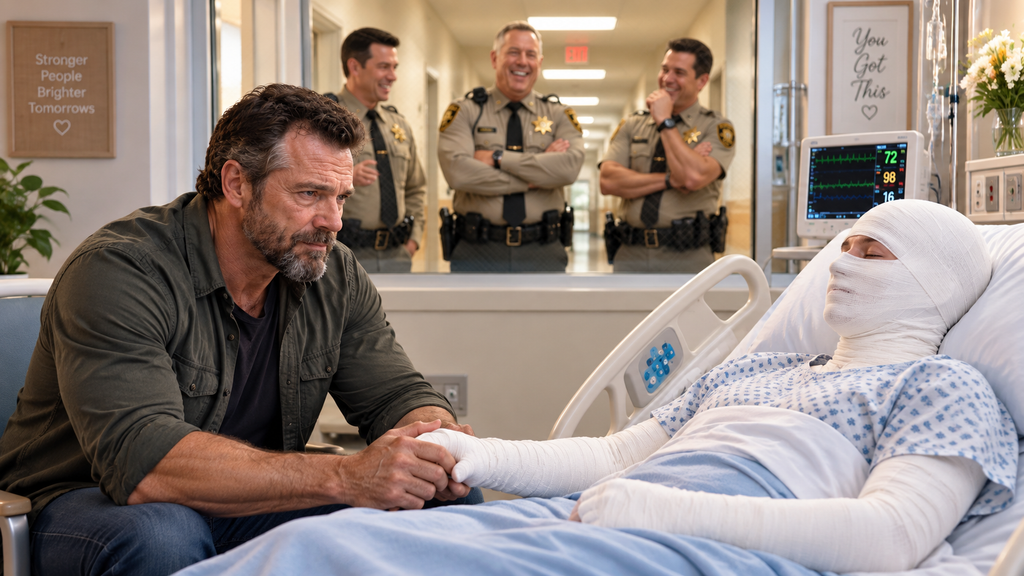
“Dennis,” she whispered, “what are you doing?”
I looked at the phone in my hand.
Mason Cole’s name was still glowing on the screen.
For seventeen years, I had kept that number buried beneath plumbers, doctors, school counselors, and grocery-store rewards accounts.
For seventeen years, I had pretended that the man Mason once knew as Reaper no longer existed.
And for seventeen years, that had been true.
Mostly.
“I’m making sure Barnes can’t do this to another kid,” I said.
Sarah shook her head.
“No.”
Her voice trembled.
“You listen to me. I know who you were. I know some of what you did before we met. I know you’re angry.”
“I’m beyond angry.”
“That’s exactly what scares me.”
I looked up at her.
She came closer.
“Tyler needs his father,” she said. “Not the man you used to be.”
Those words found the one place inside me that anger had not reached.
I closed my eyes.
For a moment, I was back beside Tyler’s hospital bed.
Dad…
I don’t think I’ll ever walk again.
My son’s voice had been so small.
So afraid.
I had spent his entire life teaching him that a decent man did not use strength to frighten weaker people.
Now a man with a badge had put two bullets through his knees.
Every instinct from my old life was screaming at me to solve the problem the way problems had once been solved in places where courts did not exist.
But this was not one of those places.
This was Colorado.
There were laws.
Judges.
Evidence.
Cameras.
Records.
Witnesses.
And if Rick Barnes had corrupted all of those things locally, then I would simply go farther up the chain.
I opened my eyes.
“I’m not going to kill him, Sarah.”
Her shoulders dropped slightly.
“I’m not going to touch him.”
“Then why call them?”
I looked back at the hospital.
“Because Barnes has spent years believing ordinary people have no power.”
I stood.
“I’m going to introduce him to four ordinary people.”
Mason arrived first.
He walked into Mercy General at 4:17 in the morning wearing faded jeans, a brown jacket, and the expression of a man who had spent two decades learning how to look harmless.
He was sixty-one now.
His hair had gone mostly white.
There was a surgical scar along the left side of his neck that had not been there the last time I saw him.
But I recognized his walk before I recognized his face.
Measured.
Balanced.
Always watching doors.
Always noticing hands.
He found me near the vending machines outside the surgical waiting room.
Neither of us said anything for several seconds.
Then Mason stepped forward and wrapped his arms around me.
That nearly broke me.
In our old life, we had survived mortar attacks together.
Ambushes.
A helicopter crash.
A winter operation in which we spent eleven hours hiding in freezing water because moving would have gotten eight people killed.
I had seen Mason injured badly enough that I thought he would die.
He had seen me carry a wounded teammate nearly two miles.
But we had never hugged.
Not like that.
Not until my son was lying under surgical lights.
“I’m sorry,” he said.
I nodded against his shoulder.
When we separated, he looked toward the operating wing.
“How’s the boy?”
“Still in surgery.”
“Sarah?”
“With him whenever they allow it.”
Mason studied me.
Then he asked the question only someone who truly knew me would think to ask.
“How close are you to doing something stupid?”
“Closer than I want to admit.”
He nodded.
“That’s why you called.”
“Yes.”
“Good.”
I frowned.
“Good?”
“You didn’t call me because you wanted revenge, Dennis.”
His voice was quiet.
“You called me because you knew you shouldn’t be alone with revenge.”
I looked away.
Damn him.
Twenty years and he could still read me.
He handed me a cup of hospital coffee.
“You said Barnes is sheriff?”
“For twelve years.”
“And your son was unarmed?”
“Yes.”
“Witnesses?”
“I don’t know yet.”
“Body camera?”
“Barnes claims it malfunctioned.”
Mason’s expression changed.
“Of course it did.”
I looked at him.
“What?”
“Nothing yet.”
That was Mason.
Never speculated aloud until speculation became something you could put on paper.
“Who else is coming?” I asked.
“Eli.”
I almost smiled.
“Jesus.”
“You said four.”
“Eli still alive?”
“Unfortunately.”
That time I did smile.
Barely.
“Priya is coming too.”
I looked at him sharply.
“Priya?”
“She retired from federal service six years ago. Does corporate investigations now.”
“And the fourth?”
Mason raised one eyebrow.
“You.”
“No. You asked if I counted myself.”
“I did.”
“I meant four besides me.”
For the first time that night, Mason smiled.
“Then we have a problem.”
“What?”
“The fifth one is already here.”
A woman’s voice came from behind me.
“You always were terrible at counting when you were angry.”
I turned.
Priya Shah stood near the elevators holding a travel bag.
At sixty, she still carried herself exactly as I remembered.
Sharp eyes.
Straight posture.
Zero wasted movement.
Her hair was streaked silver now.
She looked at me.
Then at the red smear on my shirt.
Tyler’s blood.
Her expression softened.
“Oh, Dennis.”
I could not speak.
She hugged me.
And for the second time that night, I nearly came apart.
Eli Grant arrived twenty-eight minutes later.
He was the only man I knew who could enter a trauma waiting room at five in the morning and somehow look as though he had wandered in from a fishing trip.
Old flannel shirt.
Work boots.
A gray beard.
A baseball cap with a faded trout on it.
He looked at Mason.
Looked at Priya.
Looked at me.
Then he said, “Well, this is either the world’s worst reunion or somebody finally remembered my birthday.”
Priya glared at him.
Eli’s smile disappeared.
“Too soon?”
“About twenty years too soon.”
He nodded.
“Fair.”
Then he put a hand on my shoulder.
“How’s Tyler?”
“They’re rebuilding both knees.”
His jaw tightened.
“Who shot him?”
“Sheriff Barnes.”
“Why?”
“That,” I said, “is what I need you to help me find out.”
Eli looked at Mason.
Mason looked at Priya.
Something passed between them.
Something old.
Something I had almost forgotten.
Not excitement.
Not violence.
Purpose.
That was what our team had always been best at.
Taking confusion and cutting it into pieces small enough to understand.
Mason sat down.
“Start from the beginning.”
So I did.
I told them about Sarah’s call.
The emergency room.
Harold’s diagnosis.
What Tyler had whispered.
Barnes laughing.
The destroyed body-camera footage.
Everything.
Priya took notes.
Eli asked about the location of the shooting.
Mason asked whether Tyler had been driving.
No.
Whether drugs or alcohol had been involved.
No.
Whether Tyler had a weapon.
No.
Whether he had a criminal record.
Not even a detention at school.
Then Priya asked something I hadn’t considered.
“Why was Tyler anywhere near Barnes?”
I stared at her.
“I don’t know.”
She underlined something on the pad.
“That matters.”
The operating-room doors opened.
Harold came out.
I stood so quickly my coffee fell.
I didn’t care.
Harold pulled off his surgical cap.
He looked exhausted.
“It went as well as it could.”
Sarah emerged behind him.
Her face was wet with tears.
I crossed the hall.
“What does that mean?”
Harold spoke carefully.
“We stabilized both knees. His right side suffered more extensive damage, but the major blood vessels were spared.”
“Will he walk?”
Harold hesitated.
Again.
I hated that hesitation.
“We don’t know.”
Sarah made a small sound.
I took her hand.
Harold continued.
“But Dennis… there is a path.”
I looked at him.
“A hard one. Physical therapy. More surgery. Possibly reconstructive procedures. There may be permanent limitations.”
“But there’s a path.”
“Yes.”
That was enough.
For then, that was enough.
I bent forward and pressed my forehead against Sarah’s.
“He has a path.”
She nodded.
“He has a path.”
Behind us, my old teammates stood silently.
And for the first time since Sarah’s phone call, I felt something other than rage.
Hope.
Tiny.
Fragile.
But alive.
Tyler woke shortly before noon.
His lips were cracked.
His voice was rough from anesthesia.
Sarah sat on one side.
I sat on the other.
He stared at the ceiling for a while.
Then tears gathered in the corners of his eyes.
“I was supposed to play Friday.”
I swallowed.
Our regional basketball semifinal.
He had talked about it for weeks.
Scouts from two colleges were supposed to attend.
“You don’t have to think about basketball.”
“But I worked for it.”
“I know.”
“Since I was nine.”
“I know.”
He looked down toward the blankets covering his legs.
“I don’t even know if I have knees anymore.”
Sarah started crying.
I leaned closer.
“You have knees.”
“They feel like they’re on fire.”
“I know.”
“You don’t know.”
He said it sharply.
Then guilt crossed his face.
“Dad, I’m sorry.”
“Don’t apologize.”
“You don’t know what it feels like.”
He was right.
So I didn’t lie to him.
“No,” I said.
“I don’t.”
He stared at me.
“But I know what it feels like when one moment divides your life into before and after.”
His breathing slowed.
“And I know the mistake people make afterward.”
“What?”
“They spend so long wishing they could get back to before that they forget there’s still an after.”
Tyler’s eyes filled.
“I liked before.”
My throat closed.
“Me too, son.”
He squeezed my fingers.
After a while, I asked him something I hated having to ask.
“Can you tell me what happened?”
Sarah looked at me.
“Dennis—”
“We don’t have to do it now.”
Tyler shook his head.
“No.”
His voice hardened.
“I want to.”
I reached for my phone.
Then stopped.
“Would you mind if I record you?”
“Why?”
“Because your memory matters.”
His face changed.
Something flickered there.
Fear.
Not pain.
Fear.
“Dad…”
“What?”
“He had another deputy.”
I leaned forward.
“Who?”
“I don’t know.”
“Did you see his name?”
“No. He stayed near the cruiser.”
“Did he shoot?”
“No.”
“What did he do?”
Tyler swallowed.
“Nothing.”
Sometimes nothing is its own kind of violence.
I started the recording.
Tyler closed his eyes.
“I was walking back from Jonah’s house.”
“What time?”
“Like nine-fifteen.”
“Then?”
“Sheriff Barnes drove past me.”
“In his department vehicle?”
“Yes.”
“Lights?”
“No.”
Tyler stared at the ceiling.
“He went past. Then backed up.”
My stomach turned.
“He rolled down the window and asked where I was going.”
“What did you say?”
“Home.”
“Anything else?”
“I called him sir.”
His voice cracked with anger.
“I swear, Dad. I called him sir.”
“I believe you.”
“He asked why I was walking around so late. I told him I was seventeen, not seven.”
Sarah closed her eyes.
Tyler looked at me.
“That was stupid.”
“No.”
“It made him mad.”
“That doesn’t make what happened your fault.”
Tyler took a shaky breath.
“He got out.”
“What happened next?”
“He told me to put my hands on the hood.”
“Why?”
“He didn’t say.”
“Did you do it?”
“At first.”
At first.
The words chilled me.
“Then what?”
“He started searching me.”
Tyler looked embarrassed.
“Like… rough. He emptied my pockets. My phone. Wallet. House key.”
“Anything illegal?”
“No.”
“I know. Keep going.”
“He found nothing.”
Tyler’s voice became quieter.
“Then he said kids like me needed to learn respect.”
I looked at Sarah.
“Kids like you?”
“I don’t know what he meant.”
Then Tyler said something that changed everything.
“I told him I knew about Caleb.”
I stopped breathing.
“Who is Caleb?”
Tyler looked at me.
“Caleb Morrison.”
The name was familiar.
A sixteen-year-old who had supposedly attacked a deputy the previous summer before being arrested.
Charges had eventually been dropped.
The local paper called it a misunderstanding.
“What do you know about Caleb Morrison?”
“He goes to school with me.”
“Tyler.”
“He told us what Barnes did to him.”
Sarah looked confused.
“What?”
“Barnes hit him behind the sheriff’s office. Kept hitting him. Caleb said he thought Barnes was going to kill him.”
“Did Caleb report it?”
Tyler laughed bitterly.
“To who? Barnes?”
I felt the room get colder.
“He told people at school,” Tyler continued. “Nobody believed him.”
“Did you?”
“Not at first.”
He looked ashamed.
“Then Caleb showed me pictures.”
Priya, who had been standing quietly at the doorway with permission from Sarah, suddenly moved.
“Pictures?”
Tyler noticed her.
“Who’s that?”
“An old friend.”
Priya came closer.
“Tyler, did Caleb send the photographs to you?”
“Yes.”
“Are they still on your phone?”
Tyler’s eyes widened.
“My phone.”
“What about it?”
“Barnes took it.”
That was the first real piece.
The first thread.
I looked at Priya.
She had already understood.
Barnes had not stopped Tyler randomly.
He had taken his phone.
Then shot him.
Two bullets.
One through each knee.
Punishment.
A message.
I asked Tyler what happened after he mentioned Caleb.
His lower lip shook.
“Barnes smiled.”
I felt Sarah’s hand grip mine.
“He said, ‘You kids really need to learn when to keep your mouths shut.’”
Tyler stared straight ahead.
“Then he told the deputy to turn around.”
Every hair on my arms lifted.
“What?”
“He told him to turn around.”
“Did he?”
“Yes.”
“Then?”
“Barnes told me to kneel.”
Sarah broke.
She stood abruptly and walked toward the window, both hands over her mouth.
I wanted to stop the questioning.
I should have stopped.
But Tyler looked at me.
He wanted to finish.
So I let him.
“I asked why.”
His voice was barely audible.
“Barnes pulled his gun.”
The monitor beside him quickened.
“I thought he was trying to scare me.”
I squeezed his hand.
“You’re safe.”
“He told me to kneel.”
“You’re safe now.”
“So I did.”
Tyler began crying.
“I said please.”
I lowered my head.
“I kept saying please.”
My vision blurred.
“He put the gun near my right leg.”
Sarah slid down into the chair near the window.
“And he said…”
Tyler couldn’t finish.
I waited.
Finally he whispered.
“He said, ‘Maybe now you’ll remember who gets to stand tall in my county.’”
Then came the shot.
Tyler screamed at the memory.
Not loudly.
Worse.
It was a strangled sound buried deep in his chest.
I reached to stop the recording.
“No.”
He grabbed my wrist.
“One more.”
I stared at him.
“The other knee.”
My son looked into my eyes.
“I fell after the first shot.”
He was shaking badly now.
“He walked around me.”
Tears rolled down his temples into his hair.
“I was screaming.”
“And he laughed.”
I could barely breathe.
“He said I looked lopsided.”
Sarah sobbed.
“Then he shot the other one.”
Silence swallowed the room.
Tyler stared at me.
“I thought I was going to die, Dad.”
I pressed my forehead to his hand.
And finally I cried.
Not quiet tears.
Not dignified tears.
I cried like a father whose child had called for help while a man with authority stood over him and laughed.
“I’m sorry,” I whispered.
Tyler frowned.
“For what?”
“For not being there.”
He squeezed my hand.
“You couldn’t know.”
“I should’ve—”
“You couldn’t know.”
My own words, coming back to me through my son.
I nodded.
Then I turned off the recording.
Mason had been waiting in the hall.
When I stepped outside, he took one look at my face.
“Bad?”
“Worse.”
I told them.
Every detail.
When I finished, Eli leaned against the wall and muttered something under his breath.
Priya had gone completely still.
Mason looked at me.
“Dennis.”
“I know.”
“Say it.”
I looked through the glass at Tyler.
“We do this clean.”
“Say the rest.”
“No threats.”
“Good.”
“No revenge.”
“Good.”
“No touching Barnes.”
Mason nodded.
“We don’t destroy him.”
He pointed toward Tyler’s room.
“He destroyed himself.”
Then Priya said, “We just need enough light for everyone to see it.”
By sunset, she had found Caleb Morrison.
Not by hacking databases.
Not by breaking laws.
By opening a phone book, making calls, and eventually reaching Caleb’s mother.
She explained who she was.
She explained what had happened to Tyler.
Then she asked one question.
“Would Caleb be willing to talk?”
He was.
But not at his house.
Caleb chose a diner two towns away.
At seven-thirty that evening, I walked into Miller’s Diner with Priya.
Caleb was sitting in a booth with his mother.
He was small for sixteen.
Thin.
Nervous.
He kept looking at the door.
His mother, Rebecca, looked exhausted.
“I heard about your boy,” she said.
“I’m sorry about Caleb.”
She laughed once.
It was not a happy sound.
“Everyone’s sorry after it happens again.”
I sat across from them.
Caleb stared at my hands.
“Are you military?”
I looked at him.
“Used to be.”
“How’d you know?” Priya asked.
Caleb shrugged.
“My uncle was Marines.”
I nodded.
For several seconds nobody spoke.
Then I said, “Tyler believed you.”
Caleb’s face changed.
“He did?”
“Yes.”
“He told me he didn’t at first.”
“He told me that too.”
Caleb looked down.
“At least he was honest.”
His mother reached across and touched his wrist.
I said, “Tyler said you sent him photographs.”
Caleb immediately became scared.
“He doesn’t have them anymore.”
“Because Barnes took his phone.”
Caleb nodded.
“Barnes came to our house once.”
Rebecca stiffened.
“You never told me that.”
Caleb kept looking down.
“When?”
“A month ago.”
“Caleb.”
“I was scared.”
“What did he say?”
“That lying about law enforcement was serious.”
Rebecca went pale.
“He came to my house and spoke to my child without telling me?”
Caleb nodded.
Priya leaned forward.
“What happened to the original photographs?”
Caleb looked at her.
“What do you mean?”
“The pictures you sent Tyler. Did you take them on your own phone?”
“Yeah.”
“Do you still have that phone?”
“No.”
“Why?”
“Barnes took it when I got arrested.”
“And when your charges were dropped?”
“He said it was evidence.”
Priya glanced at me.
There it was again.
Phones disappearing.
Evidence disappearing.
But then Caleb said, “I backed them up.”
Nobody moved.
“Where?” Priya asked.
He looked embarrassed.
“Cloud storage.”
His mother blinked.
“You told me everything was gone.”
“I thought it was safer if you didn’t know.”
Caleb pulled an old tablet from his backpack.
His hands were trembling.
He entered a password.
A folder opened.
Twelve photographs.
Caleb’s face.
Bruising along his ribs.
A split lip.
Finger-shaped marks on his throat.
A swollen eye.
Then one photograph taken in a mirror.
Across his back were dark red welts.
I felt sick.
Priya asked, “Did a doctor see you?”
“No.”
His mother interrupted.
“He begged me not to take him. He said Barnes would know.”
Caleb swiped again.
A video.
He hesitated.
Then pressed play.
The image shook badly.
We could see darkness.
Concrete.
Part of a vehicle.
Caleb had apparently hit record without Barnes noticing.
The audio was clearer than the picture.
A man’s voice.
Barnes.
“You think anybody in this town is going to believe you over me?”
A younger voice.
Caleb.
“Please.”
Then a hard sound.
A cry.
Barnes again.
“I am the law you call when men like me hurt you.”
Another impact.
The recording ended.
Nobody in the diner spoke.
A waitress walked past us carrying a pot of coffee.
Silverware clinked somewhere near the kitchen.
Normal life continued all around our booth.
I stared at Caleb.
“How many people have seen this?”
“Tyler.”
“Anyone else?”
“My friend Jonah.”
I looked at Priya.
“Jonah’s the house Tyler was walking home from.”
She nodded slowly.
“So Barnes may have known exactly where he had been.”
“How?”
Caleb answered.
“Jonah’s dad works for the sheriff’s department.”
There it was.
Another thread.
Jonah Ellis’s father was Deputy Paul Ellis.
The second deputy at Tyler’s shooting.
The man who had turned around.
I did not sleep that night.
Neither did Mason.
At three in the morning, he found me standing by the hospital window.
The town lights glittered below us.
“You’re thinking too loudly,” he said.
I glanced at him.
“You always say stupid things at three in the morning?”
“Only when tired.”
He stood beside me.
For a while, we watched the empty streets.
Then I said, “Paul Ellis could have stopped it.”
“Maybe.”
“He had a badge.”
“So did Barnes.”
“He had a gun.”
“So did Barnes.”
“He stood there.”
“Yes.”
I looked at Mason.
“If we’d done that…”
“We weren’t seventeen-year-old deputies with a mortgage, two kids, and a corrupt sheriff controlling our careers.”
“That excuses it?”
“No.”
Mason looked at me.
“But if you want truth, you don’t decide what a man is before you know why he failed.”
I hated when he was right.
At nine the next morning, Paul Ellis came to us.
We did not contact him.
He came to the hospital.
Alone.
No uniform.
No badge visible.
Sarah was sitting with Tyler.
I was getting coffee when Ellis approached me.
“Mr. Irwin?”
I turned.
He looked exhausted.
Early thirties.
Red eyes.
Unshaven.
I recognized him from local events.
A man I had seen directing traffic at parades.
A man Tyler probably recognized too.
“My name’s Paul Ellis.”
My hand tightened around the coffee cup.
“I know who you are.”
He swallowed.
“I was there.”
“I know.”
“I need to talk to you.”
For a moment, I pictured Tyler kneeling on asphalt.
I pictured Ellis turning away.
I stepped closer.
His face drained.
Then Mason’s words returned.
If you want truth…
I backed away.
“Talk.”
Ellis glanced around.
“Not here.”
“Anything you say to me, you can say to investigators.”
His jaw trembled.
“I don’t know which investigators I can trust.”
“That sounds like your problem.”
“It became your son’s problem.”
That stopped me.
Ellis looked ready to vomit.
“I’m sorry.”
I said nothing.
“I know that doesn’t mean anything.”
“You’re right.”
“I should’ve stopped him.”
“Yes.”
“I keep hearing Tyler scream.”
“So does Tyler.”
Ellis’s eyes filled.
“I have a recording.”
Every emotion inside me vanished at once.
“What?”
He looked around again.
“I recorded Barnes.”
“With what?”
“My phone.”
“You turned around.”
“I did.”
“You obeyed him.”
“Yes.”
“But you recorded him.”
Ellis nodded.
“I knew something was wrong before he got out of the cruiser.”
I stared at him.
“How wrong?”
Ellis breathed in slowly.
“Barnes had been watching Tyler for almost two weeks.”
My blood went cold.
“Why?”
“Because of Caleb.”
Ellis explained.
His son Jonah had shown him some of Caleb’s photographs.
Paul had confronted Barnes privately.
Barnes claimed Caleb had attacked him.
Ellis did not believe it.
Then Barnes found out Tyler had copies.
“How?”
“I don’t know.”
“You’re lying.”
“I swear I don’t.”
“Your son?”
“No.”
“Someone at school?”
“Maybe.”
Ellis rubbed his face.
“Barnes has people everywhere.”
“You’re a deputy.”
“I know.”
“You were one of his people.”
The words landed.
Ellis looked down.
“Yes.”
He deserved that.
Maybe worse.
But he continued.
“The night he stopped Tyler, we were driving together because Barnes said there had been complaints about teenagers vandalizing mailboxes.”
“Were there?”
“No.”
“You knew that?”
“Not until later.”
“When he saw Tyler, Barnes said, ‘There he is.’”
My heartbeat changed.
“Those exact words?”
“Yes.”
“Then what?”
“He backed up.”
Ellis was shaking now.
“When Tyler mentioned Caleb, I knew.”
“Knew what?”
“That Barnes hadn’t stopped him because of mailboxes.”
His voice cracked.
“Barnes told me to turn around.”
“And you did.”
“Yes.”
“Why?”
Ellis looked at me.
“Because two years ago another deputy challenged Barnes.”
“What happened?”
“He was fired.”
“That’s all?”
“No.”
Ellis swallowed.
“Three weeks later, meth was found in his truck.”
I stared at him.
“He swore it wasn’t his.”
“Was it?”
“No.”
“How do you know?”
“Because I watched Barnes put it there.”
The hallway seemed to narrow.
“And you said nothing.”
“I had a wife and two little girls.”
“And that deputy?”
“Lost everything.”
“Did he go to prison?”
“Eleven months.”
I stepped close to Ellis again.
“You let an innocent man go to prison because you were afraid.”
Tears filled his eyes.
“Yes.”
“You watched my son get shot because you were afraid.”
“Yes.”
“And now you want what? Forgiveness?”
“No.”
“Then what do you want?”
Ellis reached into his coat slowly.
Mason, sitting thirty feet away, stood immediately.
Ellis pulled out a phone.
Not his normal one.
An older device.
“I want to testify.”
I stared at it.
“I want to tell them everything.”
“Why now?”
Ellis’s face folded.
“Because Tyler is seventeen.”
His voice broke.
“My oldest daughter is fifteen.”
He wiped his eyes.
“And when Barnes fired that first shot, your son screamed for his dad.”
I stopped breathing.
Ellis whispered, “And all I could think was that if Barnes did that to my girl someday, I’d pray somebody standing there was braver than I was.”
He held out the phone.
“I wasn’t brave enough then.”
His hand shook.
“Let me be brave enough now.”
The recording was twenty-seven minutes long.
Ellis had started it before the stop.
Most of it was silence, road noise, and conversation.
Then Barnes’s voice.
“There he is.”
The vehicle slowed.
A door opened.
Footsteps.
Barnes questioning Tyler.
Tyler answering.
Then Tyler mentioning Caleb.
Silence.
And Barnes saying:
“You kids really do need to learn when to keep your mouths shut.”
Everything Tyler had told us was there.
Everything.
The order to kneel.
Tyler pleading.
The first gunshot.
His scream.
Barnes laughing.
The words about being lopsided.
The second gunshot.
And afterward, something Tyler had not heard.
Because he had been unconscious.
Barnes speaking to Ellis.
“His phone fell during the struggle.”
Ellis’s voice.
“What struggle?”
A pause.
Then Barnes.
“The one you’re going to remember.”
Another pause.
“We clear?”
Ellis did not answer.
Barnes repeated himself.
“We clear?”
Finally Ellis said, “Yes, Sheriff.”
The recording ended.
I sat in Priya’s rented SUV outside the hospital and listened to the whole thing twice.
The second time was worse.
Because the first time, part of me still hoped there would be some misunderstanding.
Some noise.
Some context.
Some fragment that would make what happened less deliberate.
There wasn’t.
Barnes had shot my son as punishment.
And then, before Tyler’s blood was cold on the pavement, he had begun manufacturing a lie.
Priya took the phone from my hand.
“We need to preserve this properly.”
“I know.”
“We need copies.”
“I know.”
“And Dennis?”
I looked at her.
“You cannot release it yourself.”
“Why?”
“Because if this becomes a circus before the right authorities secure the evidence, Barnes’s lawyers will spend the next year claiming manipulation, political pressure, contamination, editing—anything.”
“He shot my son.”
“I know.”
“I want the whole town to hear him laugh.”
“And they will.”
She leaned closer.
“But you told Tyler you would take care of everything.”
“I did.”
“Then take care of it.”
Her eyes hardened.
“Don’t satisfy your anger for ten minutes and damage his case for ten years.”
I leaned back.
She was right.
Again.
Apparently old teammates were determined to make my life miserable by being reasonable.
“So what now?”
Priya looked at Mason.
Mason looked at Ellis.
Then Priya said, “Now we go outside the county.”
At 11:42 that morning, copies of the evidence were delivered through an attorney to the Colorado Bureau of Investigation and the state attorney general’s office.
By 1:00, federal contacts had been notified of potential civil-rights violations.
By 2:17, three state investigators entered Mercy General through a side entrance.
By 3:30, they had interviewed Tyler.
By 5:00, Paul Ellis had provided a formal sworn statement.
By 7:10, investigators were interviewing Caleb and his mother.
And shortly after eight, Rick Barnes discovered that the invisible old janitor whose son he had shot was not going away.
I knew because Barnes called me.
My phone rang while I was sitting beside Tyler.
Unknown number.
I almost ignored it.
Then I answered.
“Dennis Irwin?”
I recognized his voice immediately.
I had heard it on the recording.
My hand tightened.
“Yes.”
“This is Sheriff Barnes.”
Tyler’s eyes opened.
I stood and walked into the hall.
“How did you get my number?”
“I’m the sheriff, Dennis.”
He said my name casually.
Like we were neighbors discussing a fence.
“I heard your boy’s doing better.”
I said nothing.
“That’s good.”
Silence.
“You’ve had a rough few days.”
Still nothing.
Barnes sighed.
“Look, I don’t know what Tyler told you, but teenagers sometimes remember traumatic events inaccurately.”
I looked through the window at my son.
Both legs suspended.
Bruises under his eyes.
A line carrying medication into his arm.
“He remembers enough.”
Barnes chuckled.
Actually chuckled.
“Dennis, I know you’re upset.”
“No.”
“No?”
“I passed upset yesterday.”
The chuckle disappeared.
“I’m trying to do you a courtesy.”
“You shot my child.”
“He reached.”
“For what?”
“Something in his waistband.”
“What?”
“We don’t know.”
“You searched him before you shot him.”
Silence.
That was the first moment he realized I knew more than he expected.
“Who told you that?”
I said nothing.
Barnes’s voice changed.
Less friendly.
“Listen carefully.”
I almost smiled.
Not because anything was funny.
Because I recognized that tone.
Men who relied on fear all sounded alike eventually.
“Your son interfered with an active law-enforcement matter.”
“Is that why you took his phone?”
Another silence.
Longer.
“Dennis.”
“Yes?”
“You’re getting involved in things you don’t understand.”
“I understand you laughed.”
Nothing.
“You laughed after the first shot.”
I heard his breathing.
“You told him he looked lopsided.”
The line went dead.
I lowered the phone.
Mason was standing ten feet away.
“How’d that go?”
“He’s scared.”
“Good.”
“No.”
I looked at him.
“Not good.”
Mason waited.
“A scared man like Barnes is dangerous.”
He nodded.
“That’s better.”
“What?”
“You’re thinking again.”
Barnes moved fast.
By nine o’clock that night, the sheriff’s department released a public statement.
It said Tyler Irwin had behaved “aggressively.”
It said Barnes had fired after Tyler “made repeated movements consistent with reaching for a concealed weapon.”
It said Sheriff Barnes had been placed on “administrative leave pending routine review.”
Routine.
My son’s knees had been destroyed and they called it routine.
Then the statement added something unexpected.
It said witnesses corroborated the sheriff’s account.
Witnesses.
Plural.
Ellis stared at the news article on Priya’s tablet.
“I didn’t.”
“Then who?” I asked.
His face tightened.
“I think I know.”
Twenty minutes later, he gave us a name.
Deputy Chief Warren Pike.
Pike had not been at the shooting.
But he had signed the incident report as though he had interviewed Ellis at the scene.
He had not.
That meant the cover-up was not beginning.
It had begun years ago.
Priya leaned back.
“This is bigger than Barnes.”
“How much bigger?”
“I don’t know.”
Over the next forty-eight hours, we started learning.
Not because my old team raided buildings.
Not because we broke into offices.
Not because anybody dragged information out of anyone.
People came to us.
That was the part Barnes had never understood.
Fear looks powerful when everyone experiencing it believes they are alone.
Then one person speaks.
And another.
And another.
The first was a former dispatcher named Amy Larsen.
She had quit three years earlier.
She told investigators Barnes routinely ordered dispatch logs modified to make traffic stops appear justified after the fact.
Then came former deputy Miguel Santos.
He was the officer who had supposedly been caught with meth.
The man Ellis had watched Barnes frame.
Santos still had copies of emails sent before his arrest documenting concerns about evidence handling.
Then a bar owner named Thomas Keene.
Barnes had demanded free meals and drinks for years.
When Keene finally refused, deputies suddenly began citing his customers for minor parking violations.
Then a nineteen-year-old woman named Emily Rhodes.
She claimed Barnes detained her after a traffic stop and threatened to arrest her unless she unlocked her phone.
Then a rancher named Dale Cooper.
Then a school custodian.
Then a mechanic.
Then another teenager.
Then another.
Some allegations were minor.
Some were serious.
Some would later prove impossible to verify.
But a pattern emerged.
Rick Barnes had not believed he was sheriff of Livingston County.
He had believed he owned it.
And people had learned to survive by staying out of his way.
The difference now was that he had picked the wrong seventeen-year-old boy.
Not because Tyler’s father had once been dangerous.
Not because I knew soldiers.
Not because we had secret contacts.
Barnes picked the wrong boy because Tyler had something Barnes never respected.
A voice.
And finally, people were listening.
On Tyler’s fifth day in the hospital, he had his first physical-therapy consultation.
A woman named Dr. Lena Morales entered his room carrying a clipboard.
She was barely five feet tall.
Tyler looked suspiciously at her.
She looked at his chart.
Then at him.
“You’re the basketball kid.”
“Was.”
She ignored that.
“Point guard?”
“Shooting guard.”
“Three-point percentage?”
Tyler looked at me.
Then back at her.
“Thirty-eight.”
“Not bad.”
“Not bad?”
Lena shrugged.
“I’ve seen better.”
Tyler stared at her.
I hid a smile.
She stepped toward the bed.
“I’m Lena. I’m going to be one of the people you hate for the next year.”
“A year?”
“Maybe longer.”
His face fell.
She pulled over a chair.
“Tyler, I don’t lie to patients.”
He looked at her.
“This is going to hurt.”
He looked away.
“You’ll have days when you make progress.”
She continued.
“You’ll have days when you go backward.”
His jaw tightened.
“You may regain full function. You may not.”
He closed his eyes.
“You might run again. You might walk with limitations. You may need additional surgeries.”
“Great.”
“But let me tell you what I know.”
He looked at her again.
“You’re alive.”
His face hardened.
“People keep saying that like I’m supposed to be grateful.”
“No.”
Lena did not flinch.
“You don’t have to be grateful.”
That surprised him.
“You’re allowed to be angry.”
Silence.
“You’re allowed to hate this.”
Tyler’s eyes filled.
“You’re allowed to look at your legs and think this isn’t fair.”
A tear slipped down his cheek.
“Because it isn’t.”
Sarah lowered her head.
Lena leaned forward.
“But tomorrow morning, at eight o’clock, I’m still going to ask you to move your toes.”
Tyler laughed through tears.
“That’s your big plan?”
“Tomorrow, toes.”
She smiled.
“Next week, maybe an ankle.”
“That sounds pathetic.”
“No.”
Lena stood.
“You know what’s pathetic?”
“What?”
“Giving up because the first step looks small.”
She tapped the clipboard against his bed.
“Big things are just small things that refused to stop.”
That sentence stayed with Tyler.
And with me.
Barnes was arrested eleven days after the shooting.
Not at dawn.
Not with dramatic helicopters overhead.
Not during some armed confrontation.
At 10:26 on a Monday morning, two state investigators entered the Livingston County Sheriff’s Office with an arrest warrant.
Barnes walked out twelve minutes later in handcuffs.
The local news showed it live.
I watched from Tyler’s room.
Barnes wore a dark suit instead of his uniform.
His face was red.
Reporters shouted questions.
He ignored them.
Then someone yelled:
“Sheriff Barnes, did you intentionally shoot Tyler Irwin?”
Barnes looked up.
For just a second, he looked directly into the camera.
And the strangest thing happened.
I felt nothing.
I had imagined this moment every night.
I thought seeing him in handcuffs would bring satisfaction.
Relief.
Maybe even joy.
Instead, I looked at Tyler.
He was asleep.
One foot twitching slightly beneath the blanket because his nerves had begun responding again.
That mattered more.
Barnes suddenly seemed small.
Not harmless.
But small.
The television called him powerful.
I no longer saw power.
I saw a frightened man who had spent years borrowing power from a badge.
Once the badge was removed, he was just Rick Barnes.
That afternoon, prosecutors announced charges that included aggravated assault, official misconduct, evidence tampering, obstruction, and other offenses connected to Tyler’s shooting.
Additional investigations remained open.
Barnes pleaded not guilty.
Of course he did.
His attorney stood on the courthouse steps and called the prosecution a political witch hunt.
He called Tyler’s account inconsistent.
He called Paul Ellis unreliable.
He suggested the recording had been manipulated.
And then he made a mistake.
He mentioned me.
“Mr. Irwin’s military background raises serious questions about whether witnesses have been intimidated.”
I was mopping the courthouse floor when I heard that statement playing from a reporter’s phone.
Yes.
I had gone back to work.
Three weeks after Tyler was shot.
Sarah thought I was insane.
Mason thought it was hilarious.
But I needed normal.
I needed the squeak of the mop.
The smell of floor cleaner.
The same old hallway.
I needed to remember that my life had not become the worst thing that had happened to my son.
A young reporter found me near Courtroom Two.
“Mr. Irwin!”
I kept mopping.
“Mr. Irwin, Barnes’s attorney says your background may have influenced witnesses.”
I dipped the mop into the bucket.
“Mr. Irwin?”
I wrung it out.
“Do you have a response?”
I looked at her.
She held out a microphone.
Behind her, three other reporters had gathered.
For seventeen years, most people in that building had walked past me without knowing my name.
Now cameras followed me.
I hated it.
But I understood something.
Silence had protected Barnes.
So I spoke.
“My son is seventeen.”
The hallway went quiet.
“He weighed one hundred seventy-two pounds when Sheriff Barnes stopped him.”
I rested both hands on the mop handle.
“He had a wallet, a house key, and a cell phone.”
The reporters listened.
“He did not have a weapon.”
I swallowed.
“He begged for his life.”
My voice almost broke.
I let it.
“And the man who shot him laughed.”
Nobody moved.
“I have never threatened Sheriff Barnes.”
I looked directly into the nearest camera.
“I will never threaten him.”
Then I said the words that would be replayed across the state for the next three days.
“I spent part of my younger life in places where powerful men believed fear could replace law.”
I paused.
“They were wrong there.”
Another pause.
“And he is wrong here.”
I picked up my mop.
“That’s my response.”
Then I went back to cleaning the floor.
Tyler came home after thirty-six days.
We built a temporary ramp.
His basketball teammates painted a sign across the garage.
WELCOME HOME, #11.
Tyler cried when he saw it.
Then he got angry at himself for crying.
Sarah told him crying was cheaper than therapy.
Lena told Sarah not to put her out of business.
For the first several weeks, life became measured in inches.
Could Tyler move his right foot?
Two inches.
Could he bend his left knee?
Seven degrees.
Could he transfer from the bed to the wheelchair without help?
Not yet.
Then yes.
Then no again after a surgery.
Then yes.
Pain became a member of our family.
It ate breakfast with us.
Sat in the car.
Woke Tyler at three in the morning.
Made him cruel sometimes.
Made him quiet other times.
One night, I found him in the kitchen in his wheelchair.
The refrigerator door was open.
He wasn’t looking for food.
He was staring at the top shelf.
His old basketball sat there.
He had put it in the kitchen months earlier after Sarah threatened to throw away any ball left in the hallway.
“Can’t sleep?” I asked.
He shook his head.
I sat across from him.
After a while he said, “I hate him.”
“I know.”
“Do you?”
“Yes.”
“You don’t act like it.”
“What should I do?”
“I don’t know.”
He looked at me.
“Something.”
I understood.
Tyler had grown up knowing almost nothing about my military years.
He knew I had served.
He knew I had been overseas.
He knew I disliked fireworks and always sat facing restaurant entrances.
That was about it.
But after Barnes’s attorney mentioned my background publicly, Tyler started asking questions.
Maybe he imagined I had some hidden way to make Barnes suffer.
Maybe part of him wanted that.
So did part of me.
“I could hurt him,” I said.
Tyler stared at me.
“Really hurt him.”
He said nothing.
“There was a time when I knew exactly how.”
His face changed.
“Then why don’t you?”
That question hurt more than I expected.
I leaned forward.
“Because you’re watching.”
He frowned.
“What?”
“I’m your father.”
I looked at the basketball on the shelf.
“Everything I do right now teaches you something about what a man is supposed to do when somebody hurts him.”
Tyler’s eyes lowered.
“If I become like Barnes because Barnes hurt you, then Barnes gets two victims.”
Silence.
“I won’t give him that.”
Tyler rubbed his palms against the wheels of his chair.
“I still want him to hurt.”
“I know.”
“You don’t?”
“Every day.”
He looked up.
“What do you do with it?”
“The anger?”
“Yeah.”
I thought about that.
Then I pointed toward his legs.
“I use it to get you to therapy.”
Tyler rolled his eyes.
“Seriously.”
“I am serious.”
I stood.
“I use it to call lawyers.”
I closed the refrigerator.
“To sit through meetings.”
I picked up his basketball.
“To make sure witnesses aren’t alone.”
I bounced it once.
“To clean floors.”
Tyler almost smiled.
“And tomorrow, I’ll use it to get your stubborn butt out of bed at six-thirty.”
“I hate six-thirty.”
“See?”
I tossed him the ball.
He caught it instinctively.
“Anger can be useful.”
He looked at the ball.
“As long as it doesn’t choose where you’re going.”
Barnes’s trial began nine months after the shooting.
By then, Tyler could stand.
Only with braces.
Only with parallel bars.
Only for about forty seconds before his muscles started shaking.
But he could stand.
The first time it happened, I was behind him.
Lena was in front.
Sarah was filming.
Tyler pushed upward.
His arms trembled.
His face turned red.
His right leg nearly buckled.
Then he straightened.
Not completely.
But enough.
Sarah gasped.
I forgot how to breathe.
Tyler looked into the mirror across the therapy room.
For forty-one seconds, he stood.
At thirty-five seconds, he began crying.
At forty-one, he collapsed back into the chair.
Lena caught him.
Tyler laughed and cried at the same time.
“I stood.”
Sarah ran to him.
“You stood.”
He looked at me.
“Dad!”
I could not speak.
He reached for me.
I hugged him.
He whispered against my shoulder.
“I stood.”
“Yes.”
My voice broke.
“Yes, you did.”
Later that evening, I drove alone to the courthouse.
The building was closed.
I had keys.
I let myself in.
Moonlight stretched across the marble floor.
I walked to the exact hallway where I had been mopping when Sarah called nine months earlier.
Then I sat on the bench.
And cried.
Not because Tyler was fixed.
He wasn’t.
Not because everything was over.
It wasn’t.
I cried because nine months earlier my son had whispered:
I don’t think I’ll ever walk again.
And that morning he had stood for forty-one seconds.
Sometimes miracles do not look like miracles.
Sometimes a miracle is a shaking seventeen-year-old gripping two metal bars and refusing to sit down.
The trial lasted six weeks.
Tyler testified on the twelfth day.
Barnes sat at the defense table.
It was the first time Tyler had seen him since the shooting.
I watched my son enter the courtroom using forearm crutches.
Every camera turned toward him.
Barnes looked over.
For a fraction of a second, something passed across the former sheriff’s face.
I do not know whether it was guilt.
Fear.
Annoyance.
Maybe nothing.
Tyler stopped.
His shoulders tightened.
I was seated behind the prosecution.
He looked at me.
I wanted to run to him.
Instead, I nodded.
Once.
Tyler breathed in.
Then continued.
Step.
Brace.
Crutch.
Step.
Brace.
Crutch.
The courtroom was silent except for the small mechanical sounds of his movement.
He reached the witness stand.
Sat.
Swore to tell the truth.
Then looked directly at Rick Barnes.
The prosecutor asked Tyler to describe what happened.
He did.
His voice shook at first.
Then steadied.
Barnes’s attorney tried to make him angry.
“You were disrespectful to Sheriff Barnes, weren’t you?”
“I told him I was seventeen, not seven.”
“So yes?”
“I was sarcastic.”
“You challenged his authority.”
“No.”
“You mentioned Caleb Morrison in a threatening manner.”
“No.”
“You were angry.”
“I was confused.”
“You moved toward Sheriff Barnes.”
“No.”
“You reached for your waistband.”
“No.”
“You expect this jury to believe a veteran law-enforcement officer simply decided, for no reason, to shoot a seventeen-year-old twice?”
Tyler looked at him.
“I didn’t say there was no reason.”
The attorney paused.
“What was the reason?”
Tyler’s eyes moved toward Barnes.
“He wanted me scared.”
The courtroom became still.
“And were you?”
Tyler swallowed.
“Yes.”
For a moment, he was my little boy again.
Then he continued.
“But not anymore.”
Barnes looked away.
I lowered my head.
Sarah grabbed my hand.
Paul Ellis testified two days later.
He did not ask for sympathy.
That mattered.
He admitted every failure.
Yes, he turned around.
Yes, he heard Tyler plead.
Yes, he did not intervene.
Yes, he participated initially in the false account.
Yes, fear had controlled him.
Barnes’s attorney attacked him mercilessly.
“You expect this jury to trust a coward?”
Ellis looked toward Tyler.
“No.”
The attorney blinked.
“No?”
“I expect them to look at the evidence.”
“You are a coward, aren’t you?”
Ellis nodded.
“That night, yes.”
“Yet now you’re presenting yourself as a hero.”
“No.”
“What are you presenting yourself as?”
Ellis was quiet for several seconds.
Then he said, “A witness.”
That answer stayed with the jury.
So did the recording.
When prosecutors played the audio of the shooting, I thought I was prepared.
I had heard it many times.
I was wrong.
The courtroom speakers carried my son’s voice into every corner.
Please, sir.
I didn’t do anything.
Please.
Then the gunshot.
Tyler’s scream.
Sarah buried her face against my shoulder.
I gripped the bench until my fingers hurt.
Barnes stared at the table.
Then his laugh played.
A few jurors reacted visibly.
One covered her mouth.
Then the second gunshot.
When the recording ended, no one moved.
The prosecutor waited.
Sometimes silence makes the strongest argument.
The jury deliberated for fourteen hours.
Tyler refused to wait in the courthouse.
So we went home.
He sat on the porch with his crutches nearby.
Summer was beginning.
The cottonwood trees moved in the wind.
Kids rode bicycles down our street.
Normal life again.
Always normal life.
At 6:14 in the evening, my phone rang.
Our attorney.
“They have a verdict.”
We drove back.
The courtroom was packed.
Barnes entered in a suit.
Tyler entered with his crutches.
We sat.
The clerk handed the verdict sheet to the judge.
I watched Barnes.
Not the judge.
Not the prosecutor.
Barnes.
For months, he had looked confident.
At press conferences.
At hearings.
Entering court.
Talking to attorneys.
But when the judge unfolded that paper, I saw it.
His left hand trembled.
The judge read the first count.
“Guilty.”
Sarah inhaled sharply.
Second count.
“Guilty.”
Third.
“Guilty.”
Evidence tampering.
“Guilty.”
Official misconduct.
“Guilty.”
Obstruction.
“Guilty.”
Not every charge resulted in conviction.
Some related cases remained unresolved.
But the central truth was now part of the public record.
Rick Barnes had intentionally shot my unarmed seventeen-year-old son.
When the judge finished, Barnes closed his eyes.
Tyler did not cheer.
Neither did I.
There was no celebration.
Because no verdict could reverse two bullets.
No courtroom could give Tyler back the season he lost.
No prison sentence could erase the sound of Barnes laughing.
Justice is not a time machine.
People misunderstand that.
Justice does not make the wound disappear.
It simply refuses to let the person who caused it pretend there was no wound.
Barnes was taken into custody.
As deputies approached him, he looked over his shoulder.
Straight at me.
For the first time in nearly a year, our eyes met.
He stared.
Maybe he hated me.
Maybe he blamed me.
Maybe he still could not understand how the gray-haired janitor had become the man sitting twenty feet away watching his empire collapse.
Then I realized something.
He still thought this was about me.
It wasn’t.
It had never been.
So I turned away from Barnes.
And looked at my son.
Sentencing came later.
Barnes received a lengthy prison sentence.
Other investigations led to additional charges against people who had helped alter records and intimidate witnesses.
Deputy Chief Warren Pike resigned before he was indicted.
He later entered a plea agreement.
Miguel Santos, the deputy who had been framed, began proceedings to clear what remained of his record and seek compensation.
The county implemented outside review procedures for serious uses of force.
Body-camera policies changed.
Evidence-storage practices changed.
Some people called it reform.
Some called it politics.
I called it what should have existed before my son had to bleed for anyone to care.
Paul Ellis resigned from law enforcement.
He came to our house once afterward.
Tyler answered the door.
I watched from the kitchen.
For a long moment, neither said anything.
Then Ellis said, “I’m sorry.”
Tyler nodded.
“I know.”
“I should have stopped him.”
“Yeah.”
Ellis swallowed.
“I don’t expect you to forgive me.”
Tyler leaned against one crutch.
“I don’t.”
Ellis nodded slowly.
“I understand.”
He turned to leave.
Then Tyler said, “But you told the truth after.”
Ellis stopped.
Tyler looked at him.
“That mattered.”
Ellis’s eyes filled with tears.
“Thank you.”
“Don’t thank me.”
Tyler shifted his weight.
“Just don’t turn around next time.”
Ellis lowered his head.
“I won’t.”
He left.
I stood in the kitchen pretending not to cry.
Tyler looked at me.
“What?”
“Nothing.”
“You’re doing the weird proud-dad face.”
“I don’t have a proud-dad face.”
“You definitely do.”
“Go do your exercises.”
“There it is.”
By the time Tyler turned nineteen, he could walk without crutches for short distances.
He still had a brace on his right leg.
His left knee bent better.
His right never fully recovered.
Running remained difficult.
Basketball changed from dream to memory.
That loss took longer for him to accept than any of us expected.
He attended games.
At first he sat in the top row where nobody would notice when he cried.
Then one day the high-school coach asked whether he wanted to help with the junior team.
Tyler said no.
Two weeks later, he showed up anyway.
At first he carried clipboards.
Then he worked with guards on shooting form.
Then play diagrams.
Then confidence.
He discovered he had a gift for explaining the game.
The following year, he enrolled at Colorado State to study physical therapy.
I asked him why physical therapy.
He stared at me as if the answer should have been obvious.
“Lena was annoying.”
“That’s your reason?”
“I want to annoy people professionally.”
She cried when he told her.
Then denied crying.
As for me, I kept cleaning the courthouse.
People found that strange.
After the trial, I received interview requests.
Book offers.
A television producer wanted to make a documentary about “the secret warrior janitor.”
I said no.
A security company offered me more money than I had ever made in civilian life.
I said no.
Mason asked whether I was determined to remain the most overqualified janitor in Colorado.
I told him somebody had to keep the floors clean.
The truth was simpler.
For years, I had been embarrassed by how ordinary my life had become.
I never admitted that to Sarah.
Maybe I never admitted it to myself.
I had gone from rooms where world events were discussed in whispers to unclogging courthouse toilets at two in the morning.
From classified briefings to replacing paper-towel rolls.
From commanding men to cleaning up coffee spilled by lawyers who barely noticed me.
But after Tyler was shot, I finally understood something my younger self would have laughed at.
Ordinary is not the opposite of important.
Ordinary is what important things protect.
A quiet breakfast with your wife.
Your kid yelling from upstairs because he cannot find his shoes.
A basketball game on Friday night.
A bad joke.
A grocery list.
A courthouse floor.
A town where a seventeen-year-old should be able to walk home without wondering whether the man wearing a badge will decide to destroy his life.
Those things were never small.
They were the whole point.
Three years after the shooting, Tyler asked me to meet him at his old high-school gym.
I arrived after work.
He was alone.
The lights were half off.
A basketball rested at center court.
“What are we doing here?” I asked.
“You’ll see.”
He wore shorts and a T-shirt.
No brace.
That surprised me.
He still usually wore one when walking long distances.
Tyler picked up the ball.
“Remember my last game?”
“Of course.”
“Forty-two points.”
“Thirty-one.”
“Felt like forty-two.”
“You missed six free throws.”
“Why do you remember everything embarrassing?”
“Fatherhood.”
He smiled.
Then he walked toward the free-throw line.
His right leg still had a slight stiffness.
Most strangers did not notice.
I always did.
He bounced the ball.
Once.
Twice.
Then looked at the hoop.
“What are you doing?”
“Trying something.”
He bent his knees.
I stopped breathing.
He rose.
Barely an inch.
Maybe two.
And shot.
The ball arced through the air.
Hit the back rim.
Bounced up.
Then dropped through the net.
The sound echoed through the empty gym.
Tyler landed awkwardly.
His right leg buckled.
I rushed forward.
He held up a hand.
“I’m good.”
“You sure?”
“Dad.”
He was laughing.
“I’m good.”
Then his eyes filled.
He looked at the basket.
“So much for never shooting again.”
I stared at him.
He picked up the rebound.
“This isn’t me saying I’m going back.”
“I know.”
“I’m not playing competitively.”
“I know.”
“My knee’s going to hurt like hell tomorrow.”
“I know.”
He smiled.
“I just wanted one.”
One shot.
That was all.
He tossed me the ball.
“Your turn.”
“I’m fifty-nine.”
“So?”
“My knees are older than yours.”
“That is incredibly offensive.”
I stepped to the line.
Took the shot.
Missed everything.
Tyler laughed so hard he had to grab his leg.
“Oh my God.”
“Shut up.”
“You were military?”
“Shut up, Tyler.”
“You missed the entire basket.”
“I haven’t played in years.”
“Apparently you’ve never played.”
I grabbed the rebound.
Shot again.
Missed.
Tyler doubled over.
And I realized I had not heard him laugh like that in years.
Really laugh.
Not politely.
Not because someone told a joke.
Laugh until he could barely breathe.
I stood there holding a basketball in an empty gym while my son laughed at me.
And I thought about the hospital.
The blood.
His whisper.
I’ll never walk again.
Then I looked at him.
Standing.
Not perfectly.
Not without pain.
But standing.
Some endings are not endings.
They are proof that the worst day did not get the final word.
Later that year, the county held a public ceremony in the courthouse.
I did not want to attend.
Tyler made me.
A plaque had been installed near the entrance to the sheriff’s department.
Not for me.
Thank God.
It honored citizens and officers who came forward during the Barnes investigation.
Caleb Morrison’s name was there.
Miguel Santos.
Amy Larsen.
Paul Ellis.
Several others.
And Tyler.
The inscription read:
COURAGE IS NOT THE ABSENCE OF FEAR.
IT IS THE DECISION THAT TRUTH MATTERS MORE.
After the ceremony, everyone left.
I stayed behind to clean.
Of course I did.
The hallway slowly emptied.
Chairs were folded.
Cameras disappeared.
The courthouse returned to itself.
Around nine, I was mopping near the plaque when I heard footsteps.
Tyler.
“What are you doing here?”
“Mom said you skipped dinner.”
“I didn’t skip dinner.”
“You absolutely skipped dinner.”
“I was working.”
“That’s usually how skipping works.”
He carried two sandwiches.
We sat on the same bench where I had once waited during Barnes’s trial.
Tyler handed me one.
For a while, we ate silently.
Then he stared at the plaque.
“Dad?”
“Yeah?”
“You know what’s weird?”
“Everything about this family?”
He smiled.
“No.”
He looked at me.
“When I was in the hospital, I thought you were going to kill him.”
I nearly choked on my sandwich.
“What?”
“I did.”
“Why?”
“You had this look.”
“What look?”
“The murder look.”
“I do not have a murder look.”
“You absolutely have a murder look.”
I sighed.
“Your mother said the same thing.”
“See?”
We laughed.
Then Tyler became serious.
“I wanted you to.”
That surprised me.
“For a while.”
He looked at his hands.
“I wanted Barnes dead.”
I said nothing.
“I used to imagine it.”
His voice was quiet.
“Then I felt guilty.”
“You don’t need to feel guilty for thoughts.”
“I hated what he made me feel like.”
I understood.
He continued.
“I thought if he died, maybe I’d stop being scared.”
“Did the guilty verdict do that?”
“No.”
“Did learning to walk?”
“Some.”
I nodded.
“What did the rest?”
Tyler thought about it.
“Time.”
He looked toward the dark windows.
“Mom.”
Then at me.
“Lena.”
A smile.
“Helping kids at the gym.”
Another pause.
“Realizing the worst thing somebody does to you doesn’t automatically become the most important thing about you.”
I stared at him.
“Where’d you hear that?”
“I made it up.”
“Damn.”
“What?”
“That’s better than anything I’ve ever told you.”
He laughed.
Then he nudged my shoulder.
“You did okay.”
“High praise.”
We sat quietly.
After a while, Tyler pointed at my mop bucket.
“Need help?”
“You in dress shoes?”
“So?”
“You’ll ruin them.”
“Dad.”
“What?”
“It’s a mop.”
I handed it to him.
He stood.
His right leg still stiffened after sitting too long.
He waited for the discomfort to pass.
Then began mopping.
Badly.
Very badly.
“You’re getting water everywhere.”
“I just started.”
“You’re pushing dirt instead of picking it up.”
“There’s technique?”
“There is absolutely technique.”
“You clean floors like it’s a military operation.”
“Everything has standards.”
He shook his head.
I took the mop from him.
“Watch.”
I showed him.
Slow strokes.
Overlap.
Control the water.
Corners first.
Tyler copied me.
Better.
“There.”
He smiled.
“So this is the famous training.”
“Phase one.”
“There are phases?”
“Many.”
“I’m leaving.”
“You asked.”
We kept going.
Father and son.
Past the courtroom doors.
Past the county seal.
Past the place where cameras had once waited for verdicts.
No crowds.
No reporters.
No Sheriff Barnes.
Just the quiet sound of a mop moving across marble.
At one point, Tyler stopped.
“Dad.”
“What?”
“Were you really called Reaper?”
I froze.
He grinned.
“Mason told me.”
“That traitor.”
“So?”
“It was a stupid nickname.”
“You had a secret military nickname.”
“I was young.”
“Reaper.”
“Stop.”
“Mom knows?”
“Unfortunately.”
Tyler laughed.
Then his face softened.
“I like Dennis better.”
I looked at him.
“So do I.”
And I meant it.
Because Reaper belonged to a man who had spent years learning how to survive violent places.
Dennis belonged to Sarah.
To Tyler.
To a blue house with a crooked mailbox.
To Friday-night basketball.
To hospital waiting rooms.
To therapy sessions.
To sandwiches eaten after work.
To an ordinary courthouse floor.
For most of my life, I thought strength was the ability to enter darkness and make dangerous men afraid.
I was wrong.
Strength was sitting beside my injured son when I wanted to destroy the man who hurt him.
Strength was choosing evidence when rage offered shortcuts.
Strength was letting a frightened deputy tell the truth.
Strength was watching Tyler fall during therapy and not lifting him until he asked.
Strength was hearing him say, “I can’t,” and answering, “Try once.”
Strength was understanding that justice and vengeance sometimes begin in the same wounded place—but they lead to very different destinations.
Barnes had mistaken restraint for weakness.
That was his greatest mistake.
He thought because I carried a mop instead of a rifle, I had become powerless.
He thought because I was gray-haired and quiet, I was harmless.
He thought ordinary people could be frightened into silence forever.
But a mop never made me weak.
Age never made me weak.
Walking away from violence never made me weak.
Becoming a father had not softened me into something lesser.
It had given me something worth controlling myself for.
And that required more strength than anything I had done before.
I looked down the courthouse hallway.
Tyler was pushing the mop crookedly again.
“Straight lines,” I called.
He looked over his shoulder.
“Seriously?”
“Standards.”
He rolled his eyes.
Then corrected it.
I smiled.
Outside, snow had begun falling.
Soft flakes drifted under the streetlights.
Three years earlier, a sheriff had left my son bleeding on a road and believed the story would end there.
It didn’t.
The story continued in an operating room.
In a frightened deputy’s confession.
In a teenager’s cloud-storage folder.
In a courtroom.
In forty-one seconds between parallel bars.
In one impossible basketball shot.
In every step Tyler took afterward.
And eventually, it continued here.
With my son standing beside me.
Still scarred.
Still healing.
Still laughing.
Still walking.
Barnes had shot Tyler through both knees because he wanted a seventeen-year-old boy to remember who was allowed to stand tall in his county.
Years later, I understood the final irony.
Rick Barnes had ended up behind bars.
And my son…
my stubborn, brave, infuriating son…
had learned to stand again.
Not because anybody rescued him from what happened.
Not because the pain disappeared.
Not because justice magically repaired what violence had broken.
Tyler stood because day after day, when nobody was watching, he chose to try again.
One inch.
One movement.
One step.
One more.
And in the end, that was the truth Sheriff Barnes had never understood.
Real power was never making someone kneel.
Real power was getting back up.
THE END! THANK YOU FOR READING!❤️