 Reading Time: 29 minutes
The security officer closed the hospital door. The soft click of the latch sounded louder than it should have. For several seconds, nobody spoke.
My mother sat frozen on the edge of the hospital bed, her paper gown rustling faintly whenever she breathed. Her sleeve remained pushed above her wrist.
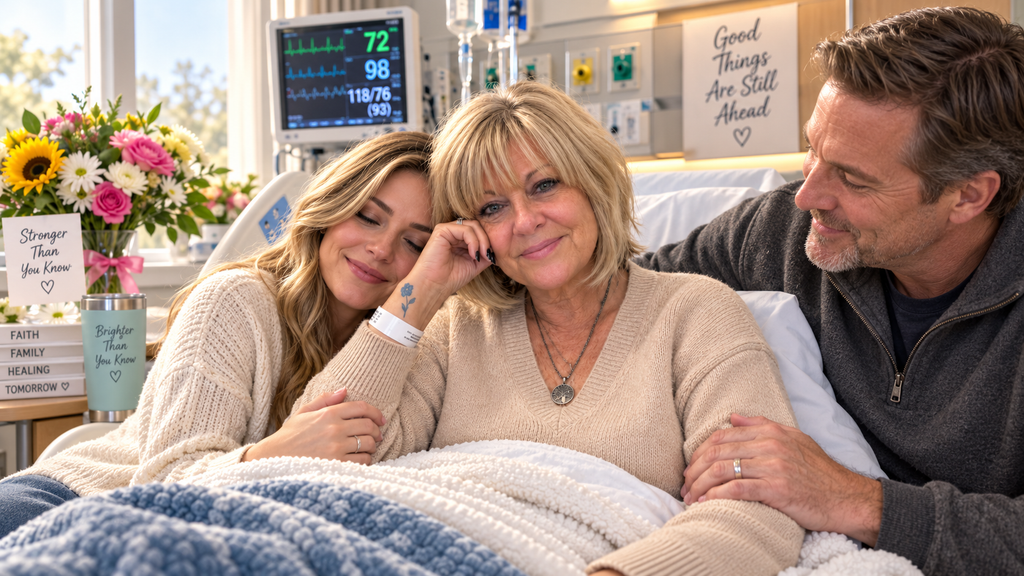
The tiny blue flower stared back at all of us.
Five delicate petals.
A faded dark center.
A thin stem curling toward the inside of her arm.
I had seen that flower thousands of times.
I had watched those hands button my winter coats when I was six.
I had watched them pack my lunches.
Hold my forehead when I was sick.
Applaud when I graduated.
Shake when my father died.
Wave goodbye whenever I drove away from her house.
And all those years, that little flower had simply been there.
Part of her.
Ordinary.
Forgettable.
Until now.
The doctor pulled a chair toward the bed.
His name badge read DR. DANIEL MERCER.
He didn’t sit immediately.
Instead, he looked at my mother with the careful expression people use when approaching someone standing at the edge of something dangerous.
“Ma’am,” he said quietly, “before we go any further, I want you to understand that you’re not in trouble.”
My mother gave a strange little laugh.
It was dry.
Broken.
“That’s what they used to say before they locked the doors.”
My blood went cold.
Dr. Mercer stopped moving.
One of the security officers looked at the other.
I stared at Mom.
“What doors?”
She closed her eyes.
For a moment, she didn’t look like the sixty-eight-year-old woman I had driven to the hospital that morning.
She looked smaller.
Younger somehow.
Not physically.
Emotionally.
As though some frightened girl had been hiding beneath my mother’s face for fifty years and had suddenly opened her eyes.
The nurse who had first noticed the tattoo stood near the wall.
Her name was Elena Ruiz.
She looked close to tears.
Dr. Mercer finally sat down.
“Mrs. Carter,” he said gently, “did you spend time at a place called Bellweather House?”
My mother stopped breathing.
I know that sounds impossible.
But I watched it happen.
Her chest rose.
Then stayed still.
Her eyes locked onto the doctor’s face.
Her mouth opened slightly.
And for perhaps three seconds, she didn’t inhale.
Then a sound came from her.
Not a word.
More like air escaping from a wound.
“No.”
Dr. Mercer leaned forward.
“Margaret—”
“No.”
She ripped the sleeve down over her wrist.
“No.”
“Mom?”
She swung her legs toward the side of the bed.
“I want to leave.”
I stepped forward.
“You can’t leave. You’re supposed to have surgery.”
“I don’t care.”
“Mom—”
“I said I want to leave.”
Her voice cracked so sharply that everyone in the room went still.
She reached for her shoes.
Her hands were shaking so badly she couldn’t get one open.
I knelt in front of her.
“Mom.”
She refused to look at me.
I put my hand over hers.
“Please.”
Her fingers stopped.
“What is Bellweather House?”
Her whole body sagged.
And then she whispered the strangest thing I had ever heard my mother say.
“It was where they took my name.”
I stared at her.
“What?”
She looked at me then.
Tears had gathered along her lower lashes.
“When I went in,” she said, “my name was Annie.”
The world seemed to tilt beneath me.
“My name wasn’t Margaret.”
I slowly stood.
Nobody interrupted her.
Not the doctor.
Not the nurse.
Not security.
My mother looked around the room as if every white wall had been replaced by something only she could see.
“My name was Annie Louise Harper.”
I shook my head.
Not because I didn’t believe her.
Because my mind didn’t know what to do with the words.
“You’ve always been Margaret Carter.”
“No.”
She swallowed.
“I became Margaret later.”
“Later when?”
Her eyes dropped to her wrist.
“After Bellweather.”
The nurse covered her mouth.
Dr. Mercer glanced toward her.
That was when I realized something.
He hadn’t recognized the flower.
She had.
I turned toward Elena.
“You know what it means.”
She hesitated.
Dr. Mercer said, “Elena’s grandmother had the same marking.”
Elena lowered her hand.
“My grandmother died eight years ago.”
Her voice trembled.
“When I was little, I thought her tattoo was just a flower too.”
The resemblance between her words and my own memories hit me so hard that I had to steady myself against the hospital chair.
Elena continued.
“She never told us much about her childhood. She would only say she’d lived somewhere bad for a while.”
My mother stared at her.
Elena slowly reached beneath the collar of her scrubs and pulled out a thin silver chain.
A tiny pendant hung from it.
A blue enamel flower.
My mother made a sound.
“Oh, God.”
Elena stepped closer.
“My grandmother’s name was Rosa.”
My mother whispered the name before Elena finished.
“Rosa Delgado.”
Elena froze.
“You knew her?”
Mom covered her face.
And began to cry.
Not quiet tears.
Not the polite crying I had seen after funerals or during sad movies.
This was different.
It came from someplace buried.
Her shoulders shook.
Her breath broke apart.
She curled inward on the hospital bed and sobbed like a child.
Elena started crying too.
She moved toward Mom.
“My grandmother talked about an Annie.”
Mom looked up sharply.
“What?”
“Not often. Near the end, especially when her memory got worse.”
Elena wiped at her cheeks.
“She used to say, ‘I hope Annie got away.'”
My mother stared at her.
Elena’s voice cracked.
“She said it over and over.”
Something inside Mom seemed to collapse.
She reached for Elena.
And Elena stepped into her arms.
They held each other in the middle of that hospital room while the rest of us stood there in complete silence.
Two strangers.
Connected by two girls who had known each other more than fifty years ago.
After several minutes, Mom finally pulled away.
Her face looked exhausted.
Dr. Mercer handed her a tissue.
“Mrs. Carter,” he said, “we can postpone the procedure.”
She shook her head.
“No. You shouldn’t have called security.”
The taller security officer spoke for the first time.
“We weren’t called because anyone thinks you’ve done something wrong.”
“Then why are you here?”
The officer hesitated.
Dr. Mercer answered.
“Because Bellweather House is still connected to an active investigation.”
My mother’s eyes widened.
I felt my stomach drop.
“Active?”
Dr. Mercer nodded.
“Not the facility itself. It closed decades ago. But evidence related to former staff members and unidentified children was uncovered recently.”
My mother gripped the hospital blanket.
“Children?”
He nodded slowly.
“A renovation crew found a sealed basement archive in a property that once belonged to Bellweather’s director.”
Mom turned white.
Elena spoke softly.
“The hospital was contacted because some survivors may have received distinctive tattoos.”
My mother looked at the flower beneath her sleeve.
“Survivors.”
She almost laughed.
“What a beautiful word for children nobody came looking for.”
That sentence silenced the room.
I sat beside her.
“Mom, tell me.”
She looked away.
“You don’t need to know.”
“Yes, I do.”
“No.”
“You can’t tell me your name wasn’t your name and expect me to go home and pretend nothing happened.”
Her jaw trembled.
“I spent fifty years pretending nothing happened.”
“And how has that worked?”
The words came out sharper than I intended.
She flinched.
Instantly, I regretted them.
But before I could apologize, Mom whispered:
“It worked well enough to give you a normal life.”
That broke something in me.
Because suddenly I understood.
This wasn’t simply a secret she had kept from me.
It was something she thought she had kept for me.
I sat down again.
My voice softened.
“Then give me the truth now.”
She looked at me for a long time.
Finally, she nodded.
“Not here.”
Dr. Mercer glanced at the clock.
“We can delay surgery and arrange a private room.”
Mom shook her head.
“I don’t want police questions yet.”
The security officer said, “Nobody will force you to make a statement today.”
“Good.”
She looked at Elena.
“Will you stay?”
Elena nodded immediately.
“Yes.”
Mom took a deep breath.
And then she began.
She was eight years old when Bellweather House took her.
Her name was Annie Louise Harper.
She lived with her parents and younger brother in a small farmhouse outside a Pennsylvania mining town.
It was 1966.
Her father, Joseph Harper, worked underground.
Her mother, Evelyn, cleaned rooms at a roadside motel.
They weren’t wealthy.
But according to Mom, they were happy.
She remembered chickens behind the kitchen.
A red bicycle.
Her father’s muddy boots beside the stove.
Her mother singing while hanging laundry.
Her brother, Samuel, chasing moths in the yard at dusk.
She remembered ordinary things.
Which somehow made what came afterward worse.
Her father was killed in a mine collapse when she was eight.
Three months later, her mother became seriously ill.
A woman from the county came to their home.
She told Evelyn that Annie and Samuel would be placed in temporary care until she recovered.
Temporary.
Mom repeated that word twice.
“That’s what they promised.”
She and Samuel were taken together.
For the first two nights, they stayed at a county facility.
Then they were separated.
“Samuel screamed when they took him,” Mom said.
Her eyes were somewhere else.
“He grabbed my dress.”
My hand tightened around hers.
“He was five.”
She stared at the floor.
“He kept yelling, ‘Annie, Annie, don’t let them take me.'”
Her voice broke.
“And I couldn’t stop them.”
She never saw him again.
I stopped breathing.
“You had a brother?”
Mom nodded.
“Did Grandma know?”
“Of course she knew. She spent years looking for us.”
“How do you know?”
“Because I found out later.”
She pressed her fingertips against her eyes.
“I found letters.”
“What letters?”
“Let me finish.”
So I did.
Annie was transported to Bellweather House.
Officially, it was a residential home for displaced girls.
A place where orphaned, abandoned, or temporarily surrendered children could supposedly receive education, food, structure, and religious guidance.
The brochure photographs showed white fences.
Gardens.
Girls in matching dresses.
Smiling matrons.
Mom said the reality was completely different.
Bellweather sat on hundreds of acres behind iron gates.
The windows on the first two floors opened.
The ones on the third floor didn’t.
Personal belongings were taken immediately.
Children were given numbers.
Their hair was cut.
Letters from family were screened.
Many were never delivered.
Mom became Girl 47.
The tattoo came three days later.
They were marched into the infirmary in groups.
A woman with cold hands swabbed the inside of each girl’s wrist.
The older girls knew what was happening.
The younger ones didn’t.
One girl fought.
They held her down.
Another fainted.
Mom remembered asking why they were getting flowers.
The nurse smiled and said:
“So we’ll always know which garden you belong to.”
Even decades later, Mom’s voice shook when she repeated it.
I felt sick.
“Why a flower?”
“Different groups had different symbols.”
Elena nodded.
“My grandmother said that too.”
Mom stared at her.
“There were blue flowers. Green circles. Little red stars. It depended on what building you lived in.”
Dr. Mercer asked carefully, “Did the marks indicate admission categories?”
Mom gave him a hard look.
“No.”
“Then what?”
Her eyes dropped.
“Which girls had nobody powerful looking for them.”
Nobody spoke.
“They didn’t mark everyone,” she continued. “Only the ones they thought could disappear.”
The room seemed colder.
I whispered, “Disappear how?”
Mom’s lips tightened.
“Some were sent to families.”
“Adopted?”
“Sometimes.”
The way she said it made my skin crawl.
“And sometimes?”
She looked toward Elena.
Elena’s face had gone pale.
Mom continued.
“Sometimes people paid money.”
Dr. Mercer sat straighter.
“What people?”
“I don’t know. Couples. Wealthy families. People connected to churches. People who wanted children without questions.”
“Bellweather sold children?”
“That’s what we believed.”
I felt nauseous.
“Mom…”
She squeezed my hand.
“Nobody explained anything. Girls simply vanished.”
There was a dormitory at Bellweather called East Wing.
Thirty beds.
Metal frames.
Gray blankets.
Every night, girls whispered after lights-out.
They traded information the way prisoners do.
Who had received a letter.
Who had been punished.
Who had gone to the infirmary.
Which staff member to avoid.
Which door sometimes remained unlocked.
And which girls had disappeared.
That was where Annie met Rosa Delgado.
Elena’s grandmother.
Rosa was eleven.
Three years older.
Brave in the way children sometimes become when bravery is the only thing left to them.
“She protected me,” Mom said.
Elena wiped her eyes.
“That sounds like her.”
Mom smiled for the first time.
A tiny, aching smile.
“She had black hair down to here.”
Mom pointed below her shoulders.
“Until they cut it.”
Elena nodded.
“My mother said Grandma hated short hair her whole life.”
Mom laughed softly through her tears.
“That’s why.”
Rosa taught Annie which floorboards creaked.
Which matrons listened at doors.
Which girls could be trusted.
She also taught Annie never to eat the pudding after Sunday supper because one of the kitchen workers sometimes mixed sedatives into it before girls were moved.
“Moved where?”
“I didn’t know then.”
Mom paused.
“I learned later.”
She told us about a girl named Clara.
Twelve years old.
Freckles.
Missing front tooth.
She slept two beds away.
One night, Clara whispered that she’d been told she was going to a new family in Ohio.
She was excited.
Terrified.
But excited.
Rosa asked whether Clara had met them.
No.
Had there been court papers?
Clara didn’t know.
Was she allowed to write her sister?
No.
The following morning, Clara was gone.
Her bed was stripped before breakfast.
The staff told everyone she had been adopted.
Six weeks later, Rosa found Clara’s sweater hidden in a laundry storage room.
Nobody knew why it was still there.
Maybe Clara had left without it.
Maybe she had never left at all.
That was when Rosa became convinced something dangerous was happening.
“She started collecting things,” Mom said.
“What things?”
“Names. Dates. Cars.”
Rosa stole half-used pencils from classrooms.
She wrote information on scraps torn from flour sacks and packaging.
License plate numbers.
Staff names.
The dates girls disappeared.
Anything she could remember.
“Where did she hide it?”
“Inside the wall.”
Elena leaned forward.
“What wall?”
Mom looked at her.
“East Wing dormitory. Behind bed fourteen.”
Elena covered her mouth.
Dr. Mercer stood abruptly.
“Are you certain?”
Mom stared at him.
“I helped put it there.”
The doctor exchanged another glance with security.
“What?”
Mom finally seemed to understand the reaction.
“Bellweather still exists?”
“The main building does.”
Nobody breathed.
“It’s abandoned,” Dr. Mercer said. “But parts of it are still standing.”
My mother whispered, “Oh my God.”
He continued.
“Investigators searched several sections three months ago.”
Mom looked straight at him.
“Did they search East Wing?”
“I don’t know.”
“Then you need to tell them.”
The security officer was already stepping toward the door.
Mom stopped him.
“Wait.”
He turned.
“If they go behind bed fourteen, tell them not to just break the wall.”
“Why?”
“Because there’s another cavity underneath.”
Her face had gone distant again.
“Rosa thought the first hiding place might be found, so we made another.”
“What did you put in the second one?”
Mom closed her eyes.
“Everything.”
The knee replacement didn’t happen that day.
By noon, the hospital had contacted a detective from the state police historical crimes unit.
Mom agreed to speak with him only after I promised I wouldn’t leave.
His name was Detective Thomas Avery.
He was in his late fifties, with graying hair and a patient voice.
He brought no uniformed officers into the room.
No recorder at first.
No stack of paperwork.
He simply sat.
Introduced himself.
And waited.
Mom watched him suspiciously.
“What do you want from me?”
“Nothing you don’t want to give.”
She studied him.
“That’s not how police usually work.”
“Maybe not.”
He nodded toward her wrist.
“But I think people have taken enough from you already.”
Something about that answer lowered her guard.
A little.
Avery explained what investigators already knew.
Bellweather House had opened in 1949.
It had operated under several nonprofit organizations until closing in 1982.
Official records described it as a charitable residential institution for girls.
But over the previous year, researchers examining sealed court archives had discovered irregularities.
Children listed as transferred to foster placements couldn’t always be matched to receiving homes.
Birth records had been amended.
Names changed.
Records vanished.
Money had moved through private foundations.
Some former residents had alleged abuse.
Others had described forced labor.
But investigators lacked physical evidence.
Then an old estate belonging to Bellweather’s final director, Reverend Silas Mercer—
Dr. Mercer interrupted.
“No relation.”
Mom barely noticed.
Avery continued.
Renovators had found files hidden behind a false basement wall.
Payment ledgers.
Photographs.
Partial admission records.
Several lists containing only numbers.
And photographs of children’s wrists.
Flowers.
Stars.
Circles.
Different colors.
Mom looked at her tattoo.
“So they kept records.”
“Some.”
“Why?”
“We don’t know yet.”
“Control,” Mom said immediately.
Avery looked at her.
“What?”
“They loved keeping records because records made them feel powerful.”
Her voice had changed.
No longer trembling.
Hard now.
“They took away our names, then wrote down everything we did. Every punishment. Every meal. Every visit. Every time somebody wet the bed. Every bruise they gave us somehow became our fault on paper.”
Avery didn’t argue.
“Would you tell me about the second hiding place?”
Mom nodded.
She told him Rosa had stolen a small metal cashbox from the office.
Together, the girls hid it beneath a loose section of baseboard behind bed fourteen.
Inside were names.
Letters.
Photographs.
And something else.
“A ledger.”
Avery leaned forward.
“What kind?”
“I don’t know exactly. I was nine by then.”
“Where did you get it?”
“Mr. Kline’s office.”
“Who was Mr. Kline?”
“The administrator who handled transportation.”
Avery’s expression sharpened.
Mom continued.
“One night Rosa saw him leave his office unlocked. We went in. She grabbed papers. I stood by the hall.”
“What was in the ledger?”
“Columns. Girls’ numbers. Dates. Dollar amounts.”
The room became very quiet.
“Do you remember any names?”
“No. Mostly initials.”
“Any dates?”
“1967. 1968.”
“Anything else?”
Mom nodded.
“There were destination codes.”
Avery leaned forward.
“What codes?”
“Rosa said they were places.”
“You remember any?”
Mom closed her eyes.
“R-H-12. M-L-4. St. Agnes. Halloway.”
Avery wrote quickly.
Mom’s brow furrowed.
“And something called Bluebird.”
His pen stopped.
“Bluebird?”
“Yes.”
“Are you certain?”
“I spent fifty years trying to forget Bellweather.”
She looked directly at him.
“I never forgot Bluebird.”
Avery exchanged a glance with Dr. Mercer.
I noticed it.
“What does Bluebird mean?”
Neither answered immediately.
Then Avery said:
“One of the ledgers found at Silas Mercer’s property mentions something called the Bluebird Placement Fund.”
Mom gave a hollow laugh.
“Placement.”
“What do you think it was?”
“I think it was money.”
“For adoptions?”
“For purchases.”
Avery’s mouth tightened.
Mom continued.
“Bellweather taught us words mattered. They never hit us. They ‘corrected’ us. They never locked us in closets. They gave us ‘reflection time.’ Girls weren’t sold. They were ‘placed.'”
She looked at the detective.
“Call it whatever makes the paperwork easier.”
Avery closed his notebook.
“I believe you.”
My mother stared at him.
Three simple words.
I believe you.
Her face crumpled.
She looked away.
I realized then that she might have spent an entire lifetime expecting no one to say them.
Detective Avery asked Mom how she escaped.
She did not answer immediately.
That part, I later understood, was the hardest.
Not because the escape itself was the worst thing that happened.
But because surviving required her to leave someone behind.
Rosa.
Mom was ten when it happened.
Bellweather had started making preparations to “transfer” Annie.
By then she had been there nearly two years.
One afternoon, a matron brought her into an office.
A married couple sat behind a desk.
The woman wore pearls.
The man smoked.
They asked Annie to turn around.
Smile.
Show her teeth.
I interrupted.
“They looked at you like that?”
Mom nodded.
“Like buying a horse.”
My stomach turned.
The couple asked whether she knew how to cook.
Whether she obeyed adults.
Whether she was healthy.
Then the woman asked if Annie’s hair could grow lighter in the summer.
A week later, she was told her name would become Margaret Elaine.
I gripped her hand.
“Margaret.”
She nodded.
“That’s where it came from.”
The name I had spoken my whole life.
The name on my birth certificate under “Mother.”
The name on my wedding invitations.
The name carved beside my father’s on the family headstone.
It had been assigned to her by strangers.
“Why Carter?”
“That came later. Your father’s name.”
“And Elaine?”
“Bellweather.”
She looked down.
“I hated Annie for a long time.”
I whispered, “Why?”
“Because Annie was weak.”
“No.”
“That’s how I felt.”
She took a breath.
“Margaret survived.”
The night before her scheduled transfer, Rosa told her they had to run.
They had been planning for months.
A laundry truck arrived every Tuesday before dawn.
The driver sometimes smoked behind the kitchen while workers unloaded.
Rosa had discovered a narrow space beneath sacks of linens.
They decided to hide there.
They packed almost nothing.
Two apples.
A jar of peanut butter.
A stolen flashlight.
Rosa carried the metal cashbox wrapped in a blanket.
But before leaving, she changed her mind.
“We couldn’t take the box.”
“Why?”
“If we got caught with it, they’d know everything we had done.”
So they returned to East Wing.
They hid it beneath bed fourteen.
Then they slipped downstairs.
Crossed the laundry corridor.
And climbed into the truck.
For twenty minutes, everything worked.
The truck moved.
Mom remembered holding Rosa’s hand in the darkness.
She could smell soap.
Diesel.
Dirty sheets.
They didn’t speak.
Then the truck stopped.
Men shouted outside.
The rear door opened.
A worker climbed inside.
Rosa pushed Annie through a side opening between canvas flaps.
Mom hit the ground.
Hard.
She rolled into a drainage ditch.
Rosa stayed in the truck.
“Why?”
My mother began crying again.
“She heard them coming.”
“Mom…”
“She told me to run.”
Elena’s lips trembled.
Mom’s voice fell into a whisper.
“The last thing she said to me was, ‘Don’t waste it.'”
Elena turned away.
Mom wiped her face.
“I ran through fields for hours.”
Barefoot.
Terrified.
Ten years old.
She reached a gas station late that afternoon.
The owner called police.
That should have saved her.
Instead, an officer called Bellweather.
Mom heard him speaking on the telephone.
She panicked.
Before anyone could stop her, she ran again.
This time she hid inside the restroom of a bus terminal.
There she met a woman named June Whitaker.
A forty-three-year-old waitress traveling home after visiting her sister.
June found Annie crying beneath a sink.
Mom told her only one thing.
“Please don’t send me back.”
June didn’t.
She bought her food.
A sweater.
Then took her to a church two counties away.
Not one connected to Bellweather.
Eventually social services became involved.
But because Bellweather records listed Annie as Margaret Elaine Harper and because nobody seemed willing to untangle the paperwork, the new name followed her.
Her mother had died by then.
Mom wouldn’t learn that for years.
Her brother remained missing.
Mom was placed with a foster couple named Wallace and Jean Bennett.
Good people.
They didn’t ask her to forget.
They didn’t push.
They let her keep “Margaret” when she was too frightened to reclaim Annie.
At eighteen, she searched for her family.
That was when she discovered the letters.
Dozens.
Her mother had written to Bellweather.
Weekly at first.
Then monthly.
Sometimes begging.
Sometimes threatening legal action.
One letter said:
Please tell Annie and Samuel I did not give them away.
Mom stopped speaking after repeating that sentence.
She bent forward and pressed her fist against her mouth.
I wrapped my arms around her.
For my entire childhood, my mother had made one thing absolutely clear.
If I was scared at school, call her.
If I got lost in a store, stay where I was and she would find me.
If I had a nightmare, wake her.
If I got in trouble, tell the truth and come home.
She had never once allowed me to believe I could be abandoned.
Now I knew why.
She had built my childhood around the promises she had needed as a child.
I held her tighter.
“You should have told me.”
She shook her head against my shoulder.
“I wanted it to die with me.”
“But it didn’t.”
“No.”
I looked at the blue flower.
“No. It didn’t.”
Three days later, investigators entered Bellweather House.
Mom refused to go.
So did I.
We waited at my house.
Detective Avery promised to call.
Morning passed.
Then noon.
By three, Mom had stopped pretending to watch television.
At 4:17 p.m., my phone rang.
Avery.
I answered immediately.
“Did you find it?”
Silence.
Then:
“Yes.”
Mom stood so quickly her coffee spilled.
“What?”
I put the phone on speaker.
Avery continued.
“We found the cavity behind the old dormitory baseboard.”
Mom gripped the kitchen table.
“The box?”
“Yes.”
Her knees buckled.
I caught her.
Avery’s voice softened.
“It was badly corroded, but intact.”
Mom covered her face.
“And inside?”
“Documents. Photographs. Letters. Pages from what appears to be a financial ledger.”
Mom began crying.
Not loudly.
Almost silently.
“And Rosa?”
Avery paused.
“There are several notes signed R.D.”
Elena’s grandmother.
Rosa.
She had existed there.
Her handwriting had survived.
Her courage had survived.
Her attempt to tell the truth had waited behind a wall for fifty-eight years.
Avery continued.
“There’s something else.”
My mother slowly lowered her hands.
“What?”
“We found a folded list.”
“What list?”
“Names.”
Her expression changed.
“What kind of names?”
“Girls’ birth names and assigned names.”
The kitchen seemed to disappear around us.
Avery cleared his throat.
“Mrs. Carter, Annie Louise Harper is on the list.”
Mom shut her eyes.
“And Samuel?”
Avery didn’t answer immediately.
Mom grabbed the phone.
“Is Samuel on it?”
“Not on that page.”
Her shoulders fell.
“But.”
She stopped.
“But what?”
“We found another notation attached to your file number.”
“What notation?”
Avery’s voice became careful.
“It mentions a sibling transfer.”
Mom stopped moving.
“Where?”
“We’re still verifying.”
“Where?”
“Margaret—”
“Where did they send my brother?”
There was a long silence.
Then Avery said:
“St. Catherine’s Home in Maryland.”
Mom’s hand flew to her mouth.
I whispered:
“He survived Bellweather?”
“It appears he was transferred before Annie arrived.”
Mom began shaking.
“Do you know what happened after that?”
“We’re looking.”
“Is he alive?”
“I don’t know yet.”
She closed her eyes.
The possibility alone seemed almost unbearable.
For fifty-eight years, Samuel had existed in her memory as a five-year-old boy screaming her name while strangers carried him away.
Now suddenly there was a road beyond that moment.
A place.
A record.
Maybe a life.
Maybe children.
Maybe grandchildren.
Maybe someone out there with our eyes.
Mom sat down slowly.
“Find him.”
Avery said nothing.
“Please.”
“We will try.”
She wiped her face.
“No.”
Her voice hardened.
“Don’t try.”
She looked at the phone like she could see him through it.
“Find my brother.”
The investigation expanded quickly.
I wish I could say everyone involved with Bellweather was brought to justice.
Life rarely gives endings that clean.
Most of the staff were dead.
Several administrators had died wealthy and respected.
One former board member was ninety-four and living in assisted care.
Others claimed memory loss.
Families connected to suspicious placements hired lawyers.
Institutions denied responsibility.
Records disappeared.
People who had built entire reputations around charity suddenly couldn’t remember signing documents.
But evidence had survived.
And once the metal box was opened properly, the story became impossible to dismiss.
The ledger listed forty-three girls transferred between 1964 and 1971.
Amounts were written beside twenty-six names.
Payments disguised as donations.
Building funds.
Religious contributions.
Medical fees.
Transportation costs.
Rosa’s notes linked dates to vehicles.
Her stolen information matched official transfers.
And inside the box was one photograph that changed everything.
It showed twelve girls standing in front of Bellweather’s East Wing.
My mother was fourth from the left.
Ten years old.
Thin.
Serious.
Her hair cut unevenly around her chin.
Beside her stood Rosa.
Elena came to our house when the photograph was released to families.
She carried a framed picture of her grandmother at seventy-two.
We placed them side by side.
The resemblance was unmistakable.
Same eyes.
Same slight tilt of the mouth.
Elena traced the edge of the old photograph.
“She really knew you.”
Mom smiled through tears.
“She saved me.”
Elena looked at her.
“I think knowing you got away would have meant everything to her.”
Mom shook her head.
“I should have gone back.”
“You were ten.”
“I should have told someone.”
“You were ten.”
“I changed my name. I stayed quiet.”
“You were ten.”
Elena’s voice became firmer.
“My grandmother didn’t blame you.”
Mom looked up.
Elena reached into her purse.
“I found something.”
She removed a small notebook.
“It belonged to Grandma.”
Mom stared at it.
“Most of it is recipes and grocery lists.”
Elena smiled faintly.
“But near the back, she wrote memories when she started forgetting things.”
She opened to a marked page.
“I think you need to hear this.”
Mom looked frightened.
Elena read.
“‘Annie had yellow ribbons once. She hated carrots. She could whistle through her teeth. She ran when I told her. I hope she ran far.'”
Mom began crying before Elena finished.
Elena continued.
“‘If Annie remembers me, I hope she remembers I was glad she got out.'”
Mom covered her mouth.
Elena closed the notebook.
“She was glad.”
Mom leaned toward her and sobbed.
And I realized guilt had kept my mother trapped inside Bellweather long after her body escaped.
Rosa’s words finally opened the door.
Four months after the tattoo was recognized, Detective Avery called again.
By then, Mom had finally undergone her knee replacement.
The surgery went well.
She was recovering at my house, using a walker she hated and complaining that physical therapists enjoyed hurting people.
It was the most normal she had seemed since the hospital.
I was washing dishes when the phone rang.
Avery asked to speak with both of us.
Mom sat at the kitchen table.
I put him on speaker.
“We located records from St. Catherine’s.”
Mom tightened her hand around the walker.
“And?”
“Samuel Harper was there for eleven months.”
Her breathing changed.
“Then what?”
“He was adopted.”
Mom closed her eyes.
“By whom?”
“A couple named Peter and Elaine Morrison.”
“Where?”
“Virginia.”
“Was his name changed?”
“Yes.”
She almost smiled bitterly.
“Of course it was.”
Avery paused.
“To Samuel James Morrison.”
Mom’s eyes opened.
“They kept Samuel?”
“Yes.”
That tiny mercy nearly broke her.
She pressed both hands against her face.
Avery continued.
“He became a teacher.”
Mom made a strangled sound.
“He married in 1982.”
I sat beside her.
“He has two daughters.”
Mom looked at me.
“And?”
Avery went quiet.
The hope in her eyes terrified me.
“Is he alive?”
“Yes.”
She screamed.
There is no other word for it.
A sharp, stunned sound burst from her.
She stood too quickly.
The walker tipped.
I caught it.
Mom clutched my arm.
“He’s alive?”
“Yes.”
“Where?”
“Outside Richmond.”
“Does he know?”
Avery hesitated.
“We contacted him through his daughter.”
“And?”
“He knew he’d been adopted. He did not know Bellweather was involved.”
Mom started pacing despite her knee.
“Does he remember me?”
“Margaret.”
“Does he?”
Avery’s voice softened.
“He remembers a sister named Annie.”
Mom stopped.
I watched fifty-eight years hit her at once.
Her hand went to her wrist.
The faded blue flower.
Her mouth opened.
Nothing came out.
Avery continued.
“He remembers you had braids.”
Tears rolled down Mom’s cheeks.
“He remembers you used to cut sandwiches into triangles because he wouldn’t eat them square.”
Mom sat down.
Hard.
“And he remembers screaming your name when they separated you.”
That was when she completely fell apart.
I knelt beside her.
She grabbed me.
“He remembers me.”
“Yes.”
“My baby brother remembers me.”
She cried into my shoulder.
Not like a survivor.
Not like a woman carrying a secret.
Like a sister who had just learned the child she lost had grown old somewhere under the same sky.
Avery waited.
Then said:
“Samuel would like to speak with you.”
Mom froze.
“Now?”
“If you want.”
Her hands flew to her hair.
She looked down at her old sweatshirt.
Then at me.
“What do I say?”
I laughed through my own tears.
“Mom, it’s a phone call.”
“But what do I say?”
“The truth.”
She shook her head.
“I can’t.”
“Yes, you can.”
“What if he hates me?”
“For what?”
“For not finding him.”
“You were eight.”
“What if he thinks I abandoned him?”
“He was five. You heard Avery. He remembers them taking him.”
“What if—”
“Mom.”
I held both her hands.
“Call your brother.”
She stared at me.
Then nodded.
Avery arranged it.
Ten minutes later, my phone rang from an unfamiliar Virginia number.
Mom stared at the screen like it was a live wire.
“Answer it.”
“You answer.”
“No.”
“I can’t.”
“You absolutely can.”
She glared at me.
For one second, she was just my mother again.
I smiled.
Then handed her the phone.
She pressed accept.
“Hello?”
Silence.
Then a man’s voice.
Older.
Soft.
“Annie?”
My mother stopped breathing.
I will remember her face until the day I die.
Every wall she had built collapsed.
She bent forward.
A sound came from her throat.
“Sammy?”
The voice broke.
“Annie.”
She cried.
He cried.
I cried.
Neither said anything sensible for nearly a minute.
Just names.
“Sammy.”
“Annie.”
“Oh my God.”
“I thought you were dead.”
“I thought you were dead.”
“I looked for you.”
“I looked for you too.”
At one point, Mom laughed through tears.
“Do you still hate square sandwiches?”
Samuel laughed.
It sounded so much like her laugh that my skin prickled.
“I haven’t eaten one in fifty years.”
She covered her mouth.
There they were.
Eight and five again.
Somewhere beyond time.
Beyond Bellweather.
Beyond every adult who had failed them.
Brother and sister.
Found.
They met two weeks later.
Samuel insisted on driving to us.
Mom woke at 4:30 that morning.
His arrival wasn’t until noon.
By eight, she had changed clothes four times.
At nine, she baked a pie.
At ten, she threw it away because the crust cracked.
At eleven, she started another one.
“Mom.”
“It’s terrible.”
“It’s pie.”
“He likes apple.”
“You don’t even know if he still likes apple.”
“He did when he was five.”
I had never seen her that nervous.
At 11:47, a dark blue sedan turned into the driveway.
Mom saw it through the window.
She went completely still.
A man got out.
Seventy-four years old.
Tall.
White hair.
Glasses.
He stood beside the car.
Mom whispered:
“That’s him.”
I didn’t know how she knew.
Maybe there are things the heart recognizes before the mind does.
Samuel looked toward the house.
Mom opened the front door.
For several seconds, neither moved.
Then Samuel smiled.
My mother made a sound halfway between a laugh and a sob.
And they walked toward each other.
Not ran.
Age wouldn’t let them run.
But they moved as quickly as they could.
Halfway across the driveway, Mom forgot her cane.
I grabbed it behind her.
Samuel opened his arms.
She fell into them.
They held each other.
No dramatic speech.
No explanation.
Just two old people crying in a driveway.
Samuel kissed the top of her head.
“You got short.”
Mom laughed.
“You got bald.”
“I’m not bald.”
“You’re close.”
He laughed.
Then they cried again.
Samuel’s wife stood near the car wiping her face.
His two daughters had come too.
My cousins.
Strangers carrying pieces of my family history.
One of Samuel’s daughters had my mother’s chin.
The other had Grandma Evelyn’s eyes, according to Mom.
We spent the entire afternoon looking through photographs.
Samuel had been adopted by kind people.
They loved him.
He had grown up believing his mother had surrendered him.
He’d never known she had written letters.
Mom showed him copies recovered from Bellweather archives.
He read their mother’s words silently.
Then left the table.
I found him standing outside.
Mom followed.
For a long time, brother and sister stood together beneath the maple tree.
I didn’t interrupt.
Later, Samuel told us his adoptive mother had once received a strange call when he was around ten.
A woman asked whether he had a sister.
His mother said yes, an adoptive sister.
The caller hung up.
Now he wondered whether it had been someone searching.
Their mother.
A social worker.
Bellweather.
We would probably never know.
Some answers had been lost permanently.
But not all of them.
The blue flower became evidence.
Investigators photographed it.
Measured it.
Compared the ink pattern to photographs found in Bellweather’s archive.
Eventually they identified twenty-one surviving women with similar markings.
Blue flowers.
Red stars.
Green rings.
Different symbols from different dormitories.
Some had spent entire lives believing nobody else remembered.
Now they found one another.
One woman called my mother from Oregon.
Another wrote from Florida.
A third mailed a photograph from 1969.
Elena organized a private reunion.
Mom almost refused to attend.
“I’m too old for this.”
“That’s exactly why you’re going.”
“I don’t want everyone staring at my wrist.”
“They all have tattoos.”
“Mine is ugly.”
“It’s five blue petals.”
“It’s crooked.”
“Mom.”
She went.
They met in a church hall not far from Bellweather.
Thirty-seven former residents came.
Some brought spouses.
Children.
Grandchildren.
Others came alone.
When Mom walked into the room, conversation slowly stopped.
Not because anyone knew who she was.
Because she pushed her sleeve up.
A tiny blue flower showed on her wrist.
Across the room, an elderly woman did the same.
Then another.
Another.
Another.
Blue flowers rose quietly around the room.
Mom began crying.
A woman named Judith walked up.
“East Wing?”
Mom nodded.
“Bed twenty-two.”
Judith laughed through tears.
“I was nineteen.”
Mom blinked.
“Judy?”
The woman covered her mouth.
“Annie?”
They hugged.
Another lost thread tied back together.
There were many stories that day.
Some terrible.
Some unexpectedly tender.
One woman had been adopted by loving parents who genuinely believed the transfer was legal.
Another escaped at sixteen.
One became a lawyer.
One a nurse.
One a florist, despite hating flowers for half her life.
They compared memories.
Names.
Staff.
Rumors.
Punishments.
Songs.
The smell of the kitchen.
The sound of the boiler at night.
The girls who vanished.
The ones who fought.
And eventually they talked about Rosa.
Elena stood in front of the room holding her grandmother’s photograph.
“My grandmother died believing most of what happened here would never be known.”
She looked at Mom.
“But she hid evidence with a little girl named Annie.”
Everyone turned toward my mother.
Mom stood slowly.
She hated public speaking.
Always had.
At my wedding, she’d written a toast and then handed it to my aunt because she couldn’t read it without crying.
Now she stood before dozens of survivors.
She pushed her sleeve higher.
“I used to hate this.”
She touched the flower.
“I spent most of my life hiding it under watches or sleeves.”
She looked around.
“I thought it marked me as something Bellweather owned.”
Silence filled the hall.
“But Bellweather is gone.”
Her voice trembled.
“We’re still here.”
Several women began crying.
Mom continued.
“They told us these marks showed which garden we belonged to.”
She glanced toward Elena.
“Maybe they were right.”
Her lips formed a small smile.
“Just not in the way they intended.”
Nobody moved.
“They thought we belonged to them.”
Mom looked around the room.
“We belonged to each other.”
Judith reached for her hand.
Someone else started clapping.
Then another.
Soon the entire room stood.
Mom cried while they applauded.
And I realized something had changed.
The flower wasn’t evidence of ownership anymore.
It had become evidence of survival.
The criminal investigation eventually resulted in charges against two living individuals connected to record falsification and financial fraud during Bellweather’s final years.
The larger system couldn’t be prosecuted in the way survivors deserved.
Too much time had passed.
Too many perpetrators had died.
Too many laws had once protected institutions instead of children.
But civil cases followed.
Records were unsealed.
Names were restored.
Death certificates were corrected.
Adoption files opened.
Families learned the truth.
A state commission was formed.
Bellweather House was no longer listed in historical archives as simply a “children’s charity.”
Official records acknowledged forced confinement, fraudulent placements, abuse, and systematic suppression of family contact.
The old building was scheduled for partial demolition.
The East Wing was preserved.
Not as a celebration.
As evidence.
A memorial plaque was installed outside.
Mom didn’t attend the dedication at first.
She said she had already given Bellweather enough of her life.
I respected that.
But six months later, she asked me to drive her there.
Just the two of us.
It was autumn.
Leaves covered the long road leading toward the property.
The iron gates stood open.
For the first time in her memory, open.
We parked near what remained of the main building.
Mom sat in the passenger seat.
She didn’t move.
I waited.
Finally, she whispered:
“I used to dream about this road.”
“What kind of dreams?”
“Sometimes I was running away.”
She stared through the windshield.
“Sometimes I was trying to get back in.”
“Why would you want to go back?”
“To find Rosa.”
She opened the door.
We walked slowly.
Her new knee was stronger now.
She used a cane more out of habit than necessity.
The building looked smaller than I expected.
Decay had eaten through the grandeur.
Broken windows.
Vines across brick.
Sections fenced off for safety.
Mom stopped near the entrance.
“This is where they took my suitcase.”
We walked farther.
“This was the dining hall.”
Another corridor.
“This is where Clara slept.”
East Wing had been stabilized for preservation.
Metal bed frames had been removed decades ago, but markings in the floor showed where they once stood.
Mom counted silently.
One.
Two.
Three.
Until she stopped.
“Fourteen.”
The wall had been carefully opened during the investigation.
Behind it was now a small glass panel showing the cavity where Rosa’s notes had been hidden.
Mom placed her palm against the glass.
“Hi, Rosa.”
Her voice cracked.
I stood several feet behind her.
She deserved privacy.
After a while, she pulled something from her purse.
A tiny folded note.
She slipped it into a memorial box beside the wall.
I didn’t read it then.
Later, she told me what it said.
I ran far.
I didn’t waste it.
Thank you.
Before leaving Bellweather, Mom asked me to walk to the old rear field.
There wasn’t much left.
Just grass.
Trees.
A rusted fence.
She stood quietly.
“That way.”
She pointed toward a line of woods.
“That’s where I ran.”
I looked toward the trees.
“You were ten.”
“Yes.”
“Were you scared?”
Mom laughed softly.
“Beyond scared.”
She took a breath.
“I remember thinking if I could just reach the trees, they couldn’t see me.”
We walked to the edge.
She touched the bark of an old oak.
“Do you know what the strangest thing is?”
“What?”
“I don’t remember most of that day clearly.”
She looked toward the field.
“But I remember one bird.”
“A bird?”
“A bluebird.”
I stared at her.
She smiled.
“Funny, considering the ledger.”
“Very.”
“It flew from one fencepost to another while I was running.”
She watched the trees.
“For years I wondered if I invented it.”
“Maybe you didn’t.”
“Maybe.”
She touched her tattoo.
“When I saw bluebirds after that, I always felt like something bad was about to happen.”
I looked at the tiny flower.
“And flowers?”
“I hated blue flowers.”
That surprised me.
She had planted hydrangeas beside my childhood home.
Blue ones.
“You grew them everywhere.”
She smiled.
“That was later.”
“Why?”
Her eyes became shiny.
“Because your father loved them.”
I smiled.
Of course.
My father.
The man who had known some of the story.
Not everything.
Mom finally admitted she told him before they married.
Not Bellweather’s details.
Only that she had survived a terrible institution, changed her name, and had family she couldn’t find.
He never pushed.
Whenever she woke from nightmares, he held her.
Whenever anyone asked about the tattoo, he repeated her lie for her.
“She got it when she was young.”
Technically true.
After Dad died, Mom became more determined to bury that life completely.
She assumed Samuel was dead.
Rosa was gone.
Bellweather forgotten.
Why dig up pain nobody could fix?
Then a nurse pushed up her sleeve.
And a secret that had slept for half a century woke up.
One year after that hospital visit, Mom finally told me what the flower truly meant to her.
We were sitting on my back porch.
Samuel and his family were coming for dinner.
Mom had cooked enough food for twenty people.
She still hadn’t learned how to feed a normal number of guests.
I looked at the tattoo.
“You ever think about removing it?”
She followed my gaze.
Years ago, she would have pulled her sleeve down.
She didn’t now.
“No.”
“Never?”
“I thought about it many times.”
“What stopped you?”
She smiled.
“For a long time, fear.”
“And now?”
She touched it gently.
“Now I think Rosa would yell at me.”
I laughed.
“Probably.”
Mom looked toward the yard.
“When I was young, I thought this meant I belonged to Bellweather.”
Her voice softened.
“Then I thought it meant something terrible had happened to me.”
She paused.
“Now I think it means something else.”
“What?”
“That somebody tried very hard to erase Annie Harper.”
She looked at me.
“And they failed.”
A car door slammed in the driveway.
Mom instantly straightened.
“That’s Sammy.”
She still called him Sammy.
Samuel complained about it every time.
Secretly, he loved it.
He came around the corner carrying a pie.
Mom stared at it.
“What is that?”
“Apple.”
“I made apple.”
“Mine’s better.”
“Your crust looks store-bought.”
“It is store-bought.”
“Then put it back in your car.”
Samuel laughed.
His wife rolled her eyes.
Their daughters followed carrying bags.
Elena arrived a few minutes later.
She had become family too.
Not by blood.
By memory.
By Rosa.
We ate beneath string lights on my porch.
Samuel told stories about his students.
Mom corrected stories about a childhood he barely remembered.
They argued about whether their father snored.
They compared photographs.
Samuel claimed Mom had stolen his red toy truck in 1966.
Mom said he had left it in the rain.
“You threw it in the creek.”
“I was eight.”
“You were mean.”
“You bit me.”
“You deserved it.”
It was ridiculous.
Ordinary.
Beautiful.
Watching them, I thought about the morning everything changed.
A routine knee replacement.
Paperwork.
An IV.
A nurse pushing up a sleeve.
Five faded blue petals.
Had Elena not been working that shift, perhaps none of us would know.
Samuel might still believe his sister had disappeared.
Mom might have died believing her brother was gone.
Rosa’s box might have remained sealed inside the wall.
Thousands of pages of history might still be sleeping in darkness.
People talk about secrets as if they always want to be discovered.
I don’t think that’s true.
Some secrets fight to stay buried.
They build entire lives above themselves.
They hide beneath marriages.
Children.
Jobs.
Sunday dinners.
Birthday cakes.
Christmas photographs.
They turn into habits.
Silences.
Half-answers.
They live beneath phrases like:
I got it when I was young.
And most of the time, nobody thinks to ask again.
But sometimes the smallest thing opens the door.
A photograph.
A name.
A letter.
A nurse who recognizes a tiny blue flower.
That night, after everyone left, Mom helped me carry dishes into the kitchen.
I noticed the flower when she reached for a glass.
The ink was still faded.
Still crooked.
Still small.
Yet it no longer looked ordinary.
It held an eight-year-old girl named Annie.
A frightened boy named Samuel.
A brave girl named Rosa.
A hidden box behind bed fourteen.
A mother writing letters nobody delivered.
A laundry truck.
A drainage ditch.
A waitress named June who believed a terrified child.
A foster family who gave her time.
A husband who never forced her to explain.
A daughter who had grown up knowing none of it.
A nurse who recognized something everyone else had ignored.
And fifty-eight years later, a brother saying one word through a telephone.
“Annie?”
Mom caught me staring.
“What?”
I smiled.
“Nothing.”
She raised an eyebrow.
“You were looking at my wrist.”
“I know.”
She glanced down.
For a few seconds, neither of us spoke.
Then Mom smiled.
“You want to know what it means?”
The question nearly made me cry.
I had asked it countless times as a child.
Back then, the answer had always been the same.
I got it when I was young.
This time, I nodded.
“Yes.”
She placed two fingers over the faded petals.
Her expression softened.
Then she said:
“It means they didn’t get to keep me.”
I swallowed.
Mom looked toward the photographs on my refrigerator.
One of Samuel and her together.
One of Elena holding Rosa’s photograph.
One of Mom standing outside Bellweather’s open gate.
She looked back at me.
“And it means I found my way home.”
For the first time in my life, that tiny blue flower wasn’t a mystery.
It was a map.
A scar.
A witness.
A promise.
And proof that even when people steal your name, separate your family, lock away your history, and spend decades hoping silence will bury what they did—
the truth has a strange way of surviving.
Sometimes behind a wall.
Sometimes inside an old metal box.
Sometimes in the memory of a woman who refuses to forget.
And sometimes—
quietly,
patiently,
for an entire lifetime—
on the inside of a mother’s wrist.
THE END! THANK YOU FOR READING!❤️